INTRODUCTION
The primary goal of this paper is to present and examine the material collected from the surface of the site of Ayios Nikolaos Mylon (hereafter Ay. Nikolaos). According to the data from other archaeological surveys conducted in southern Euboea thus far, Ay. Nikolaos is the only inhabited site of Middle Bronze date in the area (Cullen et al. forthcoming; Keller Reference Keller1985, 128–9; Tankosić Reference Tankosić2008).Footnote 2 Therefore, the study of the material from this site, even if it lacks stratigraphic information, can still contribute not only to future pottery studies in the area but also to the general knowledge of prehistory in this part of the Aegean.
Southern Euboea has been the subject of organised archaeological research for several decades. The first systematic survey of the entire island was conducted by several scholars for a prolonged period of time; it began in 1939, but was not published until 1963, since it was interrupted, among other things, by the outbreak of World War II (Sackett et al. Reference Sackett, Hankey, Howell, Jacobsen and Popham1966). The Karystia was also a part of extensive pan-Euboean surveys by Theocharis (1959) and Sampson (Reference Sampson1980). The first systematic survey work focused on the Karystia itself was carried out by Donald Keller (Reference Keller1985) in the late 1970s as part of field research for his doctoral dissertation at Indiana University, and was continued by the Southern Euboea Exploration Project (SEEP), which was founded by Keller and the late Malcolm Wallace in 1984 to promote research on the Karystian past. SEEP has conducted three systematic intensive surveys in the area since its establishment: the survey of the Paximadhi Peninsula (Cullen et al. forthcoming), the ‘route survey’ of the portions of the Bouros-Kastri region located east of the Bay of Karystos, and the survey of the Karystian Plain (Kampos) (Tankosić Reference Tankosić2008). The knowledge of the area's past obtained from the archaeological surface surveys has been greatly augmented by the numerous and dedicated rescue excavations of the 11th Ephorate for Prehistoric and Classical Antiquities from Chalkis and by SEEP's excavations at Plakari (Cullen et al. forthcoming; Talalay et al. Reference Talalay, Cullen, Keller, Karimali, Kennell and Tomlinson2005) and in the Ayia Triadha Cave (Mavridis and Tankosić Reference Mavridis and Tankosić2009), organised in collaboration with the 11th Ephorate and the Ephorate for Paleoanthropology and Speleology of Southern Greece, respectively.
The huge leaps forward in the last few years notwithstanding, the prehistoric chronological sequence in the Karystia is still insufficiently understood, particularly for the long time span between the end of Early Bronze II and the Geometric period. This is the reason we will attempt to put forward some ideas about general prehistoric developments in the region around the Bay of Karystos, but also including the northern Cycladic islands of Andros and Keos and the eastern coast of Attica. Thus, in the following pages we present, describe, and analyse surface finds from Ay. Nikolaos and interpret them in conjunction with evidence of the Middle Bronze Age known elsewhere in Greece, since comparative material is absent from the immediate vicinity of the site.
THE LOCATION OF THE SITE
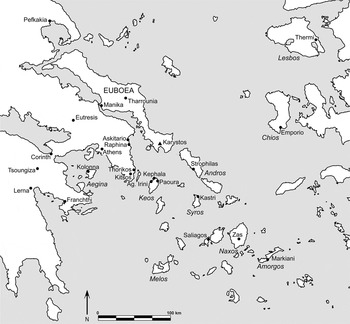
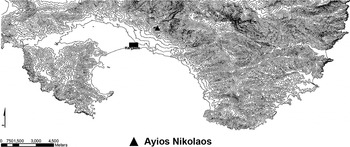
The site of Ay. Nikolaos is located in the southernmost part of the island of Euboea, northeast of the town of Karystos, above the village of Myloi (Fig. 1). Southern Euboea is frequently defined as the area south of the modern town of Styra. This region is also referred to as the Karystia, after the name of its main and largest settlement and current administrative centre, Karystos. A salient and distinguishing feature of the Karystia is the twin peaks of Mount Ochi. The mountain rises north of the Bay of Karystos to the height of 1400 m above sea level, and effectively separates the southernmost part of the Karystia from the rest of Euboea, serving as both geographical and cultural barrier, and gives this section of the island its distinctive character. The southern part of the Karystia, separated from the rest of the region by the mountain ranges of Lykorema, Ochi, and Koukouvayia, consists of four very broadly defined geographical units: the Paximadhi Peninsula, which forms the western boundary of the Bay of Karystos; the Bouros-Kastri region/peninsula, which borders the bay to the east; the Karystian Kampos, a large alluvial plain that runs approximately west–east and opens at the head of the bay, forming the basin where the town of Karystos is located; and the foothills of Mount Ochi, which slowly rise to the north of the Kampos and the Karystos basin (Fig. 2).
Southern Euboea in its geographical context.

South Karystia, topographic.

To the south of the Karystia lie the Cycladic islands. The two closest islands are Andros, located c.12 km southeast of the Bouros-Kastri Peninsula at its closest, and Keos, about 30 km south of the tip of the Paximadhi Peninsula. West of the Karystia, across c.30 km of the southern Euboean Channel, lie Attica and the Greek mainland. The closest Cycladic islands and the mainland can usually be seen from anywhere around the Bay of Karystos under most weather conditions, provided that the view is not physically obstructed. On most days when humidity is low, even the second tier of the Cyclades (i.e. Tinos and Siphnos) can be seen from the southern part of the Karystia.
The mountains that separate southern Euboea from the rest of the island also have a strong influence on the climate of the area. They combine with the Euboean Channel, which is at its widest between southern Euboea and Attica, to make the climate in the southern Karystia more similar to that prevailing in the Aegean islands, particularly the northern Cyclades, than to the rest of Euboea or the mainland. The winds, which blow primarily from the north and northeast throughout most of the year and which are often quite strong, form another salient feature of the Karystia. The Ochi range serves as a barrier to these winds; however, instead of reducing their strength it increases it by allowing the winds to accumulate on its northern slopes and then funnel down at great velocities over the southern slopes of the mountain and parts of the Kampos. The prevailing sea currents surrounding the Karystia also move from northeast to southwest. The force of the winds and the currents comes together most markedly along the eastern shores of the Karystia in the Kafiraeus Channel, which separates southern Euboea from Andros. Strong winds and currents make this area very hard to navigate even today.
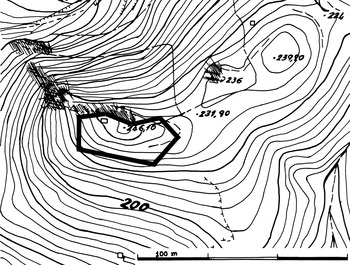
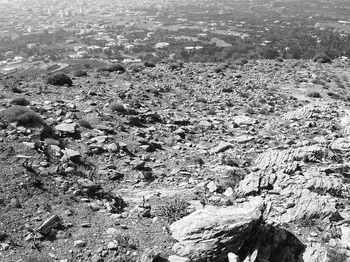
The site of Ay. Nikolaos occupies a commanding position on top of a rocky ridge (elevation c.250 m above sea level) (Fig. 3). At the southwestern end of the ridge, a small plateau (c.50 × 20 m) is sheltered from the infamous Karystian north winds by a large rocky outcrop. The cultural deposits are most easily distinguishable at this location (Fig. 4). On the westernmost edge of the plateau a small chapel to Ayios Nikolaos was built at some point in the relatively recent past (probably during the nineteenth century). Prehistoric deposits were damaged and stone quarried during the construction of the chapel. Another somewhat larger plateau extends to the southeast and below the first one. On its northern side are a modern sheep pen and another chapel, built in the second half of the twentieth century. At the foot of the ridge where the Ay. Nikolaos chapel is situated, on its southwestern side, is a modern stone quarry and a Greek Orthodox monastery. The prehistoric site lacks natural protection only on the southeastern side, where the slope is gentler, and on the east, where the plateau is connected to other foothills of Ochi. The main access to the site seems to have been along a relatively narrow ridge to the east of the main plateau area.
Location of Ay. Nikolaos and the extent of the material scatter. North is up.

Ay. Nikolaos. View of the main plateau from east.

Water sources abound in the vicinity of the site: there is a spring c.20 m below the summit and a perennial stream located roughly to the west of the Ay. Nikolaos hill (about 10 minutes' walking distance downhill). This stream has its source in the Ochi Mountains and is fed, especially in the early spring, by snowmelt. Easily accessible arable land exists at the foot of the hill, along the northeastern end of the alluvial Karystian Plain. At present, the southern and western slopes of the hill are covered with agricultural terraces of indeterminable date. It is hard to tell whether such land use arrangements existed in prehistory, since terracing is notoriously hard to date (e.g. French and Whitelaw Reference French and Whitelaw1999). Currently, Ay. Nikolaos and the area around it are used mostly for grazing sheep and goats; a modern sheep pen lies c.150 m to the east of the main plateau, at the beginning of the access ridge. Additionally, the area is currently partitioned by several barbed wire fences used to contain the animals.
The original survey of Ay. Nikolaos was conducted in 1979 by Dr Donald Keller as part of his doctoral research at Indiana University and under the auspices of the American School of Classical Studies at Athens. Dr Keller collected a number of pottery sherds, chipped stone fragments, and several metal objects from the site, and he also left behind a detailed description of the condition of the site both in his unpublished dissertation and in the original field notes (Keller Reference Keller1985, 128–30). Subsequent visitations to the site were carried out in 2005 and 2006 as part of a larger revisitation project of sites surveyed by SEEP in the eastern part of the Bay of Karystos. At that time more sherds were collected from the surface of the site and closer inspection was made of the features visible on the surface. Although additional sherds were collected primarily to prevent their loss due to ongoing erosion on the hill where Ay. Nikolaos is located, they proved to be a valuable source of additional information on the chronological sequence of the site. Our analysis is based on the material collected on those two occasions.
ARCHITECTURAL REMAINS
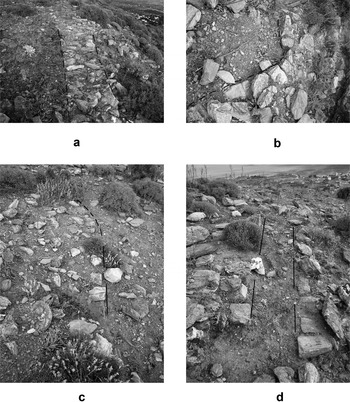
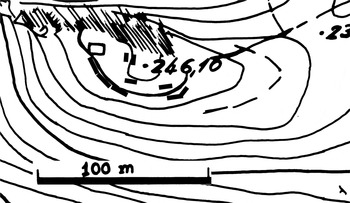
Although on the surface the deposits on the plateau consist chiefly of rubble, it is still possible to discern the outlines of several walls (Fig. 5). Unfortunately, we were not able to create a proper sketch of the architectural remains that are visible in the field; therefore, the architecture is currently best seen from the photographs. We do mark the approximate position of the walls we were able to discern on the general sketch of the site (Fig. 6).
Ay. Nikolaos. Walls visible on the surface.

Location of visible walls on the plateau (topographic enlarged).

The westernmost edge of the plateau is bordered by a double-faced curving wall that roughly follows the upper contour of the slope (Figs. 5a and 6). This wall, although partially reconstructed in modern times (especially below and, most likely, in relation to the construction of the modern chapel), seems to have originated at an earlier, possibly prehistoric date. This wall probably enveloped part or most of the southern and southwestern edge of the plateau originally, because some of its surviving sections can still be seen protruding from the ground and the rubble. The construction of the lower courses and the general appearance of this wall are similar to the more securely identified prehistoric walls among the rubble and material at the centre of the plateau. The wall runs under – and hence possibly pre-dates – the rubble of some of the collapsed prehistoric structures on the plateau. Its function is not altogether clear at present; however, it is tempting to suggest, especially in view of its location, that this wall had functions other than as a simple retaining wall, e.g. it may have served as a defensive wall.
Other architectural remains on the plateau include at least three straight and two curved double-faced walls (Figs. 5b, c, d), all built by the same technique. They were constructed by arranging medium-sized, flattish boulders and slabs of rock (almost exclusively local schist) in two parallel rows with the rocks touching or overlapping at the centre of the wall. Usually the narrower sides of the rocks were turned to the inside. The walls were probably constructed entirely of stone, although other types of superstructure cannot be ruled out.
The two straight parallel walls roughly at the centre of the plateau and just above the damaged area of the site are likely to be parts of two adjacent buildings with a narrow passage between them (Fig. 5d). These sorts of arrangements are not uncommon in areas exposed to damaging and constant winds, as they reduce the strength of the wind by breaking it up, thus providing better shelter. One of the curved walls is positioned in front of the modern access to the plateau, with its inner side facing away from the plateau (Fig. 5b). Its function is unclear, because it appears too slight to be a foundation wall. If the access to the site and the main plateau was at the same place in prehistory as it is today, which seems likely due to the configuration of the terrain, this wall may have served to restrict or direct access to the site, as it appears to have been too feeble to serve serious defensive purposes.
Another larger curved wall, or a part of it, can be seen just below the southeastern part of the main plateau (Fig. 5c). Compared to the other curved wall at the plateau's entrance, this one is much more solid and more carefully built and was definitely a part of a structure – a fairly large apsidal building, which is still mostly covered by rubble. The building technique of this wall is fairly typical for the Middle Bronze Age and has parallels from other Middle Bronze sites (e.g. Goldman Reference Goldman1931). Apsidal buildings are one of the hallmarks of Middle Bronze architecture in Greece (Dickinson Reference Dickinson1977, 33), although apsidal structures are not unknown from the preceding Early Bronze Age or even Final Neolithic (e.g. at Strofilas on Andros [Televantou Reference Televantou, Renfrew, Brodie, Gavalas and Doole2008, 45]). Combined with the movable finds (primarily pottery), the visible architecture on the site supports a strong Middle Bronze presence on Ay. Nikolaos.
THE FINDS
Aside from the nineteenth-century chapel and some evidence of a Classical presence on the site, the assemblage consists almost exclusively of prehistoric material, among which the bulk can be dated to the Middle Bronze Age, although low amounts of earlier and later material are also present in the surface collection. In addition to pottery, there are chipped stone tools, fragments of ground stone tools, a fragment of bronze tweezers, a piece of bronze wire, a piece of amorphous lead, a fragment of a bronze ingot and a relatively large lump of transparent crystal (i.e. quartz) that possibly exhibits signs of deliberate alteration (C. Runnels pers. comm.). Several objects made of ground stone were also collected by D. Keller; however, larger objects like saddle querns or door pivot stones were left on the site. Some slag was also found on the main plateau of the site. The present paper focuses on the pottery and stone tools recovered from the surface of the site. The chipped and ground stone tools presented in this paper were studied by Dr Catherine Perlès.
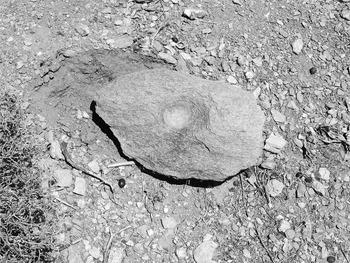
The greatest concentration of surface material on Ay. Nikolaos can be found on the main plateau, where it is intermingled with the large amounts of rubble. Outside the main plateau, the archaeological material is densely scattered on the more gentle western and southern slopes of the Ay. Nikolaos ridge, which are also intersected by a series of retaining walls. It is probable, however, that some or most of the material currently found on the slopes was re-deposited there through the action of erosion from the deposits on the top of the plateau. According to the results of the original survey, the area southeast of the main plateau yielded some quantities of slag, but little other material. However, our revisitations have failed to discover any significant amounts of slag, and the only sign of ancient presence in the area is a slab of local conglomerate rock of the kind used for typical prehistoric quern stones in the area (Fig. 7). This particular specimen, however, most likely had a different purpose, as it has a relatively deep and narrow, slightly tapering hole located roughly in its middle. This points to its use as a door pivot stone, and it is possible that it was re-deposited at its current location at a later date. The difference between the situation as recorded in the original survey and that visible today can be best explained by the extensive modifications of the surface in this part of the Ay. Nikolaos hill. The area now has an obvious agricultural use (it had been recently ploughed the last time we visited, in 2006), and several heaps of rocks suggest that the soil had been cleared of obstacles beforehand. This may have removed most traces of prehistoric use.
Pivot stone.

POTTERY CLASSIFICATION
A sample of pottery collected from the surface of Ay. Nikolaos is presented in the catalogue below. The catalogue illustrates 50 sherds, which are the most diagnostic finds from Ay. Nikolaos. A total of 150 sherds was collected from the surface of the site: these are now stored in the Karystos Museum. Most of them are heavily worn, weathered, and undiagnostic, as expected from a surface assemblage. Statistical analysis was not conducted due to the collection methods, which produced a sample unsuitable for this type of analysis. During the original survey, there was no systematic collection; only a ‘grab-bag’ sample was taken from the site. The same method was used during subsequent revisitations of the site. Even though some general observations on percentages of pottery types are presented later on, they should not be considered indicative of the general situation on the site. The material has been inspected only macroscopically, using a 10 × geological magnifying lens.
The catalogue of pottery is arranged chronologically. We decided to catalogue the ceramic finds according to fabric, combined with ware characteristics (e.g. surface treatment, texture, use) and not according to shape, in order to clarify the character of the local assemblage. The classification system used here is based on the one developed by Zerner, in which pottery is named and classified according to fabric and clay attributes (Zerner Reference Zerner1986, 58–9). A similar way of forming pottery categories was followed by Wilson (Reference Wilson and Fossey1987, 36) in the analysis of the material from Keos. An additional advantage of this classification is the potential to categorise all the material, including body sherds. The pottery is further classified according to shape and parts of vessel that are presented. Items from the catalogue are illustrated with either a photograph or a drawing, and in some cases with both. The catalogue also includes a non-comprehensive list of references and parallels when we were able to find them. The functional and analytical perspectives of the ceramic assemblage are discussed afterwards.
In order to clarify certain aspects of the cataloguing some comments concerning the fabric analysis are in order. We divided the Middle Bronze Age material into three broad categories, i.e. Karystian, Mainland, and Cycladic wares, according to observations on fabric. The Karystian wares were further divided into three ware categories: plain, slipped and burnished, and household wares.Footnote 3 ‘Mainland’ wares, as they are conventionally called, which constitute two well-known groups, Matt-Painted and Grey Minyan pottery, are considered as non-local in the assemblage. This decision is based on observations made while working with prehistoric Karystian pottery from several different periods, but needs to be supported by petrographical or chemical analysis. The clays available locally in the Karystia never produce the colours of surface and/or biscuit that are typical of Matt-Painted and Grey Minyan ceramics found at Ay. Nikolaos. Moreover, if inclusions are present in otherwise very well levigated clays of the two ware types, they do not belong to the rocks/minerals typically found mixed with local clays (i.e. quartzite and schist). The Cycladic wares are divided into two groups according to clay attributes (i.e. presence of sparkling silvery mica, schist flakes), colour, and texture of surface (Davis and Williams Reference Davis and Williams1981, 294–5; Vaughan Reference Vaughan, Hardy, Doumas, Sakellarakis and Warren1990, 476–8; Vaughan and Williams Reference Vaughan, Williams and Renfrew2007, 122).
The majority of the pottery can be fairly confidently identified as having been made locally. The fabric has inclusions of local rocks/minerals, and colours of the clay are generally light, varying from yellow-red (5YR5/6) to brown-red (2.5YR5/8). Non-local pieces can be recognised by either containing inclusions that do not exist in southern Euboea or having a fabric whose composition differs from the norm. Macroscopic differentiation between local and other wares is hampered by the fact that southern Euboea has a geological composition which is very similar to that of the northern Cyclades and eastern Attica. There is some petrographic information concerning south Euboean pottery from the Final Neolithic period, analysed and published by De Paepe (Reference De Paepe1982) in an attempt to characterise and combine contemporary examples from Karystos and Thorikos. The results of the analysis of the Karystian examples showed ‘relative abundance of mineral and rock fragments’, while ‘the lithic fraction is distinctly coarser than the norm’ (De Paepe Reference De Paepe1982, 74); these are two of the characteristics that are also encountered in the survey material. A large proportion (nearly 32%) of the local pottery is coarse to very coarse, with tabular-shaped or elongated rock fragments and silver-coloured flakes of mica, schist, and/or quartzite inclusions. Since mica is a common inclusion in the area of Karystos, micaceous wares are not necessarily imported. Nonetheless, highly micaceous examples or sherds with large mica platelets are not considered local, mainly due to similarities in fabric consistency with Cycladic (i.e. Keian) or Aeginetan pottery, respectively. Generally, the uniformity of the Karystian fabric is a determining factor in distinguishing local from imported wares.
CATALOGUE OF POTTERY
Final Neolithic
1 Deep bowl (80c25.25)
Small rim fragment; incurving walls, rolled rim to exterior. Fine brown to dark brown (7.5YR4/2; 5YR5/6 at core), hard fired with few whitish inclusions; slipped and burnished surfaces, some sheen visible externally. Diam. c.11 cm, preserved H. 2 cm, Th. 0.7 cm.
Cf. Coleman Reference Coleman1977, pl. 31.N, O; Wilson Reference Wilson1999, pl. 3.1-41.
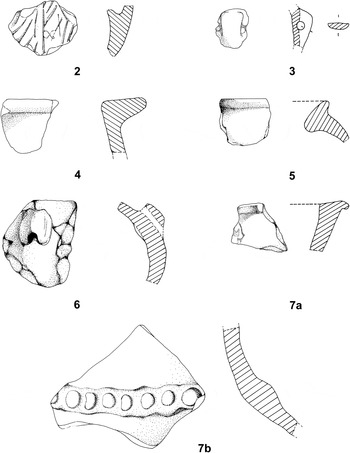
2 Scoop (?) (80c25.108) (Fig. 8)
Handle and body fragment; vertical strap handle, curved walls. Coarse yellowish red mottled (5YR5/8; 10YR4/1 at core), unevenly fired with many whitish and yellow-white inclusions, quartz, mica and schist; evened surfaces. Incised decoration of vertically and diagonally arranged grooves externally. Dimensions 6 × 4.4 cm, Th. 0.6 cm.
Cf. Sackett et al. Reference Sackett, Hankey, Howell, Jacobsen and Popham1966, pl. 19 a; Immerwahr Reference Immerwahr1971, pl. 8.116, 120–3; Coleman Reference Coleman1977, pl. 82, 83 b, c, g.
3 Deep bowl (?) (80c25.46) (Fig. 8)
Part of an ‘elephant’ lug (?) attached to body. Semi-fine yellowish brown (10YR5/4), hard fired with some whitish inclusions; hand smoothed. Dimensions 2.6 × 3.4 cm.
Cf. Coleman Reference Coleman1977, pl. 28 B.
Catalogued pottery (Scale 1:3). Catalogue items: 2–7a, and 7b.

Early Bronze Age
4 Barrel jar (80c25.106) (Fig. 8)
Rim fragment of a barrel jar; thickened offset rim, flattened on top, straight conical walls. Coarse yellowish red to brown (5YR5/8 internally; 7.5YR5/6 externally; 10YR4/2 at core), hard fired with many whitish inclusions and mica; handmade, evened to smoothed surfaces. Diam. c.34 cm, preserved H. 4.7 cm, Th. 1.2 cm.
Possibly of Cycladic origin.
Cf. Barber Reference Barber2008, 66 and fig. 7.103.
5 Deep bowl (80c25.30) (Fig. 8)
Rim fragment of a deep bowl; incurving walls, thick T-rim with pointy edges. Semi-fine yellowish red (5YR5/8; 10YR4/2 at core), hard fired with whitish inclusions; handmade. Diam. c.25 cm, preserved H. 4 cm, Th. 0.8 to 1.3 cm.
Cf. Kunze Reference Kunze1934, 67 fig. 28 b; Caskey and Caskey Reference Caskey and Caskey1960, 136, fig. 4 III.15; Sampson Reference Sampson1985, 69 fig. 21.K 55 and 71 fig. 22.K 72.
6 Pyxis (80c25.37) (Fig. 8)
Body fragment with handle preserved; rounded incurving walls, cylindrical tubular lug vertically pierced, leaves knob-like protrusion on interior. Coarse reddish brown (7.5YR5/6), hard fired with whitish inclusions, some schist and mica also; handmade; red-slipped (2.5YR5/8) smoothly burnished exterior. Dimensions 6.3 × 7.7 cm, Th. 0.8–1.3 cm.
Cf. Caskey Reference Caskey1972, fig. 4.B43; Wilson Reference Wilson1999, pl. 17.II-538, 539; Televantou Reference Televantou and Marthari1999, 25 fig. 24; Rambach Reference Rambach2000 (vol. I), pl. VI.T15 a; Renfrew and Evans Reference Renfrew, Evans and Renfrew2007, 137–8 fig. 5.2.3–4, 140.
Middle Bronze Age
Karystian plain ware
Coarse yellow-red (5YR5/6, 5/8, 6/8)
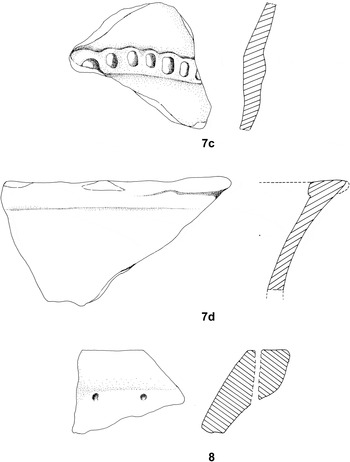
7a–d Pithos (80c25.1–3 and 55) (Figs. 8–9)
Four non-joining fragments; concave neck with thickened slightly outturned rim. a, b: rim and neck fragments; rim made by a separate adjoined coil of uneven width. Diam. >28 cm, preserved H. a 10.5 cm and b 4.2 cm, Th. 1.2 cm. c, d: parts of neck and shoulder with applied band around lower neck; band decorated by finger-impressed rope pattern. Dimensions: c. 10.8 × 13.5 cm and d 10.7 × 11 cm, Th. 1.2–1.4 cm. Coarse orange-red buff (5YR6/8), a clean paste with large mostly whitish inclusions, well fired; handmade, interior crudely smoothed, partly coil-built construction. Plain.
Cf. Hanschmann and Milojčić Reference Hanschmann and Milojčić1976, pl. 20.22, pl. 38.5 and pl. 39.12, 17–21; Christmann Reference Christmann1996, pl. XIX.4, fig. 71.4; Wilson Reference Wilson1999, pl. 70.II-754.
8 Pithos (80c25.104) (Fig. 9)
Rim fragment with upper part of cylindrical neck; spreading and thickened rim, flattened on top, two vertical perforations that run through rim. Coarse yellowish red (5YR5/6; 10YR4/3 at core), well fired throughout with whitish inclusions; handmade/coil construction; evened, worn surfaces. Diam. >40 cm, preserved H. 7.2, Th. 2.9 cm.
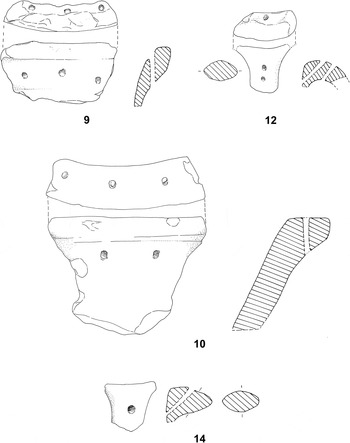
9 Pithos (80c25.105) (Fig. 10)
Rim fragment with upper part of cylindrical neck; spreading and thickened rim, slightly flattened on top, three vertical perforations that run through rim. Semi-coarse yellowish red (5YR5/8), well fired with whitish inclusions and mica; handmade, evened surface. Diam. 36 cm, preserved H. 6 cm, Th. 0.8 cm.
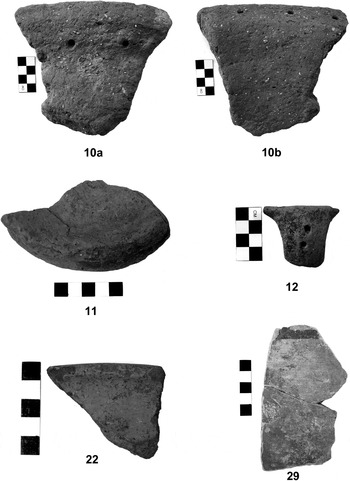
10 Pithos (80c25.137) (Fig. 10, 15)
Rim and neck fragment; spreading and thickened rim, flattened on top, four vertical perforations that run through rim. Coarse yellowish red (5YR5/8), well fired with whitish inclusions; handmade, crudely evened and flaking surface. Diam. c.50 cm, preserved H. 11 cm, Th. 2–2.5 cm.
Catalogued pottery (Scale 1:3). Catalogue items: 7c, 7d, and 8.

Catalogued pottery (Scale 1:3). Catalogue items: 9, 10, 12, and 14.

Coarse light red or red (2.5YR5/8, 6/8)
11 Jar/pithoid jar (80c25.53) (Fig. 15)
Large base fragment; broad raised ridge at lower body. Coarse light red (2.5YR6/8), hard fired with whitish inclusions; handmade, worn with heavy accretions. Diam. 15 cm, preserved H. 4.5 cm.
Semi-fine yellow-red or red (5YR5/6, 5/8, 6/8)
12 Jar (80c25.109) (Fig. 10, 15)
Rim fragment with part of handle preserved; straight rim joined with vertical oval-sectioned handle, the latter diagonally pierced in two places. Fine to semi-fine reddish yellow (5YR5/6; 10YR5/2 at core) with whitish inclusions and mica; handmade, smoothed surfaces. Diam. c.14 cm, handle dimensions 3 × 1.8 cm, preserved H. 2.3 cm.
13 Jar (80c25.111)
Small rim fragment with part of handle preserved; straight rim joined with vertical oval-sectioned handle, one vertical perforation through handle. Semi-fine reddish yellow (5YR6/8) with whitish inclusions and mica; handmade, evened surfaces. Dimensions 5.3 × 2.8 cm (Diam. unclear).
14 Jar (80c25.112) (Fig. 10)
Small rim fragment with part of handle preserved; straight rim joined with vertical oval-sectioned handle, which is vertically pierced in one place. Semi-coarse reddish yellow (5YR6/8) with whitish and yellow-white inclusions; handmade, worn surface. Diam. c.15 cm, handle dimensions 3.5 × 2 cm.
Fine yellow-red or red (5YR6/6, 6/8, 7/6)
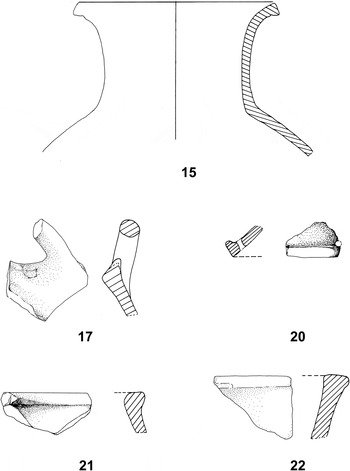
15 Jar (80c25.139) (Fig. 11)
Large rim, neck and body fragment; mended from eight sherds; flaring thickened square-sectioned rim, tall cylindrical neck, smooth transition from neck to body. Fine reddish yellow (5YR7/6), well fired; wheelmade, worn surfaces. Diam. 14 cm, preserved H. c.11 cm, Th. 0.6 cm.
Cf. Demakopoulou and Konsola Reference Demakopoulou and Konsola1975, fig. 7.7; Davis Reference Davis1986, pl. 35.AJ-17; Rutter Reference Rutter1990, 447 fig. 17.165; Maran Reference Maran1992a, pl. 139.3; Sampson Reference Sampson1993, 83 figs. 49.9, 50.25.
16 Jar (80c25.21)
Body fragment with horizontal handle preserved; curved walls, thick handle of circular section vertically perforated at both sides. Fine gritty reddish yellow (5YR6/8) with whitish inclusions, hard fired; handmade, smoothed exterior. Dimensions 12.5 × 7 cm, handle diam. 1.8 cm, Th. 0.9 cm.
Cf. Lindblom Reference Lindblom2001, 28 fig. 6.15.
17 Bowl (80c25.17) (Fig. 11)
Rim fragment with part of handle preserved; slightly everted rim flattened on top, horizontal handle of oval section rising above rim. Fine to semi-fine yellowish brown (5YR7/6) with whitish inclusions; possibly wheelmade, smoothed surface internally/externally. Diam. hard to measure, preserved H. (with handle) 7.3 cm, Th. 0.6–0.7 cm.
Cf. Maran Reference Maran1992a, pl. 14.13; 1992b, pls. 16. 547 and 29. 901.
18 Bowl (80c25.56)
Rim fragment; straight everted rim, shallow horizontal groove at rim–body transition. Fine red (5YR6/8) with whitish inclusions; possibly wheelmade, worn surface. Diam. hard to measure, preserved H. 2 cm, Th. 0.45 cm.
Cf. Zerner Reference Zerner1978, fig. 1.607.2.
19 Bowl/krater (80c25.49)
Base and lower body fragment; ring-base, convex bottom. Fine yellowish red (5YR6/8); possibly wheelmade, worn surface. Diam. 8 cm, preserved H. 2.2 cm, Th. 0.5 cm.
Cf. Goldman Reference Goldman1931, 140 fig. 191.1; Tzavella-Evjen Reference Tzavella-Evjen1984, pl. 57 β, γ; Sampson Reference Sampson1993, fig. 49.4.
20 Lid(?) (80c25.27) (Fig. 11)
Rim fragment; thickened, slightly upturned rim, conical body, fragmented perforation above rim. Fine reddish yellow (5YR7/6) well fired; possibly wheelmade; worn surface. Diam. 23 cm, preserved H. 2.5 cm.
Catalogued pottery (Scale 1:3). Catalogue items: 15, 17, 20–22.

Karystian slipped and burnished ware
Fine/semi-fine yellow-red or red (5YR6/8)
21 Deep bowl (80c25.31) (Fig. 11)
Rim fragment; thickened rounded rim, small part of body preserved. Fine to semi-fine reddish yellow (5YR6/8), hard fired with whitish inclusions and mica; handmade polished surfaces with traces of yellowish brown slip. Diam. 23 cm, preserved H. 3 cm, Th. 0.8–0.9 cm.
22 Deep bowl (80c25.50) (Fig. 11, 15)
Rim fragment; thickened, slightly flattened rim, conical walls. Semi-fine red (2.5YR5/8), hard fired with whitish inclusions; handmade; slipped (5YR6/8) and burnished exterior, mottled and blackened interior. Diam. <33 cm, preserved H. 4.6 cm, Th. 1.1 cm.
Karystian household ware
Coarse incised ware; brown-red polished surface (2.5YR5/8, 4/8)
23 Deep bowl (80c25.4) (Fig. 12)
Base and body fragment; restored from six sherds; flat base with slightly curved lower body. Medium coarse, reddish brown (2.5YR5/8), hard fired; gritty with small whitish inclusions; handmade, smoothed exterior surface with strong accretions. Incised decoration of grooves forming a vertically arranged and continuous herring-bone pattern; deep and relatively broad grooves (2 mm). Diam. 8.5 cm, preserved H. c.8 cm, Th. 0.5–0.6 cm.
Cf. BSA Sherd Collection Nea Styra;Footnote 4 Goldman Reference Goldman1931, 179 fig. 250; Deshayes Reference Deshayes1966, fig. 2, pl. XXXVII (top row in the middle); Sackett et al. Reference Sackett, Hankey, Howell, Jacobsen and Popham1966, fig. 22.117, pl. 21 a; Zerner Reference Zerner1978, figs. 5.23, 8.26, 13.13; Overbeck Reference Overbeck1989, pl. 45.72 (Group S) and pl. 45.12 (Group T).
24 Bowl (80c25.42) (Fig. 12)
Part of a vertical strap handle mended from two sherds. Coarse red (2.5YR4/8; 7.5YR3/4 at core), hard fired with whitish inclusions; handmade, smoothed and slightly polished surface. Incised decoration of shallow grooves forming a vertically arranged herring-bone pattern. Handle dimensions 4.7 × 1.3 cm, preserved H. 5.5 cm.
Fig. 12.Catalogued pottery (Scale 1:3). Catalogue items: 23–28, 34, 35.


Coarse/semi-coarse yellow-red (5YR5/6, 5/8)
25 Cooking pot (80c25.18) (Fig. 12)
Body fragment with vertical handle preserved; part belonging to upper body, two knobs due to pushed-in handle visible internally. Semi-fine yellowish red (5YR5/8), hard fired with whitish inclusions; handmade, crudely smoothed exterior. Dimensions 3.7 × 6 cm, Th. 0.6 cm.
Cf. Caskey Reference Caskey1972, 380 fig. 10.D88, pl. 85.D85; Overbeck Reference Overbeck1989, pls. 41.32 (Group M), 41.28–9 (Group N), 49.82 (Group X), 65.15 (Group AX), 80.133 (Group CE).
26 Cooking pot (80c25.107) (Fig. 12)
Part of foot and lower body; three parallel incised grooves (depth 0.5 cm) vertically arranged on foot. Coarse yellowish red (5YR5/6), hard fired with whitish to yellow-white inclusions and mica; handmade, smoothed surfaces. Dimensions 6 × 6.3 cm.
Cf. Overbeck Reference Overbeck1989, pls. 37.13 (Group C), 38.11 (Group E).
Matt-painted ware
Fine yellow-red or brown (7.5YR7/6, 6/6; 10YR7/4); dark brown paint (10YR4/2)
27 Jar (80c25.5) (Fig. 12)
Rim and shoulder fragment; offset thick squared-sectioned rim with perforation, flange at interior lower rim to support lid; fine reddish yellow (7.5YR7/6), well fired; possibly wheelmade, smoothed exterior/interior; dark-on-light decoration externally, dark brown (10YR4/2) band around neck, underneath which is a vertically arranged group of diagonal and vertical bands. Diam. 32 cm, Th. 0.6 cm.
Cf. Caskey Reference Caskey1972, figs. 8.D6 and 9.D46 (for shape only); Maran Reference Maran1992a, pl. 87.3.
28 Jar (80c25.125) (Fig. 12)
Neck and body fragment. Fine reddish yellow (7.5YR6/6; 5YR7/2 at core), well fired; possibly wheelmade, smoothed. Dark-on-light decoration externally, fugitive dark brown (10YR4/2) band around neck, underneath which is another diagonal (hard to discern). Diam. (neck) c.11.5 cm, preserved H. 6.3 cm, Th. 0.6 cm.
29 Jar (80c25.6) (Fig. 15)
Two joined body fragments; slightly curved walls belonging to lower body. Fine to semi-fine, pale brown (10YR7/4), medium fired, light paste with small whitish and orange inclusions (possibly sandstone); handmade, smoothed exterior surface, while interior heavily eroded; dark-on-light decoration externally, horizontal dark brown (10YR3/2) band, on which part of another vertical visible (very small part of decoration preserved). Dimensions 13.2 × 7.7 cm, Th. 1.1 cm.
Grey Minyan ware
Fine light grey or grey (5Y5/1, 6/1; 10YR5/1, 6/1)
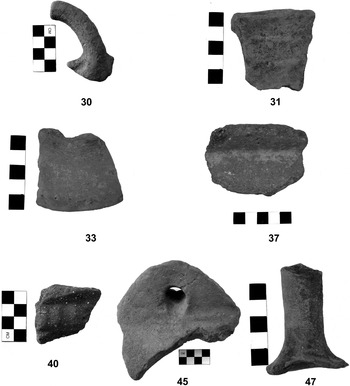
30 Goblet (80c25.115) (Fig. 16)
Small rim fragment with part of handle preserved; horizontal loop handle rising above rim. Fine grey (10YR6/1), well fired; wheelmade. Handle dimensions 1.7 × 1.4 cm, preserved H. 5.5 cm (Diam. unclear).
Cf. BSA Sherd Collection Nea Styra; Sackett et al. Reference Sackett, Hankey, Howell, Jacobsen and Popham1966, fig. 20.44, pl. 21 a; Overbeck Reference Overbeck1989, pls. 48.46 (Group X), 67.41 (Group BD); Maran Reference Maran1992a, pls. 55.7, 89.3; Sampson Reference Sampson1993, figs. 44.32, 45.33; Sarri 2010, 128 and pls. 26–7.
31 Footed goblet (80c25.7) (Fig. 16)
Part of ridged stem; four horizontal ridges preserved, widely spaced. Fine light grey (5Y6/1), medium fired; wheelmade, of soapy texture. Dimensions 5.8 × 5.6 cm.
Cf. Sarri Reference Sarri2010, 124 and pls. 23–4.
32 Footed goblet (80c25.8)
Part of ridged stem; two horizontal ridges preserved, widely spaced and worn. Fine light grey (5Y6/1), medium fired; wheelmade. Dimensions 5.4 × 6.1 cm.
Cf. Sarri Reference Sarri2010, 124 and pls. 23–4.
33 Footed goblet (80c25.11) (Fig. 16)
Part of discoid base and stem; plain(?) flaring stem with smooth ridge at the edge, wide base. Fine light grey (10YR5/1), well fired; wheelmade, striations internally; burnished surface, sheen partly preserved externally. Diam. 15 cm, preserved H. 4.7 cm.
Cf. Sackett et al. Reference Sackett, Hankey, Howell, Jacobsen and Popham1966, fig. 21.59–61; Caskey Reference Caskey1972, fig. 8.D3; Rutter Reference Rutter1990, 427 fig. 10.142, 144; Sampson Reference Sampson1993, 82 fig. 43.3.
34 Footed goblet (80c25.116) (Fig. 12)
Lower body fragment; part where stem was attached, three parallel horizontal ridges preserved. Fine grey (10YR6/1), well fired; wheelmade, smoothed surfaces. Upper stem diam. 6.2 cm, preserved H. c.5 cm, Th. 0.6–0.9 cm.
Cf. Sackett et al. Reference Sackett, Hankey, Howell, Jacobsen and Popham1966, fig. 21.56.
35 Bass bowl (80c25.9) (Fig. 12)
Rim fragment; offset flaring rim, smooth horizontal depression on rim–shoulder transition. Fine light grey (5Y6/1), hard fired with darkish inclusions; wheelmade, striations parallel to interior rim; burnished surface, dull sheen partly preserved externally. Diam. 16 cm, preserved H. 3.3 cm.
Cf. Caskey Reference Caskey1972, figs. 8.D43, D124; Zerner Reference Zerner1978, fig. 7.2; Maran Reference Maran1992a, pls. 36.14, 37.11, 41.10, 46.13, 93.4.
36 Bowl (80c25.15)
Part of discoid base and lower body of a bowl; splayed and hollowed base, no stem. Fine light grey (5YR5/1), well fired with whitish inclusions visible in fracture; wheelmade; worn surface, unclear edges. Preserved H. c.2.5 cm; Diam. unclear.
Cf. BSA Sherd Collection Nea Styra; Lindblom Reference Lindblom2001, 30 fig. 8.10.
Cycladic plain ware
Coarse yellow-red, brown or red (5YR5/6; 2.5YR5/6; 7.5YR5/6)
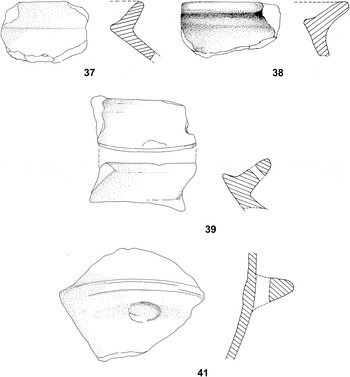
37 Pithos (80c25.22) (Fig. 13, 16)
Rim fragment; straight offset rim, sharp flange at interior lower rim to support lid, conical walls as preserved. Coarse red (2.5YR5/6; 2.5YR3/2 at core), hard fired, with whitish inclusions, some quartz and mica; handmade, smoothed but worn surfaces. Diam. c.30 cm, preserved H. 6 cm, Th. 1 cm.
Cf. BSA Sherd Collection Nea Styra; Caskey Reference Caskey1972, figs. 8.D46, 9.D65 (for the shape); Siedentopf Reference Siedentopf1991, 15 fig. 1.1.
38 Pithos (80c25.29) (Fig. 13)
Rim fragment; straight offset rim with rounded edge, small ledge at interior angle to support lid, conical walls as preserved. Coarse yellowish red (5YR5/6; 7.5YR5/4 at core), hard fired, gritty with whitish inclusions and mica; handmade, smoothed surfaces. Diam. 36 cm, preserved H. 5.5 cm, Th. 1 cm.
Cf. Caskey Reference Caskey1972, figs. 8.D46, 9.D65 (for the shape); Siedentopf Reference Siedentopf1991, 15 fig. 1.5.
39 Pithos (80c25.117) (Fig. 13)
Rim fragment; straight offset rim with rounded lip, sharp flange at interior lower rim to support lid, straight walls as preserved; part of vertical perforation through rim. Coarse brown (7.5YR5/6), hard fired with whitish inclusions, schist and mica; handmade, crudely smoothed surfaces. Diam. c.40 cm, preserved H. 5.3 cm, Th. 1.4 cm.
Cf. Overbeck Reference Overbeck1989, pl. 51.3 (Group AE); Siedentopf Reference Siedentopf1991, 15 fig. 1.84 (for the shape); Maran Reference Maran1992a, pl. 77.1.
40 Pithos (80c25.119) (Fig. 16)
Body fragment; part of neck–shoulder transition decorated with horizontal relief band of rope pattern. Coarse brown (7.5YR5/6) with whitish inclusions; handmade, smoothed surfaces. Dimensions 5 × 4.3 cm, Th. 1.1 cm.
41 Jar (80c25.128) (Fig. 13)
Body fragment with handle preserved; horizontal crescent-shaped handle vertically pierced, broad knobs due to pushed-in handle visible internally. Coarse brown to dark brown mottled (7.5YR5/6), hard fired with whitish inclusions and schist; handmade, smoothed externally. Dimensions 13.2 × 10 cm, Th. 0.8 cm.
Cf. BSA Sherd Collection Nea Styra; Davis Reference Davis1986, pl. 55:U-73; Maran Reference Maran1992a, pl. 22:13.
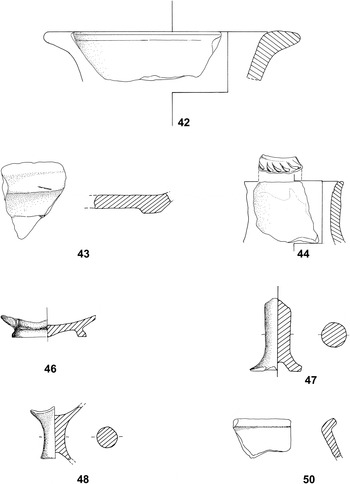
42 Jar (80c25.138) (Fig. 14)
Rim and neck fragment; flaring rim slightly flattened on top, straight walls. Coarse reddish grey (5YR5/6), hard fired with whitish inclusions and schist; handmade, smoothed surfaces. Diam. 23 cm, preserved H. 4.8, Th. 1.1 cm.
Cf. Overbeck Reference Overbeck1989, pl. 51.11 (Group AC); Barber Reference Barber and Renfrew2007, 226 fig. 6.15.337.
43 Stand(?) (80c25.51) (Fig. 14)
Base fragment; broad ring-base, flattened interior. Coarse red (2.5YR5/6) hard fired with whitish inclusions and mica, some also gold; dark grey core; handmade, evened surfaces. Diam. < 35 cm, preserved H. 1.8 cm, Th. 1.2 cm.
Catalogued pottery (Scale 1:3). Catalogue items: 37–39, and 41.

Catalogued pottery (Scale 1:3). Catalogue items: 42–44, 46–48, and 50.

Catalogued pottery (photos): Catalogue items: 10a and b, 11, 12, 22 and 29.

Catalogued pottery (photos): Catalogue items: 30, 31, 33, 37, 40, 45 and 47.

Semi-fine red (2.5YR4/8, 6/8)
44 Jar (80c25.127) (Fig. 14)
Rim and neck fragment; straight rim, slightly splaying on edge. Semi-fine red (2.5YR4/8), well fired with whitish inclusions and schist; handmade, smoothed exterior, worn interior. Stamped decoration of curved parallel ridges diagonally arranged on interior rim. Diam. c.10 cm, preserved H. 5.7 cm, Th. 0.9 cm.
45 Jar (80c25.136) (Fig. 16)
Body fragment with handle preserved; horizontal crescent-shaped handle vertically pierced. Semi-fine light red (2.5YR6/8), hard fired with whitish inclusions and grog; handmade, polished exterior surface. Dimensions 14.9 × 10.8 cm, Th. 1.4 cm.
Cf. BSA Sherd Collection Nea Styra; Davis Reference Davis1986, pl. 55.U-73; Maran Reference Maran1992a, pl. 22.13; Lindblom Reference Lindblom2001, 28 fig. 6.14.
Non-local plain ware
Fine brown (10YR7/4)
46 Krater or deep bowl (80c25.33) (Fig. 14)
Base and lower body fragment mended from four sherds; ring-base, slightly convex bottom. Fine pale brown (10YR7/4), soft fired; wheelmade, very worn surfaces. Diam. 6.5 cm, preserved H. 2 cm, Th. 0.5–0.7 cm.
Cf. Sackett et al. Reference Sackett, Hankey, Howell, Jacobsen and Popham1966, fig. 22.III-2; Caskey Reference Caskey1972, fig. 8.D110 (for the shape).
Late Bronze Age
47 Kylix (80c25.34) (Fig. 14, 16)
Stem fragment with part of discoid base. Fine brown (7.5YR5/6). Diam. stem 2.2 cm, preserved H. 6.5 cm.
48 Kylix (80c25.35) (Fig. 14)
Stem fragment with part of lower body. Fine reddish yellow (5YR6/6). Diam. stem 1.8 cm, preserved H. c.5 cm.
49 Kylix (80c25.36)
Stem fragment with part of lower body. Fine reddish yellow (7.5YR7/6); worn surface. Diam. stem 2.1 cm, preserved H. 5.3 cm.
50 Deep bowl or krater (80c25.32) (Fig. 14)
Rim and body fragment; everted, slightly flattened rim, straight conical walls. Fine reddish yellow (5YR6/8; 10YR5/2 at core) with whitish inclusions; wheelmade smoothed surfaces. Diam. c.20 cm, preserved H. 3.5 cm, Th. 0.7 cm.
Cf. Caskey Reference Caskey1972, 399 fig. 14.M15.
THE CHARACTER OF THE CERAMIC ASSEMBLAGE
From the available evidence it is possible to determine, albeit tentatively, the periods of the occupation of the site. Judging from the pottery finds, Ay. Nikolaos was first occupied in the Final Neolithic. The Final Neolithic finds are scanty and seem to belong to the later part of this period, since some of the typical forms common at the nearby site of Kephala on Keos, as well as at other Final Neolithic sites in the Karystia, e.g. ‘cheese-pots’, crusted pottery, pattern-burnished decoration, ceramics with red-slipped and burnished surfaces, are absent from Ay. Nikolaos (Coleman Reference Coleman1977; Keller Reference Keller1982; Talalay et al. Reference Talalay, Cullen, Keller, Karimali, Kennell and Tomlinson2005, 26). We suggest that the closest chronological parallels for the Final Neolithic material should perhaps be sought among Ay. Irini's period I deposits (Wilson Reference Wilson1999, 7). However, the fragment that possibly belongs to a scoop (2) finds its parallels at Kephala and not at Ay. Irini (Coleman Reference Coleman1977, 101–2, pls. 36, 82–3).
Many of the Karystian Final Neolithic sites continued to be occupied in the Early Bronze Age and Ay. Nikolaos seems to follow this pattern (Keller Reference Keller1982; Reference Keller1985, 129–30; Talalay et al. Reference Talalay, Cullen, Keller, Karimali, Kennell and Tomlinson2005). Early Bronze pottery is rare among the material collected from Ay. Nikolaos. Ring bases like 19 are found both in Early and Middle Bronze Age assemblages (Goldman Reference Goldman1931, 140, fig. 191.1; Tzavella-Evjen Reference Tzavella-Evjen1984, 160). The only rim fragment of a barrel jar (4) is dated either to the last stages of the Early Bronze Age or to the beginning of the Middle Bronze Age, corresponding to a pre-Ay. Irini IVb period (Overbeck Reference Overbeck1989, 42). The T-rim bowl (5) occurs over a broad chronological range from Early Bronze I to advanced Early Bronze II, according to similar finds from Eutresis (Caskey and Caskey Reference Caskey and Caskey1960, 136, fig. 4.III.15) and Manika (Sampson Reference Sampson1985, 69, 71). 6 belongs to a Cycladic-type pyxis (Rambach Reference Rambach2000 [vol. I], pl. VI T15a; Renfrew and Evans Reference Renfrew, Evans and Renfrew2007, 140; Televantou Reference Televantou and Marthari1999, 25 fig. 24), found also in Early Bronze I and II contexts in Tsepi at Marathon and Loutsa on the eastern coast of Attica (Efstratiou, Stathi and Mathioudaki Reference Efstratiou, Stathi, Mathioudaki, Vasilopoulou and Katsarou-Tzeveleki2009; Pantelidou-Gofa Reference Pantelidou-Gofa2005, pls. 11.7, 17.3; Reference Pantelidou-Gofa, Renfrew, Brodie, Gavalas and Doole2008, 288; Petrakos Reference Petrakos2004, 17 fig. 4).
The Middle Bronze Age is represented by local pottery and typical Middle Bronze wares: Grey Minyan, Matt-Painted and coarse incised ware. The bulk of the pottery, c.70% of the total, consists of local Karystian wares that form a fairly homogenous group. Two main categories of plain pottery, a coarser and a finer one, are presented in the catalogued material. Coarse to semi-fine fabrics, varying in colour from yellow-red to red (5YR5/6-5/8-6/8), were used for pithoid vessels, jars, or deep bowls. To this fabric-based group belongs an interestingly uniform category of large vessels for storage, the main characteristic of which is a row of vertical perforations on a thickened rim (8–10). Multiple perforations occur commonly also on handles of jars, suggesting their possible use as sealed containers for goods (12–14). K.D. Vitelli, who examined the perforated pieces, suggested that the perforations were perhaps used in the drying or firing stage of pottery making (K.D. Vitelli pers. comm.). Such perforations can be traced back at least to Neolithic times, as attested at Kephala (Coleman Reference Coleman1977, pl. 39 P, R). The perforated handles (12–14) belong possibly to oval-mouthed jars like those produced in coarse red fabrics in Ay. Irini periods IV and V (Davis Reference Davis1986, pl. 62.AA-62; Overbeck Reference Overbeck1989, 69, pl. 51.30 [Group AB]). The only example of a similar vessel from Euboea comes from Manika and bears perforations of the same type (ASCSA Sherd Collection: Drawer no. 35, Box C2). To the same fabric group belong four fragments of a large pithos with plastic rope band on the neck–shoulder transition (7a–d). Pithoid vessels decorated in a similar way are commonly found in Euboean sites such as Amarynthos-Palaiochora, Asmyni-Divouni, and Porto Kastri (ASCSA Sherd Collection: Drawer no. 38, Box C6, Drawer no. 40, Box C23 and Drawer no. 43, Box C46, respectively). Numerous examples are also encountered in other central Greek sites, such as the Athenian Acropolis (Hansen Reference Hansen1937, 566 and fig. 18 f), and this type of decoration on pithoid vessels and large bowls is common in Middle Bronze Thessaly as well, both at Argissa-Magoula and Pefkakia (Hanschmann and Milojčić Reference Hanschmann and Milojčić1976, pls. 20.22, 38.5 and 39.12, 17–21; Maran Reference Maran1992a, pls. 18.9, 20.10, 36.5.). The dating of our piece is uncertain, since plastic rope decoration was used from at least the Final Neolithic through the Late Bronze periods and later (for Early Bronze Age examples see: Kunze Reference Kunze1934, 75, pl. XXXIII.2; Tzavella-Evjen Reference Tzavella-Evjen1984, pl. 51 a; Wilson Reference Wilson1999, pl. 12.II-322. For Late Bronze examples see Maran Reference Maran1992b, pls. 21.679, 26.811 (LH I)).
Crescent handles on jars or pithoid vessels also make their appearance in the coarse material of Ay. Nikolaos, in both local and non-local fabrics (e.g. 41). On Euboea, crescent handles frequently appear at Manika and Nea Styra (ASCSA Sherd Collection: Drawer no. 35, Box C2 and BSA Sherd Collection, respectively). Jars with crescent handles are also common at Plaka, the Middle Bronze site of Andros (Televantou Reference Televantou and Marthari1999, 29–31, figs. 37–8), and at Ay. Irini periods IV and V (Davis Reference Davis1986, pl. 55.U-73; Overbeck Reference Overbeck1989, pl. 51.30 [Group AB]).
The second category of plain wares is characterised by finer fabrics, again yellow-red to red in colour and in the form of small to medium-sized bowls or jars (15–20). The exterior surface is smoothed with a slight burnish in a few cases. Of special interest is the jar (15), representing a clearly defined Euboean ware category of wheelmade, light-coloured vessels that appear in advanced Middle Bronze (or Late Helladic I) phases. This category of pottery is especially common at Kalogerovrysi and Pefkakia (Maran Reference Maran1992a, 329, no. 1127 and 332; Reference Maran1998, 99–100; Sampson Reference Sampson1993, 82–3). The sites provide exact parallels to 15 in shape and fabric and are broadly assigned to the late Middle Bronze Age (Maran Reference Maran1992a, pl. 139.3; Sampson Reference Sampson1993, figs. 49.9, 50.25).
Among Grey Minyan forms, the one almost exclusively present is the stemmed goblet with both plain and ridged stems (31–34). The goblets are all of the well-developed angular types that are common in the developed and final Middle Bronze stages (Dickinson Reference Dickinson1977, 21). 35 is more probably a Bass bowl, like ‘bowl of type 1EI’ from Pefkakia, that has a long life-span there, covering phases 4 to 6 Middle (Maran Reference Maran1992a, pls. 37.11, 41.10, 46.13 and 93.4). The so-called Bass bowl is also common in Lefkandi phase 4 (Popham and Sackett Reference Popham and Sackett1968, 9–10) and Keos (Caskey Reference Caskey1972, 383, fig. 8.D43, D124), appearing usually in dark burnished wares. 30, a goblet with tall horizontal loop handles, is a common central Greek shape of the ‘mature Minyan’ phase, like those from Pefkakia (Maran Reference Maran1992a, pls. 55. 7, 89.3) or Keos (Overbeck Reference Overbeck1989, 60, pl. 48.46 [Group X], 126, pl. 67.41 [Group BD]; Overbeck Reference Overbeck, Felten, Gauss and Smetana2007, 340, 344, fig. 2.BD-41, BD-47), present in phases 5 to 6 Middle and Ay. Irini IVa-b, respectively. This type of goblet, related to the later Pteleos-type goblets (Pavuk Reference Pavuk2002, 50 fig. 10.38), appears also at other Euboean sites like Yialtra, Nea Styra, and Kalogerovrysi (Sackett et al. Reference Sackett, Hankey, Howell, Jacobsen and Popham1966, 91 fig. 20.44 and pl. 21 a; Sampson Reference Sampson1993, 75 figs. 44.32, 45.33). Howell attributes the abundance of Grey Minyan pottery at Euboean sites such as Aliveri and Nea Styra, and the variation of fabric characteristics among them, to their local production (Sackett et al. Reference Sackett, Hankey, Howell, Jacobsen and Popham1966, 94, 99). The same is suggested by Sampson for the Grey Minyan pottery of Kalogerovrysi (Sampson Reference Sampson1993, 75). The Karystian examples, however, do not seem local. Their origin could be one of the Euboean centres such as Lefkandi or Manika. The abundance and excellent quality of Minyan vessels at Manika, according to Theocharis' reports, suggest that the region of the Euripos was a centre of production (Theocharis 1959, 298, 301).
Only three sherds of large jars or pithoid vessels bearing Matt-Painted decoration were found at Ay. Nikolaos. The profile of 27 is not found among known Aeginetan examples. It resembles rim profiles of central and northern Greek pithoi like those from Pefkakia (Maran Reference Maran1992a, pl. 87.3). The curved profile of the upper body is a chronologically early element. At Ay. Irini similar profiles of pithoi appear in early Middle Bronze red burnished ware (Caskey Reference Caskey1972, figs. 8.D6, 9.D46). The profile and fineness of 28 are reminiscent of Siedentopf's nos. 186 and 212 (Siedentopf Reference Siedentopf1991, pls. 42 and 48, respectively), except that the clay is not Aeginetan. Both sherds lack gold mica (biotite – as opposed to muscovite), and are lighter in weight than, and different in texture from, the Aeginetan Matt-Painted pottery.
Coarse incised ware, common in Middle Bronze assemblages, is also attested at Ay. Nikolaos by a large, possibly one-handled bowl and a strap handle that belongs to another vessel of the same type (23–24). Both pieces are treated here as a variety of local household or cooking pottery, and stand among the very few examples of incised ware of this period on Euboea. Nea Styra and Amarynthos are two other Euboean sites where the ware is attested (Sackett et al. Reference Sackett, Hankey, Howell, Jacobsen and Popham1966, 66, 80, fig. 22.117, pl. 21 a). Coarse incised pottery is present at Ay. Irini on Keos (Overbeck Reference Overbeck1989, pls. 45.72 [Group S] and 45.12 [Group T]), Eutresis (Goldman Reference Goldman1931, 179 fig. 250.1–9), the Aspis at Argos (Deshayes Reference Deshayes1966, fig. 2 [upper row in the middle], pl. XXXVII; Touchais Reference Touchais, Felten, Gauss and Smetana2007, 88 fig. 13.8, 15–17), and Lerna (Zerner Reference Zerner1978, 11, 24 and 188, figs. 5.23, 8.26 and 13.13), among others. Two other pieces of local household ware, a pushed-in handle of a jar and part of a foot (25–26), belong to cooking pots. 25 has many parallels among large household vessels from Ay. Irini (Caskey Reference Caskey1972, pl. 85.D85 and fig. 10.D88). Coarse wide-mouthed jars, functioning as cooking pots, are common in the shape repertoire of the early Middle Bronze Age and continued to be in use for a long time, since later they become the well-known pedestalled and more delicate cooking jars of the late Middle Bronze and Late Bronze I periods (Rutter Reference Rutter1989, figs. 6.17, 7.18–19; Rutter Reference Rutter1990, 450 fig. 18). The early Middle Bronze type, represented by our 25, is commonly attested in the two earliest phases of Ay. Irini IV in coarse dark red-brown to grey fabrics (Overbeck Reference Overbeck1989, 38, pls. 41.32 [Group M], 41.28–9 [Group N], 49.82 [Group X], 65.15 [Group AX], 80.133 [Group CE]). 26, a foot of a cooking pot that bears three deep parallel incisions, also has its parallels among Keian examples of Ay. Irini IVb period (Overbeck Reference Overbeck1989, 23, pl. 37.13 [Group C], 38.11 [Group E]; both pieces have two vertical slashes at the top of their external surface). The link with Keos, as far as this cooking pot type is concerned, is reinforced by the presence of similar fragments with deep vertical slashes in the survey material of northern Keos (Cherry, Davis and Mantzourani Reference Cherry, Davis and Mantzourani1991, 168).
Imported coarse to semi-fine wares of Cycladic origin constitute c.9% of the total assemblage. 37–45 belong to the category of Cycladic plain wares, which is further divided into two groups according to the colour of the clay. The majority of the sherds are of coarse yellow-red, brown, or red fabric with many whitish inclusions (quartz or quartzite schist), and a lot of mica grits. Large or medium-sized vessels dominate the pottery assemblage. Some of them may be of northern or central Cycladic provenance. The fabric corresponds in most cases to that of ‘Keian semi-fine to coarse red-brown ware’ defined in the Early Bronze Age pottery assemblages (Wilson Reference Wilson and Fossey1987, 36). The Keian provenance is further supported by the similarity of the fabric composition to that of the majority of the sherds collected during the survey of northern Keos (Cherry, Davis and Mantzourani Reference Cherry, Davis and Mantzourani1991, 166). Cycladic pithoid vessels are encountered in limited quantities, mostly distinguished by offset perforated or unperforated rims with interior flanges (37–39). Pithoi or pithoid jars of this type have many parallels in the red burnished wares of Keos IV, and in the survey material of northern Keos, a fact that suggests a Cycladic origin for our pieces (Caskey Reference Caskey1972, 379 fig. 9.D46 and 380 fig. 10.D65; Overbeck Reference Overbeck1989, 74, pl. 51.3 a [Group AE]; Cherry, Davis and Mantzourani Reference Cherry, Davis and Mantzourani1991, 169 fig. 5.1b.13-4, OS-39). Rim fragments that belong to similar vessels have been found at Nea Styra (BSA Sherd Collection). Large storage vessels with crescent-shaped handles and restricted necks of Cycladic type are also present (41 and 45). An interesting fragment of possible Cycladic origin is 44, which belongs to a jar with stamped decoration on its rim. Stamped decoration is commonly attested on rims of Early Bronze Age bowls (Tzavella-Evjen Reference Tzavella-Evjen1984, type B bowls, fig. 3 ζ, η, ξ, ο, π, pl. 25 ε; Cherry, Davis and Mantzourani Reference Cherry, Davis and Mantzourani1991, 170 fig. 5-1). An almost identical fragment decorated in such a manner comes from Pefkakia and is dated to the transitional Early Bronze to Middle Bronze period (Maran Reference Maran1992a, pl. 1.15). Nevertheless, the piece from Pefkakia is a bowl, while the Karystian fragment may belong to a closed vessel. Of particular interest and definite Cycladic origin is 43, a possible fragment of a stand, whose red, highly micaceous fabric points to central Cycladic parallels (e.g. to Naxos or Ios).
Finally, our scanty Late Bronze fragments are limited to three kylix stems and one rim fragment of a deep bowl or krater (47–50). The kylix stems cover the periods of Late Helladic IIB to Late Helladic IIIA2 according to the height of the stem. 50 is more probably a krater, as is indicated by an exact parallel from Keos (Caskey Reference Caskey1972, 399 fig. 14.M15).
The difficulties occurring when trying to date survey material are well known and thoroughly treated elsewhere (Cherry, Davis and Mantzourani Reference Cherry, Davis and Mantzourani1991, 166; Keller and Rupp Reference Keller and Rupp1983). We tried to date the material more precisely, rather than just assigning it to a general chronological frame. If Sampson's (Reference Sampson1987, 181) proposition that ‘under present circumstances a bipartite division of the MBA Euboea is possible’ proves valid, the majority of the Middle Bronze material from Ay. Nikolaos should be dated to the second half of the period (Middle Helladic II and onwards). Nevertheless, coarse incised wares (23–24) are most common in earlier assemblages, as indicated by Keian incised wide-mouthed jars assigned to Ay. Irini phase IVb (Overbeck Reference Overbeck1989, 23 pl. 37.13 [Group C] and 25 pl. 38.11[Group E]). Also, sherds of coarse incised and usually burnished ware appear regularly in deposits of late Lerna IV (House D) and constitute a common feature of Early Helladic as well as Middle Helladic deposits (Zerner Reference Zerner1978, 11 and 24 figs. 5.23, 8.26 and 13.13). Grey Minyan goblet stems like our 31 and 32 are dated in the advanced Middle Bronze Age (Sarri Reference Sarri2010, 124 and pls. 23–4) and the same goes for goblets with horizontal loop handles (30) (Sarri Reference Sarri2010, 128 and pls. 26–7). The local slipped and burnished ware (21–22) should be dated to the stage subsequent to Lerna IV-V and VA as indicated by the absence of similar profiles in both phases. Plain burnished wares have a long duration in northern Keos, but are most characteristic of Ay. Irini phase IV (Cherry, Davis and Mantzourani Reference Cherry, Davis and Mantzourani1991, 168).
STONE TOOLS (BY CATHERINE PERLÈS) (Table 1)
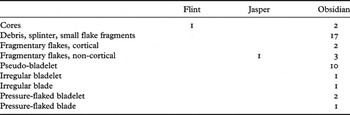
Chipped stone assemblage from 80c25 (Ay. Nikolaos). (Author: C. Perlès.)

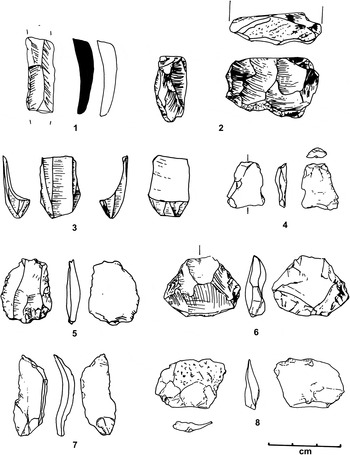
The lithic assemblage from Ay. Nikolaos shows a sharp contrast between casually produced flakes of flint and obsidian, sometimes cortical, and very rare pressure-flaked obsidian bladelets. It is characterised by the use of a hard hammer for the removal of the flakes as well as the frequent use of bipolar flaking, resulting in numerous pieces of debris and splinters (Fig. 17.4, 5, 8). The absence of rectilinear ridges on the few elongated pieces (‘bladelets’ and ‘blades’) indicates that they too are by-products of a flake production (Fig. 17.7). Overall the workmanship shows ample evidence of unskilled work: several flakes present traces of failed removal attempts due to inadequately controlled percussion. The only obsidian core shows no preparation and the simple removal of a small series of flakes on one face. The last removal presents a hinged fracture, after which the core was abandoned (Fig. 17.2). A fragmentary flat flint flake core, with centripetal removals (Fig. 17.6), as well as a fragmentary jasper flake, indicates that flint or jasper was also worked locally for a flake production. The small flakes detached from the flint core could easily have gone unnoticed during a survey, which may explain why they are absent from the collection. There are no retouched pieces in either flint or obsidian, and, chronologically speaking, this assemblage is by itself completely undiagnostic.
Ay. Nikolaos. Chipped stone tools.

The rare pressure-flaked unretouched obsidian bladelets (Fig. 17.1), as well as a blade that removed a superb pyramidion from a pressure-flaked conical core, typical of the Bronze Age (Fig. 17. 3), come as a sharp contrast. Given the complete absence of technical pieces relating to a pressure blade/bladelet reducing sequence, it can be surmised that these pieces were not produced locally. However, the pyramidion blade, which recalls Bronze Age Cycladic cores (Carter Reference Carter2007; Torrence Reference Torrence, Davis and Cherry1981), is absolutely fresh, whereas all the other pieces are heavily patinated. This suggests that some of the original settlement is still buried, and opens up the possibility of an earlier (Early Bronze Age) component.
Whatever the case, we are clearly dealing with two distinct productions: a local, unskilled production working on small fragments of flint and obsidian, and rare pieces imported as finished products from highly skilled producers. If the respective proportions can be relied upon in a surface assemblage, access to these specialised products was restricted. This opposition between specialised and domestic productions is not specific to sites located far from the sources: it was also documented by Carter (Reference Carter2007) on Milos itself. On the other hand, the inhabitants from Ay. Nikolaos did have access to some obsidian, and, in this case, it could not be found locally. The presence of cortical flakes suggests that they had access either to raw material or possibly to large cortical preparation flakes discarded from specialised workshops, as exemplified by Manika in Euboea itself for the Early Bronze Age (Karabatsoli Reference Karabatsoli1997).
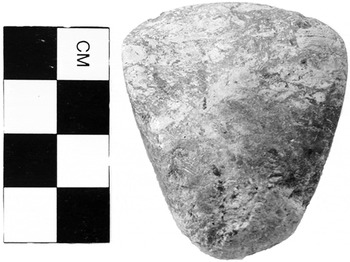
The chipped stone assemblage is accompanied by a fine polished celt (Fig. 18) of light greenstone (possibly serpentinite), of small size (c.4 cm). It is triangular in shape, and almost as wide as it is long; in plane, the cutting edge is convex and slightly asymmetrical. The section is biconvex with asymmetrical faces, but the cutting edge itself is straight (this piece was discovered after the study of stone tools was completed, and is here described from photographs).
Ay. Nikolaos. Polished celt.

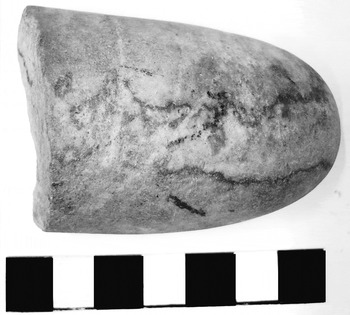
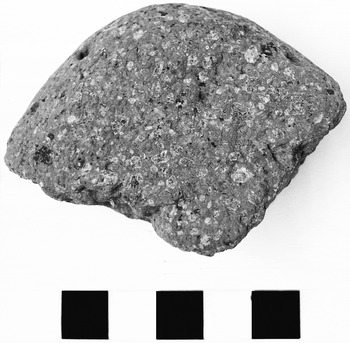
Finally, ground stone implements are represented by three pieces: a natural beach pebble, possibly marble, with traces of percussion on both ends (Fig. 19); a fragmentary handstone of a light conglomerate shaped by pecking, of quadrangular section, used on at least one surface (Fig. 20); and another handstone also manufactured by pecking, made, in contrast, of a very dense, unidentified rock. It has a circular shape and a parallelepipedic section with convex sides. Both flat surfaces were used (Fig. 21).
Ay. Nikolaos. Ground stone tool.

Ay. Nikolaos. Ground stone tool.

Ay. Nikolaos. Ground stone tool.

A HISTORICAL OVERVIEW OF AY. NIKOLAOS AND ITS PLACE IN THE PREHISTORIC KARYSTIA
It is difficult to say at present if the habitation at Ay. Nikolaos was continuous over the entire duration of the periods that are represented by the archaeological material on the site. The Final Neolithic–Early Bronze Age transition in Greece is poorly documented as it is and, with the small amount of Final Neolithic pottery we have from Ay. Nikolaos, it is impossible to draw any conclusions about the nature, extent, and duration of the Final Neolithic use/habitation of the location. From the Karystia as a whole, however, there is strong evidence for Final Neolithic habitation. The types of sites dated to the Final Neolithic period range from simple restricted sherd/obsidian scatters to possible fortified sites (e.g. Akri Rozos [Cullen et al. forthcoming]). Unfortunately, only one of the Final Neolithic sites, Plakari, has been excavated thus far (Cullen et al. forthcoming; Talalay et al. Reference Talalay, Cullen, Keller, Karimali, Kennell and Tomlinson2005); despite the very limited size of the excavation, it yielded fairly large amounts of pottery, most of which has affinities with the Final Neolithic material found on Kephala on Keos and other contemporary sites in Attica (e.g. the Agora at Athens [Immerwahr 1971] and Kitsos Cave [Lambert 1981]). This firmly places at least some of the Final Neolithic sites from the Karystia into the Attica–Kephala cultural circle. The possible scoop (2) stands as another, albeit isolated, piece of evidence for the link among sites in the broader region, since this shape has been found on Kephala, Thorikos, Plakari, Ay. Triadha, and now Ay. Nikolaos of Karystos (Coleman Reference Coleman1977, 101–2; Keller Reference Keller1982). Andros also played an important role as a step to Euboea and Attica, probably as early as Final Neolithic times, according to analogies in the material evidence of Mikrogiali, a northern site purportedly accessible only by sea (Televantou Reference Televantou and Marthari1999, 7, 9–10; 2008, 51), and Strofilas, a large fortified Final Neolithic settlement (Televantou Reference Televantou, Renfrew, Brodie, Gavalas and Doole2008).
This may have had something to do with the role that the inhabitants of southern Euboea probably played in the initial population of at least the very northern part of the Cyclades (e.g. Andros and Keos), as it is possible that the earliest evidence for human habitation in the region that includes not only southern Euboea, but Andros and Keos as well, comes from a site in the Karystia – the Ayia Triadha Cave (Keller Reference Keller1985, 125–7; Mavridis and Tankosić 2009; Sampson Reference Sampson1981, 93). During the limited excavation conducted in the cave in 2007 the joint team from the Ephorate for Paleoanthropology and Speleology of Southern Greece and SEEP recovered pottery dated to the very end of the Late Neolithic or the Late Neolithic–Final Neolithic transitional period. However, it is hard to say, solely on the basis of the survey evidence currently available to us, whether Ay. Nikolaos was a part of this interaction.
The Early Bronze finds are also inconclusive, because they are too few and undiagnostic to allow any degree of certainty. Other Early Bronze settlements of the Karystia are mainly on, or very near, the coast, and at least the larger ones (Ayia Pelagia, Ayios Georgios and Akri Rozos), like their Final Neolithic predecessors, show indications of involvement and participation in the Aegean communication networks of the Early Bronze II period in the form of Cycladic imports and shared material culture with neighbouring areas (Keller Reference Keller1982, passim; Papageorgiou Reference Papageorgiou, Renfrew, Brodie, Gavalas and Doole2008, 10). As is true of the material from Ay. Irini phases II and III (Wilson Reference Wilson1999, 237–8), the pottery from the Karystian sites that can be dated to the Early Bronze Age exhibits both mainland and Cycladic traits, with the former being more prevalent.
At some point in the Middle Bronze Age only one of the Early Bronze sites was reoccupied, if indeed it had ever been permanently abandoned (Keller Reference Keller1985, 176). This settlement, Ay. Nikolaos, was located far away from the sea (unlike the Final Neolithic and Early Bronze ‘centres’ such as Plakari, Ay. Pelagia, and Akri Rozos), in an easily defendable location, and with material culture that generally exhibits mainland Middle Helladic features, although contacts with the Cyclades, even if indirect, were most likely never completely abandoned. It seems that the people of Middle Bronze Ay. Nikolaos were looking towards the mainland for their cultural identity, judging at least by its material expressions. This can mean one of two things: either that a new population entered the area, or that there was a radical change of the socioeconomic conditions in the area that could, in turn, have influenced the identity and/or cultural orientation of the population already inhabiting it. If the latter, then it seems possible that its causes reach back to the end of Early Bronze II and the disruptions that happened then (e.g. Angelopoulou Reference Angelopoulou, Brodie, Dole, Gavalas and Renfrew2008; Rutter Reference Rutter1979; Sotirakopoulou Reference Sotirakopoulou1993).
Keller (Reference Keller1985, 176) stressed the possibility of a nucleation in Middle Bronze southern Euboea, a thought that is supported in Forsén's detailed study of the period in the wider Greek context (Forsén Reference Forsén1992, 192–3). We are not able at the present stage of research to give a proper answer to the question of nucleation, although survey evidence points in that direction. An alternative or even a complementary explanation to nucleation is population decrease. This depopulation would not have been a rapid process, although it may seem so, since the time period that separates the end of Early Bronze II and the beginning of the Middle Bronze Age is at least 200 years (Rutter Reference Rutter1993, 756 table 2; Shelmerdine Reference Shelmerdine2008, 4 fig. 1.1). We should also bear in mind that we are discussing relatively small populations, perhaps not more than 1500 people for the whole of the southern Karystia at any given time during the Early Bronze Age (Broodbank Reference Broodbank2000, 86–91).Footnote 5 In this period the area seems to have seen the highest population numbers of all prehistoric periods, at least judging by the number and the size of the located sites (Keller Reference Keller1985; Talalay et al. Reference Talalay, Cullen, Keller, Karimali, Kennell and Tomlinson2005; Tankosić Reference Tankosić2008). Regardless of the exact cause of the developments that reduced at least fifteen Early Bronze sites to only one Middle Bronze site, they are not unique to this part of Greece. In fact, a reduction of the number of settlements, whether because of nucleation or depopulation or both, is characteristic of the beginning and early stages of the Middle Bronze period throughout central and southern mainland Greece (e.g. Rutter Reference Rutter1993). Be that as it may, the different character of the location of Ay. Nikolaos in comparison to that of the earlier settlements supports the argument for an imposed, possibly external, factor that acted as at least one instigator of radical changes. Among other things, the site of Ay. Nikolaos was obviously chosen for security reasons and defence purposes (Forsén Reference Forsén1992, 259).
The survey finds, although inconclusive, suggest that the Middle Bronze community using Ay. Nikolaos was mostly self-sufficient, with occasional contacts with the rest of the Aegean world – the northern Cyclades and east Attica in particular. The number of identifiable imports is indicative of the latter. There was at least some storage of goods at the site, to judge by the amount of sherds belonging to large vessels that constitutes c.45% of the total, while cooking and serving pots account for 19% and 35% respectively.Footnote 6 Nevertheless, the above estimates are preliminary, since the identification of the function of ceramic vessels is mainly based on technological variables insufficiently defined for the moment (Mills Reference Mills1989, 134).
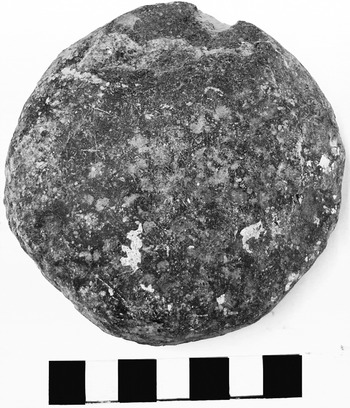
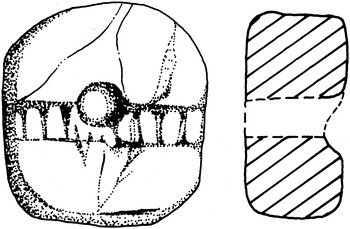
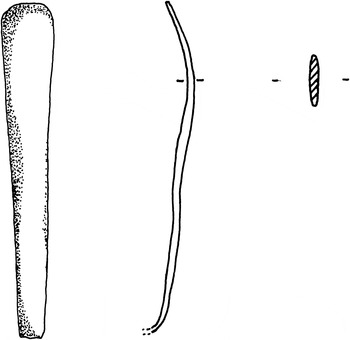
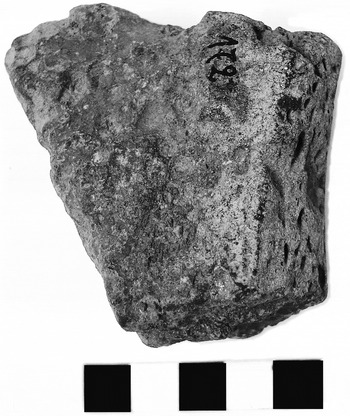
Besides defence, the position of the site is well suited for agriculture, since it is located in the vicinity of perennial water flows and has relatively easy access to arable land at the foot of the hill as well as on the terraced slopes (Keller Reference Keller1985, 177). The chipped stone tools were produced locally, although, obviously, obsidian procurement had to be done through contact with outsiders. C. Perlès argues that the chipped stone objects are of poor craftsmanship and may be generally dated to the Middle Bronze Age, although very few of them are diagnostic. This points to local production of a utilitarian nature. One spindle whorl testifies, rather poorly, to the existence of textile production on the site. The settlement might have been self-sufficient in metallurgical products as well (but not in the raw materials needed for their production), although the question of on-site metallurgy during the Middle Bronze Age remains open. The slag found on or in the vicinity of what was most likely the centre of the site, as well as a fragment of a bronze ingot and a very rare example of a ‘swage block’ (Keller Reference Keller1985, 276), suggests that the Bronze Age inhabitants of Ay. Nikolaos were engaged in metallurgy (Fig. 22). How to date these activities is somewhat problematic. The only datable metallurgy-related object from the site is the ‘swage block’. Its only analogies, distant at that, come mostly from Late Bronze Age contexts. However, we are uncertain that the interpretation of this artefact as a swage block is the most correct one. Other examples of swage blocks from the Aegean Bronze Age, whether made of metal or stone, are much more complex than the Ay. Nikolaos piece (Schliemann Reference Schliemann1880, 436 nos. 606 and 607; Bosanquet and Dawkins Reference Bosanquet and Dawkins1923, 124 fig. 105; Bass Reference Bass1967, fig. 112.136). Furthermore, they are made of sturdier material, which is essential for that type of tool as it is constantly exposed to high pressure, forceful striking, and continually high temperatures. The schist, which the Ay. Nikolaos example is made of, is too friable to be used for those purposes and it tends to flake even under slight pressure. An alternative explanation for this artefact could be its use as a so-called ‘arrow-straightener’, a type of object known from Aegean contexts of similar and later date but also well attested in the ethnographic record worldwide. These artefacts were most likely used to make or maintain the shafts of arrows. The fragmented tweezers (Fig. 23) and the fragment of a bronze ingot (Keller Reference Keller1985, 277–8) (Fig. 24) are no more helpful in shedding light on Ay. Nikolaos metallurgical activities. Tweezers of this type are hard to date. The Ay. Nikolaos example belongs to Branigan's type II (Branigan Reference Branigan1974, 31 pl. 15), which is common in the Aegean during both Early and Middle Bronze Age, probably due to its simplicity. As for the ingot fragment, its very nature suggests on-site smelting. Keller classifies it as part of a Kissenbarren ingot, which can be dated to the Middle Bronze Age (Keller Reference Keller1985, 277–8), although the small size of the fragment prevents precise identification. This notwithstanding, we believe it is far-fetched to base Karystian indigenous metallurgy solely on one possible ingot fragment. It seems probable that a more substantiated answer to the question of the plausible Middle Bronze Age metallurgy at Ay. Nikolaos and in the Karystia in general will not be forthcoming without an excavation.
Ay. Nikolaos. ‘Swage’ block (Scale 1:1.5).

Ay. Nikolaos. Bronze tweezers (Scale 1:1.5).

Ay. Nikolaos. Bronze ingot.

Finally, material datable to the Late Bronze Age is conspicuously absent from southern Euboea. The only physical remains of Mycenaean Karystos, which is mentioned by Homer and probably referred to in a Linear B tablet from Thebes as ka-ru-to (Aravantinos Reference Aravantinos, Killen, Melena and Olivier1987), are four fragments of kylix stems and the rim of a krater. There are very few other traces of Late Bronze Age presence in southern Euboea. The possibility remains that more substantial remains of the Late Bronze Age were obliterated by subsequent activity in the area or that they have yet to be found.
The Late Bronze Age, if we accept the now tenuous claim that the Homeric epics refer to this age, is the time when the Karystia, albeit very hazily, emerges from prehistory. Three locations in southern Euboea are mentioned by Homer in the Iliad and the Odyssey: Karystos (Iliad ii.539), Styra (Iliad ii.539), and Geraistos (Odyssey iii.177). As mentioned above, besides Homer, another piece of written evidence for Late Bronze Age Karystos is its mention on a Linear B sealing from ancient Thebes. Karystos is mentioned there in the form of ka-ru-to, and Aravantinos (Reference Aravantinos, Killen, Melena and Olivier1987) is certain it refers to Euboean Karystos, because another town on Euboea, Amarynthos, is mentioned on another sealing from the same group.
Evidently, the Late Bronze Karystia left some mark in the evidence pertinent to the period. How can we then explain the absence of more substantial Late Bronze Age archaeological remains? Notwithstanding the unlikely possibility that the Late Bronze material evidence was completely obliterated by subsequent processes, we think that the explanation perhaps lies in the change of perspective more than in anything else. The solution to our mystery of missing Mycenaeans might be in changing the way we look at communities in the Late Bronze Age. As Canuto and Yaeger (Reference Canuto and Yaeger2000, passim) have shown, communities are not necessarily site-based entities and they need not contain a central, archaeologically easily recognisable settlement within their territory to be defined as such. At the most basic level communities can be simply defined as groups of people whose members consider themselves as part of such sociopolitical, economic, cultural, or kinship-based entities. Thus, the Late Bronze Karystos mentioned by Homer and on the sealing from Thebes may not have been an actual site but a dispersed community of people who inhabited the area. This explanation, however, does not account for the total absence of Late Bronze evidence elsewhere in southern Karystia. Although literary evidence seems to suggest otherwise, it is also possible (although to us it does not seem probable) that the Karystia was not permanently occupied during the Late Bronze Age and that the scant remains from Ay. Nikolaos represent evidence for one-time or, at best, infrequent visitation.
CONCLUSIONS
The principal goals of this paper were to put the Karystia on the map of Middle Bronze Age Greece by presenting the surface pottery and other finds from the site of Ay. Nikolaos, and to examine the position of Ay. Nikolaos within the Karystian prehistoric sequence. As evident from the data, Ay. Nikolaos is a diachronic site with a significant Middle Bronze component. It is so far the only location in southern Euboea where Middle Bronze and Late Bronze material has been recorded. As such, the site has an enormous potential to shed light on the later prehistoric sequence in southern Euboea, which is, recent advances notwithstanding, still insufficiently understood. We have tried to put forward some ideas about the prehistoric periods in the area, which should at this time be regarded more as hypotheses in need of testing than as proper explanations. Despite the wealth of data streaming from the persistent and ongoing archaeological work in the area, the complete picture of Karystian prehistory will be hard to reconstruct without the excavation of Ay. Nikolaos.