Introduction
Martian ground contains 5–14% iron oxide and that is responsible for the reddish surface colour of the Planet. The oxidizing agent in the ground impedes the consolidation of complex organic compounds. Artificial Martian ground (AMG) is composed of fine-grained igneous rock, iron-rich smectite clays, magnesium sulphate, iron oxides and reactive oxidizing agents. There are patches containing Hematite (mostly magnetite), an iron oxide formed after sedimentation during the heat influx and reactive volcanic fluids. Silicon minerals, other metal oxides and calcium carbonate are present (perhaps synthesized by the interaction between the atmospheric water vapour and carbon dioxide). AMG also contains significant levels of chlorides and sulphides (mostly iron); the pH is alkaline, a level of 8 or 9. It also contains traces of magnesium, sodium, potassium and other elements giving it hydrophilic properties (Tarasashvili & Aleksidze Reference Tarasashvili and Aleksidze2010).
Modern mineral filling agents demonstrate increased durability and rigidity that makes them suitable for the use of polymer composites (Mukbaniani et al. Reference Mukbaniani, Markarashvili, Iskakova, Aneli and Gventsadze2008, Reference Mukbaniani, Aneli and Markarashvili2010a). These fillers have decreased intensity of the shrinkage during hardening and water absorption processes; at the same time they possess thermal stability, fire proof and dielectric properties. Finally, they are affordable, cheap and easy to manufacture (Mils & Lyuis Reference Mils and Lyuis1964; Aneli et al. Reference Aneli, Gventsadze, Markarashvili and Mukbaniani2008). It is important to mention that at high concentrations these fillers in composites may lead to the appearance of different unsuitable physical properties of composites, such as an excess number of air-sacks and cracks. Therefore the attention of scientists is attracted to the supporting substances, which could prevent the appearance of these disadvantages. It is known that silicon organic substances (both low and high molecular) reveal hydrophobic properties, high elasticity and durability throughout a wide range of temperature, humidity, pressure and other environmental factors (Mukbaniani et al. Reference Mukbaniani, Aneli, Markarashvili, Titvinidze, Katsitadze and Gogesashvili2010b).
The purpose of the presented work was the investigation of the modifying effects of tetraethoxysilane (TEOS) filler on the AMG. Some epoxy resin based composites have been used as the support material. The practical output of our work is obtaining composite materials from the Martian ground, which would be suitable for use in the extreme conditions on Mars as a building block material.
Experimental
It is essential for the building material to withstand the harsh environmental conditions on Mars and at the same time to be compatible with the requirements of different construction technologies. Thus the material has to be waterproof, flexible and mouldable at relatively high temperatures in order to be processed through the building facility. During experiments the solubility, hardening, softening and melting capabilities of the Martian composites have been tested.
Ten samples have been prepared for each type of the experimental composite and the obtained results are the mean numbers calculated from the testing of these specimens including calculated uncertainties. As the experiments have been performed on the atypical material, the Certified Reference Material (CRM) for which cannot possibly be found, for each measurements the mean value and standard deviation from all specimens for each type of material has been calculated. For example the softening temperatures of the composite interior at maximal enrichment with ED-20 were calculated using the Charpy impact test method for each sample. For the absorbed energy value repeatability was calculated as E max–E min and the error calculated from the residual was <7%.
Samples have been tested for the durability in the MCSC – Mars Climate Simulation Chamber ‘Artificial Mars’ within simulated Martian Conditions (GEO PAT 12 522/01) (Tarasashvili et al. Reference Tarasashvili, Sabashvili, Tsereteli and Aleksidze2013). Tensile properties like deformative oscillation and stretch-collapsing resistance have been measured by tensoresistors, e.g. deformation strain gages installed with Charpy impact machine systems.
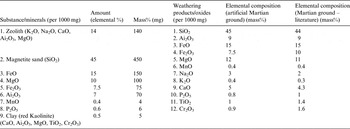
The initial TEOS was supplied from Sigma–Aldrich and has been used as filler for the AMG. All chemical variation of the AMG has been prepared based on the known chemical composition of the Martian ground (Table 1) (GEO PAT 11-234 (2015)).
AMG represents the thin-dispersive powder (the sizes of particles up to 50 µm). Chemical composition of the AMG shows: (a)Minerals and other substances – mass%; (b) Oxides (products of geological weathering) elementary composition – mass%(GEO PAT 11-234 (2015)). When hydrological origin is imitated, random amounts of chlorides, sulphates, iron sulphide and other hydrological minerals are added. Perchlorate-free sample has been used for this particular experiment

The purity of the initial materials was controlled by an ‘LKhM-8-MD’ gas–liquid chromatography (Russian model), phase SKTF-100 (10%), the NAW chromosorb, carrier gas He, 2 m column. Fourier transform infrared spectroscopy (FTIR) spectra were recorded on a Jasco FT/IR-4200 device. Organic solvents were purified via drying and distillation; physical–mechanical and thermal properties and water absorption of the obtained composite polymer materials were testified by the standard methods.
Preparation of the composite materials for building purposes: The building material on the base of thin-dispersive filler particles of AMG using of TEOS and epoxy resin (of type ED-20) was prepared by the following procedures: First, the composite of AMG, TEOS and epoxy resin with varying contents of mixing products was obtained after careful mixing of the components with a mixer in high humidity conditions – the concentration of the filler powder varied in the range of 10–60 mass% then, in accordance with ISO standards the preliminary blends with a hardening agent (polyethylene–polyamine) were placed within cylindrical moulds for hardening at room temperature +20°C during 24 h. Hardened samples passed the temperature treatment at 120°C during 4 h in the oven. Epoxy resin has been used as a silanization agent in order to increase waterproof and hermetic capabilities of the obtained composite materials.
Results and discussion
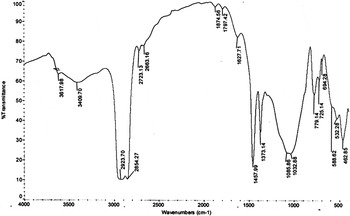
At the first stage the FTIR spectra of Martian ground was studied on the Jasco FT/IR-4200. Figure 1 shows FTIR spectra of the artificial Martian ground. Absorption bands of the non-associated hydroxyl groups are observed in the 3300–3600 cm−1 range; absorption bands at 2800–3000 cm−1 region is present, which are characteristic for ≡Si–C≡ bonds and for the deformative oscillation of ≡C–H bonds.
FTIR spectra of the artificial Martian ground

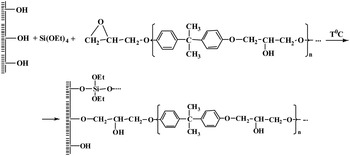
TEOS was used for providing the waterproof properties of the composite materials. For the modification of the AMG TEOS with a value of 3 and 5 wt.% was used. Most likely, a silanization reaction between AMG with TEOS and the hardening process of the mixture (with the presence of the epoxy groups) runs according to the following Scheme 1:
Silanization reaction and the hardening process of the Martian ground composite

The similar condensation reaction proceeds with other hydroxyl groups. The specified reaction of silanization not only leads to the improvement of the waterproof properties of composites, but also promotes an activation of the component – binding properties within fillers (Mukbaniani et al. Reference Mukbaniani, Aneli, Markarashvili, Titvinidze, Katsitadze and Gogesashvili2010b).
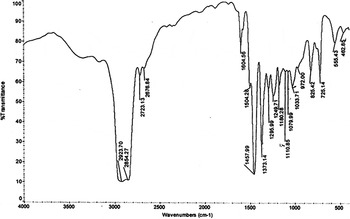
Obtained composite materials are brown cylindrical solid systems. Figure 2 demonstrates the FTIR spectra of composite materials with the evidence that the intensity of the absorption bands of hydroxyl groups decreases between the range 3300 and 3600 cm−1. Absorption bands characteristics of unreactive epoxy groups can be detected at 825 cm−1.
FTIR spectra of composite materials

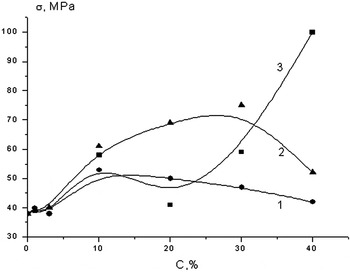
Three obtained curves with different quality and quantity are presented in Fig. 3. The first curve corresponds to the concentration dependence of strengthening for composites with unmodified (unprocessed) AMG. This curve is characterized with a wide maximum, which corresponds to the known extreme dependence ‘composite strengthening – filler concentration’. The strengthening for these composites reaches its maximum/peak at relatively low concentrations of the filler (between 10 and 20 wt.%); within composites containing the filler modified by 3 and 5 wt.% this maximum is shifted to the higher concentrations (of the filler) – Fig. 3 (curves 2, 3). The curve 3 has some peculiarities/anomalies, which has one maximum at relatively low concentrations of the filler. The appearance of this curve shows that a more rapid increase of the filler concentration leads to the essential worsening of the composites mechanical properties. Practically it was very difficult to obtain composites with filler concentrations above 40–50 wt.%, in accordance with the general character of such dependencies (Mukbaniani et al. Reference Mukbaniani, Aneli, Markarashvili, Titvinidze, Katsitadze and Gogesashvili2010b).
The dependence of the strengthening of composites based on epoxy resin – type ED-20 and unmodified Martian ground (1), composites with modified by 3 (2) and 5 wt.% TEOS filler (3)

The curves in Fig. 3 show that the modifier TEOS promotes the essential effect on the described dependence of the strengthening of these composites properties – TEOS incorporates into the chemical reactions with active groups on the filler particle surfaces and creates new chemical bonds between its compounds enhancing mechanical properties of these composites. In addition to this, TEOS creates new chemical bonds with macromolecules during thermal treatment processes of the composite, fills the pores (air-sacks) between macromolecules and creates ‘buffer’ zones between filler particles and macromolecules.
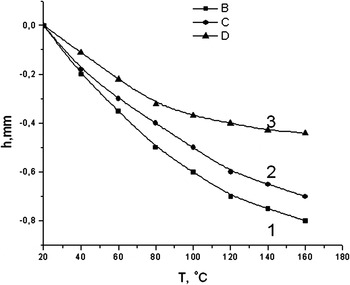
Structural peculiarities within composites have also been revealed during the testing of the thermal–mechanical properties in extreme environmental conditions within Mars Climate chamber (Tarasashvili et al. Reference Tarasashvili, Sabashvili, Tsereteli and Aleksidze2013). The epoxy resin filled with AMG particles demonstrates the best compatibility of the components unlike unmodified filler (solvent – AMG mix). The mechanical stresses acting on composites (low pressure and temperatures) influence different deformation forces, but are effectively absorbed by the soft siloxane phase. It is equivalent to the limitation of formation of the micro defects within the matrix of the carbon chain, which are embedded between siloxane regions and, consequently, the fragility of the composite decreases significantly. Figures 4–6 demonstrate the temperature dependence of the composite softening.
Dependence of the softening of pure ED-20: (1); composite of this resin with unmodified Martian ground with a concentration of 10 wt.% (2); same composite which was modified by 3 wt.% TEOS of the filler (3)

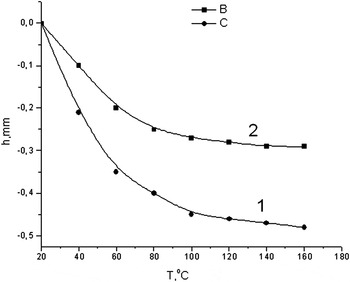
Dependence of the softening of filler content on the temperature: ED-20 based composite with unmodified (1), and modified (2) by 5 wt.% TEOS Martian ground at 20 wt.%

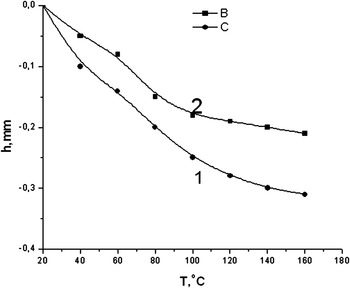
Dependence of the softening of composite on the temperature: based on ED-20 with unmodified (1) and modified (2) 5 wt.% TEOS Martian ground at filler content 30 wt.%. Softening temperatures of the composite interior at maximal enrichment with ED-20 were calculated using the Charpy impact test method (Table 2)

The curves in Fig. 4 show that: (1) Introduction of the medium concentration of the filler to the composite leads to a definite improvement in the thermal stability of the material. Stability of the composites also increases when they contain filler modified by TEOS. Here TEOS improves thermal stability of the composites as it promotes the formation of physical (diffusion of polymer segments onto the surface defects an irregularity and deepening of the filler particle) and chemical bonds between the hydroxyl groups of the filler particles and active groups (epoxy) of the binder (polymer). Best results are obtained for composites containing filler AMG modified by 5 wt.% TEOS.
The thermal stability of the composites with higher (20 and 30 wt.%) concentrations of modified by 5 wt.% TEOS filler is enhanced as a result of an increase in the apparent contact surfaces between phases (Figs. 5 and 6).
Data depicted in Table 2 show that the softening properties of the composites are proportional to the mass enrichment of the pores with epoxite. Namely the value of air-sack deepening decreases with the increase of the filler content in the composite as a result of the increasing/heightening stiffness and hardening. At the same time this results in a shift in the maximum optimal temperature at higher values.
Softening temperatures of the composite interior at maximal enrichment with ED-20 were calculated using the Charpy Impact Method

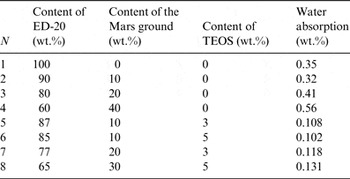
TEOS enhances the compatibility of macromolecules within the particles of the Martian ground and improves the water-repelling properties of the investigated materials. The data depicted in Table 3 show that the increase in the concentration of the filler leads to a loosening in the micro-structure and formation of connected or unconnected micro air-sacks and consequently increases water-absorption. This property could be very useful on the interior sites of the Mars station when it comes to the condensation of water-vapour from the atmosphere. However, for the composites modified by TEOS-enhanced filler these absorption capabilities are several times lower than that of analogous composites with unmodified filler. Here the well-known hydrophobic properties of the siloxane compounds reveal themselves (Mukbaniani et al. Reference Mukbaniani, Aneli, Markarashvili, Titvinidze, Katsitadze and Gogesashvili2010b). Considerably, a further increase of filler (AMG) concentration leads to the deterioration of the mechanical, thermal and hydrophobic properties of the composite materials and makes them unsuitable for use within extreme Martian conditions. Associated equivalents to such structural defects are examples of the experimental composites containing 20 and 30 wt.% of modified fillers.
The water absorption coefficient of composites with fillers (AMG) modified and unmodified by TEOS composites: ED-20 + Artificial Martian ground

In accordance with the data depicted in Table 2 the water absorption capabilities of the composites rise as the filler concentration is increasing both in the case of unmodified filler (2, 3 and 4) as well as the one modified by TEOS (4, 5 and 6) – because of the formation of some structural defects within constructions through which the water molecules can penetrate/permeate the material. However, the water absorption in composites containing filler modified by TEOS decreases, especially when the content of the latter is 5 wt.% in comparison with the composites contained the unmodified filler.
Conclusion
Polymer composites on the basis of epoxy resin with the AMG containing the various latter contents have been obtained for the first time. Preliminary experiments have shown that the use of this filler allows polymer composites to be obtained with essentially high physical properties (mechanical strengthening, thermal stability and water tightness) to be used in the future as building materials on Mars. Chemical modification of the Martian ground filler with a small amount of TEOS significantly enhances all studied properties in comparison with analogues containing the same non-modified filler. This phenomenon is explained by the formation of the buffer zone between macromolecules and filler particles created with TEOS. The role of the morphology of the surface of the Martian ground particles and its chemical surroundings for the formation of microstructure of polymer composite is the subject of our future studies; however, the suitability of the Martian ground for the successful construction of future Mars station buildings has been proved.
Acknowledgement
Authors express their gratitude to the Institute of Macromolecular Chemistry and Polymeric Materials at the Iv. Javakhishvili Tbilisi State University for granting the access and use of the Charpy Impact Machine Systems. The artificial Martian ground (AMG) was created within the frameworks of the Science Project “Imitation of Martian Ecosystem for the solution of Several Tasks necessary for Terraformation of the Planet” N GNSF/ST08/6-221 funded by Shota Rustaveli Georgia Science foundation (www.rustaveli.org.ge) from 2008 to 2014. This research has made use of NASA's Astrophysics Data System.