Introduction
Cyrtandra J.R.Forst. & G.Forst. is a large genus of c.800 species of herbs, shrubs, climbers and small trees (Atkins et al., Reference Atkins, Bramley and Clark2013). It is a predominantly Southeast Asian genus and is found in the Nicobar Islands in the Indian Ocean, throughout Malesia, in Taiwan and the southern Japanese islands, in northern Australia, and across the Pacific as far east as the Marquesas and north to Hawaii. It is recorded on the Asian continent only as far north as central Thailand. Its centres of diversity are New Guinea and Borneo (each with more than 100 species) and the Philippines (with more than 80 species) (Atkins et al., Reference Atkins, Bramley and Clark2013). It is found in the rain forest, from sea level to over 2000 m.
The Indonesian island of Sulawesi is the largest island in the biogeographical region known as Wallacea; it was identified in 2001 as being one of the top ten places in the world most in need of floristic work (Frodin, Reference Frodin2001), and it remains one of the islands in the region with the lowest collecting densities (Kessler et al., Reference Kessler, Bos, Sierra Daza, Kop, Willemse, Pitopang and Gradstein2002; Cannon et al., Reference Cannon, Summers, Harting and Kessler2007). The position of Sulawesi at the heart of Malesia, one of the most geologically complex areas in the world, makes knowledge of the affinities of the flora of the island crucially important to understanding both the biogeography of Southeast Asia and the evolution of many Southeast Asian plant groups (Mendum & Atkins, Reference Mendum and Atkins2004).
There is currently no revision of the genus Cyrtandra on Sulawesi, and until recently, no new taxa had been described since 1906. Recent expeditions to the island and subsequent research on the collections has, however, resulted in the description of a number of new species in the genus (Atkins, Reference Atkins2003; Bone & Atkins, Reference Bone and Atkins2013; Kartonegoro & Potter, Reference Kartonegoro and Potter2014). The discovery of a further eleven new species, described here, brings the current total for the island to 32. More, however, await description, and a full revision, including a key and discussion on relationships and species groupings, based on ongoing molecular phylogenetic work on the genus in Southeast Asia, is in preparation.
Materials and Methods
All available Cyrtandra specimens from A, BM, BO, CANB, E, K, L, S and SING were examined. In addition, photographs of plants growing in the field and living collections held at the Royal Botanic Garden Edinburgh (RBGE) were consulted, when available. All vegetative and fruit measurements were taken from dried material and floral characters and measurements were taken from spirit material or rehydrated herbarium material. Species descriptions follow, as closely as possible, the structure and content of other published Cyrtandra descriptions from the island. A lack of collecting activity in Sulawesi, compared with other Indonesian islands (Cannon et al., Reference Cannon, Summers, Harting and Kessler2007), means that little material is available for comparison. All material cited (as type material and, when available, additional specimens) comprise the extent of our knowledge of these species.
Proposals for IUCN conservation categories were made following the IUCN Red List Categories and Criteria and associated guidelines (IUCN, 2012). Forest types referred to in these notes follow the definitions stated in Cannon et al. (Reference Cannon, Summers, Harting and Kessler2007). When more than two collection localities were known for a species, precise geographical coordinates of collection localities from specimen labels, or georeferenced place names, were used to estimate extent of occurrence (EOO) and area of occupancy (AOO; sensu IUCN criterion B1) using a 2 km by 2 km grid cell in GeoCAT (Bachman et al., Reference Bachman, Moat, Hill, Torre and Scott2011). Because Sulawesi is under-explored (and these species under-sampled), these calculations probably underestimate true EOO and AOO values; however, we feel that their inclusion helps to emphasise the urgent need for more extensive surveying in the region to adequately assess threats to these species.
Species Descriptions
The inflorescences of all the species described here are cymose, sometimes densely clustered and occasionally reduced to one or two flowers. Likewise, the fruits of all species are indehiscent.
Cyrtandra albiflora Karton. & H.J.Atkins sp. nov.
Distinguished from other species in Sulawesi by a combination of its dense, villous indumentum, small white flowers and clustered axillary inflorescences. – Type: Indonesia, Central Sulawesi, Sumber Agung, Sungai Spa, 92 m, 24 ii 2004, Hendrian, Newman, Scott, Saleh & Supriadi 848 (holo E, iso BO). Figs 1, 2.
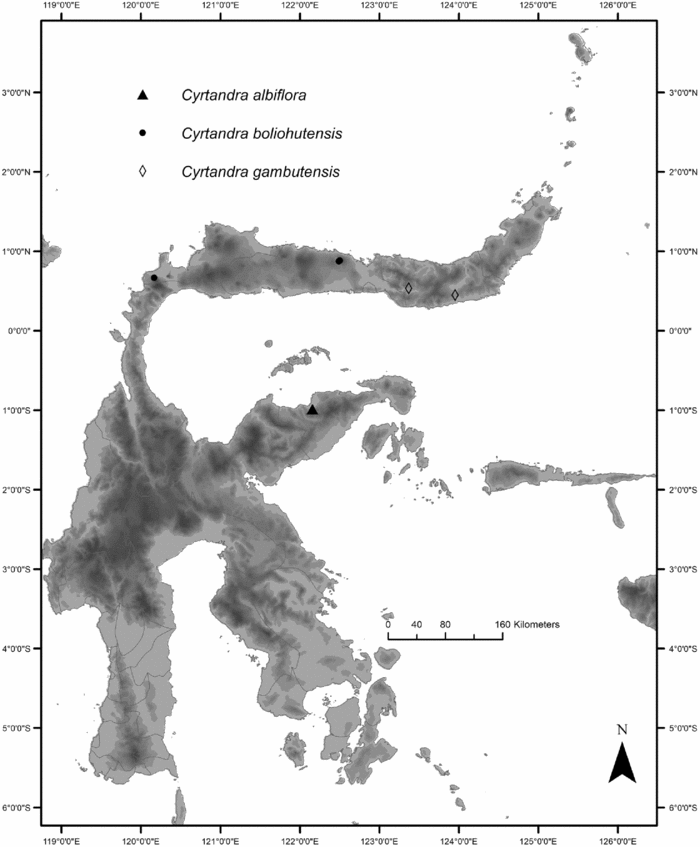
Known distribution of Cyrtandra albiflora Karton. & H.J.Atkins, Cyrtandra boliohutensis Karton. & H.J.Atkins and Cyrtandra gambutensis Karton. & H.J.Atkins.

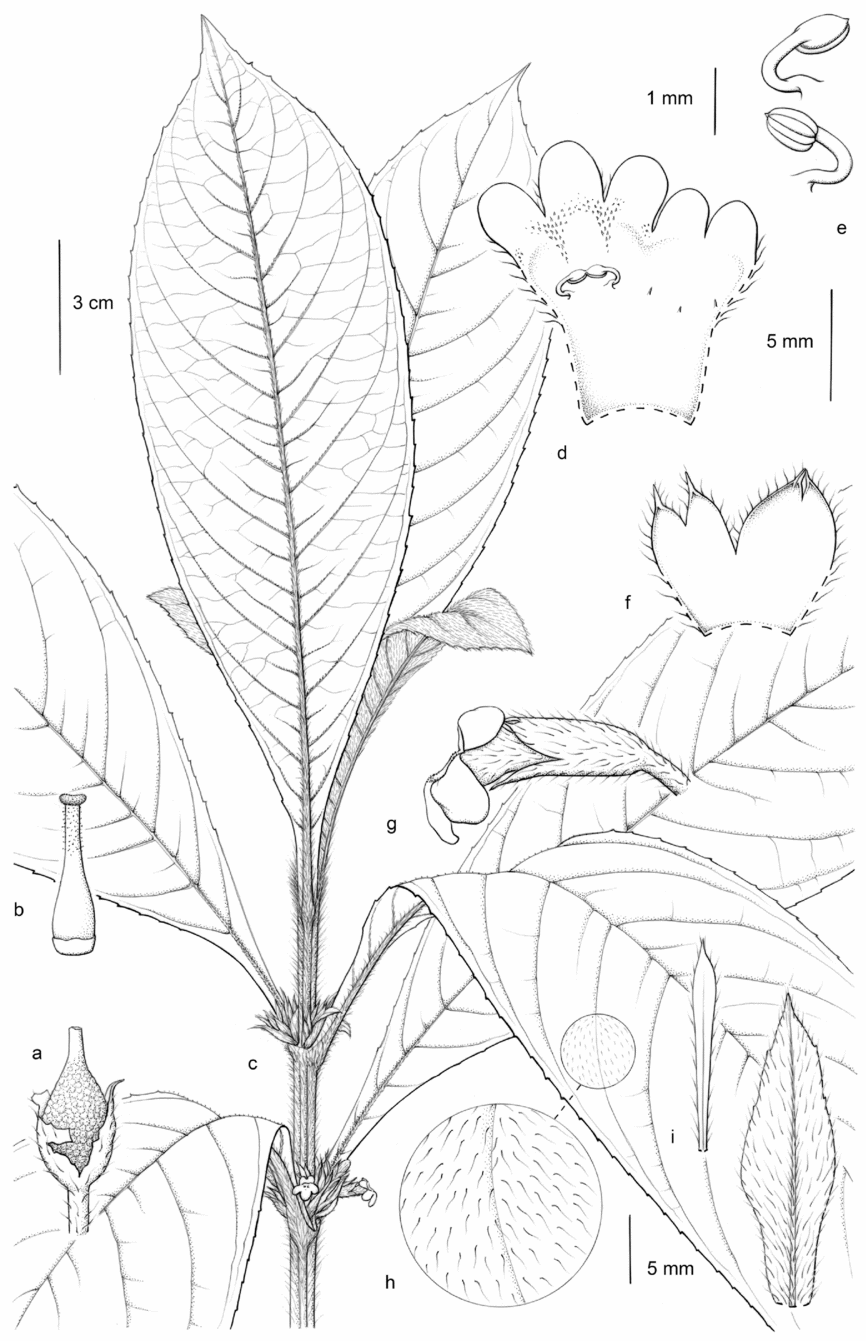
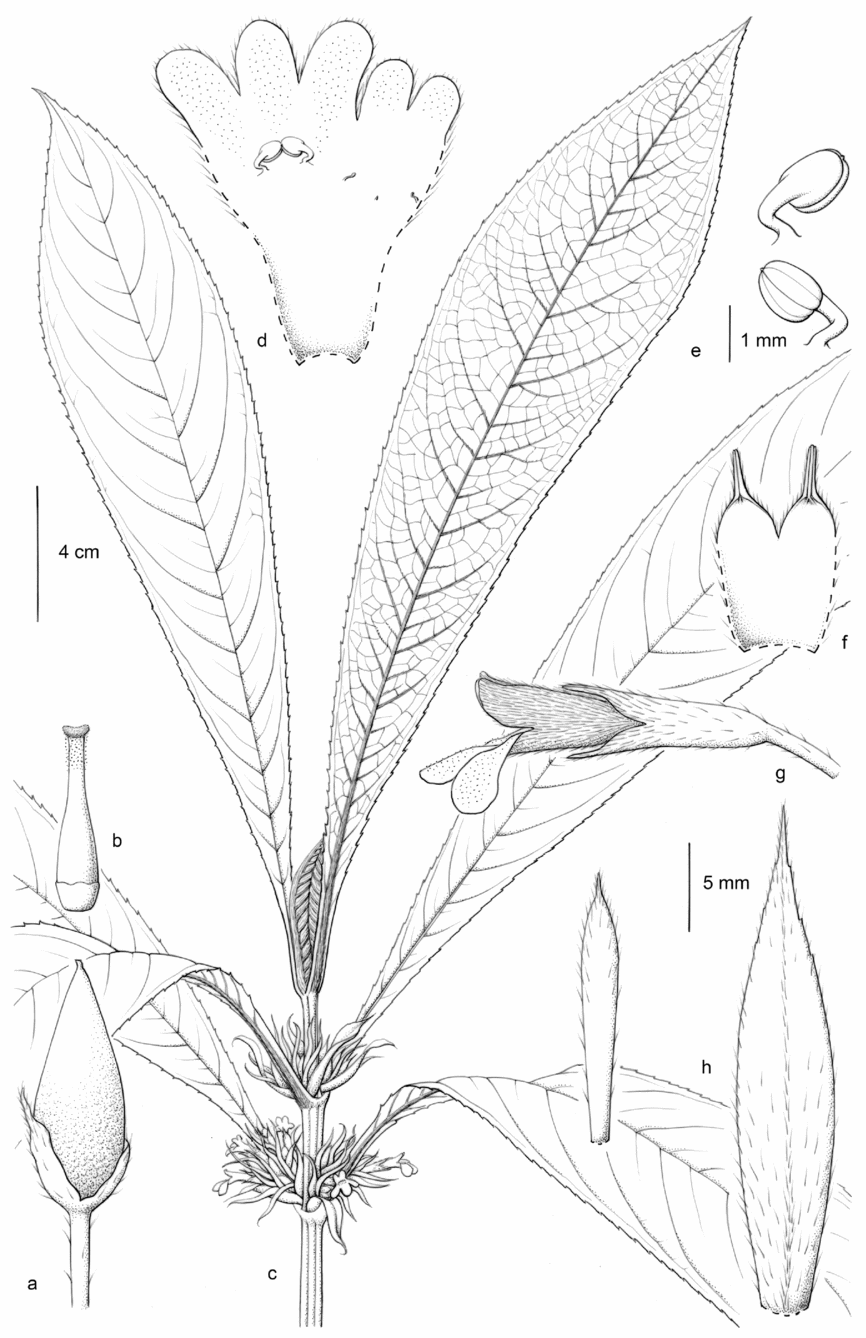
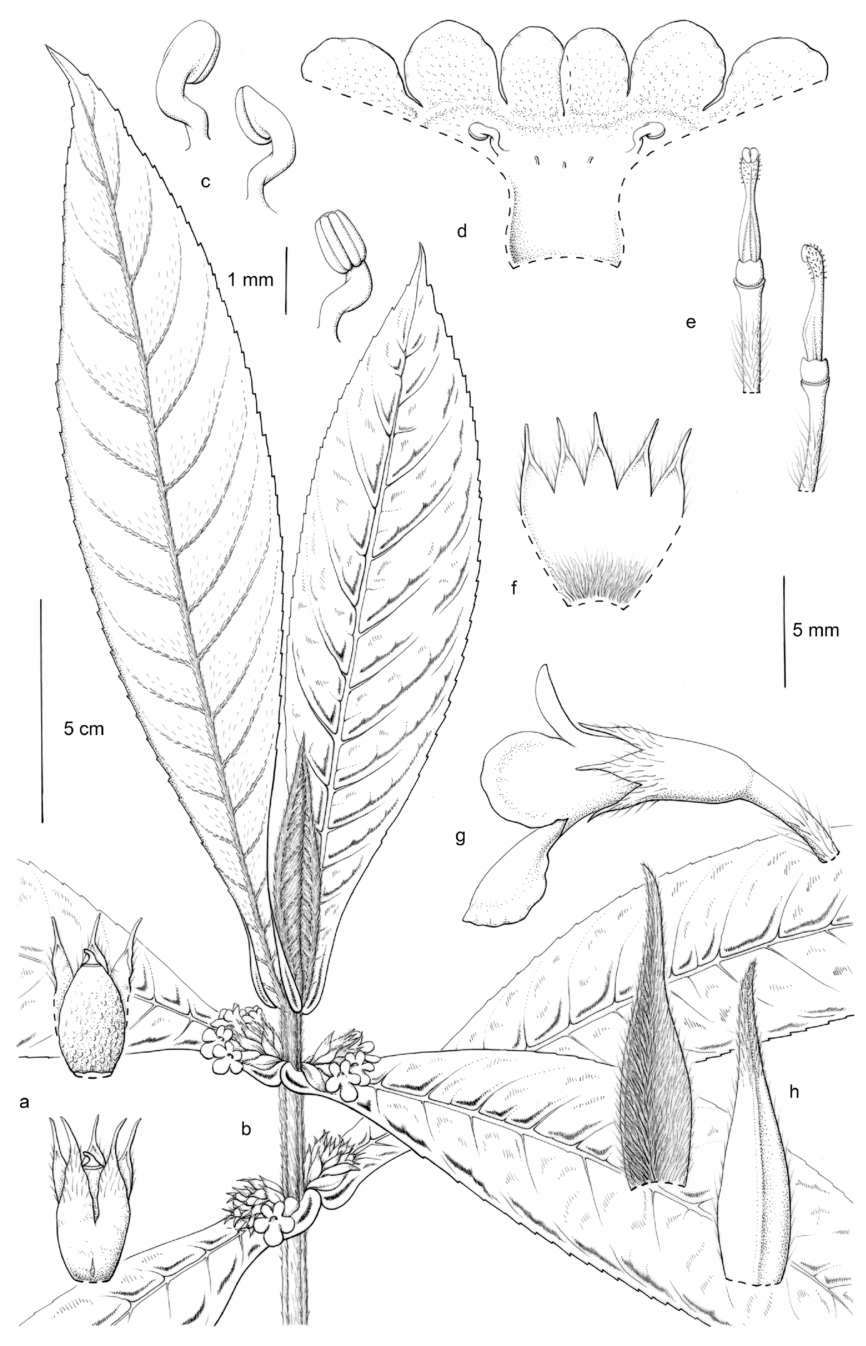
Cyrtandra albiflora Karton. & H.J.Atkins, sp. nov. A, Fruit enclosed by the persistent calyx; B, gynoecium; C, habit; D, corolla, longitudinal section; E, anthers; F, calyx, longitudinal section; G, flower, lateral view; H, detail of upper leaf surface; I, bracts and bracteoles. Drawn from Hendrian et al. 848 (E).

Shrub up to 60 cm in height. Stems striate, densely villose hairy on young growth, hairs up to 3 mm, indumentum less dense on older growth. Leaves opposite, subequal (with occasional whorl of smaller leaves on cultivated plant); petiole c.2 cm long, hairy, narrowly winged; blades 17–22.5 × 5.1–7.7 cm, narrow oblong, apex acuminate, base attenuate, margin serrulate; 9–11 pairs of lateral veins and reticulate tertiary venation, light green and hairy above, appearing whitish and hairy below, most densely so on midrib and veins. Inflorescences axillary, subsessile, with c.8–10 flowers at various stages of development; bracts green, 10–11 × 5 mm, linear-lanceolate, hairy on both surfaces, most densely so along margins, caducous; bracteoles 6–8 mm long, linear, hairy internally and along margins; pedicels 2–3 mm long, densely hairy. Calyx tubular, green, 5–6 mm long, lower lip bilobed, lobes short acuminate, c.3 mm long, upper lip divided very briefly at apex, densely hairy externally. Corolla white, 10–12 mm long, widening gradually to mouth, mouth oblique, upper lobes suborbicular, erect to slightly recurved, 1.5 × 2 mm, lower and lateral lobes more elongate, spreading to slightly recurved, 3 × 2.5 mm, hairy externally and with glandular hairs on inside of lobes and in mouth. Stamens 2; filaments short, c.1 mm long, attached 5–6 mm from base of corolla, glabrous; anthers c.1 mm long, glabrous, cohering at apices; staminodes 3, tiny, less than 0.2 mm long. Gynoecium 5.5–6 mm long overall; disc cupular with undulate margin, 1 mm long, glabrous; ovary glabrous; style glandular hairy; stigma slightly bilobed, lobes small and held upright on specimens seen. Fruits ovoid, drying dark brown, glabrous, verrucose, 5–6 × 2–3 mm, base of style and calyx persistent.
Distribution
Central Sulawesi: Luwuk (see Fig. 1).
Habitat and ecology
Disturbed lowland primary forest in a limestone area at an altitude of 92–220 m.
Etymology
This species is named for its white flowers.
Proposed IUCN conservation category
Cyrtandra albiflora is known from a single mountain from two collections made on the same trip in 2004 at altitudes of 92 and 220 m from disturbed primary forest in a limestone area. According to Cannon et al. (Reference Cannon, Summers, Harting and Kessler2007), “little over 20% of lowland forests” can be described as “good forest cover” in Sulawesi, and it is one of the most threatened habitats on the island. There are no protected areas in this part of Sulawesi (UNEP-WCMC & IUCN, 2016).
A lack of specimens of Cyrtandra albiflora precludes estimations of EOO and AOO. Until more intensive botanical exploration can be made in this area, it is assumed that this species is restricted to the type locality. It is not possible to comment on latent threats to the population with any certainty, but if the general threats to this habitat type are real (specifically forest clearance for agriculture) and there is no protection in place, then the only known population of this species could be at risk of decline or extinction. We recommend that this species is categorised as Vulnerable (VU) using the criterion VUD2, because it is a population with a very restricted number of locations and, as such, is prone to the effects of human activities or stochastic events and thus capable of becoming Critically Endangered or even Extinct in a short period of time, and we emphasise the importance of carrying out further survey work in this region.
Additional specimen examined. Central Sulawesi: Luwuk, Mt Hek, Sungai Spa, 24 ii 2004, Scott, S. 04–307, grown on at RBGE as accession 20040645A, vouchered as Scott 509 (E).
This species is most similar to Cyrtandra hendrianii (described here and collected from the same location), but it can be distinguished by its white corolla (versus corolla pink), green calyx (versus calyx red), densely villous stems and leaves (versus stems and leaves more less glabrous) and linear-lanceolate bracts 10–11 mm long (versus oblong-lanceolate bracts, 25–35 mm long).
Cyrtandra boliohutensis Karton. & H.J.Atkins sp. nov.
Distinguished from other species in Sulawesi by a combination of its inflorescence at the base of the stem, anisophyllous leaves and ridged calyx. – Type: Indonesia, Gorontalo Province, Mt Boliohutu, 300 m, 24 iv 2002, Atkins, Mendum, Newman, Hendrian & Sofyan 188 (holo BO, iso E). Figs 1, 3.
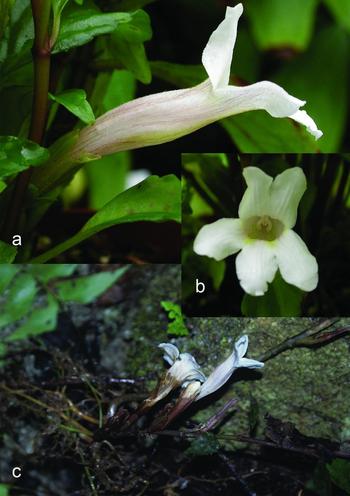
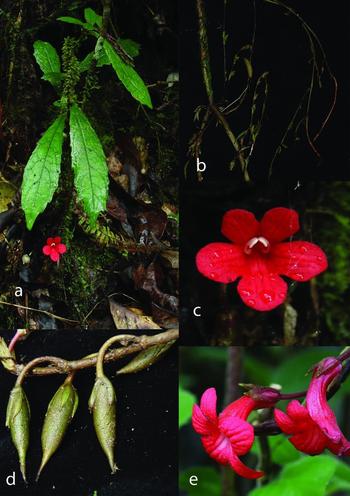
Cyrtandra boliohutensis Karton. & H.J.Atkins, sp. nov. A, Flower, lateral view; B, corolla, anterior view; C, habit. (Photographs: A and B, Steve Scott; C, Hannah Atkins.)

Branching herb up to 1 m in height. Stems slender, striate, sparsely hairy. Leaves opposite, both members of a pair well developed but somewhat unequal in size or with one leaf of a pair markedly reduced, sometimes appearing alternate; petioles 1.2–2.5 cm long, hairy; blades 7–14 × 3–5 cm, oblong to narrow oblong, occasionally somewhat rhomboid, apex acuminate, base attenuate, slightly asymmetrical, margin serrate; 4–6 pairs of lateral veins, curving and running eventually out to margin, subglabrous above, sparsely hairy below, more densely so on midrib and veins; reduced leaves (where present) 4–5 mm long, scale-like, occasionally cordate. Inflorescences subsessile to shortly pedunculate in leaf axils or at base of stems in the axils of fallen leaves, 1- or 2-flowered; peduncle 1–2 mm long, hairy; bracts elliptic or oblong, glabrous, greenish brown, 11–22 × 8–10 mm, partly enclosing calyx at the base, bilobed at apex or divided almost to base, sparsely hairy; bracteoles single, oblong, glabrous, green-brown, 10–16 × 5–6 mm; pedicels 2–5 mm long, sparsely hairy. Calyx tubular, ridged, green becoming dark red along ridges, 17–25 mm long, evenly 5-lobed, lobes 2 mm long, triangular, acuminate at apex, sparsely hairy outside. Corolla white, tube somewhat flushed pinkish outside, yellow in throat with fine, purple spots on the inside of lobes, 35–65 mm long, narrowly funnel-shaped, flattened laterally, brown hairy externally, lobes spreading not recurved, 9–10 × 5–8 mm. Stamens 2; filaments 8–12 mm long, attached 20–30 mm above base of corolla; anthers 1.5–3 mm long, thecae more or less parallel, coherent at apices, with a ‘fringe’ of hairs at the base of each anther; staminodes 3, 4–7 mm long. Gynoecium 23–35 mm long overall; disc cupular with lobed margin, 2 mm, glabrous; ovary glabrous; style glabrous at base, eglandular hairy towards stigma; stigma peltate, slightly bilobed, 2 mm across. Fruits cylindrical to narrow ovoid or elongate, green or brown-green, glabrous, verrucose, 10–25 × 2–4 mm; calyx not or only partially persistent, base of style persistent.
Distribution
Gorontalo and Central Sulawesi (see Fig. 1).
Habitat and ecology
Lowland to lower montane forest at an altitude of 300–1400 m.
Etymology
This new species is named after one of the mountains on which it was collected.
Proposed IUCN conservation category
Based on both the EOO and AOO, this species would be in the Critically Endangered category (based on 2 × 2 km grid cell size) under the B criteria (Bachman et al., Reference Bachman, Moat, Hill, Torre and Scott2011). The three collections do, however, fall within the protected areas of Nantu Sanctuary Forest and Mount Sojol Nature Reserve (UNEP-WCMC & IUCN, 2016), but at relatively low altitudes, of approximately 300 m, where the general threat to this habitat type on the island is known to be high (Cannon et al., Reference Cannon, Summers, Harting and Kessler2007; Thomas et al., Reference Thomas, Ardi and Hughes2011). Given the restricted distribution of this species and the uncertainty about threat, we recommend Vulnerable (VU) for this species, using the criterion VUD2, and reiterate the need for further botanical exploration in the area.
Additional specimens examined. Gorontalo: Mt Boliohutu, 320 m, 24 iv 2002, Atkins et al. 190 (E, L); Mt Boliohutu, 320 m, 24 iv 2002, Scott, S. 02–126, grown at RBGE as accession 20021906A, vouchered as Scott 505. Central Sulawesi: Mt Sojol, 1400 m, 27 ii 2000, Mendum et al. 00196 (E, L).
This species appears to be morphologically similar to a group of Bornean species that include Cyrtandra basiflora C.B.Clarke. They all have large flowers with long, soft hairs, flower at the base of the stem, have slightly rhomboid, anisophyllous leaves and have a ridged calyx. Of the Bornean species in this group (which includes Cyrtandra sandakanensis B.L.Burtt, Cyrtandra simplex Merr., Cyrtandra sublanea Hilliard & B.L.Burtt and Cyrtandra tenebrosa B.L.Burtt), C. boliohutensis is morphologically most similar to C. basiflora from Sarawak and Brunei but can be most easily distinguished from this species by the number of flowers in the inflorescence (1- or 2-flowered in C. boliohutensis versus 6- or 7-flowered in C. basiflora).
Mendum et al. 00196 from Mount Sojol has been included here, although there are some differences in the shape of the inflorescence bracts. Two further collections from Lore Lindu National Park in Central Sulawesi, Cicuzza 549 and 984, are similar to this species but do not have the distinctive thick beard of hairs at the base of the anthers. Further collections are required to clarify the status of these two collections.
Cyrtandra gambutensis Karton. & H.J.Atkins sp. nov.
Distinguished from Cyrtandra engleri Koord. by its obscure tertiary venation (versus tertiary venation visible), 8–11 secondary veins (versus 4 or 5 secondary veins) and anthers glabrous (versus anthers with a tuft of hairs at apex). – Type: Indonesia, Gorontalo Province, Mt Gambuta, 520 m, 8 iv 2002, Atkins, Mendum, Newman, Hendrian & Sofyan 38 (holo E, iso BO). Figs 1, 4
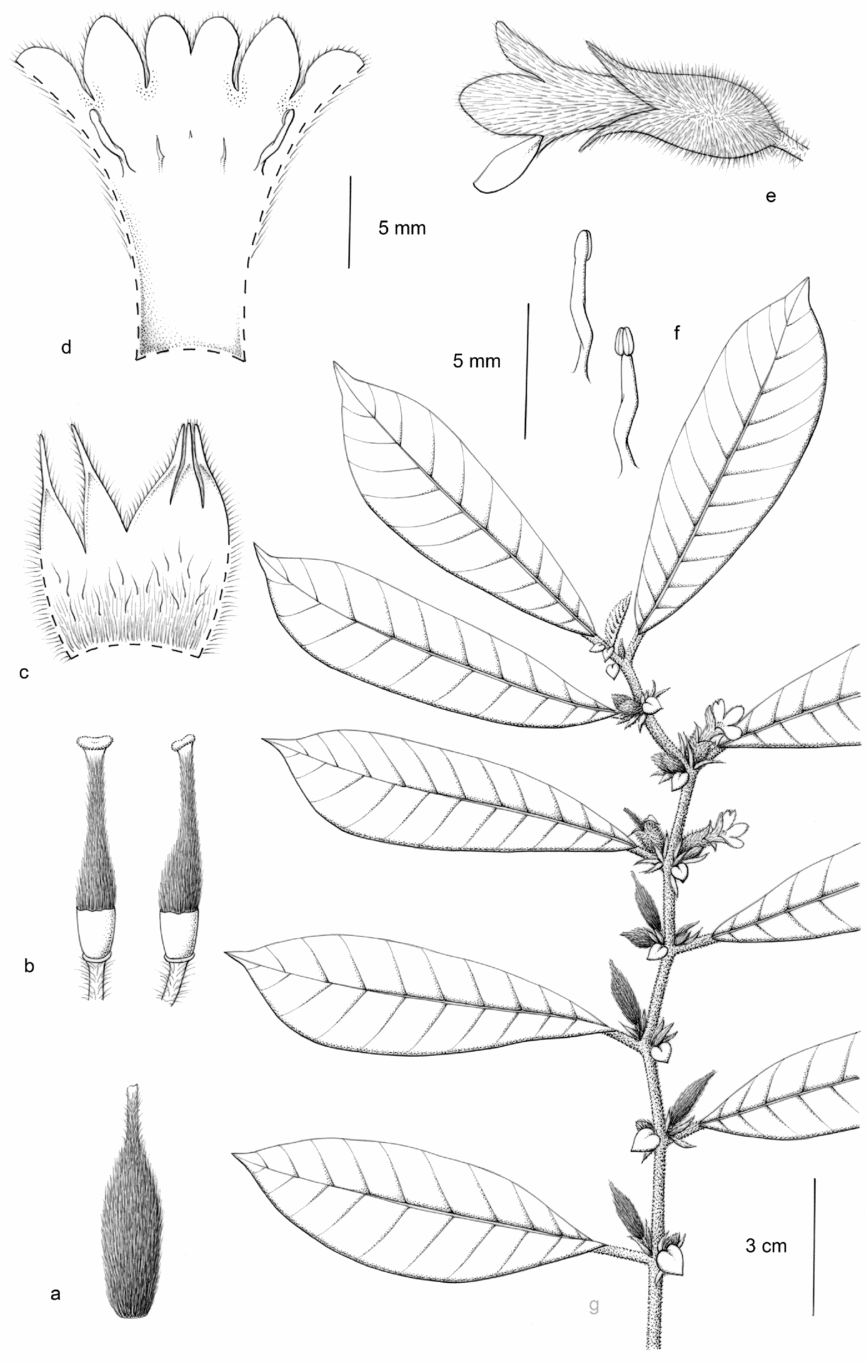
Cyrtandra gambutensis Karton. & H.J.Atkins, sp. nov. A, Fruit; B, gynoecium; C, calyx, longitudinal section; D, corolla, longitudinal section; E, flower, lateral view; F, stamens; G, habit. Drawn from Atkins et al. 38 (E).

Shrub 0.7–2.5 m. Stems striate, short hairy, appearing pubescent. Leaves opposite, unequal; one leaf of a pair markedly reduced; petioles 0.8–1.3 cm long, hairy; blades 6–9.5 × 1–2.5 cm, oblanceolate, apex short acuminate, acumen 4–5 mm long, base attenuate, slightly asymmetrical, margins subentire; 8–11 pairs of lateral veins running straight out to margin, sparse tertiary venation, glabrous above, hairy below, most densely so on midrib, veins and margin; reduced leaves cordate, 5 × 4 mm, resembling the larger leaves in other respects. Inflorescences axillary, sessile, 2- or 3-flowered; bracts oblong-lanceolate, 5 × 1 mm, hairy on both sides; bracteoles lanceolate, hairy, 3–4 × 0.5 mm; pedicels 3–5 mm long, densely hairy. Calyx tubular, white, green in bud, c.15 mm long, densely hairy externally, three upper lobes c.7 mm long, acuminate, two lower lobes c.8 mm long triangular, acuminate at apex. Corolla white with purple markings on lobes, tube narrow in basal third, widening to mouth in apical two-thirds, 19–20 mm long, densely hairy externally, upper lobes suborbicular, 4 × 2 mm, lower and lateral lobes ovate, 5 × 3 mm. Stamens 2; filaments 5 mm long, attached 8 mm above base of corolla, white; anthers 1 mm long, thecae parallel, not coherent at apices, purple; staminodes 3, c.2 mm long. Gynoecium c.11 mm overall; disc cupular with undulate, fringed margin, glabrous externally, 2 mm long; ovary and style densely eglandular hairy; stigma bilobed, 2 mm across. Fruits elongate, dark green, cylindrical, densely hairy, 9 × 3 mm; calyx not persistent, base of style persistent.
Distribution
North Sulawesi and Gorontalo (see Fig. 1).
Habitat and ecology
Lowland to lower montane forest at an altitude of 520–950 m.
Etymology
Named after the mountain on which the type was collected.
Proposed IUCN conservation category
Cyrtandra gambutensis is known from two collections made in 1985 and 2002 at relatively low altitude in disturbed primary rain forest within the Bogani Nani Wartabone National Park. The National Park status should provide some protection, although “deforestation for the production of crops like cloves, palm oil and coffee” is considered to be a threat in this area (Rainforest Trust, Reference Quisumbingno date). A lack of specimens precludes estimations of EOO and AOO, so we recommend that this species is categorised as Vulnerable (VU) using the criterion VUD2, because it is a population with a very restricted AOO or number of locations and, as such, is prone to the effects of human activities or stochastic events and is thus capable of becoming Critically Endangered or even Extinct in a short period of time, and emphasise the importance of carrying out further survey work in this region.
Additional specimen examined. North Sulawesi: Bolaang Mongondow, Dumoga Bone National Park, G. Mogogonipa, 10 iv 1985, de Vogel & Vermeulen 7081 (L).
This species is part of a group of apparently closely related species in Sulawesi that share the characteristics of strongly anisophyllous leaves (wherein the smaller leaf is highly reduced), white corollas and densely hairy calyces, corollas and fruits. The other species in the group are Cyrtandra engleri Koord., Cyrtandra gorontaloensis H.J.Atkins and Cyrtandra widjajae Karton. Cyrtandra gambutensis can be distinguished from the others by its narrow leaves, sparse tertiary venation and numerous secondary veins that run straight out to the margin without looping upwards.
Cyrtandra hekensis Karton. & H.J.Atkins sp. nov.
Distinguished from other species in Sulawesi by a combination of its coarse indumentum, serrate leaves and white flowers with greenish yellow markings in throat. – Type: Indonesia, Central Sulawesi, Mt Hek, 420 m, 9 iv 2008, Thomas, D.C. & Ardi, W.H. 08–26 (holo BO, iso E). Figs 5, 6.
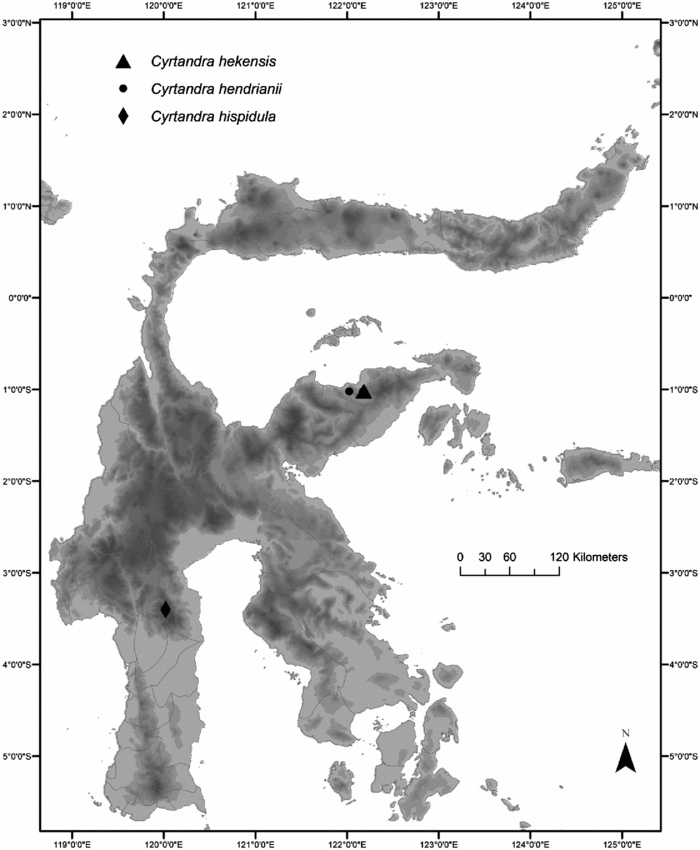
Known distribution of Cyrtandra hekensis Karton. & H.J.Atkins, Cyrtandra hendrianii Karton. & H.J.Atkins and Cyrtandra hispidula Karton. & H.J.Atkins.

Cyrtandra hekensis Karton. & H.J.Atkins, sp. nov. A, Habit; B, corolla, longitudinal section; C, calyx, longitudinal section; D, flower, lateral view; E, gynoecium; F, fruit with persistent calyx partially removed; G, bracts. Drawn from Hendrian et al. 901 (E).

Herb up to 25 cm in height. Stems ridged, striate, upper stem appearing reddish, from dense, coarse indumentum on young growth, older stems glabrous. Leaves opposite, slightly unequal; those of a pair well developed but one slightly smaller; petioles 0.8–2 cm long, densely coarse hairy on young growth becoming glabrous on older growth, narrowly winged; blades 7–7.5 × 1.6–3 cm (larger leaves), 3.5–5 × 1.3–1.7 cm (smaller leaves), narrow elliptic or oblong to somewhat oblanceolate, apex acuminate, base attenuate, margin serrate; 4–6 pairs of lateral veins and reticulate tertiary venation; dark green and mostly glabrous above with some hairs towards the base, paler green and with scattered hairs below with coarse hairs on the midrib and veins. Inflorescences axillary, subsessile to shortly pedunculate, 1- or 2-flowered; peduncles red, 2–3 mm long, hairy; bracts green, 9 × 5–6 mm, ovate, connate 4 mm from base, with some coarse hairs on midrib and margins, margin slightly serrate; bracteoles paired, green, 6–8 × 3 mm, oblong, with coarse hairs on midrib and margins; pedicels 2–3 mm long, glabrous. Calyx tubular, pale green, 10–11 mm long, upper lobes c.2 mm long, lower lobes c.3 mm long, acuminate, glabrous except for a few tufts of hair at apex. Corolla white with greenish yellow markings in throat, c.15 mm long overall, tube narrow in lower third, widening to mouth in apical two-thirds, hairy externally in the apical third, particularly densely so towards the mouth, upper lobes suborbicular, 3–4 × 3 mm, lower and lateral lobes suborbicular, 3 × 3 mm. Stamens 2; filaments c.5 mm long, attached c.6 mm from base of corolla, glabrous; anthers c.1 mm long, thecae parallel, coherent at apices; staminodes 2, c.0.5 mm long. Gynoecium c.10 mm long overall; disc cupular with lobed margin, glabrous externally, c.1.5 mm long; ovary glabrous, style eglandular hairy towards apex; stigma slightly bilobed, lobes small, c.1 mm across. Fruits ovoid, glabrous, verrucose, drying light brown, 6 × 4 mm; base of style and calyx persistent, bracts sometimes persistent.
Distribution
Central Sulawesi: Luwuk (see Fig. 5).
Habitat and ecology
Lowland to lower montane forest from 420 to 660 m.
Etymology
Named after the mountain on which it was collected.
Proposed IUCN conservation category
As for Cyrtandra albiflora and C. hendrianii, this species is known only from Mount Hek, Luwuk Regency, where it was collected at relatively low altitude during expeditions in 2004 and 2008. This is an area with no formal protection (UNEP-WCMC & IUCN, 2016).
A lack of specimens precludes estimations of EOO and AOO, and it is not possible to comment on threats to this species with any certainty, but it is anticipated that the deforestation and clearing for agriculture reported for this habitat type (Cannon et al., Reference Cannon, Summers, Harting and Kessler2007) could threaten the only known populations of this species; we therefore recommend a category of Vulnerable (VU) using the criterion VUD2, because it is a population with a very restricted AOO or number of locations and, as such, is prone to the effects of human activities or stochastic events and is thus capable of becoming Critically Endangered or even Extinct in a short period of time, but emphasise the importance of carrying out further survey work in this region.
Additional specimen examined. Central Sulawesi: Luwuk, Mt Hek, 26 ii 2004, Hendrian, Newman, M.F., Scott, S.M., Saleh, M.N. & Supriadi, D. 901 (E).
This species can be distinguished from others on the island by a combination of its serrate, more or less isophyllous leaves, coarse indumentum, particularly on young growth, and white flowers with greenish yellow markings in the throat.
Cyrtandra hendrianii Karton. & H.J.Atkins sp. nov.
Distinguished from other species in Sulawesi by a combination of its pink corolla and red calyx and long thin bracts and bracteoles. – Type: Indonesia, Central Sulawesi, Mt Hek, 660 m, 25 ii 2004, Hendrian, Newman, M., Scott, S., Nazre Saleh & Supriadi, D. 883 (holo BO, iso E). Figs 5, 7.
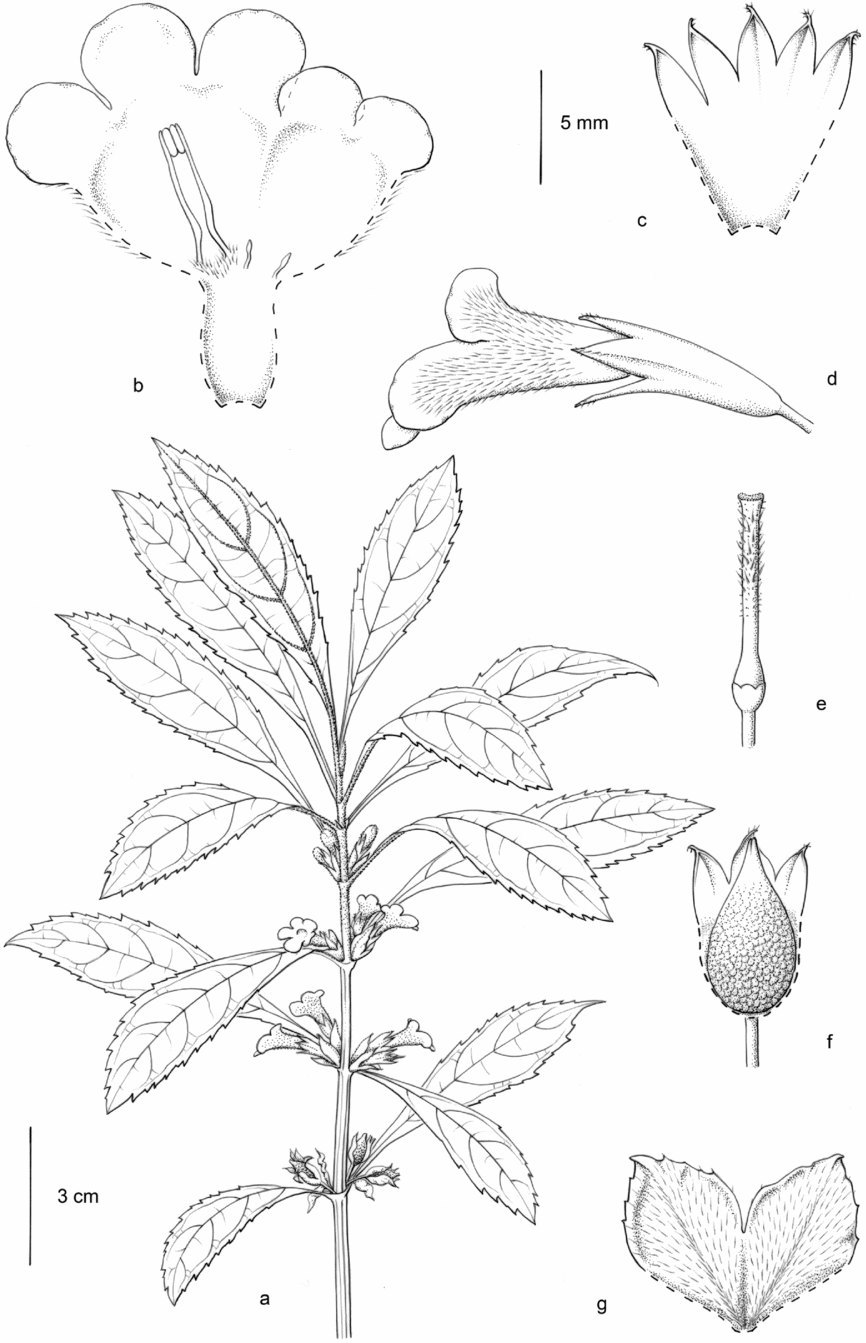
Cyrtandra hendrianii Karton. & H.J.Atkins, sp. nov. A, Fruit; B, gynoecium; C, habit; D, corolla, longitudinal section; E, anthers; F, calyx, longitudinal section; G, flower, lateral view; H, bract and bracteole. Habit and fruit drawn from Hendrian et al. 883 (E). All other parts drawn from Scott 503 (E) (accession 20040646A).

Shrub up to 2 m. Stems striate, reddish, more or less glabrous, slightly hairy in axils. Leaves opposite, subequal; petioles red, 2–4 cm long, densely hairy when young, becoming more glabrous with age, narrowly winged; blades, 16.4–29.5 × 5.7–9.5 cm, narrow oblong or elliptic to oblanceolate, apex acute to short acuminate, base attenuate, margin serrate; 8–11 pairs of lateral veins and with reticulate tertiary venation; dark green and mostly glabrous above with a few scattered hairs and on the tips of the marginal teeth, paler green below, with red to pink venation, densely fine hairy on midrib and veins with some scattered hairs on the blade. Inflorescences axillary, subsessile, with c.8–10 flowers at various stages of development; peduncle 1–2 mm, sparsely hairy; bracts greenish, 25–35 × 5–6 mm, oblong to lanceolate, acuminate, with shallowly serrate margins and a few scattered hairs externally, more densely hairy along the margins and at the apex; bracteoles 15–20 mm long, lanceolate to linear, long acuminate, sparsely hairy, more densely hairy along margins and particularly at the apex; pedicels 5–7 mm long sparsely hairy, extending slightly in fruit. Calyx tubular, red, 7–8.5(–10) mm long, appearing bilobed, lobes triangular, 3–3.5(–5) mm long, acuminate, divided very briefly at the apex into three in the upper lobe and two in the lower, sparsely hairy at the base, more densely so at apex. Corolla pink, 15–18 mm long, narrow funnel form, lobes suborbicular, lower lobes slightly more elongate, spreading to somewhat recurved, c.4 × 3 mm, hairy externally with a dense covering of short glandular hairs on the inside of lobes and in the mouth of the corolla. Stamens 2; filaments short, 1.5–2 mm long, attached c.8 mm from base of corolla, glabrous; anthers c.1 mm long, glabrous, cohering at apices; staminodes 3, c.1 mm long. Gynoecium 10 mm long; disc cupular, 2 mm long, glabrous with undulating margin; ovary glabrous; style with short, glandular hairs particularly towards the apex; stigma bilobed, c.1 mm across. Fruits ovoid to ellipsoid or rather elongate, glabrous, somewhat verrucose, drying dark brown, 11–15 × 4–7 mm; base of style and calyx persistent.
Distribution
Central Sulawesi (see Fig. 5).
Habitat and ecology
Lower montane forest from 660 to 680 m.
Etymology
Named after Hendrian, director of Purwodadi Botanic Garden, Java, and also one of the collectors of this new species.
Proposed IUCN conservation category
This species is known from two collections made on the same trip to Mount Hek in 2004 at mid-altitude (660–680 m). As stated for Cyrtandra albiflora, this area does not currently receive any formal protection (UNEP-WCMC & IUCN, 2016). The low number of collections precludes calculations of EOO and AOO. Given the threat of deforestation in lower montane forest habitat on the island (Cannon et al., Reference Cannon, Summers, Harting and Kessler2007; Thomas et al., Reference Thomas, Ardi and Hughes2011), we recommend a category of Vulnerable (VU) using the criterion VUD2, because it is a population with a very restricted AOO or number of locations, but emphasise the importance of carrying out further survey work in this region.
Additional specimen examined. Central Sulawesi: Luwuk, Mt Hek, Sungai Spa, 25 ii 2004, Scott, S. 04–316, grown at RBGE as accession 20040646A, vouchered as Scott 503 (E).
This species is most similar to Cyrtandra albiflora (described here and collected from the same location). It can be distinguished, however, by significant differences in corolla and calyx colour, density of indumentum on the stems and leaves and the size and shape of the bracts and bracteoles, which are explained in more detail under that species.
Cyrtandra hispidula Karton. & H.J.Atkins sp. nov.
Distinguished from other species in Sulawesi by a combination of its coarse, white, hispid indumentum, broad leaves and large, leaf-like inflorescence bracts. – Type: Indonesia, South Sulawesi, Mt Rantemario, 2527 m, 25 iv 2009, Thomas, D.C. & Ardi, W.H. 09–86 (holo BO; iso E, L). Figs 5, 8.
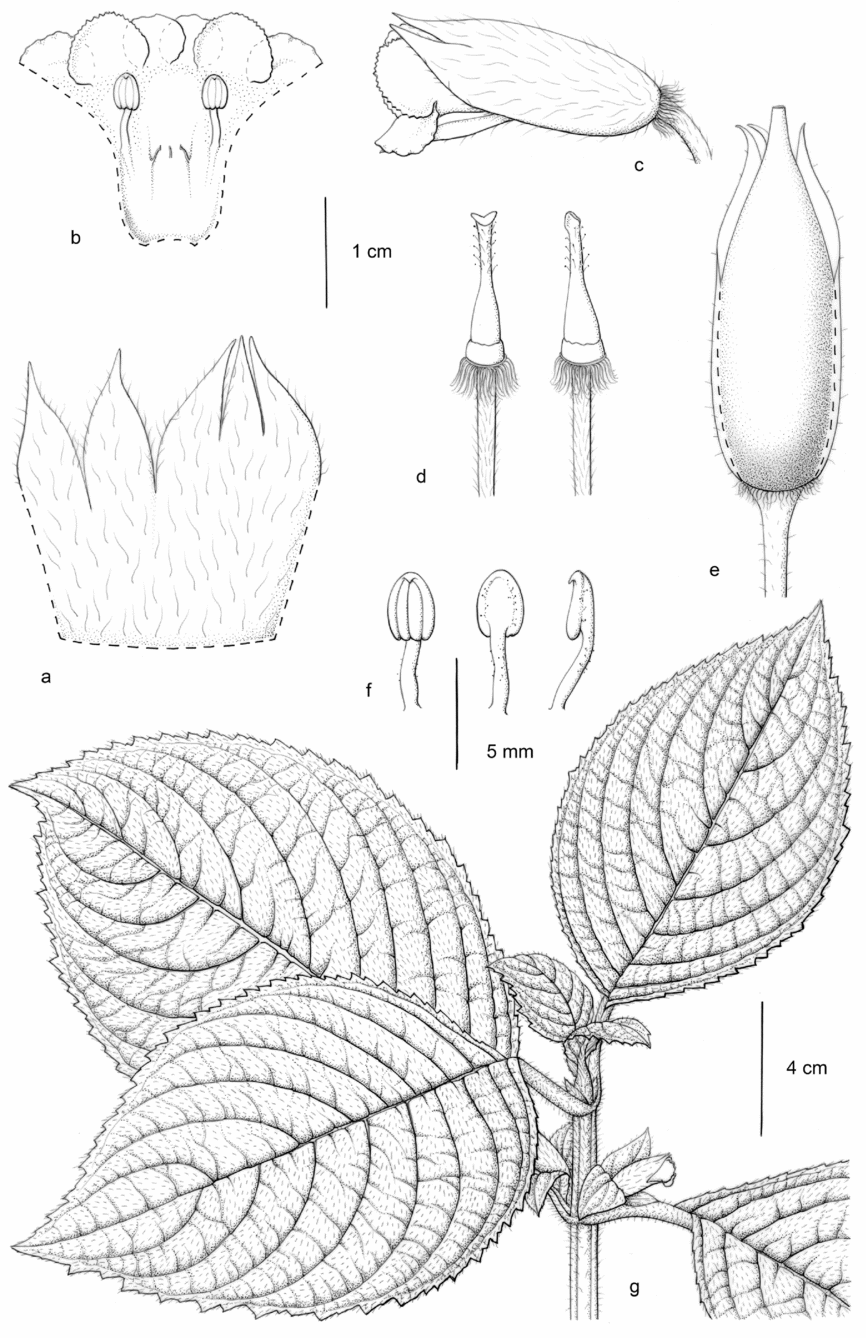
Cyrtandra hispidula Karton. & H.J.Atkins, sp. nov. A, Calyx, longitudinal section; B, corolla, longitudinal section; C, flower, lateral view; D, gynoecium; E, fruit with persistent calyx partially removed; F, anthers; G, habit. Drawn from Thomas & Ardi 09–86 (E).

Coarse herb to 150 cm. Stems ridged, striate, green, densely hairy on young growth and around axils, hairs coarse, pale, 1–3.5 mm long. Leaves opposite, subequal, drying dark brown; petioles green, 2.5–5.5 cm long, densely hairy; blades 14–16 × 9–10 cm, broad elliptic to ovate, apex acuminate, base cuneate, slightly asymmetrical, margin serrate; 8 or 9 pairs of lateral veins and reticulate tertiary venation, dark glossy green, slightly marbled with scattered, long multicellular hairs above, covered with dense, multicellular hairs on midrib and veins below. Inflorescences axillary, subsessile, 1- or 2-flowered; peduncle up to 5 mm long, densely hairy; bracts green, 25–40 × 8–20 mm, paired, leaf-like, broad elliptic to ovate, with a covering of dense, coarse white hairs, especially on veins, margins serrate, apex acute; pedicels green, 13–15 mm long, hairy, continuing to elongate up to 40 mm with the developing fruit. Calyx tubular, green, c.25 mm long, lobes acuminate, lower lobes c.10 mm long, upper lobes c.8 mm long, hairy, densely so at the base with a distinctive fringe of hairs. Corolla white, turning brown with time, tube completely enclosed within calyx, only lobes visible, c.18 mm long overall, tube glabrous externally and with a scattering of small glands in the mouth of the corolla, all lobes rounded, lateral lobes with shallowly serrate margins, upper lobes 5–6 × 4 mm, lower and lateral lobes c.8 × 5 mm. Stamens 2; filaments c.3 mm long, attached c.8 mm above the base of the corolla, straight, almost glabrous, with a few scattered, glandular hairs; anthers c.3 mm long, thecae parallel, with stalked glandular hairs on the back, not coherent; staminodes 3, c.2 mm long. Gynoecium c.12 mm overall; disc cupular with undulating margin, c.2 mm long, glabrous; ovary glabrous; style with some glandular hairs, particularly towards the apex; stigma bilobed, c.1 mm across. Fruits elongate, glabrous, smooth, green, drying dark brown, 18–25 × 5–8 mm; calyx and base of style persistent.
Distribution
South Sulawesi: Latimojong Range (see Fig. 5).
Habitat and ecology
Montane forest associated with Rhododendron, Vaccinium and Leptospermum at c.2500 m altitude.
Etymology
Named after its distinctive hispid indumentum on most parts of the plant.
Proposed IUCN conservation category
It has not been possible to calculate EOO and AOO for this species, owing to the low number of collections. This species has been collected only twice, and the locality is not within a protected area (UNEP-WCMC & IUCN, 2016). It is, however, found in montane forest, which is one of the least threatened forest types in Sulawesi (70% of upland forests above 1500 m elevation are intact). Montane and tropical alpine forests are not considered to be endangered, with a substantial majority of these sites across the island still in good condition (Cannon et al., Reference Cannon, Summers, Harting and Kessler2007). We suggest the category of Least Concern (LC) for this species.
Additional specimen examined. South Sulawesi: Mt Batutoding, 1913, Rachmat 916 (BO).
This description is based primarily on material from the type, Thomas & Ardi 09–86, but Rachmat 916 appears to be the same taxon with the same distinctive indumentum and inflorescence bracts, although it is overall a much smaller plant. The description of the flowers is based on a single, slightly immature flower. The combination of the coarse, hispid, white indumentum, broad leaves and large, leaf-like inflorescence bracts distinguishes it from any other Cyrtandra species on the island.
Cyrtandra kinhoii Karton. & H.J.Atkins sp. nov.
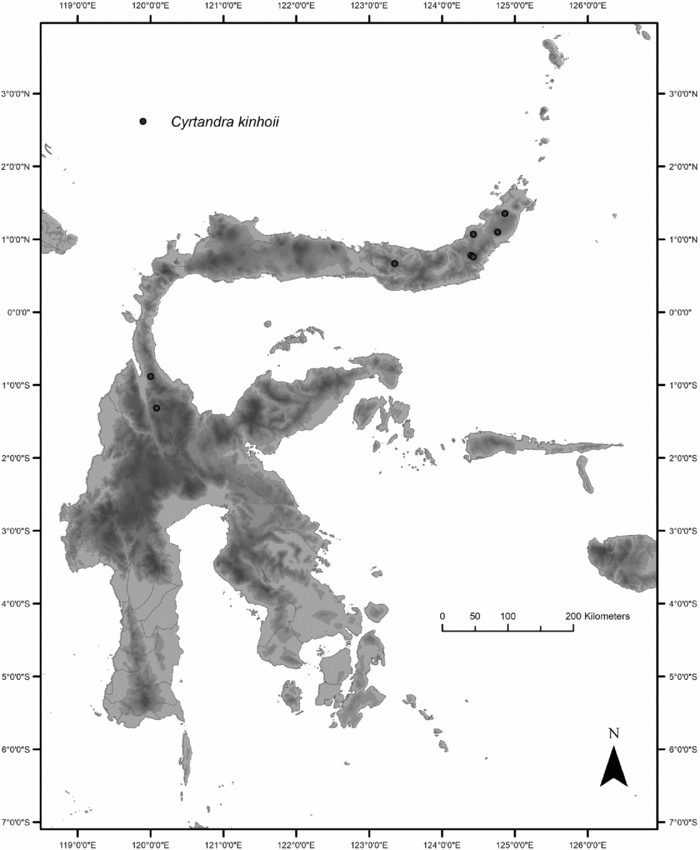
This species shares tessellate stems and decurrent, subequal leaves with Cyrtandra fasciata H.J.Atkins. It can be distinguished, however, by its longer leaf blades (30–60 cm versus 14–22 cm), bract shape and length (oblong-lanceolate bracts, 30–45 × 20–25 mm, versus linear bracts, 20 × 2 mm) and corolla colour (corolla white or flushed slightly pink with no markings versus corolla yellow with red stripes on lobes). – Type: Indonesia, North Sulawesi, Mt Ambang Nature Reserve, Paya Paya, near Sinsingon village, 1252 m, 2 xi 2016, Barber, S., Atkins, H., Kartonegoro, A. & Kinho, J. BAKK 36 (holo BO; iso E, L). Figs 9, 10.
Known distribution of Cyrtandra kinhoii Karton. & H.J.Atkins.

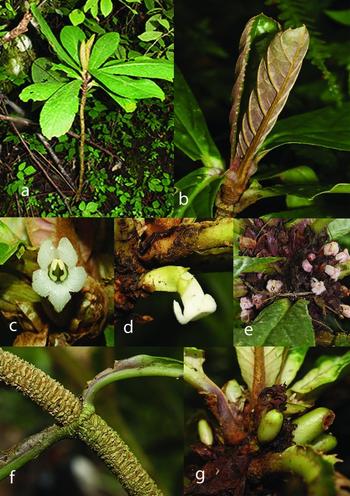
Cyrtandra kinhoii Karton. & H.J.Atkins, sp. nov. A, Habit; B, young leaves; C, corolla, anterior view; D, corolla, lateral view; E, inflorescence; F, tessellate stem; G, young fruits. (Photographs by Sadie Barber.)

Shrub 1–3 m or small tree 6–7 m. Stems tessellate, glabrous, sparsely hairy on younger growth, woody. Leaves opposite; subequal to somewhat unequal; petioles 1.5–2 cm long, winged; blades 30–60 × 10–15 cm, elliptic to obovate to oblanceolate, usually crowded at the ends of branches, apex short acuminate, rarely obtuse, base attenuate, margin serrate; 10–20 pairs of lateral veins and reticulate tertiary venation, curving upwards and running out to the margin, occasionally branching near the margin, glabrous, mid-green above, sparsely hairy and paler green below, more densely hairy on midrib and veins and occasionally flushed red at base of leaf. Inflorescences axillary, subsessile, congested, with up to c.15 flowers at various stages of development; bracts oblong-lanceolate, light green, flushed slightly reddish, leathery, 3–4.5 × 2–2.5 cm, subglabrous to sparsely hairy, slightly warty, apex acute or short acuminate, caducous; bracteoles lanceolate, light green, subglabrous c.3 × 1 cm, leathery, apex acuminate; pedicels 4–7 mm long, light green, glabrous to sparsely hairy. Calyx tubular, 21–25 mm long, light green to dark reddish brown, sparsely hairy, warty at base, lobes acuminate, lower lobes divided c.12 mm from apex, upper lobes less deeply divided, 8–10 mm from apex, densely hairy. Corolla white or flushed slightly pink, 35 mm, narrow in basal third to half, gradually widening to mouth, glandular hairy externally, densely so internally, lobes strongly recurved, upper lobes suborbicular, 6 × 5 mm, lower and lateral lobes suborbicular to slightly oblong, 5–10 × 5–7 mm, lobes with dense covering of glandular hairs. Stamens 2; filaments 2–8 mm, attached 12–20 mm above the base of corolla, glabrous, light green; anthers 2–3 mm, thecae slightly divaricate, coherent at apices, cream; staminodes 3, lateral c.1.5 mm long, central c.0.5 mm long. Gynoecium 25–30 mm overall; disc cupular with undulate margin, lower on one side, glabrous, 2–3 mm; ovary glabrous; style white, glabrous, densely eglandular hairy at apex (or densely eglandular hairy for whole length in Central Sulawesi specimens); stigma light green, bilobed, lobes 3–4 × 2–3 mm, vertical or spreading, densely glandular hairy on inner surface of lobes. Fruits ovoid to ellipsoid, glabrous, 10–15 × 5–8 mm, green when unripe; bracts and calyx not persistent, base of style occasionally persistent.
Distribution
North Sulawesi and Central Sulawesi (see Fig. 9).
Habitat and ecology
Lower montane to submontane forest at 700–1300 m.
Etymology
Named after Julianus Kinho, researcher at the Forestry Research Institute of Manado, North Sulawesi, and one of the collectors of the type specimen.
Proposed IUCN conservation category
This is a relatively widespread species on Sulawesi, collected so far from three of the island's provinces. The proposed conservation category based on the EOO calculated using GeoCAT is Near Threatened (NT), and the category based on the estimated AOO is Endangered (EN). Most of the collections, however, fall within the boundaries of Bogani Nani Wartabone National Park in Gorontalo, Lore Lindu National Park in Central Sulawesi or Mount Ambang Nature Reserve in North Sulawesi, where threats from deforestation should be somewhat reduced. We therefore consider this species to be of Least Concern (LC) at present.
Additional specimens examined. North Sulawesi: Minahasa Regency, Mt Masarang, 10 i 1895, Koorders 17187β (L); Lolombulan, 6 iv 1895, Koorders 17191β (BO, L); G. Manimporok, Soputan Mts, 18 vi 1954, Alston 15926 (BM); Tomohon, Mt Mahawu, 23 vi 1956, Forman 223 (K, L); East Bolaang Mongondow, Mt Ambang, 3 xi 2016, Barber et al. BAKK 65 (BO, E). Gorontalo: Mt Gambuta, 10 iv 2002, Atkins et al. 56 (BO, E). Central Sulawesi: Between Palu and Parigi, 17 Apr 1975, Meijer 9364 (BO, L); Road to Lake Lindu, c.60 km SSE of Palu, 30 v 1979, van Balgooy 3565 (A, BO, E, L); Road to Lake Lindu, c.60 km SSE of Palu, 30 v 1979, van Balgooy 3571 (A, BO, E, L).
Most of the detail of this description has been written using recent collections from Gorontalo and North Sulawesi. The material of the three collections from Central Sulawesi is much poorer, but they are strikingly similar vegetatively and the few flowers available for dissection were a close match, with the exception of style indumentum (noted in the description). These specimens are included here, although further collections may provide evidence for the recognition of two distinct species in the future.
This species is most similar to Cyrtandra fasciata from Central Sulawesi, in that these species both have tessellate stems and decurrent leaves, but it can be distinguished by its leaf blades 30–60 cm (versus leaf blades 14–22 cm); bract shape and length (oblong-lanceolate bracts, 30–45 × 20–25 mm versus linear bracts, 20 × 2 mm) and corolla colour (corolla white or flushed slightly pink without markings versus corolla yellow with red stripes on lobes).
One of the collections included here (Koorders 17187β) has been annotated with the name Cyrtandra similis Koorders. This appears to be a manuscript name used by Koorders but never published. The name Cyrtandra similis is used later for an unrelated Philippine species by Quisumbing (Quisumbing, Reference Quisumbing1930).
The young leaves of this plant are reported to be collected and used as a vegetable known as soroako.
Cyrtandra multinervis Karton. & R.Bone sp. nov.
Distinguished from other species in Sulawesi by a combination of its high number of lateral veins, and narrow fruits. – Type: Indonesia, Central Sulawesi, Tongoa, Mt Potong, 980 m, 8 iii 2001, Kessler, P.J.A. et al. PK 2974 (holo BO; iso E, K, L). Figs 11, 12.
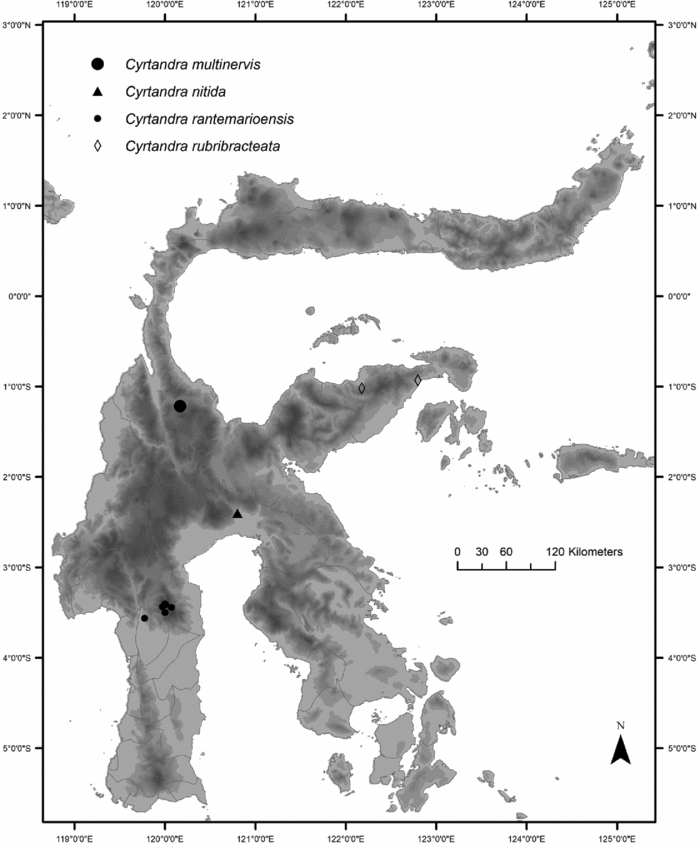
Known distribution of Cyrtandra multinervis Karton. & R.Bone, Cyrtandra nitida Karton. & H.J.Atkins, Cyrtandra rantemarioensis Karton. & R.Bone and Cyrtandra rubribracteata Karton. & H.J.Atkins.

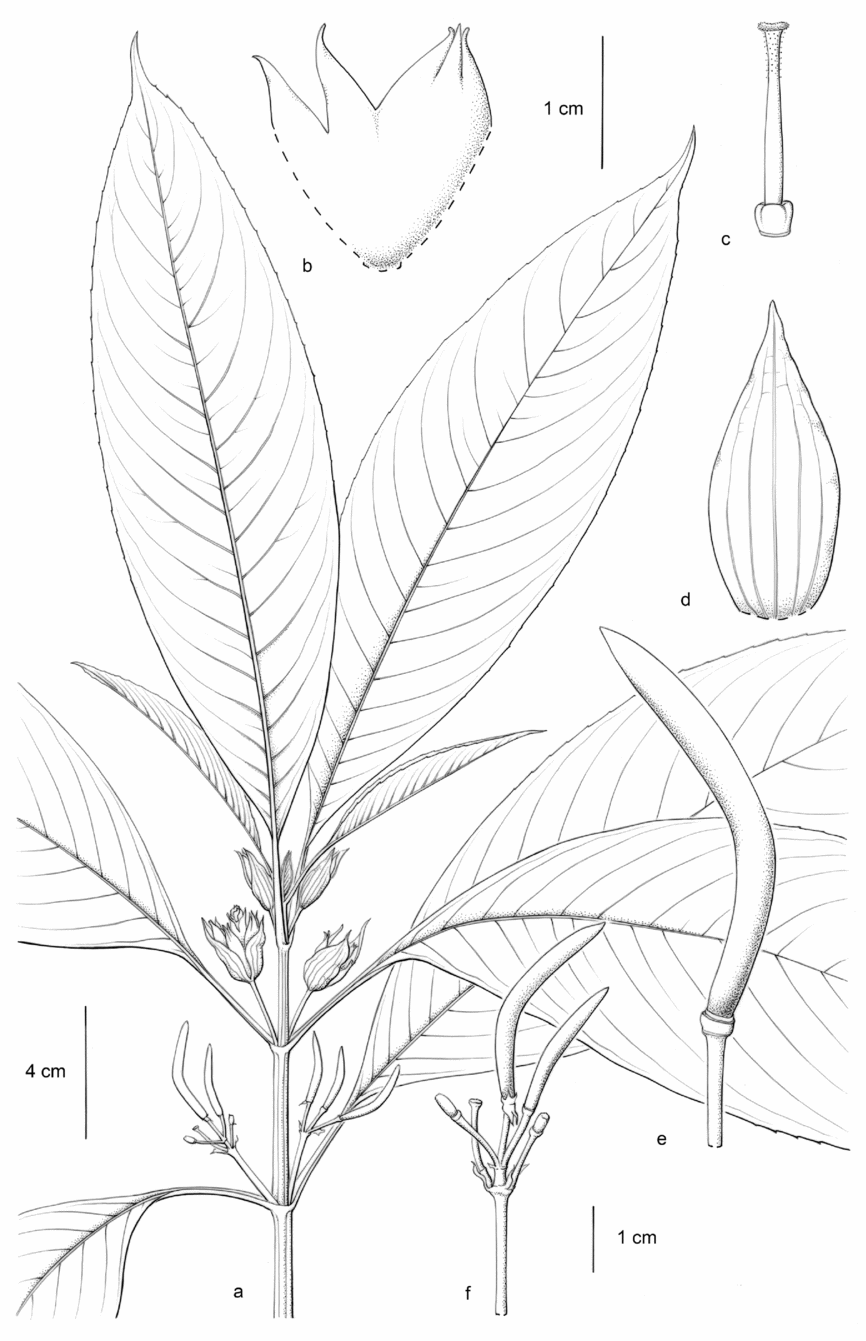
Cyrtandra multinervis Karton. & R.Bone, sp. nov. A, Habit; B, calyx, longitudinal section; C, gynoecium; D, bract; E, fruit; F, infructescence. Drawn from Kessler et al. PK 2974 (E, K, L).

Branching shrub up to 4 m. Stems ridged, striate, glabrous. Leaves opposite, subequal; petioles 4–5 cm long, glabrous; blades up to 31 × 9.5 cm, oblong or narrow elliptic, apex acuminate, base attenuate, somewhat oblique, margin subentire to minutely and distantly crenulate; 17–19 pairs of lateral veins and faint, reticulate tertiary venation, dark green and glabrous above, paler green and glabrous below. Inflorescences axillary, 1- to 5-flowered; peduncle 15–18 mm long, glabrous; bracts 20–23 × 9–12 mm, enclosing the flowers when in bud, ovate, glabrous; bracteoles, 9–11 × 3–4 mm, ovate-elliptic, glabrous; pedicels 6–8 mm long, glabrous. Calyx tubular, pale green, 16–18 mm long, glabrous, lower lobes acuminate, 7–8 mm long, upper lobes, 3–4 mm long. Corolla white with red in the throat, 18–23 mm long, glabrous, lobes recurved, just showing above the top of the calyx, upper lobes suborbicular, c.6 × 4 mm, lower and lateral lobes suborbicular, c.4 × 3 mm. Stamens 2; filaments 5–7 mm long, attached c.9–10 mm above the base of the corolla, glabrous; anthers c.2 mm, thecae parallel, cohering at apices. Gynoecium c.15 mm overall; disc cupular c.1 mm long, glabrous; ovary glabrous; style glabrous at base, short hairy at apex; stigma bilobed, c.1 mm across. Fruits cylindrical, narrow, sometimes curved, drying black, (10–)17–25 × 1–2 mm, glabrous, smooth; base of style persistent, calyx not persistent.
Distribution
Central Sulawesi, known only from the type locality in Tongoa (see Fig. 11).
Habitat and ecology
Lower montane forest at c.980 m.
Etymology
Named for the high number of lateral veins on the leaf blades.
Proposed IUCN conservation category
It has not been possible to calculate EOO and AOO for this species, because it is known only from the type collection. This collection falls within the limits of the Lore Lindu National Park (a Unesco Biosphere Reserve) and, as such, will have some protection (Schwarze et al., Reference Schwarze, Erasmi, Priess and Zeller2009). It has been collected only once from a relatively well collected area of Sulawesi, suggesting it is probably not locally abundant. We suggest a category of Vulnerable (VU) for this species, using the criterion VUD2, because it is a population with a very restricted AOO or number of locations, but emphasise the importance of carrying out further survey work in this region.
This species has been described from a single collection but is very distinctive owing to its narrow fruits and many-nerved leaves.
Cyrtandra nitida Karton. & H.J.Atkins sp. nov.
Distinguished from other species in Sulawesi by a combination of its glossy leaves, strongly auriculate leaf bases and clusters of white flowers. – Type: Indonesia, Central Sulawesi, North of Mangkutana, Wotu–Lake Poso road, c.1150 m, 20 ii 2000, Mendum, Argent & Hendrian 00111 (holo BO, iso E). Figs 11, 13.
Cyrtandra nitida Karton. & H.J.Atkins, sp. nov. A, Fruit with and without persistent calyx; B, habit; C, anthers; D, corolla, longitudinal section; E, gynoecium; F, calyx, longitudinal section; G, flower, lateral view; H, bracts. Habit and fruit drawn from Sidiyasa 1369 (K, L). Flowers drawn from Mendum et al. 00111 (E).

Herb up to 2 m in height, sometimes branching from the base. Stems longitudinally ridged, flushed purple, sparsely woolly-hairy, more densely so on young growth. Leaves opposite, unequal, both well developed; blades 15.5–30.5 × 4.5–9 cm, oblong to narrowly oblong, apex acuminate, base attenuate becoming auriculate, clasping the stem and touching the base of the opposite leaf, margin serrulate; 11–15 pairs of lateral veins, tertiary venation obscure; dark glossy green turning almost white at the base, more or less glabrous with some scattered hairs above; much paler below with a sparse covering of fine, golden hairs, more densely so on the midrib and veins. Inflorescences axillary, tucked into the auriculate leaf bases, with c.10–12 flowers at various stages of development; single bract green, 15–22 × 5–8 mm, lanceolate-ovate, apex acuminate, margin slightly serrate, densely hairy above, less so below, caducous; bracteoles lanceolate, green, 15–20 × 4–5 mm; pedicels light green, 3–5 mm long, hairy. Calyx green, 7–8 mm long, more or less evenly 5-lobed, lobes divided almost halfway to the base, 3–4 mm, acuminate, sparsely hairy, more densely so on lobes. Corolla white, 8–12 mm long, tube narrow, lobes spreading, slightly projecting forwards, upper and lateral lobes orbicular, c.5 × 4 mm, lower lobe slightly longer and ovate, c.6 × 4 mm, subglabrous externally, with a dense covering of short, glandular hairs on the inside of the lobes and the mouth of the tube. Stamens 2; filaments 1–2 mm long, attached c.4 mm from the base of the corolla, glabrous; anthers 1 mm long, thecae parallel, glabrous; staminodes 3, c.0.5 mm long. Gynoecium 4–6 mm overall; disc cupular with undulating margin, c.1 mm long, glabrous; ovary glabrous at base; style glandular hairy towards apex; stigma bilobed, lobes vertical on specimens seen, 0.8–1 mm across. Fruits ovoid, dark green, brown and verrucose when dry, 4–5 × 2–3 mm; most of calyx and base of style persistent.
Distribution
Central and South Sulawesi, close to the border of both provinces (see Fig. 11).
Habitat and ecology
Steep, rocky roadside banks on edge of primary forest at 500–1150 m.
Etymology
Named for its distinctive glossy leaves.
Proposed IUCN conservation category
It has not been possible to calculate EOO and AOO for this species, owing to the low number of collections. Both collections were described as being in disturbed roadside vegetation and at relatively low altitude. It has not been possible to accurately georeference either collection, but it is possible that they were made within the limits of the Pegunungan Faruhumpenai Nature Reserve. We recommend that this species be recognised as Vulnerable (VU) using the criterion VUD2, because it is a population with a very restricted are of occupancy or number of locations, and emphasise the importance of carrying out further survey work in this region.
Additional specimen examined. South Sulawesi: 21 km south of border line between S. Sulawesi and C. Sulawesi, 12 xii 1994, Sidiyasa 1369 (K, L).
This species is very distinctive and unlike any others in Sulawesi owing to its glossy upper leaf surface and the auriculate leaf bases which clasp the stem and hold the inflorescence.
Cyrtandra rantemarioensis Karton. & R.Bone sp. nov.
Distinguished from other species in Sulawesi by a combination of its long, trailing inflorescence stems, bright red, arcuate corollas and elongate fruits. – Type: Indonesia, South Sulawesi, Mt Rantemario, 1750 m, 5 iii 2000, Mendum et al. 00240 (holo BO; iso E, L). Figs 11, 14.
Cyrtandra rantemarioensis Karton. & R.Bone, sp. nov. A, Habit; B, trailing inflorescence; C, corolla, anterior view; D, young fruits; E, flower, lateral view. (Photographs: A–D, Axel Poulsen; E, Steve Scott.)

Branching subshrub up to 2 m, often much shorter. Stems striate, greenish brown, glabrate, sparsely hairy on young growth. Leaves opposite, sometimes clustered at the ends of the stems, more or less equal; petioles 1.5–2 cm long, sparsely hairy; blades 8–20 × 1.8–5 cm, oblong to narrowly obovate, apex short acuminate, base attenuate, margin serrate; 5 or 6 pairs of lateral veins, tertiary venation loosely reticulate, mid- to dark green, somewhat marbled and subglabrous to sparsely hairy above, much paler and flushed purple and subglabrous below, very sparsely hairy on midrib and veins. Inflorescences borne on trailing stems from the base of the plant, subsessile, 1- or 2-flowered, inflorescence stem striate, hairy when young, becoming glabrous with age, c.1 mm in diameter with persistent bracteoles; bracts green to dull red, c.25 × 10 mm, somewhat lanceolate, acuminate at apex, with serrate margins apically, hairy when young, particularly at the base and along veins, soon caducous, visible only at the tips of the inflorescence stems; bracteoles green to dull red, 10–15 × 2 mm, linear to linear-lanceolate, acuminate at apex, sparsely hairy externally, often persistent on inflorescence stem; pedicels reddish, 10–15 mm long, hairy, elongating and becoming more glabrous in fruit. Calyx reddish when in flower turning olive green when fruiting c.6 mm long, upper lobes divided briefly at apex, lower lobes free to base, lobes acuminate, sparsely hairy externally. Corolla red, slightly paler in the mouth, 15–20 mm long, arcuate with a narrow tube widening to mouth, sparsely hairy externally, internally with scattered eglandular hairs and a dense covering of glandular hairs in the mouth, lobes spreading, slightly projected forwards, two upper lobes orbicular, c.7 × 7 mm, lateral and lower lobes orbicular, 9–10 × 8 mm. Stamens 2; filaments c.2 mm, attached c.12 mm above the base of the corolla, white, glabrous; anthers 1–2 mm long, cohering at apices, thecae parallel, glabrous, white; staminodes 3, c.0.5 mm long. Gynoecium c.10 mm long overall; disc 2 mm long, unilateral with undulating to lobed margin, glabrous; ovary densely hairy; style glandular hairy towards apex; stigma bilobed, lobes vertical on specimens seen, c.1 mm across. Fruits elongate, glabrous, smooth, greenish brown (drying light brown), 15–30 × 4–8 mm; base of style and calyx persistent.
Distribution
South Sulawesi: Latimojong Range (see Fig. 11).
Habitat and ecology
Montane forest at 1500–2600 m.
Etymology
Named after the mountain where it was collected.
Proposed IUCN conservation category
Based solely on the EOO and AOO, this species would be in the Endangered (EN) category (based on a 2 × 2 km grid cell size) under the B criteria. It has, however, been collected on eight different botanical expeditions in the Latimojong Range (between 1969 and 2010), suggesting it is locally abundant and is found in montane forest sensu Cannon et al. (Reference Cannon, Summers, Harting and Kessler2007), which is one of the least threatened forest types in Sulawesi (70% of upland forests above 1500 m elevation are intact). For this reason, we recommend that this species be recognised as Least Concern (LC).
Additional specimens examined. South Sulawesi: Rantemario, Buntu Kaciling, 11 vi 2010, Kartonegoro, A. & Santoso, W. ARK475 (BO); Latimojong Mts, on path to Mt Rantemario peak, 6 vii 2002, Brown, G., Craven, L.A. & Juswara, L.S. 4 (BO); Latimojong Mts, Enrekang District, 28 i 2009, Ardiyani, M., Poulsen, A.D. & Firdaus 165 (E); Enrekang, Rantemario, 23 iv 2009, Thomas, D. & Ardi, W.H. 09–79 (E); Rantelemo, v 1929, Kjellberg, G.K. 4040 (BO); Latimojong Mts, Enrekang District, 30 x 1969, Sands, M.J.S. 307 (K); Enrekang, Rantemario, iii 2000, Mendum, M., Argent, G.C.G. & Hendrian 00240 (E); Mt Rantemario, 5 iii 2000, Smith, P. & Galloway, L. 229, grown at RBGE as accession 20000622K, vouchered as Scott 507 (E); Enrekang, 15 vi 1937, Eyma, P.J. 467 (BO, L).
There are four species in Sulawesi that share the phenomenon of flowering on long, trailing inflorescence stems that originate at the base of the plant. The other species in this group are Cyrtandra geocarpa Koord., Cyrtandra hypogaea Koord. and Cyrtandra luteiflora H.J.Atkins. This species can most easily be distinguished from the others in this group by its red flowers and elongate fruits, which although wrinkled when dry, are not as distinctly tessellate as the fruits of Cyrtandra hypogaea. It also appears to be restricted to the mountains of the Latimojong Range, specifically to Mount Rantemario.
Cyrtandra rubribracteata Karton. & H.J.Atkins sp. nov.
Distinguished from other species in Sulawesi by a combination of its faded red bracts, pink calyx, narrow serrate leaves and beaked anthers. – Type: Indonesia, Central Sulawesi, Luwuk Regency, Mt Hek, 980 m, 28 ii 2004, Hendrian, Newman, M., Scott, S., Saleh, N. & Supriadi, D. 968 (holo BO, iso E). Figs 11, 15.
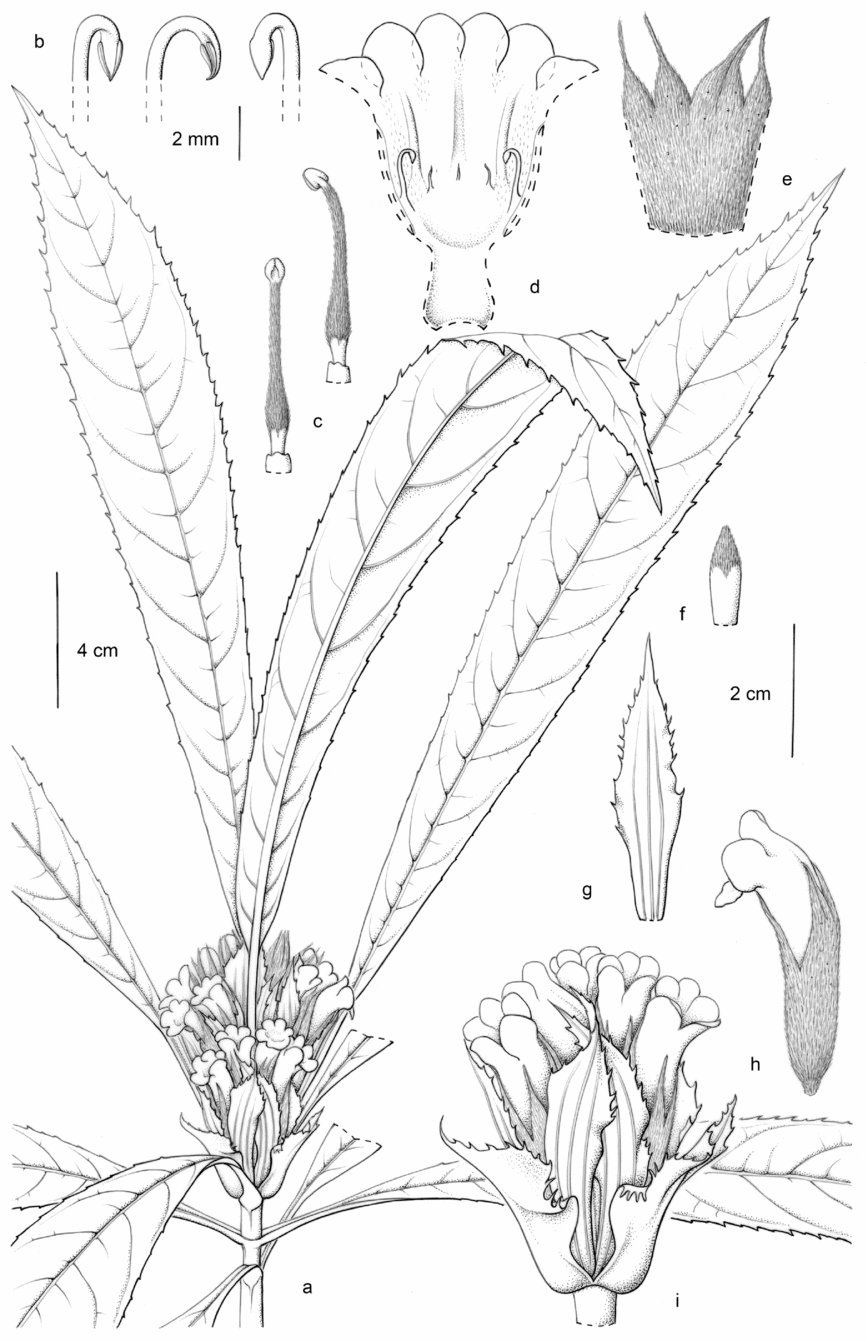
Cyrtandra rubribracteata Karton. & H.J.Atkins, sp. nov. A, Habit; B, anthers; C, gynoecium; D, corolla, longitudinal section; E, calyx, longitudinal section; F, fruit; G, bracteole; H, flower, lateral view; I, inflorescence. Drawn from Hendrian et al. 968 (E).

Shrub or treelet up to 1.8 m. Stems cylindrical, striate, glabrous. Leaves opposite, subequal; petioles 1.5–2 cm, glabrous; blades 14–25 × 2–3.5 cm, narrowly oblong to lanceolate, apex acuminate, base attenuate, margin serrate, occasionally biserrate; 5–7 pairs of lateral veins curving sharply upwards and faint tertiary venation, dark green and glabrous above, whitish green and glabrous below. Inflorescences axillary, sessile, c.6-flowered; bracts ovate, paired, dark, dull red, 3 × 2 cm, tough, leathery, joined very briefly at the base and forming an involucre with serrate margins, glabrous externally, enclosing the flowers and fruit; bracteoles c.4 × 1 cm, some much smaller, narrow lanceolate with serrate margins, leathery, glabrous; pedicels 4–6 mm long, hairy. Calyx tubular, pink, 30–36 mm long overall, lobes 9–17 mm long, acuminate, ridged along the length of the tips, hairy externally. Corolla white, 42–45 mm long overall, held upright in involucre, narrow in basal third, widening to mouth in upper two-thirds, upper lobes rounded, 5–6 × 4–5 mm, lower and lateral lobes suborbicular 8–9 × 7–8 mm, distinctive ridges running along base of the tube, densely hairy externally. Stamens 2; filaments c.10 mm long, attached c.20 mm above the base of the corolla, straight at the base, curved over slightly at the top, glabrous with a few glandular hairs at the apex; anthers c.1 mm long, thecae divaricate and very narrow, glabrous, drying much darker than the filaments, with a distinctive pointed tip appearing like a hook or beak, not coherent; staminodes 3, c.5 mm long. Gynoecium c.30 mm overall; disc cupular with undulating margin, c.2 mm long, glabrous; ovary glabrous at the base becoming densely hairy after c.4 mm with the margin of indumentum somewhat lobed; style densely hairy; stigma bilobed, lobes vertical or spreading, c.3 × 2 mm, with short glandular hairs. Fruits ovoid (immature), c.15 × 11 mm, glabrous at the base, becoming densely hairy at apex; style and calyx not persistent.
Distribution
Central Sulawesi: Luwuk (see Fig. 11).
Habitat and ecology
Lower montane forest at c.980 m.
Etymology
Named after its distinctive red bracts.
Proposed IUCN conservation category
A lack of specimens of Cyrtandra rubribracteata precludes estimations of EOO and AOO. It is known with certainty from only one location, Mount Hek in Central Sulawesi, because it has not been possible to accurately georeference the earlier collection by Eyma (Eyma 3909). As with the other species described from this locality (e.g. Cyrtandra albiflora), this species does not receive any formal protection (UNEP-WCMC & IUCN, 2016). We suggest the category Vulnerable (VU) for this species, using the criterion VUD2, because it is a population with a very restricted AOO or number of locations and, as such, is prone to the effects of human activities or stochastic events and is thus capable of becoming Critically Endangered or even Extinct in a short period of time, but emphasise the importance of carrying out further survey work in this region.
Additional specimen examined. Central Sulawesi: Luwuk Regency, between Camp I and Camp II, 28 ix 1938, Eyma 3909 (BO, K, L).
This species is very distinctive owing to its narrowly oblong leaves with serrate margins, large, dull red inflorescence bracts and unusual, somewhat beaked, anthers. No other species from Sulawesi recorded so far has these distinctive anther appendages. There are, however, a number of species from Borneo recorded with a ‘conspicuous apiculus’ on the anthers, such as Cyrtandra prostrata Kraenzl. and Cyrtandra paxiana Lauterb.
Acknowledgements
We thank the curators of the herbaria cited in the text for loans of material; Claire Banks for the detailed illustrations; Steve Scott, Sadie Barber and Nathan Kelso for great care of the living collections at RBGE; Wisnu Ardi, Sadie Barber, Axel Poulsen and Daniel Thomas for permission to use their photographs; and the RBGE Sibbald Trust for funding a visit to RBGE for one of the authors (AK) to consult the collections and collaborate on the paper.