Introduction
Corporate financial fraud is unethical wrongdoings undertaken by managers to get private benefits and avoid fiduciary duties, which causes financial loss to shareholders, breaches stakeholders’ trust, and increases financial market instability (Conyon & He, Reference Conyon and He2016; Khanna, Kim, & Lu, Reference Khanna, Kim and Lu2015). Research has primarily relied on agency theory (Berle & Means, Reference Berle and Means1932) and emphasized a set of internal mechanisms (e.g., the board of directors, incentive payments, ownership concentration, among others) and external mechanisms (e.g., activist owners, the market for corporate control, securities analysts, among others) to monitor managers and deter them from acting opportunistically and engaging in financial fraud (Daily, Dalton, & Canella, Reference Daily, Dalton and Canella2003; Martin, Wiseman, & Gomez-Mejia, Reference Martin, Wiseman and Gomez-Mejia2019).
Agency theory views managers as a unified coalition that counters these disciplinary forces (Fama & Jensen, Reference Fama and Jensen1983; Jensen & Meckling, Reference Jensen and Meckling1976). The literature on upper echelons, however, has recognized the various internal social interactions within the TMTs (Certo, Lester, Dalton, & Dalton, Reference Certo, Lester, Dalton and Dalton2006; Hambrick & Mason, Reference Hambrick and Mason1984) and delved into the effects of TMT composition on managerial attitudes, cognitions, behaviors, as well as firm outcomes (Chen, Yang, & Jing, Reference Chen, Yang and Jing2015; Eisenhardt, Kahwajy, & Bourgeois, Reference Eisenhardt, Kahwajy and Bourgeois1997; Knight et al., Reference Knight, Pearce, Smith, Olian, Sims, Smith and Flood1999; Richard, Wu, Markoczy, & Chung, Reference Richard, Wu, Markoczy and Chung2019).
Combining top managers’ demographic compositions with agency theory (Li & Hambrick, Reference Li and Hambrick2005), our investigation focuses on TMT faultlines and explores the effects of TMT faultlines on firms’ financial fraud. TMT faultline is a term used to describe the configuration of TMT and is a hypothetical dividing line that splits a team into several homogeneous subgroups based on individual members’ alignment along multiple demographic or non-demographic attributes (Lau & Murnighan, Reference Lau and Murnighan1998; Li & Hambrick, Reference Li and Hambrick2005).
This article proposes that TMT faultlines trigger distrust and conflicts, dividing the TMT into factional subgroups, which, in turn, induce mutual monitoring among factions and help deter financial fraud (Eisenhardt et al., Reference Eisenhardt, Kahwajy and Bourgeois1997; Knight et al., Reference Knight, Pearce, Smith, Olian, Sims, Smith and Flood1999). Mutual monitoring arises when one party of agents is able to audit another party’s activities and measure their performance (Arnold, Hannan, & Tafkov, Reference Arnold, Hannan and Tafkov2020; Carpenter, Reference Carpenter2007). Fama and Jensen (Reference Fama and Jensen1983) state that agents can easily acquire information about their peers’ activities when fulfilling their managerial roles. The embedded working relationships among TMT members make information more transparent to each other compared with external actors, such as independent directors. Either party’s engagement in opportunism will be detected by others via information transmission within the formal and/or informal channels (Guo, Luo, & Li, Reference Guo, Luo and Li2022; Jones, Hesterly, & Borgatti, Reference Jones, Hesterly and Borgatti1997; Li, Reference Li2014). Thus, ‘mutual monitoring systems tap this information for use in the control process’ (Fama & Jensen, Reference Fama and Jensen1983: 310).
China presents a particularly suitable context for studying faultlines and subgroup conflicts. Cliques and factions are prevalent phenomena in Chinese society (Horak, Afiouni, Ledeneva, Muratbekova-Touron, & Fey, Reference Horak, Afiouni, Bian, Ledeneva, Muratbekova-Touron and Fey2020). These phenomena reflect the deep-seated characteristics of interpersonal relationships in Chinese society, where ‘love’ and trust exist within homogeneous factional subgroups and ‘hate’ and conflict exist outside the subgroups (Chen, Wang, Zhou, Chen, & Wu, Reference Chen, Wang, Zhou, Chen and Wu2017; Choi & Sy, Reference Choi and Sy2010; Lau & Murnighan, Reference Lau and Murnighan1998; Li & Hambrick, Reference Li and Hambrick2005; Zhang & Chen, Reference Zhang and Chen2023). It is thus both theoretically and practically meaningful to examine how TMT faultlines and resulting factional subgroups can influence managerial opportunism among Chinese firms.
The article thus makes three significant contributions. First, it contributes to corporate governance literature by uncovering the TMT configuration to form a mutual monitoring perspective on corporate governance. Much corporate governance research is posited on the notion that management acts as a coalition. Limited studies have explored the possibility that management cracks may be shaped by conflictive and even antagonistic TMT members, which generate confrontations and potential mutual monitoring within the management team. Although these studies (e.g., Gao, Jiang, & Mekhaimer, Reference Gao, Jiang and Mekhaimer2023; Guo et al., Reference Guo, Luo and Li2022; Li, Reference Li2014) shed light on the potential of mutual monitoring in the executive suite (Rediker & Seth, Reference Rediker and Seth1995), they neglect the influence of the complex composition and dynamic social interaction processes within the executive team and governance outcomes. This article thus advances this line of research and argues that faultlines in the executive suite complement traditional internal monitoring and control functions (e.g., the board of directors, incentive payments) in promoting greater managerial accountability.
Second, we advance faultline theory by uncovering the role of TMT faultlines as a governance mechanism. Extant faultline literature is underpinned by the social categorization perspective and the information/decision-making perspective (Van Knippenberg, De Dreu, & Homan, Reference Van Knippenberg, De Dreu and Homan2004; Williams & O’Reilly, Reference Williams, O’Reilly, Staw and Cummings1998). Beyond these two traditional perspectives, we integrate faultline theory with corporate governance literature and argue that faultlines and the resulting factions within the TMTs generate mutual monitoring between factional subgroups. According to the social categorization perspective, mistrust and intensified conflict between subgroups may lead to undesirable consequences, such as poor social integration and decision-making outcomes (Li & Hambrick, Reference Li and Hambrick2005; Rico, Molleman, Sánchez-Manzanares, & Van der Vegt, Reference Rico, Molleman, Sánchez-Manzanares and Van der Vegt2007). We argue that conflicts between factional subgroups can paradoxically enhance internal governance by fostering mutual monitoring, ultimately reducing financial fraud. Moreover, in contrast to the information/decision-making perspective, which emphasizes task-related information exchange and processing between subgroups, this study argues that subgroups also engage in covert information collection and investigation, serving as additional evidence of mutual constraints.
Third, we construct a framework to examine the conditions under which TMT faultlines can generate stronger governance effects. Faultline literature has suggested that structural and temporal dynamics have important contingent effects on TMT demographic faultlines and organizational outcomes (Beckman & Burton, Reference Beckman, Burton and Carpenter2011; Carton & Cummings, Reference Carton and Cummings2012; Mäs, Flache, Takács, & Jehn, Reference Mäs, Flache, Takács and Jehn2013). To deepen the understanding of the complex social interaction processes within the executive team and their impacts on corporate governance outcomes, we further examine the influence of TMT faultlines on corporate financial fraud by using the subgroup’s configuration (structural element) and TMT members’ tenure overlap (temporal element) as moderators. As such, this article deepens the understanding of the boundary conditions under which TMT faultlines may act as an effective mutual monitoring mechanism.
Theoretical Background and Hypotheses Development
Corporate Financial Fraud Governance: Mutual Monitoring Perspective
Corporate financial fraud research is primarily underpinned by agency theory and discusses the agency relationship arising from the separation of ownership and control (Jensen & Meckling, Reference Jensen and Meckling1976). Under the agency relationship, managers act as self-interested opportunists and may engage in unethical actions that are inconsistent with maximizing shareholder interests (Fama & Jensen, Reference Fama and Jensen1983). The agency relationship is assumed to be inevitable and universal across all forms of corporate organization (Filatotchev, Jackson, & Nakajima, Reference Filatotchev, Jackson and Nakajima2013). Therefore, a set of organizational practices has been conceived to monitor and restrain managerial opportunism and fraudulent behavior. Researchers, for instance, have emphasized the monitoring function of boards of directors (Daily et al., Reference Daily, Dalton and Canella2003), supervisory boards (Cromme, Reference Cromme2005), or large outside shareholders (Tihanyi, Johnson, Hoskisson, & Hitt, Reference Tihanyi, Johnson, Hoskisson and Hitt2003). In addition, well-designed incentive schemes may help align the interests of agents and principals (Steinbach, Holcomb, Holmes, Devers, & Cannella, Reference Steinbach, Holcomb, Holmes, Devers and Cannella2017).
The theoretical assumptions made by agency theory exclusively focus on the bilateral contracts between principals and agents (Aguilera & Jackson, Reference Aguilera and Jackson2003). Scholars have already acknowledged principals’ diversity and observed that different types of principals, such as banks, institutional investors, and families, pursue diverse interests (Daily et al., Reference Daily, Dalton and Canella2003; David, Kochhar, & Levitas, Reference David, Kochhar and Levitas1998). However, the question of the effects of varied agents on corporate governance and fraud has been left unexplored. Stewardship theorists challenge agency theory’s characterization of agents as opportunistic and inherently untrustworthy by suggesting that agents act as a group of moral stewards who endeavor to serve the principals’ interests (Davis, Schoorman, & Donaldson, Reference Davis, Schoorman and Donaldson1997; Fox & Hamilton, Reference Fox and Hamilton1994). This theoretical aspect, however, still retains a rigid view of the agent as a unified group.
Extant corporate governance research gives no serious attention to the varied interests of managers. Top managers are multiple-domain players whose interests, behavior, and actions are unlikely to be homogeneous (Certo et al., Reference Certo, Lester, Dalton and Dalton2006; Hambrick, Reference Hambrick2007). Upper echelons researchers have long delved into the cognitions and social interactions within the TMT and their consequent actions (Carpenter, Geletkanycz, & Sanders, Reference Carpenter, Geletkanycz and Sanders2004; Hambrick, Reference Hambrick2007; Hambrick, Humphrey, & Gupta, Reference Hambrick, Humphrey and Gupta2015), suggesting that managers are not an undivided group, and potential cliques and conflicts exist within the executive team (Greening & Johnson, Reference Greening and Johnson1997; Ndofor, Wesley, & Priem, Reference Ndofor, Wesley and Priem2015). Hence, we argue that corporate governance requires an additional view that shifts from the principal–agency dichotomy to the agency–agency perspective on corporate governance.
Unlike the principal-agent control system, mutual monitoring refers to the reciprocal assessment of performance among individuals working on common tasks, whose contributions are evaluated and rewarded by a firm on the basis of a collective outcome (Welbourne, Balkin, & Gomez-Mejia, Reference Welbourne, Balkin and Gomez-Mejia1995). Mutual monitoring therefore deemphasizes dependence on external governance (e.g., independent directors) and formal authority (i.e., ownership concentration), but places control in the hands of peer agents. Li (Reference Li2014) asserts that the TMT is not a unified team, and members of the TMT can voice their concerns regarding the CEO’s self-serving, fraudulent, or unethical behavior toward other employees or the board, which generates factual mutual monitoring within the TMT. Guo et al. (Reference Guo, Luo and Li2022) assert that leaders of two inconsistent hierarchies may challenge each other’s authority. As potential successors to the CEO, other members within the TMT are motivated to look for contestation opportunities and challenge the CEO’s decisions. The competition for firms’ control may incentivize executives to monitor each other.
Compared to the abovementioned studies and power dynamics literature (Joseph, Ocasio, & McDonnell, Reference Joseph, Ocasio and McDonnell2014; Ocasio, Reference Ocasio1994; Shen & Cannella, Reference Shen and Cannella2002), this article does not oppose the CEO with other top management team members; rather, it focuses on the reciprocal assessment between or among factional subgroups within the TMT. In other words, mutual monitoring prevents agents from pursuing their self-interests because other agents can evaluate the outcomes of those collaborative processes and organizational outcomes (Li, Zheng, & Zhuang, Reference Li, Zheng and Zhuang2017).
Faultline Theory
Faultlines theory provides a perspective to delve into social interactions within the executive team. Lau and Murnighan (Reference Lau and Murnighan1998) used the term ‘faultlines,’ inspired by geological faults, to define the potential factions within a focal group and argued that there are hypothetical lines that split the group into subgroups based on multiple demographic attributes. Managerial faultlines occur when salient demographic characteristics exist and can be aligned across the team members (Li & Cui, Reference Li and Cui2018). Demographic characteristics act as key indicators for team members’ cognitive styles, values, and other psychological bases (Jackson, Reference Jackson, S., W. and J. A.1992; Jehn, Northcraft, & Neale, Reference Jehn, Northcraft and Neale1999). The alignment of multiple demographic characteristics provides solid explanations for the effect of micro-level individual attributes on group-level outcomes (Thatcher & Patel, Reference Thatcher and Patel2012).
Extant faultline literature has relied on the social categorization perspective and the information/decision-making perspective (Van Knippenberg et al., Reference Van Knippenberg, De Dreu and Homan2004; Williams & O’Reilly, Reference Williams, O’Reilly, Staw and Cummings1998). These perspectives differ in their views on whether TMT faultlines enhance or hinder firm performance and outcomes. According to social categorization theory (Turner, Reference Turner1982), TMT faultlines are suggested to drive the formation of social identity-based subgroups and, therefore, trigger social categorization processes (Kalra & Szymanski, Reference Kalra and Szymanski2023; Van Knippenberg et al., Reference Van Knippenberg, De Dreu and Homan2004). People tend to classify individuals into different social categories based on demographic characteristics (e.g., gender, age, ethnicity, occupation) (Ashforth & Mael, Reference Ashforth and Mael1989). Once social categories and identities are established, members tend to trust and hold positive attitudes toward ‘in-group’ members while exhibiting hostile and negative attitudes toward ‘out-group’ members (Tajfel, Reference Tajfel1978). Another stream of literature highlights the beneficial effects of faultlines based on the information/decision-making perspective, focusing on the process of information elaboration. Dissimilarity among multiple subgroups provides a broader range of knowledge and perspectives, which is critical for TMTs tackling non-routine, knowledge-intensive tasks (Cooper, Patel, & Thatcher, Reference Cooper, Patel and Thatcher2014; Van Knippenberg, Dawson, West, & Homan, Reference Van Knippenberg, Dawson, West and Homan2011).
Recent literature further explores the structural and temporal effects of TMT demographic faultlines (Beckman & Burton, Reference Beckman, Burton and Carpenter2011; Carton & Cummings, Reference Carton and Cummings2012; Mäs et al., Reference Mäs, Flache, Takács and Jehn2013). Structural factors are reflected in various aspects, such as team roles and power structures (Ma, Kor, & Seidl, Reference Ma, Kor and Seidl2022) and subgroup structures within teams (Carton & Cummings, Reference Carton and Cummings2012, Reference Carton and Cummings2013). Structural factors often embed the patterns of interaction within teams, providing a more nuanced understanding of the mechanisms underlying TMT faultlines. Temporal factors are recognized as another critical mechanism influencing the effects of TMT demography (Beckman & Burton, Reference Beckman, Burton and Carpenter2011). Extant studies have pointed out that as people acquire more information over time, the formation of their perceptions may be based on different demographic characteristics (Harrison, Price, & Bell, Reference Harrison, Price and Bell1998; Harrison, Price, Gavin, & Florey, Reference Harrison, Price, Gavin and Florey2002). Consequently, TMT faultlines formed based on specific demographic characteristics may exhibit varying impacts as time progresses.
TMT Faultlines and Corporate Financial Fraud
Corporate financial fraud occurs when managers deliberately act to deceive investors or other stakeholders (Gande & Lewis, Reference Gande and Lewis2009). It involves concealing company information, falsifying the firm’s performance, or covering up systematic problems (Shi, Connelly, & Hoskisson, Reference Shi, Connelly and Hoskisson2017). Corporate financial fraud occurs because of information asymmetry and intrinsic conflicts between the shareholders and management, where management may intend to increase their compensation through the appearance of improved performance (Yiu, Wan, & Xu, Reference Yiu, Wan and Xu2019). Agency theory suggests that internal governance mechanisms (e.g., activist large-block shareholders, boards of directors, auditing) can deter top managers from acting opportunistically and reduce financial fraud (Jia, Ding, Li, & Wu, Reference Jia, Ding, Li and Wu2009).
We argue that managerial faultlines generate conflicts within the top executive suite and can decrease the incidence of corporate financial fraud. Corporate financial fraud requires either coordination within the TMT, where all top executives are involved in criminal activities, or acquiescence, where some top executives witness the wrongdoing but are reluctant to ‘blow the whistle’ (Khanna et al., Reference Khanna, Kim and Lu2015). However, faultlines split the TMT into factional groups, and top executives may hold hostility toward members outside their own faction (Ashforth & Mael, Reference Ashforth and Mael1989). Managerial faultlines, therefore, lead to greater chasms within the TMT, where factional subgroups compete with each other (Antino, Rico, & Thatcher, Reference Antino, Rico and Thatcher2019; Halevy, Reference Halevy2008). The competitive nature of interaction may restrain gainsharing between subgroups, and each group is committed to achieving its own gains (Kilduff, Elfenbein, & Staw, Reference Kilduff, Elfenbein and Staw2010; Welbourne, Balkin, & Gomez-Mejia, Reference Welbourne, Balkin and Gomez-Mejia1995). The competition orientation reduces each faction’s motivation to coordinate together (Lau & Murnighan, Reference Lau and Murnighan2005) and generates mutual monitoring between subgroups (Bezrukova, Spell, Caldwell, & Burger, Reference Bezrukova, Spell, Caldwell and Burger2016). Mutual monitoring acts as an effective mechanism to detect hidden unethical actions, as factional subgroups observe and control each other’s actions (Guo et al., Reference Guo, Luo and Li2022) and seek opportunities to challenge decisions made by their counterparts (Zorn, Shrophshire, Martin, Combs, & Ketchen, Reference Zorn, Shrophshire, Martin, Combs and Ketchen2017). The agents, therefore, should be considered as a unit of analysis rather than as unified actors, frozen in interests and actions and isolated from the organizational context.
Under the circumstances where top executives are suspicious about certain activities and anticipate wrongdoing, the competitive relationships could increase their willingness to express concerns (Zhang, Ayoko, & Liang, Reference Zhang, Ayoko and Liang2021). All TMT members have substantial influence and explicit legal authority within the firm to obtain information and direct corporate behavior (Krause, Roh, & Whitler, Reference Krause, Roh and Whitler2022). TMT members’ familiarity with the ‘contextual environment’ reduces information asymmetry and enables them to detect early signs of fraud (Ndofor et al., Reference Ndofor, Wesley and Priem2015). Therefore, we argue that managerial faultlines restrain corporate financial fraud because TMT members have relatively symmetric and balanced information to help deter fraud (Xue, Tang, Xu, Ling, Xie, & Mo, Reference Xue, Tang, Xu, Ling, Xie and Mo2024). The conflicts and competition between factional groups motivate top executives to investigate and expose possible wrongdoing. Knowing that the rival faction is watching closely, TMT members can become more alert and hesitant to commit fraudulent actions (Zorn et al., Reference Zorn, Shrophshire, Martin, Combs and Ketchen2017). We thus contend that TMT faultlines may generate mutual monitoring within the TMT, which can impinge on top managers’ feelings of autonomy and crowd out their intrinsic motivation for acting opportunistically. We thus propose:
Hypothesis 1 (H1): TMT faultlines are negatively associated with the likelihood of corporate financial fraud.
Faultlines and Corporate Financial Fraud: A Contingency Perspective on Subgroup Configurations and Tenure Overlapping
TMT faultlines represent the intensity of a team being divided into subgroups, and subgroup configuration refers to the power structure of the TMT. Subgroup balance, as an indicator of subgroup configuration, refers to the balance of power between different subgroups within a team (Menon & Phillips, Reference Menon and Phillips2011; O’Leary & Mortensen, Reference O’Leary and Mortensen2010). The faultline may divide the team into subgroups with varied configurations (Lau & Murnighan, Reference Lau and Murnighan1998). Varied configurations endow each subgroup with different levels of power (Carton & Cummings, Reference Carton and Cummings2012, Reference Carton and Cummings2013). Faultline studies suggest that the subgroups’ power balance is determined by the size of each subgroup within the focal team. For example, an 8-person team can be divided into a 2-6 subgroup configuration, which is imbalanced, or a 4-4 subgroup configuration, which is balanced. Team members may experience different group interactions in the balanced vs. imbalanced subgroup configurations (O’Leary & Mortensen, Reference O’Leary and Mortensen2010).
Balanced configurations are more likely to create a balance of power among factions within the TMT. When power is balanced between subgroups within the TMT, TMT faultlines can effectively reduce the likelihood of financial fraud. TMT faultlines divide the TMT into distinct and differentiated subgroups, and balanced configurations cultivate and intensify competition within the TMT (Kilduff et al., Reference Kilduff, Elfenbein and Staw2010). When factional subgroups confront antagonistic situations, no one is willing to compromise or retreat due to the balance of power (Cramton & Hinds, Reference Cramton and Hinds2004; Spell, Bezrukova, Haar, & Spell, Reference Spell, Bezrukova, Haar and Spell2011). Furthermore, the competitive relationship between balanced factional subgroups motivates each party to monitor the others closely. In a balanced configuration, therefore, the effects of faultlines on reducing corporate financial fraud are likely to be strengthened due to intensified competition and balanced power between factional subgroups.
In an imbalanced configuration, by contrast, the larger faction is generally in a dominant position, while the smaller faction is in a disadvantageous position to challenge and compete with the larger one. The larger the faction, the greater its power and the greater the possibility of representing the whole TMT (Hogg, van Knippenberg, & Rast, Reference Hogg, van Knippenberg and Rast2012; Qi, Armstrong, Yang, & Li, Reference Qi, Armstrong, Yang and Li2022). In an imbalanced configuration, the larger factional subgroup is more likely to use its size advantages to take charge of validating and processing information (Beckman & Burton, Reference Beckman, Burton and Carpenter2011). In situations where the larger subgroup, which includes more TMT members, intends to engage in unlawful activities, the effects of faultlines on reducing fraud are weakened, as fraudulent information can easily be processed due to the group’s greater power (Menon & Phillips, Reference Menon and Phillips2011).
Hence, we argue that subgroup configuration can moderate the relationship between TMT faultlines and the likelihood of corporate financial fraud. A balanced configuration enhances the negative effects of TMT faultlines on corporate financial fraud. We thus hypothesize:
Hypothesis 2 (H2): TMT subgroup configuration moderates the relationship between TMT faultlines and corporate financial fraud. Specifically, a balanced subgroup configuration enhances the negative effects of TMT faultlines on corporate financial fraud.
TMT tenure is viewed as a temporal representation of TMT faultlines (Beckman & Burton, Reference Beckman, Burton and Carpenter2011). TMT members’ tenure overlap is defined as the amount of time TMT members have worked together in the focal firms. Our focus on tenure overlapping is motivated by interpersonal relations literature (e.g., Cumming, Reference Cumming2004; Nahapiet & Ghoshal, Reference Nahapiet and Ghoshal1998), which suggests that linkages between people are more likely to be bonded as the frequency of their interactions increases. Common job tenure reinforces associability and trust, which, in turn, fosters collaboration (Harris, McMahan, & Wright, Reference Harris, McMahan and Wright2012).
Extant demographic research has addressed the important role of tenure overlap in shaping a team’s composition and its effects (Georgakakis, Greve, & Ruigrok, Reference Georgakakis, Greve and Ruigrok2017; Mathieu, Maynard, Rapp, & Gilson, Reference Mathieu, Maynard, Rapp and Gilson2008). Prior research has suggested that social interaction processes change over time. Team members initially have a ‘homophilous selection of interaction partners’ (Lau & Murnighan, Reference Lau and Murnighan1998) and tend to categorize themselves based on superficial and observable demographic characteristics (e.g., gender, age, race, among others). However, as members interact and become more familiar with each other, the importance of the demographics that initially dominated the team’s social categorization gradually decreases. In contrast, the effects of deep diversity (e.g., attitudes, personality, values, among others) become more significant (Chatman & Flynn, Reference Chatman and Flynn2001; Harrison et al., Reference Harrison, Price, Gavin and Florey2002). For example, Barkema and Shvyrkov (Reference Barkema and Shvyrkov2007) suggest that demographic characteristics serve as the initial basis for social classification, and team members with the same demographic characteristics tend to form subgroups. However, as members interact more deeply and obtain more personal information, the significance of demographic differences between subgroups is reduced, and relationship conflict between subgroups diminishes. Mäs et al. (Reference Mäs, Flache, Takács and Jehn2013) examine the changes in a team’s faultlines over time and suggest that the initial polarization and conflicts within the team will be reduced by the ‘crisscrossing’ actors in the long term.
Therefore, we argue that TMT members’ tenure overlap weakens the relationship between TMT faultlines and corporate financial fraud. TMT members’ tenure overlap allows for the development of interpersonal trust and psychological commitment within the TMT (Buyl, Boone, Hendriks, & Matthyssens, Reference Buyl, Boone, Hendriks and Matthyssens2010). TMT faultlines may initially deter top executives’ interactions (Barkema & Shvyrkov, Reference Barkema and Shvyrkov2007; Chatman & Flynn, Reference Chatman and Flynn2001; Harrison et al., Reference Harrison, Price, Gavin and Florey2002). Following longer tenure overlapping, however, TMT members become more familiar with each other (Lau & Murnighan, Reference Lau and Murnighan1998). Familiarity in the executive suite is likely to cultivate ‘groupthink’ (Janis, Reference Janis1972). In other words, TMT members who have spent a longer time working together may develop group cohesion and establish common perceptions about their tasks (Mathieu, Heffner, Goodwin, Salas, & Cannon-Bowers, Reference Mathieu, Heffner, Goodwin, Salas and Cannon-Bowers2000).
TMT members’ tenure overlapping contributes to ‘groupthink’ and the tendency toward unanimity within the TMT (Buyl et al., Reference Buyl, Boone, Hendriks and Matthyssens2010). Mutual monitoring of financial fraud generated by TMT faultlines might be weakened by long-time shared working experiences and collaborative relationships because overlapping experiences tend to generate mutual support and trust (Taylor & Greve, Reference Taylor and Greve2006). The longer the TMT members’ tenure overlap, the closer the mental bond, and the less effective mutual monitoring can reduce financial fraud. Such reasoning would imply that tenure overlapping weakens the effects of TMT faultlines on corporate financial fraud. Hence, our next hypothesis runs as follows:
Hypothesis 3 (H3): TMT members’ tenure overlap moderates the relationship between TMT faultlines and corporate financial fraud. Specifically, longer tenure overlapping weakens the negative effects of TMT faultlines on corporate financial fraud.
Methods
Sample and Data
We drew the initial sample from all public-listed firms in the Shanghai Stock Exchange and Shenzhen Stock Exchange between 2000 and 2018. Financial data were drawn from the CSMAR (China Stock Market & Accounting Research Database). The dataset has been widely used in management research (Gong, Odom, & Kim, Reference Gong, Odom and Kim2025; Liu, Zhu, Wei, & Wu, Reference Liu, Zhu, Wei and Wu2025; Qian, Wang, Geng, & Yu, Reference Qian, Wang, Geng and Yu2017). Firms in the financial services sector were removed because such firms are under more stringent governance, and the context of their violations can be quite different from that of other sectors. We then obtained information about the top managers and board of directors from CSMAR. Firms with missing information on top managers and boards of directors were removed from the sample. The violation data were obtained from the same database, which provides comprehensive information regarding violations of all public firms, such as the types of violations, actions from authorities, and specific penalties. In our final sample, there are 4,904 observations from 1,097 firms.
Variables
Dependent variable
Our primary dependent variable, violation, is a dummy variable that indicates the incidence of a regulatory violation. For each firm-year observation, violation is coded as one if there exists any type of violation for the firm in the year, and is coded as zero otherwise. It is possible for a firm to commit multiple violations in a year, but this is quite rare. There are only 62 firm-year observations in which there is more than one violation. Therefore, it is appropriate to measure violation incidences with a binary variable rather than with a count measure. Violations do differ in terms of severity. Usually, severe violations incur fines of some amount, depending on the severity of the violation. Less severe violations, on the other hand, usually do not incur fines but receive a written warning or public condemnation. To test the robustness of the results, we also used severe violation as an alternative dependent variable. Specifically, severe violation is coded as one if a violation was found and the firm was fined, and zero if there was no violation or the violation did not incur penalty fines.
Independent variables
TMT faultline is our primary independent variable. Although several methods have been developed to calculate team faultlines (Gibson & Vermeulen, Reference Gibson and Vermeulen2003; Thatcher, Jehn, & Zanutto, Reference Thatcher, Jehn and Zanutto2003), we decided to measure TMT faultline strength by employing the average silhouette width (ASW) measure (Meyer & Glenz, Reference Meyer and Glenz2013) because the ASW algorithm appears to be more robust and versatile than other methods (Meyer, Glenz, Antino, Rico, & González-Romá, Reference Meyer, Glenz, Antino, Rico and González-Romá2014). This algorithm has also been extensively utilized by other faultline studies (e.g., Li & Jones, Reference Li and Jones2019; Mo, Ling, & Xie, Reference Mo, Ling and Xie2019). The ASW approach involves a two-step clustering procedure. First, the cluster-analytic methods are used to identify a set of starting subgroup configurations within a given team. Second, the algorithm merges subgroups with similar team members into new, larger subgroups until the solution reaches the maximum ASW (Meyer & Glenz, Reference Meyer and Glenz2013). Essentially, the ASW reflects the extent to which a TMT is split into homogeneous subgroups, making it ideal for quantifying faultline strength. The calculations are performed using the asw.cluster package (Meyer & Glenz, Reference Meyer and Glenz2013) in R software.
Following Van Knippenberg et al. (Reference Van Knippenberg, Dawson, West and Homan2011), faultlines in our study are measured based on several attributes: gender, tenure, education, and functional background. First, we consider gender as a bio-demographic attribute that forms a strong basis for subgroupings. Gender is a dichotomized variable (male or female). Second, TMT tenure refers to the duration each team member has served in that role in the current company. Tenure is measured as the number of years. Third, we classify TMT education in terms of the highest level/degree: (1) high school or below; (2) college; (3) master’s level; (4) doctoral level. Finally, we classify TMT functional background into six tracks: (1) accounting, finance, legal, investment; (2) engineering, technical, production, quality control; (3) HR, administration; (4) information, operation; (5) marketing, sales; (6) no specific management direction.
Subgroup balance. A faultline can split a TMT into subgroups with an equal number of members (balanced subgroups) or an unequal number of members (imbalanced subgroups). Subgroup configuration is a continuous variable that reflects the balancing of subgroup sizes. Specifically, it is calculated as the standard deviation of subgroup sizes, multiplied by −1, so that less deviation in subgroup sizes results in greater values. A TMT of 10 that has two 5-member subgroups has a balance score of 0 (i.e., subgroups are balanced), whereas a team that has one 2-member subgroup and one 8-member subgroup has a balance score of −3.
Tenure overlap. Tenure overlap measures top managers’ average overlap in their tenure at the firm. We adopt the measure from prior studies (Carroll & Harrison, Reference Carroll and Harrison1998):
 \begin{equation*}Tenure\;Overlap = \frac{1}{N}\sum\limits_{i \ne j} {\min \left( {{u_i}{u_j}} \right),} \end{equation*}
where N is the team size, and ui is the tenure of the i-th member (in number of years), and uj is the tenure of the j-th member. For example, for a TMT with four members that have tenures of 10, 8, 5, and 2 years, the tenure overlap is (8 + 5 + 2 + 5 + 2 + 2)/4 = 6.
Control variables
We included a comprehensive list of variables that can potentially predict the violation incidence. Firm size should be an important determinant of stock market violations. Larger firms are more visible, so they are less likely to engage in violations (Carcello & Nagy, Reference Carcello and Nagy2004). We used the annual market value of the firm as a measure of firm size. Firms that have more debts shown on their balance sheets may have a higher incentive to engage in unethical financial conduct (Stanley & Sharma, Reference Stanley and Vikram2011). Thus, we included the natural logarithm of a firm’s total debt amounts as a control variable. Similarly, firm performance can also be an important determining factor for violations because low-performing firms have more incentives to commit violations (Finnerty, Hegde, & Malone, Reference Finnerty, Hegde and Malone2016); thus, we included Tobin’s Q. Ownership concentration is an important external governance mechanism. Firms with more concentrated ownership structures (fewer owners and higher percentages of shares) may be under strong monitoring by the owners and are less likely to engage in misconduct (Wang, Wang, & Fang, Reference Wang, Wang and Fang2023). We measured ownership concentration with the total percentage of shares of the top three owners. In addition to the above-mentioned firm characteristics, the board of directors is a crucial mechanism influencing the likelihood of a firm’s stock market violations. Directors have a fiduciary duty to ensure the ethical and legal conduct of the TMT, and thus firms with boards that better monitor the top management should have a lower likelihood of committing any misconduct. We included four variables that capture the monitoring quality of boards: board size, percentage of independent directors, total compensation of directors, and CEO–Chair duality. Board size may impact monitoring intensity, which influences the likelihood of misconduct (Coles, Daniel, & Naveen, Reference Coles, Daniel and Naveen2008). Independent directors are associated with a lower likelihood of corporate financial fraud in Chinese firms (Xing, Zhang, Xiong, & Li, Reference Xing, Zhang, Xiong and Li2022). Boards that receive higher cash compensation are likely to have greater monitoring intensity, which reduces the likelihood of fraud (Radwan, Tian, Garefalakis, Koutoupis, & Kyriakogkonas, Reference Radwan, Tian, Garefalakis, Koutoupis and Kyriakogkonas2022). Yet, CEO–Chair duality can impede effective monitoring and may increase the likelihood of violations (Neville, Byron, Post, & Ward, Reference Neville, Byron, Post and Ward2019). In addition, we included TMT average compensation because executive compensation influences corporate misconduct (Harris & Bromiley, Reference Harris and Bromiley2007). CEO characteristics are associated with corporate financial fraud (Schnatterly, Gangloff, & Tuschke, Reference Schnatterly, Gangloff and Tuschke2018; Troy, Smith, & Domino, Reference Troy, Smith and Domino2011); therefore, we controlled for CEO gender, CEO age, and CEO tenure. The number of top executives hired after the CEO is also included as a control.
Results
Analysis
The final data are cross-sectional time series data, and the primary dependent variable is a dichotomized indicator variable that has values of zero and one. Thus, we used a panel-data GEE (generalized estimating equations) model. The GEE model derives maximum likelihood estimates, accommodates non-independent observations, and is robust against autocorrelation and heteroscedasticity. The GEE model is widely adopted in the management literature and upper-echelons research (e.g., Ndofor et al., Reference Ndofor, Wesley and Priem2015). Because our dependent variable is a dichotomized indicator, we specified a binomial distribution with a logit link function. We specified an exchangeable correlation structure and used robust standard error estimators (White, Reference White1980). Finally, to account for industry fixed-effects and year fixed-effects, we included industry dummies and year dummies in all models.
In addition to the primary analysis using the GEE model, we also tested the hypotheses using a rare events logistics model. The conventional logistics model is known to suffer from small-sample bias. In our final data, there are 324 violations out of the total 4,904 observations; thus, the violations may be considered rare events. To reduce the biased estimates caused by rare events in logistics models, a penalized maximum likelihood estimation should be used, which is a general approach to reducing small-sample bias in maximum likelihood estimation. Thus, we used the Firth model, which is recommended by econometricians to overcome the biased estimates in a rare events logistics model (Firth, Reference Firth1993).
Descriptive Statistics and Correlations
The descriptive statistics are presented in Table 1. Note that both Violation and Severe violation are dichotomized variables that have a value of 0 or 1; thus, their means indicate the percentage of value 1 in the sample. The values of Market Value and Total Debt are the natural logs of the original values.
Descriptive statistics

The correlations of all variables are shown in Table 2. To alleviate concerns about multicollinearity, we ran an OLS model and obtained the variance inflation factors (VIFs). The VIFs of all the control variables and predictor variables range from 1.03 to 4.94. Thus, there are minimal concerns, as they are well below the critical threshold of 10.
Correlation matrix

Note: N = 4,904, correlations ≥ 0.03 or ≤ −0.03 are significant at P < 0.05.
Hypothesis Testing Results
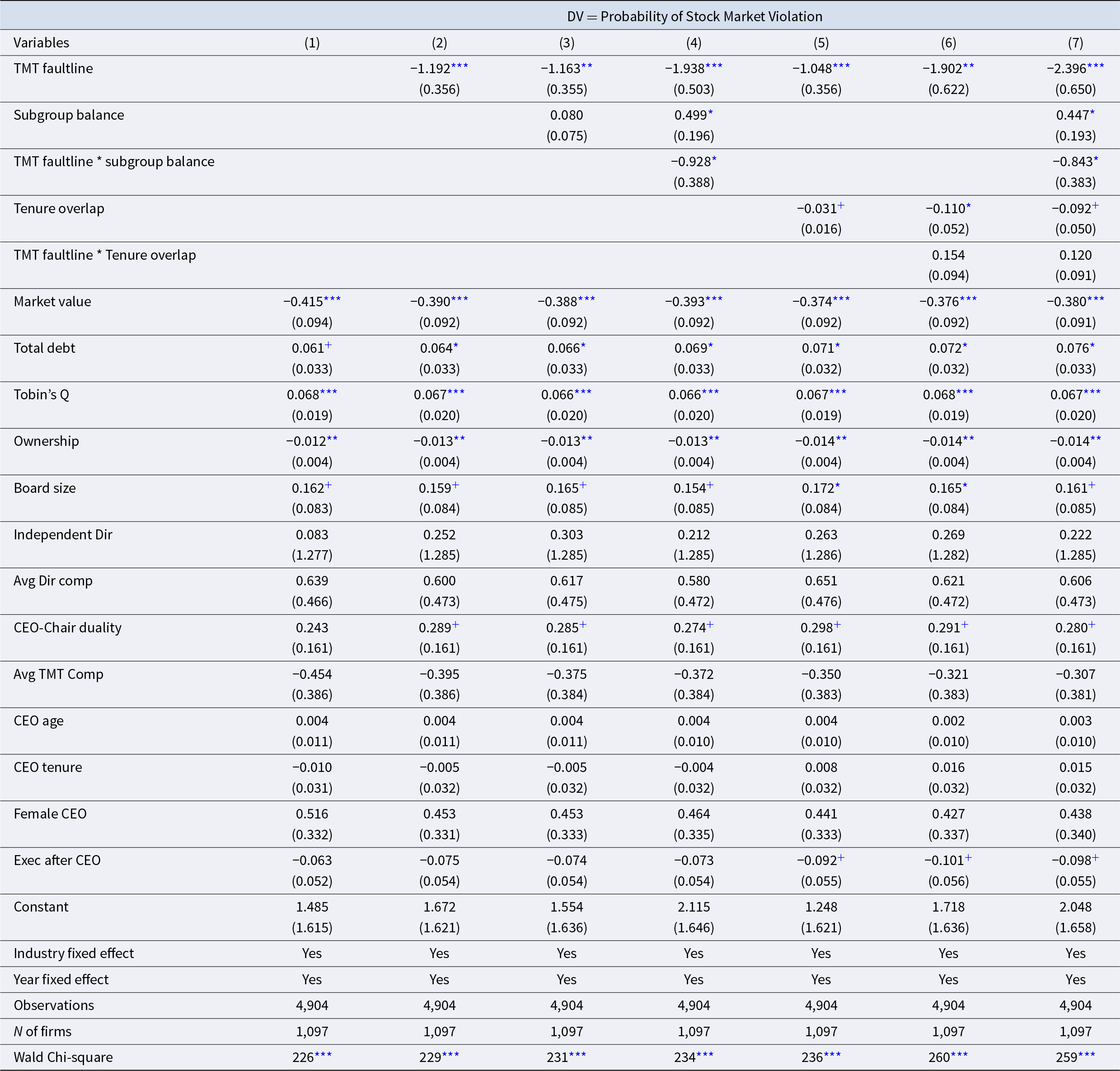
The primary analysis used GEE models and included all stock market violations as the main dependent variable. The results are presented in Table 3. Column 1 includes only control variables; column 2 tests the main effect of TMT faultlines; column 3 tests the main effects of TMT faultlines and subgroup balance; column 4 includes the interaction term between TMT faultlines and the balance of subgroups; column 5 tests the main effects of TMT faultlines and tenure overlap; column 6 includes the interaction effect between TMT faultlines and tenure overlap; and column 7 includes all variables.
Results of GEE models predicting the probability of all stock market violations

Notes: Robust standard errors are in parentheses.
+ P < 0.10, *P < 0.05, **P < 0.01, ***P < 0.001.
H1 predicts that TMT faultlines are negatively related to the likelihood of violation. In column 2, the coefficient of TMT faultline is negative and significant (b = − 1.192, p < 0.001); therefore, H1 was supported. We also conducted a marginal effects analysis to estimate the effect size. The average probability of violation is 0.102 when there is no TMT faultline, and the probability decreases to 0.038 when there is a maximum TMT faultline.
H2 predicts that the balance of subgroups will strengthen the negative effect of TMT faultlines. In column 4 of Table 3, the coefficient of the product term TMT Faultline × Subgroup Balance is negative and significant (b = −0.928, P < 0.05); thus, H2 was supported. The interaction effect is plotted in the following Figure 1. Because the dependent variable is binary (commits violation or not), the model is inherently a non-linear one. To better illustrate the non-linear effects, we use a three-dimensional surface plot. We also include a traditional two-dimensional plot at three levels of subgroup balance. As shown in the surface plot and the two-dimensional plot, TMT faultlines and the probability of violations have a generally negative relationship when subgroup balance is strong. For example, when subgroups are balanced (subgroup balance = 0), the probability of violations decreases very quickly as TMT faultlines increase from low to moderate levels, and the downward trend slows down once TMT faultlines reach high levels. Specifically, the probability of violations decreases from 0.143 to 0.026 as TMT faultlines increase from 0 to 1. However, when subgroups are not balanced (subgroup balance = −2.5), the effect of TMT faultlines flips, and it has a small positive relationship with the probability of violations. Specifically, the probability of violations increases from 0.050 to 0.070 as TMT faultlines increase from 0 to 1.
(a) Surface plot of the interaction effects between TMT faultline and subgroup balance (b) Two-dimensional plot of the interaction effects between TMT faultline and subgroup balance

H3 predicts that tenure overlap will weaken the negative effect of TMT faultline. In column 6 of Table 3, the coefficient of the product term TMT Faultline * Tenure Overlap is positive but not significant (b = 0.154, n.s.); thus, H3 was not supported.
Supplemental Analysis
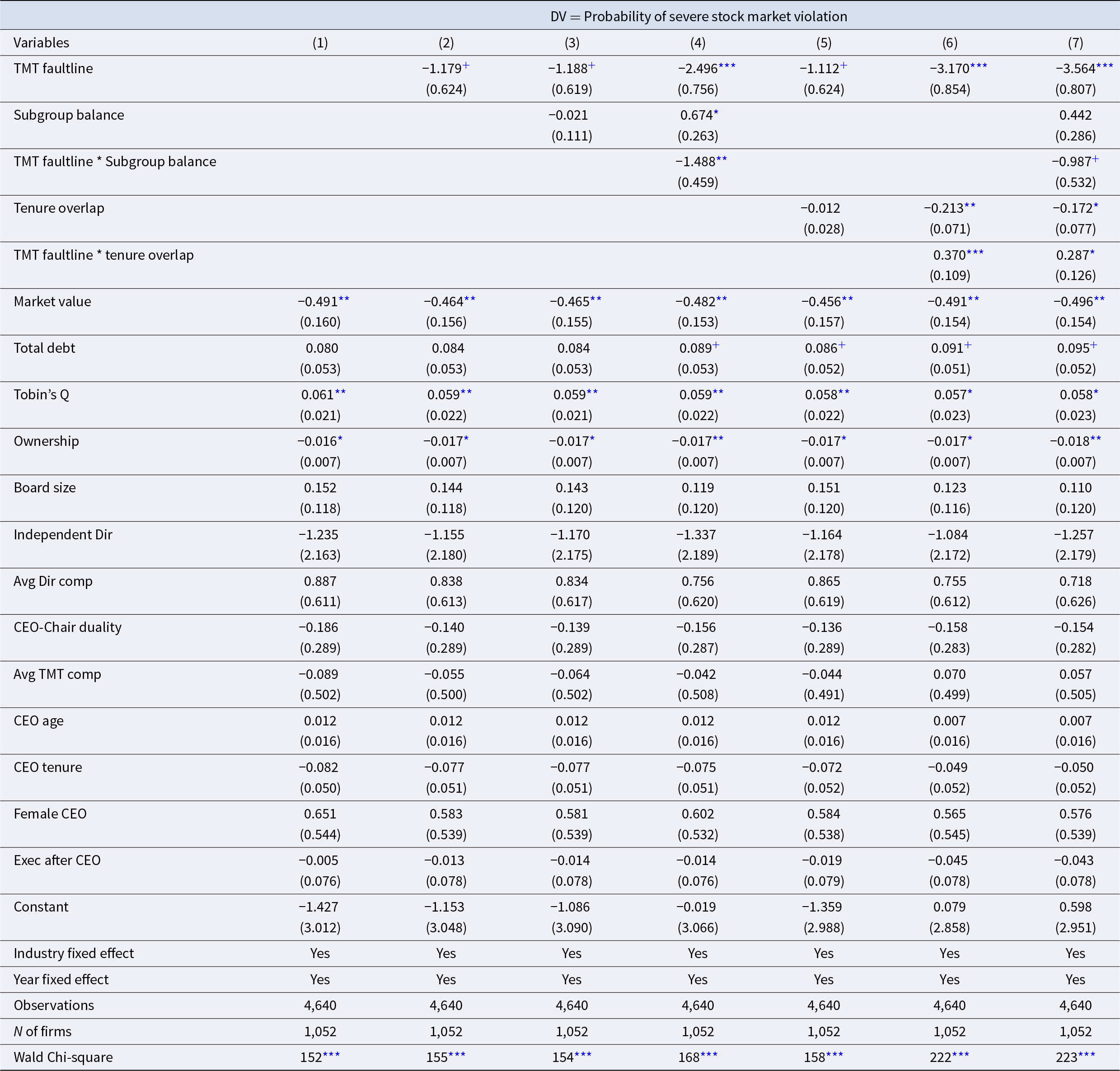
We conducted several sets of supplemental analyses to test the robustness of the results from the primary analysis. First, instead of using all stock market violations as the dependent variable, we used only severe violations, which are a more restricted and conservative indicator of firms’ misconduct. Table 4 presents the results of GEE models predicting the likelihood of severe violations.
Results of GEE models predicting the probability of severe stock market violations

Notes: Robust standard errors are in parentheses.
+ P < 0.10, *P < 0.05, **P < 0.01, ***P < 0.001.
Column 2 of Table 4 shows that TMT Faultline is negatively related to the probability of Severe Violations (b = −1.179, P < 0.1). Column 4 of Table 4 shows that Subgroup Balance strengthens the effect of TMT Faultline (b = −1.488, p < 0.01). The main effects of TMT faultline and the moderating effect of subgroup balance are fully consistent with the primary results. In addition, column 6 in Table 4 shows that the Tenure Overlap weakens the effect of TMT Faultline (b = 0.370, P < 0.001), which is consistent with H3. Thus, the results suggest that tenure overlaps between CEOs and TMT weaken the effect of TMT faultlines on severe violations only, but not all violations.
Second, we used a rare events logistics model to test our hypotheses. Stock market violations can be considered rare events, and thus conventional models such as GEE may produce biased estimates. We tested our results using a rare events logistics model by including violations and severe violations as dependent variables. Both sets of results are fully consistent with the GEE models.
Third, to address the potential bias due to omitted variables, which is a primary source of endogeneity, we conducted an analysis of the impact threshold of a confounding variable (ITCV) (Busenbark, Yoon, Gamache, & Withers, Reference Busenbark, Yoon, Gamache and Withers2022). The results indicate that an omitted variable would have to correlate with the dependent variable violations at 0.139 to invalidate the causal inference of TMT faultline. In our data, only ROA has a stronger correlation with violations (r = −0.15), and all other covariates have a much weaker correlation than this threshold. Thus, it is unlikely that there exists such an omitted variable that would correlate such highly with Violations that can bias the causal inference. Overall, the supplemental analysis shows that our primary results are quite robust.
Finally, it is possible that stock market violations may influence TMT faultlines. To address concerns about reverse causality, we conduct the Granger causality test, which is used to determine whether reciprocal effects exist in a time series or panel data (Lopez & Weber, Reference Lopez and Weber2017). We regress TMT faultlines on Violations (with one-year and two-year lags). The results show that Violations do not Granger-cause TMT faultline, alleviating the concerns about reverse causality.
Discussion
Corporate governance research is dominated by the principal–agency framework, under which inherent conflicts between shareholders and managers are considered the key to the agency problem (Fama & Jensen, Reference Fama and Jensen1983; Jensen & Meckling, Reference Jensen and Meckling1976). Despite research efforts, corporate governance literature lacks discussions of the demographic faultlines within the TMT and how managerial faultlines can be leveraged to improve corporate governance. This study addresses these gaps and proposes an agency–agency perspective on corporate governance. We argue that demographic faultlines divide the TMT into factions and increase conflict among factional subgroups, which, in turn, generates mutual monitoring. Our research demonstrates the direct effects of managerial faultlines on financial fraud in Chinese-listed companies. In particular, our findings show that managerial faultlines can attenuate corporate financial fraud and that this negative relationship is contingent on TMT subgroup balance. Our research sheds new light on the role of agent diversity in corporate governance outcomes.
Theoretical Implications
This study makes important theoretical contributions. First, we contribute to agency theory by addressing the potential conflicts within the TMT and extending the focus of the principal–agency dichotomy toward an agency–agency perspective on corporate governance. Extant corporate governance literature generally views the TMT as an aligned group and emphasizes the potential for a unified management team to appropriate corporate resources for private benefits at shareholders’ expense (Daily, Dalton, & Canella, Reference Daily, Dalton and Canella2003). This article invokes faultlines theory and suggests that faultlines amplify conflicts, cause competition, and disturb collaboration within the TMT, which, in turn, generates factional subgroups. Our argument extends principal-agency-based corporate governance by including agent diversity into consideration. Examining multiple attributes of the diversified agents opens up an exciting new avenue of research, leading to improved corporate governance practices. We invoke faultline theory and contribute to TMT and board diversity literature because faultlines consider the alignment of multiple attributes of members (Bezrukova, Jehn, Zanutto, & Thatcher, Reference Bezrukova, Jehn, Zanutto and Thatcher2009). Diversity is typically operationalized by examining one demographic characteristic at a time. Faultline research however indicates that even highly diverse teams may exhibit weak faultlines, especially when any subgroups formed are similar in only one dimension (Lau & Murnighan, Reference Lau and Murnighan1998). TMT and board diversity literature fails to account for how a combination of demographic characteristics influences TMT members simultaneously (Thatcher et al., Reference Thatcher, Jehn and Zanutto2003). Faultlines, which divide teams into subgroups based on multiple demographic attributes, offer a more comprehensive framework for understanding the effects of team composition than the traditional diversity perspective (Zhang et al., Reference Zhang, Ayoko and Liang2021).
Second, we contribute to corporate governance research by identifying and examining the underlying mechanism that transforms managerial faultlines into governance functions. Prevailing corporate governance research probes the efficacy of the various mechanisms available to discipline agents from self-serving behavior (e.g., Hambrick et al., Reference Hambrick, Humphrey and Gupta2015; Jia et al., Reference Jia, Ding, Li and Wu2009; Martin et al., Reference Martin, Wiseman and Gomez-Mejia2019). Very few studies have attempted to examine potential conflicts within the TMT and the resulting mutual monitoring among top executives. Li (Reference Li2014) asserts that the balance of authority and decision rights leads to mutual monitoring between the CEO and the highest-paid non-CEO executive. Rather than relying on the aggregation of individual executives’ attributes (i.e., payment), we lift the level of analysis to the group level and argue that faultlines create the necessary conditions and motivation for mutual monitoring. We implicitly test the relationship between TMT faultlines and corporate financial fraud and enrich our understanding of the mechanisms connecting faultlines and corporate governance.
Third, through examining faultlines’ role in corporate governance, this study alters the stereotype of social categorization effects caused by TMT faultlines. According to social identity theory (Tajfel, Reference Tajfel1978) and social categorization theory (Turner, Reference Turner1985), demographic faultlines are suggested to drive the formation of social-identity-based subgroups and, therefore, trigger social categorization processes (Van Knippenberg et al., Reference Van Knippenberg, De Dreu and Homan2004). These processes are always connected to dysfunctional social interactions and outcomes, such as emotional contradiction, mistrust, and dislike (Choi & Sy, Reference Choi and Sy2010; Lau & Murnighan, Reference Lau and Murnighan1998) and ineffective communication and information utilization (Cronin, Bezrukova, Weingart, & Tinsley, Reference Cronin, Bezrukova, Weingart and Tinsley2011; Crucke & Knockaert, Reference Crucke and Knockaert2016). However, we argue that subgroups within a TMT may also form a counterbalancing effect to reduce organizational risk.
Finally, this study provides insights into the boundary conditions of how managerial faultlines affect corporate financial fraud. Our results show that faultlines can be leveraged as a counterbalance to managerial autonomy and self-serving behavior. Extant literature has studied internal mechanisms to reduce corporate fraud by addressing board characteristics and ownership structure. This article integrates faultlines theory with corporate fraud literature and argues that faultlines and the resulting factions within the TMTs provide an alternative mechanism to deter and reduce fraud. TMT faultlines can paradoxically enhance internal governance by fostering mutual checks, which ultimately reduce corporate fraud.
We also examine under what conditions faultlines can function more effectively. Our article considers the configuration of subgroups and TMT members’ tenure overlap. Our findings clarify the conditions under which the mutual monitoring function of faultlines can be exhibited. Although managerial faultlines may directly reduce corporate financial fraud and improve corporate governance, their effectiveness is also determined by the balance of the subgroups and by tenure overlap among TMT members. This contingency effect is important because it elaborates on the distinct facets of managerial faultlines as a corporate governance mechanism and provides the foundation for leveraging faultlines to discipline the TMT.
Managerial Implications
Our study yields important practical implications. First, our findings show that TMT faultlines can improve the effectiveness of corporate governance. Thus, shareholders should place greater emphasis on understanding the demographic differences within the TMT and ensure that TMT members have heterogeneous demographic features to promote mutual monitoring among them. Second, our results indicate that the effectiveness of mutual monitoring among TMT members is weakened by imbalanced subgroup configurations. Thus, public firms and their boards of directors should place greater emphasis on managing TMT configuration and maintaining a balanced TMT team. A balanced TMT configuration, in terms of members’ demographic attributes, can strengthen the effects of faultlines on corporate fraud reduction. Finally, this study provides valuable practical implications for firms and regulators in China. Our findings suggest that managerial factional faultlines can serve as an effective governance mechanism to mitigate managerial opportunism and deter corporate financial fraud. Therefore, boards of directors at listed firms should carefully consider TMT composition when appointing top managers. Investors and their agencies should carefully balance the benefits and costs of a diversified TMT in their endeavor to promote gainful investment. Regularly rotating managers within the organization could help prevent the formation of strong managerial coalitions, thereby reducing the risk of opportunistic behavior.
Limitations and Future Research Directions
This study has several limitations, which open new avenues for future research. First, the sample of this study focuses on a single economy: China. Future studies can test whether our theoretical model applies to other agency problems, such as related-party transactions and corporate takeovers. Our theoretical model can also be tested in other emerging economies, such as Russia and India, which also suffer from various agency problems. Second, while we utilized multiple measures of managerial faultlines, it is possible that our findings captured only a partial picture of faultlines and their implications in corporate governance. This article suggests that mutual monitoring processes are not limited to formal, role-based information exchange and may involve clandestine information collection and investigative efforts. Thus, future research could consider conducting qualitative analyses to gain more insights into the black box between faultlines and corporate governance activities using surveys and case interviews. The roles of different types of faultlines (i.e., demographic-related vs. task-related) in shaping mutual monitoring and information exchanges are also required further exploration. Another interesting way is to explore the number of executives appointed after (by) the CEO to see whether these executives support the CEO. Finally, we examined the effect of faultlines on financial fraud in listed firms. However, corporate financial fraud is a multidimensional item. Thus, it would be useful to specifically examine the effects of managerial faultlines on different types of fraud.
Conclusion
In this article, we argue that TMT faultlines drive the formation of social-identity–based subgroups and therefore trigger competition and conflicts within the TMT. We provide compelling empirical evidence to illustrate that managerial faultlines can help firms mitigate corporate financial fraud, and we explore the contingency effects of faultline configuration on the relationship between faultlines and corporate financial fraud. This study theoretically addresses the potential mutual monitoring between different factions within the TMT and empirically examines the underlying mechanisms of managerial faultlines and corporate governance outcomes. Our theoretical framework and empirical findings deepen the current understanding of why and how TMT faultlines contribute to corporate governance.
Data availability statement
The data used for this study are available at https://data.csmar.com
Acknowledgements
The authors would like to thank Weize Huang and Pingli Li for their helpful comments on early drafts of this paper. This work was supported by the Beijing Municipal Social Science Funds (Grant No. 23GLB016).
Author contributions
D.T. is the project leader of the study. He contributed to project administration, conceptualization, methodology, formal analysis, funding acquisition, investigation, data collection, data curation, research design, and writing – review & editing. M.L. contributed to the manuscript preparation of the study, including conceptualization, formal analysis, methodology, resources, writing – original draft, and validation. S.C. contributed to conceptualization, formal analysis, methodology, resources, research design, writing – original draft, and writing - review & editing. Q.A. contributed to conceptualization, writing – review & editing.
Da Teng (da.teng@mail.buct.edu.cn) is an Associate Professor in international business at Beijing University of Chemical Technology, Beijing, China. He holds a PhD degree from King’s College London. His research focuses on international business and corporate governance in China. His works have been published in journals such as the Asia Pacific Journal of Management, International Small Business Journal, International Business Review, among others.
Mengge Li (mli3@utep.edu) is an Associate Professor of management in the Department of Marketing, Management, and Supply Chain at UTEP. His main research interests are strategic leadership, corporate governance, competitive strategies, and innovation management. He has published in journals such as the Journal of Management, Group and Organization Management, Journal of Management and Organization, and Journal of Management and Governance. He has presented at major international conferences organized by the AOM, the SMS, etc.
Shuai Chen (20120068@zufe.edu.cn) is an Associate Professor at the College of Business Administration, Zhejiang University of Finance & Economics, China. Her research interests lie in issues related to team dynamics and strategic HRM in the digital era. Her articles have been published in journals such as Tourism Management, Asia Pacific Journal of Management, and Small Group Research, among others.
Qi Ai (qi.ai@brunel.ac.uk) is a senior lecturer in strategy and international business at the Brunel Business School, Brunel University of London, UK. His current research focuses on mergers and acquisitions, organizational legitimacy, and emerging market multinational enterprises. His work has been published in journals such as the Journal of World Business, Asia Pacific Journal of Management, Development and Change, among others. He is a senior editor of Management and Organization Review and serves on the editorial boards of the Asia Pacific Journal of Management and Strategic Change.