Introduction
The teaching of musical instruments in what is sometimes referred to as the applied studio continues to gain attention in the literature. At the higher education (tertiary or university) level, it is a core element of the majority of undergraduate and graduate curricula. While in recent years there has been a growing body of literature about the nature of the learning environment and the interactions within the studio (private lesson), there is a limited body of work that explores the issues around why advanced musicians choose to commence working as a music instrument teacher at the higher education level. Hence, the focus of this paper is in relation to what factors motivate advanced musicians to engage and continue in the career of music instrument teaching in higher education. In examining motivation, the constructs (i.e. intrinsic interest value, attainment value, utility value, expectancy, ability and cost) of the expectancy-value framework of Eccles et al. (Reference ECCLES, ADLER, FUTTERMAN, GOFF, KACZALA, MEECE, MIDGLEY and Spence1983) are used to answer the following research questions.
(1) What might teachers say are reasons that illustrate their choices to teach?
(2) Are there differences in the beliefs (expectancy, ability, intrinsic interest, attainment, utility and cost) teachers have about instrument teaching and music performing?
(3) What are the relationships between the six motivational constructs (expectancy, ability, intrinsic interest, attainment, utility and cost) in the expectancy-value model and the current career satisfaction of teachers?
(4) Which of the six constructs in the expectancy-value model might predict the likelihood of a teacher staying satisfied with both teaching and performing?
Literature of relevance
In general, there are few studies that specifically focus on the factors that motivate advanced musicians to become music instrument teachers in higher education. While there are some that provide insights into when musicians start working at this level (e.g. Mills, Reference MILLS2004a, Reference MILLS2004b), these are limited in terms of depth of analysis of motivational factors. As discussed in the literature, most musicians pursue a career in performance, however at some point many start music instrument teaching. Yet while it is a common transition and path, some possible impacts are yet to be examined, for example the extent to which financial imperatives influence a performer's decision to commence teaching. Indeed Welch et al. (Reference WELCH, PURVES, HARGREAVES and MARSHALL2010) refer to the common reality that ‘many professional musicians take opportunities to interweave instrumental teaching alongside performance as part of a portfolio career’ (pp. 11–12). When and why this happens remains an under-researched area.
There are certain broad views relevant to the individual and social constructs around being a musician in the traditional western or classical sense, with Coulson (Reference COULSON2010) referring to the strong sense of vocation prevalent amongst this group and the sense of being ‘compelled to do it’ (2010, p. 267). Hallam (Reference HALLAM2002) provides an in-depth examination of motivation as applied to musicians, arguing that it is highly complex and complicated, given ‘musical motivation depends on a complex interaction between the characteristics of the individual and his or her environment’ (p. 235). Hallam (Reference HALLAM2002) also refers to the various stages that a musician passes through as their career develops and how at each of these times, the motivations and influences can vary significantly, thereby adding to the complexity of this issue.
In terms of higher education music instrument teachers, there are some views in the literature on the status of these roles within the music sector. For example, Mills (Reference MILLS2004) argues how prestigious these appointments are and the extent to which musicians see it as ‘a defining point of their career: a supreme achievement’ (p. 183). Traditionally, music instrument teachers at this level are appointed on the basis of their profile as a performer and often, regardless of whether they have any specific training in pedagogy and/or curricula. As stated by Wexler (Reference WEXLER2009), ‘We had been hired because we could play our instruments well and had demonstrated a certain amount of professional success, which meant we had recorded, toured, been reviewed, and promoted ourselves effectively in the competitive world of classical music’ (p. 1). While this has been a strong part of the tradition within conservatoria and other institutions of higher education, to some extent this situation appears to be changing, and Abeles (Reference ABELES and Ward-Steinman2011) argues that while for some institutions ‘the primary credential for being hired as a studio instructor may be an impressive performance resumé, an increasing number of institutions are seeking candidates with impressive performance experiences as well as the skills, knowledge, and personal qualities necessary to be an effective instructor’ (p. 19).
There are some studies that investigate musicians’ choices and thoughts on their future career. In a study involving 66 undergraduates in traditional music degree programmes, Welch et al. (Reference WELCH, PURVES, HARGREAVES and MARSHALL2010) asked how the participants imagined their future career in an ideal world: 47% saw themselves as performers, 18% as performers and teachers, 9% saw themselves involved in non-performing musical work such as music therapy and administration, and 10% imagined that they would leave the field of music altogether. Other studies (e.g. Fredrickson, Reference FREDRICKSON2007; Rickels et al., Reference RICKELS, COUNCILL, FREDRICKSON, HAIRSTON, PORTER and SCHMIDT2010) identified that many developing musicians see music instrument teaching as a part of their future. It would also seem that music instrument teachers have a significant influence on developing musicians, indeed Welch et al. (Reference WELCH, PURVES, HARGREAVES and MARSHALL2010) found that the participants ‘felt that their individual instrumental teachers (both before and during their undergraduate studies) had had the most influence on their musical careers overall’ (p. 19).
In summary, there are no published studies that specifically explore the reasons why musicians commence a career in music instrument teaching at the higher education level. While related studies exist, for example, the doctoral research by Slawsky (Reference SLAWSKY2011) who investigates how a small sample (n = 12) of beginning piano teachers working outside the higher education sector transition into becoming a teacher, the question of why they made this choice to teach was not investigated in any depth. Similarly, while there are studies that involve music instrument teachers working at the higher education level, none of these specifically investigate the reasons behind their decisions to continue to engage in work at this level.
Expectancy-value framework
In order to explore how identities manifest as careers that music instrument teachers choose to pursue, the expectancy-value model is particularly helpful. It has been used to predict student career choices in disciplines such as music (Parkes & Jones, Reference PARKES and JONES2012), engineering (Jones et al., Reference JONES, PARETTI, HEIN and KNOTT2010) and mathematics (Meece et al., Reference MEECE, WIGFIELD and ECCLES1990). The expectancy-value model (Eccles et al., Reference ECCLES, ADLER, FUTTERMAN, GOFF, KACZALA, MEECE, MIDGLEY and Spence1983, Reference ECCLES, ADLER and MEECE1984; Wigfield & Eccles, Reference WIGFIELD and ECCLES1992; Wigfield, Reference WIGFIELD1994; Eccles & Wigfield, Reference ECCLES, Elliot and Dweck1995) suggests that individuals’ expectancies and values influence their choices, performance, effort and persistence. Eccles and her colleagues showed that students’ expectancy for success relates strongly to performance on a task, whereas as values relate strongly to intentions and choice of activities. Eccles and Wigfield (Reference ECCLES and WIGFIELD1995) also demonstrated that the achievement task value was separated into three constructs: intrinsic value, attainment value and extrinsic utility value. Intrinsic interest value may be defined as either the enjoyment experienced from performing an activity or the subjective interest an individual has in a subject. Individuals who have a high intrinsic interest value are more likely to engage in the task, persist longer, and be intrinsically motivated to perform the task (Wigfield & Eccles, Reference WIGFIELD and ECCLES1992). Attainment value is defined as the importance of doing well on a task. The extrinsic utility value of a task is the usefulness of the task in terms of an individual's future goals.
The authors chose to measure the social utility aspect of utility in this study, as suggested by Parkes and Jones (Reference PARKES and JONES2012). The social utility value of a task for musicians and teachers seems more appropriate to measure as it relates to the overall social utility value of the task (i.e. the social contribution value of music performance or music teacher to society at large, rather than to individuals personally). The expectancies that individuals hold are similar, in a way, to self-efficacy; that is, how well do they think they will do, or if they think they have competence in a specific area. The construct of cost is the extent to which individuals perceive the amount of effort required is worthwhile. Cost has not been as tested empirically as the other five constructs, but is considered part of the expectancy-value model (Eccles et al., Reference ECCLES, ADLER, FUTTERMAN, GOFF, KACZALA, MEECE, MIDGLEY and Spence1983). In summary, the goal of this study was to examine the reasons music instrument teachers give for working in higher education and the six constructs in the expectancy-value model of motivation as relevant to them (i.e. intrinsic interest value, attainment value, utility value, expectancy, ability and cost). Four research questions were therefore developed as discussed previously.
Participants
Higher education music instrument teachers in nine Western countries participated in an online survey. One hundred and seventy-three individuals attempted the survey and we estimated that of the invitation emails sent, the response rate was 6.4%. In terms of location, there were 5.6% in Finland, 6.3% in South Africa, 8.1% in Denmark, 9.4% in New Zealand, 9.4% in Sweden, 12.5% in Norway, 13.1% in England, 16.3% in the USA and 19.4% in Australia. Of these, 57.5% were male, and most of them were White/Caucasian (91.3%). Additionally, 0.6% were Hispanic, 0.6% were American Indian, 5% described themselves as ‘other’ and 2.5% chose not to respond to this question. While some respondents chose not to complete every question, on average there were at least 160 responses as data for analysis.
Survey
The survey was designed to explore teachers’ beliefs about music performance and instrument teaching. For example, questions used included ‘What factors motivated you to pursue work in the tertiary sector?’ In this paper, we also discuss the results of 26 Likert-type items that asked teachers about their perceptions related to the constructs in the expectancy-value model of motivation as well as their career satisfaction.
Expectancy-value items for instrument teaching and music performance
We adapted these items with permission from the researchers Parkes and Jones (Reference PARKES and JONES2012) and each of the six constructs was measured with two 7-point Likert-type scales, for both careers in teaching and performing. Our participants currently teach and perform, along with holding identities in both of these domains. We replaced the phrase ‘classroom music teaching’ (from Parkes & Jones, Reference PARKES and JONES2012) with ‘music instrument teaching’ (see Appendix A for all items). Example items are as follows (the first Cronbach's alpha reported is for music performing and the second alpha is for music instrument teaching): for expectancy, ‘Compared to other music performers, how well do you expect to do this year?’ (very poorly, very well; α = 0.85, 0.86); for ability, ‘How good are you at music performance?’ (not at all good, very good; α = 0.90, 0.91); for intrinsic interest value, ‘In general, I find music performance?’ (Very boring, very interesting; α = 0.82, 0.92); for attainment value, ‘How important is it to do well at music performance?’ (not at all important, very important; α = 0.85, 0.92); for social utility value, ‘How much do music performers give back to society?’ (not much at all, very much; α = 0.85, 0.91); and for cost, ‘Is the amount of effort it takes to do well at music performance worthwhile to you?’ (not very worthwhile, very worthwhile; α = 0.67, 0.77).
Satisfaction with instrument teaching and music performance
These instruments consisted of one question each to measure the level of satisfaction each participant felt about music teaching and about music performing and can be seen in Appendix A. Lehmann (Reference LEHMANN2011) suggested that one question about career choice is reliable and correlates consistently with other items about job satisfaction, hence only one item for each of performing and teaching was used.
Qualitative data analysis
In order to explore the answer to our first research question (What might teachers say are reasons that illustrate their choices to teach?), respondents were asked to reflect on their time as a higher education student and whether they were actively considering this type of work. The results were as follows: I never thought about it (26.9 %, n = 43); I occasionally thought about it (25 %, n = 40); I wanted to be a teacher (23.8 %, n = 38); I regularly thought about it (14.4 %, n = 23); I didn't want to be a teacher (11.9%, n = 19); I don't remember (1.9 %, n = 3). It is interesting that for approximately half of the sample, they rarely or never thought about music instrument teaching while a student, although it may have been the case that some had thought about teaching but not necessarily at the higher education level. While nearly half were engaging with the concept of becoming a music instrument teacher, there were some that did not want to go down this particular path. This is somewhat aligned with the findings from Fredrickson (Reference FREDRICKSON2007) who found that over half the music students he surveyed agreed that they ‘hoped’ to teach privately (in a studio setting) after graduation (p. 331). He found that, to similar degrees, both education and performance majors ‘expected’ to teach in the studio after graduation. The overall findings from our study however, suggest that for many, their priority and focus was on developing into a full-time performer, rather than a teacher.
Some of the respondents (n = 23) to this question also provided additional written comments relevant to their choice. Some of the more interesting were:
• I thought that teachers were people who had failed as musicians, which is weird, thinking back on it, because I always respected the teachers that I had.
• I had been giving private lessons to students since my mid teens so teaching music was already becoming an integrated part of my music practice. I never really thought much about it therefore as it was becoming second nature by now.
• I only knew that I wanted to be a musician, to work in music. I really didn't have the confidence to know that I would be a good teacher in the future.
• I taught from my second year of university study as I needed to support myself through university.
• I didn't think I'd really be a teacher some day – I thought I'd be a performer my whole life.
• At that time, it was just part of my income earning and not the focus of my ambitions at all.
These comments offer additional insights into how diverse are the views of those actively pursuing high-level performance studies. For some, teaching is already a core element of their profile and identity, while for others it is something yet to become a reality. Additionally, the notion of teaching out of simple financial needs seemed salient.
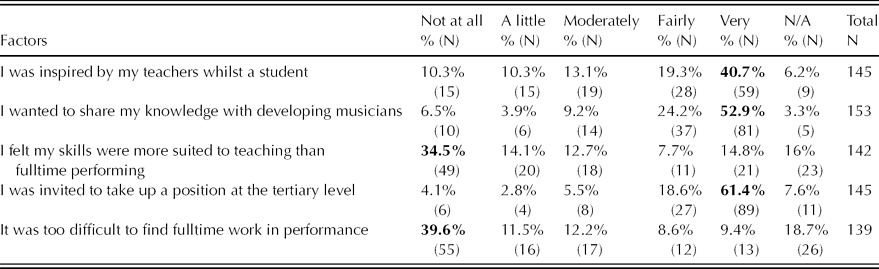
In terms of the specific motivational factors influencing the pursuit of work at the higher education level, respondents’ ratings of a number of options presented to them are reported in Table 1. The choices ‘I was inspired by my teachers whilst a student’, ‘I wanted to share my knowledge with developing musicians’, and ‘I was invited to take up a position’ were the most influential factors amongst this sample. The first two mirror the findings of Jones and Parkes (Reference JONES and PARKES2010) who found that students seeking a career in teaching were inspired by a teacher, or they wanted to share their knowledge. The latter reason was also reported by Fredrickson (Reference FREDRICKSON2007) where the majority of students reported wanting to teach privately because they would ‘enjoy seeing the students develop into better musicians’ (p. 336). The tradition of inviting high-level performers to teach at the higher education level is also evidenced amongst our participant group, and this reflects the extant literature (e.g. Mills, Reference MILLS2004a; Wexler, Reference WEXLER2009). The choice ‘I thought I was better suited to teaching’ was also not a major factor, this further evidencing the fact that being a performer was the main intention for many of this sample.
Ranked responses to the question: What factors motivated you to pursue work in the higher education/tertiary music sector?(1 = not at all important; 7 – Very important)

NB: Participants could select all answers that applied.
Most highly ranked responses are in bold.
A small number of respondents (n = 23) also provided reasons to support their response choice above. Some of the more interesting were:
• I always wanted to teach on the collegiate level – I found that just sitting in an orchestra would be too limiting.
• Fulltime performing is not a viable financial option on the instrument I prefer to perform on in the community where I live.
• I applied for the job and ‘they chose me’.
• My sudden onset of hand tremors destroyed my performing career quite quickly so I decided to deal with the issue pro-actively and embarked on a PhD in studio teaching.
These responses are valuable and themes start to become clearer in relation to what motivates people to start teaching. For some, the decision is driven by necessity (e.g. income, injury, work opportunities) while for others it is as a result of a genuine interest in education or working in the higher education sector, where there is a level of prestige attached to the role.
Respondents were asked to identify when they started teaching at the higher education level. The results, in descending order in terms of frequency of selection, were as follows: While I was a graduate student (23.8%, n = 38); Within 1–3 years after finishing studies (20.6%, n = 33); More than 10 years after finishing studies (18.8%, n = 30); Straight after graduation (15%, n = 24); While I was an undergraduate student (12.5%, n = 20); and More than 4 years after finishing studies (9.4%, n = 15). The results show that the majority of this group (71.8%, n = 115) commenced teaching while a student or within three years of finishing their studies. While the remainder took longer to start work in this area, it is clear that for many musicians, teaching forms a key part of their early career. It is also interesting that while many were potentially keen to have a fulltime career in performance only, teaching in fact becomes an early component of their career and work profile.
Participants were also asked to give the activities they currently engage in as part of their work and individually they reported performing (3.8%, n = 6) teaching (20%, n = 32), performing and teaching together (58.1%, n = 93) and several (18%, n = 29) suggested they also do other activities, such as ensemble directing, administration, teaching music education classes, research, lecturing in other subjects, coaching, accompaniment, composition, management, teaching aural skill/theory/history classes, and conducting. Participants were asked to estimate the percentage of time spent either teaching, performing or doing other activities. On average, they reported spending 35.4% of their time performing in public, 46.7% of their time teaching, and 26.1% of their time doing other things such as teaching other classes, accompanying, composing, administration, and/or conducting. This shows that they are indeed engaged in both performing and teaching as part of their position in higher education.
Quantitative data analysis
We analysed the data using the Statistical Package for Social Sciences (SPSS) 20.0 program. For reporting purposes, the level for statistical significance was set at 0.05. Descriptive statistics were computed for all of the motivation survey items. We conducted several types of analyses, including correlational, mean comparisons (t-tests), and linear regression. As suggested in Parkes and Jones (Reference PARKES and JONES2012, p. 109), we examined tolerance values as measures of collinearity for the regression analyses. We considered tolerance levels of less than 0.25 to indicate a problem with collinearity but found that none of the tolerance values were less than this value for any of our analyses.
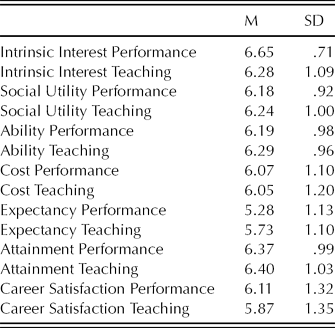
Our second research question was: Are there differences in the beliefs (expectancy, ability, intrinsic interest, attainment, utility and cost) teachers have about instrument teaching and music performing? To ascertain whether the teachers rated one or more of the six motivational constructs higher or lower between teaching and performing, we conducted six paired sample t-tests. For means, see Table 2. The t-tests revealed that there was significant difference between the scores for intrinsic interest value for teaching (M = 6.28, SD = 1.09) and intrinsic interest value for performing (M = 6.65, SD = 0.71); t(159) = 4.11, p = 0.00. Scores also differed significantly between expectancy for teaching (M = 5.73, SD = 1.10); and expectancy for performing (M = 5.28, SD = 1.13); t(159) = −4.67, p = 0.00, after using the stricter adjustment for multiple comparisons (Bonferroni = 0.008). There was initial statistically significant difference between Career Satisfaction with Performance (M = 6.11, SD = 1.32) and Career Satisfaction with Teaching (M = 5.87, SD = 1.35); t(159) = 2.12, p = 0.03 however the practical significance is reduced here with the stricter Bonferroni adjustment in this study. Participants would choose to do either career again and seem to hold high levels of satisfaction for both. Participants held significantly higher expectancy beliefs about teaching than performing; simply stated, they expected to do well at teaching, they believe in their competence as teachers. They also held significantly higher intrinsic interest value beliefs about performing than about teaching; that is, they like, are interested in, and enjoy performing significantly more than they do teaching. There were no significant differences in the four other constructs (ability, attainment value, social utility value, and cost) between teaching and performing.
Mean scores for the instruments for both teaching and performing (n = 160)
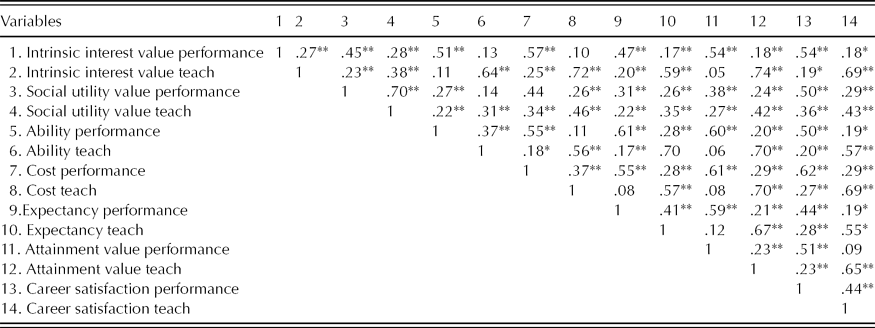
For our third research question, to examine the extent of the correlations among six motivational constructs (expectancy, ability, intrinsic interest, attainment, utility, and cost) in the expectancy-value model and the current career variables of teachers, we computed the correlation coefficients (see Table 3). The salient findings are that all the variables were positively correlated but that several were not significantly correlated. Interest in performance was not significantly correlated with ability for teaching, or cost of teaching. Social utility value in performance was not significantly correlated with ability for teaching, and ability for performing was not significantly correlated with cost of teaching. Attainment value for performing was not significantly correlated with career satisfaction for teaching and indicates that these teachers hold separate beliefs about teaching versus performing.
Intercorrelations between variables
Note: ** p ≤ 0.01; * p ≤ 0.05 (two-tailed).
For the teaching constructs, the same pattern of non-significant correlations also emerged. Interest in teaching was not significantly correlated with ability in performance, or attainment in performance. Ability for teaching was not significantly correlated with attainment in performance, and the cost of teaching was not significantly correlated with attainment in performance. Expectancy for teaching was also not significantly correlated with attainment in performance. The significant correlations (in both teaching and performance) for intrinsic interest ranged from 0.17 to 0.72; social utility value ranged from 0.22 to 0.70; ability ranged from 0.18 to 0.70; cost ranged from 0.18 to 0.72; expectancy ranged from 0.17 to 0.70; attainment ranged from 0.17 to 0.74; and career satisfaction ranged from 0.19 to 0.69.
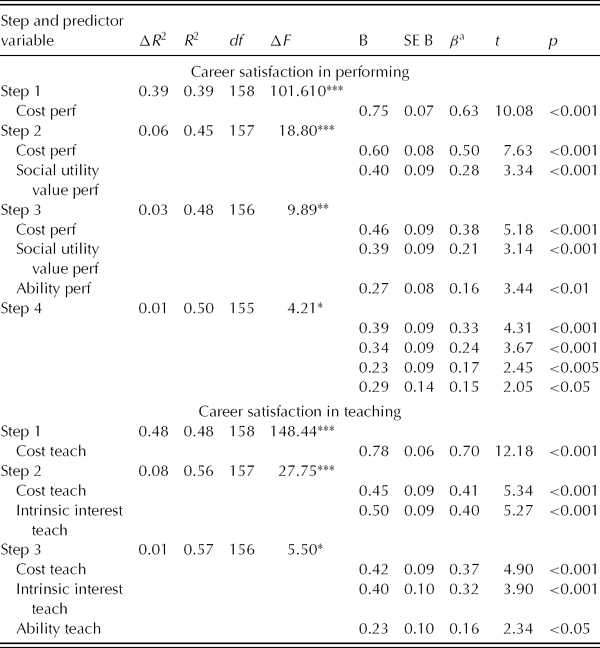
Our fourth research question was: Which of the six constructs in the expectancy-value model might predict the likelihood of a teacher staying satisfied with both teaching and performing? To address this research question, we used stepwise regression so we could add variables one at time. Given there were high correlations between many of the variables, stepwise regression was chosen as it would allow us to add variables one at a time, and because we are examining which variable may best predict the dependent variable (career satisfaction in performing or teaching) given the presence of the other predictor variables. We set the entry probability of F at 0.05 and the removal of probability of F at 0.10 and the results are presented in Table 4.
Stepwise regression analysis of predictors of teaching and performing career satisfaction
* p < 0.05; ** p < 0.01; *** p ≤ 0.001; a Standardised coefficient β.
When we entered the six variables as predictors for the dependent variable of career satisfaction with performing, four were significant predictors. Cost for music performing predicted the most variance (39%) for whether teachers were satisfied with performing. Social utility value for music performing predicted a further 6% of the variance in Step 2, and ability for music performing predicted a further 3% in Step 3. Intrinsic interest value for music performing only predicted an additional 1% in Step 4. In total, these variables accounted for 49% of the variance. Three of the variables were significant predictors of the level of career satisfaction in teaching. Cost for music teaching predicted the most variance (48%), with intrinsic interest value for teaching accounting for a further 8% in Step 2. Ability for teaching predicted a further 1% of the variance in Step 3. In total, these variables accounted for 57% for the variance in career satisfaction in teaching.
Discussion
Given that the purpose of this study was to examine reasons highly trained musicians choose to teach in higher education and the six motivational constructs in the expectancy-value model of motivation in music instrument teachers, our findings show that the cost of both teaching and performing significantly predicts satisfaction in both teaching and performing roles. We measured cost in this study in the two items as in Parkes and Jones (Reference PARKES and JONES2012, p. 108); one item measured the perceived amount of effort required to be a good teacher or performer, and the other measured the anticipated emotional state (e.g. stress) of being a teacher or performer. These aspects of cost are the predictors of our participants’ levels of career satisfaction. There are two ways to interpret this finding. Firstly, it could mean that the cost (i.e. the effort and stress), is now perceived to be worth it because it is the job that these participants find themselves in. They may want to avoid feeling a loss to self-worth (Covington, Reference COVINGTON1992) rather than indicating that the cost of being a performer and a teacher is not worth it. Another way to interpret this finding is offered by Eccles (Reference ECCLES, Elliot and Dweck2005). She suggests that cost is especially important to choice, which may show that because of the personal cost, these participants are now satisfied with both the performing and career choices they have made.
Social utility value predicted a smaller portion of music performing career satisfaction and this may suggest that part of what is satisfying about performing is that it contributes something meaningful to society. Utility value, or ‘usefulness’ (Eccles, Reference ECCLES, Elliot and Dweck2005), can be related to personal goals and one's sense of self (Eccles, Reference ECCLES, Elliot and Dweck2005, p. 112). This shows that the participants’ sense of self was very evident for both performer and teacher. Ability for performing contributed a further 3% but this would indicate that in order to find performing satisfying, one has to believe they have the ability to perform. Ability is similar to attainment but is distinct as a self-perception of achievement. Attainment is the level to which an individual feels it is important to be good at a particular skill. These participants are adults, and perhaps no longer feel that being good should be important as the students did in the Parkes and Jones (Reference PARKES and JONES2012) study; the current teachers in this study already believe they are good performers, as evidenced in their high ability for performance mean score (6.19). This score is important because rather than simply asking the teachers a simple self-report item about how ‘good’ they thought they were at performing, the expectancy-value scale that we used employed two well-designed questions that showed very good internal reliability and consistency (α = 0.90). Noting that these teachers are currently employed by higher education institutions, we have confidence that they are good performers with high ability for performance.
The finding that intrinsic interest value predicted an additional 8% of career satisfaction in teaching supports the findings of Parkes and Jones (Reference PARKES and JONES2012), indicating that individuals with high intrinsic interest values engage with tasks such as teaching, persist longer, and are intrinsically motivated to teach. This is further supportive of the choice to use stepwise regression. If we had simply performed the t-tests, it would be easy to conclude that our participants only like, or are interested in, performing. Intrinsic interest value is the enjoyment one has in performing a task, in this case teaching. Eccles (Reference ECCLES, Elliot and Dweck2005) presents an additional explanation of intrinsic value; that it is similar to the notion of flow (Csikszentmihali, Reference CSIKSZENTMIHALI, Csikszentmihalyi and Csikszentmihalyi1988). This is characterised by behaviours that are intrinsically motivating due their immediate subjective experience. As researchers have suggested, the act of teaching can at times be subjective (Fenstermacher & Richardson, Reference FENSTERMACHER and RICHARDSON2005) and difficult to characterise but the feeling of being ‘in the moment’ and being in control of actions and the environment is often a characteristic of high-quality teaching (Duke & Simmons, Reference DUKE and SIMMONS2006, pp. 11–12). Of interest to this study are the findings that not only is the personal effort or stress of teaching, in higher education, a worthwhile endeavour for our participants, the fact that they simply enjoy teaching is also keeping them satisfied with this element of their positions.
The expectancy-value framework suggests that value constructs (e.g. interest, attainment and utility) are usually the predictor for career choices and choice of activities. It is therefore not surprising that several of those values in this study also predict current career satisfaction. Our participants have already chosen this dual career and spend considerable amounts of time both performing and teaching, so they must feel the personal cost (effort) put forth in both is worthwhile. This proposes that participants will remain satisfied with performing because it feels ‘worth it’ (cost), it has worthwhile social contributions to society, and they believe they are good at performing. The teachers in this study will likely stay satisfied with teaching because it is worthwhile to them and perhaps this is supported in our qualitative data where they indicate that ‘sharing knowledge with others’ is also important.
Limitations
Because the response rate was low, our participants are most likely not representative of all music instrument teachers and therefore this limits the generalisability of the findings. However, we have no reason to believe that their beliefs differ from non-participants in a systematic manner that would influence the results significantly. Additionally, we used only two items for each of the expectancy-value constructs. If we had used more items for each construct the reliabilities, especially for the cost construct, may have been higher. We chose to replicate the items used in Parkes and Jones (Reference PARKES and JONES2012) due to their suggestion that fewer items may increase the chance of unidimensional measurement and decrease the chance that multiple constructs would emerge (p. 117). Finally, the participants in this study may have been biased to report higher beliefs given that they have already chosen to do these careers and have spent considerable time and effort in their current positions. This sample of teachers may feel they need to justify their own position thus rate most areas very highly or with great importance which may not reflect their true perceptions.
Implications and conclusions
The findings from this study, while not statistically representative of the entire higher education music instrument teaching sector, are significant and provide keen insights into the factors motivating this group of musicians. While it is not possible to separate out the distinct differences in our participants’ training, some having trained in conservatoires and others in university departments, what we can draw from our data is that regardless of their training, there are some common unifying perceptions with respect to their teaching in higher education. The key overarching conclusions and implications that can therefore be drawn are: (1) The self-rating of performance ability and frequency of references to being invited to teach reveals that those teaching at the higher education level are typically high-level performers; (2) In addition, teachers appear to choose to teach based on their high performance skills, as against experience and/or interest in teaching; (3) Experiences in learning in private lessons play a major influence on high-level performers choosing to teach, with inspiring teachers and experiences influencing their motivations to share their own knowledge and expertise at the higher education level; (4) There appears to be an almost monocular commitment to the craft of performing and teaching music, which is not surprising given the intensive years musicians spend honing their skills and craft; (5) Higher education level teachers consider the broader social context of their efforts and work; and (6) Despite many higher education students’ plans to become full-time performers, the reality is that many commence teaching alongside their work as a performance artist. That is, that while they trained as performers and continue to perform, they have added teaching as part of their career.
In conclusion, this study reveals the fact that higher education music instrument teachers are highly committed and motivated musicians. It also highlights how cyclical the applied studio environment is, with students eventually becoming teachers themselves, balancing this type of work alongside other activities. It is an important implication for the broader music sector that, while in the formative training years in private lessons the focus is typically on developing high-level performance skills, most students will at some point engage in teaching. It is this reality that is perhaps worthy of greater focus and balance in the applied studio, in order that developing musicians may be even more prepared for when they in fact do commence teaching, and regardless of what level this is pursued. While most conservatoires and universities do embed some aspect of pedagogical training in their curricula, further research might focus on determining similarities or differences between the two settings, and specifically examine the nature of these. Potentially, this would lead to even better teachers and stronger performers, thus certainly worthy of further consideration.
Appendix A
The items in the instruments used in this study are shown below. All of the items were rated on a 7-point Likert-type scale with end points as noted.
Intrinsic Interest Value for music performance
In general, I find music performance (1 = very boring, 7 = very interesting)
How much do you enjoy performing music? (not very much, very much)
Intrinsic Interest Value for music instrument teaching
In general, I find music instrument teaching (very boring, very interesting)
How much do you like music instrument teaching? (not very much, very much)
Utility Value – Social contribution of music performers
How much of a service do music performers provide to society? (not much at all, very much)
How much do music performers give back to society? (not much at all, very much)
Utility Value – Social contribution of music instrument teachers
How much of a service do music instrument teachers provide to society? (not much at all, very much)
How much do music instrument teachers give back to society? (not much at all, very much)
Ability for music performance
How good are you at music performance? (not at all good, very good)
How would you rate your ability in music performance? (not at all good, very good)
Ability for music instrument teaching
How good are you at music instrument teaching? (not at all good, very good)
How would you rate your ability in music instrument teaching? (not at all good, very good)
Cost of music performance
Is the amount of effort it takes to do well in music performance worthwhile to you? (not very worthwhile, very worthwhile)
Is the amount of stress involved with being a good music performer worthwhile to you? (not very worthwhile, very worthwhile)
Cost of music instrument teaching
Is the amount of effort it takes to do well in music instrument teaching worthwhile to you? (not very worthwhile, very worthwhile)
Is the amount of stress involved with being a good music instrument teacher worthwhile to you? (not very worthwhile, very worthwhile)
Expectancy for Success in music performance
Compared with other music performers, how well do you expect to do at performing this year? (much worse than other performers, much better than other performers)
How well do you think you will do performing this year? (very poorly, very well)
Expectancy for success in music instrument teaching
Compared with other music instrument teachers, how well do you expect to do at teaching this year? (much worse than other teachers, much better than other teachers)
How well do you think you will do teaching this year? (very poorly, very well)
Attainment value for music performance
I feel that, to me, being good at music performance is (not at all important, very important)
How important is it to you to do well in music performance? (not at all important, very important)
Attainment value for music instrument teaching
I feel that, to me, being good at music instrument teaching is (not at all important, very important)
How important is it to you to do well in music instrument teaching? (not at all important, very important)
Satisfaction in instrument teaching
How much do you agree with the following statement:
If I could, I would choose the same career, to be a music instrumental teacher, again (1 = strongly disagree, 7 = strongly agree)
Satisfaction in music performing
How much do you agree with the following statement:
If I could, I would choose the same career, to be a music performer, again.
(1 = strongly disagree, 7 = strongly agree)
Kelly A. Parkes is an Associate Professor of Education specialising in music education at Virginia Tech. (Virginia, USA). She has authored or co-authored 20 publications in journals such as the Journal of Research in Music Education, the Bulletin for the Council of Research in Music Education, and the Journal of Music Teacher Education, as well as conference proceedings. Her current areas of research are focused on higher education pedagogy, assessment in music and music teacher education.
Dr Ryan Daniel is currently a Research Professor at the School of Creative Arts, James Cook University, Australia. Recent book chapters include those in Articulating Design Thinking (Libri) and Music Business and the Experience Economy: The Australasian Case (Springer). He has also published in the British Journal of Music Education, Art and Humanities in Higher Education, CoDesign and Music Education Research.