Introduction
The neuropsychiatric symptoms (NPS) of dementia have been recognized as a relevant issue for the care of the patients with dementia. Indeed, these are the patient's factors mostly related to caregiver burden, burnout, depression, low quality of life, and the patients’ early institutionalization (Gauthier et al., Reference Gauthier2010). The prevalence of these symptoms ranges from 60% to 90%, and their incidence increases with the progression of dementia (Lyketsos et al., Reference Lyketsos, Lopez, Jones, Fitzpatrick, Breitner and DeKosky2002; Tatsch et al., Reference Tatsch2006). Approximately 80% to 97% of the patients with Alzheimer´s disease (AD) have at least one of the NPS at any stage of the disease (Jost and Grossberg, Reference Jost and Grossberg1996).
The most commonly reported NPS are apathy, depression, and anxiety (Gauthier et al., Reference Gauthier2010). Likewise, a prospective study conducted in Brazil also found that apathy, aberrant motor behavior (AMB), and anxiety were the most frequent NPS in a sample composed of 35 outpatients with mild to moderate dementia (Vega et al., Reference Vega, Marinho, Engelhardt and Laks2007). The study conducted by Tatsch et al. (Reference Tatsch2006) found that apathy, depression, and sleep disturbances were the most commonly reported NPS in a sample of Brazilian community-based AD patients. Ulstein et al. (Reference Ulstein, Wyller and Engedal2007) found that apathy, dysphoria, and anxiety were the most frequently reported NPS among Norwegian outpatients with dementia.
Neuropsychiatric symptoms describe an array of symptoms which tend to fluctuate with time and may be challenging to separate in clinical practice. Therefore, it is difficult to study these symptoms individually. As a result, some neuropsychiatric sub-syndromes or sub-phenotypes with symptoms that tend to occur together have been proposed, and these may have distinct neurobiological correlates. Frisoni et al. (Reference Frisoni1999) identified three sub-syndromes: psychotic, mood, and frontal. The study conducted by Lyketsos et al. (Reference Lyketsos2001) grouped the NPS into three sub-syndromes: no neuropsychiatric symptoms, affective, and psychotic. A population-based observational study conducted by the European Alzheimer's Disease Consortium that analyzed the data of 2,808 patients with dementia identified the presence of four sub-syndromes: hyperactive, psychosis, affective, and apathy (Aalten et al., Reference Aalten2008). A Norwegian study that aimed at investigating the stability of the factor structure of the Neuropsychiatric Inventory (NPI) – Nursing Home version over 31 months found that four sub-syndromes remained stable at the end of the study: affective, psychosis, agitation, and apathy (Selbæk and Engedal, Reference Selbæk and Engedal2012).
Transcultural studies show that cultural aspects play a significant role on the patterns of NPS found in patients with dementia (Hendrie et al., Reference Hendrie, Baiyewu, Eldemire and Prince1996; Mangone et al., Reference Mangone2000). In addition, the comparison of neuropsychiatric sub-syndromes of distinct populations might provide new information on the neurobiology of problematic behaviors observed in patients with dementia. Ultimately, these evidences might lead to the development of better treatment strategies for NPS designed to target populations.
There is a paucity of transcultural studies regarding the comparison of NPS profiles and the factor analyses of NPI between patients with dementia from Europe and Latin America. To our knowledge, this is the first transcultural study that aimed at comparing the pattern of NPS, and the factor analysis of the NPI in two samples of outpatients with dementia living in Brazil and Norway.
Methods
Samples
The data came from two consecutive samples of home-dwelling outpatients with dementia and their caregivers from Brazil and Norway. The Brazilian sample consisted of 168 outpatients treated at the Centre for Alzheimer's Disease of the Federal University of Rio de Janeiro. The Norwegian sample consisting of 155 patients was recruited from seven memory clinics.
The evaluations were carried out by multiprofessional teams, which in Brazil consisted of geriatric psychiatrists and neuropsychologists, whereas in Norway the team included a geriatrician, a psychiatrist, geriatric nurses, and occupational therapists. We performed a comprehensive dementia assessment in all patients in both countries, which included a history with information gathered by patients and caregivers, a neuropsychological test battery, a physical examination, blood tests, and a Computed Tomography or Magnetic Resonance Imaging of the brain.
The caregivers who provided the information regarding the patients’ NPS had to be older than 18 years and have at least a weekly face-to-face contact with the patient.
The patients had a diagnosis of either possible or probable AD according to the National Institute of Neurological and Communicative Disorders and Stroke – Alzheimer's Disease and Related Disorders Association, vascular dementia (VaD) according to the National Institute of Neurological Disorders and Stroke and Association Internationale pour la Recherche et l'Enseignement en Neuroscience, and mixed dementia according to the Diagnostic and Statistical Manual of Mental Disorders (4th Edition) (McKhann et al., Reference McKhann, Drachman, Folstein, Katzman, Price and Stadlan1984; Román et al., Reference Román1993; American Psychiatric Association, 1994).
Measurements
The patients’ age, gender, and caregiver kinship were recorded.
In this study we applied the NPI-10 items version to measure NPS often seen in patients with dementia. The NPI assesses the following 10 behavioral disturbances: delusions, hallucinations, depression/dysphoria, anxiety, agitation/aggression, euphoria, disinhibition, irritability/lability, apathy, and AMB. Severity and frequency are independently assessed and the total score is given as frequency × severity with a maximum score of 120 that indicates the worst score. The Brazilian validated version (Camozzato et al., Reference Camozzato2008) of the NPI was applied. We used the Norwegian version of the NPI that was translated from English to Norwegian and back into Norwegian, and was approved by the instrument's original authors (J. L. Cummings, personal communication, 1997).
Cognition was assessed by using the Mini Mental State Examination (MMSE). It assesses global mental function and consists of 30 items that evaluates the following five cognitive domains, with a maximum score of 30 points: orientation to time and place (10 points), registration of three words (3 points), attention and calculation (5 points), recall of three words (3 points), and language (8 points). The MMSE version used in the study has been translated and validated to Brazilian Portuguese (Bertolucci et al., Reference Bertolucci, Brucki, Campacci and Juliano1994), and to Norwegian (Engedal et al., Reference Engedal, Haugen, Gilje and Laake1989).
We applied the Functional Activities Questionnaire (FAQ) to the sample of Brazilian patients to assess the ability to function in daily living. It is a 10-item scale that assesses instrumental activities of daily living (IADL) and basic functional capacities in older people, each rated on a four-point scale (0 being normal and 3 incapable) and the maximum score is 30 points (severely disabled) (Pfeffer et al., Reference Pfeffer, Kurosaki, Harrah, Chance and Filos1992). The FAQ has been recommended as a useful instrument to assess functional abilities in the elderly Brazilian population (Nitrini et al., Reference Nitrini, Caramelli, Bottino, Damasceno, Brucki and Anghinah2005).
In the Norwegian sample, the activities of daily living (ADL) were assessed by the Disability Assessment for Dementia Scale (DAD). This scale includes 17 items related to basic self-care and 23 items related to IADL. The percentage of tasks that had been carried out in an appropriate way during the previous two weeks was calculated. A DAD percentage score of 100 indicates normal performance (Gèlinas et al., Reference Gèlinas, Gauthier, McIntyre and Gauthier1999).
Statistical analysis
All variables were inspected for normality before further analyses were done. Depending on the distribution, Student's t-Test or Mann–Whitney U, and Chi-Square Test were performed as an initial comparison of Brazilian and Norwegian patients’ socio-demographic and clinical characteristics.
We carried out two-factor analyses using data from the NPI for Brazilian and Norwegian patients respectively. A principal component analysis with the Varimax rotation was applied. Loadings greater than or equal to 0.40 were judged to be significant.
Data were analyzed using SPSS statistical package 19.0.
Ethical issues
A full description of the study was given to the patients and their caregivers. Explicit consent was required for enrolment, and the caregivers were asked to sign the informed consent form stating that they would agree to give the patient's clinical and socio-demographic information. This procedure was approved by the Ethics Committees of the Federal University of Rio de Janeiro, as well as by the Regional Committee for Ethics in Medical Research in Eastern Norway and the Norwegian Data Inspectorate.
Results
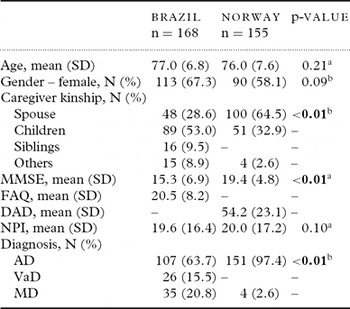
The characteristics of the patients are shown in Table 1. The majority of Brazilian patients were females (67.3%), with a mean age of 77 (SD = 6.8) years, and had a diagnosis of AD (63.7%) of moderate degree according to the cognitive and functional evaluations. The majority of the caregivers who provided the information on the NPS of the Brazilian sample were patients’ daughters (53%).
Socio-demographic and clinical characteristics of Brazilian and Norwegian patients

Note: MMSE = Mini Mental State Examination; FAQ = Functional Activities Questionnaire; DAD = Disability Assessment for Dementia; NPI = Neuropsychiatric Inventory; AD = Alzheimer´s disease; VaD = vascular dementia; MD = mixed dementia. aMann–Whitney U test.
bChi-Square Test.
Norwegian patients were predominantly females (58.1%), with a mean age of 76 (SD = 7.6) years, and had a diagnosis of AD (97.4%) of moderate degree according to cognitive and functional evaluations. The majority of the caregivers who provided information about the NPS of the Norwegian sample were patients’ spouses (64.5%).
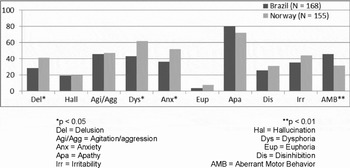
The frequencies of various NPS as measured by the NPI of two samples are shown in Figure 1. In this figure, we report the frequency of any symptom regardless of severity. Apathy (80.4%), agitation/aggression (45.8%), and AMB (45.8%) were the most common symptoms in Brazilian patients. As of Norwegian patients, apathy (72.3%), dysphoria (61.9%), and anxiety (52.3%) were the most common NPS. Delusion, dysphoria, and anxiety were significantly more frequent in Norwegian patients (p < 0.05), whereas AMB was significantly more frequent in the Brazilian sample (p < 0.01).
Prevalence of neuropsychiatric symptoms (%).

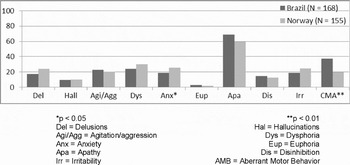
Anxiety remained significantly more frequent in Norwegian patients (p < 0.05) if we consider only the clinically significant symptoms as defined by a score ≥4 on the NPI. Likewise, we found that AMB remained significantly more frequent in the Brazilian sample (p < 0.01) (Figure 2).
Prevalence of clinically significant neuropsychiatric symptoms (≥4) (%).

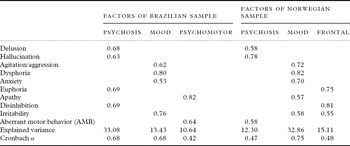
The factor analysis of the NPI resulted in three factors both for Brazilian and Norwegian patients that accounted for 57.2% and 60.3% of the variance respectively (Table 2). We named the Brazilian factors as Psychosis (delusion, hallucination, euphoria, and disinhibition), Mood (dysphoria, anxiety, agitation/aggression, and irritability), and Psychomotor (apathy and AMB). We named the Norwegian factors as Psychosis (delusion, hallucination, and AMB), Mood (dysphoria, anxiety, agitation/aggression, apathy, and irritability), and Frontal (euphoria, disinhibition, and irritability).
Factor analyses of the neuropsychiatric inventory (NPI) in a sample composed of Brazilian and Norwegian patients with dementia*

Note: *Principal component analysis with the Varimax rotation.
Discussion
This study found that the overall pattern of various NPS is the same among outpatients with dementia in Brazil and Norway. However, AMB is more frequent in Brazilian patients, whereas delusion, anxiety, and dysphoria are more commonly found and are more severe among the patients from Norway. Both groups showed two common factors, i.e. Mood and Psychosis.
Six out of the 10 NPS measured by the NPI showed similar frequencies across the two samples. This finding suggests that NPS share common neurobiological correlates among patients with dementia in Brazil and Norway. Apathy was by far the most frequent symptom in both groups. This finding was also observed by other studies that included mostly samples of patients with AD (Lyketsos et al., Reference Lyketsos, Steinberg, Tschanz, Norton, Steffens and Breitner2000; Vega et al., Reference Vega, Marinho, Engelhardt and Laks2007; Camozzato et al., Reference Camozzato2008).
We observed a higher frequency of AMB in the Brazilian sample than in the Norwegian one. The frequency of AMB in Brazilian patients is similar to the one found by Camozzato et al. (2008; 45%). The Norwegian sample showed higher frequencies of delusion, dysphoria, and anxiety compared with the Brazilian sample. These findings are corroborated by a European study that found a high prevalence of depressive and anxious symptoms in patients with dementia (Aalten et al., Reference Aalten2008). It is noteworthy that dysphoria was the most frequent symptom after apathy and AMB in the Brazilian sample if we consider only the frequency of clinically significant symptoms defined as a score of 4 or above on the NPI.
Results of international studies that investigated the prevalence of the NPS show heterogeneous results (Lyketsos et al., Reference Lyketsos2001; Tatsch et al., Reference Tatsch2006; Vega et al., Reference Vega, Marinho, Engelhardt and Laks2007). There are several explanations for the differences found in the studies that aimed at comparing the frequencies of NPS across distinct cultural and ethnical populations.
First, patients could have a dementia syndrome of different types and severities. Although the majority of the Brazilian patients had a diagnosis of AD, a subgroup also had VaD. VaD patients exhibit more frequent and severe depressive and anxious symptoms than AD patients (Lyketsos et al., Reference Lyketsos, Steinberg, Tschanz, Norton, Steffens and Breitner2000). Contrary to these evidences, we found that the Norwegian sample, composed mostly of AD patients, showed a higher frequency of dysphoria and anxiety compared with the Brazilian. Lower MMSE scores observed in the latter group could also have influenced the results, although both samples of patients exhibited a moderate cognitive impairment.
Another explanation could be the cultural influences on the reports of the NPS by the caregivers from the countries that were investigated and on the clinical judgment by the raters. We believe that culture may play a role in the higher frequency of AMB found in the Brazilian sample compared with the Norwegian sample. High frequencies of AMB were also found in the Brazilian studies conducted by Vega et al. (2007; 68%) and Camozzato et al. (2008; 45%). Repetitive behaviors, including wandering and vocalization, are frequent in patients with dementia from Latin America, and they tend to be misinterpreted as deliberate misbehavior by familial caregivers (Ferri et al., Reference Ferri, Ames and Burns2004). Lack of awareness toward NPS may also partly explain the lower reports of dysphoric and anxious symptoms in Brazilian patients compared with Norwegian patients. In our study, the co-occurrence of dysphoria and anxiety was common in both samples. Transcultural studies show that familial caregivers from developing countries fail to recognize dysphoric symptoms of demented patients as abnormal behaviors, compared with their counterparts from developed countries (Hendrie et al., Reference Hendrie, Baiyewu, Eldemire and Prince1996; Pang et al., Reference Pang2002). There is a tendency among familial caregivers from Latin America to associate patient's delusions with madness (Mangone et al., Reference Mangone2000). The social stigma that accompanies the psychotic symptoms of the patients with dementia may be related to the lower frequency of delusion reported by Brazilian caregivers compared with their Norwegian counterparts.
Our study found three neuropsychiatric sub-syndromes in both groups of patients with dementia. Two factors named Psychosis and Mood were identified in both countries. Delusion and hallucination loaded on the Psychosis factor in both samples. Dysphoria, anxiety, agitation/aggression, and irritability are loaded on the Mood factor in both samples. These findings indicate a relative high degree of stability of the NPI when used in two different countries. A third factor called Psychomotor was found in Brazilian patients, and one named Frontal was found in the Norwegian group. These factors were quite different between the patients of the two countries.
The presence of the Mood and Psychosis factors, and the symptoms loading on these two factors, are fairly in agreement with other studies that performed a factor analysis of the NPI (Frisoni et al., Reference Frisoni1999, Lyketsos et al., Reference Lyketsos2001; Spalletta et al., Reference Spalletta2010; Proitsi et al., Reference Proitsi2011; Selbæk and Engedal, Reference Selbæk and Engedal2012). Neurobiological evidences support the hypothesis that these two sub-syndromes have distinct etiopathogenic mechanisms.
According to the proposed criteria for psychosis of AD and related dementias, agitation is an associated feature commonly observed in psychotic patients with dementia (Jeste and Finkel, Reference Jeste and Finkel2000). Likewise, we found that some agitated behaviors accompanied psychotic symptoms in both samples. Disinhibition and euphoria loaded on the Psychosis factor in the Brazilian sample, and AMB loaded on the same factor in the Norwegian sample. Psychosis in AD patients is associated with increased densities of neuritic plaques and neurofibrillary tangles in the presubiculum and middle frontal cortex (Casanova et al., Reference Casanova, Starkstein and Jellinger2011)
The provisional diagnostic criteria for depression in AD include three symptoms (dysphoria, agitation, and irritability) found in the Mood factor in our samples from Brazil and Norway (Olin et al., Reference Olin, Katz, Meyers, Schneider and Lebowitz2002). The co-occurrence of dysphoric and anxious symptoms was systematically found in other studies that performed factor analysis of the NPI (Frisoni et al., Reference Frisoni1999; Fuh et al., Reference Fuh, Liu, Mega, Wang and Cummings2001; Lyketsos et al., Reference Lyketsos2001; Aalten et al. Reference Aalten2008; Spalletta et al., Reference Spalletta2010). These findings suggest that dysphoria and anxiety might share common neurobiological mechanisms. There are consistent findings in the literature showing that depression may be related to serotonergic and noradrenergic deficits in patients with AD (Gauthier et al., Reference Gauthier2010).
Apathy loaded on the Psychomotor factor in the Brazilian sample, and in the Mood factor in the Norwegian sample. A controversial issue remains whether apathy can be regarded as a distinct syndrome from depression. Apathy and depression may share common symptoms such as reduced interest and motivation. Nevertheless, apathy may be present in patients with dementia without depressive symptoms. The findings from the studies conducted by Spalletta et al. (Reference Spalletta2010) and Selbæk and Engedal (Reference Selbæk and Engedal2012) corroborate the evidence that apathy constitutes a syndrome apart from depression. According to these authors, apathy is strongly associated with executive dysfunction and high accumulation of neurofibrillary tangles in the medial frontal cortex. These evidences support the hypothesis that apathy represents a unique syndrome in patients with dementia. However, some studies that performed a factor analysis of the NPI did not find that apathy was a unique syndrome, as the presence of apathy and dysphoria loaded on the Mood factor in both samples (Frisoni et al., Reference Frisoni1999; Lyketsos et al., Reference Lyketsos2001).
The Psychomotor factor in the Brazilian sample was composed of AMB and apathy. This finding is similar to the one found by Proitsi et al. (Reference Proitsi2011), who named this factor as Uncontrolled Behavior.
The Frontal factor consisting of euphoria, disinhibition, and irritability found in the Norwegian sample suggests the involvement of specific regions of the frontal lobe, particularly the orbitofrontal cortex, in promoting manic symptoms as well as irritability. A Frontal factor consisting of dishinibition and euphoria was also found in the study conducted by Frisoni et al. (Reference Frisoni1999).
The study has limitations, which should be acknowledged. First of all, our study has a cross-sectional design that does not allow us to make inferences about the validation of these sub-syndromes. Also, differences observed between the samples, including size, dementia subtypes, and socio-demographic characteristics, may have interfered our findings. The over-representation of AD patients in the Norwegian sample is probably due to the fact that patients with dementia with more prominent vascular etiology are referred to other specialists, such as geriatricians. However, we believe that our samples overall represent the patients with dementia that regularly attend psychogeriatric facilities in Brazil and Norway. Furthermore, inter-center and inter-country differences in the selection of instruments and the quality of the information gathered from the caregivers may have influenced the factors found in our samples. Functional evaluation of the patients from Brazil was assessed with the FAQ, and in Norway this was done with the DAD. FAQ provides information on performance with emphasis on several IADL, and DAD includes questions assessing both ADL and IADL. However, in our study these two instruments were only used to describe the samples. Cholinesterase inhibitors and psychotropic usage might have contributed to the differences observed in the factor structures, but no conclusions could be drawn regarding this issue, since data of pharmacological use was not available for all patients. The fact that most of our patients come from psychogeriatric facilities and memory clinics does not allow us to generalize our findings.
The findings from our cross-cultural study show that both frequency of the NPS and factor analysis of the NPI had many similarities and the country of origin did not influence the total score, which altogether make us believe that the NPI is a robust measurement when used in countries with different cultures. However, we also found some differences between the Brazilian and Norwegian samples. We present the hypothesis that these results might be explained by cultural differences. Lack of knowledge by familial caregivers in Brazil and social stigma related to dementia and in particular the NPS should be acknowledged by healthcare professionals. Ultimately, provision of psychoeducation for Brazilian familial caregivers will lead to better treatment for both caregivers and patients with dementia.
Our data provide further support for the recognition of an affective and psychotic sub-syndrome in patients with dementia from distinct cultural populations. New interventional studies, including neurobiological and psychosocial strategies, are necessary to lessen the negative impact caused by the behavioral syndromes of dementia in patients and caregivers.
Conflict of interest
None.
Description of authors’ roles
A. Truzzi collected the data of the Brazilian sample, carried out the statistical analysis of the study, and wrote the paper. I. Ulstein collected the data of the Norwegian sample, assisted with the statistical analysis of the study, and with writing of the paper. L. Valente collected the data of the Brazilian sample, and assisted with writing of the paper. E. Engelhardt assisted with designing of the study. E.S.F. Coutinho assisted with the statistical analysis of the study. J. Laks designed the study, supervised the Brazilian data collection, and assisted with writing of this paper. K. Engedal was responsible for carrying out the statistical analysis of the study, and supervised with writing of this paper.
Acknowledgments
The study has received financial support from the Research Council of Norway. J. Laks and E.S.F. Coutinho have received financial support from the Conselho Nacional de Pesquisa (CNPq).