1. Introduction
Point processes obtained by dependent thinning of stationary Poisson processes have been extensively examined in recent decades. Matérn hard-core processes [Reference Matérn15] are classical examples of such processes, where the thinning probability of an individual point depends on the other points of the original point pattern. While a Matérn I process is based on an unmarked Poisson process, a Matérn II process relies on a marked Poisson process with independent and identically distributed (i.i.d.) marks. The Matérn models and slight modifications thereof are applied to real data in various areas, for instance ecological science [Reference Picard20, Reference Stoyan24], geographical analysis [Reference Stoyan25] and computer science [Reference Ibrahim, ElBatt and El-Keyi11].
There exist several extensions of Matérn’s models [Reference Kuronen and Leskelä13], concerning the hard-core distance [Reference Månsson and Rudemo14, Reference Stoyan and Stoyan26], the thinning rule [Reference Teichmann, Ballani and van den Boogaart27], or the generalization of the underlying Poisson process [Reference Andersen and Hahn1]. In the Matérn II model and its generalizations, the marks are uniformly distributed on the unit interval or take on values on the plane. These choices for the mark spaces stem, on the one hand, from its interpretation in specific applications, in particular in biology, where the marks are commonly interpreted as appearance or germination times [Reference Illian, Penttinen, Stoyan and Stoyan12, Reference Teichmann, Ballani and van den Boogaart27]. On the other hand, the distribution of the original Matérn II process is independent of the specific choice of the univariate mark distribution as long as it is continuous [Reference Stoyan and Stoyan26]. Therefore, extensions concerning the marks have not been the focus of interest. Allowing for more general mark spaces, however, creates the opportunity to explore novel connections to Matérn-type models from both theoretical and practical points of view.
Max-stable processes are of particular interest in the modelling of extreme events, forming the class of distributional limits of pointwise maxima of stochastic processes. In order to make the framework of max-stable processes available for applications, it is necessary to assume that the underlying stochastic process of given data lies in the max-domain of attraction of a max-stable process. However, only a few non-trivial processes are known to possess this property; see [Reference Dirrler, Schlather and Strokorb8] for details. Therefore, introducing processes in the max-domain of attraction of a max-stable process is a desirable goal.
The thinning rules of Matérn hard-core processes and their extensions usually involve a comparative operation regarding the underlying marks. In case of the Matérn II model, for example, the point in the original process with the smallest mark can never be deleted. In this sense, the marks corresponding to the points of a Matérn-type process exhibit some kind of locally minimal or, turning the perspective, maximal behaviour. Since sample-continuous max-stable processes can be represented as the supremum of continuous functions forming a Poisson process [Reference Giné, Hahn and Vatan10], the question arises whether connections can be established between max-stable processes and a Matérn-type model with continuous functions as random marks.
This manuscript consists of two main parts. In the first we present and examine a point process model which encompasses and further generalizes Matérn hard-core processes and their extensions. In the second part we establish theoretical connections between our model and max-stable processes. Based on our model, we introduce processes with a clear interpretation in the context of max-stable processes and with close relationships to them. In particular, we prove that one of these processes is in the max-domain of attraction of a mixed moving maxima process under suitable conditions.
2. Model formulation
2.1. Preliminaries
In this paper we regard a point process  $\Phi$ [Reference Daley and Vere-Jones5, Reference Daley and Vere-Jones6] as a locally finite, random, countable set of points that are elements of a complete, separable metric space S. Let
 $\mathbb{M}$ be another complete, separable metric space. A marked point process
 $\Phi_M$ on S with marks in
 $\mathbb{M}$ is a point process on
 $S \times \mathbb{M}$ such that the ground process
 $\Phi^0(\!\cdot\!) \coloneqq \Phi_M( \cdot \times \mathbb{M})$ is a simple point process itself, i.e. a point process with no multiplicities. We denote the target sets of
 $\Phi$ and
 $\Phi_M$ by
 $N_{\textrm{lf}}$ and
 $M_{\textrm{lf}}$, and their respective
 $\sigma$-algebras by
 $\mathcal{N}_{\textrm{lf}}$ and
 $\mathcal{M}_{\textrm{lf}}$.
Poisson processes are the most important examples of point processes. A simple point process  $\Phi$ is a Poisson process with intensity measure
 $\mu=\mathbb{E}\Phi(\!\cdot\!)$ if, for every Borel set
 $B \subset S$, the number of points in B is Poisson distributed with parameter
 $\mu(B)$. This implies that the number of points in disjoint Borel sets
 $B_1,\dots,B_n$,
 $n \in \mathbb{N}$, are independent. A point process
 $\Phi$ is called a Cox process with random measure
 $\Lambda$ if it is a Poisson process conditional on
 $\Lambda$ [Reference Cox4]. In the case
 $S=\mathbb{R}^d$, it is often assumed that the random measure
 $\Lambda$ has the form
 $\Lambda(d x)= \Psi(x) d x$, where
 $(\Psi(x), x\in S)$ is a non-negative, locally integrable stochastic process. Then, we call
 $\Phi$ a Cox process with random intensity function
 $\Psi$. In the case that
 $\Psi$ is a log Gaussian random field, the Cox process
 $\Phi$ is called a log Gaussian Cox process [Reference Møller, Syversveen and Waagepetersen19].
Matérn introduced point process models which are obtained from a stationary Poisson process  $\Phi$ on
 $S=\mathbb{R}^d$ with intensity
 $\lambda$ by a dependent thinning method [Reference Matérn15]. In the Matérn I model, all points
 $\xi\in\Phi$ that have neighbours within a deterministic hard-core distance
 $R > 0$ are deleted. The Matérn II model considers a marked point process
 $\Phi_M$ where each point
 $\xi\in\Phi$ is independently endowed with a random mark
 $m_{\xi}\sim \mathcal{U}[0,1]$. A point
 $(\xi,m_{\xi})\in \Phi_M$ is retained in the thinned process
 $\Phi_{\textrm{th}}$ if the ball
 $B_R(\xi)$ contains no points
 $\xi^{\prime}\in\Phi\setminus\{\xi\}$ with
 $m_{\xi^{\prime}}<m_{\xi}$. That is,
 \begin{align*}\Phi_{\textrm{th}}&=\{(\xi,m_{\xi})\in\Phi_M\,{:}\,m_{\xi}<m_{\xi^{\prime}}, \text{ for all } \xi^{\prime}\in\Phi\cap B_R(\xi)\setminus\{\xi\}\}\\[3pt]&=\{(\xi,m_{\xi})\in\Phi_M\,{:}\,f_{\textrm{th}}(\Phi_M;\,\xi,m_{\xi})=1\} ,\end{align*}
with the thinning function
 \begin{equation*}f_{\textrm{th}}(\Phi_M;\ \xi,m_{\xi})=\prod_{(\xi^{\prime},m_{\xi^{\prime}})\in \Phi_M\setminus\{(\xi,m_{\xi})\}}(1-\textbf{1}_{\xi^{\prime}\in B_R(\xi)}\textbf{1}_{m_{\xi^{\prime}}<m_{\xi}}\!).\end{equation*}
It is of particular interest to compute the probability that a given point  $(\xi,m_{\xi})\in\Phi_M$ is retained in the thinned process. This probability can be calculated using Palm calculus [Reference Chiu, Stoyan, Kendall and Mecke2, Reference Daley and Vere-Jones6, Reference Mecke16, Reference Møller and Waagepetersen18], which we briefly summarize in the following. The reduced Campbell measure
 $C^!$ for a point process
 $\Phi$ on S is a measure on
 $S\times N_{\textrm{lf}}$ defined by
 \begin{equation*}C^!(D)=\mathbb{E}\sum_{\xi\in\Phi}\textbf{1}_{(\xi,\Phi\setminus{\{\xi\}})\in D},\qquad D\subset S\times N_{\textrm{lf}}.\end{equation*}
Let the intensity measure  $\mu$ be
 $\sigma$-finite. Then, the reduced Campbell measure is, in its first component, absolutely continuous with respect to
 $\mu$. Its Radon–Nikodym density
 $P^!_{\xi}$ is called the reduced Palm distribution. Therefore,
 \begin{equation*}C^!(B\times F)=\int_BP^!_{\xi}(F) \, {\rm d}\mu(\xi),\qquad B \in \mathcal{B}(S),\ F\in \mathcal{N}_{\textrm{lf}},\end{equation*}
and for non-negative functions  $h\,{:}\,S\times N_{\textrm{lf}}\rightarrow [0,\infty)$,
 \begin{equation*}\mathbb{E}\sum_{\xi\in\Phi}h(\xi,\Phi\setminus\{\xi\})=\int\int h(\xi,\eta)\, {\rm d} P^!_{\xi}(\eta) \, {\rm d}\mu(\xi).\end{equation*}
Hence,  $P^!_{\xi}$ can be interpreted as the conditional distribution of
 $\Phi\setminus{\{\xi\}}$ given
 $\xi\in\Phi$. Thereby, the retention probability of a point
 $(\xi,m_{\xi})\in\Phi_M$ equals
 \begin{equation*}r(\xi,m_{\xi})=\int_{{M}_{\textrm{lf}}}f_{\textrm{th}}(\varphi;\ \xi,m_{\xi}) \, P_{\xi,m_{\xi}}^!({\rm d}\varphi).\end{equation*}
Since the generating functional of a point process  $\Phi$ on S is defined as
 \begin{equation*}G_{\Phi}(u)=\mathbb{E}\prod_{\xi^{\prime}\in\Phi}u(\xi^{\prime})\end{equation*}
for suitable functions  $u\,{:}\, S\rightarrow [0,1]$ [Reference Westcott28],
 $r(\xi,m_{\xi})$ is the generating functional of a point process with distribution
 $P^!_{\xi,m_\xi}$ and
 $u(\xi^{\prime},m_{\xi^{\prime}})=1-\textbf{1}_{\xi^{\prime}\in B_R(\xi)}\textbf{1}_{m_{\xi^{\prime}}<m_{\xi}}$. With
 $\Phi_M$ being a Poisson process in the case of the Matérn II model, the reduced Palm distribution
 $P^!_{\xi,m_{\xi}}$ equals the distribution of
 $\Phi_M$ itself [Reference Chiu, Stoyan, Kendall and Mecke2, Example 4.3]. Therefore, the retention probability of a point
 $(\xi,m_{\xi}) \in \Phi_M$ is given by
 \begin{align*}r(\xi,m_{\xi})=\exp(\!-\lambda |B_R(o)|\cdot m_{\xi}),\end{align*}
and the intensity of the thinned ground process equals
 \begin{align*}\lambda_{\textrm{th}}=\lambda\int_0^1 r(\xi,m_{\xi}) \, {\rm d} m_{\xi}= |B_R(o)|^{-1}(1-\exp(\!-\lambda |B_R(o)|)) ; \end{align*}
see [Reference Illian, Penttinen, Stoyan and Stoyan12]. The reduced Palm distribution of a general point process is more difficult to handle. However, it can be explicitly calculated for many Cox process models [Reference Coeurjolly, Møller and Waagepetersen3, Reference Møller17].
2.2 Generalizing the Matérn hard-core processes
We present a point process model obtained by dependent thinning of a marked point process, which generalizes the Matérn models in several ways. We therefore call the new model a generalized Matérn model.
Definition 2.1. Let  $\Phi$ be a point process on a complete, separable metric space S. Let
 $\Phi_M$ denote a marked point process where each point
 $\xi \in \Phi$ is independently attached with a random mark
 $m_{\xi}$ taking on values on a complete, separable metric space
 $\mathbb{M}$. Furthermore, let
 $\tau_{\Phi_M;\ \xi,m_\xi}$ denote a Bernoulli random variable whose success probability equals the thinning function
 \begin{equation*}f_{\textrm{th}}(\Phi_M;\ \xi,m_{\xi})=\prod_{(\xi^{\prime},m_{\xi^{\prime}})\in \Phi_M} [1-\zeta(\xi,m_{\xi},\xi^{\prime},m_{\xi^{\prime}})p(\xi,m_{\xi},\xi^{\prime},m_{\xi^{\prime}})],\end{equation*}
where  $\zeta\,:\,(S,\mathbb{M})^2\rightarrow\{0,1\}$ and
 $p\,:\,(S,\mathbb{M})^2\rightarrow[0,1]$ are measurable functions. Then, we call the thinned marked point process
 $\Phi_{\textrm{th}}$ defined by
 \begin{align} \Phi_{\textrm{th}}=\{(\xi,m_{\xi})\in\Phi_M\,:\, \tau_{\Phi_M;\ \xi,m_\xi}=1\} \end{align}
a generalized Matérn model with corresponding thinned ground process
 \begin{align*} \Phi_{\textrm{th}}^0=\{\xi\,:\,(\xi,m_{\xi})\in\Phi_{\textrm{th}}\}. \end{align*}
The functions  $\zeta$ and p in Definition 2.1 have the following interpretation. The function
 $\zeta$ specifies the inferior points which are in danger of being deleted. We call a point
 $(\xi,m_{\xi}) \in \Phi_M$ inferior to
 $(\xi^{\prime},m_{\xi^{\prime}}) \in \Phi_M$ and
 $(\xi^{\prime},m_{\xi^{\prime}})$ superior to
 $(\xi,m_{\xi})$, respectively, if
 $\zeta(\xi,m_{\xi},\xi^{\prime},m_{\xi^{\prime}})\,{=}\,1$. A point is called inferior if it is inferior to some other point of the process. Therefore, we also call
 $\zeta$ a competition function. The function p determines the probability that an inferior point is deleted by the corresponding superior point. We henceforth set
 \begin{equation*}\zeta(\xi,m_{\xi},\xi,m_{\xi})=1, \qquad p(\xi,m_{\xi},\xi,m_{\xi})=1-p_0(\xi)\in[0,1],\end{equation*}
and thereby include independent  $p_0$-thinning in our model that may depend on the locations of the points in the ground process
 $\Phi^0$. To simplify the notation, we will use abbreviations like
 $\boldsymbol{\xi}=(\xi,m_{\xi})$ and
 $\zeta(\boldsymbol{\xi},\boldsymbol{\xi}')=\zeta(\xi,m_{\xi},\xi^{\prime},m_{\xi^{\prime}})$ throughout the paper.
Example 2.1. The Matérn I and II hard-core models can be easily derived from our model. Replacing the stationary Poisson process in the Matérn II model by a Cox process, we also obtain Matérn thinned Cox processes [Reference Andersen and Hahn1].
Example 2.2. A further generalization of the Matérn I model was presented in [Reference Teichmann, Ballani and van den Boogaart27]. According to their thinning rule, a point  $\xi$ of a stationary Poisson process
 $\Phi$ is retained with probability
 \begin{equation*}p_0\prod_{\xi^{\prime}\in \Phi\setminus\{\xi\}}(1-f(\|\xi-\xi^{\prime}\|))\end{equation*}
for  $p_0\in(0,1]$ and some deterministic, measurable function
 $f\,:\,[0,\infty)\rightarrow [0,1]$. This can be obtained from our model by setting
 $\zeta\equiv 1$ and
 $p(\boldsymbol{\xi},\boldsymbol{\xi}')=f(\|\xi-\xi^{\prime}\|)$.
Example 2.3. Consider a stationary Poisson process  $\Phi$ on
 $S=\mathbb{R}^d$, marks
 $m_{\xi}$ in
 $\mathbb{M}=\mathbb{R}^{\{0,1\}}$ with
 $m_{\xi}(0)\sim \mu$ and
 $m_{\xi}(1)\sim \nu$ for probability measures
 $\mu$ and
 $\nu$. Let
 $f\,:\, [0,\infty) \times \mathbb{R}^2 \rightarrow [0,1]$ be a fixed measurable function with
 $f(\cdot,m,n) = f(\cdot,n,m)$ for all
 $m,n \in \mathbb{R}$ and
 $p_0 \in (0,1]$. We choose
 $p(\boldsymbol{\xi},\boldsymbol{\xi}')=f(\|\xi-\xi^{\prime}\|,m_{\xi}(1),m_{\xi^{\prime}}(1))$ and the competition function
 $\zeta(\boldsymbol{\xi},\boldsymbol{\xi}')=\textbf{1}_{m_{\xi}(0)\geq m_{\xi^{\prime}}(0)}$. Then,
 \begin{equation*}f_{\textrm{th}}(\Phi_M;\ \xi,m_{\xi})=p_0\prod_{\boldsymbol{\xi^{\prime}}\in\Phi_M\setminus\{\boldsymbol{\xi}\}}\big[1-\textbf{1}_{m_{\xi}(0)\geq m_{\xi^{\prime}}(0)}f\big(\|\xi-\xi^{\prime}\|,m_{\xi}(1),m_{\xi^{\prime}}(1)\big)\big].\end{equation*}
This model was presented in [Reference Teichmann, Ballani and van den Boogaart27] as an extension of the Matérn II model.
Example 2.4. Let  $\Phi$ be a Poisson process on
 $\mathbb{R}^d$ attached with random mark functions
 $m_{\xi}(\!\cdot\!)=U_{\xi}\varphi(\!\cdot-\xi)$, where
 $U_{\xi}\sim\mathcal{U}[0,1]$ and
 $\varphi$ denotes the d-dimensional standard-normal density. Consider
 $p(\boldsymbol{\xi},\boldsymbol{\xi}')=\max\!(0,1-\|\xi-\xi^{\prime}\|)$ and the competition function
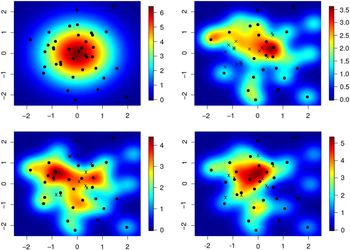
 $\zeta(\boldsymbol{\xi},\boldsymbol{\xi}')=\textbf{1}_{m_{\xi^{\prime}}(\xi)>m_{\xi}(\xi)}$. This leads to a soft-core model where inferior points are the more likely to be thinned the closer they are to superior points. See Figure 1 for a plot of this model in
 $d=2$.
Plot of the original Poisson process  $\Phi$ with its underlying intensity function (upper left) and of the ground process
 $\Phi_{\textrm{th}}^0$ of the generalized Matérn model and its estimated intensity function with the specifications
 $p(\boldsymbol{\xi},\boldsymbol{\xi}')=(1-\|\xi-\xi^{\prime}\|/R)_+$,
 $\zeta(\boldsymbol{\xi},\boldsymbol{\xi}')=\textbf{1}_{\xi^{\prime}\in B_R(\xi)}$ (upper right);
 $p(\boldsymbol{\xi},\boldsymbol{\xi}')=\break (1-\|\xi-\xi^{\prime}\|/R)_+$,
 $\zeta(\boldsymbol{\xi},\boldsymbol{\xi}^{\prime})=\textbf{1}_{\xi^{\prime}\in B_R(\xi)}\textbf{1}_{m_{\xi^{\prime}}<m_{\xi}}$,
 $m_{\xi} \sim \mathcal{U}[0,1]$ (lower left);
 $p(\boldsymbol{\xi},\boldsymbol{\xi}')=(1-\|\xi-\xi^{\prime}\|/R)_+ $,
 $\zeta(\boldsymbol{\xi},\boldsymbol{\xi}')=\textbf{1}_{m_{\xi^{\prime}}(\xi)>m_{\xi}(\xi)}$ with
 $m_{\xi}(\!\cdot\!)=U_{\xi}\varphi(\!\cdot -\xi)$,
 $U_{\xi}\sim\mathcal{U}[0,1]$, and the two-dimensional standard normal density
 $\varphi$ (lower right);
 $R=0.5$.

2.3. Generalized Matérn model based on log Gaussian Cox processes
We further examine our model by calculating first- and second-order properties. Since our model is defined in a rather general setting, reasonable restrictions are needed in order to calculate the reduced Palm distribution and subsequently the intensity function and the second-order product density. Here, we assume that  $\Phi$ is a log Gaussian Cox process because of its importance for conditionally max-stable processes [Reference Dirrler, Schlather and Strokorb8]. However, the following results may be derived in a similar way for other Cox processes or infinitely divisible point processes [Reference Mecke16], if the reduced Palm distribution is known. Let
 $\Psi=\exp(W)$ denote the random intensity function of
 $\Phi$, where W is a suitable Gaussian random field with mean function
 $\mu$ and covariance function C. We write
 $\Phi\sim\textrm{LGCP}(\mu,C)$ for short.
Proposition 2.1. Let  $\mathbb{M}$ denote a complete, separable metric space, and
 $\Phi\sim\textrm{LGCP}(\mu,C)$ with random intensity function
 $\Psi$. Let
 $\Phi_M$ denote the corresponding marked point process where each point
 $\xi \in \Phi$ is independently endowed with an
 $\mathbb{M}$-valued random mark
 $m_{\xi}$ with law
 $\nu$. Then, the retention probability of a point
 $(\xi,m_{\xi}) \in \Phi_M$ in the corresponding generalized Matérn model (2.1) is given by
 \begin{align} r(\xi,m_{\xi})=p_0 \mathbb{E}_{\widetilde{\Psi}} \exp\left(\!-\int_{S\times \mathbb{M}} \big(1-h(\boldsymbol{\xi},\boldsymbol{\xi}')\big)\widetilde{\Psi}(\xi^{\prime}) \, {\rm d}\xi^{\prime}\nu({\rm d} m_{\xi^{\prime}})\right)\!,\end{align}
where  $h(\boldsymbol{\xi},\boldsymbol{\xi}')=1-\zeta(\boldsymbol{\xi},\boldsymbol{\xi}')p(\boldsymbol{\xi},\boldsymbol{\xi}')$,
 $\widetilde{\Phi}\sim\textrm{LGCP}(\widetilde{\mu},C)$,
 $\widetilde{\mu}(\!\cdot\!)=\mu(\!\cdot\!)+C(\cdot,\xi)$, and
 $\widetilde{\Psi}$ denotes the random intensity function of
 $\widetilde{\Phi}$. Furthermore, the intensity function of the thinned ground process
 $\Phi_{\textrm{th}}^0$ is given by
 \begin{align} \rho_{\textrm{th}}(\xi)=p_0\mathbb{E}\Psi(\xi)\int_{\mathbb{M}}\mathbb{E}_{\widetilde{\Psi}}\exp\left(\!-\int_{S \times \mathbb{M}}\zeta(\boldsymbol{\xi},\boldsymbol{\xi}')p(\boldsymbol{\xi},\boldsymbol{\xi}')\widetilde{\Psi}(\xi^{\prime}) {\rm d}\xi^{\prime}\nu({\rm d} m_{\xi^{\prime}})\right)\nu({\rm d} m_{\xi}). \end{align}
Proof. Let  $\boldsymbol{\xi} \in \Phi_M$. In case of the generalized Matérn model, the retention probability of
 $\boldsymbol{\xi} \in \Phi_M$ is given by
 \begin{equation*}r(\xi,m_{\xi})=\int_{{M}_{\textrm{lf}}}f_{\textrm{th}}(\varphi\cup (\xi,m_{\xi});\ \xi,m_{\xi}) \, P_{\boldsymbol{\xi}}^!({\rm d}\varphi).\end{equation*}
Since  $\Phi\sim\textrm{LGCP}(\mu,C)$, the reduced Palm distribution
 $P_{\xi}^!$ of
 $\Phi$ equals the distribution of
 $\widetilde{\Phi}\sim\textrm{LGCP}(\widetilde{\mu},C)$ (see [Reference Coeurjolly, Møller and Waagepetersen3, Theorem 1]). Therefore, with
 $\widetilde{\Phi}_M$ denoting the corresponding marked process with independently attached marks with law
 $\nu$, we obtain
 \begin{align*}r(\xi,m_{\xi}) &= \mathbb{E}\prod_{\boldsymbol{\xi}'\in\widetilde{\Phi}_M\cup\{\boldsymbol{\xi}\}} [1-\zeta(\boldsymbol{\xi},\boldsymbol{\xi}')p(\boldsymbol{\xi},\boldsymbol{\xi}')]\\ &= \big(1-\zeta(\boldsymbol{\xi},\boldsymbol{\xi})p(\boldsymbol{\xi},\boldsymbol{\xi})\big)\mathbb{E}\prod_{\boldsymbol{\xi}'\in\widetilde{\Phi}_M} [1-\zeta(\boldsymbol{\xi},\boldsymbol{\xi}')p(\boldsymbol{\xi},\boldsymbol{\xi}')]\\ &= p_0\, \mathbb{E}\prod_{\boldsymbol{\xi}'\in\widetilde{\Phi}_M} h(\boldsymbol{\xi},\boldsymbol{\xi}')\\ &= p_0\, \mathbb{E}_{\widetilde{\Psi}} \exp\left(\!-\int_{S \times \mathbb{M}} \big(1-h(\boldsymbol{\xi},\boldsymbol{\xi}')\big)\widetilde{\Psi}(\xi^{\prime}) \, {\rm d}\xi^{\prime}\nu({\rm d} m_{\xi^{\prime}})\right)\!, \end{align*}
where the last equality follows from calculating the generating functional of  $\widetilde{\Phi}_M$. Since the intensity function of a log Gaussian Cox process equals
 $\mathbb{E}\Psi(\!\cdot\!)$ [Reference Møller, Syversveen and Waagepetersen19], the second part is a consequence of [Reference Andersen and Hahn1, Equations (7) and (8)].□
Proposition 2.2. Assume the same setting as in Proposition 2.1. Let  $\widetilde{\Phi}\sim\textrm{LGCP}(\tilde{\mu},C)$ with mean function
 $\widetilde{\mu}(\!\cdot\!)=\mu(\!\cdot\!)+C(\cdot,\xi)+C(\cdot,\eta)$ and random intensity function
 $\widetilde{\Psi}$. Then, the second-order product density of the thinned ground process
 $\Phi_{\textrm{th}}^0$ of the generalized Matérn model (2.1) equals
 \begin{align*}\rho_{\textrm{th}}^{(2)}(\xi,\eta)&=p_0^2\mathbb{E}[\Psi(\xi)\Psi(\eta)] \int_{\mathbb{M}}\int_{\mathbb{M}}\nu({\rm d} m_{\xi})\nu({\rm d} m_{\eta})\, h(\boldsymbol{\xi},\boldsymbol{\eta})h(\boldsymbol{\eta},\boldsymbol{\xi}) \\[3pt] &\qquad\qquad\qquad\ \ \times \mathbb{E}_{\widetilde{\Psi}} \exp\left(\!-\int_{S\times\mathbb{M}} \big(1-h(\boldsymbol{\xi},\boldsymbol{\xi}')h(\boldsymbol{\eta},\boldsymbol{\xi}')\big)\widetilde{\Psi}(\xi^{\prime}) \,{\rm d}\xi^{\prime}\nu({\rm d} m_{\xi^{\prime}})\right)\!. \end{align*}
Proof. The probability that neither of the arbitrary points  $(\xi,m_{\xi})$ and
 ${(\eta,m_{\eta})}$ is deleted by any point of the point configuration
 $\varphi\in M_{\textrm{lf}}$ is
 \begin{equation*}f^{(2)}_{\textrm{th}}(\varphi;\ \boldsymbol{\xi},\boldsymbol{\eta})=\prod_{\boldsymbol{\xi}'\in \varphi}(1-\zeta(\boldsymbol{\xi},\boldsymbol{\xi}')p(\boldsymbol{\xi},\boldsymbol{\xi}'))(1-\zeta(\boldsymbol{\eta},\boldsymbol{\xi}')p(\boldsymbol{\eta},\boldsymbol{\xi}')).\end{equation*}
Thus, the probability that  $(\xi,m_{\xi})$ and
 $(\eta,m_{\eta})\in\Phi_M$ are retained in the thinned process
 $\Phi_{\textrm{th}}$ equals
 \begin{align*} r(\boldsymbol{\xi},\boldsymbol{\eta})=\int_{M_{\textrm{lf}}}f_{\textrm{th}}^{(2)}(\varphi\cup\{\boldsymbol{\xi},\boldsymbol{\eta}\};\ \boldsymbol{\xi},\boldsymbol{\eta})P^!_{\boldsymbol{\xi},\boldsymbol{\eta}}({\rm d}\varphi), \end{align*}
where  $P^!_{\boldsymbol{\xi},\boldsymbol{\eta}}$ is the two-fold reduced Palm distribution of
 $\Phi_M$. Since the two-fold reduced Palm distribution
 $P^{!}_{\xi,\eta}$ equals the distribution of
 $\widetilde{\Phi}\sim\textrm{LGCP}(\tilde{\mu},C)$, see [Reference Coeurjolly, Møller and Waagepetersen3, Theorem 1], we obtain
 \begin{align*} r(\boldsymbol{\xi},\boldsymbol{\eta}) &= \mathbb{E}\prod_{\boldsymbol{\xi}'\in\widetilde{\Phi}_M\cup\{\boldsymbol{\xi},\boldsymbol{\eta}\}} \big(1-\zeta(\boldsymbol{\xi},\boldsymbol{\xi}')p(\boldsymbol{\xi},\boldsymbol{\xi}')\big)\big(1-\zeta(\boldsymbol{\eta},\boldsymbol{\xi}')p(\boldsymbol{\eta},\boldsymbol{\xi}')\big)\\ &= p_0^2h(\boldsymbol{\xi},\boldsymbol{\eta})h(\boldsymbol{\eta},\boldsymbol{\xi})\, \mathbb{E}\prod_{\boldsymbol{\xi}'\in\widetilde{\Phi}_M} h(\boldsymbol{\xi},\boldsymbol{\xi}')h(\boldsymbol{\eta},\boldsymbol{\xi}')\\ &= p_0^2h(\boldsymbol{\xi},\boldsymbol{\eta})h(\boldsymbol{\eta},\boldsymbol{\xi})\, \mathbb{E}_{\widetilde{\Psi}} \exp\left(\!-\int_{S\times\mathbb{M}} \big(1-h(\boldsymbol{\xi},\boldsymbol{\xi}')h(\boldsymbol{\eta},\boldsymbol{\xi}')\big)\widetilde{\Psi}(\xi^{\prime}) \, {\rm d}\xi^{\prime}\nu({\rm d} m_{\xi^{\prime}})\right)\!. \end{align*}
Since the second-order product density of a log Gaussian Cox process is given by  $\mathbb{E}[\Psi(\xi)\Psi(\eta)]$ [Reference Møller, Syversveen and Waagepetersen19], the claim now follows due to [Reference Andersen and Hahn1, Equations (10) and (11)].□
3. Application to mixed moving maxima processes
In a generalized Matérn model, we particularly allow the marks to be real-valued continuous functions from S to  $\mathbb{R}$. This creates the opportunity to bridge to max-stable processes.
3.1. Preliminaries on max-stable processes
We briefly summarize the main facts concerning max-stable processes for our purposes. Analogous to the case of  $\alpha$-stable processes, a stochastic process
 ${Z=(Z(t), t\in S})$ is called max-stable if, for a sequence
 $(Z_n, n \in \mathbb{N})$ of independent copies of Z, there exist sequences
 $a_n(x) > 0$ and
 $b_n(x) \in \mathbb{R}$ such that
 \begin{align*}\left\{\max_{i=1,\ldots,n} \frac{Z_i(x)-b_n(x)}{a_n(x)}\right\}_{x \in S} \overset{\mathcal{D}}{=} \{Z(x)\}_{x \in S},\end{align*}
where  $\overset{\mathcal{D}}{=}$ denotes equality in distribution. A stochastic process
 $Y=(Y(t),t\in S)$ is said to lie in the max-domain of attraction of Z if there exist sequences
 $c_n(x) >0 $ and
 $d_n(x) \in \mathbb{R}$ such that the process
 \begin{equation*}\left\{\max_{i=1,\ldots,n} \frac{Y_i(x)-d_n(x)}{c_n(x)}\right\}_{x \in S} \end{equation*}
converges in distribution to Z.
Mixed moving maxima processes [Reference Schlather21, Reference Smith22, Reference Stoev23] are the most studied max-stable processes. Let  $S=\mathbb{R}^d$,
 $K\subset S$ be a compact set, and X be a non-negative stochastic process whose paths are almost surely (a.s.) in
 $\mathbb{X}=C(S,\mathbb{R})$ and which fulfils the condition
 \begin{align*}\mathbb{E}_X\int_S\sup_{t\in K}X(t-\xi) \, {\rm d}\xi<\infty.\end{align*}
Then, a mixed moving maxima process is defined by
 \begin{align}Z(t)=\bigvee_{(s,u,X)\in\Theta} u X(t-s), \qquad t \in S,\end{align}
where  $\bigvee$ denotes the supremum and
 $\Theta$ is a Poisson process on
 $S\times (0,\infty]\times \mathbb{X}$ with intensity measure
 ${\rm d}\lambda(s,u,X)= {\rm d} s \, u^{-2} {\rm d} u \, {\rm d} \mathbb{P}_X$. A common interpretation of a mixed moving maxima process is that the process X represents the shape of a storm with centre s and magnitude u [Reference Smith22].
Replacing the underlying Poisson process in (3.1) by a Cox process, we obtain the so-called Cox extremal process [Reference Dirrler, Schlather and Strokorb8]. For a sample-continuous positive stochastic process  $\Psi$ satisfying
 \begin{align}\mathbb{E}_{\Psi}\mathbb{E}_X\int_S\sup_{t\in K} X(t-\xi)\Psi(\xi) \, {\rm d}\xi<\infty\end{align}
for any compact set  $K \subset \mathbb{R}^d$, a Cox extremal process is defined by
 \begin{align}Y(t)=\bigvee_{(s,u,X)\in\widetilde{\Theta}}uX(t-s),\end{align}
where  $\widetilde{\Theta}$ is a Cox process directed by the random measure
 \begin{equation*}{\rm d}\Lambda(s,u,X)=\Psi(s){\rm d} s\,u^{-2}{\rm d} u\,{\rm d} \mathbb{P}_X.\end{equation*}
A Cox extremal process allows for the same interpretation as a mixed moving maxima process. Being max-stable conditional on the intensity process  $\Psi$, a Cox extremal process is also called a conditionally max-stable process. The integrability condition (3.2) ensures that a Cox extremal process is almost surely finite on compact sets and sample-continuous on
 $\mathbb{R}^d$. The finite-dimensional distributions of Y are given by
 \begin{align*}\mathbb{P}(Y(t_1)\leq y_1, \dots, Y(t_n)\leq y_n)=\mathbb{E}_{\Psi}\exp\left(\!-\mathbb{E}_X\int_S \max_{1\leq i\leq n}\frac{X(t_i-\xi)}{y_i}\Psi(\xi) \, {\rm d}\xi\right)\!,\end{align*}
for  $y_1,\dots,y_n > 0$ [Reference Dirrler, Schlather and Strokorb8]. Accordingly, the finite-dimensional distributions of the mixed moving maxima process Z are given by
 \begin{align*}\mathbb{P}(Z(t_1)\leq y_1, \dots, Z(t_n)\leq y_n)=\exp\left(\!-\mathbb{E}_X\int_S \max_{1\leq i\leq n}\frac{X(t_i-\xi)}{y_i} \, {\rm d}\xi\right)\!.\end{align*}
Only finitely many storms contribute to Y and Z on the compact set K under mild assumptions (see [Reference De Haan and Ferreira7, Corollary 9.4.4] and [Reference Dirrler, Schlather and Strokorb8, Lemma 2]). Hence, all other storm processes are fully covered by a single storm or by a patchwork of several storms. The probability of being covered by a patchwork of storms is difficult to handle. Therefore, alternative quantities might be of interest, e.g. the case that a storm is completely covered by another one, or the case that a storm centre is not covered by another storm, but visible.
3.2. Matérn extremal process
We first consider the case of complete coverage. This case can also be seen as a direct analogue to the objective of the thinning rules in Matérn-type models, especially in biological applications, keeping only the ‘relevant’ points and excluding the ‘irrelevant’ ones from consideration. In the context of max-stable processes, this means excluding all storms which can never contribute to the maximum.
Definition 3.1. Let  $\Phi$ be a Cox process on
 $S= \mathbb{R}^d$ with sample-continuous random intensity function
 $\tau^{-1}\Psi$,
 ${\tau > 0}$. Let X be a non-negative stochastic process whose paths are almost surely in
 $\mathbb{X} = C(S,\mathbb{R})$. Each point
 $\xi \in \Phi$ is independently attached with a random mark function
 $m_{\xi}(\!\cdot\!)=U_{\xi}X_{\xi}(\!\cdot\!)$, where
 $U_{\xi}\sim \tau u^{-2}\textbf{1}_{(\tau,\infty)}(u) \, {\rm d} u$ and
 $X_{\xi}\sim \mathbb{P}_X$, having sample-continuous paths. Let
 $\Phi_M$ denote the corresponding marked point process and let
 $\Phi_{\textrm{th}}$ denote the generalized Matérn model
 \begin{equation*}\Phi_{\textrm{th}}=\{(\xi,m_{\xi})\in\Phi_M\,{:}\,f_{\textrm{th}}(\Phi_M;\ \xi,m_{\xi})=1\}\end{equation*}
with the thinning function
 \begin{align} f_{\textrm{th}}(\Phi_M;\ \xi,m_{\xi})=\prod_{\boldsymbol{\xi}'\in\Phi_M}\left[1-\textbf{1}_{U_{\xi^{\prime}}>\sup_{t\in S}U_{\xi}X_{\xi}(t-\xi)X_{\xi^{\prime}}(t-\xi^{\prime})^{-1}}\right]. \end{align}
Then, we call a stochastic process  $\Pi$ defined by
 \begin{align} \Pi(t)=\bigvee_{(\xi,m_{\xi})\in\Phi_{\textrm{th}}}m_{\xi}(t-\xi), \qquad t \in S, \end{align}
a Matérn extremal process.
Considering the thinning function (3.4) underlying the generalized Matérn model in the above definition, we choose  $p \equiv 1$ and the competition function
 $\zeta$ such that a point
 $\boldsymbol{\xi}\in\Phi_M$ is deleted if the corresponding function
 $m_{\xi}(\!\cdot - \xi)$ is, at each point, strictly smaller than the function
 ${m_{\xi^{\prime}}(\!\cdot - \xi^{\prime})}$ for some other point
 $\boldsymbol{\xi}'\in\Phi_M$. Hence, the thinning function is indeed chosen such that we delete each point which can never contribute to the maximum of the storms. In this sense,
 $\Phi_{\textrm{th}}$ can be interpreted as the process of potential contributors. Therefore, the functions
 $m_{\xi}(\!\cdot - \xi)$ are closely related to the extremal functions of
 $\Phi_M$ introduced in [Reference Dombry and Eyi-Minko9], i.e. those functions which actually contribute to the maximum, though the set
 $\Phi_{\textrm{th}}$ is usually much larger than the set of points corresponding to the extremal functions.
The biggest difference between a Matérn and a Cox extremal process concerns the magnitude component u of the underlying Cox processes having finite mass in the Matérn case and infinite mass in the case of a Cox extremal process. The following proposition, however, shows that we can recover a Cox extremal process from a Matérn extremal process in the limiting case  $\tau \rightarrow 0$.
Proposition 3.1. Let condition (3.2) hold, and let  $\Pi$ denote the Matérn extremal process (3.5). If
 $\tau\rightarrow 0$, then the Matérn extremal process converges weakly to the Cox extremal process, that is, the convergence
 $\Pi\rightarrow Y$ holds weakly in
 $C(S,\mathbb{R})$ with the Cox extremal process Y given by (3.3).
Proof. Since the marks  $m_{\xi}$ are sample-continuous, the continuity of the sample paths of
 $\Pi$ can be proved with similar arguments to the continuity of paths of the Cox extremal process Y [Reference Dirrler, Schlather and Strokorb8]. The finite-dimensional distributions of
 $\Pi$ are given by
 \begin{align*} \mathbb{P}(\Pi&(t_1)\leq y_1, \dots, \Pi(t_n)\leq y_n) \\[3pt] & = \mathbb{P}(U_{\xi}X_{\xi}(t_1-\xi)\leq y_1, \dots, U_{\xi}X_{\xi}(t_n-\xi)\leq y_n, \text{ for all } (\xi,m_{\xi})\in\Phi_{\textrm{th}})\\[3pt] &= \mathbb{P}\Big(U_{\xi}\leq\min_{1\leq i\leq n}({y_i}{X_{\xi}(t_i-\xi)^{-1}}),\text{ for all } (\xi,m_{\xi})\in\Phi_{\textrm{th}}\Big)\\[3pt] &= \mathbb{P}\Big(U_{\xi}\leq\min_{1\leq i\leq n}({y_i}{X_{\xi}(t_i-\xi)^{-1}}),\text{ for all } (\xi,m_{\xi})\in\Phi_M\Big)\\[3pt] &= \mathbb{E}_{\Psi}\exp\bigg[{-}\int_{\mathbb{X}}\int_S\int_{\min_{1\leq i\leq n}({y_i}{x(t_i-\xi)^{-1}})}^\infty u^{-2}\textbf{1}_{(\tau,\infty)}(u) \, {\rm d} u\Psi(\xi) \, {\rm d}\xi\,\textrm{d}\mathbb{P}_X(x) \bigg]\\[3pt] &= \mathbb{E}_{\Psi}\exp\bigg[{-}\int_{\mathbb{X}}\int_S \max\left(\tau,\min_{1\leq i\leq n}\big({y_i}{x(t_i-\xi)^{-1}}\big)\right)^{-1}\Psi(\xi) \, {\rm d}\xi \, {\rm d}\mathbb{P}_X(x)\bigg]\\[3pt] &= \mathbb{E}_{\Psi}\exp\bigg[{-}\int_{\mathbb{X}}\int_S \min\left(\frac 1{\tau},\max_{1\leq i\leq n}\big({y_i}^{-1}{x(t_i-\xi)}\big)\right)\Psi(\xi) \, {\rm d}\xi \, {\rm d}\mathbb{P}_X(x)\bigg]. \end{align*}
Hence, with condition (3.2) and by using dominated convergence,
 \begin{align*} \lim_{\tau\rightarrow 0}\ \mathbb{P}(\Pi(t_1)\leq y_1, \dots, \Pi(t_n)\leq y_n)=\mathbb{E}_{\Psi}\exp\left(\!-\mathbb{E}_X\int_S \max_{1\leq i\leq n}\frac{X(t_i-\xi)}{y_i}\Psi(\xi) \, {\rm d}\xi\right)\!, \end{align*}
which equals the finite-dimensional distributions of Y (see Section 3.1). It remains to prove the tightness of  $\Pi$, i.e.
 \begin{equation*}\lim_{\delta\rightarrow 0}\limsup_{\tau\rightarrow 0} \mathbb{P}(\omega_K(\Pi,\delta)>\varepsilon)=0\end{equation*}
for  $\varepsilon>0$, an arbitrary compact set
 $K\subset S$, and
 \begin{equation*}\omega_K(\Pi,\delta)=\sup_{t_1,t_2\in K:\|t_1-t_2\|\leq\delta}\left|\Pi(t_1)-\Pi(t_2)\right|.\end{equation*}
This can be shown analogously to [Reference Dirrler, Schlather and Strokorb8, Theorem 7] using Fatou’s Lemma, dominated convergence, and the uniform continuity of the paths of X on compact sets.□
In view of Proposition 3.1 and the fact that a Cox extremal process is in the max-domain of attraction of a mixed moving maxima process under suitable conditions [Reference Dirrler, Schlather and Strokorb8, Theorem 7], the question arises whether the same holds true for the Matérn extremal process  $\Pi$ for fixed
 $\tau >0$. Indeed, we have the following theorem.
Theorem 3.1. Let condition (3.2) hold, and let  $\Phi$ be a Cox process whose random intensity function
 $\tau^{-1}\Psi$ is stationary with
 $\mathbb{E}\Psi(o)=1$,
 $\tau >0$. Then, the Matérn extremal process
 $\Pi$ is in the max-domain of attraction of the mixed moving maxima process Z given by (3.1). That is, if
 $\Pi_i$ are i.i.d. copies of
 $\Pi$, the convergence
 \begin{equation*}n^{-1}\bigvee_{i=1}^n\Pi_i\rightarrow Z\end{equation*}
holds weakly in  $C(S,\mathbb{R})$.
Proof. Consider the sequence  $\Pi^{(n)}=n^{-1}\bigvee_{i=1}^n \Pi_i$. The tightness of
 $\Pi^{(n)}$ can again be derived by similar arguments to the proof of [Reference Dirrler, Schlather and Strokorb8, Theorem 7]. It remains to prove that the marginal distributions of
 $\Pi^{(n)}$ converge to that of Z. These can be calculated as
 \begin{align*} \mathbb{P}(\Pi^{(n)}&(t_1)\leq z_1, \dots, \Pi^{(n)}(t_m)\leq z_m)\\ &= \prod_{i=1}^n \mathbb{E}_{\Psi}\exp\left(\!-\int_{\mathbb{X}}\int_S\min\left(\frac{1}{\tau},\max_{1\leq j\leq m}\frac{x(t_j-\xi)}{nz_j}\right)\Psi_i(\xi) \, {\rm d}\xi\,\textrm{d}\mathbb{P}_X(x)\right)\\ &= \mathbb{E}_{\Psi}\exp\left(\!-\int_{\mathbb{X}}\int_S\min\left(\frac{n}{\tau},\max_{1\leq j\leq m}\frac{x(t_j-\xi)}{z_j}\right)n^{-1}\sum_{i=1}^n\Psi_i(\xi) \, {\rm d}\xi\,\textrm{d}\mathbb{P}_{X}(x)\right)\!. \end{align*}
Since
 \begin{equation*}\underset{n \rightarrow \infty}{\lim} \min\left(\frac{n}{\tau},\max_{1\leq j\leq m}\frac{x(t_j-\xi)}{z_j}\right)n^{-1}\sum_{i=1}^n\Psi_i(\xi)=\max_{1\leq j\leq m}\frac{x(t_j-\xi)}{z_j}\end{equation*}
due to the strong law of large numbers, we obtain, with condition (3.2) and by using dominated convergence, that
 \begin{equation*}\underset{n \rightarrow \infty}{\lim} \mathbb{P}(\Pi^{(n)}(t_1)\leq z_1, \dots, \Pi^{(n)}(t_m)\leq z_m)=\exp\left[{-}\mathbb{E}_{X}\int_S \max_{1\leq j\leq m}\frac{X(t_j-\xi)}{{z_j}} \, {\rm d}\xi\right]\!,\end{equation*}
showing our claim.□
3.3. Process of visible storm centres
In view of the interpretation of mixed moving maxima or Cox extremal processes, the phenomenon that a storm diminishes with growing distance to its centre gives rise to the assumption that for each path  $X(\omega,\cdot)$ of X there exist monotonously decreasing functions
 $f_{\omega}$ and
 $g_{\omega}$ such that
 \begin{align}g_{\omega}(\|t\|)\leq X(\omega,t)\leq f_{\omega}(\|t\|),\quad \text{ for all } t\in S,\end{align}
and  $g_{\omega}(0)=X(\omega,o)=f_{\omega}(0)$. Assuming further that
 \begin{align} X(o) \overset{{\rm a.s.}}{=} c, \qquad c>0,\end{align}
the location of a local maxima of a mixed moving maxima or Cox extremal process corresponds to a storm centre [Reference Dirrler, Schlather and Strokorb8]. Hence, this storm centre is ‘visible’, i.e. it can be extracted from a realization of the process. Being able to identify at least some of the storm centres is attractive, allowing the extraction of further information from a realization of a mixed moving maxima or Cox extremal process which might be used for statistical inference.
Definition 3.2. Assume the same setting as in Definition 3.1, but additionally assume that conditions (3.6) and (3.7) hold. Let  ${\Phi}^{\ast}_{\textrm{th}}$ denote the generalized Matérn model
 \begin{align*} {\Phi}^{\ast}_{\textrm{th}}=&\ \{(\xi,m_{\xi})\in\Phi_M\,{:}\,{f}^{\ast}_{\textrm{th}}(\Phi_M;\ \xi,m_{\xi})=1\} \end{align*}
with the thinning function
 \begin{align} {f}^{\ast}_{\textrm{th}}(\Phi_M;\ \xi,m_{\xi})=\prod_{\boldsymbol{\xi}'\in\Phi_M}\Big[1-\textbf{1}_{U_{\xi^{\prime}}>U_{\xi}X_{\xi}(o)X_{\xi^{\prime}}(\xi-\xi^{\prime})^{-1}}\Big]. \end{align}
Then, we call the thinned ground process  ${\Phi}^{\ast,0}_{\textrm{th}}$ a process of visible storm centres and the associated stochastic process
 $\Pi^{\ast}$ defined by
 \begin{align*} \Pi^{\ast}(t)=\bigvee_{(\xi,m_{\xi})\in\Phi^{\ast}_{\textrm{th}}}m_{\xi}(t-\xi), \qquad t \in S, \end{align*}
the extremal process of visible storm centres.
Indeed, conditions (3.6) and (3.7) and the thinning function (3.8) ensure that  ${\Phi}^{\ast}_{\textrm{th}}$ only consists of the visible storm centres. The thinning rule (3.8) is much sharper than the thinning function (3.4) in the preceding section. Because of the relation
 ${\Pi}^{\ast}(\xi)=m_{\xi}(o) = \bigvee_{\boldsymbol{\xi}' \in \Phi_M}m_{\xi^{\prime}}(\xi-\xi^{\prime}) =\Pi(\xi)$ for
 $\xi \in {\Phi}^{\ast,0}_{\textrm{th}}$, we have
 \begin{equation*}\Phi^{\ast}_{\textrm{th}}=\{\boldsymbol{\xi} \in\Phi_{\textrm{th}}\,{:}\,\Pi(\xi)=\Pi^{\ast}(\xi)\},\end{equation*}
with  $\Phi_{\textrm{th}}$ denoting the generalized Matérn model underlying the Matérn extremal process (3.5). Hence, the set
 ${\Phi}^{\ast}_{\textrm{th}}$ is a subset of the set
 ${\Phi}_{\textrm{th}}$, and even a subset of the points corresponding to the extremal functions of
 $\Phi_M$. It also shows that the continuous paths of the extremal process of visible storm centres coincide with the paths of the Matérn extremal process at least in some open neighbourhoods of
 $\xi \in \Phi_{\textrm{th}}^{\ast,0}$. If the function
 $m_{\xi}(\!\cdot - \xi)$ corresponding to a point
 $\boldsymbol{\xi} \in \Phi_M$ is an extremal function but
 $\boldsymbol{\xi} \notin {\Phi}^{\ast}_{\textrm{th}}$, then
 ${\Pi}^{\ast}(\xi)>m_{\xi}(o)$, i.e. the storm centre
 $\xi$ is covered by other storms; see Figure 2.
Illustration of an extremal process of visible storm centres  ${\Pi}^{\ast}$ (left) and a Matérn extremal process
 $\Pi$ (right). The black solid lines form the final processes. The shape with centre
 $\xi=2$ does not contribute to
 ${\Pi}^{\ast}$, since its centre is covered by another shape.

Taking over the notation from Section 2.3, we henceforth assume that the Cox process  $\Phi$ is a log Gaussian Cox process with random intensity function
 $\tau^{-1}\Psi$,
 $\tau > 0$, i.e. we consider
 $\Phi \sim \textrm{LGCP}(\mu-\log\tau,C)$. We now calculate first- and second-order properties of the process of visible storm centres.
Proposition 3.2. Let  $\Phi \sim\textrm{LGCP}(\mu-\log\tau,C)$ with random intensity function
 $\tau^{-1}\Psi$,
 $\tau >0$, and corresponding marks
 $m_{\xi}(\!\cdot\!)=U_{\xi}X_{\xi}(\!\cdot\!)$, where
 $U_{\xi}\sim \tau u^{-2}\textbf{1}_{(\tau,\infty)}(u) \, {\rm d} u$ and
 $X_{\xi}\sim \mathbb{P}_X$, having sample-continuous paths satisfying conditions (3.6) and (3.7). Then, the intensity function of the process of visible storm centres is given by
 \begin{align*} \rho_{\Phi^{\ast}_{\textrm{th}}}(\xi)=&\ \mathbb{E}\Psi(\xi)\mathbb{E}_X \left(X(o)\mathbb{E}_{\widetilde{\Psi}}\left[\frac{1-\exp(\!-\tau^{-1}X(o)^{-1}\cdot c_{\widetilde{\Psi}})}{c_{\widetilde{\Psi}}}\right]\right)\!, \end{align*}
where
 \begin{equation*}c_{\widetilde{\Psi}}=\int_{S}\mathbb{E}_XX(\xi-\xi^{\prime})\widetilde{\Psi}(\xi^{\prime}) \, {\rm d}\xi^{\prime}\end{equation*}
and  $\tau^{-1}\widetilde{\Psi}$ is the random intensity function of
 $\widetilde{\Phi}\sim\textrm{LGCP}(\widetilde{\mu}-\log\tau,C)$ with
 $\widetilde{\mu}(\!\cdot\!)=\break \mu(\!\cdot\!)+C(\cdot,\xi)$.
Proof. Using Proposition 2.1 and (2.2), the retention probability can be calculated by
 \begin{align*} r(\xi,m_{\xi})=&\ \mathbb{E}_{\widetilde{\Psi}}\exp\left(\!-\mathbb{E}_X\int_S\int_{\tau}^{\infty}\textbf{1}_{u_{\xi^{\prime}}>U_{\xi}X_{\xi}(o)X(\xi-\xi^{\prime})^{-1}}\widetilde{\Psi}(\xi^{\prime})u_{\xi^{\prime}}^{-2} \, {\rm d} u_{\xi^{\prime}} \, {\rm d}\xi^{\prime}\right)\!. \end{align*}
Due to conditions (3.6) and (3.7),  $U_{\xi}X_{\xi}(o)X(\xi-\xi^{\prime})^{-1} \ge \tau$, such that
 \begin{align*} r(\xi,m_{\xi})=&\ \mathbb{E}_{\widetilde{\Psi}}\exp\left(\!-\mathbb{E}_X\int_S\int_{U_{\xi}X_{\xi}(o)X(\xi-\xi^{\prime})^{-1}}^{\infty}u_{\xi^{\prime}}^{-2}\widetilde{\Psi}(\xi^{\prime}) \, {\rm d} u_{\xi^{\prime}} \, {\rm d}\xi^{\prime}\right)\\[3pt] =&\ \mathbb{E}_{\widetilde{\Psi}}\exp\left(\!-\mathbb{E}_X\int_{S} \frac{X(\xi-\xi^{\prime})}{U_{\xi}X_{\xi}(o)}\widetilde{\Psi}(\xi^{\prime}) \, {\rm d}\xi^{\prime}\right)\!. \end{align*}
Hence, with (2.3), the intensity equals
 \begin{align*} \rho_{\Phi^{\ast}_{\textrm{th}}}(\xi)=&\ \mathbb{E}\Psi(\xi)\mathbb{E}_X\left[\int_{\tau}^{\infty}\mathbb{E}_{\widetilde{\Psi}}\exp\left(\!-u^{-1}X(o)^{-1}c_{\widetilde{\Psi}}\right)u^{-2} \, {\rm d} u\right]\!, \end{align*}
with  $c_{\widetilde{\Psi}}=\int_{S}\mathbb{E}_XX(\xi-\xi^{\prime})\widetilde{\Psi}(\xi^{\prime}) \, {\rm d}\xi^{\prime}$. By calculating the integral with respect to u, we finally obtain
 \begin{align*} \rho_{\Phi^{\ast}_{\textrm{th}}}(\xi)=&\ \mathbb{E}\Psi(\xi)\mathbb{E}_X \left(X(o)\mathbb{E}_{\widetilde{\Psi}}\left[\frac{1-\exp(-\tau^{-1}X(o)^{-1}\cdot c_{\widetilde{\Psi}})}{c_{\widetilde{\Psi}}}\right]\right)\!.\\[-50pt] \end{align*}
□
The second-order product density can be derived in a similar manner using Proposition 2.2 and conditions (3.6) and (3.7).
Proposition 3.3. Let  $\Phi\sim\textrm{LGCP}(\mu-\log\tau,C)$ with random intensity function
 $\tau^{-1}\Psi$. Then, the second-order product density of the process of visible storm centres equals
 \begin{align*} \rho_{{\Phi}^{\ast}_{\textrm{th}}}^{(2)}(\xi,\eta)&=\mathbb{E}[\Psi(\xi)\Psi(\eta)]\int_{\mathbb{X}}\int_{\mathbb{X}}\bigg[\!\int_{\tau}^{\infty}\int_{\tau}^{\frac{u_{\eta}X_{\eta}(o)}{X_{\xi}(\eta-\xi)}}f(\boldsymbol{\xi},\boldsymbol{\eta})u_{\xi}^{-2}u_{\eta}^{-2} \, {\rm d} u_{\xi} \, {\rm d} u_{\eta}\\[3pt] &\qquad\qquad\qquad\qquad\ \ \, -\int_{\tau}^{\infty}\int_{\frac{u_{\xi}X_{\xi}(o)}{X_{\eta}(\xi-\eta)}}^{\infty}f(\boldsymbol{\xi},\boldsymbol{\eta})u_{\xi}^{-2}u_{\eta}^{-2} \, {\rm d} u_{\eta} \, {\rm d} u_{\xi}\bigg] \, {\rm d}\mathbb{P}_{X_{\xi}} \, {\rm d}\mathbb{P}_{X_{\eta}}, \end{align*}
where
 \begin{align*}f(\boldsymbol{\xi},\boldsymbol{\eta}) &= \mathbb{E}_{\widetilde{\Psi}}\bigg[\exp\left(-\mathbb{E}_X\int_{S} \frac{X(\xi-\xi^{\prime})}{u_{\xi}X(o)}\widetilde{\Psi}(\xi^{\prime}) \, {\rm d}\xi^{\prime}\right) \exp\left(-\mathbb{E}_X\int_{S} \frac{X(\eta-\xi^{\prime})}{u_{\eta}X(o)}\widetilde{\Psi}(\xi^{\prime}) \, {\rm d}\xi^{\prime}\right) \\[3pt] &\qquad\times\exp\bigg(\mathbb{E}_X\int_S \min\left(\frac{X(\xi-\xi^{\prime})}{u_{\xi}X(o)},\frac{X(\eta-\xi^{\prime})}{u_{\eta}X(o)}\right)\widetilde{\Psi}(\xi^{\prime}) \, {\rm d}\xi^{\prime}\bigg] . \end{align*}
Here,  $\tau^{-1}\widetilde{\Psi}$ is the random intensity function of
 $\widetilde{\Phi}\sim\textrm{LGCP}(\widetilde{\mu}-\log\tau,C)$ with
 $\widetilde{\mu}(\!\cdot\!)=\mu(\!\cdot\!)+C(\cdot,\xi)+C(\cdot,\eta)$.
Acknowledgements
We thank two anonymous referees for their comments, which helped to greatly improve the quality of this paper. We are grateful to Martin Kroll, Kirstin Strokorb, and Nicholas Schreck for valuable comments on earlier versions of this manuscript. The research was supported by the DFG through the ‘RTG 1953 – Statistical Modeling of Complex Systems and Processes’. Martin Dirrler was also supported by the Volkswagen Stiftung within the project ‘Mesoscale Weather Extremes – Theory, Spatial Modeling and Prediction’.