Introduction
The worldwide process of erosion of animal genetic resources for food and agriculture (AnGR) has been recently analysed by FAO (FAO, Reference Rischkowsky and Pilling2007); in Western Europe it started with the industrialization of agriculture after the Second World War, and more recently in Eastern and Central Europe countries it followed the political change and economic restructuring they underwent after the 1980s. The European Union recognizes the importance of conserving AnGR, and since 1992 started a policy of economic incentives for farmers keeping endangered breeds under ECRegulation 2078/92, followed by EC Regulation 1257/99. Despite the erosion during the last decades, Europe still hosts a large variety of local cattle breeds, although many are endangered (e.g. EFABIS, 2009).
In Europe, local cattle breeds are distributed across a wide variety of political, social, economical, cultural and environmental contexts. It is reasonable to think that this variety corresponds to a consistent diversity of farming structures, methods and motivations. In addition, both the erosion processes of the last decades and the more recent recovery processes observed in some breeds, driven by a variety of actions, possibly affected farming structure by creating additional variation within and between breeds. Thus, several questions can be posed: What kind of variation is present today among local cattle farming in Europe? What are the conditions affecting sustainability of local breed farming? Is it advisable to have common EC rules for conservation of local breeds? Can the current EC policy, based on payments of incentives – to compensate farmers for the lower profitability of the local breeds compared with substituting these breeds with more profitable mainstream breeds – and on some additional funds for applied research (GENRES, 2009), effectively contribute to AnGR conservation? The EURECA project – Towards self-sustainable EUropean REgional CAttle breeds – supported by the European Council (EURECA, 2009) was developed to contribute answers to these questions, and more generally to contribute methods and data that will be of value when new policies on farm animal genetic resources and rural development, as well as conservation programmes, are designed.
Within EURECA, this investigation aimed to understand the following: Who is today the farmer of the endangered local cattle breeds in Europe, what are the reasons for keeping local breeds instead of/besides mainstream ones, does the farmer feel understood or neglected by society, what kind of help would the farmer like to have, and what is the programme for the size of the herd in the next years? Farmers currently keeping local breeds are in a key position to guarantee sustainability of breeding, and for that reason it is necessary to understand their values and motives. This paper reports data collected by interviewing farmers of 15 European cattle breeds and proposes a first analysis of differences and similarities among breeds and countries. Other papers will investigate breed farming sustainability and will provide an analysis of strengths, weaknesses, opportunities and strengths (SWOT) to reach or maintain sustainability.
Material and methods
Farmers of 15 local cattle breeds, in the eight European countries partner of the EURECA project, were interviewed. Interviews were mostly conducted face to face during a farm visit, or by telephone or email. The questionnaire included: (i) questions related to background information on the interviewed farmer, his/her family, land use, production system and economic role of the farm; (ii) questions addressed to investigate farmers' perceptions on roles and values of the breed now and in the future, to understand farmers' perceptions on how the society values the breed; and (iii) questions aimed to analyse actions taken by the farmer in the past and expected in the future. A semi-structured questionnaire was used, including both structured and open-ended questions, for a total of 44 questions. This paper reports results on the 25 structured questions of the questionnaire.
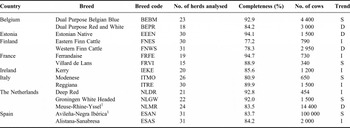
Table 1 reports, by country, names of the 15 breeds analysed, breed codes used in the presentation of results, number of herds surveyed (i.e. farmers interviewed) per breed and degree of completeness of the questionnaires returned. One breed was analysed in Estonia (Estonian Native, code EEEN) and Ireland (Kerry, code IEKE), two breeds were analysed in Belgium (Dual Purpose Belgian Blue, code BEBM; Dual Purpose Red and White, code BEPR), Finland (Eastern Finn Cattle, code FNES; Western Finn Cattle, code FNWS), France (Ferrandaise, code FRFE; Villard de Lans, code FRVI), Italy (Modenese, code ITMO; Reggiana, code ITRE) and Spain (Avileña-Negra Ibérica, code EASN; Alistana-Sanabresa, code ESAS), and three breeds in the Netherlands (Deep Red, code NLDR; Groningen White Headed, code NLGW; Meuse- Rhine- and Yssel, code NLMR). The set of 15 breeds surveyed across the eight countries was selected among those classified as endangered following EU criteria (5 000 or 7 500 cows, for breeds respectively numerically stable or declining; EC Regulations 1257/99 and 445/02) with the additional criteria of including breeds numerically declining, stable or increasing, except for two breeds above 7 500 cows, Avileña-Negra Ibérica and Meuse-Rhine-Yssel, that after the 1950s experienced severe declines. Breed sizes, as number of cows, and demographic trends are given in Table 1. All breeds are classified as dual purpose, but two are primarily dairy breeds (EEEN, ITRE) and two are beef breeds (EASN, ESAS).
Breeds surveyed by country, number of herds analysed and completeness of returned questionnaires.

Note: i, increasing; s, stable; d, decreasing. 1, breeds that, although are not endangered following EU criteria, after the 1950s experienced severe declines.
We aimed to interview an equal number (30) of farmers per breed, representing from 5 to 75 percent of the herds of the breed. An average of 24.7 farmers per breed was interviewed, with a minimum of 15 to a maximum of 31, for a total of 371 farmers across the 15 breeds. Farmers were chosen at random. If the farmer community presented some specific structure with different typologies, then a stratified random sampling was used.
Across the 25 questions and the 15 breeds, the average level of responses was satisfactory (86.9 percent completeness), with some variation among breeds (range 84–95 percent) and questions. Analysis of variance and Pearson chi-square tests were used to compare the results across breeds (SAS, 2004).
Results and discussion
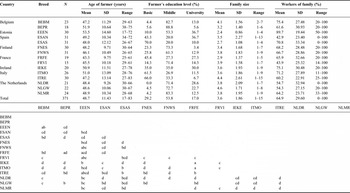
Tables 2–5 provide information on the farmers interviewed and their farms. Table 2 reports on farmers and their family. The average age of farmers across breeds is 48.7 years (SD 11.4), with some variation among and within breeds from a minimum of 43.3 years (SD 9.8) in FRFE to a maximum of 53.5 years (SD 14.6) in EEEN. Considering all breeds, most farmers (53.8 percent) have a middle education level, 29.2 percent have a basic education and 17.0 percent have a university education. Education level differs somehow among breeds. In four breeds, ESAS in Spain, FRFE in France, and ITMO and ITRE in Italy, the majority of farmers (from 43 to 70 percent) have a basic education. In the other ten breeds, the middle level is the most common, from 35 percent in IEKE to 83 percent in NLMR. In five breeds, the percentage of farmers with a university level is above 27 percent, up to a maximum of 36.7 percent (EEEN, ESAN). Information at the national levels is scarce and comparisons between farmers of mainstream breeds and our findings on local breeds are not possible. The age of the farmer provides indications on the process of transferring farming activities to the next generation and on opportunities for breed survival in the next few years. However, we did not ask farmers how they foresee the transfer of their farming activities. A recent survey in Belgium indicates that only 15.8 percent of farmers older than 50 years claim they have a presumed successor; 57.8 percent claim they have no successor and 26.4 percent do not know yet (DGARNE, 2009).
General data on the farmer and his family, by breed. Lower area, breed comparisons.

Note: Presence of letters corresponds to significant differences between breeds (<0.05). ANOVA significance (a, age of farmer;b, family size;c, workers of family);Chi-square significance (d, farmer's education level).
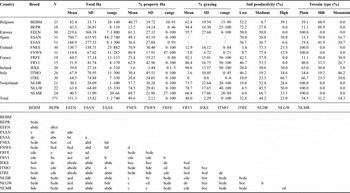
Land use, by breed. Lower area, breed comparisons.

Note: Presence of letters corresponds to significant differences between breeds (<0.05). ANOVA significance (a, total Ha; b, % property Ha; c, % grazing;d, soil productivity: e, terrain type).
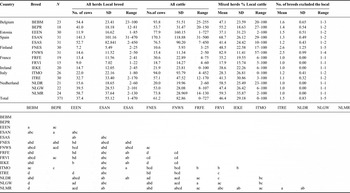
Herd size and composition, by breed. Lower area, breed comparisons.

Note: Presence of letters corresponds to significant differences between breeds (<0.05). ANOVA significance (a, local breed;b, no. of total cows; c, % of local cattle/total cattle; d, breeds farmed in addition to the local breed).
Economic role and activities of the farm, by breed. Lower area, breed comparisons.

Note: Presence of letters corresponds to significant differences between breeds (<0.05). ANOVA significance (a, total external workers; b, % animals farm activity; c, % non-feed crop farm activity; d, % forestry farm activity; e, % other farm activity; f, local cattle breed's share of the total farm income %:) and Chi-square significance (g, % income).
The average family size across breeds is 3.6 (SD 1.9) ranging from 2.4 (SD 0.9) in EEEN to 4.6 (SD 1.7) in NLGW. On average, 64.9 percent (SD 29.6) of family members contribute to farming activities, with some variation from 42.9 percent (SD 23.4) in ESAN to 89.7 percent (SD 19.4) in EEEN.
Table 3 reports data on land use. The average farm size across breeds is 151.3 ha (SD 15.8), 49.6 percent (SD 2.1) of property. Farm size ranges from 30.1 ha (SD 28.1) in NLDR to 760.7 ha (SD 633.9) in ESAN, and percentage of property ranges from 1.6 (SD 1.4) in IEKE to 80.9 (SD 17.9) in FNWS. The percentage of land used for grazing (Spanish data missing) across breeds is 48.0 (SD 2.3), ranging from zero in ITRE to 92.1 (SD 15.0) in FRFE. Table 3 also provides the type of land on which farms are located, in terms of both soil productivity compared with the country average, and orographic structure. Across breeds, the soil occupied by farming activities is approximately equally distributed across the three categories of low (32.8 percent), medium (44.2 percent) and high productivity (23.0 percent). Low or medium soil productivity is prevalent in all but two breeds, ITRE and NLGW with respectively 66.7 and 50 percent of high-productivity soil. Only in four breeds mountain terrains are used by at least 25 percent of the herds, from 26.7 percent in FRVI to 46.2 percent in ITMO. Self-sufficiency in cattle feedstuff and organic production was also analysed (data not reported in Table 3); the percentage of self-sufficiency in production of feedstuff for the local cattle herd (Spanish data missing) on average was 91.8 percent (SD 19.7) for roughage, with little variation across breeds (82–100 percent), and 22.44 percent (SD 36.5) for concentrate, with higher variation ranging from 2 percent in ITRE to 62 percent in EEEN. The percentage of farms producing organic was on average 13.2 percent, with a consistent variation, from zero in ESAS and ITRE to 25 percent or higher in EEEN, FRVI, IEKE and NLDR. It is worth noting that at least a quarter of the farmers of the four breeds from four different countries in Eastern, Southern, Central and Northern Europe add value to the local cattle by producing organic milk or meat.
Among the 371 farmers interviewed, 145 (39.2 percent) keep on their farm only the local breed that is the object of this investigation; the remaining 226 (60.8 percent) also keep cows of one or more additional breeds. Considering all 371 herds, the average size of the local cattle herd across all breeds is 37.4 (SD 55.1) cows with some differences among breeds, ranging from 7.2 (SD 5.5) in FNES to 141.3 (SD 101.2) in EASN (Table 4). Considering both the local breed under investigation and the other cattle kept on the farm, the average cattle herd size is 61.2 (SD 82.9) cows, ranging from 10.6 (SD 5.9) in FNES to 170.3 (SD 118.9) in ESAN. Considering the 226 farms with two or more breeds, the average farmer keeps on his farm, in addition to the analysed local breed, 1.5 (SD 0.8) breeds, ranging from 1 to a maximum of 2.6 in FNES, for a total, within each local breed, of 1 (NLGW and NLMR), 4 (ITRE and NLDR), 5 (FNWS, FRVI and IEKE), 6 (BEBM, ESAN and FNES), 7 (ESAS), 8 (BEPR, FRFE and ITMO) and 10 (EEEN) additional breeds. These additional breeds include mainstream breeds such as Holstein, Brown Suisse, Limousine, Simmental, Belgian Blue Beef, Charolaise, regional and local breeds, and crosses. In the average farm keeping more than one breed, the percentage of local cows of total cows is 46.4 percent (SD 29.2), ranging from 28.3 in ITMO to 82.9 in FNWS. The presence on the farm of breeds additional to the local one can be linked to a precise strategy to increase profitability (e.g. Belgian breeds), to the country tradition of having more breeds on the farm (e.g. Finland breeds), to the cultural affection of farmers of mainstream breeds to the local breeds of their parents (e.g. Italian breeds, where some successful Holstein farmers keep a few Reggiana or Modenese cows, and French breeds), to the willingness of contributing to the conservation of the endangered breed (e.g. French breeds). In some cases, local cows are preferred for their better fertility, rusticity and maternal ability, but they are mated to mainstream breed cows to produce F1 veals (e.g. Spanish breeds).
Multifunctionality was investigated by asking the roles and functions of local cattle on the farm. Besides the obvious roles of milk to be sold or processed as cheese on the farm, meat and dual purpose, the grazing role (identified by farmers as a specific role, and not as simply a cattle activity) was recognized, across all breeds, by 11 percent of farmers, in particular 30 percent in IEKE, 33 percent in FNES and 71 percent in NLDR. Only 4 percent of farmers, across all breeds, mentioned a tourism role, 60 percent of those in the NLDR. Other roles included, e.g. in the Netherlands, nature management and energy production. Some local breed farmers are moving from traditional products to new opportunities for increasing profitability, but this approach still seems limited, for example in tourism, as we will also see from the data reported in Table 5.
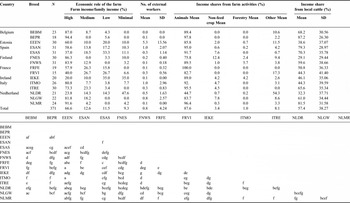
Table 5 reports data on the economic role of local cattle. Farmers were asked to identify the percentage of the total family income covered by farming activities, using the following classes: from 76 to 100 percent (high), from 51 to 75 percent (medium), from 26 to 50 percent (low) and less than 26 percent (minimal). As an average across breeds, the percentage of income from the farm is high in 66.6 percent of cases, with consistent variation among breeds ranging from 20.0 percent in IEKE to 94.4 percent in BEPR. In two breeds, the income from the farm covers on average less than 25 percent of the total family income in a consistent percentage of the interviewed farmers, in IEKE (35 percent of farmers) and in NLDR (48 percent of farmers, most of them using cows just for nature management). The local cattle breed share of the total farm income is across breed 57.4 percent (SD 38.3), with a minimum of 3.3 percent in NLDR to a maximum of 87.2 percent in BEPR.
The average number of external workers, measured as the sum of full-time persons and part-time/seasonal persons multiplied by 0.25, is 0.8 (SD 4.2), ranging from 0.0 in BEBM to 1.0 in both ESAN and ITRE. Farmers were asked to partition the farm income into income from animal food products, from non-feed crop production, from forestry, from work services for other farms, from grazing as landscape management, from tourism services, and from welfare and educational services. Considering all breeds, as mentioned above, multifunctionality seems limited, with a high percentage (87.6) of the income derived from animal food products, followed by 3.4 percent from non-feed crop production and a total of 9.0 percent from other types of income. The percentage of income from animal food products is above 83 percent in all breeds, except for FNWS, where 12.4 percent of the income derives from non-feed crops, and NLDR, where 3.5, 12.8, 10.5 and 5.0 percent of the income derives respectively from work services for other farms, from grazing as landscape management, from tourism services and from welfare and education services. It might be worthwhile to create opportunities to exchange ideas, and to promote institutional support in order to foster multifunctionality in other breeds as a tool to increase their productivity and sustainability.
Farmers were also asked to identify the percentages of the production from either the local breed or the total herd (in the case of the presence of two or more breeds on the farm) sold as raw material on the farm, as processed material on the farm, to the local market or to the industry. For the local breed, on average most (39.9 percent) of the production is sold to industry, followed by local markets (25.4 percent), on farm as raw material (9.6 percent), and on farm as processed material (5.9 percent). Additional investigations are needed to understand the role of both industry and the local market on farmer profitability, which seems to vary from case to case. In some cases, the industry guarantees a good promotion of the breed product (e.g. Spanish breeds); in other cases the local market adds value to the product (e.g. Italian breeds). When we consider the total herd production, the percentage sold to industry increases to 44 percent and quotas sold on farm decreased by half.
Besides information on farmers and their farms, our survey aimed to understand the values and motives of farmers for keeping their local breed, their perception of the attitude of society towards them for continuing to farm local breeds instead of turning to mainstream ones, and farmers' plans on the size of their herds. Figures 1 to 7 report on these aspects.
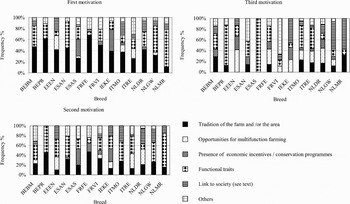
Three main motivations of farmers to keep the local breed.

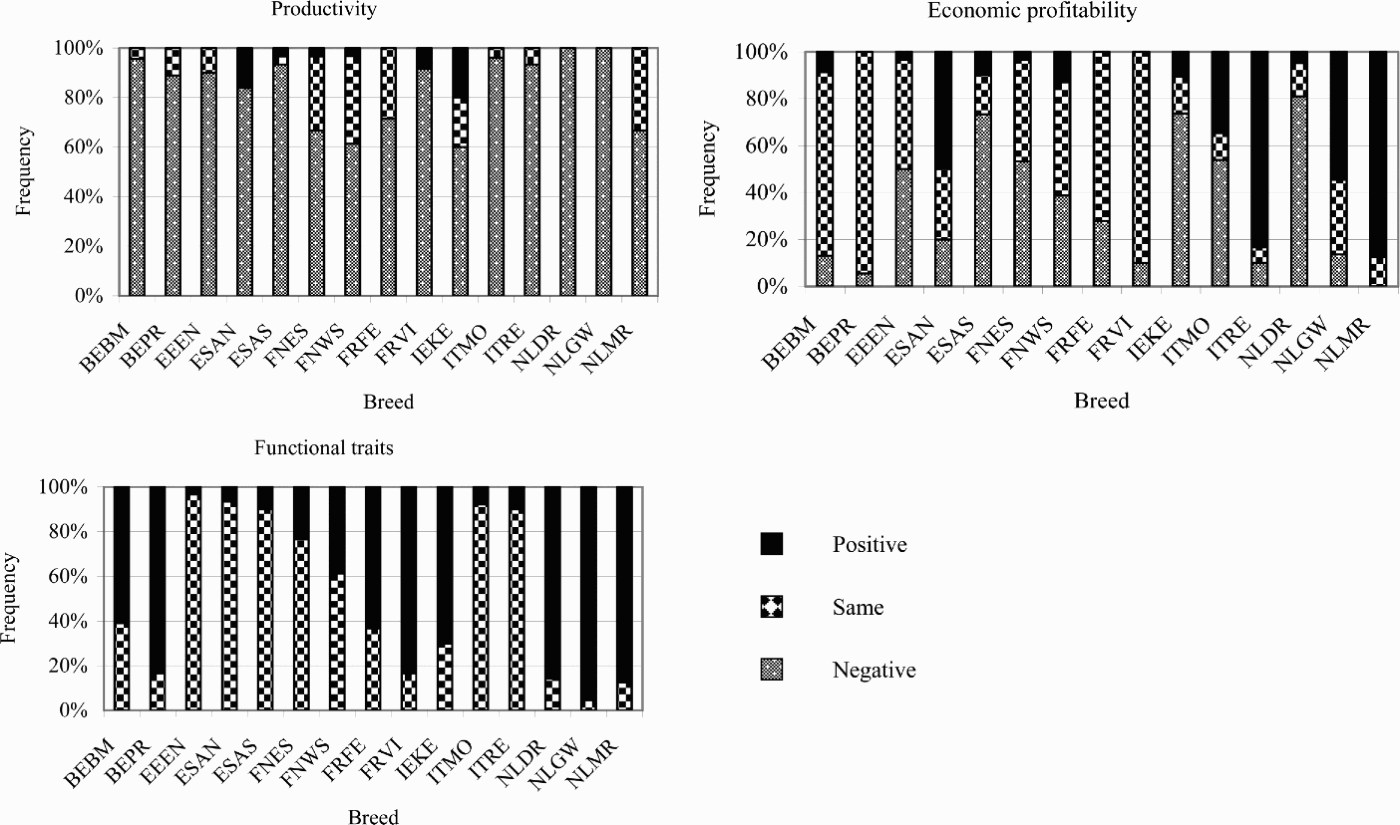
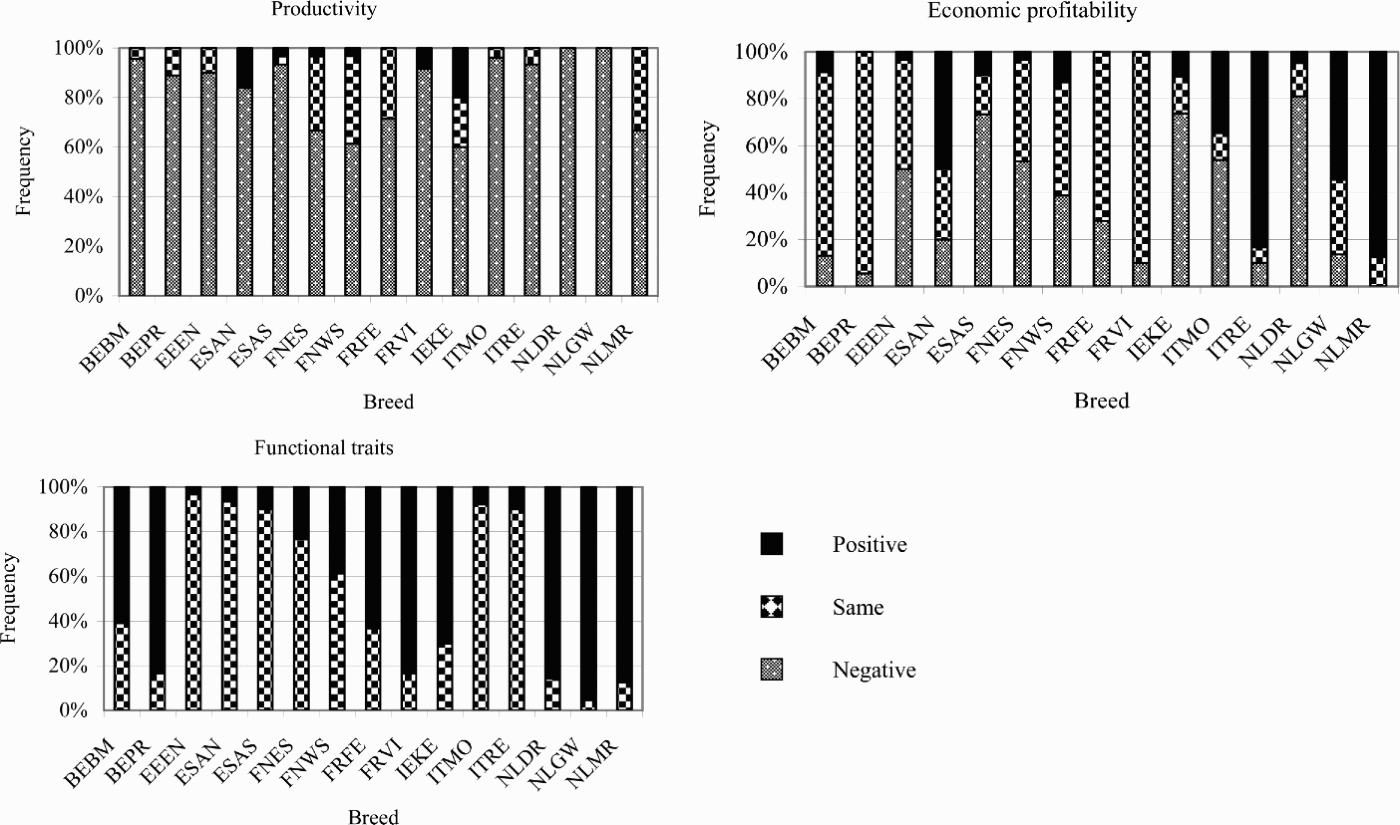
How farmers compare their local breed with the mainstream breed on productivity, economic profitability and functional traits.
Farmers' view on the appreciation of their local breed and its products by 18 stakeholder categories (see text): average across the 18 stakeholder categories.

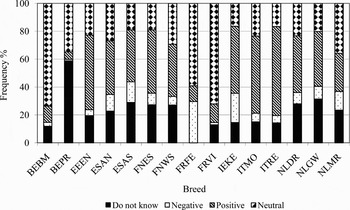
Farmers' view on the value attributed by society to their local breed: average over five breed attributes (see text).

Changes of herd size planned by the farmer in the next five years, with respect to current size.

How farmers react to changes in the amount of subsidies. Responses in those breeds that currently benefit from subsidies.

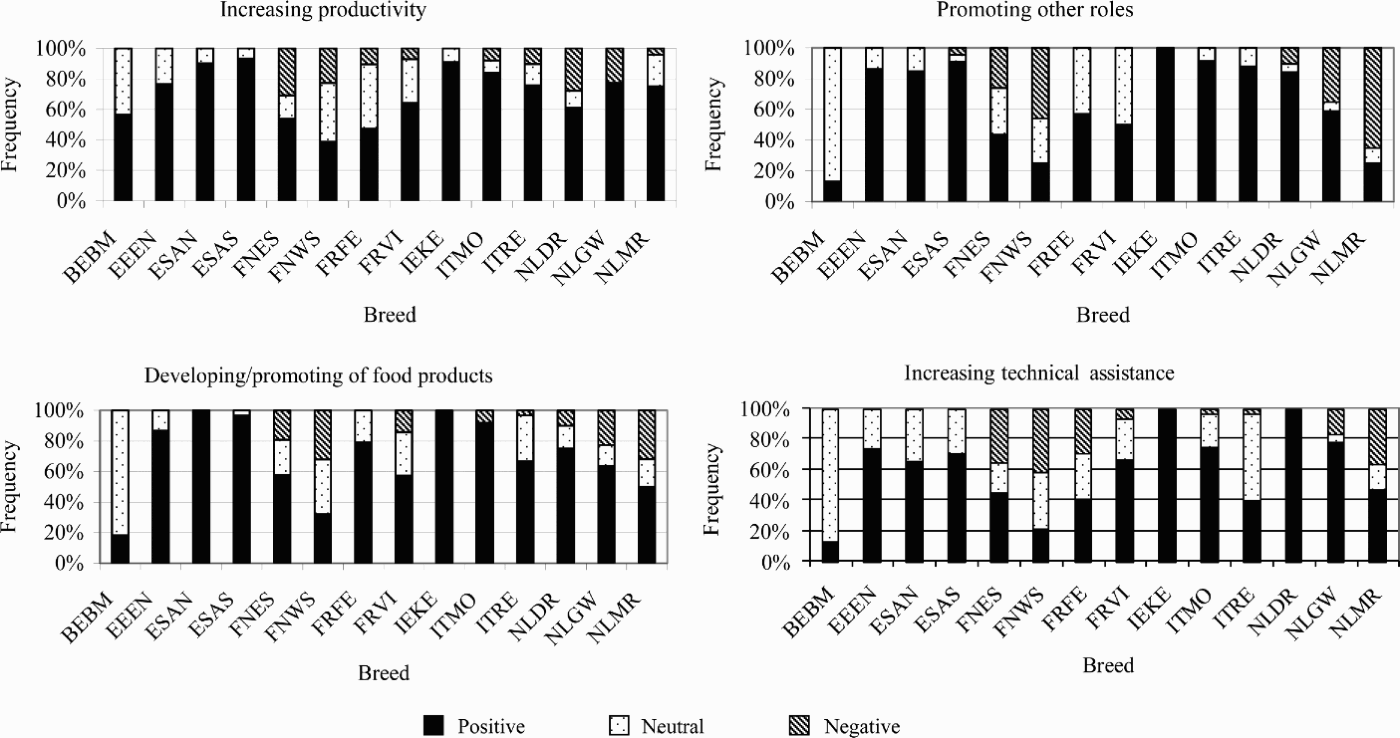
Opinion of the farmer on four possible activities as support to continue keeping the local breed on the farm.
Farmers (Figure 1) were asked to identify and rank the three main reasons for keeping their local breed from among the following: tradition (of the farm and of the farming area), multifunctionality (i.e. opportunities for multifunctional farming, including tourism, production of niche products, vegetation management), external support (presence of economic incentives or conservation programmes), functional traits, social value (including image value for the farm, link to other people who have such breeds or values, bringing pleasure to the family) and other reasons. Across all breeds, as the first reason the most frequent answer was functional traits (36 percent) strictly followed by tradition (35.4 percent), which was the most frequent answer in eight breeds (BEPR, EEEN, FNWS, FRFE, FRVI, ITMO, IEKE, NLDR). In ESAS, the most frequent first reason was external support (30 percent); in IEKE farmers indicated with equal frequency (35 percent) tradition and presence of external support. When tradition was given as the first reason, the second reason was functional traits in five breeds (BEPR, EEEN, FNWS, IEKE, ITMO), tradition again in two breeds (FRFE, FRVI), and multifunctionality or social value, with equal frequency, in one breed (NLDR). In addition, the social reason was given as the most frequent third reason in three breeds (IEKE, NLGW, NLMR). The importance of tradition, besides productivity, suggests the importance of conservation programmes, considering the cultural aspects of local cattle farming (Gandini and Villa, Reference Gandini and Villa2003). The relative low importance of support from conservation programmes might reveal the average inadequacy of these to contribute to maintaining the farming of the local breed.
Farmers were asked to compare their local breed (as poor, same, good) with a mainstream breed they knew for productivity, economic profitability and functional traits (Figure 2). Farmers were asked to analyse the following functional traits, fertility, longevity, management requirement, robustness and docility, and Figure 2 reports rounded averages across the five traits. Productivity was considered poor by the majority of farmers in all breeds, as the same by about 30 percent of farmers in FNES, FNWS and NLMR. In IEKE, 20 percent of farmers valued productivity as good with respect to the mainstream breed. Comparison in terms of economic profitability increased the value of the local breed. In fact, in only six breeds the majority of farmers considered their breed as less profitable than the mainstream breed. In four breeds (BEBM, BEPR, FRFE, FRVI), productivity was considered the same by a vast majority of farmers. In three breeds (ITRE, NLGW, NLMR) more than 50 percent of farmers valued their breed as more profitable than the mainstream breed. For the Reggiana breed (ITRE) the high profitability is linked to the success of a branded Parmigiano Reggiano cheese that is sold at a high price (Gandini et al., Reference Gandini, Maltecca, Pizzi, Bagnato and Rizzi2007). The local breed was always valued as superior or the same when comparison was on functional traits. In particular, five breeds (BEPR, FRVI, NLDR, NLGW, NLMR) were considered by 80 percent or more of the farmers as positive with respect to the mainstream. Profitability comparisons based on farmers' estimates can be misleading if production costs are not correctly considered. However, they provide some indications on the interest of farmers for their breeds and consequently on opportunities for breed survival.
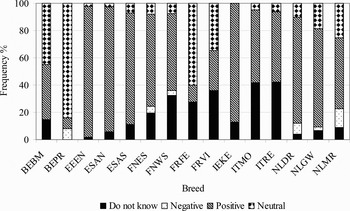
The following two questions were based on the assumption that acknowledgement by society of a positive image of the farmer of local breeds can contribute to maintaining these breeds. Farmers were first asked which type of appreciation (positive, neutral, negative, do not know) they thought the following 18 categories of persons and entities have on their local breed and their products: extension persons, inseminators, veterinarians, breeding organization, farmers' associations, agricultural authorities, environmental authorities, regional authorities, food industry, research institutes, farmers of mainstream breeds, farmers without animals, non-farmer neighbours, tourists, tourism agencies, cultural societies, consumers and media. As an average over the 18 categories and the 15 breeds (Figure 3), a positive appreciation was observed in 35.2 percent of farmers, but with rather low values in the Belgian and French breeds, BEPR (5.4 percent), FRFE (11.3 percent), BEBM (11.6 percent), FRVI (13.3 percent), and a maximum in ITRE (63.9 percent). A neutral appreciation is expected on average from 32.9 percent of farmers, with a minimum in IEKE (16.5 percent) and a maximum in BEBM (73.7 percent). A negative appreciation is on average expected by 9.6 percent of farmers, with two situations above 20 percent, in IEKE (20.9 percent) and FRFE (29.5 percent). A negative appreciation is expected from most farmers (37.2 percent) in the case of the category “farmers of mainstream breeds”, and with a rather high percentage (19.3 percent) in the category “food industry”. The percentage of farmers who did not have a precise idea (did not know) was on average 36.8 percent, ranging from zero in FRFE to 58.7 percent in BEPR. A negative appreciation was seen with a <7 percent occurrence in nine categories.
In order to further understand farmer perception of the attitude of society towards the local breed, farmers were asked to give their opinion on how (positive, neutral, negative, do not know) they think society values the following five breed attributes: quality of products, specific traits, cultural heritage, landscape conservation and source of genetic variation. As an average over all farmers, the highest positive opinion was expected for the cultural value (68.1 percent), followed by the genetic value (65.56 percent), the quality of products (63.7 percent), landscape conservation (60.5 percent) and specific traits (48.3 percent). Considering an average above the five breed attributes (Figure 4), some differences were observed among breeds, with six breeds where 75 percent or more of the farmers who think that society has an overall positive attitude towards the local breed and nine breeds where no farmers think that society has an overall negative attitude. Some variation is observed also in the percentage of farmers who did not have a precise idea (do not know), ranging from 0 percent in BEPR to 41.7 percent in ITMO and ITRE. If we assume that a positive recognition of society of the work of the farmer can enhance interest in maintaining local breed farming, it would be advisable to promote through the media the importance of local breed conservation and communication among farmers and the society as a whole.
Farmers were asked on the level of cooperation among them, in terms of participation in the activities of the breeding association, and of marketing of products and services. On average, across breeds, collaboration with the breeding association is rather high, with an average across breed of 66.9 percent and a percentage below 50 percent in only five breeds (BEBM, BEPR, FNES, FNWS, FRVI). Cooperation in marketing of products or services, on the contrary, is rather low, with an average across breeds of 23.5 percent and with only three breeds (ESAN, IEKE, ITRE) above 40 percent. The farmers of only four breeds, EEEN, FRFE, ITMO and ITRE, said that they participated in inbreeding control centralized programmes and in cooperative programmes for the development of niche products. For inbreeding control, the level of appreciation was above 85 percent in three cases except for ITMO (47 percent). Programmes on niche products were judged as failure or less appreciated, but in ITRE there was 100 percent good level of appreciation.
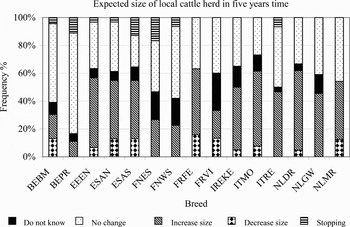
Farmers were asked about the size of their local cattle herd expected in five years time with respect to the current size. On average (Figure 5), 38.5 percent of farmers expect to increase the size (from 11.1 percent in BEPR to 57.1 percent in NLDR), 6.7 percent to decrease (from 0 percent in BEPR, FNES, FNWS, ITRE, NLGW to 15.8 percent in FRFE), 39.9 percent to keep the same size (from 22.6 percent in ESAS to 72.2 percent in BEPR) and 4.9 percent to give up farming (from 0 percent in seven breeds to 16.7 in FNES). Ten percent of farmers said they could not predict herd size in the next five years. The high proportion of NLDR farmers expecting to increase herd size is also because many farmers started to keep this breed in the last five years and they still need to reach an appropriate herd size.
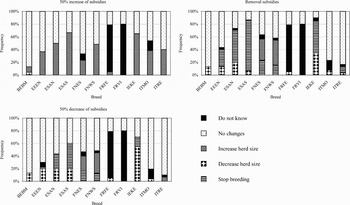
Eleven of the 15 breeds analysed benefit from economic incentives. The degree of dependence of farmers on economic incentives was estimated by asking farmers their expected behaviour (to give up farming, to decrease herd size, to keep the same herd size, to increase herd size, do not know) under three scenarios of change of subsidies: 50 percent increase, 50 percent decrease, removal. In Figure 6, for each breed, the proportions of farmers' expected behaviours are illustrated for the three scenarios. Almost all farmers seemed to know how they would react to subsidy changes, except for a high proportion of French farmers. In the case of 50 percent increase of subsidies, in four breeds (BEBM, EEEN, FNES, ITRE) most farmers will not change herd size, in ESAS and IEKE farmers will increase herd size, and in ESAN, FNWS and ITMO farmers are equally distributed among no change and increase. Under the hypothesis of removal of subsidies, in BEBM, EEEN, ITMO and ITRE most farmers will not modify herd size and in good proportion will even increase it (FNES, FNWS). Farmers of the Spanish breeds (ESAN, ESAS) and IEKE are in good proportion ready to give up farming of the local breed or to decrease herd size. The answer in the case of 50 percent decrease of subsidies is close to the case of having the subsidies removed, although slightly negative. Then, six breeds (BEBM, EEEN, FNES, FNWS, ITMO, ITRE) seem to be fairly independent of subsidies.
Signorello and Pappalardo (Reference Signorello and Pappalardo2003) observed that, in spite of EU support to farmers, it still remains unprofitable to rear local breeds. In seven breeds, we asked farmers how much subsidy per cow per year they would think to be reasonable to cover the lower-income profitability compared with the mainstream breeds. Responses were rather different both within and between breeds. In the Netherlands the requested incentives were on average 100 euro (SD 164.3; range 0–500) in NLMR, 172.7 euro (SD 254.3; range 0–800) in NLGW and 303.9 euro (SD 256.1; range 0–1 000) in NLDR, and in Spain they were 187 (SD 50.6; range 120–300) in ESAN and 396.1 (SD 116.5; range 200–600) in ESAS. Farmers of EEEN requested on average 370.1 euro (SD 128.8; range 256–770) and farmers of IEKE 381.3 euro (SD 183.4; range 150–1 000). Our survey detects poor homogeneity among requests, possibly different ideas among farmers on how local breed farming should be supported, and the necessity of better investigating the amount and roles of economic incentives.
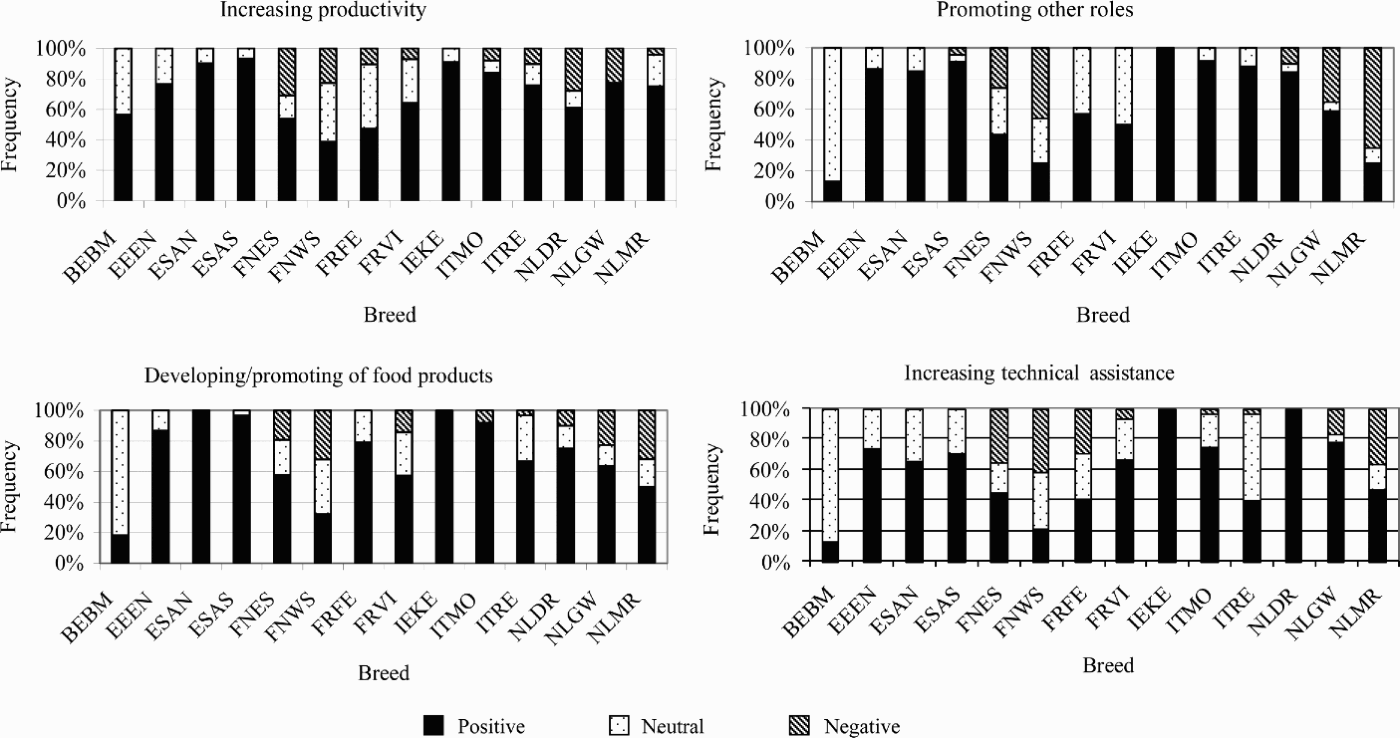
Besides subsidies, we investigated which elements would support keeping the local breed on the farm. Farmers were asked to value (as positive, neutral, negative, do not know) the following six activities: increasing breed productivity, developing/promoting food products associated with the breed, promoting other – less traditional – breed roles such as vegetation management, support to social or therapy activities and cultural testimonies, increasing technical assistance, developing non-food products associated with the breed and increasing consumer awareness. The results are given in Figure 7 for the first four activities listed above. The results concerning activities improving technical assistance and increasing consumer awareness were very similar, respectively, to promoting less traditional roles and to developing/promoting food products, and are not reported in Figure 7. All activities were most often valued positively. Considering all breeds, increasing consumer awareness (not reported in Figure 7) was valued positive, with the highest average percentage (67 percent) and with seven breeds above 85 percent. High positive responses were also given on average to increasing productivity (63.5 percent) and to developing food products associated with the breed (63 percent). The highest frequency of negative responses was from Dutch and Finnish farmers. A large majority of BEBM's farmers valued all activities neutral.
Conclusions
This survey revealed a large variation between and within breeds for most of the analysed aspects. In particular, it is worth noting that almost all local breeds are kept, by a certain percentage of farmers, together with other breeds. On average, the income from local cattle covers 57 percent of the farm income. In some cases, the local breed represents a small percentage of the total cattle farm herd, and it can be questioned whether this type of farming risks having the local breeds at the edges of the production system, kept as hobby activity.
Many farmers indicated family tradition or area tradition as an important motivation to continue keeping the local breed, and it is reasonable to wonder whether this motivation will be transferred to the next generation and whether other motivations will be capable of replacing tradition.
Considering that on average local breeds are producing less milk and/or meat than mainstream breeds, besides the optimization of the low input–output production system, multifunction farming systems capable of adding value to local breeds have often been advocated. Apart from a few cases, the survey revealed that multifunctionality is still poorly adopted.
Our survey strategy was aimed not only at detecting the average situation of the 15 breeds, but also at achieving the greatest possible amount of information from each breed, and at being considered a case study (e.g. Flyvbjerg, Reference Flyvbjerg2006). Here we can conclude that in many breeds (e.g. ESAS, ITRE, NLDR) the traditional farmer coexists with more recent production systems, characterized by more extensive systems, greater attention to quality products or to farming for specific functions such as nature management.
Some aspects investigated provide indications on the sustainability of local cattle farming. The degree of sustainability in the short term can be directly derived by the changes in herd size expected by the farmer in the next five years. Most farmers provided this information and answers are optimistic for the survival of the 15 breeds surveyed, considering that only 13 percent of the farmers declared plans to reduce the herd size or to discontinue local cattle farming. In a larger context, other parameters such as age of the farmer, farmers' view on appreciation from the society for the local breed, and comparison of the local cattle with the mainstream breed provided positive elements for survival of the breeds. Today most farmers receive some EU subsidies, but the survey on the 15 breeds revealed some degree of independence of farmers from public economic support.
Most farmers of the local cattle breeds demand the development of activities promoting and helping local breed farming. In particular, they favour opportunities to increase productivity and profitability through promoting non-conventional roles, and developing food products associated with the breed. However, the large variation observed among breeds suggests the need to develop conservation actions capable of being flexible and adaptable to local situations, among and within breeds. The presence of successful experiences in different countries and breeds also suggests the necessity of exchanging information about the successes and failures of conservation and promotion initiatives. Finally, we suggest that information on local cattle farming should not be restricted to the farming society, but should be extended to the whole society in order to increase general knowledge, awareness and appreciation of the work done by farmers of local cattle breeds.
Acknowledgements
This work was carried out within Action EURECA 012 AGRI GEN RES 870/2004. We are grateful to the European Commission, Directorate-General for Agriculture and Rural Development, for the financial support under Council Regulation (EC) No. 870/2004. Farmer interviews in the Netherlands were done by M. Maurice-vanEijndhoven and D. Bohte-Wilhelmus.