Introduction
Food is an important part of our lives, being shaped by our cultural preferences and social environment. How we acquire that food involves an almost circular series of interactions taking it from the field, through processing, consumption and discard. Whether at the local or global scale, our subsistence strategies are influenced by socio-economic factors, environmental/resource restrictions and technological/knowledge availability. The ability to produce and control agricultural surpluses is suggested to be one of the main factors in the rise of early complex societies and cities (Childe Reference Childe1950) and many, throughout history, have tackled issues of food insecurity. Therefore understanding these processes is an important goal for archaeologists and anthropologists. Even today, population growth and climate change are forcing us to re-evaluate how we can produce and consume food in more sustainable, equitable and healthy ways, and archaeology and anthropology can have a role to play in this (e.g. Reed and Ryan Reference Reed and Ryan2019; Springmann et al. Reference Springmann, Clark, Mason-D’Croz, Wiebe, Leon Bodirsky, Lassaletta, de Vries, Vermeulen, Herrero, Carlson, Jonell, Troell, DeClerck, Gordon, Zurayk, Scarborough, Rayner, Loken, Fanzo, Godfray, Tilman, Rockström and Willett2018).
Research on food has a long history in archaeology and anthropology, illuminating broad societal processes such as political-economic value creation, symbolic and ritual values, social change and identities (e.g. Mintz and Du Bois Reference Mintz and Du Bois2002; Van der Veen Reference Van der Veen2008). Both LaBianca (1990; Reference LaBianca, Baram and Carroll2000) and Gumerman (Reference Gumerman1997) explained the need to examine the food of complex societies in a more comprehensive fashion, from the various stages of production to disposal, and many scholars have used foodways to examine this. While food-systems research occurs in archaeology less frequently, systems thinking is becoming more prominent in the discipline, sharing elements with approaches such as social-network analysis and complexity science (e.g. Bentley and Maschner Reference Bentley and Maschner2003; Knappett Reference Knappett2011; Spencer-Wood Reference Spencer-Wood2013). These theories have been used to address a broad array of questions about the relationships between actors, activities and outcomes for individuals and larger groups at a range of social scales. This paper will therefore assess food systems in archaeology and will consider whether this could provide a useful framework to examine the complex relationships that existed between plants, animals, objects, environments and people in the past.
Foodways in archaeology and anthropology
The literature on the archaeology of food is diverse, touching on economics, politics, identity, gender, religion, technology and environmental reconstructions, and employing a range of different data sets from pottery to animal bones, plant remains, architectural features, stable isotopes, literature and art. Over the last few decades, a range of different definitions has emerged for understanding foodways, with many using the term to understand social, economic, political and ideological factors that enabled the production, distribution, consumption and discard of food (e.g. Pitts Reference Pitts, Wilkins and Nadeau2015; Sugiyama and Somerville Reference Sugiyama and Somerville2016; Sunseri Reference Sunseri2017). In the Encyclopaedia of global archaeology, foodways are described as representing ‘a conceptual approach adopted by researchers to study the social, cultural and ideological meanings associated with food’ (Tourigny Reference Tourigny and Smith2020), while in Peres’s (Reference Peres2017) recent review of foodways research in the south-eastern United States she defines foodways as ‘the food itself and all of the activities, rules, contexts, and meanings that surround the production, harvesting, processing, cooking, serving and consumption of those foods’. Interestingly, Sugiyama and Somerville (Reference Sugiyama and Somerville2016) suggest that ‘food systems’ indicate the physical and economic infrastructures underlying foodways, while foodways make social relationships the primary organizing factor. Thus the application of both terms seems to vary within archaeological research.
Recently Twiss (Reference Twiss, Kerner, Chou and Warmind2015, 90) highlighted that the reason foodways are a challenge to study is because they are constructed from many social and physical components, the traces of which are perceptible in virtually all aspects of material culture. She goes on to state that ‘since no single data set can reflect a people’s entire diet or entire food technology, researchers must integrate multiple data sets in order to build an interpretation of how people ate’. Each data set is a piece of the puzzle, reflecting different stages of food production, processing, consumption and disposal within different parts of society, although sometimes discerning this can be a particular challenge in itself. It can be difficult, for example, to identify whether plant remains reflect direct food consumption (e.g. Jones Reference Jones1998; Wallace and Charles Reference Wallace and Charles2013) or to disentangle nitrogen signals in human dietary studies (e.g. Hedges and Reynard Reference Hedges and Reynard2007). Thus there are numerous ways to examine past and contemporary foodways by bringing together archaeological evidence such as pottery (e.g. serving food, cooking), buildings (e.g. cooking facilities, storage), stone and metal objects (e.g. agricultural and food preparation equipment, coins for trade), human remains (diet and health), and organic matter (e.g. animal bones and the plant remains of the food themselves), as well as literary or iconographic sources. This is particularly important as each type of evidence is generally biased towards one part or one activity; thus foodways promote the use of multiple sources of data to reveal production, preparation and consumption practices.
Since the influential work of Deetz (Reference Deetz1977), historical archaeologists have frequently sought to describe the foodways of early colonial groups settling in the United States and the Caribbean (Peres Reference Peres2017; Tourigny Reference Tourigny and Smith2018). In a paper by Janowitz (Reference Janowitz1993), foodways in 17th-century New York are examined through a wide range of historical records, paintings and archaeological remains to explore whether Dutch-derived foodways continued into the British colonial period. Here food access and choice depended upon the amount and quality of farmland available, the suitability of soils and climate for European crops, the regularity of supply lines to Europe, population densities and the extent of contact with native inhabitants. This study found that although native plants, wild animals and fish were included in the diets, the basic methods of food preparation and the artefacts used to prepare and serve food remained essentially European. Foodways have been explored in other cultural contexts too. In the book Feeding cities, Zeder (Reference Zeder1991) tackles issues around how centralized and specialized economic management shaped animal production and meat distribution at the prehistoric site of Tal-e Malyan, Iran. Grounding her research in middle-range theory, she explains that complex specialized economies support states and channel products through networks that influence producer and distributor decisions as well as determining consumer choices. She emphasizes the need to look at the wider context of the zooarchaeological evidence, especially as specialized economies, social stratification and central governance are mutually reinforcing features of the state (Zeder Reference Zeder1991, 254). Through the 1990s, following the postprocessual transition in archaeology, studies such as these no longer framed foodways as consequential human action, but as active and reciprocal relationships between and within societies (Tourigny Reference Tourigny and Smith2018).
The particular concentration of foodways research within historical archaeology is highlighted further if we do a simple search for the term ‘foodways’ within some of the main archaeological and anthropological journals. Here we see that over 70 per cent of journal articles that discuss foodways, to some degree, are about historical archaeology (Table 1). If we plot these articles through time, we can see that over the last decade there has been a large increase in the use of the term (Figure 1). It is suggested that foodways research should encourage collaboration between multiple specialists in order to understand their breadth and diversity (Twiss Reference Twiss2012, 378), linking well with an increased trend in collaborative and interdisciplinary research. However, if we look at the journal articles here, we see that over 65 per cent are from single authors. What we can see is that over the last two decades, foodways as a concept has started to be used in other periods. This increase also sees archaeologists increasingly exploring how politics, ideologies, economies and landscapes are intertwined with past production, preparation, consumption and discard. This move away from simple dietary reconstructions has also allowed us to think about how people interacted with, experienced and thought about food (e.g. Hamilakis Reference Hamilakis2013; Reference Hamilakis, Beaudry and Metheny2015; Hastorf Reference Hastorf2017; Kamash Reference Kamash2018; Rowan Reference Rowan2019; Twiss Reference Twiss2007; Reference Twiss, Kerner, Chou and Warmind2015; Van der Veen 2008; Reference Van der Veen2014). A recent study by McClatchie et al. (Reference McClatchie, Schulting, McLaughlin, Colledge, Bogaard, Barratt and Whitehouse2019) explored foodways in Neolithic Ireland by integrating all the archaeological evidence available, including animal and plant remains, pottery and stone artefacts, human bone and stable-isotope analyses. Here the researchers not only examined ingredients, but also sought to explore the meanings around the meals themselves. In particular, the low frequency of quern stones suggested that cereals were being processed and cooked in different ways. Links between the presence of cereal remains and pottery was also noted, suggesting that pottery vessels may have been employed in cereal cooking activities, giving us an idea of the types of food that may have been eaten. As is typical for prehistory the data set is rather patchy and so the degree to which foodways can be explored is dependent on the available information.
Number of articles per archaeological and anthropological journal that use the term ‘foodways’ in their text

Number of articles per year that uses the term ‘foodways’ in their text.

Moving beyond foodways towards systems theory
Systems thinking (also known as nonlinear systems theory, and linked to complexity, chaos theory or dynamical systems) was developed in the 1920s–1940s by the biologists Paul Weiss and Ludwig von Bertalanffy as a reaction to reductionist theories (Drack and Apfalter Reference Drack and Apfalter2007). They suggested that there are no simple one-to-one relations to explain natural and cultural systems. Instead, a system is a complex of interacting elements that are open to and interact with their environments and are continually evolving (Bertalanffy Reference Bertalanffy1968). By the 1960s systems thinking began to be recognized as a paradigmatic effort at scientific integration and theory formulation on the transdisciplinary level, spreading from the sciences into the humanities, from biology to cybernetics to mental health (Laszlo and Krippner Reference Laszlo, Krippner and Jordan1998, 49).
In the 1960s and 1970s systems thinking was introduced to archaeology with the work of scholars such as Binford and Binford (Reference Binford and Binford1968), Clarke (Reference Clarke1968), Doran (Reference Doran1970) and Flannery (Reference Flannery and Meggers1968), with the premise that cultural systems could be examined mathematically to remove the problem of cultural bias. As early computer simulations and modelling in archaeology sought to replicate human societies, it became increasingly clear that such approaches failed to tackle the elements of human society which are specifically human (Renfrew Reference Renfrew1987). During this time Merilee Salmon (Reference Salmon1978) asked ‘what can systems theory do for archaeology?’ and concluded that although it had been instrumental in expanding our conception of systems and their importance, it cannot provide a methodology. This was largely due to her worries about mathematical systems theory and the limitations of modelling complex behaviours when components of a system and their systemic relationships are not well understood.
While systems thinking lay largely dormant in archaeology in the 1990s, the larger scientific community became increasingly interested in complexity, including complexity-inspired ecological analyses of food webs and networks (Levin Reference Levin1992; Pimm, Lawton and Cohen Reference Pimm, Lawton and Cohen1991). The development of institutional infrastructure, such as the Santa Fe Institute (Cowan, Pines and Meltzer Reference Cowan, Pines and Meltzer1994), allowed researchers to explore the underlying patterns in complex physical, biological, social, cultural and technological systems and their emergent properties across departments and disciplines (Meadows Reference Meadows2009). It took another decade for archaeologists to again explore systems and complexity theory as tools in archaeological thinking (e.g. Bentley and Maschner Reference Bentley and Maschner2003; Beekman and Baden Reference Beekman and Baden2005; Chapman Reference Chapman2003). Rather than applying systems thinking in a purely mathematical way to predict the exact trajectories of complex societies, archaeologists have developed and adapted a range of frameworks to help understand the properties that emerge from interactions of agents and the effects of changes within the system (e.g. Bentley and Maschner Reference Bentley, Maschner, Bentley, Maschner and Chippendale2007).
Today many of the elements of systems thinking are applied in archaeological complexity research, to varying degrees, within a range of theories and methods, including agent-based modelling, scaling studies (e.g. settlement-scaling theory) and network analyses. These methodologies have led to new perspectives and tools to study complex systems, allowing archaeologists to (re-)examine data and problems in novel ways, as well as proving a new conception of the archaeological record as a source of information for socio-economic development under different conditions. For example, agent-based modelling is used intermittently in archaeology, and predominantly in prehistory, to emphasize how actions by individuals combine to produce global patterns, and is classed as a ‘bottom-up’ simulation approach (e.g. Cegielski and Rogers Reference Cegielski and Rogers2016; Ortega et al. Reference Ortega, Ibáñez, Campos, Khalidi, Méndez and Teira2016; Romanowska et al. Reference Romanowska, Crabtree, Harris and Davies2019).
The collapse, resilience or transformation of complex societies has been a common theme in archaeological research (e.g. Faulseit Reference Faulseit2015; Redman Reference Redman2005; Tainter Reference Tainter1988). Resilience theory has emerged as a way to understand the source and role of change in systems and the ability of a system to absorb disturbance (e.g. war, natural disasters) by conceptualizing the interweaving of behavioural adaptations (e.g. mobility, economy, social systems) with their external environmental setting (Holling, Gunderson and Ludwig Reference Holling, Gunderson, Ludwig, Gunderson and Holling2002). Based on the concept of adaptive cycles, resilience theory highlights the complexity of interacting variables that move at different speeds and at different scales and the capacity of the system to draw on these to self-organize in order to tolerate and deal with change (Folke Reference Folke2006). Panarchy is a concept developed to illustrate the presence and connectivity of many individual adaptive cycles within a larger system. Resilience of a system has been defined in two different ways: engineering resilience and ecological resilience (Holling Reference Holling and Schulze1996; Holling and Gunderson Reference Holling, Gunderson, Gunderson and Holling2002). The former involves the short-term ability of a unit to maintain or return to homeostasis after a disturbance. On the other hand, ecological resilience focuses on understanding the long-term adaptability of a particular unit, when a quick return to equilibrium is not possible. Here, as with other systems frameworks, complex adaptive systems consist of heterogeneous collections of individual agents that interact locally, and evolve in their behaviours, or spatial distributions based on the outcome of those interactions (Janssen Reference Janssen2002). Therefore we need to examine how specific cultural and political entities intersect with economic, environmental and social structures (Redman and Kinzig Reference Redman and Kinzig2003). This is important as not all systems pass through each phase of the adaptive cycle in the same order (Iannone Reference Iannone and Faulseit2015, 181). Archaeological studies are already demonstrating the usefulness of this approach, highlighting the need to focus on the systems dynamics within specific case studies. For example, using the perspective of ‘community complexity’ and ‘societal resilience’, Porter (Reference Porter2013) recently examined groups in Early Iron Age west–central Jordan. He found that communities irregularly formed, consolidated, expanded and at times dissolved based on their resilience to the hard environmental conditions and their ability to create self-supporting communities.
The desire to understand cities, urbanization and cities’ complexities gave rise to urban-scaling studies, which suggest that cities are quantitatively predictable due to agglomeration or scaling effects. Bettencourt et al. (Reference Bettencourt, Lobo, Helbing, Kühnert and West2007, 7305) showed that ‘cities belonging to the same urban system obey pervasive scaling relations with population size, characterizing rates of innovation, wealth creation, patterns of consumption and human behavior as well as properties of urban infrastructure’. Although still largely limited in its application, many stress that these properties can be applied to the past, providing new ways of framing human societies as complex networks and providing new avenues for the study of social evolution (e.g. Ortman et al. Reference Ortman, Cabaniss, Sturm and Bettencourt2015; Mandich Reference Mandich2016). A range of other models have also been applied in this field, which have a long history in geography and economics, such as von Thünen’s (Reference Thünen1826) ‘isolated-state’ model, Weber’s (Reference Weber1909) ‘consumer city’ model and Christaller’s (Reference Christaller1933) ‘central-place theory’. The former two generally focus on the spatial distribution of agricultural practices and land use around a city or market centre, where the sole production for the city comes from its hinterland. Although hypothetical models, they highlight distance-based agricultural activities, taking into account production costs, transport costs to market, and profit maximization in order to determine ‘rent’. ‘Central-place theory’ ranks places in terms of the services they provide, i.e. higher-ranking places offer a wider range of services around a larger area. More recently, site-catchment analysis (SCA) was developed by Claudio Vita-Finzi and Eric Higgs (Reference Vita-Finzi and Higgs1970, 5) who suggested that human activity and mobility are limited to a certain range. For example, if a settlement is reliant on crops then it will be located near agriculturally productive soils; the further people move away from their settlements, the greater the energy (cost) expended to procure resources (Roper Reference Roper1979, 120; Bailey Reference Bailey, Renfrew and Bahn2005). These models have been increasingly used for GIS-based modelling of prehistoric sites (e.g. Becker et al. Reference Becker, De Andrés-Herrero, Willmes, Weniger and Bareth2017; Volkmann Reference Volkmann, Siart, Forbriger and Bubenzer2018), but have also been applied to other periods, for example Roman Italy (e.g. Morley Reference Morley1996; Casarotto, Pelgrom and Stek Reference Casarotto, Pelgrom and Stek2016).
Network analysis, or social-network analyses (SNA), has increased dramatically in archaeology over the last two decades, focusing on the structure of archaeological connections, such as the links between sites evident in shared material culture (e.g. Brughmans and Peeples Reference Brughmans and Peeples2017; Knappett Reference Knappett2011; Reference Knappett2013; Mills Reference Mills, Roddick and Stahl2016; Peeples Reference Peeples2018). Networks are complex systems and methodological advances in archaeology have concentrated on the increased ability to handle large data sets, and developments in computer technology to produce complex computer models of networks (e.g. Östborn and Gerding Reference Östborn and Gerding2014). A range of SNA has been applied to visualize and systematically compare social structures, for example modelling the transport network of Roman Hispania (de Soto Reference de Soto, Verhagen, Joyce and Groenhuijzen2019), or exploring patterns of interaction and vulnerability in maritime networks of the Middle Bronze Age Aegean (Knappett, Evans and Rivers Reference Knappett, Evans and Rivers2011; Rivers and Evans Reference Rivers and Evans2014), as well as studying networks and entanglement at the Neolithic sites of Boncuklu and Çatalhöyük in central Turkey (Hodder and Mol Reference Hodder and Mol2016).
Although only touched upon here, it is clear that there is a great range of systems/complexity analysis being undertaken in archaeology at varying spatial and temporal scales. Criticisms range, but a few are worth noting here. First is that some models are quite generic, simple and abstract, failing to capture the complexities of ‘reality’, though conversely, some suggest that these generic methods are helpful as they provide tools and ‘proxies’ to visualize and analyse various types of data that are relational between periods, regions and systems (Preiser-Kapeller Reference Preiser-Kapeller2017). Archaeology is also patchy, and the uneven preservation of archaeological remains could lead to translating possibilities into certainties, based solely on the grounds of their apparent plausibility (Goodchild Reference Goodchild, Bowman and Wilson2013, 57). Thus small data sets can cause problems and in SNA a number of researchers have pointed out the importance of validating the data, as many network measures used for social interpretations are influenced by the assumptions on which the network is constructed (Peeples and Roberts Reference Peeples and Roberts2013; Groenhuijzen and Verhagen Reference Groenhuijzen and Verhagen2016). In addition, Brughmans (Reference Brughmans2012) highlights that the identification of emergent properties in SNAs does not necessarily explain how this behaviour came about, which is problematic when the material we find reflects isolated actions of individuals or groups. Nevertheless, despite these inherent difficulties, scholars stress the potential of these methods, as the principles underlying these models are effective when examining the archaeological data, although more holistic thinking is required, drawing on other evidence and models (e.g. Brughmans Reference Brughmans2012; Comber Reference Comber2018; Goodchild Reference Goodchild, Bowman and Wilson2013; Knappett Reference Knappett2011, 37; Mandich Reference Mandich2015).
Modern food systems research
Today our food system is under increasing pressure to produce enough food for the global population, decrease the environmental impacts of production, and buffer against complex global change (e.g. Godfray et al. Reference Godfray, Beddington, Crute, Haddad, Lawrence, Muir, Pretty, Robinson, Thomas and Toulmin2010). Traditionally, components of modern production and consumption systems have been assessed or analysed in individual studies to improve the efficiency of each element, based on the assumption that this will also improve the efficiency of the whole system. However, over the last few decades it has become clear that the complex nature of food systems requires an integrated assessment tool to deal with the root causes of these challenges, rather than providing quick fixes ‘now’ which give rise to a much bigger problem to fix ‘later’. As a result, systems thinking and a food systems approach have been widely adopted to identify, analyse and assess the impact and feedback of the systems’ different actors, activities and outcomes to help identify intervention points, deal with competing priorities and address the complex relationships to improve food systems (Ericksen Reference Ericksen2008; Ingram Reference Ingram2011; Tendall et al. Reference Tendall, Joerin, Kopainsky, Edwards, Shreck, Le, Kruetli, Grant and Six2015).
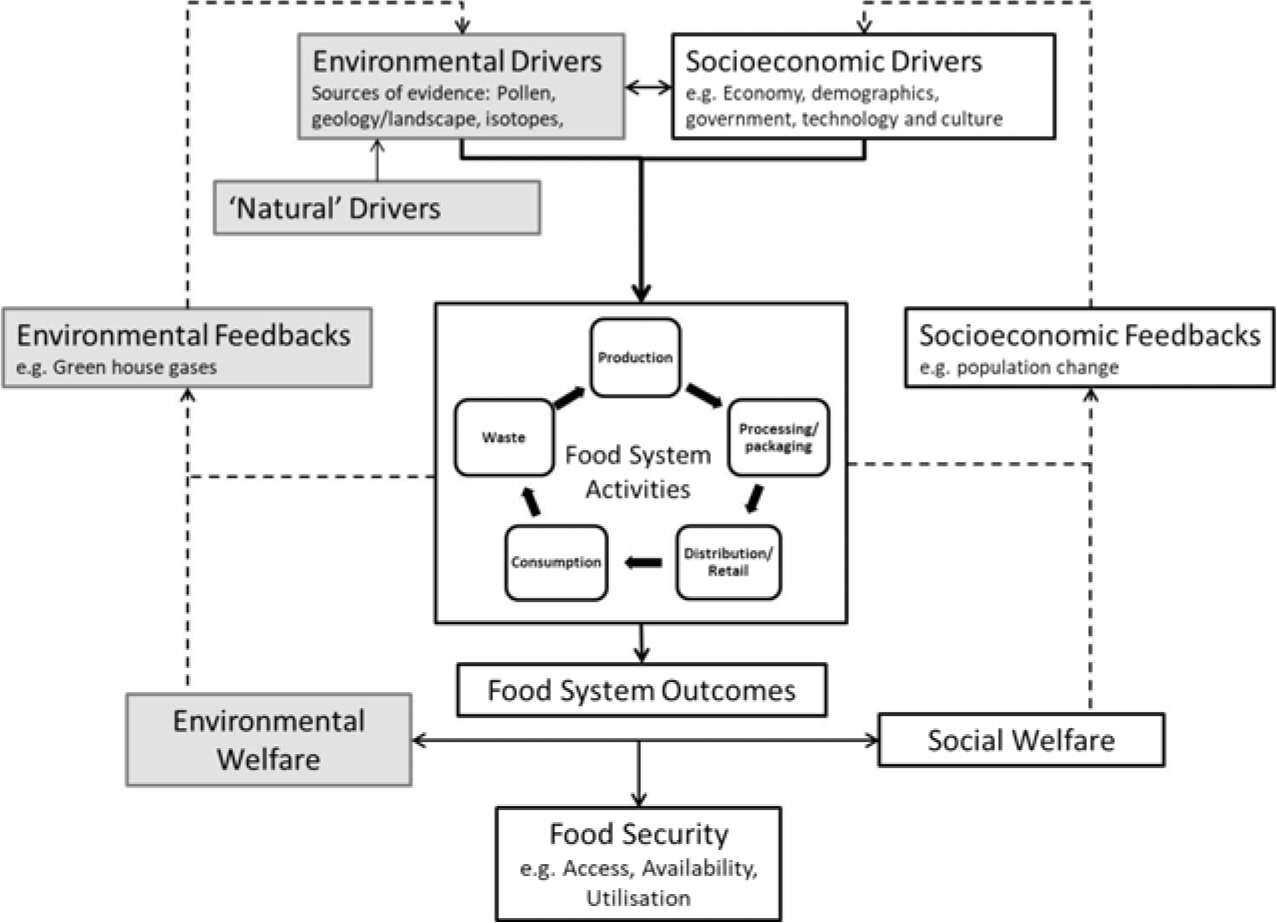
A food system includes all the processes and infrastructure involved in feeding a population. The network of activities, operating at multiple spatial scales, includes the production, processing, transporting and consumption components connected through complex social, ecological and economic relationships (see Ericksen Reference Ericksen2008; Ingram Reference Ingram2011 for further discussions). It includes the governance and economics of food production, its sustainability, the degree to which we waste food, and how food production affects the natural environment (Figure 2). Social aspects of the food system include health, food safety, nutrition, and culinary and dietary cultural factors. Food systems can also contain an array of smaller systems, such as agroecological, economic and social systems, and further sub-systems, such as water, energy, financing, marketing and policy. The interconnected and dynamic nature of the food system allows outcomes to be achieved via many possible pathways, and to be influenced by many factors. However, significant trade-offs have accompanied the increase in food supply, resulting in unanticipated outcomes and unintended consequences (Ingram, Ericksen and Liverman, Reference Ingram, Ericksen and Liverman2010). Thus looking at food systems we can put these activities in their socio-economic, political and environmental context, allowing us to think about the different actors, drivers, outcomes and trade-offs that are influenced at multiple scales from the household to the global level (Ericksen Reference Ericksen2008; Ingram Reference Ingram2011). These social and environmental outcomes result in a certain level of food security, which is defined as ‘when all people, at all times, have physical and economic access to sufficient, safe and nutritious food to meet their dietary needs and food preferences for an active and healthy life’ (FAO 1996). Several factors have been identified as critical to achieving food security:
Availability: having sufficient quantities, variety and quality of food available on a consistent basis. Three elements – production, distribution and exchange – contribute to food availability.
Accessibility: having the resources to obtain the type, quality and quantity of food required. Three elements describe food accessibility: affordability, allocation and preference.
Use and utilization are the capacity of an individual or household to consume and benefit from the food. The three elements of food utilization are nutritional value, social value and food safety.
Stability is also crucial for all three dimensions over time. War is generally acknowledged to result in major disruption of food supplies, leading to significant malnutrition and famine.
Food systems framework, adapted from Ericksen (Reference Ericksen2008).

The ‘food system’ concept is increasingly used today as a conceptual and analytical tool to explore sustainable agriculture (e.g. Banson et al. Reference Banson, Nguyen, Sun, Asare, Sowah Kodia, Afful and Leigh2018; Banson, Nguyen and Bosch Reference Banson, Nguyen and Bosch2018; Garnett et al. Reference Garnett, Appleby, Balmford, Bateman, Benton and Bloomer2013), food system vulnerabilities (e.g. Moragues-Faus, Sonnino and Marsden Reference Moragues-Faus, Sonnino and Marsden2017) and food in urban environments (e.g. Sonnino, Tegoni and Cunto Reference Sonnino, Tegoni and Cunto2019), as well as to tackle issues around obesity and nutrition security (e.g. Hammond and Dubé Reference Hammond and Dubé2012; El Bilali et al. 2019).
Studies of food system resilience have also emerged to address the capacity of the system to withstand and/or adapt to disturbances over time, in order to continue fulfilling its functions and providing its services or desirable outcomes (Carpenter et al. Reference Carpenter, Walker, Anderies and Abel2001; Folke Reference Folke2006; Folke et al., Reference Folke, Carpenter, Walker, Scheffer, Chapin and Rockström2010; Tendall et al. Reference Tendall, Joerin, Kopainsky, Edwards, Shreck, Le, Kruetli, Grant and Six2015). Disturbances in food systems can be internal or external, cyclical or structural, sudden or gradual; they can consist of natural, political, social or economic shocks. Tendall et al. (Reference Tendall, Joerin, Kopainsky, Edwards, Shreck, Le, Kruetli, Grant and Six2015) emphasize that when using a food system resilience perspective, it is important to consider this variety of possible disturbances, as disturbances may also interact and have cumulative impacts. Globalization, in particular, poses complex trade-offs for food system resilience across scales, as distances increase between producers and consumers (Clapp Reference Clapp2014; Schipanski et al. Reference Schipanski, MacDonald, Rosenzweig, Chappell, Bennett, Bezner Kerr, Blesh, Crews, Drinkwater, Lundgren and Schnarr2016).
Conceptualizing and operationalizing the food systems framework for archaeology
How, then, can we apply a food systems framework to the past and what meaningful information could this provide? Part of thinking systemically about systems is defining the purpose of the system and ascertaining a perspective. Part of this involves defining the boundary of the system under discussion. In prehistory this may be the boundary of the settlement, while in the Roman period this could extend to the whole empire and beyond. Boundaries are essentially where the differences that make a difference to your system lie. In a closed system, everything that makes a difference is clearly contained and observed within a relatively solid set of boundary conditions. However, most human systems are characterized as open systems, where the boundaries require some form of negotiation and may actually be in flux. Some say that if you are lost trying to understand where the influences and relationships within your system are then you have probably bound the system too loosely. Your boundary can also include both geographical and time dimensions.
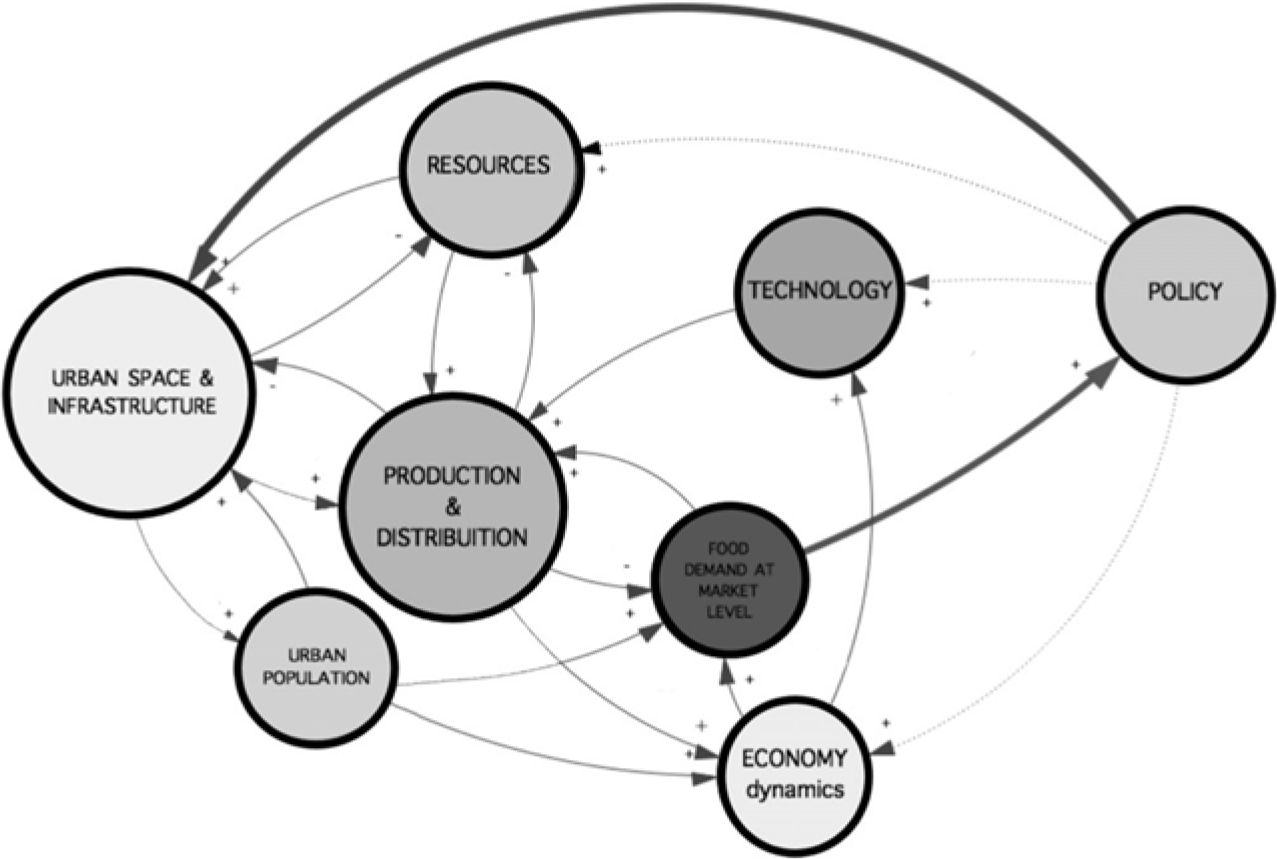
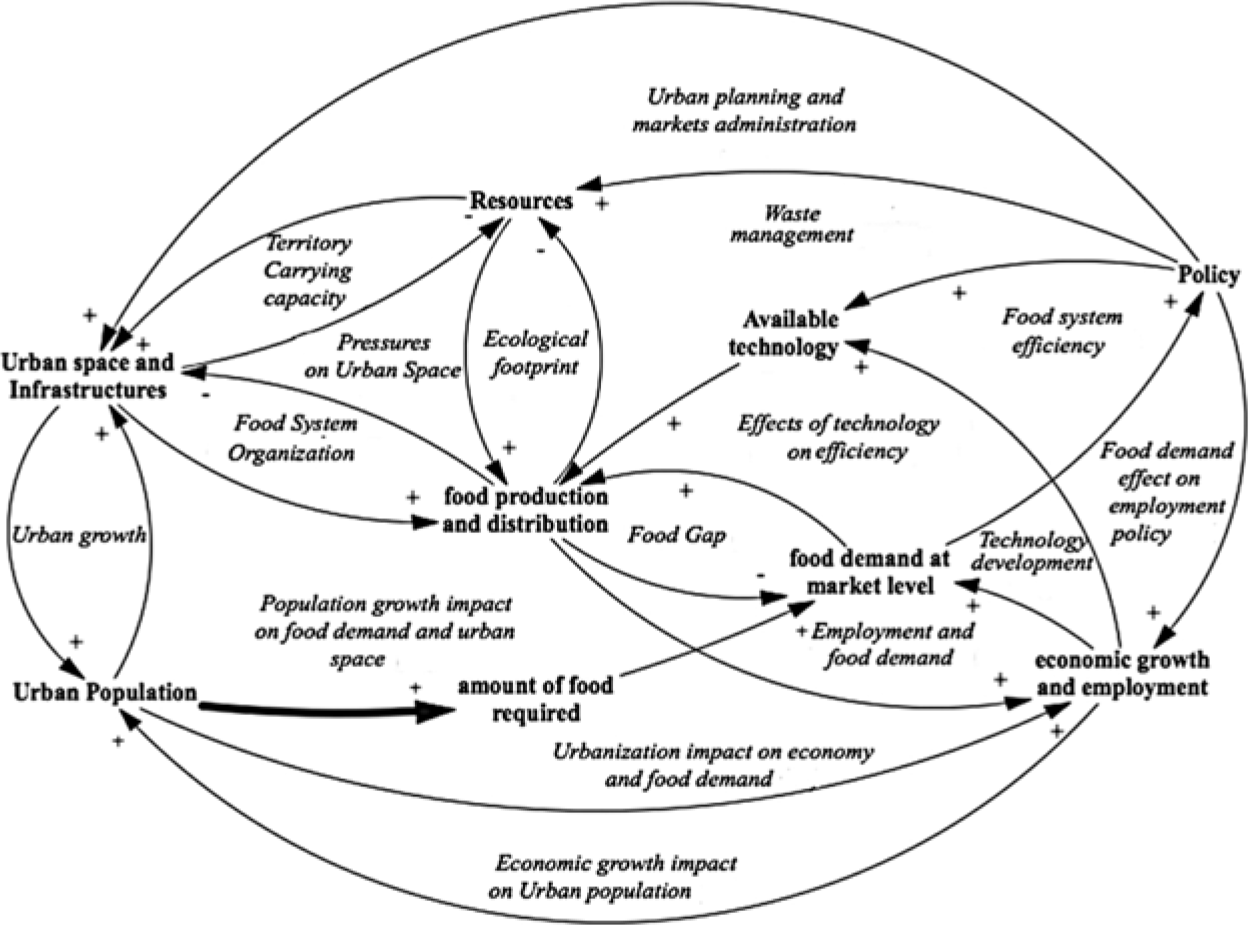
To visualize food systems, causal-loop diagrams (CLDs) are commonly used and consist of four basic elements: the variables, the links between them, the signs on the links (which show how the variables are interconnected), and the sign of the loop (which shows what type of behaviour the system will produce). Simply, the loops generated by the variables’ connections are labelled with a name, related with the loop role in the system, and a polarity (+ or − signs) (Figures 3, 4). A positive sign (+) means that A adds to B or that a positive increase in A leads to an increase in B. For example, if price is a cause and supply an effect, then a positive link indicates that an increase in price leads to an increase in supply. A negative sign (−) means either that A subtracts from B or that an increase in A leads to a decrease in B (see Morecroft Reference Morecroft, Reynolds and Holwell2010 for further discussion). So, using this same example, if supply is a cause and price is an effect, a negative link means that, all else being equal, an increase in supply causes a decrease in price or, viceversa, a decrease in supply causes an increase in price. You can further classify these feedback loops as a balancing (B, stabilizing) or a reinforcing (R, amplifying) loop. For example, as population goes up, so do births per year, and as that number goes up, so does future population. The loop goes round and round, growing exponentially. A balancing loop, in this example, would be the carrying capacity of a population, i.e. the population will grow until it reaches this constraint. These feedback loops therefore control the behaviour of a system over time, where reinforcing loops cause exponential growth or decline, while balancing loops cause confined growth. Once you have completed the CLD, it is suggested that you walk through the loops and ‘tell the story’, to be sure the loops capture the behaviour being described.
Example of a simple causal-loop diagram on the main dynamics of city food supply and distribution systems, adapted from Armendáriz et al. (Reference Armendáriz, Armenia, Dario and Claudia2016).

Example of a more detailed causal-loop diagram on food supply and distribution systems in a city, adapted from Armendáriz, Armenia and Stanislao Atzori (Reference Armendáriz, Armenia and Stanislao Atzori2016).

The main challenge in CLD analysis is to figure out what the most important feedback loops driving a system’s behaviour are and then what they should be. While large social systems contain millions of loops, the decisive behaviour of any specific problem is controlled or influenced by only a few of these loops. These determine the basic structure of a system. Deciding which variables are outside the scope of a model system can also become a challenge as most systems are not closed systems. The structure of a CLD is also determined by the knowledge of the user, the goal of the model and the resources which the user pulls to construct the model. Nevertheless, CLDs are beneficial in that they capture complex issues in a visual way that can be used to better communicate the system with others.
Next is mapping the actors or stakeholders within that system. These can be entities of different size such as individuals, families, institutions, government agencies, etc. But these need to be actors who actually act on the system, i.e. those who interact and can modify that system. Another way to look at the food system can be seen in Figure 5. This diagram, adapted from coupled human and natural systems (Liu et al. Reference Liu, Dietz, Carpenter, Alberti, Folke, Moran, Pell, Deadman, Kratz, Lubchenco, Ostrom, Ouyang, Provencher, Redman, Schneider and Taylor2007a; Liu et al. Reference Liu, Dietz, Carpenter, Folke, Alberti, Redman, Schneider, Ostrom, Pell, Lubchenco, Taylor, Ouyang, Deadman, Kratz and Provencher2007b), highlights the reciprocal interactions between human and natural systems. This may seem obvious but as we are working in the past this information has to be inferred from the archaeological or historical evidence; thus each spatial, material, biological and ideological connection in your system requires a clear link between human behaviour – what we are seeking to understand in the past – and the archaeological evidence (e.g. Brandes et al. Reference Brandes, Robins, McCranie and Wasserman2013; Collar et al. Reference Collar, Coward, Brughmans and Mills2015). This way of thinking about the data encourages us to radically expand our notion of context. Instead of thinking about the context of the objects we find, we have to think about the context of the events that generated those objects and their locations, and in what context the events took place. Take zooarchaeological approaches. Here there are a plethora of useful methods for understanding the consumption of meat in its wider social context. The identification of butchery marks on animal bones can help distinguish culturally specific preparation practices, while analyses of animal pathologies to infer husbandry practices can facilitate further understandings of the relationship between producer and consumer sites and the wider socio-economic context (Landon Reference Landon, Gaimster and Majewski2009; Bartosiewicz Reference Bartosiewicz2013).
Example of human and natural systems interactions, adapted from a diagram designed by the National Science Foundation Coupled Natural Human Systems Program.

Case study 1
Archaeologists are already undertaking various forms of systems-thinking research and so it is only a small step to start integrating this theoretical base into discussions around food. The Roman period is particularly interesting as it represents a point in European history when urbanization and territorial expansion required a rather radical reconfiguration of the food system to accommodate the regular, large-scale, inter-regional redistribution of foodstuffs and manufactured goods (e.g. Scheidel, Morris and Saller Reference Scheidel, Morris and Saller2007). The Roman period is already benefiting from the application of systems-thinking methodologies in discussion around transport and trade (e.g. de Soto Reference de Soto, Verhagen, Joyce and Groenhuijzen2019; Leidwanger Reference Leidwanger2014; Livarda and Orengo Reference Livarda and Orengo2015), religion (e.g. Collar Reference Collar2013; Woolf Reference Woolf2016) and cities and towns (e.g. Earl and Keay Reference Earl and Keay2006; Gordon Reference Gordon2018). If we take trade routes as an example, several studies have used ceramics to reconstruct routes along which goods and people were transported (e.g. Brughmans and Poblome Reference Brughmans, Poblome, Barker, Bouzarovski, Pelling and Isaksen2015; de Soto Reference de Soto, Verhagen, Joyce and Groenhuijzen2019). Where an item originated and where it was deposited are usually known points, but what happened between the production and deposition of ceramic vessels is largely unknown. The choice of the specific route could have been influenced by numerous factors, ranging from topography to sailing conditions, economy, the sociopolitical environment or just individual motivations (Brughmans Reference Brughmans2010). One factor that is commonly examined through network analysis is distance, and identifying the physical course of such routes to identify which sites are more easily reachable than others (ibid.).
In Cyprus, a range of material culture, including ceramics, architecture, prestige goods and coinage, was examined from ports in early Roman Cyprus in order to investigate how the island’s integration into Roman networks created central places that altered existing settlement types, hierarchies and, thus, local identities (Gordon Reference Gordon2018). By looking at these different sources of information in a more holistic framework, Gordon (ibid.) suggested that different identities emerged depending on the connectedness of each site to the economic opportunities offered by maritime networks during the early Roman period. In terms of food, recently Livarda and Orengo (Reference Livarda and Orengo2015) used network analyses to examine the distribution of food plants and pottery imports into London and across Britannia. The term ‘flavourscape’ was used to convey the theoretical and methodological approach adopted, where the urban and sociocultural landscape consists of several nodes, or sites, linked together by their shared acquisition/possession of exotic food plants (Orengo and Livarda Reference Orengo and Livarda2016). Generally, they showed shifts in commerce networks, where London in the early Roman period was characterized as a consumer city, but by the middle Roman phase it had changed into the main redistribution centre for Britannia (Livarda and Orengo Reference Livarda and Orengo2015). The study demonstrates the potential of examining commerce and society from archaeological material, and in particular archaeobotanical remains, within a network framework.
To date the food system framework has only been applied to my own research. Recently I used this way of thinking to discuss the Roman food system in southern Pannonia (modern eastern Croatia) (Reed and Ožanić Roguljić Reference Reed and Ožanić Roguljić2020). Historically, research on foodways in the ancient Mediterranean has relied predominantly on the study of ceramic vessels, due to their abundance in the archaeological record. Yet what was traded, eaten and used to prepare and serve food in the ancient household was far more diverse. We therefore brought together all published evidence of food in the region to answer three questions: what was being produced locally? What was being imported/exported? And what does this evidence say about society in the region? The food systems framework was used as a tool to think about the evidence recovered. For example, several aspects were considered when looking at local agricultural production. First, what was the local environment like and what could have affected local crop production (i.e. what are the ‘natural drivers’)? The natural drivers to think about here included geographic restrictions on imports and exports, the landscape itself and where suitable areas for cultivation may have been, the impact of the marshlands on production and transport, the climate, and what were the natural resources in the area, i.e. access to wood from ‘dense forests’, etc.
Three main rivers, the Drava, Sava and Danube, connected Pannonia to the rest of the empire and classical authors emphasize three main geographical features: mountains, dense forests and swamps/marshes. The easiest way to travel, according to the Romans, was therefore via the river systems, and in Pannonia coloniae (colonies) were established along these routes, for example, Colonia Aurelia Cibalae (modern Vinkovci) along the Bosut river and Colonia Aurelia Mursa (modern Osijek) along the Drava. Important road systems also developed, constructed initially to allow soldiers to move swiftly to and along the Danube Limes. We see two main roads running parallel along the Sava and Drava rivers in southern Pannonia and one running along the Danube linking Mursa and Cibalae to Aquincum (Budapest) in the north and Sirmium to the south-east (the capital of the Pannonia Inferior) (Burghardt Reference Burghardt1979). The exploitation of these routes by the local inhabitants to gain access to products from around the empire and beyond is evident from the presence of amphorae from Spain, Italy and possibly North Africa, as well as the presence of rice and black pepper, originating from Asia, found in many of the urban centres (Reed and Leleković Reference Reed and Leleković2019; Reed and Ožanić Roguljić, Reference Reed and Ožanić Roguljić2020; Ožanić Roguljić Reference Ožanić Roguljić2016).
To explore local agricultural production, one area examined was the evidence of villa estates within Pannonia. Overall evidence is rather limited, with few reports on the types of economic buildings associated with the villas (Leleković and Rendić Miočević Reference Leleković, Rendić-Miočević and Branka2012). What we do know is that most date from the late 2nd to 4th centuries A.D. Interestingly, at this time it is believed that Marcus Aurelius Probus (276–282 A.D.) introduced legislation affecting viticulture production in Pannonia by allowing goods to be exported to the wider Roman market and encouraging the draining of marsh areas for wine production. I have not been able to track down the original source, but can we see the impacts of this from the archaeological remains? Was there an increase in wine production in Pannonia from the 3rd century? To start thinking about this question we can use a causal-loop diagram (Figure 6). If we first look at the ‘natural drivers’ we see that an increase in land could lead to an increase in resources, which can lead to an increase in villa production. Governance here also plays a role as the legislation passed by Marcus Aurelius would have allowed areas of land to be cleared, increasing the potential for vines (resources) to be planted. From the archaeological evidence this may be seen from a decrease in forest species and an increase in grape (Vitis vinifera) pollen, an increase in the recovery of grape pips, and an increase in wine amphora remains or production in the region. In addition, an increase in villa production can also cause a decrease in resources. In terms of growing crops, this may be seen in the overexploitation of land, resulting in soil exhaustion and abandonment. I also linked technology to resources, as the tools available as well as the technological knowledge of how to produce high-yield crops will have an impact on production capacity. Evidence of this may be seen from literary sources and the presence of agricultural tools or architectural structures, such as wine presses.
An example of a causal-loop diagram of a Roman villa system.

Unfortunately, no pollen or archaeobotanical evidence from Pannonia supports this increase in viticulture or land-use change at present (Reed and Ožanić Roguljić Reference Reed and Ožanić Roguljić2020). There is evidence of the adoption of the Roman land divisioning system (centuriae) for fields in Pannonia (Const. Lim. 28.). But there seems to be no other evidence of land management, such as irrigation, beyond utilizing natural water sources (Bödőcs, Kovács and Anderkó Reference Bödőcs, Kovács and Anderkó2014). Generally the limited evidence for viticulture in the 1st and 2nd centuries would suggest that grapes were imported to Pannonia, along with wine from Spain and Italy, seen from the range of amphorae recovered from this period (Reed and Ožanić Roguljić Reference Reed and Ožanić Roguljić2020). The strong evidence of olive/oil, fig and grape/wine production in neighbouring Dalmatia (Glicksman, Reference Glicksman2007) would have provided Pannonia with easy access to such products. It is not until the 4th century A.D. that we have evidence of viticulture in Pannonia, an altar from Popovac, about 40 kilometres north of Roman Mursa, dedicated to Liber by Aurelius Constantius and his son Venantius, who were estate owners. Their offering was to help enrich 400 arpenes of vineyards (50 hectares, 500,000 square metres) and, among other things, support his four vine varieties (Cupenis, Terminis, Valle(n)sibus, Caballiori(s)) (Brunšmid Reference Brunšmid1907, 112–113, 233; Reed and Ožanić Roguljić Reference Reed and Ožanić Roguljić2020). No wine presses or agricultural tools have so far been identified or published either, but the altar does support the presence of viticulture in southern Pannonia by the 4th century. The mention of four vine varieties also suggests a certain level of specialist knowledge of wine making in the region.
If we then examine socio-economic drivers further, production in this system will also have been affected by labour availability, markets for trade, rural and urban settlement patterns and transport links. Export and the movement of goods along navigable waterways and road systems allowed even the most remote outposts access to Roman produce (Burghardt Reference Burghardt1979). But goods would have been subjected to customs tax of 25 per cent across the empire’s frontiers and 2–5 per cent portoria between provinces; although state cargoes, such as grain, were exempt from the portoria (Duncan-Jones Reference Duncan-Jones2006; Wilson Reference Wilson, Bowman and Wilson2009, 217). Thus the villas in Pannonia could have supplied both local and regional consumers. As production increased, however, so to would the labour requirements and materials needed to grow, process and package the goods for transport. This is all likely to have had a knock-on effect on other industries that is worth considering. For example, production of amphorae or other types of container might have needed to increase in the region to support the export of wine. In southern Pannonia amphorae were not produced locally; instead big jugs with two handles began to be made (Reed and Ožanić Roguljić Reference Reed and Ožanić Roguljić2020). Their presence in Dalmatia suggests that they were used to transport food or drink (Ožanić Roguljić Reference Ožanić Roguljić, Lipovac Vrkljan, Radić Rossi and Konestra2017). Thus most of the evidence for amphorae in southern Pannonia comes from imports, although evidence shows that these vessels were undoubtedly reused to transport and/or store more than one type of food over their lifetimes (Pecci et al. Reference Pecci, Clarke, Thomas, Muslin, van der Graaff, Toniolo and Di Pasquale2017). Large-scale pottery production starts in Pannonia after A.D. 70, with local ceramic groups emerging later during the Flavian era, or even in the time of Trajan (Leleković Reference Leleković2018). In Cibalae archaeologists have identified over 50 pottery kilns (Iskra Janošić Reference Iskra Janošić2001, 60).
Population increases will also feed into labour availability, and market demand will have both a positive and a negative affect on labour. An increase in market demand from abroad, as a result of Marcus Aurelius’ edict, is also a factor to consider and may be seen in the archaeological record in the presence of Pannonian wine amphorae outside Pannonia. Due to limited evidence of rural settlements, increases in population or population density in Pannonia are best explored through cemeteries and the expansion of large urban centres. For example, in the area north of Zagreb the concentration of Roman cemeteries suggests that the area was relatively densely populated in the second half of the 2nd century A.D., even though few rural sites have been identified (Leleković and Rendić Miočević Reference Leleković, Rendić-Miočević and Branka2012). Leleković and Rendić Miočević (ibid.) also suggest that the eastern side of the province near Mursa and Cibalae was less densely populated than to the west during the 1st and 2nd centuries, increasing to similar levels by late antiquity. Could increased production and trade in the eastern part of the region have contributed to this population increase?
Food is also an important element of warfare. Soldiers need food and many scholars have argued that intense periods of warfare correlate with relative food deficits (VanDerwarker and Wilson Reference VanDerwarker and Wilson2016). The destruction of an enemy’s food source is a key tactic in pacifying people. In Roman Pannonia, episodes of fighting along the Danube Limes have been recorded and up to 2,000 soldiers were permanently stationed there (Fodorean Reference Fodorean2016; Sanader Reference Sanader and Radman-Livaja2010). For example, at Canabae, Hungary, evidence suggests that the second half of the 3rd century and the whole 4th century were characterized by continuous attacks from the north (Borhy Reference Borhy2011). The army would have been made up of individuals from different parts of the empire with different culinary traditions that probably resulted in distinct changes in trade and supply demands along the Danube Limes (Mócsy Reference Mócsy2015, 120). This would have therefore had a significant impact on the food system in the region. Archaeological evidence shows that the army had a varied and sometimes exotic diet (e.g. Bakels and Jacomet Reference Bakels and Jacomet2003; Livarda Reference Livarda2011; Reed and Leleković Reference Reed and Leleković2019). Rare inscriptions of legion names on amphorae and barrels recovered from Pannonia, Vindonissa and Britain also show that the army was supplied with a range of non-rationed foods (Bezeczky Reference Bezeczky1996). Veterans upon retirement also received either a piece of land (misso agrarian) or a cash payment (misso nummaria) to start their civilian life (Wesch-Klein Reference Wesch-Klein and Erdkamp2007, 439), and many are known to have settled in Pannonia. It is possible, then, that colonies such as Mursa could have been positioned as centres of logistics through which goods could be distributed to the army (Pinterović, Mutnjaković, and Pehnec Reference Pinterović, Mutnjaković and Pehnec2014). This cooperation in supplying goods between the army and nearby civil settlement is seen elsewhere in the empire (Adams Reference Adams1999; Breeze Reference Breeze, Alföldy, Dobson and Eck2000). If villas were close to the Limes then warfare could have disrupted supply and demand, while those further afield could have been involved in supplying the army with goods, along with the civilian population. Unfortunately, at present the published archaeological data are limited for this Roman province, so we have more questions than answers. Yet, by exploring the nature of viticulture as part of Pannonian food systems, we are able to question the evidence more vigorously, producing a range of new questions to explore in the future.
Case study 2
A systems approach is particularly useful for understanding components of agricultural systems or the interactions that lead to overall responses within those systems (Jones et al. Reference Jones, Antle, Basso, Boote, Conant, Foster, Godfray, Herrero, Howitt, Janssen, Keating, Munoz-Carpena, Porter, Rosenzweig and Wheeler2017). The application of the framework will typically include a certain number of unknown parameters, due to gaps in the archaeological record. Yet, as I will show below, it can help to bring together and link archaeological evidence. This case study will therefore look at Neolithic agricultural systems in Europe, focusing more specifically on lakeshore villages (for overviews see Jacomet Reference Jacomet2006; Reference Jacomet, Colledge and Conolly2007), which provide unique evidence of environmental remains (e.g. wood, botanical remains, animal bones, etc.) preserved through waterlogged conditions. This second case study is not based on my own research per se, but will be an accumulation of several different sites and studies in order to provide an example of the framework rather than a comprehensive interpretation of the local food system. Numerous variables are regularly examined in order to understand crop and animal husbandry: the size of plots and herds, the intensity of cultivation (i.e. manuring, weeding, irrigation), the diversity of crops and livestock, the exploitation of wild fauna and flora, the production of secondary products, foddering practices, storage facilities, etc. More and more studies are showing that multiple factors, such as topography, climatic conditions and cultural influence, played important parts in the socio-economic organization of these Neolithic communities (e.g. Kerdy, Chiquet, and Schibler Reference Kerdy, Chiquet and Schibler2019; Schibler Reference Schibler2006). Using current evidence, Figure 7 shows a simple causal-loop diagram to aid discussions about the past food system at sites of these types. I have not included elements of ritual activity, but have instead focused on the more ‘domestic’ tasks of food production and consumption.
An example of a basic causal-loop diagram of a European Neolithic household.

Looking at the natural drivers, climatic fluctuations have been noted during the Neolithic in Europe. Studies have shown that phases of higher-lake-level conditions correspond to climate reversals that are marked by cooler and wetter climate conditions, and more particularly to a decrease in the summer temperature and a shortening of the growing season (e.g. Deák, Magny and Wüthrich Reference Deák, Magny and Wüthrich2017; Magny Reference Magny and Elias2006; Magny, Guiot and Schoellammer Reference Magny, Guiot and Schoellammer2001). The impact of such climatic fluctuations has been explored by Schibler and Jacomet (Reference Schibler and Jacomet2010), who examined about 130 Neolithic sites in the Swiss Alpine foreland showing that during short periods of climatic deterioration, wild resources like game were more intensively exploited. They also found that domestic meat consumption levels remained relatively stable and concluded that reduced cereal yield forced people to change their daily diet towards wild resources to make up the calorie deficit. Further research by Schibler (Reference Schibler2006) suggested that cultural factors may also have had an impact, with the zooarchaeological remains suggesting that a very complicated mosaic of factors influenced the economy of these northern Alpine foreland sites. Changes in the local landscape and biodiversity are also noted from pollen and botanical evidence, including the use of fire by local farmers to clear land in the past (Dietre et al. Reference Dietre, Walser, Kofler, Kothieringer, Hajdas, Lambers, Reitmaier and Haas2016; Schwörer, Colombaroli, and Kaltenrieder Reference Schwörer, Colombaroli and Kaltenrieder2015). For example, at lakeshore sites the seeds and fruits of plants that grow in woods and along woodland edges regularly appear in cereal stores from ca 4300 to 3400 B.C., yet by 3400–2500 B.C. they begin to appear less frequently (Schibler and Steppan Reference Schibler and Steppan1999). Along with the presence of annuals, the evidence suggests that permanent plots begin to expand around settlements through the Neolithic. The animal remains also support this with evidence of increases in species that prefer open landscapes (ibid.).
The scale and intensity of food production are a key aspect in interpreting agricultural regimes. Different strategies exist for a farmer to adopt, depending on local circumstance, such as land availability, population pressure, labour availability, the local political system and the opportunity to exchange. In addition, a large number of more specific agricultural variables, such as the types of primary crops cultivated, the presence of livestock, the use of specified tools, climate, topography, soil conditions and the application of cultivation techniques (e.g. weeding, manuring) will also impact on the cultivation methods implemented. Pests and diseases are also a risk factor that is rarely discussed (Antolín and Schäfer Reference Antolín and Schäfer2020), but that could have significant impacts on a yearly harvest and could influence the levels of wild fauna and flora exploited. Thus, did early farmers take this into account and adapt their husbandry strategies to account for loss? From the evidence to date the most important crops grown during the second half of the fourth millennium cal. B.C. in the lake dwellings north of the Alps were emmer (Triticum dicoccum) and naked wheat (T. durum/turgidum), but pea (Pisum sativum), flax (Linum usitatissimum) and opium poppy (Papaver somniferum) were also widely cultivated. In addition to cultivated crops, the stomach contents of the Neolithic Alpine iceman show the consumption of wild foods, and many wild taxa have been recovered from lakeshore settlements, although their consumption as food can be hard to prove (Antolín et al. Reference Antolín, Bleicher, Brombacher, Kühn, Steiner and Jacomet2016; Jacomet Reference Jacomet2009). This flexibility in the system would have allowed early farmers a certain amount of adaptability in their food system, if or when crops failed, or if livestock became ill.
The number of people needing to be fed, and the local population, will also be a critical factor in production rates. Boserup (Reference Boserup1965, 72) suggested that land productivity in traditional agricultural societies is limited not by how much food it can grow, but by how much labour is available in the harvest season. In addition, the harvest season is invariably associated with labour shortages (the high-season bottleneck on production), while there might be labour surplus during the low season. Evidence in Europe is showing that intensive garden regimes were predominantly practised during the Neolithic and the Bronze Age (Kreuz and Schäfer Reference Kreuz and Schäfer2011; Bogaard et al. 2013). Stable-isotope determinations of charred cereals and pulses from 13 Neolithic sites across Europe demonstrated that early farmers used livestock manure and water management to enhance crop yields (Bogaard et al. Reference Bogaard, Fraser, Heaton, Wallace, Vaiglova, Charles, Jones, Evershed, Styring, Andersen, Arbogast, Bartosiewicz, Gardeisen, Kanstrup, Maier, Marinova, Ninov, Schäfer and Stephan2013). The advantage of this method is that high yields can be attained from an increased labour input (e.g. weeding, fertilizing, watering) per area and it is suited to the cultivation of a greater diversity of crops. In terms of seasonality, research into the sowing times of crops in prehistoric Europe is widely debated. Hillman (Reference Hillman and Mercer1981, 147) suggested that all cereals in the Neolithic were initially autumn-sown, unless climatic conditions prevented this, similar to their wild predecessors, while minor crops may have been spring-sown, reducing the burden of labour needed for autumn sowing. In Central Europe, research has largely supported the autumn sowing of crops during the Neolithic (Bogaard Reference Bogaard2004; Willerding Reference Willerding, Krüger and Stephan1980), although einkorn and emmer could have been spring-sown at several Early Neolithic Bandkeramik sites (Kreuz and Schäfer Reference Kreuz and Schäfer2011). Nevertheless, during harvest, large groups of mobilized people would be needed to get the crop processed and stored. For smaller groups, it makes sense to store the crop less processed and carry out the full processing sequence on a day-to-day basis, spreading out labour demands through the year (Fuller and Stevens Reference Fuller, Stevens, Fairbairn and Weiss2009; Halstead and Jones Reference Halstead and Jones1989). This method of piecemeal crop processing within settlements has been commonly recognized at Neolithic sites in Europe (Reed Reference Reed2015).
Storage is also an important component, being a feature of sedentism, a necessary precursor to agriculture, as well as an indicator of sociocultural complexity and a means of social control (O’Brien and Bentley Reference O’Brien and Bentley2015; Hendon Reference Hendon2000). Varying factors can affect storage patterns, including climatic conditions (Hillman 1981), cultural practice and an ability to organize large numbers of people for agricultural purposes (Fuller and Stevens Reference Fuller, Stevens, Fairbairn and Weiss2009). Storage, along with diversification and exchange, is also another mechanism to buffer against seasonal and/or long-term variability in the food supply, allowing the year-round occupation of a site (Halstead and O’Shea 1989). Several storage systems have been identified (Tripković Reference Tripković2011) and the level of storage would have been linked to the relationship between the farmer and the socioeconomic structure in place. For example, the farmer would need to ensure that he has enough food for his family, as well as surplus for the community or state. Therefore, the location of storage inside or outside the house or the desire to use communal storage is also related to the social and economic organization of the site as a whole (Halstead Reference Halstead and Halstead1999).
The well-preserved archaeological evidence from these Neolithic lakeshore sites is also providing a range of other evidence about daily life, including flax and textile production (Herbig and Maier Reference Herbig and Maier2011; Leuzinger and Rast-Eicher Reference Leuzinger and Rast-Eicher2011; Maier and Schlichtherle Reference Maier and Schlichtherle2011), building materials used (Favre and Jacomet Reference Favre and Jacomet1998), bone tool manufacturing (Maigrot Reference Maigrot, Luik, Choyke, Batey and Lougas2005) and ceramic production (Di Pierro Reference Di Pierro2003). All these elements are linked to agricultural production to some degree and should be considered when examining the food system. In terms of cooking, the Neolithic saw a distinct change in the way people cooked food, including boiling, baking and fermenting. Although structures such as ovens, and tools such as querns, knives and certain types of vessel, all contribute to the creation of different culinary dishes, the best way to identify food is from its actual remains. However, rare, more archaeological, evidence is coming to light of bread-like and porridge-like carbonized remains (Gonzalez Carretero, Wollstonecroft and Fuller Reference Gonzalez Carretero, Wollstonecroft and Fuller2017; Heiss et al. Reference Heiss, Antolín, Bleicher, Harb, Jacomet, Kühn, Marinova, Stika and Valamoti2017). Two bread-like objects discovered from the Neolithic site of Zürich Parkhaus Opéra indicate unleavened flat breads made with barley and wheat and possible condiments, with celery being identified in one of the fragments (Heiss et al. Reference Heiss, Antolín, Bleicher, Harb, Jacomet, Kühn, Marinova, Stika and Valamoti2017). Their discovery in an area where grinding stones and bran fragments were found suggests that this was the baking area within the site.
Evidence of dairy products indicates additional dietary elements (Spangenberg, Jacomet and Schibler Reference Spangenberg, Jacomet and Schibler2006; Spangenberg et al. Reference Spangenberg, Matuschik, Jacomet and Schibler2008) and the need for particular livestock management systems. The slaughter ages and sexes of cattle and goats point to the use of dairy animals, and pathologies on cattle bone suggest that they were also used as draught animals (Deschler-Erb and Marti-Grädel Reference Deschler-Erb, Marti-Grädel, Jacomet, Leuzinger and Schibler2004; Gillis et al. Reference Gillis, Kovačiková, Bréhard, Guthmann, Vostrovská, Nohálová, Arbogast, Domboróczki, Pechtl, Anders, Marciniak, Tresset and Vigne2017). This assumption is supported by the discovery of a large maple artefact interpreted as a yoke (Leuzinger Reference Leuzinger, De Capitani, Deschler-Erb, Leuzinger, Marti-Grädel and Schibler2002, 106–107). Recent high-resolution isotopic evidence at the Swiss lakeside settlement of Arbon Bleiche 3 has also revealed three different herding strategies: (1) localized cattle herding, (2) seasonal movement and (3) herding away from the site year-round (Gerling et al. Reference Gerling, Doppler, Heyd, Knipper, Kuhn, Lehmann, Pike and Schibler2017). Gerling et al. (ibid.) suggest that the pressure on local fodder capacities would have required alternative herding regimes. This would have resulted in diverse access to grazing resources, to prevent overexploitation, which in turn may have contributed to socio-economic differentiation in these early communities. Evidence of foddering practices is also seen from preserved dung remains. Remains show that local wild plants were an additional element to grain and chaff feed. These included twigs and leaves from the Rosaceae family, as well as anthers of Corylus, Alnus and Quercus (e.g. Akeret et al. Reference Akeret, Hass, Leuzinger and Jacomet1999; Haas, Karg and Rasmussen Reference Haas, Karg and Rasmussen1998; Kühn et al. Reference Kühn, Maier, Herbig, Ismail-Meyer, Le Bailly and Wick2013). This evidence suggests that leaves and twigs were collected during winter or early spring to supplement the diet of other plants, such as cereal grains and crop processing waste. At Arbon Bleiche 3 cattle dung indicates the importance of wood pasture and suggests that grazing within and at the edges of forests and at ruderal places (including lakeshores) was common (Kühn and Hadorn Reference Kühn, Hadorn, Jacomet, Leuzinger and Schibler2004).
Ultimately all these activities would have required a certain level of household and community cooperation and an exchange system that possibly led to periodic gatherings and feasting. In Neolithic Greece, fine ceramics are widely interpreted as evidence of ceremonial eating and drinking, while the spatial organization of settlements suggests that such commensality played a significant role in shaping social relationships (Halstead Reference Halstead2004). Halstead (ibid.) suggests that large-scale feasting, and ceremonial consumption of livestock, were probably enabled by, and helped to reinforce, domestic strategies of surplus production and labour mobilization that were driven not just by ‘politics’ but also by ‘economic’ requirements. In addition, ‘investment’ in and access to lands may have led to territorial claims and social differentiation in Neolithic farming communities (Bogaard, Strien and Krause Reference Bogaard, Strien and Krause2011; Bogaard et al. Reference Bogaard, Fraser, Heaton, Wallace, Vaiglova, Charles, Jones, Evershed, Styring, Andersen, Arbogast, Bartosiewicz, Gardeisen, Kanstrup, Maier, Marinova, Ninov, Schäfer and Stephan2013). Household differentiation may have been based on land ownership and/or the ‘ownership’ of domesticated cattle (Bos taurus), which not only provided meat, milk, blood and labour (secondary products), but also represented social capital and mobile wealth (Bogucki Reference Bogucki1993; Conolly et al. Reference Conolly, Manning, Colledge, Dobney and Shennan2012; Sherratt 1981; Reference Sherratt1983).
Conclusion
Food is an exciting area of study as it intersects most human actions. As people become food-secure, they have more time to spend on other activities, such as building monuments or specializing in manufacture. In contrast, in the wake of shock events, such as war, drought or disease, people become food-insecure, which in turn affects society and the economy. The food systems approach outlined here provides a useful framework to render the complex dynamics of human bio-psycho-sociocultural change comprehensible. While models are, by necessity, a simplification of this complexity, an attempt has been made to locate them spatially in the ‘real world’. It could be argued that this framework simply tells us what we already know. It cannot report the actual production capacity of a particular area (i.e. quantity of grain per person produced) in a given period, but what it can offer is a framework to demonstrate the effects of production and consumption and investigate their associations with human society and the environment.
Clearly the available archaeological evidence can go only so far and there are inevitably gaps that cannot be filled. We also do not know how much we cannot see or what information is missing. However, this is the constant risk of any archaeological interpretation and instead food systems can help us to build a picture of society via a combination of different archaeological evidence and comparative data. It can also be argued that the diversity of archaeological data and the methodological approaches associated with each could provide an obstacle to future synthesis. Although specialist reports still have their place, especially in regions where few data exist, a food systems framework can help us move beyond this and explore greater connections with food, human society and the environment. Further, by thinking about things in the form of systems, we are naturally drawn into asking different kinds of questions about people, animals, plants and objects. This method also provides a useful framework from which archaeological projects can be structured, providing a guide to help fit together the wide range of archaeological and anthropological information and allow temporal comparisons of food system processes. This is particularly key when archaeology, along with other disciplines, is being asked to demonstrate its wider societal relevance (Richer, Stump, and Marchant Reference Richer, Stump and Marchant2019; Reed and Ryan Reference Reed and Ryan2019; Van der Leeuw and Redman Reference Van der Leeuw and Redman2002).
Acknowledgements
Many thanks to Eric Tourigny and Matthew Law for providing insightful and useful comments on this article. I am also grateful to Joanna Brück and the anonymous reviewers for their valuable comments and criticisms during the preparation of the paper.
Compliance with ethical standards
The author declares that they have no conflict of interest. This research did not receive any funding.