



1 Introduction
There have been several attempts in the literature to account for the central role of forcing in modern set-theoretic practice. For instance, forcing axioms and generic absoluteness results are amenable to a model-theoretic analysis which singles out the peculiar model-theoretic properties of models of set theory where forcing axioms hold (see for example the second author’s work on this matter [Reference Asperó and Viale1, Reference Audrito and Viale2, Reference Venturi and Viale25, Reference Viale26, Reference Viale28, Reference Viale29]). The present study complements and expands this view by highlighting a universality phenomenon arising from the Boolean-valued approach to forcing.
Section 2 collects standard definitions and basic facts about Boolean algebras and Boolean-valued structures. To gauge the effect of forcing on initial segments of the universe, we introduce
 $\mathsf {B}$
-valued structures of the form
 $H_{\check {\delta }}^{\mathsf {B}}$
, which represent
 $H_\delta $
of the forcing extension by
 $\mathsf {B}$
. Furthermore, we review normal and fine ideals and describe the Boolean algebra
 $\mathsf {B}(\mathcal {I})$
associated with a tower
 $\mathcal {I}$
of normal fine ideals.
The main technical ingredient of our analysis are the so-called good ultrafilters, to which Section 3 is dedicated. After a brief overview of the relevant model-theoretic concepts, we present a new proof, which may be of independent interest, of the existence of good ultrafilters on Boolean algebras which satisfy a disjointability condition. As opposed to standard constructions using independent families, our argument applies to a wide class of Boolean algebras, not necessarily complete.
In Section 4, we establish the first universality result for a fragment of the theory of
 $H_{\kappa ^+}$
, in a signature consisting of
 $\Delta _0$
-definable relations. Namely, we fix an infinite regular cardinal
 $\kappa $
and, assuming the existence of an inaccessible cardinal
 $\delta>\kappa $
, we use the collapsing algebra
 $\operatorname {\mathrm {\mathsf {Coll}}}(\kappa ,{<}\delta )$
to prove that any model of the universal theory of
 $H_{\kappa ^+}$
of cardinality at most
 $\delta $
can be embedded into a model of the form
 $H_{\check {\delta }}^{\operatorname {\mathrm {\mathsf {Coll}}}(\kappa ,{<}\delta )}/U$
. This approach, although technically simple, is not flexible enough to accommodate a richer signature, nor the case where
 $\kappa $
is singular.
We overcome these limitations and establish a more general universality result in Section 5. Assuming again the existence of an inaccessible
 $\delta $
, for each infinite cardinal
 $\kappa <\delta $
we make use of the stationary tower
 $\mathsf {B}(\mathcal {I}^\kappa _{<\delta })$
of height
 $\delta $
and critical point
 $\kappa ^+$
to obtain universal models for the full theory of
 $H_{\kappa ^+}$
, in a signature consisting of arbitrary relations. Moreover, under the additional assumption that
 $\delta $
is a Woodin cardinal, we show that the corresponding
 $\mathsf {B}(\mathcal {I}^\kappa _{<\delta })$
-valued structure correctly represents
 $H_\delta $
in the forcing extension.
2 Boolean-valued structures
We follow the standard notation and terminology of [Reference Koppelberg, Monk and Bonnet12]. A Boolean algebra is a complemented distributive lattice
 $\left \langle \mathsf {B},\vee ,\wedge ,\neg ,\mathsf {0},\mathsf {1} \right \rangle $
such that
 $\mathsf {0}^{\mathsf {B}}\neq \mathsf {1}^{\mathsf {B}}$
. Each Boolean algebra is equipped with a partial order, defined as
 $a\le b\iff a\vee b=b$
. With respect to this ordering, for a subset
 $X\subseteq \mathsf {B}$
we denote
 $$\begin{align*}\bigvee X=\sup(X)\quad\text{and}\quad\bigwedge X=\inf(X), \end{align*}$$
whenever they actually exist.
We define
 $$\begin{align*}\mathsf{B}^+=\mathsf{B}\setminus\left\lbrace \mathsf{0} \right\rbrace \end{align*}$$
and, for each
 $b\in \mathsf {B}^+$
, we define the relative algebra

which is also a Boolean algebra with the natural operations.
Definition 2.1. Let
 $\delta $
be a cardinal; a Boolean algebra
 $\mathsf {B}$
is
 ${<}\delta $
-c.c. if every antichain in
 $\mathsf {B}$
has cardinality less than
 $\delta $
. The saturation of
 $\mathsf {B}$
, in symbols
 $\operatorname {\mathrm {sat}}(\mathsf {B})$
, is the least cardinal
 $\delta $
such that
 $\mathsf {B}$
is
 ${<}\delta $
-c.c.
The following weakening of the
 ${<}\delta $
-c.c., essentially due to Baumgartner and Taylor [Reference Baumgartner and Taylor5], will play a role in Section 5.
Definition 2.2. Let
 $\delta $
be a cardinal; a Boolean algebra
 $\mathsf {B}$
is
 ${<}\delta $
-presaturated if for every collection of antichains
 $\left \lbrace A_\alpha : \alpha <\lambda \right \rbrace $
with
 $\lambda <\delta $
and every
 $b\in \mathsf {B}^+$
there exists
 $d\in \mathsf {B}^+$
such that
 $d\le b$
and for all
 $\alpha <\lambda $
 $$\begin{align*}\left\lvert \left\lbrace a\in A_\alpha : a\wedge d>\mathsf{0} \right\rbrace \right\rvert<\delta. \end{align*}$$
Definition 2.3. Let
 $\mathsf {B}$
be a Boolean algebra; a subset
 $D\subseteq \mathsf {B}^+$
is dense if for all
 $b\in \mathsf {B}^+$
there exists
 $d\in D$
such that
 $d\le b$
. The density of
 $\mathsf {B}$
, in symbols
 $\operatorname {\mathrm {\pi }}(\mathsf {B})$
, is the minimum cardinality of a dense subset of
 $\mathsf {B}$
.
Definition 2.4. Let
 $\kappa $
be a cardinal and
 $\mathsf {B}$
a Boolean algebra; a subset
 $C\subseteq \mathsf {B}^+$
is
 ${<}\kappa $
-closed if in C all decreasing chains of length less than
 $\kappa $
have a lower bound.
We shall focus our attention to special classes of Boolean algebras in which some suprema and infima are guaranteed to exist.
Definition 2.5. Let
 $\delta $
be a cardinal; a Boolean algebra
 $\mathsf {B}$
is
 ${<}\delta $
-complete if for all
 $X\in \left [ \mathsf {B} \right ]^{<\delta }$
both
 $\bigvee X$
and
 $\bigwedge X$
exist. Furthermore,
 $\mathsf {B}$
is complete if it is
 ${<}\delta $
-complete for every
 $\delta $
.
According to MacNeille [Reference MacNeille16], for every partial order P there exists a complete Boolean algebra
 $\mathsf {B}$
together with an order and incompatibility preserving map
 $i\colon P\to \mathsf {B}^+$
such that
 $i[P]$
is dense in
 $\mathsf {B}$
. Furthermore,
 $\mathsf {B}$
is uniquely determined up to isomorphism and is called
 $\operatorname {\mathrm {\mathsf {RO}}}(P)$
, the completion of P.
Next, we introduce the notion of a Boolean-valued structure for a given signature. We shall restrict our attention to relational signatures, that is to say, containing only relation symbols and constant symbols.
Definition 2.6 (Rasiowa and Sikorski [Reference Rasiowa and Sikorski23]).
Let L be a relational signature and
 $\mathsf {B}$
a Boolean algebra. A
 $\mathsf {B}$
-valued structure
 $\mathfrak {M}$
for L consists of:
-
(1) a non-empty domain M;
-
(2) a function

-
(3) for each n-ary relation symbol
$R\in L$
, a function -
(4) for each constant symbol
$c\in L$
, an element
$c^{\mathfrak {M}}\in M$
.


We require that the following conditions hold:
-
• for all
$\tau ,\sigma ,\pi \in M$
-
• for every n-ary relation symbol
$R\in L$
and
$\tau _1,\dots ,\tau _n,\sigma _1,\dots ,\sigma _n\in M$
,


If
 $\varphi (x_1,\dots ,x_n)$
is an L-formula and
 $\tau _1,\dots ,\tau _n\in M$
, the Boolean value
 is defined recursively as follows: first extend Definition 2.6 from atomic formulae with parameters from M to quantifier-free formulae by letting

Then, given an L-formula
 $\varphi (x,y_1,\dots ,y_n)$
and
 $\sigma _1,\dots ,\sigma _n\in M$
, let

where the supremum on the right-hand side is computed in
 $\operatorname {\mathrm {\mathsf {RO}}}(\mathsf {B})$
. This extension is legitimate because the dense embedding
 $i\colon \mathsf {B}\to \operatorname {\mathrm {\mathsf {RO}}}(\mathsf {B})$
preserves all the suprema and infima which happen to exist in
 $\mathsf {B}$
.
Definition 2.7. A
 $\mathsf {B}$
-valued structure
 $\mathfrak {M}$
for L is full if for every L-formula
 $\varphi (x,y_1,\dots ,y_n)$
and
 $\sigma _1,\dots ,\sigma _n\in M$
there exist
 $\tau _1,\dots ,\tau _m\in M$
such that

Closely related is the mixing property which, together with fullness, will guarantee that the quotient operation described in Section 3 is well behaved.
Definition 2.8. A
 $\mathsf {B}$
-valued structure
 $\mathfrak {M}$
satisfies the
 ${<}\delta $
-mixing property if for every antichain A in
 $\mathsf {B}$
with
 $\left \lvert A \right \rvert <\delta $
and every
 $\left \lbrace \tau _a: a\in A \right \rbrace \subseteq M$
there exists
 $\tau \in M$
such that for all
 $a\in A$
,
 . Furthermore,
 $\mathfrak {M}$
satisfies the mixing property if it satisfies the
 ${<}\delta $
-mixing property for every cardinal
 $\delta $
.
Proposition 2.9 (Viale [Reference Viale30, Proposition 6.3.14]).
Let
 $\mathsf {B}$
be a complete Boolean algebra. If a
 $\mathsf {B}$
-valued structure
 $\mathfrak {M}$
satisfies the
 ${<}\delta $
-mixing property for some cardinal
 $\delta>\left \lvert M \right \rvert $
, then
 $\mathfrak {M}$
is full.
In this paper, we shall be mostly focused on Boolean-valued models of set theory. As argued by Venturi and Viale [Reference Venturi and Viale24, Section 3], the appropriate signature to axiomatize them is
 $\in _{\Delta _0}$
, which is the expansion of the signature
 $\left \lbrace \in \right \rbrace $
containing an n-ary relation symbol
 $R_\varphi $
for each
 $\Delta _0 \left \lbrace \in \right \rbrace $
-formula
 $\varphi (x_1,\dots ,x_n)$
, as well as constant symbols for
 $\emptyset $
and
 $\omega $
.
For a cardinal
 $\lambda $
, let
 $H_\lambda =\left \lbrace x : \left \lvert \operatorname {\mathrm {trcl}}(x) \right \rvert <\lambda \right \rbrace $
. Whenever
 $\lambda $
is uncountable, we consider
 $H_\lambda $
as an
 $\in _{\Delta _0}$
-structure, where the interpretation of the symbol
 $R_\varphi $
is the set of tuples in
 $H_\lambda $
which satisfy
 $\varphi $
. Furthermore, if
 $\mathcal {A}$
is any set of relations on
 $H_\lambda $
, let us say
 $\mathcal {A}\subseteq \bigcup _{n<\omega }\mathcal {P}(^n(H_\lambda ))$
, then we let
 ${\in _{\mathcal {A}}}={\in _{\Delta _0}}\cup \mathcal {A}$
be the signature obtained naming each element of
 $\mathcal {A}$
by a new relation symbol.
From now on, we assume some familiarity with the forcing method. Given a notion of forcing P, let
 $V^P$
be the class of P-names. For
 $\tau \in V^P$
, let
 $\tau _G$
be the valuation of
 $\tau $
by a P-generic filter G. According to the classic approach of Scott, Solovay, and Vopěnka, if
 $\mathsf {B}$
is a complete Boolean algebra then
 $V^{\mathsf {B}}$
is a
 $\mathsf {B}$
-valued structure for
 $\in _{\Delta _0}$
with the mixing property. Indeed if
 $\varphi (x_1,\dots ,x_n)$
is a
 $\Delta _0 \left \lbrace \in \right \rbrace $
-formula, then the interpretation of
 $R_\varphi $
is naturally given by

Furthermore, the constant symbols for
 $\emptyset $
and
 $\omega $
are interpreted as
 $\emptyset $
and
 $\check {\omega }$
respectively.
Let
 $\delta $
be a cardinal; we say that a complete Boolean algebra
 $\mathsf {B}$
is
 $\delta $
-preserving if
 . In this case, we have a canonical set of names for
 $H_\delta $
as computed in the forcing extension by
 $\mathsf {B}$
, given by the following definition.
Definition 2.10 (Asperó and Viale [Reference Asperó and Viale1, Definition 2.2]).
Let
 $\delta $
be a cardinal and
 $\mathsf {B}$
be a
 $\delta $
-preserving complete Boolean algebra. We define

where
 $\alpha \ge \left \lvert \mathsf {B} \right \rvert $
is a sufficiently large ordinal such that for all
 $\sigma \in V^{\mathsf {B}}$

Proposition 2.11. If
 $\mathsf {B}$
is
 $\delta $
-preserving and G is
 $\mathsf {B}$
-generic over V, then
 $$\begin{align*}H_\delta^{V[G]}=\left\lbrace \tau_G : \tau\in H_{\check{\delta}}^{\mathsf{B}} \right\rbrace. \end{align*}$$
Proof. If
 $\tau \in H_{\check {\delta }}^{\mathsf {B}}$
, then obviously
 $\tau _G\in H_\delta ^{V[G]}$
. Conversely, suppose
 $x\in H_\delta ^{V[G]}$
and let
 $\dot {x}$
be a
 $\mathsf {B}$
-name for x. By the forcing theorem
 and, since
 $\alpha $
is sufficiently large, we may also assume that
 $\dot {x}\in V^{\mathsf {B}}\cap V_\alpha $
. Let
 $\sigma $
be an arbitrary element of
 $H_{\check {\delta }}^{\mathsf {B}}$
; using the mixing property of
 $V^{\mathsf {B}}$
, we can easily find
 $\tau \in V^{\mathsf {B}}\cap V_\alpha $
such that

Then it is clear that  and
 $\tau _G=\dot {x}_G=x$
, as desired.
The next lemma shows that, in some cases, using
 $\mathsf {B}$
-names in
 $H_\delta $
yields the same outcome as Proposition 2.11.
Lemma 2.12 (Audrito and Viale [Reference Audrito and Viale2, Lemma 5.1]).
Let
 $\delta $
be a regular cardinal and
 $\mathsf {B}\subseteq H_\delta $
be a
 ${<}\delta $
-presaturated Boolean algebra. If G is
 $\mathsf {B}$
-generic over V, then
 $\delta $
is a regular cardinal in
 $V[G]$
and
 $$\begin{align*}H_\delta^{V[G]}=\left\lbrace \tau_G : \tau\in V^{\mathsf{B}}\cap H_\delta \right\rbrace. \end{align*}$$
For the next proposition, we equip
 $H_{\check {\delta }}^{\mathsf {B}}$
with the Boolean values inherited from
 $V^{\mathsf {B}}$
. A proof can be found in Venturi and Viale [Reference Venturi and Viale24], in particular Lemma 4.10 and the discussion preceding it.
Proposition 2.13. Let
 $\delta $
be an uncountable cardinal and
 $\mathsf {B}$
be a
 $\delta $
-preserving complete Boolean algebra. Then
 $H_{\check {\delta }}^{\mathsf {B}}$
is a
 $\mathsf {B}$
-valued structure for
 $\in _{\Delta _0}$
with the mixing property.
Remark 2.14. Let
 $\delta $
be an uncountable cardinal and
 $\mathsf {B}$
be a
 $\delta $
-preserving complete Boolean algebra. For every quantifier-free
 $\in _{\Delta _0}$
-formula
 $\varphi (x,y_1,\dots ,y_n)$
and parameters
 $a_1,\dots ,a_n\in H_{\delta }$
we have

The above observation follows easily from the Boolean-valued version of absoluteness for
 $\Delta _0$
formulae. However, preservation of universal formulae is more delicate: here is a lemma which, according to Kunen [Reference Kunen14, Lemma 4], is “part of the folklore of the subject”. For further details in the context of forcing axioms, we refer the reader to [Reference Viale27, Lemma 1.3].
Lemma 2.15. Let
 $\kappa $
be an infinite regular cardinal and
 $\mathsf {B}$
be a complete Boolean algebra having a
 ${<}\kappa $
-closed dense subset. For every quantifier-free
 $\in _{\Delta _0}$
-formula
 $\varphi (x,y_1,\dots ,y_n)$
and parameters
 $a_1,\dots ,a_n\in H_{\kappa ^+}$
we have

In the final part of this section, we consider Boolean-valued structures of the form
 $\operatorname {\mathrm {Ult}}(H_{\kappa ^+},\mathcal {I})$
arising from towers of ideals
 $\mathcal {I}$
. Given a set X, recall that an ideal I over
 $\mathcal {P}(X)$
is
-
• normal if for all
$\left \lbrace a_x : x\in X \right \rbrace \subseteq I$
we have
$\left \lbrace Z\subseteq X : \exists x\in Z(Z\in a_x) \right \rbrace \in I$
; -
• fine if for all
$x\in X$
we have
$\left \lbrace Z\subseteq X : x\notin Z \right \rbrace \in I$
.


Definition 2.16. Let
 $\delta $
be an inaccessible cardinal. We say that
 $\mathcal {I}$
is a tower of height
 $\delta $
if
 $\mathcal {I}=\left \langle I_X : X\in V_\delta \right \rangle $
where
-
(1) for all
$X\in V_\delta $
,
$I_X$
is a normal fine ideal over
$\mathcal {P}(X)$
; -
(2) for all
$X\subseteq Y\in V_\delta $
,
$I_X=\left \lbrace a\subseteq \mathcal {P}(X) : \left \lbrace Z\subseteq Y : Z\cap X\in a \right \rbrace \in I_Y \right \rbrace $
.


Following the framework of Foreman [Reference Foreman, Foreman and Kanamori7, Section 4.8], to each tower
 $\mathcal {I}=\left \langle I_X : X\in V_\delta \right \rangle $
we associate a Boolean algebra
 $\mathsf {B}(\mathcal {I})$
as follows: by condition (2), whenever
 $X\subseteq Y\in V_\delta $
we have an embedding of Boolean algebras
 $$\begin{align*}\begin{aligned} \iota_{X,Y}\colon\mathcal{P}(\mathcal{P}(X))/I_X&\longrightarrow\mathcal{P}(\mathcal{P}(Y))/I_Y \\ \left[ a \right]_{I_X} &\longmapsto \left[ \left\lbrace Z\subseteq Y : Z\cap X\in a \right\rbrace \right]_{I_Y} \end{aligned}. \end{align*}$$
We let
 $\mathsf {B}(\mathcal {I})$
be the direct limit of the directed system of embeddings
 $\left \lbrace \iota _{X,Y} : X\subseteq Y\in V_\delta \right \rbrace $
. More explicitly,
 $\mathsf {B}(\mathcal {I})$
can be described as the union algebra
 $\bigcup \left \lbrace \mathcal {P}(\mathcal {P}(X)) : X\in V_\delta \right \rbrace $
quotiented by the equivalence relation which identifies
 $a\subseteq \mathcal {P}(X)$
and
 $a'\subseteq \mathcal {P}(X')$
if and only if
 $\iota _{X,X\cup X'}\bigl (\left [ a \right ]_{I_X}\bigr )=\iota _{X',X\cup X'}\bigl (\left [ a' \right ]_{I_{X'}}\bigr )$
. Modulo this identification, we simply denote elements of
 $\mathsf {B}(\mathcal {I})$
as equivalence classes
 $\left [ a \right ]_{\mathcal {I}}$
.
The Boolean-algebraic properties of
 $\mathsf {B}(\mathcal {I})$
are summarized in the following two lemmas.
Lemma 2.17 (Foreman [Reference Foreman, Foreman and Kanamori7, Lemma 4.49]).
Let
 $\delta $
be an inaccessible cardinal. If
 $\mathcal {I}$
is a tower of height
 $\delta $
, then the Boolean algebra
 $\mathsf {B}(\mathcal {I})$
has cardinality
 $\le \delta $
and thus may be identified with a subset of
 $H_\delta $
. Furthermore,
 $\mathsf {B}(\mathcal {I})$
is
 ${<}\delta $
-complete, where by normality the supremum of
 $\left \lbrace \left [ a_\alpha \right ]_{\mathcal {I}} : \alpha <\lambda \right \rbrace $
for
 $\lambda <\delta $
is computed as follows: if
 $X\in V_\delta $
is sufficiently large such that
 $\lambda \subseteq X$
and
 $\mathop {\textstyle \bigcup } a_\alpha \subseteq X$
for each
 $\alpha <\lambda $
, then
 $$\begin{align*}\bigvee\left\lbrace \left[ a_\alpha \right]_{\mathcal{I}} : \alpha<\lambda \right\rbrace=\left[ \left\lbrace Z\subseteq X : \exists\alpha\in Z\cap\lambda (Z\cap\mathop{\textstyle\bigcup} a_\alpha\in a_\alpha) \right\rbrace \right]_{\mathcal{I}}. \end{align*}$$
Lemma 2.18 (Burke [Reference Burke6, Lemma 2.4]).
If
 $\mathcal {I}$
is a tower of inaccessible height
 $\delta $
, then every antichain in
 $\mathsf {B}(\mathcal {I})$
can be represented by a disjoint sequence, in the sense that for each antichain
 $\left \lbrace \left [ a_\alpha \right ]_{\mathcal {I}} : \alpha <\lambda \right \rbrace $
there exists a sequence
 $\left \langle b_\alpha : \alpha <\lambda \right \rangle $
such that for all
 $\alpha <\lambda \left [ b_\alpha \right ]_{\mathcal {I}}=\left [ a_\alpha \right ]_{\mathcal {I}}$
and whenever
 $\beta <\alpha $
 $$\begin{align*}\left\lbrace Z\subseteq\mathop{\textstyle\bigcup} b_\alpha\cup\mathop{\textstyle\bigcup} b_\beta : Z\cap\mathop{\textstyle\bigcup} b_\alpha\in b_\alpha\text{ and }Z\cap\mathop{\textstyle\bigcup} b_\beta\in b_\beta \right\rbrace=\emptyset. \end{align*}$$
Having introduced the Boolean algebra
 $\mathsf {B}(\mathcal {I})$
, we now discuss
 $\mathsf {B}(\mathcal {I})$
-valued structures arising from the tower
 $\mathcal {I}$
.
Definition 2.19. Let
 $\mathcal {I}$
be a tower of inaccessible height
 $\delta $
. For every infinite cardinal
 $\kappa <\delta $
we define
 $$\begin{align*}\operatorname{\mathrm{Ult}}(H_{\kappa^+},\mathcal{I})=\left\lbrace f\colon\mathcal{P}(X)\to H_{\kappa^+} : X\in V_\delta \right\rbrace. \end{align*}$$
For each
 $a\in H_{\kappa ^+}$
, let
 $c_a$
be the constant function
 $$\begin{align*}\begin{aligned} c_a\colon\mathcal{P}(\emptyset)&\longrightarrow H_{\kappa^+} \\ \emptyset &\longmapsto a \end{aligned} \end{align*}$$
in
 $\operatorname {\mathrm {Ult}}(H_{\kappa ^+},\mathcal {I})$
.
If
 $\mathcal {A}\subseteq \bigcup _{n<\omega }\mathcal {P}(^n(H_{\kappa ^+}))$
is any set of relations, we equip
 $\operatorname {\mathrm {Ult}}(H_{\kappa ^+},\mathcal {I})$
with a
 $\mathsf {B}(\mathcal {I})$
-valued structure for
 $\in _{\mathcal {A}}$
as follows: given an n-ary relation R, whether it be the equality relation or any relation in
 $\mathcal {A}$
, and given
 $f_i\colon \mathcal {P}(X_i)\to H_{\kappa ^+}$
for
 $1\le i\le n$
, define

Furthermore, the constant symbols for
 $\emptyset $
and
 $\omega $
are interpreted as
 $c_\emptyset $
and
 $c_\omega $
, respectively.
Remark 2.20. If
 $\mathcal {C}\subseteq V_\delta $
is cofinal, in the sense that for all
 $X\in V_\delta $
there exists
 $C\in \mathcal {C}$
such that
 $X\subseteq C$
, then both
 $\mathsf {B}(\mathcal {I})$
and
 $\operatorname {\mathrm {Ult}}(H_{\kappa ^+},\mathcal {I})$
are completely determined by
 $\left \langle I_X : X\in \mathcal {C} \right \rangle $
. This observation will be useful in Section 5, where we shall consider towers of the form
 $\left \langle I_X : \kappa ^+\subseteq X\in V_\delta \right \rangle $
.
Proposition 2.21. Suppose
 $\mathcal {I}$
is a tower of inaccessible height
 $\delta $
; let also
 $\kappa <\delta $
be an infinite cardinal and
 $\mathcal {A}\subseteq \bigcup _{n<\omega }\mathcal {P}(^n(H_{\kappa ^+}))$
. Then
 $\operatorname {\mathrm {Ult}}(H_{\kappa ^+},\mathcal {I})$
is a full
 $\mathsf {B}(\mathcal {I})$
-valued structure for
 $\in _{\mathcal {A}}$
with the
 ${<}\delta $
-mixing property. Moreover, given an
 $\in _{\mathcal {A}}$
-formula
 $\varphi (x_1,\dots ,x_n)$
and functions
 $f_i\colon \mathcal {P}(X_i)\to H_{\kappa ^+}$
for
 $1\le i\le n$
, letting
 $X=X_1\cup \dots \cup X_n$
yields

Proof. First of all, since the conditions of Definition 2.6 are easily verified,
 $\operatorname {\mathrm {Ult}}(H_{\kappa ^+},\mathcal {I})$
is indeed a
 $\mathsf {B}(\mathcal {I})$
-valued structure for
 $\in _{\mathcal {A}}$
.
To establish the
 ${<}\delta $
-mixing property, let
 $\lambda <\delta $
and suppose we are given an antichain
 $\left \lbrace \left [ a_\alpha \right ]_{\mathcal {I}} : \alpha <\lambda \right \rbrace $
in
 $\mathsf {B}(\mathcal {I})$
as well as functions
 $f_\alpha \colon \mathcal {P}(X_\alpha )\to H_{\kappa ^+}$
for
 $\alpha <\lambda $
. Choose
 $Y\in V_\delta $
sufficiently large that
 $X_\alpha \cup \mathop {\textstyle \bigcup } a_\alpha \subseteq Y$
for each
 $\alpha <\lambda $
. By Lemma 2.18, we may assume without loss of generality that for all
 $\beta <\alpha $
 $$ \begin{align} \left\lbrace Z\subseteq Y : Z\cap\mathop{\textstyle\bigcup} a_\alpha\in a_\alpha\text{ and }Z\cap\mathop{\textstyle\bigcup} a_\beta\in a_\beta \right\rbrace=\emptyset. \end{align} $$
Now let
 $f\colon \mathcal {P}(Y)\to H_{\kappa ^+}$
be defined as follows: given
 $Z\subseteq Y$
, we distinguish two cases. If there exists
 $\alpha <\lambda $
such that
 $Z\cap \mathop {\textstyle \bigcup } a_\alpha \in a_\alpha $
, then we let
 $$\begin{align*}f(Z)=f_\alpha(Z\cap X_\alpha); \end{align*}$$
note that, in this case,
 $\alpha $
must be unique by (2). Otherwise, let
 $f(Z)$
be defined arbitrarily. Then it is clear that
 for each
 $\alpha <\lambda $
, as desired.
Finally, we establish by induction fullness and (1) at the same time. For quantifier-free formulae there is nothing to prove, so assume
 $\varphi (x,y_1,\dots ,y_n)$
satisfies (1) for any choice of parameters and let
 $f_i\colon \mathcal {P}(X_i)\to H_{\kappa ^+}$
for
 $1\le i\le n$
be given. Letting
 $X=X_1\cup \dots \cup X_n$
and temporarily dropping the superscript
 $\operatorname {\mathrm {Ult}}(H_{\kappa ^+},\mathcal {I})$
from the Boolean values, the inductive hypothesis implies that for all
 $g\in \operatorname {\mathrm {Ult}}(H_{\kappa ^+},\mathcal {I})$

and therefore

For the other inequality, we define a function
 $f\colon \mathcal {P}(X)\to H_{\kappa ^+}$
as follows: given
 $Z\subseteq X$
, if
 $$\begin{align*}\left\langle H_{\kappa^+},\in_{\mathcal{A}} \right\rangle\models\exists x\varphi(x,f_1(Z\cap X_1)\dots,f_n(Z\cap X_n)) \end{align*}$$
then choose
 $f(Z)\in H_{\kappa ^+}$
such that
 $$\begin{align*}\left\langle H_{\kappa^+},\in_{\mathcal{A}} \right\rangle\models\varphi(f(Z),f_1(Z\cap X_1),\dots,f_n(Z\cap X_n)); \end{align*}$$
otherwise, let
 $f(Z)$
be arbitrary. From the definition of f and the inductive hypothesis, it follows that

Equation (1) in Proposition 2.21 leads directly to the following corollary.
Corollary 2.22. Let
 $\mathcal {I}$
be a tower of inaccessible height
 $\delta $
, let
 $\kappa <\delta $
be an infinite cardinal and
 $\mathcal {A}\subseteq \bigcup _{n<\omega }\mathcal {P}(^n(H_{\kappa ^+}))$
. For every
 $\in _{\mathcal {A}}$
-formula
 $\varphi (x_1,\dots ,x_n)$
and parameters
 $a_1,\dots ,a_n\in H_{\kappa ^+}$
we have

3 Good ultrafilters and saturation
Boolean-valued structures can be quotiented by an ultrafilter to recover a standard Tarski structure. This section is focused on how the combinatorial properties of the ultrafilter affect the model-theoretic properties of the quotient.
Definition 3.1. Let
 $\mathsf {B}$
be a Boolean algebra and
 $\mathfrak {M}$
a
 $\mathsf {B}$
-valued structure for L. Given an ultrafilter U on
 $\mathsf {B}$
, the quotient of
 $\mathfrak {M}$
by U is the L-structure
 $\mathfrak {M}/U$
defined as follows:
-
• its domain is
$M/U{\kern-1pt}={\kern-1pt}\left \lbrace \left [ \tau \right ]_U {\kern-1pt}:{\kern-1pt} \tau {\kern-1pt}\in{\kern-1pt} M \right \rbrace $
, where ; -
• if
$R\in L$
is an n-ary relation symbol, then -
• if
$c\in L$
is a constant symbol, then
$c^{\mathfrak {M}/U}=\left [ c^{\mathfrak {M}} \right ]_U$
.

 ;


When
 $\mathfrak {M}$
is full, the semantics of the quotient
 $\mathfrak {M}/U$
can be computed by means of the following theorem, generalizing the classic theorem of Łoś. For further details, see Viale [Reference Viale30, Theorem 6.3.7].
Theorem 3.2. Let
 $\mathsf {B}$
be a Boolean algebra and
 $\mathfrak {M}$
a full
 $\mathsf {B}$
-valued structure for L. For every ultrafilter U on
 $\mathsf {B}$
and every L-formula
 $\varphi (x_1,\dots ,x_n)$
with parameters
 $\tau _1,\dots ,\tau _n\in M$
, we have

We are interested in obtaining quotients with some degree of saturation. Let
 $\delta $
be a cardinal; recall that an L-structure
 $\mathfrak {M}$
is
 ${<}\delta $
-saturated if for every
 $A\in \left [ M \right ]^{<\delta }$
, all types with parameters in A are realized in
 $\mathfrak {M}$
.
Theorem 3.3 (Morley and Vaught [Reference Morley and Vaught21]).
Let
 $\delta $
be a cardinal. If
 $\mathfrak {N}$
is a
 ${<}\delta $
-saturated L-structure, then for every model
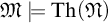 $\mathfrak {M}\models \operatorname {\mathrm {Th}}(\mathfrak {N})$
such that
 $\left \lvert M \right \rvert \le \delta $
there exists an elementary embedding
 $j\colon \mathfrak {M}\to \mathfrak {N}$
.
Recall that a sentence is universal if it is of the form
 $\forall x_1\dots \forall x_n\varphi (x_1,\dots ,x_n)$
where
 $\varphi (x_1,\dots ,x_n)$
is quantifier free. Given an L-structure
 $\mathfrak {N}$
, let
 $\operatorname {\mathrm {Th}}_\forall (\mathfrak {N})$
be the set of universal L-sentences which are true in
 $\mathfrak {N}$
.
Theorem 3.4 (Keisler [Reference Jerome Keisler11, Theorem 2.1]).
Let
 $\delta $
be a cardinal. If
 $\mathfrak {N}$
is a
 ${<}\delta $
-saturated L-structure, then for every model
 $\mathfrak {M}\models \operatorname {\mathrm {Th}}_\forall (\mathfrak {N})$
such that
 $\left \lvert M \right \rvert \le \delta $
there exists an embedding
 $e\colon \mathfrak {M}\to \mathfrak {N}$
.
We introduce goodness, a combinatorial property of ultrafilters designed to produce saturated quotients.
Definition 3.5. Let
 $\lambda $
be a cardinal,
 $\mathsf {B}$
a Boolean algebra, and
 $f\colon \left [ \lambda \right ]^{<\aleph _0}\to \mathsf {B}$
.
-
• f is monotonic if for all
$S,T\in \left [ \lambda \right ]^{<\aleph _0}$
,
$S\subseteq T$
implies
$f(T)\le f(S)$
. -
• f is multiplicative if for all
$S,T\in \left [ \lambda \right ]^{<\aleph _0}$
,
$f(S\cup T)=f(S)\wedge f(T)$
.


If f is a multiplicative function and
 $S\subseteq T$
, then
 $f(T)=f(S\cup T)=f(S)\wedge f(T)\le f(S)$
, whence f is monotonic.
Definition 3.6 (Mansfield [Reference Mansfield17, Definition 4.2]).
Let
 $\delta $
be a cardinal. An ultrafilter U on a Boolean algebra
 $\mathsf {B}$
is
 ${<}\delta $
-good if for every
 $\lambda <\delta $
and every monotonic function
 $f\colon \left [ \lambda \right ]^{<\aleph _0}\to U$
, there exists a multiplicative function
 $g\colon \left [ \lambda \right ]^{<\aleph _0}\to U$
with the property that
 $g(S)\le f(S)$
for all
 $S\in \left [ \lambda \right ]^{<\aleph _0}$
.
For further information on good ultrafilters and their model-theoretic significance, we refer the reader to the previous work of the first author [Reference Parente22, Section 2].
Theorem 3.7. Let
 $\delta $
be an uncountable cardinal,
 $\mathsf {B}$
a
 ${<}\delta $
-complete Boolean algebra, and L a signature with
 $\left \lvert L \right \rvert <\delta $
. Suppose
 $\mathfrak {M}$
is a full
 $\mathsf {B}$
-valued structure for L which satisfies the
 ${<}\delta $
-mixing property, and U is a countably incomplete
 ${<}\delta $
-good ultrafilter on
 $\mathsf {B}$
; then the quotient
 $\mathfrak {M}/U$
is
 ${<}\delta $
-saturated.
Proof. Mansfield [Reference Mansfield17, Theorem 4.1] established this result for the special case of Boolean ultrapowers
 $M^{(\mathsf {B})}/U$
. However, by inspecting his proof one sees that fullness and
 ${<}\delta $
-mixing are the only properties of the
 $\mathsf {B}$
-valued structure actually used to obtain
 ${<}\delta $
-saturation of the quotient. Thus, the very same proof applies to our case as well.
The rest of this section is dedicated to the existence of good ultrafilters. Balcar and Franek [Reference Balcar and Franek3] showed that if
 $\mathsf {B}$
is an infinite complete Boolean algebra such that
 for all
 $b\in \mathsf {B}^+$
, then there exist
 $2^{\left \lvert \mathsf {B} \right \rvert }$
ultrafilters on
 $\mathsf {B}$
which are countably incomplete and
 ${<}\operatorname {\mathrm {sat}}(\mathsf {B})$
-good. Although this is sufficient for many purposes, it relies on the completeness of the Boolean algebra, whereas in Section 5 we shall need to work with the stationary tower, which is not complete.
We overcome this by giving a new existence proof closer to the original proof of Keisler [Reference Keisler10, Theorem 4.4].
Definition 3.8 (Mansfield [Reference Mansfield17, Definition 4.3]).
Let
 $\delta $
be a cardinal; a Boolean algebra
 $\mathsf {B}$
is
 ${<}\delta $
-disjointable if for every
 $\lambda <\delta $
and every function
 $f\colon \lambda \to \mathsf {B}^+$
, there exists a function
 $g\colon \lambda \to \mathsf {B}^+$
such that:
-
• for all
$\alpha <\lambda $
,
$g(\alpha )\le f(\alpha )$
; -
• for all
$\beta <\alpha <\lambda $
,
$g(\alpha )\wedge g(\beta )=\mathsf {0}$
.


The following sufficient condition will be easier to verify for successor cardinals.
Theorem 3.9 (Balcar and Vojtáš [Reference Balcar, Vojtáš, Lachlan, Srebrny and Zarach4, Theorem 1.4]).
Let
 $\lambda $
be an infinite cardinal and
 $\mathsf {B}$
a Boolean algebra. If
 for all
 $b\in \mathsf {B}^+$
, then
 $\mathsf {B}$
is
 ${<}\lambda ^+$
-disjointable.
We now look at two consequences of
 ${<}\delta $
-disjointability.
Lemma 3.10 (Balcar and Vojtáš [Reference Balcar, Vojtáš, Lachlan, Srebrny and Zarach4]).
Let
 $\delta>2$
be a cardinal. If a Boolean algebra
 $\mathsf {B}$
is
 ${<}\delta $
-disjointable, then
 $\mathsf {B}$
is atomless and for all
 .
Proposition 3.11. Let
 $\delta $
be a cardinal and
 $\mathsf {B}$
a Boolean algebra. If
 $\mathsf {B}$
is
 ${<}\delta $
-disjointable and
 ${<}\delta $
-complete, then
 $\delta ^{<\delta }\le \left \lvert \mathsf {B} \right \rvert $
.
Proof. If
 $\delta \le 2$
there is nothing to prove, so let us assume
 $\delta>2$
. Let
 $\lambda <\delta $
be arbitrary; since
 $\mathsf {B}$
is
 ${<}\delta $
-disjointable, in particular there exists an antichain A in
 $\mathsf {B}$
such that
 $\left \lvert A \right \rvert =\lambda $
. By Lemma 3.10, for all
 $a\in A$
we have
 .
Let  denote the product algebra of the
 for
 $a\in A$
. Clearly, the function defined as

is injective. Hence,

as desired.
The next lemma will constitute the base step of the recursive construction of Theorem 3.14. Our proof is not different from the proof of Keisler [Reference Keisler10, Lemma 4B].
Lemma 3.12. Let
 $\delta $
be an infinite cardinal; suppose
 $\mathsf {B}$
is a
 ${<}\delta $
-disjointable
 ${<}\delta $
-complete Boolean algebra. For every
 $E\in \left [ \mathsf {B} \right ]^{<\delta }$
with the finite intersection property, there exists
 $Y\in \left [ \mathsf {B} \right ]^{\aleph _0}$
such that
 $E\cup Y$
has the finite intersection property and
 $\bigwedge Y=\mathsf {0}$
.
Proof. Without loss of generality, we may assume that E is also closed under finite meets. Let
 $f\colon \lambda \to E$
be a surjective function for some
 $\lambda <\delta $
. Since
 $\mathsf {B}$
is
 ${<}\delta $
-disjointable, there exists a function
 $g\colon \lambda \to \mathsf {B}^+$
such that
 $g(\alpha )\le f(\alpha )$
and
 $g(\alpha )\wedge g(\beta )=\mathsf {0}$
for all
 $\beta <\alpha <\lambda $
. By Lemma 3.10,
 $\mathsf {B}$
is atomless and therefore for every
 $\alpha <\lambda $
we can choose a sequence
 $\left \langle x_{\alpha ,n} : n<\omega \right \rangle $
such that:
-
(1)
$x_{\alpha ,0}=g(\alpha )$
; -
(2) for all
$n<\omega $
,
$x_{\alpha ,n+1}<x_{\alpha ,n}$
; -
(3)
$\bigwedge _{n<\omega }x_{\alpha ,n}=\mathsf {0}$
.


For every
 $n<\omega $
let us define
 $y_n=\bigvee _{\alpha <\lambda }x_{\alpha ,n}$
and prove that
 $Y=\left \lbrace y_n : n<\omega \right \rbrace $
has the desired properties.
Firstly, to prove that
 $E\cup Y$
has the finite intersection property, we observe that Y closed under finite meets, in fact
 $y_{n+1}\le y_n$
for all
 $n<\omega $
. Then for every
 $\alpha <\lambda $
and
 $n<\omega $
we have
 $$\begin{align*}f(\alpha)\wedge y_n\ge g(\alpha)\wedge y_n=x_{\alpha,n}>\mathsf{0}, \end{align*}$$
as desired.
Secondly, we show that
 $\bigwedge Y=\mathsf {0}$
. If not, then there must be some
 $b\in \mathsf {B}^+$
such that
 $b\le y_n$
for each
 $n<\omega $
. In particular, from point (1) we get
 $b\le y_0=\bigvee _{\alpha <\lambda }g(\alpha )$
, hence there exists
 $\beta <\lambda $
such that
 $g(\beta )\wedge b>\mathsf {0}$
. Using point (3), we can find some
 $m<\omega $
such that
 $g(\beta )\wedge b\wedge \neg x_{\beta ,m}>\mathsf {0}$
. Thus we obtain
 $$\begin{align*}\mathsf{0}<g(\beta)\wedge b\wedge\neg x_{\beta,m}\le g(\beta)\wedge y_m\wedge\neg x_{\beta,m}=x_{\beta,m}\wedge\neg x_{\beta,m}=\mathsf{0}, \end{align*}$$
which is a contradiction.
The following lemma will take care of the successor steps of the recursive construction.
Lemma 3.13 (Mansfield [Reference Mansfield17, Theorem 4.2]).
Let
 $\delta $
be an infinite cardinal; suppose
 $\mathsf {B}$
is a
 ${<}\delta $
-disjointable
 ${<}\delta $
-complete Boolean algebra. For every
 $E\in \left [ \mathsf {B} \right ]^{<\delta }$
with the finite intersection property, every
 $\lambda <\delta $
, and every monotonic function
 $f\colon \left [ \lambda \right ]^{<\aleph _0}\to E$
, there exists
 $E'\in \left [ \mathsf {B} \right ]^{<\delta }$
with the finite intersection property such that
 $E\subseteq E'$
, and a multiplicative function
 $g\colon \left [ \lambda \right ]^{<\aleph _0}\to E'$
such that
 $g(S)\le f(S)$
for all
 $S\in \left [ \lambda \right ]^{<\aleph _0}$
.
Finally, we apply Proposition 3.11, Lemmas 3.12, and 3.13 to establish an existence result for good ultrafilters.
Theorem 3.14. Let
 $\delta $
be an infinite cardinal; suppose
 $\mathsf {B}$
is a
 ${<}\delta $
-disjointable
 ${<}\delta $
-complete Boolean algebra of cardinality
 $\delta $
. For every
 $E\in \left [ \mathsf {B} \right ]^{<\delta }$
with the finite intersection property, there exists a countably incomplete
 ${<}\delta $
-good ultrafilter U on
 $\mathsf {B}$
such that
 $E\subset U$
.
Proof. If
 $E\in \left [ \mathsf {B} \right ]^{<\delta }$
has the finite intersection property, by Lemma 3.12 there exists
 $Y\in \left [ \mathsf {B} \right ]^{\aleph _0}$
such that
 $E\cup Y$
has the finite intersection property and
 $\bigwedge Y=\mathsf {0}$
. Now, if
 $\delta =\aleph _0$
there is nothing else to prove: any ultrafilter including
 $E\cup Y$
will be countably incomplete and, trivially,
 ${<}\aleph _0$
-good. Therefore, for the rest of the proof we shall assume that
 $\delta $
is uncountable.
Since
 $\left \lvert \mathsf {B} \right \rvert =\delta $
, let us enumerate
 $\mathsf {B}=\left \lbrace b_\alpha : \alpha <\delta \right \rbrace $
. By Proposition 3.11 we know that
 $\delta ^{<\delta }=\delta $
, therefore the set
 $$\begin{align*}\left\lbrace f\colon\left[ \lambda \right]^{<\aleph_0}\to\mathsf{B} : \lambda<\delta\text{ and }f\text{ is monotonic} \right\rbrace \end{align*}$$
can be enumerated as
 $\left \lbrace f_\alpha : \alpha <\delta \right \rbrace $
in such a way that each function is listed cofinally many times.
We recursively construct a sequence
 $\left \langle D_\alpha : \alpha <\delta \right \rangle $
such that, at each stage
 $\alpha <\delta $
:
-
(1)
$D_\alpha \in \left [ \mathsf {B}^+ \right ]^{<\delta }$
has the finite intersection property; -
(2) if
$\beta <\alpha $
then
$D_\beta \subseteq D_\alpha $
; -
(3) either
$b_\alpha \in D_{\alpha +1}$
or
$\neg b_\alpha \in D_{\alpha +1}$
; -
(4) if
$f_\alpha \colon \left [ \lambda \right ]^{<\aleph _0}\to D_\alpha $
where
$\lambda <\delta $
, then there exists a multiplicative function
$g\colon \left [ \lambda \right ]^{<\aleph _0}\to D_{\alpha +1}$
such that
$g(S)\le f_\alpha (S)$
for all
$S\in \left [ \lambda \right ]^{<\aleph _0}$
.


We begin the recursive construction by letting
 $D_0=E\cup Y$
. Clearly,
 $\left \lvert D_0 \right \rvert \le \left \lvert E \right \rvert +\aleph _0<\delta $
, as we are assuming
 $\delta $
to be uncountable.
For the inductive step, assume
 $D_\alpha $
has already been constructed. We first define
 $D_\alpha '$
as follows. In case the image of
 $f_\alpha $
is not included in
 $D_\alpha $
, then let
 $D_\alpha '=D_\alpha $
. On the other hand, suppose
 $f_\alpha \colon \left [ \lambda \right ]^{<\aleph _0}\to D_\alpha $
for some
 $\lambda <\delta $
. Then, by Lemma 3.13 there exists
 $D_\alpha '\in \left [ \mathsf {B} \right ]^{<\delta }$
with the finite intersection property such that
 $D_\alpha \subseteq D_\alpha '$
, and a multiplicative function
 $g\colon \left [ \lambda \right ]^{<\aleph _0}\to D_\alpha '$
such that
 $g(S)\le f_\alpha (S)$
for all
 $S\in \left [ \lambda \right ]^{<\aleph _0}$
. Note that at least one of
 $D_\alpha '\cup \left \lbrace b_\alpha \right \rbrace $
and
 $D_\alpha '\cup \left \lbrace \neg b_\alpha \right \rbrace $
has the finite intersection property, hence we may define
 $D_{\alpha +1}=D_\alpha '\cup \left \lbrace b_\alpha \right \rbrace $
in the former case, or
 $D_{\alpha +1}=D_\alpha '\cup \left \lbrace \neg b_\alpha \right \rbrace $
in the latter case.
When
 $\gamma <\delta $
is a limit ordinal, we take
 $D_\gamma =\bigcup _{\alpha <\gamma }D_\alpha $
. Finally, let
 $U=\bigcup _{\alpha <\delta } D_\alpha $
. By condition (3), the filter U is indeed an ultrafilter. Furthermore, by our choice of
 $D_0$
, U is countably incomplete and includes E. To see that U is
 ${<}\delta $
-good, let
 $\lambda <\delta $
and let
 $f\colon \left [ \lambda \right ]^{<\aleph _0}\to U$
be a monotonic function. Since
 $\delta $
is a regular cardinal, there exists
 $\beta <\delta $
such that
 $f\colon \left [ \lambda \right ]^{<\aleph _0}\to D_\beta $
. Now choose some
 $\alpha>\beta $
such that
 $f=f_\alpha $
; by (4) there exists a multiplicative function
 $g\colon \left [ \lambda \right ]^{<\aleph _0}\to D_{\alpha +1}$
such that
 $g(S)\le f(S)$
for all
 $S\in \left [ \lambda \right ]^{<\aleph _0}$
, as desired.
4 The collapsing algebra
The purpose of this section is to show that, for an infinite regular cardinal
 $\kappa $
and an inaccessible
 $\delta>\kappa $
, there exist a
 $\delta $
-preserving complete Boolean algebra
 $\mathsf {B}$
and ultrafilters U on
 $\mathsf {B}$
, such that every model of the universal theory of
 $H_{\kappa ^+}$
of cardinality
 $\le \delta $
is embeddable into
 $H_{\check {\delta }}^{\mathsf {B}}/U$
.
Let
 $\delta $
be an inaccessible cardinal. For every infinite regular cardinal
 $\kappa <\delta $
, consider the notion of forcing
 $$\begin{align*}P^\kappa_{<\delta}&=\left\lbrace p : p\text{ is a function},\, \left\lvert p \right\rvert<\kappa,\, \operatorname{\mathrm{dom}}(p)\subset\delta \times \kappa,\right.\\ &\quad \left. \forall\left\langle \alpha,\xi \right\rangle\in\operatorname{\mathrm{dom}}(p)(p(\alpha,\xi)\in\alpha\cup\left\lbrace 0 \right\rbrace) \right\rbrace \end{align*}$$
ordered by
 $q\le p\iff p\subseteq q$
; then define the collapsing algebra
 $\operatorname {\mathrm {\mathsf {Coll}}}(\kappa ,{<}\delta )=\operatorname {\mathrm {\mathsf {RO}}}(P^\kappa _{<\delta })$
. It is well known that
 $\operatorname {\mathrm {\mathsf {Coll}}}(\kappa ,{<}\delta )$
has cardinality
 $\delta $
and includes
 $P^\kappa _{<\delta }$
as a
 ${<}\kappa $
-closed dense subset.
Proposition 4.1.
 $\operatorname {\mathrm {\mathsf {Coll}}}(\kappa ,{<}\delta )$
is
 ${<}\delta $
-disjointable.
Proof. We first claim that for all
 $p\in P^\kappa _{<\delta }$
and
 $\lambda <\delta $
there exists an antichain
 $\left \lbrace q_\beta : \beta <\lambda \right \rbrace $
in
 $P^\kappa _{<\delta }$
such that
 $q_\beta \le p$
for each
 $\beta <\lambda $
. Given a condition p, it is possible to choose
 $\alpha $
such that
 $\lambda \le \alpha <\delta $
and
 $\left \langle \alpha ,0 \right \rangle \notin \operatorname {\mathrm {dom}}(p)$
. Then, for each
 $\beta <\lambda $
take
 $q_\beta =p\cup \left \lbrace \left \langle \left \langle \alpha ,0 \right \rangle ,\beta \right \rangle \right \rbrace $
.
By density, this implies that for all
 $b\in \operatorname {\mathrm {\mathsf {Coll}}}(\kappa ,{<}\delta )^+$
we have
 . Hence, by Theorem 3.9 we conclude that
 $\operatorname {\mathrm {\mathsf {Coll}}}(\kappa ,{<}\delta )$
is
 ${<}\delta $
-disjointable.
Remark 4.2. To prove Proposition 4.1 it is not necessary to use Theorem 3.9. In fact, the
 ${<}\delta $
-disjointability of
 $\operatorname {\mathrm {\mathsf {Coll}}}(\kappa ,{<}\delta )$
can also be established directly by a density argument about
 $P^\kappa _{<\delta }$
.
Corollary 4.3. For every
 $E\in \left [ \operatorname {\mathrm {\mathsf {Coll}}}(\kappa ,{<}\delta ) \right ]^{<\delta }$
with the finite intersection property, there exists a countably incomplete
 ${<}\delta $
-good ultrafilter U on
 $\operatorname {\mathrm {\mathsf {Coll}}}(\kappa ,{<}\delta )$
such that
 $E\subset U$
.
Note that, since
 $\operatorname {\mathrm {\mathsf {Coll}}}(\kappa ,{<}\delta )$
is
 $\delta $
-preserving, the Boolean-valued structure
 $H_{\check {\delta }}^{\operatorname {\mathrm {\mathsf {Coll}}}(\kappa ,{<}\delta )}$
represents
 $H_\delta $
of the forcing extension, in the sense of Proposition 2.11.
Theorem 4.4. Let
 $\delta $
be an inaccessible cardinal and
 $\kappa <\delta $
be an infinite regular cardinal. Every
 $E\in \left [ \operatorname {\mathrm {\mathsf {Coll}}}(\kappa ,{<}\delta ) \right ]^{<\delta }$
with the finite intersection property can be extended to an ultrafilter U on
 $\operatorname {\mathrm {\mathsf {Coll}}}(\kappa ,{<}\delta )$
such that:
-
• the quotient
$\left \langle H_{\check {\delta }}^{\operatorname {\mathrm {\mathsf {Coll}}}(\kappa ,{<}\delta )}/U,\in _{\Delta _0} \right \rangle $
is a model of
$\operatorname {\mathrm {Th}}_\forall (H_{\kappa ^+},\in _{\Delta _0})$
; -
• for every model
$\mathfrak {M}\models \operatorname {\mathrm {Th}}_\forall (H_{\kappa ^+},\in _{\Delta _0})$
such that
$\left \lvert M \right \rvert \le \delta $
, there exists an embedding
$e\colon \mathfrak {M}\to \left \langle H_{\check {\delta }}^{\operatorname {\mathrm {\mathsf {Coll}}}(\kappa ,{<}\delta )}/U,\in _{\Delta _0} \right \rangle $
of
$\in _{\Delta _0}$
-structures.


Proof. Applying Corollary 4.3, let U be a countably incomplete
 ${<}\delta $
-good ultrafilter on
 $\operatorname {\mathrm {\mathsf {Coll}}}(\kappa ,{<}\delta )$
such that
 $E\subset U$
. From Proposition 2.13 we know that
 $H_{\check {\delta }}^{\operatorname {\mathrm {\mathsf {Coll}}}(\kappa ,{<}\delta )}$
satisfies the mixing property, hence it is full by Proposition 2.9.
To prove the first point, let
 $\psi $
be a universal
 $\in _{\Delta _0}$
-sentence which is true in
 $H_{\kappa ^+}$
. Without loss of generality,
 $\psi $
is of the form
 $\forall x\varphi (x)$
where
 $\varphi (x)$
is quantifier free. Since
 $$\begin{align*}\left\langle H_{\kappa^+},\in_{\Delta_0} \right\rangle\models\forall x\varphi(x), \end{align*}$$
Lemma 2.15 gives  , which easily implies
 . It follows that
 $$\begin{align*}\left\langle H_{\check{\delta}}^{\operatorname{\mathrm{\mathsf{Coll}}}(\kappa,{<}\delta)}/U,\in_{\Delta_0} \right\rangle\models\forall x\varphi(x), \end{align*}$$
which is what we had to prove.
For the second point, let
 $\mathfrak {M}$
be any model of
 $\operatorname {\mathrm {Th}}_\forall (H_{\kappa ^+},\in _{\Delta _0})$
such that
 ${\left \lvert M \right \rvert \le \delta} $
. Remark 2.14 implies that
 $\mathfrak {M}$
is also a model of
 $\operatorname {\mathrm {Th}}_\forall (H_{\check {\delta }}^{\operatorname {\mathrm {\mathsf {Coll}}}(\kappa ,{<}\delta )}/U,\in _{\Delta _0})$
. Then Theorem 3.4 and Theorem 3.7 give the desired embedding.
The main drawbacks of Theorem 4.4 are, first, the requirement of
 $\kappa $
being regular and, second, the signature being restricted to
 $\Delta _0$
-definable relations. In the next section, we overcome both limitations by using the stationary tower to establish a stronger universality result.
5 The stationary tower forcing
In parallel with the previous section, we provide a second universality result for models of the form
 $\operatorname {\mathrm {Ult}}(H_{\kappa ^+},\mathcal {I})/U$
, where
 $\mathcal {I}$
is a tower of non-stationary ideals. We employ the following definition of stationarity, which is due to Shelah; see also Woodin [Reference Woodin31, Definition 3] and the monograph of Larson [Reference Larson15].
Definition 5.1. A non-empty set a is stationary if for every function
 $f\colon {^{<\omega }{(\mathop {\textstyle \bigcup } a)}}\to \mathop {\textstyle \bigcup } a$
there exists
 $Z\in a$
such that
 $f[^{<\omega }Z]\subseteq Z$
.
A set a is stationary in b if a is stationary,
 $a\subseteq b$
, and
 $\mathop {\textstyle \bigcup } a=\mathop {\textstyle \bigcup } b$
.
We clarify the relation between stationarity and Jech’s notion of closed unbounded sets.
Definition 5.2 (Jech [Reference Jech8, Definition 3.1]).
Let
 $\kappa $
be an infinite cardinal and X a set such that
 $\kappa ^+\subseteq X$
. A subset
 $C\subseteq \left [ X \right ]^{\le \kappa }$
is
-
• closed if it is closed under unions of chains of length
$\le \kappa $
, -
• unbounded if for every
$Z\in \left [ X \right ]^{\le \kappa }$
there exists
$Y\in C$
such that
$Z\subseteq Y$
.


A key example is the set
 $$\begin{align*}\mathcal{P}_{\kappa^+}(X)=\left\lbrace Z\in\left[ X \right]^{\le\kappa} : Z\cap\kappa^+\in\kappa^+ \right\rbrace, \end{align*}$$
which is closed and unbounded.
It follows from the definitions that if
 $a\subseteq \left [ X \right ]^{\le \kappa }$
has non-empty intersection with every closed unbounded set, then a is stationary in
 $\left [ X \right ]^{\le \kappa }$
. The converse is not true in general, for instance the set of countable subsets of
 $\omega _2$
is stationary, but it is disjoint from the closed unbounded set
 $\left [ \omega _2 \right ]^{\aleph _1}$
. However, we have the following result.
Proposition 5.3 (Kueker [Reference Kueker13]).
For every closed unbounded
 $C\subseteq \left [ X \right ]^{\le \kappa }$
there exists a function
 $f\colon {^{<\omega }X}\to X$
such that
 $\left \lbrace Z\in \mathcal {P}_{\kappa ^+}(X) : f[^{<\omega }Z]\subseteq Z \right \rbrace \subseteq C$
.
As a consequence, a subset
 $a\subseteq \mathcal {P}_{\kappa ^+}(X)$
has non-empty intersection with every closed unbounded set if and only if a is stationary in
 $\mathcal {P}_{\kappa ^+}(X)$
. Let us also recall a result on splitting stationary sets, which will be useful for our Proposition 5.5.
Theorem 5.4 (Matsubara [Reference Matsubara19, Theorem 2]).
Every set which is stationary in
 $\mathcal {P}_{\kappa ^+}(X)$
can be partitioned into
 $\left \lvert X \right \rvert $
disjoint stationary sets.
If
 $\kappa $
is any infinite cardinal and
 $\kappa ^+\subseteq X$
, we define the non-stationary ideal

which is a normal fine ideal over
 $\mathcal {P}(X)$
(see [Reference Foreman, Foreman and Kanamori7, Section 3]). Furthermore, a well-known result of Menas [Reference Menas20, Corollary 1.9] gives that for all
 $\kappa ^+\subseteq X\subseteq Y$

As a result, whenever
 $\delta>\kappa $
is inaccessible we have a tower

of height
 $\delta $
.
The corresponding Boolean algebra
 $\mathsf {B}(\mathcal {I}^\kappa _{<\delta })$
is called the stationary tower of height
 $\delta $
and critical point
 $\kappa ^+$
. To view concretely the stationary tower as a notion of forcing, let us define
 $$\begin{align*}Q^\kappa_{<\delta}=\left\lbrace a\in V_\delta : \kappa^+\subseteq\mathop{\textstyle\bigcup} a\text{ and }a\text{ is stationary in }\mathcal{P}_{\kappa^+}(\mathop{\textstyle\bigcup} a) \right\rbrace \end{align*}$$
and for
 $a,b\in Q^\kappa _{<\delta }$
define
 $$\begin{align*}b\le a\iff\mathop{\textstyle\bigcup} a\subseteq\mathop{\textstyle\bigcup} b\text{ and for all }Z\in b,\ Z\cap\mathop{\textstyle\bigcup} a\in a. \end{align*}$$
Then the map
 $a\mapsto \left [ a \right ]_{\mathcal {I}^\kappa _{<\delta }}$
gives a dense embedding of
 $Q^\kappa _{<\delta }$
into
 ${\mathsf {B}(\mathcal {I}^\kappa _{<\delta })}^+$
. In particular, since
 $\mathcal {I}^\kappa _{<\delta }$
concentrates on sets of cardinality less than or equal to
 $\kappa $
, for every
 $\left [ a \right ]_{\mathcal {I}^\kappa _{<\delta }}\in \mathsf {B}(\mathcal {I}^\kappa _{<\delta })$
we have
 $\left [ a \right ]_{\mathcal {I}^\kappa _{<\delta }}=\left [ \left \lbrace Z\in a : \left \lvert Z \right \rvert \le \kappa \right \rbrace \right ]_{\mathcal {I}^\kappa _{<\delta }}$
.
Proposition 5.5. Let
 $\delta $
be inaccessible; for every infinite cardinal
 $\kappa <\delta $
the Boolean algebra
 $\mathsf {B}(\mathcal {I}^\kappa _{<\delta })$
is
 ${<}\delta $
-disjointable.
Proof. We first claim that for every
 $a\in Q^\kappa _{<\delta }$
and every
 $\lambda <\delta $
, if
 $\mathop {\textstyle \bigcup } a\subseteq V_\lambda $
then there exists an antichain
 $\left \lbrace b_\beta : \beta <\lambda \right \rbrace $
in
 $Q^\kappa _{<\delta }$
such that
 $b_\beta \le a$
for each
 $\beta <\lambda $
. Given a condition a, by (5) the set
 $$\begin{align*}\left\lbrace Z\in\mathcal{P}_{\kappa^+}(V_\lambda) : Z\cap\mathop{\textstyle\bigcup} a\in a \right\rbrace \end{align*}$$
is stationary in
 $\mathcal {P}_{\kappa ^+}(V_\lambda )$
, hence by Theorem 5.4 we can partition it into
 $\lambda $
disjoint stationary sets
 $b_\beta $
for
 $\beta <\lambda $
. Then it is clear that
 $\left \lbrace b_\beta : \beta <\lambda \right \rbrace $
is the desired antichain in
 $Q^\kappa _{<\delta }$
.
By density, this implies that for all
 $b\in {\mathsf {B}(\mathcal {I}^\kappa _{<\delta })}^+$
we have
 . Therefore, Theorem 3.9 gives that
 $\mathsf {B}(\mathcal {I}^\kappa _{<\delta })$
is
 ${<}\delta $
-disjointable.
Corollary 5.6. For every
 $E\in \left [ \mathsf {B}(\mathcal {I}^\kappa _{<\delta }) \right ]^{<\delta }$
with the finite intersection property, there exists a countably incomplete
 ${<}\delta $
-good ultrafilter U on
 $\mathsf {B}(\mathcal {I}^\kappa _{<\delta })$
such that
 $E\subset U$
.
Next, we turn to the relevant Boolean-valued structure. As opposed to the case of Section 4, here
 $H_{\check {\delta }}^{\mathsf {B}(\mathcal {I}^\kappa _{<\delta })}$
would not naturally be a
 $\mathsf {B}(\mathcal {I}^\kappa _{<\delta })$
-valued structure, simply because the Boolean algebra fails to be complete. One approach is pursued in the work of Marinov [Reference Marinov18]: quotient
 $\mathsf {B}(\mathcal {I}^\kappa _{<\delta })$
by a carefully chosen ideal I to obtain a complete quotient algebra and then work with
 $H_{\check {\delta }}^{\mathsf {B}(\mathcal {I}^\kappa _{<\delta })/I}$
. Here we choose a different route and argue that
 $\operatorname {\mathrm {Ult}}(H_{\kappa ^+},\mathcal {I}^\kappa _{<\delta })$
is a suitable
 $\mathsf {B}(\mathcal {I}^\kappa _{<\delta })$
-valued structure, which then we quotient by a
 ${<}\delta $
-good ultrafilter to obtain our main universality result.
Theorem 5.7. Let
 $\delta $
be an inaccessible cardinal and
 $\kappa <\delta $
be an infinite cardinal. Every
 $E\in \left [ \mathsf {B}(\mathcal {I}^\kappa _{<\delta }) \right ]^{<\delta }$
with the finite intersection property can be extended to an ultrafilter U on
 $\mathsf {B}(\mathcal {I}^\kappa _{<\delta })$
such that for every
 $\mathcal {A}\subseteq \bigcup _{n<\omega }\mathcal {P}(^n(H_{\kappa ^+}))$
:
-
• the quotient
$\left \langle \operatorname {\mathrm {Ult}}(H_{\kappa ^+},\mathcal {I}^\kappa _{<\delta })/U,\in _{\mathcal {A}} \right \rangle $
is a model of
$\operatorname {\mathrm {Th}}(H_{\kappa ^+},\in _{\mathcal {A}})$
; -
• for every model
$\mathfrak {M}\models \operatorname {\mathrm {Th}}_\forall (H_{\kappa ^+},\in _{\mathcal {A}})$
such that
$\left \lvert M \right \rvert \le \delta $
, there exists an embedding
$e\colon \mathfrak {M}\to \left \langle \operatorname {\mathrm {Ult}}(H_{\kappa ^+},\mathcal {I}^\kappa _{<\delta })/U,\in _{\mathcal {A}} \right \rangle $
of
$\in _{\mathcal {A}}$
-structures; -
• for every model
$\mathfrak {M}\models \operatorname {\mathrm {Th}}(H_{\kappa ^+},\in _{\mathcal {A}})$
such that
$\left \lvert M \right \rvert \le \delta $
, there exists an elementary embedding
$j\colon \mathfrak {M}\to \left \langle \operatorname {\mathrm {Ult}}(H_{\kappa ^+},\mathcal {I}^\kappa _{<\delta })/U,\in _{\mathcal {A}} \right \rangle $
of
$\in _{\mathcal {A}}$
-structures.


Proof. Applying Corollary 5.6, let U be a countably incomplete
 ${<}\delta $
-good ultrafilter on
 $\mathsf {B}(\mathcal {I}^\kappa _{<\delta })$
such that
 $E\subset U$
. Proposition 2.21 ensures that
 $\operatorname {\mathrm {Ult}}(H_{\kappa ^+},\mathcal {I}^\kappa _{<\delta })$
is full and satisfies the
 ${<}\delta $
-mixing property.
The first point follows directly from Corollary 2.22. For the second point, let
 $\mathfrak {M}$
be a model of
 $\operatorname {\mathrm {Th}}_\forall (H_{\kappa ^+},\in _{\mathcal {A}})$
such that
 $\left \lvert M \right \rvert \le \delta $
. Corollary 2.22 again implies that
 $\mathfrak {M}\models \operatorname {\mathrm {Th}}_\forall (\operatorname {\mathrm {Ult}}(H_{\kappa ^+},\mathcal {I}^\kappa _{<\delta })/U,\in _{\mathcal {A}})$
. Then Theorems 3.4 and 3.7 give the desired embedding. The third point is completely analogous to the second, except that we apply Theorem 3.3 instead of Theorem 3.4 to obtain an elementary embedding.
For the universality result of the previous section, we considered Boolean-valued structures
 $H_{\check {\delta }}^{\operatorname {\mathrm {\mathsf {Coll}}}(\kappa ,{<}\delta )}$
which, by Proposition 2.11, provide a canonical representation for
 $H_\delta $
when forcing with
 $\operatorname {\mathrm {\mathsf {Coll}}}(\kappa ,{<}\delta )$
. In the remainder of this section, we aim to show that a similar fact holds for the structures we consider in Theorem 5.7. More precisely, we shall show that under large cardinal assumptions, quotienting
 $\operatorname {\mathrm {Ult}}(H_{\kappa ^+},\mathcal {I}^\kappa _{<\delta })$
by a
 $\mathsf {B}(\mathcal {I}^\kappa _{<\delta })$
-generic filter G gives rise to a well-founded structure whose transitive collapse is
 $H_\delta $
as computed in
 $V[G]$
.
Definition 5.8. A cardinal
 $\delta $
is Woodin if for all
 $f\colon \delta \to \delta $
there exists
 $\alpha <\delta $
with
 $f[\alpha ]\subseteq \alpha $
and a nontrivial elementary embedding
 $j\colon V\to M$
such that
 $\operatorname {\mathrm {crit}}(j)=\alpha $
and
 $V_{j(f)(\alpha )}\subset M$
.
If
 $\delta $
is a Woodin cardinal, then
 $\delta $
is Mahlo (see Kanamori [Reference Kanamori9, Exercise 26.10]) and therefore inaccessible.
Theorem 5.9 (Woodin).
Suppose
 $\delta $
is a Woodin cardinal. Then, for every infinite
 $\kappa <\delta $
the Boolean algebra
 $\mathsf {B}(\mathcal {I}^\kappa _{<\delta })$
is
 ${<}\delta $
-presaturated. Furthermore, if G is
 $\mathsf {B}(\mathcal {I}^\kappa _{<\delta })$
-generic over V then
 $\operatorname {\mathrm {Ult}}(H_{\kappa ^+},\mathcal {I}^\kappa _{<\delta })/G$
is well founded.
Proof. Combine [Reference Foreman, Foreman and Kanamori7, Proposition 9.2] and [Reference Foreman, Foreman and Kanamori7, Corollary 9.24].
Accordingly, if
 $\delta $
is Woodin and G is
 $\mathsf {B}(\mathcal {I}^\kappa _{<\delta })$
-generic over V, then we identify
 $\operatorname {\mathrm {Ult}}(H_{\kappa ^+},\mathcal {I}^\kappa _{<\delta })/G$
with its transitive collapse and let
 $$\begin{align*}\begin{aligned} j_G\colon H_{\kappa^+}&\longrightarrow\operatorname{\mathrm{Ult}}(H_{\kappa^+},\mathcal{I}^\kappa_{<\delta})/G \\ a &\longmapsto\left[ c_a \right]_G \end{aligned} \end{align*}$$
be the generic elementary embedding given by Corollary 2.22. Since
 $\mathcal {I}^\kappa _{<\delta }$
concentrates on those Z such that
 $Z\cap \kappa ^+\in \kappa ^+$
, using [Reference Foreman, Foreman and Kanamori7, Proposition 4.56] we see that
 $j_G(\alpha )=\alpha $
for all
 $\alpha <\kappa ^+$
.
Proposition 5.10. Let
 $\delta $
be a Woodin cardinal and
 $\kappa <\delta $
be an infinite cardinal. If G is
 $\mathsf {B}(\mathcal {I}^\kappa _{<\delta })$
-generic over V, then
 $$\begin{align*}H_\delta^{V[G]}=\operatorname{\mathrm{Ult}}(H_{\kappa^+},\mathcal{I}^\kappa_{<\delta})/G. \end{align*}$$
Proof. Theorem 5.9 guarantees that
 $\mathsf {B}(\mathcal {I}^\kappa _{<\delta })$
is
 ${<}\delta $
-presaturated, so we may apply Lemma 2.12 to obtain that
 $\delta $
is a regular cardinal in
 $V[G]$
and
 $H_\delta ^{V[G]}=\left \lbrace \tau _G : \tau \in V^{\mathsf {B}(\mathcal {I}^\kappa _{<\delta })}\cap H_\delta \right \rbrace $
.
To prove that
 $H_\delta ^{V[G]}\subseteq \operatorname {\mathrm {Ult}}(H_{\kappa ^+},\mathcal {I}^\kappa _{<\delta })/G$
, it is enough to define a function
 $f\colon V^{\mathsf {B}(\mathcal {I}^\kappa _{<\delta })}\cap H_\delta \to \operatorname {\mathrm {Ult}}(H_{\kappa ^+},\mathcal {I}^\kappa _{<\delta })$
in V with the property that
 $\left [ f(\tau ) \right ]_G=\tau _G$
. Given
 $\tau \in V^{\mathsf {B}(\mathcal {I}^\kappa _{<\delta })}\cap H_\delta $
, enumerate it as
 $$\begin{align*}\tau=\left\lbrace \left\langle \sigma_\alpha,\left[ a_\alpha \right]_{\mathcal{I}^\kappa_{<\delta}} \right\rangle : \alpha<\lambda \right\rbrace \end{align*}$$
for some
 $\lambda <\delta $
and assume inductively that each
 $f(\sigma _\alpha )\colon \mathcal {P}(X_\alpha )\to H_{\kappa ^+}$
for
 $\alpha <\lambda $
has already been defined in such a way that
 $\left [ f(\sigma _\alpha ) \right ]_G={(\sigma _\alpha )}_G$
. Let
 $X\in V_\delta $
be sufficiently large that
 $\lambda \cup X_\alpha \cup \mathop {\textstyle \bigcup } a_\alpha \subseteq X$
for each
 $\alpha <\lambda $
and define
 $f(\tau )\colon \mathcal {P}(X)\to H_{\kappa ^+}$
as follows: given
 $Z\subseteq X$
, if
 $\left \lvert Z \right \rvert \le \kappa $
then let
 $$\begin{align*}f(\tau)(Z)=\left\lbrace f(\sigma_\alpha)(Z\cap X_\alpha) : \alpha\in Z\cap\lambda\text{ and }Z\cap\mathop{\textstyle\bigcup} a_\alpha\in a_\alpha \right\rbrace. \end{align*}$$
Otherwise, let
 $f(\tau )(Z)$
be defined arbitrarily.
Keeping in mind Lemma 2.17, it is easy to verify that for any
 $g\in \operatorname {\mathrm {Ult}}(H_{\kappa ^+},\mathcal {I}^\kappa _{<\delta })$

Using the inductive hypothesis and the genericity of G, we conclude that

as we wanted to show.
For the reverse inclusion, first note that
 $$\begin{align*}\left\langle H_{\kappa^+},\in_{\Delta_0} \right\rangle\models\forall x(\left\lvert x \right\rvert\le\kappa) \end{align*}$$
in V. By the elementarity of
 $j_G$
, it follows that
 $$\begin{align*}\left\langle \operatorname{\mathrm{Ult}}(H_{\kappa^+},\mathcal{I}^\kappa_{<\delta})/G,\in_{\Delta_0} \right\rangle\models\forall x(\left\lvert x \right\rvert\le j_G(\kappa)) \end{align*}$$
in
 $V[G]$
. Since
 $j_G(\kappa )=\kappa <\delta $
, we have that
 $\operatorname {\mathrm {Ult}}(H_{\kappa ^+},\mathcal {I}^\kappa _{<\delta })/G$
is transitive and all its elements have cardinality less than
 $\delta $
, whence
 $\operatorname {\mathrm {Ult}}(H_{\kappa ^+},\mathcal {I}^\kappa _{<\delta })/G\subseteq H_\delta ^{V[G]}$
.
Funding
The first author is an International Research Fellow of the Japan Society for the Promotion of Science. The second author acknowledges support from INdAM through GNSAGA and from the projects: PRIN 2017 “Mathematical Logic: models, sets, computability”, prot. 2017NWTM8R, and PRIN 2022 “Models, sets and classifications”, prot. 2022TECZJA.



