


A long-standing area of interest in phonological theory has been the analysis of processes that exhibit action at a distance.Footnote * Consider for example a nasal harmony process in Tshiluba (Bantu; e.g. Odden Reference Odden1994: 301), where the applicative suffix (among others) normally contains an [l] (1a), which is realised instead as [n] when attached to a stem that contains a nasal (1b). In Tshiluba and other languages exhibiting long-distance nasal harmony (e.g. Kikongo; see Rose & Walker Reference Rose and Walker2004, among others), there is no report of nasalisation on the intervening material. The stem nasal appears to interact directly with the suffix liquid, by-passing the intervening segments entirely.
-
(1)


A number of analyses have been proposed for such long-distance processes. In non-linear (autosegmental) phonology, they are generally analysed as feature spreading among tier-adjacent segments (e.g. Odden Reference Odden1994). A more recent approach is the framework of Agreement by Correspondence (ABC; e.g. Rose & Walker Reference Rose and Walker2004, Hansson Reference Hansson2010). In ABC, long-distance assimilation is achieved through the interaction of two constraint families. Corr constraints privilege output candidates in which segments that are similar on some dimension stand in correspondence with each other. Corr·[+cons, +son], for example, demands that sonorant consonants stand in correspondence with one another. CC·Ident constraints then compel corresponding consonants to become more similar. CC·Ident[nas], for example, requires that corresponding consonants have the same value for [nasal].
When both a Corr·[F] and a CC·Ident[G] constraint dominate the relevant faithfulness constraint(s), the result is correspondence, and further agreement along some featural dimension [G] among consonants that are identical along some dimension [F]. For example, if Corr·[+cons, +son] and CC·Ident[nas] dominate IO·Ident[nas], then the result is the pattern in (1): agreement for [nasal] among [+cons, +son] segments, as demonstrated in (2). (I use the symbol ↔ to denote consonants that occur in either order, following MacEachern Reference MacEachern1997 and others. Correspondence relations are indicated with subscripts; matching subscripts indicate correspondence.)
-
(2)
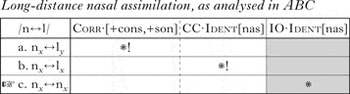
Candidate (a) is eliminated because the two sonorant consonants do not stand in correspondence with each other, and (b) because the corresponding consonants do not agree for [nasal]. The optimal candidate is thus (c), the assimilating candidate, which incurs only a violation of low-ranked IO·Ident[nas]. (I assume that the choice between (2c) and equally harmonic l x ↔l x is made by other factors, e.g. root faithfulness in the case of Tshiluba.)
The majority of the literature on ABC focuses on assimilatory processes, but the framework also offers a novel way of analysing dissimilatory processes. Consider, for example, the input–output mapping n↔l → n x ↔d y . This dissimilatory mapping is optimal when Corr·[+cons, +son] and CC·Ident[nas] dominate IO·Ident[son]. Effectively, dissimilation of n↔l to n x ↔d y (rendering one of the members [—sonorant]) is a way to avoid an otherwise required correspondence relation among sonorant consonants.
-
(3)

As is evident from (2) and (3), both assimilation (n↔l → n x ↔n x ) and dissimilation (n↔l → n x ↔d y ) can be motivated by the same combination of Corr and CC·Ident constraints, with the repair exhibited dependent on the ranking of the relevant faithfulness constraints (here IO·Ident[nas] and IO·Ident[son]). In short, ABC is a natural theory of both assimilation and dissimilation.
In The phonology of consonants: harmony, dissimilation, and correspondence, Wm. G. Bennett develops the Surface Correspondence Theory of Dissimilation (SCTD), a refinement of the ABC model capable of accounting for the full typology of long-distance consonant dissimilation.Footnote 1 Bennett makes the novel observation that ABC-based theories of long-distance harmony and dissimilation (such as the SCTD) make a typological prediction termed the Mismatch property. The Mismatch property predicts that the typologies of long-distance consonant assimilation and dissimilation should be related, but in a consistently mismatched way. For example, if there exists some constraint Corr·[F], where [F] is any feature (or feature bundle), then we expect to find some systems that exhibit harmony for some property [G] among consonants sharing [F] (e.g. nasal harmony among sonorants, as in (2)), as well some other systems that exhibit dissimilation for [F] (e.g. sonorant dissimilation among nasals, as in (3)). Based on in-depth case studies of ten languages and an comprehensive typological survey of 154 long-distance consonant-dissimilation patterns, as well as pre-existing work on long-distance consonant assimilation (e.g. Rose & Walker Reference Rose and Walker2004, Hansson Reference Hansson2010), Bennett (p. 358) concludes that the Mismatch property is more correct than incorrect, and that the correspondence-based approach to dissimilation is the best available one.
1 Overview
The first two chapters of the monograph provide an introduction to the SCTD, and outline the set of predictions that is investigated in later chapters. The monograph focuses entirely on the typology of categorical long-distance consonant dissimilation and its relation to long-distance consonant assimilation. This means that several kinds of patterns, often considered to be part of the typology of dissimilation, are not included in the discussion. These include (i) vowel-to-consonant interactions, and (ii) gradient co-occurrence restrictions (of the kind exhibited in Arabic; see e.g. Frisch et al. Reference Frisch, Pierrehumbert and Broe2004). Instead, the study focuses in detail on three phenomena: (i) long-distance consonant dissimilation as revealed by alternations, (ii) categorical static co-occurrence restrictions and (iii) cases in which otherwise regular alternations are blocked by a co-occurrence restriction. The rationale behind focusing the study on this particular set of empirical domains, and excluding the others, is discussed in §9.2.
Chapter 2 provides an in-depth introduction to the workings of the SCTD, outlining the monograph's novel assumptions regarding the structure of surface correspondence (i.e. that it is symmetric, transitive and reflexive). §2.3.3 introduces the class of constraints that Bennett terms CC-Limiter constraints – constraints that place additional similarity requirements on corresponding consonants. In addition to constraints familiar from other work in the ABC literature (e.g. CC·Ident constraints, as in (2) and (3)), Bennett's inventory of CC-Limiter constraints also includes a number of other constraint or constraint families with novel formalisations, such as CC·SyllAdj (‘Cs in the same correspondence class must inhabit a contiguous span of syllables’, p. 61; cf. Rose & Walker's Reference Rose and Walker2004 Proximity) and CC·Edge constraints. CC·Edge constraints require corresponding consonants to reside within the same domain, be it morphological (e.g. the verbal stem) or phonological (e.g. the syllable). The interaction between Corr and CC-Limiter constraints is what drives the predictions of the SCTD's Mismatch property.
The case studies in Chapters 3–6 develop arguments for the Mismatch property by showing that several predicted interactions of the Corr and CC-Limiter constraints are attested. For example, in a system where the harmony domain is delimited by CC·Edge[stem], we might expect to find long-distance harmony applying within the stem (where correspondence is permitted), but long-distance dissimilation applying across the stem boundary (where correspondence is banned). In Chapter 3, Bennett argues this pattern is attested in Kinyarwanda, where sibilant harmony operates within the verbal stem (schematised in (4a)) and Dahl's Law (voiceless dissimilation) occurs across the prefix–stem boundary (schematised in (4b)).Footnote 2
-
(4)

Chapters 4–6 investigate further examples of complementarity in assimilation and dissimilation. Chapter 4 focuses on an interlocking pattern of liquid assimilation and dissimilation in Sundanese (also Cohn Reference Cohn1992, Zuraw Reference Zuraw2002: 433), where – simplifying slightly – liquids that occupy adjacent syllables must harmonise, but liquids occupying non-adjacent syllables must dissimilate (e.g. rVr, but *r … r, where … = at least one syllable). Bennett shows that this complementarity can be derived by the CC-Limiter constraint CC·SyllAdj, which requires corresponding consonants to occupy adjacent syllables. In a system where CC·SyllAdj is active, harmony will be favoured among adjacent syllables (where correspondence is permitted), and dissimilation will be favoured among non-adjacent syllables (where correspondence is prohibited). Chapter 5 investigates the role of syllable edges in conditioning long-distance processes, and Chapter 6 investigates the role of similarity (see §3 of this review for discussion).
Chapter 7 focuses on a process of labial palatalisation in Zulu, which maps labial consonants to palatals when a suffix containing a labial consonant (such as the passive -wa) is added, as in (5) (data from p. 218).
-
(5)

Bennett notes that this pattern, while possible to analyse in the SCTD, is difficult for OCP-motivated theories of dissimilation. The alternations in (5) cannot be traced to a restriction on multiple labials, for example, as multiple labials are allowed to surface stem-internally if no suffixal labial is present (e.g. /-bab-a/ → -〈bab-a〉 ‘trap’; pp. 240–241). Chapter 8 contains an analysis of blocking effects in dissimilation, where Bennett argues that the SCTD better characterises the typology of segmental blocking effects than alternative analyses of dissimilation.Footnote 3 Chapter 9 steps back from the details of individual systems to take a look at the broader typology of dissimilation, established through a cross-linguistic survey of 154 dissimilatory processes in 134 languages and dialects. On the basis of this survey, Bennett concludes that the predictions of the SCTD fit the typology more accurately than the predictions of alternative theories (e.g. Suzuki's Reference Suzuki1998 Generalised OCP).
The supplementary material, available online, contains additional discussion on segmental blocking, an Excel database containing the survey of dissimilatory processes, and related materials. The database not only provides support for the generalisations in Chapter 9, but it also stands on its own as a substantial contribution. It contains a number of different types of information (language family, dissimilating features, references and author's notes) and is fully editable and searchable, making it an invaluable resource for any scholar wishing to conduct research that builds on Bennett's work.
2 Extensions
It should be clear from the above discussion that the monograph is impressive in its ambition and in its scope. It makes a substantial empirical and theoretical contribution to the study of dissimilatory processes and co-occurrence restrictions more generally, and will certainly serve as a cornerstone for any future research on these or similar topics in the foreseeable future.
The rest of this discussion focuses on the roles of similarity and identity in the SCTD, a topic briefly addressed in Bennett's Chapter 6. In what follows, I develop the SCTD's broader predictions regarding the role of similarity and identity in dissimilatory processes, and suggest that the theory in its current form does not easily extend to explain additional data and generalisations in the literature, particularly regarding MacEachern's (Reference MacEachern1997) typology of laryngeal co-occurrence restrictions.
2.1 Similarity in the SCTD
A number of languages exhibit complete identity effects (term from MacEachern Reference MacEachern1997), where a ban on similar segments that are identical along some dimension [F] fails to apply to segments identical along every dimension (including [F]). An example of a complete identity effect comes from Chol (Gallagher & Coon Reference Gallagher and Coon2009, discussed in Chapter 6), where identical ejective stops are exempted from an otherwise categorical ban on the appearance of two ejectives within the same root, as shown in (6) (from Gallagher & Coon Reference Gallagher and Coon2009: 546).
-
(6)

In Chapter 6, Bennett shows that complete identity effects such as the Chol pattern can be analysed in the SCTD without any reference to identity per se. Bennett's analysis of the pattern in (6) requires the four constraints defined in (7).
-
(7)

I follow Bennett in assuming that the pattern in (6) is a dissimilatory effect (e.g. p’↔k’ maps to p’↔k or p ↔k’).Footnote 4 This pattern can be derived under the assumption that Corr·[+c.g.], CC·Ident[Place] and IO·Ident[Place] dominate IO·Ident[c.g.]. As shown in (8), this ranking forces dissimilation of the heterorganic pair of ejectives, as they are both required to correspond (by Corr·[+c.g.]) but at the same time are prohibited from corresponding (by CC·Ident[Place]).
-
(8)
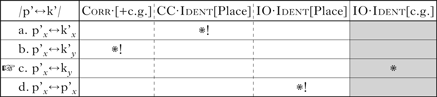
This same ranking predicts that the homorganic pair of ejectives should be allowed to correspond and therefore co-occur, as the faithful (9a) satisfies all relevant constraints. The candidate in which the homorganic ejectives co-occur do not correspond (9b) fatally violates Corr·[+c.g.], and the candidate in which dissimilation occurs fatally violates IO·Ident[c.g.].
-
(9)

This analysis of complete identity effects makes broader predictions regarding the role of featural similarity in the typology of dissimilation. It predicts that if a language bans some pair of featurally similar segments that corresponds for some feature or set of features [F], it must also ban all featurally less similar pairs of segments that correspond for that same [F]. To see why, consider the small list of potentially corresponding pairs, each of which shares at least the feature [labial], in Table I. Each labial pair is annotated with the CC·Ident constraint(s) that the pair would violate, were they forced to correspond by Corr·[lab]. The relevant generalisation is that the fewer features shared by the two [labial] consonants, the more CC·Ident constraints they violate.
Potentially corresponding [labial] pairs.

If Corr·[lab] is undominated, these constraints generate three possible systems, given different rankings of IO·Ident, CC·Ident[cont] and CC·Ident[voice]. If CC·Ident[cont] ≫ IO·Ident, then p↔p alone will be licit (Table IIa), if CC·Ident[voice] ≫ IO·Ident ≫ CC·Ident[cont], then p↔p and p↔f will be allowed (b), and if IO·Ident[Place] dominates both CC·Ident constraints, then all three pairs will be allowed (c). (Note that I exclude a system that bans all pairs of labial consonants, as this system cannot be generated with the constraints in Table II. See McMullin & Hansson 2016: 11 on dissimilation of identical elements in the SCTD.)
Factorial typology.

All else being equal, the broader prediction is that if some pair of segments X↔Y sharing [F] (where [F] is a feature or set of features) is not permitted to co-occur, all pairs of segments sharing [F] that are featurally less similar than X↔Y will also not be permitted to co-occur. This prediction is a fundamental consequence of similarity-driven correspondence: featurally more similar segments are better correspondents, as they violate fewer CC·Ident constraints. So if correspondence for [F] is penalised for a featurally more similar pair of segments, all else being equal, correspondence for [F] will also be penalised for a featurally less similar pair of segments. More concisely, less similar pairs of corresponding consonants are dispreferred relative to more similar pairs.
2.2 Laryngeal co-occurrence restrictions
A closer look at the typology of identity effects, however, reveals that the picture is more complex than presented in Chapter 6, in ways that do not clearly follow from the SCTD's predictions.
The results from MacEachern's (Reference MacEachern1997) study of co-occurrence restrictions suggest that, even in languages that exhibit complete identity effects, more similar pairs of consonants are dispreferred relative to less similar pairs. Some of her results are presented below. The co-occurring pairs in (10) are ordered by increasing degree of hypothesised auditory similarity (MacEachern Reference MacEachern1997: 106–108). (a)–(b) are identical for [long VOT] (Gallagher Reference Gallagher2011; also MacEachern Reference MacEachern1997: 108), (c)–(f) are identical for [long VOT] and [continuant] and (g)–(i) are completely identical for all features.
-
(10)

Focusing on the data in (10a–f), there is a clear implicational generalisation: if a language bans some pair of segments that is hypothesised to exhibit a lesser degree of auditory similarity, it will also ban all pairs of segments that are hypothesised to exhibit a greater degree of auditory similarity.
The exception to this generalisation comes from complete identity effects. What is important about the typology of identity effects in (10) is that they are found in systems that otherwise place a ban on similar (but non-identical) types of segments: in Bolivian Aymara, for example, identical t’↔t’ (i) is permitted to the exclusion of similar t’↔k’ (e), but similar t’↔th (f) is banned while less similar t’↔kh (d) is permitted. In other words, the observed identity effects are not part of a broader permissiveness accorded to consonant pairs that meet a certain similarity threshold. Rather, they appear to be driven by an independent preference for fully identical segments, which, in systems like Bolivian Aymara, can overrule a coexisting dispreference for heightened similarity.
MacEachern's typology of laryngeal co-occurrence restrictions suggests two generalisations. These are stated in (11); many other authors have made the same observations in other domains.
-
(11)

Evidence beyond the typology of laryngeal co-occurrence restrictions for (11a) – that strength of dispreference positively correlates with similarity – is extensive, and perhaps exceptionless (Suzuki Reference Suzuki1998: 18).Footnote 5 The list of languages exhibiting similarity effects provided by Suzuki (Reference Suzuki1998) includes Arabic (McCarthy Reference McCarthy1988, Pierrehumbert Reference Pierrehumbert1993, Frisch et al. Reference Frisch, Pierrehumbert and Broe2004), Javanese (Mester Reference Mester1986), Yucatec Mayan (Yip Reference Yip1989), Luo (Mester Reference Mester1986, Yip Reference Yip1989), Alur (Mester Reference Mester1986), Russian (Padgett Reference Padgett1991), Pomo (Yip Reference Yip1989) and Takelma (Lee Reference Lee1991); others introduced into the literature following Suzuki (Reference Suzuki1998) include Muna (Coetzee & Pater Reference Coetzee and Pater2008) and Telugu (Balusu Reference Balusu, Lee and Zee2011). Evidence for (11b) – that identity should be treated as a formal construct separate from heightened similarity – has since received a significant amount of experimental support (e.g. Berent & Shimron Reference Berent and Shimron2003, Gallagher Reference Gallagher2013). Further typological evidence that identical pairs of segments can be exempt from co-occurrence restrictions banning otherwise similar pairs of segments comes from a number of other languages, which include Amharic (Colavin et al. Reference Colavin, Levy and Rose2010), Japanese (Kawahara et al. Reference Kawahara, Ono, Sudo, Vance and Jones2006), Javanese (Graff & Jaeger Reference Graff and Jaeger2009), Muna (Coetzee & Pater Reference Coetzee and Pater2008) and Ngbaka (Thomas Reference Thomas1963).
It is possible to predict both of the generalisations in (11a) with a grammar that acknowledges both (i) a dispreference for similar segments, which grows stronger as the segments become more similar, and (ii) a preference for identity, which can override (i) on a language-specific basis (see e.g. MacEachern Reference MacEachern1997). But the SCTD, which acknowledges neither anti-similarity nor pro-identity constraints, has a harder time deriving the typology of patterns in (10). To see why, consider the co-occurrence patterns of ejectives with aspirates in (10c) and (f).
Let us first consider Peruvian Aymara, where homorganic and heterorganic combinations of ejectives and aspirates are banned (*t’↔th, *t’↔kh). This can be easily accounted for in the SCTD by assuming that ejectives and aspirates are placed in correspondence for [Long VOT] ([LV]), and that a Corr constraint, Corr·[+LV], compels [+LV] consonants to correspond. Let us furthermore assume that corresponding consonants in Peruvian Aymara must have the same value for [constricted glottis], as enforced by CC·Ident[c.g.]. Assuming that both Corr·[+LV] and CC·Ident[c.g.] dominate the relevant faithfulness constraint (which I assume here to be IO·Ident[c.g.], defined in (7d)), both homorganic and heterorganic pairs of ejectives and aspirates will be banned, as is shown in (12). (I assume that the relevant repair here is deaspiration of the second consonant, but the choice of repair is not crucial.)
-
(12)

The Bolivian Aymara pattern cannot be derived if we assume that Corr·[+LV] is responsible for the ban on homorganic pairs. In fact, the only other pattern that can be derived is the reverse. This pattern, where homorganic t’↔th is permitted but heterorganic t’↔kh is banned, can be derived by requiring that corresponding consonants agree in place (through CC·Ident[Place], defined in (7b)). If CC·Ident[Place] dominates the relevant faithfulness constraints, then the reverse pattern, (13), results. It is important to note that this system, and others in which similar (but non-identical) pairs surface but less similar pairs do not, are unattested more generally in MacEachern's typology.Footnote 6
-
(13)

There is no constraint that can be added to the analysis to derive the Bolivian Aymara pattern, in which t’↔kh but not t’↔th is permitted. This is because there is no available CC·Ident constraint capable of penalising heterorganic t’↔kh to the exclusion of homorganic t’↔th, as the set of CC·Ident constraints violated by the less similar t’↔kh is a superset of the CC·Ident constraints violated by the more similar t’↔th. In short, t’↔th are inherently better correspondents than t’↔kh.
To analyse systems in which only more similar pairs of segments undergo a dissimilatory process, it is necessary to restrict the scope of the relevant Corr constraint, such that the only consonants required to correspond (and therefore the only consonant pairs for which dissimilation is motivated) are the more similar consonants. In the case of Bolivian Aymara, the ban on only homorganic t’↔th can be captured if we assume that the relevant Corr constraint is one that demands correspondence only among homorganic [+LV] consonants. I refer to this constraint as Corr·[+LV, αPlace] (though this is a simplification).Footnote 7 As shown in (14), assuming that Corr·[+LV, αPlace] and CC·Ident[c.g.] dominate IO·Ident[c.g.], homorganic t’↔th must dissimilate because the two consonants do not agree for [constricted glottis]; heterorganic t’↔kh is exempted from this requirement, and can therefore surface, because it is not forced to correspond.
-
(14)

Note that this analysis of dissimilation in Bolivian Aymara makes complementary predictions about assimilation: if Con contains Corr·[+LV, αPlace], then we would expect to see not only dissimilation for [+LV, αPlace] consonants, but also assimilation among [+LV, αPlace] consonants for some other feature. To the best of my knowledge, such patterns are unattested.
My broader point is the following. Identity effects aside, a clear trend and perhaps exceptionless law in the typology of dissimilation is for more similar pairs of segments to be dispreferred relative to less similar pairs. The SCTD can analyse all existing patterns, but in its current form it cannot predict this implicational generalisation. In other words, the SCTD does not undergenerate, but it does appear to overgenerate. While this lack of restrictiveness is not a reason in and of itself to discredit the SCTD, the fact that the theory predicts the opposite similarity implication than the one suggested by the extant typology strikes me as an indication that there is ample room for additional research.
3 Summary
To close, I would like to reassert that Bennett's monograph makes a number of substantial contributions to our knowledge of the typology and analysis of long-distance consonant dissimilation. For example, one of the major results of the study is the identification of a link between long-distance consonant assimilation and dissimilation regarding the features that are targeted for both types of process. In part because of this result, the monograph's fundamental claim – that the typologies of long-distance assimilation and long-distance dissimilation should be analysed using the same formal mechanism – is one that future work on the analysis of long-distance consonantal interactions will have to seriously consider. But as discussed in §2 of this review, and in the last few sections of Bennett's Chapter 10, there is further work to be done if the SCTD is to become the theory that provides the best overall fit to the typology of long-distance consonant dissimilation.




