Introduction
Members of Verrucariales grow mainly on rocks and are particularly diverse on calcareous substrata (Gueidan et al. Reference Gueidan, Roux and Lutzoni2007). In northern Europe Verrucariales has been understudied in these habitats, and Verrucaria and related species described from calcareous rocks in Fennoscandia are based on somewhat limited sampling. In his monograph of pyrenocarpous lichens, Vainio (Reference Vainio1921) cites only 36 specimens representing 13 species of Verrucaria from calcareous rocks in Finland. In addition, Magnusson and Servít have described a small number of new species from calcareous rocks in Sweden and Norway (Magnusson Reference Magnusson1946, Reference Magnusson1948, Reference Magnusson1952; Servít Reference Servít1949, Reference Servít1952).
During the study of lichens on calcareous rocks in Finland, it became evident that many species of Verrucaria and related genera do not fit any of the previously described species (Pykälä & Myllys Reference Pykälä and Myllys2016; Pykälä et al. Reference Pykälä, Launis and Myllys2017). In this paper, we describe three new Verrucaria species from the Endocarpon group (see Gueidan et al. Reference Gueidan, Roux and Lutzoni2007, Reference Gueidan, Savić, Thüs, Roux, Keller, Tibell, Prieto, Heiðmarsson, Breuss and Orange2009). These species are well defined by a combination of morphology and ITS sequences.
Material and Methods
This study is based on material collected by the first author during a lichen inventory of calcareous rocks and lime quarries in Finland (see Pykälä et al. Reference Pykälä, Launis and Myllys2017). Type material of putatively related species from herbaria H, H-NYL, M, PRM, TUR-V, UPS and VER was studied for comparison.
Morphology
Perithecia and thalli were hand-sectioned with razor blades. The sections were examined and measured in water. Asci and ascospores were also studied in squash preparations of perithecia mounted in water. Sections and squash preparations of old herbarium specimens were mounted in potassium hydroxide (KOH) solution. Additionally, involucrellum characters and exciple colour and diameter were studied by cutting perithecia into two pieces and studying the pieces using a binocular microscope.
Measurements for ascospores are given as
 $$\bar{x}\;\pm\;\rm SD}$$
, with maximum and minimum values in parentheses. The sizes of the perithecia are given in surface view. The colour of the exciple wall was observed from the basal parts.
DNA extraction and sequencing
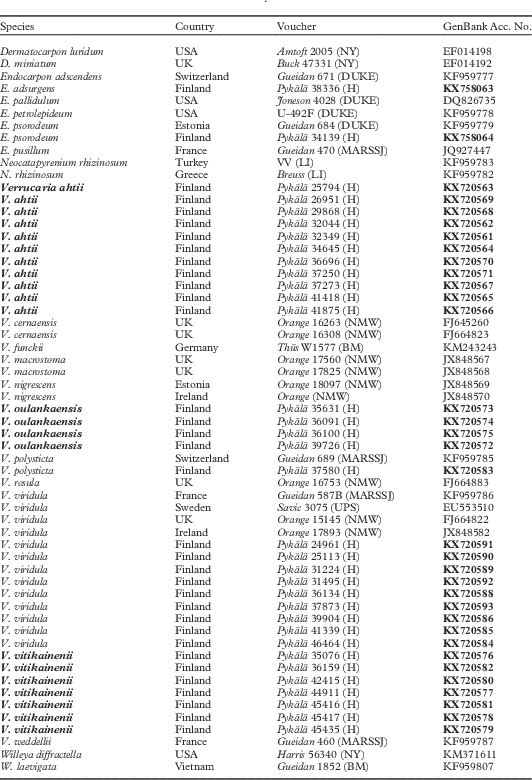
Total genomic DNA was extracted from 1 to 3 perithecia of two to six-year-old herbarium specimens. All but 13 samples (see below) were placed in 96-well microplates and sent to the Canadian Centre for DNA Barcoding (CCDB). CCDB’s standard protocols (documentation available at http://ccdb.ca/resources.php) were used for extraction, PCR and sequencing. Primers ITS1-LM (Myllys et al. Reference Myllys, Lohtander, Källersjö and Tehler1999) and ITS4 (White et al. Reference White, Bruns, Lee and Taylor1990) were used both for PCR and sequencing of the nuclear ribosomal ITS barcode region. The barcode sequences and their trace files, along with all relevant collection data and photographs of the voucher specimens, were uploaded to the Barcode of Life Data Systems (BOLD, http://www.boldsystems.org) database. The sequences were deposited in GenBank (Table 1).
Specimens used in the phylogenetic analyses. New species and sequences are in bold

DNA of the specimens Pykälä 24961, 25113, 25794, 26951, 29868, 31224, 31495, 34775, 35076, 35631, 36134, 39726 and 39904 was extracted using DNeasy® Blood & Tissue kit by Qiagen following the protocol described in Myllys et al. (Reference Myllys, Velmala, Holien, Halonen, Wang and Goward2011) (Table 1). PCR reactions were prepared using PuReTaq Ready-To-Go PCR beads (GE Healthcare). The 25 µl reaction volume contained 19 µl of dH2O, 0·4 µM of each primer and 4 µl extracted DNA. PCR was run under the following conditions: initial denaturation for 5 min at 95°C followed by five cycles of 30 s at 95°C (denaturation), 30 s at 58°C (annealing), and 1 min at 72°C (extension); in the remaining 35 cycles the annealing temperature was decreased to 56°C, the PCR schedule ending with a final extension for 7 min at 72°C. PCR products were cleaned and sequenced by Macrogen Inc., South Korea (www.macrogen.fi). Primers ITS1F (Gardes & Bruns Reference Gardes and Bruns1993) and ITS4 (White et al. Reference White, Bruns, Lee and Taylor1990) were used both for PCR amplification and sequencing of the ITS regions.
Phylogenetic analyses
Based on a BLAST search (http://blast.ncbi.nlm.nih.gov/Blast.cgi) our new species belonged to the Endocarpon group as defined in Gueidan et al. (Reference Gueidan, Roux and Lutzoni2007). Consequently, the phylogenetic analysis included 35 ITS sequences representing species of the Endocarpon group, in addition to 22 ITS sequences obtained from the new species (Table 1). Dermatocarpon luridum (With.) J. R. Laundon and D. miniatum (L.) W. Mann were used as outgroup taxa based on the studies of Gueidan et al. (Reference Gueidan, Roux and Lutzoni2007) and Prieto et al. (Reference Prieto, Martínez, Aragón, Gueidan and Lutzoni2012). Altogether 34 new sequences were generated in this study and 25 sequences were loaded from GenBank.
A total of 59 ITS sequences were aligned with MUSCLE v.3.8.31 (Edgar Reference Edgar2004) using EMBL-EBI’s freely available web service (http://www.ebi.ac.uk/Tools/msa/muscle/). The aligned data set was subjected to maximum parsimony analysis as implemented in TNT v.1.1 (Goloboff et al. Reference Goloboff, Farris and Nixon2008). The analysis was performed using Traditional search with random addition of sequences with 100 replicates and TBR branch-swapping algorithm. Ten trees were saved for each replicate and gaps were treated as missing data. Node support was estimated using the bootstrapping method (Felsenstein Reference Felsenstein1985) with 1000 replicates.
Results and Discussion
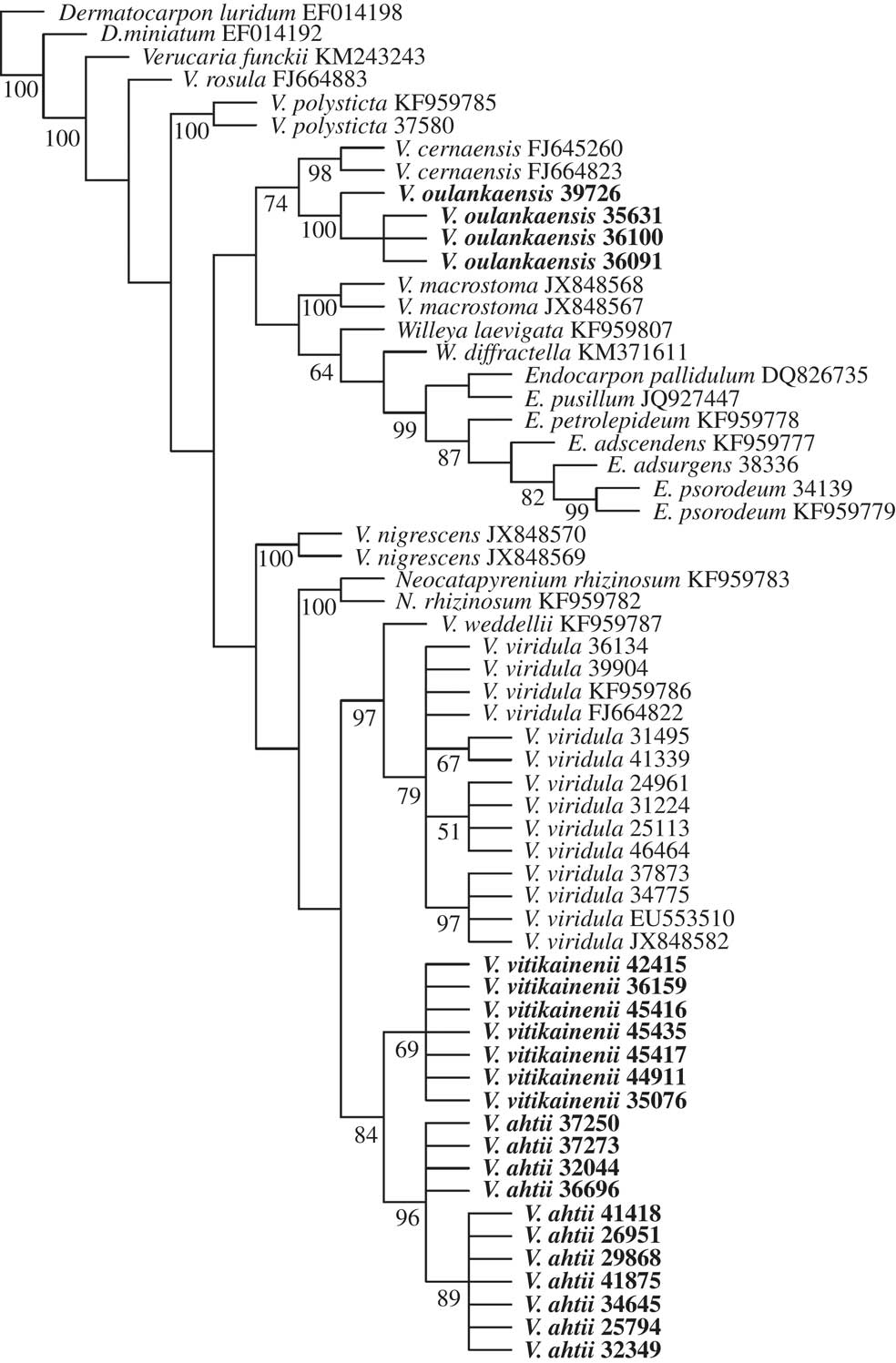
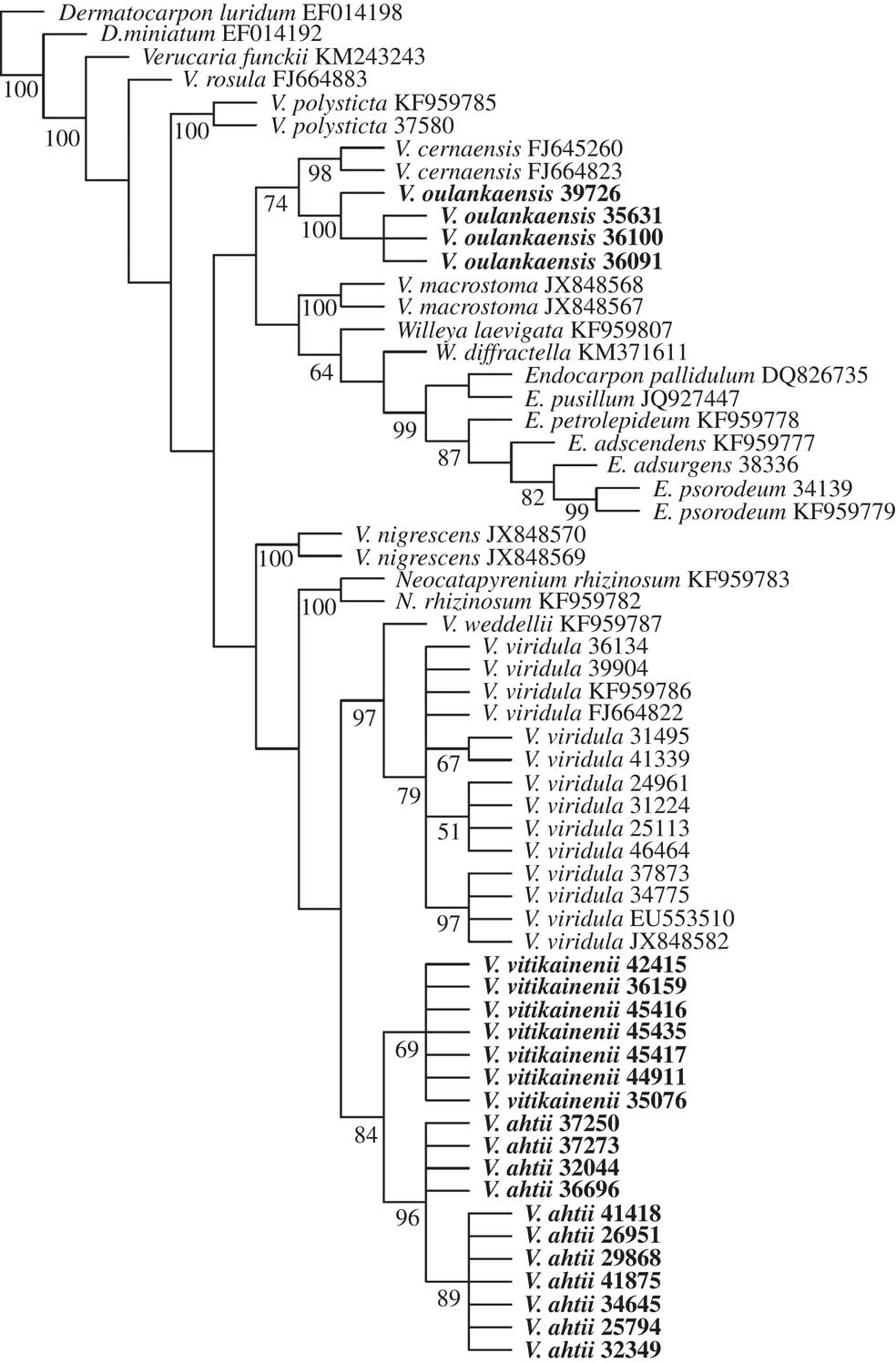
The ITS data set consisted of 528 characters of which 175 were parsimony informative. In the strict consensus tree, all three of the new species were recovered as monophyletic (Fig. 1). Verrucaria oulankaensis sp. nov., represented by four specimens, is related to the freshwater species V. cernaensis. The two species are also morphologically similar, differing mainly in their thallus characters (see detailed discussion under species descriptions). Verrucaria ahtii sp. nov., 11 specimens of which were included in this study, and V. vitikainenii sp. nov., with seven specimens, are sister species with 84% support value and they form an unsupported group with V. weddellii and V. viridula. Our new species, however, do not resemble these two species morphologically. The monophyly of V. vitikainenii is relatively poorly supported (69%), but the species is morphologically well defined (see species descriptions).
Phylogenetic relationships of Verrucaria ahtii, V. oulankaensis and V. vitikainenii. Strict consensus tree based on ITS data set with bootstrap values (>50%) at nodes. New species described in this study are indicated in bold.
The Species
Verrucaria ahtii Pykälä, Launis & Myllys sp. nov.
MycoBank No.: MB 817958
Similar to V. apomelaena (A. Massal.) Hepp, but with a thinner involucrellum, (25%–)50–75%–immersed perithecia and a fimbriate prothallus.
Type: Finland, Varsinais-Suomi, Lohja, Lohja, NW of Tytyri lime processing factory, high road bank, on pebbles enriched by calciferous dust, 53 m, 60°15'N, 24°04'E, 6 February 2008, J. Pykälä 32349 (H—holotype). GenBank Accession number: KX720561 (ITS).
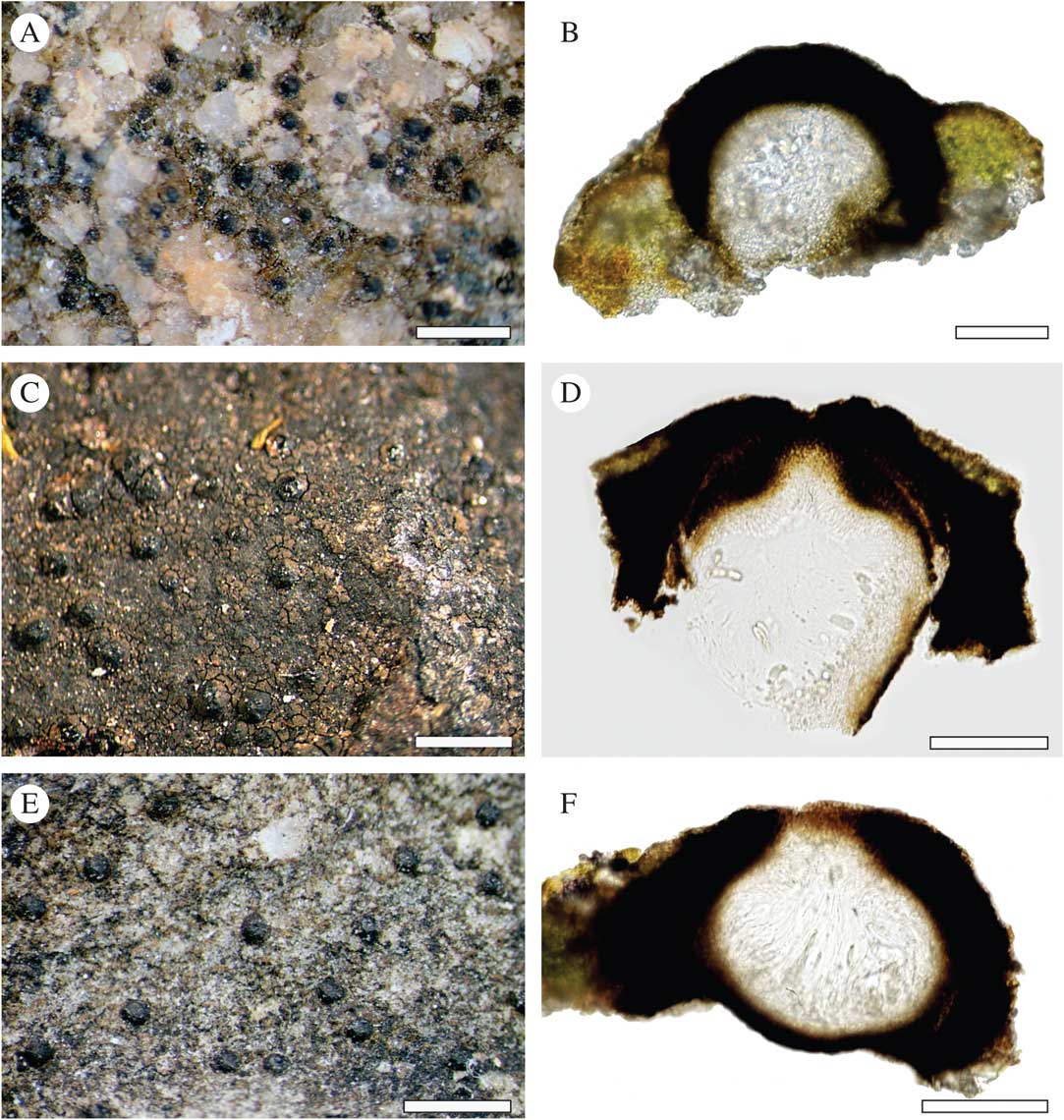
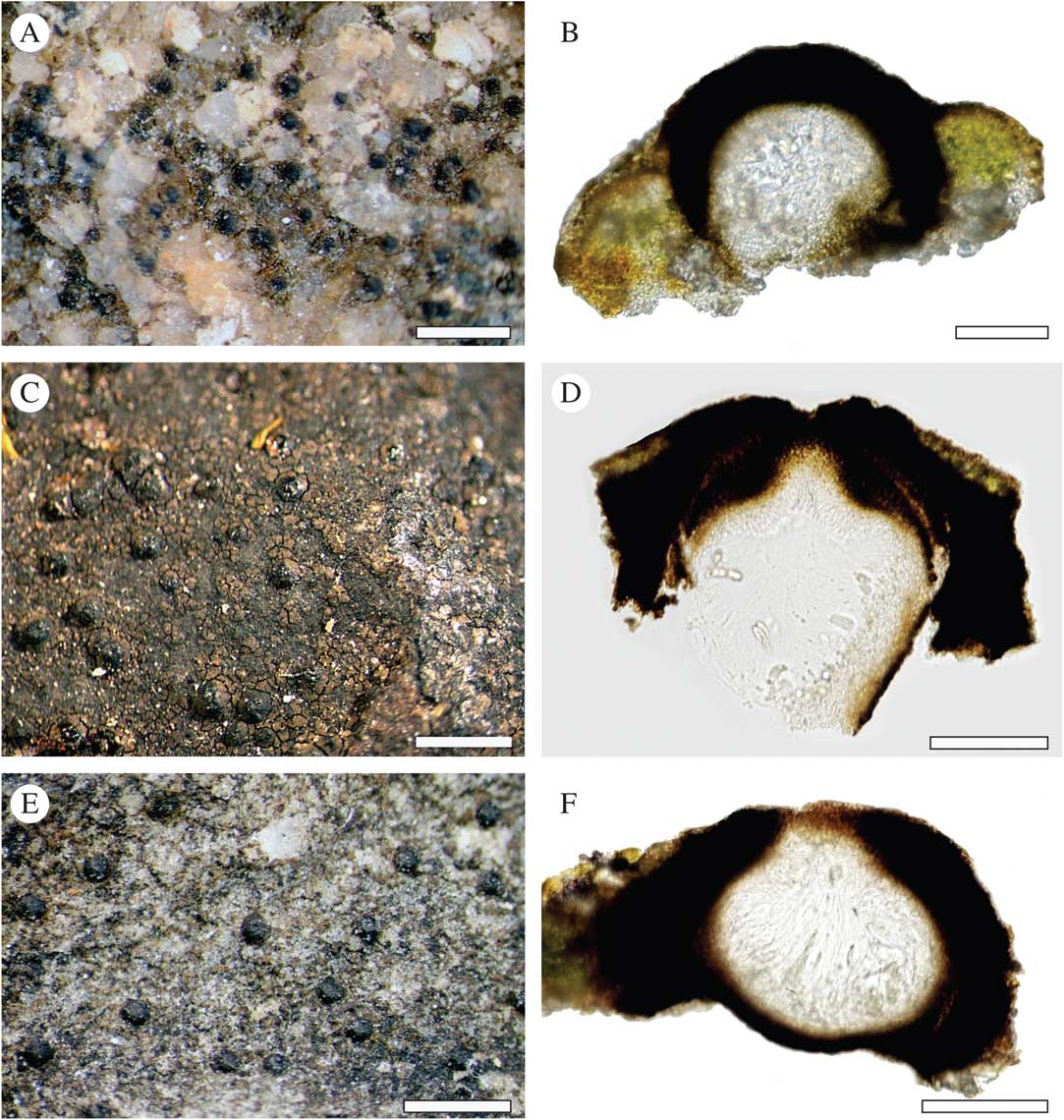
A & B, Verrucaria ahtii (holotype); A, habitus; B, section through perithecium. C & D, V. oulankaensis (holotype); C, habitus; D, section through perithecium. E & F, V. vitikainenii (holotype); E, habitus; F, section through perithecium. Scales: A, C & E=1 mm; B, D & F=100 μm. In colour online.
Prothallus medium brown or dark brown, fimbriate, usually rather inconspicuous. Thallus grey (rarely), pale brown or medium brown, fleck-like, continuous or rimose, c. 0·02–0·15(–0·25)mm thick; thallus or thallus surface uneven, commonly consisting of tiny units of 0·03–0·08(–0·13)mm diam., algal cells c. 5–11 μm, cortex c. 10–24 μm thick, cortical cells brown.
Perithecia 0·15–0·32 mm diam., (25–)50–75%-immersed in thallus, not leaving pits, often with a thin thalline cover, thalline cover c. 11–24 μm thick; perithecial density 60–180(–220) cm–2. Ostiole inconspicuous, pale or usually dark, plane, depressed or often dark projecting papillae, c. 20–30–(50)μm wide. Involucrellum usually extending to the exciple base level, occasionally only exceeding half of the exciple, (20–)30–50 μm thick, in one specimen rarely increasing in thickness towards the base to 50–60 μm thick, appressed to the exciple or slightly diverging from it. Exciple 0·16–0·25(–0·32)mm diam., wall usually dark brown, in few specimens also pale exciple walls present, c. 13–18 μm thick. Periphysoids c. (20–)25–30(–40)×(1·5–)2·0–2·5(–3·0)μm. Ascospores (17·0–)20·6–23·1–25·5(–28·3)×(9·2–)10·2–11·3–12·4(–13·9)μm (n=223), perispore absent.
Etymology. The species is named in honour of Professor Teuvo Ahti for his major contributions to lichenology.
Habitat and distribution. Known from Finland, Lithuania and Russia. The species prefers sun-exposed sites. It often grows on calcareous pebbles or on siliceous pebbles enriched by calcareous dust. It also grows in lime quarries on south-facing walls and on concrete and mortar but was not detected in natural calcareous habitats. However, the Lithuanian specimens are from calcareous pebbles in dry semi-natural grassland.
Notes. Based on the ITS phylogeny, V. ahtii is closely related to V. vitikainenii. For differences with V. vitikainenii, see that species (below). The first collections of V. ahtii were originally identified as V. apomelaena (Pykälä Reference Pykälä2008) and V. gudbrandsdalensis Zschacke ex H. Magn. (Pykälä & Breuss Reference Pykälä and Breuss2008). Later some specimens in H were identified as V. invenusta H. Magn. Unfortunately, ITS sequences of V. apomelaena and V. invenusta are not available, but we detected some morphological differences between the taxa. Based on ITS sequences, V. gudbrandsdalensis is not closely related to V. ahtii (J. Pykälä, A. Launis & L. Myllys, unpublished data).
Verrucaria apomelaena (syntype: VER!) differs in a thicker involucrellum (40–70 μm thick), a larger exciple (0·20–0·35 mm wide) and the perithecia, which are 75%–(100%)-immersed in thalline warts. The syntype specimen lacks a prothallus. Verrucaria apomelaena is excluded from the Finnish lichen flora.
Verrucaria gudbrandsdalensis (UPS-L-194855!, H!, syntypes) has larger perithecia (0·2–0·4 mm diam.), thinner periphysoids (1·5–2·0 μm thick), a usually grey (rather rarely pale brown) thallus and a prothallus is lacking.
The involucrellum of V. invenusta (syntypes: UPS-487169!, S-L72!) often thickens to the exciple base to c. 40–70 μm thick. The exciple wall is pale or pale brown. The prothallus was not seen. The type material is from a schistose rock outcrop in northern Sweden, whereas V. ahtii seems to occur in Finland only in the southern part of the country on calcareous habitats. Nevertheless, based on morphology, V. invenusta may be related to V. ahtii.
The identity of the Finnish specimen reported as V. invenusta in Pykälä & Breuss (Reference Pykälä and Breuss2009) is uncertain. It does not belong to V. ahtii, and probably not to V. invenusta, but might represent another unidentified species of Verrucaria. The Lithuanian and Russian specimens erroneously reported as V. invenusta (Motiejūnaitė et al. Reference Motiejūnaitė, Berglund, Czarnota, Himelbrant, Högnabba, Konoreva, Korchikov, Kubiak, Kukwa and Kuznetsova2012; Pykälä et al. Reference Pykälä, Stepanchikova, Himelbrant, Kuznetsova and Alexeeva2012) represent V. ahtii.
Additional specimens examined. Finland: Varsinais-Suomi: Lohja, Pietilä, W of Lentoo, small dry grassland, house ruins, on mortar, 42 m, 60°13'N, 23°54'E, 2004, Pykälä 25794 (H); Lohja, Hermala, Kalkkimäki, 150 m NW of Kekla lime quarry, road cutting of calcareous rock outcrop, on pebbles, 53 m, 60°13'N, 23°51'E, 2005, Pykälä 26951 (H); Salo (Kiikala), Saari, Kalkkimäki, abandoned lime quarry, on SE-facing wall, 105 m, 60°25'N, 23°40'E, 2009, Pykälä 34645 (H); Länsi-Turunmaa (Parainen), Ersby, N of Sementtitie Road, siliceous rock outcrop enriched by calcareous dust, on pebbles, 40 m, 60°17'N, 22°15'E, 2009, Pykälä 36696 (H); Länsi-Turunmaa (Parainen), Simonby, Gropen, abandoned lime quarry, road cutting of calciferous rock outcrop, on pebbles, 15 m, 60°16'N, 22°14'E, 2009, Pykälä 37250 (H); Länsi-Turunmaa (Parainen), Simonby, Gropen, abandoned lime quarry, road verge, on pebbles, 18 m, 60°16'N, 22°14'E, 2009, Pykälä 37273 (H). Uusimaa: Sipoo, Träsk, Kalkstrand, N of lime processing factory, flat siliceous rock outcrop enriched by calciferous dust, on path, on pebbles, 20 m, 60°15'N, 25°23'E, 2006, Pykälä 29868 (H); Sipoo, Träsk, Kalkstrand, lime quarry, E-slope, quarry spoil gravel on siliceous rock outcrop, on calcareous pebbles, 12 m, 60°15'N, 25°23'E, 2010, Pykälä 41418 (H); Helsinki (Vantaa), Västersundom, 400 m NW Vikkulla, abandoned lime quarry on shore of the Baltic Sea, on SW-facing wall, 2 m, 60°13'N, 25°09'E, 2011, Pykälä 41875 (H).—Russia: Leningrad Region: Vyborg District, Berezovye Islands (Koiviston Saaret), Zapadny Berezovy Island (Tiurinsaari), 60°20'N, 28°31'E, on concrete of old military construction, 2004, Alexeeva (H) (not sequenced).—Lithuania: Utena County: Ignalina District, Aukštaitija National Park, Stripeikiai Village, close to Traditional Apiculture Museum, dry grassland, on calcareous pebbles, 55°24'N, 25°56'E, 2011, Pykälä 46085, 46087 (H) (not sequenced).
Verrucaria oulankaensis Pykälä & Myllys sp. nov.
MycoBank No.: MB 817959
Similar to V. cernaensis Zschacke but differs in an often pruinose, small areolate (not rimose to areolate) thallus and narrower spores.
Type: Finland, Koillismaa, Salla, Oulanka National Park, Pikkuköngäs, shore of Oulankajoki River, high cliff, calciferous (dolomite) schistose rock outcrop, on SW-facing wall, 180 m, 66°25'N, 29°09'E, 10 August 2009, J. Pykälä 36100 (H—holotype). GenBank Accession number: KX720575 (ITS).
Prothallus dark brown, non-fimbriate. Thallus pale brown, brownish grey, medium brown or dark brown, usually grey pruinose, areolate, 0·1–0·2 mm thick, fertile areoles 0·2–0·7 mm diam., sterile areoles 0·1–0·4 mm diam., algal cells 5–10 μm, cortex 6–24 μm thick, cortical cells pale or brown, epinecral layer sometimes present, medulla not differentiated.
Perithecia 0·12–0·27 mm diam., (50–)75–100%-immersed in thallus or in thalline warts; perithecial density 80–160 cm–2; 1(–2) perithecia per areole. Ostiole inconspicuous, dark, depressed, c. 20–60 μm wide. Involucrellum covering half of the exciple or extending to the exciple base level, c. (40–)50–70(–80) μm thick, appressed to the exciple or slightly diverging from it. Exciple 0·15–0·25 mm diam., wall dark brown, 16–21 μm thick. Periphysoids 20–35×(1·5–)2·0–2·5 μm. Asci c. 50–61×19–24 μm, 8-spored. Ascospores (15·2–)16·2–17·7–19·3(–22·4)×(7·2–)7·7–8·4–9·1(–10·3)μm (n=62), perispore absent.
Pycnidia not seen.
Etymology. Most collections are from the Oulanka area, one of the lichenologically most important areas in Finland.
Habitat and distribution. Known from north-eastern Finland. All collections are from calcareous or calciferous rocks on river shores. The species occurs on the upper part of the geolittoral zone affected by spring flooding, often growing with Staurothele areolata (Ach.) Lettau. Calcareous rocks on river shores are very rare in Finland and are mostly found in the Oulanka area. It is possible that V. oulankaensis is a north-eastern species hardly reaching Fennoscandia and Europe. The biogeographical province Koillismaa (Ks), particularly the Oulanka area, is well known for very rare lichens in the European context, such as Nephroma helveticum Ach. and Peltigera retifoveata Vitik.
Notes. Verrucaria oulankaensis is usually easily identified by its pruinose small areolate thallus and rather short spores compared to their width. Based on the ITS phylogeny, V. oulankaensis is related to V. cernaensis (95% similarity in ITS). Verrucaria oulankaensis is also morphologically rather similar to the descriptions of V. cernaensis given by Zschacke (Reference Zschacke1927) and Orange (Reference Orange2013), as well as to the syntype of the species (M-0023497!). Verrucaria cernaensis and V. oulankaensis mainly differ in thallus characters. Verrucaria cernaensis has a non-pruinose thallus, which is rimose to cracked-areolate, whereas areoles of V. oulankaensis are mainly separated from each other. The thallus of V. oulankaensis is clearly thicker surrounding the perithecia, somewhat convex in fertile areoles, and the perithecia are commonly 75–100%-immersed in thalline warts and on a higher level than the surrounding sterile areoles. The colour of the exciple wall varies in V. cernaensis from pale to dark, whereas in V. oulankaensis only dark exciples were seen. Pycnidia have been reported as common in V. cernaensis (Orange Reference Orange2013), but were not detected in V. oulankaensis. Verrucaria cernaensis also has broader spores: mean 10·6 μm (Orange Reference Orange2013). It is possible that some specimens of V. oulankaensis (lacking pruina) might be difficult to separate from V. cernaensis.
Verrucaria oulankaensis may also resemble species of the V. nigrescens Pers. complex. These species, also members of the Endocarpon group, lack pruina and have a fimbriate prothallus.
Verrucaria obnigrescens Nyl. (as observed from the syntypes H!, H-NYL 2625!) is superficially rather similar to V. oulankaensis as both species have a grey pruinose small areolate thallus. Verrucaria obnigrescens, however, differs from V. oulankaensis in having considerably larger spores (20–27×10–14 μm). Furthermore, V. obnigrescens is characterized by a usually shorter involucrellum and a fimbriate prothallus.
The syntypes of V. mauriza Nyl. (H!, TUR-V!, H-NYL 2824! not identifiable) also have a small, areolate grey pruinose thallus, but the species has a fimbriate prothallus, smaller perithecia (0·15–0·20 mm) and a pale exciple.
Additional specimens examined. Finland: Koillismaa: Kuusamo, Paljakka, E shore of Kuusinkijoki River, Kiukaankorva, nature reserve, dolomite rock outcrop, on SW-facing wall, with Staurothele areolata, 214 m, 66°11'N, 29°38'E, 2009, Pykälä 35631 (H); Salla, Oulanka National Park, Pikkuköngäs, shore of Oulankajoki River, high cliff, calciferous (dolomite) schistose rock outcrop, on overhanging SW-facing wall, 180 m, 66°25'N, 29°09'E, 2009, Pykälä 36091 (H); Kuusamo, Juuma, Oulanka National Park, Jyrävä, shore of Kitkajoki, cliff, calciferous (dolomite) schistose rock outcrop, on SW-facing wall, with Staurothele areolata, 206 m, 66°15'N, 29°26'E, 2010, Pykälä 39726 (H).
Verrucaria vitikainenii Pykälä, Launis & Myllys sp. nov.
MycoBank No.: MB 817960
Similar to V. ahtii, but thallus darker brown, prothallus absent, perithecia lacking thalline cover, involucrellum thicker, exciple walls always dark and perithecia occurring more sparsely.
Type: Finland, Koillismaa, Salla, Hautajärvi, Kurtinniittykuru, cliff, dolomite rock outcrop, beneath W-facing wall, steep slope, on dolomite pebbles, 205 m, 66°26'N, 29°09'E, 29 August 2011, J. Pykälä 45435 (H—holotype). GenBank Accession number: KX720579 (ITS).
Prothallus absent. Thallus pale brown (rarely), medium brown or dark brown, fleck-like, sometimes continuous or granular, often poorly developed, c. 20–100 μm thick, cortex absent or c. 11–17 μm thick, cortical cells brown, algal cells 5–9 μm.
Perithecia 0·20–0·36 mm diam., 25–50%-immersed, not leaving pits, without thalline cover, occasionally irregular thin cover of dead cells; perithecial density 40–120 cm–2. Ostiole usually inconspicuous, pale brown to dark, plane or depressed, rarely projecting papillae-like, 20–50(–70) μm wide, ostiolar depression occasionally wide and up to 130 μm wide. Involucrellum to the exciple base level, occasionally enveloping the exciple, 30–60 μm thick, sometimes increasing in thickness towards the base to 60–80 μm thick, appressed to the exciple, more rarely slightly or moderately diverging from the exciple. Exciple 0·19–0·27 mm diam., wall rarely medium brown, usually dark brown or black, 14–21 μm thick. Periphysoids 15–40×(1·0–)1·5–2·5 μm. Asci c. 65–82×25–30 μm, 8-spored. Ascospores (19·7–)21·9–23·7–25·6(–28·7)×(10·1–)10·9–11·8–12·8(–14·4) μm (n=152), perispore absent.
Etymology. The species is named in honour of Dr Orvo Vitikainen who has with his modest style contributed significantly to the knowledge of taxonomy and biogeography of Finnish lichens.
Habitat and distribution. Known only from Finland. Verrucaria vitikainenii has a north-eastern distribution in Finland with only one isolated outpost known from south-west Finland. It occurs mainly in the Oulanka area in the biogeographical province Koillismaa (Ks) in north-east Finland. One specimen is from eastern Finland and one from south-west Finland. Outside the Oulanka area the species seems to be very rare. It is calcicolous growing on calcareous rock outcrops, stones and pebbles and might prefer half-shady habitats. We did not find any specimens occurring in limestone quarries. This suggests that the species might have declined due to mining of limestone.
Notes. The specimens of V. vitikainenii were first identified as V. triglavensis Servít (Pykälä Reference Pykälä2013). However, examination of the holotype specimen of V. triglavensis (PRM–756870!) revealed clear differences between the two species. Verrucaria triglavensis has perithecia leaving shallow to fairly deep pits, whereas the perithecia of V. vitikainenii do not leave pits. The spores of V. triglavensis are also larger: 24–30×13–15 μm.
Verrucaria vitikainenii may sometimes be difficult to separate from the closely related V. ahtii. Verrucaria ahtii, however, has a fimbriate prothallus, frequently a pale brown, thicker thallus and often thalline covered perithecia. Furthermore, V. ahtii may occasionally have pale exciples present and perithecia often occur more densely than in V. vitikainenii. The involucrellum of V. ahtii is also on average thinner than in V. vitikainenii. The two species have different ecology and distribution patterns: V. vitikainenii has an eastern or north-eastern distribution in Finland whereas V. ahtii is known only from southern Finland. Verrucaria vitikainenii has never been collected from artificial calcareous habitats whereas V. ahtii has not been collected from a natural calcareous habitat. Verrucaria vitikainenii prefers half-shady habitats whereas V. ahtii prefers sun-exposed sites.
All but one of the sequenced specimens of V. vitikainenii have identical ITS sequences. The specimen 42415 differs in nine bases, but it does not differ morphologically from the other specimens of V. vitikainenii.
Additional specimens examined. Finland: Varsinais-Suomi: Salo (Kisko), Haapaniemi, 200 m NW of Iso Sorronlahti, herb-rich heath forest, on calcareous stone, 56 m, 60°13'N, 23°30'E, 2009, Pykälä 35076 (H). Koillismaa: Kuusamo, Juuma, Oulanka National Park, Lammasvuoma, gorge, dolomite rock outcrop, on SW-facing wall, 220 m, 66°16'N, 29°26'E, 2009, Pykälä 36159 (H); Salla, Oulanka National Park, 1·4 km NE Savilampi, shore of Savinajoki River, cliff, dolomite rock outcrop, steep SE-slope, on dolomite pebbles, 190 m, 66°26'N, 29°11'E, 2011, Pykälä 44911 (H); Salla, Hautajärvi, Kurtinniittykuru, cliff, dolomite rock outcrop, beneath W-facing wall, steep slope, on dolomite pebbles, 205 m, 66°26'N, 29°09'E, 2011, Pykälä 45416 (H); Salla, Hautajärvi, Kurtinniittykuru, cliff, dolomite rock outcrop, on W-facing wall, 205 m, 66°26'N, 29°09'E, 2011, Pykälä 45417 (H). Pohjois-Karjala: Juuka, Polvela, Valkealampi, close by E-shore, Pinus sylvestris-dominated forest, calcareous rock outcrop, on W-facing wall, rather scarce, 175 m, 63°10'N, 29°07'E, 2011, Pykälä 42415 (H).
The fieldwork was carried out for the research project “Threatened lichens of calcareous rocks” (grant number YTB059), part of the research programme on deficiently known and threatened forest species (PUTTE) financed by the Ministry of the Environment. The ITS sequencing was financed by the Kone Foundation and the Finnish Cultural Foundation through the FinBOL project to the Finnish Museum of Natural History. Diana Weckman and Laura Häkkinen are thanked for laboratory work. Anna Palomäki took the photographs in Figs 2C and 2E. Herbarium visits were granted by Societas pro Fauna et Flora Fennica. We also thank Andreas Beck, František Bouda and Francesco Di Carlo for their hospitality during the visits to M, PRM and VER and the curators of the herbaria TUR-V and UPS for the loan of type specimens.