INTRODUCTION
Over the past two decades, as therapeutic options for adults with cancer have shifted to outpatient facilities and patients survive longer with active disease, the role of family caregivers has become essential and expansive. With little to no preparation, family caregivers are engulfed in patient care responsibilities such as assistance with activities of daily living, medication management and administration, provision of nutrition support, physical care, and emotional support, as well as transportation and household management (Yost et al., Reference Yost, McCorkle and Buhler–Wilkerson1993; Weitzner et al., Reference Weitzner, McMillan and Jacobsen1999; Given et al., Reference Given, Given and Kozachik2001). Historically and trans-culturally, there has always been a role for family caregivers; however, the level of technical, psychological, and physical support demanded of family caregivers at this time is unprecedented (Hudson, Reference Hudson2004; Proot et al., Reference Proot, Abu–Saad and ter Meulen2004). The responsibility for complex patient care may reside with the family member without regard for adequacy of resources or sufficiency of skill. Subsequently, family caregivers can suffer a myriad of physical, mental, social, and spiritual consequences, which may exceed that of the ill family member (Oberst & Scott, Reference Oberst and Scott1988; Oberst, et al., Reference Oberst, Thomas and Gass1989; Northouse et al., Reference Northouse, Mood and Kershaw2002; Harding et al., Reference Harding, Higginson and Donaldson2003; Matthews, Reference Matthews2003; Given et al., Reference Given, Wyatt and Given2004; Mellon et al., Reference Mellon, Northouse and Weiss2006; Northouse, 2006; McCorkle et al., Reference McCorkle, Siefert and Dowd2007).
Despite growth in the number of publications dedicated to cancer caregivers, organization of the descriptive literature and aggregation of the results remains wanting. Because caregiving to an adult with cancer is a dynamic process, it seems logical that caregivers' perceived burden and psychosocial concerns would be different at different phases of the care recipient's disease. There is evidence of escalation in caregiver anxiety, depression, and psychological distress as the patient's functional status declines and as the patient nears death (Harding et al., Reference Harding, Higginson and Donaldson2003; Given et al., Reference Given, Wyatt and Given2004; Grunfeld et al., Reference Grunfeld, Coyle and Whelan2004; Kurtz et al., Reference Kurtz, Kurtz and Given2004; Grov et al., Reference Grov, Dahl and Moum2005).
The purpose of this review is to organize the literature in a meaningful way that can potentially capture the unique needs of caregivers at different times in the caregiving experience. The descriptive cancer family caregiver literature was reviewed with studies clustered by phase of disease (i.e., time of diagnosis, in treatment, post-treatment survivorship, palliative care/hospice, bereavement). Presented here is the literature describing family caregivers to patients receiving palliative and/or hospice care and those who are in the post-death bereavement phase.
METHOD
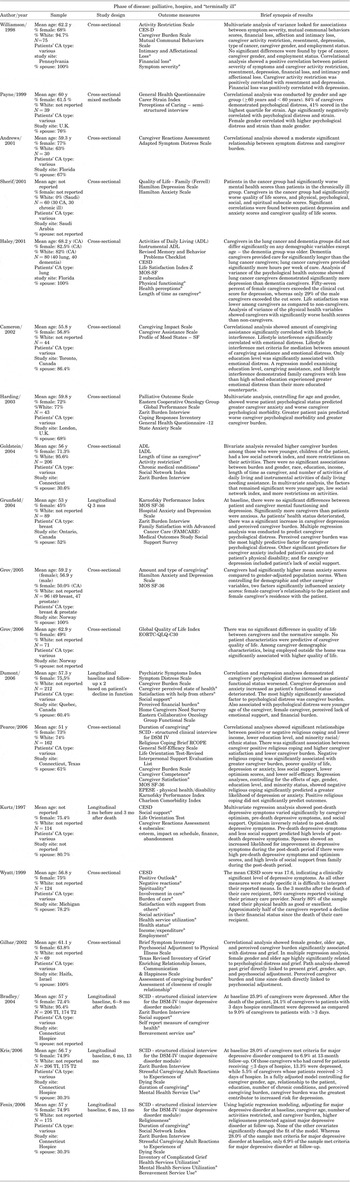
Three major databases were searched (Medline, CINAHL, and PubMed) from 1992–2007. The terms “caregiver,” “caregiving,” “neoplasm,” “oncology,” and “cancer” were entered as keywords. Results were limited to English language, non-intervention descriptive studies, and abstract review was conducted to further limit the sample to articles that included psychosocial variables of family caregivers to adult patients. Forty-five descriptive studies were identified. Of the 45 descriptive studies, 26 either mixed or did not report phase of disease, described caregivers to patients in treatment or caregivers to post-treatment survivors, and therefore were not included in this review. The remaining 19 studies assessed family caregivers caring for patients receiving palliative care, identified as “terminally ill”, enrolled in a hospice program (13 studies) or in the post-death bereavement phase (6 studies), and are reported here. The 19 studies reviewed appear in Table 1 catalogued under phase of disease, listing author and year, a description of the sample (size, mean age, percent female, relationship of caregiver to patient, race/ethnicity, patient's cancer type, study site), study design, outcome measures used, and a brief synopsis of results.
Descriptive studies evaluating psychosocial outcomes of cancer family caregivers during the palliative, hospice, and post-death bereavement phases

aIndicates a study-specific instrument.
RESULTS
Despite limiting the articles reviewed to descriptive studies of cancer family caregivers in the palliative, hospice, or post-death bereavement phases, there remained considerable heterogeneity relative to caregiver characteristics, patient characteristics, measurement tools, and analytic methods. The 19 English language studies were conducted in six countries: Canada (3 studies), Israel (1 study), Norway (2 studies), Saudi Arabia (1 study), United Kingdom (2 studies), United States (9 studies); one article did not report a study site. Study sample sizes ranged from 30 to 212. Of the 19 studies, >50% (11 studies) had a sample size of <100 family caregivers.
Six studies of the 19 were longitudinal in design, however, three of the studies (Bradley et al., Reference Bradley, Prigerson and Carlson2004; Fenix et al., Reference Fenix, Cherlin and Prigerson2006; Kris et al., Reference Kris, Cherlin and Prigerson2006) used the same data set. The two longitudinal studies from the palliative and hospice phase demonstrated an increase in perceived caregiver burden, depression, anxiety, and psychological distress among caregivers as the patient's condition deteriorated (Grunfeld et al., Reference Grunfeld, Coyle and Whelan2004; Dumont et al., Reference Dumont, Turgeon and Allard2006).
Most of the studies were of caregivers who attended to patients with a variety of cancers; only three studies focused on caregivers to individuals with a particular type of cancer: lung cancer (Haley et al., Reference Haley, LaMonde and Han2001), breast cancer (Grunfeld et al., Reference Grunfeld, Coyle and Whelan2004; Grov et al., Reference Grov, Dahl and Moum2005), and prostate (Grov et al., Reference Grov, Dahl and Moum2005). The three studies that looked at a particular type of cancer each had a sample size of <100 participants. The small samples made it difficult to interpret the influence of cancer type on the caregiver experience.
The extant literature frequently ascribed the relationship of the caregiver to the care recipient (spouse/partner, adult child, friend) as a key influence on the caregiving experience. Of the 19 studies reviewed, only 4 limited their sample to spouses, exclusively. Two studies did not report the caregiver's relationship to the care recipient, and the remaining 13 studies had caregiver samples that were composed of individuals with a variety of different relationships with the care recipient. Among the latter group, only 3 studies compared spouses versus non-spouses on psychosocial outcomes. Results were inconsistent. When comparing spouses versus non-spouses in the palliative/hospice phase, Cameron (Reference Cameron, Franche and Cheung2002) found no significant difference between groups, whereas Goldstein (Reference Goldstein, Concato and Fried2004) reports spouses had better psychosocial outcomes. The one study in the bereaved phase that compared spouses versus non-spouses found no influence from the relationship (Kurtz et al., Reference Kurtz, Kurtz and Given1997) (Table 2).
Studies showing impact of spouse versus non-spouse role on caregiver psychosocial outcomes

aCG, caregiver.
bNo studies = no studies demonstrated the outcome.
Age was a frequent predictor variable for psychosocial outcomes and also provided inconsistent results. Seven palliative studies examined age, all dichotomizing the variable at a cut-point in the sixth decade (Williamson et al., Reference Williamson, Shaffer and Schulz1998; Cameron et al., Reference Cameron, Franche and Cheung2002; Harding et al., Reference Harding, Higginson and Donaldson2003; Grov et al., Reference Grov, Dahl and Moum2005). Four of the seven studies showed no influence from age (Williamson et al., Reference Williamson, Shaffer and Schulz1998; Cameron et al., Reference Cameron, Franche and Cheung2002; Harding et al., Reference Harding, Higginson and Donaldson2003; Grov et al., Reference Grov, Dahl and Moum2005), whereas three studies showed younger caregivers experiencing worse psychosocial outcomes than did older caregivers (Payne et al., Reference Payne, Smith and Dean1999; Goldstein et al., Reference Goldstein, Concato and Fried2004; Dumont et al., Reference Dumont, Turgeon and Allard2006). One bereavement phase study looked at age as a predictor variable, and found older age predicted increased distress and grief (Gilbar & Ben-Zur, Reference Gilbar and Ben-Zur2002) (Table 3).
Studies showing impact of age on caregiver psychosocial outcomes

aCG, caregiver.
bNo studies = no studies demonstrated the outcome.
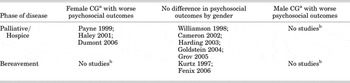
The effect of gender differences on psychosocial outcomes was reported with regularity, with eight palliative/hospice phase studies (Payne et al., Reference Payne, Smith and Dean1999; Hagedoorn et al., Reference Hagedoorn, Buunk and Kuijer2000; Iconomou et al., Reference Iconomou, Vagenakis and Kalofonos2001; Harding et al., Reference Harding, Higginson and Donaldson2003; Matthews, Reference Matthews2003; Gaugler et al., Reference Gaugler, Hanna and Linder2005; Dumont et al., Reference Dumont, Turgeon and Allard2006; Kim et al., Reference Kim, Baker and Spillers2006a, Reference Kim, Loscalzo and Wellisch2006b; Mellon et al., Reference Mellon, Northouse and Weiss2006) and two bereavement phase studies (Kurtz et al., Reference Kurtz, Kurtz and Given1997; Fenix et al., Reference Fenix, Cherlin and Prigerson2006) examining the association. Most commonly, no significant influence from gender was found (Williamson et al., Reference Williamson, Shaffer and Schulz1998; Cameron et al., Reference Cameron, Franche and Cheung2002; Harding et al., Reference Harding, Higginson and Donaldson2003; Goldstein et al., Reference Goldstein, Concato and Fried2004; Grov et al., Reference Grov, Dahl and Moum2005). Three palliative/hospice phase studies (Payne et al., Reference Payne, Smith and Dean1999; Haley et al., Reference Haley, LaMonde and Han2001; Dumont et al., Reference Dumont, Turgeon and Allard2006) showed that women had worse psychosocial outcomes than men (Table 4).
Studies showing impact of gender on caregiver psychosocial outcomes

aCG, caregiver.
bNo studies = no studies demonstrated the outcome.
For each of the demographic predictor variables of relationship to patient, age, and gender, the inconsistent results across studies may be related to whether the investigators controlled for confounders such as financial status, employment status, and competing demands on the caregiver's time and attention. When controls were in place, differences by predictor variables were less likely to be identified (Williamson et al., Reference Williamson, Shaffer and Schulz1998; Cameron et al., Reference Cameron, Franche and Cheung2002; Harding et al., Reference Harding, Higginson and Donaldson2003; Grov et al., Reference Grov, Dahl and Moum2005).
Patient–caregiver dyad analysis was conducted in eight studies in the palliative and hospice phase (Andrews, Reference Andrews2001; Haley et al., Reference Haley, LaMonde and Han2001; Sherif et al., Reference Sherif, Jehani and Saadani2001; Harding et al., Reference Harding, Higginson and Donaldson2003; Grunfeld et al., Reference Grunfeld, Coyle and Whelan2004; Dumont et al., Reference Dumont, Turgeon and Allard2006; Grov et al., Reference Grov, Fossa and Tonnessen2006). Although the studies assessed different key patient variables, ranging from physical and mental health symptoms, to measures of activities of daily living and intimacy, with rare exception there was mutuality between the patient's condition and the caregiver's response.
Across the 19 studies examining family caregivers in the palliative, hospice, and bereavement phases, 89 unique instruments were used. Almost half of the instruments (n = 41) were study specific with no psychometric testing reported. The vast majority of instruments used were exclusively self reports with only rare confirmation of the findings with an objective measure.
DISCUSSION
The descriptive psychosocial literature of cancer family caregivers was difficult to interpret in the aggregate, even when limiting evaluation to studies in the palliative, hospice, and bereavement phases. The major obstacle to aggregation was the lack of research standards. Many of the studies had small sample sizes which precluded subgroup analysis, and used cross-sectional designs thereby eliminating the opportunity to study caregiver maturation and adaptation as the disease changes over time. Commonly, the dynamic interplay between psychosocial, physical, and pragmatic needs was ignored, despite foundational work in the 1990's which looked at these interrelationships (Kurtz et al., Reference Kurtz, Kurtz and Given1997; Williamson et al., Reference Williamson, Shaffer and Schulz1998).
The number of unique measurement tools used in the reviewed studies (n = 89) is staggering, as is the reliance on study-specific tools (n = 41) particularly when, in many cases, a comparable valid and reliable instrument already existed. The 2003 review of self-report instruments to measure burden, needs, and quality of life (QOL) among family caregivers should provide an accessible resource for caregiver researchers selecting instruments in the future (Deeken et al., Reference Deeken, Taylor and Mangan2003). However, reliance on self-report measures without objective confirmation undermines the validity of study results. The addition of medical record review to ascertain the patient's clinical status is a simple, albeit time-consuming, way to corroborate family caregiver self-report data.
The body of literature reviewed here underscores the considerable contributions made by family caregivers and the burden they must shoulder. The mutuality between patient physical and emotional concerns and caregiver response is consistent across studies and dramatic in magnitude. Although not yet addressed in the caregiver literature, it seems logical that the mutuality of responses would be bidirectional between patients and caregivers. This means that in addition to considering an increase in perceived burden and psychological distress among caregivers as the patient deteriorates, we must, for example, also consider the consequences to the patient as the caregiver becomes more depressed and anxious.
Cancer family caregivers represent a sizable and diverse segment of the population who support their families, communities, and the healthcare system, often at the expense of their own health and well-being. The cost associated with family caregiving to individuals with cancer was conservatively estimated at $1 billion dollars annually in 2001 (Hayman et al., Reference Hayman, Langa and Kabeto2001) . This cost evaluation is based on survey data from the Asset and Health Dynamic Study (AHEAD) (N = 7,443) accounting solely for direct patient care hours and valuing those hours at $8.17/hour. The cost of family caregiving far exceeds $1 billion dollars when one considers the health and social consequences incurred by the caregiver.
CONCLUSIONS
To date, the opportunity to use the descriptive literature as a springboard to intervention studies has not been realized. Cancer family caregivers are a valuable resource whose needs should be accurately identified so that interventions to support their caregiving can be efficiently tested and supplied. As a direct consequence of assuming the caregiver role, cancer family caregivers in the palliative, hospice, and bereavement phases are at increased risk for physical and mental morbidity. Often the psychological burden of the caregiver exceeds that of the critically ill patient. It is possible that distressed caregivers have a deleterious influence on patient well-being. By aggregating the descriptive literature devoted to caregivers during the palliative, hospice, and bereavement phases, this review can help researchers design intervention studies that address appropriate questions and use suitable measurement tools.
ACKNOWLEDGMENTS
This study was supported by a grant from the National Institute of Health, National Center for Complementary and Alternative Medicine (F31AT003535).