INTRODUCTION
Of the more than 1000 anuran species in South-East Asia, more than 150 species have geographic ranges extending from equatorial to subtropical zones (Iskandar & Colijn Reference ISKANDAR and COLIJN2000). Some of these species reproduce successfully in environments that receive rain year-round, and in environments that have limited seasonal rainfall. Numerous studies of amphibians across environmental gradients provide examples where species, mainly in the temperate regions, have responded to increases in altitude and latitude with changes in clutch size (Berven Reference BERVEN1982, Riha & Berven Reference RIHA and BERVEN1991), time to metamorphosis (Bury & Adams Reference BURY and ADAMS1999, Gollman & Gollman Reference GOLLMAN and GOLLMAN1996, Howard & Wallace Reference HOWARD and WALLACE1985), egg size (Kaplan Reference KAPLAN1980, Pettus & Angleton Reference PETTUS and ANGLETON1967), and delayed onset of breeding (Highton Reference HIGHTON1962). Tropical species, despite their greater numbers and diversity, have not yet received comparable attention (Morrison & Hero Reference MORRISON and HERO2003). Further, few studies have examined life-history changes associated with rainfall gradients.
Within amphibian species, variation in clutch size is generally due to resource availability (e.g. higher net primary productivity, NPP, provides more energy to females that can then produce more eggs), body size (larger individuals lay more eggs; Duellman & Trueb Reference DUELLMAN and TRUEB1994), or physiological constraints on egg size and a trade-off between egg size and number (e.g. larger and fewer eggs at colder temperatures; Berven Reference BERVEN1982). Differences in breeding season length can also lead to differences in clutch size (Ritke et al. Reference RITKE, BABB and RITKE1992). If the annual reproduction of a species is the same across environments, then populations with restricted breeding seasons may lay fewer but larger clutches compared with populations that breed year-round. I examined reproduction of three common and widespread South-East Asian anuran species to test the hypothesis that tropical anurans lay smaller clutches where breeding season is longer compared with conspecifics in areas where breeding season is shorter. The results of this study on shifts in phenological traits, if they occur, may be useful in projecting anuran ability to respond to further environmental change.
STUDY SITES
Observations were conducted in Thailand at Sakaerat Environmental Research Station (14°30′N, 101°55′E), and in Singapore at the Singapore Zoo and adjoining Mandai Orchid Garden (1°24′N, 103°47′E). These study sites lie approximately 1600 km apart, and the three frog species occur throughout the intervening area. The study sites were chosen based on their rainfall patterns (6-mo rainy season in Thailand, year-round rain in Singapore), and presence of the three focal species. Amphibian diversity is similar (25 species at Sakaerat, 26 species in Singapore), and seven frog species are common to both sites (Chan-ard Reference CHAN-ARD2003, Lim & Lim Reference LIM and LIM2002). Further, the mean annual temperature for the two sites is the same (27°C), and the long-term mean temperatures for the study months are similar as well (26.8–27.8°C) (http://weatherbase.com). Thus, for the purposes of this study, the sites are roughly comparable, other than differences in rainfall as noted above. The study area in Thailand comprised secondary forest and cleared areas, and has a mean annual rainfall of 1260 mm, with most of the rain falling between April and September. The study areas in Singapore were mainly cleared areas with potted or landscaped vegetation adjacent to secondary and primary forest with a mean annual rainfall of 2345 mm distributed fairly evenly throughout the year.
For a complete description of the Thai site see Sheridan (Reference SHERIDAN2008a). Polypedates leucomystax and M. heymonsi were found on site at Sakaerat in Thailand, and H. erythraea was found in nearby rice fields. In Singapore, P. leucomystax and M. heymonsi were found at the Mandai Orchid Garden, and H. erythraea was found nearby at the Singapore Zoo. Both the Mandai Orchid Garden and the Singapore Zoo are cleared areas surrounded by secondary forest, adjacent to primary forest. In both locations, eggs of P. leucomystax and M. heymonsi were collected from man-made structures that had been used for breeding for several years prior to the start of the study. Eggs of H. erythraea were collected from rice paddies in Thailand and man-made ponds in Singapore. Although the Mandai Orchid Garden receives regular spraying with pesticides that may cause tadpole and adult mortality when rainfall is low, application of pesticides did not seem to affect adults or tadpoles when rainfall was frequent. When amplectant pairs were allowed to lay eggs in a basin in the laboratory, clutch size was within the range of clutch sizes seen in the field. Artificial breeding sites (shallow ponds and cisterns) were common in both Thailand and Singapore, but as for other anurans, it appears that standing water alone does not stimulate egg laying; breeding was triggered by rainfall combined with the presence of standing water (McCallum et al. Reference MCCALLUM, TRAUTH, MARY, MCDOWELL and WHEELER2004, K. Lovich, pers. comm., pers. obs.).
METHODS
Study species
Three common species were studied: Polypedates leucomystax Gravenhorst (Rhacophoridae), Microhyla heymonsi Vogt (Microhylidae), and Hylarana erythraea Schlegel (Ranidae), in Singapore where the breeding season is 12 mo and in central Thailand where the breeding season is 6 mo. All three species range from Indonesia in the south to northern Thailand or southern China (http://globalamphibians.org). The range of P. leucomystax extends west to India, but that of M. heymonsi and H. erythraea extends only as far west as Myanmar. All three species require standing water to complete their 22–90-d larval phase (Alcala Reference ALCALA1955, Heyer Reference HEYER1973, Sheridan Reference SHERIDAN2008b). Genetic sequence and call analyses of M. heymonsi and H. erythraea indicate that the study populations are conspecific (Sheridan Reference SHERIDAN2008b). The complete phylogeny of Polypedates leucomytax is not yet published, but P. leucomystax is generally acknowledged to be a species complex (Narins et al. Reference NARINS, FENG, YONG and CHRISTENSEN-DALSGAARD1998). Analysis of approximately 500 bp of the 16S mitochondrial gene sequence reveals that the two populations in the present study are about 3% divergent, and calls show significant differences in call duration, pulse number, and call rate. This may indicate that the two populations are closely related congeners, but further studies are necessary to fully resolve the issue. For the purposes of this study, the two populations are treated as conspecific.
Surveys and analyses
Observations were made sequentially in Thailand (21 and 17 wk) and Singapore (12 and 14 wk) between April 2005 and March 2007. Observations in 2005 were limited to only P. leucomystax; thereafter all three species were monitored. During each study period, study sites were searched for egg masses three to six times per week. Eggs of P. leucomystax are laid in a foam nest on vertical surfaces, usually overhanging water. Microhyla heymonsi and H. erythraea lay their eggs in a single layer on the surface of standing water. Hylarana erythraea lays its eggs among aquatic vegetation, rather than in open water, whereas M. heymonsi will lay its eggs in open water. Eggs were counted either in the field or in the laboratory, and were raised to tadpoles when necessary for species confirmation. Eggs of P. leucomystax lack a jelly capsule and can thus be measured with calipers to obtain egg diameter. If eggs of this species were found prior to developmental stage 13 (Gosner Reference GOSNER1960), the diameters of ten eggs were measured under a dissecting scope to the nearest 0.01 mm with digital calipers, averaged to give a mean egg size per clutch, and used to calculate clutch volume. Clutches that were large for a given study site were encountered on occasion, but all were double checked and determined to have been single clutches based on physical characteristics of the foam mass and the embryo's stage of development. Note that for P. leucomystax, not all clutches were used to calculate clutch volume as some clutches were found after eggs had passed Gosner (Reference GOSNER1960) stage 13. Clutch size, egg size, and clutch volume of P. leucomystax did not differ significantly between years in Thailand (ANOVA, F = 0.09–0.41, P > 0.52 for all), so data for both years were pooled for comparisons with Singapore. Except where noted, clutch size, egg size and clutch volume did not differ significantly between sampling periods at a given site for any species, so data from both study periods were pooled for cross-site comparisons.
The relationship between the number of eggs (clutch size) and rainfall was analysed in two ways: regressing mean weekly clutch size on rainfall of the week in which it was found, and regressing clutch size on rainfall of the day it was found plus the two previous days. Results were not different for these two methods, so only the results of the former analyses are presented here.
Areas were also surveyed weekly for 2–3 h at night to mark and measure adults. Adults were captured, sexed, measured and marked via toe-clipping (Hero Reference HERO1989) in order to estimate the proportion of individuals recaptured, to determine how often individuals breed in a single season. Following marking, adults were released immediately at point of capture.
In order to investigate whether females laid multiple clutches in a single breeding season, amplectant pairs of P. leucomystax, and M. heymonsi were collected and allowed to lay eggs in a basin, then females were preserved in 10% buffered formalin and later transferred to 70% ethanol. Any remaining ova in their body cavity were counted. If females contain large numbers (approximately equal to an average clutch) of fully developed eggs after oviposition, it is likely that these females will lay multiple clutches in a given season. If females contain some undeveloped eggs that are ≤50% the size of fully developed eggs, there is a possibility these females may lay multiple clutches in a given season, but it is unknown how long it takes these eggs to fully develop. Amplectant pairs of Hylarana erythraea were never encountered in Thailand, and rarely in Singapore. In order to compare relative reproduction of P. leucomystax between the two sites, given the significant difference in SVL, the volume of the female was calculated as for a cylinder. By using published head widths for this species (Inger Reference INGER1966) and by considering half the head width as the radius and SVL as the height of the cylinder, body volumes for each population were estimated. Mean clutch volume (mm3) was then divided by body volume (mm3) to get a corrected measure of reproductive output. Voucher specimens of adults were deposited in the Natural History Museum at Chulalongkorn University (Bangkok, Thailand) and the Raffles Museum of Biodiversity (Singapore).
RESULTS
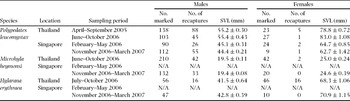
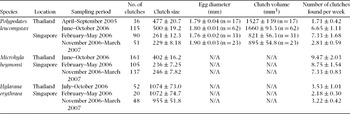
Summaries of snout–vent lengths, recaptures, and reproductive measures are presented in Tables 1 and 2.
Summary of number of adults marked and recaptured, and snout–vent length (SVL) for three species at Sakaerat, Thailand and in Singapore. Data are mean ± SE.

Summary of reproductive data for three species at Sakaerat, Thailand and in Singapore. Data are mean ± SE.

Polypedates leucomystax, Thailand
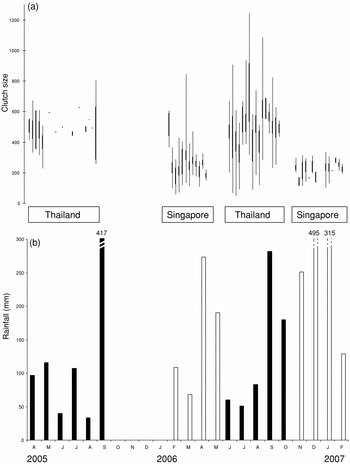
In 2005, there was no significant difference in clutch size (ANOVA, F20,15 = 0.14, P > 0.99; Figure 1), egg size (F4,9 = 0.46, P = 0.77), or clutch volume (F4,9 = 0.10, P = 0.98) between weeks. In 2006 clutch size (ANOVA, F13,93 = 1.88, P = 0.04) and egg size (F13,48 = 2.25, P = 0.02) varied between weeks, but there was no clear trend of an increase or decrease over time, and both were unrelated to recent rainfall (regression r2 < 0.09, P > 0.30 for both; Figure 1). Clutch volume did not differ significantly between weeks (F13,48 = 1.15, P = 0.34). In both the 2005 and 2006 sampling periods, number of clutches found per week did not change predictably and was not dependent on recent rainfall (regression r2 = 0.01, F1,19 = 0.28, P = 0.60 and r2 = 0.14, F1,15 = 0.22, P = 0.65, respectively).
Clutch size for Polypedates leucomystax and rainfall at Sakaerat, Thailand and in Singapore. (a) Clutch size for P. leucomystax. Thick bars indicate mean ± SE, thin bars show ranges. (b) Rainfall for Sakaerat, Thailand (solid bars) and Singapore (open bars) during the study period.

Eight of the nine females found in amplexus and allowed to oviposit in the laboratory retained no fully developed eggs, although they contained many developing ova of about 25–50% the diameter of fully developed eggs. Overall proportion of individuals recaptured in Thailand was 55% for males and 12% for females, with 17.7 ± 6.6 d between recaptures for females.
Polypedates leucomystax, Singapore
In both sampling periods, there was no significant difference in egg size or clutch volume (ANOVA F10,18 > 0.77, P > 0.13 for both) between weeks. In the February–May 2006 sampling period, there was a significant difference in clutch size between weeks (ANOVA F10,73 = 1.99, P = 0.047), but this was unrelated to recent rainfall (regression r2 = 0.12, F1,10 = 1.40, P = 0.26). Rather, the significant difference in clutch size between weeks was due to a single large clutch in the first week of the study with 606 eggs. The number of clutches found per week was unrelated to recent rainfall in either sampling period (regression r2 = 0.12, F1,10 = 1.40, P = 0.26 and r2 = 0.07, F1,14 = 1.08, P = 0.32, respectively).
In all five females discovered in amplexus that were allowed to oviposit in the laboratory, no fully developed eggs remained, although there were immature eggs 25–50% the diameter of mature eggs present in all cases. The proportion of individuals recaptured in Singapore was 40% for males and 9% for females, with 100 ± 79.3 d between recaptures of females. However, two of the females were recaptured after 21 d and a third was recaptured after 259 d.
Polypedates leucomystax, Thailand-Singapore comparison
Clutch size (ANOVA F1,290 = 186.5, P < 0.01) and clutch volume (ANOVA F1,131 = 64.9, P < 0.01) were significantly larger in Thailand than in Singapore. Egg size in Singapore for the February–May 2006 sampling period was smaller than that in Thailand (ANOVA F1,108 = 4.10, P = 0.045), but during the November 2006–March 2007 sampling period, egg size was larger than that in Thailand (ANOVA F1,100 = 16.0, P < 0.001).
Females and males were over 23% larger in Thailand than in Singapore (females ANOVA F1,73 = 235.9, P < 0.01, males ANOVA F1,409 = 1087, P < 0.01; Table 2). Using population mean values of SVL and clutch volume, the reproductive output for Thai females was 0.037, and 0.036 for Singapore females. The proportions of individuals recaptured were similar for the two study populations (arcsine test of percentages t = 0.07, n = 81, P > 0.20). Number of days between recaptures was similar in the two populations (ANOVA F1,7 = 2.45, P = 0.16), despite different mean values, most likely due to large range in number of days between recaps for the Singapore population (21–259 d).
The majority of individuals (8 of 9 in Thailand and 5 of 5 in Singapore) laid all fully developed eggs in a given oviposition event, but had smaller eggs already developing. The one exception was a Thai female which retained 316 fully developed ova.
Microhyla heymonsi, Thailand
From June–October 2006, clutch size did not differ between weeks (ANOVA F15,144 = 0.70, P = 0.78), and the number of clutches found per week was not related to recent rainfall (regression r2 = 0.01, F1,15 = 0.18, P = 0.69). Of the eight females captured in amplexus and allowed to lay eggs in the laboratory, none retained any fully developed eggs, but six had ova that were nearly full size, as well as some that were pigmented and about 50% the diameter of fully developed eggs, and some very small unpigmented ova. It is unknown how long it takes the remaining ova to become fully developed.
Microhyla heymonsi, Singapore
In the February–May 2006 sampling period, clutch size did not differ significantly between weeks (ANOVA F11,94 = 1.15, P = 0.33) and the number of clutches found per week was not related to rainfall (regression r2 = 0.05, F1,10 = 0.53, P = 0.48). In the November 2006–March 2007 sampling period, clutch size varied across weeks (ANOVA F17,117 = 1.81, P = 0.03), but was unrelated to rainfall (regression r2 = 0.004, F1,16 = 0.06, P = 0.80). Across both sampling periods, number of clutches found per week was unrelated to rainfall (regression r2 = 0.08, F1,16 = 1.33, P = 0.27).
None of the ten females collected in amplexus and allowed to lay eggs in the laboratory had any fully developed eggs remaining, but all contained undeveloped ova similar to those observed in Thailand.
Microhyla heymonsi, Thailand–Singapore comparison
Clutch size was significantly larger in Thailand than in Singapore (ANOVA F1,406 = 119.6, P < 0.01). Neither male (ANOVA F1,341 = 0.75, P = 0.4) nor female (ANOVA F1,55 = 0.6, P = 0.5) SVL differed significantly between Thailand and Singapore. No females in either population had fully developed eggs left following oviposition, but in both populations, females had immature ova remaining. The proportion of females recaptured in the two populations were similar (arcsine test of percentages t = 1.63, n = 60, P > 0.10; Table 1), indicating that number of breeding events per female is similar within the study period in both locations.
Hylarana erythraea, Thailand
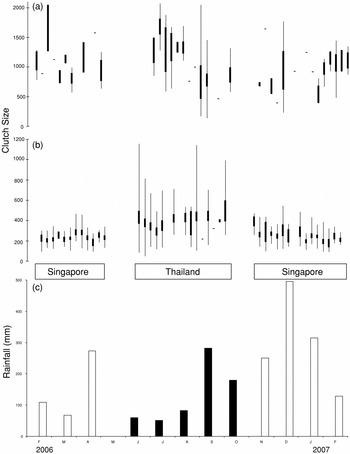
From July–October 2006 clutch size decreased sharply after 6 wk, and was nearly twice as large for the first 6 wk (1421 ± 78.4 eggs) as for the remaining 9 wk (776 ± 84.2 eggs; ANOVA F1,50 = 30.7, P < 0.001). Number of clutches found per week was unrelated to recent rainfall (regression r2 = 0.06, F1,13 = 0.76, P = 0.40). Although there was no significant difference in number of clutches found per week when clutch size decreased (ANOVA F1,13 = 0.13, P = 0.72), it is notable that for 6 of the final 9 wk, the number of clutches found was only 0 or 1 wk−1, while for the previous 6 wk, this value was 2–7 wk−1. Clutch size was inversely related to rainfall (regression r2 = 0.48, F1,10 = 9.41, P = 0.01; Figure 2).
Clutch size for Hylarana erythraea and Microhyla heymonsi and rainfall at Sakaerat, Thailand and in Singapore. (a) Clutch size for H. erythraea and (b) M. heymonsi at Sakaerat, Thailand and in Singapore. Thick bars indicate mean ± SE, thin bars show ranges. (c) Rainfall for Sakaerat, Thailand (solid bars) and Singapore (open bars) during the study period.

Hylarana erythraea, Singapore
In the February–May 2006 and November 2006–March 2007 sampling periods, clutch size did not differ significantly between weeks (ANOVA F11,9 = 1.31, P = 0.35 and F15,26 = 1.04, P = 0.45, respectively), and number of clutches found per week was unrelated to rainfall (regression r2 = 0.23, F1,9 = 2.71, P = 0.13 and r2 = 0.02, F1,16 = 0.38, P = 0.54, respectively).
Hylarana erythraea, Thailand–Singapore comparison
Clutch size in Singapore (991 ± 42.8) was smaller than clutch size from the first six survey weeks in Thailand (1421 ± 78.4; ANOVA F1,90 = 25.1, P < 0.01). However, clutch size in Singapore is not significantly different from that of the entire study period in Thailand (ANOVA F1,118 = 1.05, P = 0.31). Number of clutches found per week seemed to decrease towards the end of the survey period in Thailand, but this was not the case in Singapore. Body size of the two populations was not significantly different for either males (ANOVA F1,86 = 2.7, P = 0.1) or females (ANOVA F1,46 = 1.6, P = 0.2).
DISCUSSION
All three species have larger clutch sizes in the seasonal environment, suggesting an adaptation to shortened breeding season length.
Polypedates leucomystax
Clutch size, clutch volume, and body size varied between Thailand and Singapore but egg size was not significantly different between the study populations. Clutch size was 1.8–1.9 times larger in Thailand than in Singapore. However, the larger body size of the Thailand females likely contributes to the larger clutch size there compared with Singapore, as clutch volume scales with body volume. This suggests that reproductive output relative to body size is comparable in the two populations. In aseasonal Singapore, smaller females lay fewer eggs per clutch but may produce more clutches per year. This would result in similar numbers of offspring for the two populations, as the larger females in seasonal Thailand lay nearly twice as many eggs per clutch, but likely fewer clutches in a shorter breeding season. The different reproductive strategies (more eggs per clutch in the seasonal environment and presumably fewer clutches per year) should result in similar annual fecundity. This supports the hypothesis that populations in a seasonal environment make up for lost breeding time by producing more offspring in a given breeding event. The presence of undeveloped ova inside females post-oviposition in both populations, the similar proportions of female recaptured (12% in Thailand, 9% in Singapore), and the overlap in the range of number of days between recaptures, suggest that females of both populations reproduce multiple times in a single season and return to the breeding sites periodically. Unfortunately, sample sizes for these measures are small, and my observations do not permit a quantitative comparison of iteroparous behaviour at the study sites, but yolking-up undeveloped ova will presumably take weeks or months. The recaptured individuals were found again after approximately 20 d in most cases, which may be the minimum time necessary for females to yolk up another clutch after oviposition. Accurate measures of iteroparity and time between oviposition events can be difficult to obtain, but are necessary to accurately interpret data on reproductive variation between populations. Future studies examining iteroparity in these populations will allow for a more complete interpretation of the results presented here. Nevertheless, it is clear that this species has adapted reproductively to the contrasting environments through adaptations in female body size, and the number of eggs produced per clutch.
Microhyla heymonsi
Clutch size was 1.7 times larger in Thailand (seasonal) than in Singapore (aseasonal). Body size did not differ between the sites, so larger clutch size was not a result of larger body size. Females in Thailand produced more offspring in a single reproductive event than did females in Singapore that can breed year-round. This larger clutch size in Thailand appears to be an adaptation to the shorter breeding season (6 mo). Females in both populations contained undeveloped ova after oviposition, indicating that both populations may reproduce multiple times a year. Percentage of females recaptured was higher in Thailand (5%) than in Singapore (0%), but this difference was not significant.
Hylarana erythraea
Differences in H. erythraea clutch size between the seasonal and aseasonal sites was similar to that in the other two species, but were more complex as clutch size decreased with time in the seasonal environment. Clutch size in the first 6 wk of the breeding season in Thailand was significantly larger than that observed in Singapore. The difference decreased later in the season, however, as clutch sizes fell in Thailand but remained the same in Singapore. I interpret this to mean that in the seasonal environment the females lay most of their eggs at the first opportunity while those in aseasonal Singapore can breed repeatedly throughout the year. Although I did not examine the duration of the larval phase for either population, Alcala (Reference ALCALA1955) reports that for Philippines individuals reared in aquaria, the shortest time to metamorphosis was 66 d, and the mean time to metamorphosis was approximately 90 d. Thus, females in Thailand may be reproducing early in the breeding season in order to avoid exposing their offspring to desiccation in the larval phase late in the rainy season. Females in Singapore are not constrained in the same way, and are producing fewer offspring per breeding event, while females in Thailand may have fewer breeding opportunities per year. This suggests that females in the seasonal environment make up for lost larval developmental time with a greater fraction of their annual offspring production in a single reproductive event early in the rainy season. In this species, female body size did not vary between sites so the differences in reproductive output represent different strategies in contrasting environments.
CONCLUSIONS
All three species have adapted to the contrasting reproductive environments with larger clutches in the seasonally constrained environment. There is a difference in the clutch size of H. erythraea between weeks at the seasonal location (Thailand), and clutch size from the beginning of the sampling period in Thailand was significantly larger than that from Singapore, which did not change over time. In one of the three species, increased fecundity is associated with increased female body size, but in the other two species it is not. These data support the hypothesis that individuals in seasonal sites compensate for less breeding time by producing more offspring in a single reproductive event, and that adaptation involves a combination of morphological, behavioural and other changes.
It is important to consider alternative explanations for the observed trends. Although I did not quantify larval predators in either population, there were no major differences in predator assemblages and I assumed that while the assemblages contain different species, functionally they are similar. Further, habitat was not quantified in either location, but each site occurred in disturbed forest or cleared areas adjacent to primary forest. Thus, overall, I believe the study sites to be functionally similar, with the main difference being seasonality. Additionally, actual evapotranspiration (AE), which can be used as a proxy for net primary productivity (Rosenzweig Reference ROSENZWEIG1968), is higher in Singapore (annual AE = 1723 mm) than in Nakhon Ratchasima, the nearest major town to Sakaerat (1036 mm, Mather Reference MATHER1963), suggesting that larger clutch sizes in Thailand are not due to higher resource levels there. Thus, the larger clutch sizes observed in Thailand are likely due to seasonality differences and not differences in predator assemblages, habitat, or primary productivity.
Surprisingly few studies have examined clutch size variation across latitude in anurans, although some studies report egg size variation across latitude (Gollman & Gollman Reference GOLLMAN and GOLLMAN1996, Kaplan Reference KAPLAN1980, Moore Reference MOORE1949, Riha & Berven Reference RIHA and BERVEN1991). Clutch size variation has been studied extensively across elevation (Beattie Reference BEATTIE1987, Elmberg Reference ELMBERG1991, Howard & Wallace Reference HOWARD and WALLACE1985, Koskela & Pasanen Reference KOSKELA and PASANEN1975, Kozlowska Reference KOZLOWSKA1971, Lai et al. Reference LAI, KAM and LIN2003), which is generally assumed to mimic latitude in terms of temperature effects on clutch size and egg size. In the present study, mean temperatures are similar, but rainfall and seasonality differ. Many frog species in the aseasonal tropics breed year-round, while species in seasonal regions tend to breed only in rainy months (Duellman & Trueb Reference DUELLMAN and TRUEB1994). It has been shown that within temperate herpetofauna, populations at lower latitudes can reproduce more often in a given year than those at higher latitudes and populations that breed multiple times a year have smaller clutches than those that reproduce only once (Litzgus & Mousseau Reference LITZGUS and MOUSSEAU2001). The three species in the present study appear to show the same trend in that they adjust their clutch size in response to seasonality.
Anurans may be more sensitive to differences in breeding season length than to temperature (Parmesan & Yohe Reference PARMESAN and YOHE2003) and future studies of the limits of adaptability in anurans should focus on this and the response of life-history variables such as clutch size, frequency of oviposition, and time to metamorphosis. Further studies are needed to show whether life-history traits aside from clutch size vary between populations, and whether differences in degree of iteroparity or life expectancy, for example, also co-vary with breeding season length.
This is one of the first studies of tropical amphibians to examine reproductive differences across large geographic ranges. I set out to test whether frogs that occur in both aseasonal and seasonal habitats adjust their reproduction in response to varying breeding opportunities. For these three common species, the data indicate that they can indeed adapt to different climates. Future studies along a latitudinal gradient could help confirm whether differences in clutch size are due to seasonality differences. The Thai–Malay Peninsula has a seasonality gradient that ranges from year-round rainfall in most of Malaysia to increasingly longer dry seasons at higher latitudes (Wells Reference WELLS1999). If seasonality is truly driving variation in clutch size, variations in clutch size between populations intermediate between the sites of this study should mirror variations in seasonality. Future studies should also include species with restricted ecological niches, as the majority of South-East Asian anurans are forest-dwelling, and not human commensals like those studied here. Studies including controlled transplant and common garden experiments could determine how quickly these species can respond to environmental changes.
ACKNOWLEDGEMENTS
I wish to thank R. F. Inger, H. K. Voris, D. S. Woodruff, and two anonymous reviewers for valuable comments on the manuscript. Work in Thailand was facilitated by Taksin Artchawakom, Tanya Chan-Ard, Wichase Khonsue, Jarujin Nabithabata and Kumthorn Thirakupt. Research in Thailand was conducted under National Research Council of Thailand permit 0004.3/0191. The Singapore Zoo and the Mandai Orchid Garden provided access to field sites. Work in Singapore was made possible through the assistance of D. Bickford, C. Furley, B. Guha, T. M. Lee, N. Sodhi and C. Yeong. I thank J. Avina, H. Betts, D. Bickford, P. Bowles, R. Businello, A. Diesmos, K. Hesed, S. Ho, J. Kee, K. Kee, D. McLeod, L. Meijer, A. Ng, J. Ocock, R. Oon, H. Pong, M.R. Posa, P. See, P. Valcarcel and C. Yeong for their generous help in the field. Funding for this research was provided by a UCSD Graduate Biological Fellowship, Singapore Zoo Conservation Grant and the ASIH Gaige Fund Award.