INTRODUCTION
Southern hemisphere humpback whales (Megaptera novaeangliae) migrate from summer feeding grounds in the Antarctic to mating and calving grounds in tropical and sub-tropical regions near islands or offshore reef systems (Chittleborough, Reference Chittleborough1965; Dawbin, Reference Dawbin and Norris1966; Whitehead & Moore, Reference Whitehead and Moore1982). For many years, Abrolhos Bank was considered the only known breeding and calving ground for humpback whales in the western South Atlantic. However, the humpback whale population wintering along the Brazilian coast has increased (Kinas & Bethlem, Reference Kinas and Bethlem1998; Freitas et al., Reference Freitas, Kinas, Martins and Engel2004; Andriolo et al., Reference Andriolo, Kinas, Engel and Martins2006); between 6830 and 13,490 individuals were present during 2005 (Andriolo et al., Reference Andriolo, Kinas, Engel and Martins2006). Concomitantly, occurrence of humpback whales in other areas along the Brazilian coast has been reported (Lodi, Reference Lodi1994; Siciliano, Reference Siciliano1997; Pizzorno et al., Reference Pizzorno, Lailson-Brito, Dorneles, Azevedo and Gurgel1998; Martins, Reference Martins2004). Despite the apparent general expansion and increase in abundance of wintering humpback whales in coastal Brazilian waters, the area surrounding Abrolhos Archipelago continues to be recognized as an important calving area because of the proportion of groups with calves: roughly 50% of the groups sighted containing a calf (Martins et al., Reference Martins, Morete, Engel, Freitas, Secchi and Kinas2001; Morete et al., Reference Morete, Bisi and Rosso2003).
Whale abundance in a breeding area may fluctuate throughout winter because of variable migration patterns among groups (Dawbin, Reference Dawbin and Norris1966), local movements (Herman & Antinoja, Reference Herman and Antinoja1977), changes in social behaviour (e.g. Darling et al., Reference Darling, Gibson, Silber and Payne1983; Mobley & Herman, Reference Mobley and Herman1985; Mattila et al., Reference Mattila, Clapham, Vasquez and Bowman1994) or because some individuals may overwinter in high latitudes, a theory suggested by Brown et al. (Reference Brown, Corkeron, Hale, Schultz and Bryden1995) to explain the male-biased sex ratio on migration routes to breeding grounds.
Long term studies using consistent methods are important to characterize and detect population parameters changing over time. Knowledge of the consistency with which humpback whales use a nursing area should prove beneficial for designing future monitoring programmes. Herein, we summarize seven years of whale-count data collected from a land-based station on Abrolhos Archipelago. Even though the basic data collected cannot be construed to be an estimate of population size, they appear to form the basis of a robust index of local population abundance. Using a longer time series than that used in Morete et al. (Reference Morete, Bisi and Rosso2003) we are better able to describe the considerable within- and among-year dynamics observed in whale abundance in this important breeding area.
MATERIALS AND METHODS
Study area
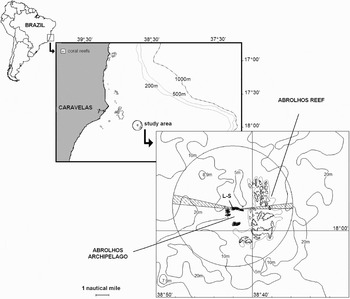
Abrolhos Bank (16º40′ to 19º30′S 37º25′ to 39º45′W) is located on an extension of the Brazilian continental shelf, on the east coast of Brazil (Figure 1). The Bank is a mosaic of coral reefs, mud and calcareous algae bottoms with warm (winter average temperature = 24°C) and shallow (average depth = 30 m) waters (IBAMA/Funatura, 1991). The extensive coral reef system and other oceanographic features found in the region are similar to those found in other humpback whale breeding grounds (e.g. Whitehead & Moore, Reference Whitehead and Moore1982; Clapham, Reference Clapham1996).
The study area which encompasses 9.3 km (5 n.m.) radius excluding the two blind areas (to east and west) from the land-based station (L-S) at Santa Barbara Island in the Abrolhos Archipelago, east coast of Brazil.

A land-based observation station (17º57′S 38º42′W) was established 37.8 m above sea level on the western portion of Santa Barbara Island, one of the five islands that comprise the Abrolhos Archipelago. Observers from the station surveyed a circular study area with a radius of 9.3 km (5 n.m.) surrounding the station, except for two areas hidden by islands: one to the east and one to the west, which covered arcs of 8º and 14º, respectively. Excluding blind spots, the study area was approximately 250 km2 with a maximum depth of 20 m. The Abrolhos Reef, which is a typical reef formation (14 km long by 6 km wide), covers approximately one-quarter of the area, from north-east to south-east (Figure 1).
Definitions
A season was defined as the period from July to November. A group was defined as either a lone whale or an association of whales with members within 100 m of each other, generally moving in the same direction in a coordinated manner (Whitehead, Reference Whitehead1983; Mobley & Herman, Reference Mobley and Herman1985). A calf was defined as an animal in close proximity to another whale, estimated to be less than 50% of the length of the accompanying animal (Chittleborough, Reference Chittleborough1965) and presumably born during the current season. All non-calf whales were considered in this study to be adults because of the impossibility of distinguishing other age-related size-classes.
Observations
Observations were carried out almost daily (weather permitting) during July through to November of 1998–2004, however, data were not collected during rainy days, or when wind was greater than 20 knots and/or when sighting conditions were considered poor by the observers due to haze, glare and cloud cover. Data consisted of counts of whales seen during one-hour-scans. Scans were classified according to time of day (morning or afternoon). Morning scans occurred from 5:45 to 11:25 a.m. and afternoon scans from 12:25 to 4:45 p.m.
During each scan, three observers searched for humpback whale groups within the study area. The search was done by naked eye and 7 × 50 binoculars. Sighting cues consisted of blows, splashes caused by more active behaviour or exposure of a part of a whale's body. Once a group was sighted, the principal observer tracked the group with a theodolite (30-power monocular magnification) until group size, composition and behavioural states were determined. The principal observer also noted unique characteristics of animals in the group (i.e. scars, natural markings, and the shape of dorsal fin), and the group behaviour to distinguish the group from any other in close proximity so as to avoid double counting. Observers continued to watch some whale groups after the one-hour sample period in order to properly determine that group's composition. If movement of multiple groups concentrating in a small area confused the count of whales, the scan was cancelled, data were discarded and a new one-hour-scan was begun. There was some chance for biasing counts to be low due to restarting, but because this happened rarely and because restarts occurred within the same time block as discontinued scans, the overall influence should be negligible. It is also possible that some groups present during some scans were not counted. Groups that remain motionless (logging or resting) in areas of glare are difficult to detect, but restricting observations to good viewing conditions and scanning only out to 9.3 km, the likelihood that many groups were missed is small.
In some instances, groups were sighted only once during the scan and their composition could not be determined; these were identified as indeterminate groups. During our research all data were collected by the same principal researcher or by other observers that had been extensively trained by the principal researcher.
Statistical analyses
Generalized linear modelling (GLM) procedures (McCullagh & Nelder, Reference McCullagh and Nelder1989) were used to describe and compare the chronology of humpback whale sightings (adults and calves were analysed separately). Our first inclination was to use the Poisson distribution to produce model counts of adults and calves. Because of the over-dispersed characteristic of the counts of adults and calves (Hilborn & Mangel, Reference Hilborn and Mangel1997), negative binomial distributions and log links were also examined.
Time of day (morning or afternoon), year treated as a continuous variable (1998 to 2004), year treated as a categorical variable, day of season (since 1 July), and day of season2 were examined as predictors of counts of adults and calves. These predictors and possible two-way interactions (year by time of day, year by day of the season, year by day of the season2, time of day by day of the season, time of day by day of the season2) were tested by comparing Akaike information criterion (AIC) values among fitted models (Burnham & Anderson, Reference Burnham and Anderson2002). Models with smaller AIC values are supported more by the data. Differences in AIC (Δ AIC) ≤ 2 indicate no substantial difference between competing models, Δ AIC = 3–7 provides some evidence for a difference, and Δ AIC >10 indicate no support for the model with the higher AIC (Burnham & Anderson, Reference Burnham and Anderson2002).
Whale counts were modelled according to

where

and

Groups with indeterminate composition (IND) were initially excluded from our analyses. To examine the impact of having IND groups on the adult counts, we calculated mean number of non-calf animals across all other observed groups. Then, for all instances for which an IND group was recorded, we added the calculated value into the adult count data set to create a new response variable (adult + mean number of IND). A new set of competing models was run with this new response variable. Models with and without the IND groups included were compared.
All statistical computations were performed using the software R version 2.1.1 (R Development Core Team, 2005).
RESULTS
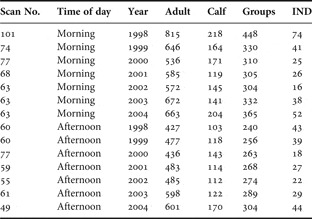
We collected a total of 930 one-hour scans (Table 1). Humpback whales were sighted from 3 July through to 27 November. During 101 scans, no whales were seen, but 4782 groups were observed during the remaining scans, among these, 494 (10.3%) groups sighted were considered IND, while the remaining 4288 (89.7%) groups included 10,044 humpback whales (2044 calves, 7996 adults). [NB: 2044 + 7996 = 10,040]
Numbers of adults and calves of humpback whales, total number of groups with determinate and indeterminate (IND) composition, sighted during one-hour scans around Abrolhos Archipelago, east coast of Brazil during July–November, 1998–2004.

Mean group size observed among non-IND groups was 1.87. The inclusion of IND groups had no impact on discerning the best model for adult counts. Models described similar patterns of fluctuating abundance among years, within years and between times of day. The only noticeable change was in the average number of whales seen each day, which we expected because we knowingly increased the total count for any scan during which an IND group was noted.
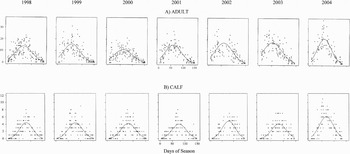
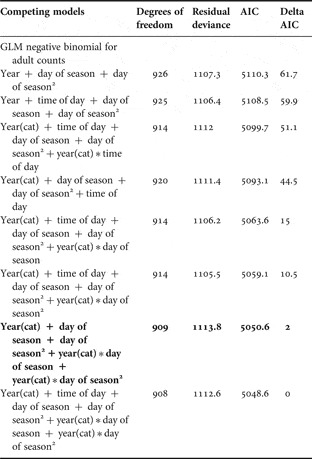
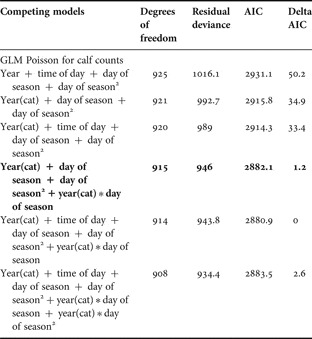
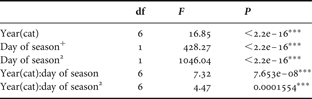
Competing GLM models for adult and calf counts were mostly well separated based on AIC scores (respectively Tables 2 & 3). Models of adult counts that assumed negative binomial data had lower AIC values than similar models that assumed adult counts were Poisson, whereas the Poisson assumption was adequate for calf counts. Preferred models adequately described count data showing a gradual build-up and decline in whale abundance during each year (Figure 2). Humpback whale adult counts during hourly scans ranged from 0 to 37 (Figure 2A). That adult counts varied among years was strongly supported by the data. In particular, during 2002, 2003 and 2004 many more whales were seen. The timing of the peak count also varied among years (from 22 August to 7 September) as evidenced by significant interactions between year and day of season, and year and day of season2 (Figure 2A; Table 4).
Numbers of adult (A) and calf (B) humpback whales sighted (º), and fitted values (line), from one-hour scans of a 250 km2 circular study area around Santa Barbara Island in the Abrolhos Archipelago, east coast of Brazil during July–November, 1998–2004.

Degrees of freedom, residual deviance, Akaike information criterion (AIC) and delta AIC of competing generalizes linear models (GLMs) for humpback whale adult counts, sighted during one-hour scans from 1998 to 2004, predicted by year, categorical year (year(cat)), day of season, day of season2, time of day, and interactions of year(cat):time of day, year(cat):day of season, and year(cat):day of season2. In bold are the models chosen by AIC.

Degrees of freedom, residual deviance, Akaike information criterion (AIC) and delta AIC of competing generalized linear modelling (GLMs) for humpback whale calf counts, sighted during one-hour scans from 1998 to 2004, predicted by year, categorical year (year(cat)), day of season, day of season2, time of day, and interactions of year(cat):time of day, year(cat):day of season, and year(cat):day of season2. In bold are the models chosen by AIC.

Statistical significance of the parameters for best fit of the generalized linear models, negative binomial distribution, used to predict numbers of adult humpback whales counted during one-hour scans around Abrolhos Archipelago, Bahia, Brazil during July–November, 1998–2004.
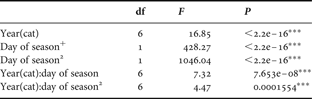
Significance codes: 0 ‘***’, 0.001; ‘**’, 0.01; ‘*’, 0.05; ‘.’, 0.1; ‘’,1. +, Days since 1 July.
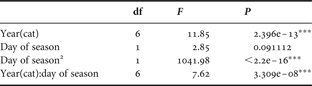
Calf counts ranged from 0 to 11 (Figure 2B). The timing of peak calf abundance also varied among years (from 7 September to 21 September). From 1998 to 2003 there was little evidence that calf abundance varied. However, there was a strong increase of calf counts during the 2004 season (Figure 2B; Table 5).
Statistical significance of the parameters for best fitted generalized linear model, Poisson distribution used to predict numbers of calves of humpback whales counted during one-hour scans around Abrolhos Archipelago, Bahia, Brazil during July–November, 1998–2004.
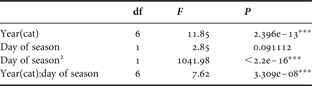
Significance codes: 0 ‘***’, 0.001; ‘**’, 0.01; ‘*’, 0.05; ‘.’, 0.1; ‘’, 1.
DISCUSSION
The pattern observed was a gradual build-up, concentration and gradual decline in whale abundance within each season. This gradual arrival and departure of individuals of whales near Abrolhos reflects a well described migration pattern (Dawbin, Reference Dawbin and Norris1966). The index of abundance of adult humpback whale sightings around Abrolhos Archipelago also varied among seasons. In particular, we saw more whales from 2001 to 2004. This increase in whale counts around Abrolhos Archipelago seems to reflect an overall increase in the humpback whale population wintering in Brazilian waters (Freitas et al., Reference Freitas, Kinas, Martins and Engel2004; Andriolo et al., Reference Andriolo, Kinas, Engel and Martins2006).
Martins (Reference Martins2004) using aerial surveys to study the distribution of humpback whales along the Abrolhos Bank from 2001 to 2003, noted that whale density increased in the region which includes our study area. Similarities with our study were also observed from vessel surveys around Abrolhos Bank. From 2002 to 2004, the sighting per unit of effort (SPUE) of adult humpback whales increased and the highest SPUE for calves was observed in 2004 (M. Marcondes, personal communication). Understanding the dynamics of the whales that use this region is important, because the area is very important for calves (Martins et al., Reference Martins, Morete, Engel, Freitas, Secchi and Kinas2001; Morete et al., Reference Morete, Bisi and Rosso2003) and also because it may be considered a reflection of patterns observed for the whole Abrolhos Bank, as changes in abundance of the population in a small area may reflect not only variation in local conditions but also variation in other locales (Ricklefs, Reference Ricklefs1993).
There are other factors that may lead to fluctuations in abundances intra and inter-season around Abrolhos. Ecological linkages with humpback whale migratory dynamics remain unknown, but a complex relationship between climate, sea-ice extent and annual krill productivity in Antarctic waters (Loeb et al., Reference Loeb, Siegel, Holm-Hansen, Hewitt, Fraser, Trivelpiece and Trivelpiece1997) could be influencing these dynamics. Craig et al. (Reference Craig, Herman, Gabriele and Pack2003) suggested that the availability of food in high latitudes may play a role in determining if or when whales migrate. The feeding grounds of humpback whales wintering off Brazil have been recently established (Stevick et al., Reference Stevick, Godoy, MCosker, Engel and Allen2005; Zerbini et al., Reference Zerbini, Andriolo, Heide-Jorgensen, Pizzorno, Maia, VanBlaricom, DeMaster, Simões-Lopes, Moreira and Bethlem2006), so studies correlating ecological events in their summering area may help to elucidate the dynamics of the observed fluctuation in the abundance of humpback whales in Abrolhos.
The observed intra-season variation of peak whale counts may be due to local movements of whales, as also reported by Darling et al. (Reference Darling, Gibson, Silber and Payne1983) in Hawaii. For the whole Abrolhos Bank, concentration areas for humpback whales also varied between 2001 and 2003 (Martins, Reference Martins2004). Zerbini et al. (Reference Zerbini, Andriolo, Heide-Jorgensen, Pizzorno, Maia, VanBlaricom, DeMaster, Simões-Lopes, Moreira and Bethlem2006) in a study towards the end of the season (October–November) showed that the residence pattern of whales in the Abrolhos Bank also varied. Some whales remained in relatively small areas for long periods, while others moved around the Bank or further south along the coast. Despite the daily or weekly stochastic variation of adult and calf counts in our study area, we observed significant fluctuations in overall whale abundance patterns.
Morete et al. (Reference Morete, Bisi and Rosso2003) reported that the number of adult whales counted during one-hour scans varied by time of day with more whales sighted during mornings, suggesting that morning and afternoon should be compared. Helweg & Herman (Reference Helweg and Herman1994) observed that the differences in humpback whale activity levels between periods could lead to differences in sightings and could therefore influence whale counts. In our study, which was conducted over a longer time frame, time of day was not important when modelling counts.
It is intriguing that while we noticed an apparent increase in adult counts since 2000, calf abundance was only significantly higher in 2004. So for the latter years of the study, our scan data reflect a gradual influx of adult whales to the area around Abrolhos Archipelago without a concomitant increase in calf abundance in most years. This could be a reflection of larger groups in the area increasing the adult/calf ratio. However, Morete et al. (Reference Morete, Pace III, Martins, Freitas and Engel2007) did not detect any differences in the proportion of different humpback group categories during these seven years. Hence, the question remains as to what caused this disparity. Potential hypotheses include females with calves selecting other areas as general abundance increases, a general decline in reproductive rate and a shift in population age structure that resulted from more mature males seeking reproductive opportunities.
This study showed that the general pattern observed in our smaller sampling area reflected observations made during aerial and vessel surveys in a larger sampled area of Abrolhos Bank. It also showed that the abundance of humpback whales around Abrolhos fluctuated. However, research is needed in both wintering and summering grounds of this population, to determine which factors (such as climate, sea-ice extent and annual krill productivity) can explain those fluctuations, and clarify those dynamics. Besides, knowledge of the consistency with which humpback whales use this important nursing area should prove beneficial for designing future monitoring programmes especially related to whale watching activities around Abrolhos Archipelago.
ACKNOWLEDGEMENTS
Funding and support for this research was provided by the Instituto Baleia Jubarte, IFAW, Petrobras, Arim Componentes para Fogão Ltda. and Abrolhos Marine National Park/IBAMA. We thank the Brazilian Navy (Rádio Farol de Abrolhos) for logistic support. We are indebted to the Instituto Baleia Jubarte interns, without whom data collection would not have been possible. Special thanks to Ms Cristiane Cavalcanti de Albuquerque Martins and Claudia Brigagão Petta for their helpful assistance in the field as principal investigators, to Professor PhD Pércio de Souza Santos Filho and Milton Marcondes for helpful comments on the manuscript.