A prominent explanation for why conflict occurs between countries is shifting power: states that are declining in power may act belligerently to prevent a decline and states that are increasing in power cannot credibly commit to not taking advantage of their new-found power in the future. A large literature has developed that describes why and how the dynamics of shifting power explain international conflict, ranging from power transition theory to formal accounts emphasizing commitment problems.Footnote 1 This literature largely adopts a “billiard ball” view of the state in which the influence of the public and domestic politics, as well as elite perceptions of both the internal and external environment, is bracketed. This approach contrasts with other literatures that have described mechanisms through which the public and domestic politics affect both international outcomesFootnote 2 and intrastate conflict.Footnote 3
This paper combines the theoretical and empirical motivations of both sets of literatures. It is the first to directly examine whether the public holds views that are consistent with the theoretical mechanisms suggested by models with shifting power. While a broad cross-section of research posits that the public has a role in constraining or enabling particular foreign policies,Footnote 4 this literature has not directly engaged with ideas prevalent in game-theoretic accounts of international bargaining and conflict. Furthermore, much survey work disengages from propositions and insights from game-theoretic literatures.
An emerging literature is just now beginning to consider the role of the public in game-theoretic models of international conflict. Several articles have addressed ways that the public matters in strategic models involving elite-public interaction.Footnote 5 Other work, which has inspired my present study, looks at how public preferences and responses might inform state decision making in international strategic contexts.Footnote 6 Citizens can play an important role in driving how states respond to shifting power. They also play a role in micro-level dynamics in intrastate disputes that involve shifting power.Footnote 7 Of course, to the extent that it is reasonable to use citizens as convenience samples of elites, the results I report here speak to elite decisions as well. This paper is an important first step in merging what have been separate literatures on public opinion and game theory, providing innovative tests of arguments about shifting power that have immediate relevance to international and intrastate bargaining.
One empirical focus of this paper is to test the simple proposition generated by theoretical models of shifting power that, from the perspective of those in the declining power, larger shifts in power generate greater credibility concerns and more bellicosity than do smaller shifts in power. If there is no shift in power, then there is no commitment problem. At a certain point, however, a shift in power becomes large enough to engender these concerns. This study uses a series of original survey experiments to interrogate this claim. The baseline manipulation uses a conflict situation involving the United States and estimates the effect that differences in the size of the power shift make for individuals' support for conflict. This is tested with both hypothetical vignettes and ones drawing on real-world events. As the shift in power becomes larger and more salient, I observe greater credibility concerns and increasing support for the use of force.
To understand how individuals analyzed this situation, I asked respondents to propose a response that the United States should make and then explain why they chose that option. In the experiment with the US as a declining power, I uncover a broad variety of motivating factors, including a concern for commitment-problem logics. The responses reveal that some people do evaluate the situation strategically. But other individuals focus less on the strategic aspects of the situation and more on basic structural features such as costs and benefits. Still others wanted to explore alternative ways of dealing with the problem rather than through military force. The focus on strategic considerations versus cost/benefit considerations represents distinct ways of evaluating the same situation. Such behavioral heterogeneity has been increasingly documented.Footnote 8
A second empirical focus is to examine the impulse to initiate conflict that citizens in a newly powerful state might feel. In the literature that explains how shifting power can lead to conflict, both rising and declining powers are motivated to belligerence. Power-transition models assume that a state with new-found power may want to obtain more favorable terms. Given that such a power transition has happened, will individuals in the advantaged state actually want to take advantage of the other side? I examine this situation through a vignette in which the United States is cast as a rising power, and I again find substantial variation in individuals' responses. Some want to take advantage of new-found power but most do not. This provides mixed evidence for standard rationalist accounts. I unpack this variation by analyzing how individuals evaluated the situation and connect these explanations to previous work on perspective taking and prospect theory.
A final manipulation to the experimental vignettes changes whether or not previous public commitments were made between the United States and its potential opponent. The crucial motivation for this manipulation is that shifting power arguments posit a “commitment problem.” A natural question from a behavioral perspective is whether public commitments reduce the commitment problem. Interestingly, my results do show that prior public commitments to the status quo division of territory mitigate the effects of large shifts in power. What explains this finding? Previous work in both international relations and American politics suggests that many individuals have a psychological motivation for behavioral consistency. I find additional evidence for this perspective and highlight that commitments can lead to expectations of consistency that trump concerns about credible commitments or potential future gains. Nevertheless, as in some previous work on audience costs,Footnote 9 some individuals are more concerned about consistency than others, illustrating the presence of heterogeneous behavioral patterns.
More broadly, my findings about heterogeneity in individual responses to international conflict parallel related work that emphasizes individual heterogeneity.Footnote 10 To explicitly document this heterogeneity, I asked respondents for both their preferred course of action as well as why they chose that course of action. This lets us unpack beliefs to help showcase the tight connections between beliefs and preferences.Footnote 11 I analyzed the open-ended survey responses using new methodological tools.Footnote 12 These tools extract common topics mentioned in the responses and link the propensity to talk about each topic with the respondent's treatment condition. In doing so, this method helps to uncover a range of mechanisms linking the treatment with respondents' policy preferences. These data reveal heterogeneities in how individuals respond to shifting power in much more detail than can usually be gained using more standard survey or experimental tools.
Theoretical and Empirical Foundations
To unpack the range of ways individuals could react to international bargaining, it is helpful to focus on two key parameters: changes in power and commitments, and how a behavioral perspective helps us to understand them. I also discuss literatures that prima facie predict heterogenous responses across individuals to shifting power.
Power Shifts
Rationalist models of shifting power focus on the commitment problems that shifting power creates. In the future, a rising power will take advantage of other countries, a fact that cannot be resolved with current commitments not to do so because there is no mechanism through which that commitment is enforced. As a result, the declining power is expected to initiate conflict to maximize its long-term utility. This paper takes a first step at analyzing whether or not individuals respond to shifting power in a way that comports with the commitment-problem logic by looking at decisions from the perspective of both a declining and rising power. Several psychological mechanisms might influence how individuals respond to these situations. These mechanisms, while quite different in content, all predict that individuals in declining powers will be more inclined to pursue aggressive foreign policies than those in a rising power.
First, a long literature examines individual perceptions of power.Footnote 13 Scholars have been interested in understanding how power relationships are perceived and constructedFootnote 14 and how such perceptions influence the way individuals interpret the intentions of others. One theme in this literature is that individuals perceive the power of other countries in terms of the threat this power poses to their own country. Hence another country's rising power is implicitly seen as a threat, which could reinforce or run parallel to concerns about commitment problems. But individuals do not see their own country in these terms:Footnote 15 individuals rarely perceive their own country's power, or positive changes in power, as threatening to others, even if their country is indeed powerful or becoming more powerful. This suggests that individuals in a declining power will support an adjustment to the distribution of resources to a greater degree than those in a rising power. Prospect theory makes a similar prediction about the asymmetry in individuals' responses to power shifts: individuals will be more concerned about the implications of their country's decline in power because it may lead to future losses, which are especially aggrieving because individuals are loss averse. When an individual's country gains in relative power, the utility from future acquisition is smaller in absolute magnitude than the decrease in utility from a future loss. Both the asymmetry in how individuals view the threat posed by their country versus the threat from other countries, as well as loss aversion, suggest that a decline in power is more likely to make individuals prefer hostile policies than is a rise in power.
Second, analogical reasoning may reinforce concerns about shifting power by drawing on past instances in which revisionist states violated commitments as they grew in power.Footnote 16 For example, a common trope prevalent to this day harks back to the perils of appeasing Hitler. Hence we should expect that core concerns about trust and being “taken advantage of” would be reinforced by historical analogies.Footnote 17 Broadly speaking, this is important because excessive reliance on analogical reasoning may lead to bad foreign policy outcomes.Footnote 18
The Credibility of Commitments
Given that shifting power can lead to commitment problems, it is helpful to review what we understand about the effects of commitments in conflictual settings. The standard view is that unless commitments are credible, which is established, for example, by making a commitment that is costly to make, they will be seen as cheap talk and thus ineffective. Some behavioral work challenges this claim.Footnote 19 In the present context, the crucial question is whether past non-costly commitments to not take advantage of gains in power have any influence on state behavior or citizen support for particular state policies.
Non-costly commitments might affect behavior through individuals' preference for consistency. Studies in both American politics and international relations find that individuals strongly oppose leaders who behave inconsistently with previous commitments. For example, while only briefly discussed, Tomz's well-known study of audience costs finds that a major (but not only) reason individuals punished a leader who backed down was because the leader did not “keep their word” and acted inconsistently.Footnote 20 This is important to highlight because audience-cost models assume that publics will punish politicians for not abiding by commitments but do not say why this happens. Other scholarship shows a similar preference for consistency by citizens both in international conflict contextsFootnote 21 as well as in other domains, such as voter decision making involving domestic policy commitments.Footnote 22 Just as Tomz helped to provide a clear behavioral mechanism for the audience-cost literature, my study also investigates whether a preference for consistency animates how individuals confront situations with shifts power.
Consistency, however, is not part of the story when it comes to traditional explanations of commitment problems. Rather, declining states launch a preventive war because of a rising power's inability to credibly commit to keeping a current arrangement in the future. Yet the belief that consistency and upholding an agreement are important in principle could mitigate commitment problems. For example, a public commitment from a rapidly rising power could reduce the public support in a declining power for a preventive strike. This could hold if, for example, it is broadly understood that consistency is valued in the rising power or if there are reputational costs to being seen as inconsistent. Indeed, a contribution of this paper is to begin exploring the nexus between commitments and commitment problems in situations with shifting power.
The preceding discussion of responses to shifting power and commitments highlights that individuals may confront and process information about a particular international bargaining situation in a variety of ways, thereby generating different ideas and beliefs.Footnote 23 This heterogeneity in ideas may reflect individual differences in perception and information processing.Footnote 24 Standard decision or game-theoretic models may or may not capture the way actual individuals process an international bargaining situation. I am trying to expand behavioral work in international relations to incorporate more directly the role of ideas and beliefsFootnote 25 in addition to behavioral outcomes and preferences. This move towards understanding differences both in how individuals respond to and think about a situation. This helps to put cognition alongside other work on affective processes.Footnote 26
Research Sample, Design, and Methodology
Research Sample
Most models of international bargaining posit either unitary actors or leaders constrained by their nation's institutional structure.Footnote 27 Because this paper uses experiments embedded in public opinion surveys to study the micro-foundations of responses to shifting power, it is important to explain how this connects to actors who have a direct impact on international relations and other conflict settings. I cover several connections: the public is a convenience sample of elites; the public can influence elite decisions; the public plays a core role in audience-cost theories that implicitly connect with shifting power explanations of conflict; and shifting power explanations of civil conflict directly involve members of the public.
Non-elite adult subjects can be seen as a convenience sample of elites. This perspective reflects the literature that emphasizes the role of individual leaders, often focusing on their psychological and even physiological characteristicsFootnote 28 Leaders are drawn from the adult population in a country, and like non-elites, leaders have psychological characteristics that can vary across individuals. For example, different leaders might well respond to the same objective situation in very different ways.Footnote 29 I explore this possibility with respect to responses to shifting power, but use a convenience sample of adults.
Even if elites are different somehow from members of the public, public opinion on international agreements that relate to shifts in power might influence elite decisions. As others have shown, politicians take into account public opinion when it comes to foreign policy considerations.Footnote 30 Thus if we think shifts of power are important to explaining conflict, it is important to show that publics are aware of and mobilized by shifts in power. For example, historian Walter McDougall, writing about the Soviet Union's leap beyond the US with the Sputnik program, noted, “No event since Pearl Harbor set off such repercussions in public life.”Footnote 31 Israeli Prime Minister Netanyahu cited Israeli public opinion in opposing the Iranian nuclear deal, connecting Iran's acquisition of nuclear weapons to a need for preventive strikes.Footnote 32 More broadly, the perspective that citizens are pertinent to international conflict bargaining is consistent with a range of previous work that has connected citizen preferences to international decision making in a variety of ways.Footnote 33
Two particular examples help to illustrate the role of the public in shifting power explanations of conflict. Consider first the implicit connection between the shifting-power and the audience-cost literatures.Footnote 34 In the audience-cost literature, leaders first choose whether or not to make a threat. What motivates leaders to make this threat is left black-boxed, but presumably it is reducible to some sort of commitment problem based on a rapid shift in power.Footnote 35 In the first generation of work on audience costs, leaders could send a threat or not, and if they sent a threat they then chose whether to follow through on it. There was no connection between what generated the threat and the subsequent decision to follow up on the threat or not. More recent work on audience costs changes this set-up and shows, perhaps not surprisingly, that information about the conflict itself can change the size of audience costs.Footnote 36 If threats are generated by shifting power,Footnote 37 then information about shifting power is pertinent to the generation of audience costs. If subsequent information revealed that the opponent was unlikely to obtain a gain in power in the near future, then citizens would be less likely to punish a leader for backing down (the threat was no longer present). But if the impending threat is confirmed and yet the leader still backs down, then the leader would face a punishment consistent with the standard audience cost story. The crucial point here is that if we admit a role for the public in audience-cost accounts of conflict, then we should be interested in how publics respond to shifting power.
Second, in intrastate conflict contexts, individuals and small groups play a key role in commitment-problem-based explanations of both conflict and peace making.Footnote 38 For example, different ethnic groups—each with individuals who can cause violence against outgroups—face commitment problems driven by sudden shifts in power.Footnote 39 The literature on resolving commitment problems also focuses on how to design political institutions that enable small groups of political actors to overcome commitment problems.Footnote 40 Furthermore, individuals driven by commitment problems can engage in misconduct, which is especially difficult to monitor and control in weak states.Footnote 41 More broadly, deals to establish peace might actually incite further violence because of the shifts in power that the agreement creates.Footnote 42 The crucial point here is that while the shifting-power and commitment-problem literature is perhaps best known in international relations in terms of country-level relations, it also plays a crucial role in more micro-level interactions that animate intrastate disputes as well. Indeed, some argue that breaking down the unitary actor assumption in prevailing commitment-problem-based explanations of conflict represents crucial future work.Footnote 43 While the experimental vignettes in this paper are not framed in the context of intrastate disputes, the theoretical arguments and experimental tests could easily extend to this domain.
Research Design
Shifts in power between countries vary among two dimensions that are of interest. The first is direction: a country may increase or decrease in relative power. The second is size: a power shift can be small or large. To explore the impact of the direction of a power shift, I examine situations when the United States recently increased its relative power and when the United States was predicted to suffer a decline in relative power in the near future. If the behavioral work discussed earlier is correct in arguing that individuals perceive the power of other countries in terms of the threat others pose but do not see their own country in these terms,Footnote 44 then I expect respondents to take a more aggressive position when their country is declining in power than when their country is becoming more powerful.Footnote 45 The size of the power shift should also affect individual responses to situations of shifting power. Rationalist theory predicts that if a shift is small, then as discussed elsewhere, there is little concern about commitment problems: bargaining would be incremental (so-called salami tactics). But as the size of the power shift increases, credibility concerns should become more pronounced. To test this hypothesis, I utilize experimental conditions that involve small and large shifts in power.
A second crucial focus of my experimental design is on the effect of public commitments between countries on citizen preferences. I intentionally abstract from a commitment by a particular actorFootnote 46 and instead focus on commitments made by governments.Footnote 47 To analyze the role of public commitments, I cross the four experimental conditions with whether there was a previous public agreement.
Studying responses to shifting power and public commitments can take many different forms. One approach is to take a microscopic view of behavior by focusing on laboratory experiments in highly stylized situations. Previous research has examined shifts in bargaining power and costly conflict by comparing comparative static predictions of theoretical models of bargaining with decision making by human subjects in controlled laboratory conditions using abstract (e.g., “you are player A”) vignettes completely disconnected from international relations.Footnote 48 This paper moves away from decision making in abstract situations and instead embeds the experiments in hypothetical but realistic international situations and real situations involving the rise of China's power (presented in the online appendix).
The research design tries to make an additional conceptual move. Individuals might base their responses to an external event on many different possible rationales or feelings. What reasons do individuals give when considering how the United States should react to an international event? They might rely on their understanding of history (“the United States always wins its wars”); on strategy (“if we attack now, we'll deter other countries from attacking in the future”); on religion (“sacred texts teach that violence is always wrong”); on emotion (“I hate China”). Indeed, one theoretical tradition in international relations, constructivism, embraces the idea that individuals have heterogenous beliefs as well as well as different norms or “logics of appropriateness.”Footnote 49 For example, in the context of shifting power with public commitments, we can ask whether the norm of “we should honor our agreements” comes into play for many individuals.
Existing research designs are ill-equipped to unpack this heterogeneity in individuals' motivations. For example, asking many closed-ended “why did you select this option” questions that provide a set of possibilities can prime individuals to think in ways that they did not otherwise.Footnote 50 To uncover the full breadth of ways that individuals respond to shifting power, I follow previous behavioral work in international relations by analyzing open-ended responses that explain a respondent's rationale for choosing their strategy.Footnote 51 The statistical methods described later allow us to systematically analyze large quantities of open-ended responses, which opens up new avenues of research for international relations scholars.
Bargaining as a Declining or Rising Power
Design 1: Declining Power
Previous laboratory-based research suggests that individuals are more likely to reject proposals to divide a resource when they come from an actor who is known to be growing in bargaining power in the future. These rejections occur despite the fact that rejection is costly for both parties. This effect disappears when shifts in power are small, which is consistent with the game-theoretic predictions these experiments are designed to explore. The following experiments seek to examine whether the results from the previous research hold when the experimental set-up presents respondents with a concrete real-world or hypothetical international scenario that involves familiar countries.
In the late fall and early winter of 2013–2014, I fielded an experiment via Amazon's Mechanical TurkFootnote 52 that recruited 1,372 US subjects to take a short survey for payment.Footnote 53 Respondents were given a scenario describing a fictional island controlled by the US and another country. The scenario states that the other country is expected to grow in power over time. The other country is now proposing to take over a small amount of US territory on the island, and respondents were asked whether to reject or accept the offer. The first manipulation varied whether the other country was predicted to grow “slightly” or “much more” powerful in the future. I predicted that when the other country was growing much more powerful in the future, there would be more support for rejecting the proposal and starting a conflict. The second manipulation included a statement indicating that both countries would agree publicly to the proposal. Subjects either received this statement or received no additional information regarding the agreement. If public commitments are perceived to have a binding effect on future behavior, then support for rejecting the proposal will be weaker compared to the condition in which there is a large shift in power but no public commitment.Footnote 54
After reading the vignette, respondents stated whether they would reject or accept the proposal. Immediately after making this choice, subjects were asked, “Please write a couple sentences to explain your opinion. Your opinion is very important to us and we want to understand it.” We also collected several other covariates, including gender, political ideology, and support for the use of military force.Footnote 55
Design 2: Rising Power
In design 1, respondents confronted a situation in which another country was the rising power and had to decide how the US should respond. The second design changes the scenario to test a different component of commitment-problem explanations. At the core of bargaining models with shifting power is an assumption that the rising power, when it becomes more powerful in the future, will take advantage of this newfound power. Previous experiments do not focus on this aspect of the model. For this experiment, also fielded in late fall and early winter 2013–2014 but to a separate subject pool of 1,388 individuals, I designed vignettes that depicted the US as the rising power. The setting was largely similar to the one described previously: at some point in the past, a strategic territory was divided between the US and another country. The US was weaker when this division was made. Respondents were asked to consider what the US should do given a recent increase in US military strength. US military strength was described as either slightly greater than the other country (“Small Shift”) or much more powerful (“Large Shift”), depending on the treatment condition. As in design 1, respondents were randomly assigned to a condition stating that in the past, the two countries had publicly agreed to the division (“Commit”) or to no mention of an agreement (“No Commit”). I recorded whether or not the respondent supported changing the status quo and acquiring additional territory. As before, subjects explained their decision in an open-ended follow-up question.
Results
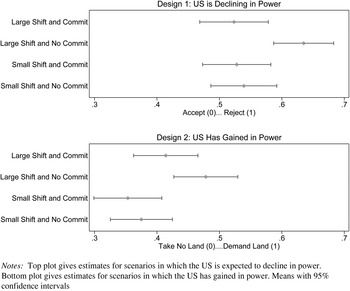
What is the effect of the experimental manipulations on the decision to accept or reject a rising power's proposal (in design 1) and on the decision to acquire more territory from a declining power or retain the status quo (in design 2)? I scaled the outcome variable from 0 to 1, with 1 indicating the aggressive response and 0 the non-aggressive. Figure 1 plots the proportion of respondents adopting the aggressive position (i.e., reject the other country's proposal in design 1 or acquire more territory in design 2) along with 95 percent confidence intervals for each experimental condition for each design. Prior to comparing results within each design, it is immediately apparent that the level of support for the aggressive position is lower when the US is the rising power than when it is the declining power. This is consistent with the behavioral predictions I discussed earlier.Footnote 56
Average treatment effects across experimental conditions

Next I focus on design 1, in which the respondent's country faced an imminent decline in power. When the other country was predicted to become much more powerful than the US but there was to be no public commitment about the new proposal, respondents were significantly more likely to oppose the proposal compared to all of the other experimental conditions. This is clear from the contrast between the “Large Shift and No Commit” condition and the “Small Shift and No Commit” condition. In the former, respondents are significantly more likely to reject the offer, a finding that is consistent with previous laboratory-based research.
Note that the public commitment treatment eliminated the effect of shifting power. In this case, average opposition to the other country's proposal following a large shift in power was statistically indistinguishable from the conditions with a small shift in power. However, it is not the case that the public commitment reduced the willingness to reject the offer in the condition with a small shift in power. Public commitments had an impact in the large shift condition only. Unsurprisingly, a test of the difference in differences reveals a significantly different effect of commitments in the large-shift condition compared to the small-shift condition.
Next consider design 2, in which the US was depicted as a rising power. The bottom half of Figure 1 plots the results. We see that the greatest support for revising the status quo occurs in the condition in which the US experienced a large positive shift in power but had not publicly committed to the earlier division of territory. This level of support was significantly greater than all of the other conditions at a p value of less than 0.1. Furthermore, regardless of public commitments, there is more support for revising the status quo when the US has become much more powerful compared to becoming slightly more powerful. Unlike in design 1, we do not see a significant differential effect of the public commitment in the large-shift versus small-shift conditions. While the direction of this difference is the same direction as before, with a greater effect in the large-shift condition than the small-shift condition, this difference in difference was not statistically significant.Footnote 57
Text Analysis
In these experiments, subjects were asked to explain their decisions in their own words. I used an unsupervised machine learning technique that incorporates important information about a text, such as characteristics of the author (e.g., political ideology) and the treatment condition in an experiment. In particular I made extensive use of the Structural Topic Model (STM).Footnote 58 This method helps to uncover common “topics” that can be thought of colloquially as sets of words that often co-occur across multiple documents. The applicability and usefulness of the STM for surveys and survey experiments are established elsewhere,Footnote 59 though the model extends to many social science applications.
The STM provides a number of interesting quantities of interest. The core quantities that I focus on deal with the prevalence of different topics. For example, is it common for people to focus on the costs of conflict when forming their decisions? Are individuals in different treatment conditions likely to talk about different topics such that treatment conditions can be statistically related to topic prevalence? This means, for example, we can inspect whether subjects in the “Large Shift and No Commitment” condition justify their position in ways different from subjects in other conditions. The STM model provides a unified way for estimating these quantities of interest.Footnote 60
Results for Design 1: Declining Power
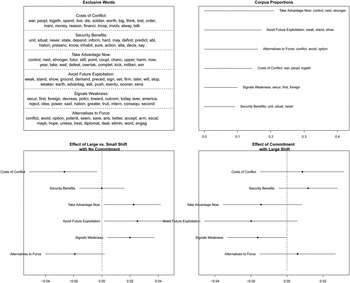
When the US is a declining power, what reasons do individuals give for their positions? To answer this question I estimated a seven-topic model. Figure 2 presents several outputs from the model. The top left presents the words that are highly exclusive to each topic.Footnote 61 Using these words and individual responses highly associated with each topic, I developed semantic labels for each. I present six topics—the seventh had little interpretable semantic meaning. The rest were quite clear. “Costs of Conflict” focused on how war destroys resources and lives. The “Security Benefits” topic focused on how it is important to keep the island because of its security benefits. “Take Advantage Now” argued that the US should immediately use its current position of power to expel the other country before it became more powerful. “Avoid Future Exploitation” focused on how the other country would be likely to take advantage of the US in the future. “Signals Weakness” argued that if the US did not take advantage of its power now, it would be seen as weak by other countries. “Alternatives to Force” argued that the US should avoid using force and instead find other means to solve the conflict, such as diplomacy or selling the island.Footnote 62
Exclusive words, corpus/topic proportions, and effects of experimental contrasts on topic proportions for design 1

The importance of commitment-problem logics arises in several of the topics. The “Take Advantage Now” and “Avoid Future Exploitation” topics use language that suggests an awareness of commitment problems. The contrast between these two topics is that the former is focused more on the current time period whereas the “Avoid Future Exploitation” topic is focused more on what might happen in the future.Footnote 63 Obviously “Take Advantage Now” and “Avoid Future Exploitation” are closely related to each other, and the topic model separates them because of their slightly different semantic focus. Also related is the topic “Signals Weakness,” which differed from the other two topics by invoking reputational consequences vis-à-vis additional countries, an effect that has been studied by international relations scholars.Footnote 64
The top-right plot presents the estimated proportion of all responses that were generated by each topic. The most prevalent topic dealt with taking advantage of current US power. However, commitment-problem logics were not the only concerns that respondents voiced. For example, the fourth-highest estimated proportion was the “Costs of Conflict” topic. Justifications that referred to costs mentioned both financial costs and the cost in terms of human lives. This has nothing to do with commitment problems. Not surprisingly, individuals who explained their decisions in terms of costs were unlikely to support conflict.Footnote 65 A third group of respondents focused on alternative strategies that might be available, rather than taking the current bargaining situation as given, and perhaps transforming it into a non-zero-sum situation. Finally, a small group of respondents focused on the benefits of owning the island, but this was a less prevalent concern. In conclusion, the STM results suggest that a plurality of respondents were indeed focused on the dynamics implied by shifting power and the resulting commitment problem. However, a significant number of individuals in the sample were focused on the cost-benefit dimensions of the situation instead.
The bottom-left panel plots the estimated mean difference in proportions of a document dedicated to a particular topic between the “Large Shift and No Commitment” and “Small Shift and No Commitment” conditions. We see that when faced with an opponent who is gaining significant power versus one who is gaining only an incremental amount of power, respondents are focused less on the costs of war or a desire to negotiate and instead are more concerned with taking advantage of their country's current power before the shift. The impact on the “Take Advantage Now” topic and “Avoid Future Exploitation” topic was positive and did not have confidence intervals overlapping zero. These results are largely consistent with the implications of commitment-problem explanations: when faced with a steep decline in power, negotiation will only forestall the inevitable and current costs are less relevant than future losses, thus the optimal choice is to fight a preventative war now. The positive impact on the “Signals Weakness” topics represents a similar dynamic. Here we see a parallel between these results from an experiment that used a substantive vignette related to international conflict and the results from other studies that used more abstract depictions of bargaining situations in a laboratory setting.
The bottom-right panel plots the estimated mean difference in proportions of a document dedicated to a particular topic between the “Large Shift and Commitment” and “Large Shift and No Commitment” conditions. This lets us inspect whether prior commitments change how individuals perceive a large shift in power that will create a future commitment problem. The “Take Advantage Now,” “Avoid Future Exploitation,” and “Signals Weakness” topics all were decreased in the presences of the commitments. This suggests that individuals' expectations about future behavior are tied to prior commitments. When countries make an explicit public commitment, individuals seem less concerned that the other country will fail to honor its side of the deal.Footnote 66
Results for Design 2: Rising Power
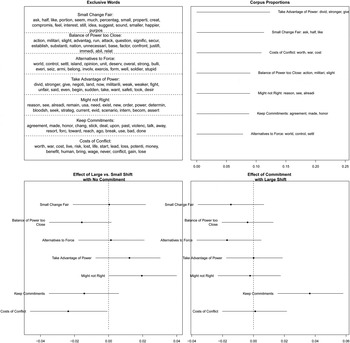
The second design depicted a scenario in which the United States had increased its relative power compared to a previous period in which it was weaker than its negotiating partner. Figure 3 plots the result from a ten-topic STM using the same topical prevalence parameters as before. I present seven interpretable topics. I present the same types of data as were presented in Figure 2.
Exclusive words, corpus/topic proportions, and effects of experimental contrasts on topic proportions for design 2

As the top-right panel shows, the distribution of topics in the corpus was more even in the design 2 experimental conditions than it was in design 1. No one topic played a decidedly more prominent role in the rationales given by the respondents. While one topic considered whether the US should “Take Advantage of Power,” this topic was somewhat split in whether or not the US should do so. Furthermore, another topic (“Might not Right”) argued that just because the US had become more powerful, this did not make it right to take advantage of this power. This parallels earlier results that found that individuals do not believe that their own country will exploit gains in power, but they do believe that other countries will exploit their country's loss in power.Footnote 67
One topic from respondents' rationales, “Keep Commitments,” focused on how it is wrong to break previous agreements even if you have an advantage. Here individuals noted that the US should be consistent and keep its commitments, that honoring previous agreements is important, and that just because circumstances have changed doesn't mean that the US should shift away from a previous commitment. These logics parallel the role of consistency in the work on audience costs discussed earlier.Footnote 68 The other topics that the STM found in the design 2 responses also do not connect directly to commitment problem logics. The “Costs of Conflict” topic focuses on how conflict destroys resources and lives and was quite similar to the results presented in Figure 2. The “Balance of Power too Close” topic focused on whether there was a sufficiently large power difference to justify taking a gamble that could lead to war. Other topics considered the given scenario within the broader context of US international relations. For example, “Alternatives to Use of Force” considered arguments about how peace in a present dispute can generate broader peace dividends later. Rather than fixating on zero-sum-type logics, positive-sum opportunities could be generated.
The relationship between the treatment conditions and topics helps us to better understand the results in Figure 3. In the large-power-shift-with-no-commit condition, we see less concern than in the small-shift condition with whether or not the probability of victory is now sufficiently large (lower left panel). Furthermore, the large power-shift condition responses focus more on the benefits of action and being able to take control than do the small-power-shift condition responses. More interesting is the contrast between the “Large Shift and Commit” and the “Large Shift and No Commit” conditions (lower-right panel). We see that a number of respondents saw their country's past commitments as binding. This suggests that prior commitments can decrease the attractiveness of a shift in power. A mediation analysis estimates that there is a negative change in probability of demanding territory that arises from the effect of the past commitment framing through the “Keep Commitments” estimate. In this sense, public commitments mitigated the propensity to take advantage of a shift in power.
Discussion
These results are very interesting. First, in both experimental designs 1 and 2, we see that individuals respond to shifting power in different ways. Some people focus on rationales consistent with commitment-problem explanations. However, others focus on the costs and benefits of the situation or want to transform the situation perhaps into a non-zero-sum type game. In their explanations for their responses to scenarios of rising and declining power, we find that individuals make use of a variety of approaches that represent distinct evaluative psychological models. Importantly, these models do not always conform to the standard credible commitment model.
Second, we see that public commitments have an effect on respondents, in part because they reduce expectations that the rising power will, or should, take advantage of the power shift. This result is consistent with previous work on the role of public commitments. However, I am unable to differentiate among several different mechanisms that might lead to this effect. For example, do some individuals have strong inherent preferences for consistency, or do they value keeping their country's commitments for more instrumental reasons, since reneging could lead other countries to break their commitments in the future? These results may also connect to the role of cosmopolitan commitments to international institutions.Footnote 69
Third, there is an interesting contrast between the experiment with the US as a future declining power and the US as a recently rising power. Consistent with previous work,Footnote 70 individuals see the implications of power held by another country differently from the way they see their own country's power. For some, increases in other countries' power should be feared; they worry that the other country will use its new power to revise the status quo. But most people do not think that their own country should exercise its new power to act in a revisionist manner, preferring a policy of restraint instead.Footnote 71 This might illustrate how national identity can influence beliefs.Footnote 72 Furthermore, prospect theory suggests that individuals want to protect against future losses but are less concerned about prospective gains. If individuals care less about extracting gains, then commitment problems might be less vexing than standard models assume. This paper provides evidence for how these behavioral perspectives play out vis-à-vis a standard rational choice account of shifting power.
Conclusion
A prevailing puzzle for scholars of international relations is why costly conflict occurs. One common explanation is that preventive strikes are a rational response to an imminent increase in the power of another country. The rising power faces a commitment problem: it cannot guarantee to not take advantage of others once it becomes more powerful, thus the rational response for the declining power is to be aggressive now. This explanation is well known.
Less understood are the micro-foundations of this explanation. Recent experimental work in the laboratory has tested some of the comparative static predictions that fall out of these models, finding in general that even in abstract decision-making contexts, humans respond to incentives in ways consistent with the theoretical models. This paper takes a further step by investigating implications of these models at a micro level but in a less abstract context that directly engages with international relations. To the extent that the public is relevant for bargaining, this move helps to unpack what domestic political pressures might look like when the unitary-actor assumption is dropped.
The results from the survey experiments described here reveal the heterogeneous ways in which individuals respond to shifting power. Many individuals dismiss the threat posed by another country that is increasing in power, instead preferring cooperative strategies or isolationism. Others articulate logics close to those spelled out in standard game-theoretic models. Future research could, and should, try to understand the exact sources of this heterogeneity. Another important finding is that individuals respond to being a declining power differently from how they respond to their country's rising power. Identifying the conditions when this difference is strong or weak would be an important next step because it points to where commitment problems might be more or less severe.
I've also presented evidence that mass political behavior is sensitive to the presence of a commitment or agreement in a situation that otherwise might evoke a commitment problem. Some individuals emphasize that commitments constrain state behavior, even though some accounts of international affairs consider those commitments to be noncredible. The behavioral foundations of this effect appear to be based on a general tendency to favor consistency and “keeping one's word.” This finding is similar to other work in American politicsFootnote 73 and international relations.Footnote 74 By showcasing that individuals (1) respond to shifting power differently depending on whether their country is a rising or falling power, (2) have highly heterogenous beliefs about what drives a response to shifting power, and (3) respond to commitments with a preference for consistency, this paper begins to highlight how power transition arguments could be developed in light of behavioral foundations.