I. Introduction
Which democracies are most likely to consolidate and which to break down? When does democratic consolidation occur, if at all? In addressing these and related questions, existing empirical research on democratic consolidation typically follows one of two strategies. We may call them the ‘substantive’ and ‘prospective’ approaches to democratic consolidation. The substantive approach focuses on a set of outcomes that we should observe in a consolidated democracy and then evaluates to what extent a democracy approximates them. Such desirable outcomes frequently include robust political competition, vibrant civil society, and widespread acceptance of key democratic tenets among the public and the elites.Footnote 1
The second, prospective approach primarily associates consolidation with the durability of democracy. According to Schedler, for instance, ‘consolidating democracy means reducing the probability of its breakdown to the point where [we] can feel reasonably confident that democracy will persist.’Footnote 2 Empirically, questions about consolidation are addressed by examining what distinguishes democracies that achieve such durability from those that do not. In large-N research, this is frequently accomplished by specifying a temporal criterion that is used to identify consolidated democracies. Prominent examples of such criteria are Huntington's two-turnover test and Gasiorowski's twelve-year threshold.Footnote 3
One difficulty associated with the first, substantive, approach to the study of democratic consolidation is the continuing disagreement about the outcomes that constitute its appropriate indicators.Footnote 4 In turn, why and even whether consolidation occurs remains contested, and the difference between plausible causes and consequences of consolidation is often unclear.Footnote 5 Meanwhile, one shortcoming of the second, prospective approach is that it presumes that consolidation indeed occurs. By specifying a particular criterion for consolidation – such as the two-turnover test – the prospective approach implicitly assumes that consolidation occurs by a particular time threshold. Yet whether and when consolidation occurs is disputed: Przeworski et al. and Epstein et al. do not find evidence of consolidation while Tilly asserts that ‘democratization and de-democratization occur continuously, with no guarantee of an end point in either direction.’ Whether and when consolidation occurs should therefore be an outcome that we investigate rather than assume at the outset of any analysis.Footnote 6
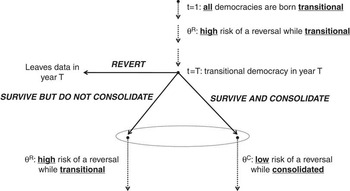
In this article, I propose a new empirical approach to democratic consolidation that avoids some of the weaknesses of existing research and leads to new findings about the dynamics and covariates of democratic consolidation and breakdown. Figure 1 outlines its key elements. A democracy's trajectory after a transition is hypothesized to consist of two distinct stages. All democracies are born transitional and face a high risk of an authoritarian reversal, θ R . At any later point in time, one of the following three events may occur: First, a democracy may revert to a dictatorship, which we can observe. Second, a transitional democracy may survive and consolidate, in which case it will subsequently face a low risk of an authoritarian reversal, θ C . Finally, a transitional democracy may survive but not consolidate and therefore continue to face a high risk of an authoritarian reversal, θ R . Crucially, whether or when a democracy that survives also consolidates cannot be directly observed and must be inferred.Footnote 7
A change-point model of democratic consolidation

The key advantage of the present approach to the study of democratic consolidation is its empirical realism. The model outlined in Figure 1 does not require that we directly observe whether a democracy is consolidated or not. Instead, whether the risk of breakdown faced by transitional democracies is indeed higher than the risk faced by consolidated democracies and whether or when the shift between the two occurs are quantities to be inferred from data on democratic survival rather than assumed from the outset.
More precisely, following existing literature, consolidation is hypothesized to take place when a large, durable, and statistically significant decline in the risk of authoritarian reversals occurs at a well-defined point during the lifetime of a democracy.Footnote 8 The present model allows us to attach statistical confidence to the estimated timing of that decline – if it occurs at all – and to assess whether it is substantial, durable, and statistically significant enough to warrant the label ‘democratic consolidation.’ In turn, we need not rely on arbitrary temporal criteria in order to distinguish transitional from consolidated democracies. In fact, the present approach allows us to evaluate whether a particular criterion – such as Huntington's two-turnover test – is an appropriate indicator of consolidation in the first place.
The results that follow strongly suggest that democratic consolidation indeed occurs: A large and durable decline in the risk of authoritarian reversals is estimated to take place between the seventeenth and twentieth year of a democracy's existence. Consolidation reduces the annual risk of breakdown from 1 in 33 for transitional democracies to 1 in 200 for consolidated democracies. In other words, consolidation comes close to eliminating the possibility of a return to dictatorship. By combining two of the estimated quantities – the timing of consolidation and the risk of breakdown faced by transitional democracies – we can address a question of considerable theoretical and policy-making importance: Which democracies can we expect to survive long enough to consolidate? I refer to the probability that an existing democracy will survive long enough to consolidate as the consolidation odds and find that, on average, only about 1 in 3 democracies can expect to do so at the time of their transition.
These initial results offer guidance to empirical research on democratization that often seeks to restrict attention to a subsample of either ‘new’ or ‘advanced’ democracies. Such distinctions are typically based on ad-hoc geographic or temporal criteria – for instance, by limiting the sample to African democracies when evaluating hypotheses relevant for new democracies or, alternatively, by only including countries that have democratized before 1989 when evaluating hypotheses relevant for ‘advanced’ democracies. Our finding that consolidation occurs after approximately two decades provides a very simple but empirically grounded temporal threshold for the construction of such subsamples, especially when the relevant concern is democratic stability. At the same time, this finding indicates that some of the criteria for democratic consolidation frequently employed in the empirical literature – such as Huntington's two-turnover test or Gasiorowski's twelve-year threshold – may be too optimistic, while Przeworski et al.'s, Epstein et al.'s, and Tilly's claims that consolidation does not occur at all appear to be too pessimistic.Footnote 9
In fact, the model comparisons based on Bayes’ Factors that I conduct in Section III suggest that the framework outlined in Figure 1 fits the data better than do alternative models that either ignore the possibility of consolidation, allow for de-consolidation, or conceive of consolidation as a multi-stage process. Thus the dichotomous nature of the frequently drawn distinctions between ‘transitional’ and ‘consolidated’, ‘new’ and ‘established’, or ‘partial’ and ‘full’ democracies is indeed empirically warranted.Footnote 10
The inclusion of covariates within the present framework provides for a richer and more precise interpretation of the dynamic of democratic consolidation than is possible using existing techniques. In Section IV, I examine the potentially distinct effects of covariates on the risk of authoritarian reversals in transitional and consolidated democracies. In agreement with extant research, I find that a high level of economic development reduces the risk of authoritarian reversals in transitional democracies while economic recessions, authoritarian neighbors, the Cold War, and a military authoritarian past raise it. These factors however differ in how they affect the risk of reversals once democracies consolidate: The positive effect of economic development persists while none of the remaining factors threaten the survival of consolidated democracies. Put differently, once democracies consolidate they gain resilience to the pernicious effects of economic recessions, an authoritarian neighborhood, or military past, but not to low levels of economic development. Democracies never fully consolidate against the risk of breakdown that is associated with low levels of economic development.
These findings remain significant after accounting for unobserved heterogeneity via country-level random intercepts. That is, we may expect that even after controlling for available covariates, outcomes in democratic spells from the same country will be correlated due to unmeasured, country-specific factors. The inclusion of country-level random intercepts reveals that unobserved heterogeneity indeed accounts for a significant amount of cross-country differences in the risk of breakdown. Countries like Argentina and Thailand are estimated to have reverted to authoritarianism more often than can be accounted for by their measured covariates; by contrast, Switzerland and India exemplify democracies that have survived against the odds implied by their low levels of economic development at the time of democratization. The estimated random intercepts thus affirm our qualitative knowledge of the unusual regime trajectories experienced by these countries and serve as an informal indicator of a good model fit.
In Section V, I apply the approach outlined above to original data on democratic survival that distinguish between the distinct processes by which authoritarian reversals occur. The vast majority of democratic breakdowns occur either after the military seizes power (as in the 1976 Argentine military coup that overthrew Isabel Perón), after a democratically elected incumbent subverts democracy (as in Alberto Fujimori's 1992 suspension of the Peruvian Congress and constitution), or during a civil war (as in the Republic of the Congo in 1997). The differences in the nature of these processes raise the possibility that the occurrence, timing, and determinants of consolidation also differ across these disparate forms of democratic breakdown.
That is precisely what I find when I examine the dynamic of democratic consolidation with respect to military coups and incumbent takeovers separately – two processes that together account for more than 91percent of all authoritarian reversals. Whereas the risk of a coup almost disappears once a democracy survives for two decades, the risk of an incumbent takeover persists. Therefore, we cannot conclude that democracies consolidate against the risk of incumbent takeovers.
Military coups and incumbent takeovers also differ in their determinants. I find that the Cold War and authoritarian neighbors raise the risk of coups but not incumbent takeovers, that fuel exports and presidentialism raise the risk of incumbent takeovers but not coups, and that a democracy's military past raises the risk of coups but lowers the risk of incumbent takeovers. These findings imply that the prevailing approach in empirical research on democratization – whereby all authoritarian reversals are treated as a homogeneous category – is flawed.Footnote 11 When we fail to differentiate between military coups and incumbent takeovers, we miss their distinct consolidation dynamics and confound their unique determinants. The results here call for theoretical explanations that distinguish between the two reversal processes and suggest that different institutions may best guard against these distinct risks to new democracies.
The statistical model that underlies this article's approach to democratic consolidation builds on the Bayesian analysis of hidden Markov change-points models.Footnote 12 In methodologically related research, Park applies these methods to data on US military interventions abroad and Hays, Freeman, and Nesseth study exchange rate volatility in new democracies using a classical (rather than a Bayesian) approach to Markov regime switching models.Footnote 13 This article's conceptualization of democratic consolidation parallels Coppedge, Alvarez, and Maldonado, Treier and Jackman, and Pemstein, Meserve, and Melton, who conceive of the level of democracy (instead of consolidation) as one of possibly several latent quantities to be inferred rather than directly measured.Footnote 14
II. A Change-Point Model of Democratic Consolidation
In order to estimate the empirical model of democratic consolidation that I outline in Figure 1, I build on Chib's approach to hidden Markov and change-point models.Footnote 15 Assuming that we cannot directly observe whether or when democratic consolidation occurs, I estimate three key parameters of interest: (i) the timing of democratic consolidation and (ii) the separate risks of an authoritarian reversal while a democracy is transitional and consolidated. I extend Chib's methods to estimate the effect of time-varying covariates on the key parameters of interest as well as to account for the survival nature of the data on democracy, particularly the presence of censoring and multiple democratic spells.
Suppose that a democracy may be in one of two latent, unobservable states: transitional (R) or consolidated (C). We denote these latent states by
 $$$ {{s}_t} \in \{ R,C\} $$$
, where
 $$$ t \in \{ 1,2, \ldots, T\} $$$
refers to time. At any point t, we only observe whether a democracy i survives, yit
= 0, or reverts to a dictatorship, yit
= 1. The outcome yit
is a Bernoulli random variable with the parameter θt
and the states R and C correspond to a high and low probability of an authoritarian reversal, θ
R
and θ
C
, where θ
R
>θ
C
.
Consolidation is modeled as the transition from state R to state C at some unknown time τ. Thus θt
= θ
R
for t ≤ τ and θt
= θ
C
for t > τ. Following Chib, rather than estimate τ directly, we will instead let the state st
follow a discrete-time, two-state Markov process and estimate the parameters of this process. In order for this Markov process to correspond to the dynamic implied by the concept of democratic consolidation, I assume that all democracies are born transitional, s
1 = R, and let
 $$$ \pi \, = \,p({{s}_t}\, = \,C|{{s}_{t\,{\rm{ - }}\,{\rm{1}}}}\, = \,R) $$$
be the probability that a transitional democracy at time t − 1 consolidates at time t. At first, I do not allow for a consolidated democracy to return a transitional one; later, I extend this basic model and allow for the possibility of de-consolidation by specifying the probability
 $$$ \rho \, = \,p({{s}_t}\, = \,R|{{s}_{t\,{\rm{ - }}\,{\rm{1}}}}\, = \,C) $$$
that a consolidated democracy at time t − 1 returns to being a transitional one at time t. Building on Chib's Bayesian approach, we obtain consolidation time τ indirectly, by estimating an augmented set of parameters θ
R
, θ
C
, π and the sequence of states
 $$$ \{ {{s}_t}\} _{{\rm{1}}}^{T} $$$
using the Gibbs sampler.Footnote
16
The time of consolidation τ then corresponds to the timing of change-points in the draws of the states
 $$$ \{ {{s}_t}\} _{{\rm{1}}}^{T} $$$
. In turn, we can model covariate effects on τ through their effects on the transition probability, π.
The estimates for this change-point consolidation model are based on data on democratic survival that cover the entire history of modern democracy (1789–2008) and are based on my own data collection as well as an update of the regime type data compiled by Przeworski et al., Boix and Rosato, and Cheibub and Gandhi.Footnote 17 The data consist of democratic spells, each of which begins in the year of a country's transition to democracy and ends in either the year of an authoritarian reversal, if one occurred, or in the last recorded year for that country, if no reversal occurred. The complete data contain 5,467 democracy-years with 90 reversals in 223 democratic spells out of 145 countries.
III. An Analysis Without Covariates
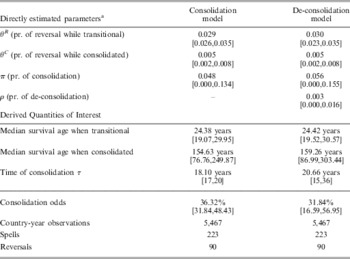
As an illustration of how the present model sheds light on the dynamic of democratic consolidation, consider first parameter estimates from its simplest formulation, one that ignores any covariate effects. The left column in Table 1 shows the estimated parameters as well as several derived quantities of interest.Footnote 18 These results strongly suggest that democratic consolidation indeed occurs and is associated with a large decline in the risk of an authoritarian reversal. The estimated probability that a transitional democracy reverts to a dictatorship is 0.029, whereas the corresponding probability for a consolidated democracy is only 0.005. In other words, the risk of an authoritarian reversal is about six times greater for transitional democracies than it is for consolidated democracies. The corresponding median survival ages are 24.38 years for transitional and 154.63 years for consolidated democracies. The difference between the two survival ages is 130.25 years with the 95 percent highest posterior density (HPD) region of [52.69, 225.61]. Thus we see a large and statistically significant decline in the risk of an authoritarian reversal faced by consolidated democracies.Footnote 19
Estimation Results for the Change-Point Consolidation and De-Consolidation Models without Covariates

Note: Posterior means and 95 percent HPD regions (in brackets) are based on a Gibbs sampler run of 50,000 iterations after a burn-in of 10,000 iterations. See the online aupplementary appendix for convergence diagnostics.
a
Latent states
 $$$ \{ {{s}_t}\} _{{\rm{1}}}^{T} $$$
are not listed.
When does consolidation occur? Using the draws of the latent states
 $$$ \{ {{s}_t}\} _{1}^{T} $$$
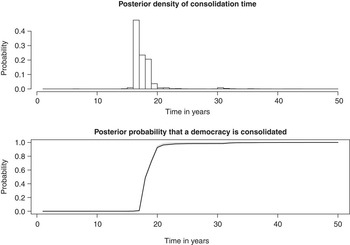
, Figure 2 plots the posterior density of consolidation time (top) and the probability that a democracy is consolidated (bottom). We see that with a 95 percent probability, consolidation occurs between the seventeenth and twentieth year, with the estimated time to consolidation of about eighteen years. Thus out of the total of 223 democratic spells in the data, between seventy-one and 108 democracies are estimated to have consolidated with a greater than 95 percent probability.Footnote
20
Posterior density of consolidation time (top) and the probability that a democracy is consolidated (bottom) based on the change-point consolidation model
Note: The 95 percent credible interval is shown in gray.

A related question concerns the likelihood that a transitional democracy will survive long enough to consolidate,
 $$$ p(T \gt \tau |{{s}_t}\, = \,R) $$$
. We may refer to this quantity as the consolidation odds and it depends on both the estimated risk of a reversal for transitional democracies θ
R
and on the estimated time of consolidation τ. According to the draws of the latent states
 $$$ \{ {{s}_t}\} _{{\rm{1}}}^{T} $$$
, the consolidation odds for a new democracy are roughly 36 percent. In other words, at the time of their transition to democracy, only about one in three democracies can expect to reach an age after which their breakdown is no longer a serious concern.
Another concern is whether the estimated decline in the risk of authoritarian reversals is durable enough to warrant the term consolidation. In order to address it, we can extend the present model to allow for both consolidation and de-consolidation to occur at any given point in time. Thus in addition to the probability of consolidation π, we also estimate the probability of de-consolidation
 $$$ \rho \, = \,p({{s}_t}\, = \,R|{{s}_{t\,{\rm{ - }}\,{\rm{1}}}}\, = \,C) $$$
and allow for changes in the hazard of authoritarian reversals to occur in both directions. The estimates based on this extension are shown in the right column of Table 1.Footnote
21
We see that the estimates for θ
R
, θ
C
, and π are close to identical to those estimated earlier. Crucially, de-consolidation is extremely unlikely: in no year within the time-range of the data does de-consolidation occur with a probability greater than 0.05.
As a final robustness check, consider the possibility that consolidation occurs in multiple gradual steps instead of a single consolidation step, as we have assumed so far. The present framework can account for this possibility by letting the latent states st
take K + 1 values corresponding to K +1 distinct reversal probabilities θ
0 to θK
and K change-points τk
for
 $$$ k\, = \,{\rm{1}}, \ldots, K $$$
. We can formally compare the goodness of fit of these alternative (non-nested) models using Bayes factors. The Bayes factor is the ratio of marginal likelihoods of two competing models and reflects the relative support in the data for the two models.Footnote
22
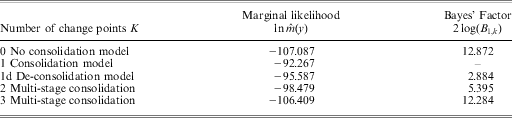
In Table 2, the single change-point consolidation model (K = 1) is compared to a no-consolidation alternative (K = 0), a single change-point model that allows for de-consolidation (K = 1d), and models in which consolidation occurs in multiple stages (K = 2, 3). Values of the Bayes factor larger than 5 (on the 2log scale) indicate strong support for the single change-point consolidation model.Footnote
23
We see that the single change-point consolidation model fits the data significantly better than either the no-consolidation model, the de-consolidation model, or the multi-stage consolidation models.
Model Comparisons for the Change-Point Consolidation Model without Covariates

Note: Larger values of the Bayes’ Factor correspond to stronger support for the single change-point consolidation model. Following Jeffrey's scale (Jeffreys Reference Jeffreys1939), support for model j versus k is ‘positive’ if
 $$$ {\rm{2}}\, \lt \,{\rm{2}}\log ({{B}_{j,k}})\,\leq \,{\rm{5}} $$$
, ‘strong’ if
 $$$ {\rm{5}}\, \lt \,{\rm{2}}\log ({{B}_{j,k}})\,\leq \,{\rm{10}} $$$
, and ‘very strong’ if
 $$$ {\rm{2}}\log ({{B}_{j,k}})\, \gt \,{\rm{10}} $$$
.
This preliminary analysis without covariates reveals several important characteristics of democratic consolidation. We found that a large, durable, and statistically significant decline in the risk of authoritarian reversals indeed occurs between seventeen and twenty years after a democracy's emergence. The estimated dynamic of democratic survival thus warrants the label ‘consolidation.’ We also saw that the proposed change-point consolidation model fits the data much better than a number of alternatives that either ignore the possibility of consolidation, allow for de-consolidation, or conceive of consolidation as a multi-step process.
At the same time, these initial findings prompt a number of further questions. The risk of breakdowns in both transitional and consolidated democracies may depend on a number of covariates and these may in turn account for the decline in the risk of authoritarian reversals that I call consolidation. In the next section, I address this concern by incorporating covariate effects on the reversal probabilities θ R and θ C . An alternative source of heterogeneity may be due to the differences in the process by which most authoritarian reversals occur – by a coup as opposed to an incumbent takeover. I examine whether differences between the two types of reversals affect the variation in the nature and timing of consolidation in Section V.
IV. An Analysis With Covariates
I now extend the change-point consolidation model from the previous section to account for covariates. Specifically, I estimate the effects of covariates on the risk of authoritarian reversals in transitional and consolidated democracies via the reversal probabilities θ R and θ C .Footnote 24 As a result, both parameters are now associated with a set of covariates X and a set of coefficient estimates β R and β C for θ R and θ C , respectively. I will refer to models for θ R and θ C as the reversal model for transitional democracies and the reversal model for consolidated democracies, respectively. The Gibbs sampling algorithm that generates these coefficient estimates is summarized in the online supplementary appendix.
When choosing and interpreting covariate effects, I intentionally follow an exploratory approach. That is, I build on existing research on democratic survival and explore the present model's new implications for our understanding how factors commonly hypothesized to affect democratic survival do so.
I examine the effects of five sets of covariates. The first contains the economic covariates of annual GDP per capita, GDP growth, and fuel exports. Footnote 25 The second set of covariates contains contemporaneous and past institutional factors. These include the constitutional foundation for the executive (parliamentary, presidential, or mixed), the type of dictatorship that preceded the transition to democracy (military, civilian, or monarchy),Footnote 26 the nature of the last authoritarian transition of power prior to the transition to democracy (coup, election, or other), the number of authoritarian reversals that a country has experienced, the total time that a country has spent as a democracy, potentially over multiple spells of democracy (time democratic), and a dummy variable that takes the value 1 if the last authoritarian legislature prior to the transition to democracy existed and seated at least one member of the opposition and 0 otherwise.Footnote 27
Finally, I control for international, demographic factors, and temporal factors. I account for diffusion effects by including the fraction of a democracy's neighbors that were also democratic in any given year;Footnote 28 I use a set of dummies (Latin America, Sub-Saharan Africa, Asia, or Other) in order to control for region-specific factors; I measure a democracy's involvement in the world economy by trade openness;Footnote 29 I control for ethnic and religious fractionalization;Footnote 30 and I include the dummy Cold War, which takes the value 1 between the years 1945 and 1990 and 0 otherwise.
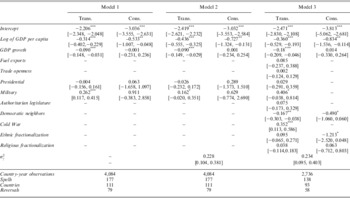
Because missing data affect the size and composition of the sample significantly, I present several estimates. Models 1 and 2 in Table 3 employ a sample that preserves the largest number of observations while including four covariates that have figured prominently in empirical research on democratic survival: GDP per capita, GDP growth, a dummy for the presidential executive, and a dummy for whether a military dictatorship preceded the current democratic spell. After including these covariates, lagging each by one year, and dropping missing observations, the data consist of 4,084 democracy-years with seventy-nine reversals and 177 spells in eleven countries. Nearly all of the missing observations result from the lack of data for some nineteenth-century democracies and for some small contemporary democracies.
Estimation Results for a Change-Point Consolidation Model with Covariates

Note: All covariates are standardized and lagged by one year; regional and authoritarian exit dummies not shown (and not significant). Posterior means and 95 percent HPD regions (in brackets) are based on a Gibbs sampler run of 10,000 iterations thinned by 100 after a burn-in of 1,000 iterations. Significance levels *, *,*** indicate that zero is not covered by the 90 percent, 95 percent, 99 percent HPD region, respectively. See the online supplementary appendix for convergence diagnostics.
A positive coefficient in each of the models in Table 3 implies that an increase in the corresponding covariate raises the risk of a reversal.Footnote 31 Consistent with our earlier analysis, we see that the baseline risk of a democratic breakdown – captured by the intercept – is lower in consolidated than in transitional democracies. At mean and modal values of the covariates, transitional democracies face a risk of a breakdown that is six times larger than that of consolidated democracies.Footnote 32
The inclusion of covariates allows for a more nuanced interpretation of how consolidation shapes the risk of authoritarian reversals. In agreement with the influential literature that examines the effect of economic factors on the survival of democracy, we see that both a high level of economic development and economic growth reduce the risk of authoritarian reversals in transitional democracies.Footnote 33
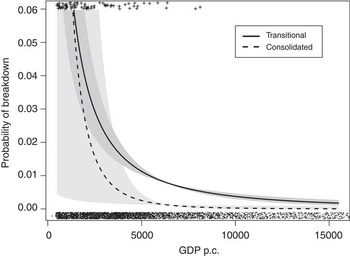
However, the two factors differ in their effect on the risk of breakdown in consolidated democracies. The positive effect of economic development persists (and possibly increases in magnitude) even after a democracy consolidates. Figure 3 illustrates this finding. At the mean/modal levels of the remaining covariates, an interquartile increase in GDP per capita (from $2,573 to $9,155) lowers the annual risk of a democratic breakdown in a transitional democracy about five-fold (from 1 in 63 to 1 in 333). This positive effect persists after a democracy consolidates, although with a much smaller statistical significance at low levels of GDP per capita. This is because few poor democracies have survived long enough to consolidate – in part due to the large effect that the level of economic development exerts on democratic survival.
The association between the level of economic development and the risk of democratic breakdowns in transitional and consolidated democracies
Notes: The 95 percent HPD regions are shown in gray. The bottom and top rugs plot the distribution of GDP per capita and breakdowns, respectively.

Economic growth, by contrast, is significantly associated with the risk of breakdown in transitional but not consolidated democracies. An economic recession corresponding to an interquartile drop in GDP growth (from 4.5 percent to 0.1 percent) raises the risk of a democratic breakdown by about 20 percent – but only in transitional democracies. Simply put, while economic recessions threaten the survival of transitional democracies, consolidated democracies have become immune to their pernicious effects.
The effect of a past military dictatorship parallels that of economic growth. Consistent with the arguments by Cheibub, Debs, and Lehoucq and Pérez-Liñán, a democracy that was governed by the military prior to its transition is about 50 percent more likely to revert to a dictatorship than a democracy that used to be a civilian dictatorship or a monarchy.Footnote 34 Yet as in the case of economic growth, a democracy's military past is no longer relevant for its survival once it consolidates. Meanwhile, consistent with Cheibub's findings, we see that presidential democracies are no more likely to break down than parliamentary or mixed democracies – regardless of whether they are transitional or consolidated.
The key difference between Models 1 and 2 in Table 3 is that the latter includes random effects. Given the limited number of covariates, we may expect that the risk of breakdown in democratic spells from the same country will be correlated due to unmeasured factors. Model 2 accounts for potential estimation bias resulting from such unobserved heterogeneity via country-level random effects. More specifically, we assume that observations from the same country share a common intercept
 $$$ {{\gamma }_{j[it]}} $$$
, that is distributed normally with a mean of 0 and the variance
 $$$ \sigma _{\gamma }^{2} $$$
,
 $$$ {{\gamma }_{j[it]}} \sim N(0,\sigma _{\gamma }^{2} ) $$$
, where j denotes countries, i democratic spells, and t the age of democracy. A positive random intercept
 $$$ {{\gamma }_{j[it]}} $$$
implies that democratic spells from country j are more likely to experience an authoritarian reversal.Footnote
35
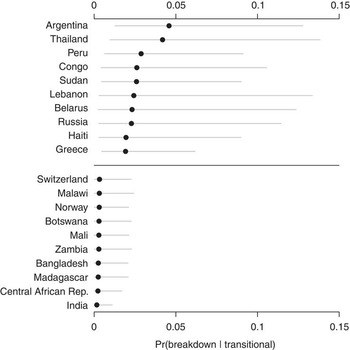
Figure 4 plots the estimated probability of a breakdown (at mean/modal covariate values) for transitional democracies with the ten highest (top) and lowest (bottom) country-level random intercepts (95 percent HPD regions in gray). We see that democracies like Norway, Switzerland, and India are estimated to have survived against the odds implied by their low levels of economic development at the time of democratization, which is in turn attributed to their unobserved, country-specific factors and captured via the low values of their random intercepts. Countries like Argentina and Thailand, by contrast, exemplify democracies that have reverted to authoritarianism more often than can be accounted for by their measured covariates. The estimated random intercepts thus correspond to our qualitative knowledge of the unusual regime trajectories experienced by these countries.Footnote 36
Probability of a breakdown at mean/modal covariate values for transitional democracies with the ten highest (top) and lowest (bottom) country-level random intercepts
Note: The 95 percent HPD regions are shown in gray.

As Figure 4 highlights, unobserved heterogeneity accounts for a significant amount of cross-country differences in the baseline risk of a democratic breakdown: At mean/modal covariate values, a transitional democracy with Argentina's estimated random intercept faces a risk of breakdown that is twenty-nine times larger than the risk faced by a country with India's random intercept! Nonetheless, the direction and statistical significance of the estimated coefficients in Models 1 and 2 remain comparable.
Accounting for covariates and unobserved country-specific factors also allows for a more informative interpretation of consolidation odds. Recall that consolidation odds denote the probability that an existing transitional democracy survives long enough to consolidate. Consolidation odds now depend on both the estimated time of consolidation and the estimated coefficients and country-level random intercepts in the model for transitional democracies. The difference in GDP per capita in a democracy's first year corresponding to the bottom quartile ($226 versus $2,573) accounts for an increase in consolidation odds from 1 percent to 67 per cent. Based on covariate values in their first year as democracy and country-level random intercepts, consolidation odds vary from 16 percent for France in 1870 to 99 percent for Czechoslovakia in 1990.
Finally, Model 3 in Table 3 controls for the full set of covariates as well as random effects. Data missingness now reduces the number of observations from 4,084 to 2,736 and the number of democratic breakdowns from seventy-nine to fifty-eight. This prevents us from including dummy variables in the reversal model for consolidated democracies: only between one to six consolidated democracies revert to a dictatorship in 95 percent of Gibbs draws and these tend to be perfectly predicted by the dummy variables employed in the reversal model for transitional democracies. We should therefore be cautious when interpreting coefficients in the reversal model for consolidated democracies.
The most notable findings in Model 3 concern the role of international factors. While Model 3 does not find a statistically significant relationship between trade openness and the likelihood of authoritarian reversalsFootnote 37 , we see that both the presence of neighboring democracies and the Cold War have a substantial effect on the risk of authoritarian reversals in transitional democracies. At the mean/modal levels of the remaining covariates, a new democracy that is surrounded by dictatorships faces a risk of an authoritarian reversal that is about 60 percent greater than the risk faced by a new democracy that is surrounded only by democracies.Footnote 38 This is consistent with previous research that considers regional concentration of democracies or the proximity to the WestFootnote 39 , although here I focus more directly on the concentration of democracies in a new democracy's neighborhood.Footnote 40 Meanwhile, the likelihood of an authoritarian reversal was almost three times greater during the Cold War than at all other times in the history of modern democracy. Thus the Cold War struggle between the United States and the Soviet Union had a destabilizing effect on new democracies.Footnote 41 But note that only the effect of democratic neighborhood appears to persist in consolidated democracies.
The key findings concerning the effects of economic development, growth, and military past from the parsimonious Models 1 and 2 are also supported by Model 3. However, we do not see a significant relationship between fuel exports and the likelihood of reversals in transitional democracies. This is contrary to Ross's and Morrison's finding that oil either hurts or stabilizes democracies, respectively,Footnote 42 but it is consistent with research that finds that such negative effect is either absentFootnote 43 or conditional on other factors, such as economic inequality and state capacity.Footnote 44 Similarly, we do not find a statistically significant relationship between the likelihood of reversals in either transitional or consolidated democracies and the remaining covariates, including the dummy for whether the last authoritarian legislature prior to a transition to democracy seated any opposition – which we took as a measure of the degree of pre-democratic political competition.Footnote 45
V. Coups, Incumbent Takeovers, and Democratic Consolidation
So far, our analysis has treated all authoritarian reversals as a single, homogeneous category – as does virtually all existing empirical research.Footnote 46 Yet as I pointed out in the introduction, the manner by which democratic breakdowns occur varies considerably. More precisely, democratic breakdowns occur in one of four distinct ways: a military coup, an incumbent takeover, a civil war, or a popular uprising. Among the ninety authoritarian reversals between 1789 and 2008, fifty-five (61 percent) resulted from a military coup, twenty-seven (30 percent) followed an incumbent takeover, six (7 percent) were due to a civil war, and two (2 percent) were due to a popular uprising. The latter two processes – civil wars and popular uprisings – are too rare to be included in a statistical analysis. We can, however, extend the models in previous sections to examine the possibility that the nature and dynamics of consolidation depend on whether the reversal risk in question is that of a military coup or that of an incumbent takeover.
When coding for differences between democratic breakdowns, I say that an authoritarian reversal occurred by a coup d’état when the armed or security forces participated in the removal a democratically elected government by employing or threatening violence. Meanwhile, an incumbent takeover occurred when a democratically elected incumbent undermined key tenets of democracy, most often by abolishing or manipulating elections. The military overthrow of Salvador Allende's government in Chile in 1973 is an example of a military coup; the collapse of the Weimar Republic under Adolf Hitler's chancellorship is a prominent instance of an incumbent takeover. These two processes account for 91 percent of the ninety authoritarian reversals in the data.
When extending the change-point consolidation model outlined in Section II to allow for the simultaneous risk of coups and incumbent takeovers, I build on competing risks models. These are survival models for processes that may terminate in multiple ways.Footnote 47 I follow the ‘classical approach’ to competing risks, which assumes that individual risks act independently and are associated with distinct latent survival times of which only the earliest is observed.Footnote 48 Given these assumptions, we can estimate the models for the risk of coups and incumbent takeovers separately while treating democratic spells that terminate in other reversal processes as right-censored.
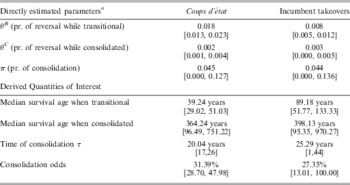
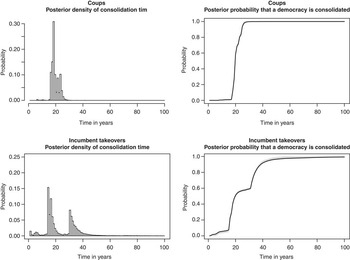
A key question that I will examine is whether and when democracies consolidate against the distinct risks of coups and incumbent takeovers. As in Section III, I first conduct an analysis without covariates, the results of which are presented in Table 4.Footnote 49 They reveal that the risk of coups affects democratic survival very differently than the risk of incumbent takeovers. Estimates for the former are very close to the original model examined in Section III. We see strong evidence that a substantial and statistically significant decline in the hazard of coups occurs between the seventeenth and twenty-sixth year of a democracy's existence. Democracies indeed appear to consolidate against the risk of a coup d’état.
Estimation Results for a Change-Point Consolidation Model without Covariates that Distinguishes between the Risk of Coups and Incumbent Takeovers

Note: Posterior means and 95 percent HPD regions (in brackets) are based on a Gibbs sampler run of 50,000 iterations after a burn-in of 10,000 iterations. See the online supplementary appendix for convergence diagnostics.
a
Latent states
 $$$ \{ {{s}_t}\} _{{\rm{1}}}^{T} $$$
are not listed.
By contrast, there is less evidence that democracies consolidate against the risk of incumbent takeovers. The difference between the risks of incumbent takeovers in transitional and consolidated democracies is much smaller than in the case of coups (the 95 percent highest posterior density regions overlap) and the time of consolidation is estimated with less precision (the 95 percent HPD region spans forty-four years). This difference in the dynamics of consolidation between coups and incumbent takeovers is apparent in Figure 5.
Posterior density of consolidation time and the probability that a democracy is consolidated based on a change-point consolidation model that distinguishes between the risk of coups and incumbent takeovers
Note: The 95 percent credible interval is shown in gray.

This analysis without covariates suggests that the change-point consolidation model estimated in Sections III and IV is most appropriate for the risk of coups. Meanwhile, a more appropriate model for studying the dynamics of risk of incumbent takeovers may be either a standard survival model (one that does not anticipate a sharp shift in the hazard of a reversal over a democracy's lifetime) or a change-point model that allows for consolidation to occur in multiple stages.Footnote 50 Therefore, I only consider the risk of coups when I estimate the change-point consolidation model with covariates below; I estimate a separate, discrete-choice survival model for the risk of incumbent takeovers.
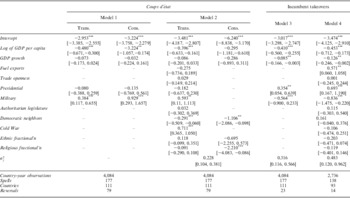
The estimates from these models are presented in Table 5. For each type of breakdown, I present model specifications that preserve the largest number of observations (Models 1 and 3) as well as those that include the full set of covariates (Models 2 and 4). All models include country-level random effects.Footnote 51 In the change-point consolidation model, which now only considers the risk of coups, most of the estimated coefficients correspond closely to those in the earlier analysis that did not distinguish coups from other reversal processes. We see that economic recessions, authoritarian neighbors, and the Cold War increase the risk of breakdown in transitional but not consolidated democracies. By contrast the positive effect of economic development – and now also the negative effect of a military past – persists (and possibly increases in magnitude) even after a democracy consolidates. Put differently, when it comes to the risk of a coup d’état, democracies appear to consolidate against the adverse effects of recessions, authoritarian neighbors, and the Cold War but not against the risks associated with low levels of economic development and a military past.
Estimation Results for a Model with Covariates that Distinguishes between the Risk of Coups and Incumbent Takeovers

Note: All covariates are standardized and lagged by one year; regional and authoritarian exit dummies not shown (and not significant). Posterior means and 95 percent HPD regions (in brackets) are based on a Gibbs sampler run of 10,000 iterations thinned by 100 after a burn-in of 1,000 iterations. Significance levels *, **, *** indicate that zero is not covered by the 90, 95, 99 percent HPD region, respectively. See the online supplementary appendix for convergence diagnostics.
The most notable difference between the model for coups and the model for incumbent takeovers concerns (i) the irrelevance of international factors, (ii) the relevance of presidentialism and fuel exports, and (iii) the reverse effect of a military past. Neither authoritarian neighbors nor the Cold War are associated with the risk of incumbent takeovers, whereas both are significantly associated with an increase in the risk of coups in transitional democracies. This is consistent with the history of the Cold War, during which the superpowers encouraged coups d’état against ideologically adversarial governments.Footnote 52 Goemans and Marinov, for instance, observe that military coups typically resulted in the installation of durable authoritarian regimes before the end of the Cold War while they have been increasingly followed by competitive elections after the end of the Cold War.Footnote 53
By contrast, Table 5 shows that presidentialism and fuel exports – two factors that were not relevant for the risk of coups – raise the risk of incumbent takeovers. Compared to parliamentary or mixed democracies, presidential democracies are about ten times more likely to experience an incumbent takeover, whereas democracies in which fuel accounts for more than 10 percent of exports are about seven times more likely to face an incumbent takeover. Note, however, that the baseline probability of an incumbent takeover remains small, despite these large predicted effects: only twenty-three and fourteen democracies in the data with covariates experience an incumbent takeover in Models 3 and 4, respectively.
Finally, we see that a democracy's military past lowers the likelihood of incumbent takeovers – the opposite of its effect on the risk of coups. This finding points to a strategic interdependence between the processes by which coups and incumbent takeovers result in the eventual breakdown of democracy: In a democracy that lacks a history of military rule, an incumbent may succeed in accumulating enough power to subvert democracy, especially if aided by a presidential constitution and natural resources. But in a democracy that was preceded by a military dictatorship, these factors may be insufficient for a successful incumbent takeover because any such attempts will be preempted by a military coup.
Overall, the analysis in this section implies that we need to distinguish between the distinct processes by which authoritarian reversals occur for at least two reasons. First, these processes differ in their dynamics when it comes to consolidation: democracies consolidate against the risk of a coup d’état, but there is little evidence that they consolidate against the risk of incumbent takeovers. Second, the two reversal processes also differ in their determinants: fuel exports and presidentialism raise the risk of incumbent takeovers but not coups; the Cold War and authoritarian neighbors raise the risk of coups but not incumbent takeovers; and a democracy's military past raises the risk of coups but lowers the risk of incumbent takeovers. When we fail to differentiate between military coups and incumbent takeovers, we may confound the association between each of these processes and their unique determinants – that is, the distinct ways in which they contribute to the survival of democracy.
VI. Conclusion
This article proposes a new, change-point model of democratic consolidation. Building on existing research, I hypothesized that consolidation takes place when a large, durable, and statistically significant decline in the risk of authoritarian reversals occurs at a well-defined point during the lifetime of a democracy. A key advantage of the present approach is that whether such a decline occurs at all, when it occurs, and whether it is large or durable enough to warrant the label ‘democratic consolidation’ are all parameters that are estimated. Democratic consolidation is thus thought of as a latent quality that is most usefully inferred rather than measured directly when working with a large number of observations. From the outset, we saw that a large and durable decline in the risk of authoritarian reversals that was hypothesized to be associated with democratic consolidation indeed occurs, that consolidation ‘takes time,’ and that consolidation essentially eliminates the possibility of a return to a dictatorship.
When I applied this approach to new data on democratic survival that distinguish between coups d’état and incumbent takeovers – the two processes by which an overwhelming majority of authoritarian reversals occurs – we found that these two processes differ in both their dynamics and their determinants. While the risk of both reversal processes is lower in more developed and growing economies, the impact of other factors differs across them. Fuel exports and presidentialism raise the risk of incumbent takeovers but not coups; the Cold War and authoritarian neighbors raise the risk of coups but not incumbent takeovers; and a democracy's military past raises the risk of coups but lowers the risk of incumbent takeovers. Crucially, democracies appear to consolidate against the risk of coups but not against the risk of incumbent takeovers. Put metaphorically, the risk of a coup appears to be a childhood disease: its danger disappears once a democracy survives long enough to consolidate. By contrast, the accumulation of too much power in the hands of an incumbent seems to be a persistent threat to democratic stability.
These findings suggest that the two modes of breakdown represent two distinct vulnerabilities within democracies. In democracies that perish by a coup, elected governments are too weak to retain power in the face of extra-institutional pressures and the threat of violence. In democracies that revert to a dictatorship via an incumbent takeover, elected leaders accumulate enough power to subvert democratic institutions from within. In this latter case, it is the opposition that is too weak to deter authoritarian tendencies that emanate from within the democratic system. Separate theoretical mechanisms are needed, therefore, to explain the vulnerability of new democracies to these alternative modes of breakdown. Meanwhile, empirical research that fails to distinguish between the two reversal processes confounds qualitatively distinct modes of democratic breakdown and overlooks the unique effects that a covariate may have on each type of reversal risk.