1. Introduction
The convergence between Gondwana and Laurussia to form the Pangaean supercontinent is one of the most momentous and intriguing events in Late Palaeozoic history. Palaeogeographic reconstructions involving both megacontinents have been based mainly on palaeomagnetic, palaeoclimatic, lithological and biogeographic data. The distribution of land-derived palynomorphs recovered from various Western Laurussian and Northern Gondwanan localities has played an important role in biogeographic interpretations (McKerrow et al. Reference McKerrow, Mac Niocaill, Ahlberg, Clayton, Cleal, Eagar, Franke, Haak, Oncken and Tanner2000; Clayton, Wicander & Pereira, Reference Clayton, Wicander and Pereira2002), insofar as two distinctive palynofloristic provinces are recognizable in the Middle/Late Mississippian. The Laurussian Grandispora Microflora occupies Western Europe and North America, whereas the Gondwanan Aratrisporites saharaensis Microflora has been recognized in North Africa, the Middle East and northern Brazil (Sullivan, Reference Sullivan1965, Reference Sullivan1967; Clayton, Reference Clayton1985; Clayton et al. Reference Clayton, Loboziak, Streel, Turnau and Utting1991; Loboziak, Melo & Streel, Reference Loboziak, Melo and Streel2000). Mixed palynological associations containing miospore representatives of both provinces have been described in Western Gondwana, particularly in northern Brazil (Loboziak et al. Reference Loboziak, Streel, Caputo and Melo1991, Reference Loboziak, Streel, Caputo and Melo1992; Loboziak, Melo & Streel, Reference Loboziak, Melo and Streel1998, Reference Loboziak, Melo and Streel2000; Melo & Loboziak, Reference Melo and Loboziak2000, Reference Melo and Loboziak2003). However, in northwestern Africa and southwestern Europe, where the palaeocontinents were evidently in close proximity, assemblages transitional between the Grandispora and Aratrisporites saharaensis Microfloras are as yet unreported.
The absence of mixing has been suggested as consequential on palaeolatitudinal (climatic) control, or on a large seaway separating North Africa and Western Europe during Viséan time (Clayton, Wicander & Pereira, Reference Clayton, Wicander and Pereira2002). However, most palaeogeographic reconstructions (e.g. Matte, Reference Matte1986, Reference Matte2001; Kent & Keppie, Reference Kent, Keppie, Harris and Fettes1988; Neugebauer, Reference Neugebauer1988; Ziegler, Reference Ziegler1989; Van der Voo, Reference Van der Voo1993; McKerrow et al. Reference McKerrow, Mac Niocaill, Ahlberg, Clayton, Cleal, Eagar, Franke, Haak, Oncken and Tanner2000; Scotese, Reference Scotese2004; Scotese & McKerrow, Reference Scotese, McKerrow, McKerrow and Scotese1990) indicate the unlikelihood that, during the Viséan (close in time to the initiation of Pangaean amalgamation), the distance separating Gondwana and Laurussia would have been sufficient to induce strong latitudinal climate variations and thus to prevent or restrict the possibility of plant migration.
Analysing the palynological content of the Viséan of Morocco is critical to constraining the palaeogeography and evolution of the megacontinental borders and the inter-megacontinental areas. The northwestern African margin is the area of Northern Gondwana that first converged with Laurussia (Matte, Reference Matte1986) and the only African region affected by the Variscan Orogeny. Hence, the structural and palaeogeographic differences between Morocco and elsewhere in Northern Gondwana remain significant since the Mississippian. In contrast to the extensive and stable intra- and pericratonic basins that occupied most of the North African region, Morocco was a tectonically active and palaeogeographically complex area. The unequivocal similarity in the miospore assemblages reported from other Gondwanan regions (from Algeria to Iran) is not shared by Morocco, where the different assemblages published thus far reveal important variations in terms of palynofloral affinity.
A better understanding of the compositional variability of the Moroccan palynofloras, and their relationship to the pre-collisional tectonic settings in which they were deposited, is a prime purpose of this study. This is appropriately based on statistical comparison between the published Viséan miospore assemblages from Morocco and those documented from Western Europe and other North African and Middle Eastern areas.
This comparison is intended to provide further insights into the Mississippian palaeogeography of Morocco, the relationship between Southern Laurussia and Northern Gondwana, and the role of the northwest African margin in the ultimate Pangaean amalgamation.
2. Palaeogeographic evolution of the North African Variscan Belt
Since the Early Cambrian to Middle Devonian, North Africa has been tectonically stable and has experienced a generally uniform depositional history. In the Late Devonian, however, its northwestern corner was affected by the earliest stages of the Variscan Orogeny (Piqué, Reference Piqué1975). Thereafter, northwest Africa was primarily controlled by the orogenic evolution, developing depositional and structural patterns markedly different from those prevailing in the remaining passive margin of Northern Gondwana.
The Early Palaeozoic palaeogeography of North Africa was dominated by a shallow marine epicontinental platform that developed over a basement consisting of Late Precambrian post-collisional volcanic rocks and molassic red deposits of the Panafrican Orogeny. This platform, extending over other Western European and northeastern American regions (Piqué, Reference Piqué1989, Reference Piqué2001; Piqué & Michard, Reference Piqué and Michard1989), received mainly siliciclastic sediments during the Cambrian, Ordovician and Silurian. Sediment distribution and locally significant thickness variations were controlled by the moderate extensional tectonic regime that prevailed in North Africa during the Middle Cambrian (Cornée, Destombes & Willefert, Reference Cornée, Destombes and Willefert1987; Bernardin et al. Reference Bernardin, Cornée, Corsini, Mayol, Muller and Tayebi1988; Michard et al. Reference Michard, Hoepffner, Soulaimani, Baidder, Michard, Saddiqi, Chalouan and Frizon de Lamotte2008), by reactivation of pre-existing fault systems (Craig et al. Reference Craig, Thusu, Luning, Zanella, Davidson, Said, Asbali, Glover, Echickh, Seddiq, Zwawi and Shelmani1999), and also through synsedimentary faulting associated with epeirogenic movements (Echikh, Reference Echikh, McGregor, Moody and Clark-Lowes1998).
During the Early Devonian, the graptolitic black shales that had dominated Silurian sedimentation transmuted into continental facies in eastern and central North Africa, whereas in the northwest, extensive carbonate platforms and deep troughs were covered respectively by reef limestones and pelagic and turbiditic sediments (Piqué et al. Reference Piqué, Bossière, Boulin, Chalouan and Hoepffner1993; Michard et al. Reference Michard, Hoepffner, Soulaimani, Baidder, Michard, Saddiqi, Chalouan and Frizon de Lamotte2008). In the Late Devonian, the sedimentary continuity was interrupted, and the advent of the Variscan Orogeny caused the dislocation of the platform in northwest Africa (Piqué, Reference Piqué1975, Reference Piqué1989; Piqué & Michard, Reference Piqué and Michard1989). In response to the orogenic activity, new structural domains with disparate evolutionary histories developed in this marginal zone (Hoepffner, Soulaimani & Piqué, Reference Hoepffner, Soulaimani and Piqué2005).
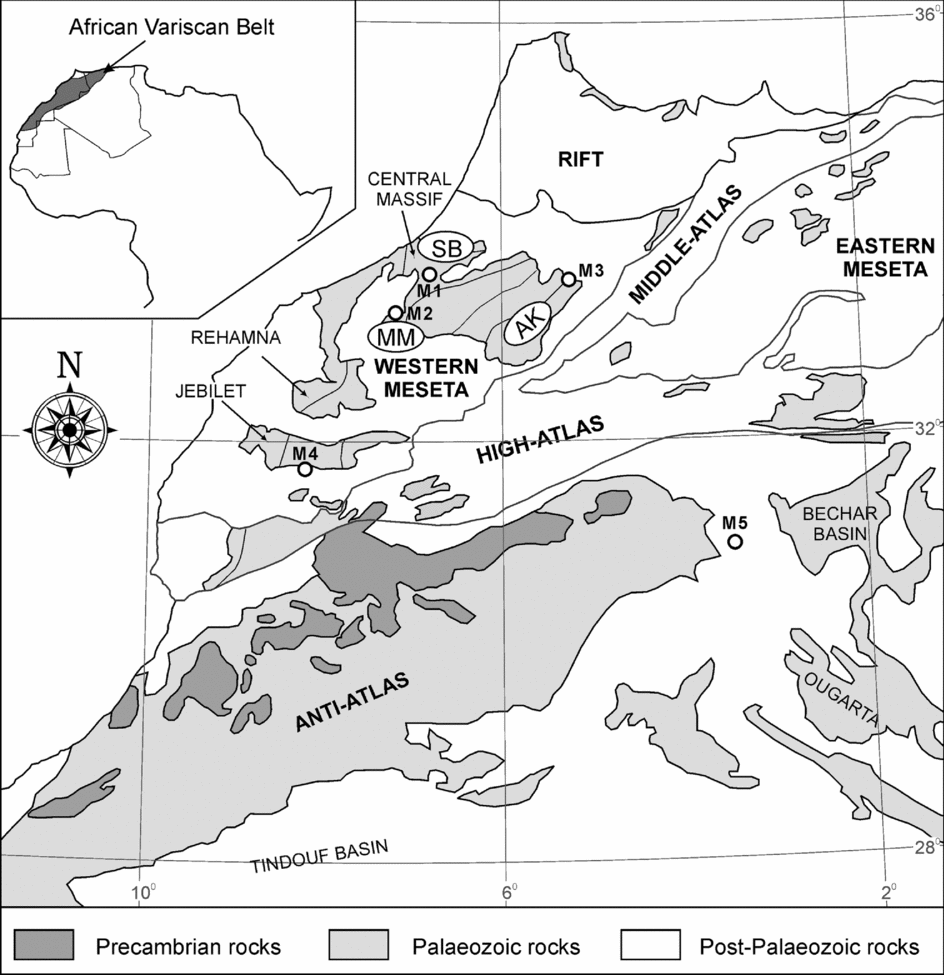
The rocks affected by the Variscan Orogeny occupy, in Africa, a wide NE–SW band extending from northern Algeria to western Mauritania (Fig. 1). They are more extensively exposed in Morocco, in the so-called Meseta Domain, which is subdivided by the Mesozoic mountains of the Atlas Range into the Western and Eastern Meseta (Gentil, Reference Gentil1918). The Western Meseta comprises three major outcrops: the Central, Rehamna and Jebilet massifs; several other minor disconnected inliers constitute the Eastern Meseta. To the south, the Moroccan Meseta is delimited by the Anti-Atlas (Fig. 1). This domain, weakly affected by the Variscan deformation, is transitional between the North African Variscan Belt and the West African Craton (Piqué et al. Reference Piqué, Bossière, Boulin, Chalouan and Hoepffner1993).
Location of the African Variscan Belt (upper left corner); and geological sketch map of the main Palaeozoic and Precambrian outcrops in northwest Africa showing the locations of the Moroccan Viséan palynofloras referred to in this study. M1-assemblage studied by Marhoumi, Doubinger & Piqué (Reference Marhoumi, Doubinger and Piqué1984); M2-assemblage, Loboziak et al. (Reference Loboziak, Vachard, Fadli and Streel1990); M3-assemblage, Ouarhache et al. (Reference Ouarhache, Baudelot, Charriere, Perret and Vachard1991); M4-assemblage, Playford et al. (Reference Playford, González, Moreno and Al Ansari2008); M5-assemblage, Rahmani-Antari & Lachkar (Reference Rahmani-Antari and Lachkar2001). AK – Azrou-Khénifra Basin; SB – Sidi-Bettache Basin; MM – Mdkra Massif.

During Late Devonian time, the Western Meseta was influenced by extensional tectonism that gave rise to the opening of several basins bounded by NE–SW transcurrent shear zones generally corresponding to ancient reactivated fractures (Piqué, Reference Piqué2001; Hoepffner, Soulaimani & Piqué, Reference Hoepffner, Soulaimani and Piqué2005). At that time, the largest and most subsiding basin was that of Sidi-Bettache, located at the northwestern margin of the Central Meseta. Bordered by chaotic facies including conglomerates, olistostromes and mud flows (Piqué, Reference Piqué1979), this basin was filled mainly by fine-grained turbiditic sediments and localized volcanic deposits (Kharbouch et al. Reference Kharbouch, Juteau, Treuil, Joron, Piqué and Hoepffner1985). The Eastern Meseta experienced a significant reduction in sediment supply and compressive tectonic activity with intensive folding related to regional ENE–WSW shortening (Piqué et al. Reference Piqué, Bossière, Boulin, Chalouan and Hoepffner1993; Hoepffner, Soulaimani & Piqué, Reference Hoepffner, Soulaimani and Piqué2005). The Anti-Atlas Domain remained tectonically stable in its western part, but normal faulting and tilting of platform blocks along its northeastern margin resulted in the opening of relatively small basins (Wendt, Reference Wendt1985).
During the Early Mississippian (Tournaisian), the Moroccan Palaeozoic was well differentiated palaeogeographically. It was characterized by continuous deposition in the subsiding Sidi-Bettache Basin and other subsidiary basins of the Western Meseta, the virtual lack of sedimentation in the presumably uplifted Eastern Meseta, and successive transgressive–regressive cycles in the Anti-Atlas (Piqué & Michard, Reference Piqué and Michard1989; Piqué, Reference Piqué2001).
In the Middle Mississippian (Viséan), increasing transtensional activity occurred in the Western Meseta. Further deepening of the Sidi-Bettache Basin was coeval with the opening of new, strongly subsiding basins, notably the Azrou-Khénifra and Jebilet basins (Fig. 1). These basins, also controlled by NE–SW dextral strike-slip shear zones, were rapidly infilled by fine- to coarse-grained detrital sediments, subordinate limestones, and local volcanic and subvolcanic rocks (Huvelin, Reference Huvelin1977; Beauchamp & Izart, Reference Beauchamp and Izart1987; Berkhli, Vachard & Paicheler, Reference Berkhli, Vachard and Paicheler2001; Bamoumen, Aarab & Soulaimani, Reference Bamoumen, Aarab and Soulaimani2008; Moreno et al. Reference Moreno, Sáez, González, Almodóvar, Toscano, Playford, Alansari, Rziki and Bajddi2008). The environmental and magmatic conditions characterizing some of these basins during the orogenic process favoured the generation and preservation of large massive sulphide deposits (Moreno et al. Reference Moreno, Sáez, González, Almodóvar, Toscano, Playford, Alansari, Rziki and Bajddi2008). At this time, the Eastern Meseta was characterized by the formation of small basins filled with detrital, carbonate and volcaniclastic deposits (Hoepffner, Soulaimani & Piqué, Reference Hoepffner, Soulaimani and Piqué2005), while the Anti-Atlas was dominated by widespread marine clastic deposition to the south and by reef building to the east (Piqué & Michard, Reference Piqué1989; Piqué, Reference Piqué2001).
The Palaeozoic rocks of Morocco were folded during the major compressive phase of the Variscan Orogeny in northwest Africa (Michard, Reference Michard1976), dated as late Westphalian–Early Permian. In the Western and Eastern Meseta the effects of deformation varied considerably. Large, weakly deformed areas were delimited by strongly deformed shear zones, commonly accompanied by intrusive and extrusive magmatic rocks (Lagarde, Omar & Roddaz, Reference Lagarde, Omar and Roddaz1990; Michard et al. Reference Michard, Hoepffner, Soulaimani, Baidder, Michard, Saddiqi, Chalouan and Frizon de Lamotte2008). The shear zones usually coincided with pre-existing faults like those responsible for the opening of the Devonian–Mississippian strike-slip basins (Piqué & Michard, Reference Piqué and Michard1989). Southward, in the Anti-Atlas, the deformation was generally weak, attenuating progressively toward the south, where this domain connects with the pericratonic, undeformed Tindouf Basin (Fig. 1).
From a broader palaeogeographic perspective, the tectonic complexity of northwest Africa is clearly a manifestation of the high oblique convergence between Gondwana and Laurussia (Houari & Hoepffner, Reference Houari and Hoepffner2003; Simancas et al. Reference Simancas, Tahiri, Azor, González Lodeiro, Martínez Poyatos and El Hadi2005). Space–time evolution of the prolonged dextral transpressive regime affecting this region since the Late Devonian was critical for the rupture and compartmentalization of the pre-orogenic platform, for the infill and evolution of the syn-orogenic basins, and for the distribution of the different post-orogenic deformational patterns that characterize northwest Africa.
3. Statistical analysis
The statistical analysis developed here is based on the quantitative comparison between the Middle Mississippian (Viséan) miospore floras of Morocco and those from Southern Laurussia and other Northern Gondwanan regions. This comparison is plausible because, although the Viséan palynofloral assemblages reported in these two regions include relatively short-ranged and hence chronostratigraphically significant miospore species, they are mostly characterized by species whose stratigraphic ranges are not strictly confined to the Viséan. This permits assessment of the palynofloral affinity by comparison of Viséan assemblages even including species having disparate stratigraphic ranges.
The method of comparison is the cluster analysis of a data matrix constructed with the similarity coefficients among the palynofloral assemblages of Morocco, and those selected from Western Europe, elsewhere in North Africa, and the Middle East. Cluster analysis has proven useful in studying the relationships between Northern Gondwana and Southern Laurussia palynological assemblages (see, for example, Clayton, Wicander & Pereira, Reference Clayton, Wicander and Pereira2002).
The numerous palynological publications based in these regions show significant differences in terms of taxonomic documentation. Those including comprehensive systematic descriptions and illustrations of the assemblages are in the minority. By contrast, most of the studies simply provide an inventory of the miospores identified or, more commonly, merely a summary listing of species deemed important stratigraphically. Accordingly, from this disparate database, selection criteria of both data analysis (statistical comparison method) and data source (previous literature) are clearly critical for the integrity of the comparative analysis.
The clustering method is by means of agglomerative, unweighted pair-groups with arithmetic averages, adopting normalized squared Euclidean distances as measurements. This method was selected from among various other options because it produced the highest cophenetic correlation coefficient (rcoph = 0.96). The clustering procedure was performed using the software SPSS 15.0.
The data matrix was constructed via a selection of published palynological assemblages considered representative of each given region. The potentially misleading effect produced by comparison of ‘complete’ and ‘selective’ lists of taxa was solved by using the similarity index of Simpson (Reference Simpson1960), because this coefficient minimizes the effects of unequal population size and species diversity, and, furthermore, reduces the effect of discrepancies in sampling procedures (Simpson, Reference Simpson1960; Rowell, McBride & Palmer, Reference Rowell, McBride and Palmer1973; Campbell & Valentine, Reference Campbell and Valentine1977; Fallaw, Reference Fallaw1979). Simpson's coefficient is given by: Sc = c/N1, where c represents the number of shared species between two populations and N1 represents the total number of species in the smaller assemblage.
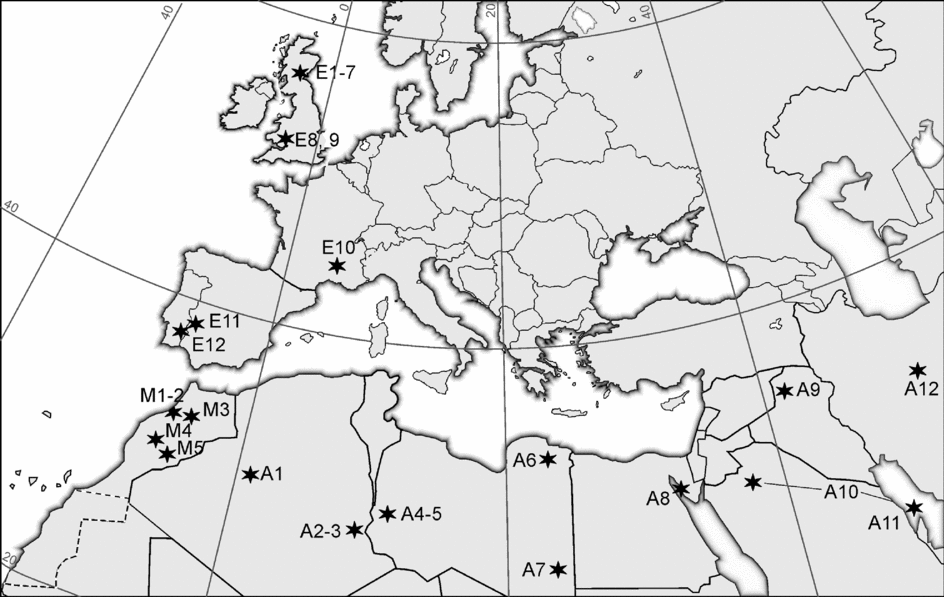
The rectangular data matrix includes Moroccan Viséan assemblages in the left column, and selected Viséan assemblages from Western Europe, the rest of North Africa and the Middle East in the top row. The Moroccan assemblages were published by Marhoumi, Doubinger & Piqué (Reference Marhoumi, Doubinger and Piqué1984); Loboziak et al. (Reference Loboziak, Vachard, Fadli and Streel1990); Ouarhache et al. (Reference Ouarhache, Baudelot, Charriere, Perret and Vachard1991); Rahmani-Antari & Lachkar (Reference Rahmani-Antari and Lachkar2001) and Playford et al. (Reference Playford, González, Moreno and Al Ansari2008). Those from Western Europe refer to Love (Reference Love1960); Doubinger & Rauscher (Reference Doubinger and Rauscher1966); Sullivan & Marshall (Reference Sullivan and Marshall1966); Smith & Butterworth (Reference Smith and Butterworth1967); Neves et al. (Reference Neves, Gueinn, Clayton, Ioannides, Neville and Kruszewska1973); Neves & Ioannides (Reference Neves and Ioannides1974); Brindley & Spinner (Reference Brindley and Spinner1989); Mahdi & Butterworth (Reference Mahdi and Butterworth1994); Turner, Spinner & Dorning (Reference Turner, Spinner and Dorning1995); Owens et al. (Reference Owens, Mclean, Simpson, Shell and Robinson2005); Pereira, Oliveira & Oliveira (Reference Pereira, Oliveira and Oliveira2006) and Rodríguez et al. (Reference Rodríguez, Medina, González Lodeiro, Martín, Martínez and Matas2007). The North African and Middle Eastern assemblages are those documented by Coquel et al. (Reference Coquel, Loboziak, Stampfli and Stampfli-Vuille1977); Coquel, Doubinger & Massa (Reference Coquel, Doubinger and Massa1988); Attar et al. (Reference Attar, Fournier, Candilier and Coquel1980); Massa et al. (Reference Massa, Coquel, Loboziak and Taugourdeau-Lantz1980); Clayton & Loboziak (Reference Clayton and Loboziak1985); Loboziak & Clayton (Reference Loboziak, Clayton, El-Arnauti, Owens and Thusu1988); Grignani, Lanzoni & Elatrash (Reference Grignani, Lanzoni, Elatrash, Salem, Hammuda and Eliagoubi1991); Kora (Reference Kora1993); Ravn et al. (Reference Ravn, McPhilemy, Rutherford, Talli, Bahra and Simmons1994); Clayton (Reference Clayton1995); Abdesselam-Rouighi & Coquel (Reference Abdesselam-Rouighi and Coquel1997); Coquel & Abdesselam-Rouighi (Reference Coquel and Abdesselam-Rouighi2000) and Clayton et al. (Reference Clayton, Owens, Al-Hajri, Filatoff, Al-Hajri and Owens2000). The location of these assemblages is shown in Figure 2.
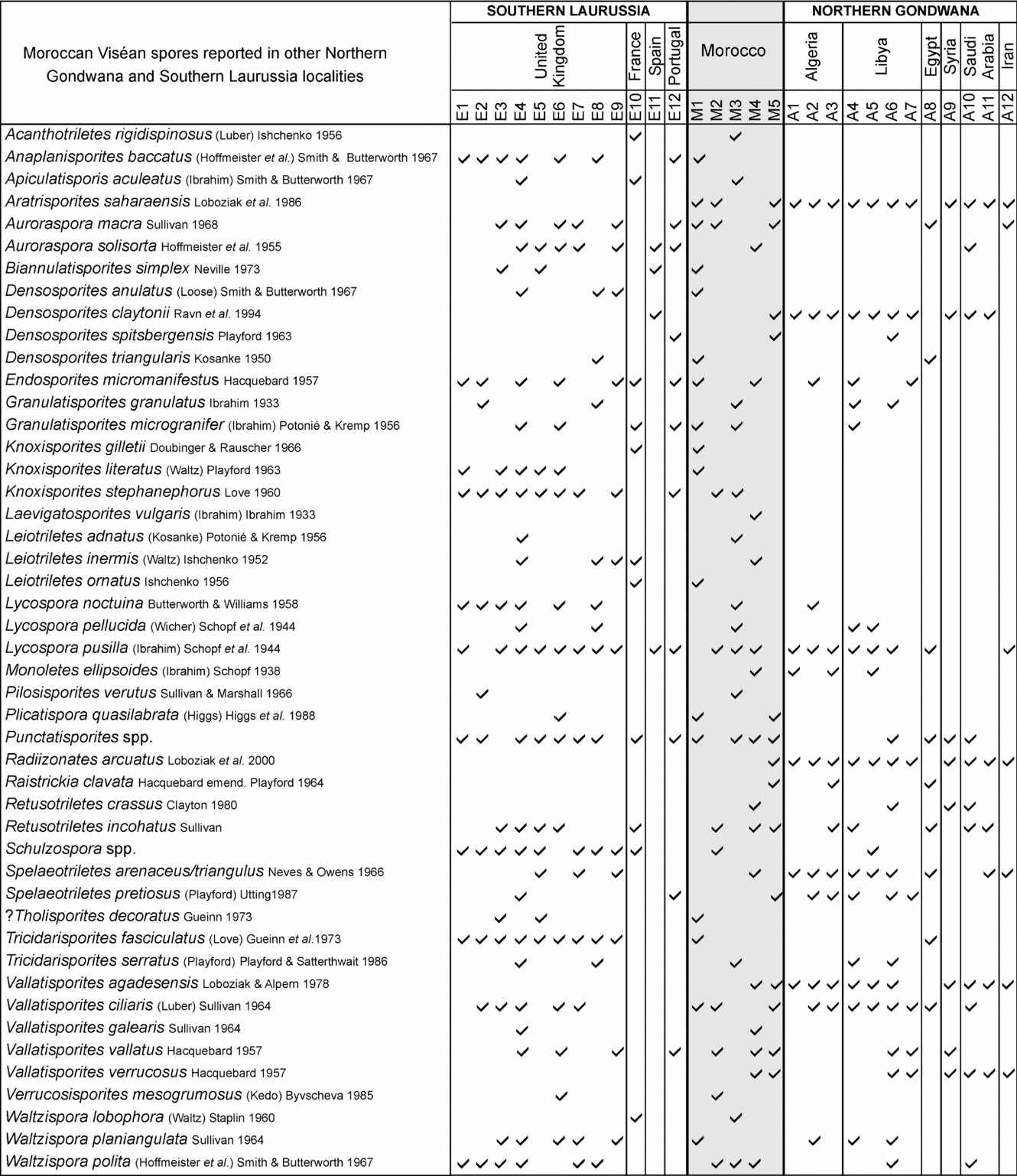
Location of the Viséan miospore assemblages from Morocco, Europe, the Middle East, and the rest of North Africa referred to in this study. The Moroccan assemblages (M1 to M5) are located more precisely in Figure 1. Authors/locations of the European assemblages are: E1, Love (Reference Love1960); E2, Sullivan & Marshall (Reference Sullivan and Marshall1966); E3, Neves et al. (Reference Neves, Gueinn, Clayton, Ioannides, Neville and Kruszewska1973); E4, Neves & Ioannides (Reference Neves and Ioannides1974); E5, Brindley & Spinner (Reference Brindley and Spinner1989); E6, Mahdi & Butterworth (Reference Mahdi and Butterworth1994); E7, Owens et al. (Reference Owens, Mclean, Simpson, Shell and Robinson2005); E8, Smith & Butterworth (Reference Smith and Butterworth1967); E9, Turner, Spinner & Dorning (Reference Turner, Spinner and Dorning1995); E10, Doubinger & Rauscher (Reference Doubinger and Rauscher1966); E11, Rodríguez et al. (Reference Rodríguez, Medina, González Lodeiro, Martín, Martínez and Matas2007); E12, Pereira, Oliveira & Oliveira (Reference Pereira, Oliveira and Oliveira2006). Authors/locations of the North African and Middle East assemblages are: A1, Coquel & Abdesselam-Rouighi (Reference Coquel and Abdesselam-Rouighi2000); A2, Attar et al. (Reference Attar, Fournier, Candilier and Coquel1980); A3, Abdesselam-Rouighi & Coquel (Reference Abdesselam-Rouighi and Coquel1997); A4, Massa et al. (Reference Massa, Coquel, Loboziak and Taugourdeau-Lantz1980); A5, Coquel, Doubinger & Massa (Reference Coquel, Doubinger and Massa1988); A6, Clayton & Loboziak (Reference Clayton and Loboziak1985) and Loboziak & Clayton (Reference Loboziak, Clayton, El-Arnauti, Owens and Thusu1988); A7, Grignani, Lanzoni & Elatrash (Reference Grignani, Lanzoni, Elatrash, Salem, Hammuda and Eliagoubi1991); A8, Kora (Reference Kora1993); A9, Ravn et al. (Reference Ravn, McPhilemy, Rutherford, Talli, Bahra and Simmons1994); A10, Clayton (Reference Clayton1995); A11, Clayton et al. (Reference Clayton, Owens, Al-Hajri, Filatoff, Al-Hajri and Owens2000); A12, Coquel et al. (Reference Coquel, Loboziak, Stampfli and Stampfli-Vuille1977).

The number of Viséan palynological assemblages documented in Southern Laurussia is clearly larger than that in Northern Gondwana. However, in order to preserve the equanimity of the cluster analysis and the weight given to each palynofloristic province, the numbers of assemblages selected from both regions were equalized. Several attempts were made to substitute assemblages in the constructed data matrix with others also considered representative (that is, Sullivan, Reference Sullivan1964; Butterworth & Spinner, Reference Butterworth and Spinner1967; Neville, Reference Neville1968; Hibbert & Lacey, Reference Hibbert and Lacey1969; Pereira, Reference Pereira1999; Jäger, Reference Jäger2002). In all instances, the final result proved virtually identical to that illustrated in Figure 3.
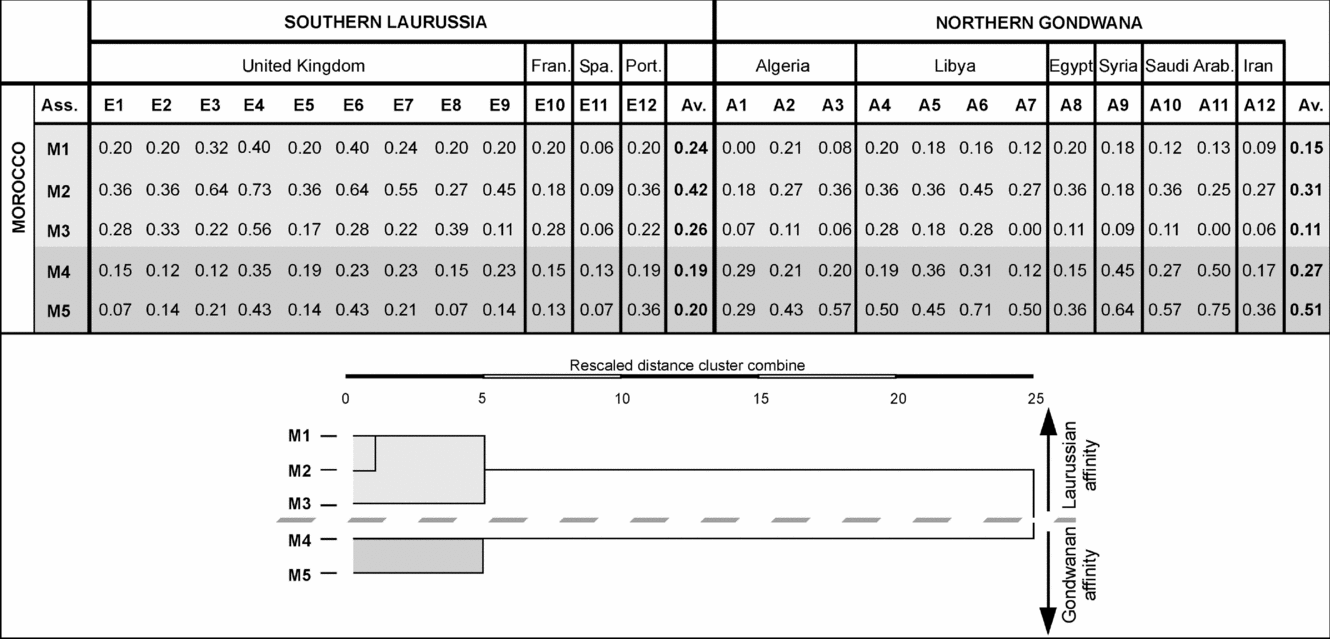
Simpson similarity matrix between the Viséan miospore assemblages of Morocco and those of Western Europe, the rest of North Africa and the Middle East. The resultant dendrogram shows two distinct groups, one Laurussian and the other Gondwanan in character.

The list of species from Morocco reported also in other West European, North African and Middle Eastern assemblages is given in Appendix Figure A1. The published assemblages discarded for comparative purposes are: (1) those characterized by very low diversity (and would thus produce an unrealistic or detrimental effect on the statistical analysis); and (2) those that classified the miospores under an informal taxonomic system and hence proved difficult or impossible to compare with assemblages expressed via conventional taxonomy. Where a species has been assigned to different genera by different authors, we have chosen what we judge to be the more appropriate binomen. Where individual species within a genus (e.g. Punctatisporites) were not identified per se, the designation ‘Genus spp.’ (e.g. Punctatisporites spp.) is adopted.
4. Results and discussion
The regional and global palaeogeographic inferences expressed herein are based on comparison of the Moroccan Viséan palynofloras with those from Western Europe, the rest of North Africa, and the Middle East (Fig. 3). The values in Figure 3 represent the ‘signature’ of each Moroccan assemblage in terms of its affinity with the Laurussian and Gondwanan palynofloras. The clustering analysis of these data (Fig. 3) presents two distinctive groups: one containing the assemblages reported from the northern part of the Western Moroccan Meseta (samples M1, M2 and M3 from Marhoumi, Doubinger & Piqué, Reference Marhoumi, Doubinger and Piqué1984; Loboziak et al. Reference Loboziak, Vachard, Fadli and Streel1990 and Ouarhache et al. Reference Ouarhache, Baudelot, Charriere, Perret and Vachard1991, respectively); and the other comprising assemblages from the southern part of the Western Meseta and Anti-Atlas (samples M4 and M5 from Playford et al. Reference Playford, González, Moreno and Al Ansari2008 and Rahmani-Antari & Lachkar, Reference Rahmani-Antari and Lachkar2001, respectively). The average Simpson similarity between the northern Moroccan assemblages and the Laurussian assemblages ranges between 0.24 and 0.42 (mean, 0.30), whereas values between the Laurussian assemblages and the southern Moroccan assemblages are 0.19 and 0.20. By contrast, the similarity between the northern assemblages of Morocco and the Gondwanan correlatives ranges between 0.11 and 0.31 (mean, 0.19), and the values between the southern Moroccan assemblages and that of the rest of Gondwana are 0.27 and 0.51 (Fig. 3). In palaeogeographic terms this means that, whereas the Viséan spore assemblages of northern Morocco (M1, M2 and M3) are more akin to the Laurussian assemblages, those reported further south in the Variscan Domain (M4, M5) reveal an unmistakable Gondwanan affinity. In addition, common to all the Moroccan palynological assemblages analysed in this study is the conspicuous absence of transitional assemblages, that is, containing species representative of the two palynofloristic provinces involved (the Grandispora and Aratrisporites saharaensis microfloras).
The likelihood that the results illustrated in Figure 3 could be influenced by preservational differences among the five Moroccan assemblages analysed merits consideration. However, it is extremely unlikely that only typical Northern Gondwanan species were selectively destroyed in those assemblages from the northern part of the Western Moroccan Meseta, and only characteristic Southern Laurussian miospores were eliminated from those assemblages from the southern part of the Western Meseta and Anti-Atlas.
In order to enhance understanding of the palaeogeographic significance of these trends, both locally and regionally, it is important to view them vis-à-vis the geotectonic settings in which the selected palynological assemblages were deposited. Assemblages M1–M4 are all from the Western Meseta (Fig. 1): M1 was reported by Marhoumi, Doubinger & Piqué (Reference Marhoumi, Doubinger and Piqué1984) from the lower Viséan of the northwestern Sidi-Bettache basin; M2 by Loboziak et al. (Reference Loboziak, Vachard, Fadli and Streel1990) from the middle Viséan of the Mdkra Massif, a southwesterly prolongation of Sidi-Bettache; M3 by Ouarhache et al. (Reference Ouarhache, Baudelot, Charriere, Perret and Vachard1991) from an upper Viséan olistolith on the northeastern margin of Azrou-Khénifra Basin, northeastern Western Meseta and M4 by Playford et al. (Reference Playford, González, Moreno and Al Ansari2008) from the upper Viséan of the central zone of the Jebilet Massif. During the Late Devonian/Mississippian, Variscan tectonism resulted in the palaeogeographic complexity of the Western Meseta. The distribution, composition and affinity of the palynofloras seem to be markedly controlled by this highly tectonized setting. This is evidenced by the varied affinities of the miospore assemblages from the northern (Laurussian-influenced) and southern (Gondwanan-influenced) basins of the Western Meseta. Assemblage M5, studied by Rahmani-Antari & Lachkar (Reference Rahmani-Antari and Lachkar2001), derived from the lower Viséan of the eastern margin of the Tafilalt Basin, eastern Anti-Atlas Domain (Fig. 1). This basin, only weakly affected by the Variscan Orogeny, correlates to the north with the Jebilet Basin and to the south with the pericratonic Tindouf Basin. The Gondwanan affinity of this assemblage is clearly compatible with the proximity and influence of the emergent land masses of the West African Craton.
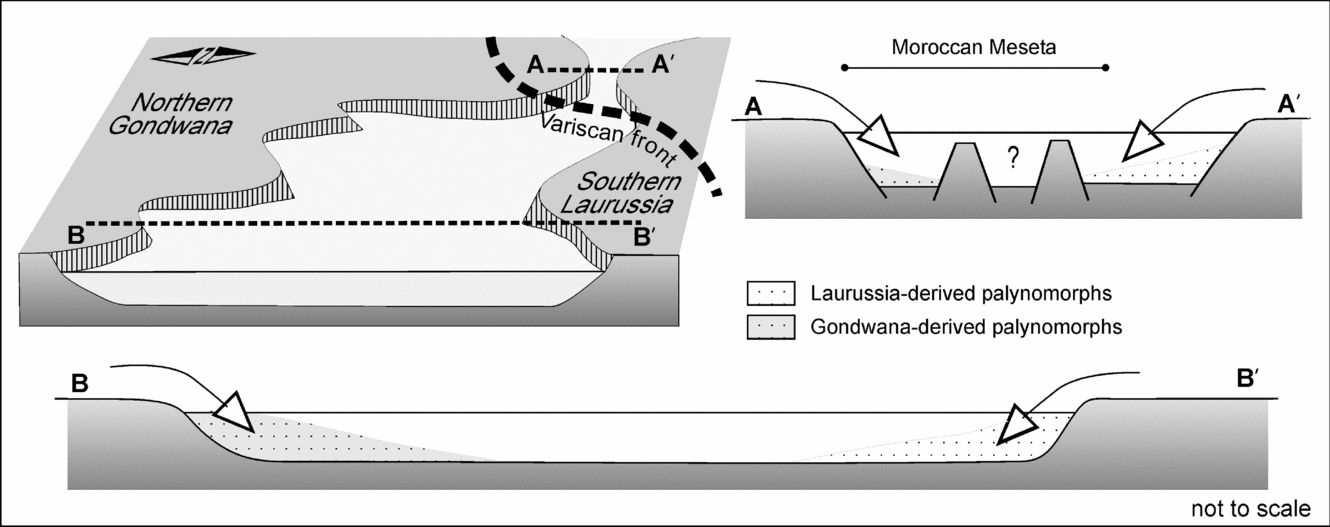
Palynofloral variations within the Western Meseta have regional palaeogeographic implications. It is generally accepted that the Late Devonian/Mississippian transtensional deformation affecting the Moroccan Meseta resulted in a complex palaeogeography with several basins showing comparable tectonic evolution (Beauchamp & Izart, Reference Beauchamp and Izart1987). The original extension and relationship between such basins are often masked by tectonic overprints derived from the Variscan and post-Variscan shortening, and also by the subsequent, extensive Mesozoic and Cenozoic cover deposits. That notwithstanding, the northern Sidi-Bettache and Azrou-Khénifra basins may well be contiguous southward with the Rehamna and Jebilet basins (see, for example, Piqué & Michard, Reference Piqué and Michard1989; Piqué, Reference Piqué1989, Reference Piqué2001; Hoepffner, Soulaimani & Piqué, Reference Hoepffner, Soulaimani and Piqué2005; Hoepffner, Houari & Bouabdelli, Reference Hoepffner, Houari and Bouabdelli2006; Moreno et al. Reference Moreno, Sáez, González, Almodóvar, Toscano, Playford, Alansari, Rziki and Bajddi2008). This is supported by the genetic relationship of these basins; they exhibit a common set of major shear zones responsible for their opening and development, and pronounced similarities in their depositional, magmatic and structural evolution. However, their disparate palynological signatures and their lack of mixed assemblages point to the existence of a physical barrier impeding free connection of the Jebilet Basin with its northern counterparts. This is more likely a consequence of the complex palaeogeography of the Moroccan Meseta rather than the existence of a broad seaway separating its northern and southern parts. For Viséan time, such a seaway would scarcely be conceivable. Elements of the palynofloras characteristic of the southern regions of Western Europe are clearly represented in the northern Moroccan basins. To the south, the Gondwanan palynoflora occurs in the slightly deformed platform immediately north of the West African Craton, and also in the southern margin of the Western Meseta (the Jebilet massif), but never reached the northern Moroccan basins (Fig. 4). This interpretation is compatible with the structural evolutionary model proposed by Bouabdelli & Piqué (Reference Bouabdelli and Piqué1996, Fig. 5a), in which the Moroccan Variscan domain collapsed during the latest Devonian/Early Mississippian to form several individual pull-apart basins that were bordered by stretched and/or longitudinally equivalent transcurrent strike-slip shear zones.
Proposed schematic depiction of the Southern Laurussian and Northern Gondwanan margins during Viséan times, and hypothetical cross sections illustrating the inferred relatively short distance but complex palaeogeography separating Gondwana and Laurussia from the west (A–A′); and the existence of an extensive seaway separating them from the east (B–B′).

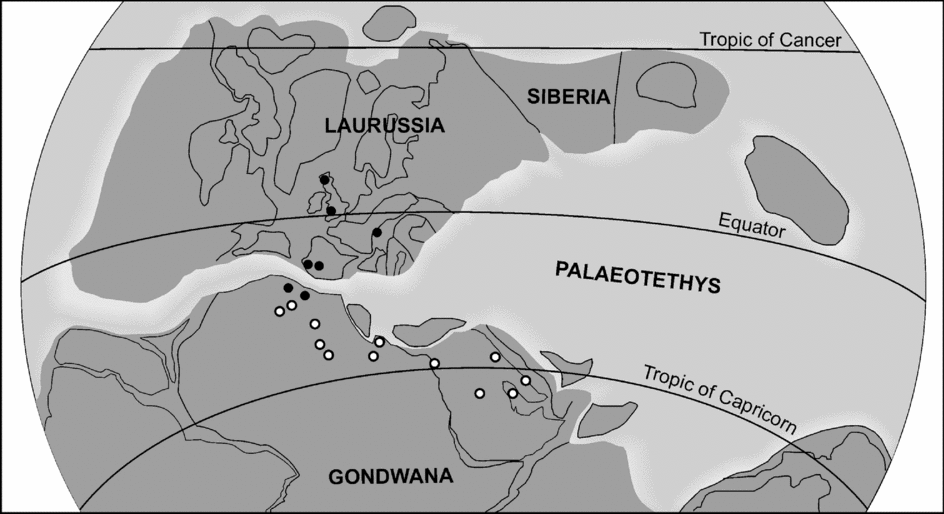
Mississippian palaeogeographic map (modified from Stampfli, Reference Stampfli, Bozkurt, Winchester and Piper2000) showing the inferred position of the Laurussia-influenced (black dots) and Gondwana-influenced (white dots) miospore assemblages used in this study.

The Late Palaeozoic palaeogeographic situation of the Moroccan Meseta represents a nexus between Northern Gondwana and Southern Laurussia. Understanding the distribution of its Viséan palynoflora may well provide further details regarding the pre-collisional relationship between these megacontinents. The evolution of Gondwana and Laurussia has been inferred from numerous studies. These show limited consensus on the drift pattern of Gondwana, on the motion and amalgamation of the different Gondwana–derived terranes that joined Laurussia, and on the location, nature and age of the suture zones (e.g. Tait et al. Reference Tait, Bachtadse, Franke and Soffel1997, Reference Tait, Schätz, Bachtadse, Soffel, Franke, Haak, Oncken and Tanner2000; McKerrow et al. Reference McKerrow, Mac Niocaill, Ahlberg, Clayton, Cleal, Eagar, Franke, Haak, Oncken and Tanner2000; Weil, Van der Voo & van der Pluijm, Reference Weil, Van der Voo and van der Pluijm2001; Stampfli & Borel, Reference Stampfli and Borel2002; Stampfli, Von Raumer & Borel, Reference Stampfi, Von Raumer, Borel, Martínez Catalán, Hatcher, Arenas and Díaz García2002; Robardet, Reference Robardet2003; Simancas et al. Reference Simancas, Azor, Martínez Poyatos, Tahiri, El Hadi, González Lodeiro, Pérez Estaún and Carbonell2009; Keppie et al. Reference Keppie, Nance, Murphy, Dostal and Braid2010; Nance et al. Reference Nance, Gutiérrez-Alonso, Keppie, Linnemann, Murphy, Quesada, Strachan and Woodcock2010; Tahiri et al. Reference Tahiri, Montero, El Hadi, Martínez Poyatos, Azor, Bea, Simancas and González Lodeiro2010). However, the models proposed for the Late Devonian/Carboniferous interval mostly do not envisage any substantial separation between Gondwana and Laurussia. The Laurussian affinity of the palynoflora reported from the northern margin of the Moroccan Meseta is not only in good agreement with such a scenario, but also suggests very close Gondwana–Laurussia proximity during the Viséan.
Clayton, Wicander & Pereira (Reference Clayton, Wicander and Pereira2002) detected strong dissimilarities, particularly in Viséan time, between the miospore assemblages of Western Europe and North Africa. Accordingly, they suggested that, in the absence of transitional assemblages, the two continents were separated by a large oceanic distance. This conjecture apparently disagrees with our results. However, the fact that our study is focused on the northwestern border of Gondwana (Morocco), and that of Clayton, Wicander & Pereira (Reference Clayton, Wicander and Pereira2002) analysed assemblages from its northern and northeastern margins (Algeria, Libya and Saudi Arabia), makes both studies complementary and not incompatible. Thus, by taking the two studies jointly into account, it is possible to provide a more comprehensive palaeogeographic scenario of this northern margin of Gondwana, that is, extending from northern Morocco to Saudi Arabia. During the Late Devonian, the convergence between Laurussia and Gondwana was initiated in northwest Africa. Here, the development of a transpressive–transtensive geodynamic regime resulted in the final collapse of the Moroccan Platform, with ensuing formation of several subsiding pull-apart basins, principally in the Western Moroccan Meseta (Piqué, Reference Piqué2001; Hoepffner, Houari & Bouabdelli, Reference Hoepffner, Houari and Bouabdelli2006). The northwestern margin of Gondwana was in close proximity to Laurussia in the Viséan (Fig. 5), and the northern basins of the Western Meseta clearly received a southerly influx of Laurussian terrestrial palynofloras (Fig. 4). The strong tectonic control and compartmentation of the Meseta Domain precluded the further southerly migration of such palynofloras and their potential mixing with those characterizing the Gondwanan realm. Further east, the oceanic separation of Laurussia from the central and eastern border of Northern Gondwana evidently remained much wider (Fig. 5) and, as suggested by Clayton, Wicander & Pereira (Reference Clayton, Wicander and Pereira2002), this was probably the principal factor impeding plant migration and consequential miospore mixing (Fig. 4).
The interpretation proposed here, based on the composition and distribution of the Viséan palynofloras of Northern Gondwana, is fully consistent with the clockwise rotational movement of Gondwana with respect to Laurussia that has been invoked by virtually all the pre-collisional palaeogeographic models. Furthermore, because northern Morocco is the only region in Africa featuring Viséan miospore assemblages of Laurussian character, the present palaeogeographic interpretation is consonant with reconstructions depicting very close proximity between the northwest margin of Gondwana and Southern Laurussia during Viséan time (e.g. Kent & Keppie, Reference Kent, Keppie, Harris and Fettes1988; Ziegler, Reference Ziegler1989; McKerrow et al. Reference McKerrow, Mac Niocaill, Ahlberg, Clayton, Cleal, Eagar, Franke, Haak, Oncken and Tanner2000; Matte, Reference Matte2001; Robardet, Reference Robardet2003; Scotese, Reference Scotese2004).
In the later syn-collisional stage, the land connection between North Africa and Western Europe is indicated by, among other things, the mixed palynofloras preserved in uppermost Carboniferous and Lower Permian continental basins of Spain, Algeria, Nigeria and Oman (Doubinger & Fabre, Reference Doubinger and Fabre1983; Broutin, Reference Broutin1986; Broutin & Doubinger, Reference Broutin and Doubinger1985; Broutin et al. Reference Broutin, Doubinger, El Hamet and Lang1990, Reference Broutin, Roger, Platel, Angiolini, Baud, Bucher, Marcoux and Al Hasmi1995). In view of the efficacy of palynomorphs as palaeogeographic indicators, further palynological analysis of Northern Gondwana and Southern Laurussia would clearly be important. For instance, knowledge of the Víséan palynoflora of the Rehamna Massif, located in the central part of the Western Meseta, would enhance understanding of the Palaeozoic palaeogeography of northwest Africa. Additionally, the Late Mississippian, and particularly the Pennsylvanian palynological sequence of Southern Laurussia and the remaining northern passive margin of Gondwana, could provide further information on the timing of the Pangaea amalgamation.
5. Conclusions
The statistical analysis of the Viséan miospore assemblages reported from Morocco reveals two distinct groups allied to the palynofloras reported from Western Europe on the one hand, and to the remaining areas of North Africa and the Middle East on the other. The assemblages defined from the northern margin of the Western Meseta signify a clear Laurussian affinity, whereas those known from the southern part of the Western Meseta and the Anti-Atlas are more Gondwanan in composition. On the other hand, no transitional assemblages have been described so far in the Viséan of northwest Africa. Both the differences in terms of Gondwanan/Laurussian affinity manifested by the Western Meseta miospore assemblages, and the notable absence of transitional assemblages in this area, appear to be consequential on the pronounced palaeogeographic variations that occurred within a confined area. In this regard, the Jebilet Basin, characterized by the Gondwanan signature of its palynoflora, evolved apparently separately from the northern Sidi-Bettache and Azrou-Khénifra basins, where the miospore assemblages are distinctly Laurussian in character. The differing evolution of these basins occurred despite them sharing the same structural trend.
In a broader palaeogeographic context, the disparate complexion of the Mississippian palynofloras reported along the North African margin is in good agreement with the generally accepted scenario in which the Late Carboniferous amalgamation of Pangaea initially evolved from its western margin, while, in the east, a large ocean still separated Southern Laurussia from Northern Gondwana. As the Viséan palynofloras of these margins appear to have been highly sensitive to the geodynamic changes related to the Pangaea accretion, further palynological data from the Carboniferous of Northern Gondwana and Southern Laurussia would facilitate an improved understanding of the amalgamation process.
Acknowledgements
Special thanks are extended to Dr Tony Roberts (The University of Queensland) for his helpful mathematical advice. This research was financed by the CICYT (Spain) Research Project CGL2006-08517, the Research Group THARSIS RNM 198-PAI (Junta de Andalucía), and IGCP-UNESCO 502 project. Professor Maurice Streel (Université de Liège) and an anonymous reviewer are thanked for providing helpful suggestions for improvement of the manuscript.