Introduction
In single-miracidium infections of Galba truncatula with Fasciola hepatica, the development of redial generations is dependent on behaviour of the first mother redia of the first generation (R1a). If this R1a redia remains alive throughout snail infection, it produces most second-generation rediae. In contrast, if it dies during the first weeks, daughter redia formation is ensured by a substitute redia, i.e. the second mother redia of the first generation, or the first redia of the second generation (Rondelaud et al., Reference Rondelaud, Belfaiza, Vignoles, Moncef and Dreyfuss2009a). However, this R1a redia is not the only larva to ensure daughter redia formation because the first two mother rediae (in snails>12 mm) or all first-generation rediae (in Moroccan snails infected with sympatric miracidia) can produce most second-generation daughter rediae (Rondelaud et al., Reference Rondelaud, Belfaiza, Vignoles, Moncef and Dreyfuss2009a).
In multiple-miracidium infections, the problem of redial generations is more complex for the following two reasons. First, the main snail host of F. hepatica in Europe and North African countries, i.e. G. truncatula, does not exceed 12 mm in shell height (Hubendick, Reference Hubendick1951; Brown, Reference Brown1994) so that the redial burden in active infections is mainly constituted of first-generation rediae because of the limited volume of the snail body (Rondelaud & Barthe, Reference Rondelaud and Barthe1982a). Second, most species of European and North African Lymnaeidae, greater than 12 mm in height at the adult stage, can only be infected if they are 2 mm or less in height at miracidial exposure (Boray, Reference Boray1978). Furthermore, these infected snails have limited growth (less than 10 mm), at least for Omphiscola glabra (Bouix-Busson & Rondelaud, Reference Bouix-Busson and Rondelaud1986) and Stagnicola palustris (Dreyfuss et al., Reference Dreyfuss, Moukrim, Rondelaud and Vareille-Morel1994). Under these conditions, it was necessary to find a lymnaeid species that had a sufficient shell height at the adult stage and could be experimentally infected by the parasite to analyse the dynamics of redial generations. As several Egyptian populations of Radix natalensis (adult shell height up to 25 mm; Brown, Reference Brown1994) can sustain larval development of F. hepatica up to cercarial shedding when they are subjected twice to bimiracidial exposures (Dar et al., Reference Dar, Djuikwo Teukeng, Vignoles, Dreyfuss and Rondelaud2010), an experiment was carried out with this lymnaeid by subjecting them to a French isolate of miracidia and analysing live rediae according to their generation in snails dissected from day 28 post-exposure (p.e.) at 24°C.
Materials and methods
Snails and parasites
The R. natalensis population was living in an irrigation canal at El Mansoria, Giza governorate, Nile Delta. One hundred and fifty snails measuring 2–3 mm in height were collected from a colony bred in the laboratory since July 2002. As both species of Fasciola and intermediate forms exist in Egypt (Periago et al., Reference Periago, Valero, El Sayed, Ashrafi, El Wakeel, Mohamed, Desquesnes, Curtale and Mas-Coma2008), the parasite strain used for this study originated from central France. Fasciola hepatica eggs were collected from gall bladders of heavily infected cattle at the slaughterhouse of Limoges, department of Haute Vienne, central France. They were washed several times with spring water and incubated at 20°C for 20 days in the dark (Ollerenshaw, Reference Ollerenshaw1971).
Experimental protocol
Thirty uninfected snails were used as controls. The other 120 were each exposed to two newly hatched miracidia before being subjected 4 h later to two other miracidia at 20°C. The choice of this protocol was based on the results of a preliminary experiment (Dar et al., Reference Dar, Djuikwo Teukeng, Vignoles, Dreyfuss and Rondelaud2010). According to these authors, the prevalence of infections with F. hepatica was five times higher in R. natalensis subjected to two successive bimiracidial exposures than in single-exposed snails. The use of four miracidia for each snail during a single exposure was not performed in the present study because of high snail mortality (>80%). After the second exposure, snails were raised in different types of covered aquaria with five snails per litre of permanently oxygenated water. Water originated from a spring located on calcareous soil so that the dissolved calcium content ranged from 60 to 73 mg/l. Pesticide-free lettuce was given ad libitum as food for snails. These aquaria were placed in an air-conditioned room under the following conditions: constant temperature of 24 ± 1°C and diurnal 12 h photoperiod with 3000–4000 lux light intensity.
Samples of 25–30 R. natalensis each were collected from this group at days 28, 42 and 56 p.e. These dates were chosen according to the mean length of the prepatent period (67.4 days at 24°C) noted by Dar et al. (Reference Dar, Djuikwo Teukeng, Vignoles, Dreyfuss and Rondelaud2010). No samples were collected at day 70 p.e. due to the low number of surviving snails (only three), which were uninfected. After snail dissection under a stereomicroscope, all live rediae present were counted under a light microscope. As the pharynges of first-generation rediae can be easily recognized by their ovoid or spherical lumen (Rondelaud et al., Reference Rondelaud, Belfaiza, Vignoles, Moncef and Dreyfuss2009a, Reference Rondelaud, Vignoles and Dreyfussb), we also identified R1a rediae (these larvae only produced daughter rediae and had the largest dimensions) and counted other rediae of this generation (R1b rediae were smaller and produced cercariae and a few daughter rediae). As there was a single R1a redia per fully grown sporocyst (Augot et al., Reference Augot, Rondelaud, Dreyfuss, Cabaret, Bayssade-Dufour and Albaret1998), we also determined how many sporocysts had matured in these snails.
Parameters studied
The numbers of all live rediae (redial burdens) and R1b rediae present in each snail were the first two parameters studied. Their maturity was also studied by considering the percentage of procercariae and/or cercariae-containing rediae for different redial burdens and R1b rediae. These figures came from counts performed in snails killed at day 42 and 56 p.e. The other two parameters were the prevalence of each type of infection (single-, two-, or three-sporocyst infections) and shell height of infected snails at day 56 p.e. A χ2 test and one-way analysis of variance (Stat-Itcf, 1988) were used to establish levels of significance.
Results
In the control group, two dead snails were noted, the first at day 60 of the experiment and the second at day 65. In the experimental group, the mortality rate of snails was 15.8% (19/120) at day 28 before snail collection for dissection. At days 42 and 56, 65 and 32 snails, respectively, were living before snail collection, so that the overall snail mortality was 38.4% (25/65) at day 42 and 82.5% (33/40) at day 56.
Type of F. hepatica infections
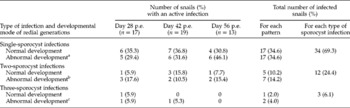
Out of 85 R. natalensis dissected for the three dates, 49 showed an active infection with live rediae and the prevalence was 57.6%. The number of fully grown sporocysts within these animals and the developmental pattern of redial generations differed (table 1) from one snail to another. Snails with single-sporocyst infections were significantly (χ2 = 46.71, P < 0.001) the most numerous: 69.3% (34/49), with equivalent numbers of normal and abnormal patterns. Two-sporocyst infections represented 24.4% of infected snails and no significant difference between the frequency of abnormal developments and that of normal patterns was noted. Only three snails (6.1%) showed the presence of three-sporocyst infections at days 28 and 42 p.e.
Type of infection and developmental mode of redial generations in R. natalensis infected with F. hepatica and dissected at regular intervals. n, number of dissected snails for each date.

a R1a redia produced by the sporocyst was degenerated.
b Live R1a redia (sporocyst 1) and another degenerated (sporocyst 2).
c Live R1a rediae (sporocysts 1 and 2) and a third degenerated (sporocyst 3).
At day 56 p.e. the shell height of infected snails (13/25) was 16.5 ± 1.9 mm while that of uninfected congeners (12/25) was 17.3 ± 1.7 mm. No significant difference was found between both groups of snails (data not shown).
Redial burdens
In all infected snails (table 2), a single R1a redia per sporocyst was produced, regardless of the physiological stage (alive or degenerated) of this larva throughout snail infection. In single-sporocyst infections, the number of live rediae was significantly higher (F = 20.35, P < 0.001) in snails with normal development of redial generations. This was also true for snails with two-sporocyst infections. Indeed, the total redial burden was significantly greater (F = 10.62, P < 0.05) when the development of redial generations was normal. In the single snail with a three-sporocyst infection, the redial burden was slightly higher (61 rediae) than that of corresponding two-sporocyst infections.
Distribution of live rediae found in R. natalensis infected with F. hepatica in relation to their number per snail and developmental stage. Redial counts were made in snails dissected at days 42 and 56 p.e.

a Rediae containing procercariae and/or cercariae.
In two-sporocyst infections with a normal developmental pattern, the number of R1b rediae was significantly greater (F = 11.76, P < 0.01) than in single-sporocyst ones. Similar results were also found for R. natalensis with an abnormal pattern (F = 17.28, P < 0.01). However, for each type of infection, the difference between R1b rediae numbers in snails with a normal or abnormal pattern was insignificant. The percentage of R1b rediae increased with the number of fully grown sporocysts (from 29.3% in single-sporocyst infections with an abnormal pattern up to 40.9% in the three-sporocyst infection). For each type of infection, the highest percentage was constituted by rediae belonging to the second and third generations (data not shown).
Redial maturity
Table 2 gives the number of procercariae- or cercariae-containing rediae noted at days 42 and 56 p.e. in the five types of snail infections. In single-sporocyst infections, R. natalensis showing normal development of redial generations contained more differentiated rediae (χ2 = 5.60, P < 0.05) than snails with an abnormal pattern. In two-sporocyst infections, redial maturity was significantly lower than in single-sporocyst ones, in snails with normal redial development (χ2 = 7.99, P < 0.01) as well as in those with an abnormal pattern (χ2 = 10.16, P < 0.01). In snails with normal development, the total number of rediae (χ2 = 5.67, P < 0.05) was significantly greater. In the three-sporocyst infection with an abnormal pattern, the percentages recorded in each category were close to those found for the corresponding two-sporocyst infections.
In single-sporocyst infections, the percentage of mature R1b rediae was significantly greater (χ2 = 3.94, P < 0.05) in snails with a normal developmental pattern than in the other types of infection. However in the two- and three-sporocyst infections, no difference was found between the percentages of R1b rediae.
Discussion
The high frequency (69.3%) of single-sporocyst infections noted in R. natalensis subjected twice to bimiracidial exposures agreed with the frequencies (62.3% and 80.2%) reported by our team in natural infections of G. truncatula with F. hepatica (Rondelaud et al., Reference Rondelaud, Vignoles and Dreyfuss2004). The main difference noted in the present study concerns the frequencies of infections with an abnormal developmental pattern of redial generations, because a total of 52.8% of infected snails (see table 1) showed the presence of a degenerated R1a redia during snail infection. As this last value was much higher than that recorded by Rondelaud et al. (Reference Rondelaud, Belfaiza, Vignoles, Moncef and Dreyfuss2009a) for single-sporocyst infections (20%), it is useful to comment on this discrepancy. In our opinion, the most valid assumption is to relate this high frequency of abnormal patterns in R. natalensis to an incomplete adaptation that would still exist between this population of snails and the parasite. An argument supporting this hypothesis was the prepatent period length (a mean of 67.4 days at 24°C) noted by Dar et al. (Reference Dar, Djuikwo Teukeng, Vignoles, Dreyfuss and Rondelaud2010) for the same population of R. natalensis exposed to F. hepatica miracidia, whereas the mean length of this period ranged from 31.5 to 34.7 days (at 24°C) for G. truncatula, the main snail host of F. hepatica in Europe and northern Africa (Rondelaud et al., Reference Rondelaud, Fousi, Vignoles, Moncef and Dreyfuss2007).
The increased redial burden with increasing numbers of fully grown sporocysts agreed with the reports by Kendall (Reference Kendall1949) and Rondelaud & Barthe (1982a). The values noted for R1b rediae in snails with a normal developmental pattern also agreed with those reported by Rondelaud & Barthe (Reference Rondelaud and Barthe1982b) and Rondelaud et al. (Reference Rondelaud, Belfaiza, Vignoles, Moncef and Dreyfuss2009a, Reference Rondelaud, Vignoles and Dreyfussb) for G. truncatula. In contrast, in the two- and three-sporocyst infections, there was a difference in the distribution of live rediae according to the three redial categories. The redial burden of F. hepatica was mainly constituted of R1b rediae in G. truncatula submitted to multiple miracidial exposures (Rondelaud & Barthe 1982a), whereas there were more rediae belonging to the second and third generations (Augot et al., Reference Augot, Rondelaud, Dreyfuss, Cabaret, Bayssade-Dufour and Albaret1998) in R. natalensis from the present study, regardless of the mode of redial development. To explain this discrepancy, the most valid hypothesis is to relate this fact to the more rapid growth of the snail shell over time as R. natalensis adults were frequently more than 20 mm in height (Brown, Reference Brown1994). Under these conditions, quicker snail growth over time would permit differentiation of more second- and third-generation rediae in the two- and three-sporocyst infections, due to the available volume of the snail body. Even if the percentage of R1b rediae increased with the number of fully grown sporocysts (from 29.3% in the single-sporocyst infections with an abnormal pattern up to 40.9% in the three-sporocyst infections, see table 2), these R1b rediae did not constitute the principal element of the redial burden.
The frequencies of mature rediae recorded in single-sporocyst infections at days 42 and 56 p.e. agreed with the report by Augot & Rondelaud (Reference Augot and Rondelaud2001) in G. truncatula infected with F. hepatica. Decreased redial maturity in snails with two- or three-sporocyst infections was more difficult to interpret because this delay affects more second- and third-generation rediae than the first generation. Even if the above-mentioned hypothesis, i.e. volume available in the snail body, can explain this delay when snails harboured two- or three-sporocyst infections and, consequently, a greater number of rediae, another assumption cannot be excluded. In view of the long prepatent period (already mentioned), one may wonder whether the delay in redial maturity is due to a physiological process. It is possible that F. hepatica rediae cannot find the quality and quantity of nutrients in R. natalensis that they need for growth and differentiation of their germinal masses.