Introduction
Patients suffering from cancer have distressing experiences, from the initial perception of the physical symptoms of cancer all the way through the terminal stage (Akizuki et al., Reference Akizuki, Shimizu and Asai2016; Pranjic et al., Reference Pranjic, Bajraktarevic and Ramic2016). Kerr et al. (Reference Kerr, Engel and Schlesinger-Raab2003) reported that in a questionnaire survey of breast cancer patients, 59% of the patients agreed with the statement, “I want to talk more with the medical staff in charge.” Lower quality of life was also found in patients who were not satisfied with the communication with their medical professionals. Patients with cancer are eager not only for satisfactory communication with, but also emotional support from, medical staff (Willems et al., Reference Willems, Bolman and Mesters2017). Rehabilitation is one occasion in which emotional support can be offered to cancer patients in distress (Karitsky et al., Reference Karitsky, Chulkova and Pestereva2015). Based on the findings of a study showing that rehabilitation may have a role to play in maintaining and improving the quality of life of cancer patients, emotional supports are recommended in rehabilitation for patients in all stages of cancer, in addition to physical rehabilitation and practice with activities of daily living (Okamura, Reference Okamura2011). Therefore, rehabilitation therapists (including physical, occupational, or speech therapists) require skills in communication with cancer patients to support them emotionally.
Several studies have shown effects of communication skills training (CST) of doctors and nurses to increase emotional support for cancer patients (Moore et al., Reference Moor, Rivera Mercado and Grez Artigues2013). Fujimori et al. (Reference Fujimori, Shirai and Asai2014a) reported that communication skills based on patients’ preferences comprised four elements, grouped into the acronym “SHARE:” setting up a supportive environment for the interview (S [ENV]), considering how to deliver bad news (H [HOW]), discussing additional information (A [ADD]), and providing reassurance and responding empathically to the patient's emotions (RE [EMP)]. In two studies (Fujimori et al., Reference Fujimori, Shirai and Asai2014b; Tang et al., Reference Tang, Chen and Hsu2014), CST developed based on patients’ preferences for medical communication increased confidence of oncologists to communicate with cancer patients. Also, Razavi et al. (Reference Razavi, Delvaux and Marchal2002) reported that this type of CST increased the use of emotional words by not only doctors, but also by nurses in communicating with patients with cancer. However, no CST that targets cancer patients’ satisfaction with rehabilitation therapists’ communication has been developed.
Autistic-like traits (ALT) are characteristics related to experienced difficulties in communicating. These traits are life-long and appear immediately after birth (American Psychiatric Association, 2013). A severe form of ALT is usually characterized as autism spectrum disorder (ASD). Symptoms of ASD include communication disorder, social interaction difficulty, and deficiency of flexibility in interests and behaviors (World Health Organization, 1992). ALT differs from ASD in severity; however, ALT can be regarded as a milder form of ASD that is within the spectrum of ‘‘normality’’ (Lundstrom et al., Reference Lundstrom, Chang and Rastam2012). A recent study reported the prevalence of ASD in Japan was 1.8% (Kawamura et al., Reference Kawamura, Takahashi and Ishii2008). If this estimation of prevalence were extended to include ALT (which is a milder form of ASD), more people would be affected. Similarly, there may be medical staff with high ALT, and it is likely that medical staff with high ALT may have difficulty communicating with patients. Higuchi et al. (Reference Higuchi, Inagaki and Koyama2016) reported a high prevalence of severe ALT among medical staff (measured with a questionnaire), although participants in that study were not rehabilitation therapists. Those authors previously showed that medical staff with high ALT had lower levels of empathic attitudes toward patients (Higuchi et al., Reference Higuchi, Uchitomi and Fujimori2015); therefore, special consideration is needed to increase the communication skills of medical staff with high ALT. To develop effective CST for rehabilitation therapists, it is necessary to clarify the relationship between an individual's ALT and difficulty communicating with patients.
Higher ALT may also be related to deterioration of mental health among rehabilitation therapists because of more difficult and burdensome communication with patients with cancer; in turn, this may make medical staff hesitant to communicate with patients. Patients with ASD experience difficulty in communication and tend to avoid communication (American Psychiatric Association, 2013). Reducing difficulties in communication may promote better communication between rehabilitation therapists and patients with cancer, especially rehabilitation therapists with high ALT. As previously mentioned, doctors’ confidence in communicating with patients with cancer can be increased by CST (Fujimori et al., Reference Fujimori, Shirai and Asai2014b). It is reasonable to expect that this increased confidence, in turn, results in behavioral changes in communicating with patients with cancer (Bandura, Reference Bandura1977). In this study, we investigated whether confidence in communicating with patients with cancer mediated the relationship between rehabilitation therapists’ ALT and perceived difficulty in communication. The findings will assist the development of the specialized CST interventions for rehabilitation therapists with high ALT who experience difficulty in communicating with patients.
Methods
Participants
Inclusion criteria were: status as a certified rehabilitation therapist; participation in an educational program for cancer rehabilitation conducted by legally and institutionally authorized person commissioned by the Ministry of Health, Labour and Welfare of Japan (July 10, 2010–May 18, 2014); and affiliated with registered hospitals on January 2015. Exclusion criteria were not working at registered hospital in January 2015 or being on maternity leave. We mailed self-administered questionnaires to eligible candidates and informed them in writing of the aims, methods, risks, and benefits of the study. Participants were asked to complete the questionnaires anonymously.
This study was approved by the Ethics Committee of the Okayama University Graduate School of Medicine, Dentistry and Pharmaceutical Sciences on September 30, 2014 (receipt number 1057). With the approval of the Ethics Committee, we assumed that the return of questionnaires constituted informed consent.
Measures
The Autism-Spectrum Quotient short form (AQ)
People with ASD scored highly on the AQ. The long version of the AQ comprises 50 items on a 4-point Likert scale ranging from 1 (not at all) to 4 (very well), with scores collapsed to a dichotomous scale (1 = 0; 2 = 0; 3 = 1; 4 = 1) and a maximum score of 50 in the original version. There are five classified subscales including attention-switching, social skills, communication skills, imagination, and local details (Baron-Cohen et al., Reference Baron-Cohen, Wheelwright and Skinner2001). The 28-item AQ Short Form (AQ-S) was developed and its validity examined by Murray et al. (Reference Murray, Booth and McKenzie2014). The AQ-S uses the same 4-point Likert scale as the AQ long version, but retains the full 4-point scoring scale (1-2-3-4), thereby rendering a maximum score of 112. In the present study, we adapted the AQ-S (Murray et al., Reference Murray, Booth and McKenzie2014; Wakabayashi et al., Reference Wakabayashi, Tojo and Baron-Cohen2004). The cutoff point for screening ASD in the short versions validated by Murray was 64/65 with sensitivity and specificity of 0.97 and 0.82, respectively (Kuenssberg et al., Reference Kuenssberg, Murray and Booth2014).
SHARE scale
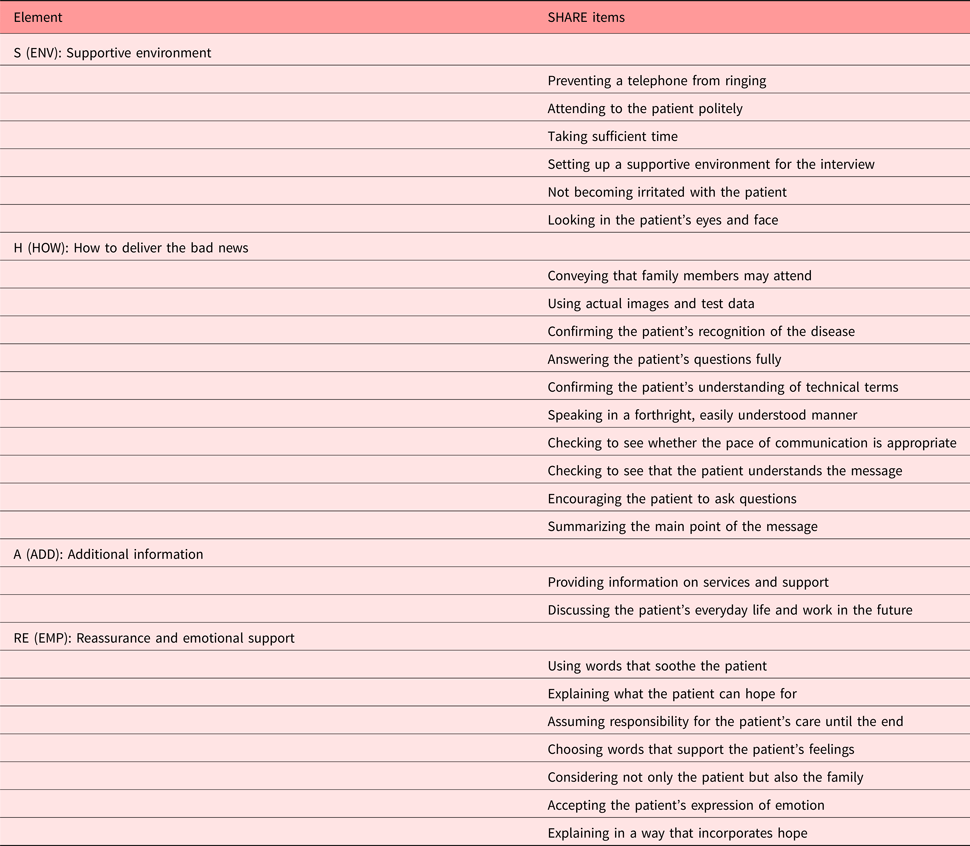
The SHARE scale is the scale of confidence in communicating bad news to patients with cancer (Fujimori et al., Reference Fujimori, Shirai and Asai2014b) and is used to measure effects of CSTs in doctors (Tang et al., Reference Tang, Chen and Hsu2014). There are 36 items and the four subscales described earlier: S (ENV), H (HOW), A (ADD), and RE (EMP). These four elements represent communication skills based on patients’ preferences (Fujimori et al., Reference Fujimori, Shirai and Asai2014b). The scale has been validated with doctors who participated in a CST for conveying bad news (Fujimori et al., Reference Fujimori, Shirai and Asai2014b). In the present study, we revised the SHARE scale to enable comparison with previous findings accumulated in the field of patient-physician communication. We excluded items in the original SHARE scale that were not suited to rehabilitation therapists based on advice from researchers of communication in medical settings and rehabilitation therapists. For some items, “physician” was changed to “rehabilitation therapist.” We selected 25 items from the full set of 36, omitting 11 items that were not suited to the work of rehabilitation therapists (for example, items related to treatment and diagnosis) (Table 1) (Fujimori et al., Reference Fujimori, Shirai and Asai2014b). In addition, we tested validity by confirming that the factor structure was identical to the original scale using the present data (confirmation factor analysis: χ2 = 3163.939, degree of freedom=69, Goodness of Fit Index [GFI] = 0.826, Normed Fit Index [NFI] = 0.836, Comparative Fit Index [CFI] = 0.847, Root Mean Square Error of Approximation [RMSEA] = 0.090). We also examined the internal consistency of the revised SHARE scale (Cronbach's alpha = 0.939).
Revised SHARE scale for rehabilitation therapists

Scale of difficulty in communication
We asked the participating rehabilitation therapists about the degree of difficulty they experienced in communicating with cancer patients, using a numerical rating scale (0–100, in increments of 10) (Fujimori et al., Reference Fujimori, Akechi and Uchitomi2017; Hunt et al., Reference Hunt, Takacs and Hart2014). The question was, “When a cancer patient asks you the following, is it difficult for you? ‘Will I ever be able to walk again?’ ‘Will I ever be able to live life the way I want to?’ and ‘Will I ever be able to eat with my mouth again?’” The content of that question was carefully selected to evaluate difficulty in the most distressing form of communication (giving bad news). The wording was determined by researchers who specialized in communication in medical settings and rehabilitation therapists to maximize the content validity. This question was sent to all rehabilitation therapist regardless of specialty (physical, occupational, or speech therapists), because we could not determine specialty at the time of the survey. This means that some rehabilitation therapists might have misunderstood the nature of the question.
General Health Questionnaire-12 (GHQ-12)
The GHQ-12 is self-administered screening instrument aimed at detecting a diagnosable psychiatric disorder. The 12-item tool produced results comparable to longer versions of the GHQ in a World Health Organization study of psychological disorders in general healthcare (Fukunishi, Reference Fukunishi1990). The GHQ uses the same 4-point Likert scale and dichotomous scoring method as described for the AQ. The cutoff point showing the tendency of the mental disorder is >4 points (Kim et al., Reference Kim, Cho and Park2013).
Demographics
Participants initially completed questions about their demographic and professional backgrounds, providing information about age; gender; what kind of rehabilitation therapist (physical therapist, occupational therapist, or speech therapist); number of years since qualification as a rehabilitation therapist; whether they worked in a cancer medical treatment cooperation base hospital or not; number of patients they treated in a day, and of those, the number who were cancer patients.
Hypothetical models
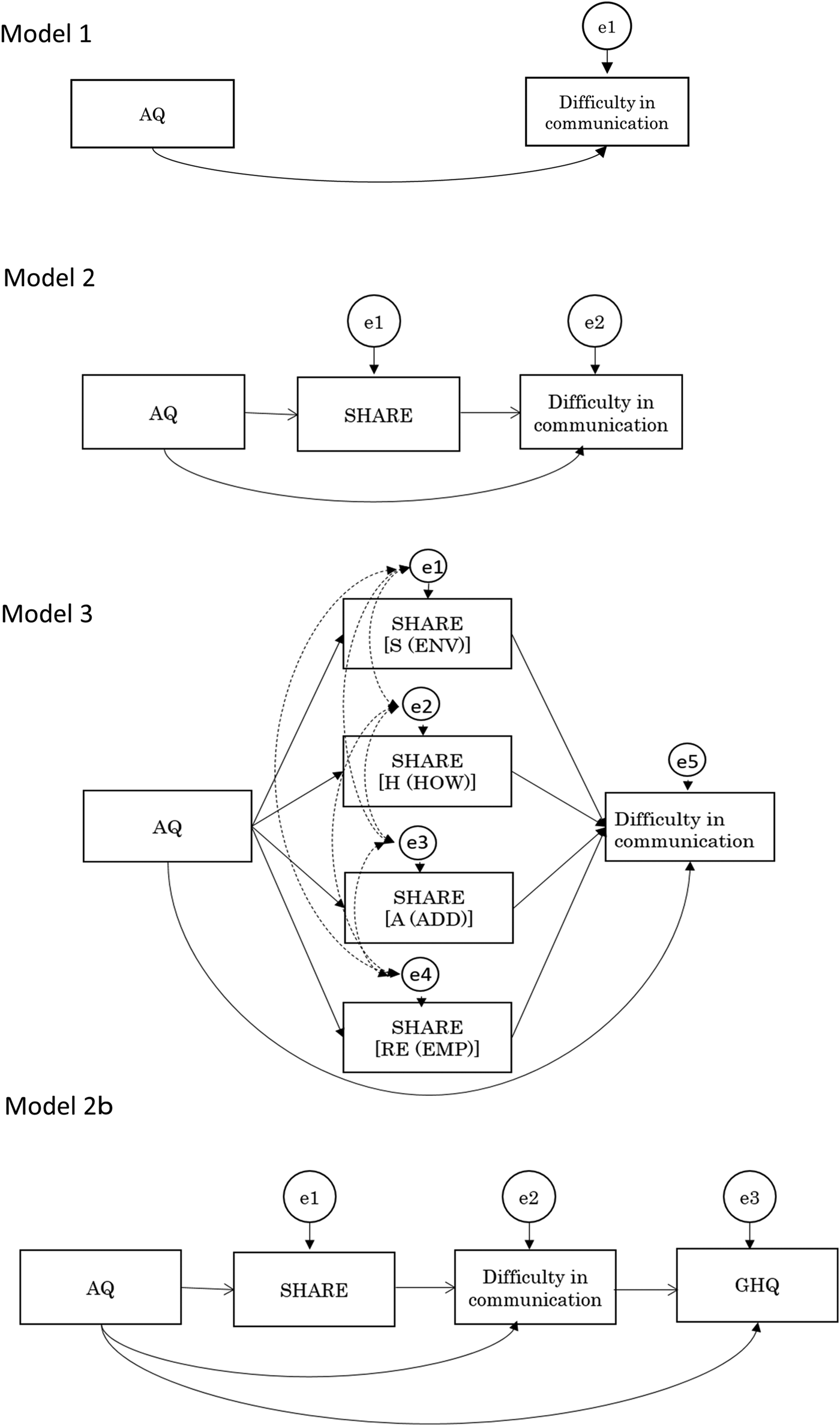
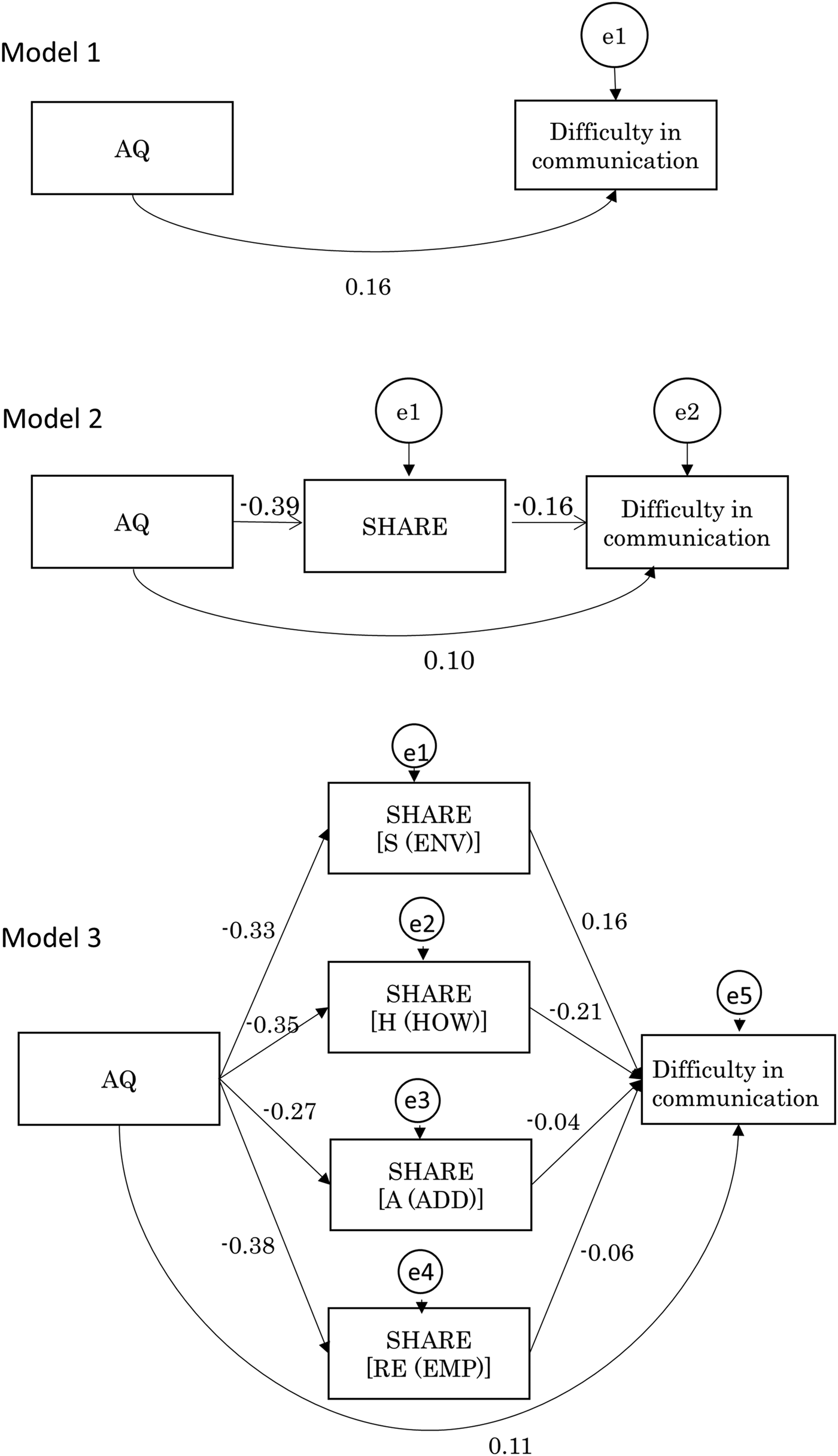
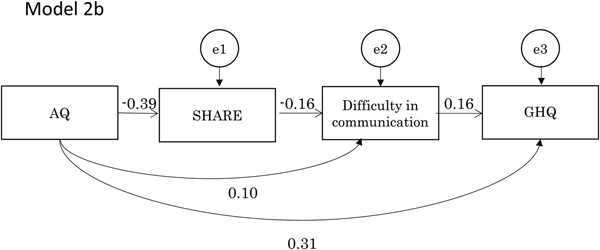
We hypothesized two models (models 1 and 2) and an additional submodel (model 3) expressing covariance structure analyses as follows: model 1, that confidence in communication does not mediate associations between ALT status and difficulty in communication (Fig. 1, model 1); and model 2, that confidence in communication mediates associations between ALT status and difficulty in communication (Fig. 1, model 2). Moreover, we additionally hypothesized model 3, which allows that confidence in communication, as measured by the SHARE scale (model 2), may influence the four elements of communication differently (Fig. 1, model 3). Because mental health status was an additional preliminary interest, we created model 2b, which was derived from model 2 and incorporated mental health status (Fig. 1, model 2b). Our hypothesis was that model 2b examined the relationship between communication difficulty and mental status as a secondary analysis. In all models, ALT was positioned as the uppermost stream because ALT represents inborn traits. Communication difficulty was located after ALT, and we placed confidence between ALT and difficulty, based on the primary hypothesis of the present study that confidence in communicating mediates the relationship between ALT and communication difficulty.
Model 1 shows that ALT (autistic-like traits) exert a direct effect on difficulty in communication. Model 2 shows that confidence in communication mediated the relationship between ALT and difficulty in communication in addition to Model 1. Model 3 incorporated the four elements of communication confidence. Model 2b shows that ALT (autistic-like traits) exert a direct effect on difficulty in communication and on poor mental health status and difficulty in communication exerts an effect on GHQ. e: error.

Statistical analysis
Covariance structure analysis of hypothetical models was performed using IBM SPSS AMOS, version 22 (IBM, Tokyo, Japan). We calculated the goodness of fit of the three models and expressed the result as χ2, degrees of freedom, significance probability, NFI (Normed Fit Index), CFI, RMSEA, and Akaike Information Criterion. We also calculated each of the path coefficients in models 1 and 2 and used them to investigate whether confidence in communication mediates the association between ALT status and difficulty in communication.
We explored the elements mediating between ALT status and difficulty in communication by examining each path coefficient between ALT status and confidence and between confidence and difficulty in communication. Other analyses were performed using IBM SPSS, version 22 (IBM). Alpha levels were set at p < 0.05 (two-tailed). Cases with missing data were excluded because there was no clear rule for imputing the missing data in each questionnaire.
Results
Subjects
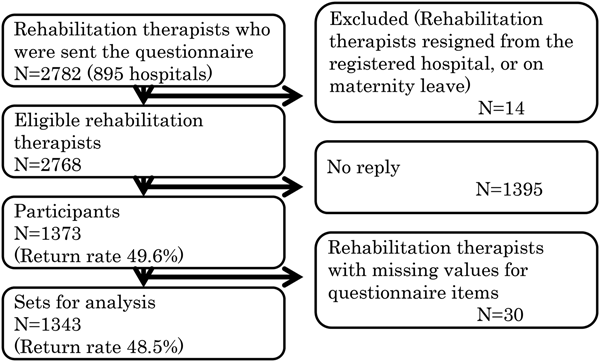
After excluding rehabilitation therapists who met the exclusion criteria, we sent the questionnaire by mail to the remaining 2,768 eligible rehabilitation therapists. Of those, 1,373 replied (response rate, 49.6%). After excluding 30 with missing data for variables used in models 1, 2, and 3, our data set included 1,343 (48.5%) cases for analysis (Fig. 2).
Study flowchart for subject sampling and attrition.

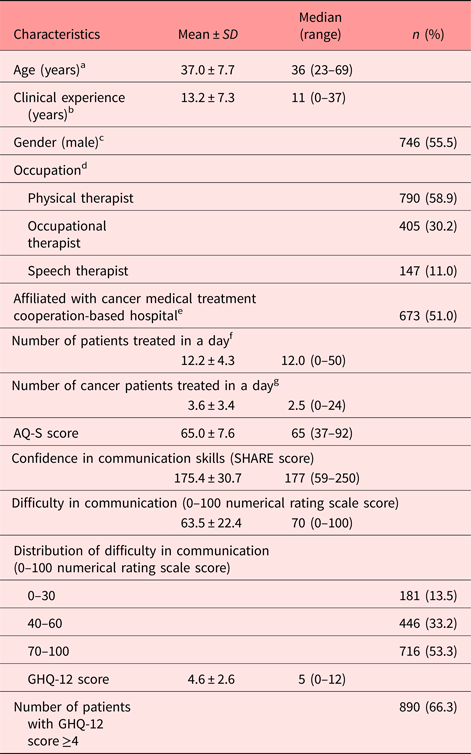
Table 2 shows the demographic summary of the participants. There were 746 (55.5%) males, with a mean age of 37.0 ± 7.7 years and a mean of 13.2 ± 7.3 years of clinical experience. Participants who reported their levels of difficulty in communication with cancer patients as low (scores, 0–30), moderate (scores, 40–60), and high (scores, 70–100) were 13.5%, 33.2%, and 53.3%, respectively. A large majority of participants (66.3%) exceeded the GHQ cutoff score of 4 points, showing the tendency of the mental disorder. Additional data and descriptive statistics are shown in Table 2.
Background characteristics

AQ-S, Autism-Spectrum Quotient Short Form; GHQ-12, General Health Questionnaire-12; SD, standard deviation; SHARE, setting up a supportive environment for the interview, considering how to deliver bad news, discussing additional information, and providing reassurance and responding empathically to the patient's emotions.
n = 1,343.
a n = 1,338.
b n = 1,336.
c n = 1,341.
d n = 1,342.
e n = 1,319.
f n = 1,329.
g n = 1,312.
Goodness of fit and path coefficients
Hypothetical models 1, 2, and 3 were saturation models. In hypothetical model 2b, goodness of fit indexes were: χ2 = 2.809, degrees of freedom = 1, significance probability = 0.094, GFI = 0.999, Adjusted Goodness of Fit Index (AGFI) = 0.989, NFI = 0.994, CFI = 0.996, RMSEA = 0.037, and Akaike Information Criterion = 20.809. All hypothetical models were fit models (Figs. 3 and 4).
The path coefficient of Model 1, 2, and 3. The hypothetical Model 1, 2 and 3 were saturation models. The correlation arrows among e1–4 are omitted (Model 3).

The path coefficients of Model 2b. χ2 = 2.809, degrees of freedom = 1, significance probability = 0.094, GFI = 0.999, AGFI = 0.989, NFI = 0.994, CFI = 0.996, RMSEA = 0.037, and AIC = 20.809.

Figure 3 shows the path coefficients for models 1, 2, and 3. The path coefficient of ALT on difficulty in communication going through confidence in communication was 0.062, the result of multiplying the path coefficient of ALT on confidence in communication (-0.39) and that of confidence in communication on difficulty in communication (-0.16) (Fig. 3, model 2).
We investigated model 3, in which we divided the confidence in communication scale into the four elements that reflect patients’ preferences in communication with medical staff—S (ENV, H (HOW), A (ADD), and RE (EMP)—and explored the path coefficients in this model (Fig. 3, model 3).
The path coefficient of ALT's indirect effect on difficulty in communication through element S (ENV) was −0.053, which resulted from multiplying −0.33 and 0.16. The path coefficient through element H (HOW) was 0.074 (−0.35 × −0.21). The path coefficient through element A (ADD) was 0.011 (−0.27 × −0.04); and the path coefficient through element RE (EMP) was 0.023 (−0.38 × −0.06) (Fig. 3, model 3).
The path coefficient for communication difficulty on the GHQ was 0.16 (Fig 4, model 2b).
Discussion
The present study with more than 1,000 participants investigated the association between ALT and difficulty in communication with cancer patients in rehabilitation therapists. This is the first study showing the association within our knowledge.
Although the path coefficient that reflects the association between ALT and difficulty in communication mediated by confidence of communication in model 2 was small (0.062), it constituted 3/8 of the path coefficient between ALT and difficulty in communication (0.10) (Fig. 3, model 2). Although this study was cross-sectional and causality cannot be determined, the findings indicated that 3/8 of the difficulties in communication related to ALT may be ameliorated by the path of confidence in communication.
We revealed some confidence elements associated with both ALT and difficulty in communication in model 3. Confidence was categorized into four elements, and the mediating effects of these four elements were different (Fig. 3, model 3). The path coefficient between ALT status and difficulty in communication was a negative value (−0.053) for element S (ENV), as described in the Results section (Fig. 3, model 3). One interpretation of this finding is that rehabilitation therapists with high levels of ALT perceived low confidence in element S (ENV) and low difficulty in communication via element S (ENV), and that the reverse was true for rehabilitation therapists with low levels of ALT. However, it is necessary to consider the unique character of “S” in comparison with other factors in a future study.
Model 3 showed that higher confidence in element S (ENV) was associated with higher difficulty in communication in cases when the influence of confidence in elements H (HOW), A (ADD), and RE (EMP) on difficulty in communication would be fixed and then excluded. If confidence in element S was high and confidence in the other elements (H, A, and RE) was low, difficulty in communication may become worse (Fig. 3, model 3). If only S was increased by CST that aimed to increase confidence, it may unexpectedly have an undesirable result of increasing difficulty in communication. Limiting consideration to rehabilitation therapists setting the environment of communication without information required from patients and without emotional communication with patients with an empathic attitude may increase patients’ distress, and in turn increase rehabilitation therapists’ distress. Other factors may also be beneficial to patients, and mean that the distress of rehabilitation therapists may not be increased. However, the present findings did not reveal precise mechanisms.
In contrast, the path coefficient that reflects mediation by element H (HOW) between ALT and difficulty in communication was positive (0.074) (Fig. 3, model 3). This means that the rehabilitation therapists with higher ALT status perceived more difficulty in communicating with patients. Therefore, a CST for increasing confidence in element H (HOW) may be recommended from the standpoint of both confidence and difficulty in communication.
Meanwhile, coefficients mediated by elements A (ADD) and RE (EMP) were small, suggesting that changing these elements may not influence the association between ALT and difficulty in communicating with patients with cancer. Although neither element had a mediating effect on the association between ALT and difficulty in communication with patients with cancer, these elements may be important skills to train because all of the elements were derived from patients’ preferences regarding the communication style of medical staff, and CSTs for medical staff have been shown to increase patients’ satisfaction with communication and subsequently to decrease depressed mood in patients with cancer (Fujimori et al., Reference Fujimori, Shirai and Asai2014b).
In the present study, rehabilitation therapists with a high level of communication difficulty also had poor mental status (Fig. 4, model 2b). Previous studies have clarified poor mental health among medical staff (Higuchi et al., Reference Higuchi, Uchitomi and Fujimori2015, Reference Higuchi, Inagaki and Koyama2016), and the results of the present study are consistent with those studies. Although mental health status as measured by the GHQ may reflect various factors of daily living, our path analysis indicated that, to some extent, it may also be related to communication difficulty. Higuchi et al. reported high ALT was related to poor mental health as assessed by GHQ in pharmacists (Higuchi et al., Reference Higuchi, Uchitomi and Fujimori2015, Reference Higuchi, Inagaki and Koyama2016), which is consistent with the results of the present study. Therefore, a high prevalence of poor mental health may be related to a high level of ALT among rehabilitation therapists in the present study. However, exact reasons, including that for high ALT, are unclear from the present findings.
Conclusion
High levels of ALT appear to be associated with rehabilitation therapists’ communication difficulties with patients with cancer. In addition, confidence in communication mediates the relationship between difficulties in communication and ALT. However, higher confidence in creating a supportive atmosphere was associated with more difficulty in communication. Therefore, CSTs aiming to increase confidence in communication for rehabilitation therapists with high levels of ALT should be developed carefully, with particular vigilance toward avoiding unwanted effects. Further study is necessary to devise an intervention based on the present findings and to confirm its effectiveness.
Practice Implications
Recently, rehabilitation therapists have become involved in cancer rehabilitation and therefore require communication skills to support cancer patients emotionally; however, no CST that increases the ability to provide emotional support for cancer patients has been developed for rehabilitation therapists. When we develop CST, the portion of training that focuses on creating a supportive environment for communication must be approached with care to avoid the reverse effect of increasing rehabilitation therapists’ communication difficulties, especially for rehabilitation therapists with high ALT.
Limitations
There are several limitations in the present study. First, causality between variables cannot be determined conclusively, because the study design is cross-sectional; thus, longitudinal observational and/or intervention studies are needed. Second, the response rate was less than 50%; therefore, selection bias may have been present. The high prevalence of high ALT and poor mental health might have been caused by selection bias. Third, the validity of the revised SHARE scale was not examined sufficiently, although the scale was confirmed to have a four-factor structure identical to the original SHARE scale and the internal consistency was high. In addition, the single scale of difficulty in communication had not been validated, although it was created by researchers who specialized in communication. All scales were self-reported, and scores might have been influenced by mental status at the time of the survey.
Acknowledgments
This work was supported in part by Research for Promotion of Cancer Control Programmes [H26-political-general-002] Health and Labour Sciences Research Grants from the Ministry of Health, Labour and Welfare, Japan. The authors thank the all participants and express their gratitude for the enormous help of Shoko Yoshimoto for funds management and Yifei Tang for excellent data management. We are grateful to Life Planning Centre for their assistance with posting questionnaire to the participants.
Conflicts of interest
MI reports grants from Novartis and personal fees from Pfizer, Mochida, Shionogi, Sumitomo Dainippon, Daiichi-Sankyo, Meiji Seika, Takeda, Nippon Hyoron-Sha, Nanzando, Seiwa Shoten, Igaku-shoin, and Technomics outside the submitted work (the 36 months before submission of the work). NY reports grants from Daiichi Sankyo, Eisai, Otsuka, Astellas, MSD, and Pfizer, and personal fees from UCB Japan, Tsumura, Sumitomo dainippon, Daiichi-Sankyo, MSD, Pfizer, Eisai, Meiji Seika, and Mochida outside the submitted work (the 36 months before submission of the work). M. Fujimori reports personal fees from Mochida, Igaku-Shoin, Chugai-Igakusha, Nankodo, and Kongo-Shuppan outside the submitted work (the 36 months before submission of the work). M. Fujiwara reports personal fees from Mochiea, Sentan Igaku-Sha, Igaku-Shoin, and Seiwa Shoten outside the submitted work (the 36 months before submission of the work). YU reports personal fees from Mochida and Eisai and other fees from QOL Company outside the submitted work (the 36 months before submission of the work). The remaining authors declare no conflict of interest.