1. Introduction
The increasing ubiquity, growing BYOD (bring your own device) movement, and varied potentials of mobile technology (MT), together with affordably priced mobile phones, has stimulated educators and researchers to delve into mobile learning, and, of course, EFL ones are no exception to that. Using the one-size-fits-all method is no longer suitable for successful language teaching and learning. According to Tai and Ting (Reference Tai and Ting2011), the use of technology in language teaching and learning has advanced from what has been known as computer-assisted language learning (CALL) to what has been recently called mobile-assisted language learning (MALL). One way or another, mobile devices are affecting the way people learn. In response, educators are expected to go beyond just watching this happen (Kukulska-Hulme, Reference Kukulska-Hulme2009).
As such, an important question arises: Are teachers going to respond to the call, go beyond just CALL, and try MALL, benefiting from its exclusive add-on features? The answer to this question depends on many factors, including, among others, teachers’ perceptions and the way they use MT. Hence, the current study was conducted to investigate the effect of MALL training on preservice and in-service EFL teachers’ perceptions and use of MT. The main research questions were:
-
1. Do differences exist between preservice and in-service EFL teachers’ perceptions before and after MALL training?
-
2. Does EFL in-service teachers’ use of MT evolve after MALL training?
-
3. Do EFL in-service teachers’ perceptions predict their use of MT?
-
4. How do EFL in-service teachers perceive their use of MT?
2. Literature review
2.1 Mobile-assisted language learning
With the spread of mobile devices such as smartphones, cellular phones, pocket electronic dictionaries, MP3 and MP4 players, iPods, data-travelers, digital cameras, personal digital assistance devices, laptops, netbooks, iPads, tablets, e-readers, and handheld game consoles, the world has become a “mobigital” virtual learning space where teaching and learning are done digitally anytime and anywhere (Chen, Reference Chen2017; El-Hussein & Cronje, Reference El-Hussein and Cronje2010; Şad & Göktaş, Reference Şad and Göktaş2014). The ubiquity and widespread ownership of these handheld devices among young learners nowadays is aspiring to the future of education. That is, as claimed by Pettit and Kukulska-Hulme (Reference Pettit and Kukulska-Hulme2007), regardless of whether teachers decide to integrate new (mobile) technologies in formal education, learners are already implementing them in their learning.
This has led to the emergence of a new learning paradigm named “mobile learning” or “m-learning”. M-learning is defined as an advanced model of e-learning that makes use of one or more of the aforementioned mobile devices (Chen, Reference Chen2017; Jeng, Wu, Huang, Tan & Yang, Reference Jeng, Wu, Huang, Tan and Yang2010; Motiwalla, Reference Motiwalla2007; Şad & Göktaş, Reference Şad and Göktaş2014). Similarly, Park, Nam and Cha (Reference Park, Nam and Cha2012) refer to m-learning as any educational context where handheld or palmtop devices are the sole or dominant technologies. Another common definition in scholarly literature is using portable devices that are or can be connected to the internet in educational contexts (Kinash, Brand & Mathew, Reference Kinash, Brand and Mathew2012). Simply put, it is a type of learning that takes place via mobile devices (Kukulska-Hulme & Shield, Reference Kukulska-Hulme and Shield2008).
As such, according to Tai and Ting (Reference Tai and Ting2011), technology adoption in language learning has proceeded from CALL to MALL. MALL is a new and more specialized variety or form of m-learning, in Şad, Özer, Yakar and Öztürk’s (Reference Şad, Özer, Yakar and Öztürk2020) terms, and a relatively novel area or subdivision of TELL (technology-enhanced language learning), in Lin and Lin’s (Reference Lin and Lin2019) and Yang’s (Reference Yang2013) terms. MALL refers to language learning that is performed or enhanced using a handheld mobile device (Chinnery, Reference Chinnery2006). According to Kukulska-Hulme (Reference Kukulska-Hulme2009), the ownership, number, and type of mobile devices are all determining factors influencing the effectiveness of mobile learning.
The varied potentials of MT, together with affordably priced mobile phones, have urged researchers to explore its potential for educational implementation (Chen, Reference Chen2017). Table 1 summarizes pertinent research in this respect.
Studies on mobile-assisted language learning

Note. Ss = students or learners; Ts = teachers or instructors; At = attitudes, perceptions, perspectives, or conceptions; A = acceptance; L = listening; S = speaking; R = reading; W = writing; V = vocabulary or idioms; G = grammar; Pr = pronunciation.
a These studies were specifically selected based on a number of search criteria: (a) The search topics were “Mobile technology/applications/devices/phones and language learning,” “M-learning,” “mobile learning,” “MALL,” and “Mobile-Assisted Language Learning”; (b) the search databases were indexed journals, particularly specialized in (language) learning and technology, like Computer Assisted Language Learning, ReCALL, Language Learning & Technology, CALICO Journal, The JALT CALL Journal, Multimedia-Assisted Language Learning, Computers & Education, British Journal of Educational Technology, Educational Technology & Society, Journal of Computer Assisted Learning, Journal of Computing in Higher Education, Open Learning, etc.; (c) the publication date is 2005–2021.
As shown in Table 1, studies on MALL have focused more on students than teachers while examining its impact on different variables: perceptions, acceptance, listening, speaking, reading, writing, vocabulary, grammar, and pronunciation. Among these variables, vocabulary was the most investigated. These studies, in addition to others, highlighted a number of merits of mobile learning, such as (a) facilitating tailoring learning to fit learners’ individual differences (Chen, Reference Chen2017); (b) making collaborative learning easier as it provides a borderless context of real-time interactions (Hsu, Hwang & Chang, Reference Hsu, Hwang and Chang2013; Kim, Lee & Kim, Reference Kim, Lee and Kim2014); (c) encouraging autonomous learning (Boticki, Baksa, Seow & Looi, Reference Boticki, Baksa, Seow and Looi2015); (d) providing for interactivity and instant feedback (Azli et al., Reference Azli, Shah and Mohamad2018); (e) increasing communication between pupils and teachers (Boticki et al., Reference Boticki, Baksa, Seow and Looi2015); (f) promoting learners’ self-awareness and self-regulation (Kondo et al., Reference Kondo, Ishikawa, Smith, Sakamoto, Shimomura and Wada2012; Sha, Looi, Chen & Zhang, Reference Sha, Looi, Chen and Zhang2012); (g) providing student-centered learning opportunities (Sha et al., Reference Sha, Looi, Chen and Zhang2012); (h) attaining many academic benefits (Abdous, Camarena & Facer, Reference Abdous, Camarena and Facer2009); (i) differentiating instruction (Kukulska-Hulme & Shield, Reference Kukulska-Hulme and Shield2008); and (j) exceeding CALL and e-learning in terms of user-friendliness, low cost, flexibility, and small size (Liu, Reference Liu2009). In this vein, successful integration of MT into EFL/ESL learning is much related to students’ and teachers’ attitudes toward MT and how it is implemented (Botero, Questier, Cincinnato, He & Zhu, Reference Botero, Questier, Cincinnato, He and Zhu2018), as presented in the following section.
2.2 MALL and (pre- and in-service) teacher training
MT extends learning out of the classroom walls, mostly beyond the teacher’s access. This is actually considered a threat as well as a challenge for teachers to develop learning designs that clearly pinpoint what is best learned in and outside the classroom and how to effectively connect these contexts (Kukulska-Hulme, Reference Kukulska-Hulme2009). In this respect, teacher training is of crucial importance. Scholarly literature posits that teacher training plays an influential role in teacher adoption of technology (Comas-Quinn, Reference Comas-Quinn2011). Besides, teacher perceptions and attitudes toward technology are a significant determiner of the degree of technology integration (Huang & Liaw, Reference Huang and Liaw2005; Kadel, Reference Kadel2005; Luan, Fung, Nawawi & Hong, Reference Luan, Fung, Nawawi and Hong2005). Correspondingly, lack or deficiency of teacher training, together with negative attitudes toward MALL on the part of the teachers, will certainly be a stumbling block to implementing or integrating these technologies in language learning contexts.
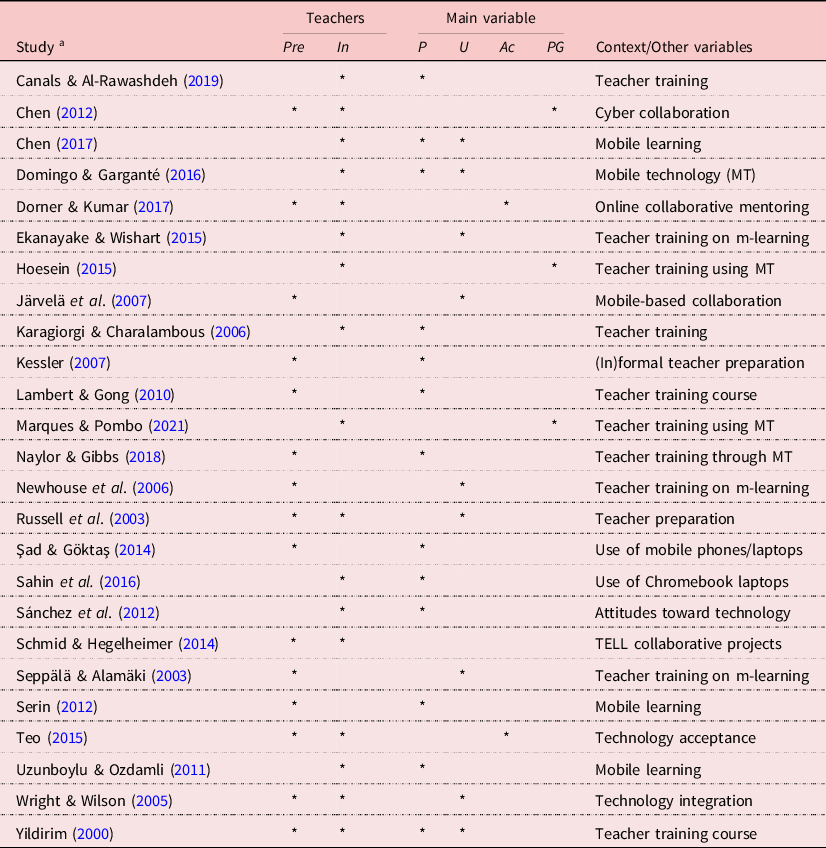
Sahin, Top and Delen (Reference Sahin, Top and Delen2016) reported that two types of barriers may hinder successful technology implementation: internal and external barriers. The former may be referred to as teacher perceptions or attitudes toward technology, whereas the latter includes the availability of and accessibility to required hardware and software, the existence of technically qualified and well-trained personnel as well as institutional support, and an accredited program for teacher training and skill building. With respect to preservice and in-service teacher training on new and mobile technologies, previous research has examined this topic from varied perspectives, as illustrated in Table 2.
Previous studies on pre- and in-service teacher training and (mobile) technology

Note. Pre = preservice or graduate teachers; In = in-service teachers; P = perceptions or attitudes; U = use or integration of technology; Ac = acceptance or satisfaction; PG = professional growth or professionalism or professional development; TELL = technology-enhanced language learning.
a These studies have been obtained after searching Google Scholar for preservice and/or in-service teachers, training or preparation, and mobile learning or MT.
To elaborate, Hoesein (Reference Hoesein2015) implemented a mobile-based teacher training program that aimed at enhancing elementary language teachers’ performance. The purpose of the study was to investigate the use of MT for providing support during online mentoring and training sessions. For this purpose, a global expert, local program representative, and mobile-based delivery of the content teacher training sessions were in use. Results showed improvements in their classroom teaching practices. Similarly, Seppälä and Alamäki (Reference Seppälä and Alamäki2003) used a mobile-based virtual teacher training model. Participants’ responses to interview questions after the training highlighted several positive aspects of MT: convenience (conducting educational activities during their wait times), expediency (doing educational tasks in many places other than classrooms), and immediacy (making memos, taking photos, and sharing them while observing other trainees’ demo lessons). Also, Ekanayake and Wishart (Reference Ekanayake and Wishart2015) developed and implemented teacher training workshops on integrating mobile devices into teaching. Teachers were provided with hands-on training sessions, followed by a number of collaborative lesson planning activities. Qualitative results yielded that these training workshops provided numerous opportunities to improve teachers’ skills, knowledge, and attitudes toward the integration of mobile devices in teaching and learning. Besides, planning and reviewing workshops fostered teachers’ professional development opportunities.
Herrington, Mantei, Herrington, Olney and Ferry (Reference Herrington, Mantei, Herrington, Olney and Ferry2008) investigated the uses of smartphones and iPods by university teachers to enhance teaching and learning practices in higher education. Participants went through four phases: (1) familiarization with the given iPod or smartphone, (2) using mobile devices as cognitive tools for planning authentic exercises, (3) implementing the planned learning tasks, and (4) reflecting on the MT-based pedagogy they were involved in. Naylor and Gibbs (Reference Naylor and Gibbs2018) examined the relationship between MT and teachers’ perceptions during international collaboration between English preservice teachers and college students. Qualitative data analysis highlighted the themes of authenticity, professional learning, and collaboration through the integration of MT. English preservice teachers pinpointed the interrelationship between mobile devices and the different language skills: listening, reading, speaking, and writing. They added that the use of iPads in English teaching and learning was far more accessible than paper-based resources.
As indicated in Table 2 and subsequent review of previous research, studies on teacher training and MT targeted both preservice and in-service teachers with the focus being laid on their attitudes, use, acceptance, and professional growth. Of these variables, teachers’ attitudes/perceptions and use/integration were the most recurrently researched. However, according to Ekanayake and Wishart (Reference Ekanayake and Wishart2015) and Baran (Reference Baran2014), teacher training on mobile-assisted learning (not just through or using MT) is the least explored topic in m-learning research. Also, limited research examined variance or change in these perceptions and that integration by dint of or after training teachers on MALL applications and tools. Even more, in this last respect, scarce research attempted to hold a comparison between both pre- and in-service teachers.
3. Method
3.1 Study design
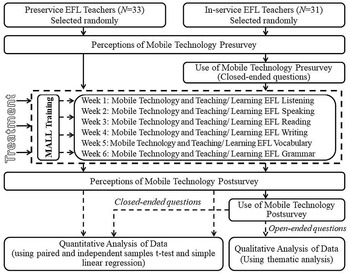
The pretest-posttest experimental mixed-methods design (Creswell & Plano Clark, Reference Creswell and Plano Clark2018) was used. Accordingly, data were quantitatively and qualitatively collected and analyzed. Figure 1 details these procedures.
Study design and implementation procedures

3.2 Participants
Two groups of preservice (N = 33) and in-service (N = 31) EFL teachers were randomly selected and exposed to MALL training. Simultaneously with working at schools, in-service teachers were doing their postgraduate studies in EFL education wherein they were enrolled in the study. Preservice teachers were junior EFL college students enrolled in EFL micro-teaching and teaching methods courses. Preservice teachers were 19–21 years old, whereas in-service teachers’ ages ranged between 24 and 30 years. In-service teachers’ work experience was 2–5 years. All participants reported that they had access to mobile devices with an internet connection.
3.3 Instruments
3.3.1 The perceptions survey
A closed-ended-question survey was developed and then administered online (using Google Forms) to assess EFL preservice and in-service teachers’ perceptions of MT. Based on Davis’s (1989) technology acceptance model, the dimensions of the perceptions survey were perceived usefulness, perceived ease of use, perceived interest, and perceived attitudes. After reviewing pertinent studies and relevant literature (e.g. Canals & Al-Rawashdeh, Reference Canals and Al-Rawashdeh2019; Emerson & MacKay, Reference Emerson and MacKay2011; Kessler, Reference Kessler2007; Marzilli et al., Reference Marzilli, Delello, Marmion, McWhorter, Roberts and Marzilli2014; Qudais, Al-Adhaileh & Al-Omari, Reference Qudais, Al-Adhaileh and Al-Omari2010; Sahin et al., Reference Sahin, Top and Delen2016; Sánchez, Marcos, González & GuanLin, Reference Sánchez, Marcos, González and GuanLin2012; Teo, Reference Teo2008), the researcher developed the items under these dimensions. The items were cross-culturally checked to avoid any culturally loaded expressions and, accordingly, necessary modifications were made. The final version of the perceptions survey included 23 categorical quantitative (positive and negative) items.
3.3.2 The use of mobile technology survey
Another closed- and open-ended-question survey was developed and administered online to collect both quantitative and qualitative data about EFL in-service teachers’ use of MT. Adapted from Marzilli et al. (Reference Marzilli, Delello, Marmion, McWhorter, Roberts and Marzilli2014), four open-ended questions were used to collect the qualitative data. Closed-ended questions (which were adapted from Kessler, Reference Kessler2007; Sánchez et al., Reference Sánchez, Marcos, González and GuanLin2012; Teo, Reference Teo2008) were in two dimensions: (a) actual use of MT and (b) behavioral intention. In addition to the four open-ended questions, the use of the MT survey comprised 22 categorical quantitative (positive and negative) items.
Content and face validity of the scales were judged by a panel (N = 7) of educational technology and TEFL experts. Accordingly, suggested revisions were made. The questionnaires were then piloted on a sample (N = 30) of EFL preservice and in-service teachers (other than the ones assigned to the study). Pilot administration aimed to check the validity, wording difficulties, discrimination, and reliability of the instrument. Using data collected from the piloting of the questionnaires, their internal consistency (reliability) was examined. Accordingly, Cronbach’s alpha internal consistency coefficient was estimated, and its value was .89 (for the perceptions survey) and .91 (for the use of the MT survey). According to Rovai, Baker and Ponton (Reference Rovai, Baker and Ponton2013), Cronbach’s α ≥ 0.70 is typically the recommended benchmark of questionnaire reliability. This indicated that the questionnaires were reliable enough to be used for assessing EFL preservice and in-service teachers’ perceptions and use of MT.
The 5-point Likert scales were administered before and after the treatment. Then, Likert’s summated-rating method was used to score participants’ responses to closed-ended questions, where participants were asked to respond to statements by indicating whether they strongly disagree, disagree, are uncertain, agree, or strongly agree with them. Point values were assigned to their responses on a 1 to 5 weighting. These values were reversed for scoring negative items. Subsequently, point values were totaled to obtain each participant’s total score on the scale.
3.4 Intervention and data collection
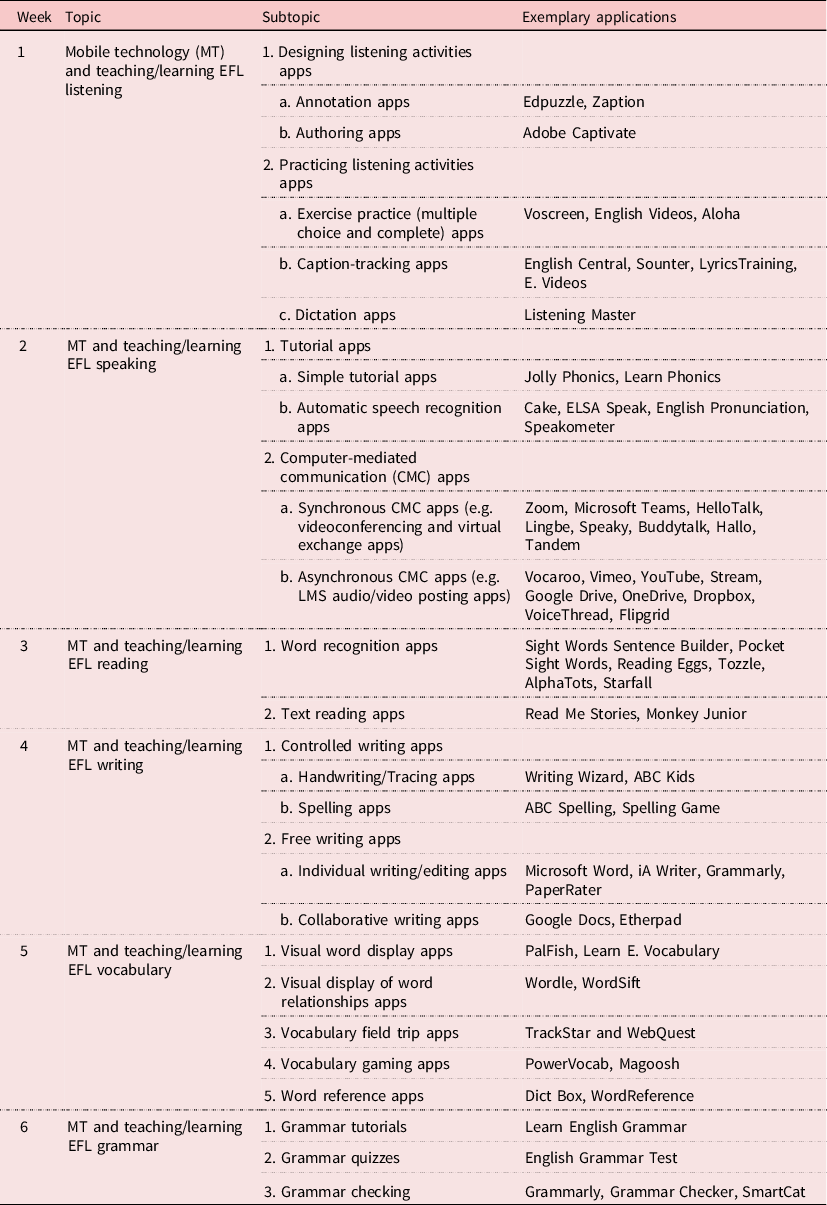
Having been pretested on their perceptions and use of MT, both pre- and in-service EFL teachers were exposed to the intervention, which lasted for six weeks, two sessions a week (face to face and online), and two hours per session. During the intervention, the participants attended a training course on the varied applications and implementation of MT in EFL teaching and learning. Table 3 outlines the intervention timeline, topics, subtopics, and the applications taught.
Training framework

3.5 Data analysis
3.5.1 Quantitative data analysis
Participants’ responses to the closed-ended-question surveys were quantitatively analyzed using the paired-sample and independent-sample t-test in addition to simple linear regression (using perceptions as predictors of MT use) in SPSS Version 23. Prior to running these parametric tests, their main assumptions of normality of distribution and homogeneity/homoscedasticity of variances (in addition to linearity as assumed by the linear regression test) were verified.
3.5.2 Qualitative data analysis
The researcher conducted a thematic analysis of the data collected from the open-ended-question survey. The inductive content analysis approach was adopted since no themes were set in advance. Homogeneity and heterogeneity of the elicited themes were double-checked. Subsequently, using the statistics-by-theme approach for the joint display of the data (Creswell & Plano Clark, Reference Creswell and Plano Clark2018), frequencies of themes across the participants’ responses were counted. Exemplary quotes from these responses were then cited.
4. Results
4.1 Quantitative results
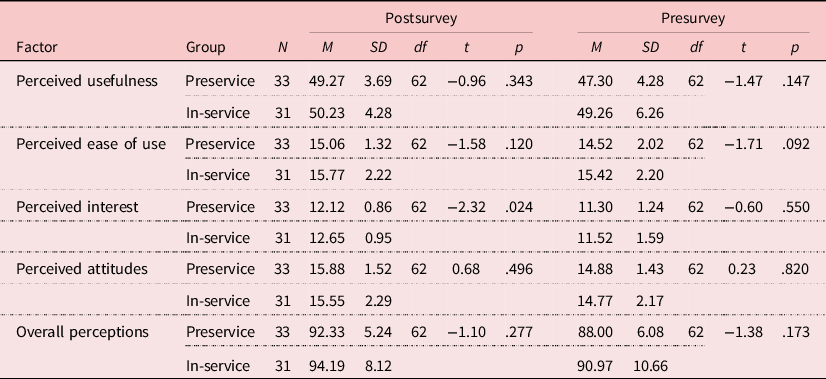
Using the independent-sample t-test, preservice and in-service teachers’ postsurvey (in addition to presurvey) scores on MT perceptions were analyzed. Table 4 presents relevant data in this respect.
Independent-sample t-test of preservice and in-service teachers’ perceptions pre- and postsurvey scores

Independent-sample t-test results show that there were no statistically significant differences between the preservice and in-service teachers’ presurvey mean scores on their overall perceptions and subfactors (P < 0.05). The same goes with their postsurvey mean scores, except that there was a statistically significant difference between their mean scores on perceived interest. This means that both groups generally had similar perceptions of MT at the beginning and at the end of the study. The only exception is that in-service teachers were more interested in MT than preservice teachers after the study. To compare pre- and postsurvey scores of each group (in-service and preservice teachers), the paired-sample t-test was used. Table 5 presents relevant t-test data.
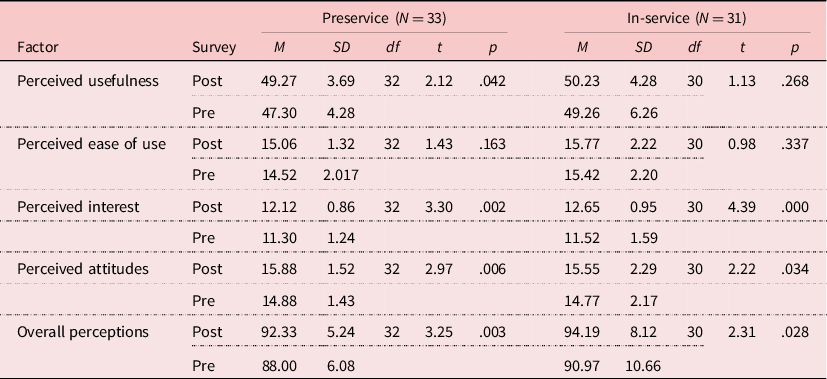
Paired-sample t-test of preservice and in-service teachers’ perceptions pre- and postsurvey scores

Results of the paired-sample t-test indicate that there were statistically significant differences between the preservice teachers’ pretest and posttest mean scores on only three factors (i.e. perceived usefulness, interest, and attitudes) and their overall perceptions of MT (P < 0.05) in favor of their posttests. This means that, apart from their perceived ease of use, their overall and subfactors of perceptions of MT positively developed in their posttests. The same results were found in terms of in-service teachers’ perceptions, except that their perceived usefulness (as well as perceived ease of use) did not improve in their posttests. In short, both groups demonstrated an overall improvement in their perceptions of MT, except for their perceived ease of use (and usefulness in respect of in-service teachers’ perceptions).
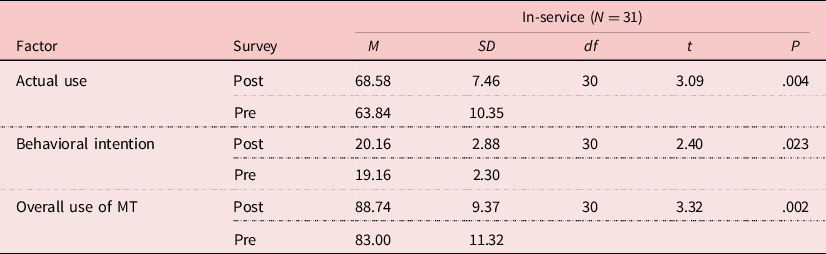
In respect of in-service teachers’ use of MT, their pre- and postsurvey scores were analyzed using paired-sample t-test. The results are reported in Table 6.
Paired-sample t-test of in-service teachers’ mobile technology use pre- and postsurvey scores

As shown in Table 6, there were statistically significant differences between in-service teachers’ pre- and postsurvey mean scores on their overall use of MT and all its subfactors (P < 0.05) in favor of their postsurvey. This reveals that MT training has improved in-service teachers’ use of MT. To find out if in-service teachers’ perceptions can be a predictor of their use of MT, a simple linear regression analysis was conducted, and its results are presented in Table 7.
Regression analysis for in-service teachers’ perceptions predicting their use of mobile technology

Note. R = .805; R 2 = .648; R 2 adjusted = .636.
The results of the regression analysis indicated that there was a statistically significant positive correlation (P < 0.05) between in-service teachers’ perceptions and use of MT and that 65% of the variance in their use could be accounted for by their perceptions. Therefore, their perceptions were a significant predictor of their use of MT.
4.2 Qualitative results
4.2.1 Analysis of in-service teachers’ perceptions of their use of mobile technology
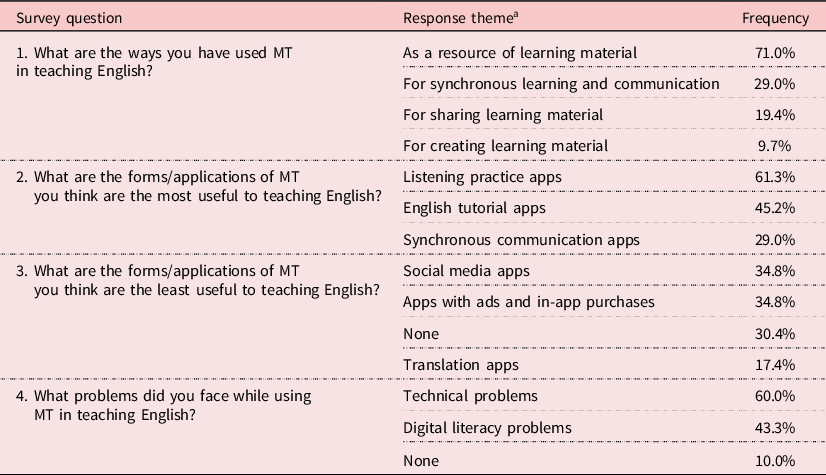
In-service teachers’ responses to the four open-ended questions in the postsurvey on the use of MT were thematically analyzed, as detailed in Table 8.
In-service teachers’ responses to the open-ended questions of mobile technology (MT) use postsurvey

a Some participants’ responses included more than one theme.
As shown in Table 8, thematic analysis of participants’ responses resulted in defining four categories of EFL instructional use of MT. To explain, in-service teachers mentioned four ways they used MT in teaching English. Nearly two thirds of them used it as a resource of learning materials (i.e. audio/video material, pictures/photos, text), using apps like audio/video streaming, tutorial, dictionary, and practicing listening apps, as enumerated by them. Also, some participants (nine teachers) implemented it in synchronous learning and communication using videoconferencing and chatting apps. The same number of teachers added two other ways: sharing learning materials (directly or using QR code generation apps) and creating learning materials (using audio/video recording, photo editing, and quiz-making apps). In these last two respects, teachers wrote, “to make interactive presentations and sessions and to make quizzes” and “They can record themselves speaking English and share it with friends.”
When asked about the forms/applications of MT they thought were most useful to teaching English, participants’ responses showed that they mainly used mobile apps in EFL listening and speaking rather than reading and writing. To elaborate, roughly two thirds of in-service teachers named some listening practice apps like “Voscreen, LyricsTraining, Musixmatch, Sounter, English Videos, and Cake.” Others (45% of in-service teachers) listed some English tutorial apps (i.e. automatic speech recognition apps like Jolly Phonics and Cake, online and offline dictionary apps, and English/grammar tutorial apps like ZAmericanEnglish). Finally, one third of them added synchronous learning and communication apps like synchronous virtual exchange apps (e.g. Lingbe and HelloTalk), videoconferencing apps (e.g. Microsoft Teams and Zoom), and chatting apps.
Conversely, when asked about the forms/applications of MT they thought were least useful to teaching English, one third of them mentioned the apps with ads and in-app purchases (like many synchronous virtual exchange apps). The same percentage of in-service teachers (34.8%) added social media apps (like Instagram, Facebook, Twitter, Viber, and WhatsApp). Others (30.4%) mentioned nothing in this respect and commented, “I don’t know because the apps that I have used are useful” and “I think that there are no useless applications, but perhaps there are applications which are more useful than [the] others.” Translation apps were also cited in the responses to this question.
Finally, in respect of the problems they faced while using MT, a 10th of participants mentioned nothing, whereas the others specified some technical (i.e. internet connection inconsistency, limited mobile bandwidth, in-app purchases and ads, short battery life, small screen size, and lack of technical support) and digital literacy problems (i.e. the difficulty of using and unfamiliarity with some apps). Participants’ quotes included “Low internet connection is the worst problem,” “Some apps are not free so we have to pay a lot of money,” “First l can’t use it for [a] long time and frequently,” and “Some apps are very complex,” “In the beginning, I didn’t know how to deal with the apps.”
5. Discussion
The quantitative results of the study revealed that, as compared to each other, both preservice and in-service teachers had similar perceptions of MT before and after training. The only exception is that in-service teachers were more interested in MT than preservice teachers after training. However, both groups demonstrated an overall (and subfactor) improvement in their perceptions after MT training, except for their perceived ease of use subfactor. As for in-service teachers’ use of MT, it improved after training. Moreover, there was a positive correlation between in-service teachers’ perceptions and use of MT, and that perceptions were a significant predictor of teachers’ use. Qualitative findings showed that in-service teachers used MT more in listening (as a resource of audio/video material) and speaking (for synchronous communication) than in reading and writing while selecting social media and translation apps as the least useful apps. In addition, they reported that technical and digital literacy problems were the most challenging in the effective use of MT.
In respect of preservice and/or in-service teachers’ perceptions and the impact of (MALL) training, the findings of the current study corroborate those of Ekanayake and Wishart (Reference Ekanayake and Wishart2015), who reported that teacher training workshops on integrating mobile devices into teaching improved teachers’ practical skills, knowledge, and attitudes toward the integration of mobile devices in teaching and learning. Correspondingly, Yildirim (Reference Yildirim2000) and Kumar and Kumar (Reference Kumar and Kumar2003) concluded that preservice and in-service teachers’ attitudes toward technology implementation improved after an educational technology course and project, respectively. Correspondingly, Lambert and Gong (Reference Lambert and Gong2010) concluded that preservice teachers’ attitudes improved after instruction on a 21st century–redesigned educational technology course. In the same vein, there is a consensus between Canals and Al-Rawashdeh (Reference Canals and Al-Rawashdeh2019), Karagiorgi and Charalambous (Reference Karagiorgi and Charalambous2006), and Comas-Quinn (Reference Comas-Quinn2011) on the positive impact of technical training and preparation on teachers’ perceptions, whereas Kessler’s (Reference Kessler2007) and Sánchez et al.’s (Reference Sánchez, Marcos, González and GuanLin2012) studies highlighted no significant effects of training on (in-service) teachers’ perceptions. Also, the results of the current study are inconsistent with those of Thomas and O’Bannon (Reference Thomas and O’Bannon2015) and Spaulding (Reference Spaulding2007), who found that there were significant differences between preservice and in-service teachers’ perceptions of mobile phones and technology integration, respectively, in favor of preservice ones. Differences in training contexts, tasks, participants, tools, and purpose may account for the variance and even discrepancy among study results (Hafour & Al-Rashidy, Reference Hafour and Al-Rashidy2020).
As regards teachers’ use of technology, the current study findings are concurrent with those of Hoesein (Reference Hoesein2015), who reported that the mobile-based teacher training program improved teachers’ instructional practices. The results of the current study are also in agreement with Vannatta and Fordham’s (2004), who explored teachers’ dispositions as predictors of their technology use and found that technology training was one of the factors that predict teachers’ use. In a similar vein, Luan et al. (Reference Luan, Fung, Nawawi and Hong2005), Huang and Liaw (Reference Huang and Liaw2005), and Kadel (Reference Kadel2005) pointed out that the possibility of teachers’ use of technology is highly related to their perceptions and attitudes toward it, the results of which validate those of the current one.
Concerning the qualitative results, they are compatible with those of Russell, Bebell, O’Dwyer and O’Connor (Reference Russell, Bebell, O’Dwyer and O’Connor2003), who reported that teachers used technology more in preparation (i.e. importing audio/video resources) and communication than in assigning learning activities (like sharing content and materials) or delivering instruction. Also, in line with the current study, Şad et al. (Reference Şad, Özer, Yakar and Öztürk2020) concluded that EFL freshmen used MT more in practicing listening and speaking than reading and writing, whereas Canals and Al-Rawashdeh (Reference Canals and Al-Rawashdeh2019) found that EFL teachers used it more in listening and reading than speaking and writing. This might be due to the difference in the participants, contexts, and type of technologies used in the two studies. In correspondence with the findings of the current study on the barriers to effective use of MT, a number of studies reiterated the following problems: small screen size (El-Hussein & Cronje, Reference El-Hussein and Cronje2010; Liu, Reference Liu2009), absence of a keyboard, short battery life (Liu, Reference Liu2009), inadequate storage capacity (Zhang, Wei & Burston, Reference Zhang, Wei and Burston2011), and lack of comprehensive professional training, network sustainability (Liu, Navarrete & Wivagg, Reference Liu, Navarrete and Wivagg2014; Tayan, Reference Tayan2017), technical support personnel (Liu et al., Reference Liu, Navarrete and Wivagg2014; Sahin et al., Reference Sahin, Top and Delen2016), and institutional support (Sahin et al., Reference Sahin, Top and Delen2016).
On the one hand, improvement in both preservice and in-service teachers’ perceptions of MT could potentially be attributed to the MALL training experiences they went through. The same reasons account for in-service teachers’ developed use of MT. However, lack of progress in their perceived ease of use may be because training focused more on demonstrative tutorials and awareness-raising experiences rather than on hands-on training and authentic tasks, as recommended by Tai and Ting (Reference Tai and Ting2011), comprehensive training, as proposed by Tayan (Reference Tayan2017), or due to the relatively short period of training (six weeks).
On the other hand, significant differences between preservice and in-service teachers’ perceived interest after MALL training is owing to the increasing demands placed upon in-service teachers to shift to online spheres and mobile technologies, especially within current pandemic conditions, as safe and appropriate alternatives to face-to-face teaching/learning contexts. In-service teachers’ increased interest, as compared to preservice ones, can be seen as their way of responding to these demands.
6. Conclusion
The implications inferred from the results of the current study highlight the significant positive impact of MALL training on EFL preservice and in-service teachers’ perceptions and also use of MT while recommending providing more comprehensive hands-on training. However, some limitations could possibly avert generalizing these findings. To explain, this study was limited to EFL preservice and in-service teachers. Besides, MALL training lasted for only six weeks, which (despite being sufficient to generate positive significant results) cannot be considered an adequate period for pursuing teachers’ use or perceptions, especially their perceived ease of use. The nature of the training itself and the applications selected for demonstrative tutorials are also considered another limitation of the study. As such, it is necessary to interpret the results of the current study cautiously.
Ethical statement and competing interests
Participants were volunteers. Written informed consent was obtained from them after explaining the experiment and its procedures in full. Efforts were made to ensure the respondents’ anonymity. There are no conflicts of interest.
About the author
Marwa F. Hafour is an assistant professor of TEFL, Faculty of Education, Tanta University, Egypt. She teaches courses on EFL teaching methods and computer-assisted language learning. In her research, she is interested in technology-enhanced language learning, collaborative learning, digital media production and interaction in EFL, and mobile-assisted language learning.
Author ORCIDs
Marwa F. Hafour, https://orcid.org/0000-0002-2854-9818