INTRODUCTION
Coastal ecosystems have been increasingly encroached and modified by humans (Burke et al. Reference BURKE, KURA, KASEM, REVENGA, SPALDING and MCALLISTER2001). Worldwide, 19% of the land within the first 100 km from the coast is altered by agricultural and urban uses and 10% is partially altered with a mosaic of natural and altered vegetation. Many habitats such as mangroves and wetlands are disappearing fast. In some countries 5–80% of original mangroves have been lost with extensive loss occurring within the last 50 y. While it is known that changes in land use/land cover (LULC) affect large mammals and birds (Arden Reference ARDEN1994), it is not clear how land crabs are responding to these changes in LULC: are land crabs resilient or vulnerable to changes in LULC?
Land use/land cover changes can negatively affect the physical microhabitat conditions for land crabs in several ways. Deforestation or changes in plant species composition can result in higher soil temperatures and lower soil moisture (Polcher & Laval Reference POLCHER and LAVAL1994) increasing water loss from crabs within their burrows. Increased run-off and land filling from urban development in low-lying areas (Harbour Reference HARBOUR1994, Pringle et al. Reference PRINGLE, FREEMAN and FREEMAN2000) can prevent crabs from having access to the groundwater table (Herreid & Gifford Reference HERREID and GIFFORD1963). The reduction of freshwater inputs due to decrease in agricultural activities can cause an increase in soil and water salinity (Rodriguez Reference RODRÍGUEZ2006) affecting crab osmoregulation (Bliss & Mantel Reference BLISS and MANTEL1968). Given that changes in LULC can significantly alter the physical microhabitat experienced by land crabs, we expect that these changes will alter their abundance and size in response to changing physical conditions.
Land use/land cover changes are occurring at a dramatic rate in Puerto Rico (Grau et al. Reference GRAU, AIDE, ZIMMERMAN, THOMLINSON, HELMER and ZOU2003, Thomlinson et al. Reference THOMLINSON, SERRANO, DEL MAR LOPEZ, AIDE and ZIMMERMAN1996), where land cover has mainly shifted from agriculture to grasslands and finally to urban development. In this study we aim to understand the effects of LULC changes on the habitat of the land crab Cardisoma guanhumi (Latreille, 1825), and the resulting effect on its abundance and size structure. Specifically, we hypothesize that Cardisoma guanhumi will be absent or in low abundance in areas with high soil temperatures, low soil moisture, depth to groundwater, and high salinity.
METHODS
Study organism
Cardisoma guanhumi (Latreille) is a tropical, semi-terrestrial land crab, ranging from southern Florida to Brazil including the Caribbean Islands and West Africa (Burggren & McMahon Reference BURGGREN and MCMAHON1988). It inhabits areas close to the sea, such as muddy shores, mangrove swamps and brackish low-lying areas where crabs have access to the groundwater table (Bliss & Mantel Reference BLISS and MANTEL1968, Feliciano Reference FELICIANO1962, Garcia & Bonnelly de Calventi Reference GARCIA and BONNELLY DE CALVENTI1983, Wolcott Reference WOLCOTT, Burggren and McMahon1988).
Research areas
The landscape-scale data were collected in two contrast-ing estuarine ecosystems, a protected reserve, Jobos Bay Estuary (JBE) on the south-east coast (17°56′53.54″N, 6612′17°.53″W) and a restored estuary, the San Juan Bay Estuary (SJBE) on the north-east coast (18°26′50.83″N, 65°58′45.82″W). Both estuary systems are made up of subtropical dry forest, coral reefs, fringing and basin mangrove forest, seagrass beds, mangrove channels, salt or mud flats, lagoons and freshwater wetlands. These two estuaries have experienced different LULC changes over the past 66 y (Govender Reference GOVENDER2007). The SJBE is surrounded by urban sprawl while the JBE is surrounded by sparse industry and urban development within agricultural and grassland landscapes.
Crab abundance and size at JBE and SJBE
To measure crab abundance and size within the JBE and SJBE, we selected 100 random geographic positioning system (GPS) points for each estuary. These were surveyed for presence and absence of crabs in June–August of 2004 when crabs are most active, during the rainy season (Feliciano Reference FELICIANO1962). Once the GPS point was located we surveyed a 10-m radius for the presence or absence of crab burrows. When crab burrows were present we set up a 10 × 10-m plot, following methods described in Govender & Rodriquez-Fourquet (Reference GOVENDER and RODRIGUEZ-FOURQUET2008), to estimate crab abundance and size. We also recorded LULC type at each point, which was classified into five categories viz. mangrove (areas with Rhizophora mangle L., Avicennia germinans L., Laguncularia racemosa (L.) C.F. Gaertn. and Conocarpus erectus L.), grassland (areas containing pastures and emergent vegetation, dominant grass species was Pennisetum purpureum Schum., with less than 20% trees), forest (areas with non-mangrove trees more than 20% cover), urban (areas with residential and commercial cover) and industrial (areas contained manufacturing operations) (Govender Reference GOVENDER2007).
In addition, we chose 18 GPS points within the two estuaries that had crabs present to measure physical microhabitat conditions and relate them to crab abundance and size structure. All sites selected were within 1 km from the sea. These 18 points represented the different LULC types found in both estuaries: four mangroves, three urban, three grassland, four forests and four industrial points. At each point we estimate abundance and size following methods described in Govender & Rodriquez-Fourquet (Reference GOVENDER and RODRIGUEZ-FOURQUET2008). We measured burrow abundance and burrow size twice, once during the period when they are least active (December 2004) and once during the period when crabs are most active (June 2005).
Effect of LULC type on microhabitat conditions
We measured environmental variables within the 18 sites from October 2004 to December 2005. To determine the difference in the environmental variables between areas with crabs and areas with no crabs, we used three already established sites and set up three new sites that had no crabs present in JBE. The sites represented three land-cover types (two mangrove, two grassland and two forest). Sites with crabs and sites without crabs were approximately 50 m apart from each other. We measured environmental variables from December 2005 to August 2006. According to literature the following physical environmental variables are important for crabs: depth to groundwater (Burggren & McMahon Reference BURGGREN and MCMAHON1988), groundwater salinity (Ashton et al. Reference ASHTON, MACINTOSH and HOGARTH2003, Gillikin et al. 2004), soil temperature (Atkinson & Taylor Reference ATKINSON and TAYLOR1988), air temperature, relative humidity, rainfall (Wolcott Reference WOLCOTT, Burggren and McMahon1988) and soil characteristics (moisture and bulk abundance) (Ashton et al. Reference ASHTON, MACINTOSH and HOGARTH2003, Morrisey et al. Reference MORRISEY, SKILLETER, ELLIS, BURNS, KEMP and BURT2003).
Depth to groundwater was measured using piezometers made from 5-cm diameter PVC pipes. The PVC pipes were 1.5 m in length and with 1-mm holes every 20 cm to prevent suction and to allow pore water to enter the tube. The bottom end of the tube was covered with a fine plastic mesh to prevent mud from plugging it. The pipes were dug to a depth of 1 m since the literature suggests that crab burrows may reach such depths (Feliciano Reference FELICIANO1962). Measurements of depth to groundwater were taken by inserting a measuring tape into the piezometer until the tape touched the water within the tube. We determine the tape had reached groundwater when we saw water within the tube move. A droplet of groundwater was collected from the end of the measuring tape when it was withdrawn from the tube. To prevent contamination between samples the tape was rinsed in distilled water. The salinity of the droplet was read with a refractometer.
Air temperature and relative humidity were measured at each site using a data logger. Dataloggers were placed in the centre of the 50 × 20-m plot, approximately 50 cm above ground to prevent dataloggers from being flooded. Direct reading rainfall gauges were set up in each site and rainfall collected for the month was recorded. Soil temperatures were collected monthly between 07h00 and 09h00 at 10 cm depth with a Reotemp Soil Thermometer. Three soil temperatures were recorded in the 10 × 10-m plot. Average soil temperature was used in the analysis.
Soil samples were collected once from each site with an AMS soil auger, from 50 cm depth. Soil samples were stored in ziplock bags and were brought back to the laboratory where they were analysed for soil moisture and bulk density using standard methods (Rowell Reference ROWELL1994).
Statistical analysis
Crab abundance and size structure. To test for differences in crab abundance and burrow size between JBE and SJBE we ran a Mann–Whitney U-test. For this analysis we used the abundance and size data collected from the random points. We also used the Wilcoxon rank sum test to determine the seasonal differences (June vs. December) in abundance and size.
Effect of LULC on physical habitat conditions, crab abundance and size. To test the null hypothesis of no differences on median crab abundance and size among the different LULC types we ran Kruskal–Wallis tests (Sokal & Rohlf Reference SOKAL and ROHLF1981) for data collected using random point and for abundance collected in the 18 sites to determine seasonal differences. The same was done for each of the physical habitat variables measured within the 18 sites (Sokal & Rohlf Reference SOKAL and ROHLF1981)
Effect of physical habitat conditions on abundance and size of crabs. For each environmental variable measured (depth to groundwater, salinity of groundwater, soil temperature, air temperature, relative humidity, rainfall, soil moisture and soil density) we calculated the minimum, the maximum, the mean and the coefficient of variation (SD/mean). We had to remove data on relative humidity from the data set since several data loggers recording humidity data malfunctioned half way through the study. The (28) environmental responses (i.e. the above seven variables × the above four statistical measures of central tendency and variability) were used in the Spearman's non-parametric correlation analysis with crab density and size taken in June and with crab density and size taken in December. To test for differences in the environmental variables of sites with crabs and sites with no crabs we used a Mann–Whitney U-test.
To determine the relationship among the different physical habitat conditions and between these physical variables with abundance and size of crabs Spearman's non-parametric correlation was also used. Those environmental variables that were significantly correlated to abundance and size of crabs were logarithmically transformed and used in a linear regression analysis.
RESULTS
Abundance and size of crabs
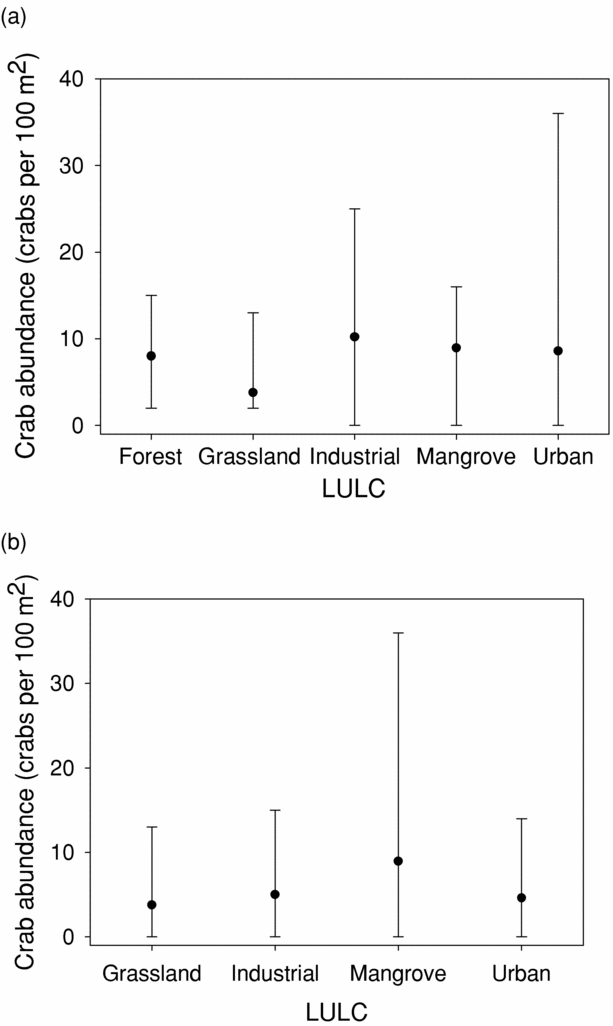
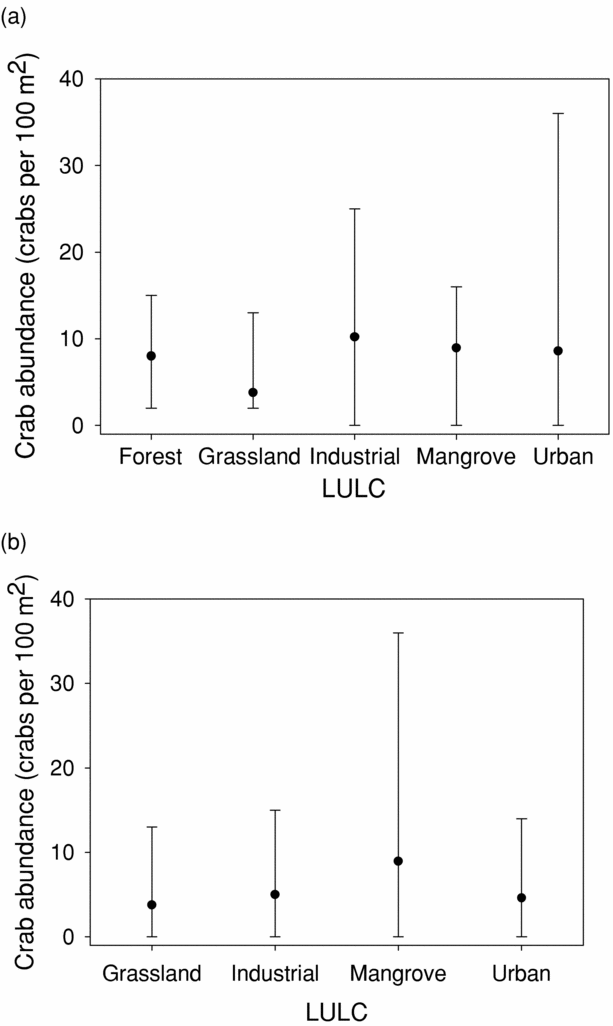
Of the 100 points surveyed in both estuaries we found 20 with crabs in SJBE and 17 in JBE. No significant difference in crab abundance (JBE: n = 54 and SJBE: n = 60; Z = 1.50, P = 0.133) or burrow size (JBE: n = 426 and SJBE: n = 418, Z = 1.01, P = 0.314) was found between JBE and SJBE. Although some of the sites had lower abundance in December, the difference was not significant (WT: Z = 1.63, n = 18, P = 0.104). Also, no seasonal differences in burrow size were apparent (WT: Z = 1.06, n = 18, P = 0.145). There was no significant difference in crab abundance among the different LULC types in either estuary, JBE (KW: (4:48) H = 5.38, P = 0.250) (Figure 1a) and for SJB (KW: (4:43) H = 4.27, P = 0.231) (Figure 1b).
Study of land crab abundance in Puerto Rico, a comparison of mean abundance among the different land-use/land-cover (LULC) types in Jobos Bay Estuary (a) and San Juan Bay Estuary (b).
Effect of LULC on physical habitat conditions
We found no significant differences for depth to groundwater (U = 439, P = 0.196), groundwater salinity (U = 418, P = 0.238), rainfall (U = 388, P = 0.684), soil temperature (U = 407, P = 0.460), maximum air temperature (U = 172, P = 0.765), minimum air temperature (U = 381, P = 0.430), average air temperature (U = 394, P = 0.309) and air temperature coefficient of variation (U = 417, P = 0.152) when we compared sites with and without crabs.
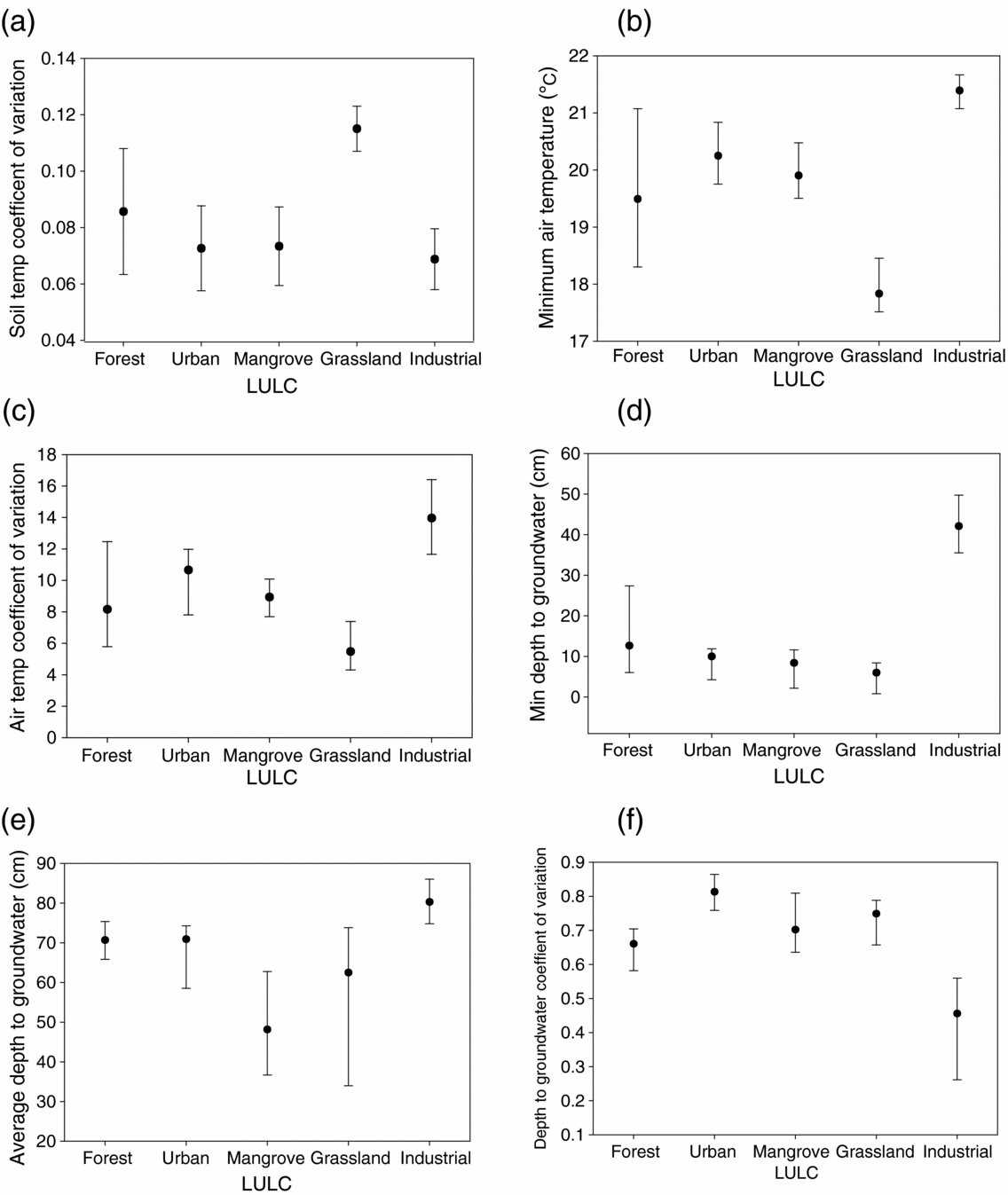
Of the environmental variables measured in the 18 plots with crabs, six exhibited significant variation among the different LULC types viz. minimum depth to groundwater (KW: H = 13.4, P = 0.016), average depth to groundwater (KW: H = 12.7, P = 0.013), depth to groundwater coefficient of variation (KW: H = 13.3, P = 0.01), minimum temperature (KW: H = 12.4, P = 0.016) and temperature coefficient of variation (KW: H = 10.5, P = 0.033). Grassland sites were different from the other land-use types in that soil temperatures were consistently higher and exhibited a higher coefficient of variation (Figure 2a, b), reflected in air and soil temperatures that included both the highest (34–40 °C) and lowest (20–21 °C) values we observed (Figure 2c).
The effect of land-use/land-cover (LULC) changes in Puerto Rico on soil temperature coefficient of variation (a) minimum air temperature (b) air temperature coefficient of variation (c) minimum depth to groundwater (d) average depth to groundwater (e) depth to groundwater coefficient of variation (f).
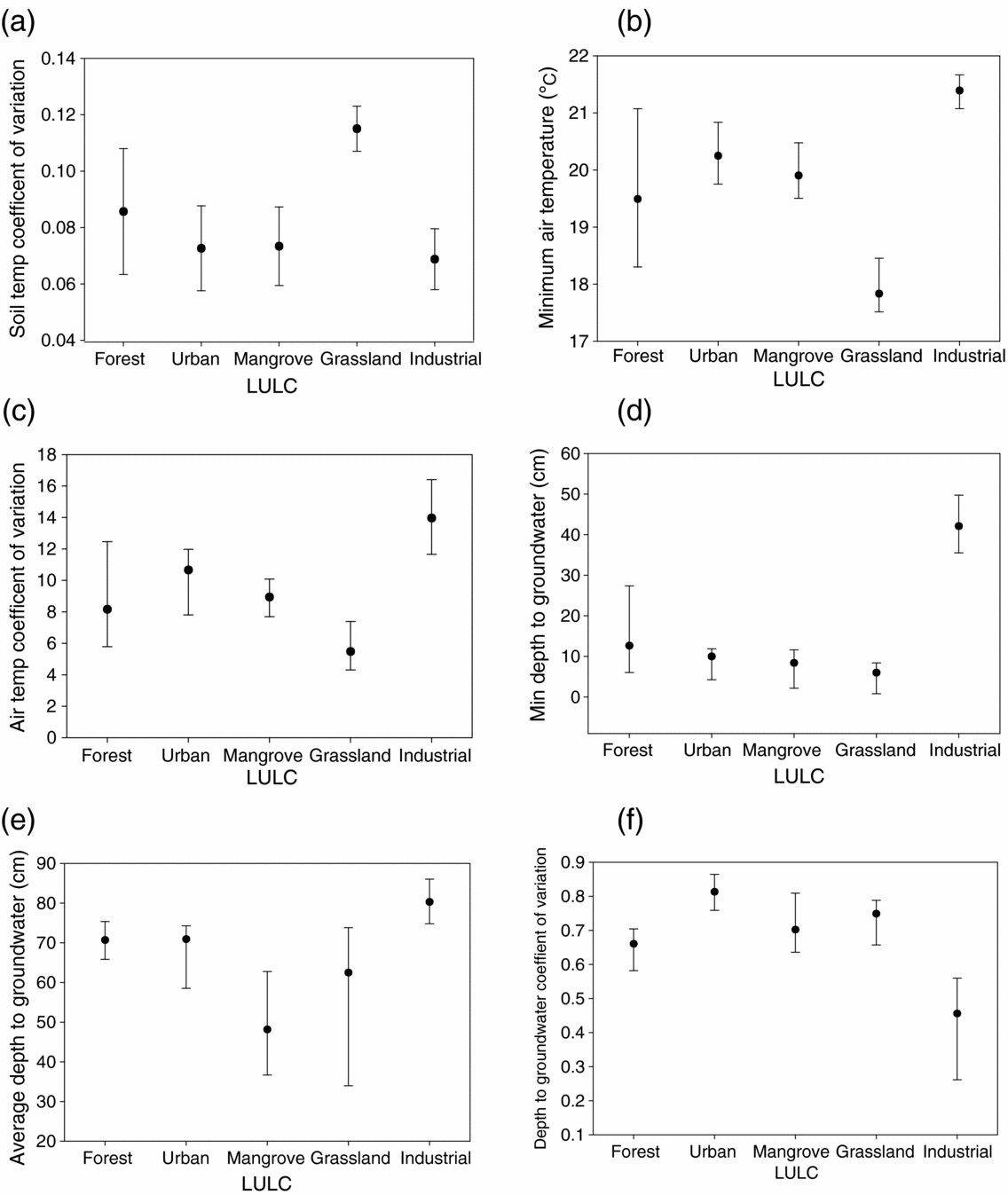
The water table was closer to the surface in grasslands sites (Figure 2d), but deeper and with very little temporal variation in industrial sites (Figure 2d–f). At grassland, mangrove and urban sites the water table was closer to the surface (Figure 2d) and exhibited higher temporal variation (Figure 2e, f). In forest sites the depth to groundwater was closer to the surface and varied little temporally (Figure 2e, f) when compared to grasslands and industrial areas.
Effect of physical habitat conditions on crab abundance and size
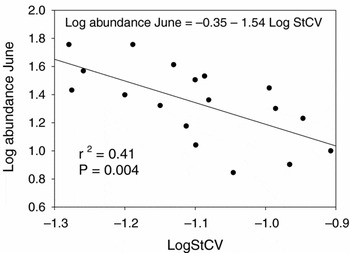
Of the 28 environmental variables used in the Spearman's correlation analysis with abundance of crabs for December and June only two environmental variables, soil temperature coefficient of variation (STCV) and maximum soil temperature (STMAX) correlated significantly: STCV vs. June abundance (R = −0.68, P = 0.002) and STCV vs. December abundance (R = −0.55, P = 0.018) and STMAX vs December abundance (R = −0.51, P = 0.03). Since both StCV and StMax were correlated to each other (Spearman's Rank: n = 18, r = 0.739, P = 0.005) and since we found no significant difference between the crab abundances in June and December we used only StCV and June abundance data in the regression analysis. The coefficient of variation of soil temperature explained 41% of variation in crab abundance within our sites (Figure 3). Crabs were least abundant in sites where the soil surfaces temperatures fluctuated more.
Relationship between abundance of land crabs and coefficient of variation of soil temperature in Puerto Rico. Log-StCV = log-transformed data for soil temperature coefficient of variation, Log Abundance June = log-transformed data of crab abundance estimated for the month of June.

Given the significant relationship between coefficient of variance for soil temperature and crab abundance and given that we observed differences in soil temperature between grassland sites and other LULC types we tested for difference in crab abundance between grassland sites versus abundance of all the other LULC types (pooling their abundance data). A Mann–Whitney U-test indicated significant difference in abundance in grasslands versus the other land-use types in JBE but not in SJBE (Mann–Whitney U-test: U = 482, df = 1, P = 0.001 for JBE and U = 289, df = 1, P = 0.205 for SJBE).
DISCUSSION
The lack of differences in crab abundance between the SJBE and the JBE is surprising considering that the LULC changes that occurred within both estuaries are very different (Govender Reference GOVENDER2007). In SJBE abandoned agricultural areas were replaced by grasslands and intense urban and industrial development in the early 1960 s while in JBE there is still some ongoing agricultural activity. We expected higher crab abundance in JBE than SJBE since landfill and furrow irrigation in agricultural fields could have provided crabs with ideal microhabitat conditions. The fact that we recorded high crab abundance in both estuaries for urban and industrial LULC types suggests that physical habitat requirements of Cardisoma guanhumi are met within these sites or that land crabs are able to adapt to the changes in the physical habitat brought about by these land-cover changes.
Cardisoma guanhumi typically build its burrows in areas where there is a slight rise in the ground so that the entrance is rarely flooded (Herreid & Gifford Reference HERREID and GIFFORD1963). Hence, landfill within these sites provided crabs with stable soils at an acceptable distance above the water table, in areas that would otherwise be affected by tidal effect or periodically flooded. Crabs living in the industrial and urban areas were able to survive there because these areas, although altered, were still able to provide stable depth to groundwater and low soil temperatures. A stable depth to groundwater was due to the fact that sites were within 50-m of the sea (Govender Reference GOVENDER2007) and the lower soil temperatures were provided by the shade of trees within these developments. In the Bacardi industrial site, for example, crabs avoided grassy areas that were trimmed to maintain the garden landscape and were found concentrated under the shade of the coconut trees.
Since crabs are mostly nocturnal and dwell in burrows it was not expected that soil surface temperature variation would affect their abundance because burrows afford decapods the ability to cope with the challenges of living with high temperatures on land (Atkinson & Taylor Reference ATKINSON and TAYLOR1988). Studies have shown that burrows can lower body temperature by as much as 10 °C (Atkinson & Taylor Reference ATKINSON and TAYLOR1988). For example, a study done on Gecarcinus lateralis showed that when air temperature was 35 °C and surface soil temperature was 48–50 °C, burrow temperature at 40 cm depth ranged from 28–32 °C, thus providing sufficient protection from high temperatures (Bliss Reference BLISS1968). When crabs of the genus Uca were caught on the surface of the sediment, their body temperatures were close to lethal upper limits therefore stressing the importance of burrows in protection from high surface temperature.
In this study we found a negative relation between soil surface temperature variation and crab abundance. This may be because sites with high soil temperatures at the surface also had higher groundwater tables (Figure 2) resulting in the crab burrows being closer to the surface. During June, July and August when the highest soil temperatures were recorded, the groundwater table was less than 20 cm below the surface. Since the depth of the burrows is limited by groundwater (Feliciano Reference FELICIANO1962, Herreid & Gifford Reference HERREID and GIFFORD1963) we can assume that burrow depth was only about 20 cm below the surface where the crabs probably reach their upper lethal limits for temperature.
The high degree of variation in temperature and depth to groundwater in grassland sites explain why we recorded the lowest crab abundances within this LULC type. Crab burrows within grassland sites were exposed to direct effects of sunlight. During the months of June to August we observed cracking of the soil in the grasslands sites, an indication of high temperature and rapid evaporation. We also found that grassland sites were frequently flooded during the rainy season thus explaining the low density in these sites. Since Cardisoma guanhumi rarely builds or occupies new burrows (Rodriguez-Fourquet Reference RODRÍGUEZ-FOURQUET2004), areas that are flooded and have high variation in temperature, even for a short period during the year, may well be inhospitable.
It was surprising that crab abundance in the industrial sites was not significantly lower. However, contrary to expectation, there was little variation in soil temperature and depth to groundwater in these sites while in the other LULC types (urban, forest and mangrove) groundwater table fluctuated seasonally. Also in the industrial sites tree cover was high around the areas where crab burrows were located thus protecting them from extreme temperature. When crabs are unable to lower high body temperatures through air currents (convection), contact with cool substrate (conduction) or reflection of incident light (radiation), they resort to evaporation, a risky procedure because it involves loss of water (Bliss Reference BLISS1968). When Bliss (Reference BLISS1968) exposed Gecarcinus lateralis, Cardisoma guanhumi and Ocypode quadrata to temperatures of 30 °C without food or water she found that Gecarcinus lateralis died due to dehydration after 89 h, Cardisoma guanhumi after 53 h and Ocypode quadrata after 20 h.
The observed differences in crab abundance among the different LULC is accounted for by differences in environmental conditions since food availability and predation is unlikely to have differed among the sites. Cardisoma guanhumi is a generalist feeder, accepting all food types offered (Rodriguez Fourquet Reference RODRÍGUEZ-FOURQUET2004), thus allowing it to live within areas of different vegetation cover. Crab hunting appears to have occurred at all sites with the same intensity. The rate of harvesting was the same as traps were found in all LULC types during the study period (pers. obs). Natural predation appears to be low and not different among sites, as no predation events were observed.
CONCLUSIONS
One of the key objectives of this research was to assess the extent to which LULC types affect the physical habitat conditions and in turn crab abundance. Our research revealed that crabs are resilient to changes in LULC when there is little or no alteration of depth to groundwater and soil temperature. We found that grasslands had significantly lower crab abundances and significantly higher variation in soil temperature and higher groundwater table. This suggests that high soil temperature variability coupled with depth to groundwater create conditions intolerable to crabs. A high water table in grassland sites eliminates the possibility of burrowing deep to escape hostile surface conditions. The increase of grasslands during the 1970 s in Puerto Rico (Govender Reference GOVENDER2007, Thomlinson et al. Reference THOMLINSON, SERRANO, DEL MAR LOPEZ, AIDE and ZIMMERMAN1996) corresponds with the population declines noted for Cardisoma guanhumi in Puerto Rico.
ACKNOWLEDGEMENTS
This project was funded by the National Oceanographic and Atmospheric Administration, Grant #NA04NOS4200133. The authors would like to thank the staff of the Department of Natural Resources especially in the Jobos Bay Estuary Research Reserve and the Forest manager at Pinoñes State Forest for logistical support. We would like to thank Dr Tom Wolcott and the anonymous reviewers whose comments greatly improved this manuscript.