Background
Suicide is a public health priority (Nelson et al., Reference Nelson, Denneson, Low, Bauer, O'Neil, Kansagara and Teo2017). Concerns regarding the impact of military service on military personnel are longstanding globally (Gradus et al., Reference Gradus, Shipherd, Suvak, Giasson and Miller2013). However, the importance of understanding suicidal behaviors has become increasingly urgent with studies showing that the rates of suicide in military personnel are rising (Schoenbaum et al., Reference Schoenbaum, Kessler, Gilman, Colpe, Heeringa, Stein, Ursano and Cox2014). There are lower rates of completed suicide in the Australian Defence Force (ADF) than the general population but rates of suicidal ideation are higher. In addition, rates of suicide are particularly high in ex-military personnel and the issue of suicide in the ADF has been the subject of two recent enquiries (Australian Institute of Health and Welfare, 2017).
Whilst suicide itself is a rare outcome, it is strongly predicted by the broader measure of suicidality (suicidal thoughts, plans, and attempts) (Joiner et al., Reference Joiner, Conwell, Fitzpatrick, Witte, Schmidt, Berlim, Fleck and Rudd2005). Research on suicidality in military populations (Kuehn, Reference Kuehn2009) has traditionally concentrated on occupational risk factors. However, several studies have not found a significant impact of deployment (LeardMann et al., Reference LeardMann, Powell, Smith, Bell, Smith, Boyko, Hooper, Gackstetter, Ghamsary and Hoge2013; Schoenbaum et al., Reference Schoenbaum, Kessler, Gilman, Colpe, Heeringa, Stein, Ursano and Cox2014; Kang et al., Reference Kang, Bullman, Smolenski, Skopp, Gahm and Reger2015). It is likely, therefore, that other factors also impact on the rates of suicidality in military personnel (Afifi et al., Reference Afifi, Taillieu, Zamorski, Turner, Cheung and Sareen2016).
General population studies have demonstrated the severe and long-term impact of childhood adversity on physical (Gilbert et al., Reference Gilbert, Breiding, Merrick, Thompson, Ford, Dhingra and Parks2015) and mental health (Green et al., Reference Green, McLaughlin, Berglund, Gruber, Sampson, Zaslavsky and Kessler2010) as well as on suicidality (Dube et al., Reference Dube, Anda, Felitti, Chapman, Williamson and Giles2001; Norman et al., Reference Norman, Byambaa, De, Butchart, Scott and Vos2012). Higher rates of adversity have been demonstrated in military compared with civilian populations in the UK (Iversen et al., Reference Iversen, Fear, Simonoff, Hull, Horn, Greenberg, Hotopf, Rona and Wessely2007), USA (Blosnich et al., Reference Blosnich, Dichter, Cerulli, Batten and Bossarte2014), Canada (Afifi et al., Reference Afifi, Taillieu, Zamorski, Turner, Cheung and Sareen2016), and higher rates of childhood trauma exposure, in the ADF. In addition, a recent Canadian study (Afifi et al., Reference Afifi, Taillieu, Zamorski, Turner, Cheung and Sareen2016) demonstrated that childhood adversity was strongly related to suicidality in military and civilian populations, but that whilst child abuse was more common in the military population, the association appeared stronger in civilians. In the USA, mental disorder, including pre-enlistment disorder, was found to be an important determinant of suicidality in the Army (Nock et al., Reference Nock, Stein, Heeringa, Ursano, Colpe, Fullerton, Hwang, Naifeh, Sampson, Schoenbaum, Zaslavsky and Kessler2014) but this study did not examine the specific role of childhood mental disorder.
Childhood factors are not only important determinants of adult suicidality but are also likely to be the earliest identifiable factors related to suicidality. Therefore, they hold great potential for the development of prevention and early intervention strategies (Nelson et al., Reference Nelson, Denneson, Low, Bauer, O'Neil, Kansagara and Teo2017). Before this can be achieved however, there are several important gaps in our understanding of the childhood determinants of adult suicidality.
It is unclear if all types of childhood trauma (including accidents) are related to adult suicidality, or if suicidality is related only to interpersonal types of childhood trauma such as abuse. This has proved challenging to decipher because of clustering, i.e. many of those who have been exposed to childhood adverse experiences have experienced many different types of trauma (Finkelhor et al., Reference Finkelhor, Ormrod and Turner2007). Whilst pre-enlistment disorder has been studied in military populations, childhood disorder has not been specifically studied (Nock et al., Reference Nock, Hwang, Sampson, Kessler, Angermeyer, Beautrais, Borges, Bromet, Bruffaerts, de Girolamo, de Graaf, Florescu, Gureje, Haro, Hu, Huang, Karam, Kawakami, Kovess, Levinson, Posada-Villa, Sagar, Tomov, Viana and Williams2009) but is potentially different from adult pre-enlistment disorder in terms of its etiological significance.
Previous studies have demonstrated that it is not only trauma, but the mental health impact of the trauma, that carries risk in terms of future outcomes (Breslau et al., Reference Breslau, Peterson and Schultz2008). The relationship between childhood disorder and trauma is therefore potentially important in determining future suicidality. Given that differences exist between military and civilian populations in terms of the patterns and rates of childhood trauma, comparing the populations is likely to be a useful avenue in determining the impact of childhood trauma and disorder and how they relate to each other in contributing to future suicidality.
In an attempt to decipher the early factors relating to risk and resilience, we investigated the association of childhood trauma and childhood disorder with past-year suicidality, in military compared with employed civilian populations. Due to marked sex differences in non-lethal suicidal behavior rates (Nock et al., Reference Nock, Stein, Heeringa, Ursano, Colpe, Fullerton, Hwang, Naifeh, Sampson, Schoenbaum, Zaslavsky and Kessler2014; Ursano et al., Reference Ursano, Heeringa, Stein, Jain, Raman, Sun, Chiu, Colpe, Fullerton, Gilman, Hwang, Naifeh, Nock, Rosellini, Sampson, Schoenbaum, Zaslavsky and Kessler2015) and the relatively low number of females in the ADF which limited statistical power, we confined this analysis to males.
More specifically, in both populations, we aimed to analyze and compare the associations between childhood trauma and past-year suicidality, to analyze and compare the associations between childhood disorder and past-year suicidality and to examine whether the association of childhood trauma and past-year suicidality was independent of childhood disorder, and vice versa, in both populations. In addition, we aimed to examine and compare mediator pathways from childhood trauma to past-year suicidality via childhood disorder. Finally, we aimed to investigate whether the associations between childhood trauma, disorder, and past-year suicidality were independent of service factors and combat exposure in the ADF. We hypothesized that elucidation of these associations, mediator pathways and differences between populations, would provide clues as to the early signs relating to risk and resilience.
Methods
The Joint Health Command Low-Risk Ethical Review Panel provided ethical approval for this analysis.
Military study (ADF sample)
All ADF personnel were invited to participate in the 2010 ADF Mental Health Prevalence and Wellbeing Study (MHPWS) which employed a two-phase design to estimate the prevalence of ICD-10 mental disorders across all serving regular ADF personnel (Van Hooff et al., Reference Van Hooff, McFarlane, Davies, Searle, Fairweather-Schmidt, Verhagen, Benassi and Hodson2014). This two-phase design is well accepted for investigating mental disorder prevalence (Dunn et al., Reference Dunn, Pickles, Tansella and Vazquez-Barquero1999).
• Phase 1 investigated levels of psychological and physical symptoms through a self-report questionnaire, which is economical of time and resources.
• Phase 2 examined mental disorder prevalence within the ADF. To do this, a stratified sub-sample of phase 1 respondents was selected to complete a more accurate but costly and time-consuming structured diagnostic interview, the CIDI.
All recruitment and assessment were conducted between April 2010 and January 2011. At phase 1, all serving ADF personnel (N = 50 049), excluding trainees and reservists, were invited to complete a self-report questionnaire, including basic demographics, the Kessler Distress Scale (K10) (Andrews and Slade, Reference Andrews and Slade2001), the Posttraumatic Stress Disorder Checklist (PCL) (Ventureyra et al., Reference Ventureyra, Yao, Cottraux, Note and De Mey-Guillard2002), and the Alcohol Use Disorders Identification Test (AUDIT) (Conigrave et al., Reference Conigrave, Saunders and Reznik1995). There were also three items relating to past year suicidality. In all, 24 481 participants provided usable data at phase 1.
Fifteen percent of the eligible participants from phase 1 were stratified and selected for participation in phase 2, where the World Mental Health Initiative Version of the Composite International Diagnostic Interview version 3.0 (CIDI) (Kessler and Ustun, Reference Kessler and Ustun2004) was utilized. Participants were selected for phase 2 with the joint aims of ensuring sufficient power within key demographic groups and of ensuring that participants had a reasonable chance of a positive diagnosis. Therefore, eligibility for phase 2, was based on service, sex, and scores on the PCL and AUDIT.
The 60th and 80th percentiles of the PCL and AUDIT distributions were used as cut-offs to form three stratification bands. The 80th percentile was chosen for ‘high scorers’ as it was deemed a conservative lower bound on what the diagnostic cut-off could be. The 60th percentile was chosen as a further cut-off to provide reasonable numbers of participants just below the first cut-off. Using these bands, the higher scoring ADF members (those in bands 2 and 3) were oversampled to provide adequate power to make more accurate prevalence estimates. Of the 3688 participants selected for phase 2, 1798 (49%) completed a CIDI interview. Taylor series linearization was used to estimate variance (Deville, Reference Deville1999; Ravva et al., Reference Ravva, Karlsson and French2014).
Weighting
Detailed descriptions of stratification procedures and weighting are available elsewhere (Hodson et al., Reference Hodson, Van Hooff and Davies2011; Van Hooff et al., Reference Van Hooff, McFarlane, Davies, Searle, Fairweather-Schmidt, Verhagen, Benassi and Hodson2014). In summary, mental disorder prevalence estimates were derived using a robust two-stage weighting process which attenuated the impact of low response rates, as well as any selection and responder bias. In the first step, a weight was assigned which was equal to the inverse of the probability of being selected for an interview. This accounted for the differential probability of being selected for a CIDI based on scores on the PCL and AUDIT (band) sex and service. In the second step, weights were applied to correct for differential non-response to the survey. A representative value or ‘weight’ was applied to each survey responder, using known characteristics about each individual in the population, in this case, age, sex, rank, and medical fitness, to indicate how many ‘like’ individuals in the entire population (based on those characteristics) each responder represented. These two weights were combined to give each responder a single weight within the data, enabling data from responders to be adjusted so that it was representative of the entire ADF.
For the purposes of this study, output for men was achieved by post-stratification to adjust the weights so that known population totals were reproduced by the estimates. A total of 43 207 (86.3%) of the ADF were men aged 18–60. Of these, 1356 had a CIDI interview which was weighted to represent all regular ADF men aged 18–60.
Civilian study (Australian Bureau of Statistics sample)
The 2007 Australian Bureau of Statistics (ABS) National Survey of Mental Health and Wellbeing (NSMHWB) was based on a stratified, multistage area probability sample of residents aged 16–85 years across all states and territories in Australia. Person weights (used in this study) were calibrated to independent estimates of population benchmarks in order to minimize sampling error of estimates and the level of non-response bias. Population benchmarks were obtained from the 2006 Australian Census, as well as from the 2007 Australian Survey of Education and Work. This allowed weighting of the sample according to the probability of being selected, so that the final sample of 8841 represented an estimated population of 16 015 000 Australian adults (Slade et al., Reference Slade, Johnston, Oakley Browne, Andrews and Whiteford2009).
For the purposes of this study, all employed males aged 18–60 were selected. Those who said that they had served in the ADF, received a DVA pension, or experienced combat exposure were then excluded. A total of 2120 employed civilian males in the general population (ABS) had a CIDI interview which was weighted to represent all 4.67 million (CI 4.54–4.79 million) employed civilian males. This interview included items relating to suicidality. Person and replicate weights were applied to these data to ensure that subpopulation weighting was correct.
Measures
Both studies utilized the CIDI (Kessler and Ustun, Reference Kessler and Ustun2004) which consists of a structured diagnostic assessment of lifetime, 12-month and 30-day ICD-10 disorder. Additional socio-demographic data were also available from the ABS census and the ADF self-report questionnaire, and service data from ADF administrative data. In the ADF, items relating to suicidality were included in the self-report questionnaire at phase 1. In the ABS, the CIDI interview included items relating to suicidality.
Suicidality
In the ADF, at phase 1, the self-report questionnaire included the following specific items regarding suicidality:
• In the last 12 months, have you ever felt so low that you thought about committing suicide?
• In the last 12 months, have you made a suicide plan?
• In the last 12 months, have you attempted suicide?
In the ABS, as a part of the CIDI interview, each respondent was asked to read the respondent booklet, and consider each of the following experiences which were described there:
• Experience A was ‘seriously thought about committing suicide’,
• Experience B was ‘made a plan for committing suicide’,
• Experience C was ‘attempted suicide’.
If they had experienced it, they were asked how old they were the first time it had happened and whether it had happened to them within the previous 12 months. If they responded that they had not experienced A, the interviewer did not ask about experience B or C. The previous 12-month responses were used for the purposes of this study.
The items were analyzed to determine overall rates of thoughts, plans, and attempts in each population. The items were also combined to form a measure of ‘any suicidality’ in the previous 12 months.
Disorder
Childhood disorder was defined as disorder with age of onset below 18 years and was grouped as follows: any depression (mild, moderate, or severe depressive episode), any anxiety [social phobia, OCD, GAD, agoraphobia, panic attack, panic disorder, post-traumatic stress disorder (PTSD)], and any alcohol use disorder (abuse or dependence). Those who had a lifetime anxiety disorder but no childhood anxiety disorder were coded as having an adult onset anxiety disorder. Coding was performed in a similar way for adult onset depression and adult onset alcohol use disorders.
Traumatic experiences
Respondents were asked if they had experienced any of the CIDI criterion A1 events listed in the CIDI 3.0. To determine age at onset of each experience, respondents were asked how old they were when it first happened to them.
For the purposes of this study, we defined childhood trauma as those experienced with age of onset below 18 years and coded the number of trauma types (trauma count) and age of onset (0–11 or 12–17 years old). Adult trauma refers to trauma types first experienced aged 18 years or over.
Types of childhood trauma were classified as follows, based on Forbes et al. (Reference Forbes, Lockwood, Phelps, Wade, Creamer, Bryant, McFarlane, Silove, Rees, Chapman, Slade, Mills, Teesson and O'Donnell2014), non-interpersonal trauma (exposed to a toxic chemical, life-threatening automobile accident, other life-threatening accident, man-made disaster, life-threatening illness, major natural disaster) and interpersonal trauma (sexual assault, raped, stalked, beaten by spouse/romantic partner, beaten by parents/guardian as a child, badly beaten by anyone else, kidnapped or held captive, mugged, held up or threatened with a weapon).
Due to the co-occurrence of childhood trauma types (Green et al., Reference Green, McLaughlin, Berglund, Gruber, Sampson, Zaslavsky and Kessler2010), we then categorized individuals (as per our previous study) into mutually exclusive childhood trauma categories, non-interpersonal trauma without interpersonal trauma, interpersonal trauma without non-interpersonal trauma, and both non-interpersonal and interpersonal trauma. We categorized those who experienced childhood trauma that did not fit into the previous categories as unclassified trauma (child had life-threatening illness/injury, combat, refugee, peacekeeper, purposefully injured/tortured/killed someone, other traumatic event, unarmed civilian in a place of conflict, accidentally injured/killed someone, and lived as a civilian in a place of ongoing terror, experience don't want to talk about; saw atrocities or carnage; someone close had traumatic experience; witness serious physical fights at home as a child; someone close died; saw someone badly injured). The mutually exclusive childhood trauma categories were therefore exhaustive of the lifetime trauma items in the CIDI.
Demographics and service characteristics
In the ABS, prior to the formal mental health diagnostic interview, socio-demographic information was collected, including age, education, and relationship status. In the ADF, information regarding age, education, and relationship status was available from the self-report questionnaire.
In the ADF, information regarding service characteristics was available from ADF administrative data. Military ranks were grouped into three categories, other ranks (Private to Corporal equivalents), non-commissioned officers (Sergeant to Warrant Officer equivalents), and commissioned officers (Lieutenant to General equivalents). Medical fitness to deploy was based on MEC categories. Information regarding previous deployment was available from the self-report questionnaire.
Analysis
As the data to be compared came from surveys in different populations, data-merging techniques were not deemed statistically appropriate primarily due to complexities in the poststratification process. All analyses were performed in STATA version 14.2, accounting for complex survey designs by survey weighting, utilizing the STATA ‘svy’ command. Therefore, all analyses were conducted applying weights to provide population prevalence estimates. P values were not calculated due to the complexities associated with accurately testing results across two complex surveys. Therefore, for each population, the weighted analyses give the population prevalence, and the term ‘significant’ is used to describe differences when the 95% confidence intervals do not overlap.
Firstly, descriptive statistics were undertaken to describe the overall prevalence of suicidal thoughts, plans, and attempts over the previous 12 months, in both populations. Next, associations between childhood and adult factors and past-year suicidality were calculated, controlling for demographic factors.
Logistic regression analyses were utilized to analyze the relationship between childhood trauma and childhood disorder with suicidality, controlling for each other and demographics. We then also controlled for adult onset trauma types and adult onset mental disorder. All of these analyses were conducted with the same variables in both populations for comparison. The analyses were then repeated in the ADF with the addition of service characteristics in each step, with a final step for adult combat exposure. Any differences were highlighted and reported.
We examined mediator pathways between childhood trauma and suicidality, via childhood disorder, using logistic regression models. We utilized Generalized Structural Equation Modelling (GSEM), rather than SEM, as the outcome variable was dichotomous. In STATA, the GSEM pathway utilized the link ‘logit’ and the family ‘Bernoulli’. We conducted mediator analysis where there was a direct association between childhood trauma and suicidality. Where possible, we accounted for complex survey designs within STATA by utilizing the ‘svy’ command. Possible mediators examined were childhood disorder (childhood anxiety, depression, and alcohol use disorders). We examined all pathways both with and without controlling for demographic variables (age, highest education, and current relationship status). In order to investigate the extent of possible mediation, we compared β coefficients for total effects with indirect and direct effects, along with levels of significance. We compared military and civilian populations using the same variables, and then repeated the analysis in the military population, also controlling for service factors (service and rank).
Results
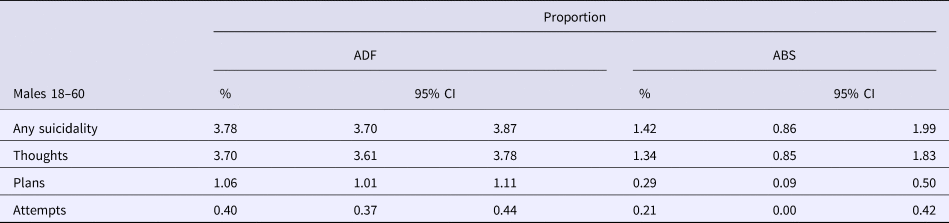
There were significantly higher rates of suicidality in the ADF (see Table 1).
Comparison of suicidality rates

Associations
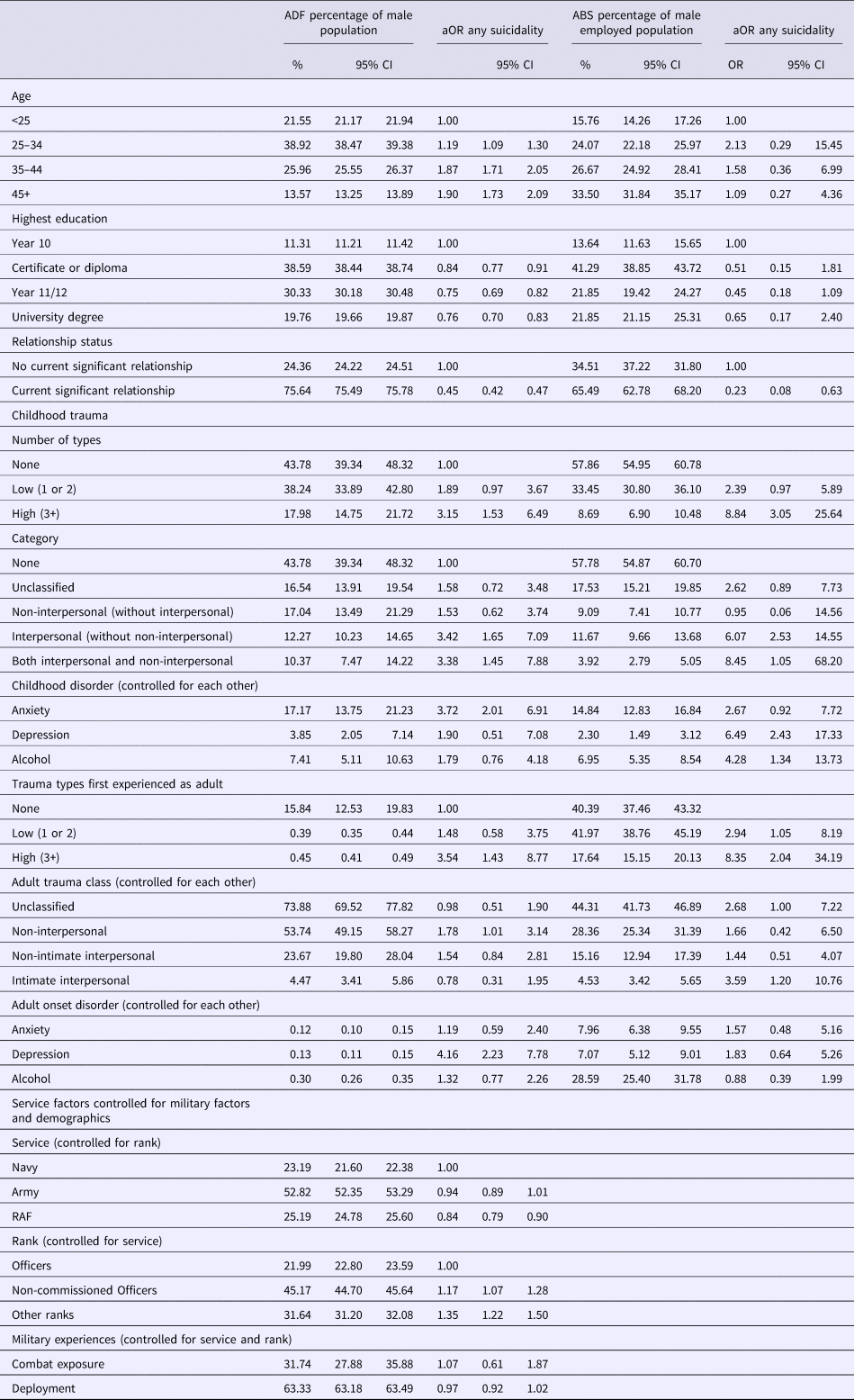
In the ADF, controlling for other demographic factors, suicidality was associated with the lowest education category (year 10 or below) and with being older. There was no association of suicidality with age or highest education in civilians. In both populations, suicidality was associated with being single (see Table 2).
Associations controlling for demographic factors

aOR, adjusted odds ratio.
All controlled for demographics: age, relationship status, highest education.
Childhood factors
In the ADF, there was a much higher proportion of those with a high count of childhood trauma (three or more types). Suicidality was associated with high counts of childhood trauma types in both populations. Suicidality was not associated with childhood non-interpersonal or unclassified trauma (in the absence of interpersonal trauma) in either population; however, it was associated with childhood interpersonal trauma (alone or together with non-interpersonal trauma) in both populations.
In the ADF, suicidality was associated with childhood anxiety, but not with childhood depression or alcohol use disorders. In contrast, in civilians, it was associated with childhood depression and with alcohol use disorder, but not with childhood anxiety (see Table 2).
Adult trauma
A higher proportion of those in the ADF experienced high counts of adult trauma (number of types of trauma first experienced aged 18 or over). Suicidality was associated with high counts of adult trauma in both populations.
Service factors
Suicidality was associated with being in the Navy or Army and with not being an Officer. Suicidality was not associated with combat exposure or deployment.
Regression models
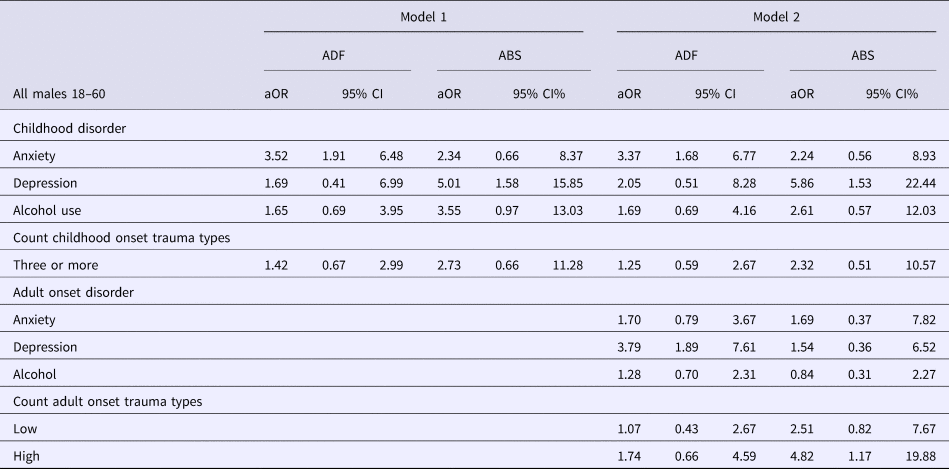
In the ADF, in the first model (see Table 2), which controlled for childhood factors (disorder and trauma) and demographics, high counts of childhood trauma were not associated with suicidality in either population once childhood disorder was controlled for (Table 3).
Childhood factors regression comparison

aOR, adjusted Odds Ratio of Any Suicidality.
Covariates in every model: age, relationship status, highest education.
However, controlling for childhood trauma, childhood anxiety was associated with suicidality in the ADF, whereas childhood depression was associated with suicidality in civilians.
Controlling also for adult onset trauma types and adult onset disorder (as in the second model) did not affect the significance of the association of childhood disorder and suicidality. Depression (but not anxiety or alcohol use disorder) which had its first onset in adulthood was associated with suicidality in the ADF. In civilians, no adult onset disorders were associated with suicidality.
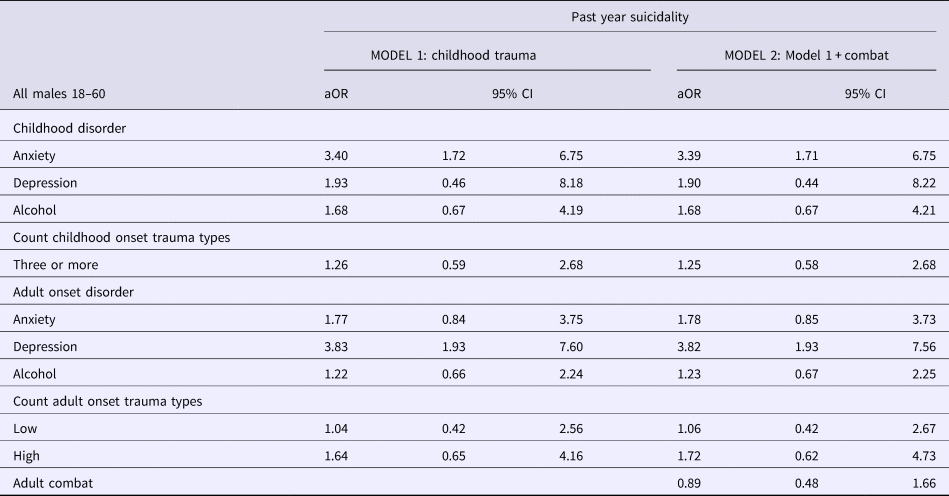
In the ADF (Table 4), childhood anxiety was associated with suicidality even when also controlling for service factors, and combat exposure. Combat exposure, however, was not associated with suicidality in any model.
Regression ADF

aOR, adjusted odds ratio any suicidality.
Covariates in every model: age, relationship status, highest education, rank, and service.
Generalized Structural Equation Modelling
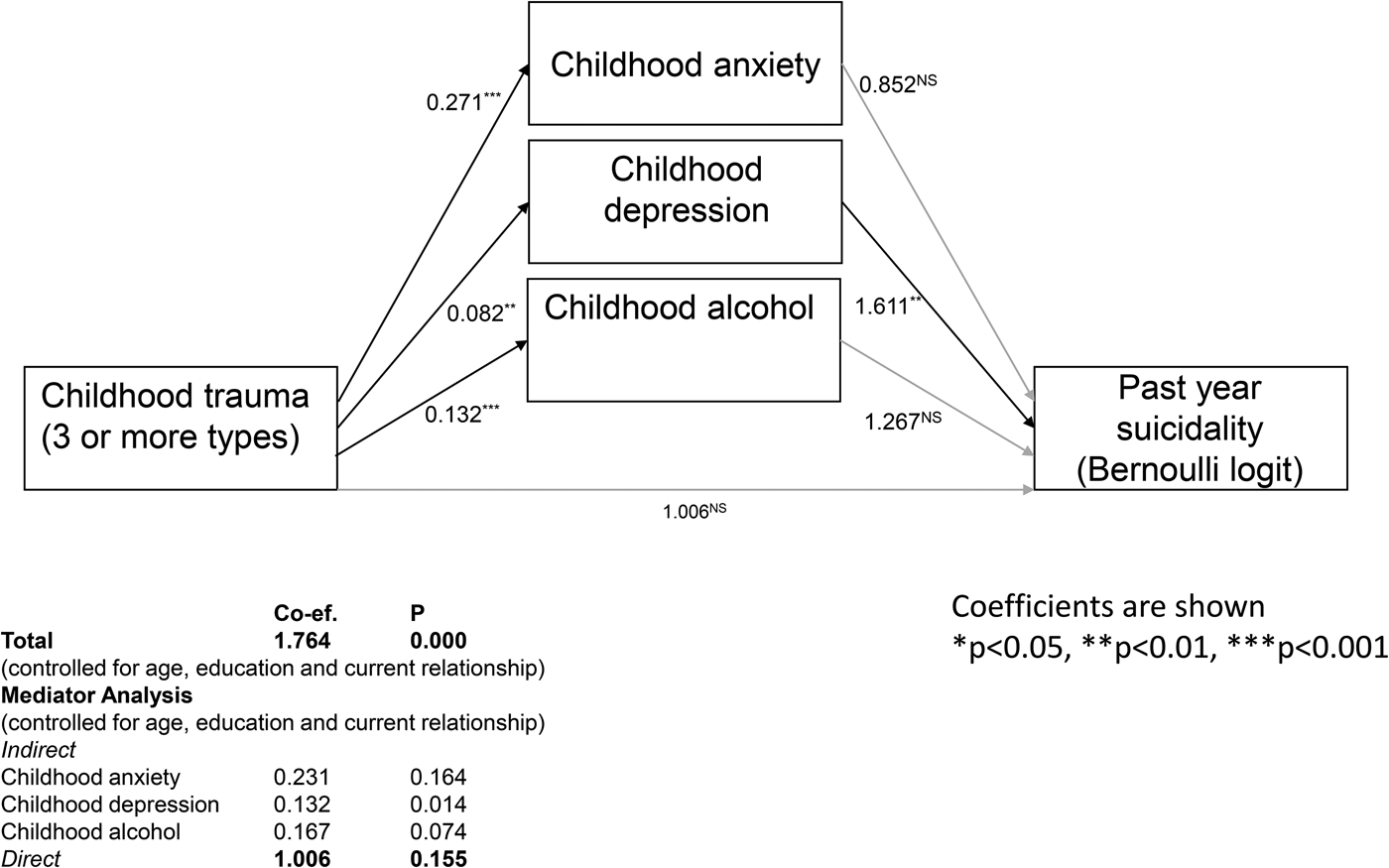
There was a significant association between high count childhood trauma (three or more types of trauma types experienced in childhood) and past-year suicidality in both populations (see Table 2 and figures). GSEM mediator analysis demonstrated that the direct pathway became insignificant when childhood disorders were added as mediators. The indirect pathway between childhood trauma and suicidality was significant for childhood anxiety but not for childhood depression or childhood alcohol in the ADF. This was also the case when controlling for demographic factors (see Fig. 1). Therefore, we investigated the mediator pathway for childhood anxiety alone. The indirect pathway was significant (β coefficient = 0.28, p = 0.004), whereas the direct pathway became insignificant (β coefficient = 1.640, p = 0.136). This suggests full mediation of the association between childhood trauma and suicidality by childhood anxiety in the ADF.
Military male mediator pathways through childhood disorder, controlling for demographics (age, education, and current relationship status).

In civilians, GSEM mediator analysis also demonstrated that the direct pathway between childhood trauma and past-year suicidality became insignificant when childhood disorders were included as mediators. The indirect pathway between childhood trauma and suicidality was significant for childhood depression but not for childhood anxiety or childhood alcohol. This was also the case when controlling for demographic factors (see Fig. 2). Therefore, we investigated the mediating pathway for childhood depression alone, controlling for demographic factors; however, the direct pathway remained significant. These results suggest full mediation of the relationship between childhood trauma and disorder via the spectrum of childhood disorders, most notably depression, but not by childhood depression alone.
Civilian male mediator pathways through childhood disorder, controlling for demographics (age, education, and current relationship status).

Discussion
Main findings
The prevalence of suicidality was substantially higher in ADF than civilian males. Suicidality was associated with being single in both populations. In both populations, suicidality was associated with high counts of childhood trauma (three or more types), as well as high counts of trauma types first experienced in adulthood. In the ADF, combat exposure was not associated with suicidality (in any model).
There were substantially higher proportions of those with high counts of childhood trauma types and high counts of adult trauma types in the ADF than civilians. Childhood non-interpersonal trauma, such as accidents, and unclassified trauma (in the absence of interpersonal trauma) were not associated with suicidality in either population. Childhood anxiety (but not depression or alcohol use disorders) had a strong and independent association with suicidality in the ADF (controlling for demographics and childhood trauma) which remained when controlling for adult trauma and adult onset disorder. In contrast, in civilians, this was the case for childhood depression (but not anxiety or alcohol use disorders). Adult onset depression was associated with suicidality in the ADF, but not in civilians. GSEM suggested that childhood anxiety fully mediated the relationship between childhood trauma and suicidality in the ADF. Whereas, in civilians, the association of childhood trauma with suicidality appeared to be fully mediated via childhood disorder, most notably childhood depression, but not by any of the individual disorder types alone.
Comparison with other studies
In agreement with studies in the USA and Canada (Kuehn, Reference Kuehn2009; Afifi et al., Reference Afifi, Taillieu, Zamorski, Turner, Cheung and Sareen2016), the rate of suicidality was higher in the military than the civilian population. Given that youth (15–24 years old) suicide has been found to be higher than the average rates in Australia and New Zealand (Pritchard, Reference Pritchard1992) and is the leading cause of death in those aged 25–44 years in Australia (Kinchin and Doran, Reference Kinchin and Doran2018), this is an issue of importance. The rate of past year suicidal thoughts in the ADF was similar to that in the Canadian military (Afifi et al., Reference Afifi, Taillieu, Zamorski, Turner, Cheung and Sareen2016), but less than that in the US military (Nock et al., Reference Nock, Stein, Heeringa, Ursano, Colpe, Fullerton, Hwang, Naifeh, Sampson, Schoenbaum, Zaslavsky and Kessler2014).
Consistent with studies in civilian populations (Dube et al., Reference Dube, Anda, Felitti, Chapman, Williamson and Giles2001; Harford et al., Reference Harford, Yi and Grant2014) and another in the military (Afifi et al., Reference Afifi, Taillieu, Zamorski, Turner, Cheung and Sareen2016), childhood adversity was associated with suicidality. However, our study investigated childhood traumatic experiences, but not certain items included in studies of childhood adversity, such as neglect.
In terms of demographics, once childhood factors were included in our analysis, the only demographic factor associated with suicidality, in both populations, was being single. A recent meta-analysis demonstrated that being single significantly increased risk for ideation and death, but not attempts (Huang et al., Reference Huang, Ribeiro, Musacchio and Franklin2017).
The Canadian study (Afifi et al., Reference Afifi, Taillieu, Zamorski, Turner, Cheung and Sareen2016) looked particularly at childhood abuse and deployment-related trauma, in contrast to our broader definitions of both childhood and adult trauma. However, consistent with our findings, child abuse was associated with suicidality, and was a stronger indicator of suicidality than deployment-related trauma. However, childhood disorder, and its role in these relationships was not explored in that study.
Military studies have not tended to explore childhood disorder. However, there are studies that shed light on these phenomena in civilian populations. One such study prospectively demonstrated that the total number of childhood adversities had a strong graded relationship with new onset suicidality. In the case of both physical abuse and neglect (but not other adversities), an association remained once other types of adversity and disorder were controlled for. However, that study did not include PTSD, a major factor in the pathway between childhood trauma exposure and suicidality (Enns et al., Reference Enns, Cox, Afifi, De Graaf, Ten Have and Sareen2006).
A US Army research project looked specifically at disorder (pre- and post-enlistment) and suicidality in order to delineate the relationships (Nock et al., Reference Nock, Hwang, Sampson, Kessler, Angermeyer, Beautrais, Borges, Bromet, Bruffaerts, de Girolamo, de Graaf, Florescu, Gureje, Haro, Hu, Huang, Karam, Kawakami, Kovess, Levinson, Posada-Villa, Sagar, Tomov, Viana and Williams2009). Whilst their measurements and predictors were dissimilar to those used in this study, interestingly and consistent with our findings, the pre-enlistment disorders relating to suicidality were both anxiety disorders, namely panic disorder and PTSD. The authors stated that approximately one-third of post-enlistment suicide attempts were associated with pre-enlistment mental disorders suggesting that pre-enlistment mental disorders are potential targets for early intervention.
Recently, studies in general populations have highlighted anxiety as an important independent determinant of suicidality (Sareen et al., Reference Sareen, Cox, Afifi, de Graaf, Asmundson, ten Have and Stein2005), and also as a mediator of the relationship between childhood trauma and suicidality (Bahk et al., Reference Bahk, Jang, Choi and Lee2017). These studies found evidence for state and trait anxiety as risk factors for adolescent suicidal behaviors (Ohring et al., Reference Ohring, Apter, Ratzoni, Weizman, Tyano and Plutchik1996), and also features of anxiety within affective disorders as risk factors for adult suicidality (Fawcett et al., Reference Fawcett, Scheftner, Fogg, Clark, Young, Hedeker and Gibbons1990). Importantly, there is evidence of anxiety disorders (particularly panic and PTSD) as independent predictors of adult suicidality, including attempts (Cougle et al., Reference Cougle, Keough, Riccardi and Sachs-Ericsson2009), in males.
Strengths
This is the first study, of which we are aware, to investigate childhood trauma and childhood disorder simultaneously in determining suicidality in a military population compared with a civilian employed population. Both of these datasets provide detailed interview data on lifetime disorder and trauma. The classification of people into mutually exclusive categories according to the types of trauma experienced as children allowed the disentangling of trauma type from trauma load which has been a particular challenge for research on childhood experiences (39).
Weaknesses
This analysis utilized two cross-sectional surveys. The main predictor variables utilized in this analysis were childhood experiences recalled from adulthood, thus rendering the responses vulnerable to autobiographical bias. However, such retrospective reporting of childhood experiences is more prone to false negatives than positives and if well defined, as in this study, has good reliability (40).
There may appear to be a low response rate in the ADF sample. However, unlike most surveys, the demographic and health status of the ADF members who did not respond at each stage was known. This was accounted for in the back-weighting of the sample to minimize any error. However, it is possible that there may be an underestimate of the impact of childhood adversity in this sample, due to false negatives.
As our principle aim was to compare the male ADF and civilian populations, only male employed civilian subjects were included. Therefore, the poorer functioning unemployed male civilian population are not included in this analysis. In addition, we did not include a measure of other forms of childhood adversity, such as neglect.
Conclusions
These data demonstrate the need to take a whole life approach to understanding suicidality and the importance of categorizing the nature of childhood trauma exposure. Particularly, there was a lack of association between childhood trauma that was not interpersonal in nature (such as accidents) and adult suicidality, in both populations.
The comparison with employed civilians provides insights into the relative magnitude of child and adult aspects of traumatic experiences and their impact on suicidality, as well as how these relate to childhood and adult onset disorder. The higher proportion of those who had three or more types of childhood trauma in the military compared with civilians highlights how military service may provide a refuge for a subgroup of recruits who then carry this vulnerability into their service. This risk matrix is an important consideration in understanding suicidality in military and veteran populations.
Importantly, we have extended our understanding of the importance of childhood disorders as mediators of childhood traumatic experiences and suicidality. In the ADF, childhood anxiety was not only independently associated with suicidality, but also and in contrast to civilians, fully mediated the association between childhood trauma and suicidality. In addition, adult onset depression was also associated with suicidality in the military but not the civilian population. This has etiological implications for the importance of these factors in a population more highly exposed to trauma. These findings have the potential to inform the development of strategies for suicide prevention.
Acknowledgements
We thank all investigators and scientific advisors for their contribution to the design of the Program. We also thank the study teams at the Centre for Military and Veterans’ Health and the University of Adelaide for their role in data collection. Most importantly, we thank all of the ADF personnel who participated in the study.
Financial support
Data analyzed in this study were derived from the Military Health Outcomes Program – a combined dataset including the Health and Wellbeing Survey (University of Adelaide, Centre for Traumatic Stress Studies and Joint Health Command), and the Middle East Area of Operations Census and Prospective Surveys (Centre for Military and Veterans’ Health) (Davy et al., Reference Davy, Dobson, Lawrence-Wood, Lorimer, Moores, Lawrence, Horsley, Crockett and McFarlane2012; Dobson et al., Reference Dobson, Treloar, Zheng, Anderson, Bredhauer, Kanesarajah, Loos, Pasmore and Waller2012). These surveys were supported and funded by The Australian Department of Defence. Views and opinions expressed within this article are those of the authors, and do not necessarily reflect the official policy or position of the Australian Department of Defence. Whilst the Department of Defence was involved with the study design and data collection, it had no role in the analysis and interpretation of the data, or the decision to submit the manuscript for publication.
Conflict of interest
AM and MVH receive funding from the Departments of Veterans Affairs and the Australian Department of Defence. AM is the principal adviser in psychiatry to the Department of Veterans Affairs and has advisory roles with the Australian Department of Defence. GM reports grants from National Health and Medical Research Council, Ramsay Research and Teaching Fund, American Foundation for Suicide Prevention, and the NSW Agency for Clinical Innovation and NSW Ministry of Health, and personal fees from Astrazeneca, Elsevier, Lundbeck, Janssen-Cilag, Servier, and other from Melbourne University, outside of the submitted work. RSS receives funding from Australian Rotary Health in the form of a Ph.D. scholarship. There is no conflict of interest in the present study for any of the other authors.
Author ORCIDs
Rebecca Syed Sheriff 0000-0002-5934-6722.