In recent years donkey milk has been widely studied because its composition has been shown to be very similar to that of human milk. Donkey milk is characterized by low β-lactoglobulin, casein and fat content; also, the lipid fraction appears characterized by high levels of both linoleic and linolenic acids (Salimei et al. Reference Salimei, Fantuz, Coppola, Chiofalo, Polidori and Varisco2004; Vincenzetti et al. Reference Vincenzetti, Polidori, Mariani, Cammertoni, Fantuz and Vita2008). Lysozyme content has been reported to be very high (3750 mg/l) in comparison with cow milk (0·09 mg/l) and human milk (40–200 mg/l) (Chiavari et al. Reference Chiavari, Coloretti, Nanni, Sorrentino and Grazia2005; Vincenzetti et al. Reference Vincenzetti, Polidori, Mariani, Cammertoni, Fantuz and Vita2008). Such a high amount of lysozyme in donkey milk has positive effects on the conservation of raw milk and milk products (Zhang et al. Reference Zhang, Zhao, Jiang, Dong and Ren2008). Moreover, Chiavari et al. (Reference Chiavari, Coloretti, Nanni, Sorrentino and Grazia2005) demonstrated, in a fermented beverage with lactobacilli, a lysozyme activity virtually unchanged in comparison with initial values, even after a 30-d shelf life. For its characteristics, ass milk has been proposed as an alternative to goat milk or artificial milk in infants allergic to cow milk (Iacono et al. Reference Iacono, Carroccio, Cavataio, Montalto, Soresi and Balsamo1992; Vita et al. Reference Vita, Passalacqua, Di Pasquale, Caminiti, Crisafulli, Rulli and Pajno2007). A recent study considering multi-allergic children, showed a significant increase in length/stature and weight in the majority of the subjects treated with donkey milk, in comparison with untreated subjects (Monti et al. Reference Monti, Bertino, Cristina, Coscia, Cresi, Silvestro, Fabris, Fortunato, Gabriella and Conti2008). Furthermore, the immunological properties of donkey milk have been recently investigated, showing that humans consuming ass milk have an increased blood mononuclear cells nitric oxide release, which could be useful in the prevention of atherosclerosis (Tafaro et al. Reference Tafaro, Magrone, Jirillo, Martemucci, D'Alessandro, Amati and Jirillo2007).
On the other hand, the importance of innate defences, including lysozyme and N-acetyl-ß-D-glucosaminidase (NAGase), in the mammary health of dairy cows is well known (Piccinini et al. Reference Piccinini, Binda, Belotti, Casirani and Zecconi2005, Reference Piccinini, Binda, Belotti, Daprà and Zecconi2007). Nevertheless, the role of such enzymes in the health of donkey mammary gland has been poorly investigated. NAGase is a lysosomal enzyme secreted in large amounts in the mammary gland during inflammation, implicated as an indicator of tissue damage during mastitis. Lysozyme displays antibacterial activity against a number of bacteria and it is present in high amounts in human and ass milk, in contrast to cow milk. Such high concentrations could represent a mechanism of protection against infections and also contribute to the elimination of new infections (Salimei et al. Reference Salimei, Fantuz, Coppola, Chiofalo, Polidori and Varisco2004; Vincenzetti, Reference Vincenzetti, Polidori, Mariani, Cammertoni, Fantuz and Vita2008). Indeed, mastitis in asses is very rare, and usually follows traumatic injures to teats, or drying off (Conte et al. Reference Conte, Piccinini, Daprà and Gagliano2006).
The aim of this study was to assess mammary gland health status and milk hygiene of companion donkeys during an entire lactation, in order to try to define some physiological ranges. These could become useful to test the healthiness and safety of ass milk in infant feeding.
Animals from different provinces of Lombardy region, Italy, were repeatedly sampled and half-udder milk was examined by total bacteria count (TBC), bacteriological analysis and somatic cell count (SCC), determination of lysozyme and NAGase content. Finally, the pathogenic potential of Staphylococcus aureus isolates was investigated at a molecular level.
Materials and Methods
Study population and sampling procedure
Ten animals from Novara, Pavia, Bergamo, Milano and Como provinces (Amiata breed) were included in this study. The median age of the donkeys was 6.7 years and all the animals were from hobby farms.
The donkeys were sampled once a month, for eight months. The foal was taken away from the mother 2–3 h before sampling, then 10 ml milk was collected aseptically from each half udder, in accordance with NMC guidelines (1999). All samples were kept at 4°C until bacteriological analysis of milk was performed.
Milk cytological and bacteriological analysis
Ten μl of each milk sample was plated onto blood agar plate (5% sheep blood; Oxoid, Cambridge, UK) and processed according to NMC guidelines (1999). Colonies of growth were isolated, identified following NMC guidelines and confirmed by API system. The major pathogens were further tested for antimicrobial susceptibility by agar disk diffusion method (Bauer et al. Reference Bauer, Kirby, Sherris and Turk1966) and subsequently, the isolates were frozen in Brain Heart Infusion Broth (Oxoid, Cambridge, UK) with 15% glycerol (v/v) until further molecular analyses were performed.
TBC was performed on plate count agar, using the inclusion method. One ml of undiluted samples and of each 10−1 and 10−2 dilution were included in the agar and the plates were incubated for 48 h before counting. The results were then multiplied by the dilution factor, and expressed as cfu/ml.
A 3-ml aliquot of each milk sample was centrifuged at 16 000 g for 20 min, and the whey was frozen at −80°C for enzyme determination.
The samples were further tested for SCC by a Bentley Somacount 150 (Bentley Instruments, Chaska MN, USA).
Molecular analysis
DNA extraction
Molecular characterization of bacteria was performed only on Staph. aureus isolates, owing to their central role as causative agents of foodborne diseases. From each isolate, one colony was cultured in Nutrient Broth (Oxoid) at 37°C overnight. The broth was then centrifuged at 5000 g for 5 min and the DNA was extracted using the Wizard Genomic DNA Purification Kit (Promega, Madison WI, USA). Lysostaphin (5 mg/ml; Sigma) was used for bacterial lysis. DNA amount and purity were tested with a ND-100 Spectrophotometer (NanoDrop Technologies Inc., Wilmington DE, USA). DNA integrity was checked by electrophoresis on 0·8% agarose gel containing ethidium bromide (0·5 μg/ml) in TAE buffer.
Nanoarray analysis
DNA microarray (CLONDIAG chip technology, Jena, Germany) was used to genotype Staph. aureus isolates. A set of probes covering different toxins (enterotoxins, leukotoxins, haemolysins), the allelic variants of the Agr gene and antibiotic resistance determinants to β-lactams, methicillin, macrolides, aminoglycosides, vancomycin, lincosamides and tetracyclines were included in the chip. The arrays were processed as described elsewhere (Monecke et al. Reference Monecke, Levbe and Enright2003; Monecke & Ehricht, Reference Monecke and Enright2005). Briefly, genomic DNA was amplified, labelled with biotin-16-dUTP (Roche Diagnostics, Mannheim, Germany) and hybridized into the array. The products were visualized using streptavidin-horseradish-peroxidase and a chromogenic substrate (Seramun, Wolzig, Germany). The reaction was read on an array tube reader ATR01 with the Iconoclust software package (CLONDIAG chip technologies, Jena, Germany).
Enzyme determinations
Enzyme determinations were performed in a single session for each enzyme, at the end of the follow-up period.
Lysozyme activity was assessed by a commercial fluorimetric method (EnzChek Lysozyme Kit, Invitrogen, Carlsbad CA, USA) on microplate. The method is based on the lysis of Micrococcus lysodeycticus labelled with fluorescine to such a degree that fluorescence is quenched. Lysozyme activity was measured on a fluorimeter at 494 nm exc and 518 nm em (Ascent, Thermo Labsystem FL, USA) and expressed as Units (amount of lysozyme producing a decrease in turbidity of 0·0001 OD units per min, using 0·3 mg/ml). For each plate, a standard curve was prepared within a range, 8–500 U/ml.
NAGase activity was assessed by the procedure described by Kitchen et al. (1978) and expressed as Units (pmol of 4-methylumbelliferon released per min at 25°C catalysed by 10 μl milk) on a microplate fluorimeter at 355 nm exc and 460 nm em (Ascent, Thermo Labsystem).
Statistical analysis
Data were recorded in a database. To assess the pattern of the different milk components during follow-up period and the differences between bacteriologically positive and negative samples, data were analysed using the GLM procedure of SAS 9.1 (SAS Institute, Cary NC, USA). The GLM model included age, days in milk and bacteriological status as predictive variables.
Results
Milk hygienic parameters and mammary gland health status
Cytologic and bacteriologic analysis
Overall, 101 half-udder samples were taken. SCC and TBC during the follow-up period are reported in Table 1. All milk samples showed very low values of TBC, ranging from 10 to 250 cfu/ml. Overall SCC values were below 50 000 cells/ml, independently of bacteriological results; the only 5 samples showing high values (>600 000 cells/ml) were from 3 donkeys close to the dry period. Accordingly, 88·8% of all samples were bacteriologically negative and 60% of such samples were sterile. Staph. aureus was isolated from 5 samples taken from 3 different animals. Other donkey major pathogens, i.e. Streptococcus equi and Str. equisimilis, represented 2% (2 samples) and 1% (1 sample) respectively of the isolates. As reported in Table 2, most infections were evidenced in the central period of lactation, i.e. 2–6 months after parturition. All the isolates were further tested by the agar disk diffusion method and not one of them exhibited resistance to any of the antibiotics tested. Indeed, 100% of bacteria were sensitive to all antibiotic classes used in veterinary medicine.
Somatic cell count (SCC) and total bacteria count (TBC) of donkey milk during the follow-up period, in relation to days in milk

† Values within a row without a common superscript are significantly different at α=0·05
Results of bacteriological analysis of ass milk samples during the follow-up study

Molecular analysis
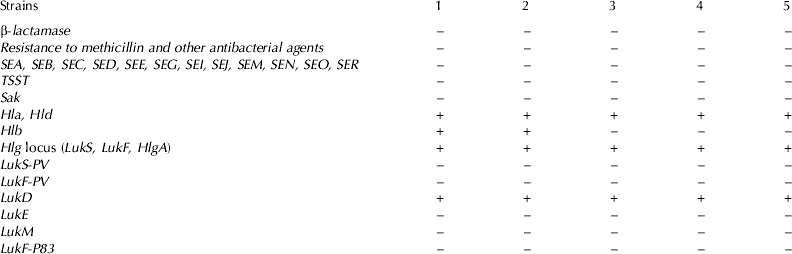
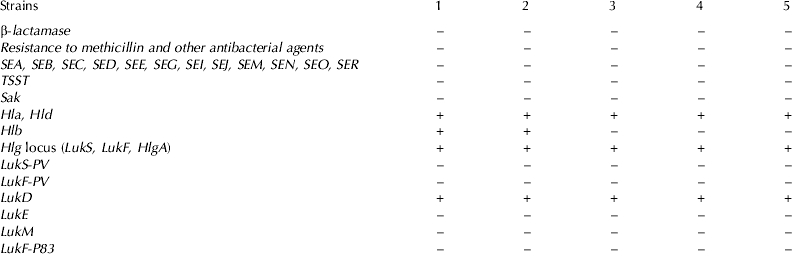
In accordance with the phenotypic sensitivity demonstrated by all the isolates, the nanoarray characterization of Staph. aureus isolates showed that not one of them harboured any of the genes encoding resistance to either β-lactams, or methicillin, aminoglycosides, macrolides, vancomycin, lincosamides or tetracyclines.
Moreover, neither enterotoxin genes nor toxic-shock syndrome toxin (TSST) gene were ever detected. Among the leukocidins and bicomponent toxins, all Staph. aureus isolates harboured the leukocidin D (LukD) gene, but not the E component of LukD/E, and the genes coding for α-, γ- and δ-haemolysin. Furthermore, two strains from two donkeys displayed the β-haemolysin gene, while the other three isolates from the third animal lacked such gene, as shown in Table 3.
Results of nanoarray analysis of Staphylococcus aureus isolates collected during the follow-up period
Immune parameters
Enzyme determination
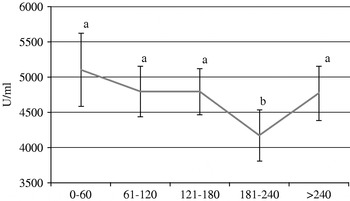
Lysozyme levels were always very high, since most samples showed values around 4000–5000 U/ml, independently of the presence or absence of bacteria. The activity of this enzyme evidenced higher values in the first 60 d post parturition, then lysozyme content showed a slight decrease until 180 days in milk (DIM). In the following two months a significant decrease was observed, while in the last part of lactation lysozyme content increased to the levels observed in the period 61–180 DIM (Fig. 1).
Lysozyme activity versus days in lactation, during the follow-up period. Values with different letters (a,b) are significantly different at α=0·05.

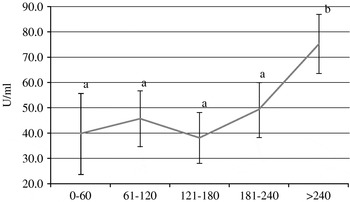
On the contrary, NAG values were mostly low, usually below 50 U/ml for the whole lactation, but evidenced a significant increase close to 80 U/ml after 8 months of lactation (Fig. 2) independently of bacteriological status, as reported in Table 4.
NAGase activity versus days in lactation, during the follow-up period. Values with different letters (a,b) are significantly different at α=0·05.

Hygienic and health parameters of donkey milk from culture-negative and culture-positive samples, during the follow-up period

† Values within a column with different superscript are significantly different at α=0·05
Discussion
The increased interest in feeding allergic infants with donkey milk is raising the importance of increasing our knowledge on health and immunological aspects of donkey milk. To address this topic, 10 donkeys were enrolled in the present study, as a model to explore physiological ranges for ass mammary gland immunity and health status. Indeed, these donkeys were bred as companion animals, thus they were not exposed to the stresses affecting animals in commercial herds, such as milking procedures. The findings can be useful to investigate the potential benefits of donkey milk in infant feeding, or else the risks to human health.
SCC and TBC values were always extremely low, in accordance with Beghelli et al. (Reference Beghelli, Roscini, Valiani, Vincenzetti, Cavallucci and Polidori2009) who registered SCC values between 14 736 and 46 095 cells/ml during an entire lactation. Nevertheless significant differences could be observed between culture-negative and culture-positive half glands, since the infected glands showed both increased cell and bacterial counts. On the other hand, TBC values never exceeded 90 cfu/ml, even in infected half-glands, proving that high bulk milk TBC values are related to poor milking procedures.
Another interesting outcome concerned the molecular characterization of Staph. aureus strains. Nanoarray genetic analysis showed similar results overall, although the animals sampled were absolutely not related. The only difference observed, concerned the β-haemolysin gene. Indeed, 2 of the 5 isolates harboured all the haemolysin genes (α-, β-, γ- and δ-haemolysin) while the remaining 3 isolates from the same donkey lacked the β-haemolysin gene. In contrast to studies on cow isolates (Zecconi et al. Reference Zecconi, Cesaris, Liandris, Daprà and Piccinini2006; Fournier et al. Reference Fournier, Kuhnert, Frey, Miserez, Kirchhofer, Kaufmann, Steiner and Graber2008) none of the Staph. aureus strains harboured genes coding for any enterotoxin or TSST. Besides, all the isolates lacked any gene encoding antibiotic resistance. Therefore, the results of the present study suggest that these isolates had a low pathogenicity, and also represent a low risk to the potential consumer.
When immunological characteristics were considered, lysozyme activity in half-udder milk samples was always very high, when compared with cow milk. These results are in accordance with previous studies (Conte et al. Reference Conte, Mazzullo, Lo Verde, Monsù, Scatassa and Macrì2003; Salimei et al. Reference Salimei, Fantuz, Coppola, Chiofalo, Polidori and Varisco2004; Conte et al. Reference Conte, Piccinini, Daprà and Gagliano2006; Zhang et al. Reference Zhang, Zhao, Jiang, Dong and Ren2008; Polidori et al. Reference Polidori, Beghelli, Mariani and Vincenzetti2009) reporting levels as high as 4 mg/ml in donkey bulk milk, or 7000 U/ml in the milk of single animals. Interestingly, lysozyme activity was independent of udder bacteriological status. Indeed, the milk samples of the half-udders infected with major pathogens (Staph. aureus, Str. equi, Str. equisimilis) showed lysozyme values similar to those of the healthy ones. Furthermore, nearly all the donkeys showed transient infections that self-cured within the 4-week interval between samplings. Indeed, only the oldest animal, a 12-year-old ass, was infected throughout lactation.
On the other hand, NAG values were always moderately low, in negative as well as in bacteriologically positive milk samples, with no differences throughout lactation, except for the last part of it. Such data suggest a major role for lysozyme in the defence of donkey mammary gland.
The results of this follow-up study suggest that donkey milk could be a safe food for allergic infants and elderly people, if the mammary gland is healthy and the animals are milked properly, following hygienic procedures as recommended by Regulation (EC) No 853/2004 for cows and small ruminants (Conte & Passantino, Reference Conte and Passantino2009). Indeed, it should be emphasized that this paper considered only donkeys held in hobby farms. Such results may not be applicable to commercial donkey farms. Indeed, methicillin-resistant Staphylococcus spp have been recently isolated from donkey milk in Sicily (Naccari et al. Reference Naccari, Foti, Giacopello, Mariavitale, Passantino, Russo and Conte2009) suggesting the presence of health risks, when the donkey herd is not characterized by high-level of management and hygiene. Besides, it should be advised to milk the donkey for not longer than 6 months, since thereafter a significant fall in lysozyme and an increase in NAG content were detected. The values observed in the last part of lactation appeared to be not physiological in the ass, supporting previous observations (Salimei et al. Reference Salimei, Fantuz, Coppola, Chiofalo, Polidori and Varisco2004) of a significant reduction of protein content throughout lactation.
Conclusion
The anatomical structure of donkey mammary gland together with some parameters related to udder innate immunity, appeared to be able to keep it healthy, as confirmed by the low prevalence of intramammary infections in donkey. Indeed, when hygienic milking procedures were applied, donkey milk showed very low TBC and almost absence of pathogens. Above all, food-borne pathogens such as the enterotoxin-producer Staph. aureus, were never detected. Even though the results of this study are very encouraging, further studies in donkey herds are required, to investigate health status of mammary gland and safety of donkey milk in intensive farming conditions, in order to satisfy the consumer's demand.