Introduction
Isospora suis is one of the most prevalent parasites in intensive pig production and can cause significant economic losses due to transient diarrhoea and dehydration in nursing piglets with subsequently decreased weight gain and poor performance (Stuart et al. Reference Stuart, Lindsay, Ernst and Gosser1980; Stuart and Lindsay, Reference Stuart and Lindsay1986). Isosporosis represents a considerable problem worldwide, and various studies have demonstrated its high prevalence in suckling piglets (Henriksen, Reference Henriksen1991; Driesen et al. Reference Driesen, Carland and Fahy1993; Eysker et al. Reference Eysker, Boerdam, Hollanders and Verheijden1994; Otten et al. Reference Otten, Takla, Daugschies and Rommel1996; Sayd and Kawazoe, Reference Sayd and Kawazoe1996; Roepstorff et al. Reference Roepstorff, Nilsson, Oksanen, Gjerde, Richter, Örtenberg, Christensson, Martinsson, Bartlett, Nansen, Eriksen, Helle, Nikander and Larsen1998; Meyer et al. Reference Meyer, Joachim and Daugschies1999; Mundt et al. Reference Mundt, Cohnen, Daugschies, Joachim, Prosl, Schmaschke and Westphal2005). The disease occurs mainly in the second to third week of life and is characterized by non-haemorrhagic yellow to whitish diarrhoea (Lindsay et al. Reference Lindsay, Blagburn and Power1992). Not all litters or piglets within a litter in a farrowing facility are affected equally; morbidity can be high, but mortality is usually low except for cases with secondary bacterial infections (Stuart et al. Reference Stuart, Lindsay and Ernst1978; Lindsay et al. Reference Lindsay, Blagburn and Power1992).
The relative importance of different sources of the infection is inadequately characterized, but once I. suis has established itself on a farm, the infection is probably maintained through piglet-to-piglet transmission via contaminated farrowing pens, as sows are rarely found to excrete oocysts (Lindsay et al. Reference Lindsay, Dubey and Blagburn1997). The presence of I. suis has been shown to occur in all types of farrowing facilities and under all types of management systems (Lindsay and Blagburn, Reference Lindsay and Blagburn1994), although disease is rarely seen in organic systems (Roepstorff et al. Reference Roepstorff, Nilsson, Oksanen, Gjerde, Richter, Örtenberg, Christensson, Martinsson, Bartlett, Nansen, Eriksen, Helle, Nikander and Larsen1998). A recent study carried out in 12 European countries confirmed the presence of I. suis in 26% of litters and in 69% of the farms examined (Torres, Reference Torres2004). Control of this parasite is currently almost completely based on early routine treatment of piglets with toltrazuril (Mundt, Reference Mundt2000).
In this study, we examined the intra-litter infection dynamics of I. suis under natural farrowing pen conditions, to explore the association between parasite transmission and the contamination level of the farrowing pen, and to investigate the effect of different interventions to reduce the transmission of I. suis infection within the litter.
Materials and Methods
The farm
The study took place under regular farrowing conditions in a commercial 250 sow herd. The herd was included in the Danish SPF (Specific Pathogen Free) system and free from Brachyspira hyodysenteria, toxigenic Pasteurella multocida and Actinobacillus pleuropneumoniae type 2. The farm had a history of clinical diarrhoea caused by Escherichia coli in piglets, but no anti-coccidial compounds had been used. The presence of I. suis was confirmed by examining pooled faecal samples from suckling piglets for 3 consecutive weeks prior to the start of the study.
The farm's single farrowing unit contained 84 farrowing pens located along 7 corridors. Each corridor was separated from the next by concrete walls. Neighbouring farrowing pens were separated by solid pen partitions. The farrowing pens had partially slatted floors (2/3 solid and 1/3 slatted). The sows were transferred to the farrowing pen 1 week before expected farrowing. A farrowing rail was placed in the middle of each pen. Each pen had a covered creep area and a heating lamp in the farrowing pen during the first week after farrowing. The floor underneath the lamp was solid concrete supplied with straw bedding. The farrowing capacity was 10–12 sows per week and piglets were usually weaned after 28 days. After weaning, the piglets were moved to 3 nursery rooms with climate control. Between farrowings, the pens were cleaned with cold water under high pressure and left to dry for approximately 2 h before the introduction of the next batch of sows. No cleaning was carried out during the nursing period when sows and pigs were present. The sows were cross-bred Landrace-Yorkshire, which were inseminated with mixed Duroc semen.
Study design
Twenty-two litters with a total of 254 piglets were included in this study. Each litter was retained in their original farrowing pen throughout the nursing period. To avoid reproductive and behavioural problems, gilts with litters were excluded from the study. No cross-fostering of piglets was done during the duration of the study. The average litter size of the selected sows was 11·5 piglets. The study included 2 trials designed as follows.
Trial 1
The first trial included 4 litters with a total number of 48 piglets and an average litter size of 12 piglets. The piglets were followed coprologically from farrowing until 2 weeks after weaning.
During the nursing period, individual faecal samples were collected from all piglets on a daily basis from day 2 post-partum and up to weaning, which took place at day 32 after birth. After weaning, individual faecal samples were collected from all piglets every second day for a period of 15 days (until 47 days of life). In addition, individual faecal samples were taken daily from the 4 sows, beginning the day they were moved to the farrowing pens and until one week after farrowing. Hygiene and management procedures applied to these 4 litters and their farrowing pens were the standard procedures practiced routinely on the farm (see above).
Trial 2
In the second trial, the effect of 3 different management intervention procedures on I. suis transmission was evaluated. Each procedure was evaluated in 2 farrowing pens, which were replicated 3 times (rounds 1, 2 and 3), i.e. total 18 litters. Different pens within the farrowing house were used in each of the 3 rounds. The employed management procedures were as follows. Group A: hygiene and management procedures as routinely applied in the farm without modification (Control group). Group B: standard hygienic procedures as in Group A, but all the piglets, which were found to first excrete I. suis oocysts in each pen were removed from the pen (i.e. censored from the study), the day after oocyst excretion was detected in order to limit early oocyst contamination of the pens. Group C: reduced cleaning. Faeces were only removed mechanically from the pen floor between farrowings, and the pens were not washed.
In the initial round, there was a total of 67 piglets in 6 litters (average litter size 11·2); in round 2 there was a total of 65 piglets in 6 litters (average litter size 10·8); and in round 3 there was a total of 74 piglets in 6 litters (average litter size 12·3). In total, 206 piglets. The farrowings took place over the course of 2 months.
Environmental recordings
In Trial 2, temperature and relative humidity were recorded from 6 selected spots in each farrowing pen (slatted and concrete floor) by means of a data logger at the following times: on the day the sow was introduced to the farrowing pen (1 week before farrowing), 3 days before farrowing, on the farrowing day, 3 days after farrowing and finally 1 week after farrowing. In an effort to define the hygienic status of each pen following the cleaning, i.e. before the sow was moved into the pen, total adenosine triphosphate (ATP) was measured by bioluminescence as an indicator of the presence of organic residues and microorganisms on the floor (Clean Trace Test, BIOTRACE International). The samples were taken by means of a swab device from 8 selected spots on the floor surface (slatted and concrete floor). The measurements were carried out using a luminometer and read out in relative light units (RLU).
Sampling procedures
All piglets included in the study were ear-tagged and weighed on the second day of life (‘birth weight’) and at weaning, and average daily gain (ADG) was calculated. In addition, in Trial 2 the sex of the piglets was recorded. All litters were followed from day of farrowing and until weaning at an age of approximately 28 days. Individual faecal samples were collected from all piglets on a daily basis from day 4 to 12 after farrowing and subsequently every second day up to weaning. Faecal samples were taken individually from the rectum of each piglet in the morning (9–11 a.m.) by means of an ear-swab and stored individually in labelled plastic containers. To avoid cross-contamination, plastic protective shoes and gloves were used during faecal sampling. Shoes and gloves were changed between pens.
Parasitological methods
Faecal consistency and oocyst excretion were recorded for all faecal samples. The consistency of individual faecal samples was scored using the following scale: 1=formed; 2=pasty; 3=yellow diarrhoea, 4=watery or/and haemorrhagic diarrhoea. The concentration of oocysts was determined by a modified McMaster technique using saturated sodium chloride solution with 500 g glucose per litre, as flotation fluid (Henriksen and Christensen, Reference Henriksen and Christensen1992; Meyer et al. Reference Meyer, Joachim and Daugschies1999). The oocysts were counted in glass McMaster chambers under a fluorescence light source using UV excitation (340–380nm) (Daugschies et al. Reference Daugschies, Bialek, Joachim and Mundt2001) and oocyst excretion was expressed as oocysts per gramme of faeces (opg). The method had a lower detection limit of 20 opg.
Statistical methods
All analyses were conducted using SAS® 9.1.3 (2002–2003, SAS Institute Inc., Cary, NC, USA).
Descriptive analyses
Data from trial 1 were used to evaluate the piglet age at onset of oocyst excretion in the first 47 days of life. The prevalence of oocyst excreting piglets (%) and the arithmetic mean of the opg values (including both positive and negative samples, unless a deviation is specified) was determined for each or every second day in this period. For each pig a proxy of the total amount of oocysts excreted from birth to weaning was measured as the area under the curve (AUC), using the daily opg values for each piglet. Opg was log-transformed (log10 (opg+1)) to obtain normally distributed data. The piglet age at onset of diarrhoea (faecal score >2) ranged from 2 to 28 days (median: 19·5). For each pig a proxy of the ‘accumulated diarrhoea’ from birth to weaning was measured by means of AUC, using daily diarrhoea values (faecal score >2) for each piglet. Linear regression analysis was used to examine the correlation between the first day of oocyst excretion and (1) the AUC of oocyst excretion and (2) the AUC of accumulated diarrhoea. Linear regression was also used to examine the correlation between onset and duration of oocyst excretion.
Analyses of the effect of management procedures
Certain data from trials 1 and 2 were merged to increase the power of the analyses. The 4 litters from trial 1 were included in the control group (Group A) from trial 2 because the management procedures in the two groups were identical. Data from trial 1 collected after weaning were omitted from further analyses. Cumulative relative frequencies of pigs excreting oocysts or developing diarrhoea were estimated for each of the three different management procedures. Mean log-arithmetically transformed opg (log10 (opg+1)) values were calculated across piglets within each group for each day after onset of excretion. Only piglets that excreted oocysts during the study period were included. For each pig a proxy of the total amount of oocysts excreted from birth to weaning was measured using AUC, as above, which is estimated by the mean log10 (opg+1). A mixed linear model (proc MIXED) was constructed with AUClog10 (opg+1) of oocyst excretion as dependent variable, management procedure as explanatory variable, birth-weight and trial as confounder controls and sow as random variable.
The association between ADG and the 3 different management procedures was examined by a mixed linear model (proc MIXED) with ADG as dependent variable, the management procedures (groups A, B, and C) as explanatory variable, birth-weight and trial as confounder controls and sow as random variable. The association between ADG and AUC of oocyst excretion was examined by a mixed linear model (proc MIXED) with ADG as dependent variable, AUC of oocyst excretion as explanatory variable, birth weight, management procedures (groups A, B, and C) and trial as confounder controls and sow as random variable. Crude analysis of the association between sex and excretion of oocysts, or occurrence of diarrhoea were done using the χ2 test.
A survival analysis was used to investigate whether there was an association between the time until either excretion (yes/no), or diarrhoea (yes/no) at the pig level, and the 3 different management procedures (A, B, or C). The dependent variables were the time from birth until the first occurrence of either: (1) excretion; (2) pasty or yellow diarrhoea or (3) yellow diarrhoea in an individual pig, or alternatively, time until the pig was censored (observations stopped for some reason). The explanatory variables were birth weight and management procedures (groups A, B, or C). Round (1 of 4) was also included in the models to adjust for the effect of various time-related factors operating in the herd.
A serious drawback of the standard survival analysis model is that ‘clustering’ cannot be taken into account in the analyses, which may lead to biased results. Clustering is present, when the probability of a piglet excreting oocysts or showing signs of diarrhoea is not independent of the probability of other piglets in the litter excreting oocysts/showing signs of diarrhoea, which we assumed was the case in our study. For this reason we did not use the standard method, the Cox proportional hazards model, but instead we developed a discrete version of the method to take account of the litter effect.
Because many pigs in the study had recurrent episodes of excretion with pauses in between, it was appropriate to use a model, which can accommodate repeated events as well as random factors. In our case the discrete Cox model calculates the ‘survival’ probability of a piglet during the nursing period, given that the piglet is at risk at the beginning of the nursery period. Each pig contributes with a binary observation for each time-interval at risk: infected/not infected at the end of the interval and the probability of excretion depends on known covariates. This means that the appropriate statistical model should be a generalized linear model with random effects (e.g. litter).
The SAS procedure proc GLIMMIX was used to estimate parameters and test for the significance of factors. Kaplan-Meier survival curves were derived from the Cox proportional hazards model (proc TPHREG) and hazard curves were created using proc LIFETEST.
Results
Descriptive analyses
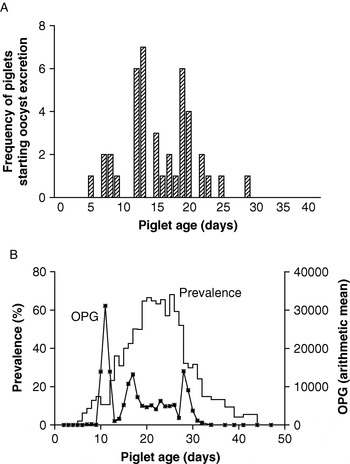
None of the 4 sows in the first trial were found to excrete I. suis oocysts during the 2-week period of observation from 1 week before to 1 week after farrowing. Piglets from all litters excreted I. suis oocysts at least once during the suckling period. The piglet age at onset of oocyst excretion ranged from 5 to 29 days (Fig. 1A). The prevalence of piglets excreting oocysts and the arithmetic mean of the opg values are shown in Fig. 1B.
(A) Day of first detection of Isospora suis oocysts in faeces from 4 litters of naturally infected piglets in Trial 1. (B) Prevalence of oocyst excreting piglets (%) and mean number of oocysts per gramme of faeces (arithmetic mean) from the same piglets.

Linear regression analysis revealed that the first day of oocyst excretion was significantly correlated with (a) the AUC of oocyst excretion (P=0·0125, slope=−0·0675, Fig. 2A and B) with the duration (in days) of oocyst excretion (P=0·0012, slope=−0·622, Fig. 2B). Additionally, linear regression analysis showed that there was a statistically significant association between accumulated diarrhoea and the day of first oocyst excretion (P=0·0367, slope=−0·2759, Fig. 2C).
Correlations between the first day of Isospora suis oocyst excretion and (A) the area under the curve (AUC) of the intensity of oocyst shedding (opg), (B) the duration (days) of I. suis oocyst excretion, and (C) the accumulated diarrhoea (AUC) in Trial 2.

Analyses of the effect of management intervention procedures
The analyses of the effect of different pen management cleaning practices was based on the pooling of data from Trials 1 and 2, and included 10 litters assigned to group A (standard farm cleaning), 6 to group B (standard farm cleaning+removal of first piglet excreting oocysts), and 6 to group C (reduced pen cleaning). A total of 254 piglets were included in the analyses: 115 piglets in group A, 73 piglets in group B and 66 piglets in group C. The average litter size in the 3 groups was very similar, ranging from 11·0 to 12·2. The number of piglets that were removed from their pens after onset of excretion (group B) was 14 in total and varied from 1 to 4 piglets per litter. The time of removal ranged from day 4 up to day 18 after birth (median 10).
Oocyst excretion patterns
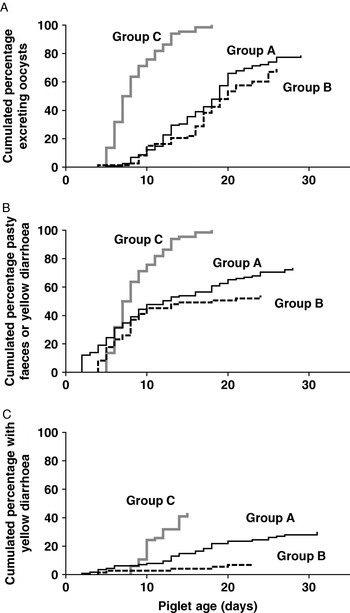
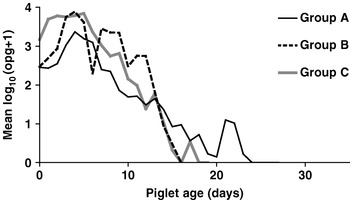
Overall, 206 of the 254 piglets (81·1%) excreted oocysts at least once during the course of the investigation; however, considerable differences in oocyst excretion were observed between groups A, B, and C. The cumulative relative frequencies of piglets excreting oocysts are shown in Fig. 3A. At the end of the 1st week of life the percentages of piglets which had excreted oocysts at least once were 2·6% (group A), 1·4% (group B) and 50·0% (group C), respectively. In that order, at the end of the 2nd, 3rd and 4th week oocyst excretion was detected in 30·4%, 67·8% and 77·4% (Group A), 20·5%, 57·5% and 68·5% (Group B), and 95·5%, 100% and 100% (Group C) of piglets. The mean log10 (opg+1) values calculated across piglets that excreted oocysts within each group for each day after onset of excretion show that the overall excretion patterns of the oocyst-excreting piglets were quite similar in the three groups (Fig. 4).
Cumulated percentage of piglets (A) excreting Isospora suis oocysts, (B) with pasty or yellow diarrhoea and (C) with yellow diarrhoea in the 3 treatment groups (Group A: standard cleaning, Group B: standard cleaning+removal of the first oocyst excreters; Group C: reduced cleaning).

The mean log10 (opg+1) of Isospora suis oocyst excretion by piglets in relation to the onset of excretion. (Group A: standard cleaning; Group B: standard cleaning+removal of the first oocyst excreters; Group C: reduced cleaning).

The survival analysis showed that the period of time before onset of oocyst excretion was not significantly different between the control group A and group B. However, this period of time in group C (low hygiene) was significantly shorter than in either group A (P<0·0001) or group B (P<0·0001). The risk of a piglet excreting oocysts within a given time interval (day, week, 2 weeks etc.) was 4·3 [95% confidence interval: 2·1–8·5] times higher in group C than in group A and 4·4 [95% C.I. 2·2–8·8] times higher than in group B. Moreover, birth weight was associated with period of time before onset of oocyst excretion (P=0·009). An increase of 1 kg increased the risk of a piglet excreting oocysts within a given time-interval by 1·63.
The association between the three different management procedures and ADG, with the area under the curve for log10 (opg+1), as a measure of the average amount of oocysts shed per day per pig, were examined in a mixed linear model (proc MIXED). The mean log10 (opg+1) in groups A (βA=−1·4658) and B (βB=−1·5908) was significantly lower (P<0·0001) than group C. In other words, the amount of oocysts excreted on a given day by a given piglet (in the period from birth to weaning) was on average 29·2 times (101·4658) lower in group A compared to group C. The amount of oocysts excreted by piglets in group B was on average 39·0 (101·5908) times lower compared to group C. There was no significant difference in mean log10 (opg+1) between groups A and B.
Diarrhoea
In 179 piglets (70·5%), pasty faeces or yellow diarrhoea (faecal score=2 or 3) was observed on at least 1 occasion. Of these, 68 were scored as yellow diarrhoea only (faecal score=3) (26·8%). However, considerable differences in occurrence of diarrhoea were observed between groups A, B, and C. At the end of the first week of life, the percentages of piglets which had experienced yellow diarrhoea (Fig. 3C) at least once were 6·1% (group A), 2·7% (group B) and 0% (group C), compared to 14·8%, 23·5% and 27·8% (Group A), 4·1%, 6·8% and 8·2% (Group B), and 40·9%, 42·4% and 42·4% (Group C) at the end of the 2nd, 3rd week and prior to weaning (4th week), respectively. The cumulative relative frequencies of piglets with pasty faeces or yellow diarrhoea, or piglets with yellow diarrhoea only according to group are shown in Fig. 3B and C, respectively.
The period of time before onset of pasty faeces or yellow diarrhoea in the control group (A) was not significantly different from that in group B (Fig. 3B). However, for group C (reduced cleaning) this interval was significantly shorter than for group A (P=0·010) and group B (P=0·011). The risk of a piglet showing pasty faeces or yellow diarrhoea within a given time-interval was 3·1 times [95% C.I. 1·3–7·2] higher in group C than in the control group (A) and 3·1 times [95% C.I. 1·3–7·4] higher than in group B. There was no association between onset of having pasty faeces or yellow diarrhoea and birth weight.
The period of time before onset of having yellow diarrhoea in group A was not significantly different from that of groups B or C; however, this period was significantly (P=0·008) shorter in group C than in group B. The risk of developing yellow diarrhoea in a given time-interval was 9·1 times [95% C.I. 1·8–46·5] higher in group C than in group B. There was no significant association between onset of yellow diarrhoea and birth weight.
Association between oocyst excretion and diarrhoea
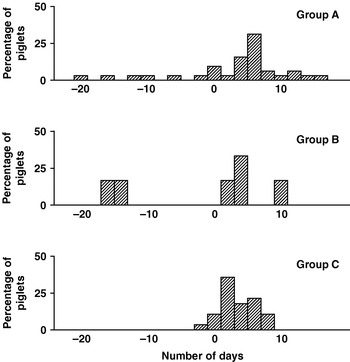
For each piglet that excreted oocysts during the study period, the interval (in days) from onset of oocyst excretion until first observation of yellow diarrhoea was calculated. It should be noted that while the numbers of piglets excreting oocysts in groups A, B, and C were 90, 50, and 66, respectively, fewer than half developed yellow diarrhoea during the study period (32, 6, and 28, respectively). The distribution of intervals between initiation of oocyst excretion and onset of diarrhoea in groups A, B, and C are shown in Fig. 5. The mean time-interval from oocyst excretion to onset of diarrhoea varied from 2·5 to 3·1 days in groups with standard (A) or reduced cleaning (C), with large variation in interval length in pens undergoing standard farm cleaning treatment. The effect of removing the first few oocyst excreters on the excretion–diarrhoea interval cannot be evaluated due to the very low number of piglets with yellow diarrhoea.
Distributions of the number of days from onset of Isospora suis oocyst excretion until onset of yellow diarrhoea (Day 0) in the 3 treatment groups of piglets (Group A: standard cleaning; Group B: standard cleaning+removal of the first oocyst excreters; Group C: reduced cleaning).

Sex influence and effect on ADG
Sex was recorded for 206 of the 254 piglets (Trial 2 only). There was no significant association between sex and excretion of oocysts or occurrence of diarrhoea (χ2 test). Therefore sex was not included in the survival analysis.
ADG data were available for 227 piglets. There was no significant association between ADG and the 3 different management procedures. The analysis of the association between ADG and AUC for oocyst excretion by a mixed linear model showed a negative association between ADG and the AUC: an increase of 1 unit on the log-scale for AUC of oocyst excretion decreased the ADG by 7·3 g. However, this association was not statistically significant (P=0·084).
Environment
The minimum and maximum temperatures recorded in Trial 2 were 15·1°C and 31°C (median 20°C), respectively. Minimum and maximum relative humidity values recorded were 49·8% and 99% (median 71·4%). The average temperature and relative humidity for all pens included in the trial were as follows: 1 week before farrowing: 18·3°C and 88·2%; 3 days before farrowing: 20·2°C and 71·6%, at farrowing 20·9°C and 57·3%; 3 days after farrowing 21·5°C and 79·6%; and 1 week after farrowing 24·2°C and 68·6%.
The ATP measurements of residual organic matter on the pen floors ranged from 17 396 to 206 435 RLU and varied considerably from spot to spot even within the same pen. The threshold below which a pen is considered properly disinfected is 5000 RLU, indicating that none of the pens included in the study could be considered properly cleaned.
Discussion
The present study has helped to unveil or confirm several important epidemiological aspects of isosporosis in piglets. Although the sow would be a logical source of infection for newborn piglets, several studies have either failed to demonstrate I. suis in sows or only detected very low prevalence, usually less than 5% (Vetterling, Reference Vetterling1966; Roberts et al. Reference Roberts, Walker, Snodgrass and Angus1980; Greiner et al. Reference Greiner, Taylor, Frankenbergerer and Belden1982; Lindsay et al. Reference Lindsay, Ernst, Current, Stuart and Stewart1984; Nilsson et al. Reference Nilsson, Martinsson and Persson1984; Ernst et al. Reference Ernst, Lindsay and Current1985; Eysker et al. Reference Eysker, Boerdam, Hollanders and Verheijden1994; Sotiraki et al. Reference Sotiraki, Himonas, Antoniadou-Sotiriadou and Papazahariadou1998). Also in the current study I. suis oocysts could not be detected in faecal samples from sows on a farm with considerable neonatal isosporosis. Although remarkable, this is in agreement with studies conducted previously under similar conditions in which sows were examined before and after farrowing (Stuart and Lindsay, Reference Stuart and Lindsay1986; Otten et al. Reference Otten, Takla, Daugschies and Rommel1996; Martineau and del Castillo, Reference Martineau and del Castillo2000). This suggests that the sow does not play an important role in transmission of I. suis in the farrowing pen, although this is based on a low number of sows examined in our study.
As expected from pre-study examinations, I. suis occurred widely in the farm under investigation. Regardless of the management practices applied, piglets from all litters (i.e. in all farrowing pens under study) excreted oocysts at least once during the study period, demonstrating that the farm environment was favourable for transmission of the parasite. This likely reflects that routine cleaning in commercial pig herds is not effective in removing potentially infective organic matter from the farrowing unit, as shown from our ATP measurements in cleaned pens. A mean environmental temperature of at least 20°C and relative humidity ranging from 57% to 80% in the farrowing unit provides a favourable environment for oocyst sporulation (Lindsay et al. Reference Lindsay, Current and Ernst1982; Langkjær, Reference Langkjær2006).
Isospora suis infection dynamics have most often been studied in nursing piglets that have been experimentally infected at a very young age. The current study conducted under natural on-farm conditions showed that piglet age at onset of oocyst excretion varies considerably. Considering that the pre-patent period of I. suis is 4–5 days (Lindsay et al. Reference Lindsay, Dubey and Blagburn1997), it appeared from our data that piglets could become infected at any time from the first 2 days after birth up to their 4th week of age. In addition, none of the piglets in the present study became infected after weaning. For those piglets excreting oocysts at the time of weaning, the oocyst excretion declined or ceased rapidly after weaning. This pattern likely reflects a marked age-related resistance as observed by others (Stuart et al. Reference Stuart, Gosser, Allen and Bedell1982; Koudela and Kucerova, Reference Koudela and Kucerova1999). The infrequent (Vetterling, Reference Vetterling1966; Greiner et al. Reference Greiner, Taylor, Frankenbergerer and Belden1982; Lindsay et al. Reference Lindsay, Ernst, Current, Stuart and Stewart1984) occurrence of I. suis oocysts in faeces of weaned pigs has been associated with post-weaning stress (Nilsson, Reference Nilsson1988).
There was an apparent cyclic pattern of onset of oocyst excretion, with 2 peaks (one at 12–13 days after birth and another at 19–20 days after birth). It seems that not all piglets in a litter become infected at the same time; and that the oocysts excreted from the initial infections (peak 1) amplify the oocyst contamination in the pen, leading to subsequent infection of the remaining littermates (peak 2). A biphasic (and even triphasic) pattern has also been observed in experimentally infected piglets given single inoculations of oocysts (Harleman and Meyer, Reference Harleman and Meyer1984, Reference Harleman and Meyer1985; Vitovec and Koudela, Reference Vitovec and Koudela1990; Christensen and Henriksen, Reference Christensen and Henriksen1994; Lindsay et al. Reference Lindsay, Dubey and Blagburn1997; Martineau and del Castillo, Reference Martineau and del Castillo2000; Mundt et al. Reference Mundt, Cohnen, Daugschies, Joachim, Prosl, Schmaschke and Westphal2005), which probably reflects the cyclic propagation of the parasite within the intestinal cells, resulting in cyclic bursts of oocyst excretion. However, the presently observed biphasic pattern is more likely to reflect spread of infection in the litter as described above.
The prevalence of I. suis oocyst excreting piglets in Trial 1 peaked between 19 and 26 days post-farrowing, which is in agreement with previous studies (Mathea, Reference Mathea1993; Otten et al. Reference Otten, Takla, Daugschies and Rommel1996; Meyer et al. Reference Meyer, Joachim and Daugschies1999). Interestingly, individual oocyst excretion levels were relatively low during that period. In contrast, high excretion levels were recorded around day 11 after birth, when prevalence (10%) was low. In general, it seems that the course of oocyst excretion differs between each piglet and does not follow any rules.
A notable observation in our study was that piglets, which were infected soon after birth had increased and prolonged oocyst excretion as well as more severe diarrhoea. Conversely, piglets infected later in life, when oocyst excretion levels among litter mates were relatively low, exhibited shorter excretion periods (20 days of excretion versus 40 days for piglets with early onset) and suffered less severe diarrhoea. This in turn reduced the number of oocysts contaminating the farrowing pen environment, and led to a higher level of nursing piglet health and reduced production losses.
The observation that early infection caused high excretion levels and increased diarrhoea led us to the hypothesis that a higher piglet age at the time of infection with I. suis would reduce oocyst transmission and contamination of the pen, reduce exposure levels for litter mates and subsequent development of disease among the litter. We therefore conducted Trial 2 with the aim of reducing early transmission to suckling piglets. The course of I. suis infection differed among the different treatment groups (A, B, C), confirming that the overall transmission of oocysts is responding to control aimed at age at first exposure and the level of exposure. The cumulative relative frequency of oocyst excretion increased gradually until weaning, reaching 77·4% in pens with normal cleaning (A) and 68·5% in pens where early excreting piglets were removed (B). In contrast, the cumulative prevalence of infection increased most rapidly in poorly cleaned pens (C), with 100% of piglets excreting oocysts by the end of the 2nd week. The survival analyses showed that piglets in the dirty pens (C) had >4 times greater risk of excreting oocysts. This confirmed that an existing high level of contamination with I. suis oocysts in the farrowing pen led to earlier and heavier oocyst excretion in infected piglets, and demonstrated the importance of exposure level (level of contamination) for 2 to 4-day-old piglets which play an important role in amplifying the exposure level to litter-mates.
Our results are in agreement with earlier studies, which reported that contaminated farrowing pens are an important source of infection for the piglets (Driesen et al. Reference Driesen, Carland and Fahy1993; Eysker et al. Reference Eysker, Boerdam, Hollanders and Verheijden1994).
It is interesting to note that infected piglets had similar oocyst excretion profiles, irrespective of hygiene status or piglet removal, when mean opg levels are related to the onset of excretion. This indicates that the differences in total oocyst output of groups A and B versus group C are primarily associated with the number of infected piglets and not the intensity of infection. This was confirmed in the statistical analysis, which showed that the amount of oocysts excreted on a given day by a given piglet, and hence pen contamination, was much higher (a factor 30–40) in pens with poor hygiene and no cyclic biphasic pattern observed, which may be due to a continuous/repeated exposure.
Diarrhoea is considered the most characteristic sign of piglet isosporosis and diarrhoeic faeces are initially pasty or creamy and later fluid, yellowish to grey (Stuart et al. Reference Stuart, Gosser, Allen and Bedell1982; Harleman and Meyer Reference Harleman and Meyer1985; Lindsay et al. Reference Lindsay, Blagburn, Dubey, Straw, Allaire, Mengeling and Taylor1999; Meyer et al. Reference Meyer, Joachim and Daugschies1999). However, pre-weaning diarrhoea may also be caused by various other agents, such as Escherichia coli, rotavirus, and Clostridium perfringens (Lindsay et al. Reference Lindsay, Current, Ernst and Stuart1983). In the present study, changes in faecal consistency were recorded in approximately 70% of the piglets, of which 26·8% developed characteristic yellow diarrhoea. During the suckling period, the occurrence of yellow diarrhoea increased gradually in pens with standard cleaning (A) and in pens from which early oocyst-excreting piglets were removed (B), but occurred more rapidly in pens with poor cleaning (C), reaching 40% by the end of the 2nd week of life. The survival analysis showed that piglets in the contaminated pen environment of C had a 3–9 times greater risk of developing diarrhoea. Although other causal infections cannot be ruled out, this observation may reflect that the occurrence of diarrhoea due to I. suis infection is both age and dose related.
In addition, in pens with normal cleaning, early removal of the first piglets that excreted oocysts (Group B) resulted in a reduction of yellow diarrhoea in their litter mates compared to litters in which early excreters were left in the pen (Group A), despite the fact that the cumulative relative frequency of piglets excreting oocysts was quite similar in both groups. A possible explanation might be that the removal of early excreters, which typically excreted high numbers of oocysts, resulted in fewer oocysts spread in the pens of Group B. In other words, the essential difference between Groups A and B was quantitative (numbers of oocysts excreted) and not qualitative (comparable prevalence of early oocyst excretion), and the development of yellow diarrhoea may thus be dose dependent. This is further supported by the observed relationship between oocyst excretion and yellow diarrhoea shown in Fig. 5 in which the massive early oocyst excretion in Group C is associated with yellow diarrhoea occurring shortly after. However, selective removal of those piglets, which were most likely to develop diarrohea, makes direct comparison difficult, and thus this result should be interpreted with caution. It should be noted that the implementation of this control method is rather theoretical under most circumstances. Obviously there was the possibility to simply treat the excretors with totrazuril but the above intervention was definitely more rapid and there was no contamination with drugs.
The general picture arising from the present study is that diarrhoea most often becomes evident very shortly after the onset of oocyst shedding. However, the association between yellow diarrhoea and onset of oocyst excretion in Group A is less clear, perhaps because other aetiological agents may be the cause of some of the diarrhoea cases. Group B cannot be evaluated in this respect due to a very low number of diarrhoea cases.
It is not clear from the literature if a distinct pattern exists for occurrence of diarrhoea in relation to shedding of oocysts; hence some authors have described that experimentally infected piglets developed diarrhoea within 3 to 9 days after inoculation, i.e. before and after oocyst excretion (Roberts et al. Reference Roberts, Walker, Snodgrass and Angus1980; Stuart et al. Reference Stuart, Gosser, Allen and Bedell1982; Robinson et al. Reference Robinson, Morin, Girard and Higgins1983; Harleman and Meyer, Reference Harleman and Meyer1985; Vitovec and Koudela, Reference Vitovec and Koudela1990; Vitovec et al. Reference Vitovec, Koudela, Kudweiss, Stepanek, Smid and Drovak1991; Koudela and Kucerova Reference Koudela and Kucerova1999, Reference Koudela and Kucerova2000; Bach et al. Reference Bach, Kalthoff, Mundt, Popp, Rinke, Daugschies and Luttge2003). Martineau and Del Castillo (Reference Martineau and del Castillo2000) pointed out that diarrhoea might occur before the onset of oocyst excretion in naturally infected pigs. Mundt et al. (Reference Mundt, Joachim, Becka and Daugschies2006) showed that I. suis oocyst excretion and diarrhoea do not always occur simultaneously and argued that diarrhoea may not be a suitable parameter to estimate the intensity and spread of I. suis infection. Finally, observed differences in diarrhoeic patterns may also be due to concurrent bacterial and viral pathogens causing enteritis in parasitized piglets (Harleman and Meyer, Reference Harleman and Meyer1985; Vitovec et al. Reference Vitovec, Koudela, Kudweiss, Stepanek, Smid and Drovak1991).
The present study could not demonstrate significant differences in I. suis infection intensity relating to the sex of piglets. In contrast, birth weight and average daily gain (ADG) were both associated with I. suis infection. An increase of 1 kg in birth weight increased the risk of a piglet excreting oocysts within a given time-interval by 1·63. This suggests that heavy piglets at birth are more prone to acquire I. suis infection, which could be explained by more active behaviour and thus increased exposure to infective oocysts. On the other hand, birth weight and diarrhoea were not associated. Weight gain is often reduced by I. suis infection and variable weight gain may be used as an indicator for the severity of isosporosis (Stuart et al. Reference Stuart, Gosser, Allen and Bedell1982; Mundt et al. Reference Mundt, Joachim, Becka and Daugschies2006). Our results are in agreement with this as they showed a (non-significant) tendency toward a negative influence of oocyst excretion level on ADG.
Our results from intervention manipulations demonstrated that efforts to delay I. suis infection in newborn piglets can be useful in reducing transmission and consequently disease. Reduced environmental contamination by thorough cleaning can be effective in preventing or delaying initial infections in very young suckling piglets (index cases), thus allowing innate resistance in littermates to develop, helping to minimize the disease in animals that do become infected. The use of this knowledge and its application will enable farm managers to minimize the use of chemicals and drugs to control neonatal coccidiosis.
This study was financed by the Marie Curie Actions (contract nr HPMF-CT-2002-01885) and the Danish Meat Association. We wish to especially acknowledge Christina Vinther for her technical (not only) support throughout the study as well as Jeff Craven, Niels Midtgaard, Gro Leithe Andersen, and Christina G. Hansen. Additionally, we would like to thank the farm owner, Peter K. Jensen, and the farm manager, Michael Jensen, for making the experiment feasible. Moreover, Dr Henrik Wachmann is thanked for valuable help and advice during the statistical analysis.