In industrialised nations, adolescents commonly engage with a range of small screen technologies, including television, video games, computers, the internet and mobile phones (Brown & Marin, Reference Brown and Marin2009; UNICEF, 2012). For example, in 2010 more than 90% of Australians 15–17 years of age accessed the internet from home (Australian Bureau of Statistics [ABS], 2011). Similarly, in 2009, Americans aged 8–18 years spent an average of 7 hours and 38 minutes each day consuming small screen media, a significant increase from previous years, attributed primarily to widespread use of mobile phones (Rideout, Foehr, & Roberts, Reference Rideout, Foehr and Roberts2010). In Canada, adolescents currently spend an average of 22 hours each week watching television (Television Bureau of Canada, 2012) and in Singapore adolescents report playing video games for approximately 20 hours each week (Gentile et al., Reference Gentile, Choo, Liau, Sim, Li, Fung and Khoo2011). Almost half of British teenagers (47%) own a smartphone, with more than half of these having acquired one during the past year (Ofcom, 2011). This rise in ownership and use of smart phones is particularly noteworthy; in recent times, the cost of mobile phones has made them accessible to adolescents from a wide range of socioeconomic backgrounds (Hampton, Reference Hampton2010; Jansen, Reference Jansen2010; Smith, Reference Smith2012; Wei & Blanks Hindman, Reference Wei and Blanks Hindman2011).
Although concerns are regularly raised in the popular media about young people overusing small screen technology, previous research actually suggests there are benefits associated with particular patterns of use (Johnson, Reference Johnson2012; Schmidt & Anderson, Reference Schmidt, Anderson, Pecora, Murry and Wartella2007), particularly in relation to the development of digital literacy (Jenkins, Reference Jenkins2009). Specifically, moderate use complements, rather than displaces, learning activities and meaningful human interaction (Robinson, Reference Robinson2011). With respect to television, some programs viewed by adolescents, such as those belonging to an educational genre, are associated with positive developmental outcomes (Brown & Marin, Reference Brown and Marin2009; Warburton & Highfield, Reference Warburton, Highfield, Bowes, Grace and Hodge2012). Similarly, Gentzkow and Shapiro (Reference Gentzkow and Shapiro2008) found positive effects of television viewing ‘for adolescents from households where English was not the primary language, whose mothers had less than a high school education and for nonwhite children’ (p. 279). Akilli (Reference Akilli, Gibson, Aldrich and Prensky2007) reported that playing certain types of video games may increase adolescents’ scores on measures of memory, critical thinking and problem solving. DeBell and Chapman (Reference DeBell and Chapman2006) similarly point to positive outcomes for internet use, suggesting it promotes cognitive development, ‘specifically in the area of visual intelligence, where certain computer activities — particularly games — may enhance the ability to monitor several visual stimuli at once, to read diagrams, recognize icons, and visualize spatial relationships’ (p. 3). Of particular relevance to the findings of the current study, Durkin, Conti-Ramsdent, and Walker (Reference Durkin, Conti-Ramsdent and Walker2011) found positive relationships between the extent of mobile phone text messaging and measures of adolescent Standard English literacy.
Although screen technology use can be associated with positive developmental and educational consequences, including the development of digital literacy, the outcomes appear to be mediated by a variety of individual characteristics (Homer, Hayward, Frye, & Plass, Reference Homer, Hayward, Frye and Plass2012; Johnson, Reference Johnson2011), life circumstances (Hilbert, Reference Hilbert2011) and a number of other factors, including: age (Lee, Bartolic, & Vandewater, Reference Lee, Bartolic and Vandewater2009; Roberts & Foehr, Reference Roberts and Foehr2008; Rideout, Reference Rideout2011; Warburton & Highfield, Reference Warburton, Highfield, Bowes, Grace and Hodge2012); gender (Lin & Overbaugh, Reference Lin and Overbaugh2009; Vekiri & Chronaki, Reference Vekiri and Chronaki2008; Zhong, Reference Zhong2011); place of residence, especially urban versus rural locations (Velaga, Beecroft, Nelson, Corsar, & Edwards, Reference Velaga, Beecroft, Nelson, Corsar and Edwards2012); and ethnicity and social-economic background (Hargittai, Reference Hargittai and Grusky2008). For example, in one study, reading skills were found to improve with internet use, but only for those youth who began with low-level reading skills (Jackson, von Eye, Witt, Zhao, & Fitzgerald, Reference Jackson, von Eye, Witt, Zhao and Fitzgerald2011). Another study found that it was adolescent readers, and specifically those who were initially unmotivated, who acquired literacy skills through text-based communication required for online video games (Black & Steinkuehler, Reference Black, Steinkuehler, Christenbury, Bomer and Smargorinsky2009).
Of course, it is likely that it is not one factor alone, but rather a combination of individual characteristics and circumstances that result in adolescent use of small screen technologies (Brown & Marin, Reference Brown and Marin2009). For instance, use of mobile phone technology has been found to relate to parental education levels, family incomes, size of a family and location of residence (Hofferth & Moon, Reference Hofferth and Moon2012), although Harambama, Aupersb, and Houtmanc (Reference Harambama, Aupersb and Houtmanc2012) concluded that cultural attitudes are a better predictor of the appropriation of small screen technology, particularly the use of internet technologies. The factors examined in the current study are ethnicity, namely an Indigenous background, location (i.e., remote Western Australia), age and gender.
Approximately 2.5% of Australians self-nominate as Indigenous and more than two thirds of these individuals reside outside of metropolitan areas (ABS, 2009). In many countries, Indigenous citizens do not have access to emerging technologies and are disadvantaged in school and in life (Black & Atkinson, Reference Black and Atkinson2007; Pirbhai-Illich, Reference Pirbhai-Illich2010). In Australia, a range of government policies has attempted to address inequalities in access to digital technologies. For instance, increased connectivity is being addressed by the National Broadband Network, and improved mobile phone technology — especially the rise of smartphones — is serving to overcome problems with hardware. Further, the high cost of fixed-line services and their absence in many remote communities, combined with the deregulation of telecommunications, has fuelled exponential growth in mobile phone use in isolated regions of Australia (Brady, Dyson, & Asela, Reference Brady, Dyson and Asela2008). Despite these attempts, the key determinants of access such as age, income, educational attainment and Indigenous status seem to be persistent with respect to digital disadvantage (Notley & Foth, 2007). Whether or not this perception is accurate needs to be explored, and in the current study we do this to see if those factors outlined above (i.e., ethnicity, location, age and gender) affect the use of small screen technology.
Thus, the aim of this study is to provide a description of patterns of use and perceptions of small screen technology among Indigenous adolescents in remote regions of Australia as this will assist our understanding of the effect of improved digital infrastructure. In particular, this study explores their television viewing, video gaming, use of computers with and without internet connectivity and mobile phone use. It also examines whether patterns of small screen technology use are related to Indigenous adolescent age and gender.
Method
Collecting data from Indigenous Australian adolescents can be difficult because the population is transient and obtaining parental permission for children to participate in research is extremely difficult. Therefore, the current study was undertaken at a boarding school in remote Western Australia where approximately 70 Indigenous students are enrolled.
The school principal, acting in loco parentis, provided consent for a research assistant to ask adolescents to voluntarily participate in a structured individual interview that queried patterns and perceptions of current use of small screen technologies, including television, video games, computers with and without internet connectivity, and mobile phones. Although the students were not of adult age, given their distance from their families (e.g., some needing to catch up to three airline flights to move between home and school), with permission from the appropriate university Ethics Committee, the students were provided information about the study and also signed permission forms to participate.
Participants
Twenty-four Indigenous adolescents (15 males and 9 females) participated in the individual structured interviews. Four participants reported their age as 15 years, nine as 16 years, eight as 17 years and three as 18 years (mean 16.42 years, SD 0.929). These adolescents were enrolled at the boarding school, as described previously, for up to 9 months each year and lived with their families the remainder of the year in even more remote regions of Western Australia. Adolescents can commence at the school in Year 10 (i.e., at approximately 15 years of age), though many enter during the equivalent of Year 11 or Year 12. Some stay a short time (e.g., one semester), while others stay longer, for 3 or more years. The Indigenous adolescents, in every case, spoke English as a second language and, in general, were shy and preferred to respond non-verbally.
Procedure
The research assistant was known by the Indigenous adolescents from previous data collection and community service, and a high level of rapport had been established between him and the students at the school. Despite this, the adolescents often responded to the prepared interview questions by nodding their head, shrugging their shoulders or providing a single word or phrase.
Each interview occurred in the school during regular school hours at a time approved by the classroom teachers. Ample time was allowed for participants to provide responses and this resulted in interview sessions of approximately 20 minutes in duration.
During the individual interview session, the research assistant asked the Indigenous participants about their current patterns of use of: (1) television, (2) video games, (3) computers, (4) the internet, and (5) mobile phones. For example, the research assistant queried each adolescent individually: ‘You’ve watched TV, right? How often? What show did you last watch? Where was the TV? Where you alone or with others? Did you enjoy watching TV? Why or Why not?’ The questions regarding internet use included type of connection (i.e., computer or mobile phone) and the questions on mobile phone use included ‘Did you talk or text?’ The research assistant wrote each response on a record of interview sheet and codes were subsequently assigned; for example, with respect to frequency of use: 1 = once a week or less; 2 = 2–3 times a week; 3 = 4–5 times a week; 4 = 6–7 times a week; 5 = more than once a day. The final two questions of the interview asked the participants to indicate which small screen device they would select if they could only access one (i.e., television, video game, computer, internet and mobile phone) and why that would be their choice.
Data Analysis
Current patterns of use for television, video games, computers, the internet and mobile phones are described in terms of frequency of responses. As indicated previously, for those questions relating to frequency of use the data were converted to scores (i.e., 1 = once a week or less; 2 = 2–3 times a week; 3 = 4–5 times a week; 4 = 6–7 times a week; 5 = more than once a day) and entered into Statistical Package for Social Science (SPSS, version 22). Next, to determine associations, adolescent age and self-reported frequency of use were subject to Spearman's rho non-parametric correlational analysis, appropriate to a small sample size. To determine gender differences, male and female categorical description of use was compared with Pearson chi-square analysis. The open-ended questions were examined qualitatively and key themes were identified and used to provide supporting evidence for the quantitative results.
Results
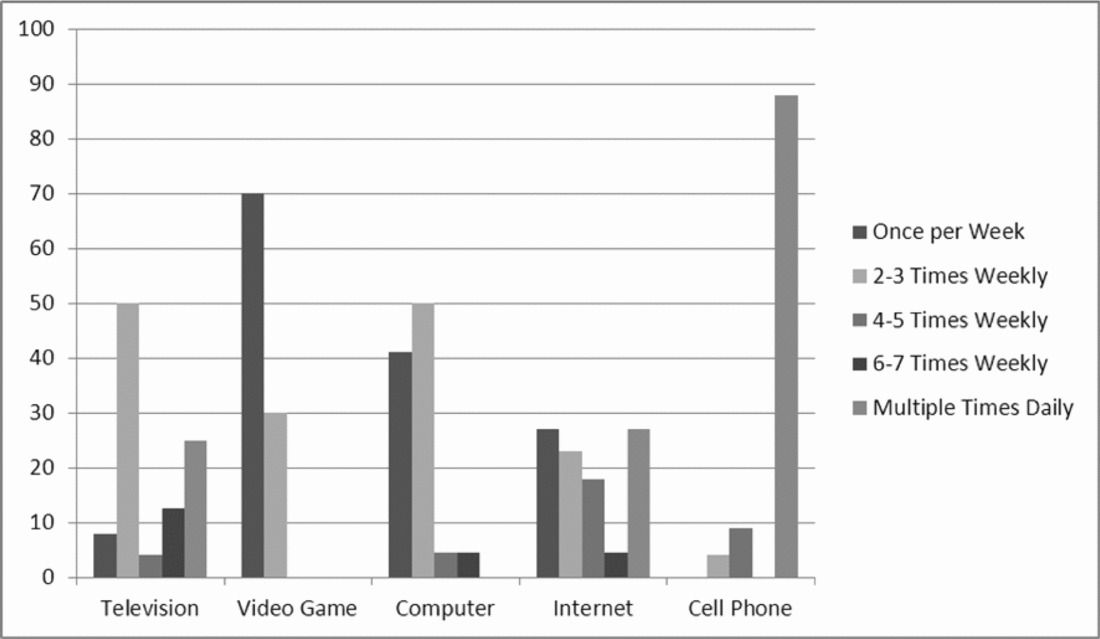
All the adolescents interviewed reported using each of the nominated small screen technologies during the past week, although considerable variability was apparent. As illustrated in Figure 1, 50% of adolescents reported watching television two or three times each week while 25% reported watching television multiple times each day. With respect to the most recent television program viewed, two adolescents reported that they had watched the news, seven that they had watched a sporting event, two had watched cartoons, ten had watched Home and Away (a popular Australian night-time drama), one watched a crime show and two reported watching a movie. Two respondents indicated that they had last watched television at home, while 22 indicated that they had last watched television in their dormitory. Only one adolescent reported watching television alone, 21 indicated that they had watched with others and two adolescents noted that they were alone some of the time and with others some of the time when they last watched television. Twenty-three of the participants indicated that they had enjoyed watching television; only one claimed not to enjoy the experience because it was boring. Fifteen did not provide a reason for their television viewing enjoyment, one claimed that television provided information but most responded that it was fun, entertaining or provided something to do.
Percentage (valid) of indigenous adolescents selecting each response-option for frequency of use of each small screen technology.

Perhaps because the Indigenous adolescents interviewed were similar in age (i.e., 15 to 18 years), it was not surprising to find that age was not associated with patterns of television viewing. However, gender differences emerged in relation to patterns of viewing, but not in terms of frequency. Specifically, boys were more likely than girls to report watching sporting events on television while girls were more likely than boys to report watching the night-time drama Home and Away; χ2(5) = 12.91, p < .05. There were no other significant gender differences in television viewing with others or alone and no differences in reported reasons for enjoying television viewing, although lack of significance may be a function of small sample size exacerbated by a lack of responses, despite the culturally sensitive encouragement by the research assistant.
With respect to video gaming, fewer than half of the participants provided information in response to the interview questions. Despite repeated explanation and examples of video games by the research assistant, 14 of the Indigenous adolescents were unable to provide a response to the question about use. It may be the term video game (as well as Nintendo, Play Station, Xbox, Gameboy, Pac-man) was not understood by participants. Of the ten adolescents who responded, seven reported playing video games once a week or less and three reported gaming two or three times each week (Figure 1). With respect to the nine adolescents who provided details of the game they most recently played, four indicated that the game involved guns, three indicated racing, one sports and another reported last playing an action game. Four participants reported that they had last played a video game at home, two at a friend's place and four at school. One respondent indicated playing a video game alone, six indicated that they had played with others and one adolescent was alone some of the time and with others some of the time during the last gaming episode. Eight of the adolescents indicated that they had enjoyed playing a video game because it was fun; three claimed not to enjoy the experience because it was boring. It appears that gaming is more often used by the younger participants, so that the frequency of reported gaming decreased as age increased (r = −.56, n = 10, p < .05). There were no significant gender differences in patterns of video gaming (i.e., frequency, enjoyment, type and location of games played, and whether they played with others or alone).
Unlike most Australian adolescents (ABS, 2011) who report frequent use of computers and the internet, only two of the twenty-two adolescents indicated using a computer more than three times weekly. When they did use a computer, most of the respondents (n = 20) indicated they did so for school work and this occurred at school (n = 19), only two reported playing games, and another two individuals reported viewing pictures and listening to music. Only one respondent indicated last using a computer at home. One student reported that he had last used a computer alone, but most indicated that they had used a computer with others because they did so in class at school. Nineteen of the participants interviewed indicated that they enjoyed using a computer because it was fun, interesting or easy to do school work; three claimed not to enjoy the experience because it was boring. Age and gender were not significantly related to any aspect of computer use, although lack of significance may be a function of small sample size.
Again, unlike most Australian adolescents, approximately half of the 22 participants indicated using the internet less than three times weekly. However, five reported using the internet four to seven times weekly, and in a similar response to the ABS data, six reported internet use multiple times daily. When they did use the internet, more than two thirds of respondents indicated that they last used the internet to access Facebook or to chat; five reported using the internet to do school work and two others reported playing games or listening to music. In a similar pattern to computer use, 20 of the respondents indicated that they accessed the internet at school while the remainder indicated that they had accessed the internet at both home and school. When they used the internet, approximately one third reported accessing the internet via a personal computer, one third via phone and one third using both types of small screen devices. One adolescent reported that he was last online alone, 19 indicated that they were last online with others, and 2 adolescents noted that they were alone some of the time and with others some of the time during their most recent use of the internet. Nineteen of adolescents indicated that they had enjoyed accessing the internet because it was fun, interesting or easy to do school work; three claimed not to enjoy the experience because it was boring. Although it was found that females reported using the internet an average of 4.5 times weekly, while males reported using the internet an average of 2.5 times weekly, there was not a statistically significant difference for internet use according to age and gender.
Approximately 90% (n = 23) of the participants indicated using a mobile phone multiple times daily (see Figure 1). Slightly fewer than half of the adolescents indicated that they last used their phones to access the internet, eight to send a text message and four to send/receive a voice call. Approximately 54% of respondents indicated that they talked or texted their family, one third contacted a friend, and four — all males — simply stated girls. More than 80% (n = 19) of the participants indicated that they used their mobile phone last at school, three at home and one respondent indicated using a mobile phone both at home and school. Slightly fewer than half (n = 11) of the participants reported using their phones when they were alone, six when they were with others and another six both alone and with others. All adolescents indicated that they had enjoyed using their mobile phone because it was nice to talk and text. Again, age and gender were not significantly related to any aspect or pattern of mobile phone use. Overall, it would seem that mobile phones are frequently used and in similar ways to most Australian adolescents.
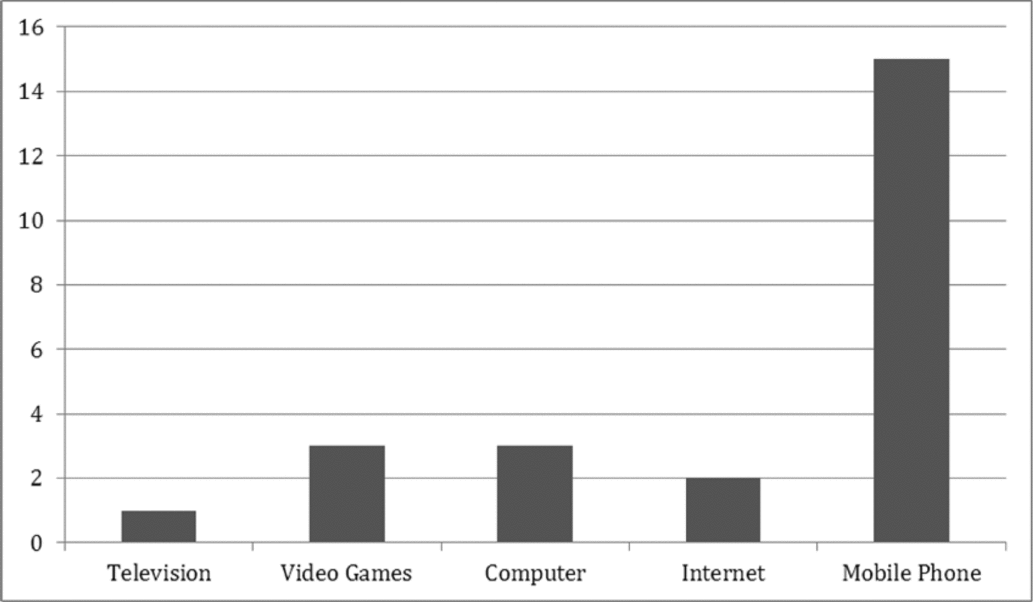
This finding is supported by the responses from the final two questions in the interview that queried the participants about which small screen technology application the participants would select if they could only access one, and why that would be their choice. The majority of adolescents indicated their preference for a mobile phone because they could use it to communicate (ten respondents) or because it can do everything (five respondents; see Figure 2). Three adolescents indicated their preference for a personal computer to access information (two respondents) or because it was fun (one respondent). One participant indicated his preference for a television to access information and three indicated their preference for video games to relax or to have fun. Selection of a specific preferred small screen application was not significantly related to age or gender, although no female indicated preference for use of television or video games.
Number of Indigenous adolescents indicating most preferred small screen technology.
Discussion
There are profound cultural, ethical and logistic challenges to collecting data from Indigenous Australian adolescents residing in remote communities. Indigenous Australian cultures are collective and cooperative, not individualistic and competitive; public presentation and expression is viewed negatively and often associated with ridicule (Kral, Reference Kral2012) or with shame (i.e., the embarrassment or shyness that Aboriginal people feel when attention is focused on them, see Harkins, Reference Harkins1990; Eagleson, Kaldor & Malcolm, Reference Eagleson, Kaldor and Malcolm1982; Oliver, Grote, Rochechouste, & Exell, Reference Oliver, Grote, Rochechouste and Exell2012). Relative to non-Indigenous Australian adolescents, Indigenous adolescents may appear shy, withdrawn and timid (Brady et al., Reference Brady, Dyson and Asela2008). Being directly asked questions, as in a research interview such as the current study, particularly if the question is not understood, can engender social anxiety and emotional disengagement and lead to the participants getting shame. As already indicated, every effort was made to overcome this potential difficulty by using a trained but younger research assistant with whom the participants were familiar and comfortable. He conducted the interviews using a ‘yarning’ approach — that is, he undertook the interviews in a relaxed and culturally appropriate style. He also accepted non-verbal responses, such as a nod or shake of the head or a click for yes, and confirmed the meaning if uncertain of the participant's intent. Despite this, some students were still challenged by the interview process.
Clearly, the data collection with Indigenous adolescents presents challenges, and despite our best efforts, it did again in the current research. This may also explain the paucity of research on this population. And yet the very populations who are least researched may be those most in need of rich description and corresponding accurate conceptualisation prerequisite to strategies intended to improve developmental and learning outcomes.
With respect to the current investigation, the adolescents who provided data attended a residential high school, albeit also in a remote location in Western Australia, and thus may represent the most digitally connected and literate Indigenous youth in remote regions of Australia. While the sample size was small (n = 24) and, consequently, generalisation of findings questionable, especially given the students’ boarding school enrolment, tentative and preliminary conclusions regarding patterns and preferences of small screen technology use are warranted.
The extent of television viewing reported among the participants was less than might typically be reported by adolescents in urban regions (Brown & Marin, Reference Brown and Marin2009), perhaps due to limited program selection, school-based restrictions and/or cultural characteristics. Indeed, it is possible that the collective, as opposed to individualistic, culture of Australian Indigenous people (Exley, Reference Exley and Henderson2012) explains why only one adolescent reported watching television alone. Yet, gender differences in viewing preferences appeared consistent with those frequently reported in the general population; that is, that males view sporting events while females view relationship dramas (Vasan, Reference Vasan2010). Similarly, the participating adolescents reported watching television as a leisure activity, as is the case with most adolescents regardless of cultural background (Lin & Overbaugh, Reference Lin and Overbaugh2009). Even so, while Australia recently introduced educational television programming directed at Indigenous children (Lonsdale, Reference Lonsdale2010), and Indigenous television dramas are increasingly available (Knox, Reference Knox2012) as a new Indigenous media landscape continues to emerge (Rennie & Featherstone, Reference Rennie and Featherstone2008), current findings would suggest that television plays a relatively minor role in the lives of the participants.
During the individual interviews, more than half of the Indigenous adolescents were non-responsive with respect to video gaming and the group that did provide information indicated infrequent gaming relative to the general population (Brown & Marin, Reference Brown and Marin2009; Rideout et al., Reference Rideout, Foehr and Roberts2010). Therefore, the current findings suggest that gaming does not play a significant role in the lives of the participants. It may be that video games have been slow to infiltrate remote Indigenous communities or that they are the type of small screen technology that does not appeal to these students. Further, it might be that video games are not as readily available in the boarding school as they are in other situations. This is perhaps something that staff members at this school could address, particularly as video games have been found to contribute to the development of cognitive skills (Boot, Blakely, & Simons, Reference Boot, Blakely and Simons2011) and school-based learning (Hainey, Connolly, Stansfield, & Boyle, Reference Hainey, Connolly, Stansfield, Boyle and Felicia2011; Jorgensen & Lowrie, Reference Jorgensen and Lowrie2011). Anderson and Courtney (Reference Anderson, Courtney and Felicia2011), for instance, describe an educational intervention to introduce and develop design thinking skills with two groups of Australian Indigenous high school students in Far North Queensland using Indigenous knowledge to develop design thinking skills, along with literacy and numeracy skills.
Consistent with collective cultural nuances, only one adolescent reported playing a video game alone. The types of games reportedly played were similar to those played by adolescents generally (Lenhart, Reference Lenhart2008). The younger participants reported more frequent gaming than did the older adolescents, suggesting a cohort effect. Relative to internet use, computer use was not commonly reported by participating Indigenous adolescents and occurred primarily at school during completion of school work and with others present, perhaps in a classroom or computer lab. Most commonly, adolescents reported enjoying computer use because it facilitated completion of school assignments. However, internet use was considerably more common than using a computer; approximately half reported internet use more than four times in the past week and nearly 30% reported using the internet multiple times daily. Almost all respondents indicated accessing the internet at school, which may reflect limited connectivity in their extremely remote family homes. School-based computers and mobile phones were both commonly used to access the internet and, consistent with their collective culture, the internet was rarely accessed when an Indigenous adolescent was alone, even though in this boarding school context, opportunities for solitude did exist. As is the case with adolescents generally (Brown & Marin, Reference Brown and Marin2009; Rideout et al., Reference Rideout, Foehr and Roberts2010), the internet was a mechanism of social exchange, particularly Facebook, which may be compatible with Indigenous preference for visual, as opposed to linguistic, representations (Exley, Reference Exley and Henderson2012; Kral, Reference Kral2012). Unlike television, video games and computers, and consistent with recent research, the internet appears to play a relatively important role in the lives of these Aboriginal students (Martin, Reference Martin and Healy2010; Pirbhai-Illich, Reference Pirbhai-Illich2010).
Mobile phones were frequently used by the participants and in similar ways to adolescents in the general population (e.g., to send text messages and access the internet). When presented with the hypothetical option of using only one small screen technology (i.e., the second last interview question), overwhelmingly but not exclusively, Indigenous adolescents selected a mobile phone. The reasoning for such a preference emphasised the importance of communication and the global functionality of the device (e.g., internet connectivity). Based on previous research, this is not surprising. Specifically, Brady et al. (Reference Brady, Dyson and Asela2008) reported that within a few short weeks of the implementation of the wireless network in 2005, most adults in a remote Indigenous Australian community had purchased a mobile phone, and one young adult in this study estimated that he/she sent 100 messages per day, that is, ‘yarning through text’ (p. 392). In fact, Australian telecommunications companies report ‘that the introduction of mobile telephony into Indigenous communities has trebled the usage expected’ (Department of Industry and Resources, 2006, p. 6), attributed to the low price of basic mobile phones compared with the purchase of a computer and internet service provider contracts. Kral's (Reference Kral2012) ethnographic research undertaken in the Ngaanyatjarra Land in the south-east of Western Australia explains the social mechanisms responsible for Indigenous adolescent adoption of small screen technologies such as mobile phones thus:
As small mobile digital technologies — digital camera, USB sticks, MP3 players and mobile phones —have become more affordable, yarnangu [people or person] are purchasing these devices as individual everyday social objects. The size of these objects is important: most are small enough to fit in pockets and bras and can be slept with at night. In an environment predicated upon demand sharing, these are items of personal ownership that don't have to be shared. These technological artefacts are an extension of yarnangu sociability; they represent a medium of identity expression and a way of maintaining connectedness with others, and, as such, they are objects to be looked after for future use. Affective significance is embedded in these new artefacts. They make sense because they enable communication and enrich social relationships, albeit at a distance, thus illustrating that when the adaptability of material artefacts is immediately evident, new social practices emerge, corporeal dispositions alter and new resources are woven into an existing system to fulfil an essentially expressive function. (p. 230)
Given the Indigenous adolescent preferences for small screen technology described in the current study (i.e., preference for the use of mobile phones to communicate and to access the internet, but also television viewing consistent with the general population, but not so computer use), there is a challenge for educators to incorporate these preferences into an education program. In particular, there is a real need to consider how to address the needs of this cohort while satisfying their preferences. It does seem that culturally, m-learning (i.e., learning via a mobile device such as a phone) is compatible with learning styles of these participants, possibly because it allows for ‘flexible and democratic styles of teaching and learning’, and particularly the way that it allows ‘students more autonomy and control over their learning, and gives voice to underrepresented groups’ (Pirbhai-Illich, Turner, & Austin, Reference Pirbhai-Illich, Turner and Austin2009, p. 147). As such, m-learning may represent the way forward for Indigenous adolescents in remote regions. Finally, by providing a description of preferences and pattern of small screen technology use, studies such as the current one provide a first step in enabling Indigenous educators to meet the challenge of incorporating m-learning with their often extremely remote classrooms.
Acknowledgement
The authors wish to thank the staff and students at Wongutha CAPS, our research assistant, Mike Exell, and the School of Education, Curtin University for the funding that made this research possible.
About the Authors
Genevieve Marie Johnson received a doctoral degree from the University of Alberta (Canada) in 1990 and a Graduate Diploma in Distance Education Technology from Athabasca University (Canada) in 2007. Having been actively involved in university teaching for more than 20 years, she is currently Associate Professor in the School of Education at Curtin University in Western Australia. Dr Johnson has conducted many studies and published and presented widely on the instructional applications of digital technology.
Rhonda Oliver is a Professor in the School of Education at Curtin University. She is an active researcher and her work has appeared in a number of international journals. Her research focuses on studies of second language acquisition, including large scale studies on international and Indigenous university students, and on migrant and Aboriginal children acquiring English as a Second Language.