INTRODUCTION
Hyperiids represent a remarkable lineage of amphipods that are adapted to live as holoplanktonic forms from primitive benthic forms. The life cycle of most species of hyperiids involves a symbiotic association with other pelagic organisms, mainly gelatinous zooplankters, which are used as a substratum (Laval, Reference Laval1980). The duration and nature of the symbiosis depends on the hyperiid species and varies according to factors including season, abundance and size of hosts, development of host's gonads and water temperature (Dittrich, Reference Dittrich1987, Reference Dittrich1992). The ways in which hyperiids are associated with the gelatinous zooplankton are quite variable (Vader, Reference Vader1983) and in most cases, the biological details of these symbioses remain unstudied. Some hyperiid taxa appear to be restricted to associations with certain host groups, but the mechanisms for host selection are yet to be studied. In general, it is assumed that most hyperiid amphipods depend on the symbiosis to complete their life cycle (Laval, Reference Laval1980), but the scant evidence is still inconclusive.
Previous studies have documented the composition and distribution of these symbiotic interactions in different geographic areas and environments (Madin & Harbison, Reference Madin and Harbison1977; Thurston, Reference Thurston and Angel1977; Laval, Reference Laval1980). These data are mainly from surveys in the epipelagic layers; hence, the amphipod fauna of deep waters is still poorly known, along with its associated host species. Some recent efforts have explored this interesting phenomenon at meso- and bathypelagic depths (Gasca & Haddock, Reference Gasca and Haddock2004; Gasca, Reference Gasca2005; Gasca et al., Reference Gasca, Suárez-Morales and Haddock2007). In this contribution we report new observations on the interaction of hyperiids with different groups of gelatinous zooplankton observed (and collected) in vivo during surveys of the water column between the surface and 4000 m in four different areas of the Pacific Ocean.
MATERIALS AND METHODS
The planktonic fauna of Monterey Bay, California, was surveyed during several oceanographic cruises carried out on board the R/V Western Flyer of the Monterey Bay Aquarium Research Institute (MBARI). The cruises took place between 2006 and 2008. A remotely operated submersible (ROV) was used to sample the zooplankton at depths between 200 and 3000 m. Specimens of different groups of gelatinous zooplankton were individually captured together with their associated hyperiids and brought on board the ship where the host species and symbiotic amphipods were examined and identified. After this initial manipulation in vivo, the specimens were fixed in 4% formaldehyde and preserved in a solution of propylene glycol 4.5%, propylene phenoxetol (0.5%) and seawater (95%) for further taxonomic examination. The identification of the hyperiid amphipods followed Shih & Chen (Reference Shih and Chen1995), Vinogradov et al. (Reference Vinogradov, Volkov and Semenova1996) and Zeidler (Reference Zeidler1992, Reference Zeidler1998, Reference Zeidler2003, Reference Zeidler2004). The gelatinous zooplankton was identified following mainly Totton (Reference Totton1965), Mills (Reference Mills, Kozloff and Price1987), Godeaux (Reference Godeaux and Bone1998) and Mills & Haddock (Reference Mills, Haddock and Carlton2007).
To examine broader questions of the depth distribution of hyperiid amphipods in association with cnidarians and ctenophores, we used the MBARI's 25-year record of ROV dives. Each dive is annotated by experts and entered in the VARS (Video annotation and retrieval system) database (Schlining & Jacobsen Stout, Reference Schlining and Jacobsen Stout2006). Using a custom script to generate database searches (vars_retrieve_concept.py, available at http://bitbucket.org/mbari/database/), we queried this database for records of hyperiid amphipods and for amphipods in association with each species of cnidarian and ctenophore that has been entered into the database. These datasets were filtered using Unix commands cut, sort, and uniq, and histograms were generated using R version 3.0.1.
RESULTS
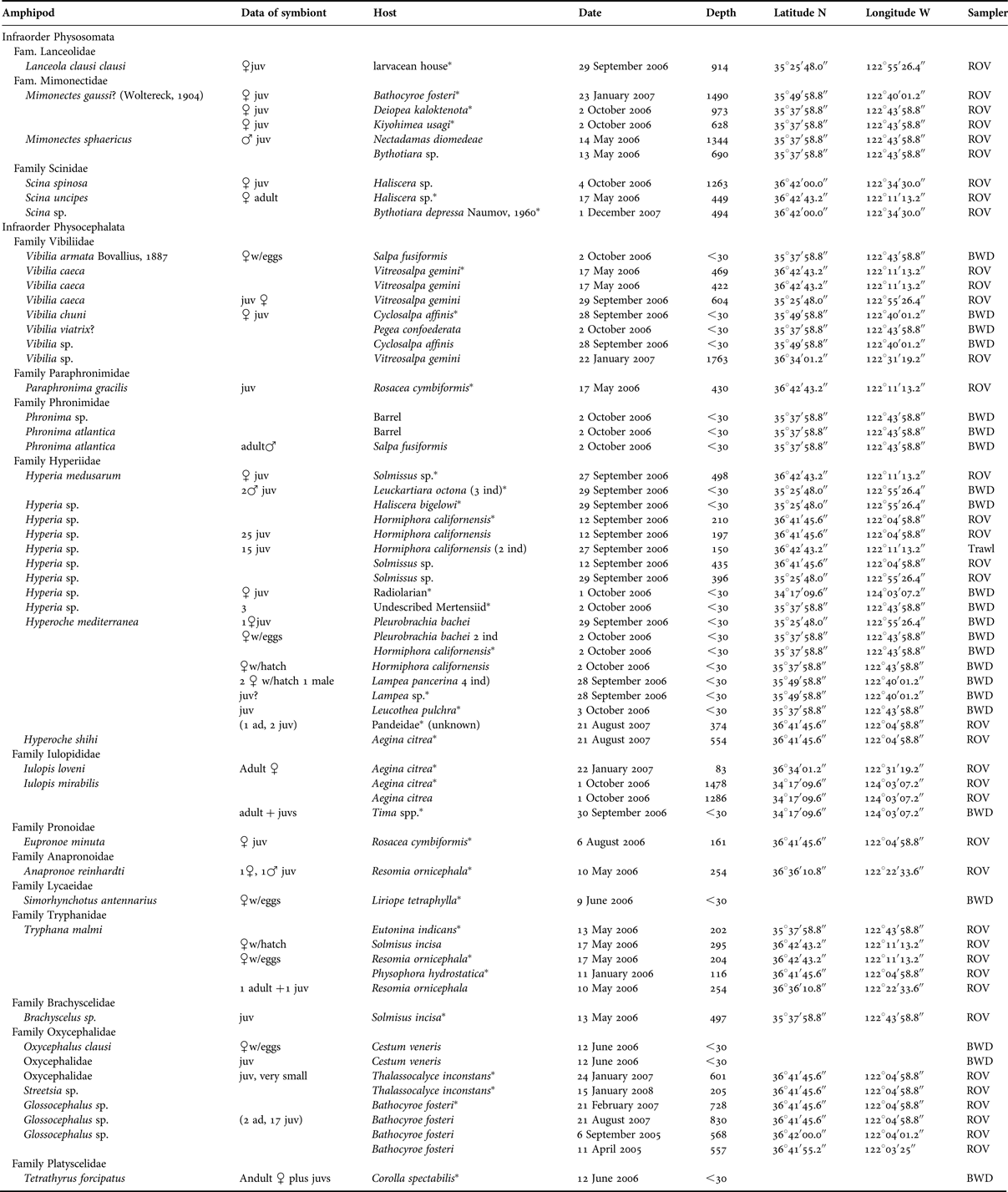
We collected amphipods associated with eight species of ctenophores, eight of medusae, four siphonophores, five salps and one mollusc (Table 1). Up to 23 species of hyperiid amphipods were recorded in association with these gelatinous organisms. Overall, 34 new associations of hyperiid species with gelatinous zooplankters were recorded (marked with * in Table 1). In addition, we recorded and confirmed a total of 12 associations that were reported in other works (Gasca & Haddock, Reference Gasca and Haddock2004; Gasca, Reference Gasca2005; Gasca et al., Reference Gasca, Suárez-Morales and Haddock2007) and documented some of these prior associations in the Monterey Bay area. Details of the new symbioses discovered during this survey, including data on the hosts and biological remarks, are provided below and in Table 1.
Hyperiid amphipods associated with gelatinous zooplankton off California. ROV, remotely operated submersible; BWD, blue-water diving; juv, juvenile specimens.

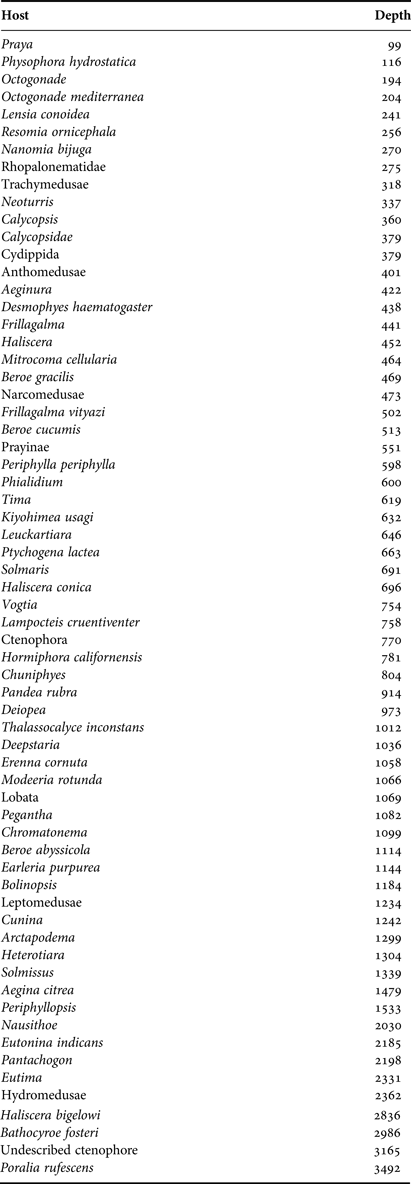
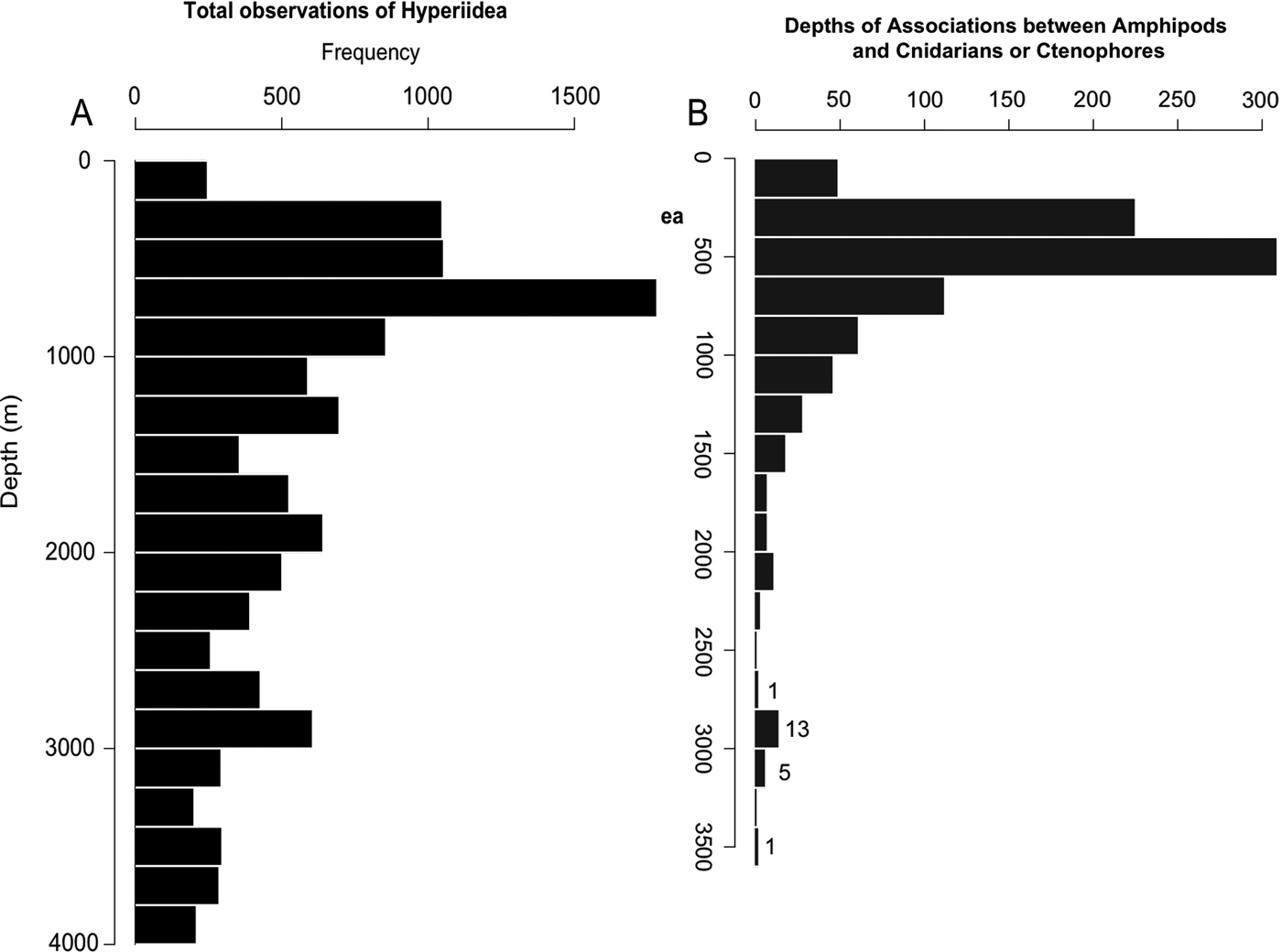
The database searches for Hyperiid amphipods retrieved 11,292 annotations of hyperiids spanning the years 1989 to 2014, and with depths from the surface to a maximum of 3980 m. These records were not necessarily associated with hosts and not necessarily identified to species. We searched for records of hydrozoan, scyphozoan and ctenophore hosts associated with amphipods, with the command ‘vars_retrieve_concept.py -a Hydrozoa, Scyphozoa, Ctenophora + Amphipod’. This search process used hosts concepts from 309 hydrozoans, 57 scyphozoans and 85 classifications of Ctenophora, along with 40 concepts (genera, species) for amphipods. Total amphipods were found frequently to the deepest depths that MBARI's ROVs can operate (Figure 3A). The records with specific associations between amphipods and hosts ranged as deep as 3493 m, with the deepest host being the scyphomedusa Poralia sp. (Table 2).
The maximum depth at which hosts were found to be associated with amphipods, based on the ROV video record. (Specimens not necessarily collected or identified to species.) Taxa are sorted by maximum depth from shallowest to deepest.
Infraorder PHYSOSOMATA
Family LANCEOLIDAE
Lanceola clausi clausi Bovallius, 1885
Remarks: This is the first record of a species of Lanceola as a symbiont of a larvacean. The juvenile female observed was crawling outside the larvacean house. Hitherto, the known associations involving members of this family are those of Lanceola sayana with Pelagia sp., L. pacifica found as a symbiont of the medusa Aegina citrea Eschscholtz, 1829 (Gasca et al., Reference Gasca, Suárez-Morales and Haddock2007), and Lanceola loveni with the hydromedusae Solmissus sp. (Zeidler, Reference Zeidler2012).
Family MIMONECTIDAE
Mimonectes gaussi (Woltereck, 1904)
Remarks: We are not completely sure of the identification of this species because all the specimens collected were juveniles. This species has been previously recorded from a lobate ctenophore and Bolinopsis sp. (Zeidler, Reference Zeidler2012). During this survey it was found as a symbiont of the lobate ctenophores Bathocyroe fosteri Madin & Harbison, Reference Harbison, Madin and Swanberg1978 (Figure 1), Deiopea kaloktenota Chun, 1879, and Kiyohimea usagi Matsumoto & Robison, 1992. This genus appears to have a wide host range among lobate ctenophores.
The hyperiid Mimonectes sphaericus as a symbiont of the medusa Bythotiara sp., from off California, photo in situ obtained during the survey.
Mimonectes sphaericus Bovallius, 1885
Remarks: This hyperiid, recorded herein in association with the siphonophore Nectadamas diomedeae (Bigelow, 1911) was previously found from the same host in the Monterey Bay area by Gasca et al. (Reference Gasca, Suárez-Morales and Haddock2007). In the same work it was recorded as Proscina stephenseni from the same host (see Zeidler, Reference Zeidler2012). It is here reported in association with an unidentified medusa of the genus Bythotiara hosting a single male juvenile at a depth of 690 m. Zeidler (Reference Zeidler2012) reported it previously on the medusae Bythotiara sp. and Solmissus sp. This amphipod is widely distributed in the world oceans and has been observed in different regions of the Pacific Ocean (Vinogradov et al., Reference Vinogradov, Volkov and Semenova1996). Young specimens are commonly found in the water column between 200 and 2000 m but mature females have been recorded near the surface (Vinogradov et al., Reference Vinogradov, Volkov and Semenova1996).
Family SCINIDAE
Scina spinosa Vosseler, 1901
Remarks: The specimen reported herein was identified as S. spinosa, and its morphology is congruent with the subspecies S. spinosa uncipes as described by Zeidler (Reference Zeidler1992). Scina spinosa is a common inhabitant of mid- and deep waters of the Atlantic and Pacific oceans and it does not reach the surface layers (Vinogradov et al., Reference Vinogradov, Volkov and Semenova1996; Vinogradov, Reference Vinogradov and Boltovskoy1999). Out of the about 110 nominal species of the Physosomata, only a few are known as symbionts of gelatinous zooplankters; this is also true for the speciose genus Scina. Only six out of the 50 species of this genus are known as symbionts of gelatinous zooplankters. In the Monterey Bay area, S. spinosa was recently recorded in association with the medusa Haliscera bigelowi (Gasca et al., Reference Gasca, Suárez-Morales and Haddock2007). This association was confirmed with the finding of two more records during this survey, thus suggesting that the host range of this hyperiid is limited to this medusa.
Infraorder PHYSOCEPHALATA
Family VIBILIIDAE
Remarks: Most of the previous records of associations involving species of Vibilia have been from different species of salps (Madin & Harbison, Reference Madin and Harbison1977; Laval, Reference Laval1980). There is a single report of a species of this genus as a symbiont of a siphonophore (Lavaniegos & Ohman, Reference Lavaniegos, Ohman, von Vaupel Klein and Schram1999), but this was based on statistic correlation data and not on direct observation of the specimens associated. During this survey, and also in previous works in the area (Gasca & Haddock, Reference Gasca and Haddock2004; Gasca, Reference Gasca2005; Gasca et al., Reference Gasca, Suárez-Morales and Haddock2007), all records of Vibilia associations are with salp species.
Vibilia armata Bovallius, 1887
Remarks: It has been found as a symbiont of different salp species (Laval, Reference Laval1980; Hoogenboom & Hennen, Reference Hoogenboom and Hennen1985; Lavaniegos & Ohman, Reference Lavaniegos, Ohman, von Vaupel Klein and Schram1999), but it has not been previously recorded from Cyclosalpa fusiformis Cuvier, 1804; hence, this is the first report of this association and an expansion of its host range among salps.
Vibilia caeca Bulycheva, 1955
Remarks: Two and one specimens of V. caeca were recorded from two specimens of the salpid Vitreosalpa gemini Madin & Madin, 2004 in the surveyed area. This is the first information about the symbiotic relationship of V. caeca. This species is known from the north-western sector of the Pacific Ocean (Vinogradov et al., Reference Vinogradov, Volkov and Semenova1996). There was no previous information about the symbiotic associations of this species.
Vibilia chuni Behning & Woltereck, 1912
Remarks: As V. armata, this species has been reported as a symbiont of different salps species (Madin & Harbison, Reference Madin and Harbison1977), but it has not been previously found as a symbiont of Cyclosalpa affinis Chamisso, 1819, thus expanding its known host range.
Vibilia viatrix Bovallius, 1887
Remarks: In this survey it was found as a symbiont of the salp P. confoederata (Forskål, 1775). As some of its congeners, this hyperiid has been previously reported from different salps, as summarized by Lavaniegos & Ohman (Reference Lavaniegos, Ohman, von Vaupel Klein and Schram1999). Reported hosts include P. confoederata (Gasca et al., Reference Gasca, Suárez-Morales and Haddock2007) so this association is confirmed herein with new observations.
Vibilia sp.
A few unidentifiable juvenile specimens of this genus were recorded from the salps Cyclosalpa affinis and Pegea confoederata.
Family PARAPHRONIMIDAE
Paraphronima gracilis Claus, 1879
Remarks: A single specimen of P. gracilis was observed in association with the siphonophore Rosacea cymbiformis (delle Chiaje, 1830), thus expanding the known host range of this amphipod. This hyperiid has been recorded in the California area as a symbiont of the siphonophore Sphaeronectes gracilis (now accepted as S. koellikeri Huxley, 1859) and the salp Ritteriella picteti (Lavaniegos & Ohman, Reference Lavaniegos, Ohman, von Vaupel Klein and Schram1999). The other species of the genus, P. crassipes is known only as a symbiont of siphonophores including Rosacea cymbiformis (Laval, Reference Laval1980).
Family PHRONIMIDAE
Phronima atlantica Guérin-Méneville, 1836
Remarks: In this survey this species was found as a symbiont of Salpa fusiformis, as previously reported by Laval (Reference Laval1980). A single specimen was found in a salp barrel (Laval, Reference Laval1980), the usual host of members of this genus.
Family HYPERIIDAE
Hyperia medusarum (Müller, 1776)
Remarks: During this survey this species was found as a symbiont of two medusae, Solmissus sp. and Leuckartiara octona (Fleming, 1823). The only previous record of this hyperiid species in Monterey Bay was as a symbiont of another medusa: Mitrocoma cellularia (Gasca et al., Reference Gasca, Suárez-Morales and Haddock2007). This species has been known as a host of several other species of medusae worldwide (von Westernhagen, Reference von Westernhagen1976; Thurston, Reference Thurston and Angel1977; Brusca, Reference Brusca1981; Buecher et al., Reference Buecher, Sparks, Brierley, Boyer and Gibbons2001). Solmissus sp. (Fewkes, 1886) is among the most common hydromedusae in Monterey Bay.
Hyperia sp.
Remarks: Several unidentifiable juvenile specimens of Hyperia were found on several hosts in associations not previously known among species of the genus, including records on the ctenophore Hormiphora californensis (Torrey, 1904), an undescribed mertensiid ctenophore, the hydromedusa Haliscera bigelowi (Kramp, 1947) and also on an unidentified radiolarian. The finding of adult specimens will allow an accurate record of these associations.
Hyperoche mediterranea Senna, 1908
Remarks: An ovigerous female was found on the ctenophore Hormiphora californensis, and a juvenile on the ctenophore Leucothea pulchra Matsumoto, 1988; adults and juveniles were obtained from an undescribed pandeid medusa. This is the first record of this association with these ctenophores and Pandeidae. Hitherto, it was also recorded from the ctenophore Lampea pancerina (Chun, 1879) (Laval, Reference Laval1980; Hoogenboom & Hennen, Reference Hoogenboom and Hennen1985) and from Pleurobrachia bachei A. Agassiz, 1860, as previously recorded by Hirota (Reference Hirota1974), Flores & Brusca (Reference Flores and Brusca1975). This species has been previously recorded as a symbiont mainly of ctenophores but it has also been recorded from medusae and siphonophores (Steuer, Reference Steuer1911; Hirota, Reference Hirota1974; Laval, Reference Laval1980).
Hyperoche shihi Gasca, Reference Gasca2005
Remarks: This is the second record of this species after its original description. It was first found in a symbiotic association with the mesopelagic medusa Chromatonema erythrogonon (Bigelow, 1919) (Gasca, Reference Gasca2005). During this survey it was found on Aegina citrea, thus expanding the known host range of this hyperiid. The hyperiid was crawling outside the umbrella.
Family IULOPIDIDAE
Iulopis lovenii Bovallius, 1887
Remarks: In this survey I. lovenii was recorded as a symbiont of the medusa Aegina citrea, representing an expansion of its known host range; hitherto, it was found in association with the medusa Pandea conica (Quoy & Gaimard, 1827) (Harbison et al., Reference Harbison, Biggs and Madin1977).
Iulopis mirabilis Bovallius, 1887
Remarks: As reported here in reference to its congener I. lovenii, this species was found on the medusan host Aegina citrea and also on another two medusae of the genus Tima. There are no previous data about the symbiotic associations of I. mirabilis.
Family PRONOIDAE
Eupronoe minuta Claus, 1879
Remarks: This is the first report of E. minuta as a symbiont of the siphonophore Rosacea cymbiformis. This species has been recorded with the siphonophores Agalma elegans (Harbison et al., Reference Harbison, Biggs and Madin1977), Apolemia uvaria and Sulculeolaria quadrivalvis (Laval, Reference Laval1980) and also from a salp (Spandl, Reference Spandl1927).
Family ANAPRONOIDAE
Anapronoe reinhardti Stephensen, 1925
This is the second record of this species in the Monterey Bay as a symbiont. It was first reported by Gasca et al. (Reference Gasca, Suárez-Morales and Haddock2007) from the same undescribed physonectid siphonophore.
Family LYCAEIDAE
Simorhynchotus antennarius (Claus, 1871)
During this survey it was found as a symbiont of the abundant medusa Liriope tetraphylla (Chamisso and Eysenhardt, 1821), which is closely related to Geryonia, thus expanding the known host range of this amphipod. This species has been reported only in association with the medusa Geryonia proboscidalis (Laval, Reference Laval1980) and with the siphonophore Sulculeolaria quadrivalvis (Lima & Valentin, Reference Lima and Valentin2001).
Family TRYPHANIDAE
Tryphana malmi Boeck, 1870
Remarks: During this survey, an adult female of T. malmi was found from the medusa Solmisus incisa (Fewkes, 1886); its marsupium contained several larval individuals. In addition, an egg-bearing female was found as a symbiont of an undescribed physonectid siphonophore and of Physophora hydrostatica Forskål, 1775. This amphipod has been found previously in Monterey Bay as a symbiont of the leptomedusa Mitrocoma cellularia and the narcomedusa S. incisa (Gasca et al., Reference Gasca, Suárez-Morales and Haddock2007). This is the third finding of the species in association with gelatinous zooplankton and the second time it has been found in association with a siphonophore, after a record by Laval (Reference Laval1980) from the abylid Ceratocymba sagittata in the north-east Atlantic. Apparently, this species tends to associate with both medusae and siphonophores. Tryphana malmi is considered an anti-equatorial species, distributed in the epipelagic layer (Vinogradov et al., Reference Vinogradov, Volkov and Semenova1996).
Family BRACHYSCELIDAE
Brachyscelus sp.
Remarks: An unidentifiable juvenile individual of this genus was observed in the narcomedusa Solmisus incisa. Members of Brachyscelus are frequently found as symbionts of medusae and salps (Laval, Reference Laval1980).
Family OXYCEPHALIDAE
Oxycephalus clausi Bovallius, 1887
Remarks: During this survey a female with eggs and a few juvenile individuals of O. clausi were observed as symbionts of the ctenophore Cestum veneris Lesueur, 1813. This species has been known from other ctenophore species and also with thaliaceans (Madin & Harbison, Reference Madin and Harbison1977; Harbison et al., Reference Harbison, Madin and Swanberg1978). In addition, several immature specimens of members of this family (Oxycephalus sp. and Streetsia sp.) were found in association with the ctenophore Thalassocalyce inconstans Madin & Harbison, 1978.
Glossocephalus sp.
Remarks: These specimens were found to represent an undescribed species of Glossocephalus that is currently in the process of description. During this survey it was recorded always as a symbiont of the ctenophore Bathocyroe fosteri Madin & Harbison, 1978 (Figure 2). The genus has been found associated with ctenophores only (Steuer, Reference Steuer1911; Krumbach, Reference Krumbach1911; Harbison et al., Reference Harbison, Biggs and Madin1977, Reference Harbison, Madin and Swanberg1978; Laval, Reference Laval1980).
Juvenile of the hyperiid Glossocephalus sp. found on the ctenophore Bathocyroe fosteri from off California, in vivo photo obtained during the survey.
Family PLATYSCELIDAE
Tetrathyrus forcipatus Claus, 1879
Remarks: Its finding in association with the gelatinous pteropod mollusc Corolla spectabilis Dall, 1871 in the present study represents the first record of a non-siphonophore host for this hyperiid. The pteropod is known to host at least two other species of hyperiids: Lycaea bovalloides (Harbison et al., Reference Harbison, Biggs and Madin1977) and Streetsia steenstrupi (Lavaniegos & Ohman, Reference Lavaniegos, Ohman, von Vaupel Klein and Schram1999). Tetrathyrus forcipatus has been recorded as a symbiont of two species of siphonophores: Agalma clausi and Nanomia bijuga (Harbison et al., Reference Harbison, Biggs and Madin1977).
DISCUSSION
Most of the symbiotic associations reported in the literature involve hyperiid species of the Infraorder Physocephalata (Laval, Reference Laval1980). The same tendency was observed in this and previous works in the California area (Gasca & Haddock, Reference Gasca and Haddock2004; Gasca et al., Reference Gasca, Suárez-Morales and Haddock2007) as most hyperiids recorded herein belong to this group. It is also remarkable that more records of physocephalatous hyperiids are consistently being discovered as our sampling capabilities improve. Overall, associations in this Infraorder might be much more common than believed in the past. It is clear that these kinds of deep-water samples represent a unique opportunity to reveal details of these associations that are not available from traditional net plankton samplings.
Members of the family Phronimidae (Thiel, Reference Thiel1976, Reference Thiel, von Vaupel Klein and Schram2000) and Oxycephalidae (Gasca & Haddock, Reference Gasca and Haddock2004) have been recognized among the few pelagic crustaceans for which maternal care has been reported. The mothers feed and keep the larvae within barrel-shaped salp tests after demarsupiation. Oxycephalus clausi takes care of its juveniles after they are demarsupiated in a ctenophore (see Gasca & Haddock, Reference Gasca and Haddock2004). In this survey juveniles of this hyperiid were found as symbionts of the ctenophore Cestum veneris, thus supporting the notion that ctenophores are used for protection of immature individuals.
As noted by Gasca (Reference Gasca2005), most symbiotic amphipods have been recorded as juveniles (males and females). It is less frequent to find gravid or larvae-bearing females, and adult males are rare. The same pattern was observed in this survey and suggests the relevance of the gelatinous zooplankters as an adequate substratum to complete the life cycle of the hyperiid symbionts; it is probable that most of the vulnerable growth phases of many species occur during this symbiotic association. In some species adults remain in the host together with their offspring. Laval (Reference Laval1980) stated that males are probably free-living and aggregate under certain circumstances (moon phases); the non-ovigerous adult females are deemed more independent than juvenile or egg-carrying females. In some species, such as Hyperoche medusarum, there is evidence suggesting that the same host could be ‘used’ by different generations. Juveniles at different developmental stages were found coexisting in the same host individual with gravid females (Laval, Reference Laval1980; personal communication).
The findings of this survey increase the previous knowledge about these symbiotic associations both in the Monterey Bay area and worldwide. In this survey we provide data of 51 certain records of hyperiid/gelatinous zooplankton associations, of which 34 are new and 16 have already been observed in the area. The depth distributions we obtained (Figure 3A, B, Table 2) show that amphipod associations with gelatinous zooplankton continue down below 2000 m, and in fact, amphipods are known to be some of the deepest-living organisms (e.g. Kobayashi et al., Reference Kobayashi, Hatada, Tsubouchi, Nagahama and Takami2012). We expect that additional surveys in the bathypelagic zone will produce many more examples of new species and new symbiotic associations.
Histograms of depth of observations from the MBARI video database, 1989–2014. (A) Total number of observations of Hyperiidea with depth. (B) Number of in situ observations of amphipods seen in direct association with planktonic cnidarians and ctenophores.
ACKNOWLEDGEMENTS
The Monterey Bay Aquarium Research Institute (MBARI) organized and the David and Lucile Packard Foundation supported these scientific expeditions and allowed us to examine the hyperiids and the gelatinous zooplankton. Constructive comments and suggestions made by anonymous reviewers were very helpful to improve the contents of this manuscript.