Introduction
The city of Najaf, also referred to as al-Gharī, is located in southern Iraq and stands out as one of the holiest cities in the Islamic world.Footnote 1 It is home to the golden-domed shrine of the Prophet Muḥammad’s son-in-law—the first Shiʿi Imam and fourth rightly guided caliph—ʿAlī Ibn Abī Ṭālib (d. 41/661).Footnote 2 In the Shiʿi tradition, Najaf is cited as the dwelling place of prophets and the location where Abraham, Moses, Jesus, and Muḥammad attained prophethood. Additionally, it is the supposed burial site of Adam and Noah, the final destination of Noah’s ark, and the expected site of the Hidden Imam’s return.Footnote 3 Najaf is also one of the oldest college towns in the world. In fact, the history of scholarly activity in Najaf stretches back before the oldest university in the English-speaking world, the University of Oxford, which was established in the sixth/twelfth century.
The long history of intellectual endeavor in Najaf has recently been the cause of great celebration throughout the Shiʿi world because many Shiʿis believe that the first Shiʿi seminary (ḥawza) was established in Najaf 1,000 years ago. Conferences and other commemorations have been held in the past several years, celebrating the millennial anniversary of Shiʿi scholarship in Najaf.Footnote 4 The Islamic Education, Scientific and Cultural Organization nominated Najaf as its capital of Islamic culture for 2012, and more than fifty wax figures of Najaf’s Shiʿi scholars were reportedly commissioned as part of the commemorative activities.Footnote 5
Outside of Iran, Najaf is currently the most important seat of Shiʿi authority and knowledge production, which is directly tied to the Shiʿi seminary system (ḥawza).Footnote 6 The only contemporary international rival of the ḥawza complex in Najaf is Qom in Iran.Footnote 7 There is a loose comparison to be made between the Najaf‒Qom rivalry and the rivalries between universities in the West, such as Cambridge and Oxford. Claims to higher authority in Najaf are often a direct result of the notion that its tradition of learning is older than any other Shiʿi center, including Qom.
References to the 1,000-year tradition of learning in Najaf are abundant in Shiʿi literature.Footnote 8 The author of The Schools of Najaf (Madrasat al-Najaf) sums up the sentiments of many Shiʿis as he asserts, “Najaf has been the location of the study of Islamic law (fiqh), legal principles (uṣūl), exegesis (tafsīr), philosophy (falsafa), and whatever else is related to Islamic affairs and thought for the past one thousand years.”Footnote 9 Shiʿi historians generally agree that the great scholar Shaykh al-Ṭūsī (385/995‒459/1067) founded the Shiʿi seminary system (ḥawza) in Najaf in the mid-fifth/eleventh century.Footnote 10 In the words of Wahid Akhtar, Shaykh al-Ṭūsī moved “from Baghdad and settled in al-Najaf al-Ashraf, where he established the first ḥawza ʿilmiyyah that proved to be the highest centre of Shiʿi studies and spiritual leadership, and enjoyed this status till Saddam, the Baʿthist tyrant, recently closed it by force.”Footnote 11 Prior to taking up refuge in Najaf, Shaykh al-Ṭūsī had been the leading Shiʿi scholar in Baghdad, the capital of the Buyid dynasty, which lent patronage to Shiʿism. He has been immortalized as the author of many foundational works on Shiʿism and as the compiler of two of the “four books” of Shiʿi hadith material that were collected before 447/1055.Footnote 12 Robert Gleave argues that “the genesis myth of the Ḥawza” based on Shaykh al-Ṭūsī’s arrival in Najaf and the common view that the period following Shaykh al-Ṭūsī was marked by intellectual “stagnation” or “unoriginality” has been “promulgated in Shiʿi legal histories in order to establish al-Ṭūsī as the undisputed progenitor of the Shiʿi legal tradition.”Footnote 13
Shaykh al-Ṭūsī did in fact arrive in Najaf toward the end of his life, after the Seljuqs ousted the Buyids from Baghdad in 447/1055. Sectarian strife overtook the capital city and Shaykh al-Ṭūsī was particularly targeted. Especially because he arrived in Najaf under harrowing circumstances, Shaykh al-Ṭūsī has achieved legendary status in Shiʿi lore. Therefore, traces of Shaykh al-Ṭūsī continue to be found in Najaf. For example, one of the main mosques in Najaf bears his name, and the northern gate of the city, which leads to the shrine of Imam ʿAlī, is called the “gate of al-Ṭūsī.” Furthermore, the unique system of learning that continues in contemporary ḥawzas, which allows students the freedom to choose their courses of study and is based on the oral transmission of knowledge from one scholar to the next, is often referred to as the “Shaykh al-Ṭūsī method.”Footnote 14
In what follows, I endeavor to answer the question of whether or not there is sufficient historical evidence to prove that the ḥawza of Najaf is, in fact, 1,000 years old. In addition to contributing to a more nuanced understanding of the origins and history of the Shiʿi ḥawza system, this study adds to the scholarship on Islamic education and the history of Najaf. First, I will develop a working definition of the term ḥawza. I will then contextualize the origins of the ḥawza in Najaf within the history of Islamic educational institutions, and finally I outline a history of scholarly endeavors in Najaf.
Shaykh al-Ṭūsī was the first great Shiʿi scholar to reside in Najaf and therefore had a profound influence on Islamic education in that city. There appears to have been a steady trickle of scholars in Najaf throughout much of Shiʿi history. Although Najaf has a long and storied scholarly tradition and is an enduring center of Shiʿism, it has rarely been the most prominent center of Shiʿi learning. Excluding the time of Shaykh al-Ṭūsī and his students, Najaf only became the most prominent educational center of Shiʿism in the early thirteenth/nineteenth century. Put differently, aside from the period surrounding Shaykh al-Ṭūsī, the majority of scholarly output in Najaf has occurred in the past 200 years. Therefore, Roy Mottahedeh points out that “We have very little information about the teaching system and curriculum in Najaf before the nineteenth century.”Footnote 15 The proliferation of ḥawzas and mujtahids in Najaf (and Karbalāʾ) resulted from the expansion of neo-Usulism, which began in the late twelfth/eighteenth century, and exerted a profound influence on the histories of Shiʿism, Iraq, Iran, and indeed the Islamic world.
Defining Islamic Educational Institutions
Islamic educational systems were not built overnight; they slowly evolved alongside the development of Islam. By the sixth/twelfth century, when the so-called Sunni-Seljuq revival was underway, Islamic education had developed into the full-fledged madrasa system, which was partially constructed on the educational traditions of the Buyid-Fatimid era of the fourth/tenth and fifth/eleventh centuries. Although historians might emphasize specific moments that were integral to the process of developing various Islamic educational institutions, single individuals or moments in time did not produce a phenomenon as long-lasting, complex, and impressive as the Islamic scholarly tradition.
In order to begin to answer how old the ḥawza is, it is necessary first to examine what the ḥawza is. Is it a building, an institution, a charitable endowment, a collection of teachers and students, the location where great scholars operate, a curriculum, an intellectual movement, a college (madrasa), a study circle, a seminary? The figurative meaning of ḥawza certainly includes many of these descriptors. Shiʿi historians often focus their definition of the ḥawza on great scholars who produce influential works. Certainly, such scholars can attract students and funds. Therefore, a good indicator of which ḥawza was the most prominent at a given time is the location in which influential scholars studied, lived, worked, and received and distributed teaching licenses (ijāzas).Footnote 16 The issuance of ijāzas and scholarly output are both good indicators of how active a ḥawza is. A scholar on his own, however, without students, is not a ḥawza.
Literally, ḥawza has been defined as an “enclosed, barricaded area or specified place.”Footnote 17 The verbal form (ḥa-wa-za) means to possess, obtain, or gain control. Ḥawza as a noun can also be defined as territory or property.Footnote 18 ʿAbd al-Ḥusayn al-Ṣāliḥī defines ḥawza in terms of township, community, and center of gravity.Footnote 19 ʿAlī al-Bahādilī describes ḥawza as a “scholarly entity,” especially for the purpose of conducting ijtihād.Footnote 20 Laurence Louer suggests that ḥawza refers to a community of learning in a particular place, especially considering the fact that Islamic authority was more localized prior to the second half of the thirteenth/nineteenth century.Footnote 21 Meir Litvak writes, “The hawza denotes a communal whole which encompasses scholarship, interpersonal and social bonds, as well as organizational and financial aspects.”Footnote 22 Finally, Devin Stewart defines ḥawza ʿilmiyya as an “academic center” and argues that the ḥawza, more than any other institution (including the raʾs al-madhhab and marjaʿ al-taqlīd), “gives structure to the Twelver Shiʿite legal madhhab diachronically” and “has allowed a remarkable degree of continuity in Shiʿite legal education from the 5th/11th century until the present.”Footnote 23 A critical component of the ḥawza system, therefore, is related to the locality in which scholarly activity is carried out.Footnote 24
Coincidentally, Shaykh al-Ṭūsī appears to have been the first Shiʿi scholar to utilize the term ḥawza.Footnote 25 However, he does not use it in reference to education. He employs the phrase al-ḥawza al-Islamiyya in the context of a discussion on the necessity of jihad. In a similar way, Shiʿi seminaries are commonly referred to as al-ḥawza al-ʿilmiyya, literally meaning realm, domain, or territory of scholarship. Therefore, ḥawza, like madrasa, refers to a localized community of learning, not to be confused with a maddhab, which is a school of legal thought that is not necessarily confined by local boundaries. Only Shiʿis, not Sunnis, use the term ḥawza in reference to places of learning. The fact that ḥawza connotes a defensible territory may indicate that Shiʿi scholars felt that their institutions of learning were under attack and needed to be defended.
Najaf and the Evolution of Islamic Colleges (madrasas)
Historically speaking, Islamic learning has taken on a multiplicity of forms. In addition to ḥawza, the term madrasa is commonly used in pre-modern as well as modern Shiʿi (and Sunni) literature to refer to the location in which teaching, learning, and research was conducted. The term madrasa was first used in the third/ninth century, and initially referred to centers of learning that developed in relation to mosques.Footnote 26 In addition to teaching and learning activities, early madrasas carried out state functions, especially as they related to the legal system. As George Makdisi and others have pointed out, the madrasa developed explicitly for the study of Islamic jurisprudence.Footnote 27 Judges at these institutions held court sessions, participated in tax agreements, and provided other legal services.Footnote 28 As will be clear from what follows, the term madrasa refers to a variety of institutions that evolved over time.
Different from Western scholarship, which generally emphasizes institutions of learning, Islamic education places a high premium on individual scholars. As Jonathan Berkey has argued, “Islamic higher education … rested on the character of the relationship a student maintained with his teachers, and not the reputation of any institution.”Footnote 29 Indeed, madrasas are often referred to by the names of influential scholars. Unlike Western education, it is the individual scholar who grants ijāzas, not the institution. Additionally, Islamic education, including the training of Muslim scholars, often occurred outside of the madrasa.Footnote 30 However, the advent of more formalized educational systems, especially related to the madrasa, certainly marked the beginning of a new era of Islamic education and deeply influenced the lives of Muslim academics.Footnote 31 Formal and informal learning in the classical period of Islamic education included the following settings:
-
1. Lectures given by Muslim scholars held in public squares, gardens, etc., and often attended by large crowds.
-
2. Study circles (al-halaqāt al-ʿilmiyya) held in teachers’ homes, shops, bookstores, archways, city gates, etc.
-
3. Discipleship, which often meant that a student lived with a scholar long enough to acquire the teacher’s knowledge.Footnote 32
-
4. Mosque-colleges (masjid-madrasa), which continued to be centers of learning after the establishment of more formalized madrasas.
-
5. Shrine-colleges (mashhad-madrasa), which developed near shrines instead of mosques. The Shiʿi centers of learning in Najaf and Karbalāʾ are examples of shrine-colleges.
-
6. Madrasas unassociated with mosques or shrines.
The history of Islamic colleges (madrasas) reinforces the plausibility that Shaykh al-Ṭūsī contributed to the development of a center of learning in Najaf. Indeed, the evolution of Islamic educational institutions had already been well on its way. Some scholars suggest that the Seljuqs built the first madrasas in the fifth/eleventh century, even though the term madrasa had been in use since the third/ninth century, and Shiʿis established institutions of learning by the fourth/tenth century.Footnote 33 In his widely cited book, The Rise of Colleges, George Makdisi suggests that madrasas developed in three phases. In the second/eighth century, the masjid became a college—providing stipends for staff and students. During the second phase, madrasas developed into the masjid-inn complex, providing students with room and possibly board. Finally, the madrasa developed as an institution complete with all the requisites of teaching and learning.Footnote 34 Accepting Makdisi’s three phases, Said Amir Arjomand adds a fourth stage: the “educational-charitable complex,” which, he argues, developed in the late seventh/thirteenth century.Footnote 35 Makdisi supports the notion that the institution of the madrasa flourished in the fifth/eleventh century as a result of the so-called Sunni revival associated with Seljuq rule.Footnote 36 However, he argues that pre-madrasa institutions of learning had been developing as part of mosques from the early stages of Islamic history.
Essentially describing the development of the madrasa in Najaf, Makdisi points out that the phenomenon of a shrine-college (mashhad-madrasa) was one of the many cognate madrasa institutions. Instead of Najaf, he cites Abū Hanīfa as an example, which was founded around the same time as Najaf, in 459/1067. Although some scholars categorize Najaf as a mosque-college (masjid-madrasa),Footnote 37 it is more precisely a shrine-college (mashhad-madrasa). Shrine-colleges are often perceived to have more religious legitimacy than other madrasas because of the authority that the shrine adds to the educational endeavors that occur nearby. The shrine also attracts pilgrims, who often extend their stay in the shrine city for educational pursuit. This phenomenon has historically occurred in Najaf and Karbalāʾ as well as Mecca and Medina.
The longevity of Najaf as a center of learning, therefore, is largely related to the authority provided by the shrine of Imam ʿAlī. In fact, the origins of Najaf itself are directly related to ʿAlī, who was buried in Najaf after his assassination in 41/661 in Kufa. By the third/ninth century, the ʿAbbasid caliph Harūn al-Rashīd (d. 193/809) built a domed structure over the once-secret location of ʿAlī’s resting place, which attracted pilgrims. The Buyid ruler ʿAḍud al-Dawla (d. 372/983) then built a more elaborate superstructure in 337/949.Footnote 38 Najam Haider argues that by the fourth/tenth century “pilgrimage became an integral and even necessary component of Imami [Shiʿi] identity.”Footnote 39 Rose Aslan suggests that ʿAlī’s grave was, in fact, a center of pilgrimage by the late second/eighth century and that pilgrimage manuals developed as part of the scholarly activity in Najaf.Footnote 40
Returning to the question of the evolution of Islamic educational institutions, it is important to consider the specific institutions leading up to the establishment of the renowned Seljuq madrasas. Bayt al-Ḥikma in Baghdad is often cited as one of the earliest such institutions. However, as Dimitri Gutas argues, Bayt al-Ḥikma was not a madrasa or even a meeting place for scholars. Instead, he suggests that it was a “library, most likely established as a ‘bureau’ under al-Manṣūr, part of the ʿAbbasid administration modeled on that of the Sasanians.”Footnote 41 An additional institution is al-Azhar in Cairo, established in 359/970 by Ismāʿīlī Shiʿis of the Fatimid Caliphate. According to al-Maqrīzī, the Fatimid Caliph al-ʿAzīz Billah (d. 386/996) paid stipends to legal scholars and built living quarters for them near al-Azhar in 378/988.Footnote 42 Although many scholars have suggested that al-Azhar stands out as the world’s oldest madrasa and university,Footnote 43 Paul Walker argues that during the Fatimid period, al-Azhar was not an educational institution at all, whether as a university, madrasa, or otherwise.Footnote 44 Instead, Walker suggests that the majlis al-ḥikma, which unlike madrasas moved to different locations, was “the most enduring educational institution of the Fatimids.”Footnote 45 Al-Ḥākim, the famous Fatimid caliph, founded Dār al-Ḥikma in 395/1005 in Cairo as a similar institution to the Bayt al-Ḥikma library in Baghdad.Footnote 46 The first Twelver Shiʿi institution of higher learning, al-ʿAḍudiyya, was established by the Buyid ruler ʿAḍud al-Dawla in Baghdad in 362/973 and was equipped with student housing.Footnote 47 Claude Cahen suggests that the Dār al-ʿIlm (383/993) of the Buyid vizier Shapur was also established as an endowment (waqf) and was modeled on the Fatimid system.Footnote 48 Bayard Dodge argues that the first institution that deserves the name madrasa is the one built in Nishapur in the first quarter of the fifth/eleventh century.Footnote 49 Al-Mustanṣiriyya (est. in 631/1234) in Baghdad, which Hisham Nishabe refers to as “the highest form of expression in classical muslim [sic] education,” stands out as a culmination of the madrasa system following the Seljuq invasion.Footnote 50
Like the Fatimids and Seljuqs, the Buyids were extraordinary patrons of learning, which, according to Joel Kraemer, resulted in a veritable renaissance in humanistic learning.Footnote 51 Buyid patronage extended beyond “religious” and “legal” studies. In fact, ʿAbd al-Ḥusayn al-Ṣāliḥī argues that prior to the establishment of al-ʿAḍudiyya in Baghdad, study circles had been established in philosophy, theology, medicine, astrology, mysticism, and mathematics.Footnote 52 During the Buyid period, these circles of study and scholarly discussions took place at a great variety of locations, including mosques, gardens, city squares, private residences, markets, archways, gates, and bath houses. Bookshops were the most prominent forums for informal intellectual pursuits and were bona fide literary salons.Footnote 53 The proliferation of bookshops under the Buyids was so great that the Shiʿi neighborhood of al-Karkh in Baghdad hosted roughly a hundred book dealers.Footnote 54 Additionally, debate sessions (majlis al-munāẓara) were often held in the courts of Buyid officials, especially ʿAḍud al-Dawla who provided scholars with funds, a massive library, and space to hold discussions.Footnote 55 Indeed, major intellectual discovery and artistic output resulted from Buyid patronage. For example, Ibn al-Nadīm produced his famous Fihrist during this time and the great Ibn Sīna (Avicenna) flourished under Buyid support.Footnote 56 The Buyids also established hospitals in Baghdad and Shiraz as well as an observatory in Baghdad. ʿAḍud al-Dawla’s hospital is said to have staffed twenty-four physicians.Footnote 57 In addition to the great libraries in Baghdad, the cities of Shiraz, Rey, and Isfahan were also home to impressive libraries.Footnote 58
Buyid sponsorship of Shiʿism provoked violent sectarian strife in Baghdad and beyond. “In the conflagration of 362/972,” as Kraemer reports, “seventeen thousand people are said to have perished, and 300 shops and 33 mosques were burned to the ground.”Footnote 59 In the 410s/1020s, Sunnis began to attack Shiʿi houses and institutions in Baghdad.Footnote 60 When the Seljuqs conquered Baghdad in 447/1055, Shiʿi libraries and educational institutions in Baghdad were destroyed, including al-Sharīf al-Murtaḍā’s collection of books, which is said to have been composed of some 80,000 titles. Shaykh al-Ṭūsī’s house and library were also among those torched.Footnote 61 As a result of the Seljuq invasion, Shiʿi learning decentralized and Shiʿi scholars were displaced.
After toppling the Buyid dynasty in the mid-fifth/eleventh century, the Seljuqs certainly expanded the madrasa system, and A. C. S. Peacock argues that the madrasa is “perhaps the period’s most lasting legacy.”Footnote 62 For this reason, the Seljuqs are often credited with establishing the madrasa system. Although the number of Sunni madrasas increased exponentially under Seljuq rule, Shiʿi historians often point out that Shiʿis were the first to establish madrasas in the Islamic world.Footnote 63 As Omid Safi states, “Niẓām al-Mulk and the [Seljuq] patronage of madrasas became so synonymous that many later scholars would come to erroneously assume that he had invented the whole madrasa system.”Footnote 64
Whether or not Niẓām al-Mulk and his successors proliferated Sunni madrasas as a method to counteract the “Shiʿification” of the Islamic world that had taken place in the fourth/tenth and fifth/eleventh centuries is the subject of serious scholarly debate. Some historians have focused on the utility of Seljuq madrasas as a method of maintaining Islamic orthodoxy and countering Shiʿism.Footnote 65 According to Safi, the Seljuqs developed madrasas as a “coercive ideological state apparatus,” to counter Ismāʿīlism and contribute “to the larger process of legitimizing and maintaining Saljuq rule and legitimacy.”Footnote 66 Peacock, however, asserts that the Seljuq religious policy was contradictory, did not unambiguously promote Sunnism, and even supported Shiʿism at times.Footnote 67 Therefore, he argues that “the madrasa served as a means of extending patronage” and was not an “instrument of state policy.”Footnote 68 Additionally, Daphna Ephrat argues that there are no grounds on which to argue that the Seljuqs “supported the madrasas because they were fanatically anti-Shiʿi.”Footnote 69
Scholarly Activity in Najaf during the Past 1,000 Years
Returning to the question of the origins and longevity of the Shiʿi intellectual tradition in Najaf, I argue that we can determine whether or not a center was active when known scholars were living there. Certainly, teaching and learning without the output of scholarship is also important. However, it is nearly impossible for historians to determine whether teaching and learning occurred in the absence of such evidence. Eyewitness accounts do exist—like the one from Ibn Battuta discussed below. However, such references are rare and do not give a clear picture of how active a center of learning was over time. For the purpose of this study, therefore, I consider Najaf to be an active scholarly center during times in which scholarship was produced there or scholars are known to have spent time there. I have searched each period before and after Shaykh al-Ṭūsī to determine how many Shiʿi scholars lived in Najaf in relation to other Shiʿi centers at a given time.
A study of the birthplace of influential Shiʿi scholars who died between the beginning of the fourth/tenth and the end of the eighth/fourteenth centuries shows that a grand total of six of them were from Najaf. According to Shaykh al-Ṭūsī’s Fihrist, most scholars of the fourth/tenth century were from nearby Kufa, a few were from Baghdad, and not one was from Najaf.Footnote 70 Aqa Bozorg Tehrani’s list of scholars from the fifth/eleventh century shows that most scholars were from Iran, especially Khorasan and Qom, twelve were from Baghdad, and not one was from Najaf.Footnote 71 Most scholars in the sixth/twelfth century were from Iran (especially Rey and Qom) and eight were from Karbalāʾ. Not one was from Najaf.Footnote 72 Scholars in the seventh/thirteenth and the eighth/fourteenth centuries were primarily from Hilla and six were from Najaf.Footnote 73 It is only in the eighth/fourteenth century, therefore, that we see more than one or two scholars from Najaf. In total only six Najafis are reported among the noteworthy scholars during the 400-year period between the fifth/eleventh and eighth/fourteenth centuries. Five of them lived in the eighth/fourteenth century.
During the Safavid period (1501‒1722), many Shiʿi scholars were attracted to Iran, and consequently the old centers in Hilla, Aleppo, and elsewhere declined during this period. However, Karbalāʾ and Najaf slowly began to rise in importance during the Safavid period. Still, in the eleventh/seventeenth century the majority of scholars were from Jabal ʿAmil and Bahrain and only eight were from Najaf. By the twelfth/eighteenth century, most scholars were from Isfahan and only one was from Najaf.Footnote 74
This survey suggests that Shaykh al-Ṭūsī’s presence in Najaf did not make the city a bastion of Islamic scholarship. These statistics, however, may not tell the whole story. For Najaf to be an active center of learning simply means that scholars studied, taught, or conducted research in Najaf—not that they were born there. So, what about those who died, studied, or taught in Najaf?
Based on a list of fifty-four of the most influential Shiʿi scholars of all time, twenty-eight of them lived in Najaf as students, teachers, or both.Footnote 75 This does not mean that these scholars were “Najafis” per se, but at first glance it seems to suggest that Najaf, historically, has been a major center of Shiʿi learning. Does it mean, however, that Najaf has been a center of learning for a full thousand years? Out of these twenty-eight scholars who spent time in Najaf, twenty-three lived in the past two centuries. Therefore, among these fifty-four influential scholars, only five lived in Najaf during the first 800 years of the 1,000-year period that Najaf has been a center of Islamic learning.
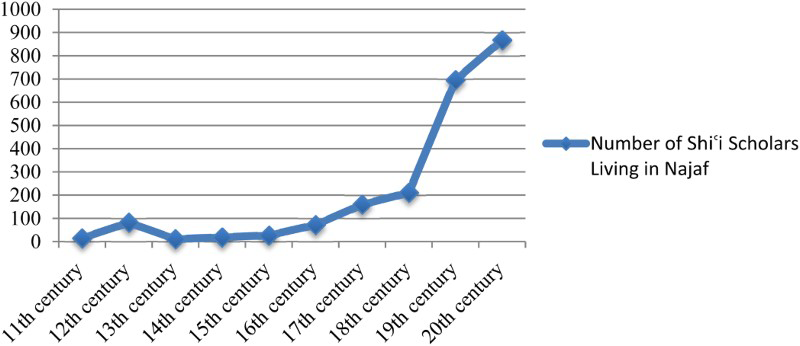
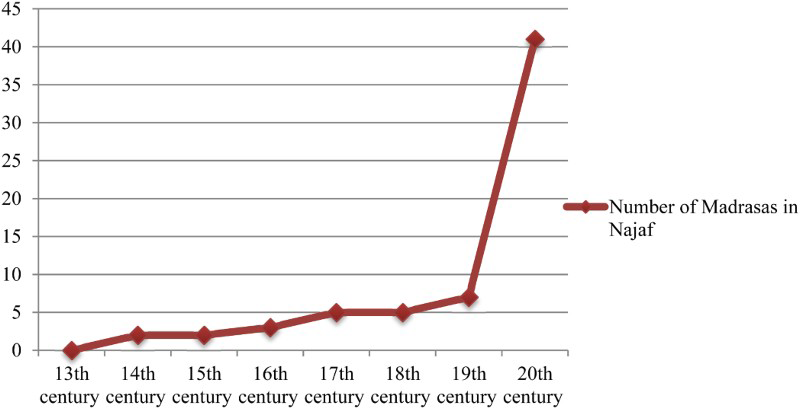
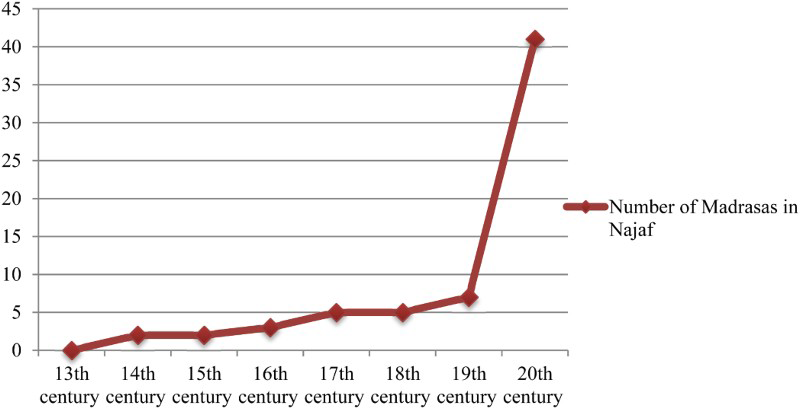
Even if the above-mentioned sample is a rough representation of the most influential scholars, it is still a relatively small sample. Therefore, I have compiled a fairly exhaustive list of over 2,000 Najafi scholars based on a wide range of Shiʿi biographical sources.Footnote 76 This list corroborates what I have outlined above. That is, although there were a few high points in Najafi scholarship prior to the modern period, Najaf rarely dominated Shiʿi learning prior to the thirteenth/nineteenth century (Figures 1 and 2). Below is the numerical distribution of Shiʿi scholars in Najaf from Shaykh al-Ṭūsī’s time until the present. Additionally, I have added the number of madrasas established in Najaf during each century:
fifth/eleventh century: 15 scholars
sixth/twelfth century: 82 scholars
seventh/thirteenth century: 11 scholars
eighth/fourteenth century: 92, two madrasas
ninth/fifteenth century: 27 scholars
tenth/sixteenth century: 72 scholars, one madrasa
eleventh/seventeenth century: 160 scholars, two madrasas
twelfth/eighteenth century: 211 scholars
thirteenth/nineteenth century: 696 scholars, two madrasas
fourteenth/twentieth century: 868 scholars, thirty-four madrasas
(fifteenth/twenty-first century: 92 scholars)
This data shows that the number of scholars in Najaf did increase after Shaykh al-Ṭūsī’s arrival in Najaf. However, during the following four centuries (seventh/thirteenth–tenth/sixteenth), the numbers were not sustained. Toward the end of the tenth/sixteenth century, the number of scholars in Najaf resurged, which was partially the result of the activities of al-Muqaddas al-Ardabīlī (d. 993/1585) and support from the Safavid dynasty. However, the main center of Shiʿi scholarship during this period was the capital of the Safavids in Isfahan as well as Shiraz, not Najaf. The real jump in activity came in the thirteenth/nineteenth century, when the increase in scholars was a 350 percent growth from the previous century. This is the period in which Najaf emerged as the most powerful international center of Shiʿi learning for the first time since its establishment in the fifth/eleventh century. It is also a period that witnessed a proliferation of Shiʿi scholars throughout the Shiʿi world, largely as a result of the spread of Usuli Shiʿism.
Figure 1.
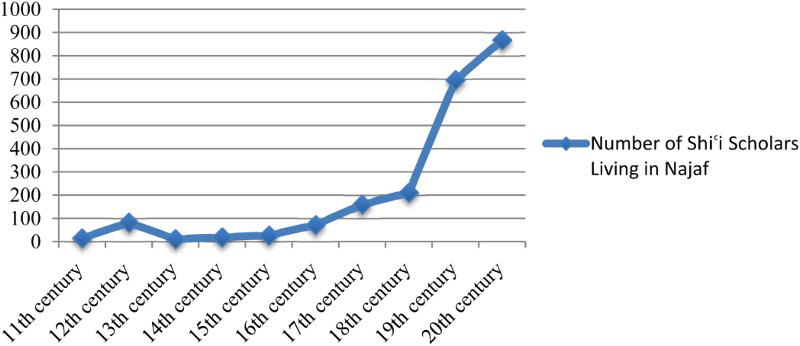
Figure 2.
The statistics above demonstrate that even during the pre-modern period, when little scholarship was produced in Najaf, scholarly activity was sustained, even if at a relatively low rate. Therefore, it is possible to conclude that Najaf has indeed been a center of Shiʿi learning for the past 1,000 years—even if it has rarely been the most important center. In addition to Najaf, the most dominant Shiʿi intellectual centers include Jabal ʿAmil, Hilla, Isfahan, and Qom. It is incredibly significant to note here that none of these cities has been the most dominant center of Shiʿism for more than a few centuries. This fact points to the historical rise and fall of Shiʿi patronage in these localities. It also indicates the willingness of Shiʿi scholars to move in order to preserve their tradition or to gain the support of patrons.
Early Islamic Education in Najaf (First/Seventh–Sixth/Twelfth Centuries)
In the remainder of this paper, I outline a short history of Shiʿi scholarly activity in Najaf from the origins of Islam to modern times. In doing so, I propose three general periods: the early period (first/seventh–sixth/twelfth centuries), the middle period (sixth/twelfth–tenth/sixteenth centuries), and the modern period (tenth/sixteenth–fifteenth/twenty-first centuries). After the towering figure of Shaykh al-Ṭūsī, Ibn Ṭāwūs (d. 664/1266) was the only major scholar to visit Najaf until al-Muqaddas al-Ardabīlī in the tenth/sixteenth century. Al-Ardabīlī was able to attract a few young scholars, who sustained Shiʿi scholarship in Najaf for a few decades. Subsequently, Najaf was revived by Muḥammad Mahdī Baḥr al-ʿUlūm (d. 1211/1797) and other students of Wahīd Bihbihānī at the end of the twelfth/eighteenth century. Since Baḥr al-ʿUlūm’s arrival in Najaf, the city has been a regular fixture of Shiʿi scholarship and the primary residence of many of the most influential Shiʿi scholars. The shrine city also attracted Shiʿi scholars for varying periods of time as it developed the most extensive ḥawza system in the Shiʿi world.
The Islamic tradition generally suggests that the Prophet Muḥammad established the first center of Islamic learning. Shiʿi historians largely agree that the seed for the ḥawza was planted when Muḥammad dedicated the courtyard of the mosque in Mecca to teaching and learning. A number of reports indicate that the courtyard was specifically intended for teaching (tablīgh).Footnote 77 Therefore, part of the original function of mosques was educational.
After ʿAlī became caliph, he moved the Islamic capital to Kufa in 35/656, which meant that the center of Islamic learning moved with him.Footnote 78 Most Shiʿis accept that ʿAlī was buried in Najaf after his assassination in 41/661, although some traditions claim that he was buried in Kufa, while others say Medina.Footnote 79 The ʿAbbasid Caliph Harūn al-Rashīd (d. 193/809) was the first to build a structure over ʿAlī’s resting place—solidifying the idea that his remains are in Najaf. The shrine of ʿAlī was the single attraction that would eventually encourage students and scholars to seek and produce knowledge in Najaf. In Muḥammad Jawād Fakhr al-Dīn’s words, “the mashhad al-sharīf was the first kernel towards the establishment of the ḥawza of Najaf.”Footnote 80
Marshall Hodgson famously referred to the period from the end of the minor occultation (333/945) to the fall of the Buyid dynasty (447/1055) as the “Shiʿi century.”Footnote 81 During this period, several Shiʿi dynasties (Fatimids, Buyids, Hamdanids, Barīdīs, and Carmathians) controlled much of the Islamic world. As indicated already, the Buyid dynasty played a significant role in patronizing the Twelver Shiʿi renaissance. The Buyid ruler ʿAḍud al-Dawla (d. 373/983) is reported to have enhanced the shrine of ʿAlī in Najaf. He also became the first to be buried there after ʿAlī.Footnote 82 The combination of the recent occultation of the 12th Imam and Buyid support propelled Shiʿi scholars to define Twelver Shiʿi thought and theology more clearly during this period. The four riwaʾiyya books as well as the four rijāl books (including Shaykh al-Ṭūsī’s Fihrist and rijāl works) were compiled during this historical moment. Shaykh al-Mufīd and al-Sharīf al-Murtaḍā developed a rationalist (ijtihādī) view of Shiʿi law associated with Muʿtazilī thought. It was in this context that Shaykh al-Ṭūsī migrated from Iran to Baghdad in 408/1017 to study with these scholars and was therefore trained in the rationalist approach to Shiʿi law. Shaykh al-Ṭūsī’s migration, in fact, indicates that Shiʿi education in Baghdad had a far-reaching reputation during this period. Al-Kulaynī (d. 337/949) was also an important scholar in Baghdad at this time. According to ʿAbd al-Ḥusayn al-Ṣāliḥī, the “ḥawza of Baghdad” was the center of the great theological and legalistic renaissance of Shiʿism.Footnote 83 It is precisely because Shiʿi learning was sustained in Najaf and did not continue in Baghdad, therefore, that Shiʿis place the origins of the ḥawza in Najaf instead of Baghdad.
Virtually all Shiʿi sources agree that Najaf became an important place of Shiʿi learning as a result of Shaykh al-Ṭūsī’s migration there. Shiʿi scholars disagree, however, when considering the question of whether or not there was an institution of learning in Najaf prior to Shaykh al-Ṭūsī. A number of scholars suggest that an “intellectual movement” existed in Najaf before Shaykh al-Ṭūsī’s arrival. Others suggest that al-Ṭūsī and his predecessors also presided over a ḥawza or madrasa in Baghdad. Muḥammad Jawād Fakhr al-Dīn argues that “denial of an intellectual movement in Najaf prior to Shaykh al-Ṭūsī’s arrival there is unacceptable.”Footnote 84 This statement is in response to Muḥammad Mahdī Baḥr al-ʿUlūm’s claim that “Najaf was intellectually dry when Shaykh al-Ṭūsī migrated there and founded an intellectual movement.”Footnote 85 Fakhr al-Dīn bases his argument on three pieces of evidence. First, he cites a travelogue which reports that a handful of people were living near ʿAlī’s shrine, engaged in studying and teaching in 378/988.Footnote 86 Second, Fakhr al-Dīn presents a fourth/tenth-century poem that refers to Najafis as “people of peace and people of knowledge and honor.”Footnote 87 Additionally, he cites the authority of ʿAlī Kāshif al-Ghitāʾ, who claims that there was an intellectual movement in Najaf starting in the third/ninth century. ʿAbd al-Ḥusayn al-Ṣāliḥī agrees with Fakhr al-Dīn that Najaf was a center of learning prior to al-Ṭūsī’s arrival because it had all the ingredients of a center of learning.Footnote 88
Although there seems to have been some scholarly activity in Najaf prior to Shaykh al-Ṭūsī, he was the first great scholar to reside there.Footnote 89 The question that is still unsettled, though, is whether Shaykh al-Ṭūsī established an educational institution in Najaf. Unfortunately, we only have documentary evidence with which to answer this question. Shiʿi sources generally indicate that Shaykh al-Ṭūsī did establish an institution of higher learning. Muḥammad Mahdī al-Āṣafī argues that Shaykh al-Ṭūsī established a building for the ḥawza of Najaf, and claims that it was simply known as the university of Najaf.Footnote 90 Al-Āṣafī also argues that scholars in al-Ṭūsī’s school enjoyed great academic freedom and studied new subjects that had not previously been studied in Baghdad, including math, engineering, and philosophy.Footnote 91 Fakhr al-Dīn suggests that the original madrasa in Najaf was referred to as the ḥawza of Shaykh al-Ṭūsī.Footnote 92 Finally, Sabrina Mervin indicates that Shaykh al-Ṭūsī founded a “ville de science” (dār al-ʿilm) once he arrived in Najaf.Footnote 93 However, I have not found primary source evidence to support the claim that Shaykh al-Ṭūsī established a physical building dedicated to educational pursuits.
Four Hundred Years of Silence in Najaf (Sixth/Twelfth–Tenth/Sixteenth Centuries)
Shaykh al-Ṭūsī died in 459/1067, thirteen years after his arrival in Najaf. He is reported to have left 300 students behind, some of whom were Sunnis. Shaykh al-Ṭūsī’s most prominent successor was his son (Shaykh Abū ʿAlī al-Ḥasan al-Ṭūsī, d. 508/1114), often referred to as al-Mufīd al-Thānī. Shaykh al-Ḥasan al-Ṭūsī was intellectually active, producing serious scholarly works, and Aqa Bozorg Tehrani suggests that he had thirty-six students.Footnote 94 However, his son (Abū al-Naṣr al-Ṭūsī al-Najafī) was the final scholarly descendant of Shaykh al-Ṭūsī to reside in Najaf.Footnote 95 The fact that Abū al-Naṣr al-Ṭūsī is not generally mentioned in biographical dictionaries suggests that he was not a scholar of great import. Therefore, after Shaykh al-Ṭūsī’s son, no significant scholarship occurred in Najaf for several centuries, resulting from Sunni-Seljuq dominance and a lack of Shiʿi patronage.
Ibn Ṭāwūs confirms that Najaf was not an important center of scholarship in the seventh/thirteenth century.Footnote 96 He was a direct descendant of Shaykh al-Ṭūsī, but was initially educated in his hometown of Hilla, where he studied the works of Shaykh al-Ṭūsī, Shaykh al-Mufīd, and others. From Hilla, Ibn Ṭāwūs moved to Baghdad and then to Najaf and Karbalāʾ. Ibn Ṭāwūs writes that he moved to Najaf for a quieter life, where he would be far from Baghdad, which he referred to as the “place of the Devil’s snares.”Footnote 97 Therefore, he seems to have moved to Najaf not because it was a bustling center of learning, but because it was a quiet place for him to write. Ibn Ṭāwūs only stayed in Najaf for three years (645/1247‒648/1250) and he does not appear to have taught in Najaf. However, Ibn Ṭāwūs’s residence in Najaf does increase the visibility of scholarly activity in the shrine city during the seventh/thirteenth century.
In terms of non-Shiʿi sources, there is one significant reference written nearly a hundred years after Ibn Ṭāwūs’s stint in Najaf. This reference is from none other than Ibn Battuta, whose famous al-Riḥla mentions the existence of a “great college” (madrasa ʿazīma) in Najaf, which was attended by Shiʿi students. Al-Riḥla claims that Ibn Battuta visited Najaf in 733/1333.Footnote 98 There is serious doubt regarding Ibn Battuta’s chronology and whether he actually visited Najaf at all. Recent scholars have proven that large portions of al-Riḥla were plagiarized and not necessarily based on first-hand accounts.Footnote 99 Even if Ibn Battuta’s reference is second-hand knowledge, it is a contemporary source, and there is no discernable reason that Ibn Battuta would have fabricated the notion that there was a madrasa in Najaf.
Ibn Battuta’s reference to Shiʿi learning in Najaf in the eighth/fourteenth century presents an interesting question. If Najaf was home to a “great college,” why is there no significant scholarship from this period? The most plausible answer seems to be that no groundbreaking scholarship was written in Najaf during this period. Most critical Shiʿi works were penned in other centers, such as Hilla. However, it is likely that some level of teaching and learning continued during this period without significantly impacting the direction of Shiʿi studies.
Najaf in the Modern World (Tenth/Sixteenth–Fifteenth/Twenty-First Centuries)
From the tenth/sixteenth to twelfth/eighteenth centuries, Shiʿism was transformed into the state religion of the Safavid dynasty (1501‒1722). The number of Shiʿi adherents and scholars dramatically increased during this period as a result of forced and willing conversions within the Safavid realm.Footnote 100 Largely because of Safavid patronage, the most significant developments in Shiʿi scholarship took place in Iran (especially Isfahan and Shiraz) during this period. In the Arab world, Najaf and Karbalāʾ grew in importance, primarily as pilgrimage sites, while other centers of learning, including Hilla and Aleppo, declined. During the tenth/sixteenth and early eleventh/seventeenth centuries, most Shiʿi scholars were from Jabal ʿAmil and Bahrain, but several were from Najaf. By the late eleventh/seventeenth century, however, most prominent Shiʿi scholars were from Isfahan and only one was from Najaf.
The tenth/sixteenth century was a critical period for the development of scholarship in Najaf. During the early period of the Safavid dynasty, a number of scholars moved to Najaf from Iran and revitalized it as a center of learning. As Yitzhak Nakash argues, “Shiʿi madrasas were built in Iraq in large numbers only after the rise of the Safavids in Iran in 1501.”Footnote 101 The result of patronage during the Safavid era was that significant scholarship was produced in Najaf for the first time since Ibn Ṭāwūs, though scholarly developments in Najaf would remain eclipsed by Isfahan and other centers during this period.
Al-Muqaddas al-Ardabīlī (d. 993/1585) was the first major scholar in Najaf since Ibn Ṭāwūs. Unlike Ibn Ṭāwūs, al-Ardabīlī attracted students from Iran, Jabal ʿAmil, and elsewhere. The fact that the Safavids made repairs to the shrines and colleges also accounted for the revival of Najaf. Among the students of al-Ardabīlī were Ṣāhib al-Maʿālim (d. 1011/1602) and Mulla ʿAbdullah Shūstarī (d. 1021/1612). The existence of Ṣāḥib al-Madārik (d. 1009/1600) in Najaf also indicates that the city continued as a center of learning after al-Muqaddas al-Ardabīlī was long gone. Evidence exists, however, that ʿAlī’s shrine was in disrepair in the early eleventh/seventeenth century. Pedro Texeira (d. 1051/1641), a Portuguese traveler, made his way through Najaf in 1013/1604, and states that ʿAlī’s shrine “has suffered not a little in appearance and condition.”Footnote 102
With the collapse of the Safavids after 1722, the center of Shiʿism shifted from Iran to southern Iraq. The shrine cities became prominent centers of learning after Shiʿi scholarly families fled Iran as the Safavid dynasty met its demise in the first half of the twelfth/eighteenth century. Meir Litvak maintains that “the eighteenth century was a turning point in the history of the shrine cities” as a result of the fall of the Safavids, the weakness of the Ottoman-Mamluk regime in Baghdad, and the rise of Usulism.Footnote 103 Juan Cole argues that Shiʿis were a persecuted religious minority under the Ottomans, who “actually favored Jews” over Shiʿis. The Iraqi Shiʿi community, therefore, “often benefited from times of Ottoman weakness and decentralization and felt greater restrictions during times of renewed Ottoman strength.”Footnote 104 The twelfth/eighteenth century was perhaps the most important period of Ottoman decentralization, and Iraq was located on the periphery of the Ottoman realm. For those in Istanbul, Baghdad “became a metaphor for anything that was extremely far away.”Footnote 105 Najaf and Karbalāʾ, then, were located on the frontier of the Ottoman empire, and Shiʿi leaders enjoyed unprecedented autonomy in the late twelfth/eighteenth and early thirteenth/nineteenth centuries.
After the demise of the Safavids, Karbalāʾ initially became the most important center of Shiʿi learning. The development of the neo-Usuli movement in Karbalāʾ—associated with Wahīd Bihbihānī (1118/1706‒1207/1792)—resulted in profound intellectual, social, and economic changes in the Shiʿi community.Footnote 106 One significant change was that Shiʿi scholars greatly enhanced their socio-religious power, which was sustained without direct state sponsorship. Usuli mujtahids forged alliances with local political players and the merchant class. Therefore, once the Qajar dynasty consolidated power in Iran and re-established Shiʿism as the state religion, many Shiʿi scholars elected to remain in southern Iraq. Khalid Sindawi concludes that the development of ḥawza institutions was a direct result of the victory of Usulism over the Akhbari school, which resulted in the need for more schools to train mujtahids.Footnote 107 Therefore, the proliferation of ḥawzas in the thirteenth/nineteenth century was largely caused by the rise of the neo-Usuli movement, which enhanced the socio-legal status of mujtahids.
The consolidation of Najaf as the preeminent center of Shiʿi scholarship was associated with Sayyid Muḥammad Mahdī Baḥr al-ʿUlūm, who revitalized the Usuli school of thought in Najaf after Wahīd Bihbihānī’s victory over the Akhbari establishment in Karbalāʾ.Footnote 108 Additional notable scholars who were based in Najaf include Jawad al-ʿĀmilī, Kāshif al-Ghitāʾ, and Ḥasan al-Najafī. The most outstanding Shiʿi figure of the thirteenth/nineteenth century, Shaykh Murtaḍā al-Anṣārī, who was the first sole supreme exemplar (marjaʿ al-taqlīd) accepted by the majority of the Shiʿi world, initially studied in Karbalāʾ, but eventually moved to Najaf.Footnote 109 Anṣārī’s residence in Najaf was among the most important reasons that the city remained the center of the Shiʿi world in the mid-1800s.Footnote 110 Najaf continued as the center of the Shiʿi world and was partially eclipsed by Qom in the mid-fourteenth/twentieth century.
The proliferation of Shiʿi madrasas in Najaf and Karbalāʾ in the thirteenth/nineteenth century produced far-reaching implications and must be considered as a turning point in the history of Shiʿism in Iraq. As Yitzhak Nakash rightly argues, in addition to its role as a center of learning, Najaf was “a base for dissemination of Shiʿi ideas and political action.”Footnote 111 Najaf and Karbalāʾ were also magnets for Shiʿis outside of Iraq, attracting roughly 100,000 visitors annually by the end of the thirteenth/nineteenth century, which was significantly more than previous centuries.Footnote 112 Usuli mujtahids and their supporters emerged as a powerful socio-political force in southern Iraq, challenging the authority of the Qajars in Iran as well as Ottoman and eventually British officials in Iraq.Footnote 113
By the end of the thirteenth/nineteenth century, hundreds of Shiʿi scholars and over 10,000 students were associated with more than forty madrasas in Najaf.Footnote 114 This religious community was instrumental in converting to Shiʿism tribesmen in southern Iraq, who had settled on the fertile land near the shrine cities to engage in agriculture.Footnote 115 The expansion of Shiʿism occurred at a historical moment in which Shiʿis experienced unprecedented autonomy in southern Iraq and the fortunes of Ottoman Sunnism were waning.Footnote 116 Although Tanzimat reforms may have benefited Christians more than Shiʿis, as Juan Cole argues, Tanzimat policies also resulted in a decline of the Sunni establishment in the empire, associated with government confiscation of waqf property related to Sunni madrasas, Sufi orders, and other educational institutions.Footnote 117 Throughout much of the thirteenth/nineteenth century, Karbalāʾ and Najaf operated as centers of Ottoman opposition, and Ottomans only established direct rule in the cities in the middle of the century. Abubekir Ceylan argues that Ottoman officials viewed the shrine cities as a potential fifth column because of the sizable Iranian Shiʿi community, and Ottoman governors would not enter the cities, partially because they harbored “runaway malefactors and gangs.”Footnote 118 Shiʿi expansion in Iraq was of great concern to Sultan Abdulhamid, who made several unsuccessful attempts to convert Shiʿis to Sunnism and limit Shiʿi advances in the Ottoman realm. Gohkan Cetinsaya concludes that Abdulhamid’s policy of pan-Islamism must be understood within the context of “the Shiʿi problem in Iraq.”Footnote 119 In response to the mass conversion of southern Iraqis to Shiʿism, Ottoman officials argued that the surest method of curbing the expansion of Shiʿism was for the state to revive Sunni madrasas.Footnote 120
Conclusion
The city of Najaf is, in fact, home to a 1,000-year tradition of Islamic education, making it one of the oldest scholarly towns in world history. Throughout Islamic history Najaf has been a bastion of Shiʿism, but is not the oldest center of Twelver Shiʿi learning. Shiʿis and the Buyid dynasty had already built intellectual institutions in Baghdad. Shiʿi control of Baghdad, however, was short-lived. After heavy persecution and the Seljuq invasion of Baghdad, Shiʿi scholars were forced to seek refuge elsewhere. Shaykh al-Ṭūsī, the most prominent Shiʿi scholar of his time, moved to Najaf, and Baghdad was never revived as a center of Shiʿi scholarship. Najaf, therefore, became the partial inheritor of the tradition of scholarship that had developed in Baghdad in the fourth/tenth and fifth/eleventh centuries.
It was the shrine of Imam ʿAlī that drew Shaykh al-Ṭūsī and future scholars to Najaf, and the shrine guaranteed that Najaf would continue to attract faithful Shiʿi Muslims. However, it did not ensure that scholarly activities would be sustained in Najaf for the entirety of its 1,000-year history. Because of the authority that great scholars carry in Islamic studies, the intellectual tradition in Najaf largely rested on scholars themselves. Therefore, when Shaykh al-Ṭūsī arrived in Najaf, he attracted students, which allowed him to establish circles of study and possibly a center of learning. However, after Shaykh al-Ṭūsī’s son, the momentum of Shiʿi education in Najaf slowed greatly until the tenth/sixteenth century when al-Muqaddas al-Ardabīlī revived Najaf as a center of learning with the help of the Safavids. Najaf became the preeminent center of Shiʿism in the thirteenth/nineteenth century—after the collapse of the Safavid dynasty forced Shiʿi scholars from Isfahan to seek refuge in Karbalāʾ, Najaf, and elsewhere. The proliferation of ḥawzas and mujtahids during this period resulted from the rise of neo-Usulism, which advocated that Shiʿi scholars play a more central role in the realms of society, economics, law, politics, and education.