Introduction
Horseweed is a facultative winter annual weed native to North America that grows in many locations, including alongside roadsides and railways, and in reduced-tillage or no-tillage crop production fields (Weaver Reference Weaver2001). Each plant can produce up to 200,000 seeds, that are approximately 1 mm in length with an attached pappus that facilitates wind dispersal into the Planetary Boundary Layer for travel of over more than 500 km (Bhowmik and Bekech Reference Bhowmik and Bekech1993; Shields et al. Reference Shields, Dauer, VanGessel and Neumann2006; Weaver Reference Weaver2001). Peak emergence occurs in May and again from late August to early September in the north central United States; however, emergence has been observed throughout the growing season (Buhler and Owen Reference Buhler and Owen1997; Tozzi and Van Acker Reference Tozzi and Van Acker2014). In Michigan, there has been a shift to primarily spring and early summer emergence (Schramski et al. Reference Schramski, Sprague and Renner2020). Horseweed seeds are nondormant and readily germinate on the soil surface, making horseweed especially difficult to manage in no-tillage fields (Buhler and Owen Reference Buhler and Owen1997).
Horseweed is resistant to at least one herbicide site-of-action in 18 countries (Heap Reference Heap2020). In the United States, horseweed resistant to glyphosate (Weed Science Society of America [WSSA] group 9) was first confirmed in Delaware in 2001 (VanGessel Reference VanGessel2001) and has since been identified in 25 states (Heap Reference Heap2020). In many cases, horseweed populations are resistant to multiple herbicide sites of action. In Michigan, horseweed is also resistant to acetolactate synthase (ALS) inhibitors (WSSA group 2), triazine herbicides (WSSA group 5), diuron (WSSA group 7), and paraquat (WSSA group 22; Heap Reference Heap2020). If not controlled, horseweed can cause soybean yield losses of 83% to 93% (Bruce and Kells Reference Bruce and Kells1990; Byker et al. Reference Byker, Soltani, Robinson, Tardif, Lawton and Sikkema2013). Management in no-till soybean requires effective control of emerged horseweed before planting and a residual herbicide to control later emerging plants (Loux et al. Reference Loux, Stachler, Johnson, Nice, Davis and Nordby2006). Preplant applications of the auxinic herbicides 2,4-D or dicamba (WSSA group 4) control emerged glyphosate-resistant horseweed (Byker et al. Reference Byker, Soltani, Robinson, Tardif, Lawton and Sikkema2013; Eubank et al. Reference Eubank, Poston, Nandula, Koger, Shaw and Reynolds2008; Keeling et al. Reference Keeling, Henniger and Abernathy1989; McCauley et al. Reference McCauley, Johnson and Young2018; Sherman et al. Reference Sherman, Haramoto and Green2020). However, data on the efficacy of auxinic herbicides on larger plants are inconsistent, and strategies to reduce horseweed size at the time of application are needed (Keeling et al. Reference Keeling, Henniger and Abernathy1989; Kruger et al. Reference Kruger, Davis, Weller and Johnson2010; Wiese et al. Reference Wiese, Salisbury and Bean1995). Use of preplant residual herbicides such as metribuzin (WSSA group 5), flumioxazin, or sulfentrazone (WSSA group 14) resulted in horseweed control up to 8 wk after application (Davis et al. Reference Davis, Gibson, Bauman, Weller and Johnson2007, Reference Davis, Gibson, Bauman, Weller and Johnson2009; Eubank et al. Reference Eubank, Poston, Nandula, Koger, Shaw and Reynolds2008; Steckel et al. Reference Steckel, Craig and Hayes2006); however, continued horseweed emergence throughout the growing season necessitates the need for additional management strategies.
Recent adoption of cover crops for various ecosystem purposes has piqued interest in the use of cover crops as an additional weed suppression strategy. Cover crops suppress weeds by competing with them for soil resources while living and by creating a mulch layer on the soil surface after they die (Teasdale et al. Reference Teasdale, Brandsaeter, Calegari, Neto, Upadhyaya and Blackshaw2007). The mulch left following cover crop termination suppresses weeds by modifying light quantity and quality, reducing soil surface temperature, and creating a physical barrier to seedling emergence (Teasdale and Mohler Reference Teasdale and Mohler1993). Two cover crops, cereal rye and winter wheat, are often grown before no-till soybean is planted in the Midwest due to their winter hardiness and biomass production (CTIC 2017). Cereal rye is more cold-tolerant (Peltonen-Sainio et al. Reference Peltonen-Sainio, Hakala and Jauhiainen2011) and produces similar or greater biomass than winter wheat (Haramoto Reference Haramoto2019). Previous research has primarily focused on cereal rye for its weed suppression ability. However, growers may choose to plant winter wheat to avoid production of an unmanageable amount of cereal rye biomass in the spring.
Davis et al. (Reference Davis, Gibson, Bauman, Weller and Johnson2007) observed similar horseweed density when comparing suppression by a winter wheat cover crop versus spring-applied residual herbicides 1 mo after preplant herbicide application in 1 yr of a 4-yr study. Haramoto (Reference Haramoto2019) reported a reduction in winter annual weed biomass at the time of cereal rye and winter wheat termination and showed a negative correlation between cover crop and weed biomass. Similarly, Ryan et al. (Reference Ryan, Mirsky, Mortensen, Teasdale and Curran2011) reported a decrease in summer annual weed biomass with increasing levels of cereal rye biomass. Weeds were completely suppressed when cereal rye biomass was greater than 1,500 kg ha−1. Factors such as planting date, termination date, and climatic region can influence cover crop biomass and weed suppression. Duiker (Reference Duiker2014) used 1,500 kg ha−1 dry biomass as a threshold and found that cereal rye and winter wheat planted on or before October 1 in Pennsylvania reached this threshold. Additionally, cereal rye was able to reach the 1,500 kg ha−1 threshold by May 1 if planted in mid-October in two of three years at one location. Delayed main crop harvest and colder spring conditions in northern climatic regions such as the upper Midwest could compromise cover crop biomass due to fewer growing degree days. For example, cereal rye cover crop planted and terminated on similar dates in Virginia and Michigan produced 7,671 and 2,180 kg ha−1 biomass, respectively (Pittman et al. Reference Pittman, Barney and Flessner2019; Rogers Reference Rogers2017). To compensate for colder temperatures, growers may consider adjusting seeding rates; however, seeding rates increased ground cover but did not consistently increase biomass in Kentucky (Haramoto Reference Haramoto2019).
Cereal rye reduced horseweed density prior to spring cover crop termination in Kentucky, Pennsylvania, and Virginia when cereal rye biomass was greater than 1,500 kg ha−1 (Pittman et al. Reference Pittman, Barney and Flessner2019; Sherman et al. Reference Sherman, Haramoto and Green2020; Wallace et al. Reference Wallace, Curran and Mortensen2019). Additionally, Wallace et al. (Reference Wallace, Curran and Mortensen2019) reported that winter-hardy cover crops reduced the size inequality of horseweed populations at the time of cover crop termination by reducing the number of large horseweed plants; however, total horseweed density at the time of POST herbicide application did not differ between cover and no cover crop treatments. In contrast, Pittman et al. (Reference Pittman, Barney and Flessner2019) observed 77% horseweed suppression in soybean 6 wk after treatment from cereal rye-containing treatments. Sherman et al. (Reference Sherman, Haramoto and Green2020) reported that horseweed suppression by cereal rye was short-lived when emergence occurred mainly in the spring or when cereal rye biomass was low.
The recent shift in horseweed emergence in Michigan from fall to primarily spring and summer has farmers searching for integrated weed management strategies. As farmers continue to adopt cover crops for their numerous benefits, we wondered whether they could also be used in horseweed management. Previous research comparing winter wheat to cereal rye for its benefits as well as how seeding rate affects these species vis-à-vis horseweed management is lacking. Additionally, many previous studies have compared fall-seeded cover crops and herbicide programs, but research that fully integrates both tactics has been minimal. Therefore, the objectives of this research were to 1) evaluate cereal rye and winter wheat at two seeding rates for their ability to suppress horseweed at the time of cover crop termination and throughout the growing season in soybean and 2) determine an integrated horseweed management strategy using cereal rye and winter wheat cover crops and herbicides.
Materials and Methods
Field experiments were conducted in commercial fields in Isabella County, Michigan in 2018 (43.6128°N, −84.8777°W) and 2019 (43.6255°N, −84.9812°W) and at the Michigan State University (MSU) Agronomy Farm in East Lansing, Michigan (42.6876°N, −84.4907°W) in 2019. Sites were selected based on glyphosate-resistant horseweed escapes the previous season. The soil types in Isabella County were a Selfridge sand (loamy, mixed, active, mesic Aquic Arenic Hapludalfs), pH 6.4, 2.2% organic matter in 2018; and a Wasepi loamy sand (coarse-loamy, mixed, semiactive, mesic Aquollic Hapludalfs), pH 5.2, 2.2% organic matter in 2019. The soil type at MSU was a Conover loam (fine-loamy, mixed, active, mesic Aquic Hapludalfs), pH 5.7, 3.0% organic matter.
The experiment was established as a split-plot randomized complete block design in 2018 and as a split-split plot randomized complete block design in 2019. At each site-year, main plots and subplots were replicated six times until the time of POST herbicide application. Each plot measured 3 m wide by 9 m long. The main plot factor was cover crop, the subplot factor was preplant herbicide strategy, and the sub-subplot factor in 2019 was POST herbicide. The main plots consisted of five cover crop factors: 1) winter wheat seeded at a low rate of 67 kg ha−1 (WWL), 2) or at a high rate of 135 kg ha−1 (WWH), 3) cereal rye seeded at a low rate of 67 kg ha−1 (CRL), 4) or at a high rate of 135 kg ha−1 (CRH), and 5) no cover crop control (NC). The subplots consisted of three preplant herbicide strategies: 1) control, 2) preplant herbicide without residuals, and 3) preplant herbicide with residuals (Table 1). In 2019, the sub-subplot factors were two POST herbicide application strategies (three replications each): 1) an effective POST herbicide application or 2) a noneffective POST herbicide application only to control other weeds, but not horseweed (Table 1).
Herbicide application timings, active ingredients, and product information for three different herbicide preplant strategies (sub-plots) and two different POST herbicide strategies (sub-sub plots) used for management of glyphosate-resistant horseweed.

a Preplant herbicides were applied approximately 7 d before planting and POST applications occurred approximately 5 wk after planting.
b All herbicides with the exception of glyphosate + dicamba were applied with 2% v/v of ammonium sulfate. A drift-reduction agent at 0.5% v/v was included with the Effective POST treatment.
c Bayer CropScience, St. Louis, MO (www.cropscience.bayer.com).
d Loveland Products, Inc., Greeley, CO (www.lovelandproducts.com).
e Valent U.S.A. Corporation, Walnut Creek, CA (www.valent.com).
f Winfield Solutions, St. Paul, MN (winfieldunited.com).
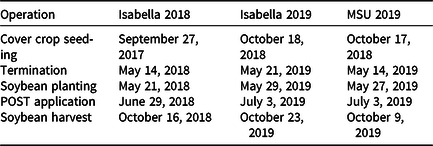
Main plots of ‘Wheeler’ cereal rye and ‘Sunburst’ winter wheat were sown in 19-cm rows using a no-till drill (Great Plains, Salina, KS) the autumn before data collection. Dates for all field operations are listed in Table 2. Preplant herbicide subplots were established 1 wk prior to soybean planting the following spring. Each preplant herbicide treatment included glyphosate to terminate cover crops at this time. Glyphosate and dicamba-resistant soybean ‘AG 26X8’ (Roundup Ready 2 Xtend, Bayer CropScience, St. Louis, MO) was planted in 76-cm rows at a seeding rate of 383,000 seeds ha−1. POST herbicide applications were made approximately 5 wk after planting (WAP) when emerged horseweed was approximately 10 cm tall. In 2018, a POST herbicide application of glyphosate + dicamba was applied to individual plots if needed. This treatment was applied to all of the control (glyphosate-only) and preplant herbicide without residuals plots. In 2019, POST herbicide application was a sub-subplot factor and was established at this time. All herbicide applications were made using a tractor-mounted, compressed-air sprayer calibrated to deliver 177 L ha−1 at 207 kPa of pressure through 11003 TTI nozzles (TeeJet Technologies, Spraying Systems Co., Wheaton, IL).
Cover crop seeding and termination, soybean planting, POST herbicide application, and soybean harvest dates for the three experimental locations.

Data Collection
Horseweed emergence was monitored by placing two random 0.25 m2 quadrats in each main plot immediately following cover crop planting. Newly emerged horseweed plants were counted and removed by hand pulling biweekly until soybean harvest. Prior to cover crop termination, percent ground cover was measured using line-transects (Laflen et al. Reference Laflen, Amaemiya and Hintz1981) laid diagonally across each main cover and the no-cover plots. Presence of cover crop, horseweed, other weed, or no vegetation was recorded at every 30-cm point along a 9-m transect and converted to a percentage. Aboveground cover crop and weed density and biomass were collected at this time from two randomly placed 0.25 m2 quadrats in each plot. In addition to horseweed, annual bluegrass (Poa annua L.), common chickweed [Stellaria media (L.) Vill.], shepherd’s purse [Capsella bursa-pastoris (L.) Medik.], and dandelion (Taraxacum officinale F. H. Wigg.) were present during the time of preplant herbicide subplot establishment for all site-years. Spring whitlowgrass (Draba verna L.) and white campion (Silene latifolia Poir.) were also present at the 2019 locations. Subsamples of cover crop biomass were analyzed for carbon:nitrogen (C:N) ratios by A&L Great Lakes Laboratories, Inc. (Fort Wayne, IN) using a TruMac CNS Macro Analyzer (LECO Corporation, St. Joseph, MI). Horseweed density and biomass were collected from two randomly placed 0.25 m2 quadrats in all plots at the time of POST herbicide application and prior to soybean harvest. At soybean harvest, fall-emerged horseweed rosettes were segregated from fully mature horseweed plants. Biomass samples were dried for approximately 7 d at 65 C and weighed. When soybean reached the VE growth stage, percent ground cover of terminated vegetation was reassessed using the line-transect method described above. Soybean populations were also assessed in all plots at this time. Soybean was harvested for yield using a small-plot research combine (Massey-Ferguson 8XP, AGCO, Duluth, GA) with a 1.5-m header. Yields were adjusted to 13% moisture.
Soil moisture was measured at the time of soybean planting with a TDR 300 Soil Moisture Meter (FieldScout, Spectrum Technologies, Aurora, IL) by collecting five measurements per plot at a depth of 7.6 cm. Precipitation and temperature data were obtained throughout the growing season from the Michigan Automated Weather Network (http://www.agweather.geo.msu.edu/mawn/, MSU, East Lansing, MI) stations located in Mecosta, Mount Pleasant, and East Lansing for Isabella 2018, Isabella 2019, and MSU 2019, respectively (Table 3).
Monthly and 5-yr average precipitation at Isabella County in 2018 and 2019 and Michigan State University in 2019.a

a Michigan Automated Weather Network, http://www.agweather.geo.msu.edu/mawn/, Michigan State University, East Lansing, MI.
b Precipitation up to cover crop termination.
c Precipitation up to soybean planting.
d The harvest month does not include rainfall after harvest.
e Total precipitation is a total of rainfall from cover crop planting until termination, not including precipitation in December, January, February, and March.
f Total precipitation is a total of rainfall from soybean planting until harvest.
Statistical Analysis
Data analysis was conducted using the lmer function in R (version 3.6.2, R Development Core Team 2019). The statistical model consisted of site-year (individual year and location), cover crop treatment, and preplant herbicide strategy as fixed effects and replication nested in site-year and the interaction between cover crop treatment and replication nested within site-year as the random effects. Replications were used as an error term for testing the effect of site-year, and data were combined over site-year when the interaction of site-year and cover crop treatment or preplant herbicide was not significant. The cover crop treatment-by-replication interaction was used as an error term to test the effect of cover treatment. Additionally, preplanned contrasts were performed to compare cover species pooled over cover rate and cover rates pooled over cover species. Data for horseweed density and biomass at harvest and soybean yield were analyzed separately by POST herbicide treatment. Normality assumption was checked by examining histogram and normal probability plots of the residuals. Unequal variance assumption was assessed by visual inspection of the side-by-side box plots of the residuals followed by the Levene’s test for unequal variances. In cases of marked deviations from normality, the data were log-transformed and further analyses were performed using the transformed data. For all experiments, treatment means were separated using Fisher’s LSD at α ≤ 0.05.
Results and Discussion
Cover Crop Biomass and Ground Cover
Cover crop biomass at termination was highest at Isabella 2018 followed by MSU 2019 and Isabella 2019. CRH at Isabella 2018 and MSU 2019 produced 1,747 and 1,731 kg ha−1 dry biomass at the time of termination, respectively (Table 4). This was the only treatment to reach the 1,500 kg ha−1 cereal rye biomass threshold previously reported to suppress horseweed at cover termination (Pittman et al. Reference Pittman, Barney and Flessner2019; Sherman et al. Reference Sherman, Haramoto and Green2020; Wallace et al. Reference Wallace, Curran and Mortensen2019) and control summer annual weeds throughout the season (Ryan et al. Reference Ryan, Mirsky, Mortensen, Teasdale and Curran2011). Cereal rye seeded at 67 or 135 kg ha−1 at Isabella 2018 and MSU 2019, respectively, provided biomass similar to previous studies in Michigan (800 to 2,900 kg ha−1; Rogers Reference Rogers2017; Snapp et al. Reference Snapp, Swinton, Labarta, Mutch, Black, Leep and O’Neil2005). Cereal rye biomass was significantly greater than that of winter wheat at these locations. This is consistent with previous reports of cereal rye producing more biomass than winter wheat (Cornelius and Bradley Reference Cornelius and Bradley2017; Haramoto Reference Haramoto2019). At Isabella 2019, biomass production among CRH, CRL, and WWH treatments was similar, and all were greater than WWL (Table 4). Contrasts indicated that the high seeding rate increased cover crop biomass only at MSU 2019 (Table 4). This is consistent with previous research in which cereal cover crops reportedly often compensate for lower seeding rates by tillering (Haramoto Reference Haramoto2019; Masiunas et al. Reference Masiunas, Weston and Weller1995).
Cover crop dry biomass and growing degree days accumulated at the time of cover crop termination.g

a Winter wheat and cereal rye were seeded at 67 and 135 kg ha−1 for the low and high seeding rates, respectively.
b Means followed by the same letter within a column are not statistically different at α ≤ 0.05.
c Significance is designated as: * = P < 0.05; ** = P < 0.001; NS denoted P ≥ 0.05.
d Contrasts comparing cover crop species pooled over seeding rate.
e Contrasts comparing seeding rates pooled over cover crop species.
f Growing degree days (GDD; base 4.4 C) accumulated from the timing of planting until termination.
Differences in cover crop biomass among site-years were likely a function of accumulated precipitation and growing degree days (GDD) between cover crop planting and termination. Cereal rye and winter wheat reached Feekes stage 6 prior to termination at Isabella 2018, whereas the 2019 sites reached Feekes stage 5. The Isabella sites were planted on similar soil types, but cover crops were sown earlier (~3 wk) and received greater amounts of precipitation between planting and termination at Isabella 2018 compared with 2019 (Tables 2 and 3). GDD accumulations between cover crop planting and termination were 541 and 315 (base 4.4 C) for the Isabella 2018 and 2019 sites, respectively (Table 4). Similarly, the MSU 2019 site was sown later, received less precipitation, and accumulated fewer GDD (326) compared with Isabella 2018. However, the soil type at MSU 2019 was a loam, which was believed to have greater nitrogen availability due to higher clay and silt content as well as higher soil organic matter (Hassink Reference Hassink1994). Cereal rye and winter wheat sown in Pennsylvania produced at least 1,500 kg ha−1 biomass by early May if planted by early October (Duiker Reference Duiker2014). Cover crops in our study were terminated in mid-May and only CRH at Isabella 2018 and MSU 2019 reached this threshold. Furthermore, delayed termination in the spring increases cover crop biomass greater than planting date (Mirsky et al. Reference Mirsky, Curran, Mortensen, Ryan and Shumway2011). The difference in biomass production between our studies and those previously conducted in other regions exposes the challenge of using fall-planted cover crops for weed suppression in northern climates.
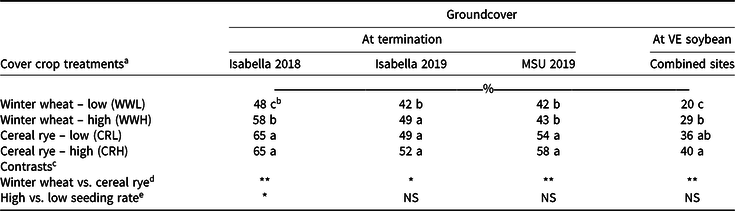
Differences in biomass at termination among cover treatments were reflected in measurements of ground cover. Contrasts indicated that cereal rye provided more ground cover compared with wheat (Table 5). This trend varied at Isabella 2019, where ground cover with WWL was lower than all other treatments. There was no difference in ground cover for high and low seeding rates of cereal rye at any site. In contrast, WWH provided 10% and 7% more ground cover compared with WWL at Isabella 2018 and 2019, respectively (Table 5). Contrasts indicated that cereal rye maintained more ground cover than winter wheat 3 wk after cover crop termination when soybeans were at the VE growth stage (Table 5). Cereal rye had a higher C:N ratio compared with winter wheat (data not shown). However, the C:N ratios of both covers were below the ideal microbial diet of 24:1 (USDA-NRCS 2011). Cover residues with C:N ratios greater than 24:1 decompose more slowly compared with residues with C:N ratios smaller than 24:1 (Odhiambo and Bomke Reference Odhiambo and Bomke2001). Thus, the persistence of cereal rye and winter wheat residues in this study were assumed to be similar and ground cover differences at the VE growth stage are believed to reflect cover biomass at termination. Similar to what was observed at cover crop termination, there were no differences in ground cover between seeding rates of cereal rye. However, WWH provided as much ground cover as CRL and 9% more than WWL.
Cover crop ground cover at cover crop termination and soybean growth stage VE.

a Winter wheat and cereal rye were seeded at 67 and 135 kg ha−1 for the low and high seeding rates, respectively.
b Means followed by the same letter within a column are not statistically different at α ≤ 0.05.
c Significance is designated as: * = P < 0.05; ** = P < 0.001; NS denoted P ≥ 0.05.
d Contrasts comparing cover crop species pooled over seeding rate.
e Contrasts comparing seeding rates pooled over cover crop species.
Soil Moisture at Soybean Planting
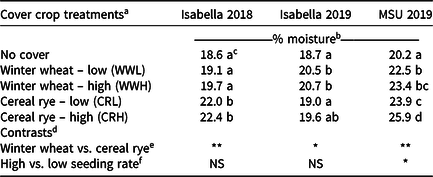
Soil moisture when soybean was planted was influenced by cover crops, but results were not consistent. At Isabella 2018, soil moisture was higher in the cereal rye plots, whereas at Isabella 2019 soil moisture was higher in the winter wheat plots compared with the no-cover controls (Table 6). At MSU 2019, soil moisture was higher in all cover crop treatments compared with no cover, and cereal rye plots held more moisture compared with winter wheat plots (Table 6). The effects of cover treatments on soil moisture between the sites is believed to be a function of cover crop biomass, soil texture, and precipitation prior to planting. Precipitation in the 4 wk prior to soybean planting was 73, 104, and 106 mm for Isabella 2018, Isabella 2019, and MSU 2019, respectively (Table 3). Greater cereal rye biomass at Isabella 2018 and MSU 2019 resulted in higher soil moisture retention in the cereal rye cover treatments. Although winter wheat biomass was relatively low, extensive precipitation and a finer soil texture at MSU 2019 resulted in winter wheat treatments retaining soil moisture compared with the no cover plots.
Soil moisture at 7.6-cm depth measured at the time of soybean planting in the cover crop and no cover plots.

a Winter wheat and cereal rye were seeded at 67 and 135 kg ha−1 for the low and high seeding rates, respectively.
b Soil moisture reported as volumetric water content and measured with a TDR 300 Soil Moisture Meter (FieldScout, Spectrum Technologies, Aurora, IL).
c Means followed by the same letter within a column are not statistically different at α ≤ 0.05.
d Significance is designated as: * = P < 0.05; ** = P < 0.001; NS denoted P ≥ 0.05.
e Contrasts comparing cover crop species pooled over seeding rate.
f Contrasts comparing seeding rates pooled over cover crop species.
Horseweed Suppression at Cover Crop Termination
Initial horseweed emergence occurred between April 25 and May 14 in all site-years and all horseweed plants exhibited a summer annual lifecycle. Horseweed densities at the time of cover crop termination in no cover plots were 1,916, 714, and 21 plants m−2 at Isabella 2018, Isabella 2019, and MSU 2019, respectively. Cover crops reduced horseweed density 47% to 68% compared with no cover at Isabella 2018 where horseweed was dense and cover crop biomass was relatively high (data not shown). At MSU 2019, cover crops also reduced horseweed density compared with no cover, with the exception of WWH. At Isabella 2019, horseweed populations were high and cover crop biomass was low. As a result, cover crops did not reduce horseweed density compared with the no-cover control. Contrasts indicated there was no difference in horseweed density between cereal rye and winter wheat or by seeding rate. Recent studies reported cereal rye reduced horseweed density 80% to 98% at the time of termination across many locations (Pittman et al. Reference Pittman, Barney and Flessner2019; Sherman et al. Reference Sherman, Haramoto and Green2020; Wallace et al. Reference Wallace, Curran and Mortensen2019). Cereal biomass in these studies ranged from one-fold to four-fold of the maximum biomass produced in our study. Therefore, our findings at Isabella 2018 and MSU 2019 suggest that fall-planted cover crops suppress horseweed emergence prior to termination when they are present at much lower biomass levels than previously reported. Combined over site-year, cover crops reduced horseweed biomass 59% to 70% compared with no cover at the time of cover termination. Total weed biomass is a useful measurement for horseweed suppression; however, biomass can be misleading because it is a result of both weed density and the size of individual plants. Wallace et al. (Reference Wallace, Curran and Mortensen2019) evaluated the size of individual horseweed plants at the time of termination and found that cereal rye reduced horseweed size and improved size uniformity. In our study, horseweed biomass was reduced by all cover treatments, regardless of whether horseweed density was reduced. We attribute the early-season horseweed suppression to the presence of a cover crop competing for water, nutrients, and light.
Horseweed Suppression 5 Wk After Soybean Planting
Fall-planted cereal cover crops had no effect on horseweed density 5 wk after soybean planting. Additionally, we observed no difference in biomass of cereal rye and winter wheat, regardless of seeding rate at this time. Applying a residual herbicide at cover crop termination reduced horseweed density greater than 99% compared with the no-herbicide control in all site-years (data not shown). Without the residual herbicides, the preplant herbicide without residuals treatment of 2,4-D + glyphosate reduced horseweed density 60% and 51% compared with the no-herbicide control at Isabella 2019 and MSU 2019, respectively. At Isabella 2018, the preplant herbicide without residuals of 2,4-D + glyphosate did not reduce horseweed density compared with the control, due to additional horseweed emergence following the preplant herbicide application. Our findings support those of Wallace et al. (Reference Wallace, Curran and Mortensen2019) who reported no reduction in horseweed density at the time of POST by a cereal rye cover crop when no herbicides were applied. In contrast, Davis et al. (Reference Davis, Gibson, Bauman, Weller and Johnson2007) observed similar horseweed densities 1 mo after preplant herbicide application between a winter wheat cover crop and a spring-applied residual herbicide in 1 yr of a 4-yr study. Sherman et al. (Reference Sherman, Haramoto and Green2020) reported no additional horseweed control from preplant applications of 2,4-D or dicamba when a cover crop was present. Lower production of cover biomass at the time of termination likely explains the greater impact of preplant herbicides compared with cover crops in our study.
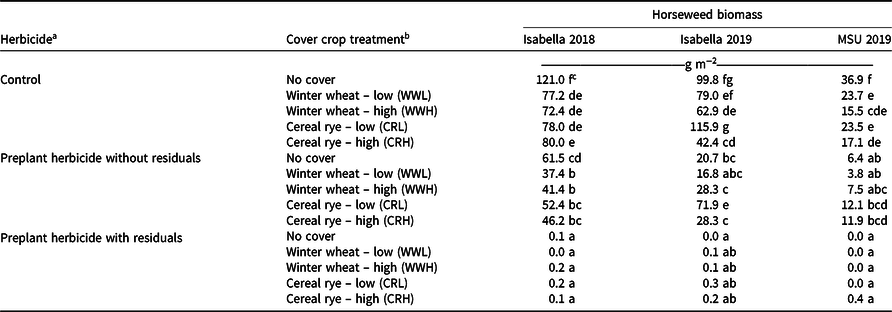
Although cover crops alone did not reduce horseweed density at the time of POST herbicide application, horseweed biomass was reduced by cover treatments in the absence of a preplant herbicide with or without residuals. Within the no-herbicide control plots, all cover crops reduced horseweed biomass compared with no cover, with the exception of the low seeding rates of both winter wheat and cereal rye at Isabella 2019 (Table 7). Cover crops reduced horseweed biomass by at least 33% and 36% compared with the no-cover control at Isabella 2018 and MSU 2019, respectively. At Isabella 2019, WWH and CRH reduced horseweed biomass 37% and 58%, respectively. We observed no differences between cereal rye and winter wheat or by seeding rates. Horseweed biomass was reduced in no-cover plots that received a preplant herbicide without residuals 49%, 79%, and 83% compared with the no-cover control at Isabella 2018, Isabella 2019, and MSU 2019, respectively. Within preplant herbicide without residuals treatments, only WWL and WWH at Isabella 2018 reduced horseweed biomass compared with no cover. Applying a residual herbicide reduced horseweed biomass 99% compared with the no-cover control (Table 7). Any effect cover crops had within residual herbicide plots was overwhelmed by this level of control by the herbicides. Overall, cover crops effectively reduced horseweed biomass, but the magnitude was less evident as preplant herbicide treatment effectiveness increased. Due to adequate horseweed control in residual herbicide plots, an effective POST herbicide was applied only to control and preplant herbicide without residuals treatments at Isabella 2018.
Effect of cover crop and preplant herbicide interactions on horseweed biomass at the time of POST herbicide application.

a Abbreviations: Control, glyphosate only; Preplant herbicide without residuals, glyphosate + 2,4-D; Preplant herbicide with residuals, glyphosate + 2,4-D + flumioxazin + metribuzin.
b Winter wheat and cereal rye were seeded at 67 and 135 kg ha−1 for the low and high seeding rates, respectively.
c Means followed by the same letter within a column are not statistically different at α ≤ 0.05.
Horseweed Suppression at Soybean Harvest
Prior to soybean harvest, sampled horseweed was separated by recently emerged rosettes and mature plants expected to produce viable seed. Cover crops and preplant herbicide treatments had little impact on late-emerging horseweed rosettes (data not shown), and the presence or absence of a cover crop had no effect on horseweed density or biomass at soybean harvest. This supports previous research by Osipitan et al. (Reference Osipitan, Dille, Assefa and Knezevic2018) when reported cover crop residues did not persist long enough to provide weed suppression throughout the growing season, yet refutes research by Pittman et al. (Reference Pittman, Barney and Flessner2019) in which cover crops reduced horseweed biomass 66% at the time of soybean harvest in a study in which the minimum cover biomass was 3,000 kg ha−1. When an effective POST herbicide application was made in 2019, neither cover crop treatment nor preplant herbicide treatment influenced horseweed density or biomass at soybean harvest (Table 8). Differences between preplant herbicide treatments were still evident at the Isabella 2018 and Isabella 2019 sites where a noneffective POST herbicide was applied. At Isabella 2018, only newly emerged rosette horseweed plants were present in the control and preplant herbicide without residuals treatments, due to the effectiveness of the POST dicamba application. At the 2019 sites, preplant herbicide with and without residuals treatments reduced horseweed density 84% and 38%, respectively, compared with the control when a noneffective POST herbicide was applied (Table 8). However, neither cover crop treatment nor preplant herbicide treatment influenced horseweed biomass at Isabella 2019. At MSU 2019, preplant herbicide with residual and without residual treatments reduced horseweed biomass 95% and 31%, respectively, compared with the control. Our results show the downfall of relying solely on fall-planted cover crops for season-long horseweed suppression in northern climates and furthermore, the importance of soil-applied residual herbicides.
Main effects of preplant herbicide treatment on mature horseweed density and biomass at the time of soybean harvest. a

a The main effect of cover treatment had no effect on horseweed density or biomass at the time of soybean harvest.
b Abbreviations: No POST, non-effective POST herbicide (glyphosate); POST, effective POST herbicide (glyphosate + dicamba).
c Site abbreviations: ISB 2018, Isabella 2018; ISB 2019 Isabella 2019; 2019 sites, Isabella 2019 and MSU 2019 combined.
d Effective POST herbicide (glyphosate + dicamba) was applied to control and preplant herbicide without residuals treatments at Isabella 2018.
e Abbreviations: Control, glyphosate only; Preplant herbicide without residuals, glyphosate + 2,4-D; Preplant herbicide with residuals, glyphosate + 2,4-D + flumioxazin + metribuzin.
f Means followed by the same letter within a column are not statistically different at α ≤ 0.05.
g Treatment differences were not detected due to the variability of horseweed biomass in the control and preplant herbicide without residuals treatments.
Soybean Establishment and Yield
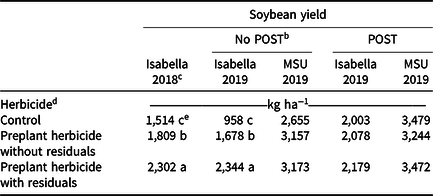
Pooled over site-year and preplant herbicide treatment, cover crops did not affect soybean stand, with the exception of CRH (data not shown). Soybean stand was 4% lower in the CRH treatment compared with no cover. Cereal rye cover crop has been reported to reduce soybean 10% to 35% and result in subsequent yield loss (Moore et al. Reference Moore, Gillespie and Swanton1994; Reddy Reference Reddy2001). However, cover crops did not affect soybean yield at any site-year, when averaged over preplant herbicide treatment and in the presence or absence of an effective POST herbicide application (data not shown). Our findings support those reported by Pittman et al. (Reference Pittman, Barney and Flessner2019) who observed no effect on soybean yield from a cereal rye cover crop. Preplant herbicide treatment affected soybean yield at Isabella 2018 and at Isabella 2019 when a noneffective POST herbicide was applied (Table 9). Soybean yield was 52% and 145% higher with residual herbicides and 19% and 75% higher without residual herbicides at Isabella 2018 and Isabella 2019, respectively, compared with the control. Preplant herbicide treatment had no effect on soybean yield, regardless of POST herbicide application at MSU 2019 where soybean yields were relatively high and horseweed pressure was low.
Main effects of preplant herbicide treatment on soybean yield. a

a The main effect of cover treatment had no effect on soybean yield.
b Abbreviations: No POST, non-effective POST herbicide (glyphosate); POST, effective POST herbicide (glyphosate + dicamba).
c Effective POST herbicide (glyphosate + dicamba) was applied to control and preplant herbicide without residuals treatments at Isabella 2018.
d Abbreviations: Control, glyphosate only; Preplant herbicide without residuals, glyphosate + 2,4-D; Preplant herbicide with residuals, glyphosate + 2,4-D + flumioxazin + metribuzin.
e Means followed by the same letter within a column are not statistically different at α ≤ 0.05.
Farmers who seed cereal rye or winter wheat as a cover crop benefit from the ecosystem benefits these cover crops provide, including protection from soil erosion, an increase in soil organic matter over time, and better soil water retention. The addition of cereal rye or a winter wheat cover crop to no-tillage soybean systems reduced horseweed emergence and density at the time of preplant herbicide application, regardless of cover crop species or seeding rate. Cover crop biomass at the time of termination in Michigan was less than 2,000 kg ha−1, regardless of species or seeding rate, suggesting suppression but not control of horseweed would be expected when seeding a winter cereal cover crop. By 5 wk after soybean planting, horseweed biomass was reduced by 30% or more by cover crops alone, which was not adequate for control; however, this reduction in horseweed biomass may improve POST herbicide efficacy. When a preplant residual herbicide was applied there was 99% horseweed control 5 wk after soybean planting, regardless of the presence of the cover crop. Farmers should include a preplant residual herbicide for optimizing control of spring-emerging horseweed populations. Farmers who do not include a preplant residual herbicide at will benefit from using a cover crop to reduce the biomass of the horseweed at the time of POST herbicide application and reduce the development of horseweed resistant to multiple herbicide sites of action.
Acknowledgments
We thank the Michigan Soybean Promotion Committee and Project GREEEN for supporting this research and Gary Powell and Brian Stiles II for their technical assistance. No conflicts of interest have been declared.