Over the past decade, there has been growing consensus among scholars and health technology assessment (HTA) analysts that ethical considerations should be standard concerns in the formal assessment of health technologies (Reference Busse, Velasco and Perleth8;Reference Davies, Wetherell, Barnett and Seymour-Smith11). The most conventional efficacy, effectiveness, safety, and efficiency questions of traditional HTA are inherently ethical, as they ask: What are the benefits, the harms, the costs, and are these fairly distributed? Bioethicists will recognize these questions resonating with the familiar ethical principles of beneficence, nonmaleficence, and justice (Reference Ashcroft1;Reference Beauchamp3). Ethics is always present in HTA; the task of HTA analysts is to ensure that it is “addressed, made explicit, and emphasized” (Reference Hofmann19). The question, therefore, is not whether to “integrate” ethics into HTA, but how to appropriately address the ethical issues that inevitably arise. Most large HTA agencies declare they include ethical, social, and legal issues in the scope of their evaluative criteria for assessment (Reference Banta and Perry2;Reference Lehoux and Williams-Jones26). Even so, few agencies heed their mandates to address ethics directly (Reference Lehoux, Tailliez, Denis and Hivon25;Reference Menon and Topfer28).
Why are ethical issues neglected in HTA? Defining what “ethics” means in the context of HTA is difficult. Grunwald (Reference Grunwald16) argues that “ethics” in HTA refers to normative judgments conceived by ethical experts. On the other hand, Busse et al. (Reference Busse, Velasco and Perleth8) claim that “assessment of psychological, social and ethical considerations refers to the inclusion of the public perspective in a structured way in HTA” (p. 385). Ashcroft (Reference Ashcroft1) points to problems of determining who is to judge ethicality, and how to formulate generalizable conclusions from an ethical analysis. Within and beyond the field of HTA, controversy prevails regarding who has the authority to offer ethical expertise (Reference Benatar4;Reference Callahan9). Other barriers are more pragmatic; Lehoux (Reference Lehoux23) notes that agencies’ constraints on time and analytic resources inhibit them from taking on the “additional” task of ethical analysis.
Hofmann (Reference Hofmann18) suggests that a lack of clear analytic methods results in the exclusion of ethics; in contrast to well-developed guidelines for the examination of effectiveness and costs, no guidelines exist for the assessment of ethical issues. Lehoux and Williams-Jones (Reference Lehoux and Williams-Jones26) identify three typical methods used to incorporate “ethics” in HTA: (i) seeking expert advice from bioethicists and social scientists, (ii) performing secondary research that includes published literature on ethical issues, and (iii) conducting primary research.
This study describes the strategies Canadian HTA agencies have used to incorporate ethically relevant information into HTA reports over the past decade. We review Canadian HTA reports for their ethics content, and describe and classify the strategies used to address ethically relevant information explicitly. We also apply Hofmann's (Reference Hofmann18) guidelines for identifying moral issues in HTA to a subset of HTA reports to ascertain whether and how ethical issues arise, even when they are left implicit by the authors of HTA reports.
METHODS
Our first empirical objective was to determine the extent to which ethics was identified among the stated HTA objectives. Canadian English and French language HTA reports published from January 1997 through December 2006 were identified using the Centre for Research and Dissemination (CRD) HTA Database, and downloaded from the 6 HTA agency Web sites (n = 608). Two researchers independently coded descriptive features from the abstract and/or full report, including the agency of origin, publication year, technolog(ies) assessed, medical condition(s) involved, type of technology (drug, device, procedure, service, information, laboratory test, other), clinical purpose (screening, prevention, diagnosis, treatment, other), and the scope of assessment (effectiveness, economics, socioethical concerns, safety, other). Disagreements were resolved by discussion and consultation with a third researcher.
Our second empirical objective was to detect the presence of explicit ethical issues in Canadian HTAs (i.e., clear ethical content even when the stated aim of the report was not specifically to assess ethics). For all reports (n = 608), passages related to ethical content were sought using text searches (Macintosh Spotlight®) for the strings “ethic*,” “legal*,” “moral*,” “normative,” “principle,” or “value*.” When found (n = 102 documents, hereafter, “the ethics subset”), the relevant passages of the report were extracted for qualitative content analysis (Reference Sandelowski33). TAMS Analyzer® v.3.31b2 software and Microsoft Excel® v.11.3.3 were used to manage the qualitative data and its analysis. Progressive, repeated reading and coding of ethics-relevant passages focused on characterizing the range of ethical issue types and the variety of strategies for addressing ethics.
The third objective was to compare the presence of ethical issues in reports that address common topics. We purposively sampled reports concerning technologies that had been addressed by multiple HTA reports, some of which addressed ethics explicitly (i.e., in “ethics subset”), and some of which did not contain explicit mention of “ethics.” Four technologies met this criterion: drug eluting stents, endovascular repair, gastric banding, and sacral nerve stimulation (n = 15 reports). A descriptive qualitative analysis of this set was guided by Hofmann's (Reference Hofmann18) checklist for integrating moral issues into HTA; the checklist was used to identify whether any of the ethical issues listed by Hofmann were addressed in the reports.
FINDINGS
HTA reports may address ethical issues implicitly, without identifying them as “ethics”, or explicitly, by labeling certain questions or analyses as “ethical”. To investigate whether ethics are addressed implicitly, we conducted a qualitative analysis applying a list of 33 HTA-relevant ethics questions formulated by Hofmann (Reference Hofmann18) to a subset of fifteen reports that addressed one of the four technologies that were the topic of multiple Canadian HTAs (drug eluting stents, endovascular repair, gastric banding, and sacral nerve stimulation). We find that some of these broadly defined ethical issues arise comparatively frequently, although typically in an implicit way not declared as “ethics”. Utilitarian ethical questions about benefit and harm are, not surprisingly, ubiquitous. Hofmann's first question asks, “What are the morally relevant consequences of the implementation of the technology?,” which he expands to, “What are the risks and the benefits for the particular patient (group) with respect to the application of the technology?”(Reference Hofmann18). Arguably, all of the reports, through their examination of the effectiveness or the safety of the technologies, address these questions. Hofmann's (Reference Hofmann18) related question, “Can the technology harm the patient?” pertains to safety and outcomes; again, addressed in all the HTAs. Another question asks, “Are there related technologies that have or have not been assessed?” (Reference Hofmann18) – all of the reports referred to a related technology. The majority of this sample of reports (93 percent) addressed the question of which patient group is the beneficiary of the technology. Most reports (80 percent), by incorporating economic analyses, offer some information about how the implementation of the technology may affect the distribution of health care. Finally, most of the reports (87 percent) mention that the characteristics of the patients studied in the assessment resemble those of patients in real clinical practice. In summary, all of the reports in the sample address implicit ethical issues in some way (Reference Hofmann18).
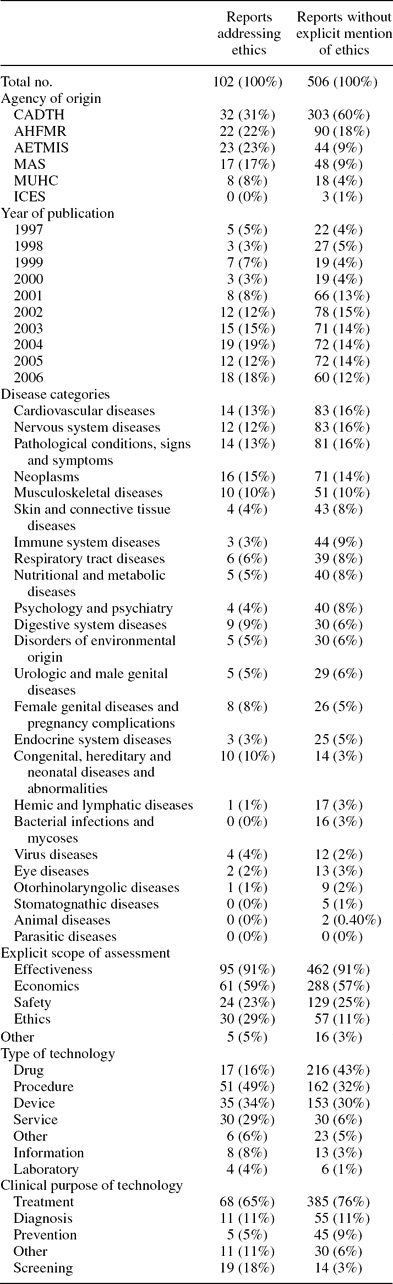
However, Canadian HTAs infrequently identify “ethical” analysis per se. When reports do refer to “ethics,” they invoke a much narrower range of concerns than those outlined by Hofmann (Reference Hofmann18), and analyze these much less rigorously than they do conventional HTA questions (i.e., effectiveness, efficiency). Fourteen percent of all reports explicitly intend to address ethics, that is, by including ethics analysis among the objectives. Ninety-two percent of reports aimed to assess effectiveness, 57 percent assessed economics, and 25 percent assessed safety. Descriptive characteristics of those reports that explicitly intend to address ethics, compared with those that do not, are presented in Table 1.
Descriptive Characteristics, Canadian HTA Reports Addressing Ethics Compared to Those without Explicit Mention of Ethics

Of 608 Canadian HTAs collected, 102 (17 percent) in fact addressed ethical issues (this is the group we refer to as the “ethics subset”). Of this subset, 83 percent included the string “ethic*,” 36 percent included the string “legal*,” 24 percent were identified through careful reading of the abstracts and executive summaries, 5 percent included “moral*,” 12 percent included the term “principle*,” and 10 percent the term “value” or “values.” Of interest, 71 percent of reports in the ethics subset did not include ethics assessment in their objectives.
Reports in the ethics subset addressed digestive system diseases, female genital diseases and pregnancy complications, or congenital, hereditary, and neonatal diseases and abnormalities more frequently than the nonethics HTAs (9 percent, 8 percent, and 10 percent versus 6 percent, 5 percent, and 3 percent, respectively). Substantially fewer of the ethics subset reports dealt with pharmaceuticals compared with the set of HTAs omitting ethics (16 percent versus 43 percent, respectively). The proportion of reports dealing with screening technologies was much greater in the ethics subset than in the set of reports that did not address ethics (18 percent versus 3 percent, respectively).
What sorts of ethical issues are addressed in the ethics subset? Ethical considerations occur at two levels in HTA (Reference Dahlgren10;20). The first is the ethical review of primary research studies included in the HTA, which appears commonly in Canadian HTA reports (n = 23 of ethics subset). Topics include, for example, ethical barriers to randomized controlled trials of effectiveness, or whether primary studies included in the assessment received ethics approval.
The second level of consideration involves assessing the ethicality or implications of the technology itself. This covers a diverse range of issues in Canadian HTAs. Ethical analyses of technologies vary from consequentialist (i.e., whether an action is morally right depends only on its consequences, e.g., “Identifying fetuses with a congenital disease and performing abortions can reinforce the prejudices toward handicapped individuals” [15, p. 40]), to deontological (i.e., duty based ethics with a focus on the rightness or wrongness of intentions or motives behind action, e.g., “Dissecting a patient's fundamental constitutional makeup also raises psychological, ethical and professional questions” [17, p. 38]), to principlist (i.e., moral judgment based on four moral principles of autonomy, beneficence, nonmaleficence and justice, e.g., “After autonomy and justice, the other two overarching principles are beneficence and nonmaleficence” [24, p. 45]) or virtue ethics based (i.e., moral judgment that emphasizes character over rules or consequences, e.g., “The CMQ feels that the use of telemedicine should not alter the physician–patient relationship” [32, p. 39]).
Reports addressing ethics seldom report that authors with ethical expertise were involved in the HTA (7 percent). When they are involved, their contributions typically are not described, and often their roles are characterized as subjunctive to the analysts responsible for more technical aspects of the assessment, for example: “An economist, a lawyer and an ethicist joined the team to deal with the additional aspects of the assessment” (32, p. 3). In some cases, authors with ethical expertise are listed as “reviewers” of the report, suggesting that their input was sought after the assessment had been completed.
When authors are involved in conducting ethical assessments, their contribution typically involves reviewing secondary research:
[A research officer] reviewed abstracts and selected articles for inclusion in the ethical issues section; assessed study quality; abstracted and analyzed data; and prepared and revised the ethics section of this report (27, p. ii).
None of the reports includes primary analysis by an author reported to have ethical expertise. In one instance, “a multidisciplinary working group was convened to explore the social, ethical, and legal issues regarding MS/MS screening with the objective of building a theoretical framework” (35, p. 48); however it is unclear whether authors with ethical expertise were involved in the “multidisciplinary group”, and the resulting report includes no further reference to any such framework. Two reports include a section labeled “expert opinion”, authored by medical professionals without specified ethics training, in which ethical issues are discussed (Reference Scott34).
Secondary research is the predominant method used to incorporate ethical considerations into HTA documents. Agencies employ a variety of strategies for generating these secondary analyses. In eight cases, ethically relevant literature is sought within the overall search strategy for the assessment using keywords. For example, one report describes this approach:
With respect to the literature review, searches on PubMed (National Library of Medicine, including Medline and pre-Medline) were conducted using the following key words: “high-tech home care”, “home care delivery models”, “ethical issues”, “legal issues”, “social issues”, and “organizational issues” . . . (Reference Brophy and Erickson6;Reference Lehoux and Law24, p. 4).
In the example above, although ethical issues are explicitly sought, the review relies on PubMed, a primarily biomedical bibliographic database and a narrow set of text strings. Other reports (n = 13) search broader databases more likely to include ethics literature (e.g., CINAHL, Bioethicsline). Most commonly (n = 81), ethical issues are discussed, yet no strategy for retrieving primary ethics literature is described.
Only three reports include primary empirical research. One report used a mail survey of transplant centers to measure prevailing values and opinions related to the technology (29, p. 50). The survey results were analyzed descriptively and coupled with a review of the published literature to create a comprehensive picture of the ethical aspects related to the technology. Another report explored ethical issues of privacy and consent, surveying home-based chemotherapy program representatives using a mail questionnaire. A third HTA report included original interview data (5, p. 10). Although the goal was not specifically to gather ethical information, the findings from the interviews were cited in the section on ethical issues, suggesting that issues identified in the interviews were taken into consideration.
Just as reports address ethical issues using a variety of methods, there are equally diverse approaches to the presentation of the resulting ethical information. Although many reports include separate sections on aspects such as effectiveness, economics, and safety, dedicated passages addressing ethical issues are rare. Ethics content is typically superficial, and often stops at the mere mention that ethical issues exist, for example: “there may be possible ethical issues related to the use of this device in individuals whose faith prohibits the ingestion of pork” (Reference Demeter and Hailey12), or, “Pharmacogenomic testing carries many social and ethical issues” (Reference Palylyk-Colwell30). In both of these examples, and other similar reports, the ethical issues remain unnamed and their implications unaddressed. Six reports (6 percent) state that ethical assessment of technologies is important, but omit ethical assessment nonetheless: “A more in-depth analysis of the social, ethical and legal repercussions of the large-scale introduction of telepsychiatry services throughout Québec is needed before it is planned and carried out” (32, p. 38). It is not uncommon for a report to end with advice such as: “A number of ethical and legal issues require further discussion” (36, p. 3). Only one HTA report (assessing transdermal hormone replacement therapy) explicitly stated that ethical issues related to the technology were sought but not found (7, p. 20). Six reports (6 percent) omitted an ethical analysis because it had been presented elsewhere, for example, a previous report (21, p. 29), although the ethics findings from the cited reports are not typically discussed. Finally, in one case an identical “boilerplate” ethics discussion was inserted into two reports of different but similar technologies, without cross-reference (Reference Pineau, Moqadem and St-Hilaire31;Reference Pineau, Moqadem and St-Hilaire32).
DISCUSSION
This study has identified Canadian HTA reports containing ethics content published over the last decade, described the range of methods used to address ethical issues, and characterized strategies used to incorporate ethical issues. Overall, we find no standard, robust methodology for ethics assessment in HTA. Ethical issues are explored sporadically and unsystematically, although arguably, these are uniformly present. When ethical issues are analyzed, the findings tend to be superficial and have unclear implications for policy and practice.
Of the 608 HTA documents published by 6 HTA agencies in Canada from 1997 to 2006, 17 percent address ethical issues. This finding parallels the investigation of Lehoux et al. (Reference Lehoux, Tailliez, Denis and Hivon25) of a different set of six Canadian HTA agencies, which also found 17 percent addressed ethical issues. Reports addressing digestive system diseases, female genital diseases, and pregnancy complications more consistently mention ethics than do reports concerned with other health conditions. This may reflect the relative popularity of certain conditions in bioethical scholarship more generally. Technologies such as colorectal cancer screening and liver transplantation, for example, are addressed in the bioethics literature. Similarly, female genital diseases, pregnancy complications, and neonatal abnormalities often involve technologies readily recognized as ethically controversial. We also find that HTA reports concerning pharmaceutical are less likely to address ethics than are reports concerning services. The former may be less well represented in part because many drug assessments often follow shorter report formats that are less likely to incorporate comprehensive issues such as ethics. Services may be relatively more represented because this category includes screening technologies, which involve well-recognized ethical dilemmas. The overall pattern seems to reflect a common attitude that ethical analyses are only necessary for controversial technologies, rather than applicable to the evaluation of every health technology.
What approaches do Canadian HTA agencies use to integrate ethically relevant information into HTA reports? We found that, in practice, agencies seldom report consulting authors with ethical expertise. When researchers with ethical expertise appear as HTA authors, their role in the assessment is often unclear (e.g., the extent to which they were involved in the design, analysis, writing, or editing of the report). Sometimes authors with a clear hand in ethical assessment have unspecified expertise in ethics. What does ethical expertise, as a means for incorporating ethical issues into HTA reports, entail? Bioethics is a branch of philosophical inquiry; it involves “advancing and examining arguments about what ought, morally, to be done and not done—about what is (actually, rather than merely thought to be) right and wrong” (Reference Benatar4). This sort of genuine ethical inquiry is rarely found in Canadian HTA. The role of ethical experts is more typically described as searching the literature for articles containing ethical issues, abstracting the issues, and summarizing information in a manner analogous to the review of clinical evidence.
Secondary literature review is currently the most common method of incorporating ethical issues in Canadian HTA reports. This is not surprising given that HTA is conceived as a method for producing evidence on the basis of synthesizing existing information (Reference Draborg and Andersen13), with systematic review the dominant HTA method (Reference Draborg and Gyrd-Hansen14). The main advantage of using secondary research to collect ethically relevant information is that it can be more feasibly integrated within the current methodologies typically used by HTA agencies.
There are particular challenges in the secondary analysis of ethics-related health technology scholarship, however. First, a vast amount of relevant ethics scholarship is indexed in nonclinical bibliographic databases, necessitating a much broader search strategy. Second, search strategies that will locate the appropriate citations within a given database are limited. Searchers looking for ethics-related citations in Medline can limit their search using the Bioethics Subset (‘Bioethics’ is available as a subset under the limits feature in Medline/PubMed or alternatively can be indicated in the search statement by adding “AND bioethics [sb]” to the search statement) (Reference Kahn and Ninomiya22). In LOCATORplus, ethics-related citations can be retrieved using the search string “(ethic? OR bioethic? OR KIE) AND subject term” (Reference Kahn and Ninomiya22). Researchers can also use free text words to retrieve ethics-related citations (e.g., “subject term AND ethics”). The final barrier to targeting ethics related literature is the trade-off between sensitivity and specificity. A targeted search using the Bioethics Subset as a limiter can potentially miss relevant information. Conversely, a broad search using the subject term and “ethics” will retrieve numerous citations, many of which are irrelevant. Retrieved literature comes in a variety of formats, including lengthy essays and monographs. These resist the reduction and tabulation exercises typical of systematic reviews of biomedical research, and require a more scholarly and selective narrative review.
In practice, however, we find that most HTA agencies rely on the ethics literature indexed in biomedical databases only, and few use ethics-specific search terms. Many describe no method of systematically identifying and reviewing the ethical scholarship. Following on the conventions of HTA, one might expect to find a methods description that describes a search strategy, the literature identified, as well as a thorough review and citation of this literature, that is, a narrative review in a spirit of transparency analogous to that given to systematic reviews of clinical evidence.
Primary research provides a third approach for integrating ethical issues into HTA. In bioethics, this generally involves original analysis by an ethicist. This might involve top-down use of ethical theory to define the possible ethical issues, or bottom-up descriptive ethics using empirical methods to identify prevailing ethical values or stances to inform the assessment, or both. Primary ethical analysis is rare. We found 2 reports that used primary mail survey research on technology appropriateness. Another report conducted qualitative interviews on a nonethical topic, but found that ethical issues emerged incidentally. Primary research in ethics, as in other disciplines, may be worthwhile when it provides needed information that is inadequate or missing from existing literature.
A lingering and important question is when ethical assessment is appropriate in HTA. Perhaps the small percentage of HTA reports that address ethical issues reflects a conviction that ethical issues are not relevant to the assessment of most technologies. The lack of explicit attention to ethics despite the implicit presence of ethical issues could mean (i) that HTA analysts do not recognize ethical issues, or, (ii) that HTA analysts recognize ethical issues but work under tacit understandings of moral consensus that are left implicit (Reference Grunwald16), or (iii) that HTA analysts recognize ethical issues but consider them outside their expertise or remit, and thus “ignore” them. Despite universal mandates in Canada to address ethical issues in HTA, the clause “when appropriate” often pertains. Hofmann (Reference Hofmann19) suggests that ethical issues are inherent in all technologies—HTA, as “evaluation,” requires a reflection on values. Our analysis of a sample of HTA reports using the Hofmann checklist (Reference Hofmann18) confirms this: ethical issues, as identified through the checklist, were present in all reports, but only made explicit in half of them. Grunwald argues that only occasions of moral conflict call for explicit ethical analysis (Reference Grunwald16); under conditions of moral consensus, “business-as-usual” HTA may proceed without special ethical expertise or analysis. However, Grunwald (Reference Grunwald16) points out that moral indifference is a form of moral conflict requiring ethics involvement, and that discerning between conditions of moral conflict and consensus is crucial to ethical HTA. It remains a challenge for health technology assessors and their policy-making counterparts to determine the cases for which explicit ethical attention is necessary.
Although inescapable and imperative, ethical analysis in HTA remains methodologically underdeveloped (20). Like all methods of HTA, it seems far easier to generate descriptive accounts of evidence and issues than prescriptive advice for policy making (Reference Menon and Topfer28). For example, the seminal Hofmann checklist (Reference Hofmann18) primarily serves to indicate whether ethical issues are addressed, not resolved, in HTA. Some questions are more descriptive than normative (without considerable additional analysis), for example, “what patient group is the beneficiary?” To transform lists of ethical considerations into an ethical assessment that might guide policy requires normative analysis—answers to questions of what is right, good, moral, or consistent with values. For this, additional information from theoretical scholarship, empirical research, and ethical expertise may be required—each entailing their own analytic requirements (20).
In summary, Canadian HTA reports rarely address ethical issues, despite mandates to do so and ethical scholars’ in HTA consensus that ethical issues are intrinsic to all health technologies. A more systematic and transparent approach to ethical analysis in HTA should identify ethical issues and go further to develop methods that contribute meaningfully to the evaluation of the health technology.
CONTACT INFORMATION
Deirdre DeJean, MSc (dejeand@mcmaster.ca), Doctoral Candidate, Health Research Methodology Programme, Mita Giacomini, PhD (giacomin@mcmaster.ca), Professor, Department of Clinical Epidemiology & Biostatistics, Lisa Schwartz, PhD (schwar@mcmaster.ca), Associate Professor, Clinical Epidemiology & Biostatistics, McMaster University, 1200 Main Street West, HSC-3H1C, Hamilton, Ontario L8N 3Z5, Canada
Fiona A. Miller, PhD (fiona.miller@utoronto.ca), Associate Professor, Department of Health Policy, Management and Evaluation, University of Toronto, 155 College Street, Suite 425, Toronto, ON M5T 3MS, Canada