There is growing evidence that callous-unemotional (CU) traits (e.g., a lack of guilt and empathy; poverty in emotional expression) may designate an important subgroup of antisocial youth (see Frick, Reference Frick2006; Frick & Marsee, Reference Frick, Marsee and Patrick2006, for reviews). For example, Frick and Dickens (Reference Frick and Dickens2006) reviewed 24 published studies using 22 independent samples that have shown that the presence of CU traits (a) designates a particularly severe and aggressive group of antisocial youth in both adjudicated (e.g., Kruh, Frick, & Clements, Reference Kruh, Frick and Clements2005) and nonadjudicated (e.g., Frick, Cornell, Barry, Bodin, & Dane, Reference Frick, Cornell, Barry, Bodin and Dane2003) adolescents, (b) predicts future aggressive and violent behavior in adjudicated (e.g., Vincent, Vitacco, Grisso, & Corrado, Reference Vincent, Vitacco, Grisso and Corrado2003) and nonadjudicated (e.g., Frick, Stickle Dandreaux, Farrell, & Kimonis, Reference Frick, Stickle, Dandreaux, Farrell and Kimonis2005) adolescents, and (c) predicts poorer response to treatment in adjudicated adolescents (e.g., Falkenbach, Poythress, & Heide, Reference Falkenbach, Poythress and Heide2003). Existing research also suggests that the presence of CU traits designates a group of antisocial youth with a distinct temperament that could play an important role in their impaired moral development (Blair, Reference Blair1995; Frick & Morris, Reference Frick and Morris2004). Specifically, antisocial youth with CU traits show a preference for thrill and adventure seeking activities (Frick, Cornell, Bodin, et al., Reference Frick, Cornell, Barry, Bodin and Dane2003; Frick, Lilienfeld, Ellis, Loney, & Silverthorn, Reference Frick, Lilienfeld, Ellis, Loney and Silverthorn1999), a reward dominant response style (Barry et al., Reference Barry, Frick, Grooms, McCoy, Ellis and Loney2000; Fisher & Blair, Reference Fisher and Blair1998), and deficits in the processing of emotional stimuli (Blair, Reference Blair1999; Kimonis, Frick, Fazekas, & Loney, Reference Kimonis, Frick, Fazekas and Loney2006; Loney, Frick, Clements, Ellis, & Kerlin, Reference Loney, Frick, Clements, Ellis and Kerlin2003).
The deficit in the processing of emotional stimuli is important because it is a deficit that is also found in antisocial adults with psychopathic traits and, thus, it provides a theoretical link between the literature on CU traits in children and psychopathy in adults. Specifically, research has found that adults with psychopathic traits show a reduced skin conductance response to stimuli involving distress cues (Aniskiewz, Reference Aniskiewicz1979; Blair, Jones, Clark, & Smith, Reference Blair, Jones, Clark and Smith1997; House & Milligan, Reference House and Milligan1976), an inhibited startle reflex to noise probes while viewing distressing images (Levenston, Patrick, Bradley, & Lang, Reference Levenston, Patrick, Bradley and Lang2000), cognitive and electrocortical abnormalities in response to negative words (Williamson, Harpur, & Hare, Reference Williamson, Harpur and Hare1991), and impairment in recognizing fearful vocal affect (Blair, Budhani, Colledge, & Scott, Reference Blair, Budhani, Colledge and Scott2005; Blair et al., Reference Blair, Mitchell, Richell, Kelly, Leonard and Newman2002). Research on emotional deficits in youth with CU traits is less extensive but reveals similar findings. Specifically, youth with CU traits show a reduced electrodermal response to distress and threat slides (Blair, Reference Blair1999), deficits in cognitive responses to words with a negative emotional content (Loney et al., Reference Loney, Frick, Clements, Ellis and Kerlin2003), and an impairment in recognizing both sad and fearful facial expressions and vocal tones (Blair, Colledge, Murray, & Mitchell, Reference Blair, Colledge, Murray and Mitchell2001; Stevens, Charman, & Blair, Reference Stevens, Charman and Blair2001). In addition, youth high on CU traits and aggression show a reduced emotional responsiveness to pictures involving distressing content (e.g., persons or animals in pain; Kimonis et al., Reference Kimonis, Frick, Skeem, Marsee, Cruise and Munoz2006). In sum, the deficient emotional processing of youth and adults with psychopathic traits is generally in response to negative emotional stimuli, and even more specifically in response to distressing stimuli.
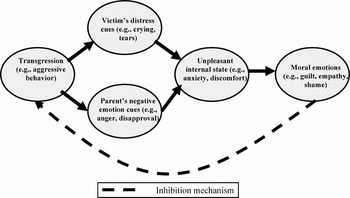
As a result of this literature, deficits in the processing of emotional stimuli have played a major role in many etiological theories of psychopathic traits in adults (Blair, Reference Blair1995; Patrick, Reference Patrick1994) and CU traits in children and adolescents (Frick & Morris, Reference Frick and Morris2004). For example, Cleckley (1982) proposed that individuals with psychopathy do not develop appropriate morality because their early socializing experiences are not accompanied by normal affective experiences. Similarly, a number of developmental theories have emphasized the importance of normal emotional responses in the development of the affective components of conscience (see Frick & Morris, Reference Frick and Morris2004, for a review). In early development, a child's transgression (e.g., aggressive behavior) is met with the parent's affective response signaling a threat of punishment (e.g., anger, disapproval) and/or the distress cues (e.g., crying, tears) of the victim of the transgression. These cues elicit an unpleasant internal state (e.g., anxiety, discomfort) in the child that is coded as a moral emotion (e.g., guilt, empathy). This hypothesized process is illustrated in Figure 1. Repeated pairings of this series of events results in a conditioning process through which the child develops his or her internalized model of morality (Blair, Reference Blair1995; Kochanska, Reference Kochanska1993). As a result, strong emotions of fear and guilt are elicited in the child at even the thought of a future transgression and in the absence of the socializing agent (e.g., parent), functioning to inhibit future transgressions (Kochanska, Reference Kochanska1993). Thus, the impaired emotional experiences in the child with psychopathic traits could interfere with early moral socialization by disrupting this normative conditioning process (Eysenck, Reference Eysenck1964). As a result, moral emotions fail to develop and fulfill their function of inhibiting aggressive and antisocial behaviors.
The developmental model for moral socialization.

However, this theoretical model may not explain the development of CU traits (e.g., lack of empathy, guilt) for all individuals, in particular, those that do not show emotional deficits. For example, although preliminary, in the few studies that have examined these emotional deficits in ethnically diverse samples, the link between emotional deficits and psychopathic traits in adults (Kosson, Smith, & Newman, Reference Kosson, Smith and Newman1990; Lorenz & Newman, Reference Lorenz and Newman2002a) and between emotional deficits and CU traits in children (Kimonis, Frick, Fazekas, et al., Reference Kimonis, Frick, Fazekas and Loney2006) have not been as strong in African American individuals as in Caucasian individuals. For example, Lorenz and Newman (Reference Lorenz and Newman2002a) found that adult African Americans high on psychopathy compared with African Americans low on psychopathy did not show the same affective processing deficits on a lexical decision task that had differentiated the performance of Caucasian individuals with and without psychopathic traits (Lorenz & Newman, Reference Lorenz and Newman2002a). In addition, in their child sample, Kimonis, Frick, Fazekas, et al. (Reference Kimonis, Frick, Fazekas and Loney2006) did not find the same relationship between CU traits and reduced sensitivity to distressing stimuli in African American children as was found in Caucasian children. Ethnic differences in the various processes underlying psychopathy may be explained by social factors related to living in a threatening living environment, which are more likely experienced by African American individuals living in urban areas (Skeem, Edens, Sanford, & Hauser, Reference Skeem, Edens, Sanford and Hauser2004). The majority of research studies to date that use samples that are a majority or entirely Caucasian would fail to detect such important moderating effects of race (e.g., Blair et al., Reference Blair, Budhani, Colledge and Scott2005; Patrick, Bradley, & Lang, Reference Patrick, Bradley and Lang1993).
Another potential moderator is the presence of aggression. Research to date has focused largely on the association between emotional processing deficits and CU traits in antisocial samples (e.g., Loney et al., Reference Loney, Frick, Clements, Ellis and Kerlin2003; Patrick et al., Reference Patrick, Bradley and Lang1993). This methodology leaves open the possibility that the differences in the processing of emotional stimuli may be associated with the aggressive and antisocial behavior exhibited by persons with CU traits. For example, in both adults (Woodworth & Porter, Reference Woodworth and Porter2002) and youth (Frick, Cornell, Barry, et al., Reference Frick, Cornell, Barry, Bodin and Dane2003; Kruh et al., Reference Kruh, Frick and Clements2005), individuals high on CU traits also tend to show high rates of aggression. Further, some aggressive individuals also show a reduced responsiveness to emotional stimuli (Hubbard et al., Reference Hubbard, Smithmyer, Ramsden, Parker, Flanagan and Dearing2002; Pitts, Reference Pitts, Raine, Brennan, Farrington and Mednick1997). Therefore, it is unclear whether the abnormalities in emotional processing are more strongly related to the presence of CU traits, to the presence of aggression, or to the combined presence of aggression and CU traits. In support of the latter possibility, Kimonis, Frick, Fazekas, et al. (Reference Kimonis, Frick, Fazekas and Loney2006) found that CU traits were associated with a reduced responsiveness to distressing stimuli but only for children high on aggression. This finding fits with the theoretical model presented in Figure 1 that suggests that an emotional deficit would interfere with the conditioning process that is essential to normative moral development, resulting in the youth's failure to experience moral emotions that function to inhibit aggressive behaviors. However, this finding needs to be replicated in other samples to determine whether aggression may have simply operated as a marker for the severity of CU traits in this community sample of preadolescent children.
Implicit in testing potential moderators to CU traits is the possibility that there may be different etiological pathways in the development of these traits. For example, in psychopathic adults, a distinction has been proposed between primary and secondary psychopathy (Skeem, Poythress, Edens, Lilienfeld, & Cale, Reference Skeem, Poythress, Edens, Lilienfeld and Cale2003). According to Karpman (1941, Reference Karpman1948), these subtypes may be indistinguishable based on their outward behavior, but can be differentiated by the etiology of their emotional deficits. Specifically, primary psychopathy is believed to be strongly associated with emotional deficits that are present early in life and may be congenital (Blair, Reference Blair2001; Hare, Hart, & Harpur, Reference Hare, Hart and Harpur1991; Patrick, Reference Patrick1994; Viding, Blair, Moffitt, & Plomin, Reference Viding, Blair, Moffitt and Plomin2005). In contrast, secondary psychopathy has been proposed as either (a) being less strongly associated with emotional deficits (Haapasalo & Pulkkinen, Reference Haapasalo and Pulkkinen1992; Karpman, Reference Karpman1948) or (b) being more strongly related to environmental causes (Mealey, Reference Mealey1995; Porter, Reference Porter1996; Skeem et al., Reference Skeem, Edens, Sanford and Hauser2004). Although both subtypes would appear equally callous, theory supports the possibility that the secondary subtype may or may not show emotional deficits at a more basic level of processing (e.g., direct measures of emotional functioning). For example, the callous interpersonal style of secondary psychopaths may be an adaptive emotional response to harsh environmental conditions, including parental rejection and abuse (see Skeem et al., Reference Skeem, Poythress, Edens, Lilienfeld and Cale2003), rather than the result of a temperamental emotional deficit that interferes with normative conditioning processes during early moral development. Equally viable is the possibility that effectively adapting to chronic and severe trauma in childhood could involve learning to “turn off” emotions through a desensitization process (Porter, Reference Porter1996), resulting in emotional deficits at a more basic level of processing (e.g., changing the pattern of emotional reactivity).
This possibility for a secondary variant to CU traits and psychopathy leads to several important questions for understanding the link between CU traits and deficits in emotional processing. For example, it is not clear from these formulations of secondary psychopathy whether the traumatizing experience would influence the individual at the more basic level of his or her temperament (e.g., changing the pattern of emotional reactivity) or at the level of the interpersonal style related to this temperament (e.g., CU traits). The former possibility would suggest that traumatizing experiences would be related to emotional deficits as well as CU traits. In this case, emotional deficits would account for (i.e., mediate) any association between traumatizing experiences and CU traits. The latter possibility would suggest that CU traits would be more strongly associated with deficits in emotional processing in the absence of traumatizing experiences, such that traumatizing experiences would be another moderator to the link between CU traits and deficits in emotional processing. Further, both competing alternatives are plausible as they may be discretely related to distinct traumatic experiences.
A second important question in considering a secondary pathway to CU traits is to consider what types of traumatizing experiences may be involved in this pathway. There are two possibilities that would be consistent with the existing research. First, research suggests that the experience of abuse and neglect is associated with a variety of emotional deficits, such as the abnormal recognition, expression, and understanding of emotions (Camras et al., Reference Camras, Ribordy, Hill, Martino, Sachs and Spaccarelli1990; see Pollak, Cicchetti, Hornung, & Reed, Reference Pollak, Cicchetti, Hornung and Reed2000), difficulty detecting differences between distinct facial expressions (Pollak et al., Reference Pollak, Cicchetti, Hornung and Reed2000), and a lack of empathy and concern for the distress of others (Klimes-Dougan & Kistner, Reference Klimes-Dougan and Kistner1990; Main & George, Reference Main and George1985; Troy & Sroufe, Reference Troy and Sroufe1987). Second, similar emotional deficits have been identified in youth exposed to violence, leading to a number of theories suggesting that chronic exposure to high levels of violence can interfere with moral development and lead youth to become uncaring, callous, lack empathy and guilt, and show a reduced emotional response toward others (Farrell & Bruce, Reference Farrell and Bruce1997; Fitzpatrick, Reference Fitzpatrick1993; Garbarino, Kostelny, & Dubrow, Reference Garbarino, Kostelny and Dubrow1991; Jonson-Reid, Reference Jonson-Reid1998; Ney, Fung, & Wickett, Reference Ney, Fung and Wickett1994; Pynoos, Reference Pynoos1993).
Based on this background research, it is clear that CU traits have been linked to deficits in the processing of distressing stimuli in youth. However, there may be a number of moderators to this link that could have important theoretical implications, such as the ethnicity of the child, the level of aggression displayed by the child, a history of abuse, and a history of exposure to violence. In the current study we tested three primary hypotheses. First, consistent with past findings, we predicted that the association between CU traits and emotional processing of distressing stimuli would be moderated by the ethnicity of the adolescent participant and by the level of aggression displayed by the adolescent. Specifically, in line with past research, we predicted that CU traits would only be associated with a reduced responsiveness to distressing stimuli for youth that are Caucasian, or youth that are high on aggression. Second, we predicted that adverse living environments (i.e., abuse, exposure to community violence) would also moderate the association between CU traits and the processing of distressing stimuli. Third, we predicted that deficits in the processing of emotional stimuli would be associated with both CU traits and adverse living environments and would mediate the association between these two variables.
Methods
Participants
Participants were 88 detained 13- to 18-year-old boys (M = 15.57, SD = 1.28) housed at a juvenile detention center in a moderate sized metropolitan city in the southeastern United States. The sample consisted of 60 African American (68%), 20 Caucasian (23%), 4 Hispanic (5%), 2 Native American (2%), and 2 boys classified as “Other” ethnicity (2%) based on the boy's self-classification. The 88 participants were a subset of 102 boys who provided assent to participate and whose parents also provided consent. Thirteen boys were excluded from the study because they showed impaired verbal abilities (scores below 66) on the Peabody Picture Vocabulary Test—Third Edition (PPVT-III; Dunn & Dunn, Reference Dunn and Dunn1997), making it unclear if they could understand the study questionnaires, and another boy was unable to complete questionnaires. The mean PPVT-III score of the final sample fell approximately 1 standard deviation below average at 85.6 (SD = 13.5). Each youth's address was used to obtain the median family income for their neighborhood from the United States Census 2000, which ranged from $19,768 to $80,895 with a mean of $38,001 (SD = $13,301). Of the 88 boys, 19% (n = 17) were currently on psychotropic medications, 51% (n = 45) had a history of special education placement, and 69% (n = 61) had received some type of mental health care according to the youth's self report. Based on their institutional records, the youths' current offenses included violent (30.7%), property (40.9%), status (9.1%), drug (11.4%), and other types (8.0%; e.g., weapon, resisting an officer). In addition, 51% had been arrested at least once in the past for a violent crime.
Procedures
A staff member from the detention center contacted the parents or legal guardians of all youth and informed them of a study being conducted by researchers at a local university and asked permission to forward their phone number to the researchers. They were informed that their child's participation in the project would in no way influence his treatment at the detention center or his legal standing in the adjudication process. Those parents who agreed to be contacted by the researchers were phoned and had the study procedures explained to them. As approved by the host university's institutional review board and the director of the detention center, parents or legal guardians who agreed to have their child participate were asked to have the consent process tape-recorded and were subsequently mailed a copy of the consent form for their records. Of the 126 parents contacted, 9 parents declined to participate.
Youth whose parents provided consent were met in a private room at the detention center and were asked to assent to participate. Ten youth declined participation. Five additional youth were released from the facility before youth assent could be obtained. Each youth participating in the study was individually administered a demographic interview followed by a questionnaire requiring him to report on his ethnicity. The youth then completed the computerized emotional pictures dot-probe task described below, followed by the PPVT-III. Later in the day, and at least 0.5 h following the initial session, boys were escorted in groups to a larger visitor's room (groups ranged from one to four youth), where they were read questionnaires by a researcher. Youth recorded their answers on a response sheet in order to facilitate greater confidentiality. In addition, an assistant was available to help answer participant questions and to ensure that each participant was working independently and completed every item. The group was then given their choice of refreshments as compensation (i.e., soft drinks and candy bars).
Measures
CU traits
CU traits were assessed using the 24-item Inventory of Callous-Unemotional Traits (ICU; Frick, Reference Frick2004). The ICU was developed using items from the Callous-Unemotional scale of the Antisocial Process Screening Device (APSD; Frick & Hare, Reference Frick and Hare2001), which is a widely used scale to assess these traits in children and adolescents. However, the self-report CU scale has demonstrated only moderate internal consistency in past studies with adolescent samples (e.g., Falkenbach et al., Reference Falkenbach, Poythress and Heide2003; Loney et al., Reference Loney, Frick, Clements, Ellis and Kerlin2003; Poythress et al., Reference Poythress, Douglas, Falkenbach, Cruise, Lee and Murrie2006), which is likely because of its small number of items (n = 6) and three-point rating system. The Inventory of Callous-Unemotional Traits was designed to overcome the psychometric limitations of the APSD. The four items from the APSD CU scale that loaded consistently on this factor in clinic and community samples (Frick et al., Reference Frick, Bodin and Barry2000) were expanded to include three similar positively worded items and three similar negatively worded items. These 24 items, such as “I do not show my emotions to others,” were then put on a 4-point Likert scale from 0 (not at all true) to 3 (definitely true).
The construct validity of the ICU was supported in a large community sample (n = 1,443) of 13- to 18-year-old nonreferred German adolescents (774 boys and 669 girls; Essau, Sasagawa, & Frick, Reference Essau, Sasagawa and Frick2006), as well as an American sample (n = 248) of male and female juvenile offenders (188 boys, 60 girls) between the ages of 12 and 20 (Kimonis, Frick, Skeem, et al., Reference Kimonis, Frick, Fazekas and Loneyin press). Specifically, the total scale showed predicted associations with aggression, delinquency, personality traits (e.g., sensation seeking, Big Five dimensions), psychophysiology, and psychosocial impairment (Essau et al., Reference Essau, Sasagawa and Frick2006; Kimonis, Frick, Skeem, et al., Reference Kimonis, Frick, Fazekas and Loneyin press). Consistent with these past studies, items 2 and 10 from the ICU were deleted because of low corrected item-total correlations. The remaining 22 items were summed for a total score, which had an internal consistency of α = .73 in the current detained sample.
Emotional processing of distressing stimuli
The emotional pictures dot-probe task (Kimonis, Frick, Fazekas, et al., Reference Kimonis, Frick, Fazekas and Loney2006) is a variant of the traditional word version of the task that has been used extensively in the anxiety literature (MacLeod, Mathews, & Tata, Reference MacLeod, Mathews and Tata1986). This task is designed to tap the preattentive mechanism that automatically directs attention toward biologically relevant aversive stimuli (Ohman, Reference Ohman, Lewis and Haviland1993), providing an indirect index of emotional reactivity. It was selected as the measure of emotional processing for two important reasons. First, emotional processing deficits cannot be adequately assessed though self-report ratings with individuals high on psychopathic traits, as studies show that they rate emotional stimuli in the same way as nonpsychopathic individuals (e.g., Loney et al., Reference Loney, Frick, Clements, Ellis and Kerlin2003; Patrick, Cuthbert, & Lang, Reference Patrick, Cuthbert and Lang1994; Verona, Patrick, Curtin, Bradley, & Lang, Reference Verona, Patrick, Curtin, Bradley and Lang2004; Williamson et al., Reference Williamson, Harpur and Hare1991). Second, compared with psychophysiological measures, the dot-probe task provides a low-cost and noninvasive method for measuring emotional experiences.
The emotional pictures dot-probe task used in the current study was developed using primarily slides taken from the International Affective Picture System (IAPS; Lang, Bradley, & Cuthbert, Reference Lang, Bradley and Cuthbert1997). These slides were carefully selected to tap distressing (e.g., crying child), positive (e.g., puppies), and neutral emotional content (e.g., fork), and had been validated in previous studies with children and adolescents (Blair, Reference Blair1999; McManis, Bradley, Berg, Cuthbert, & Lang, Reference McManis, Bradley, Berg, Cuthbert and Lang2001). Because the number of neutral and distressing images was not sufficient for dividing the slides into neutral, distress, and positive categories, additional slides (distress, n = 19; neutral, n = 42) were added that directly matched the IAPS slide content. For example, additional slides of a crying child were added to the existing IAPS slides of crying children.
The dot probe task consists of one block of practice stimuli (16 picture pairs) followed by four test blocks of picture pairs, each containing 24 picture pairs. Each picture pair presentation consists of three sequential and nonoverlapping components: (a) a 500-ms fixation cross appearing in the center of the screen, (b) a 250- or 500-ms simultaneous presentation of two picture stimuli that are centered and located immediately above and below the location of the fixation cross, and (c) an asterisk (i.e., dot probe) appearing in either the top or bottom picture location immediately after the offset of the picture. The objective of the task is to select a key on the keyboard that corresponds to the location on the screen (up or down) where the dot-probe appears, as quickly as possible. The time between when the probe appears and when the youth presses the corresponding key to its location is recorded in milliseconds and used for the calculation of facilitation indices (described below). If the spatial location of the probe corresponds to the same spatial location where the participant's attention is allocated then their response to the probes' location will be faster. If no key is pressed within 5000 ms, the response is recorded as incorrect. Consistent with past uses of the task (Vasey, Daleidon, Williams, & Brown, Reference Vasey, Daleidon, Williams and Brown1995; Vasey, El-Hag, & Daleidon, Reference Vasey, El-Hag and Daleidon1996), incorrect responses were not included in the calculation of facilitation indices as they reflect that the participant was not paying attention to a specific stimulus pair. In addition, response times of <100 ms were not included in calculations because they were considered to be outliers resulting from program error.
The picture pairs represented one of three potential picture pairings: neutral–neutral, distress–neutral, and positive–neutral. The number and location of picture stimuli were counterbalanced across test trials to assure an equal number of emotional and neutral stimuli appearing in both top and bottom locations of the screen across the four blocks of test stimuli. In addition, there were an equal number of emotional and neutral stimuli that were replaced versus not replaced by a dot-probe stimulus. The primary dependent measure for the current study is an attentional facilitation index, which was calculated using the following formula (MacLeod & Mathews, Reference MacLeod and Mathews1988): facilitation = 1/2 × [(neutral only/probe up − distress up/probe up) + (neutral only/probe down − distress down/probe down)]. This index is calculated by subtracting the participant's average response time to probes replacing distress stimuli from their average response time to probes replacing neutral stimuli in the various neutral–neutral picture pairings. This formula controls for potential location effects (participant's tendency to attend to either the top or bottom location of the screen) by summing latencies for top and bottom picture locations and taking their average. The facilitation index for positive emotion slides was calculated in the same way, and was included to compare participants on their processing of two distinct types of emotional stimuli. Given that the emotional quality of stimuli is generally thought to facilitate allocation of attention, participants were generally expected to respond more quickly to probes replacing emotional (distress, positive) images because their attention selectively orients to them (Ohman, Reference Ohman, Lewis and Haviland1993; Vasey et al., Reference Vasey, Daleidon, Williams and Brown1995, Reference Vasey, El-Hag and Daleidon1996). This normal response pattern would result in an overall shorter mean response time to distressing or positive pictures, indicated by higher scores on the facilitation index.
Facilitation indices were calculated for distress and positive stimuli at the 250- and 500-ms stimulus durations. Studies using the dot-probe task in college students most commonly use a stimulus duration of 500 ms for picture presentations; however, the duration can range anywhere from 17 to 1,250 ms, with more robust findings at shorter stimulus durations (17 ms; Fox, Reference Fox2002; and 500 ms; Bradley, Mogg, Falla, & Hamilton, Reference Bradley, Mogg, Falla and Hamilton1998). A previous study with a similar version of the dot-probe task in children used a 500-ms stimulus duration (Kimonis, Frick, Fazekas, et al., Reference Kimonis, Frick, Fazekas and Loney2006). However, there is a general lack of research guiding appropriate stimulus durations across different developmental levels. Therefore, the current version of the task included two stimulus durations, 250 and 500 ms, which were evenly and randomly distributed throughout the test trials. The 500-ms duration was used based on its validity from a previous study of children (Kimonis, Frick, Fazekas, et al., Reference Kimonis, Frick, Fazekas and Loney2006). The second stimulus duration of 250 ms was selected to (a) include a shorter stimulus duration that avoids confounding automatic and effortful processes and (b) to address the possibility that individuals exposed to trauma may show an attentional bias for actively orienting away from (i.e., avoiding) distressing images when the stimulus duration is long enough to detect this effortful process (Elsessor, Sartory, & Tackenberg, Reference Elsesser, Sartory and Tackenberg2004). This latter issue was also addressed by including a disengagement score.Footnote 1
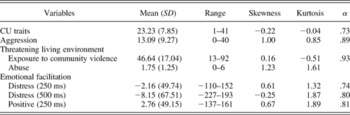
The internal consistency of facilitation indices for each picture category (i.e., distress, positive) at each stimulus duration (i.e., 250 and 500 ms) was examined. Three pictures were removed from the calculation of facilitation to distress pictures at the 500-ms stimulus duration because of low item-total correlations (i.e., r = −.02; r = .07; r = .04). In addition, facilitation scores that fell more than 3 standard deviations above or below the mean were eliminated from analyses (distress 250 ms, n = 2; distress 500 ms, n = 4, positive 250 ms, n = 2). This resulted in adequate internal consistency for facilitation to distress pictures at the 250 ms (α = .74) and 500 ms (α = .80) durations, and facilitation to positive pictures at the 250-ms stimulus duration (α = .81). However, the internal consistency for facilitation to positive pictures at the 500-ms stimulus duration (α = .31) was low, and this facilitation index was not included in any analyses.
Aggression
Participant's self-report of aggression was measured using the Peer Conflict Scale (PCS; Kimonis, Marsee, & Frick, Reference Kimonis, Marsee and Frick2004). The PCS was developed to improve upon existing measures for assessing aggression by measuring four dimensions of aggression (i.e., reactive, proactive, overt, and relational aggression) and including a sufficient number of items (n = 10) for each, while also limiting items to acts harming another person. Items were pooled from a number of aggression scales (Bjorkqvist, Lagerspetz, & Osterman, Reference Bjorkqvist, Lagerspetz and Osterman1992; Brown, Atkins, Osborne, & Milnamow, Reference Brown, Atkins, Osborne and Milnamow1996; Crick & Grotpeter, Reference Crick and Grotpeter1995; Dodge & Coie, Reference Dodge and Coie1987; Galen & Underwood, Reference Galen and Underwood1997; Little, Jones, Henrich, & Hawley, Reference Little, Jones, Henrich and Hawley2003). Redundant items and items that were not clearly related to harming others were deleted. These items were reviewed to ensure that the wording was simple and developmentally appropriate. The total overt aggression score, excluding all items related to relational aggression, was used in the current study and consisted of 20 items assessing both reactive (e.g., “When I am teased, I will hurt someone or break something”) and proactive (e.g., “I have hurt others to win a game or contest”) overt aggression. Items are rated on a 4-point scale from 0 (not at all true) to 3 (definitely true), and the scale demonstrated good internal consistency (α = .89) in this detained sample.
Exposure to violence
Children's self-reported exposure to community violence was assessed using the Children's Report of Exposure to Violence—Revised (CREV-R: Cooley, Turner, & Beidel, Reference Cooley, Turner and Beidel1995). The CREV-R is a 33-item scale that assesses exposure to community violence. Community violence is defined as “deliberate acts intended to cause physical harm against a person or persons in the community” (Cooley-Quille, Boyd, Frantz, & Walsh, Reference Cooley-Quille, Boyd, Frantz and Walsh2001), and includes situations such as being robbed or mugged, stabbed, or killed. For the first 29 items, youth rate the frequency of their exposure to violence on a 5-point Likert scale from 0 (never) to 4 (every day). The CREV also includes four open-ended questions for youth to indicate whether they have ever been exposed to other types of violent acts not listed. The youth's lifetime total exposure to community violence score was used in the current study by summing all of the 29 rated items. The CREV has demonstrated good internal consistency (α = .78) and 2-week test–retest reliability (r = .75), and has been used in research with high-risk African American youth between the ages of 9 and 15 (i.e., Cooley et al., Reference Cooley, Turner and Beidel1995; Cooley-Quille et al., Reference Cooley-Quille, Boyd, Frantz and Walsh2001). In the current study the total exposure to violence score ranged from 13 to 92 with a mean of 46.64 (SD = 17.04), which is consistent with findings from a community sample of inner-city high school students (M = 52.03, SD = 16.21; Cooley-Quille et al., Reference Cooley-Quille, Boyd, Frantz and Walsh2001). The scale demonstrated good internal consistency (α = .93) in the current detained sample.
Abuse history
As part of their standardized intake procedures, every youth entering the participating detention center was administered the Multifaceted Assessment of Juvenile Offender Risk (MAJOR; Trainham, Reference Trainham2000) by a trained staff member. The MAJOR is a structured interview that predominately asks youth to respond to a series of questions in a yes/no format. The abuse scale of the MAJOR consists of eight items, and was used in the current study to assess the child's experience of physical (three items; e.g., Have you ever had bruises, burns, or broken bones as a result of being hit by a parent or guardian?) and sexual abuse (two items; e.g., Has anyone other than your parents ever touched you in ways that made you feel uncomfortable?), and related maltreatment issues (three items; e.g., Have your parents ever been investigated by the child protection agency?). Abuse scores from the MAJOR were obtained from the child's detention center records and ranged from 0 to 6, with a mean of 1.75 (SD = 1.25).
Results
The distributions of the main study variables are described in Table 1. The mean facilitation to distress images was −2.16 (SD = 49.74) at the 250-ms stimulus duration and −8.15 (SD = 67.51) at the 500-ms stimulus duration. In addition, the mean facilitation to positive images (250 ms) was 2.76 (SD = 49.15). These distributions from the dot-probe task suggest that, on average, participants showed a typical response pattern to the positive stimuli, being somewhat quicker to recognize probes following positive emotional stimuli (Kimonis, Frick, Fazekas, et al., Reference Kimonis, Frick, Fazekas and Loney2006). However, this detained sample overall did not show the normative pattern for faster recognition of probes following distress pictures.
Distributions of main study variables

Note: CU, callous-unemotional.
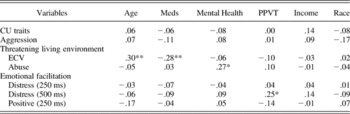
The correlations between the main study variables and demographic variables are reported in Table 2. Age, taking psychotropic medications, receipt of mental health services, PPVT scores, income, and ethnicity were generally not associated with the main study variables. Three exceptions were that exposure to community violence was positively associated with age (r = .30, p < .01) and negatively associated with taking psychotropic medications (r = −.28, p < .01) and abuse was positively associated with receipt of mental health services (r = .27, p < .05). Demographic variables were generally not significantly associated with facilitation indices to distress or positive pictures at either stimulus duration, with the exception of a significant positive association between verbal ability (PPVT) and facilitation to distress stimuli at the 500-ms stimulus duration (r = .25, p < .05). This suggests that boys with a higher verbal ability tended to show a greater facilitation to distress pictures at the longer stimulus presentation.
Correlations between main study variables and demographics

Note: CU, callous-unemotional; Meds, taking psychotropic medication; Mental health, receipt of mental health services; PPVT, Peabody Picture Vocabulary Test (verbal ability); ECV, exposure to community violence; n = 88 for CU traits and aggression; n = 87 for ECV; n = 86 for facilitation to distress and positive (250 ms); n = 85 for abuse; n = 83 for facilitation to distress (500 ms); n = 80 for race. Race was coded as 0 for Caucasian and 1 for African American.
*p < .05. **p < .01.
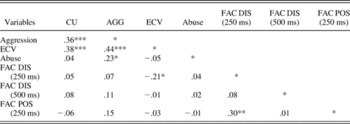
In Table 3, the correlations among CU traits, aggression, exposure to community violence, abuse, and facilitation indices are provided. As expected from past research, there was a significant correlation between CU traits and aggression (r = .36, p < .001) and abuse and aggression (r = .23, p < .05). In addition, exposure to community violence was significantly positively correlated with CU traits (r = .38, p < .001) and aggression (r = .44, p < .001). Facilitation indices were generally uncorrelated with the main study variables, with correlations ranging from −.06 to .15. Specifically, facilitation indices were not significantly associated with CU traits. The one significant correlation with the facilitation indices was between exposure to community violence and facilitation to distress pictures at the 250-ms stimulus duration (r = −.21, p < .05), indicating that greater exposure to community violence was related to a reduced responsivity to distress stimuli.
Correlations among main study variables

Note: CU, callous-unemotional traits; AGG, aggression; ECV, exposure to community violence; FAC DIS, facilitation to distress; FAC POS, facilitation to positive; n = 88 for CU traits and aggression; n = 87 for ECV; n = 86 for facilitation to distress and positive (250 ms); n = 85 for abuse; n = 83 for facilitation to distress (500 ms).
*p < .05. **p < .01. ***p < .001.
According to Baron and Kenny (Reference Baron and Kenny1986) a variable functions as a mediator when it meets the following conditions: (a) the independent variable (abuse/community violence exposure) is significantly associated with the presumed mediator (emotional processing), (b) the mediator is significantly associated with the dependent variable (CU traits), and (c) when controlling for the mediator, the previously significant relation between the independent and dependent variables is no longer significant (Baron & Kenny, 1986, p. 1176). According to this definition, the processing of emotional stimuli could not be a mediator of the association between CU traits and traumatic environments as predicted because it was not significantly correlated with CU traits. Thus, no further tests of mediation were performed.
Testing the moderating effects of ethnicity
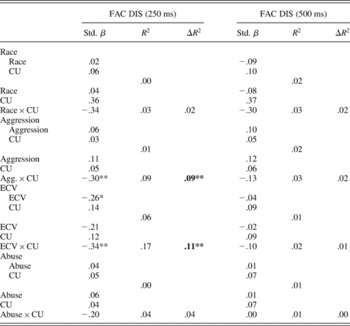
However, it was still possible that the weak associations between CU traits and facilitation indices were because of the presence of the hypothesized moderator variables. To test for these potential moderating effects, a series of two-step hierarchical multiple regression analyses were conducted. For these analyses, all predictors were centered by subtracting the sample mean from each participant's score. Centering is necessary to reduce the multicollinearity between predictors and the interaction term that is formed based on them. The first of these analyses tested whether CU traits were similarly associated with facilitation to distress and positive stimuli across ethnic groups. For these analyses, ethnicity was dummy coded as 0 for Caucasian and 1 for African American, and the other ethnic groups were eliminated from these analyses. In Step 1, facilitation indices were individually regressed onto the predictors, ethnicity and CU traits. In Step 2, a multiplicative interaction term was entered into the equation to test for the interaction between these two predictors. The results of these analyses for predicting the emotional processing of distress stimuli are presented in Table 4. For these regressions none of the interactions were significant, such that there was a .02 change in R 2 when the interaction term was added. The interaction for predicting positive facilitation was also nonsignificant.Footnote 2
Hierarchical regression analyses testing for the potential moderating role of race, aggression, exposure to community violence, and abuse in the association between callous-unemotional traits and processing of distress of cues

Note: CU, callous-unemotional traits; ECV, exposure to community violence; FAC DIS, facilitation to distress. All predictors were centered using the sample mean prior to entering them into the regression analyses; n = 88 for CU traits and aggression; n = 87 for ECV; n = 86 for FAC DIS (250 ms); n = 85 for abuse; n = 83 for FAC DIS (500 ms); n = 80 for race.
*p < .05. **p < .01.
Testing the moderating effects of aggression
To determine whether CU traits were differentially associated with facilitation indices across levels of aggression, similar two-step hierarchical multiple regression analyses were conducted using CU traits and aggression (both measured continuously) as the two predictors. In Step 1, facilitation indices were individually regressed onto the predictors, aggression and CU traits. In Step 2, a multiplicative interaction term was entered into the equation to test for the interaction between these two predictors. There were no significant interactions between CU traits and aggression in predicting facilitation to distress pictures at the 500-ms stimulus duration or facilitation to positive pictures. However, there was a significant interaction between CU traits and aggression in predicting facilitation to distress pictures at the 250-ms stimulus duration (R 2 change = .09, p < .01). The results of these analyses for the distress indices are provided in Table 4.
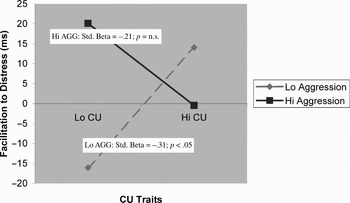
The form of this interaction was tested using the procedure recommended by Holmbeck (Reference Holmbeck2002). In this procedure, the regression equation from the full sample is used to calculate predicted values of the dependent variable (i.e., the facilitation index to distress pictures) at high (1 SD above the mean) and low levels (1 SD below the mean) of the two predictors (i.e., CU traits and aggression scores). Post hoc probing was used to determine if the association between CU traits and facilitation to distress pictures at the 250-ms stimulus duration was significant at either of the two levels of aggression by computing the simple slopes (i.e., standardized betas) and testing these for significance (Holmbeck, Reference Holmbeck2002). The form of this interaction is summarized in Figure 2. The results of these analyses show a different association between CU traits and facilitation to distress at low and high levels of aggression that led to the significant interaction. Specifically, as predicted, there was a negative association between CU traits and facilitation to distress pictures at high levels of aggression (standardized β = −.21, p = ns). However, at low levels of aggression there was a significant positive association between CU traits and the facilitation index to distress pictures (standardized β = .31, p < .05).
The interaction between callous-unemotional traits and facilitation to distress pictures (250 ms) at high and low levels of aggression.

Testing the moderating effects of abuse and exposure to community violence
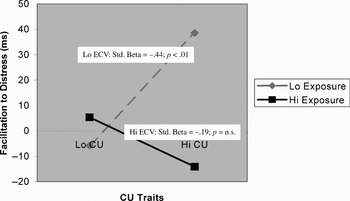
The next set of analyses focused on the potential moderating role of histories of abuse and exposure to community violence. Again, none of the interactions were significant for predicting response to positive pictures, adding <2% of the variance to their prediction. The results for predicting response to distress indices are provided in Table 4. For abuse, there were no significant interactions with CU traits in predicting response to distress at either stimulus duration, with the change in R 2 ranging from .04 (250 ms) to .00 (500-ms stimulus duration). Of importance, there was a significant interaction between CU traits and exposure to community violence in predicting facilitation to distress pictures at the 250-ms stimulus duration (R 2 change = .11, p < .01). This interaction was not significant for predicting facilitation to distress pictures at the 500-ms stimulus duration. The significant interaction between exposure to community violence and CU traits was further explored and the results for predicting response to distress at the 250-ms stimulus duration are summarized in Figure 3. As noted in this figure, there was a negative association between the facilitation index to distress pictures and CU traits at high levels of exposure (standardized β = −.19, p = ns) but a significant positive association between facilitation to distress and CU traits at low levels of exposure (standardized β = .44, p < .01).Footnote 3, Footnote 4
Interaction between callous-unemotional traits and facilitation to distress pictures (250 ms) at high and low levels of exposure to community violence.

Person-centered analyses
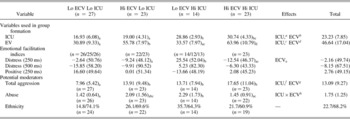
The interaction between CU traits and exposure to violence provided in Figure 3 suggests that there may be two groups of youth high on CU traits: one that was also high on exposure to violence and showed low facilitation to distressing stimuli (i.e., emotional deficit), and one that was low on exposure to violence but high on facilitation to distressing stimuli (i.e., hypervigilance). To further explore these two potentially important groups of youth high on CU traits, a person-centered approach to analyses was used to complement the main regression analyses. A person-centered approach to analyses is useful for identifying unique patterns of variable associations within more homogeneous subgroups of individuals (Laursen & Hoff, Reference Laursen and Hoff2006). To maintain consistency with the regression analysis that most clearly differentiated the two groups of youth high on CU traits with contrasting patterns of emotional reactivity (Figure 3), we created four groups based on a median split on scores on the ICU and the CREV-R scales. Then, a series of 2 × 2 analyses of variance (ANOVAs) were conducted to compare groups on the continuous study variables (dependent variables), whereas a logistic regression was conducted with ethnicity as the dependent variable. The results of these analyses are reported in Table 5.
Characteristics of the sample split by levels of callous-unemotional traits and exposure to community violence

Note: ECV, exposure to community violence; ICU, inventory of callous-unemotional traits. Effects are from a 2 × 2 ANOVA with median split of ICU and median split of ECV as the between groups factors, with the exception of the dichotomous ethnicity variable (0 = Caucasian, 1 = African-American), which was analyzed using a 2 × 2 logit model analysis. The change in numbers reflect missing cases. Facilitation scores that fell more than 3 standard deviations above or below the mean were eliminated from analyses (distress 250 ms, n = 2; distress 500 ms, n = 4; positive 250 ms, n = 2). Further, two cases had missing data for abuse and eight youth were eliminated from the ethnicity analyses because they could not be dichotomized into Caucasian or African American. Different subscript letters denote significant differences in pairwise comparisons using the least significant difference procedure for pairwise comparisons. The numbers in the ethnicity cells indicate the percentage of Caucasians/African Americans.
a F (1, 83) = 125.77, p < .001, partial η2 = .60.
b F (1, 83) = 3.51, p = .06, partial η2 = .05.
c F (1, 83) = 7.10, p < .01, partial η2 = .08.
d F (1, 83) = 184.12, p < .001, partial η2 = .69.
e F (1, 81) = 4.16, p < .05, partial η2 = .05.
f F (1, 83) = 6.13, p < .05, partial η2 = .07.
g F (1, 83) = 6.66, p < .05, partial η2 = .07.
h F (1, 81) = 7.56, p < .01, partial η2 = .09.
The results of the logistic regression revealed that there were no significant main effects of CU traits (odds ratio [OR] = .96, p = ns) or exposure to violence (OR = 1.01, p = ns), and no significant interaction effect in predicting ethnicity. Further, as would be predicted by the multiple regression analyses, the group high on both exposure to violence and CU traits showed less emotional facilitation to the distress pictures (M = −12.54), whereas the group high on CU traits but low on exposure to violence showed higher facilitation scores (M = 25.54). There also emerged from these analyses an interaction between CU traits and exposure to violence in predicting histories of abuse, F (1, 81) = 7.56, p < .01, partial η2 = .09). Specifically, the group with high CU traits and high exposure to violence (who also showed an emotional deficit to distress pictures) did not show elevated histories of abuse, whereas the group with CU traits that were exposed to only low levels of community violence (who were hypervigilant to distress pictures) showed elevated histories of abuse. Pairwise comparisons using the LSD procedure revealed a significant difference in the history of abuse between these two high CU groups. Thus, the two measures of traumatic family backgrounds showed different associations with CU traits and emotional facilitation. Exposure to community violence was associated with the typical pattern of decreased facilitation to distress cues (i.e., emotional deficit) and high rates of CU traits, whereas abuse appeared to be more strongly associated with high levels of CU traits but enhanced facilitation to distress cues.
Discussion
As noted previously, CU traits have been consistently linked to deficits in the processing of negative emotional stimuli, especially cues of distress, in samples of both adults (Blair et al., Reference Blair, Jones, Clark and Smith1997; Levenston et al., Reference Levenston, Patrick, Bradley and Lang2000; Williamson et al., Reference Williamson, Harpur and Hare1991) and youth (Blair et al., Reference Blair, Colledge, Murray and Mitchell2001; Loney et al., Reference Loney, Frick, Clements, Ellis and Kerlin2003). However, in the current study, this link was not found without considering moderating variables. One possible reason for this finding may be the ethnic composition of the present sample. This sample was predominantly African American (68%), whereas past studies have used primarily Caucasian samples (Blair et al., Reference Blair, Budhani, Colledge and Scott2005; Hiatt, Lorenz, & Newman, Reference Hiatt, Lorenz and Newman2002; Kimonis, Frick, Fazekas, et al., Reference Kimonis, Frick, Fazekas and Loney2006; Patrick et al., Reference Patrick, Bradley and Lang1993). Further, this finding would be consistent with studies in adult prison samples suggesting that the association between psychopathic traits and many cognitive–affective deficits are not as strong in African American samples as in Caucasian samples (Kosson et al., Reference Kosson, Smith and Newman1990; Lorenz & Newman, Reference Lorenz and Newman2002a, Reference Lorenz and Newman2002b). Although there was no interaction between ethnicity and CU traits for predicting emotional responses to distressing stimuli in the current sample, the relatively small sample of Caucasians (n = 20) may not have provided enough power to detect such an interaction.
As a result, the moderating role of ethnicity needs to be tested further, and all of our results need to be interpreted in light of the ethnic composition of our sample. Specifically, it is important to consider possible reasons for the weaker association between CU traits and emotional deficits in African American samples. For example, it is possible that the traits used to define psychopathy or its method of assessment may make the construct less valid in ethnically diverse samples (Skeem, Edens, Camp, & Colwell, Reference Skeem, Edens, Camp and Colwell2004). Alternatively, it is possible that the causes of CU traits and psychopathy are more diverse in ethnic minority individuals, especially those who come from high-risk backgrounds. Our findings provide some support for both possibilities.
For example, CU traits were associated with deficits in the processing of distress stimuli in those detained boys who also showed high rates of aggression (see Figure 2). Thus, it may be that in this primarily African American sample, it is the combination of CU traits and high rates of aggression that defines a unique subgroup of antisocial individuals that more closely fits with the construct of psychopathy, rather than the presence of CU traits alone. It is also important to note that the interaction between CU traits and aggression in predicting the processing of emotional stimuli suggests that those other youth that are high on aggression, but low on CU traits, showed an enhanced attentional orienting response to distressing stimuli, as measured by the dot-probe task. This finding is consistent with past studies of youth (Kimonis, Frick, Fazekas, et al., Reference Kimonis, Frick, Fazekas and Loney2006; Loney et al., Reference Loney, Frick, Clements, Ellis and Kerlin2003) and with a theoretical model suggesting that aggressive youth low on CU traits are more likely to show impairments in their ability to regulate their emotions, and that these impairments may be a primary causal factor leading to the aggressive behavior in this group (Frick & Morris, Reference Frick and Morris2004).
There was also some support for the contention that there may be several different causal pathways to CU traits, especially in high-risk samples that may have high rates of environmental risk (Straus & Hamby, Reference Straus, Hamby, Kaufman Kantor and Jasinski1997). Specifically, in the regression analyses (see Figures 2 and 3), there was a significant positive association between CU traits and facilitation to distress at low levels of aggression. In the person-centered analyses, there was a group with low levels of violence exposure who were high on CU traits who also showed enhanced facilitation to distress stimuli, contrary to many past theories of the causes of these traits (Frick, Reference Frick2006; Frick & Marsee, Reference Frick, Marsee and Patrick2006). Further, as presented in Table 5, this group was notably different from the group high on CU traits but with an attenuated facilitation to distress stimuli by having more severe histories of abuse.
Although this pattern of characteristics does not appear to fit with Porter's (Reference Porter1996) suggestion that the experience of severe trauma, such as abuse, leads individuals to learn to “turn off” emotions through a desensitization process, it does fit with research suggesting that there may be heterogeneous affective outcomes resulting from maltreatment (Pollak et al., Reference Pollak, Cicchetti, Hornung and Reed2000). For example, such results would be consistent with findings that one consequence of abuse is that children may become hypervigilant to emotional cues (Dodge & Pettit, Reference Dodge and Pettit2003), and this hypervigilance and subsequent overarousal may lead the child to miss cues of distress in others (Kochanska, Reference Kochanska1993; Osofsky, Reference Osofsky1995), interfering with early moral socialization (Figure 1). Further, these findings are consistent with the possibility that there may be environmentally influenced pathways to CU traits, which have been labeled as “secondary psychopathy” or “sociopathy” in many theoretical models (Lykken, Reference Lykken1995; Mealey, Reference Mealey1995; Porter, Reference Porter1996; Skeem et al., Reference Skeem, Edens, Sanford and Hauser2004).
In considering possible environmentally influenced pathways to CU traits, we also investigated the associations among exposure to community violence, CU traits, and responsiveness to distress images. Our findings suggest that exposure to community violence was significantly associated with CU traits, and this is one of the first studies to demonstrate this link. Further, the interaction between CU traits and exposure to violence in predicting responses to distress images suggests that the link was largely related to those youth with deficits in their responses to distressing images. There are several possible interpretations of this finding. This finding could provide evidence for a second environmentally influenced pathway in which exposure to violence can lead to a reduced sensitivity to emotional stimuli (through a desensitization process; Cooley-Quille et al., Reference Cooley-Quille, Boyd, Frantz and Walsh2001), and this alteration in emotional processing could lead to the development of CU traits in some children (Frick & Morris, Reference Frick and Morris2004). However, our failure to find a significant relationship between emotional deficits and CU traits suggests that not all youth with an emotional deficit go on to develop CU traits. Future research is needed to determine what may cause some youth with such an emotional deficit to develop CU traits but not others.
One difference across the groups with high levels of exposure to community violence was on level of abuse. The group high on exposure to violence but low on CU traits also showed significantly higher abuse experiences. In fact, the level of abuse in this group was comparable to the group high on CU traits and low on exposure to violence (see Table 5). It is important that these two groups with significant histories of abuse had very different patterns of response to distress stimuli. Interpretation of the role of abuse in explaining differences in the emotional processing of the two groups needs to be made cautiously, in that the interaction between CU traits and abuse did not reach significance in the regression analyses. However, there are at least two possible explanations for these differences in emotional processing. Although there is research to suggest that some maltreated youth may become hypervigilant to emotional stimuli (Dodge & Pettit, Reference Dodge and Pettit2003), the effect of community violence and its desensitizing effects on a child's reactivity to emotional stimuli may override this process, leading to the deficits in emotional reactivity in the group high on exposure to violence. Alternatively, it is also possible that there may have been different forms of abuse and/or different family dynamics associated with the abuse operating for youth with and without high levels of exposure to community violence. Such differences could not be captured by the global abuse measure used in this study, but they may be related to different patterns of emotional responding.
It is important to note that the correlational nature of our data makes it impossible to firmly establish the causal direction among our study variables. For example, youth with CU traits show strong histories of aggression (Frick, Cornell, Barry, et al., Reference Frick, Cornell, Bodin, Dane, Barry and Loney2003) and violence (Kruh et al., Reference Kruh, Frick and Clements2005) that could lead to witnessing more violent events and result in a desensitization to the cues of distress in others. Alternatively, there is evidence for a fairly substantial genetic contribution to CU traits (Viding et al., Reference Viding, Blair, Moffitt and Plomin2005). As a result, children with CU traits may be more likely to have parents with similar affective and interpersonal characteristics that lead them to act aggressively and that increase the likelihood that the child will be exposed to violence.
When investigating participants' response to pictures involving distress, two stimulus durations for the dot probe task were included. Results were only significant for the shorter 250-ms stimulus presentation. This finding coincides with research on attentional biases in anxious individuals, which reports more robust associations at shorter stimulus durations (e.g., Bradley et al., Reference Bradley, Mogg, Falla and Hamilton1998; Fox, Reference Fox2002). The nonsignificant findings for the 500-ms stimulus duration suggests that at the longer stimulus duration, adolescents' attention may shift in focus and effortful processes may come into play. This finding suggests that the deficits experienced in some youth with CU traits may be more apparent at the automatic level of attentional orienting to emotional stimuli, and would be consistent with findings using other measures of attentional allocation. For example, Loney et al. (Reference Loney, Frick, Clements, Ellis and Kerlin2003) used an emotional lexical decision task in an adjudicated sample in which participants were shown a string of letters that either formed words or nonwords. These authors reported that youth higher on CU traits showed less facilitation in their speed of recognizing words of emotional content compared to words that were neutral in emotional content (automatic attention allocation) but the adolescent's level of CU traits was unrelated to how the emotional valence of the words was rated (effortful processing of words). Similar findings were reported using the lexical decision paradigm on adults with psychopathic traits (Williamson et al., Reference Williamson, Harpur and Hare1991). All of these findings suggest that the emotional deficits related to CU traits may not be as strong on tasks that utilize effortful processing of emotional stimuli (e.g., rating scales and interviews), but may only be apparent on tasks assessing more immediate automatic processing of emotional stimuli.
All of these results need to be interpreted in light of a number of limitations. Three important limitations have already been noted. First, the ethnic composition of the sample makes it possible that the results may not generalize to other samples with different ethnic compositions. Second, we have already noted that the correlational design prevents any firm conclusions about the direction of causation among the variables used in the study. Third, the abuse measure was a global measure that encompassed multiple forms of abuse, making it impossible to determine if different types or patterns of abuse resulted in different emotional and behavioral correlates. In addition to these limitations that have already been discussed, a fourth limitation was the size of the sample. It was relatively small, which may have resulted in a lack of statistical power to detect potential interactions. For example, in order to detect a significant interaction at a power of .80, 7% of the variance in the outcome would have to be explained by the interaction term to be significant (Jaccard, Turrisi, & Wan, Reference Jaccard, Turrisi and Wan1990). Fifth, we did not measure anxiety, and this variable has been used to distinguish between adults with primary and secondary psychopathy who differ on their cognitive and affective processing of information (Brinkley, Newman, Widiger, & Lynam, Reference Brinkley, Newman, Widiger and Lynam2004; Levenson, Kiehl, & Fitzpatrick, Reference Levenson, Kiehl and Fitzpatrick1995; Newman & Brinkley, Reference Newman and Brinkley1997; Schmitt & Newman, Reference Schmitt and Newman1999). Thus, it is possible that the group high on CU traits with enhanced responses to distressing stimuli would also have scored high on measures of anxiety, but we do not have the data to test this possibility. Sixth, we acknowledge that our choice of models is only one of the multiple ways of conceptualizing the current research question. That is, one could develop a theoretical model in which emotional responsiveness is viewed as a moderator of the association between exposure to violence and CU traits. Seventh, the dot-probe paradigm is not a direct index of emotional responsiveness, because a number of cognitive, affective, and motoric processes are operating between the child's perception of the pictorial stimuli and his or her motoric response concerning the location of the dot (Vasey et al., Reference Vasey, El-Hag and Daleidon1996). In addition, pictures of people were more highly represented in the distress picture category (97%) versus the positive (34%) and neutral (5%) picture categories, such that it is possible that any impairment in facilitation to distress may be specific to people rather than the negative valence of the picture.
Within the context of these limitations, the current results support the importance of deficits in the processing of distress cues for understanding CU traits but only if important moderators are considered. The current study supports the existence of a group of youth high on CU traits that also showed a reduced responsiveness to distressing stimuli, consistent with past research. However, in this sample of detained and predominantly African American youth, this was only the case if they also showed high levels of aggression or high levels of exposure to community violence. Further, our results support the presence of a group that has heretofore been conjectured to exist but has not been the focus of much empirical research. That is, there was a group high on CU traits that also showed high levels of emotional reactivity to distressing stimuli. This group also had significant histories of abuse.
Overall, these results support the need to continue to investigate contextual factors that may be involved in the development of CU traits (e.g., Kimonis, Frick, & Barry, Reference Kimonis, Frick and Barry2004; Skeem et al., Reference Skeem, Edens, Sanford and Hauser2004), despite the fact that they may have a strong genetic component (Viding et al., Reference Viding, Blair, Moffitt and Plomin2005). Such investigations have important implications for developmental models of these traits by recognizing that there may be diverse pathways leading to the inception of these traits in youth. It is important that there is evidence that these two pathways may lead to different outcomes. For example, Ishikawa, Raine, Lencz, Bihrle, and Lacasse (Reference Ishikawa, Raine, Lencz, Bihrle and Lacasse2001) reported that individuals high on psychopathic traits but who showed an increase in heart rate during an emotional stress paradigm were less likely to be convicted of a crime than those who showed reduced cardiovascular activity to stress. These results may also have important implications for determining subgroups of youth that are more amenable to treatment (Skeem et al., Reference Skeem, Poythress, Edens, Lilienfeld and Cale2003) and to help tailor treatment to the unique needs of youth with different causal processes leading to their problems in moral development (Frick, Reference Frick2006). The results of the current study suggest that these interventions need to include methods for helping youth cope with histories of abuse that have not often been considered in treatment recommendations for these youth. Given the high rate of criminal or violent behavior that is often displayed by youth with CU traits (Frick & Dickens, Reference Frick and Dickens2006), developing more effective prevention and treatment programs is a critical mental health priority.