Youth conduct problems (i.e., oppositional defiant disorder [ODD] and conduct disorder [CD]) represent a significant public health concern. They are associated with numerous negative correlates and long-term psychosocial sequelae, such as difficulties with interpersonal relationships, academic achievement, and economic security; co-occurring psychological disorders; and they are among the most frequent referrals for children's mental health services (Colman et al., Reference Colman, Murray, Abbott, Maughan, Kuh, Croudace and Jones2009; Piehler et al., Reference Piehler, Distefano, Ausherbauer, Bloomquist, Almy and August2019; Propp, Bedard, & Andrade, Reference Propp, Bedard and Andrade2020; Rivenbark et al., Reference Rivenbark, Odgers, Caspi, Harrington, Hogan, Houts and Moffitt2018). Youth residing in low-income, urban communities are at increased risk for conduct problems (Goodnight et al., Reference Goodnight, Lahey, Van Hulle, Rodgers, Rathouz, Waldman and D'Onofrio2012; Leventhal & Brooks-Gunn, Reference Leventhal and Brooks-Gunn2003; Romero, Richards, Harrison, Garbarino, & Mozley, Reference Romero, Richards, Harrison, Garbarino and Mozley2015). This risk is likely because of factors associated with limited opportunities stemming from current and historical trauma and systems of oppression (e.g., redlining) and low socioeconomic status (SES). These factors include physical and psychosocial stressors, community and interpersonal violence, low levels of cohesion, and exposure to deviant peers (Bringewatt & Gershoff, Reference Bringewatt and Gershoff2010; Cotter & Smokowski, Reference Cotter and Smokowski2017; Devenish, Hooley, & Mellor, Reference Devenish, Hooley and Mellor2017; Mohatt, Thompson, Thai, & Tebes, Reference Mohatt, Thompson, Thai and Tebes2014; Piotrowska, Stride, Croft, & Rowe, Reference Piotrowska, Stride, Croft and Rowe2015; Price, Drabick, & Ridenour, Reference Price, Drabick and Ridenour2019). Nevertheless, not all youth from low-income, urban communities develop conduct problems, suggesting heterogeneity in risk and resilience processes, developmental pathways, and outcomes (Drabick, Bubier, Chen, Price, & Lanza, Reference Drabick, Bubier, Chen, Price and Lanza2011; Propp et al., Reference Propp, Bedard and Andrade2020). Identifying more homogeneous subgroups of youth could inform etiological models, assessment approaches, identification of youth at risk, and targets and approaches for interventions for conduct problems (Graziano et al., Reference Graziano, Landis, Maharaj, Ros-Demarize, Hart and Garcia2019; Piehler et al., Reference Piehler, Distefano, Ausherbauer, Bloomquist, Almy and August2019; Propp et al., Reference Propp, Bedard and Andrade2020).
It is especially important to identify homogeneous subgroups of youth at risk for conduct problems due to heightened contextual disadvantage. Youth from lower-income families are less likely to receive mental health services because of financial and logistical barriers (Bringewatt & Gershoff, Reference Bringewatt and Gershoff2010; Copeland & Snyder, Reference Copeland and Snyder2011; Larson, Stewart, Kushner, Frosch, & Solomon, Reference Larson, Stewart, Kushner, Frosch and Solomon2013; Santiago, Kaltman, & Miranda, Reference Santiago, Kaltman and Miranda2013). These barriers have been created and perpetuated by policies rooted in structural racism, such as segregation, systematic denial of services, and historical trauma (Graff, Reference Graff2019; Hillier, Reference Hillier2003; Mohatt et al., Reference Mohatt, Thompson, Thai and Tebes2014). The stigma surrounding mental health treatment may be further exacerbated among families who also experience prejudice or discrimination based on SES (e.g., Copeland & Snyder, Reference Copeland and Snyder2011). Likewise, a general distrust of the healthcare system rooted in the historical maltreatment of many historically underrepresented individuals in medical contexts contributes to the underutilization of mental health services among individuals in low-income communities, where marginalized individuals are disproportionately represented (Bringewatt & Gershoff, Reference Bringewatt and Gershoff2010; Firebaugh & Acciai, Reference Firebaugh and Acciai2016). The current study sought to identify profiles of child-specific processes assessed using multiple levels of analysis and across domains that have been implicated as correlates of conduct problems. This approach and the variables selected were informed by the National Institute of Health's (NIH) Research Domain Criteria (RDoC; Insel et al., Reference Insel, Cuthbert, Garvey, Heinssen, Pine, Quinn and Wang2010), as well as a developmental psychopathology framework.
RDoC and Developmental Psychopathology Frameworks for Youth Conduct Problems
RDoC is an initiative intended to identify areas of functioning that cut across psychiatric diagnoses and to stimulate translational research (De Los Reyes, Drabick, Makol, & Jakubovic, Reference De Los Reyes, Drabick, Makol and Jakubovic2020). As a transdiagnostic approach that maintains critical information about symptoms regardless of diagnostic threshold, RDoC may be particularly useful for early detection, prediction of course, and prevention of future psychopathology (Franklin, Jamieson, Glenn, & Nock, Reference Franklin, Jamieson, Glenn and Nock2015). Given its potential role in the improvement of mental health interventions, RDoC may provide a foundation for significant improvements to public health (De Los Reyes et al., Reference De Los Reyes, Drabick, Makol and Jakubovic2020). Research guided by the RDoC initiative considers dysfunction across multiple domains and levels of analysis, with the goal of ultimately amassing genetic and neuroscientific data to aid in the development of a new classification of psychopathology and to advance our understanding of optimal interventions (Franklin et al., Reference Franklin, Jamieson, Glenn and Nock2015; Insel et al., Reference Insel, Cuthbert, Garvey, Heinssen, Pine, Quinn and Wang2010).
Within the RDoC initiative, impairments fall into five functional domains: positive affect, negative affect, cognition, social processing, and regulatory systems (Sanislow et al., Reference Sanislow, Pine, Quinn, Kozak, Garvey, Heinssen and Cuthbert2010). RDoC's units of analysis were initially developed for research among adults and include cells, genes, neural circuitry, self-reports, and behavior, among others (Cuthbert & Insel, Reference Cuthbert and Insel2010). These units are thus comprehensive in nature and suggest that activity should be measured at multiple levels with the goal of understanding the whole person (De Los Reyes et al., Reference De Los Reyes, Drabick, Makol and Jakubovic2020). Nevertheless, this approach does not delineate specifically how to address an individual's context. Contextual factors affect not only assessment in the research setting (e.g., laboratory or experimental conditions), but also behavior given that individuals have reciprocal and transactional relations with their contexts (Drabick & Kendall, Reference Drabick and Kendall2010). Indeed, conduct problems likely arise from a diversity of individual, familial, and broader ecological risk factors (Dodge & Pettit, Reference Dodge and Pettit2003; Frick, Reference Frick2012).
It has been proposed that the RDoC framework may benefit from the integration of transactional developmental processes (Franklin et al., Reference Franklin, Jamieson, Glenn and Nock2015). A developmental psychopathology framework can inform our understanding of the neurodevelopmental origins of mental illness, a stated goal of RDoC, by integrating research and theory on key developmental processes (Franklin et al., Reference Franklin, Jamieson, Glenn and Nock2015). Developmental psychopathology studies reveal the importance of considering multiple units of analysis and the complex transactions among risk factors, which may not confer the same risk for all people or in the same way throughout life (Cicchetti & Rogosch, Reference Cicchetti and Rogosch1996; Franklin et al., Reference Franklin, Jamieson, Glenn and Nock2015). Developmental and contextual considerations complement the RDoC approach. For example, factors that may initiate difficulties are not necessarily the same that maintain them; thus, consideration of processes and expectations for a specific developmental period is critical (Drabick & Kendall, Reference Drabick and Kendall2010). A particular RDoC profile, or combination of features across units of analysis, may be linked to different symptoms across individuals and periods of development, consistent with multifinality – the idea that similar processes can lead to different outcomes depending on other aspects of the system (e.g., contextual factors; Cicchetti & Rogosch, Reference Cicchetti and Rogosch1996; Franklin et al., Reference Franklin, Jamieson, Glenn and Nock2015). Similarly, youth may have different patterns of functioning and developmental trajectories that lead to conduct problems, consistent with equifinality (i.e., different paths lead to the same outcome; Cicchetti & Rogosch, Reference Cicchetti and Rogosch1996).
It is clear that considering different levels of analysis across domains of functioning (consistent with RDoC recommendations) and developmental and contextual processes (consistent with a developmental psychopathology approach) could be useful for understanding youth conduct problems. In line with this possibility, Fonagy and Luyten (Reference Fonagy and Luyten2018) merged the RDoC framework and an evolutionary-informed developmental psychopathology approach. Their review took a developmental lens to our understanding of the origins of conduct problems among youth across different domains of functioning per the RDoC approach and determined that complex interactions among impairments across domains are at play. The researchers focused on impairments in interpersonal understanding and a lack of flexibility in response to environmental demands as key developmental pathways for conduct problems (Fonagy & Luyten, Reference Fonagy and Luyten2018). Thus, the current study extends this model and is consistent with their recommendations for further investigation of associations between vulnerabilities and areas of resilience in multiple domains related to youth conduct problems.
Although constructs and levels of analysis are specified in RDoC, there are some areas related to assessment that are more specific to children that are not addressed. For example, we may use distinct assessment approaches to decrease mono-method and/or mono-rater biases, but recommendations for optimal reporters for youth behaviors are wanting. Indeed, there are low levels of agreement among caregivers, teachers, and youth in reporting conduct problems; a meta-analysis indicated that agreement among various informant pairs for externalizing problems was r = .30 (De Los Reyes et al., Reference De Los Reyes, Augenstein, Wang, Thomas, Drabick, Burgers and Rabinowitz2015). There are a variety of reasons for these informant discrepancies: informants’ reports may differ because of the child's characteristics, context in which ratings occur, demands of particular settings, aspects of rater perspectives (e.g., teachers have more experience with children on average than caregivers and thus may be more likely to recognize typical vs. atypical behavior), and measurement error (De Los Reyes et al., Reference De Los Reyes, Augenstein, Wang, Thomas, Drabick, Burgers and Rabinowitz2015; Drabick et al., Reference Drabick, Bubier, Chen, Price and Lanza2011). In addition, informants may have different opportunities to observe youth behaviors and thus differentially report on the frequency and/or severity of youth conduct problems. Given the significant influence of environmental factors on youth conduct problems, understanding the context-sensitivity of RDoC units of analysis is crucial (De Los Reyes et al., Reference De Los Reyes, Drabick, Makol and Jakubovic2020). Taken together, it is critical to consider patterns of processes among youth at risk for conduct problems to better understand these different developmental pathways, as well as risk and resilience, which can inform identification, assessment, and intervention efforts (Graziano et al., Reference Graziano, Landis, Maharaj, Ros-Demarize, Hart and Garcia2019; Piehler et al., Reference Piehler, Distefano, Ausherbauer, Bloomquist, Almy and August2019; Propp et al., Reference Propp, Bedard and Andrade2020).
Person-Centered Approaches Can Identify Homogeneous Youth Profiles
Given the equifinality and heterogeneity within conduct problems (Aitken, Henry, & Andrade, Reference Aitken, Henry and Andrade2018; Fanti & Kimonis, Reference Fanti and Kimonis2017), it is likely that more homogeneous subgroups of youth who differ in terms of conduct problem symptoms and correlates can be identified. Prior person-centered work has identified profiles or classes of youth who differ in frequency, severity, and correlates of conduct problems, though there is a great deal of variability in the processes jointly considered in this previous research. For example, among a sample of preschool-aged children with elevated levels of callous–unemotional (CU) traits or behaviors (i.e., lack of empathy, uncaring behaviors, restricted emotional expression; Essau, Sasagawa, & Frick, Reference Essau, Sasagawa and Frick2006) and conduct problems per parent- and teacher-report, children displayed poorer emotion regulation (Graziano et al., Reference Graziano, Landis, Maharaj, Ros-Demarize, Hart and Garcia2019). Using caregiver-reported conduct problems, CU traits, and anxiety, Huang, Fan, Lin, and Wang (Reference Huang, Fan, Lin and Wang2020) identified four subgroups: low problems, high anxiety, high conduct problems/CU traits, and high on all three. Fanti and Kimonis (Reference Fanti and Kimonis2017) examined externalizing, internalizing, and CU behaviors; latent profile analysis similarly identified four subgroups: low problems, high on externalizing/internalizing problems, high on externalizing problems/CU traits, and high on all. Profiles were furthermore differentiated on aggression, biological indices (e.g., heart rate), and cognitive abilities (Fanti & Kimonis, Reference Fanti and Kimonis2017).
Byrd, Hawes, Loeber, and Pardini (Reference Byrd, Hawes, Loeber and Pardini2018) considered interpersonal callousness and identified five trajectories among boys assessed from ages 7 to 15: low, moderate, early-onset chronic, childhood limited, and adolescent onset. The early-onset chronic subgroup evidenced the highest levels of child and contextual risk factors, as well as higher levels of conduct problems, than the childhood-limited and adolescent-onset subgroups. Dugré and Potvin (Reference Dugré and Potvin2020) considered psychological features (i.e., irritability, internalizing symptoms, interpersonal callousness, hyperactivity/impulsivity) among children in a parallel process growth mixture model. They identified eight developmental patterns and demonstrated that CU behaviors predicted conduct problems independently, and this risk was greater in the context of hyperactivity/impulsivity, irritability, and/or internalizing symptoms, consistent with other research supporting equifinality of conduct problems. Among a clinic-referred sample of children with disruptive behaviors, Propp et al. (Reference Propp, Bedard and Andrade2020) identified four classes that differed in CU traits, emotion regulation, and executive functioning (EF); classes with poor selective attention and elevated CU traits had the highest levels of conduct problems.
Additional research has considered conduct problems and peer processes concurrently in person-centered analyses. This work has reported classes that differ in the type and severity of deviant peer behavior (i.e., conduct problems and substance use behavior) among adolescents (Price et al., Reference Price, Drabick and Ridenour2019). Kremer et al. (Reference Kremer, Poon, Jones, Hagler, Kupersmidt, Stelter and Rhodes2020) identified four profiles of children who differed in their levels of behavioral and social problems: low on both, overactive, isolated, and aggressive; the aggressive subgroup had the highest levels of delinquent behavior and negative school outcomes. Similarly, among a clinic-based sample, Aitken et al. (Reference Aitken, Henry and Andrade2018) identified five profiles that differed in levels of prosocial behavior, reactive and proactive aggression, and CU traits; profiles with elevated reactive aggression and CU traits and low levels of prosocial behavior had the highest levels of social difficulties. Taken together, findings indicate that profiles of youth who differ in terms of conduct problems and associated correlates can be identified. However, there is a dearth of research among children residing in low-income, urban communities who are at elevated risk for conduct problems and that considers neurobiological and cognitive correlates of conduct problems using multiple levels of analysis.
Neurobiological and Cognitive Correlates of Conduct Problems
The current study integrated developmental psychopathology- and RDoC-informed approaches to examine conduct problems among a community-based sample of children who experience contextual disadvantage. We used a person-centered analytic approach to identify profiles of children who differ in conduct problems (identified using multiple informants) and child-specific correlates indexed across different neurobiological and cognitive domains that are associated with conduct problems. These include autonomic nervous system (ANS), limbic system, orbitofrontal, and dorsolateral prefrontal functioning. We also sought to externally validate profiles using child-specific factors and peer processes. The rationale for these variables is presented next.
Autonomic nervous system functioning
The ANS is comprised of the sympathetic nervous system (SNS), which is responsible for preparing the body for and responding to stress (i.e., “fight or flight” responding), and the parasympathetic nervous system (PNS), which mainly functions to promote growth and restore homeostasis (Beauchaine, Reference Beauchaine2001; Bubier, Drabick, & Breiner, Reference Bubier, Drabick and Breiner2009). SNS impact on cardiac activity can be indexed by cardiac pre-ejection period (PEP), which refers to the time between the onset of the left ventricular depolarization and ejection of blood into the aorta (Beauchaine, Reference Beauchaine2001; Brenner, Beauchaine, & Sylvers, Reference Brenner, Beauchaine and Sylvers2005). This time interval is determined by beta-adrenergic influences that are in turn under the control of the SNS; shorter time intervals reflect more sympathetic activity. Parasympathetic cardiac influences are indexed by respiratory sinus arrhythmia (RSA), which is the waxing and waning of heart rate across the respiratory cycle (Beauchaine, Reference Beauchaine2001, Reference Beauchaine2015; Porges, Reference Porges1995). Measurement of PEP and RSA at rest appear to reflect temperamental reactivity and emotionality (Beauchaine, Reference Beauchaine2001), whereas measurement during challenge or in response to a stressor indexes reactivity and self-regulation (Beauchaine, Reference Beauchaine2015; Porges, Doussard-Roosevelt, Portales, & Greenspan, Reference Porges, Doussard-Roosevelt, Portales and Greenspan1996).
Both ANS systems are implicated in youth conduct problems; in particular, attenuated SNS at baseline and SNS reactivity, as well as lower levels of PNS at baseline and RSA modulation, are associated with conduct problems across various developmental periods (Baker et al., Reference Baker, Tuvblad, Reynolds, Zheng, Lozano and Raine2009; Beauchaine, Reference Beauchaine2001, Reference Beauchaine2015; Beauchaine, Gatzke-Kopp, & Mead, Reference Beauchaine, Gatzke-Kopp and Mead2007; Boyce et al., Reference Boyce, Quas, Alkon, Smider, Essex and Kupfer2001; Bubier et al., Reference Bubier, Drabick and Breiner2009; Crowell et al., Reference Crowell, Beauchaine, Gatzke-Kopp, Sylvers, Mead and Chipman-Chacon2006; Posthumus, Bocker, Raaijmakers, Van Engeland, & Matthys, Reference Posthumus, Bocker, Raaijmakers, Van Engeland and Matthys2009; van Goozen, Fairchild, Snoek, & Harold, Reference van Goozen, Fairchild, Snoek and Harold2007). However, findings regarding RSA are less consistent than PEP. For example, although some research demonstrates relations among low baseline levels of RSA, emotion dysregulation, and conduct problems (Beauchaine et al., Reference Beauchaine, Gatzke-Kopp and Mead2007; El-Sheikh, Reference El-Sheikh2005; Vasilev, Crowell, Beauchaine, Mead, & Gatzke-Kopp, Reference Vasilev, Crowell, Beauchaine, Mead and Gatzke-Kopp2009), other research among community-based samples does not (Calkins, Graziano, & Keane, Reference Calkins, Graziano and Keane2007; El-Sheikh & Whitson, Reference El-Sheikh and Whitson2006). Regarding reactivity, excessive RSA reactivity is associated with lower levels of emotion regulation and higher levels of conduct problems across developmental periods (Beauchaine, Reference Beauchaine2015; El-Sheikh & Whitson, Reference El-Sheikh and Whitson2006; Porges, Reference Porges2007), though lower RSA reactivity is related to conduct problems among younger children (Boyce et al., Reference Boyce, Quas, Alkon, Smider, Essex and Kupfer2001; Calkins et al., Reference Calkins, Graziano and Keane2007; Obradovic, Bush, Stamperdahl, Adler, & Boyce, Reference Obradovic, Bush, Stamperdahl, Adler and Boyce2010). Considering these inconsistent findings, we examined both PEP and RSA reactivity among youth in middle childhood, given that reactivity may not become stable until this developmental period (El-Sheikh, Reference El-Sheikh2005; El-Sheikh et al., Reference El-Sheikh, Kouros, Erath, Cummings, Keller and Staton2009; Hinnant, Elmore-Staton, & El-Sheikh, Reference Hinnant, Elmore-Staton and El-Sheikh2011) and the likelihood that reactivity could index difficulties with emotion regulation particularly under conditions of emotion evocation (Beauchaine, Reference Beauchaine2015). Taken together, findings suggest that patterns of ANS functioning may be differentially associated with risk for conduct problems and highlight the likelihood of multifinality in outcomes from indices of ANS functioning.
Limbic system, orbitofrontal, and dorsolateral prefrontal functioning
In this section, we consider three areas of the brain using relatively superordinate terms: (a) the limbic system, including the amygdala, which is involved in the recognition of others’ facial expressions, especially negatively valenced emotions (e.g., fear, disgust), and has been implicated in aversive conditioning and instrumental learning; (b) the orbitofrontal cortex, which subsumes the ventromedial prefrontal cortex, has extensive connections with the limbic system, and has been implicated in processing affect and cognition; and (c) the dorsolateral prefrontal cortex, which is associated with EF (e.g., attention, concentration, planning, working memory, shifting) (Adolphs, Reference Adolphs2001; Best & Miller, Reference Best and Miller2010; Blair, Reference Blair2004, Reference Blair2007; Jolles, Kleibeuker, Rombouts, & Crone, Reference Jolles, Kleibeuker, Rombouts and Crone2011; Sonuga-Barke, Cortese, Fairchild, & Stringaris, Reference Sonuga-Barke, Cortese, Fairchild and Stringaris2016). Broadly, these brain areas have been associated with emotion recognition and processing, cognition, decision making, problem solving, socialization of care-based transgressions (i.e., those that cause harm or distress to others), and motivation. They are thus particularly relevant for conduct problems, given that many youth with conduct problems exhibit deficits in these areas (Blair, Reference Blair2015; Martin-Key, Graf, Adams, & Fairchild, Reference Martin-Key, Graf, Adams and Fairchild2018; Passamonti et al., Reference Passamonti, Fairchild, Fornito, Goodyer, Nimmo-Smith, Hagan and Calder2012; Raschle et al., Reference Raschle, Fehlbaum, Menks, Martinelli, Prätzlich, Bernhard and Stadler2019; Sonuga-Barke et al., Reference Sonuga-Barke, Cortese, Fairchild and Stringaris2016).
Youth with conduct problems evidence reduced amygdala activity when processing negative emotional expressions relative to neutral ones (Blair, Reference Blair2015; Ewbank et al., Reference Ewbank, Passamonti, Hagan, Goodyer, Calder and Fairchild2018), though findings differ depending on the type of stimuli and presence of CU traits. In general, CU traits are associated with impairments in processing others’ emotional distress (e.g., sadness, fear, pain) and negative stimuli (Blair, Reference Blair2015; Hwang et al., Reference Hwang, Nolan, White, Williams, Sinclair and Blair2016; Lozier, Cardinale, & Vanmeter, Reference Lozier, Cardinale and Vanmeter2014). Moreover, youth with conduct problems and CU traits evidence lower amygdala and ventromedial prefrontal activation in the context of negative stimuli than youth with conduct problems only or neither (Hwang et al., Reference Hwang, Nolan, White, Williams, Sinclair and Blair2016). Given that the amygdala is necessary for establishing conditioned fear and recognizing threat cues (Davidson, Reference Davidson2002; Sears, Schiff, & LeDoux, Reference Sears, Schiff and LeDoux2014), an underactive amygdala may contribute to difficulty learning stimulus-incentive associations, which may lead to challenges with socialization related to care-based judgments and thus conduct problems (Blair, Reference Blair2015). In terms of task performance, however, the presence of CU traits is associated with better fear (Martin-Key et al., Reference Martin-Key, Graf, Adams and Fairchild2018) and anger (Blair, Reference Blair2015) recognition, suggesting heterogeneity in associations among conduct problems with these brain regions based on strategies for indexing these processes.
In terms of structural differences, the severity of conduct problems among youth is associated with reduced amygdala volume, and CU traits mediate this relation (Cardinale et al., Reference Cardinale, O'Connell, Robertson, Meena, Breeden, Lozier and Marsh2019). Moreover, conduct problems are associated with white-matter microstructural abnormalities in the uncinate fascicle, which connects the amygdala and orbitofrontal cortex (Passamonti et al., Reference Passamonti, Fairchild, Fornito, Goodyer, Nimmo-Smith, Hagan and Calder2012). Female adolescents with CD also exhibit lower dorsolateral prefrontal activation and reduced connectivity with the amygdala (Raschle et al., Reference Raschle, Fehlbaum, Menks, Martinelli, Prätzlich, Bernhard and Stadler2019). Pertinent to the sample considered in the present study, Hanson et al. (Reference Hanson, Chung, Avants, Rudolph, Shirtcliff, Gee and Pollak2012) indicated that the relation between greater cumulative life stress beginning in childhood and cognitive decrements is mediated by structural changes in the prefrontal cortex. These associations suggest that continual exposure to psychosocial stressors may lead to structural changes in brain regions shown to be impaired among individuals with conduct problems.
With regard to EF, difficulties with attention, concentration, planning, working memory, and inhibition of prepotent responses are associated with youth aggression and conduct problems (Halperin & Schulz, Reference Halperin and Schulz2006; Jakubovic & Drabick, Reference Jakubovic and Drabick2020). These associations may be particularly important among children who experience higher levels of direct community violence exposure; within this subset of children, lower working memory abilities were associated with higher levels of proactive aggression (Jakubovic & Drabick, Reference Jakubovic and Drabick2020). Decision making associated with CD has been characterized as reckless and insensitive to negative consequences (Sonuga-Barke et al., Reference Sonuga-Barke, Cortese, Fairchild and Stringaris2016). Nevertheless, conduct problems are not necessarily associated with poor planning (Blair, Reference Blair2004); indeed, age-appropriate or good planning abilities and emotion regulation may facilitate some aggressive and conduct problem behaviors, including victimizing others while avoiding adult detection and recruiting others to facilitate bullying (Deater-Deckard, Reference Deater-Deckard2001; Drabick et al., Reference Drabick, Bubier, Chen, Price and Lanza2011). Given developmental changes related to improvements in EF and increases in limbically mediated motivational strivings from childhood to adolescence (Best & Miller, Reference Best and Miller2010; Luciana, Reference Luciana2013), childhood may be a particularly useful period for examining these processes that may be malleable yet confer risk for conduct problems. Indeed, there are important developmental differences in performance on tasks shown to recruit the amygdala and orbitofrontal cortex among youth and adults in that the former demonstrates lower levels of impairment (Blair, Reference Blair2004, Reference Blair2015). Connections between the amygdala and orbitofrontal cortex are developing during childhood; over time, reduction in afferent input from the amygdala to the orbitofrontal cortex may lead to decreased responsiveness of the orbitofrontal cortex, again suggesting that childhood may be a critical period for examining risk and resilience for conduct problems using these particular levels of analysis.
Potential External Validators for Conduct Problem Profiles
We considered several child-specific and peer processes as potential external validators of identified profiles. Specifically, we examined CU behaviors, given that the presence of CU traits with conduct problems may represent a distinct subtype of youth who are at increased risk for a more severe and persistent trajectory of conduct problems and antisocial behavior, higher levels of negative contextual correlates, and less responsiveness to intervention than youth with conduct problems without CU traits (Colins, Fanti, & Andershed, Reference Colins, Fanti and Andershed2020; Fanti & Kimonis, Reference Fanti and Kimonis2013; Frick, Reference Frick2012; Pardini, Stepp, Hipwell, Stouthamer-Loeber, & Loeber, Reference Pardini, Stepp, Hipwell, Stouthamer-Loeber and Loeber2012). More specifically for the present study, the relations among conduct problems and the neurobiological and cognitive factors that we considered often vary based on the presence of CU traits, suggesting that CU traits may indicate differential risk (Blair, Reference Blair2015; Frick, Reference Frick2012; Hwang et al., Reference Hwang, Nolan, White, Williams, Sinclair and Blair2016; Lozier et al., Reference Lozier, Cardinale and Vanmeter2014; Martin-Key et al., Reference Martin-Key, Graf, Adams and Fairchild2018). We also examined caregiver-reported emotional lability. Given that neurobiological processes associated with emotional lability (e.g., limbic, orbitofrontal, and dorsolateral functioning) were examined in the latent profile analysis, this index of emotional lability was included as another level of analysis of this construct that is often implicated in conduct problems (Ezpeleta, Granero, de la Osa, & Domènech, Reference Ezpeleta, Granero, de la Osa and Domènech2017; Frick & Morris, Reference Frick and Morris2004; Raschle et al., Reference Raschle, Fehlbaum, Menks, Martinelli, Prätzlich, Bernhard and Stadler2019; Sonuga-Barke et al., Reference Sonuga-Barke, Cortese, Fairchild and Stringaris2016).
Various difficulties with peer processes are associated with conduct problems (Milledge et al., Reference Milledge, Cortese, Thompson, McEwan, Rolt, Meyer and Eisenbarth2019). Some of these peer processes overlap with the conceptualization of conduct problems (e.g., higher levels of bullying, proactive and reactive aggression; Salmivalli & Nieminen, Reference Salmivalli and Nieminen2002; Salmon, James, Cassidy, & Javaloyes, Reference Salmon, James, Cassidy and Javaloyes2000; Thornton, Frick, Crapanzano, & Terranova, Reference Thornton, Frick, Crapanzano and Terranova2013), whereas others are correlates (e.g., low levels of prosocial behavior, elevated levels of peer victimization; Barker & Salekin, Reference Barker and Salekin2012; Fontaine, Hanscombe, Berg, McCrory, & Viding, Reference Fontaine, Hanscombe, Berg, McCrory and Viding2018; Kokkinos & Panayiotou, Reference Kokkinos and Panayiotou2004; Wolke, Woods, Bloomfield, & Karstadt, Reference Wolke, Woods, Bloomfield and Karstadt2000). Consistent with transactional processes between youth and their contexts (Drabick & Kendall, Reference Drabick and Kendall2010), children with conduct problems may be more likely to be victimized by typically developing (TD) children given developmental expectations of self-regulation, compliance with adults, and positive peer interactions that might be challenging for children with conduct problems, and this possibility may be further exacerbated among children with CU traits (Kokkinos & Voulgaridou, Reference Kokkinos and Voulgaridou2018). Moreover, youth who experience victimization may be more likely to exhibit conduct problems (Jackson, Hanson, Amstadter, Saunders, & Kilpatrick, Reference Jackson, Hanson, Amstadter, Saunders and Kilpatrick2013), perhaps in an effort to attenuate bullying by engaging in aggression (Evans, Cotter, & Smokowski, Reference Evans, Cotter and Smokowski2017). As such, youth with conduct problems demonstrate increased susceptibility to engaging in and experiencing a variety of negative peer processes that in turn may exacerbate youth conduct problems. However, it is also important to consider positive peer interactions that may confer resilience. As one example, the relation between children's prosocial behaviors (e.g., helping, sharing, cooperating with peers) and conduct problems may be curvilinear (Nantel-Vivier, Pihl, Côté, & Tremblay, Reference Nantel-Vivier, Pihl, Côté and Tremblay2014). Whereas lower levels of prosocial behavior may be associated with lower levels of empathy (or higher levels of CU traits; Hastings, Zahn-Waxler, Robinson, Usher, & Bridges, Reference Hastings, Zahn-Waxler, Robinson, Usher and Bridges2000), higher levels of prosocial behavior may reflect excessive levels of empathy that could put children at risk for distress and subsequent conduct problems (Hay & Pawlby, Reference Hay and Pawlby2003; Perren, Stadelmann, Von Wyl, & Von Klitzing, Reference Perren, Stadelmann, Von Wyl and Von Klitzing2007). These findings suggest heterogeneity in relations among conduct problems and peer processes that can be examined using a person-centered approach.
Present Study and Hypotheses
The present study uses latent profile analysis (LPA) to identify profiles of children from a low-income, urban community who are expected to differ in the type and levels of the neurobiological, cognitive, and conduct problem variables that were assessed using multiple levels of analysis. No study to date has jointly considered this type of combination of variables. Nevertheless, given heterogeneity in conduct problem correlates, we hypothesized that we would identify four profiles: (a) TD, (b) moderate levels of conduct problems with impairment on cognitive variables or (c) neurobiological variables, and (d) elevated conduct problems with mixed levels of impairment on cognitive and neurobiological variables. The current study also investigates whether profiles differ in terms of caregiver-reported variables, which addresses the utility of the profiles in two ways. First, caregiver-reported conduct problems were not included in the LPA; thus, we sought to externally validate profiles using these variables. Second, we examined caregiver reports of child-specific and peer correlates that are expected to vary among profiles that differ in levels of conduct problems. We hypothesized that profiles with elevated conduct problems would differ from profiles with lower levels on caregiver-reported conduct problems and CU behaviors; CU behaviors would differentiate profiles with impairment on neurobiological variables; and profiles with impairment on cognitive variables would exhibit greater impairment in terms of emotional lability and peer processes.
Method
Participants
The current study analyzes data collected as part of a project investigating the social and psychological adjustment of children who reside in low-income, urban neighborhoods. The study was approved by a University Institutional Review Board. Children were recruited from second (8%), third (37%), fourth (27%), and fifth (28%) grade classrooms across five public schools in Philadelphia, PA. Participants were 104 children (M = 9.93 ± 1.22 years; 50% male; 96% African American, 4% Latinx) and their primary caregivers (86% biological mothers; hereafter, “caregivers”). Families primarily resided in urban neighborhoods with high rates of poverty and homogeneity in terms of race/ethnicity. Crime data suggest that participants resided in neighborhoods with the highest rates of aggravated assaults, robberies, burglaries, prostitution, narcotic arrests, and domestic abuse incidents (The Philadelphia Inquirer, 2019). Forty-four percent of families in the present sample reported income less than $10,000; 25% reported income from $10,000 to $19,999; 9% reported income from $20,000 to $29,999; and 22% reported income that was greater than $30,000. Sixty percent of children lived in households receiving public assistance. All students in the sample qualified for free meals based on the Community Eligibility Provision for the National School Lunch Program and School Breakfast Program, which reflects the proportion of students at or below the poverty line.
Procedure
The project director was granted permission by principals of five low-income, urban elementary schools to disseminate study information to families, who were sent a description of the study, consent forms, and a self-addressed stamped postcard. Families could either call or return the postcard if interested in participating. The sample characteristics (i.e., ethnicity, sex, family SES) reflect the schools from which the families were drawn; nevertheless, because of confidentiality requirements, no information was available to compare those who did and did not self-select into the project. Caregivers provided informed consent prior to participation and children provided assent. Families completed two lab visits, approximately 2.5 h each. During these visits, the caregiver completed questionnaires related to their child and family, and the child (working with a trained graduate research assistant) participated in a protocol designed to measure autonomic functioning, completed computer-based tasks, and reported on their own conduct problems. Caregivers were compensated for their time and reimbursed for transportation. Children received a small gift. Following caregiver consent, teachers were sent questionnaires to assess children's behaviors. Teachers were compensated for each set of measures completed and a donation was made to the school for every child who participated.
Measures: Latent profile analysis predictors
The current study indexed four constructs (with nine variables) that were used in the LPA: ANS reactivity, limbic system/orbitofrontal cortical functioning, dorsolateral prefrontal cortical functioning, and conduct problems. Indicators of these constructs are described below.
Autonomic nervous system reactivity
Child autonomic functioning was measured using Bio-Impedance Technology's HIC-2000 (Bio-Impedance Technology, Inc., Chapel Hill, NC, n.d.), a noninvasive instrument for detecting and monitoring bioelectric impedance signals. An external electrocardiographic (ECG) cable was added to the HIC-2000 to increase the flexibility for electrode positioning and ease of detecting the ECG signal. The HIC-2000 recorded RSA and PEP with a constant 5 V potential across seven, pre-gelled electrodes that have circular contact areas with 1 cm diameters. Disposable spot electrodes were applied to the child's neck, back, stomach, and shoulder (Qu, Zhang, Webster, & Tompkins, Reference Qu, Zhang, Webster and Tompkins1986). Cardiac signals were monitored by and interfaced to a PC-based computer. Both RSA and PEP were measured during tasks chosen to provide a range of stressors (i.e., social, cognitive, physical, and emotional; Alkon et al., Reference Alkon, Goldstein, Smider, Essex, Kupfer and Boyce2003; Bubier & Drabick, Reference Bubier and Drabick2008). The protocol is a reliable and valid method for examining sympathetic and parasympathetic responses to challenge among children aged 3–11 years (Alkon et al., Reference Alkon, Goldstein, Smider, Essex, Kupfer and Boyce2003; Bubier & Drabick, Reference Bubier and Drabick2008; Bubier et al., Reference Bubier, Drabick and Breiner2009). Tasks were ordered as follows: social (3 min; engaging in conversation about the child's school, family, and interests); cognitive (3 min; repeating a list of 2–6 numbers presented orally by the researcher); physical (1 min; tasting and identifying several drops of lemon juice); and emotional (3 min; watching two brief video clips selected to evoke fear or sadness) (Alkon et al., Reference Alkon, Goldstein, Smider, Essex, Kupfer and Boyce2003). To establish baseline measures (i.e., indices of RSA and PEP at rest), age-appropriate books were read to the child before and after the challenge tasks. Each baseline task was 3 min.
The child's behavior and physiological reactions were monitored during all tasks. Sympathetic-linked cardiac activity was indexed by PEP, measured as the interval from the beginning of ventricular depolarization (ECG Q wave) to the onset of ventricular ejection (impedance cardiographic B wave). Waveforms were collected via the spot electrode configuration described above (Qu et al., Reference Qu, Zhang, Webster and Tompkins1986). PEP data were ensemble-averaged in Cop-Win 6.0 H software in 30-s epochs. Parasympathetic cardiac activity was assessed using spectral analysis via Nevrokard's Long-Term Heart Rate Variability (LT-HRV) software (Nevrokard, Ljubljana, Slovenia, n.d.), which separates HR variability time series into component frequencies using fast-Fourier transformations (Berntson et al., Reference Berntson, Bigger, Eckberg, Grossman, Kaufmann and Malik1997). High-frequency spectral power (>.15 Hz) was extracted to measure RSA, which is a better index of cardiac vagal control compared to low-frequency (<.04 Hz) or mid-frequency (.04 to .15 Hz) variability, as the low and mid frequency include other components besides PNS activity (Beauchaine, Reference Beauchaine2015; Houtveen & Molenaar, Reference Houtveen and Molenaar2001). Spectral densities were calculated in 30-s epochs.
The log of RSA was used to index parasympathetic functioning, which is a commonly used transformation to normalize spectral analytic data (Crowell et al., Reference Crowell, Beauchaine, Gatzke-Kopp, Sylvers, Mead and Chipman-Chacon2006). Mean scores for PEP and RSA were calculated at baseline, and the difference score (mean across each of the four challenge tasks minus mean at baseline) was used as a measure of autonomic reactivity (Alkon et al., Reference Alkon, Goldstein, Smider, Essex, Kupfer and Boyce2003; Bubier & Drabick, Reference Bubier and Drabick2008). Therefore, reactivity refers to the shortening of PEP and vagal withdrawal. Participants were included in the analyses if they had at least 50% scorable epochs within each task and during baseline to maximize the number of participants while maintaining an adequate number of epochs (Bubier & Drabick, Reference Bubier and Drabick2008; Bubier et al., Reference Bubier, Drabick and Breiner2009). As described below, missing data were addressed using full information maximum likelihood (FIML) estimation for the primary analyses. For the present study, we considered RSA reactivity and PEP reactivity.
Limbic system/orbitofrontal cortical functioning
Two tasks indexed limbic system/orbitofrontal cortical functioning. The Facial Expression Labeling Task (FELT) is a computer-based emotional expression recognition laboratory task (Blair, Morris, Frith, Perrett, & Dolan, Reference Blair, Morris, Frith, Perrett and Dolan1999; Marsh et al., Reference Marsh, Finger, Mitchell, Reid, Sims, Kosson and Blair2008). For approximately 20 min, youth were presented with individual emotional expressions of 10 men and 10 women from the Pictures of Facial Affect series (Ekman & Friesen, Reference Ekman and Friesen1976), which depict either happy, sad, angry, or fearful expressions at four levels of intensity (Blocks 1–4). Blocks represent the degree that faces were “morphed” from the original emotional expression via graphical manipulation. Block 1, the highest intensity morph, reflects 50% of the emotional expression, Block 2 is 70% of the emotional expression, Block 3 is 90% of the emotional expression, and Block 4 is no morph (100% of the emotional expression). Facial expression stimuli were displayed in four runs, each lasting approximately 5 min, and comprising 80 face trials, consisting of a 1-s fixation cross and 2-s face presentation. Youth were prompted to identify the correct emotion by pressing the corresponding number key for the four emotions. Due to a lack of variability among participant scores for happy expressions, only accuracy of responses for sad, fearful, and angry expressions were considered.
Upon examining the data, it was discovered that youth were performing at chance levels in Block 1 (greatest morph); as such, these scores were omitted from further analyses. Inter-correlations among Blocks 2–4 were high within each emotion (anger: rs = .71–.74, sadness: rs = .68–.78, fear: rs = .71–.74; all ps < .001) and across emotion categories (rs = .55–.56, all ps < .001); thus, accuracy scores across angry, sad, and fearful expressions were combined and scores were averaged to create a total emotion expression recognition (EER) score. Brain imaging (i.e., functional magnetic resonance imaging [fMRI]) research indicates that activation of the amygdala is associated with this task; moreover, youth with behavior problems and/or CU behaviors are less accurate in recognizing facial expressions than those without (Kimonis et al., Reference Kimonis, Fanti, Anastassiou-Hadjicharalambous, Mertan, Goulter and Katsimicha2016; Lozier et al., Reference Lozier, Cardinale and Vanmeter2014; Martin-Key et al., Reference Martin-Key, Graf, Adams and Fairchild2018). The FELT has demonstrated high test–retest reliability across all emotions (Cecilione et al., Reference Cecilione, Rappaport, Verhulst, Carney, Blair, Brotman and Hettema2017). In addition, children's ability to accurately identify emotions increases as emotions became clearer (i.e., less morphed), suggesting good construct validity (Cecilione et al., Reference Cecilione, Rappaport, Verhulst, Carney, Blair, Brotman and Hettema2017).
Youth also completed the Emotional Interrupt task (EI; Mitchell, Richell, Leonard, & Blair, Reference Mitchell, Richell, Leonard and Blair2006), an emotional processing (EP) computer-based task that uses images taken from the International Affective Picture System (Lang & Greenwald, Reference Lang and Greenwald1988). Image stimuli consisted of 48 pictures divided evenly among neutral, positive, and negative images. Youth were shown a fixation cross, flashed a valenced image, flashed a circle or square (target), and flashed the same valenced image again. Youth were instructed to respond as quickly as possible to identify the shape observed by pressing the corresponding key to the target (circle or square). Accuracy of the shape identified was calculated in the context of negative, positive, and neutral images. The difference score for accuracy in the context of negative minus neutral images was used as a measure of EP (Mitchell et al., Reference Mitchell, Richell, Leonard and Blair2006). Performance on this motor response task is associated with decreased amygdala and ventromedial prefrontal cortical activation, as well as brain regions involved in attentional control (Mitchell et al., Reference Mitchell, Luo, Mondillo, Vythilingam, Finger and Blair2008). Individuals with CU behaviors and conduct problems show lower levels of interference from negative emotional stimuli compared to individuals with conduct problems only, both of whom demonstrate less interference than healthy youth (Hwang et al., Reference Hwang, Nolan, White, Williams, Sinclair and Blair2016; Mitchell et al., Reference Mitchell, Richell, Leonard and Blair2006).
Dorsolateral prefrontal cortical functioning
Dorsolateral prefrontal cortical functioning was indexed using two computer-based tasks from the Cambridge Neuropsychological Test Automated Battery (CANTAB; Luciana & Nelson, Reference Luciana and Nelson2002) and a caregiver-reported questionnaire on youth EF. The CANTAB is a battery of neuropsychological tests administered via a touch-screen computer. The present study used the Stockings of Cambridge (SOC) task to assess spatial planning and the Spatial Span (SS) task to assess working memory. In the SOC task, participants are shown two rows of three colored balls in different orders on the top and bottom of their screen. Participants were prompted to move the balls in the bottom row one at a time to match the top row in as few moves as possible. The present study measured performance on this task using the number of problems solved with the minimum number of moves. In the SS task, participants observed a sequence in which some number of 10 white boxes on the screen change color one-by-one. The participant must reproduce the sequence by tapping the boxes in the exact order in which the boxes changed color. The present study measured performance on this task with the longest sequence of boxes correctly recalled. Tasks assessing youth's manipulation of and memory for visually presented information were selected to reduce potential biases associated with verbal stimuli among children living in low-income, urban environments. Evidence suggests that visuospatial, as opposed to verbal, EF tasks may be less vulnerable to the influence of educational opportunities and life experience, and might therefore be preferable for individuals from socioeconomically disadvantaged backgrounds (Engel de Abreu, Puglisi, Cruz-Santos, Befi-Lopes, & Martin, Reference Engel de Abreu, Puglisi, Cruz-Santos, Befi-Lopes and Martin2014) and across cultures (Hedden et al., Reference Hedden, Park, Nisbett, Ji, Jing and Jiao2002).
Caregivers also completed the Behavior Rating Inventory of Executive Function (BRIEF; Gioia, Isquith, Guy, & Kenworthy, Reference Gioia, Isquith, Guy and Kenworthy2000a), which is an 86-item measure of a child's problem behaviors across eight EF domains. Caregivers rated the frequency with which the child exhibits particular behaviors on a scale from 1 (never) to 3 (often). The BRIEF has good construct validity, predictive validity, and test–retest reliability (Gioia, Isquith, Guy, & Kenworthy, Reference Gioia, Isquith, Guy and Kenworthy2000b, Reference Gioia, Isquith, Kenworthy and Barton2010). The present study used the Behavior Regulation Index (α = .95), which captures a child's ability to shift cognitive set and modulate emotions and behaviors using appropriate inhibitory control. This index includes the Inhibit subscale, which assesses the child's ability to stop their own behavior at the appropriate time and resist impulses; the Shift subscale, which assesses the child's ability to move freely from one situation, activity, or aspect of a problem to another as circumstances demand; and the Emotional Control subscale, which assesses the child's ability to modulate their emotional responses and the impact of EF problems on emotional expression. A higher T-score on this index indicates greater difficulties in behavior regulation.
Conduct problems
ODD and CD symptoms were rated by caregivers and teachers using the Child and Adolescent Symptom Inventory-4R (CASI-4R; Gadow & Sprafkin, Reference Gadow and Sprafkin2008) and by children using the Youth Inventory-4 (YI-4; Gadow & Sprafkin, Reference Gadow and Sprafkin2005b). The CASI-4R and YI-4 are Diagnostic and Statistical Manual of Mental Disorders (DSM)-referenced rating scales designed to assess symptoms of most disorders experienced during childhood and adolescence. Caregivers, teachers, and children reported on the occurrence of ODD symptoms (e.g., “Loses temper,” “Argues with adults”) and CD symptoms (e.g., “Bullies, threatens, or intimidates others,” “Has deliberately destroyed others’ property”) on a scale from 0 (never) to 3 (very often). Responses to individual items were summed to create symptom severity scores. Given high intercorrelations among the ODD and CD subscales (caregiver r = .74, teacher r = .73, youth r = .48; all ps < .001), these subscales were summed to create a conduct problems subscale for each informant. In the current study, very good to excellent internal reliability was found for all conduct problems subscales across informants: youth, α = .80; teacher, α = .96; and caregiver, α = .91. Numerous studies indicate that the CASI-4R and YI-4 are psychometrically sound in terms of internal consistency; test-retest reliability; convergent and divergent validity with corresponding dimensional rating scales, laboratory measures, chart diagnoses, and structured psychiatric interviews; and in terms of comparisons between samples with and without specific behavioral syndromes (e.g., Gadow & Sprafkin, Reference Gadow and Sprafkin2002, Reference Gadow and Sprafkin2005a, Reference Gadow and Sprafkin2005b, Reference Gadow and Sprafkin2008). Research among low-income, urban children indicates that these conduct problem scales have good internal consistency and predictive and divergent validity for child-specific (e.g., ANS) and contextual (e.g., family, neighborhood) factors (Bubier & Drabick, Reference Bubier and Drabick2008; Bubier et al., Reference Bubier, Drabick and Breiner2009).
Measures: External validators
Three areas of external validators were considered, all of which were rated by caregivers: conduct problems, child-specific variables, and peer processes.
Conduct problems
Caregivers completed the Child Behavior with Peers questionnaire (CBWP; Crick, Bigbee, & Howes, Reference Crick, Bigbee and Howes1996; Kochenderfer & Ladd, Reference Kochenderfer and Ladd1996), comprised of five subscales, two of which were considered as external validators of conduct problems: bullying and relational aggression. The bullying subscale assesses the degree to which children are aggressive toward peers (nine items; e.g., “Tends to react to other children's distress by teasing them or making things worse,” “Threatens other children;” α = .92). The relational aggression subscale contains six items (e.g., “Spreads rumors or gossips about some peers,” “Threatens to stop being someone's friend in order to hurt that child or to get what is wanted from that child;” α = .79). Caregivers rated items on a scale from 0 (not true) to 2 (often true). The CBWP questionnaire has demonstrated convergent and divergent validity with other measures of peer, classroom (e.g., emotional and instructional support), and family (e.g., caregiver depressive symptoms, employment, parent–child attachment) processes; adequate interrater reliability with teacher-report; and good internal consistency (Luckner & Pianta, Reference Luckner and Pianta2011; Malm & Henrich, Reference Malm and Henrich2019; Monahan & Booth-LaForce, Reference Monahan and Booth-LaForce2016; Seibert & Kerns, Reference Seibert and Kerns2015).
In addition, caregivers completed the Parent-rating scale for Reactive and Proactive Aggression (PRPA; Kempes, Matthys, Maassen, van Goozen, & van Engeland, Reference Kempes, Matthys, Maassen, van Goozen and van Engeland2006), which is designed to distinguish between proactive (i.e., bullying, planful) aggression (five items; e.g., “My child is sneaky in order to gain an advantage,” “My child threatens or pesters others in order to get his/her own way;” α = .73) and reactive (i.e., angry, emotionally labile) aggression (six items; e.g., “My child gets angry quickly when minor things go wrong,” “My child is a hot head;” α = .85). Caregivers rate items on a scale from 0 (never) to 2 (often); items are summed such that higher scores indicate higher levels of the aggression subtype. Subscales indicate good convergent validity with indices of conduct problems, hostile attributions, and impulsivity; and differentiate youth with and without disruptive behavior disorders (Kempes et al., Reference Kempes, Matthys, Maassen, van Goozen and van Engeland2006; Yaros, Lochman, Rosenbaum, & Jimenez-Carmargo, Reference Yaros, Lochman, Rosenbaum and Jimenez-Carmargo2014).
Child-specific factors
Two child-specific external validators were considered: CU traits and emotional lability. Caregivers rated levels of youth CU traits using the Inventory of Callous/Unemotional Traits (ICU; Frick, Reference Frick2003), which contains 24 items that ask reporters to rate the child's demonstration of remorse, sympathy, empathy, and emotion expression on a scale from 0 (not at all true) to 3 (definitely true) (e.g., “Cares about how well s/he does at school or work” (reverse scored), “Does not care who s/he hurts to get what s/he wants;” α = .86). Higher scores indicate higher levels of CU traits. ICU total scores have shown good internal consistency, construct validity (with moral development), and concurrent validity (with aggressive behavior) among youth (Essau et al., Reference Essau, Sasagawa and Frick2006; Fanti et al., Reference Fanti, Eisenbarth, Goble, Demetriou, Kyranides, Goodwin and Cortese2019).
Caregivers rated youth emotional lability using the Lability/Negativity subscale (15 items, α = .83) of the Emotion Regulation Checklist (Shields & Cicchetti, Reference Shields and Cicchetti1997), which consists of items tapping lack of flexibility, emotional intensity, mood lability, and anger dysregulation (e.g., “Exhibits wide mood swings,” “Is easily frustrated”). Items are rated on a scale from 1 (never) to 4 (always). Higher scores indicate greater emotional lability. The Lability/Negativity subscale has evidenced good internal consistency (e.g., αs = .70-.83; Dunsmore, Booker, Ollendick, & Greene, Reference Dunsmore, Booker, Ollendick and Greene2016; Kim-Spoon, Cicchetti, & Rogosch, Reference Kim-Spoon, Cicchetti and Rogosch2013; Shields & Cicchetti, Reference Shields and Cicchetti1997) and convergent and divergent validity with temperamental features (Séguin & MacDonald, Reference Séguin and MacDonald2018).
Peer processes
Three subscales from the CBWP questionnaire were considered as external validators: peer victimization (seven items; e.g., “Is picked on by other children,” “Is hit or kicked by other children;” α = .92); peer exclusion (four items; e.g., “Is excluded from peers’ activities,” “Is ignored by peers;” α = .80); and prosocial behavior (nine items; e.g., “Seems concerned when other children are distressed,” “Compromises in conflict with peers;” α = .89). See above for additional psychometric information.
Statistical analyses
Descriptive statistics and bivariate correlations for all study variables were conducted in IBM SPSS Statistics Version 26. All additional statistical analyses were performed in Mplus Version 8 (Muthén & Muthén, Reference Muthén and Muthén1998–2017). Mplus uses FIML estimation to address missing data. FIML extends maximum likelihood estimation by fitting statistical models based on all observed data and thus including all participants, even those with missing data. As such, this approach is less likely to bias an analytic sample than other strategies for dealing with missing data (e.g., listwise or pairwise deletion, single imputation, nonresponse weighting; Enders, Reference Enders2001; Graham, Reference Graham2009; Lang & Little, Reference Lang and Little2018; Newman, Reference Newman2014). FIML estimation was appropriate as missingness was characterized as missing at random (MAR), given that the missing data could be estimated by other variables included in analyses (e.g., variables derived from multiple informants and using multiple levels of analysis; Graham, Reference Graham2009; Lang & Little, Reference Lang and Little2018; Nicholson, Deboeck, & Howard, Reference Nicholson, Deboeck and Howard2017). The FIML approach does not impute values but rather uses available data to iteratively identify and select model parameter estimates that maximize the probability of data that are present (Enders, Reference Enders2001; Newman, Reference Newman2014; Nicholson et al., Reference Nicholson, Deboeck and Howard2017). FIML estimation results in smaller errors in parameter estimates and standard errors compared to other missing data strategies, particularly among small samples, under varying proportions of construct-level missingness, and with data that are non-normal (Graham, Reference Graham2009; Newman, Reference Newman2014; Shin, Davison, & Long, Reference Shin, Davison and Long2017; Xiao & Bulut, Reference Xiao and Bulut2020).
LPA was used to identify profiles using the following nine variables (and their indices): PEP reactivity, RSA reactivity, planning (SOC), working memory (SS), EER (FELT accuracy), EP (EI accuracy), behavior regulation, youth-reported conduct problems, and teacher-reported conduct problems (TCP). Variables were z-scored (M = 0, SD = 1) prior to inclusion in the LPA. Whereas variable-centered approaches examine relations among variables to predict outcomes, LPA examines relations among individuals to classify them into homogeneous “profiles” that differ in terms of identified variables (Bates, Reference Bates2000). LPA uses a stepwise procedure by starting with a one-profile model and increasing the number of profiles one at a time until there are no additional improvements to model fit (Nylund, Asparouhov, & Muthén, Reference Nylund, Asparouhov and Muthén2007).
There is no “gold standard” for determining best model fit. Thus, a variety of statistical indices are used to determine whether the addition of a profile improves the fit to the data (Nylund et al., Reference Nylund, Asparouhov and Muthén2007). Fit indices include the Akaike Information Criterion (AIC; Akaike, Reference Akaike1987), Bayesian Information Criterion (BIC; Schwarz, Reference Schwarz1978), and sample-size adjusted BIC (ABIC; Sclove, Reference Sclove1987); the model that yields the smallest values on these indices is considered the best fitting model. In addition, we examined the Bootstrap Likelihood Ratio Test (BLRT), which indicates whether fit significantly improves from the model that includes k-1 versus k profiles (Nylund et al., Reference Nylund, Asparouhov and Muthén2007). Entropy is also considered when determining the best-fitting model; values greater than .7 indicate a clearer demarcation of profiles (Celeux & Soromenho, Reference Celeux and Soromenho1996). Models are also examined to determine whether the addition of another profile is conceptually meaningful and consistent with previous research and theory. Finally, smallest profile size is considered such that those composed of less than 5% to 10% of the total sample suggest over-fitting of the data, which could lead to problems with generalizability and model replication in other samples (Iampietro, Giovannetti, Drabick, & Kessler, Reference Iampietro, Giovannetti, Drabick and Kessler2012; Potter, Drabick, & Heimberg, Reference Potter, Drabick and Heimberg2014; Price et al., Reference Price, Drabick and Ridenour2019).
Following the identification of the best-fitting model, tests of equality of means across profiles were conducted to evaluate whether profiles differed on caregiver-reported externalizing symptoms, child-specific variables, and peer processes. The test of equality of means holds profile membership constant while also taking into account posterior probabilities (to address uncertainties in assignment to profiles) and provides chi-square statistics for omnibus and pairwise comparisons across latent profiles. Pairwise comparisons were interpreted only if the omnibus tests were significant (p < .05).
Results
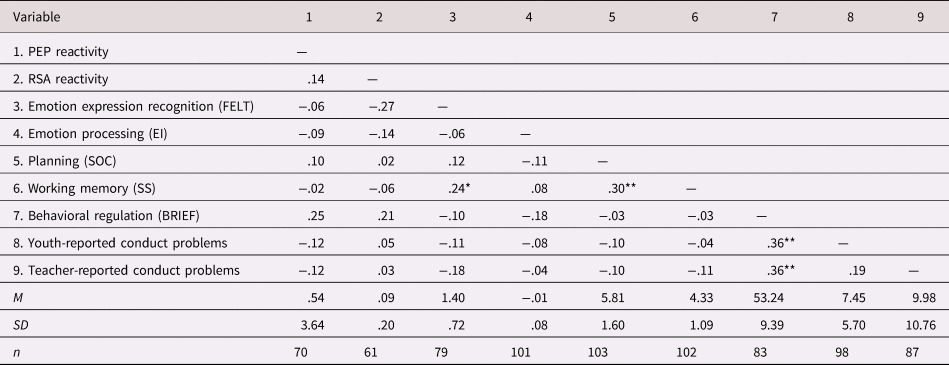
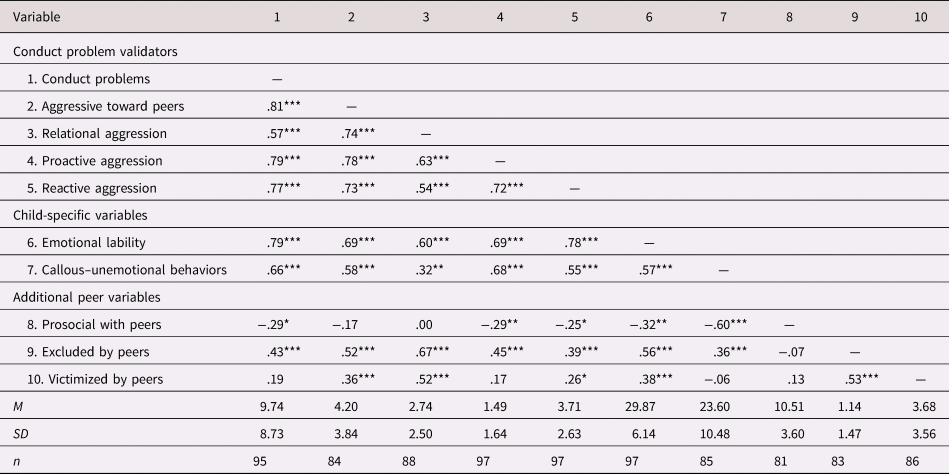
Bivariate correlations, means, standard deviations, and ns for variables used in the LPA are presented in Table 1 and for variables used in auxiliary analyses in Table 2.
Bivariate correlations, means, standard deviations, and ns for latent profile analysis predictors

Note. PEP = pre-ejection period, RSA = respiratory sinus arrhythmia, FELT = Facial Expression Labeling Task accuracy, EI = Emotional Interrupt accuracy, SOC = CANTAB Stockings of Cambridge number of problems solved in minimum number of moves, SS = CANTAB Spatial Span longest sequence recalled, BRIEF = Behavior Rating Inventory of Executive Functioning.
*p < .05. **p < .01.
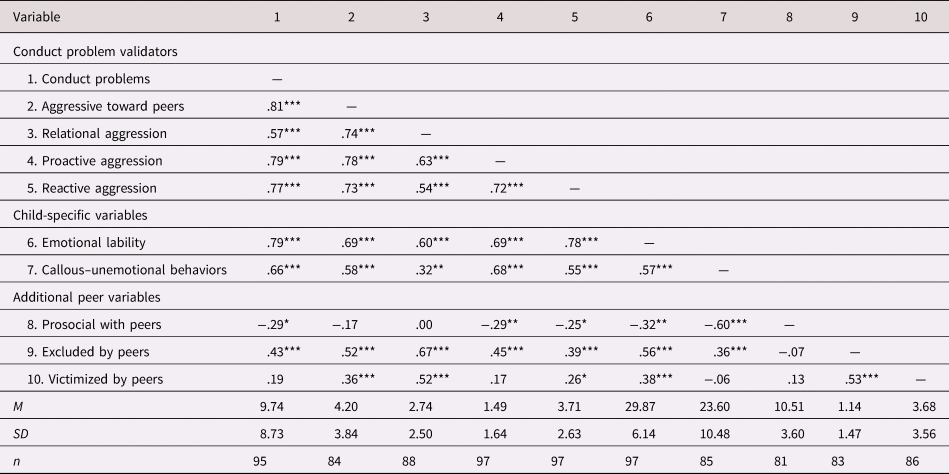
Bivariate correlations, means, standard deviations, and ns for caregiver-reported external validators
*p < .05. **p < .01. ***p < .001.
Examination of Table 1 indicates that working memory (SS) was moderately correlated with EER (FELT accuracy) and planning (SOC), and behavior regulation was moderately correlated with teacher- and youth-reported conduct problems. These low levels of correlation across variables were consistent with expectations and support our approach to use person-centered analyses to identify more homogeneous profiles.
All variables in Table 2 were derived from caregiver-rated questionnaires; thus, not surprisingly, there were moderate to high correlations among conduct problem validators, child-specific variables (i.e., emotional lability and CU behaviors), and peer exclusion. Prosocial behaviors were negatively associated, and peer victimization was positively associated, with some but not all conduct problem and child-specific variables.
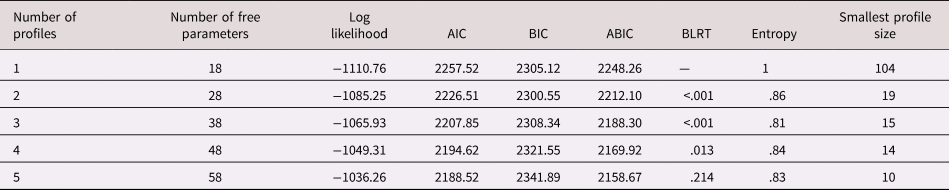
LPA was conducted with the nine variables listed in Table 1. The one-profile model was fit first, followed by models with two, three, four, and five profiles.
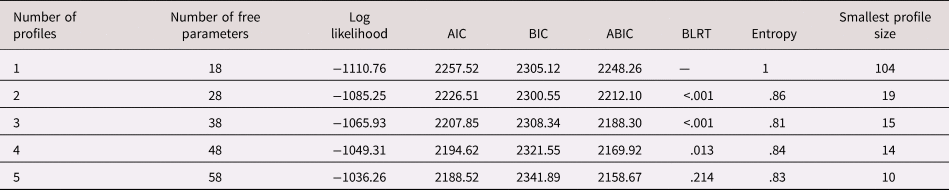
Examination of Table 3 indicates that whereas the lowest BIC was found for the two-profile model, the lowest AIC and sample size adjusted BIC were found for the five-profile model. The BLRT indicated that the four-profile model provided an improvement in fit from the three-profile model; however, the BLRT indicated that the five-profile model did not provide an improvement from the four-profile model. In addition, the size of one profile was relatively small for the five-profile model (n = 10; 9.62% of sample), suggesting further division of these profiles might not be substantively meaningful or replicable in other samples. Entropy was good across all models (>.80).
Fit indices for latent profile analysis models with 1–5 profiles
Note. AIC = Akaike Information Criterion, BIC = Bayesian Information Criterion, ABIC = sample-size adjusted BIC, BLRT = Bootstrap Likelihood Ratio Test. BLRT for the 1-profile model is not calculated.
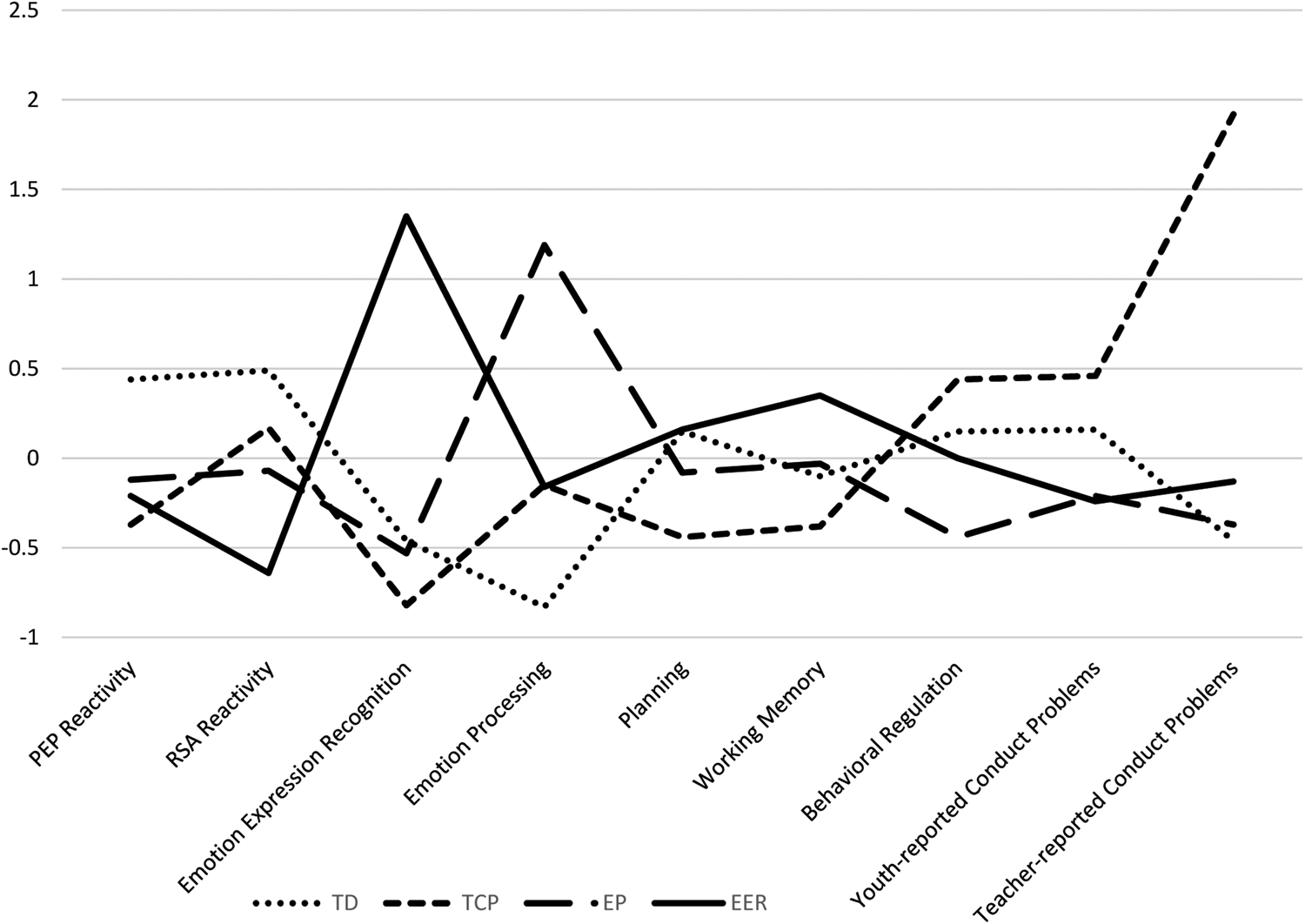
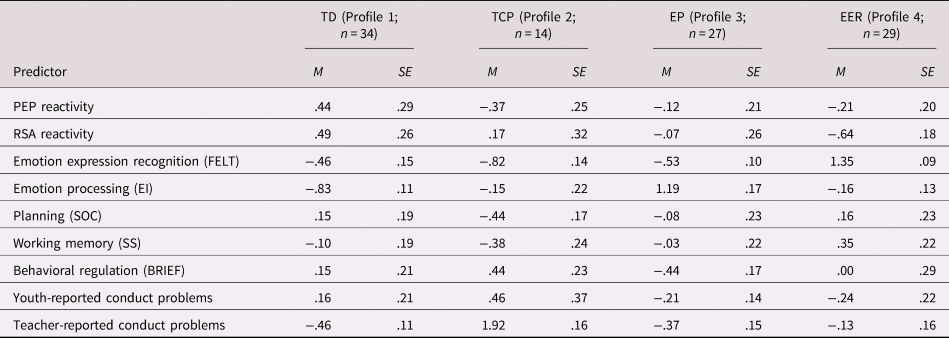
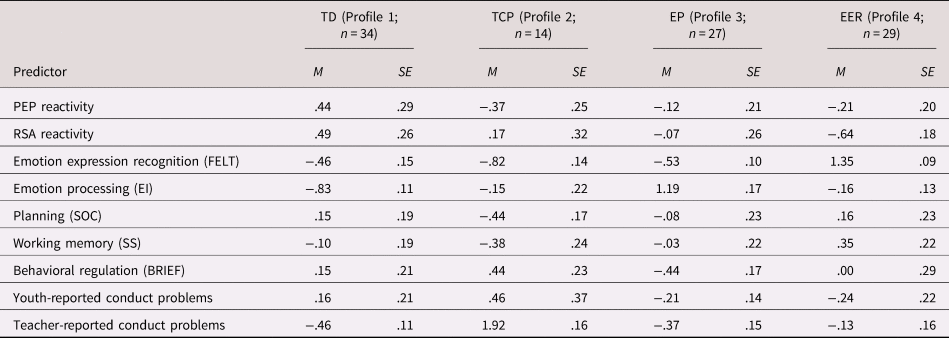
Conceptual and theoretical considerations were also used to determine the best-fitting model. Mean z-scores for the variables across the four profiles are included in Table 4 and illustrated in Figure 1.
Standardized variables for each profile. Note. TD = typically developing, TCP = teacher-reported conduct problems, EP = emotion processing, EER = emotion expression recognition.

Means and standard errors (z-scores) for each profile in the four-profile model
Note. PEP = pre-ejection period, RSA = respiratory sinus arrhythmia, FELT = Facial Expression Labeling Task accuracy, EI = Emotional Interrupt accuracy, SOC = CANTAB Stockings of Cambridge number of problems solved in minimum number of moves, SS = CANTAB Spatial Span longest sequence recalled, BRIEF = Behavior Rating Inventory of Executive Functioning. TD = typically developing, TCP = teacher-reported conduct problems, EP = emotion processing, EER = emotion expression recognition.
Profile 1 (TD, n = 34) was characterized by scores within 0.50 SD from the sample means, with the exception of EP performance (EI accuracy), which was 0.83 SD below the sample mean, suggesting some distractibility when presented with negative emotional stimuli relative to the overall sample's performance. Profile 2 (TCP, n = 14) was characterized by TCP that were nearly 2 SDs above the sample mean. Most scores were within 0.50 SD from the sample means, though accuracy of EER (FELT) was 0.82 SD below the sample mean.
Profile 3 (EP, n = 27) was characterized by performance on the EP task (EI accuracy) that was more than 1 SD above the sample mean, indicating that youth in this profile were less distracted by negative emotional stimuli relative to other youth in the sample. All other scores were approximately within 0.50 SD from the sample means. Profile 4 (EER, n = 29) was characterized by performance on EER (FELT) that was 1.35 SDs above the sample mean, with all other scores approximately within 0.50 SD from the sample means.
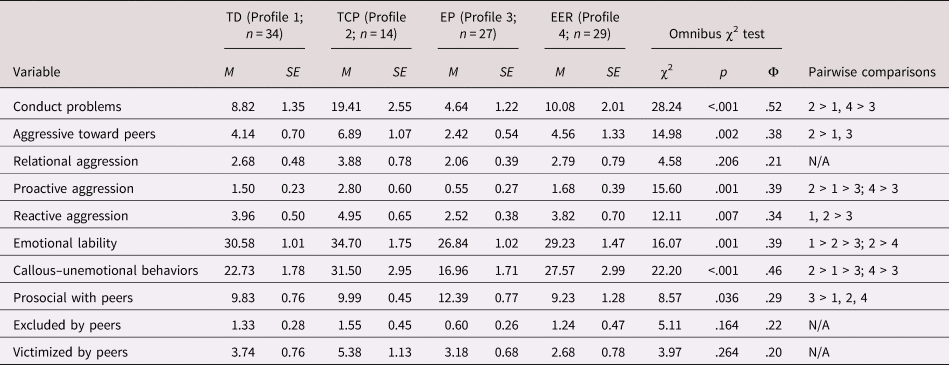
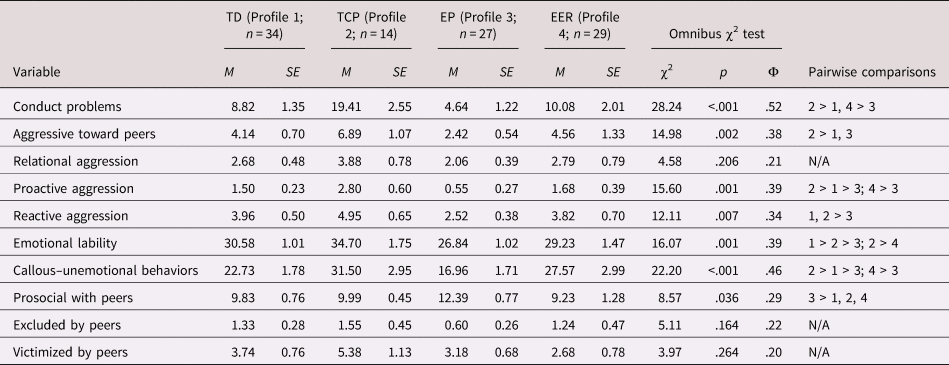
To test the predictive validity of the profiles, we examined whether caregiver-reported conduct problem validators, child-specific variables, and peer processes differed across the four profiles. Mean raw scores for the external validators across profiles, omnibus chi-square test statistics, and effect sizes are reported in Table 5.
Results of auxiliary analyses in the four-profile model
Note. TD = typically developing, TCP = teacher-reported conduct problems, EP = emotion processing, EER = emotion expression recognition.
Among the conduct problem validators, profiles differed on all variables except relational aggression. The TCP profile was rated as exhibiting elevated levels of (a) conduct problems relative to the TD and EER profiles, which also demonstrated elevated levels compared to the EP profile (significant pairwise χ2s range: 4.89 to 26.56; ps range: .027 to <.001; Φs range: .28 to .80); (b) aggression toward peers compared to the TD and EP profiles (significant pairwise χ2s: 4.46, 13.61; ps: .035, <.001; Φs = .28, .58, respectively); (c) proactive aggression compared to the TD profile, which was also elevated compared to the EP profile (significant pairwise χ2s range: 3.89 to 11.41; ps range: .049 to <.001; Φs range: .28 to .53); and (d) reactive aggression compared to the EP profile (χ2 = 10.00; p = .002; Φ = .49). In addition, the EP profile exhibited lower levels of (a) proactive aggression compared to the EER profile (χ2 = 5.64; p = .018; Φ = .32) and (b) reactive aggression compared to the TD profile (χ2 = 4.91; p = .027; Φ = .28). Taken together, the TCP profile was elevated on conduct problems whereas the EP profile was lower on conduct problems, with the TD and EER profiles varying based on the conduct problem constructs considered.
Profiles differed on both child-specific variables, emotional lability and CU behaviors. The TD profile exhibited higher levels of emotional lability compared to the TCP profile, which demonstrated elevated levels compared to the EP and EER profiles (significant pairwise χ2s: 3.94 to 14.55; ps range: .047 to <.001; Φs range: .29 to .60). With regard to CU behaviors, the TCP profile exhibited higher levels compared to the TD profile, which exhibited elevated levels compared to the EP profile; in addition, the EER profile was elevated relative to the EP profile (significant pairwise χ2s range: 5.10 to 17.69; ps range: .024 to <.001; Φs = .29 to .66). Profiles differed on prosocial behavior, though not exclusion or victimization, with the EP profile exhibiting higher levels of prosocial behavior than the other profiles (significant pairwise χ2s range: 4.33 to 7.18; ps range: .038 to .007; Φs range: .28 to .42). Consistent with the pattern of findings observed with the conduct problem validators, the EP profile exhibited lower levels of emotional lability and CU behaviors, and higher levels of prosocial behavior. The TD profile was rated as exhibiting elevated emotional lability, with some additional noteworthy pairwise comparisons among child-specific variables.
Discussion
The current study used a person-centered, developmental psychopathology- and RDoC-informed approach to identify profiles of youth based on conduct problems, as well as neurobiological and cognitive correlates of conduct problems, among a sample of children residing in low-income, urban neighborhoods. LPA identified four profiles: (a) TD, with scores on variables generally within 0.50 SDs above or below the sample means; (b) TCP, characterized by scores on this index that were nearly 2 SDs above the sample mean; (c) EP, children who were less distracted by negative emotional stimuli during a laboratory-based task; and (d) EER, characterized by better performance in identifying facial expressions of sadness, fear, and anger. The TD profile exhibited elevated emotional lability and the TCP profile demonstrated elevated CU behaviors relative to the other profiles. The EP profile evidenced elevated levels of prosocial behavior and lower levels of emotional lability and CU behaviors compared to the other profiles. In addition, profiles differed in terms of caregiver-reported conduct problems, providing further external validation. For example, the TCP profile was rated by caregivers as demonstrating elevated levels of conduct problems, suggesting some cross-setting/cross-informant consistency. The EP profile generally had the lowest levels of caregiver-reported conduct problems, suggesting that reduced distractibility for negative stimuli may be associated with attenuated risk for conduct problems within the present sample. The TD and EER profiles were often lower than the TCP profile and greater than the EP profile, but seldom differed from each other in terms of caregiver-rated conduct problems.
As noted, we included variables in the LPA that were assessed using multiple levels of analysis across several neurobiological and cognitive domains. Although no study to date has considered this range of variables, we hypothesized that profiles would differ in terms of levels of conduct problems, cognitive variables, and neurobiological variables. Consistent with expectations, one profile was differentiated by elevated levels of conduct problems (TCP). This profile also evidenced the highest level of youth-reported conduct problems in the sample, as well as the lowest scores on tasks that are associated with dorsolateral prefrontal functioning (among other brain areas) and the caregiver-reported index of EF. Thus, the TCP profile evidenced not only elevated conduct problems, but also lower EF abilities as indexed by both the CANTAB tasks and the BRIEF, relative to other profiles. These findings replicate well-established relations among problematic decision-making and EF difficulties with conduct problems (e.g., Jakubovic & Drabick, Reference Jakubovic and Drabick2020; Sonuga-Barke et al., Reference Sonuga-Barke, Cortese, Fairchild and Stringaris2016).
We hypothesized that profiles would evidence different patterns of neurobiological functioning. Although there was not much differentiation in terms of ANS reactivity, two profiles were distinguished by performance on laboratory-based tasks that have been shown to recruit the amygdala (FELT; EER profile) and the orbitofrontal cortex (EI; EP profile). The EER profile had both the highest accuracy in facial expression recognition and the lowest RSA reactivity, consistent with evidence that age-appropriate amygdala functioning and low RSA reactivity are associated with emotion regulation (Beauchaine, Reference Beauchaine2015; Blair, Reference Blair2015). Generally, results of auxiliary analyses indicated that scores among children in this profile fell lower than those in the TCP profile but higher than those in the EP profile. Although speculative, it may be that this profile captures youth who have intact social cognition and thus are better able to adapt to interpersonal demands (Deater-Deckard, Reference Deater-Deckard2001). Specifically, given their ability to identify nonverbal (e.g., facial) cues and emotion regulation skills, these youth may have a broader repertoire of social behaviors to select from depending on their circumstances. Further research is necessary to evaluate this possibility.
Findings related to the EP profile were unexpected. Better performance on the EI task is associated with attenuated amygdala activity (Blair, Reference Blair2015; Hwang et al., Reference Hwang, Nolan, White, Williams, Sinclair and Blair2016). As such, these youth are less distressed by negative stimuli relative to children in other profiles. Performance indicating less distraction by negative stimuli is generally associated with conduct problems and CU behaviors (Blair, Reference Blair2015; Hwang et al., Reference Hwang, Nolan, White, Williams, Sinclair and Blair2016; Lozier et al., Reference Lozier, Cardinale and Vanmeter2014). However, in the current sample, these youth were rated by caregivers as lower on both conduct problems and CU behaviors; in fact, they were more likely to be rated as prosocial than youth in any other profile. This pattern of results suggests that children in the EP profile are able to adequately cope with negative stimuli, which may be more common in their environments, and display positive adjustment, at least according to caregiver reports. Future research that evaluates additional correlates and examines these relations prospectively will be necessary to understand whether underactive amygdala functioning and lower levels of distress in the context of negative stimuli are in fact adaptive or associated with resilience among youth who experience elevated psychosocial and physical stressors. Based on prior work, youth with CU traits evidence reduced amygdala activity, which may interfere with difficulty learning stimulus-incentive associations that are necessary for socialization related to care-based transgressions (Blair, Reference Blair2015; Davidson, Reference Davidson2002; Sears et al., Reference Sears, Schiff and LeDoux2014). However, in this community-based, nonreferred sample, underactive amygdala activity without CU traits may contribute to prosocial behavior as children are better able to manage others’ distress and demonstrate empathy than youth who are more reactive to negative environmental stimuli (Hay & Pawlby, Reference Hay and Pawlby2003; Nantel-Vivier et al., Reference Nantel-Vivier, Pihl, Côté and Tremblay2014).
We labeled the TD profile as such because almost all scores fell within 0.50 SDs above or below the sample means. There were, nevertheless, some noteworthy patterns among the variables considered. For example, the TD profile evidenced the highest levels of ANS reactivity and lowest EI scores, which may be associated with lower levels of emotion regulation and more distraction by negative stimuli (Beauchaine, Reference Beauchaine2015; Mitchell et al., Reference Mitchell, Richell, Leonard and Blair2006). In terms of auxiliary analyses, the TD profile evidenced the highest levels of caregiver-reported emotional lability, as well as levels of reactive aggression that were similar to the TCP profile. The TD profile was not elevated on conduct problems based on the LPA findings. However, given that lability is a transdiagnostic phenomenon (and thus consistent with an RDoC approach), lability may confer risk for, be associated with, and/or exacerbate other emotional or behavioral difficulties. Future research will be necessary to test whether this profile is in fact more likely to experience internalizing symptoms or other negative correlates besides conduct problems.
The use of a developmental psychopathology- and RDoC-informed approach to our conceptual model and the use of multiple levels of analysis to index constructs of interest are in line with prior calls in the literature (Fonagy & Luyten, Reference Fonagy and Luyten2018; Franklin et al., Reference Franklin, Jamieson, Glenn and Nock2015) and are strengths of the current study. Examining variables during childhood when these processes may be more amenable to intervention, and including variables that can be assessed in school, the primary setting for preventive interventions, can aid in the identification of youth at risk for a more severe or pernicious course of conduct problems. The current approach also permitted variables to compete against each other for characterizing profiles; thus, the findings suggest that there may be indices that are more useful for identifying children at risk. Moreover, the person-centered approach in this community-based sample provides opportunities for recognizing that patterns of functioning associated with risk in other samples may in fact be related to resilience and more adaptive functioning among children residing in neighborhoods with elevated physical and psychosocial stressors. Implications of this work are particularly critical for the development of preventive services that may attenuate risk for youth in low-income, urban neighborhoods, who are more likely to be underserved and contend with historical trauma and acute and chronic stressors (Bringewatt & Gershoff, Reference Bringewatt and Gershoff2010; Cotter & Smokowski, Reference Cotter and Smokowski2017; Devenish et al., Reference Devenish, Hooley and Mellor2017; Goodnight et al., Reference Goodnight, Lahey, Van Hulle, Rodgers, Rathouz, Waldman and D'Onofrio2012; Leventhal & Brooks-Gunn, Reference Leventhal and Brooks-Gunn2003; Mohatt et al., Reference Mohatt, Thompson, Thai and Tebes2014). Nevertheless, ecologically valid models of conduct problems will require additional research that considers youth who vary in age, ethnicity, SES, and contextual processes to determine the generalizability of these findings. Last, the use of objective indicators of neurobiological and cognitive processes, combined with the inclusion of multiple informants, minimize concerns related to mono-rater and mono-method biases (De Los Reyes et al., Reference De Los Reyes, Augenstein, Wang, Thomas, Drabick, Burgers and Rabinowitz2015, Reference De Los Reyes, Drabick, Makol and Jakubovic2020).
Despite these strengths, the present study has several limitations. First, the study was cross-sectional. Thus, it cannot be determined whether the cognitive and neurobiological factors should be construed as mechanisms, risk factors, correlates, or sequelae of conduct problems based on the current data. Longitudinal research, particularly studies that can take into account the bidirectional and transactional relations among these variables, is necessary to better understand the roles of the factors assessed. Although we posited a role for emotion regulation, particularly for the EER profile, we had to base this possibility on findings related to laboratory-based tasks. We administered a questionnaire indexing emotion regulation, but the psychometrics were not sufficient for inclusion in auxiliary analyses. In addition, greater consideration of contextual (e.g., neighborhood, family) factors that may influence these cognitive and neurobiological processes is warranted given evidence that these processes are malleable during childhood in response to both positive and negative contextual factors (e.g., marital conflict, neighborhood cohesion; Bubier et al., Reference Bubier, Drabick and Breiner2009; El-Sheikh & Whitson, Reference El-Sheikh and Whitson2006). Conduct problems were operationalized as ODD and CD symptoms but were assessed using questionnaires. This dimensional approach is useful for conceptualizing broader risk (Drabick & Kendall, Reference Drabick and Kendall2010) but is not equivalent to DSM diagnoses. The sampling method (i.e., self-selection) may have also led to sampling biases. Last, although we were able to identify four profiles, the sample size was relatively small. Thus, future research should evaluate the generalizability of these findings and the utility of these profiles for identifying children at risk for conduct problems, as well as children who exhibit resilience despite experiencing significant contextual stressors given heterogeneity and equifinality associated with conduct problems (Aitken et al., Reference Aitken, Henry and Andrade2018; Fanti & Kimonis, Reference Fanti and Kimonis2017).
In summary, we identified four profiles of children who differed in their levels of conduct problems (TCP), EER, and reactivity to negative stimuli (EP). The TD profile also evidenced associations suggestive of emotional lability (e.g., ANS reactivity, caregiver-reported reactive aggression and lability). Clinically, identifying youth who are elevated on TCP could be accomplished in a fairly straightforward manner with a screening instrument, which may also assess the correlates for this profile as rated by youth and caregivers, such as difficulties with EF and conduct problems. Thus, for these youth, interventions could address cross-setting behavioral difficulties and EF challenges to reduce conduct problems and provide skills for improving in these areas. Given continual development of EF abilities into adulthood (Luciana, Reference Luciana2013) and the impact of early childhood stress on the prefrontal cortex (Hanson et al., Reference Hanson, Chung, Avants, Rudolph, Shirtcliff, Gee and Pollak2012), it might be preferable to consider tasks shown to recruit the amygdala and/or orbitofrontal cortex during childhood to better differentiate youth at risk for conduct problems, as these measures were more sensitive to differences among profiles. Continued research that takes into account the equifinality associated with conduct problems, as well as the multifinality from processes such as ANS reactivity, could address the extent to which processes are specific to conduct problems vs. transdiagnostic. Given heterogeneity in conduct problems, identifying more homogeneous subgroups of youth could inform etiological models, assessment approaches, identification of youth at risk, and targets and methods of interventions for conduct problems (Graziano et al., Reference Graziano, Landis, Maharaj, Ros-Demarize, Hart and Garcia2019; Piehler et al., Reference Piehler, Distefano, Ausherbauer, Bloomquist, Almy and August2019; Propp et al., Reference Propp, Bedard and Andrade2020). Accounting for context along with the reciprocal and transactional interactions among children and their environments could bolster these aims. Such knowledge can address not only risk and resilience, but also targets of preventive interventions that can attenuate risk for conduct problems in settings with limited resources and elevated levels of stressors.
Acknowledgments
We are indebted to the families, principals, and school staff who participated in this research.
Financial Support
This study was funded in part by grants from Temple University Office of the Vice President for Research and College of Liberal Arts and National Institute of Mental Health 1 K01 MH073717–01 A2 awarded to Dr. Deborah Drabick.
Conflicts of Interest
None.