In my youth, a proposal to place part of the trust funds in private securities would have been labeled socialism and seen as increasing government control of the private economy.
P. Diamond (1996: 70)1 Introduction
The traditional pay-as-you-go (PAYG) system of financing social security benefits is no longer sustainable in light of the adverse demographics and actuarial imbalance. As a result, most countries have abandoned the pure PAYG pensions of the past and adopted a partially funded, partially public system, a mixture of public and private elements varying with each nation's culture, history, and social conditions. Interestingly enough, these countries have recognized the importance of investing at least part of the contributions in the stock and bond markets through either decentralized individual accounts or a centralized trust fund.Footnote 1 To secure reserves, some countries have established strict rules of investing pension reserves placing most of the funds in ‘safe’ instruments like bank deposits, treasury bills and bonds and avoiding stock investments. The management of the Greek public pension funds since 1950 has followed such an investment policy.
The aim of this paper is to investigate the issue of fund management in the Greek pension system. In particular, we examine whether pursuing more liberal investment rules could have provided some relief to its current unfunded state. The analysis focuses on the historical yields offered by various investment instruments (bank deposits, treasury bills and bonds, and stocks) during the second half of the twentieth century and the effect that various allocations to these instruments would have on the risk and return characteristics of invested funds. Such an analysis allows us, among other things, to examine the appropriateness of the mandatory policy that kept most of the fund reserves in low earning deposits with the Central Bank of Greece. Also examined is the absence of long-term investment vehicles and the prohibition to invest in the stock market until more recently. Simulation of a more liberal investment policy with part of the money being placed into equity investment helps to assess the appropriateness of fund management and provides useful policy guidelines.
The conservative fund management of Greek pension reserves is not in line with the more flexible investment policies being followed by other countries. In this paper, we examine this difference by simulating the Greek pension reserves using more flexible investment regimes in order to provide policy implications for improving and reforming the current Greek system of fund management.
Regarding the reforms made in the management of other pension systems, Engstrom and Westerberg (Reference Engstrom and Westerberg2003) presented the case of the Swedish pension system as an example of a reform whereby individuals are encouraged to make own investment decisions that will affect their public pension accounts for retirement. In a similar approach, US occupational pension plans 401(k) give full responsibility to participants to make investment decisions on their own. In addition and pursuant to the unfamiliarity of some participants with investment decisions, a default alternative is also provided as an investment guide. Structuring its version of 401(k) corporate schemes differently, China plays a more assertive role of fund management and chooses pension managers that will be allowed to manage newly established corporate schemes on behalf of participants.Footnote 2
In this paper, we utilize data on pensions' reserves spread from 1950 to 2000 and cover almost all funds. End-of-year data on pensions' reserves are combined with simulated stock returns and available yields on deposits and Treasury bills and bonds in order to generate the distribution of actuarial terminal values. In so doing, we are able to assess not only the effect of alternative investment strategies on pensions' reserves, but also the risks associated with them.
The rest of the paper is structured in the following way. Section 2 describes the current state of the Greek pension system and sets forward the related issues surrounding pension fund management and the investment decisions to direct funds into equity. Section 3 presents the data used in this study and the methodological issues in generating the various scenarios in the simulation analysis. The discussion of the empirical results is presented in Section 4 and our conclusions are summarized in Section 5.
2 The state and the management of the Greek pension fund system
2.1 The state of the public pension system
Greece is one of the few countries among OECD countries with a high ratio of pension expenditure over GNP. Greek demographics over the last two decades along with economic adversities affected disproportionately an already fragile social security system suffering from a number of structural problems, such as limitations and state intervention in pension fund management; fragmentation, diversity, and inefficient management (see IMF, Reference Carmichael, Palacios, Musalem and Palacios2002).Footnote 3 These problems along with pension contribution evasion and with a number of unfounded provisions and benefits led to a dramatic increase in the cost of social security.
The Greek public pensions system operates on a PAYG via 86 public agencies under the supervision of six different ministries. Among those institutions, 28 public pension funds provide the primary pension to retired persons in all sectors of the Greek economy. Social security contributions come primarily from four large groups, covering wage earners in the private sector (45%), farmers (17%), non-agricultural self-employed (19%) and public servants (8%). Each of these four large categories is served by an independent pension system.Footnote 4 In addition to these four pension organizations, a number of smaller professional and enterprise-specific agencies also operate providing services to bank employees, to persons employed by large public utilities and to several professional groups (lawyers, doctors, engineers, press employees, etc).
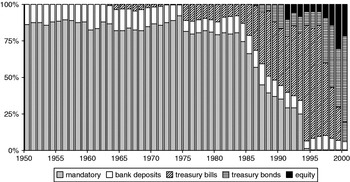
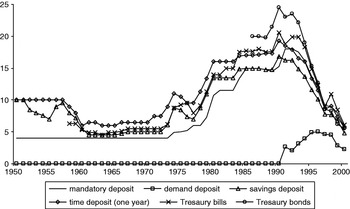
Current reserves of public pension agencies resulted from pre-1980 accumulations because contributions were cashed in, whereas claims were long to mature. However, agencies did not have control in managing their wealth and more than 75% of total reserves had to be locked in mandatory deposits with the Central Bank of Greece (see Figure 1). Prior to 1973, mandatory deposits earned a meager 4%, which was lower than the yield from savings or time deposits. Soon after the first oil shock, interest on mandatory deposits was readjusted in order to keep pace with bank rates and inflation, although persistently undershooting them (see Figure 2). A clear change in the composition of pension reserves occurred in 1984, whereby mandatory deposits started to decline significantly, making room for investments in treasury bills. By 1994, the rules regarding mandatory deposits were lifted, allowing reserves to be shifted gradually to treasury bills, treasury bonds, and equity.
Asset composition of pension fund reserves

Yield on bank instruments and securities

Regarding equity investment, the Greek pension funds had a real, although limited, option of placing their reserves in stocks from as early as 1975.Footnote 5 Equity investment, however, could not exceed 10% of the net reserves accrual or 10% of the fund's total reserves and it can easily be seen by inspection of Figure 1 that this opportunity was ill-used prior to 1991.
All the institutional handicaps and limitations of the Greek social security system have been the accumulated result of government policies since the 1950s. The situation worsened in the 1980s when the attempted political openness along with electoral gains made the system more generous. These, in addition to the economic weaknesses pertaining primarily to moonlighting and contribution evasion have put an extremely fragile social security system into a deep crisis. In the year 2000 retirees accounted for approximately 15% of a stagnating population and as a result the ratio of working persons to retirees plunged to 2.05:1 relative to a 3.66:1 in 1975Footnote 6. Demographic projections for the decades to come are even more alarming as old age persons are expected to account for one fifth of the population by year 2050 (see IMF, Reference Carmichael, Palacios, Musalem and Palacios2002).
These demographic adversities are mirrored in the finances of social security. Since the early 1980s, public pension funds recorded increasing current deficits. The total current deficit of the seven larger agencies increased from 14.5 billion drachmas in 1981 to 591 billion drachmas in 1993 and to more than a trillion drachmas in 2000.Footnote 7 To address this worsening situation, two major pension reforms were attempted in 1992 and 2002.
The 1992 reform consisted of tightening up the parameters of the system for all post-1992 workers, while providing for state funding. However, even these significant reforms were not adequate to reduce the fragmentation and inequality in the system (Petmesidou, Reference Petmesidou, Mosialos and Mitsos2000).
The 2002 reform (Law 3029/02) provided for additional state funding, revised once again the parameters of the system and unified them across various agencies, introduced private fully funded pensions funds and encouraged further primary fund merging (IMF, 2003). Yet, this law neither allowed for better management of fund reserves nor gave greater autonomy and initiative in the decision making of social security funds. As a result, a more radical reform in the social security system is pending.
2.2 The Issue of pension fund management
Financial management of pensions' reserves and, especially, stock investment is a highly controversial issue. Its critics are spread over the entire political spectrum and attack it either as too liberal or too socialist, depending on their political views.Footnote 8 For example, Weller (Reference Weller2000: 264) notes that political risk is a major issue in the equity investment controversy. For one thing, these contrasting views for, as well as against, stock investment exist because it is difficult to draw the line between an active stock selection strategy and a well-intentioned or, even worse, corrupt public intervention in the stock market. For this reason, to alleviate criticism, state pension fund management tends to operate on passive investment strategies. As a result, any discussion as to how the system might be or might have been relieved by higher yields must necessarily, if not primarily, touch upon the issue of risk, given that a stated goal of Social Security is to provide retirement benefits at low risk (Gillion, Reference Gillion2000).
Reforms are not only needed in the main parameters of the social security system but involve the management of fund reserves as well. In fact, there are several issues involved in pension fund management: issues of good governance, issues of transparency in stated objectives and their implementation, and issues of accountability vis-à-vis present and future beneficiaries.Footnote 9 Investment policy issues and especially the decision on how to allocate the fund's reserves are financial issues that can be addressed on the basis of existing principles of portfolio management and the risk and return relationship. There are also secondary financial considerations pertaining to the style of the equity investment, the decision of delegating active management to one or more outside fund managers, the question of the trust's market power in the stock market, the restrictions and constraints of financial management to name just a few.
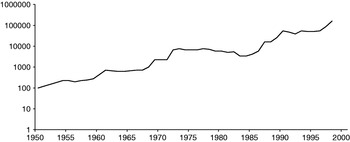
Fund diversification through the stock market is not a cure to all; higher returns can only be achieved by bearing more risk and any reform that allows for more equity investment will always look better than its alternatives.Footnote 10 Financial risk must be introduced and properly assessed in order to have an objective picture of how equity investment may affect fund performance. Pension fund managers should set the target return according to the long-term funding objective and, at the same time, define the level of tolerable risk at which the target is to be attained.Footnote 11 In doing so, they must adopt modern financial market practices such as the value at risk and economic capital.Footnote 12 Gains and risks of equity investment in the Greek Stock Exchange can be deduced from Figure 3, which shows in semi-log form the evolution of the Composite Market Index from 1950 to 2000.
Athens stock exchange composite market index (1950=100)

Market price risk is the predominant, although not the unique source of financial risk when equity investment is allowed for. Another risk comes from state interference in the management of the funds. Such interference may arise through the appropriation of existing fund reserves, which may eventually force fund managers to liquidate investment holdings at non-accommodating market conditions, thus eroding previously established investment strategies and reducing the potential to maximize returns. The state may also implement a policy of appropriating investment income, thus undermining existing re-investment options.
In essence, state appropriation of fund reserves and income investment adds another constraint to management towards preferring more liquid assets. As a result, fund managers would have to take this interference risk into account when designing and implementing investment strategies in order to minimize its effect on the fund value. This strategy is likely to incorporate smaller stock investment than it would have in the case of no state interference.
Again, because of state interference, the investment pension fund strategy that has been implemented is likely to span over a smaller investment horizon to match the expected time of fund manager appointment. This is so because fund managers are usually replaced with a change or reshuffling in the government. With all these considerations it is reasonable to assume that state interference would result in suboptimal investment strategies that may not maximize fund returns.
A number of recent studies (Weller, Reference Weller2000; Munnell and Balduzzi,Reference Munnell and Balduzzi1998 and the references cited therein) have investigated the effect of equity investment on projected pension funds wealth and risk. What these studies have in common is that they take the present situation as given. This is, of course, an operational advantage: after all bygones are bygones and stock market opportunities cannot be exploited retrospectively. However, the effect of equity investment on pensions' wealth is probably underestimated, since it is limited to a period where financial stress has already been installed. A more general, although partly non-operational, assessment of equity investment should therefore include the period during which pensions funds had a significant financial slack.
A retrospective assessment of equity investment also affects the political economy of reform. In fact, unions hold the government responsible for having mismanaged pension's wealth and, thus, for having aggravated the initial conditions of reform.Footnote 13 This argument gives unions a negotiating edge and makes public funding of social security deficits appear as sort of due reparation in the political economy of the government–unions game over pensions.Footnote 14 Therefore, a retrospective investigation on equity investment would be essential in gauging the argument, although this point diverges from the main focus of this paper.
3 Data and methodology
In this paper we simulate the effect of a more liberal pension fund management on the risk and return characteristics of invested funds, following different investment strategies and using existing historical returns of various instruments. Our database includes three series of data on the financing of pension funds, which are maintained by three organizations: the Central Bank of Greece, the National Statistical Service of Greece, and the Ministry of Labour.
The first series covers the period 1950–2000 and offers data on pension reserves by type of placement, without, however, providing information on equity. The second series covers the period 1962–2000 and offers data on pension revenues and expenses, including revenues from and depreciation of real estate property. The third series offers the most detailed breakdown of pension reserves, including equity investment since 1990. Among other things, the three data series differ in the number of pension funds covered: the first and second series cover all pension funds, whereas the third series covers only pension funds supervised by the Ministry of Labour.
In what follows we rely on a combination of the first and third series. Data for all pension funds and for all types of reserves, equity excluded, from 1950 to date are taken from the Central Bank of Greece series. These data are supplemented with equity investment data taken from the Ministry of Labour series from 1990 on without any loss of information since, as noted earlier, pension funds did not invest in the stock market prior to that date.
3.1 Random scenario generation
For the purposes of our study, stock returns are simulated using several scenarios of random generation processes. A first group of processes is non-parametric and random generation is equivalent to bootstrapping.Footnote 15 A second group of processes is parametric and scenarios are generated by Monte Carlo simulation of well-documented stock return models.
First, the historical vector of returns is randomly permutated and each permutation is equivalent to a scenario. By construction, all scenarios have a mean and variance equal to the historic values of returns. However, these scenarios do not preserve the time structure of the original series (i.e. serial correlation of returns), and are equivalent to assuming that the original process is an i.i.d. In order to ensure that the sample of scenarios is balanced, i.e. that each return appears equally frequently, we furthermore construct a vector of returns containing 51 repetitions of the history of returns. Scenarios are then generated by random permutations of the 51×51 long vector and by selecting its 51 first elements. Again, the time structure of the original series is not preserved. Finally, in an attempt to capture the time series structure of the original series, we set up a random block scenario generation process. Block scenarios are generated by random permutations of the 17 three-year return blocks.
In our second set of processes, parametric scenarios simulate a white noise process with drift where the parameters are set equal to their historical estimates. Given that the relevant horizon here is very long, the need to take account of, and simulate, volatility clustering and risk variability is minimal.Footnote 16 The parameters of the returns process are set equal to their historical values since 1950, i.e. a mean of 21.59% and a standard deviation of 46.34%.
Programs of parametric as well as non-parametric simulations were written for, and executed in, Matlab® and 10,000 scenarios were generated for each process.
3.2 The wealth effect of alternative investment strategies
Stock return scenarios are plugged into the pension fund's basic accounting identity in order to evaluate the distribution of reserves at some terminal date under alternative investment strategies.
The basic accounting identity is

where
W t(t+1):The fund reserves at end of period t(t+1)
ωti:The percentage of fund reserves invested on asset i at end of period t
r t+1i:The yield on asset i in period t+1
NC t+1:The net cash flow to the fund in t+1
An alternative investment strategy , implemented from t=0 onwards, would generate a new series of fund reserves given by

with 
The relationship between historical and simulated reserves results by subtracting (1) from (2), which also provides an estimate of the change of reserves due to adopting an alternative investment strategy, 

where
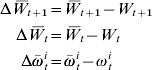
According to equation (3), the effect of implementing an alternative investment strategy up to time (t) has two distinct sources: a cumulative gain, which is equal to the first term, and a current gain, which is equal to the second term.
The pension fund's wealth at some terminal date, say T, is recursively evaluated as  on the basis of the original series of pension wealth, [W t]t=1, …, T, the original investment strategy, [ωti]t=1, …, Ti=1, …, N, the history of returns on all investments except stock investment, [r ti]t=1, …, Ti≠s, the simulated stock return series, [r ts]t=1, …, T, and the alternative investment strategy,
 , under consideration.Footnote 17 The effect of alternative investment strategies is expressed as the average percentage difference of simulated over actual terminal value, i.e.
 .
It must be noted that investment strategies are directly and not gradually implemented. For example, a 40% equity investment means that initial reserves as well as subsequent pension surpluses are invested in stock so as to maintain a constant 40% equity balance by the end of each year.Footnote 18 Consequently, our results correspond with the steady-state fund reserves series compared to existing assessments of alternative strategies, involving a gradual transition from bonds to stocks as in Weller (Reference Weller2000).
3.3 The risk of alternative investment strategies
As stated earlier, however, the assessment of alternative strategies must take also into consideration the associated risks. Standard measures of risk rely on either volatility or probability measures of the corresponding distribution. The value at risk (Var) measures of risk fall into the second category and have the advantage of focusing on downside risk, i.e. the probability that losses end up at or below some critical level. Computer-intensive methods, as the ones used here, generate large numbers of realizations and can therefore produce reliable estimates of downside risk.
In what follows, we define downside risk as the probability, p, with which the fund's simulated wealth might have ended up at or below actual wealth, i.e.  . Probabilities thus obtained express the risk that an alternative investment strategy might have done worse than the strategy that was effectively pursued. Alternatively, we present two genuine value at risk measures at the industry's standard confidence levelsFootnote 19 of 95% and 99%; both measures are expressed as percentage differences of the corresponding percentile wealth over actual terminal wealth, i.e.
 where
 such that
 with c=0.95 and 0.99. The values thus obtained express the amount of cushion reservesFootnote 20 that fund managers would have to put aside in order to face unexpectedly adverse stock market conditions. Finally, we present beyond value at risk (bVaR)Footnote 21 measures expressed as percentage differences of the corresponding expected wealth over actual terminal wealth, i.e.
 , where
 is equal to the conditional expectation
 . These measures have better statistical propertiesFootnote 22 and are more representative of the value at risk when the corresponding distribution is fat tailed.
4 Empirical results
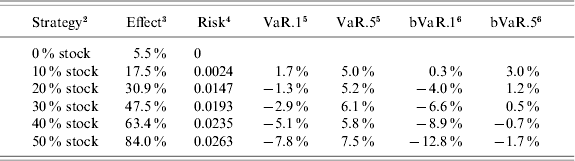
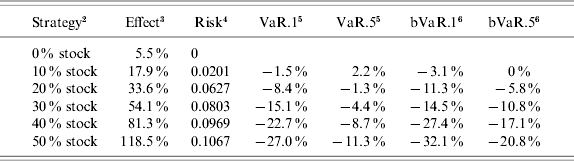
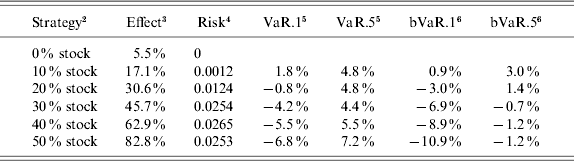
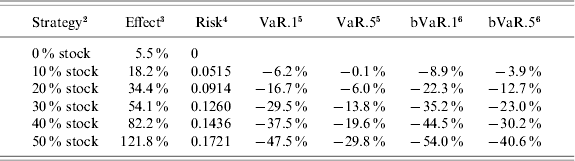
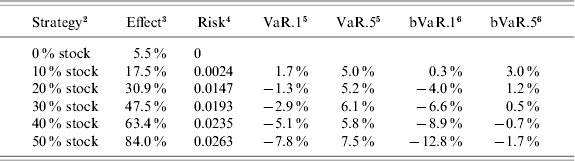
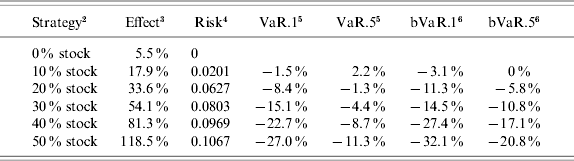
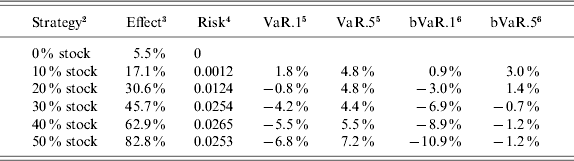
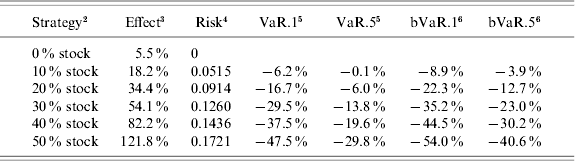
Results pertaining to the various return generation processes and for alternative investment strategies are reported in Tables 1 through 4. The stock market component of each strategy is passive, index tracking, constant balancing of equity investment, and alternative investment strategies differ only as to the relative amount of the latter.
Random scenario generating process 1 (1950–2000) Footnote 1
Notes:
1 Stock returns scenarios are generated by random permutations of stock returns history.
2 Stock investment is index tracking, whereas non stock investment is equally placed on savings and time deposit, and Greek Treasury bills and bonds.
3 Effect is the percentage difference between simulated and actual wealth in 2000.
4 Risk is the frequency with which simulated wealth ends up below actual wealth in 2000.
5 VaR 1% and 5% is the value at risk at confidence levels of 99% and 95% respectively as a percentage difference over the fund's actual wealth in 2000.
6 bVaR 1% and 5% is the conditional value at risk at confidence levels of 99% and 95% respectively as a percentage difference over the fund's actual wealth in 2000.
Equity investment ranges from 0% to 50% and the remaining is equally divided among the available fixed income investments (deposits, both savings and time, and securities, both bills and bonds).Footnote 23 For each strategy thus defined and for each returns process, we report the expected effect as a percentage difference of simulated over actual reserves in year 2000. Its downside risk is captured by the probability of simulated reserves falling short of actual reserves and its value at risk (percentile and conditional values) is expressed as percentage differences from actual reserves in year 2000. Negative percentages mean that the simulated percentile or conditional VaRs have been below actual terminal reserves, and consequently imply that the corresponding investment strategy would entail some risk, conditional on the choice of the returns generating process. On the contrary, positive percentages imply that simulated percentile or conditional VaRs have been above actual terminal reserves at the corresponding confidence levels.
A natural common feature among all processes is that the effect of equity investment on terminal reserves is increasingly a function of the percentage amount invested. The effect of each strategy is proportional to the percentage amount invested in equity for processes 1 and 3 and clearly more pronounced for processes 2 and 4 and for higher amounts of equity investment. Furthermore, it appears thus that only an extra 5.5% would have been earned on actual reserves by the year 2000 (row 1 in Tables 1 through 4) if the strategy of no equity investment and no mandatory deposits with Central Bank but all-safety investments had been implemented. As a consequence, we could hardly argue that the harsh financial condition of the pension system is due to mandatory deposits. Bank and fixed income yields had not been sufficiently high so as to provide relief to pension funds.
When some of the reserves are being gradually invested into equity, the improved effect on terminal reserves becomes associated with increasing risk, as expected. This observation is based on the fact that probabilities in column 2 are everywhere positive. Yet, the magnitude of the probabilities is rather small suggesting that the resumed risk remains at acceptable levels.
The small risk associated with equity investment has important implications for the effectiveness of the conservative fund management policies that have been followed for many decades. A close inspection of values at risk reveals that the safety-above-all strategy that has been pursued has had a considerable cost in terms of forgone yield. Given that only negative VaRs represent losses, the presence of positive values means that the corresponding yield would have been achieved at no cost at given confidence levels. As evidenced by column 6 in Tables 2 and 4, a 10% equity investment would have entailed almost no cost at acceptable confidence levels while adding a substantial slack of approximately 18% above actual reserves in year 2000 even in the worst scenario. This would have prolonged the life expectancy of the pension system by an approximately proportional number of years and would provide more discretion to the authorities as to the timing and scope of pension reform.
Random scenario generating process 2 (1950–2000) Footnote 1
Notes:
1 Stock returns scenarios are generated by taking the first 51 elements out of random permutations of 51 repetitions of the returns history.
2–6 See notes 2–6, Table 1.
Random scenario generating process 3 (1950–2000) Footnote 1
Notes:
1 Stock returns scenarios are generated by random permutations of 3 year return blocks.
2–6 See Footnote notes 2–Footnote 6, Table 1.
Random scenario generating process 4 (1950–2000) Footnote 1
Notes:
1 Stock returns scenarios are generated by parametric simulation of the returns process as an i.i.d. with drift and variance equal to their sample value.
2–6 See Footnote notes 2–Footnote 6, Table 1.
We can also compare our results to those reported for the US Social Security by Weller (Reference Weller2000). Assuming gradual transition to equity investment up to 40% and three investment strategies, Weller (Reference Weller2000, Table 1) reports the effect and risks of equity investment in terms of additional years until fund depletion. By converting additional years for the most aggressive strategy (strategy iv) to a percentage difference against the baseline strategy (only bonds), the effect of stock investment ranges from 19% to 44%, conditional on the returns generating process. The effect is approximately half the effect reported in Table 4 and the difference should be attributed to the gradual transition to stocks, the implementation partly in a period of financial slack and the difference in returns parameters.Footnote 24 Although Weller's (Reference Weller2000) risk measures are not comparable to ours by any means, it can be reasonably assumed that this higher effect of equity investment in Greek pension funds should only come with a correspondingly higher portfolio risk.
Finally, the results can also highlight the size of equity risk in projections of the pension funds reserves. Given that a strategy of α% equity equivalently means a 1−α% of cushion reserves in fixed income securities, inspection of Tables 1 through 4 reveals that the values at risk for every strategy are far beyond the corresponding size of cushion reserves. This observation should be taken to imply that an upper, if any, bound to the equity balance of pension funds could only be justified by political risk or social consensus considerations.
5 Conclusions
The Greek pension system, besides inevitable changes in its parameters, needs significant restructuring in its fund management process and policies. Two significant reforms implemented in 1992 and 2002 only deferred the problem for a few years. The present system is still in jeopardy and needs a radical reform for a longer-term solution that will make it sustainable. The continuing ageing of the population during the next decades creates serious problems and pressure for increased contributions and perhaps reduced benefits. After years of neglect, there is a growing demand for self-supported defined contribution schemes, although the government has not clarified the framework into which such a system will function.
An important area of needed reforms is with the management of fund reserves and the investment rules being followed. The large amount of reserves being kept in low earning deposits with the Central Bank of Greece and the almost total prohibition of reserves being invested in equities were blamed for depriving important investment income from the system. In the context of this public debate and criticism for implemented policies in the past, this paper has focused on fund management policies that, had they been implemented earlier, may have helped the system bypass its problems.
Our findings suggest that the policy of mandatory deposits with the Central Bank alone cannot be blamed for the present adverse financial condition of the public fund system. Furthermore, our results demonstrate that no asset allocation could have provided substantial relief to the pension funds' present situation, had it not included an equity investment component. In other words, equity investment could have offered considerable yields on past pension surpluses, while keeping risks at acceptable levels. Although, this matter has been examined in retrospective, we believe that our findings are also suggestive as to the prospective scope and limitations of financial management in Greek pension funds. The increased importance of the stock market in financing the growing economic sectors suggests that stock investments should be an important part of pension fund investment policies. This is exactly what other countries have done by introducing flexible equity investment rules as part of their pension funds reform
The empirical results of the paper suggest that efficient management of reserves can result in additional significant revenues with certainty. However, it cannot be argued that such management of reserves is the solution to the large funding deficit nor can it by itself solve the problem of the social security system, even if pension funds achieve great returns. Nevertheless, investment income is an alternative source of revenues and if coupled with reasonable and flexible investment it has the potential to alleviate the liquidity problem and provide time to policymakers to make adjustments to the parameters of the system. The liquidity problem becomes crucial in unfunded social security systems and in the case of fiscal and budget constraints imposed by the strict rules of the Eurozone Growth and Stability pact that member states must adhere to.
Overall, the restructuring of the present bureaucratic system of management of reserves must be a major part of needed reforms in the Greek social security system. For one thing, the liberalization of management of reserves by the state in the way other institutional investors operate will provide the opportunity to broaden the capabilities of investing across various instruments and geographically in various countries in the Eurozone, and even beyond. Finally, the results of this paper offer useful guidelines for pension fund reforms in other countries that have followed conservative fund investment policies.