In the waning days of the primary election season in 2004, several Catholic Bishops warned that communion would be withheld from Catholics in their parishes who supported American presidential candidate John Kerry because of his liberal stances on social issues. Such castigations, were, by no means, reflective of all or probably even a majority of American Bishops, although the statements were widely publicized at the time.
This study, based on secondary analysis of existing data, evaluates the influence of religious leaders' statements on parishioners' electoral behavior. Previous work has investigated the role of clergy as religious leaders in mainly protestant denominations (Crawford and Olson Reference Crawford and Olsen2001; Djupe and Gilbert Reference Djupe and Gilbert2003; Guth et al. Reference Guth, Green, Smidt, Kellstedt and Poloma1997; Jelen Reference Jelen, Crawford and Olsen2001; Olson Reference Olson2000; Smith Reference Smith2005). We extend this work by addressing the role of American Bishops in the Roman Catholic Church. Unlike previous studies, we employ a theory of social judgment that suggests that leaders' messages have diverse influences on believers. Such messages may reinforce the conforming behavior of Catholics of conservative religious belief and influence liberal Catholics to take stances against the Church's political teachings. We assess this model using the case of Catholics' preferences for John Kerry in the 2004 presidential election in response to Bishops' warnings and a Doctrinal Note from the Roman Catholic Church discouraging support of candidates who encourage policies against Church teachings. Findings confirmed theoretical expectations. Catholics of liberal religious belief exposed to Church messages were more likely to support Kerry than liberals unexposed to those messages, and exposed religious conservatives were less likely to support Kerry than unexposed conservatives.
AMERICAN CATHOLICS AS A POLITICAL GROUP
Catholics represent a sizable political constituency and are the largest religious denomination in the United States with approximately 70 million members (Froehle and Gautier Reference Froehle and Gautier2000). Pundits and political scientists alike emphasize Catholics' importance as a decisive “swing vote” (Catholic News Service 2000; Kenski and Lockwood Reference Kenski, Lockwood, Guth and Green1991). For instance, each presidential election winner since 1960 has won the Catholic vote with the exception of the 2000 election (Leege Reference Leege and Espinosa2008). Narrow margins in the two most recent presidential elections underscores the importance of Catholic voters, as a small change in their support could have altered the outcomes.
In the 2004 presidential election the Catholic, John Kerry, lost to the born again Protestant, George W. Bush. Foreign policy was the dominant theme throughout the election campaign, especially the war in Iraq. The attacks of September 11, 2001 were still on the minds of Americans, and the incumbent, George W. Bush, had sent American troops into Iraq. Involvement in Iraq had not yet become unpopular in the United States, and the president was enjoying a “rally around the flag” effect in public opinion. The issue of Kerry's Catholicism did not appear to be a handicap among the general population, at least partially due to the popularity of the Kennedy administration, and increases in education since 1960.
However, for Catholics, domestic social issues were nonetheless important. In a July 4, 2004, interview, Kerry told the Dubuque (Iowa) Telegraph Herald “I oppose abortion, personally. I don't like abortion … I believe life does begin at conception … I can't take my Catholic belief, my article of faith, and legislate it on a Protestant or a Jew or an atheist … We have separation of church and state in the United States of America” (Finer Reference Finer2004). However, the Roman Catholic Church teaches that abortion is always wrong (Catholic Culture 2004). In addition, Kerry's endorsement of civil rights for gay and lesbian Americans, lifting the ban on gays in the military, and support for the death penalty for convicted terrorists were also against Catholic teachings. Kerry received an official warning that he could be excommunicated for heresy, but never actually was (Burke Reference Burke2004).
Compared to John Kennedy, Kerry was less successful among Catholic voters (Wilson 2005), in part due to social issues with which he was identified, and perhaps more due to the swing of Catholics away from the Democratic Party during the preceding 44 years. A preliminary survey conducted by the Pew Research Center for the People and the Press revealed that Catholic voters backed Bush 53% to 47% for Kerry (Slater Reference Slater2005). Non-Latino Catholic support for Bush increased by about 5% from the 2000 election and Catholic turnout increased from 56 to 67% (Green Reference Green2005).
Green (Reference Green2005) classified Catholics as “traditionalist, centrist, or modernist,” and found that Bush experienced gains among traditionalist and centrist Catholics, an increase of 17% and 11%, respectively. However, Bush lost substantial ground among modernist Catholics. Bush's hard-line stance on moral issues may have dissuaded modernist Catholics to vote for him since many of these Catholics are liberal on many social issues (Mockabee Reference Mockabee2004).
It appears that Catholic religiosity also may have played an integral part in the 2004 presidential election. As a result, the degree that Catholic leadership, beyond individual parish leaders, cue political behavior is crucial for American politics and, as Jelen (Reference Jelen2003) has noted, is yet to be analyzed systematically.
THE POLITICAL INFLUENCE OF RELIGIOUS LEADERS
Church leaders in the United States increasingly communicate political messages to their members. The tax-exempt status of churches stipulates that leaders abstain from “overt endorsements of candidates for public office,” although such restrictions have been ignored for many and have rarely been enforced by governmental authorities (Wald, Owen, and Hill Reference Wald, Owen and Hill1988, 533). Churches increasingly connect their stances on cultural issues to the social platforms of political parties (Guth Reference Guth, Leege and Kellstedt1996; Wald, Kellsted, and Leege Reference Guth, Smidt, Kellstedt and Green1993; Wald, Owen, and Hill Reference Wald, Owen and Hill1988; 1990), which may have influenced American voters to become more accepting of religious leaders preaching on partisan issues. Servin-Gonzalez and Torres-Reyna (Reference Servin-Gonzalez and Torres-Reyna1999, 593), for instance, report that support for strict separation of religion and partisanship has decreased from 70% in 1952 to 59% in 1998, while support for partisanship in church messages has increased from 22% in 1952 to 34% in 1998.
Roman Catholics have not been exempt from political activism. Beginning in the late 1960s, American Bishops have issued a series of high profile statements ranging in topic from the military role in Vietnam, the doctrine of nuclear deterrence, social inequalities because of free market economics, and, more recently, abortion and gay marriage (Byrnes Reference Byrnes, Crawford and Olsen2001; Segers Reference Segers and Jelen1995; Welch et al. Reference Welch, Leege, Wald, Kellstedt, Leege and Kellstedt1993). In addition, American Bishops acting in semi-autonomous roles have also become more political, applying general Catholic doctrines with specific political language (Byrnes Reference Byrnes, Crawford and Olsen2001; Wald Reference Wald1992).
Religious leaders provide information that links the abstract importance of faith to the material world (Layman Reference Layman2001). The translation of faith into politics is underscored in importance as religious leaders communicate messages with divine authority to groups that are often receptive (Welch et al. Reference Welch, Leege, Wald, Kellstedt, Leege and Kellstedt1993). Pragmatically, leaders provide believers with an identity and provide a set of rules to live by and instructions to follow (Welch and Leege Reference Welch and Leege1991). As a result, believers may adhere to their leaders' rules, or be denied some benefit, or, at worst, be damned to hell. Therefore, religion may have greater salience for adherents than any secular social identity, norm, and boundary (Welch and Leege Reference Welch and Leege1991).
Religious leaders act as cue givers (Brady, Verba, and Scholzman Reference Brady, Verba and Schlozman1995; Guth et al. Reference Guth, Green, Smidt, Kellstedt and Poloma1997; Welch et al. Reference Welch, Leege, Wald, Kellstedt, Leege and Kellstedt1993) and opinion leaders (Beatty and Walter Reference Beatty and Walter1988; 1989; Morris Reference Morris1984). Both identify the importance of religious leaders' actions and comments as having direct influence on their flocks' behavior and attitudes. Even so, it may not be easy for religious leaders to influence the minds of congregants (Djupe and Gilbert Reference Djupe and Gilbert2003). Johnson (Reference Johnson, Margolis and Mauser1989) argues that televangelists and ministers are constrained by what congregants can and will tolerate in admonitions. Although these constraints may be diminished when describing a strongly hierarchical organization like the Catholic Church, it is reasonable to assume that limits on their influence exist. Devout Catholics have competing sets of cues concerning politics and doctrine because some Bishops have different priorities. In the 2004 campaign, some may have stressed that Catholics should focus primarily on issues such as abortion and same-sex marriage, while others may have stressed that Catholics should focus primarily on economic justice, the death penalty, and just war, for example.
Research focusing on the effects of clergy have had mixed results, demonstrating significant effects (Beatty and Walter Reference Beatty and Walter1988), small effects (Morris Reference Morris1984), and no effects (Huckfeldt and Sprague Reference Huckfeldt and Sprague1995). The lack of concrete results emphasizes the difficulty of isolating specific religious leaders' actions that influence believers' specific political behaviors (Lenski Reference Lenski1961; Wald, Owen, and Hill Reference Wald, Owen and Hill1988). To evaluate the role of religious leaders influence, we turn to the timely example of Bishops' and Church warnings in 2004.
BISHOPS' WARNINGS AND THE CHURCH DOCTRINAL NOTE IN 2004
The rite of Communion is one of the most valued of the seven sacraments for Catholics. It embodies “one with Christ,” as the Eucharistic celebration is a mirror of Christ's Last Supper with his apostles, and is seen as an important preparation for life after death (Canon Law 905). Ripples throughout the Church were created when Archbishop Raymond Burke sought to deny this rite to Senator Kerry, declaring that the senator should “not present himself for communion” if he appeared in one of the parishes in the Archbishop's St. Louis diocese (Tumulty Reference Tumulty2004, 34). Archbishop Burke's statements were followed by other threats of the denial of communion by a small number of Bishops to Kerry supporters or to supporters of particular policies, such as pro-choice stances or gay marriage, which were in conflict with Church teachings.
Similarly, Bishop Michael Sheridan publicized his position in a Cable New Network (CNN) interview warning that people voting for candidates who hold positions contradicting church teachings should not participate in the sacrament of communion until they had visited a confessional. In addition, Bishop Sheridan made his feelings known to his parishioners in a May 2004 letter published in the diocese's newspaper and sent to each parish (Cable News Network 2004).
Catholic politicians are caught between constituent preferences, personal values, and demands of some church officials. The priest of Democratic Senator Durbin's parish in Springfield, Illinois, announced in April 2004 that the Senator could not receive Communion there despite the fact that Senator Durbin had attended Catholic school there, and his daughters had been married in the church (Tumulty Reference Tumulty2004). Durbin was placed in a particularly difficult situation when a close friend passed away and he was asked to deliver the eulogy at the funeral. Ultimately, Durban did not deliver the eulogy for fear that his presence at the altar would create an embarrassing scene (Tumulty Reference Tumulty2004).
Part of Archbishop Burke's and Bishop Sheridan's pronouncements was that Catholics who vote contrary to the church's teachings on abortion, gay marriage, or other prominent social issues are unfit for the sacrament. As many as 10 dioceses extended similar warnings to members of their congregations. The Vatican requires that Church leaders denounce all abortions as “unspeakable crimes” (Abbot and Gallagher Reference Abbot and Gallagher1966, 255–256), but by no means did all Bishops emphasize the Church's position using the political and public rhetoric of Burke, Sheridan, and supporters. In addition to the statements of a few American Bishops, the Vatican issued a Doctrinal Note consistent with previous political efforts discouraging support of candidates who espouse policies contrary to Church teachings (Tumulty 2004). The Doctrinal Note represents the moderated general consensus of the Church in comparison to the statements made by some radical Bishops.
Church messages should not be literally taken to be targeting abortion, same sex marriage, or any single issue. It is possible that Catholics interpreted statements they heard to mean issues like just war, which could favor Kerry. However, these pronouncements and the media attention that followed focused on the disagreement between liberal domestic policies and Church teachings. Moreover, these messages occurred in the context of a few Bishops and parish leaders denying services to specifically Democratic politicians.
SOCIAL JUDGMENT THEORY
Social judgment theory holds that receivers' reactions to a given persuasive communication will depend on how they assess the point of view it is advocating and compares the arguments to their current attitudes (O'Keefe Reference O'Keefe1992; also see Woodward Reference Woodward2004; Lupia and McCubbins Reference Lupia and McCubbins1998). If a person agrees with the message, he/she will tend to be persuaded to take action on that message. If the recipient is uncommitted to the issue, social judgment theory suggests that the message may produce change in the advocated direction. But, a communication that is perceived to advocate a position in disagreement with existing values will produce no change, and may create a boomerang effect causing a behavior opposite to that advocated by the message (O'Keefe Reference O'Keefe1992). Thus, studies of persuasion often focus on the receiver of the message (Woodward Reference Woodward2004) since the beliefs of the target audience play a major role in deciding what types of messages will be most effective.
Consider the analogy of an athletic event. The home team has the advantage of being urged on by home cheers. These cheers are assumed to induce better performance and victory. However, these messages are not hidden from the opposing team. These cheers produce a similar rallying effect among the opposition to prove home team cheers wrong. Hence, the cheers cannot rally the home team without simultaneously motivating their opposition. In the case of 2004, the game was the presidential election. The motivators were a few Catholic Bishops taking strong stances against liberal politicians and the Vatican Doctrinal Note discouraging support of liberal politicians. The divisor was an intense religious ideology dividing liberal and conservative Catholic believers.
This investigation addresses the explanatory power of such an analogy around the following hypotheses:
- Hypothesis 1:
Catholics of conservative religious beliefs will be influenced by the Bishops' warnings to vote against Kerry while liberal Catholics will be more influenced to support Kerry.
- Hypothesis 2:
The Doctrinal Note will be more influential than the Bishops' warnings. Catholics of conservative religious beliefs will be influenced by The Doctrinal Note to vote against Kerry while liberal Catholics will be more influenced to support Kerry.
The assumptions are that conservative Catholics defined Church officials' political views as within their latitudes of acceptance while liberal Catholics defined church officials' political views as within their latitudes of rejection (O'Keefe Reference O'Keefe1992). Among liberal Catholics, we expect a similar motivating effect in the opposite direction, where cues from a non-agreeing source can prove useful for political judgments and actions (Lupia and Mcubbins 1998). In addition, attribution of high credibility to a source facilitates the tendency to be persuaded by that source (Lupia and Mcubbins 1998).
Method
Data were drawn from a 2004 random-digit-dial telephone survey of adults conducted by Dautrich Research (N = 1,300 respondents of which 493 self identified as Catholic) and published in the June 21, 2004 issue of Time magazine. Using the Time poll has two fundamental limitations: (1) Catholics represent a relatively small sub-group of 493 respondents and (2) data were obtained before rather than after the November election. However, the data were collected during a period when Burke, Sheridan, and supporters made strong, highly publicized political claims, and the survey instrument specifically measures whether respondents heard these messages. Despite the deficiency of these data, they are perhaps the only source that measures exposure to specific statements by some Catholic Bishops, and the resulting political effects.
Measures
The dependent variable was measured by responses to “Suppose the 2004 election for president were being held today, and you had to choose between rotate order (Massachusetts Senator John Kerry the Democrat, and George W. Bush, the Republican), for whom would you vote?”
The primary independent variable evaluates whether respondents were aware of the admonitions by Burke, Sheridan, and supporters that politicians should be denied communion if they support policies against church teachings such as abortion or gay marriage. It was assumed that Catholics exposed to these statements would be less likely to vote for Kerry than those who were not exposed, all other things being equal. The measure was derived from responses to: “Some Catholic Bishops have recently said that they would deny communion to Catholic politicians who do not support the Church's position on abortion. Have you read or heard anything about this?” About 59.9% of Catholics reported awareness of the statements.
The data allow inclusion of other independent variables that capture the broader consensus of American Catholic Bishops. The Doctrinal Note represents the Bishops' consensus that Catholic politicians should not support legislation that contradicts the Church's teachings. About 52.9% of the Catholic sub-sample reported they had heard of the Doctrinal Note.
Respondents' religiosity was evaluated based on religious commitment and belief. Following Ayers (Reference Ayers2007; Ayers and Hofstetter Reference Ayers and Richard Hofstetter2008), religious commitment summarizes the degree of commitment to religious practices including “which of the following best describes how often you generally attend religious services...” (frequency of church attendance); “How often do you pray at home alone or with friends and family...” (prayer); and “How often do you generally read the Bible…” (reading the Bible). Response options for each item were “A few times a year, Once a month, A few times a month, Once a week, Several times a week, or Every day.” Responses to each item were first standardized (mean = 0.0, SD = 1.0) so that each item in the composite weighed the same in the final index and then summed to form a composite measure (mean = 0.0, SD = 2.19, Cronbach's α = 0.70). Since Bible reading may be less common among Catholics than some other denominations, the analysis was replicated with and without the Bible item, and no significant differences in results were discerned.Footnote 1
Religious belief was measured by responses to: “Which of the following terms best describes you: First, a conservative Catholic, Second, a centrist and middle of the road Catholic, or Third, a liberal Catholic?” Dummy variables coded conservative (coded 1, else 0) and liberal (coded 1, else 0) were used in comparison to moderate Catholics. About 40.3% self reported as “liberal Catholic,” 39.2% “moderate Catholic,” and 20.5% “conservative Catholic.”
Political ideology and party identification were measured by responses to: “In politics today, do you consider yourself to be a Democrat, Republican, independent or something else?” and “Do you consider yourself to be very liberal, liberal, a moderate, conservative or very conservative?” Party identification was scored from a high (Democrat) to a low (Republican) with “independent” and “something else” coded as a middle value, and other responses coded as missing. Ideology was coded from a low (very liberal) to a high (very conservative) with “moderate” coded as a middle value and other responses coded as missing. About 4.4% reported being very liberal, 24.0% liberal, 37.0% moderate, 26.6% conservative, 5.0% very conservative, 0.8% other, and 2.2% not sure.
Covariates included self-report of gender, family income, education, race, and age. Mean Catholic family income in the survey was $42,800 (SD = $10,640), mean age 36.8 years (SD = 25.1), and mean education 14.2 years (SD = 4.6). About 46.9% of the sample was male. Statistical analysis employed SPSS Version 6.1.3 (1995) and STATA Version 9.0 (2005).
Findings
Exposure to Anti-Kerry Messages
The first step was to assess which Catholics were exposed to anti-Kerry messages. Exposure to church teachings was expected to be moderated by religious commitment and beliefs. Catholics who have more encounters with fellow believers (high religious commitment) and who are more conservative were expected to be more likely to heed these messages.
About 60% of Catholics had heard of Burke, Sheridan, and supporters' warnings, compared to slightly more than half who reported exposure to the Doctrinal Note. Dividing religious commitment at the median, Catholics with higher religious commitment were more likely to have heard the Bishops' warnings than the less committed (65.3% vs. 53.5%). Exposure to the Doctrinal Note was similarly affected by religious commitment with 57.4% of the more committed Catholics and 46.9% of the less committed Catholics reporting exposure. It appears that religiously committed Catholics were more likely to have heard Bishops' warnings than the general Doctrinal Note.
Exposure to the Doctrinal Note increased slightly with escalating religious conservatism, ranging from 49.7% among liberals to 53.3% among moderates to 58.5% among conservatives. Conservatives were much more likely to have been exposed to the Bishops' warnings, 70.2%, compared to 57.8 and 56.7% among liberal and moderate Catholics, respectively. It appears that religious leaders' messages were more likely to reach conservative or moderate Catholics who, in turn, were more likely to be persuaded, if they required persuading. The relationship was even stronger for the Bishops' warnings.
The next step was to evaluate the influence of religious leaders' messages concerning Catholics' candidate preferences.Footnote 2 An interactive binary logistic model, following standard procedures (Brambor, Clark, and Golder Reference Brambor, Clark and Golder2006), was specified for exposure to leaders' messages by religious belief, formally expressed below:

Predicted effects for the interaction terms are relative to the effects for general exposure. The interaction terms should be interpreted as conditional effects, where reported Bs represent the influence of leaders' messages given respondents' reported religious beliefs. However, hypothesis testing for interactive terms in binary regression models rests on the discrete changes and corresponding standard errors rather than values from traditional results tables (Brambor, Clark, and Golder Reference Brambor, Clark and Golder2006; Norton, Wang, and Ai Reference Norton, Wang and Ai2004).
Effects of Bishops' Warnings
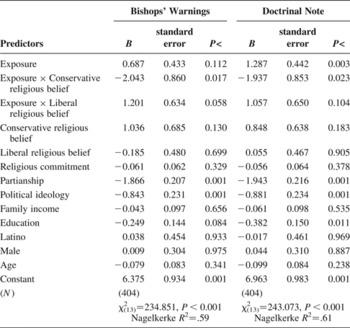
First the effects of Bishops' warnings were evaluated. Results of the logistic regression are reported in the first column of Table 1.
Logistic Regression of Kerry Preference on Exposure to Catholic Leaders' Messages Discouraging Support for Liberal Politicians and Selected Predictors among American Catholic Adults, 2004a

a Numbers in cells are regression coefficients, associated standard errors, and two tailed probabilities, between each variable and 2004-vote preference. The dependent variable was “Suppose the 2004 election for president were being held today, and you had to choose between ROTATE (Massachusetts Senator John Kerry the Democrat, and George W. Bush, the Republican), for whom would you vote?” Kerry responses were code 1 and Bush responses were coded 0. Bishops' Warnings was derived from “Some Catholic Bishops have recently said that they would deny communion to Catholic politicians who do not support the Church's position on abortion. Have you read or heard anything about this?” Yes responses were coded as 1, otherwise responses coded as 0. The Doctrinal Note measure was “Recently the Vatican issued a Doctrinal Note which stated that Catholic politicians should not support legislation that contradicts the church's teachings. Have you read or heard anything about this?” Yes responses were coded as 1, otherwise responses coded as 0.
The direct effects for Bishops' warnings appeared to have no statistically significant influence on preferences for Kerry (B = 0.667, P < 0.112). However, the relationship between exposure to the Bishops' warnings and Kerry preference diverged by respondents' religious beliefs. Conservative Catholics exposed to the Bishops' warnings appeared to be more likely to support Bush (B = −2.043). Based on the average marginal effect −0.449 (standard error = 0.137), the effect was significant at the P < .001 level. This finding confirms the hypothesis that hearing Bishops' warnings would reduce support for Kerry among Catholics of conservative religious belief. The message boomeranged among liberal Catholics (B = 1.201; dy/dx = 0.270, P < 0.028) increasing support of the liberal candidate Kerry.
Given the difficulty of interpretation of discrete changes for these interactive effects and to illuminate the relative impact of Bishops' warnings, predicted probabilities of voting for Kerry given estimates from the regression equation were calculated (Long Reference Long1997).
The relative change in the probability of a Kerry preference among conservatives exposed to Bishops' warnings decreased 45% after accounting for the direct effects of general exposure and religious belief, with all other variables held constant at their mean value. Among Catholics of liberal belief, exposure to Bishops' warnings increased the probability of a Kerry preference by 25%, after accounting for the direct effects of general exposure and religious belief, with all other variables held at their mean value. Where Bishops hoped to persuade Catholic voters to denounce the socially liberal candidate John Kerry, those messages appeared to boomerang. In addition, the smaller relative impact among liberal Catholics is underscored given that they out-number conservatives, in the sample, by approximately two to one.
It should be noted that religious conservatism/liberalism and religious commitment did not independently influence Catholics' candidate preference. Among Catholics after accounting for exposure to Bishops' warnings, liberal partisanship and liberal political ideology were significant (P < 0.05) predictors of Kerry preference in 2004.
While theoretical discourse maintains that religious leaders have political influence over their flocks, in this case, Burke, Sheridan, and supporters' warnings were ignored or contravened by many Catholics. This preliminary finding did not entirely confirm the hypothesis, since the results may have been a reflection that a very few ultra-orthodox Bishops were ignored, and liberal Catholics acted against the Bishops' directives because of their extreme position. We turn our attention toward the Doctrinal Note, capturing the broader consensus of Church leaders to evaluate the possible influence of a unified and moderated message with greater religious authority.
Hearing the Doctrinal Note that Catholic politicians should not support policy in violation of Church teachings appears to operate similarly to the Bishops' warnings, but with some interesting exceptions. Unlike with the Bishops' messages, the direct effect of exposure to the Doctrinal Note was positive, resulting in increased support of Kerry with all other variables being controlled (B = 1.287, P < 0.003). It may be that the Doctrinal Note disseminated by the Vatican failed to conform to Catholics' belief in separation of church and state. In this case, rather than ignoring messages, as with the Bishops' warnings, moderate Catholics may have resisted attempts of political conversion and acted against the Doctrinal Note (Wald et al. Reference Wald, Owen and Hill1988). Even though Catholic leadership in America has increasingly become politically active during the past four decades, compared to other Christian denominations, they have not been as active as, for instance, evangelical Protestants who have regularly incorporated political messages (Johnson Reference Johnson, Margolis and Mauser1989). Centrist Catholics may be uncomfortable with specific political messages ignoring or acting against violations of their comfort zone. For instance, when asked “Do you think that the Catholic Church should or should not be trying to influence the way Catholics vote?” 70% of Catholics in our sample responded it should not.
It appears that exposure to the Doctrinal Note lessened support of Kerry among conservative Catholics (B = −1.937) and increased support of Kerry among liberal Catholics (B = 1.057), according to data in the second column of Table 1. Again, hypothesis testing for our interactive terms rests on the calculated marginal effects, and not those calculated using Bs as reported in Table 1. The effects for conservatives appears to be highly significant (dy/dx = −0.431, P < 0.002) and approaching significance among liberals (dy/dx = 0.238, P < 0.063).
To elucidate the effects for exposure to the Doctrinal Notes predicted probabilities were calculated. First among Catholics of non-liberal/conservative belief, the direct effect of exposure was evaluated. After accounting for religious belief and holding all other variables at their mean value, exposure to the Doctrinal Note increased the probability of supporting Kerry by 31%, a sizable effect that influenced moderate Catholics to move against the Church doctrine. The likelihood of voting for Kerry among conservative Catholics decreased 42% among those exposed to the Doctrinal Note after accounting for general exposure and religious beliefs with other variables held constant at their mean value. The likelihood of favoring Kerry increased by 18% among liberal Catholics exposed to the Doctrinal Note.
The model including the Doctrinal Note Religious belief or commitment had no independent influence on Kerry-Bush vote preference. Catholic Democrats, political liberals, and the lesser educated were more likely to prefer Kerry (P < 0.05).
However, the net effect of Bishops' warnings and the Doctrinal Note remains unclear. To calculate the net effect of exposure on preferences, the effects based on the proportions by religious beliefs in our sample were summed. This method is similar to what would be used for a common weighted average calculation. This is formally expressed below where W represents the frequency of cases weighted by religious belief and δP k is the change in average probability for supporting Kerry by religious belief group.Footnote 3

The average net effect was an increase in support for Kerry by about 1% for Bishops' warnings. Hence, the results of Bishops' warnings boomeranged marginally by slightly increasing support of Kerry taken together among Catholics. While the Doctrinal Note had a similar effect increasing support for Kerry, the result was much stronger, as hypothesized, but it increased Kerry's support taken together by about 10%. The final judgment, and contrary to Church leaders' expectations, was that public political pronunciations did more harm than good in this case. Researchers have assumed that the Catholic Church would be a powerful source of political motivation because of hierarchical organization. The findings in this article demonstrate that while they may not always have much influence on specific issues (Smith Reference Smith2005) in the case of Catholic officials' political messages the effects were unintended.Footnote 4
DISCUSSION
The findings suggest quite a different understanding of religious influence on Catholic voter choice. In all cases, Catholics' religious commitment and belief had no independent influence, but measures of exposure to Bishops' statements and a Church Doctrinal Note were influential. Religious leaders' cues were influential but not always in the manner, Bishop Burke and others would have preferred. Public opposition to Kerry among this group of leaders appears to have had a boomerang effect, actually increasing support for the candidate among many Catholics in the aggregate. Apparently, liberal parishioners tended to reject starkly political admonitions of the Church. A likely reason for this may have been that political assertions of the kind that the Catholic Bishops made were in the “region of rejection” among many liberal and moderate Catholic voters (O'Keefe Reference O'Keefe1992). The content of the Bishops' warnings and the Doctrinal Note failed to conform to some Catholics' religious beliefs. As our theory suggests, such statements are likely to be ignored or, in some cases, to motivate precisely the opposite behavior.
Unlike other religious organizations that present messages that tend to support one party over another, Catholics emphasize issues that cut across party lines. Notably, many Catholics often agree with conservative Republicans on abortion and same sex marriage, but many Catholics often agree with liberal Democrats on aid to the poor and capital punishment (Byrnes 2001; Jelen Reference Jelen2003; Reichley Reference Reichley1986; Smith Reference Smith2005). As a result, Catholicism in America is a denomination of politically mixed messages. In these cases, researchers have argued individuals derive their political information from within and ultimately fall back on their default values (Popkin Reference Popkin1991). Simply put, Catholics may not have reinforced their existing preference because cues were not appropriately congruent with internal political information, or acted against messages that conflicted with other religious issues of greater salience.
A post-election poll by Zogby (Reference Zogby2005) supports findings reported here in that it suggests that religious political messages helped Kerry. One question, addressed to a sample of 3,000 Catholic voters, stated that some conservative groups informed Catholic voters that issues such as abortion and stem cell research were non-negotiable. Respondents were then asked if that claim made the respondent much more likely to vote for Bush, somewhat more likely to vote for him, much more or somewhat more likely to vote for Kerry, or that it made no difference. Fewer than 19% said the appeals had increased the likelihood of voting for Bush, and 25% said it had increased the likelihood of their voting for Kerry (Zogby Reference Zogby2005).
Alternative Explanations
It may be that specific issue positions moderated the Bishops' warnings and the Doctrinal Note rather than general religious beliefs. Unfortunately, no direct measure of abortion, gay marriage, women's issues, premarital cohabitation and other “social issues” were available in this secondary analysis of data. Questions of the potency of specific issue positions versus the more fundamental dimension of religious belief must await future analysis. But religious beliefs have been a consistent predictor of moral conservatism (Leege and Welch Reference Leege and Welch1989; Wald, Owen, and Hill Reference Wald, Owen and Hill1988).
Leege and Welch (Reference Leege and Welch1989) reported that religious beliefs explain variation in political views on abortion, support of the Equal Rights amendment, premarital cohabitation, the husband as exclusive breadwinner, and opposition to secular humanism among Catholics once social demographic variables were controlled. Religious beliefs are the single most influential predictor of abortion attitudes, same sex marriage, or the other issues closest to this study (Green Reference Green2005; Guth et al., Reference Guth, Green, Smidt, Kellstedt and Poloma1997), and opinions on gay marriage (Pew Research Center for the People and the Press 2006). In addition, specific policy positions may not always be associated with the credibility and likely influence of religious leaders.
Evaluating moderation of religious belief is more appropriate since specific issue positions are in part post-treatment effects of beliefs. In this case, our analysis allows the moderated effect to be measured for respondents regardless of issue salience, whether in relation to abortion, same sex marriage, or family traditionalism. One study that included both general and specific influences (Djupe Reference Djupe, Crawford and Olson2001) reported that support for Catholic Cardinal O'Connor was driven by general views about the church and not specific policy stances.
The present analysis may mask other moderated influences, most likely those involving religious commitment. An interaction term for religious commitment and exposure to the Bishops' warnings and the Doctrinal Note was computed and included in additional analyses. Results suggested that religious commitment did not moderate Church messages (P > 0.05). An additional three way interaction term was computed for religious beliefs, religious commitment, and the Doctrinal Note, or Bishops' warnings, and again results did not support religious commitment moderation. It appears that moderation of support for Kerry by religious commitment was not supported and did not confound our earlier conclusions.
Limitations and Future Research
This article is based on a secondary analysis of an existing data set with many limitations, but these data were created contemporaneously with a set of communications widely reported in the press and is one of the few that bear directly on the issue. As such, the analysis has been restricted to a limited set of variables that were available and based on a single research modality.
Subsequent research would be advised to draw observations of patterns of church leadership on a number of methods that were beyond the scope of this study and the data that were available, including focus groups, direct observation, and structured and unstructured interviews. It should identify the conditions under which religious leaders are more and less likely to influence parishioners, rather than assuming that followers either simply ignore or accept the warnings of religious leaders. The present findings point toward an additional choice of religious flocks, acting against religious leaders, as did Catholics of liberal religious convictions in the case of the Bishops' warnings and the Doctrinal Note in 2004. Clarifications of the underlying responsiveness of Catholics also may be elucidated by imaginative use of alternative methods such as experimental design, focus groups, and ethnographic analysis.
Future research should investigate conditional effects beyond those we report, especially those that tap into the multi-level religious and secular cultures in which Catholics are embedded. Catholics are no more isolated from a multitude of forces than Protestants or any other religious group. For instance, conservative Catholics in a conservative parish in a liberal diocese might respond much more intensely to messages concerning liberal politicians than under other conditions. The influence of religious messages on political engagement and participation among specific religious and secular groups should also be explored. Messages may influence attitudes (positive or negative) but attitudes do not translate into political behavior unless they stimulate action. The degree to which changed attitudes are translated into political mobilization is consequential for democratic outcomes.