





Introduction
Graduate medical education faces challenges due to changes in the clinical environment, increased time pressures on faculty physicians, and evolving expectations and needs of today’s learners. Reference Albanese, Mejicano and Gruppen1,Reference Osborne and Fields2 Clinical medical education historically has been deployed in the form of informal and impromptu lectures on topics at the discretion of the teaching physician, experiential learning from direct patient care, self-directed reading, and formal planned lectures which may or may not follow a specific curriculum. Without systemisation of the clinical curriculum, the learners’ educational experiences often rely on chance clinical exposures, and their clinical education may not be fully optimised.
Many clinical rotations in medical education have groups of learners with different educational levels and backgrounds, and each group has their own learning goals and needs. Faculty members responsible for the education of these learners may have difficulty tracking the individual needs of each learner and understanding each individual’s prior educational exposure. Additionally, trainees may not be fully aware of their own knowledge gaps or their learning expectations and opportunities for each clinical rotation. Meeting the educational needs of different groups requires individualisation and standardisation of the educational curricula.
In the Pediatric Cardiac ICU at our hospital, we routinely have learners from three graduate medical education fellowships: Pediatric Cardiology, Pediatric Critical Care Medicine, and Neonatal-Perinatal Medicine. This rotation is often the only cardiac critical care education that they receive in their fellowship. Each trainee, regardless of their specialty, must possess this knowledge for patient care throughout their career and for preparation for board exams, but each fellow has different background knowledge and different educational priorities while on this rotation. Despite the importance of this rotation for all the fellowship groups, we noted dissatisfaction among the fellow learners regarding their education on this rotation.
Education passports are a checklist-based educational tool that have been used to customise the educational experiences for different groups of learners, re-centre the education to the individual learner needs, and empower the trainees to influence their education while guiding them to ensure they receive exposure to a well-rounded number of topics. Reference Zurca, Krawiec, McKeone, Solaiman, Smith and Ceneviva3 Education passports benefit learners by using principles of Adult Learning Theory Reference Merriam and Baumgartner4 to allow learners to drive their own learning while also providing a roadmap to guide a learner to a higher level of competence. For medical students and residents, education passports have been shown to increase trainee satisfaction and to help faculty target teaching toward individual gaps in knowledge. Reference Merriam and Baumgartner4–Reference Wayne and Udden7
To improve the education experience in our Pediatric Cardiac ICU, we implemented an education passport with topics individualised for each group of fellows to better target their educational needs.
Materials and methods
This education study was conducted in the Pediatric Cardiac ICU at a large tertiary care hospital with multiple graduate medical education training programmes from July 2022 to June 2025. This study was approved by the Institutional Review Board at the University of Texas Southwestern Medical Center.
The education structure in the Pediatric Cardiac ICU at our hospital consists of each fellow completing two to three rotations (each lasting two weeks) per year. The Pediatric Cardiology fellows and Pediatric Critical Care fellows have the Cardiac ICU rotation during all three years of their fellowship, while the Neonatal-Perinatal Medicine fellows only participate in the rotation during the second year of their fellowship. During the rotation, the fellows learn through patient care, informal education from faculty on rounds and at the bedside, and during more formal lectures that are scheduled throughout the year. Based on formal and informal evaluations of the education on this rotation showing dissatisfaction among learners, we conducted a needs assessment to better define the problem with the education system. The results of the needs assessment led us to implement the education passport. Follow-up surveys were completed to evaluate the effectiveness of the intervention and have led to the evolution of the passport as improvements were suggested.
Surveys
The needs assessment and end-of-year surveys were conducted and managed using REDCap electronic data capture tools hosted at the University of Texas Southwestern Medical Center. Reference Harris, Taylor and Minor8,Reference Harris, Taylor, Thielke, Payne, Gonzalez and Conde9 The needs assessment survey included questions on year of training and type of fellowship, perceptions of the education system, barriers to learning, and ratings of potential topics. The list of potential topics was developed by collating all topics pertaining to paediatric cardiac intensive care in the American Board of Pediatrics Subspecialty Content Outlines for each fellowship (www.abp.org) and the authors’ experiences. Fellows and recent alumni were asked to rate each topic on a scale of 0 (least important) to 100 (most important) for fellows in their subspecialty to learn while rotating in the cardiac ICU. The faculty were asked to rank the topics as least to most important for all fellows to learn while rotating in the cardiac ICU. The end-of-year surveys included similar questions about year of training and type of fellowship, perceptions of the education system, and barriers to learning and also included questions about the experience using the passport. The needs assessment was sent via email to current fellows, recent alumni, and faculty. The end-of-year surveys were sent via email to current fellows and faculty. The question types included single-answer multiple choice, multi-choice checkboxes, fill-in-the-blank, 5-point Likert scale (strongly disagree to strongly agree), and 100-point slider scale (least important to most important). There were also free response questions on all surveys to allow for subjective information to be gathered.
Education passport creation
A specific education passport was created for each of the three fellowship groups: Pediatric Cardiology, Pediatric Critical Care Medicine, and Neonatal-Perinatal Medicine. Each passport contained 10 topics: 6 “core topics” and 4 “elective topics.” The core topics were used in all the passports, and the elective topics were individualised for each fellow group (Figure 1). The topics were selected based on the ratings of the list of topics in the needs assessment and based on the authors’ experience of potential gaps in each fellowship’s education outside of the cardiac ICU. The ratings of the topics were broken down between faculty and fellows and then by subspecialty (Supplemental Figure 1). The authors used the ratings of the topics to help guide the choices of topics for the passport. For example, topics that were highly rated amongst all groups were more likely to be chosen as a core topic, and topics which were highly rated for only one group were more likely to become an elective topic. If a topic was rated low by the faculty, it was less likely to be chosen as a topic for the passport.
Structure of the fellowship education passport.

Figure 1. Long description
Core topics - All fellows: CVICU Orientation, Identification and initial management of critical heart disease, ductal dependent lesions, components of cardiac output and Qp:Qs, cardiopulmoary interactions, hemodynamic monitoring; Elective topics - Cardiology Fellows: Management of heart failure, cardiopulmonary resuscitation and post-arrest care, post-operative management and low cardiac output syndrome, mechanical ventilation and non-invasive modes of ventilation; Elective topics - critical care fellows: arrhythmias, sedation in patients with cardiac dysfunction, post-operative management and low cardiac output syndrome, basics of echocardiography and evaluation of cardiac function; elective topics - neonatal - perinatal medicine fellows: arrhythmias, pulmonary artery hypertension, management of left to right shunts, basics of echocardiography and evaluation of cardiac function.
Prior to implementation of the passport, a letter was sent to the cardiac intensive care faculty introducing the concept of the passport and the topics that would be included for each fellow group, and the passports were discussed at a faculty meeting so that questions could be addressed. The faculty were asked to continue to teach as they normally would, and that the passport could be used as a guide to help identify areas to discuss with the fellows. Additionally, the fellows were oriented to the passport and topics through an in-person group session for each fellowship. At the implementation of the programme in July 2022, each fellow was provided with a pocket-sized passport printed on cardstock. The fellows were asked to check off topics while on their rotation and make a note of the learning modality utilised to learn each topic.
Based on feedback from the fellows after the first year through the end-of-year survey, the passport was transitioned to an online platform in July 2023, creating a digital passport. We used an online learning management platform that is provided for free to faculty members through our institution, D2L Brightspace® (D2L Corporation, USA). This platform is more commonly used in undergraduate medical education at our institution, but we adapted it for use at the graduate medical education level. This platform allowed the passport to be available on the fellows’ personal electronic devices (through an application available on Apple and Android devices) and on desktop (through a website). Once digitalised, we linked educational content to each topic on the passport that the fellows could access. Additionally, based on the efficacy of gamification in other educational settings, Reference Willig, Croker and McCormick10,Reference van Gaalen, Brouwer, Schonrock-Adema, Bouwkamp-Timmer, Jaarsma and Georgiadis11 we implemented these principles and were able to gamify the passport by providing awards through the system for completed topics. If the fellows completed all topics on their passport, they could unlock the resources of the other fellowship elective topics. The passports were available to the fellows year-round and could be accessed outside of their scheduled rotations.
Once the passport was digitalised, additional surveys were sent to each fellow at the end of their two-week rotation through D2L Brightspace®, asking the fellow to identify which topics they learned about and to suggest improvements. The question types in this survey included multi-choice checkboxes and fill-in-the-blank.
Passport content creation
We utilised pre-existing content, including journal articles, slide decks, handouts, and videos. We also created novel content for the topics. The goal was to ensure that each topic had several different learning modalities, knowing that each learner has different preferred learning styles. The primary modalities that we created included short videos, one-page handouts, and interactive modules that included self-tests and cases to work through. For the videos, we recorded cardiac intensive care faculty members explaining different topics, and we followed best practices in the production to increase learner engagement. Reference Guo, Kim and Rubin12 The videos were edited using Adobe Premier Pro and Adobe Audition (Adobe® Creative Cloud® Suite, 2024). The handouts were created in Canva (www.canva.com) or Adobe Illustrator (Adobe® Creative Cloud® Suite, 2024). The interactive modules were created within D2L Brightspace® utilising the platform’s templates to create practice questions with explanations.
Data analysis
Data were exported from REDCap and D2L Brightspace® and analysed using descriptive statistical methods in Microsoft Excel® (Microsoft 365, 2025; Microsoft Corporation, Redmond, WA). Prior to analysis, the dataset was checked for completeness and accuracy.
Categorical variables, including response rates, topic completion rates, and identification of barriers to learning, were summarised using frequencies and percentages. For the topic completion rates, the percentages for core topic were calculated with the total number of fellows, while the percentages for elective topics were calculated using the number of fellows within the specific fellowship. Continuous variables, including number of weeks, number of topics completed, and Likert scale responses, were summarised as medians and interquartile ranges (IQRs).
The Likert scale items were measured on a 5-point scale with options of “Very Poor” to Excellent” or “Strongly Disagree” to “Strongly Agree.” For selected analyses, Likert responses were dichotomised and analysed as categorical variables with “Strongly Disagree,” “Disagree,” and “Neutral” categorised as negative responses and “Agree” and “Strongly Agree” categorised as positive responses.
No comparative statistical analyses were performed due to the small sample size.
Results
Needs assessment
Response rate for the needs assessment was 65% (9/13 faculty, 23/34 current fellows, 15/25 alumni fellows). Fellows had completed a median of 6 (IQR 4–10) weeks in the Cardiac ICU prior to the survey. Using a 5-point scale, “Very Poor” to “Excellent,” the median rating for the current educational experience in the Cardiac ICU was 4 (IQR 3–4). Most trainees reported that they did not have a clear understanding of their learning needs while rotating in the Cardiac ICU (57% disagree/neutral, 43% agree when asked if they had a clear understanding of their learning needs), and there was an even split on trainee agreement if faculty targeted teaching toward gaps in their knowledge (50% disagree/neutral, 50% agree). Most of the faculty members disagreed that they were able to identify and keep track of each fellow’s learning needs (78% disagree/neutral, 22% agree). Most of the trainees agreed that the knowledge and skills gained during their cardiac intensive care rotation were important for their future career plans (32% disagree/neutral, 68% agree). The most identified barriers to learning by fellows were lack of defined learning objectives, too many clinical responsibilities, and inadequate time (Figure 2).
Fellow reported barriers to learning while in the pediatric cardiac ICU.

Figure 2. Long description
“Inadequate time” did not improve across the time period (reported as a barrier by 61% of the fellows pre-implementation and 50% of the fellows at the end of year 3). “Lack of defined learning objectives” improved over the study period (reported as a barrier by 63% of the fellows pre-implementation and down to 33% at the end of year 3). “Too many clinical responsibilities” worsened over the period (reported as a barrier by 50% of the fellows pre-implementation and up to 75% at the end of year 3). “Attendings disinterested in teaching” was not reported to be a large barrier and remained the same over the study period (reported by 26% of fellows pre-implementation and reported by 33% at the end of year 3). “Inadequate learning resources” were not a large reported barrier, but reduced to 0 by the end of the study period (reported by 21% of the fellows pre-implementation and 0 fellows at the end of year 3).
Passport utilisation
Over the three years of implementation of the education passport, 49 fellows utilised the tool in our Pediatric Cardiac ICU (15 Pediatric Cardiology, 23 Pediatric Critical Care Medicine, and 11 Neonatal-Perinatal Medicine). In year 1, there were 21 fellows (6 Pediatric Cardiology, 11 Pediatric Critical Care Medicine, and 4 Neonatal-Perinatal Medicine) with passports. In year 2, there were 25 fellows (9 Pediatric Cardiology, 13 Pediatric Critical Care Medicine, and 3 Neonatal-Perinatal Medicine) with a passport. Of these, there were 14 first-time users (4 Pediatric Cardiology, 7 Pediatric Critical Care, and 3 Neonatal-Perinatal Medicine). In year 3, there were 30 fellows (12 Pediatric Cardiology, 14 Pediatric Critical Care Medicine, and 4 Neonatal-Perinatal Medicine) with a passport. Of these, there were 14 first-time users (5 Pediatric Cardiology, 5 Pediatric Critical Care, and 4 Neonatal-Perinatal Medicine). Within the total number of fellows with a passport, 7 fellows had a passport in all 3 years (3 Pediatric Cardiology and 4 Pediatric Critical Care Medicine). Neonatal-Perinatal Medicine fellows never participated in more than one year due to only having one Pediatric Cardiac ICU rotation during their fellowship. The Pediatric Cardiology and Pediatric Critical Care Medicine fellows who did not have a passport for all 3 years either started their fellowship after the programme was started or graduated before the third year of the passport programme. The time the fellows had rotations in the Cardiac ICU was similar each year with a median of 4 (IQR 4–8) weeks per year in the first two years and median 6 (IQR 4–8) weeks in the third year.
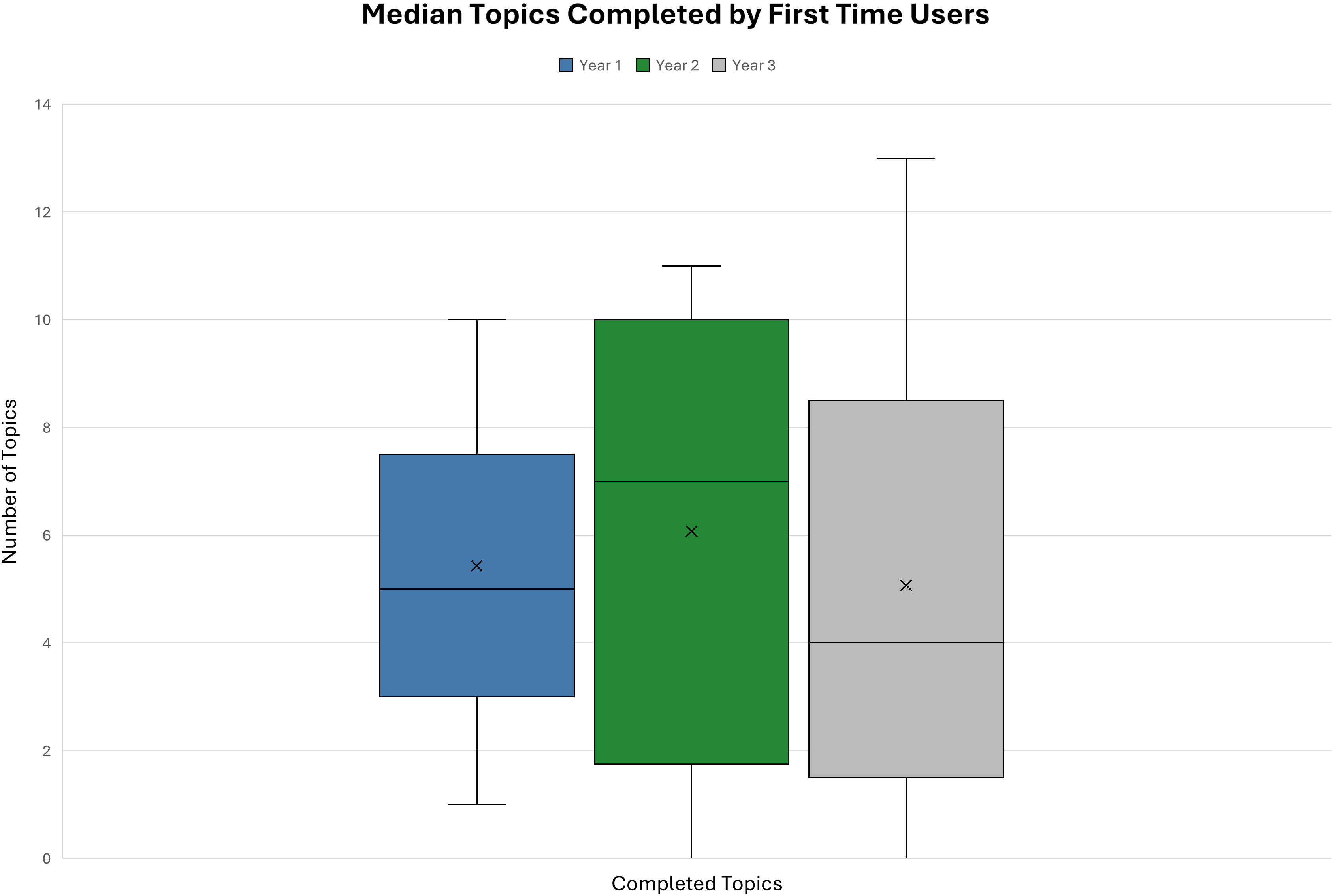
Among fellows using the passport for the first time, there was a median of 5 (IQR 3–7.5) topics completed in year 1, a median of 6 (IQR 1.75–10) topics completed in year 2, and a median of 4 (IQR 1.5–8.5) topics completed in year 3 (Figure 3). Topic completion among fellows using the passport for the first time is summarised in Supplemental Table 1. Of the 11 fellows that participated in year 1 and year 2 of the passport, they added a median of 3 (IQR 2–5) topics in their second year with the transition to the electronic passport. Of the 16 fellows that participated in year 2 and year 3, they added a median of 0 (IQR 0–2) topics in their second year of participation. In the seven fellows that participated in all 3 years, no fellow added any topics in their third year.
Median passport topics completed by first-time users.

Post-passport implementation survey
After the first year of the passport programme, the end-of-year survey response rate was 57% (8/13 faculty, 11/23 current fellows). After year 2, the response rate was 26% (4/13 faculty, 6/25 current fellows). After year 3, the response rate was 51% (11/15 faculty, 12/30 current fellows).
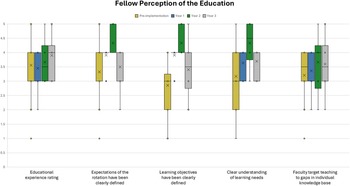
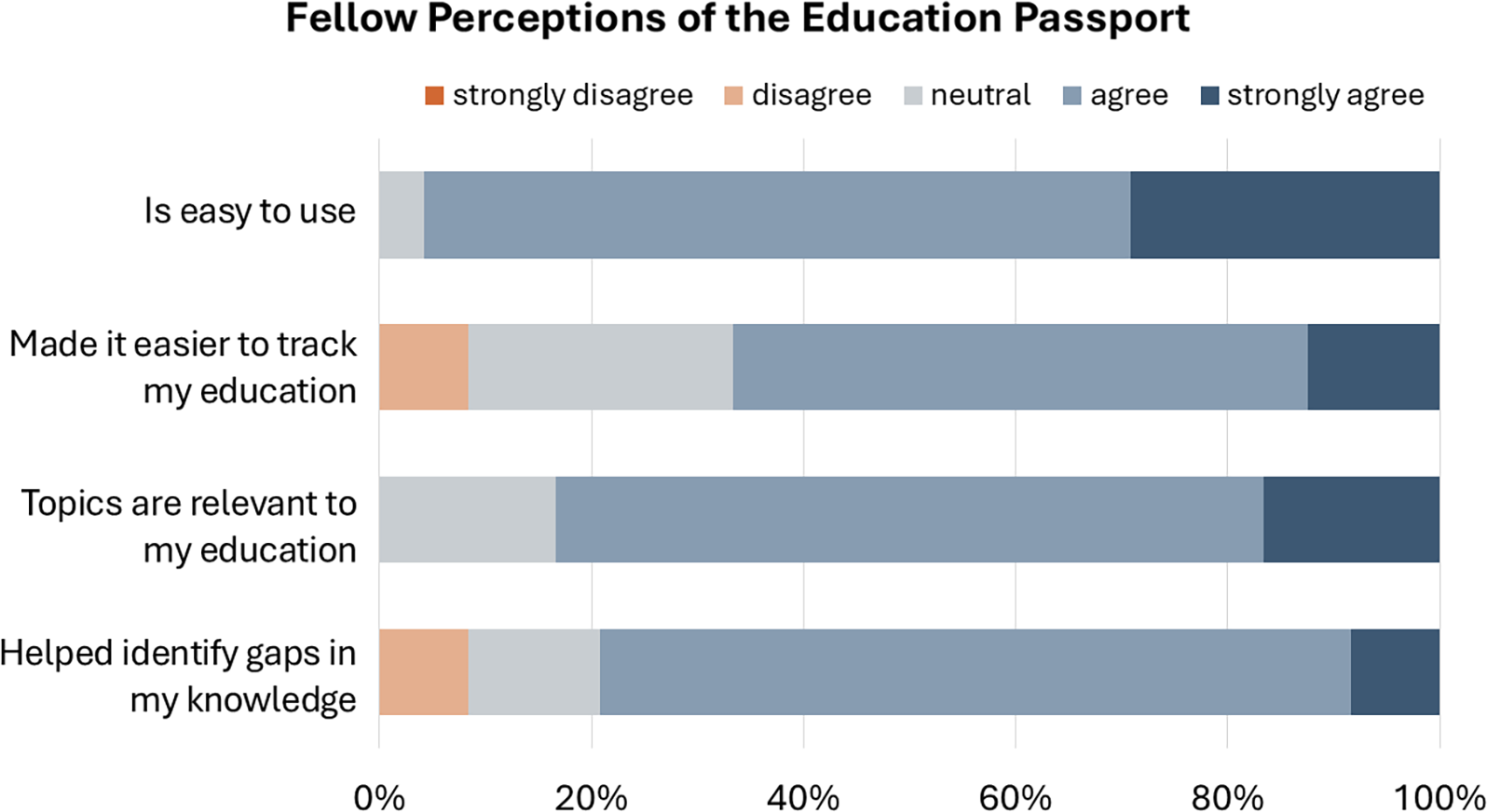
Fellows reported an increase in having clearly defined expectations for the rotation, clearly defined learning objectives and a clear understanding of their learning needs while rotating in the Cardiac ICU (Figure 4). The overall rating of the educational experience did not change following passport implementation with the median rating being 4 (IQR 3–4.25) at the end of year 3. Inadequate time and too many clinical responsibilities were still the most reported barriers to learning by fellows, but the lack of defined learning objectives and inadequate resources as barriers decreased after passport implementation (Figure 2). The overall perception of the passport was rated positive by the fellows (Figure 5). The faculty perceptions of the passport were not as favourable as the fellows with a majority of faculty reporting neutral or disagreement with the passport helping facilitate their teaching (Figure 6).
Fellow perception of the education in the pediatric cardiac ICU.

Fellow perceptions of the education passport.

Faculty perceptions of the education passport.

To understand what prevented the fellows from completing all of the topics on the passport, the majority of comments from the survey focused on lack of time and clinical responsibilities preventing the use of the passport. Summary of some of these comments include: “…the biggest barrier was lack of time…all the attendings were very interested in teaching…didn’t have the time to have one-on-one or small group teaching,” “Didn’t get taught or no exposure…,” “Busy rotation, attendings not always willing to do bedside teaching especially on longer topics…,” “Opportunities to review the passport and discuss items with attendings were limited. Paper format would sometimes result in the passport being lost or forgotten,” “Inadequate time secondary to high census and high acuity,” “Clinical load was so high that there was very little teaching.” Suggestions for improvement after the first year primarily focused on the desire to have an electronic version of the passport and having more specific examples included with the passport. A summary of these comments include “electronic version,” “a digital platform…,” “…would recommend a virtual format,” “…might help if it was more specific or include example topics,” “…the topics in the passport are good but having more structured education time…on a topic once a week…can help increase education.” These comments helped inform the next version of the passport and moving it to a digital platform.
In the end-of-year summaries from year 2 and year 3, after the digitalisation of the passport, comments about what prevented the fellows from completing the topics on the passport continued to centre on lack of time and clinical burden. This is a summary of the comments: “time,” “clinical burden,” “I wish I would have utilised the website more, I honestly forgot it was there until the later half of the rotation.” Recommendations for improvement primarily centred on requests for more resources and topics. The summary of the comments included “more resources…,” “I’ve enjoyed the CVICU passport, the more topics available the better,” “Additional topics; different learning modalities.” These comments have informed our next steps of continuing to create additional resources.
Discussion
Our study demonstrates that a structured and individualised curriculum with an education passport can enhance the learning experience for graduate medical education trainees in a high-acuity clinical environment. The passports were easy to use, provided clear learning objectives, helped the fellows identify gaps in their knowledge, and were well received by the fellow groups. While education passports and individualised curriculums have been used in the past, Reference Zurca, Krawiec, McKeone, Solaiman, Smith and Ceneviva3,Reference Read6,Reference Minhas, Enogieru, Mitchell and Mata13 we were able to show benefit at the fellow level of graduate medical education in an intensive care setting.
This project highlights the value of an iterative approach to curriculum development in graduate medical education. We utilised a needs assessment to identify actionable problems within the current educational system. We had success with our first cycle of implementing the passport and were able to refine the passports by making iterative improvements based on feedback from the fellows at the end of each academic year. Specifically, the transition to a digital passport, at the recommendation of the fellows, increased utilisation. By consistently evaluating the utilisation of the passport and soliciting feedback, we were able to meet the needs of our current learners.
The structure of the passport was able to reduce barriers to education in the Pediatric Cardiac ICU, including lack of defined learning objectives and inadequate resources, by providing the fellows with easily accessible content related to a pre-defined list of topics for each fellow group. Unsurprisingly, inadequate time and clinical responsibilities remained the most reported barriers to education throughout the study. This aligns with prior literature documenting similar challenges across clinical learning environments. Reference Almushait, Alabdaljabar and Alkhani14–Reference Cullen, Lawless, Nadkarni, McCloskey, Corddry and Kettrick17 Given that these constraints are unlikely to change, there is an increasing need for educational tools that are easily accessible and efficient. The passport has evolved to try to meet this need by providing foundational topics and subspecialty-specific content that could be quickly accessed and revisited as time allowed. We could not completely overcome the barriers related to time and clinical demands, so future iterations will need to continue to re-evaluate and evolve to address these specific problems.
Despite the positive reception and reported ease of use, there was attrition in the utilisation over time. After the initial transition to a digital platform, there was increased use by the fellows, but this increased engagement did not persist in subsequent years. First-time users continued to have good engagement with the passport. The decline in the second-and third-year users may reflect a ceiling effect, where the fellows perceived diminishing returns from repeated exposure to the passport content. Future iterations of the passport will benefit from having new and individualised topics for upper-level fellows that represent a graduation from the first-year level passport.
A potential barrier to implementing a similar education passport at another institution is the time and resources needed to develop the platform and learning resources. We were able to utilise an existing online learning platform already in use for undergraduate medical education at our institution. This allowed us to make the passport digital without a significant financial and structural investment. Initially, we linked pre-existing educational materials to passport topics, allowing for immediate use by our fellows. We then identified content gaps and prioritised those areas for the creation of new materials. While developing novel content requires significant up-front time commitment, there is benefit to the faculty once it is created. The faculty also noted time constraints as a limitation to education in the Cardiac ICU. By providing these resources to the fellows, we were able to support the fellow education and complement the faculty’s teaching efforts.
There are several limitations to this study that should be acknowledged. This is a single-centre’s experience, and the education structure, culture and learners will be different at each institution. During the timeframe of this study, we were unable to prove the quantity of knowledge gained or impact on patient care. However, we think that there are important aspects to highlight from what was learned in the iterative changes to the passport over the past three years. With future iterations, we plan to evaluate knowledge retention among learners and assess higher levels of the Kirkpatrick’s framework. Reference Kirkpatrick18
Conclusions
Education passports in the Pediatric Cardiac ICU for fellow-level graduate medical education learners complement the education that they receive on their rotations. We were unable to overcome the barriers of inadequate time and clinical demands, and these areas should be the focus of future studies.
Supplementary material
The supplementary material for this article can be found at https://doi.org/10.1017/S1047951126123713.
Acknowledgements
The authors would like to thank the faculty who helped create content through recorded videos for the passport and supported the authors’ efforts in trying to improve the clinical education in our Cardiac ICU.
Financial support
MC and PB received the University of Texas Southwestern Department of Pediatrics Flora Miller Parrill Award to support the creation of educational content for the passport. This award allowed for the purchase of audiovisual equipment and software to create and edit the educational content.
Competing interests
None.




 Open access

