Introduction
An established and vibrant research literature examines the causes, patterns and consequences of later-life migration within the United States (for reviews see Longino and Bradley Reference Longino, Bradley, Binstock and George2006; Walters Reference Walters2002). By contrast, a mere handful of studies have focussed on US elders migrating across international boundaries (Banks Reference Banks2004; Migration Policy Institute 2006; Otero Reference Otero1997; Palma Mora Reference Palma Mora2000; Truly Reference Truly2002). The scarcity of such research is surprising given the explosion of popular interest in Mexican and Central American retirement destinations, as evidenced by extensive media coverage (e.g. Golson Reference Golson2004; Luboff Reference Luboff2001; Miller Reference Miller2004; Petersen Reference Petersen2004), and the proliferation of websites that promote overseas retirement (e.g. www.escapeartist.com; www.internationalliving.com; www.livinginthephilippines.com; www.liveabroad.com).
Later-life migration flows are important for at least two reasons. First, the in-migration of older people may drive social change in the receiving communities. For example, elder in-migrants may stimulate local economies, in part by purchasing local goods and services with earnings generated outside the region (Sastry Reference Sastry1992). Though caution is warranted, evidence from the United States suggests that in local economies, the infusion and re-circulation of retiree in-migrant dollars generates new jobs, especially in real estate, health-care and financial services, and raises an area's tax-revenue more than local government expenditure (Bennett Reference Bennett1996; Fagan and Longino Reference Fagan and Longino1993; Reeder Reference Reeder1998; Sastry Reference Sastry1992; Serow and Haas Reference Serow and Haas1992).
At the same time, the impact of retirement in-migration is likely to depend on many situational factors. Particular retirement destinations may reach a point of ‘saturation’, where newcomers contribute to overcrowding, environmental degradation and social fragmentation (e.g. Reeder Reference Reeder1998; Rowles and Watkins Reference Rowles and Watkinaas1993). With respect to the latter, McHugh, Gober and Borough (Reference McHugh, Gober and Borough2002) described a heated controversy between the affluent residents living in a retirement community near Phoenix, Arizona, and working-class Latinos in the surrounding area over school funding.
A second reason for the growing interest in later-life migration is that the practice is likely to increase substantially in the coming decades. In 2000, an estimated two-million people in the United States aged 60 years had relocated across state lines within the previous five years (Longino Reference Longino and Ronald2006). On the whole, elders are less likely to make long-distance moves than those of working age, and the rate of elder inter-state migration has not changed greatly since 1960 (Longino Reference Longino2002, Reference Longino, Bradley, Binstock and George2006; Longino and Bradley Reference Longino and Bradley2003). Yet, the ageing of the ‘baby-boom generation’, born between 1946 and 1964, will result in an unprecedented increase in the US older population between 2010 and 2030, by which date approximately one-in-five Americans will be at least 65 years old (Hobbs and Damon Reference Hobbs and Damon1996). The absolute number of older movers will almost certainly grow along with the elder population.
The US elder migration literature has paid little attention to those moving to Mexico, Central America, or indeed any foreign country. This is an important omission because international and internal migration differs in many respects. Many international migrants move to radically different economic, cultural, and political contexts, which means that models developed to account for internal or inter-state elder migration may not apply directly to retirees moving abroad. US retirement migration flows to Mexico and Central America are of particular interest given the history of population exchanges and ties among these countries and their contiguity. Truly (Reference Truly2002) suggested that the North American Free Trade Agreement (NAFTA) has contributed not only to an increase in the flow of Americans to Mexican retirement destinations, but also to a shift in the character of the expatriate community. The readier access to US products and services appears to have reduced the barriers to international migration, resulting in new arrivals less interested in adapting to the local culture. The ‘Dominican Republic-Central America Free Trade Agreement’ (DR-CAFTA) may have similar implications for retirement destinations throughout the region.
The number of US retiree migrants to other countries, particularly Mexico, is expected to rise through the growth of the older population, increased life expectancy, and improvements in transport and communications (Clark and Davies Reference Clark and Davies1990; Conway and Houtenville Reference Conway and Houtenville1998; Truly Reference Truly2002). It will, therefore, be increasingly important to understand the retirees' reasons and aspirations for migration, and the extent to which they will stay in their new locations as they age. This study attempts to end this gap in the literature by addressing the reasons why US retirees have migrated to the Guadalajara and Chapala areas in the state of Jalisco, Mexico. In particular, we examine the social, economic and environmental reasons that prompted the moves. The following sections of the paper review the literature on retirement migration, present the data collection methods, summarise the results and discuss their implications.
Literature review
Individual and household decision-making processes
An established approach to research on migration emphasises the decision-making process at the individual or household levels. It conceives both internal and international migrations as the product of cost-benefit calculations made by rational actors. A classic formulation posits the operation of ‘push’ factors (e.g. low wages at origin) and ‘pull’ factors (e.g. employment prospects at destination), along with intervening obstacles that increase the effective cost of migration (e.g. distance between origin and destination, difficulty of the journey) (Lee Reference Lee1966; Ravenstein Reference Ravenstein1885). Several labour economists argue in this vein, that the migration decision is based on the estimated net return to immigration; that is, the difference between anticipated earnings at the origin and destination over a period, less the costs and risks associated with an international move (e.g. Borjas Reference Borjas1990).
For elders who have left the labour force, the factors that condition an internal or international move clearly differ from those that affect working-age individuals and their families. Scholars typically distinguish three broad types of later-life moves that reflect changing conditions across the life-course (e.g. Litwak and Longino Reference Litwak and Longino1987; Walters Reference Walters2000; Wiseman and Roseman Reference Wiseman and Roseman1979). ‘Amenity-seeking migrants’ are motivated by lifestyle considerations and pulled to destinations that offer cultural and recreational opportunities, an agreeable climate and scenic beauty, along with a relatively low cost-of-living and low crime. ‘Assistance-seeking migrants’ tend to be older than their amenity-seeking counterparts and to move towards younger family members in response to modest disability or negative life experiences, such as widowhood. Severe illness and frailty is the trigger for ‘disability-impelled moves’ into an institutional setting, the third type of later-life move.
A large proportion of North Americans arriving in Mexican retirement destinations are expected to be amenity-seekers. What are likely to be the most important pull factors? Within the United States, later-life amenity-oriented movers typically originate in the Northern and Midwestern states, and move to States with warmer winters in the South and Southwest (Conway and Houtenville Reference Conway and Houtenville1998; Longino Reference Longino and Ronald2006; Longino and Bradley Reference Longino and Bradley2003). Similarly, the Mediterranean climate appears to be an important pull for the majority of northern European retirees who move to the Costa del Sol in Spain (and to other Iberian coasts) (Rodríguez, Fernández-Mayoralas, and Rojo Reference Rodríguez, Fernández-Mayorales and Rojo1998). Moreover, across nine receiving areas in Southern Europe, Casado-Díaz, Kaiser, and Warnes (Reference Casado-Díaz, Kaiser and Warnes2004) reported that about 80 per cent of northern European retirement migrants mentioned climate as a reason for moving. Many associated the mild Mediterranean winters with improved health and enhanced morale, and mentioned the ability to engage in outdoor activities even during the relatively cold months. O'Reilly (Reference O'Reilly1995: 31) corroborated previous findings about British migrants to Spain, in concluding that ‘sun, sea, scenery and leisure opportunities’ were the main factors in the decision.
Second, later-life movers may be attracted to low cost-of-living areas where the purchasing power of retirement income is enhanced (e.g. Graves and Waldeman Reference Graves and Waldman1991; Fournier, Rasmussen and Serow Reference Fournier, Rasmussen and Serow1988). Home-owners in inflated real-estate markets may be able to realise substantial gains by relocating to an area of lower housing demand and lower property prices (Hoggart and Buller Reference Hoggart and Buller1995; Steinnes and Hogan 1992). Northern European international retirement migrants often point to the financial advantages of living in southern Europe, though the importance of this factor varies by destination (Casado-Díaz, Kaiser and Warnes Reference Casado-Díaz, Kaiser and Warnes2004; King, Warnes and Williams Reference King, Warnes and Williams1998; Rodríguez, Fernández-Mayoralas and Rojo Reference Rodríguez, Fernández-Mayorales and Rojo1998; Warnes et al. Reference Warnes, King, Williams and Patterson1999, Reference Warnes, Friedrich, Kellaher and Torres2004). Moreover, economic modernisation since 1945 has transformed Mediterranean Europe, resulting in a convergence of the cost-of-living between northern European sending areas and southern European destinations (King, Warnes and Williams Reference King, Warnes and Williams2000). Certainly there is every reason to suspect that North American elders might be attracted to Mexican retirement destinations by the winter climate and the relatively low cost-of-living (Migration Policy Institute 2006; Otero Reference Otero1997; Truly Reference Truly2002).
Conditions at the origin may also push elders into a move; for example, the dominant sending areas in the US are characterised by relatively harsh winters (Longino Reference Longino and Ronald2006). In addition, urban problems such as traffic congestion, pollution and crime also motivate later-life moves (e.g. Haas and Serow Reference Haas and Serow1993). Then again, a high cost-of-living, especially among the oldest-old, may generate pressure for a move (Conway and Houtenville Reference Conway and Houtenville1998). Beyond these considerations, international movers may seek to escape perceived negative conditions in the country of origin. In Portugal's Algarve region, a non-trivial proportion of Williams and Patterson's (Reference Williams and Patterson1998) British retiree respondents identified ‘antipathy to the United Kingdom’ as an important reason for emigration. Similarly, previous studies of North American retirees in Mexico suggest that disillusionments with selected aspects of US culture, such as the loss of traditional values and a perceived obsession with work and employment, are influential (Banks Reference Banks2004; Migration Policy Institute 2006; Truly Reference Truly2002).
Of course people perceive and respond to similar pushes and pulls in different ways. All other factors being equal, those with strong or emotional ties to the place where they live and the people in their community should be less likely to move. Moreover, those with greater personal resources should be better prepared to expend the time, energy and money needed to make a move (Longino, Perzynski, and Stoller Reference Longino, Perzynski and Stoller2002; Wiseman Reference Wiseman and Roseman1979). Yet geographical moves involve more than a physical relocation, for migrants must be able to detach their identities from their pre-retirement location and re-create themselves as permanent or seasonal residents of their retirement destination (Cuba and Hummon Reference Cuba and Hummon1993). This challenge is particularly difficult for those who cross international borders (Banks Reference Banks2004; Gustafson Reference Gustafson2001; O'Reilly Reference O'Reilly1995, Reference O'Reilly2000). Longino, Perzynski and Stoller (Reference Longino, Perzynski and Stoller2002: 33) argued that experienced travellers and geographically-mobile people are more likely to have the skills and cultural capital necessary to integrate into a new environment. Not surprisingly, international travel and residential experience appear to be relatively common among northern European expatriate elders (e.g. King and Patterson Reference King and Patterson1998; King, Warnes and Williams Reference King, Warnes and Williams2000), and we expect North American seniors in Mexico also to be well travelled.
Numerous areas with an agreeable climate, scenic vistas and a low cost-of-living nevertheless do not attract elder in-migrants in substantial numbers. Receiving communities must offer expatriates appropriate infrastructure, notably roads, power, water, housing stock, commercial establishments and mass-media (King, Warnes and Williams Reference King, Warnes and Williams2000). Beyond this, the attractive features of a particular destination can exert a ‘pull’ effect only on those familiar with or possessing information about the locale (Haas and Serow Reference Haas and Serow1993). Individual- and household-level models of migration generally fail to recognise that rational actors are embedded in social structures that constrain information, perceived opportunities, decisions and behaviour (see Portes Reference Portes and Portes1995; Portes and Sensenbrenner Reference Portes and Sensenbrunner1993). Applied to the present case, what are the social dynamics that bring Mexico's Lake Chapala region into the ‘search space’ of older North Americans contemplating a move (Wiseman and Roseman Reference Wiseman and Roseman1979)?
Structural explanations for international later-life migration
World-systems theory asserts that the global expansion of capitalist economic relations into peripheral areas (1) dislocates regional populations by disrupting traditional economies, and (2) forges an array of linkages that facilitate labour migration flows from peripheral to core countries. Material linkages are critical because the international flows of raw materials, consumer goods and information simultaneously undermine the ‘intervening obstacles’ to international migration. Sometimes derived from a colonial past, and sometimes constructed through cultural exports, ideological and cultural linkages similarly reduce the effective cost of moving from peripheral to core areas (see Massey et al. Reference Massey, Arango, Hugo, Kouaouci, Pellegrino and Taylor1993). The world-systems perspective is useful for understanding international later-life migration flows. As a starting point, labour migrants moving from lesser developed to more developed economies are often followed by parents or older family members, and constitute an important later-life migration flow (for a review see Longino and Bradley Reference Longino, Bradley, Binstock and George2006). International amenity-seeking elders, by contrast, typically move from developed nations toward more peripheral areas of the global market system. With respect to this latter group, what kinds of linkages between sending and receiving areas are important?
As a legacy of the long-standing economic and military linkages between Britain and its former colony, many British retirees who moved to the Mediterranean island of Malta reported former work or family connections with the country. For example, many men (and a few women) had been stationed on the island while in the military. Many Anglo-Maltese marriages followed the large-scale migration of Maltese men to Britain during the 1950s and 1960s, establishing another cross-national pathway to retirement migration (Warnes and Patterson Reference Warnes and Patterson1998). Given the shared history and intricate economic ties between Mexico and its trading partners to the north, there is every reason to suspect that some older in-migrants will report previous work or family connections in Mexico. Arguably, however, the more important linkage has been tourism, presently one of Mexico's principal sources of foreign exchange. In 1998, Mexico hosted an estimated 20 million international tourists, and they contributed $7.8 billion to the economy. Assisted by the jet plane and proximity to the United States, the expansion of Mexican tourism since 1970 has resulted from government initiated and subsidised programmes that have strategically developed the infrastructure (Clancy Reference Clancy2001).
The growth of the Mexican tourism industry is important because vacation experience is one mechanism by which connections to potential retirement destinations are established (e.g. Cuba Reference Cuba1989, Reference Cuba1991; Wiseman and Roseman Reference Wiseman and Roseman1979; Haas and Serow Reference Haas and Serow1993; McHugh Reference McHugh1990). For any given destination, tourism establishes the connections to individuals and families who in later-life may choose to relocate to the area. Foster and Murphy (Reference Foster and Murphy1991) specifically pointed to the synergy between tourism and later-life in-migration. For any given community, natural and constructed amenities and services designed for tourists may also attract active older adults seeking cultural and leisure opportunities. At the same time, in-moving retirees represent a year-round clientele that dampen the lulls of the seasonal tourism cycle and create additional demand for facilities for both tourists and retirees, e.g. golf courses, marinas and fishing piers.
The connection between tourism and northern European international retirement migration has been well documented. A large majority of British retirees in southern Europe previously visited their chosen area while on holiday, although the importance of the holiday connection varies by destination area (King, Warnes and Williams Reference King, Warnes and Williams1998, Reference King, Warnes and Williams2000). Indeed, the nature and evolution of a region's tourism conditions the kinds of retirees attracted as well as their settlement patterns. By way of example, Tuscany's scenic rural landscapes and cultural treasures have attracted British migrants since the early 18th century, since when there has been a vibrant expatriate community. British elders resident in Tuscany are relatively highly educated, have more experience of living in other countries, and have greater fluency in the host-country language than their counterparts who retire to the Spanish and Portuguese mass tourism coastal areas that have been developed since the 1950s (Casado-Díaz, Kaiser and Warnes Reference Casado-Díaz, Kaiser and Warnes2004; King and Patterson Reference King and Patterson1998; King, Warnes and Williams Reference King, Warnes and Williams2000).
Linkages between sending and receiving areas reduce the cost of immigration and engender connections between people and potential retirement destinations. At the same time, the cross-national flows of migrants between particular origins and destinations typically become less dependent on the initial conditions that motivated people to move, e.g. a low cost-of-living. Network theory asserts that this is partly because friends and family at the destination offer critical support and reduce both the costs and risks of an international move. For any receiving area, above a critical threshold, each new arrival offers the promise of assistance to his or her social network members who remain in the community of origin, and so raises the likelihood of additional immigration (e.g. Massey et al. Reference Massey, Alarcón, Durand and González1987). Institutional theory similarly argues that international migration flows are often at least partly self-sustaining; companies and organisations are established that provide services which, in turn, support additional immigration, e.g. the provision of counterfeit documents, humanitarian assistance and legal advice (Massey et al. Reference Massey, Arango, Hugo, Kouaouci, Pellegrino and Taylor1993).
Consistent with this line of argument, retirement destinations often evolve along a cycle comparable to that of tourist areas (Rowles and Watkins Reference Rowles and Watkinaas1993; Truly Reference Truly2002). Resort areas initially tend to attract adventurous tourists in small numbers, and they generate a demand for additional services and amenities that make the area accessible to larger numbers of more cautious visitors (Butler Reference Butler1980). In this light, it is understandable that, among British retirees in selected southern European destinations, the vanguard, as compared to the late-to-arrive, were well-educated, disproportionately drawn from intellectual or creative professions (e.g. teachers, artists and journalists), and more likely to have lived abroad during the five years prior to retirement (King, Warnes and Williams Reference King, Warnes and Williams2000). Many pioneers are those best equipped to make an international retirement move. What kinds of structures and processes work to reduce the costs and risks for those who follow, and therefore to perpetuate the flow?
Some later-life migrants actively encourage friends and family to follow them, thus helping to sustain a particular migration stream (Cuba Reference Cuba1989; Longino Reference Longino and Warnes1982). Also, because many international retirement migrants are isolated from family and have limited ability in the language of the host country, they often form associations within the migrant population. Expatriate clubs and associations to a variable degree offer the occasion and setting to meet like-minded others and to form supportive friendships (Gustafson Reference Gustafson2001; Huber and O'Reilly Reference Huber and O'Reilly2004; King, Warnes and Williams Reference King, Warnes and Williams2000; Otero Reference Otero1997; Rodríguez, Fernández-Mayoralas and Rojo Reference Rodríguez, Fernández-Mayorales and Rojo1998). The support provided by a vibrant expatriate community can then substantially reduce the risks and costs associated with international retirement migration. Consistent with the findings of previous research, we expect that the expatriate community plays an important role in sponsoring and sustaining North American elders living in Mexico (Migration Policy Institute 2006).
Data and methods
The data for the present study came from a survey of non-Hispanic Whites living in Mexico after retirement (it did not include Mexican-American retirees who have moved to Mexico). It was conducted by the authors in June 2004. A non-random sample of 211 retirees participated in the survey; the inclusion criteria being that the respondent was a US citizen (born or naturalised), aged 55 or more years, and had lived in Mexico for at least six months. A self-administered questionnaire was distributed through four American voluntary organisations in Guadalajara City and the towns of Chapala and Ajijic near Lake Chapala in the state of Jalisco, Mexico.Footnote 1 The questionnaire covered the respondents' travel history, migration decision-making, quality of life in Mexico, cultural adaptation, attitude about living in Mexico and towards the local community, aspects of personal identity, financial security, and health-care.2 The respondents were also asked to provide a brief personal narrative regarding any aspect of their migration to Mexico that had not been covered in the questionnaire or on which they wished to elaborate. The findings presented in this paper come from the quantitative survey and the personal narratives that the respondents wrote at the end of the questionnaire.
Results
Reasons for retiring to Mexico
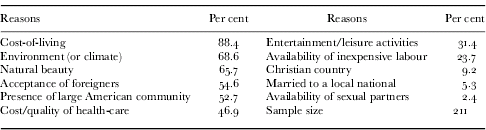
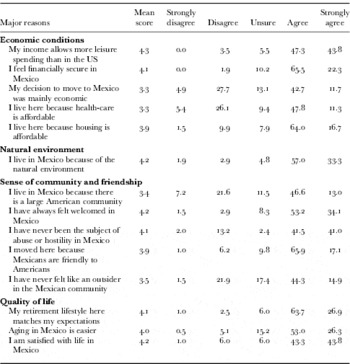
Table 1 presents the major reasons for retiring in Mexico. The most prevalent were the low cost-of-living (88%), the environment, weather and climate (69%), the natural beauty of the area (66%), acceptance of foreigners in the area (55%), the presence of a large American community (53%), and the availability of quality health-care at reasonable cost (47%). Similar results were obtained from the respondents' rating of their level of agreement with statements about their reasons for retiring to Mexico (Table 2). They most strongly agreed that economic factors, the climate, acceptance of foreigners and the presence of other Americans influenced their decisions to migrate and to remain in Mexico. The personal narratives confirmed and elaborated the quantitative assessment, and are drawn upon in the following sections that consider the main reasons in turn.
Reasons for retirement migration to Guadalajara and Chapala, Mexico
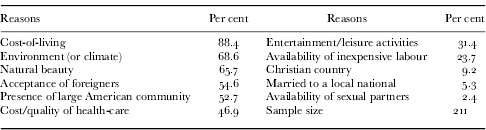
Note: Percentage of respondents who checked the reason on a multiple choice list.
Major reasons for migration and level of agreement

Economic conditions
The cost-of-living is a major consideration for both permanent and seasonal (snowbirds or sunbirds) American retiree migrants in Mexico. Nine-in-ten (91%) of the respondents indicated that they ‘agreed’ or ‘strongly agreed’ with the statement, ‘my income allows me more leisure spending than if I were in the US’ (Table 2). There was also strong agreement with the statements, ‘I feel financially secure in Mexico’, and ‘my decision to move to Mexico was mainly economic’. The respondents' median annual income was in the range $46,000–49,999 before retirement and $21,000–25,999 after retirement, and their median monthly expenditures were in the range $901–1,500. The majority (56.8%) of the respondents rented apartments or homes and the rest owned properties. The importance of financial considerations was elaborated well by one male migrant in Ajijic, Lake Chapala:
Here you have quality of life for a cheaper price. For me this is having the culture, the arts, the food, the access to international sports half-an-hour a day, and being centrally located in Mexico. The cost-of-living is less and the quality of life is better. I never could afford a gardener in the United States. I could never afford a cleaning lady everyday or every other day. In the States you can't afford to eat out in restaurants because it's too expensive. You can't! The cost of labour is cheaper … to get the car fixed is cheaper, to get your TV fixed is cheaper. All that stuff.
Closely related to cost-of-living is the issue of affordability, such as being able to pay for health-care and having a place to live. Affordable health-care is a sensitive issue for retirees living on a fixed income, particularly those with chronic conditions. Three-in-five respondents agreed with the statement, ‘I live here because health-care is affordable’. Many retirees with a ‘Permanent Residency Permit’ were enrolled in the Mexican medical insurance provided by the Instituto Mexicano de Seguro Social, IMSS [Mexican Institute of Social Security], which is charged in the local currency (pesos). As of 2004, some retirees informed that they were paying the equivalent of US $250 a year to cover their health costs, including medications for major diseases such as diabetes. As one woman living in Chapala said, ‘My husband has Parkinson's disease and needs 24-hour care. We came to Mexico because we could find affordable care. It has been a perfect solution’. A man who had retired to Guadalajara city elaborated the reasoning:
I would say that the Mexican insurance, if you can get it, is very reasonable. It's between $250–300 a year and is very good. Americans can get it. I am diabetic and it covers all my diabetes, my medicines, everything. In the States I still have an insurance policy and still pay a co-pay[ment plan]. … I am not sure what's the deal when you reach 65, just what Medicare, Medicaid and all of that covers. At least more than half of the Americans I know are covered by the [Mexican] insurance. Even if you are not covered by the insurance, the medicines here are a lot of cheaper than in the States. Regarding doctors, here in Guadalajara you have some of the finest doctors in the country.
Since affordability is so important, we asked the respondents to rate their agreement with the statement, ‘I live here because housing is affordable’. In aggregate 81 per cent of the respondents reported they either ‘strongly agreed’ (16.7%) or ‘agreed’ (64%). A 59 year-old college-educated woman living who was living on $600 a month captured well the pleasure that many respondents expressed about finding agreeable, distinctive and good-value housing:
My rent is $190 [a month]. I have a living room, dining room, kitchen, bathroom, two bedrooms and hot water. This is a town house. They cut it in two and added two bedrooms, so you have to get through bedroom one to get to bedroom two, and it got a nice backyard and then there is a little three-bedroom apartment upstairs. I thought I did pretty damn good with this deal. Try that in the States.
The ability to enjoy a better material standard of living on a fixed income was evidently a major factor in many of the respondents' decisions to migrate to Mexico. They felt financially secure and could spend more on leisure activities than in the United States. Affordable housing and health-care was a major incentive for a large majority of the respondents.
Natural environment
The weather, climate and natural beauty were the second main set of reasons given for migrating to Mexico. Approximately 69 per cent of the respondents selected the ‘environment’ category from the multiple-choice list, while another 66 per cent said they moved for the natural beauty of the location. These high percentages were matched by a high level of agreement with the statement, ‘I live in Mexico because of the natural environment’ (see Table 2). Truly (Reference Truly2002: 267) explained that the renowned climate of the Lake Chapala area ‘results from the moderating effect of the lake on daily and seasonal temperature variations, the area's elevation, and the effect of the surrounding mountain ranges’. He elaborated that the areas is blessed with an excellent climate and the mountains block the cold northerly winds, giving January average daily maximum temperatures between 16.3° and 22.8° Celsius.
The climate in Jalisco ranked very high in the retirees' rating of their reasons for moving to Mexico. In their personal narratives, all those living on the Lake Chapala Riviera praised the weather, which they described as a year-round spring climate because it allowed them to pursue many outdoor activities, a central feature of their social life in Mexico. One woman, who had lived in Mexico for 13 years, cryptically listed the six reasons for, and satisfactions with, her retirement in the area: ‘perfect climate, international community, good airport, beautiful country, kind Mexican people, excellent food’. A man living in Guadalajara gave a more nuanced account of the advantages of the climate:
I do enjoy it. I find the weather extremely pleasant; the need for air-conditioning and heat is very limited … you just don't need it. It's a lot more comfortable where the weather is concerned. I have lived before in south Louisiana and in Miami, Florida [where] it is very, very hot and humid. So, I am conditioned to live in hot and humid climates, and of course the humidity here is not nearly so bad, so again it makes it more comfortable.
Other areas of Mexico attract US retirees such as Baja California, Baja California Sur, and San Miguel de Allende in the State of Guanajuato. A recent analysis of data from the 2000 Mexican Census suggests that four states are the centres of US retirement immigration. Baja California and Baja California Sur, on the Baja peninsula, together account for about 21 per cent of US-born seniors (aged 55 or more years) resident in Mexico. In central Mexico, Jalisco and Guanajuato states account respectively for 21 and seven per cent of the US-born senior population in Mexico. The US retiree population in each of these retirement states grew substantially between 1990 and 2000, more than doubling in Jalisco and Baja California Sur. Moreover, arrivals within the past five years formed a relatively large portion of the US-born older population in the four retirement states, ranging from 16 per cent in Guanajuato to 45 per cent in Baja California Sur (Migration Policy Institute 2006).
Sense of community and friendship
The respondents were asked to rate their level of agreement with several statements related to their relationship with other US citizens and the local Mexican population. A majority agreed with the statement, ‘I live in Mexico because there is a large American community’, and this consideration ranked fifth among the reasons for retiring to the area. About 91 per cent of the respondents indicated that they met other Americans every day (47%) or every week (44%), and many counted on other American residents and friends (27%) and organisations (18%) to help them adapt to the Mexican culture. Most of the respondents were very active, participated frequently in social gatherings, and praised the camaraderie and the networks of assistance in the expatriate community. They were also more than content with the range of activities that the local organisations facilitated, particularly in the area of the Lake Chapala. One of the fullest elaborations was by a man living in Ajijic:
I feel at home in an expat community, after living as an expat for 20 years before coming to Mexico. … What greatly enhances my quality of life is the life-long learning programme at Lake Chapala Society (LCS). I have presented a course (Geography of Mexico), many lectures and have attended many courses, lectures and discussion groups. I love it that I can walk to LCS, a Post Office, ATM, and shops. I am only 30 minutes from a major international airport and 45 minutes from COSTCO, Sam's, and Wal-Mart.
The rich social and cultural life provided a framework not only for adaptation to living abroad and rewarding diversions, but also for both the formation of new close ties and for interactions between the American and Mexican communities. One woman living in Ajijic described shared interests and integration between the two national groups: ‘We have a great community theatre here, the best one I've seen anywhere. We have high quality presentations coming here, like the Bolshoi Ballet. There are many activities organised by Americans for the foreign and local community’. Repeated references to activities in and with the Mexican residents revealed the interest of some in establishing links with the local community, even beyond those of similar educational and occupational backgrounds. As one female respondent said:
I feel we owe help to the community we live in. Therefore we have had for nine years a weekly feeding programme for the very poor in our town. We serve 300 persons basic food plus special Christmas items, plus clothing. About 40 local persons support us. [It's called] Operation Feed. I am also the organist at the local Catholic cathedral.
The respondents rated their level of agreement with four statements about the relationship between foreign residents or visitors and the local Mexican community. Most agreed that they felt very welcome in Mexico (Table 2), and there was similar affirmation of the statements, ‘I moved here because Mexicans are friendly to Americans’, ‘I have never been the subject of abuse or hostility in Mexico’, and ‘I have never felt like an outsider in the Mexican community’. This consensus about the tolerant and friendly attitude of the Mexican community was corroborated by the multiple-choice responses (Table 1) and by the responses to other structured questions, such as, ‘Do you participate in activities organised by members of the local Mexican community?’ Even the personal narratives spontaneously mentioned that the friendly attitude of the Mexican people was one of the major reasons why they stayed in Mexico and they took pride in their voluntary work within the local community. For many of them, the Mexicans were polite and welcoming. As one retiree put it, the Mexicans are ‘too polite to actually put someone down’.
In general, the respondents felt accepted, safe and comfortable living among Mexicans. Although many lacked the language skills to communicate well, they still declared that they enjoyed the culture and worked hard to establish close interactions with the local community. Some foreigners actively participated in local charitable organisations and others interacted mostly with other foreigners, but there were a few who, it appeared, hardly interacted with either community, except with Mexican personal services workers (e.g. domestic helpers, builders, gardeners). The respondents had diverse perceptions about their social interactions, according to how long they had lived in the area, their command of the Spanish language, travel experience and citizen status, and whether they were US-born or naturalised US citizens.Footnote 3
To enjoy a better quality-of-life
Quality-of-life considerations were also among the main reasons for moving to Mexico. An overwhelming majority of the respondents agreed with the statement, ‘my lifestyle here matches with my expectations of retirement lifestyle’. Similarly, there was a high level of agreement with the statements, ‘ageing in Mexico is easier’, and ‘I am satisfied with my life in Mexico’. The responses revealed a group of respondents that were very content with their life in Mexico and who had fulfilled their post-retirement expectations. In the personal narratives, the respondents used different attributes to define what quality of life meant for them. For some, it was about saving money, for others it was about weather and climate, and for others it meant variously better health, the possibility of being more active, and of being involved with the local community. It is emphasised, however, that a great diversity of ‘qualities’ were mentioned. To one 73 year-old woman living in Chapala, quick access to the United States was important: she wrote, ‘being near an airport and within driving distance to the US is a positive feature of the Lake Chapala area’. To another woman in Ajijic, the sense of living in a supportive expatriate community in a mildly exotic setting was important: ‘the warm, friendly, smiling faces of the Mexican people, the incredible climate, flowers everywhere, the bonding of all the expats. The feeling of having an adventure all the time’.
In general, the respondents were comfortable and ‘happy’ with their life in Mexico. They enjoyed the weather, the activities and a sense of adventure. At the same time, they felt close to their home country; if they wanted to return, they could easily do so. The voluntary narratives also defined underlying reasons that referred to the pace of life in the United States and the country's current socio-political conditions. Although the questionnaire did not include explicit inquiries about the push factors that prompted the move from the United States, some respondents included such reasons in their narrative accounts. One woman living in Chapala wrote: ‘Considering the unhappiness of life in the United States today, I feel safe, secure and happy here’. A man living in Ajijic noted: ‘Here there is less violence and paranoia than in the US, and more respect and appreciation of genuine human values’. Another male respondent, living in Ajijic, was more fulsome:
I am more comfortable living in Mexico because it is not the US. I am thoroughly disgusted with the direction in which current government is taking the country. The US is totally focused on money, consumerism (buy, discard, replace) and ruling the rest of the world, and seizing whatever resources are needed for its economic benefit.
The respondents defined quality of life with a wide array of attributes that went beyond economic factors and the climate. The possibility of being active, of participating in the community (Anglo or Mexican), and of having a constant sense of adventure or vacation were among the main pull factors expressed in the questionnaires and personal narratives. For some of the respondents, quality of life also entailed getting away from a social and political environment that repelled them.
Discussion and conclusions
United States international retirement migration is slowly building its contribution to the migration literature, and this paper reports a first examination of the reasons for US retirement migration to Mexico. Although many implications may be drawn from the findings, given the focus on one destination region and the non-random sample we urge caution, particularly in making generalisations for other Mexican destination regions or other countries. Future studies should employ a sampling design that specifically seeks out those who typically escape selection through organisations and voluntary participation.
Contrary to the general understanding of international migration, the retirement flow to and settlement in Jalisco differs on at least three grounds. First, and by definition, it occurs much later in life than most international (labour-oriented) migrations. Second, retirement migration is not primarily to raise or maximise income, but is performed by flexible and geographically-mobile migrants who are not constrained by work or family and social ties in the country of origin. Third, and most importantly, it is from a developed and rich country to a less-developed and poorer country (see Otero Reference Otero1997; Truly Reference Truly2002). Four major reasons or motivations for the moves were identified: financial considerations (related to the cost-of-living and the affordability of housing and health-care), the attractions of the natural environment, a sense of community and friendship, and the good quality of life. Studies of northern Europeans' reasons for retiring to southern Europe have reached similar findings: Huber and O'Reilly (Reference Huber and O'Reilly2004: 331) found that retirees from Switzerland were especially attracted to Costa del Sol, Mallorca and the Canary Islands because of these areas' ‘comfortable and reputedly healthy climate’. Casado-Díaz, Kaiser and Warnes (Reference Casado-Díaz, Kaiser and Warnes2004: 363) concluded that the Mediterranean winter climate attracted northern European retirees because it ‘enables outside activities (from patio meals to golf), while being able to avoid the cold, wet northern winters’. There are, however, important differences between the European and north American cases: in the former, the retirees move from a developed nation to another developed nation, which reduces the cost-of-living or financial advantage, and raises the relative importance of the environmental attractions. By comparison, the US retirees with their fixed incomes are mainly looking for affordable retirement locations.
The sense of community and friendship at the retirement destination was also found to be a strong attraction. Many of the respondents had visited several possible retirement locations, primarily as tourists, but it was the areas at which they had developed social networks that became the most likely places for retirement. The local expatriate associations organise social and cultural activities and help the retirees, particularly the newcomers, during their transition to the new community. These new social networks give the migrants a sense of community and for many become more active components of their social life than kinship ties and relationships in the United States. Another main reason for the migration was to improve the quality of life, which was most often measured in terms of the amenities, such as the housing and domestic help (e.g. maids, nurses and gardeners) that they can afford in Mexico. This supports the general pattern among European amenity-seeking retirement migrants (Casado-Díaz, Kaiser and Warnes Reference Casado-Díaz, Kaiser and Warnes2004). Further, Mexico's close proximity to the US and the technological improvements in transportation and communication made their migration decision more flexible, a factor that enables family and social ties in the US to be maintained. Although on average the US retirees probably travel further to reach their destinations in Mexico than European international retirement migrants, the US international retirement migration replicates several features of US internal retirement migration, such as the predominance of origins in the northern States, and the age and socio-economic profiles of the migrants. Thus retirement to Mexico can be treated as an extension of the migration of retirees to Florida, Arizona, California and Texas.
There are many opportunities to extend research on and to develop our theoretical understanding of international retirement migration. Much current migration theory lacks the capability to explain this distinctive and recent migration pattern. With spreading globalisation and economic liberalisation, a holistic approach to the phenomenon is required. Recent developments, such as technological advances in and deregulation of the aviation industry, the lowering cost of international travel, increases in educational and occupational mobility, and changing inter-generational family dynamics, are likely to increase retirement migration around the world. This is particularly significant to the US, as the 76 million ‘baby-boomers’ approach their retirement age. In addition, the geographical and economic synergy between the United States and Mexico creates a particular milieu for this type of migration. It would be interesting to expand this study to other areas in Mexico, such as San Miguel de Allende and Puerto Vallarta, and to other Latin American countries, such as Costa Rica, Panama and Belize.
While it is popularly taken for granted that as people approach and reach old age, they tend to stay at the place where they have spent most of their productive lives, the decision that some take to move for retirement to a new location far from their ‘homes’ is of considerable interest to scholars in sociology, social gerontology, anthropology, population studies, social geography, communication and tourism. Sociologists might be interested in understanding the formation of identity among retirees at their new retirement location. Scholars from communication could contribute on studies which deal with the inter-cultural communication between retirees and the host community. Future studies may also look at comparing the characteristics of retirees who move within the US to the international migrants. Issues related to health, health-care access and ageing could be of interest among public-health analysts and demographers.