Introduction
White matter hyperintensities (WMH) are hyperintense signals on T2-weighted magnetic resonance images (MRI) that suggest ependymal loss and altered brain myelination.Reference Thomas, Perry, Barber, Kalaria and O'Brien 1 , Reference Thomas, O'Brien and Davis 2 According to their localization, WMHs are divided into periventricular white matter hyperintensities (PWMHs) and deep white matter hyperintensities (DWMHs) of a predominant vascular aetiology.Reference Thomas, Perry, Barber, Kalaria and O'Brien 1 WMHs are known to be commonly associated with older age and risk factors such as arterial hypertension and diabetes.Reference Ovbiagele and Saver 3 – Reference Videbech 5 Several studies have suggested that WMHs are associated with mood disorders and suicidal behavior in different populations (eg, children, young adults, etc).Reference Ehrlich, Noam and Lyoo 6 – Reference Pompili, Ehrlich and De Pisa 8 Patients with WMHs, particularly with abnormalities in the prefrontal cortex, amygdala–hippocampus complex, thalamus, and basal ganglia, the integrity of which is necessary for adequate mood regulation,Reference Soares and Mann 9 may be at a higher risk for developing mood disorders because of possible disruption of neuroanatomic pathways.Reference Taylor, Payne and Krishnan 10
Among mood disorders, bipolar disorder (BD), particularly BD type I (BD-I) is a serious mental illness that affects approximately 1% of the adult population.Reference Ishak, Brown and Aye 11 Several structural changes can be found in the brains of patients with BD, but establishing correlations between neuroimaging findings and measures of illness exposure or age in cross-sectional studies requires caution.Reference Schneider, DelBello, McNamara, Strakowski and Adler 12
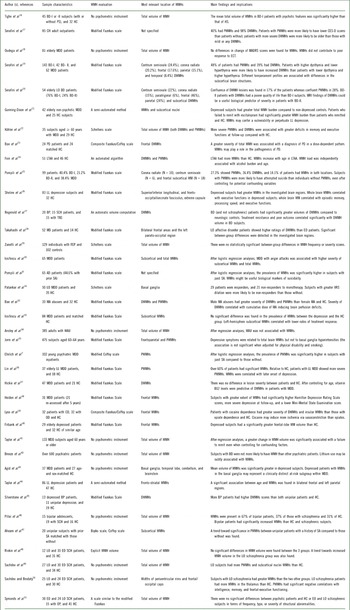
Studies investigating the eventual volumetric abnormalities in some brain structures have indicated possible involvement of the frontal cortex, temporal lobes, basal ganglia, and cerebellum in BDReference Beyer and Krishnan 13 and, recently, the subgenual cingulate cortex in both adultReference Singh, Chang and Chen 14 and pediatric populations.Reference Baloch, Hatch and Olvera 15 Table 1 summarizes the most relevant MRI studies of WMHs in adult patients with major psychiatric disorders.
MRI studies of WMHs in adult patients with major psychiatric disorders

Note: AD = affective disorders; BD-I = bipolar disorder type I; BD-II = bipolar disorder type II; CD = cocaine dependence; CH = chronic headache; DWMHs = deep WMHs; ECT = electroconvulsive therapy; EO = early-onset; FEP = first-episode psychosis; HC = healthy control; LL = late-life; LO = late-onset; LTAA = long-term abstinent alcoholics; MA = methamphetamine; MADRS = Montgomery–Asberg Depression Rating Scale; MDD = major depressive disorder; MRI = magnetic resonance imaging; OD = opiate dependence; OP = other psychoses; PD = panic disorder; PS = psychotic symptoms; PWMHs = periventricular WMHs; SA = suicide attempts; SCH = schizophrenia; TNS = transient neurologic symptoms; VRS = Virchow Robin spaces; WAU = weekly alcohol use; WMHs = white matter hyperintensities.
WMHs are, no doubt, the most common neuroimaging finding that have been found in patients with BD, regardless of age.Reference Vasudev and Thomas 52 Furthermore, there are differences between BD-I and bipolar II (BD-II) patients, as PWMH are more common in BD-I patients compared to BD-II and healthy controls,Reference Altshuler, Curran and Hauser 53 , Reference Vieta and Suppes 54 indicating that these neuroimaging findings may be a sensitive and even subtype-selective diagnostic tool.
Interestingly, WMH location may be critical in the expression of certain bipolar symptoms. For example, the presence of DWMHs has been associated with poorer response to treatment in bipolar patients, less favorable outcome, and more frequent relapseReference Moore, Shepherd and Eccleston 55 ; also, a relevant association between increased rates of PWMHs and previous suicide attempts has also been suggested.Reference Pompili, Ehrlich and De Pisa 8
Among all clinical manifestations, insight into illness may be widely considered as a relevant factor in coping with and treating patients with BD.Reference Cassidy 56 , Reference Van Der Werf-Eldering, Van Der Meer and Burger 57 Understanding the neural mechanisms underlying insight and illness awareness may have important implications for the development of targeted treatments. Some previous findings have reported an association between WMHs and insight in schizophrenic and/or schizoaffective populations.Reference Antonius, Prudent and Rebani 58 – Reference Rossell, Coakes, Shapleske, Woodruff and David 61
Our previous studies concerning WMHs found an association between PWMHs and lower depression severity as assessed by the Center for Epidemiologic Studies Depression ScaleReference Serafini, Pompili and Innamorati 62 ; an association between WMHs and older age in patients with late-onset BDReference Pompili, Serafini and Innamorati 63 ; an association between affective temperamental profiles, WMHs, and suicidal risk in patients with mood disordersReference Serafini, Pompili and Innamorati 64 ; an association between WMHs and suicide attempts in patients with bipolar disorders and unipolar depressionReference Pompili, Ehrlich and De Pisa 8 , Reference Pompili, Innamorati and Mann 25 , Reference Pompili, Rihmer and Akiskal 65 ; and an association between deep WMHs and poor prognosis in a sample of patients with late-onset bipolar II disorder.Reference Serafini, Pompili and Innamorati 20
Here we hypothesized that those with WMHs compared to those without may be at a higher risk of impaired insight as assessed using the item 17 of the HDRS17 and item 11 of the YMRS, respectively. The present study aimed to evaluate whether the presence of WMHs is associated with impaired insight in patients with BD-I. To our current knowledge, there are no data that link white matter abnormalities and insight in BD-I.
Methods
Subjects and study design
A total of 193 white Caucasian patients consecutively admitted to the psychiatric inpatient units of Sant'Andrea Hospital and the “Samadi Clinic” in Rome from September 2007 to September 2009 participated in the study. Inclusion criterion was a Diagnostic and Statistical Manual of Mental Disorders, 4th edition, text revision (DSM-IV-TR) diagnosis of BD-I. 66 Exclusion criteria were as follows: other DSM-IV-TR major psychiatric disorders; the presence of any neurological disorders (eg, epilepsy, multiple sclerosis, Alzheimer's disease, dementia); history of brain concussion; family history of dementia; presence of structural MRI findings compatible with stroke, including lacunar infarcts or other gross brain lesions or malformations; history of electroconvulsive therapy in the past 6 months; and conditions affecting the ability to participate in the assessment, including mental retardation. Based on inclusion criteria, 45 (23.3%) patients were not included because they had a diagnosis of BD-II. BD-II patients who were excluded from the study had similar socio-demographic characteristics and did not differ significantly from the patients included in the final sample with respect to clinical variables (eg, diagnosis or history of suicide attempts). The final sample consisted of 148 patients (77 men and 71 women). The mean age was 47.9 years (SD = 16.1; range: 19–83 years). Around 13% of the patients reported alcohol abuse; 6.1% reported illicit drug abuse, most commonly cannabis; and 2.0% reported concurrent abuse of alcohol and illicit drugs. Demographic and clinical characteristics of the sample are presented in Table 2. Clinical and socio-demographic information was taken from medical records by 2 researchers independently.
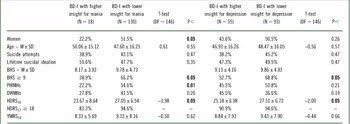
Differences between groups with different levels of insight

Note: BHS = Beck Hopelessness Scale; DWMHs = deep white matter hyperintensities; HDRS16 = sum of items 1–16 of the Hamilton Scale for Depression (item 17 was excluded to avoid the strong correlation between measures of depression and insight); PWMHs = periventricular white matter hyperintensities; YMRS10 = sum of items 1–10 of the and Young Mania Rating Scale (item 11 was excluded to avoid the strong correlation between measures of mania and insight); mean HDRS total score in the total sample = 25.4; mean YMRS total score in the total sample = 8.8. In bold are significant tests.
Current severity of affective symptoms was evaluated using the Young Mania Rating Scale (YMRS)Reference Young, Biggs, Ziegler and Meyer 67 and the Hamilton Depression Rating Scale (HDRS17).Reference Hamilton 68 Participants were additionally administered the Mini International Neuropsychiatric Interview (MINI)Reference Sheehan, Lecrubier and Sheehan 69 and the Beck Hopelessness Scale (BHS).Reference Beck, Weissman, Lester and Trexler 70 , Reference Beck and Steer 71
Subjects participated voluntarily in the study, and each subject provided written informed consent. The study protocol received approval from the local research ethics review board. Clinical interviews were conducted on average 5 days after admission.
Magnetic resonance image acquisition and rating of white matter hyperintensities
Brain MRIs were performed using a Siemens Sonata MRI scanner (Erlangen, Germany; 1.5 T). The Fluid attenuated inversion recovery (FLAIR) scan sequence was used for WMH measurement (ax: TR 10000; TE 125; thickness 5 mm; matrix 144 × 256). Proton density and T2-weighted images were obtained (PD and T2 ax: TR 2870; TE 13/107; thickness 5 mm; matrix 147 × 256) in the axial and the coronal planes. Axial and sagittal T1-weighted images were also obtained (T1 ax: TR 647; TE 17; thickness 5 mm; matrix 128 × 192 T1 sag: TR 552; TE 17; thickness 5 mm; matrix 231 × 192). The presence of a WMH was assessed by a neuroradiologist who was blind to all clinical information, using the modified Fazekas 4-point rating scale, which describes MRI hyperintensities on an ascending scale of intensity and frequency.Reference Coffey, Wilkinson and Weiner 72 A second neuroradiologist, who was blind to all clinical information and previous WMH ratings, independently reviewed all MRI films. In the present study, the 4-point assessment of the modified Fazekas scale was collapsed into a dichotomous variable that measured the presence or absence of WMHs. The mean k value for inter-rater reliability for both PWMHs and DWMHs was 0.90.
Measures: clinical assessment
MINI
The MINI is a clinically administered, short, structured interview with high validity and reliability that was developed to explore 17 disorders according to the Diagnostic and Statistical Manual of Mental Disorders, 3rd edition, revised (DSM-III-R),Reference Amorim, Lecrubier, Weiller, Hergueta and Sheehan 73 and is routinely used in our unit soon after admission. One section of this instrument was developed to assess suicidal risk, it includes questions about past and current suicidality.Reference Sheehan, Lecrubier and Sheehan 69
Although the MINI should not be a substitute for a psychiatric clinical interview, validation studies confirm the validity of this instrument as a reliable tool in psychiatry.Reference Sheehan, Lecrubier and Sheehan 69 MINI diagnoses were confirmed by clinical DSM-IV-TR diagnoses. Clinical diagnoses were assigned by 2 psychiatrists who were blind to the results of the MINI and MRI scans.
BHS
The BHS is a 20-item scale for measuring attitudes about the future.Reference Beck, Weissman, Lester and Trexler 70 Research consistently supports a positive relationship between BHS scores and measures of depression, suicidal intent, and current suicidal ideation.Reference Beck, Brown, Berchick, Stewart and Steer 74 The BHS, therefore, may be used as a proxy indicator of suicide potential. In the study reported in 1985, 91 of people who died by suicide had a score ≥ 9, while only 9% of suicide victims had a score < 9, establishing the BHS cut-off score as 9 or higher as predictive of higher suicide risk.Reference Beck, Steer, Kovacs and Garrison 75
HDRS17 and YMRS
The HDRS17,Reference Hamilton 68 a 17-item clinician-rated scale, was used to evaluate depressive symptom severity. The YMRS is an 11-item rating scale for mania that explores manic symptoms and is considered the gold standard for evaluating the concurrent validity of bipolar mania with newer scales.Reference Young, Biggs, Ziegler and Meyer 67 The item of the HDRS17 that assesses insight (item 17) is measured on a 3-point Likert-type scale [from 0 (acknowledges being ill and depressed) to 2 (denies being ill at all)]. The item of the YMRS that assesses insight (item 11) is measured on a 5-point Likert-type scale [from 0 (present; admits illness; agrees with need for treatment) to 4 (denies any behavior change)]. Both variables were dichotomized, and patients were included in any of the following groups: (1) patients who admitted even only the possibility of being ill at the YMRS (higher insight for mania), and those who denied illness or behavior change (lower insight for mania); (2) patients who admitted to being depressed and ill at the HDRS17 (higher insight for depression) and those who completely denied being ill (lower insight for depression).
To avoid the strong correlation between measures of depression/mania and insight, we estimated depressive (HDRS16) and mania (YMRS10) severity by omitting items of the scales measuring insight.
Statistical Analysis
One-sided Fisher exact tests and t-tests were used for bivariate analyses. All variables that were significant in the bivariate analyses were entered as independent variables into 2 logistic regression analyses with groups with different levels of insight as the criterion. Chi-squared tests (χ2), Nagelkerke R2, and –2 Log likelihood statistics are reported as statistics of model fit. Odds ratios (OR) and their 95% confidence intervals (CI) are reported as measures of association. Patients were stratified into 2 groups (having similar severity of bipolar illness): those having lower insight (having a > 1 as assessed by YMRS item 11) and those with higher insight (having a ≤ 1 as assessed by YMRS item 11). Among these groups, subjects were subsequently divided in those with lower or higher insight for mania and depression, respectively. All the analyses were performed with the Statistical Package for the Social Sciences (SPSS) for Windows 19.0.
Results
Clinical characteristics of the sample
At the time of assessment, 62.8% of the patients had scores of 9 or higher on the BHS, denoting elevated hopelessness and suicide risk. Approximately 88% and 63% of BD-I patients denied being ill according to item 11 of the YMRS and item 17 of the HDRS17, respectively.
Suicide risk
Around 43% of the patients (42.6%) had attempted suicide at least once in the past, and 48.6% of them had reported suicidal ideation.
MRI findings
A total of 73 subjects (49.3%) had PWMHs and 59 (39.9%) had DWMHs. Overall, 41 (27.7%) subjects had both PWMHs and DWMHs. Of those with PWMHs, 49 (67.1%) had multiple punctate lesions, 23 (31.5%) had beginning confluency of lesions, and only 1 (1.4%) had large confluent lesions as assessed by the modified Fazekas scale. Of those with DWMHs, 47 (79.7%) had multiple punctate lesions, 10 (16.9%) had beginning confluency of lesions, and 2 (3.4%) had large confluent lesions.
Insight ratings
Groups with different levels of insight differed in several variables (see Table 2). BD-I patients with lower insight for mania were more frequently women (51.5% vs 22.2%; p = 0.05), had significantly more PWMHs (54.6% vs 22.2%; p < 0.05), significantly higher scores on the HDRS16 (27.05 ± 6.54 vs 23.67 ± 8.64; t146 = −1.98; p < 0.05), and a significantly more frequent BHS score ≥ 9 (66.2% vs 38.9%; p < 0.05) when compared to BD-I patients with higher insight for mania.
On the contrary, BD-I patients with higher insight for depression differed only for BHS (p < 0.05) and HDRS16 (t146 = −2.00; p < 0.05) scores. BD-I patients with lower insight for depression had greater depressive severity (27.51 ± 6.72 vs 25.18 ± 6.98) and more frequently had scores of 9 or higher on the BHS (68.8% vs 52.7%).
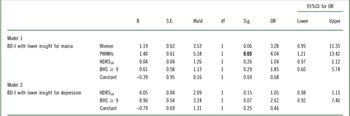
Two logistic regression models assessed multivariate associations between groups and variables significant at the bivariate analysis when controlling for the presence of other variables. Both models fit the data well (see Table 3). The first model explained 20% of the variability of the data, and groups with different levels of insight in the YMRS differed significantly only for PWMHs (p < 0.05). The presence of PWMHs was independently associated with lower insight for mania: Patients who denied illness according to the YMRS were 4 times more likely to have PWMHs (95% CI: 1.21/13.42) than other patients.
Logistic regression models (groups with different levels of insight as criterion)

Model 1 fit: χ2 4 = 16.56; P < 0.01; –2 Log likelihood = 93.00; Nagelkerke R2 = 0.20.
Model 2 fit: χ2 2 = 6.94; P < 0.05; –2 Log likelihood = 102.63; Nagelkerke R2 = 0.09.
Note: BHS = Beck Hopelessness Scale; HDRS16 = sum of items 1–16 of the Hamilton scale for depression; PWMHs = periventricular white matter hyperintensities. In bold are significant tests.
The second model explained only 9% of the variability of the data, but none of the variables inserted in the model was independently associated with lower insight for depression (HDRS16: OR = 1.05; p = 0.15; BHS ≥ 9: OR = 2.62; p = 0.07).
Discussion
To our knowledge, this was the first study to investigate the association between WMHs and insight as assessed by 1 item of the YMRS in a population of patients with BD-I. Subjects with lower insight for mania had significantly more PWMHs when compared to BD-I patients with higher insight for mania. These results indicate that differences in white matter abnormalities, as assessed using the modified Fazekas scale, are associated with differences in insight levels.
The present findings extended some previous results of studies that investigated the association between WMHs and insight in different psychiatric populations (eg, schizophrenic and/or schizoaffective patients).Reference Antonius, Prudent and Rebani 58 – Reference Rossell, Coakes, Shapleske, Woodruff and David 61 For example, Antonius etal Reference Antonius, Prudent and Rebani 58 suggested that white matter deficits in fronto-temporal brain regions are linked to symptom unawareness, and reduced white matter integrity in temporal and parietal regions is implicated in the misattribution of symptoms. Similarly, Palaniyappan etal,Reference Palaniyappan, Mallikarjun, Joseph and Liddle 60 in a sample of predominantly male subjects, found a significant decrease in right posterior insular area in patients with poor insight relative to healthy controls; a negative correlation between insight and local white matter volume of the right posterior insula; and a positive association between the lower surface area of the right posterior insula and the lower degree of insight.
Not all studies, however, reported a relationship between frontal lobe atrophy and impaired insight. Bassitt etal Reference Bassitt, Neto, De Castro and Busatto 59 found no significant inverse correlations between insight impairment and gray or white matter volumes in the prefrontal region. Similarly, Rossell etal Reference Rossell, Coakes, Shapleske, Woodruff and David 61 reported no significant correlations between the whole brain, white and gray matter volumes, and the degree of insight in a sample of 78 male patients with schizophrenia and 36 normal male comparison subjects.
According to our results, different levels of insight as assessed by the YMRS are associated with MRI findings. BD-I patients with impaired insight on the YMRS were more likely to have PWMHs. WMHs were observed mostly in the centrum semiovale (24.4%) and corona radiata (20.2%) regions and higher in cortical and subcortical deep frontal (17.6%), parietal (15.1%), and temporal (8.4%) areas. These brain regions are involved in the regulation of mood and may contribute to the emergence of impairments in insight.Reference Soares and Mann 9 , Reference Craig 76 – Reference Taylor, Macfall and Steffens 82 It is unlikely that impairments in insight are related to a single brain area. Most likely, symptom unawareness is linked to complex abnormalities in the network of fronto-temporal brain regions.
The assumption that some bipolar symptoms might be due to vascular-related processes (eg, degenerative processes including atherosclerosis, lacunar infarcts, atrophic demyelination, and arteriolar hyalinization)Reference DeCarli, Murphy and Tranh 83 that alter the connectivity between these brain structures is intriguing and is supported by the observed post-stroke emergence of mania.Reference Berthier, Kulisevsky, Gironell and Fernández Benitez 84 , Reference Celik, Erdogan, Tuglu and Utku 85 However, here we did not find any association between the presence of DWMHs (usually having a vascular etiology) and impaired insight; therefore, manic symptoms other than impaired insight would be affected by these vascular processes as previously reported.Reference Serafini, Pompili and Innamorati 64
The association between bipolar disorder and cardiovascular risk factors, including hypertension, hypercholesterolemia, obesity, and cigarette smoking,Reference Kilbourne 86 , Reference Yates and Wallace 87 is well known. However, our findings did not support this link between vascular risk factors and the emergence of manic symptoms, because after including PWMHs, DWMHs, hypertension, diabetes, total cholesterol, triglycerides, and number of daily cigarettes as covariates in our analyses, the results did not indicate any significant association.
In contrast with our previous findings,Reference Pompili, Ehrlich and De Pisa 8 , Reference Pompili, Innamorati and Mann 25 our study did not currently find any association between PWMHs and suicidal behavior as assessed using the BHS. However, here we investigated a sample of BD-I patients, whereas the previous findingsReference Pompili, Ehrlich and De Pisa 8 , Reference Pompili, Innamorati and Mann 25 were found in a mixed sample of bipolar and major depressed patients. The association between PWMHs and suicidal behavior is presumably significant only in some subgroups of patients with major affective disorders, such as those with a BD type II or major depression.
Overall, these findings provide hypothetical evidence in support of the notion that the presence of PWMHs may significantly predict the presence of impaired insight in subjects with BD-I. Therefore, the presence of PWMHs might be used for grouping those subjects with BD-I who will manifest a more pronounced impairment in insight during hospitalization than other bipolar individuals, which will potentially help to optimize alternative treatment strategies.
Limitations
The present study must be considered in the light of the following limitations. First, the small sample size did not allow for a generalization of the present findings. In addition, all our patients were admitted to a psychiatric hospital, which may indicate more severe affective symptoms and poorer insight at admission compared to that usually found in outpatients. This is a potential confounder of the present results according to some recent studies,Reference Liu, Blond and van Dyck 88 , Reference Van der Schot, Kahn, Ramsey, Nolen and Vink 89 which suggests that, at least at functional level, some white matter abnormalities may be state-related. However, the present sample did not include bipolar subjects with current psychotic symptoms, nor severely depressed/manic patients as confirmed by the HDRS and YMRS mean total scores (see Table 2). Therefore, we suggest that the observed white matter abnormalities in our sample were trait-related rather than state-related features.
Also, the present study did not include a formal measure of insight. The measurement of insight through item 11 of the YMRS and item 17 of the HDRS17 may be considered questionable, as the variance is not likely to be high. It is also difficult to make a fair comparison with the one item having a 0–4 range for mania and the other 0–2 for depression. However, our results are in line with those of Shad etal Reference Shad, Muddasani, Prasad, Sweeney and Keshavan 90 and Ha etal Reference Ha, Youn and Ha 91 and with other authors,Reference David, Buchanan, Reed and Almeida 92 which suggests that insight is a multidimensional domain. Factor analytic studies have often identified that different insight dimensions significantly overlap and may be represented by a single component able to explain approximately 80% of the variance.Reference Birchwood, Smith and Drury 93 – Reference Lincoln, Lüllmann and Rief 96 In addition, it has been demonstrated that a good degree of agreement exists between single- and multiple-item measurement of insight.Reference Sanz, Constable, Lopez-Ibor, Kemp and David 97
Moreover, although all our inpatients were taking psychoactive medications and most had a history of substance abuse, we did not analyze the effects of these variables on insight ratings and image processing.
It is reasonable to inquire whether the use of psychotropic medications could influence the presence and maintenance of WMHs. To date, there is no evidence that WMH rates could be influenced by the use of lithium, tricyclic antidepressants, or antiepileptic medications.Reference Videbech 5 , Reference Altshuler, Curran and Hauser 53 , Reference Sassi, Brambilla and Nicoletti 98 , Reference Persaud, Russow and Harvey 99 Conversely, findings concerning the possible influence of antipsychotic drugs is very limited, which suggests that caution should be used when interpreting the significance of WM lesions in patients with major affective disorders who were treated with psychoactive medications. However, most of the subjects included in the present sample were at their first hospitalization, presumably reflecting a short history of exposure to antipsychotic drugs. Also, the lack of accounting for the cognitive effects of medications was due to the fact that these patients did not complete a specific neurocognitive assessment.
Other methodological issues concern the procedure. The MRI studies were of quite low spatial resolution and done on a 1.5 T scanner. Studies at 3 T and with higher resolution would have likely yielded a much higher number and extent of WMHs. An analysis to quantify total white matter lesion volume would strengthen the findings. In addition, diffusion tensor imaging techniques may be more sensitive for detecting white matter abnormalities in association with mood disorders. Also, although we found that WMHs were predominant in some brain regions, we could not perform regional analysis showing specific regional relationship of WMHs to insight.
Importantly, although WMHs are frequently found in populations of bipolar patients, and different mechanisms are considered in the emergence of WMHs, it is possible that WMHs may represent the “tip of the iceberg” that might be interpreted as an extreme consequence of underlying microstructural processes that affect brain connectivity, and which may be more specifically investigated using diffusion tensor imaging methods. Additionally, the Fazekas rating scale as a lesion assessment method was limited because visual rating scales, even where details of where lesions occur are provided, are a less objective method than many of the volumetric methods that are available.
Conclusions
More than 45% of our BD-I patients had PWMHs and a significant percentage of them had DWMHs. BD-I patients with impaired insight were more likely to have PWMHs than those without.
Prospective additional studies are needed in order to provide a better understanding of the biological processes that are involved in bipolar illness outcome.
Disclosures
Disclosures for Dr. Serafini: Innova Pharma Italy, speaker, speaker honoraria; Astra-Zeneca, speaker, speaker honoraria; Servier, congress participation, grant; Lundbeck, congress participation, grant. Disclosures for Dr. Pompili: Astra-Zeneca, speaker, speaker honoraria; Lundbeck, speaker, speaker honoraria. Disclosures for Dr. Girardi: Innova Pharma Italy, speaker, speaker honoraria; Eli Lilly, research, research support; Janssen, research, research support. Disclosures for Dr. Rihmer: Krka, speaker, speaker honoraria; Lundbeck, speaker, speaker honoraria; Monrose, speaker, speaker honoraria; Solvay Pharma, speaker, speaker honoraria; Wyeth, speaker, speaker honoraria; Worwag Pharma, speaker, speaker honoraria; Astra-Zeneca, speaker, speaker honoraria, advisor, honoraria; GSK, speaker, speaker honoraria; Eli Lilly, speaker, speaker honoraria, advisor, honoraria; Organon, speaker, speaker honoraria, advisor, honoraria; Pfizer, speaker, speaker honoraria, advisor, honoraria; Richter, advisor, honoraria; Richter, speaker, speaker honoraria, Sanofi-Aventis, speaker, speaker honoraria, advisor, honoraria; Servier-Egis, speaker, speaker honoraria, advisor, honoraria; Schering-Plough, speaker, speaker honoraria, advisor, honoraria. Drs. Innamorati, N. Girardi, Sher, Amore, and Strusi have no relevant disclosures.