INTRODUCTION
Recent studies predict that many undescribed species of marine taxa still await discovery (Reimer & Sinniger, Reference Reimer and Sinniger2010; Mora et al., Reference Mora, Tittensor, Adl, Simpson and Worm2011), and although new findings are expected from species-rich regions such as coral reefs, comparatively unexplored Canadian waters may also offer significant potential for discoveries. Driven primarily by interest in the study and conservation of deep-sea corals (Cogswell et al., Reference Cogswell, Kenchington, Lirette, MacIsaac, Best, Beazley and Vickers2009; Gilkinson & Edinger, Reference Gilkinson and Edinger2009; Murillo et al., Reference Murillo, Durán Muñoz, Altuna and Serrano2011) and more recently sponges (Kenchington et al., Reference Kenchington, Lirette, Cogswell, Archambault, Archambault, Benoit, Bernier, Brodie, Fuller, Gilkinson, Lévesque, Power, Siferd, Treble and Wareham2010), the past decade has seen a number of studies dedicated to deep-water taxa of eastern Canada (e.g. Mercier & Hamel, Reference Mercier and Hamel2008; Baillon et al., Reference Baillon, Hamel, Wareham and Mercier2012; Baker et al., Reference Baker, Haedrich, Snelgrove, Wareham, Edinger and Gilkinson2012; Gale et al., Reference Gale, Hamel and Mercier2013, in press).
The deep-sea holothurian fauna epitomizes the potential paucity of detailed knowledge from the region, as highlighted by recent discovery of rare and new species (Mercier et al., Reference Mercier, Pawson, Pawson and Hamel2010; Gebruk et al., Reference Gebruk, Rogacheva, Pawson, Hamel, Macisaac and Mercier2013). While the shallow-water holothurian fauna of the North Atlantic, including Atlantic Canada, is reasonably well studied (Whiteaves, Reference Whiteaves1901; Brunel et al., Reference Brunel, Bossé and Lamarche1998) and significant taxonomic works encompass the region (Deichmann, Reference Deichmann1930; Pawson, Reference Pawson1977), holothurians from below the shelf break remain poorly known (Haedrich & Maunder, Reference Haedrich, Maunder, Keegan and O'Connor1984). During a Canadian scientific expedition on the vessel CCGS ‘Hudson’ in 2009, collection of multiple sediment samples at bathyal depths off the coast of Nova Scotia in eastern Canada provided an opportunity to examine and catalogue poorly described endofauna, and to add two new holothurian species to the Canadian marine fauna.
MATERIALS AND METHODS
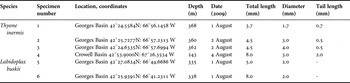
Sediment samples collected in Atlantic Canada (Table 1; Figure 1) with an Oktopus multicorer in 2009 on the vessel CCGS ‘Hudson’ were analysed by extruding and slicing cores from 39 separate multicorer drops into three sediment depths (0–2 cm, 2–5 cm and 5–10 cm). Each section was sieved (300 µm pore size), preserved in 10% buffered formalin and then transferred in 70% ethanol for storage. Rose Bengal stain was added a minimum of 24 h before isolating organisms from each sediment sample. Sea cucumbers were isolated and identified using standard anatomy and ossicle morphology.
Map showing the location where Thyone inermis (•) and Labidoplax buskii (▴) were collected along the south-western coast of Nova Scotia (eastern Canada) in 2009 (details in Table 1).

Sampling coordinates and depth for Thyone inermis and Labidoplax buskii along the continental slope of south-western Nova Scotia (eastern Canada) in 2009. The specimen numbers correspond to collection sites on Figure 1.

Material is held in the collections of the Institut Royal des Sciences Naturelles de Belgique under the reference number IG 32720 (4 specimens for Thyone inermis Heller, Reference Heller1868 and 1 specimen plus one in toto preparation for Labidoplax buskii, (McIntosh, Reference McIntosh1866)).
RESULTS
Species 1—Thyone inermis
SYSTEMATICS
Order DENDROCHIROTIDA Grube, 1840
Family PHYLLOPHORIDAE Oestergren, 1907
Genus Thyone Jaeger, 1833
Thyone inermis Heller, Reference Heller1868
(Figures 2A, 3A–E)
Thyone inermis: Heller, Reference Heller1868: 78; von Marenzeller, Reference von Marenzeller1893: 18: Hérouard, Reference Hérouard1902: 45; Hérouard, Reference Hérouard1923: 114; 62; Zavodnik, Reference Zavodnik1961: 52; Miller & Pawson, Reference Miller and Pawson1984: 40, figures 12–13 (citations before 1984); Hayward & Ryland, Reference Hayward and Ryland1990; 869; Picton, Reference Picton1993: 76 McKenzie, Reference McKenzie1991: 141; McKenzie, Reference McKenzie, Howson and Picton1997: 274; Southward & Campbell, Reference Southward and Campbell2006: 216, figure 197; Paulay, Reference Paulay2014a.
Havelockia inermis: Panning, Reference Panning1949: 461; Cherbonnier, Reference Cherbonnier1959: 62; Tortonese, Reference Tortonese1965: 90, figure 37B; Pancucci-Papadopoulou, Reference Pancucci-Papadopoulou1996: 43, map 16; Zavodnik, Reference Zavodnik1997: 373; Hansson, Reference Hansson, Costello, Emblow and White2001: 348.
Uroxia aurantiaca: Costa, Reference Costa1869: 57, 3 plates.
Thyone aurantiaca: Hérouard, Reference Hérouard1889: 688, pl. XXXII figures 1, 11–14.
MATERIAL EXAMINED
Three specimens collected in Georges Basin and one specimen in Crowell Basin (south-west Nova Scotia, Canada). Found in the first 2 cm of a muddy to very muddy substratum, with an average grain size of 56 µm and average mud content of 69%. Depth and location of collection as well as size of the specimens summarized in Table 1 and Figure 1.
DESCRIPTION
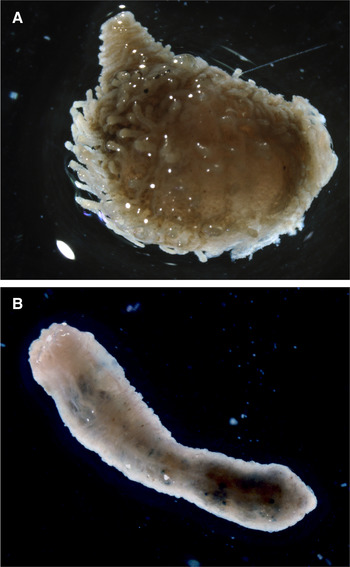
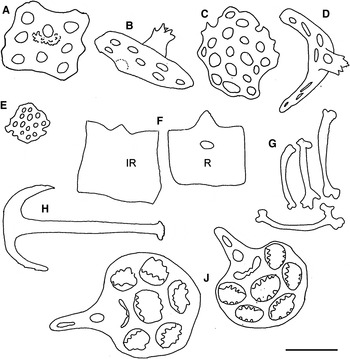
Body anteriorly rounded, tapering posteriorly in a short tail (Figure 2A). Tube feet very long, numerous particularly ventrally at mid-body (Figure 2A). Tentacles contracted, not visible. Radial plates of calcareous ring with two long posterior processes (1/4 of body length), mosaic like. Table ossicles in body wall, 75–100 µm across with 5–9 holes, 2 short pillars ending in a cluster of short spines (Figure 3A, B). A few larger plates up to 150 µm across, perforated by 10–18 holes (Figure 3C). In the tube feet, arched rods 100 µm long with 2 short pillars; (Figure 3D) small perforated end plate more or less 35 µm across (Figure 3E).
(A) General view of a 6 mm long Thyone inermis collected at 368 m depth; (B) general view of a 6 mm long Labidoplax buskii collected at 335 m depth.

Thyone inermis: (A, B) small perforated plates from the body wall; (C) large perforated plates from the body wall; (D) arched rods with short central pillars; (E) end plate of tube feet. Labidoplax buskii: (F) pieces of the calcareous ring (R, radial; IR, inter-radial); (G) rods of the tentacles; (H) anchor; (J) anchor-plates. Scale bars: A, B, D, E, H, J, 50 µm; C, 100 µm; F, 200 µm.

REMARKS
The species T. inermis has been allocated to the genus Thyone by Heller (Reference Heller1868). Panning (Reference Panning1949) transferred it to the genus Havelockia. The two genera differ mainly in the presence of tables and absence of rosettes in the introvert of the species belonging to Havelockia, whereas the species referred to as Thyone are characterized by the presence of rosettes and the absence of tables in the introvert. However, Pawson & Miller (Reference Pawson and Miller1981) consider that T. inermis has tables and rosettes in the introvert. Discussion about the validity of these genera is beyond the aim of this paper. According to the key to western Atlantic species of Thyone given by Pawson & Miller (Reference Pawson and Miller1981), we are dealing with T. inermis.
DISTRIBUTION
According to Paulay (Reference Paulay2014a), Thyone inermis is already known from the Mediterranean Sea, European Atlantic coast, British Isles, Scandinavia, Madeira, Azores, Florida (USA), Tobago, Cuba and the Caribbean. A map can be accessed at http://iobis.org/mapper/?taxon=Thyone%20inermis/. However, because of numerous misidentifications in the literature (see McKenzie, Reference McKenzie1991: pp. 141–146) this distribution would be more restricted. The species characteristically occurs in shallow waters (0–200 m), but extends to depths of 366 m along the coast of Florida (Miller & Pawson, Reference Miller and Pawson1984) and 1385 m around the Azores (Hérouard, Reference Hérouard1902).
Species 2—Labidoplax buskii
SYSTEMATICS
Order APODIDA Brandt, 1835
Family SYNAPTIDAE Burmeister, 1837
Genus Labidoplax Oestergren, 1898
Labidoplax buskii (McIntosh, Reference McIntosh1866)
(Figures 2B; 3F–J)
Synapta buskii McIntosh, Reference McIntosh1866: 12, figure 6.
Labidoplax buskii; Oestergren, Reference Oestergren1904: 156; Pawson, Reference Pawson1967: 153, figures 1–4 (citations before 1967); Cherbonnier & Guille, Reference Cherbonnier and Guille1968: 1219, figures a–h (full synonymy and citations); Cherbonnier, Reference Cherbonnier1969: 344; Madsen & Hansen, Reference Madsen and Hansen1994: 110, figures 71–73, map 30; Pancucci & Papadopoulou, 1996: 43, map 19; McKenzie, Reference McKenzie, Howson and Picton1997: 275; Southward & Campbell, Reference Southward and Campbell2006: 42, figure 223A–D; Hansson, Reference Hansson, Costello, Emblow and White2001: 350.
MATERIAL EXAMINED
Two very small specimens (5–8 mm long, 2 mm across; Table 1; Figure 2B) sampled from Georges Basin (south-west Nova Scotia), found in the first 2 cm of the substratum, with an average grain size of 65 µm and average mud content of 66%. Dissection not possible; preparation in toto to examine ossicles.
DESCRIPTION
Ten tentacles, each with two lateral digits. Calcareous ring with quadrangular plates (Figure 3F), radial plates perforated for the nerve (Figure 3F). Ossicle anchors and anchor plates in the body wall; short curved rods in the tentacles. Anchors 140–170 um long, 100–130 µm width; arms with 3–4 teeth, vertex smooth, stock granulose but not branched (Figure 3G). Anchor plates 110–160 µm long, 100–110 µm width, bat-shaped (Figure 3H). Anterior part with 7 serrated holes, the posterior one smaller; posterior part generally with two smooth holes (Figure 3J), the anterior rounded, the posterior elongated (Figure 2H). Rods of the tentacles, slightly curved, 50–60 µm long (Figure 3J).
DISTRIBUTION
Labidoplax buskii is known from the Mediterranean Sea (Cherbonnier & Guille, Reference Cherbonnier and Guille1968; Pancucci-Papadopoulou, Reference Pancucci-Papadopoulou1996), the Atlantic coast of Europe, Scandinavia and the USA (Madsen & Hansen, Reference Madsen and Hansen1994), including North Carolina (USA) (Pawson, Reference Pawson1967). A map of the geographical distribution (Paulay, Reference Paulay2014b) can be accessed at http://iobis.org/mapper/?taxon=Labidoplax%20buskii/. The reported collection depths of L. buskii span 10–560 m.
DISCUSSION
Present collecting depths for Thyone inermis, between 243 and 368 m, are within its known bathymetric distribution. The species can reach 150 mm long. In this respect, the specimens examined here, which are 3.7–8 mm long, must be considered juveniles. Specimens of Labidoplax buskii were also collected within their known bathymetric range, at 335 and 338 m depth. The latter species is reportedly quite small; 15–30 mm long according to Clark (Reference Clark1907), Mortensen (Reference Mortensen1927) and Southward & Campbell (Reference Southward and Campbell2006); 10 mm according to Pawson (Reference Pawson1967). Therefore, the specimens examined here (5–8 mm long) are not necessarily juveniles.
Thyone inermis and Labidoplax buskii are new records for the Canadian marine fauna, thereby extending the geographical range of these species, which are reported in several locations on both sides of the North Atlantic Ocean.
ACKNOWLEDGEMENTS
We thank the captain and crew of the CCGS ‘Hudson’ and the staff of the Department of Fisheries & Oceans Canada (DFO), as well as Paul Snelgrove, Kate Wilke, Krista Baker, Christine Vickers and Helen Gillespie. The collection of specimens was funded by the NSERC Canadian Healthy Oceans Network (P. Snelgrove).