The mainstay of constitutional law training is the examination of landmark rulings of principle, beginning with the Marbury principle that the Supreme Court has the power to declare void any legislative act repugnant to the Constitution.Footnote 1 Subsequent rulings on constitutional principles include those enunciated in Barron v. Baltimore in 1833 that the provisions of the Bill of Rights do not apply to the actions of state governments and the reversal of that principle in Gitlow v. New York in 1925. Many other cases announce new or evolving principles, such as the principle in Katz that the Fourth Amendment protects people, not places; Schenck’s ruling that a clear and present danger of substantive evils is required to abridge the freedom of speech; or Brandenburg’s restriction of that standard to incitement of imminent lawless action. Much of the literature on judicial decision making follows this emphasis on constitutional principles, even while taking competing positions on their origins.Footnote 2 In this article, we argue that the focus on constitutional principles as the center of judicial concern and influence neglects another crucial aspect of constitutional decision making: the role of social facts.
A social fact is not a statement of principled standard, but an assertion of empirical reality. The core distinction is that principles are normative statements of what should be, while facts are empirical statements about what is. Statements of fact can be falsified (demonstrated to be incorrect) by empirical evidence (that either exists now or may exist in the future), while statements of principle cannot be falsified regardless of old or new evidence, as they are grounded in judgments of better or worse rather than true or false. However, the justices (as well as most citizens) rarely acknowledge that many of our empirical beliefs about the nature of things are grounded in collective perceptions that are potentially malleable or shifting: Are women inherently different from or similar to men? Is racism still prevalent or no longer influential? Is sexual orientation innate or experiential? Public perceptions of these and many other politically influential social facts have evolved radically over time. However, the Court’s rulings on such social facts have been given short shrift by both justices and scholars compared to the emphasis on evolving principles. While principles are usually stated openly and disputed consciously, social facts may often be discussed as seemingly obvious, such that they need not be justified or even clearly articulated.
It is important to emphasize that constitutional principles and social facts are not dichotomous constructs. They are separable in theory but intertwined in practice. Principles and facts play separate roles in constitutional analysis and are influenced by different historical changes, but in the practice of the Court they are often conflated. It is precisely this interdependence—that a change in one can demand a change in the other—that illuminates the importance of identifying the neglected side of the union. Regardless of the importance of both elements, the Court has devoted a clear preponderance of its time and ink to justifying the changes in principle. Less attention has been paid to the evolution or justification of social facts. To be clear, this article is not arguing that facts are entirely separable from principles; but instead it is exactly because principles are so dependent on them that we must identify the instances in which evolving social facts are influential.
The role of disputed facts in contemporary electoral and social movement politics has entered mainstream political science discussion in recent years. A growing literature demonstrates clear divisions among the American public regarding many politically relevant realities, from economic conditions to climate change to the prevalence of racism (Kuklinski et al. Reference Kuklinski, Quirk, Jerit, Schweider and Rich2000; Bartels Reference Bartels2002; Kahan and Braman Reference Kahan and Braman2006; Gaines et al. Reference Gaines, Kuklinski, Quirk, Peyton and Verkuilen2007; Kahan et al. Reference Kahan, Braman, Gastil and Slovic2007; Shapiro and Bloch-Elkon Reference Shapiro and Bloch-Elchon2008; Gerber and Huber Reference Gerber and Huber2010; Nyhan and Reifler Reference Nyhan and Reifler2010; Jerit and Barabas Reference Jerit and Barabas2012; Kahan Reference Kahan2013; Joslyn and Haider-Markel Reference Joslyn and Haider-Markel2014; Marietta, Barker, and Bowser Reference Marietta, Barker and Bowser2015). These studies employ different terms to describe the phenomenon, including disputed facts, dueling facts, partisan facts, misinformation, cultural cognition, and polarized fact perceptions, but all contribute to the conclusion that public perceptions of many realities are highly disputed.Footnote 3 By any name, the scholars studying this phenomenon agree that Americans have become polarized by more than merely partisanship and ideology, moving on to polarization over the perceived facts of contemporary society and politics.
The role of disputed social facts has long been a concern in legal scholarship, which emphasizes the distinction between legislative facts and adjudicative facts. Kenneth Culp Davis, a giant in the field of administrative law, defined legislative facts as those that come into play when a court “wrestles with a question of law or policy” rather than the “facts concerning immediate parties” (Reference Davis1942, 402). While adjudicative facts “are the facts that normally go to the jury in a jury case,” relating “to the parties, their activities, their properties, their businesses,” legislative facts “are ordinarily general and do not concern the immediate parties” (Davis Reference Davis1955, 945).Footnote 4 Davis recognized two critical facets of legislative facts: (1) while they may be included in the evidentiary record, “more frequently they come to the court’s attention through researches of a judge or briefs of counsel” (Reference Davis1942, 403); and (2) “the exceedingly practical difference between legislative and adjudicative facts is that, apart from facts properly noticed, the tribunal’s findings of adjudicative facts must be supported by evidence, but findings or assumptions of legislative facts need not, frequently are not, and sometimes cannot be supported by evidence” (Reference Davis1955, 945). These two aspects—judicial discretion and paucity of evidence—have framed the problem of how the Court “wrestles” (as Davis phrases it) with social facts.
The broad, general, or universal facts that Davis termed legislative facts have also been referred to in law journals as social facts (McGinnis and Mulaney Reference McGinnis and Mulaney2008; Borgmann Reference Borgmann2013), premise facts (Keeton Reference Keeton1988; Larsen Reference Larsen2013), constitutional facts (Shaman Reference Shaman1983; Faigman Reference Faigman1991, Reference Faigman2008), and foundational facts (Sherry Reference Sherry2011). Several legal scholars have discussed their importance to constitutional decision making, including Henry Biklé (Reference Biklé1924), Kenneth Karst (Reference Karst1960), and especially David Faigman, though none have attempted a broad empirical examination of the prevalence of social fact rulings.Footnote 5 A general theme has been the haphazard approach that the Court has taken to identifying and justifying social facts. Karst describes the process as one in which the Court “groped its way to a conclusion largely on the basis of hunch” (Reference Karst1960, 83); Davis writes that “the Supreme Court’s lawmaking is sometimes based on understanding the relevant legislative facts and sometimes not. When the Court lacks the needed information, it usually makes guesses” (Reference Davis1986, 9); while Faigman refers to social fact rulings as “the Justices’ best guesses about the matter” (Reference Faigman1991, 545).
Despite the recognition within legal circles of their importance, the role of social facts in constitutional decision making has received lesser attention in political science scholarship. Notable exceptions include Howard Gillman and Ronald Kahn.Footnote 6 Kahn describes the nature of Supreme Court decision making as “a two-stage process. The first stage is the identification of the presence and nature of constitutional principles at issue in a particular case. The second stage then asks how the recognition and definition of political, economic, and social facts change over time and how changes in the definition of social facts inform changes in constitutional law and doctrine” (Reference Kahn, Gillman and Clayton1999, 45). Hence it is a “continuous and mutually constitutive dynamic relationship between internal legalistic and external factors” (Reference Kahn, Kahn and Kersch2006, 67).
In his study of Lochner-era jurisprudence, Gillman (Reference Gillman1993) questions legal orthodoxy about the nature of the landmark 1905 case that rejected legislative authority to regulate the terms of industrial employment. In doing so, he makes an implicit distinction between the role of constitutional principles and social facts. The orthodox view of Lochner is that the justices substituted their ideological preferences regarding laissez-faire economic policy for constitutional principles; hence the decision is often denounced as a quintessential example of an activist (and therefore potentially illegitimate) Court. In response to this view, Gillman offers the early-20th-century justices’ understanding of the meaningful distinction between legitimate state action designed to benefit society as a whole (salus populi) and illegitimate state action that benefits one class of citizens over another. In this sense, the Lochner ruling was determined by a foundational fact: the understanding of the unfettered market as leading to the public good is a social fact about the nature of empirical reality. Implicit in Gillman’s approach is the argument that constitutional principles interact with social facts to produce judicial decisions; a change in either component can be responsible for judicial evolution. Moreover, because some principles rely on unstated facts, a change in a foundational social fact can make a principle unstable. In the Lochner era, the principles remained stable, but the social facts underwent substantial evolution with the changing economy. The perception expressed in the Lochner decision—that “the social relations constructed by the common-law regime of contract and property were essentially fair and liberty loving” (27)—gave way to a new understanding that markets can obstruct liberty unless limited by government intervention. This emerging social fact was summarized by Teddy Roosevelt: “There was once a time in history when the limitation of governmental power meant increasing liberty for the people. In the present day the limitations of governmental power, of governmental action, mean the enslavement of the people by the great corporations who can only be held in check through the extension of governmental power” (151).
The social facts underlying Lochner become even more interesting when we compare them to the views expressed in Muller v. Oregon just 3 years later. Muller is a short decision focused solely on the nature of women, in response to the same question argued in Lochner, though with a significant twist: can a state limit the hours of work without violating the right to contract when the law applies specifically to females? The unanimous Court in Muller ruled that, “without questioning in any respect the decision in Lochner,” the rule does not apply to women. This is due to an explicitly stated social fact about “the inherent difference between the two sexes,” specifically that “woman’s physical structure and the performance of maternal functions place her at a disadvantage in the struggle for subsistence” (208 U.S. 421). What is crucial to the outcome in Muller is not the identification of the relevant constitutional principle about the nature of property rights (which had been established 3 years prior), but instead its interaction with the relevant social fact about the nature of women.Footnote 7 Gillman and Kahn’s arguments rely on a recognition of the close relationship between principles and facts, raising the question of how the Court should determine rulings on social facts in a consistent fashion.
Many of the Court’s significant decisions reflect the recognition of an altered social fact rather than merely an enunciation of constitutional principle. In this sense the Court fills a role in our constitutional system as the final arbiter of disputed social realities. This study offers an empirical test of the frequency of these social fact rulings and the nature of their justifications across the breadth of the landmark cases of the last century.
An Empirical Study of Social Fact Rulings and Their Justifications
A thorough evaluation of Supreme Court decisions would allow us to examine several important questions:
-
1. How prevalent are rulings on social facts?
-
2. How often does the Court offer a justification for its social fact rulings?
-
3. What kinds of justifications does the Court offer?
-
4. Are there differences between conservative and liberal decisions in the frequency or justification of social facts?
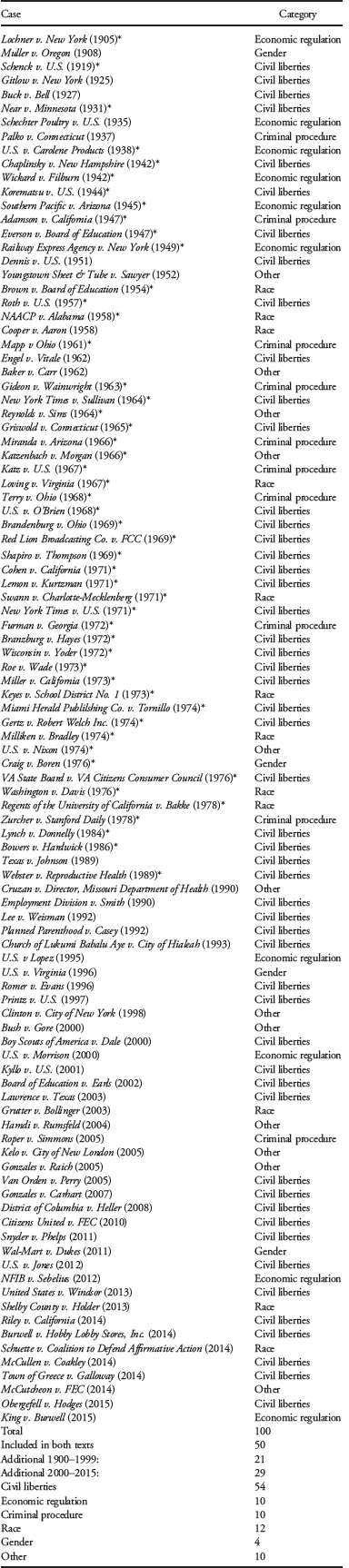
One empirical approach to these questions is to conduct a full examination of a set of landmark cases. While there is no universally accepted list of landmarks, two possibly authoritative sources are Donald Lively’s Landmark Supreme Court Cases: A Reference Guide (Reference Lively1999) and Hartman, Mersky, and Tate’s Landmark Supreme Court Cases (Reference Hartman, Mersky and Tate2004). If we accept inclusion in both texts as a standard for landmark status, this yields 50 such cases during the 20th century. This list has the advantages of being grounded in an external standard rather than relying on our own judgment and also representing a broad spectrum of constitutional controversies (25 civil liberties, eight criminal procedure, eight race, five economic regulation, and four others). However, it may strike some constitutional scholars as too narrow because of its neglect of several noteworthy cases as well as the many important cases decided since the books’ publication in 1999 and 2004. If we pose the question of whether there are missing cases that are of such significance that any list of landmarks would be suspect without them (as we did to several constitutional scholars), a small set of decisions stand out, including the Sick Chicken and Steel Seizure cases, Muller, Gitlow, Palko, and Dennis, as well as Cooper v. Aaron, Engel v. Vitale, Baker v. Carr, and Texas v. Johnson. From the 1990s, significant cases seem to include Cruzan, Casey, Employment Division v. Smith, Lee v. Weisman, Church of Lukumi, U.S. v. Virginia, Lopez, Romer, and Printz. In total, at least 20 additional cases from the 20th century beyond those suggested by Lively and Hartman et al. seem to warrant inclusion. For the more recent cases after the turn of the century, we collected 29 that seem to demand inclusion, from Bush v. Gore in 2000 to Obergefell v. Hodges in 2015. One could argue about including or excluding individual cases, but a line has to be drawn at some point, and this collection of 100 cases represents the heart of constitutional controversy since 1900.Footnote 8 For the full list of the landmark cases included in the study, see appendix table A1.
For each of the 100 cases, both researchers independently coded the decision for any social fact ruling, limiting the identification of social facts to those that are
-
1. broad statements of reality defining a class of persons, things, or circumstances beyond the specific facts of the case at hand;
-
2. disputed, including only nonobvious statements instead of the infinite number of accepted facts that underlie any ruling (in Roe, the claimant is female, the gestation period before birth is 9 months, etc.); and
-
3. influential on the outcome of the decision (i.e., the social fact is not merely an obiter dictum or a superfluous statement of the Court that would not alter the decision).
To clarify these standards further, we discussed above the distinction between adjudicative (case-specific) and legislative (general) facts. Social facts are only of the second kind, characterizing events or circumstances well beyond the case at hand. That a specific high school conducted a certain type of prayer at a graduation ceremony is a case-specific fact, but whether schools in general create a conformist environment that exerts psychological coercion is a social fact. Whether a 17-year-old defendant acted in a premeditated and violent fashion is a case-specific fact; whether adolescents are essentially the same as or distinctly different from adults in their ability to consider consequences or control their impulses is a social fact. Several noteworthy Supreme Court decisions may seem to revolve around disputed facts rather than constitutional principles but are too specific to the case at hand to have broader social significance. One example is Bush v. Gore in 2000, which clearly deals with disputed facts about the nature of the counts and recounts that took place in Florida. But these events were quite specific rather than the broad facts to which we are limiting the inquiry. While this standard excludes some possible rulings of social fact—which may exist in some cases if one squints enough—we follow the more restricted definition in order to not exaggerate the findings.
Another key to identifying a ruling is that the social fact is disputed, not necessarily on the Court (because some rulings are unanimous, as in Brown), but at least disputed in society at large. In this sense we are discussing nonobvious fact rulings. For example, the factual rulings in Wisconsin v. Yoder are quite different from the ones in Branzburg v. Hayes, both announced by the same Court in 1972. Yoder—which deals with the right of Amish parents to keep their children out of state-mandated schooling past the eighth grade—rules as a factual matter that exposure to public schools would influence children within a specific religious order away from that faith. This is a factual (causal) statement, but it is not counted in this study as a meaningful social fact ruling because it is not disputed, by the justices or by any other identifiable group in society. On the other hand, Branzburg—which deals with the right of newspaper reporters to be shielded from grand jury questioning regarding their sources—rules that requiring this testimony will not impede the collection of news by causing sources to be more reticent in offering anonymous information. This factual understanding was highly disputed, by four justices and many leaders of the journalistic profession. Hence it is a disputed and meaningful ruling of social fact.
The third question is whether the decision is dependent on the social fact. A fact ruling could fulfill the first two standards of being both broad and disputed but nonetheless not be significant enough to have changed the outcome of the case. But if the decision—grounded in its own reasoning—would have been compelled to go the other direction if the social fact had not been ruled as it was, then the fact is influential. This third requirement distinguishes social fact rulings from the occasional obiter dicta that justices issue even though they are not significant to the outcome. These three standards led to a relatively conservative approach to identifying rulings of social fact, leaving out several cases that might at first glance seem to include them.
A final point that also limits our findings is that judicial judgments of whether a fact pattern is above or below a constitutional standard are not social fact rulings. Because the Court is often applying a broad principle to a factual pattern, it is important to distinguish between normal judicial judgment and a ruling of social fact. It is only the prior judgment about the social fact itself that concerns us. Many judicial judgments conclude that factual condition X (which may be a broad social fact that applies to many circumstances or the specific case facts that apply only to the particular controversy) is above or below constitutional standard Y. Examples abound in Commerce Clause rulings, which often determine if whatever facts the Court recognizes “substantially affect” interstate commerce. This is not a question of social fact, but of how facts compare to the standard. For example, the landmark ruling in Lopez identifying a limit of congressional power under the Commerce Clause may at first seem to be grounded in a social fact: that economic activity does not encompass possessing a gun or pursuing an education. However, the definition of “commerce” or “economic activity” is not something that most citizens would wonder about or dispute, but is instead a concern of constitutional doctrine alone. A simple ruling of whether a reality is above or below a constitutional standard is not a social fact ruling, but instead a normal judicial judgment, especially when it relates to a subjective standard such as “substantially affecting” or “creating an undue burden.” In this way we have limited our categorization of social fact rulings to those that are broad, disputed, and influential, while also excluding judicial judgments that compare prevailing facts with constitutional standards. This creates a clear and limited collection of what we categorize as social fact rulings.Footnote 9 For the full description of all social fact rulings, see the Social Facts Database.Footnote 10
Once the rulings are identified, the second question is how the Court justifies its rulings on social facts. In Roe v. Wade, Harry Blackmun asserts that “an honest judge on the bench would call things by their proper names.” However, determining the proper name for a disputed social category is often no simple task. If the justices were open and honest about their role in determining social facts, how would they justify their decisions? While the Court has refrained from enunciating a clear doctrine of judging social facts, several decisions have offered possible standards. Muller in 1908 offered the justification that “when a question of fact is debated and debatable, and the extent to which a special constitutional limitation goes is affected by the truth in respect to that fact, a widespread and long-continued belief concerning it is worthy of consideration. We take judicial cognizance of all matters of general knowledge” (208 U.S. 420; italics added). The Casey decision in 1992 also provides an explicit discussion of the question of social facts but fails to provide a clear theory of their elucidation. The question at issue in Casey was not merely the constitutionality of the abortion regulations put in place by the state of Pennsylvania, but whether the core holding of Roe would be revised.Footnote 11 The plurality ruling written by Justice O’Connor states that “no change in Roe’s factual underpinning has left its central holding obsolete” (505 U.S. 835). O’Connor argues that one of the only grounds for abandoning precedent is that “facts have so changed, or come to be seen so differently, as to have robbed the old rule of significant application or justification” (855). According to the plurality in Casey, these precedents have been overturned “on the basis of facts, or an understanding of facts, changed from those which furnished the claimed justifications for the earlier constitutional resolutions. The overruling decisions were comprehensible to the Nation, and defensible, as the Court’s responses to changed circumstances” (836). Justice O’Connor is clear that “the Court’s Justices are sometimes able to perceive significant facts … that eluded their predecessors and that justify departures from existing decisions,” but does not explain the method by which the Court should determine its new perceptions (866).Footnote 12
Muller in 1908 endorses the traditional norms of society as the best means of understanding social facts; Casey in 1992 recognizes the evolution of social facts away from traditional understandings but does not offer much guidance as to how the justices should judge among disputed facts. This leaves us with the question of a consistent judicial means of determining social facts. Without taking a position on which is most compelling, the study identifies the distinct approaches that the Court has invoked. While it is not possible to settle here which approach is the most appropriate, it is nonetheless useful to see the range of potential methods and how often the Court has employed them.
Empirical Results I: The Prevalence of Social Fact Rulings
The results of the study indicate that social fact rulings played a substantial role in the landmark cases from 1900 to 2015. In 59 out of the 100 cases, the Court relied on at least one ruling on a disputed social fact. There is no substantial difference between the full list of cases and the smaller objective list (64% relied on social fact rulings in the objective list of 50, compared to 59% for the full list of 100).
The social facts addressed by the Court vary across a broad spectrum, including the nature of the industrial economy in Wickard v. Filburn and the circumstances of race relations from Brown to Shelby County. The Court addressed, among other things, the nature of insults, internment camps, the Catholic Church, the Communist Party, women, marriage, fetuses, minors, drug abuse, marijuana, and sexual orientation. Table 1 illustrates the frequency of social fact rulings in different areas of law, comparing civil liberties, economic regulation, criminal procedure, race, and gender. Civil liberties cases form the bulk of the landmark decisions (54 out of 100), and their rate of social fact rulings mirrors the overall rate (63%). The lowest rate is found in cases focusing on economic regulation (40%), while the highest categories are race (67%) and gender (100%). Gender cases rely strenuously on the recognition of evolving social facts, varying from the dependent status of women in Muller (1908) to their fully independent status, free of “overbroad generalizations about the different talents, capacities, or preferences of males and females” in U.S. v. Virginia (1996).
Social Fact Rulings in Landmark Cases, 1900–2015

Some of the most noteworthy social fact rulings are found in recent cases. Obergefell in 2015 explicitly rules that sexual orientation is innate, overruling the 1986 Bowers position that homosexuality is a controllable action rather than an unchosen state of being.Footnote 13 Citizens United in 2010 rules that corporations are persons for the purposes of certain First Amendment rights.Footnote 14 The Court also addressed the nature of corporations in the 2014 Hobby Lobby decision, ruling that corporations can have a religious character.Footnote 15 The 2013 Shelby County decision addressed the prevailing circumstances of racial discrimination in the southern states, ruling that there are no longer substantial impediments to minority voting.Footnote 16 The question of whether minors are substantially similar to or distinct from adults was decided in Roper in 2005: “as any parent knows and as the scientific and sociological studies respondent and his amici cite tend to confirm, a lack of maturity and an underdeveloped sense of responsibility are found in youth more often than in adults” (543 U.S. 569). This social fact led Kennedy to the conclusion that “the differences between juvenile and adult offenders are too marked and well understood to risk allowing a youthful person to receive the death penalty” (573).
Two other recent cases highlight questions about the nature of the Court’s social fact rulings: Gonzales v. Raich (2005) and Gonzales v. Carhart (2007). The first Gonzales dealt with the nature of marijuana: the Court ruled that it was a dangerous drug with no acceptable medical uses, deferring to the regulations established by Congress.Footnote 17 Given the fast pace of change regarding American public opinion on marijuana use and the movement toward legalization in several states (Eidinger Reference Eidinger2015), this is a notable assertion. The decision does, however, clarify how this social fact ruling may change in the future: “We acknowledge that evidence proffered by respondents in this case regarding the effective medical uses for marijuana, if found credible after trial, would cast serious doubt on the accuracy of the findings that require marijuana to be listed in Schedule I” (fn. 37). In the absence of such evidence, the Court defers to the congressional power to make the determination.
Gonzales v. Carhart in 2007 includes a noteworthy exchange between Anthony Kennedy and Ruth Bader Ginsburg about the factual question of whether women come to regret the decision to have an abortion. Kennedy asserts that, “While we find no reliable data to measure the phenomenon, it seems unexceptionable to conclude some women come to regret their choice to abort the infant life they once created and sustained. … Severe depression and loss of esteem can follow” (Kennedy slip opinion 29). The first part of the quote is remarkable for its recognition of a social fact ruling in the absence of empirical evidence. Ginsburg counters in dissent that “the Court invokes an antiabortion shibboleth for which it concededly has no reliable evidence: Women who have abortions come to regret their choices, and consequently suffer from ‘severe depression and loss of esteem.’… This way of thinking reflects ancient notions about women’s place in the family and under the Constitution—ideas that have long since been discredited” (Ginsburg 15, 18). Ginsburg follows with a page-long footnote citing several scholarly studies arguing that no such effect exists (fn. 7). As much as this exchange is about prevailing facts in the United States, it is also about how the Court should determine such social facts. This brings us to our second set of questions on the frequency and nature of the justifications offered by the Court.
Empirical Results II: The Justifications of Social Fact Rulings
With the prevalence of social fact rulings in mind, our next questions are about the justifications the Court has offered for its assertions. How often have the justices invoked an explicit standard for social fact rulings versus merely asserting them as obvious constructs that require no justification? And what justifications have been offered when the Court has done so?
Most of the time the Court has enunciated social facts without offering evidence or justification. Only a third of the decisions that include social fact rulings (19 out of 59) have offered an explicit rationale. Social facts rulings are common and their justifications few.
In the minority of rulings for which the Court does provide an explanation, we have identified seven distinct justifications that the Court has offered. One standard is relying on expert judgment. This approach raises questions about which experts are the most appropriate and how their conclusions should be weighed when experts disagree, but it is a step toward removing rulings from solely judicial discretion.Footnote 18
A second approach is determining the current norms of society. This differs from the previous standard in that the justices are not seeking expert interpretations, but contemporary social norms as the justices understand them. Those norms could be the ones held by mainstream society or those of the educated and more influential sector of society—the distinction between what public opinion scholars call mass opinion and elite opinion (and perhaps what Casey means when it refers to “the thoughtful part of the Nation”). In following this approach, justices might employ evidence such as public opinion polls or instead invoke their own observation of current social conditions. In this spirit, Justice Hughes argues in West Coast Hotel in 1937 that “it is unnecessary to cite official statistics to establish what is common knowledge throughout the length and breadth of the land” (300 U.S. 399).
The five other approaches focus on deference to other decision makers. Congress is perhaps the most obvious decision-making body that the Court could follow. Another is a state legislature. In a set of nonlandmark cases (Block v. Hirsh in 1921 and Chastleton Corporation v. Sinclair in 1924), Justice Oliver Wendell Holmes states a clear dual standard for the degree to which the Court should follow the factual pronouncements of state legislatures: “a declaration by a legislature concerning public conditions that, by necessity and duty, it must know, is entitled at least to great respect” (256 U.S. 154); but “a Court is not at liberty to shut its eyes to an obvious mistake when the validity of the law depends on the truth of what is declared” (264 U.S. 547). In other words, the Court should give respect to a state legislature’s finding of social fact, but not to the degree that the justices ignore blatant errors.
Another political body to which the Court could defer is the local jury. Juries are specifically charged to find facts and may be in a viable position to do so. However, deference to either a state legislature or a local jury requires a prior judgment about the boundaries of federalism, because it raises the contentious question of whether social facts can vary in different parts of the country or whether we must maintain one national standard for a given social fact.
A sixth approach is to invoke deference to a lower court, as the Supreme Court did in Dennis v. U.S. In this decision, the majority asserted that the district court’s finding on the nature of the Communist Party was authoritative, though it is unclear when this standard would apply and when the Court should exert its own judgment. The final approach to justifying social facts is deference to the executive branch, allowing the authority and expertise of the president and his officers to decide controversial questions of fact.
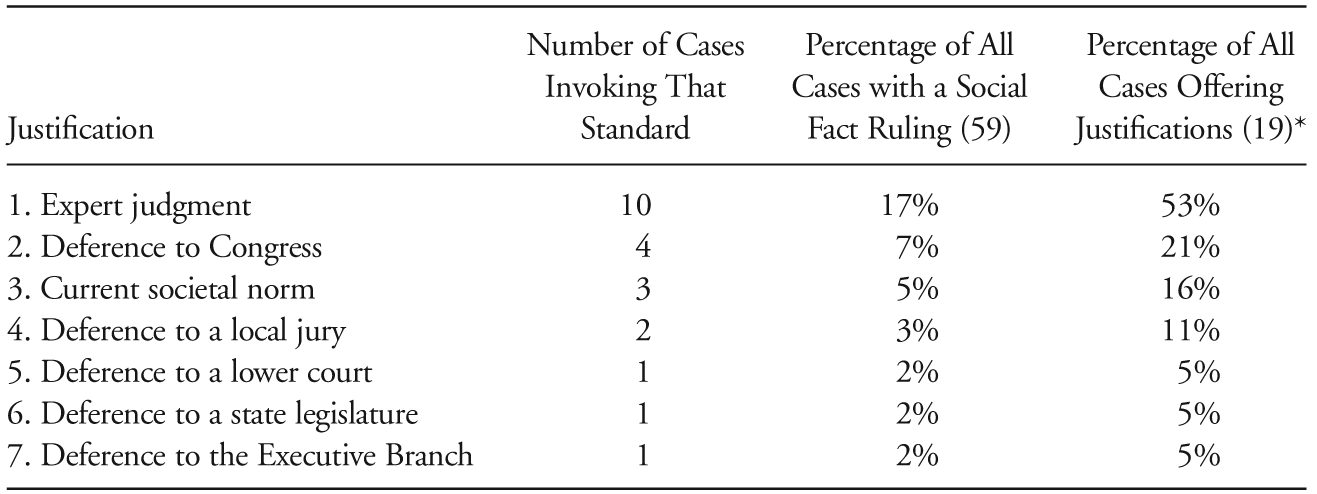
This list of seven standards—expert judgment, current societal norms, deference to Congress, a state legislature, local juries, a lower court, or the executive branch—is exhaustive of the explicit justifications offered by the Court in the cases under examination. Table 2 illustrates the frequency of the forms of justification the Court has employed. When a justification was expressed, the Court cited expert opinion more than any other approach (53% of social fact justifications). The experts range from psychologists in Brown, to doctors in Roe and Casey, to government statistics in Board of Education v. Earls. Perhaps the most well-known invocation of expert opinion is the famous footnote in Brown, in which for the first time the Court cited scholarly sources as a clear foundation for social reality.Footnote 19 Expert judgment was invoked 10 times in the landmark cases from 1900 to 2015, making it the most common form of explicit justification. However, this justification has been criticized as well as embraced; the Court explicitly rejected the expert statistical evidence offered in Craig v. Boren in 1976, substituting instead its own judgment about whether there is a meaningful difference between genders.Footnote 20
Social Fact Justifications in Landmark Cases
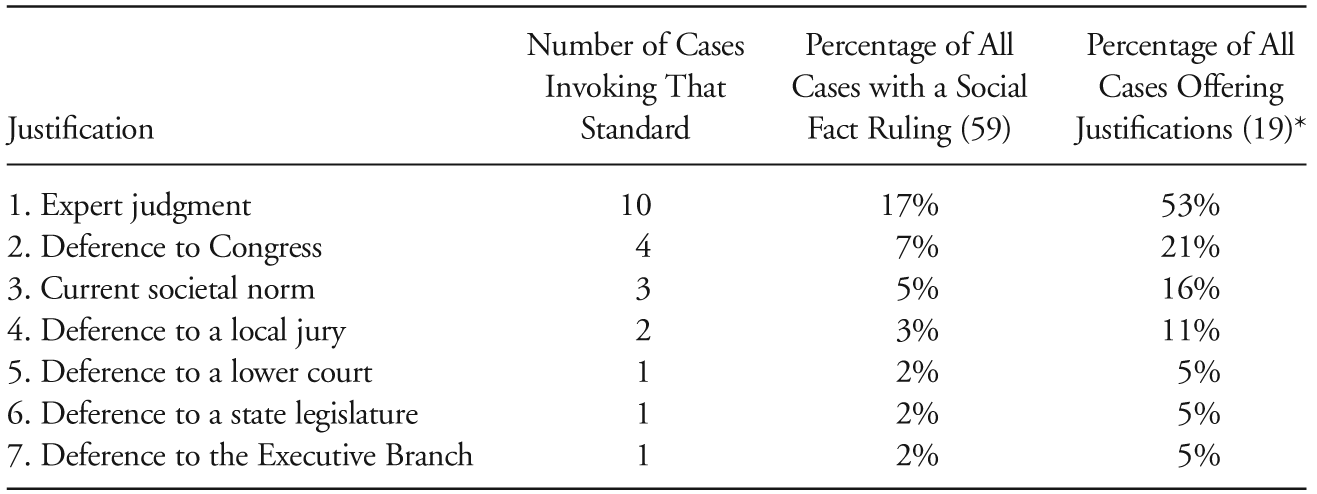
Note.—Of all landmark cases ruling on a social fact, 32% offer an explicit justification (19 out of 59). Because some cases offer more than one justification, there are a total of 22 justifications in the 19 cases that provide them. These cases and their form of justification (in chronological order) are Muller (1 and 3), Buck (6), Carolene Products (1 and 2), Chaplinsky (3), Korematsu (7), Dennis (5), Brown (1), Roth (4), Miranda (1), Roe (1 and 3), Miller (4), Weisman (1), Casey (1), Morrison (2), Earls (1), Roper (1), Raich (2), Carhart (2), and Obergefell (1).
*. Adds up to greater than 100% because some cases offer more than one justification.
The next most frequent justification is deference to Congress, allowing the national legislature to make the factual determination in Carolene Products, U.S. v. Morrison, Gonzales v. Raich, and Gonzales v. Carhart. In Carolene Products the Court refused to override the congressional assessment “as long as it rests upon some rational basis within the knowledge and experience of the legislators” (304 U.S. 152). Only once did the Court explicitly defer to the judgment of a state legislature, in Buck v. Bell in 1927.Footnote 21
The next most frequent justification is an endorsement of a current societal norm, employed in 15% of the cases that offered justifications. For example, the Court recognized a “widespread and long-continued belief” standard in Muller and a “common man” standard in Chaplinsky, both possible operationalizations of the attempt to mirror social facts as understood by contemporary Americans.
The standard of deferring to a local jury was offered only in two cases dealing with obscenity. The rules created in Roth in 1957 and Miller in 1973 revolve around the contemporary community standard as understood by the average person. The method of determining this standard is not the judgment of the state legislature, but that of the local jury members, who are tasked with this duty grounded in their knowledge of the community. Hence obscenity standards in New York can be quite different from those in New Mexico. This is an explicitly deferential method of determining social facts, discounting both a national standard and judicial judgment.
The final deference standards—either to a lower court or to the executive branch—were also infrequent. The Court deferred to executive judgment in Korematsu and to a lower court in Dennis, but when the Court will choose to be deferential is unclear. As Faigman notes, “the Supreme Court has no overriding theory of when it should be deferential to other bodies—judicial and nonjudicial—that have made findings of constitutional fact” (Reference Faigman2008, 114). The seven standards that were employed—expert judgment, contemporary social norms, deference to Congress, to a state legislature, to a local jury, to a lower court, or to the executive branch—appear only rarely and haphazardly.
Empirical Results III: Social Facts on the Left and Right of the Court
Our final question is the role of social facts in the ideological divisions on the contemporary Court. Kahn has argued that one division between originalists and nonoriginalists is “the legitimacy of a robust SCP [social construction process],” or whether the Court should be “engaging in a detailed, disciplined, and at times robust SCP” (Reference Kahn, Kahn and Kersch2006, 68). Kahn argues that conservatives on the Court resist engaging in the recognition of evolving social facts, which they see as an illegitimate enterprise, while the more liberal justices are more likely to embrace this role. We take this as a starting point of our examination of the role of ideology in the social fact rulings of the Court.
In order to examine the systematic differences between liberal and conservative decisions, we divided the landmark rulings according to the ideological categories assigned by the Supreme Court Database developed by Harold Spaeth et al. (Reference Spaeth, Epstein, Martin, Segal, Ruger and Benesh2015). The database assigns an overall assessment of the liberal or conservative nature of each decision, arriving at a total of 50% liberal outcomes, 48% conservative outcomes, and 2% unspecifiable among the 8,600 cases they include. Reference to this database is the most legitimate and unbiased means for our purposes of dividing the landmark decisions by ideology. Of our 100 cases, 53 are liberal rulings and 45 conservative rulings (with two unspecifiable).Footnote 22 This allows us to address the final question of whether liberal and conservative rulings differ in their use and justification of social facts.
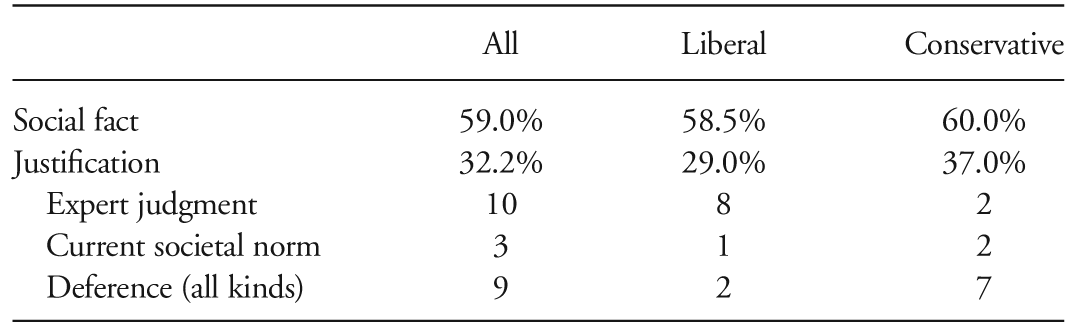
Contrary to our expectations, liberal and conservative decisions did not differ in their rate of social fact rulings. While all cases under consideration had a 59.0% rate of social fact rulings, liberal decisions displayed a 58.5% rate (31 out of 53) and conservative decisions 60.0% (27 out of 45; see table 3). It seems that conservative justices employ social facts to the same degree as liberal justices. When we consider the prominent rulings of social fact, it is clear that many are in a conservative direction: Muller and Buck v. Bell in the early 20th century, Bowers on the nature of homosexuality, Boy Scouts v. Dale on religious organizations, Hobby Lobby and Citizens United on the nature of corporations, Wal-Mart v. Dukes on the nature of gender differences, and Shelby County on contemporary race relations. Noteworthy conservative social facts play a role as frequently as noteworthy liberal social facts.
Social Fact Rulings, by Ideology
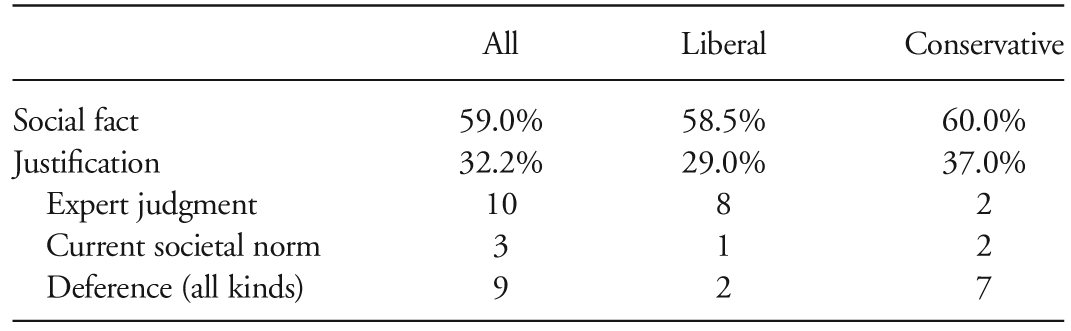
But what about the frequency of justifications? If liberal decisions do not contain social fact rulings more often, do they contain justifications more often? Again, there is no discernible difference between the two ideological camps. The overall rate of justification is approximately one-third (32.2%) of rulings that offer social facts. The rate for liberal decisions is 29.0% (nine out of 31) and for conservative decisions 37.0% (10 out of 27), suggesting only minor fluctuations between the two groups.
There is, however, a sense in which liberal and conservative decisions differ considerably in regard to social facts. It is neither the frequency of rulings nor the frequency of justifications, but instead the type of justification. Of the 10 invocations of expert opinion, eight are in liberal decisions; and of the 10 invocations of deference to other democratic institutions, seven are in conservative decisions. Looked at from the other direction, of the 11 justifications offered in liberal decisions, eight are expert judgment (73%), while the conservative decisions invoke experts only 18% of the time. Of the 11 justifications offered in conservative decisions, seven are a form of deference (64%), while liberal decisions invoke deference only 18% of the time. Clearly the Left prefers expert judgment, while the Right prefers deference to other democratic institutions.
The conservative lean toward deference may be related to a preference for majoritarian decision making over judicial judgment. A majoritarian approach argues that the role of the Court is to defer whenever possible to representative institutions. In this view, if there is a judgment of social fact to be made, our legislative bodies or juries are the institutions best equipped to do this in the name of the people they represent. In this sense, the social facts of society can be known through the democratic political process, which justices can recognize rather than rely on their own judgment. A majoritarian approach raises the question of whether it eviscerates the role of the Court as a countermajoritarian body able to overrule legislative judgments. It also raises questions about whether the Court should recognize a national standard or allow regional premises within a federal system. The right’s greater regard for federalism accords with a state-by-state majoritarian approach. Conservative justices such as Thomas and Scalia clearly argue for a more restrictive and deferential role for the Court, allowing majoritarian democratic institutions to decide many controversial questions (see, e.g., the dissents by Thomas and Scalia in Obergefell).
It is also noteworthy that the only example of deference to the executive branch is in a highly conservative decision. Korematsu explicitly invokes deference to executive judgment under two explicit conditions: a state of war and a dual-branch concurrence between the president and Congress. The question remains whether deference would be appropriate if the president acted alone or if war powers did not attach.Footnote 23
Liberal justices, on the other hand, are less impressed with the probity of legislatures, juries, or the executive branch and are more likely to invoke the authority of experts in establishing a single national standard. When addressing the circumstances of inequality or oppression, the facts matter and expert judgments of those facts take on tremendous significance. This was the case in landmark decisions invoking the effects of segregation, the procedures followed by police, the nature of coercion in schools or abuse by spouses, and the differences between adults and minors or the lack of differences between heterosexual and homosexual couples. For each of these decisions, expert opinion on the relevant social fact was at the heart of the ruling. Even though social fact rulings are justified only a third of the time, the infrequent justifications that have been offered provide insight into how proponents of the major schools of constitutional interpretation on the Left and Right of the Court understand the appropriate grounds for recognizing social facts, accounting for some of the divisions on the contemporary Court.
Conclusion
Social facts play a major role in constitutional decision making, but the Court has not developed a consistent means of recognizing or justifying these rulings. Almost two-thirds of the landmark cases of the 20th century rely on social fact rulings, but only one-third of these offer explicit justifications. Most of the time the justices do not admit the centrality of social fact rulings nor the reliance on their own judgment in enunciating what are presented as obvious or natural observations. When they do offer a justification, the most frequent is the judgment of experts, followed by the majoritarian views of legislatures. One of the most striking findings of the study is the ideological division over these justifications: liberal justices prefer expert judgment while conservative justices prefer deference to other democratic bodies, even as they both rule on social facts at equivalent rates. But no consistent standard or doctrine has emerged for this crucial aspect of the Court’s work. Nonetheless, the Court remains one of our most important arbiters of social reality. The prevalence and importance of the Court’s rulings on social facts are clear, even while the justifications they employ to determine them are not.
Landmark Cases, 1900–2015
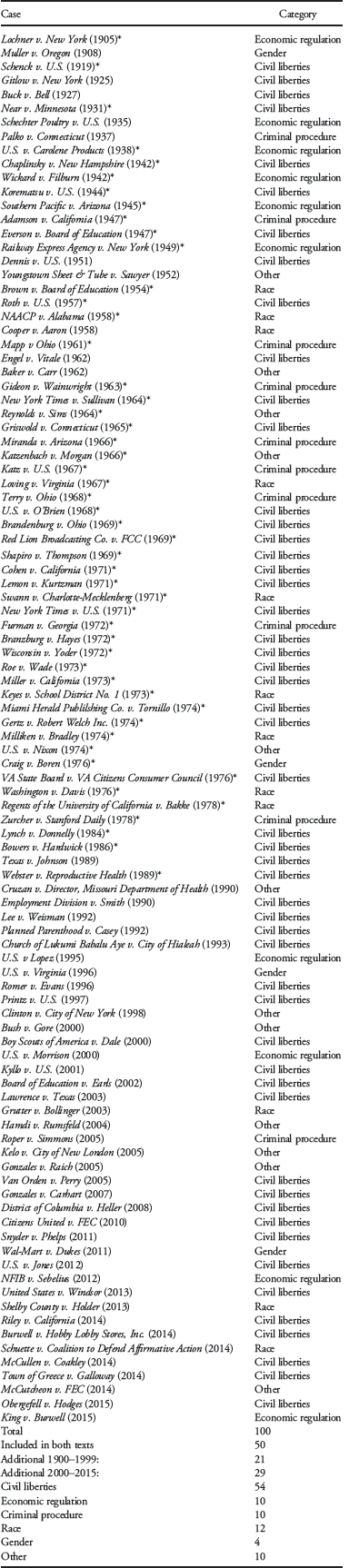
*. Included in both Lively (Reference Lively1999) and Hartman et al. (Reference Hartman, Mersky and Tate2004).