

Trusting societies are better able to solve dilemmas of collective action (Sønderskov, Reference Sønderskov2011), experience more economic growth (Knack and Keefer, Reference Knack and Keefer1997) and have more capable institutions (Putnam, Reference Putnam1993). While the literature on trust has identified important national and regional differences in trust (Beugelsdijk and Van Schaik, Reference Beugelsdijk and Van Schaik2005) and examined its many different sources (Hooghe and Stolle, Reference Hooghe and Stolle2003; Nannestad, Reference Nannestad2008), some puzzles remain unsolved, especially in the Canadian context. Notably, even with a broad literature on interprovincial/regional differences (see for example, Simeon and Elkins, Reference Simeon and Elkins1980; Helliwell, Reference Helliwell1996; Wiseman, Reference Wiseman2011; McGrane and Berdahl, Reference McGrane and Berdahl2013), there is little known about why some regions seem to be consistently less trusting.
In this article, we return to a debate that received attention in the Canadian media when the perceived poor management of a winter storm by Quebec municipal and provincial authorities led a pundit to blame low levels of trust and social capital in the province (Bélair-Cirino, Reference Bélair-Cirino2017; Montreal Gazette, 2017). While previous work has established that Quebec has overall lower levels of generalized trust, it has not provided strong explanations for this difference. This article pushes that area of inquiry forward and makes several contributions to a better understanding of regional trust differences. First, we test the robustness of the trust differentials between Quebec and other provinces in a large high-quality dataset (three waves of Statistic Canada's General Social Survey). Second, we examine a set of identities that the literature suggests might account for the Quebec difference, notably the religious and ethno-linguistic aspects of Québécois ethnicity. Third, we probe the temporal nature of the trust differential to understand whether it holds across the youngest cohorts of Quebecers and those in the rest of Canada.Footnote 1 Fourth, we add a new dimension of analysis that focuses on the effects of bilingual capability and linguistic context on generalized trust. In sum, this article examines how ethnicity, religion and living in Quebec interact to shape generalized trust and brings new hypotheses into the study of regional trust differences within Canada and beyond.
Generalized Trust Revisited
The revival of the concept of social capital in political science has been associated with a commensurate increase of investigation into generalized trust. Robert Putnam, in particular, has directed our attention to what he calls the three aspects of social capital: norms of reciprocity, generalized trust and civic engagement, and most follow-up research has highlighted the centrality of generalized trust (see, among others, Fukuyama, Reference Fukuyama1995; Paldam, Reference Paldam2000; Delhey and Newton, Reference Delhey and Newton2003). Generalized trust is a kind of trust that extends beyond one's in-group to include out-groups and that reflects a general perception that “most people” belong to one's moral community (Uslaner, Reference Uslaner2002: 241). This trusting perspective serves as a lubricant for well-functioning societies, with numerous social and economic benefits associated with societies that have been able to build broad, mutually trusting moral communities (Knack and Keefer, Reference Knack and Keefer1997; Sønderskov, Reference Sønderskov2011; Uslaner, Reference Uslaner2018).
Large differences in generalized trust have been detected across groups and especially across regional boundaries. In earlier accounts of social capital theory, such patterned differences were largely seen as endemic or path-dependent (Putnam, Reference Putnam1993: chap. 5), with a history going back to the Middle Ages. Such a view is often seen as unsatisfactory, and a new research agenda has arisen to explain better how and why modern regions differ in social trust. This research agenda has primarily aggregated individual attitudes into overall levels of trust at some abstracted geographic level, such as subnational territory. A variety of factors have been scrutinized; we distinguish here mainly between compositional and contextual ones.
Compositional factors attribute differences in generalized trust across regions to the differences in the composition of their population; they apply more specifically when geographically based populations consist of different linguistic, ethnic or socio-economic groups with different experiences. For example, racial and ethnic minority groups are often less trusting because they have collectively and historically (as well as contemporaneously) experienced discrimination or subjugation (Douds and Wu, Reference Douds and Wu2018; Fan, Reference Fan2019). Such experiences can be transported across generations. Socio-economic resources also matter, with low socio-economic status consistently related to lower levels of trust (Uslaner, Reference Uslaner2002; Delhey and Newton, Reference Delhey and Newton2003, Reference Delhey and Newton2005). A compositional exploration of regional trust differences takes those individual-level factors into account.
This is contrasted with contextual explanations, which have also become important explanatory factors over the last decade, both inspired by and responding to Putnam's (Reference Putnam2007) argument that regional ethnic diversity leads to lower trust and lower civic engagement. Meta-studies of this broad literature have confirmed that neighbourhood, census tract or other regional-level (ethnic) diversity is somewhat negatively associated with trust in Western societies (Kaufmann and Goodwin, Reference Kaufmann and Goodwin2018; Dinesen et al., Reference Dinesen, Schaeffer and Mannemar Sønderskov2020). One part of the explanation could be that the exposure to out-groups without intergroup contact increases threat perceptions, which potentially increases distrust. However, diversity is not related to distrust in all contexts or at all times (Stolle et al., Reference Stolle, Soroka and Johnston2008; Helbling et al., Reference Helbling, Reeskens and Stolle2015; Tolsma and van der Meer, Reference Tolsma and van der Meer2018). Other contextual experiences that appear to matter for trust are poverty and disorder (Abascal and Baldassarri, Reference Abascal and Baldassarri2015), intergroup segregation (Uslaner, Reference Uslaner2002) and quality of institutions (Nannestad, Reference Nannestad2008).
These compositional effects have also been found in Canada. Researchers who have measured the ethnic diversity of census tracts or neighbourhoods in Canada have found lower levels of generalized trust there compared to more homogenous places (Soroka et al., Reference Soroka, Banting, Johnston, Bardhan, Bowles and Wallerstein2006). However, these results do not seem to hold at a higher scope of analysis. At the provincial level in Canada, diversity is not related to lower trust, and thus Johnston and Soroka (Reference Johnston, Soroka, Dekker and M2001: 40) conclude that “diversity is not obviously the enemy of social capital.” Similarly, at the municipal level, Canadian cities stand out as being simultaneously diverse and trusting places (Kazemipur, Reference Kazemipur2006), with the possible explanation that Canadian cities have high levels of informal interactions between different groups (Aizlewood and Pendakur, Reference Aizlewood, Pendakur, Kay and Johnston2007). Overall, Canada is characterized by high levels of immigration coupled with deeply rooted cultural and linguistic cleavages, which do not seem to be inhospitable conditions for generalized trust to flourish, as trust levels in Canada have been found to be relatively high; the majority of Canadians agree that “most people” can indeed be trusted.Footnote 2 Only when ethno-racial diversity is measured very locally has it been shown to be negatively correlated with trust (Stolle and Harell, Reference Stolle and Harell2013). Thus, it seems that Canada is an example where ethno-racial diversity and trust can co-exist.
Whether attributable to compositional, contextual or other factors, a steady trust gap in generalized trust between regions has been apparent across studies that looked at Canada; in fact, all point to lower levels of generalized trust in Quebec (Helliwell, Reference Helliwell1996; Kazemipur, Reference Kazemipur2006; Soroka et al., Reference Soroka, Banting, Johnston, Bardhan, Bowles and Wallerstein2006; Wu, Reference Wu2021). Breton et al. (Reference Breton, Hartmann, Lennards and Reed2004) find a similar pattern for trust in family, friends and colleagues,Footnote 3 with significantly lower levels in Quebec. Is there indeed a difference in the social fabric of Quebec in comparison to the rest of Canada? Multiple scholars have addressed the idea of a distinct political culture in Quebec: a culture in which nationalism—ranging from ethnic to purely civic nationalism—along with identity play an unmatched role (Breton, Reference Breton1988; Gagnon and Maclure, Reference Gagnon and Maclure2001) and one that is generally contrasted with the rest of Canada (Wiseman, Reference Wiseman2011; McGrane and Berdahl, Reference McGrane and Berdahl2013). Taking the previous research on the importance of composition and context into account, there is a need to better understand how being raised in and living in Quebec shapes generalized trust and perceptions of other people.
Explaining the Quebec Generalized Trust Differential
Research so far has highlighted several important factors that may be the source of the trust differential both within Quebec and between Quebec and the rest of Canada. Most of the findings point toward the religious and ethnic composition of Quebec and the historical experiences that come with them. Quebec society is one where those of French-Canadian origin make up a majority, yet this group is an ethnic, linguistic and religious minority within Canada and North America. Quebecers of French-Canadian origin, while now generally considered to be members of the racialized majority group in their province, were subjected to historical ethnically based discrimination in the Canadian context and suffered a history marked by colonization, conquest and life under British rule until the mid to late twentieth century (Lalonde, Reference Lalonde1974; Breton, Reference Breton1988). These collective experiences are likely connected to the general phenomenon of distrust, as seen when other racial and ethnic minorities are targeted by historical and ongoing ethnically motivated discrimination (Patterson, Reference Patterson and Warren1999; Abascal and Baldassarri, Reference Abascal and Baldassarri2015). This historically discriminated against Québécois population is identified through language (French-speaking) and religion (Catholic).Footnote 4 We thus anticipate that these religious and linguistic group experiences and identities may explain part of the trust gap.
H1: The higher levels of distrust in Quebec, as compared to the rest of Canada, are partially explained by the composition of Quebec. Specifically, it is Québécois francophone Catholic Quebecers born in Quebec that are less trusting.
If the experience of being a francophone Catholic Quebecer is driving higher levels of distrust, then as the proximity and importance of history fades without further (or simply less) injustice, generational shifts should reduce the difference in trust between Quebec and the rest of Canada. There are strong reasons to suspect that these generational differences between Quebec and the rest of Canada decline; there have been significant shifts in attitudes since the 1960s, when Quebec society underwent a marked civil society reorganization following la Révolution tranquille (the Quiet Revolution) (Gauthier, Reference Gauthier1996; Turgeon, Reference Turgeon1999). The importance of religion in Quebecers’ lives drastically shrank with collective efforts to dissociate civil and political life from religion (for an analysis of these changes and the contemporary relationship of Quebecers toward religion, see Mager and Cantin, Reference Mager and Cantin2010). The generation made up of the “baby boomers” (those born during the population boom that lasted from 1945 until 1964) was the last to have experienced the period later coined la Grande Noirceur (the Great Darkness). This generation's formative years occurred during a period when anglophones were economically and linguistically dominant in Quebec, and they then later experienced firsthand the wave of socio-economic change associated with the Quiet Revolution (Guay, Reference Guay1997). In contrast, the generations that followed—Generation X and Millennials—were born after these social and institutional changes and were thus socialized in a drastically different context. Research has suggested that Quebec baby boomers differ behaviourally and attitudinally from those born after them; for instance, they exhibit higher levels of support for sovereignty (Martin, Reference Martin1995; Mahéo and Bélanger, Reference Mahéo and Bélanger2018), attach more importance to postmaterialist values than any other generation in Quebec and are significantly more interested by and knowledgeable about politics than younger generations (Piroth, Reference Piroth2004).
Considering these generational findings elsewhere, there is reason to suspect that trust differentials between Quebec and the rest of Canada may have decreased across generations. A convergence between Quebec and the rest of Canada has already been highlighted for another metric often associated with social capital: a sizable gap exists between Quebecers and those who reside in the rest of Canada in voluntary associations participation; however, this gap narrows and even disappears among most recent cohorts (Curtis et al., Reference Curtis, Baer, Grabb and Perks2003; Hwang et al., Reference Hwang, Andersen and Grabb2007).We simply do not know whether the trust differential is equally strong today compared to decades before and whether it applies equally to younger age cohorts.
However, we know from research in the United States that trust has steadily fallen across birth cohorts: that is, the younger cohorts are generally less trusting than the older cohorts at the same age (Robinson and Jackson, Reference Robinson and Jackson2001; Schwadel and Stout, Reference Schwadel and Stout2012; Clark and Eisenstein, Reference Clark and Eisenstein2013). The reasons for this general decline are not well researched, but we expect a similar decline in the Canadian and potentially also Quebec contexts (Stolle and Harell, Reference Stolle and Harell2013). These two societal developments—diminishing marginalization of francophone Quebecers and a general decline in social trust—represent two countervailing processes in Quebec society. As a result, will young Quebecers remain less trusting compared to their other Canadian counterparts, or will the trust differential fade away among younger birth cohorts? We hypothesize that diminishing marginalization will have reduced the gap between young Quebecers and non-Quebecers:
H2: The trust gap between Quebecers and non-Quebecers is diminishing with younger birth cohorts.
A third factor that has not received enough attention is language. Language is both an important marker of one's origin and culture and a key tool that allows individuals to interact and develop broader social ties. Those who speak more than one language can bridge gaps across different linguistic groups, which may help them to cross not only linguistic but also cultural divides. Such bridging networks are expected to produce higher levels of trust.Footnote 5 Conversely, the challenges that language barriers may present to the development of trust and intergroup contact have been tackled in a variety of fields (as one of many examples, see Tenzer et al., Reference Tenzer, Pudelko and Harzing2014). Knowing only one language in a general multilingual context might be isolating, fostering mostly homogeneous ties and low openness, and could indeed nurture distrust against outsiders who are not part of the linguistic in-group. Conversely, bilingual ability should create more cross-cutting networks and could function as a booster for generalized trust. While bilingualism has a real practical value in metropolitan diverse places with multilingual groups, it might still contribute to an openness toward out-groups when adopted in more homogeneous settings and dilute distrust toward out-groups (suggested in Tsai et al., Reference Tsai, Laczko and Bjørnskov2011). The causal role of bilingualism or multilingualism in fostering social trust in multicultural societies has yet to be studied deeply.
H3: Bilingualism relates to increased generalized trust through permitting communication between otherwise distinct groups.
In addition to these compositional or individual-level features, trust is also a product of context. Linguistic abilities and barriers are likely only relevant in bilingual/multilingual environments, and contextual linguistic homogeneity may prevent such interactions. This has not been tested in much detail; however, some empirical analyses show that measures of linguistic diversity may result in diminished social capital (Delhey and Newton, Reference Delhey and Newton2005; Wang and Steiner, Reference Wang and Steiner2015). Digging more deeply into neighbourhood-level diversity has also yielded mixed results. In Australia, Leigh (Reference Leigh2006) compares linguistic and ethnic diversity and finds that linguistic diversity is an even more important determinant of trust than ethnic fragmentation. The Canadian case has been studied primarily for contextual ethnic diversity, and we know much less about linguistic diversity. This lacuna is surprising, because geographical proximity and thus ability to communicate with each other across linguistic group divisions establishes a key condition for intergroup contact.
There are two competing theories that can be brought to bear to anticipate how linguistic diversity may impact trust. Like ethnic identity, language forms a primary element of social identity (Giles et al., Reference Giles, Taylor and Bourhis1977), and it is likely that linguistic diversity operates in a similar manner and ultimately threatens social identity and diminishes social trust to others. The historical threat against the francophone linguistic community may produce particularly acute impacts when linguistic out-group members are more visible and present (see White and Curtis, Reference White and Curtis1990). However, living close to others who speak a different language also has the potential to be beneficial to one's openness toward others, through opening opportunities for weak ties between linguistic out-group members to develop through daily encounters (for example, at shops, restaurants, bus stops, community centres or even workplaces). Empirical work seems to confirm the latter theories. For example, infants’ exposure to linguistic neighbourhood diversity (such as in parks, on bus rides, or visits to the grocery store) has been shown to influence their propensity to learn from linguistic out-group members (Howard et al., Reference Howard, Carrazza and Woodward2014). White and Curtis (Reference White and Curtis1990) find that local linguistic diversity was associated with more favourable attitudes towards linguistic out-groups, particularly for those who lived in other-language dominant regions (anglophones residing in Quebec and francophones residing in bilingual areas of English-speaking Canada).
Conversely, if such diverse linguistic context is lacking, we expect that unilingual groups become inward oriented. But how do these dynamics impact trust? While focusing on racial diversity, Hou and Wu (Reference Hou and Wu2009) found that linguistic diversity was not associated with higher trust in the Canadian context. Their measure of linguistic diversity, however, is based on how well represented the 20 largest linguistic groupings of Canada are in each census tract and does not tap into if these neighbourhoods are predominantly French- or English-speaking. Simply put, it misses the crux of the matter: Are francophones and anglophones in Canada living in contexts where their regular social contacts speak their language, and how does that affect their generalized trust? And are francophones more affected by such local linguistic barriers than anglophones? Overall, we anticipate that linguistic homogeneity is not conducive for generalized trust, particularly among linguistic minority populations.
H4: Linguistic homogeneity is associated with lower levels of generalized trust. Those residing in linguistically homogenous communities in Quebec will be particularly low trusting.
These hypotheses collectively posit that the generalized trust differential between Quebec and the rest of Canada is linked to both the composition of Quebec society (as evaluated through ethnicity, religion/history and language) and to local area features—specifically linguistic homogeneity.
Data and Methods
To test the hypotheses described above, we draw upon data from Statistics Canada. Specifically, we use the pooled results from three waves (2003, 2008, 2013) of the Canadian General Social Survey (GSS) linked with precise measures of neighbourhood-level linguistic measures drawn from the 2001, 2006 and 2011 Canadian censuses.Footnote 6 The GSS is a cross-sectional probability sample survey that includes a long battery of questions designed to “provide an overall picture of Canadians’ identification, attachment, belonging and pride in their social and cultural environment,” (Statistics Canada, Reference Statistics Canada2014) including detailed measures on social networks, civic participation and engagement, shared values, confidence in institutions, and trust. Collection of data is usually carried out via computer-assisted telephone interviews over a 6-to-12-month period, and respondents are selected through random digit dialling (which generates phone numbers based on in-use area codes).Footnote 7 The surveys are a random sample composed of Canadian residents aged 15 and over and living in private households spanning the 10 provinces. The regular sample is geographically stratified following province/census metropolitan areas (CMAs). For the 2013 GSS, specific geographic areas were targeted to get an oversample of immigrants and youth. The survey does not include responses from Yukon, the Northwest Territories and Nunavut. Respondents were interviewed in the official language of their choice (English or French).
Measures
The dependent variable is generalized trust, which is measured by the dichotomous response to the question: “Generally speaking, would you say that most people can be trusted or that you cannot be too careful in dealing with people?” (possible responses bolded).Footnote 8 As described above, generalized trust is a common measure and a frequently used single indicator of social capital (Uslaner, Reference Uslaner2012).Footnote 9
The key explanatory variables are province of residence, language, religion, birthplace, birth cohort, linguistic ability and a contextual measure of linguistic diversity. To establish a baseline, we test region of residence and language. For province, we distinguish between Quebec respondents and those from the rest of Canada. For language, respondents are separated into three categories: francophone (first language French), anglophone (first language English) and allophone (first language other). Our first hypothesis concerns the composition of Quebec society with a focus on religion, language and birthplace as the main identifiers of Québécois identity. Religion is measured dichotomously with respondents either self-identifying as Catholics or not.Footnote 10 We expect francophone Catholic respondents that were born in Quebec to display lower levels of generalized trust. Our second hypothesis requires us to evaluate birth cohort effects and the decline of the linguistic trust gap across generations; to do so, we divided respondents into 5-year birth cohorts.Footnote 11 The third and fourth hypotheses rely on a measure of individual linguistic ability and community-level linguistic homogeneity. Linguistic ability is different from mother tongue; we anticipate that those who reside in unilingual communities will have lower levels of generalized trust, which should be detected when comparing unilingual and bilingual anglophones and francophones. For the contextual measure of linguistic homogeneity, we construct a measure that captures the percentage of anglophones and francophones in each census tract and then assign to each individual the percentage of their same-language community. The Canadian census tract level constitutes a neighbourhood that varies between 2,500 and 8,000 individuals. The variables are developed using all census household respondents from the 2001, 2006 and 2011 censuses, aggregated at the tract level. Here, we use a measure that captures linguistic homogeneity at the census tract levelFootnote 12 and interact that with the respondent's language. We adopt the definition of neighbourhood from Huckfeldt (Reference Huckfeldt2007): a shared geographic location and structural factor that influences attitudes and behaviours. In Huckfeldt's view, shared geography itself is enough, since physical proximity to linguistic others is itself a treatment.Footnote 13
Finally, we include controls for gender, education, urban or rural, income, and life satisfaction. For these basic socio-economic and attitudinal controls, each has been shown to consistently have an impact on reported generalized trust (Nannestad, Reference Nannestad2008). Life satisfaction is the most uncommon of the control measures; however, self-reported life satisfaction is typically associated with higher levels of generalized trust, and results are robust to this variable's inclusion/exclusion. In the model using the level of neighbourhood linguistic homogeneity as the key explanatory variable, we also control for ethnic diversity in order to isolate the effect created by linguistic diversity (standard controls to understand contextual features; see Abascal and Baldassarri, Reference Abascal and Baldassarri2015). Ethnic diversity is constructed using a Herfindahl-Hirschman Index (Rhoades, Reference Rhoades1993), which measures the probability that two individuals randomly chosen from the population under investigation share a common ethnic group.Footnote 14 Here we use the 11 visible minority ethnic groups captured by Statistics Canada.Footnote 15
Modelling strategy
As the generalized trust outcome variable is binary, we employ logistic regression to test all our hypotheses. Statistical analysis is performed using R at the offices of the Quebec Inter-University Centre for Social Statistics (QICSS). The results in the figures shown in the body of the article are simulated probabilities using the Zelig package (Choirat et al., Reference Choirat, Honaker, Imai, King and Lau2016) to display the effect of change in our explanatory variables on generalized trust for a modal respondent. Consequently, the figures show simulated probabilities holding control variables at their median values, unless otherwise specified. All regression tables can be found in the supplementary materials.
Results
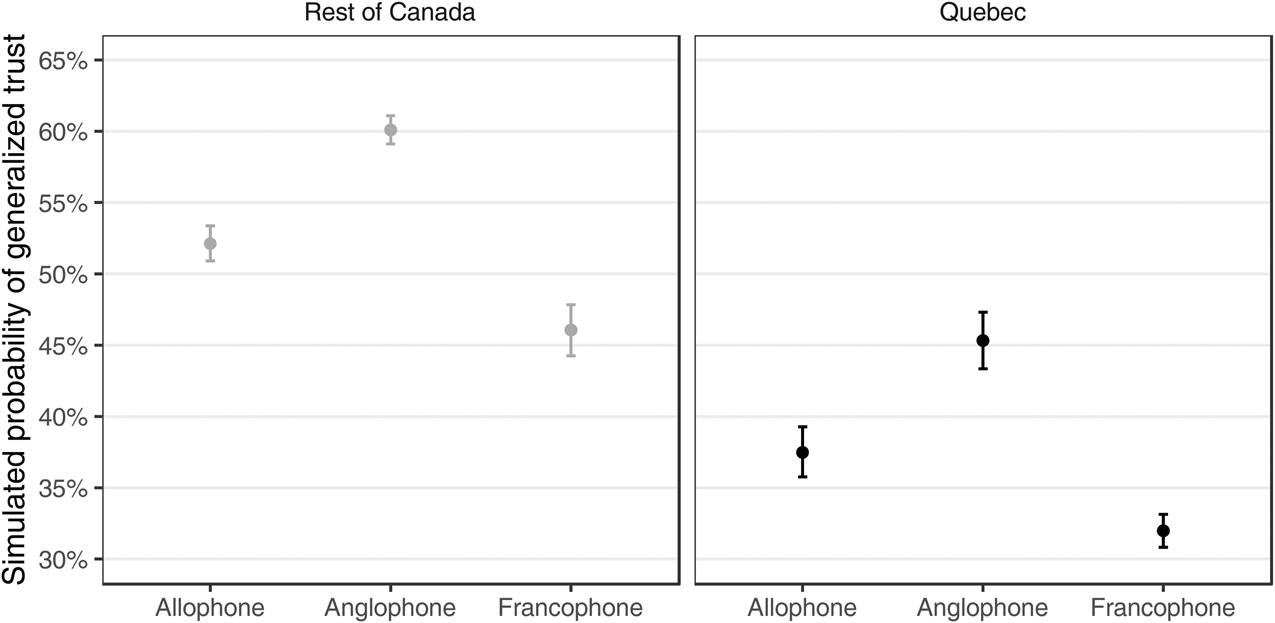
We run an initial model confirming linguistic and geographic differences, as shown in Figure 1. The y-axis is the simulated probability of expressing generalized trust for modal respondents with the specific features. The figure indicates that anglophone Canadians residing in the rest of Canada have an approximate 60 per cent chance to express generalized trust, while francophone Canadians residing in Quebec are only about 30 per cent likely to express similar feelings of trust.
Linguistic and geographic generalized trust simulated probabilities calculated using a model that controls for gender, age, income, life satisfaction, rural/urban and wave of survey.

Across Canada, francophones stand out as a particularly low-trusting group. Yet in Quebec, despite forming the majority in that province, the effect is even stronger: francophone Quebecers are less trusting than anglophones, and they are the least trusting linguistic group in the sample. In other words, previous findings about the low level of trust among francophones still hold today (Soroka et al., Reference Soroka, Johnston, Banting and Van Parijs2004; see also, more recently, Wu, Reference Wu2021). Looking across all groups shows the existence of a “Quebec effect” that transcends linguistic cleavages and brings anglophones living in Quebec to the levels of francophones living outside of Quebec (significantly lower than the anglophone Canadian average). Given the strength of these findings, we wanted to confirm that there is not a major confounder in the language of the survey. Elsewhere, cultural differences have been shown to be relevant for interpreting responses to categorical questions (King et al., Reference King, Murray, Salomon and Tandon2004). The words used in the French-language version of the question may have a different meaning than those in the English version. To address this possibility, we rerun the analysis on a bilingual subset of the respondents (n = 5,173) and include a variable for response language of survey (see supplementary materials for the full model). The null hypothesis holds in this case, and we do not find that response language of the survey is a relevant explanatory variable; it appears that the phrasing of the trust question in French has little to do with the observed differences.
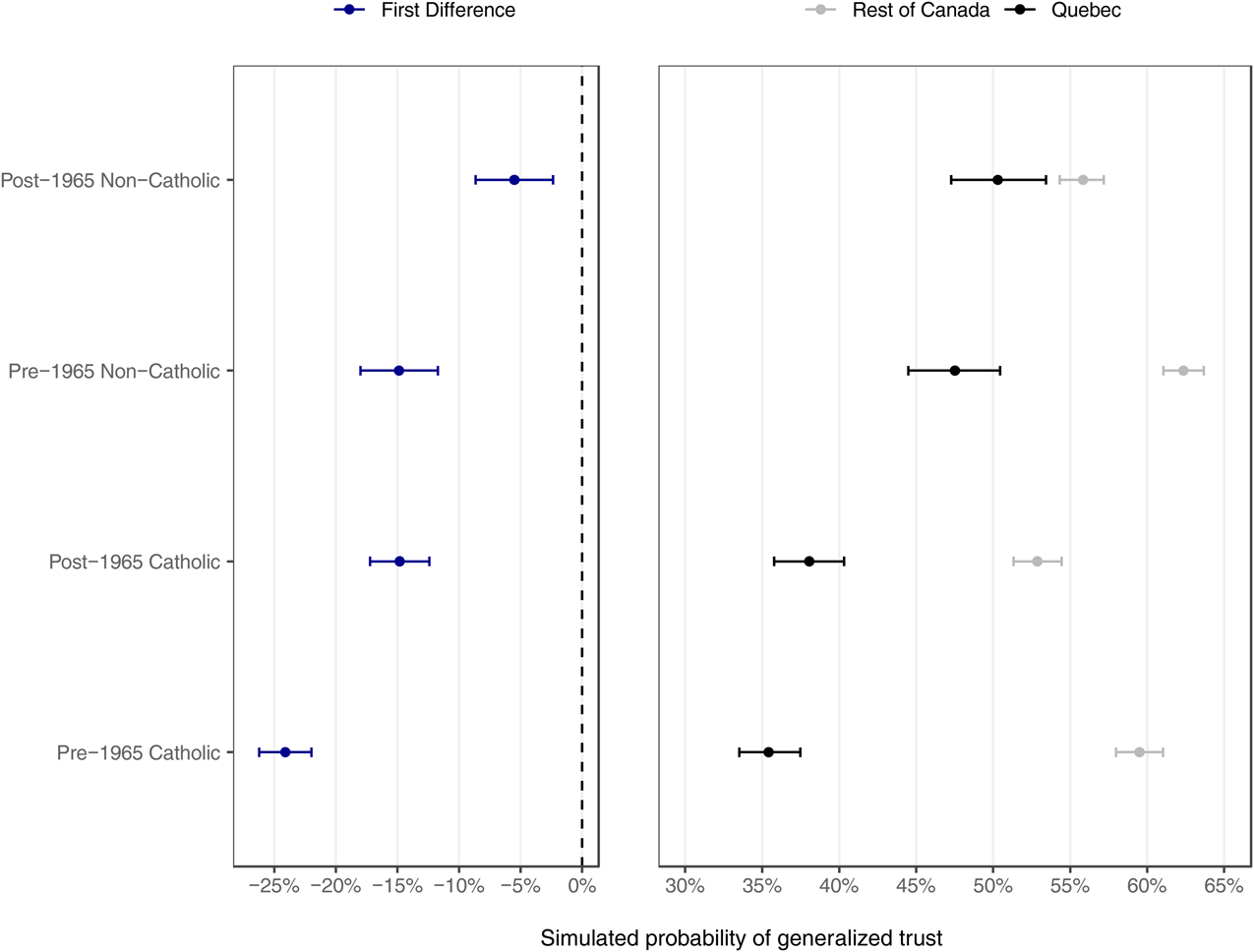
Given these differences, we test our four hypotheses. First, and to get a better grasp of who does not trust in Quebec, we examine the composition of Quebecers, notably those who are Catholic, currently reside in Quebec, and are born in Canada. We include an interaction term between a binary variable capturing pre- and post-1965 birth year interacted with Quebec residency. This coarsening of birth cohort into two categories allows us to differentiate effectively between older generations of Québécois who experienced the Quiet Revolution (pre-1965) and those who did not (post-1965). Outside of Quebec, this variable simply marks a generational difference that we explore further below. Figure 2 shows the results for this composition model. The left panel shows first differences: the difference between a respondent in Quebec and one in the rest of Canada who is pre– or post–Quiet Revolution and who identifies or does not as a Catholic. The right panel shows the estimated values for the two groups and descends from the most-trusting to least-trusting group in Quebec.
Generalized trust based on historical legacy in Quebec/the rest of Canada (H1A). Right panel shows simulated probabilities for those residing in Quebec versus the rest of Canada. Left panel shows first differences between those groups. Probabilities calculated using a model that controls for gender, age, income, life satisfaction, rural/urban and wave of survey.

As expected, Catholicism and birth cohort play an important role in overall levels of trust, but Figure 2 shows that this is not equally the case across Canada. First, Quebecers born after 1965 express generalized trust at similar levels compared to cohorts born before 1965, while in the rest of Canada, those born before 1965 are much more likely to express generalized trust. We further observe that the gap between Quebec and the rest of Canada has effectively narrowed for post-1965 generations. In addition, being Catholic is associated with small trust differentials in the rest of Canada; however, Catholics in Quebec are far less trusting than their non-Catholic counterparts. This underscores that it is not necessarily Catholicism itself that drives lower levels of trust but rather the unique experience of being Québécois (here identified through language and religion).Footnote 16 We find that the trust differential between Quebecers and those residing in the rest of Canada is the largest for pre-1965 Catholic Canadians (approximately 22%). We confirm the first hypothesis: those who are the least trusting are French-speaking Catholic Quebecers (Québécois). Our two analyses so far make clear that low trust is a characteristic observed in the specific population of older Catholic Quebecers of French-Canadian origin who experienced a period where most aspects of Quebec society were subject to heavy influence of the Catholic church and English dominance.
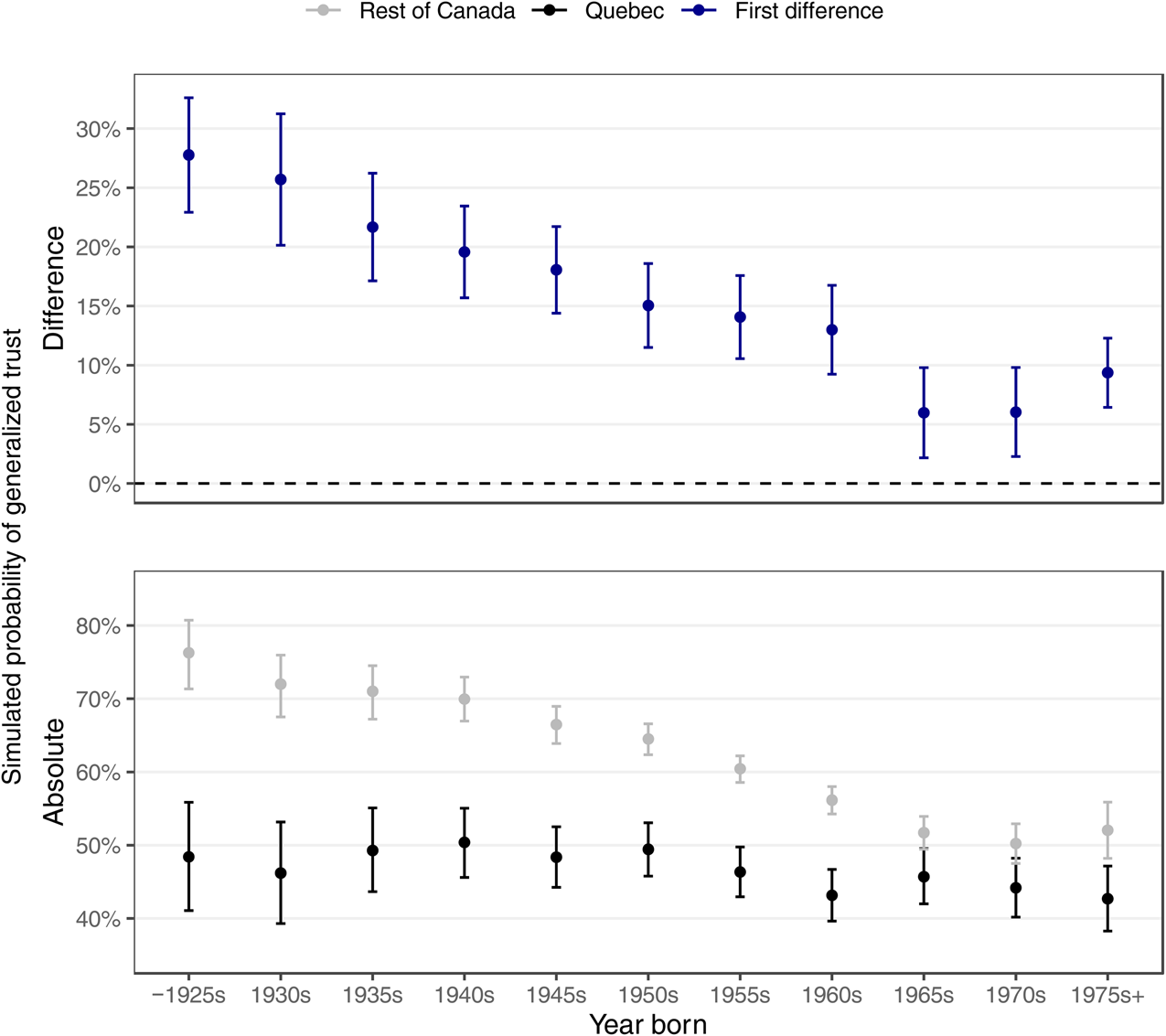
To test the second hypothesis, longitudinal data are necessary to help distinguish age and cohort effects. While the dataset is composed of only three waves spanning a total of 10 years, we have variation across the birth cohort measure, which we exploit. Figure 3 presents the results from a model that interacts birth cohort with respondent province of residence, with the y-axis showing simulated probability and the x-axis showing birth cohort. The top panel shows first differences or the difference between a respondent in Quebec and the rest of Canada. We should find that younger cohorts in Quebec born after the Quiet Revolution should gradually become more trusting, while we do not anticipate such a trend in the rest of Canada. Overall, we should see a convergence on trust values across Quebec and the rest of Canada. Indeed, there is a generational convergence between the rest of Canada and Quebec-based residents across the birth cohorts, and particularly those born after 1965 have levels of trust that are similar. However, this convergence is not based on increasing levels of trust experienced in Quebec. The bottom panel shows the simulated probabilities separately for Quebec-based and rest of Canada respondents and indicates that convergence comes from a significant decrease in trust among the rest of Canadians (resembling similar trends in the United States, as demonstrated by Putnam [Reference Putnam, Crothers and Lockhart2000]) but no such noticeable decrease in trust for Quebecers.
Generalized trust for birth cohorts in Quebec and the rest of Canada (H1B). Bottom panel shows simulated probabilities for those residing in Quebec versus the rest of Canada. Top panel shows first differences between those two groups. Probabilities calculated using a model that controls for gender, age, income, life satisfaction, rural/urban and wave of survey (see supplementary materials for underlying model).

We do not see the decline in trust in Quebec that is seen in many parts of North America, but instead we find a relatively stable pattern of trust across cohorts. One possible explanation for this is that the potential rise in trust for cohorts born after the Quiet Revolution has occurred simultaneously with the precipitous decline of trust in several parts of the Western world, including the rest of Canada. These countervailing forces may have kept trust at a lower but stable level in Quebec.Footnote 17
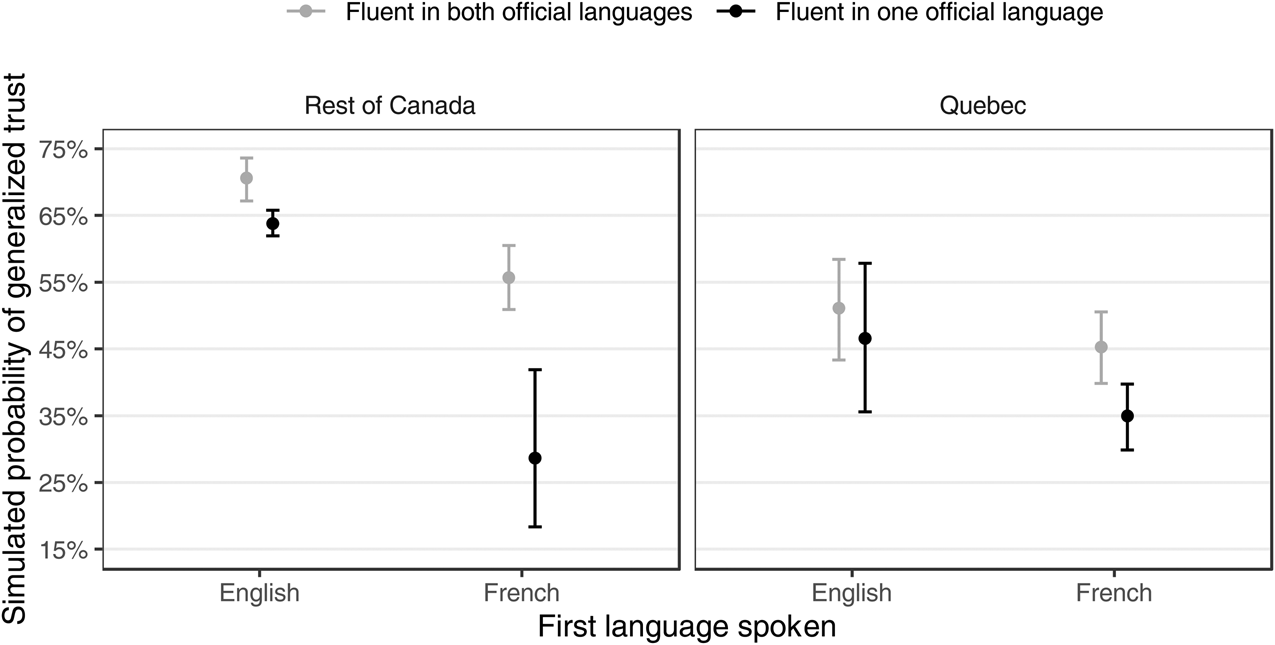
Our third hypothesis concerns the linguistic ability of Canadians. Bilingualism is higher in Quebec as compared to the rest of Canada; thus, bilingualism overall cannot explain the trust differences between Quebec and the rest of Canada, but it can help us identify the people within Quebec who are less trusting. According to the most recent census, approximately 46 per cent of Quebec residents are bilingual, whereas only approximately 10 per cent of the population outside Quebec speaks both French and English. Figure 4 shows simulated probabilities of generalized trust for francophones and anglophones, distinguishing between those who speak only one official language and those who speak both official languages. Here we show that it is francophones in both the rest of Canada and Quebec who experience the highest increase in generalized trust when they learn the second official Canadian language. In Quebec, bilingual francophones exhibit similar levels of trust as their English-speaking counterparts and are in fact statistically indistinguishable from bilingual anglophone Quebecers. Also noteworthy is that bilingual francophones outside Quebec are about twice as likely as unilingual francophones (n = 91) to indicate generalized trust. At the same time, speaking only one official language is negatively associated with generalized trust across three of the four language groups. There is only one exception: anglophones in Quebec do not benefit from bilingualism as much as others do. In sum, speaking two official languages is generally related to more generalized trust, and bilingual francophones in Quebec express similar trust levels as anglophones in Quebec.
Generalized trust based on linguistic ability in Quebec/rest of Canada (H2). Probabilities calculated using a model that controls for gender, age, income, life satisfaction, rural/urban and wave of survey (see supplementary materials for underlying model).

While we provide evidence for the correlational relationship between linguistic ability and trust, we also acknowledge that bilingualism may also reflect an openness to new experience, opportunities for contact or potentially other unobserved variables. The causal role of bilingualism cannot be tested here.
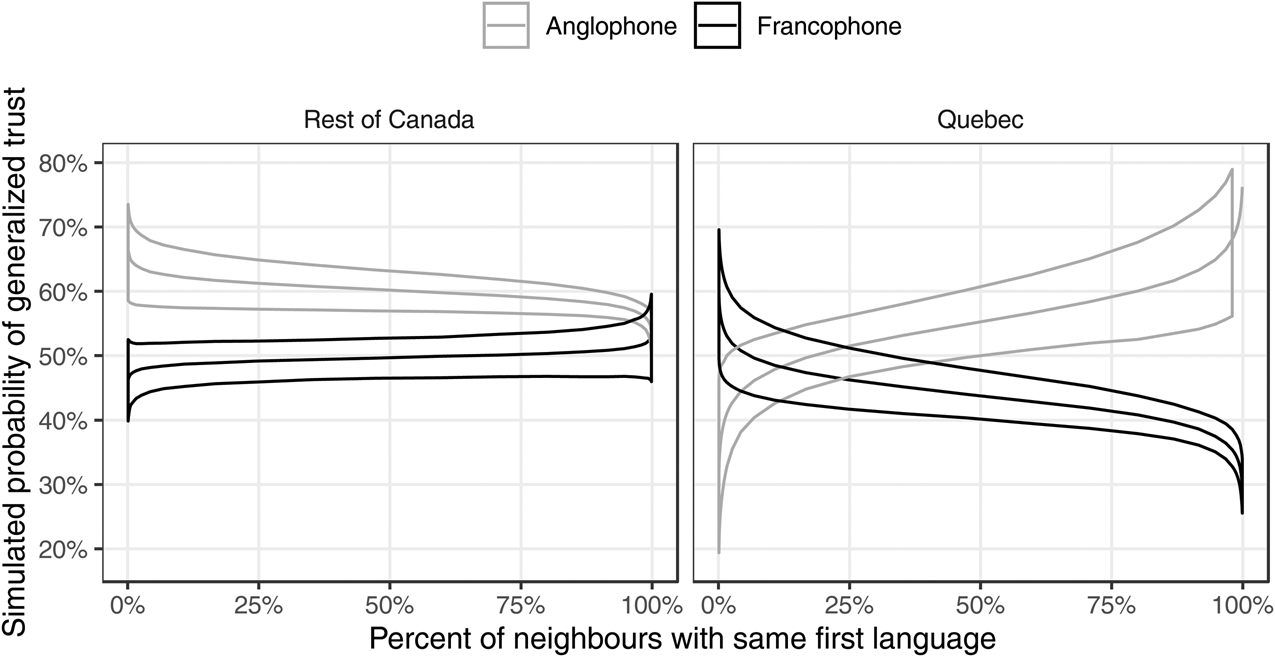
Finally, we examine how the immediate linguistic context matters for trust. Here we include the linguistic homogeneity of the respondent's neighbourhood in the regression model. We control for our usual covariates as well as several neighbourhood characteristics, such as ethnic diversity, the transiency of neighbourhood residents, and neighbourhood income level, to help isolate the effect of the linguistic dimension of one's immediate environment and not that of the overall context. The results are displayed below in Figure 5.
Generalized trust based on neighbourhood linguistic diversity in Quebec/rest of Canada (H3). Probabilities calculated using a model that controls for gender, age, income, life satisfaction, rural/urban, contextual variables and wave of survey (see supplementary materials for underlying model).

First, we find no significant relationship between linguistic diversity at the census tract level and levels of generalized trust for those who reside outside Quebec. However, for those who reside in Quebec, we find a strong relationship that runs in different directions for the two main linguistic groups within Quebec. As the number of people who speak French increases in a francophone's neighbourhood, he or she is less likely to trust. The anglophones, conversely, have an increased level of trust if they live in English-dense areas, although there are few of these neighbourhoods in Quebec. Increasing linguistic homogeneity at the neighbourhood level is associated with lower overall levels of trust, but only for francophones. Note that the above analysis is tested at the census tract level, which focuses on urban areas, but the results are similar using the census metropolitan area/census agglomeration (CMA/CA), which includes respondents who live outside small towns and cities.
It is not necessarily that these neighbourhoods drive down trust but rather that the composition of these neighbourhoods generally reflect a subset of the Quebec population that expresses low levels of generalized trust; thus, a causal argument is not being made. We can simply conclude that living in these homogeneous communities in Quebec is associated with low trust levels. Furthermore, it is important to note that when this contextual linguistic diversity is accounted for, the independent effect of Quebec residency loses substantive and statistical significance. In other words, contextual linguistic diversity emerges as an important correlate of trust; yet this relationship is not universal and does not appear in the rest of Canada.
Our reading of the literature on linguistic cleavages links to the historical and cultural explanations associated with the identity of francophone Quebecers as a minority group within Canada and suggests that the gap separating low- and high-trusting francophones might stem from their social networks. Francophones who encounter only other francophones in their daily lives might develop strong ties with their peers, but those trusting relationships may not necessarily extend to generalized trust. While a full test of this proposition goes beyond the scope of this article, we present here a descriptive account of a range of trust measures for a variety of francophone and anglophone linguistic groups in Quebec, as well as the rest of Canada, by religion and cohort. Table 6 in the Appendix shows mean trust levels by these groups to determine whether levels of generalized trust are similarly reflected in other trust measures (for example, those who speak another language, neighbours, work colleagues). While these descriptive results here do not account for the factors presented in previous models, we observe that the groups with the lowest generalized trust levels are francophone, Québécois, older, Catholic respondents in homogenous neighbourhoods (28.7%, n = 2,177), while the most trusting population is found in older anglophones residing outside Quebec in homogenous neighbourhoods (63.8%, n = 8,595). The former group is also the least likely to express trust in those who speak another language; however, they tend to express higher levels of trust in their neighbours and work colleagues. This finding seems to confirm that older Catholic francophones in Quebec who are surrounded mostly by other francophones trust those in their communities quite strongly, but this trust does not seem to travel to other groups or to a general form of trust. Yet in the rest of Canada, similar groups indicate high levels for all types of trust. Overall, it seems that generalized trust, trust in strangers and trust in those from other linguistic groups tap more into attitudes of unknown others, which are particularly low in Quebec; whereas trust in groups that are known from daily interactions, such as trust in neighbours and work colleagues, is not related to the Quebec versus rest of Canada divide. Although even on these last two types of trust, groups from homogeneous communities in the rest of Canada score highest. Clearly, additional investigation into the radius of trust for groups with different experiences are in order to further clarify how and why trust in known others travels to unknown others or not (Delhey et al., Reference Delhey, Newton and Welzel2011) and why these relationships differ in Quebec and the rest of Canada.
Discussion and Conclusion
The literature has repeatedly found that Quebecers are less trusting than their Canadian counterparts but has so far lacked a deeper analysis of that differential and of the reasons behind it. Our article aims at filling that scholarly gap by testing if this “Quebec difference” exists across birth cohorts and by proposing new compositional and contextual explanations while taking previous findings into account. Our results show that Quebecers are indeed less likely to agree that most people can be trusted and that this reluctance travels within the province beyond compositional lines of Québécois and stands out for older francophone Catholics born in Canada. While older cohorts of Quebecers are strikingly less trusting than other Canadians born at the same time, this differential softens for the most recent cohorts. This is not because Quebecers have grown much more trusting across generations but instead because levels of trust have fallen outside of Quebec.
Looking at the context in which respondents are placed, we highlight the influence of linguistic cleavages on generalized trust in Canada and Quebec. We find that being bilingual enhances trust among most anglophones and francophones, and unilingual francophones are the least trusting in Quebec and in the rest of Canada. Against the widely held idea that diversity erodes generalized trust, we also find that francophones’ trust decreases as the proportion of francophones within their neighbourhood increases. According to our multivariate regression analyses, in the Quebec context at least, the most trusting people can be found in the most diverse linguistic contexts.
While we provide different paths of explanations for the trust differential between Quebec and the rest of Canada, we do not make causal claims. Notably, we have highlighted cohort differences among the Québécois that cannot be decoupled from a unique set of experiences including political and economic marginalization by the anglophone majority in Canada and a socially and culturally powerful Catholic church. The cohort with these experiences, and especially those who live in linguistically homogeneous contexts, are the ones with particularly low levels of trust, both calculated directly and when controlling for a host of other factors. Thus, we were able to identify where and among whom trust differences occur, yet we cannot tell a causal story about why this is the case. The fact that linguistic diversity seems to have opposite associations in the rest of Canada is at first peculiar, but it might also relate to the experiences of marginalization: distrust of outsiders or strangers is historically justified. Hopefully, this information can be leveraged to better establish causal pathways moving forward.
We have focused here heavily on generalized trust, and further investigation into the radius of trust is critical to better understand which groups are perceived as trustworthy among the low generalized trust populations. Research into the radius of trust may also be a useful strategy in helping unpack the causal mechanisms at play. Experimental methods could also be used to improve our understanding of Quebec-specific dynamics around different types of trust. Furthermore, the precipitous decline of trust in the rest of Canada also warrants further theoretical consideration; more research is needed to understand the mechanisms and implications of decreasing trust among Canadians in general vis-à-vis the relative stability of trust in Quebec. Finally, we have examined the two major linguistic groups in Canada and found that bilingual individuals are indeed more trusting than their unilingual peers. Whether this extends to allophones, and why anglophones in Quebec do not experience this increase in trust, is of central interest for future research.
Notwithstanding these limits and next steps, our article makes two central contributions. First, it identifies more precisely those Quebecers who have low levels of trust and those who more closely resemble their counterparts in the rest of Canada. Second, it shows the significance that linguistic cleavages can hold for the development of trust in a society. It seems that the ability to bridge gaps between groups—to establish a diverse network of contacts on a linguistic basis—allows individuals to develop generalized trust and might also work even when they have experienced marginalization. We further contribute to the literature looking at diversity and trust by showing that beyond ethnic diversity, linguistic heterogeneity can matter too: in Canada, francophones seem especially affected by their linguistic context, and living in neighbourhoods where they are exposed to mostly other francophones seems to impede the development of generalized trust. A more fine-grained analysis of why these linguistically homogeneous communities experience such low levels of trust is needed, as are other studies in societies with similar linguistic cleavages. Our findings contribute to discussions about developing mutual trust in multilingual societies and inform trust-generating programs and policies that seek to cultivate a more cohesive and trusting country.
Supplementary Material
To view supplementary material for this article, please visit https://doi.org/10.1017/S0008423921000780.
Acknowledgments
We wish to acknowledge help from and access to the Quebec Inter-University Centre for Social Statistics (QICSS) in making this research possible. We would also like to thank the Social Sciences and Humanities Research Council (SSHRC), the Fonds de recherche du Québec—Société et culture (FRQSC) and the Centre for the Study of Democratic Citizenship (CSDC) for their support. Further, we thank the Political Behaviour Research Lab at McGill University and the panel at the Canadian Political Science Association conference in 2018 for their useful comments on earlier versions of the article. Finally, we gratefully acknowledge the three anonymous reviewers and the editor for their useful feedback.