

Introduction
In the 2020 and 2024 Presidential elections, both Joe Biden and Donald Trump invested heavily in outreach toward the Latino electorate. Part of that outreach involved Spanish-language campaign communications. In Florida, for example, both campaigns paired general Spanish-language ads with messages targeted specifically at Puerto Rican and Cuban audiences.Footnote 1 These spots featured speakers using origin-specific accents and cultural references, reflecting an increasingly sophisticated effort to mobilize Latino voters that goes beyond generic Spanish-language ads. This strategy raises broader questions: How do linguistic features, such as accents, shape how Latino voters interpret and respond to these Spanish-language campaign messages?
Despite comprising a growing share of the US electorate, Latinos have long been under-mobilized (Fraga Reference Fraga2018). Campaigns have responded by turning to targeted, identity-based mobilization strategies, including Spanish-language campaign communications (Barreto Reference Barreto2010; Panagopoulos and Green Reference Panagopoulos and Green2011; Valenzuela and Michelson Reference Valenzuela and Michelson2016). Prior work shows that such appeals can boost candidate evaluations by signaling cultural and political familiarity with and commitment to the Latino community (Flores and Coppock Reference Flores and Coppock2018; Zárate, Quezada-Llanes, and Armenta Reference Zárate, Quezada-Llanes and Armenta2024). Yet this literature tends to treat Spanish as a uniform cue of Latino identity. We argue instead that Spanish-language communication operates through a dual-cue logic: it can signal a broad panethnic Latino identity, while the accent of delivery can simultaneously elicit subgroup attachments tied to national origin that may undermine its intended identity-affirming persuasiveness.
Recognizing this nuance is critical because Latino panethnicity encompasses significant internal diversity (Okamoto and Mora Reference Okamoto and Mora2014). While Spanish has been central to constructing a shared Latino identity (Mora Reference Mora2014), it varies widely in accent, cadence, and vocabulary across Latin America. As a result, a Spanish-language appeal may not simply signal panethnic recognition; it can also make subgroup differences more salient. Appeals delivered in an accent that aligns with the listener’s national origin (a congruent appeal) may affirm community ties and commitment, while an appeal delivered in an accent that does not align with the listener’s national origin (an incongruent appeal) can risk backfiring by undermining the symbolic electoral connection that the appeal is meant to foster. We therefore expect that Spanish-language appeals delivered in incongruent accents will be less effective than congruent ones.
To test this argument, we fielded a preregistered survey experiment with 953 Latinos of Mexican origin recruited by Forthright. Campaigns sometimes choose the accents they deploy—selecting narrators or spokespeople whose voices resonate with targeted communities. Yet when candidates speak for themselves, accent becomes less of a matter of strategy than of embodiment: it signals identity even when no deliberate cueing is intended. For Latino candidates, a Spanish-language appeal quite literally speaks for itself. In both cases, accents signal information about group membership. In this study, respondents were randomly assigned to hear one of two campaign ads delivered in either a Mexican or Puerto Rican accent by a fictitious Latino political candidate. We measured candidate evaluations, perceptions of candidate commitment to the Latino and Mexican-American community, and perceived political and cultural commonality with Latinos as a group. Respondents exposed to the incongruent (Puerto Rican) accent rated the candidate more negatively and perceived weaker commitment to the Mexican-American community than those exposed to the congruent (Mexican) accent. By contrast, accent incongruence did not affect perceptions of panethnic commonality.
As the nation’s second-largest ethno-racial group, Latinos increasingly shape the balance of political power in the United States. Spanish-language appeals—now routine even among candidates who once derided their use—have become a defining site for understanding how identity is communicated and contested in American campaigns. We advance theories of identity-based campaign contact by showing that language is not always a straightforward identity cue. For Latinos, language operates as a layered signal that can simultaneously activate panethnic and subgroup identities. We demonstrate that accent congruence conditions the effectiveness of language-based outreach, revealing how campaigns can unintentionally undermine the very symbolic benefits that these strategies seek to achieve. By highlighting origin-based linguistic variation as a political signal, we explain when Spanish-language appeals can resonate or fall flat, extending theories of ethnic and identity-based politics to emphasize the political significance of language and accent. This, in turn, sheds light on what inclusion and representation look like in practice within a linguistically diverse democracy. Finally, our results underscore the broader challenges of panethnic outreach. Something as subtle as accent can shape how intended audiences receive and respond to campaign communications.
Looking ahead, these dynamics are unlikely to remain static, and recognizing the dual-cue logic of Spanish-language appeals will become increasingly important. From the audience’s side, the modal Latino voter today is of Mexican descent, but the composition of the Latino community is rapidly changing and reshaping the contours of the electorate. From the messenger’s side, as more candidates from non-Mexican backgrounds seek office, the likelihood of accent incongruence will only increase, making linguistic alignment an ever more consequential feature of political communication.
Campaigning to a Latino Electorate
Latino voters have historically participated in US elections at lower rates than non-Hispanic whites (Fraga Reference Fraga2018; Leighley Reference Leighley2001; Verba et al. Reference Verba, Schlozman, Brady and Nie1993), in part because they are less likely to be mobilized by campaigns (Enos et al. Reference Enos, Fowler and Vavreck2014; Leighley Reference Leighley2001; Ramírez, Solano, and Wilcox-Archuleta Reference Ramírez, Solano and Wilcox-Archuleta2018; Verba et al. Reference Verba, Schlozman, Brady and Nie1993). In response, campaigns have increasingly relied on identity-based mobilization strategies (Barreto Reference Barreto2007; Barreto Reference Barreto2010; Valenzuela and Michelson Reference Valenzuela and Michelson2016). Spanish-language campaign communications are often a core part of this strategy. While most Latinos are English-dominant, Spanish retains both cultural and symbolic importance across generations (Mora and Lopez Reference Mora and Lopez2023).
For Spanish-dominant voters, Spanish-language outreach serves an informational function, lowering participation costs and expanding access to campaign content (Hopkins Reference Hopkins2011; Jones-Correa Reference Jones-Correa2005; Panagopoulos and Green Reference Panagopoulos and Green2011). For bilingual and English-dominant Latinos, however, Spanish can also operate as a symbolic cue. Experimental studies show that candidates who use Spanish are evaluated more positively because language is an identity-affirming cue that communicates cultural familiarity and recognition (Flores and Coppock Reference Flores and Coppock2018). Spanish-language appeals can also signal a candidate’s embeddedness within the Latino community (Zárate, Quezada-Llanes, and Armenta Reference Zárate, Quezada-Llanes and Armenta2024) and commitment to represent its interests (Wamble Reference Wamble2024). Yet these symbolic benefits are conditional. When language use feels inauthentic, it can be dismissed as pandering (Zárate Reference Zárate2023; Zárate, Quezada-Llanes, and Armenta Reference Zárate, Quezada-Llanes and Armenta2024). Poorly targeted messages can also backfire (Flores and Coppock Reference Flores and Coppock2018; Hersh and Schaffner Reference Hersh and Schaffner2013). The impact of Spanish-language appeals depends not only on whether candidates speak Spanish, but on how it is used and who it appears to represent. Viewing Spanish simply as a marker of identity overlooks the distinction between deliberate signaling and performative display, ultimately flattening language’s political significance.
Much of this research centers the panethnic Latino or Hispanic identity, similar to how most political campaigns operate. Strategically, campaigns have incentives to emphasize a panethnic identity (Barreto Reference Barreto2010; Fraga Reference Fraga2018; Padilla Reference Padilla1985), as it allows them to downplay intragroup distinctions and mobilize across national origin groups (Barreto Reference Barreto2010; Beltrán Reference Beltrán2010; Lopez and Espiritu Reference Lopez and Espiritu1990; Mora Reference Mora2014; Padilla Reference Padilla1985). However, this approach can obscure the complex internal diversity of the group, flattening distinctions between national origin groups and sidelining alternative perspectives within the community (Beltrán Reference Beltrán2010). National origin identities also serve as a powerful source of attachment that candidates or other messengers can activate. This is similar to how appeals to state or regional pride can momentarily eclipse broader national identification. Recognizing this layered structure of identity helps clarify when appeals framed in panethnic terms may connect broadly and when more particular cues may carry greater weight. Campaign appeals invoking identity, whether explicit or implicit, are effective only when recipients see their own identity reflected in the message and then link that identity to politics (Lee Reference Lee2008; McClain et al. Reference McClain, Carew, Walton and Watts2009).
Latino and Hispanic are panethnic identities that are formed through the consolidation of multiple subgroup identities into a broader umbrella category (Okamoto and Mora Reference Okamoto and Mora2014). In the Latino context, this allows individuals to identify simultaneously as “Latino” and “Mexican” or “Mexican-American,” without being forced to choose between the two (Jones-Correa and Leal Reference Jones-Correa and Leal1996), forming what scholars describe as a portfolio of identities (Garcia-Rios et al. Reference Garcia-Rios, Pedraza and Wilcox-Archuleta2019). Historically, Hispanic panethnicity emerged as a US-based construct, forged through bureaucratic, activist, and media efforts to create a cohesive identity category (Jones-Correa and Leal Reference Jones-Correa and Leal1996; Mora Reference Mora2014). Efforts to construct a panethnic Latino identity have long relied on the symbolic power of Spanish to bind together linguistically connected but nationally distinct communities—a unifying logic that both campaigns and scholars often take for granted. Spanish-language media, particularly Univision, played a central role in promoting the shared identity (Mora Reference Mora2014). To appeal broadly across diverse national origin communities, the network promoted a standardized, “neutral” Spanish that avoided regional slang or accents to appeal across subgroups (Avilés-Santiago and Báez Reference Avilés-Santiago and Báez2019). By smoothing over aspects of vocal expression that differentiated between cultures, the network aimed to expand its reach and helped facilitate the broader adoption of a unified panethnic identity category.
At the same time, this effort highlights the very tension at the heart of contemporary Spanish-language appeals. The variations in accent, cadence, and vocabulary that the media attempted to neutralize remain prevalent. Spanish-language appeals can both unify and divide. Their persuasive power rests on identity affirmation, but that affirmation is strongest when the linguistic form of the appeal mirrors the listener’s own subgroup identity. Incongruent cues may thus weaken the very sense of recognition that makes such appeals effective.
Language-to-Identity Connection
Conceptualizing Latinos as holding a portfolio of identities implies that there are multiple potentially politically salient identities that campaigns can activate (Garcia-Rios et al. Reference Garcia-Rios, Pedraza and Wilcox-Archuleta2019). As a result, the effectiveness of Spanish-language appeals may depend not only on their informational content or the identity and proficiency of the speaker but also on subtle linguistic cues tied to accent. Prior work on language appeals has focused primarily on language proficiency and ethnic congruence between candidates and voters (Flores and Coppock Reference Flores and Coppock2018; Zárate, Quezada-Llanes, and Armenta Reference Zárate, Quezada-Llanes and Armenta2024). We argue instead that Spanish operates as a layered signal, carrying what we call a dual-cue logic. It can simultaneously activate a shared panethnic identity and narrower subgroup identities. Spanish can unify when received as a marker of panethnic recognition, but it can also divide when its linguistic variation highlights subgroup difference.
The presence of accents in campaign communications can emerge for different reasons, yet they function similarly as signals. In some campaign contexts, campaigns select messengers with specific accents to target a group on behalf of a candidate. In others, accents can reflect the candidate’s own identity and background and cannot be easily changed. In both cases, accents are encoded into social identity, conveying information about group membership and belonging that can shape how recipients evaluate a candidate and their commitment to their listener’s group.
If accents structure the cultural referents of a Spanish-language appeal, then the central political question becomes: who do voters believe the messenger is speaking to? Spanish has long served as a tool of recognition in Latino politics, symbolically addressing “Latinos” as a collective. Yet accents narrow or broaden the perceived audience. What appears panethnic on paper may, in practice, be understood as subgroup-specific. For campaigns, this reframing underscores that the effectiveness of Spanish-language appeals depends not only on whether language is used, but on how it is voiced.
In the traditional view, Spanish is treated as a straightforward cue of panethnic, Latino identity expected to enhance candidate evaluations. Our alternative view suggests that accents and other linguistic features also have the potential to cue subgroup identity. While a Spanish-language appeal may aim to affirm shared panethnicity, an incongruent accent can disrupt its symbolic power by signaling out-group membership. Since the symbolic benefits of language appeals rely on their ability to signal shared identity or commitment to the recipient’s community, incongruent accents can undermine these goals. In such cases, the Spanish appeal may not be interpreted as a gesture of communal ties but as evidence that the candidate lacks familiarity with the recipient’s community and may not be an effective representative. In this way, accent cues do not merely prime subgroup identity; they also shape perceived representation fit, linking linguistic difference to political distance (see Figure 1).
The logic of Spanish-language appeals. The figure on the left depicts the traditional logic behind Spanish-language appeals. The figure on the right depicts the alternative dual-cue logic.

The dual-cue logic builds on prior research showing that exposure to language influences the salience of political considerations (Pérez Reference Pérez2016). Speaking or hearing a language can make certain political considerations more accessible, shaping how individuals evaluate political information (Zaller Reference Zaller1992). In the case of Spanish-language appeals, hearing accents associated with other subgroups can heighten awareness of internal Latino diversity (Pérez and Tavits Reference Pérez and Tavits2022), making within-group differences more cognitively salient and likely to influence candidate evaluations. As a result, voters may see an accent-incongruent Latino candidate as belonging to a different group, weakening perceptions of shared experience that support the symbolic value of identity. This argument aligns with research on descriptive representation showing the political impacts of national origin representation relative to panethnic representation (Sadhwani Reference Sadhwani2022; Wu Reference Wu2023). Prior work similarly finds that Latinos are less likely to support a co-ethnic candidate from a different national origin than one from their own (Cuevas-Molina and Nteta Reference Cuevas-Molina and Nteta2023). We extend this insight by shifting the focus to the connection between language and identity.
Building on this framework, we derive several testable hypotheses about how accent cues shape candidate evaluations. Existing research often treats Spanish as a generic, panethnic cue that signals that Latinos are seen and valued collectively. Yet Spanish is never simply uniform in effect; its linguistic form carries specificity. Subtle variations in pronunciation and rhythm can simultaneously signal shared belonging and mark subgroup distinction, revealing who is being addressed—and who is not. The dual-cue logic therefore predicts that Spanish-language appeals delivered in an accent incongruent with the listener’s national origin identity will be less effective than congruent appeals, as the linguistic mismatch disrupts the symbolic connection between identity and politics rooted in language.
H1: Congruent Spanish-language appeals will improve candidate evaluations relative to incongruent Spanish-language appeals.
Previous research finds that identity-based appeals are most effective among Latinos with stronger group attachments (Valenzuela and Michelson Reference Valenzuela and Michelson2016; Zárate, Quezada-Llanes, and Armenta Reference Zárate, Quezada-Llanes and Armenta2024). We therefore expect that the effect of accent congruence will depend on national origin identity strength. Latinos with strong national origin attachments should respond more negatively to incongruent accents than those with weaker attachments.
H1a: Incongruent Spanish-language appeals will more strongly decrease candidate evaluations among Latinos with strong national origin identities.
Processing accent cues also depends on Spanish proficiency. While the symbolic benefits of language are not limited to fluent speakers, those with limited proficiency may not detect accent variation or out-group membership cues. Consequently, more proficient Spanish speakers should be more sensitive to incongruent accents and respond more negatively to them:
H1b: Incongruent Spanish-language appeals will more strongly decrease candidate evaluations among Latinos who are more proficient in Spanish.
Finally, if mismatched accents heighten awareness of subgroup difference, they may also weaken perceptions of panethnic commonality. Because panethnicity rests partly on perceived shared culture and values, increased awareness of subgroup distinctions could gradually weaken perceived commonality within the panethnic community, an important foundation for panethnic political solidarity.
H2: Incongruent Spanish-language appeals will decrease perceptions of Latino cultural and political commonality relative to congruent Spanish-language appeals.
Data and Methods
Experimental Design
To test our hypotheses, we conducted a two-arm between-subjects survey experiment that varied the accent of a Spanish-language appeal delivered by a Latino candidate. Participants listened to a brief audio campaign ad for a fictional candidate running for mayor of their (unnamed) city and then completed a series of questions evaluating the candidate and Latinos as a group.Footnote 2 The survey was fielded from April 10 to 28, 2025, through Forthright, with a final sample of N = 953 Latinos of Mexican origin residing in the United States.
We restricted the sample to Latinos of Mexican origin to enhance internal validity, maximize statistical power, and ensure recruitment feasibility. Recruiting large, representative samples of Latino respondents is often difficult and costly, and focusing on a single national origin group allows for a cleaner test of our theoretical expectations. In this study, the key contrast is between a congruent accent (Mexican-accented Spanish) and an incongruent accent (Puerto Rican–accented Spanish). Limiting the sample to Mexican-origin Latinos allows for a direct comparison between congruent and incongruent conditions without the added complexity of multiple subgroup baselines. Mexican-origin Latinos are also the largest Latino national origin group in the United States and the only group for which it was feasible to recruit a large enough sample to be statistically powered. The survey was administered in English to avoid the possibility of language effects in multilingual surveys (Pérez Reference Pérez2016; Velez, Saavedra Cisneros, and Gomez Reference Velez, Cisneros and Gomez2024).
All participants heard the same Spanish-language campaign ad; only the accent of delivery varied across conditions. Prior work has already documented the benefit of Spanish-language appeals relative to English-language ones (Flores and Coppock Reference Flores and Coppock2018; Zárate, Quezada-Llanes, and Armenta Reference Zárate, Quezada-Llanes and Armenta2024), making variation between Spanish accents the theoretically novel comparison.Footnote 3 Puerto Rican Spanish provides an appropriate incongruent comparison because it is linguistically distinct from Mexican Spanish yet familiar enough to avoid confusion. Additionally, it avoids confounding the treatment with other political attributes (e.g., Cuban Spanish and partisan identity). Both versions were delivered by native, fluent Spanish speakers, and the transcript content was identical across conditions.Footnote 4 The ad was intentionally brief, nonpartisan, and policy-neutral to isolate the effect of language, consistent with work on candidate appeals (Valenzuela and Michelson Reference Valenzuela and Michelson2016; Zárate Reference Zárate2023).
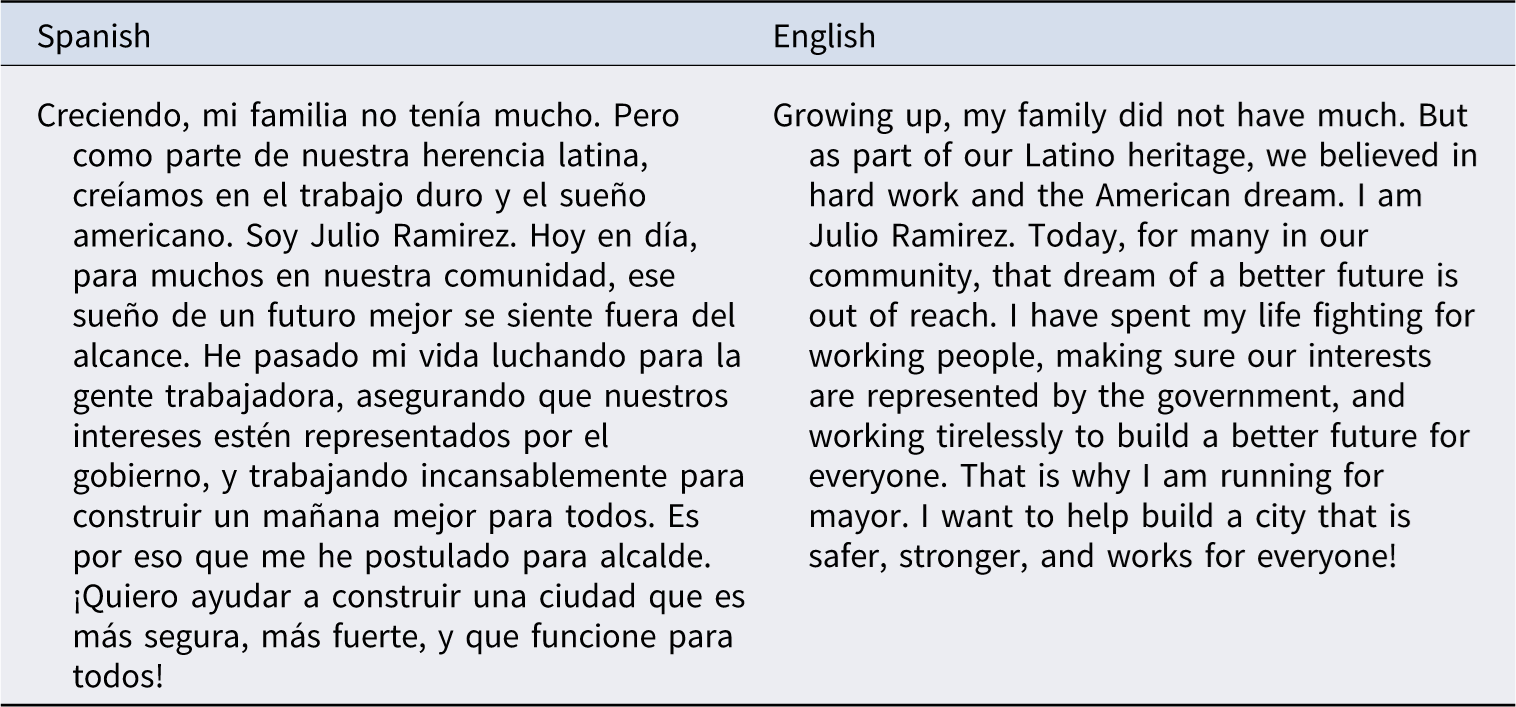
The ad was narrated by the fictitious candidate, Julio Ramirez, a validated Latino name used to signal co-ethnicity (Crabtree et al. Reference Crabtree, Kim, Gaddis, Holbein, Guage and Marx2023). We used a candidate as the messenger, rather than a campaign proxy, to strengthen the identity signal and make the accent a feature of a person whose representational capacity could be directly evaluated. Prior studies of Spanish-language appeals have used both real ads for past candidates (Flores and Coppock Reference Flores and Coppock2018) and snippets of speeches from hypothetical candidates (Zárate Reference Zárate2023; Zárate, Quezada-Llanes, and Armenta Reference Zárate, Quezada-Llanes and Armenta2024). Because our focus is on Spanish accent variation, existing ads would compromise informational equivalence (Dafoe et al. Reference Dafoe, Zhang and Caughey2018), as otherwise-identical ads in different accents likely do not exist. The full transcript of the ad appears in Table 1.
Full transcript of campaign ad in English and Spanish

Table 1. Long description
A table with two columns and multiple rows comparing the English and Spanish text of a campaign ad. The first column is labeled ‘Spanish’ and the second column is labeled ‘English’. Row 1: Spanish: Creciendo, mi familia no tenía mucho. Pero como parte de nuestra herencia Latina, creíamos en el trabajo duro y el sueño americano. Soy Julio Ramirez. Hoy en día, para muchos en nuestra comunidad, ese sueño de un futuro mejor se siente fuera del alcance. He pasado mi vida luchando para la gente trabajadora, asegurando que nuestros intereses estén representados por el gobierno, y trabajando incansablemente para construir un mañana mejor para todos. Es por eso que me he postulado para alcalde. Quiero ayudar a construir una ciudad que es más segura, más fuerte, y que funcione para todos! English: Growing up, my family did not have much. But as part of our Latino heritage, we believed in hard work and the American dream. I am Julio Ramirez. Today, for many in our community, that dream of a better future is out of reach. I have spent my life fighting for working people, making sure our interests are represented by the government, and working tirelessly to build a better future for everyone. That is why I am running for mayor. I want to help build a city that is safer, stronger, and works for everyone!
Outcome Measures
Following the treatment, respondents completed two sets of outcome measures. The first assesses evaluations of the candidate. The second measures attitudes toward Latinos as a group. All outcome items were measured on five-point scales and rescaled to range 0–1. To capture candidate evaluations, we followed prior research emphasizing the multidimensional nature of candidate evaluations (Zárate, Quezada-Llanes, and Armenta Reference Zárate, Quezada-Llanes and Armenta2024). Respondents indicated whether they would vote for the candidate, how much they liked and trusted the candidate, and how well represented they felt by the candidate. The four items were averaged to create a candidate evaluation index (α = .91), with higher values indicating more favorable evaluations. Because our theory highlights that the value of Spanish-language appeals lies in their ability to signal community commitment and foster a sense of political recognition among Latinos, we also measured perceptions of the candidate’s community commitment. Respondents rated how committed they believed the candidate was to (1) the Mexican-American community and (2) the broader Latino community. These items allow us to distinguish between perceptions of panethnic commitment and national origin-specific commitment, the latter of which should be especially sensitive to accent congruence.
In addition to candidate-specific outcomes, we assessed whether accent incongruence shapes broader group attitudes. Exposure to an out-group accent may heighten awareness of internal diversity within the Latino community, reducing perceived panethnic similarity. To test this, respondents reported their perceived level of cultural and political commonality with Latinos as a group. If incongruent accents prime subgroup difference, we expect a decline in perceived commonality with Latinos overall, but no corresponding change in perceived commonality with Mexican Americans.
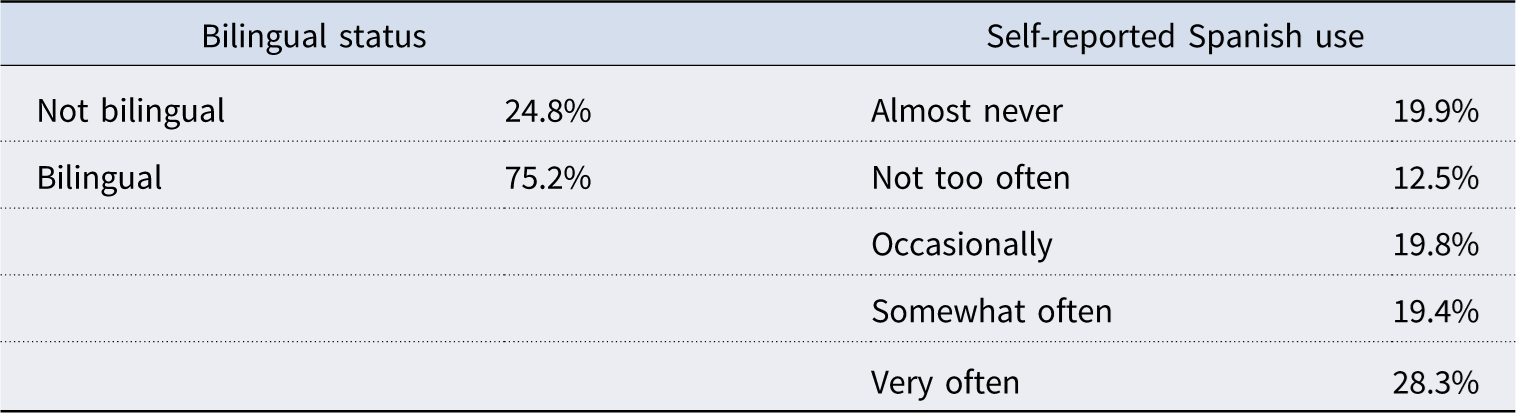
We also measure two moderators. To test H1b , which posits that Spanish-language proficiency conditions responses to accent cues, we use two indicators of Spanish ability. First, respondents reported how frequently they spoke Spanish at home, with family or friends, or at work. Second, respondents completed a simple quiz in English and Spanish to establish proficiency (Flores and Coppock Reference Flores and Coppock2018). While distinct, the two measures capture related concepts and are modestly correlated (r = .29). Table 2 notes the levels of bilingualism in the sample.
Spanish-language proficiency
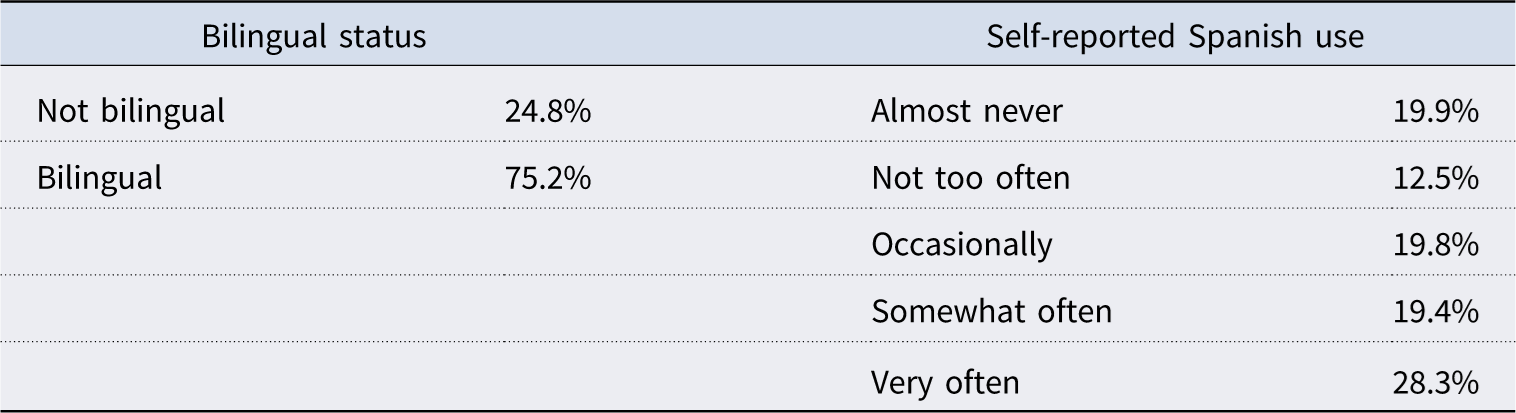
Table 2. Long description
The table has two columns: Bilingual status and Self-reported Spanish use. The Bilingual status column has two rows: Not bilingual with 24.8 percent and Bilingual with 75.2 percent. The Self-reported Spanish use column has five rows: Almost never with 19.9 percent, Not too often with 12.5 percent, Occasionally with 19.8 percent, Somewhat often with 19.4 percent, and Very often with 28.3 percent.
To evaluate H1a, which posits that national origin identity strength conditions responses to accent cues, respondents were asked how important both their Mexican and Latino/Hispanic identities were to their sense of self. The two items are highly correlated (r = .87).
Both moderators were measured pretreatment. Measuring them beforehand minimizes the risk of posttreatment bias, which we judge to be a larger risk than potential priming effects (Klar et al. Reference Klar, Leeper and Robison2020). Any priming from pre-measurement is likely minimal (Sheagley and Clifford Reference Sheagley and Clifford2025). Finally, to assess treatment compliance and participant attentiveness,Footnote 5 we included a mock vignette check (Kane et al. Reference Kane, Velez and Barabas2023), a factual manipulation check (Kane and Barabas Reference Kane and Barabas2019), and a manipulation check asking respondents to identify the national origin of the candidate based on the accent in the ad. The goal of the accent-based manipulation check is to gauge the extent to which respondents identify the accent belonging to their national origin ingroup or not. For respondents in the Puerto Rican condition, it is more important for them to identify the accent as not Mexican than it is for them to precisely identify it as Puerto Rican. Our theory speaks to a broader distinction between ingroups and outgroups rather than a specific Mexican versus Puerto Rican dynamic.
Results
Candidate Evaluations
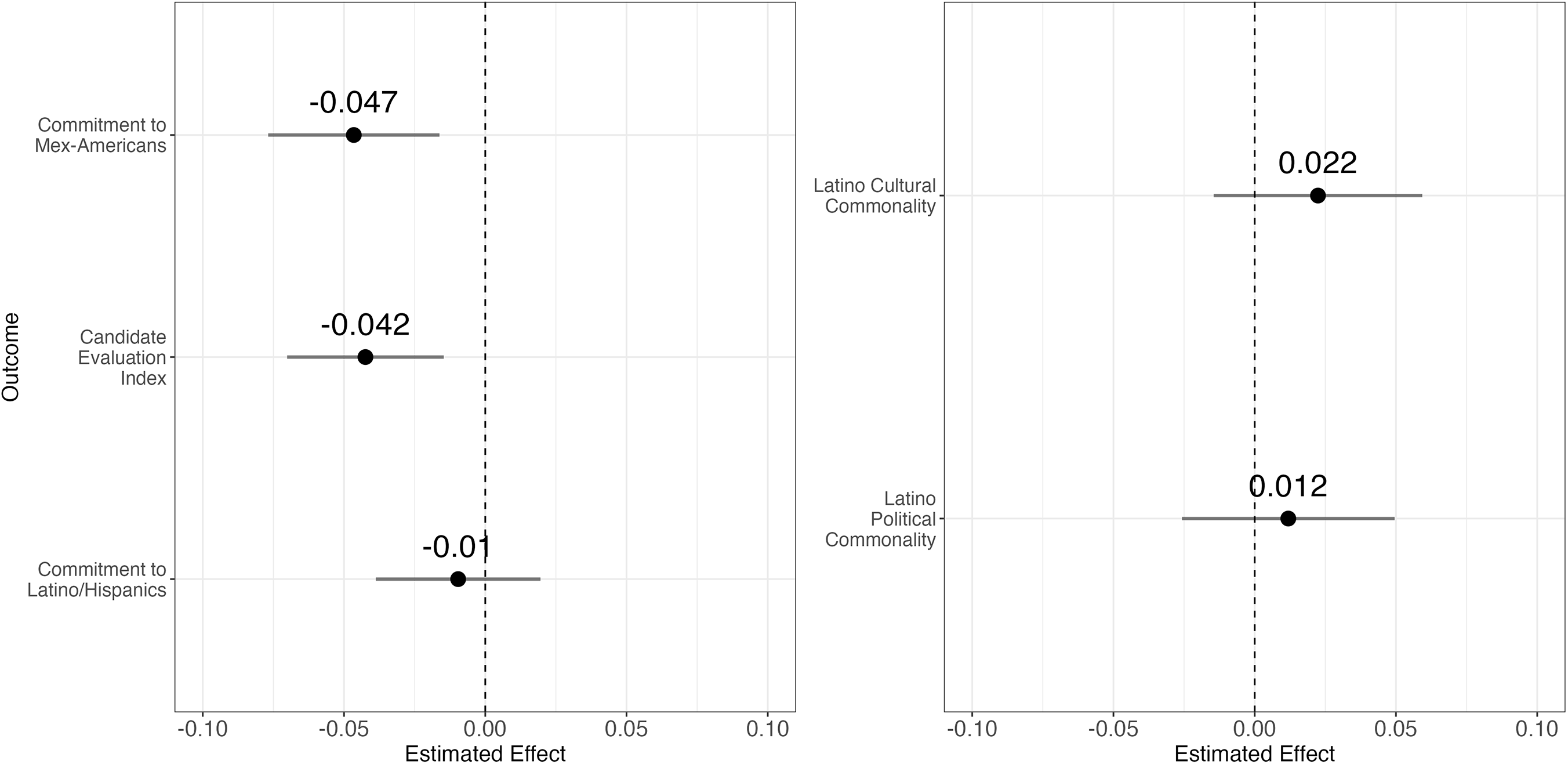
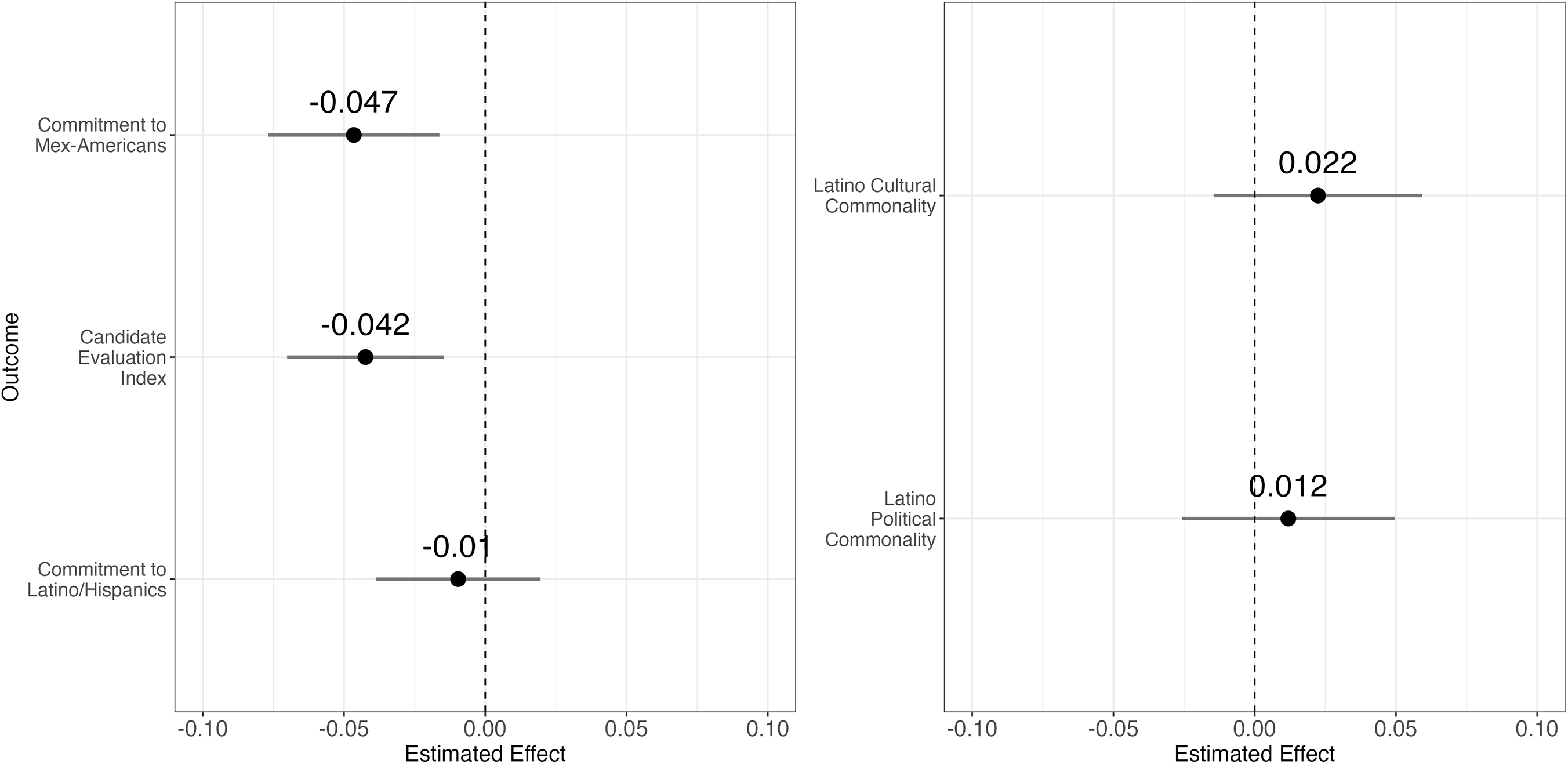
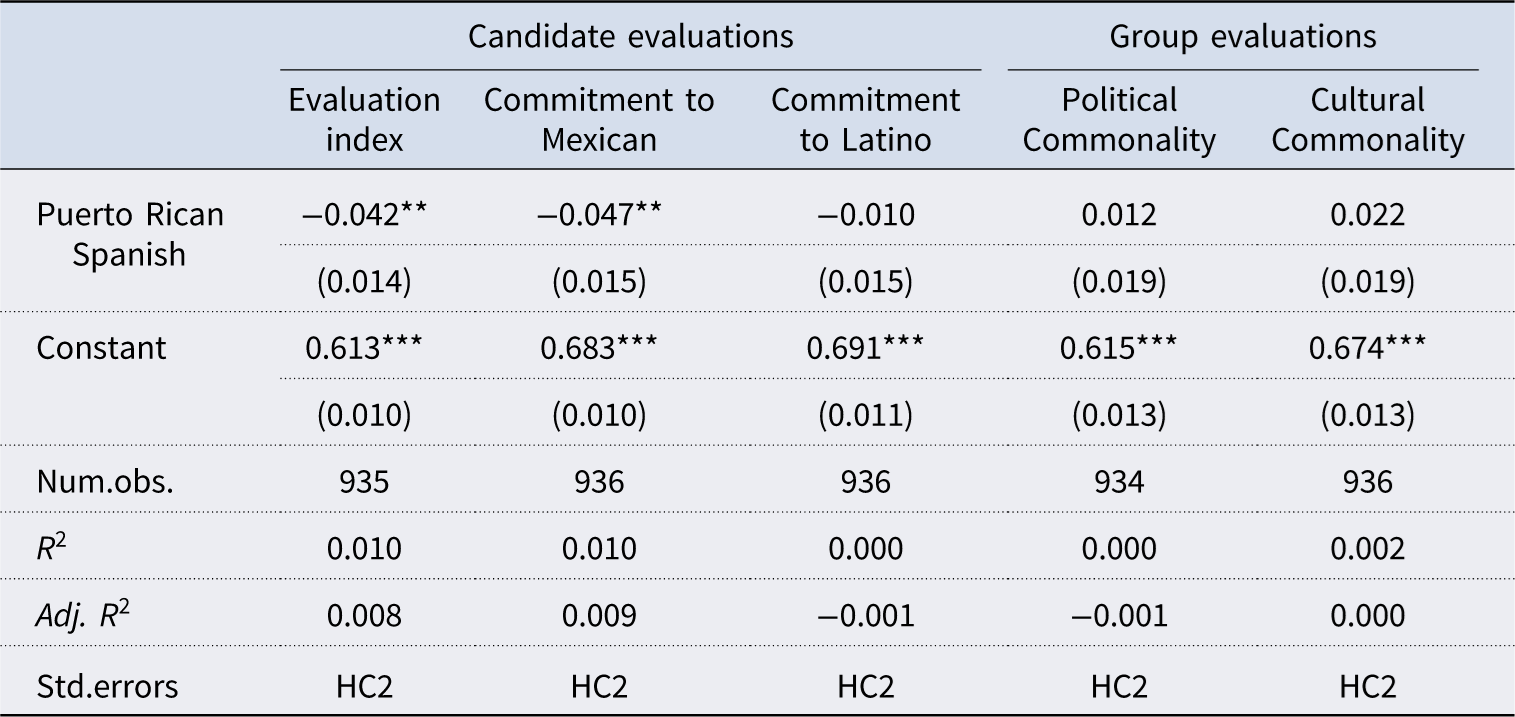
To evaluate the effects of accent variation in Spanish-language appeals, we estimated a series of linear regressions with candidate evaluations and group commonality measures as dependent variables. The key independent variable is a binary treatment indicator, with the Mexican-accented Spanish appeal serving as the baseline.Footnote 6 Results are reported in Table 3 and visualized in the first panel of Figure 2.
Estimated effects of accent incongruence on candidate evaluations. The right Cut panel depicts the coefficient for the treatment of accent incongruence on the two group commonality outcomes. The left panel depicts the coefficient for the treatment of accent incongruence for each candidate evaluation outcome.
Effects of incongruent Spanish-language appeal on candidate and group evaluations
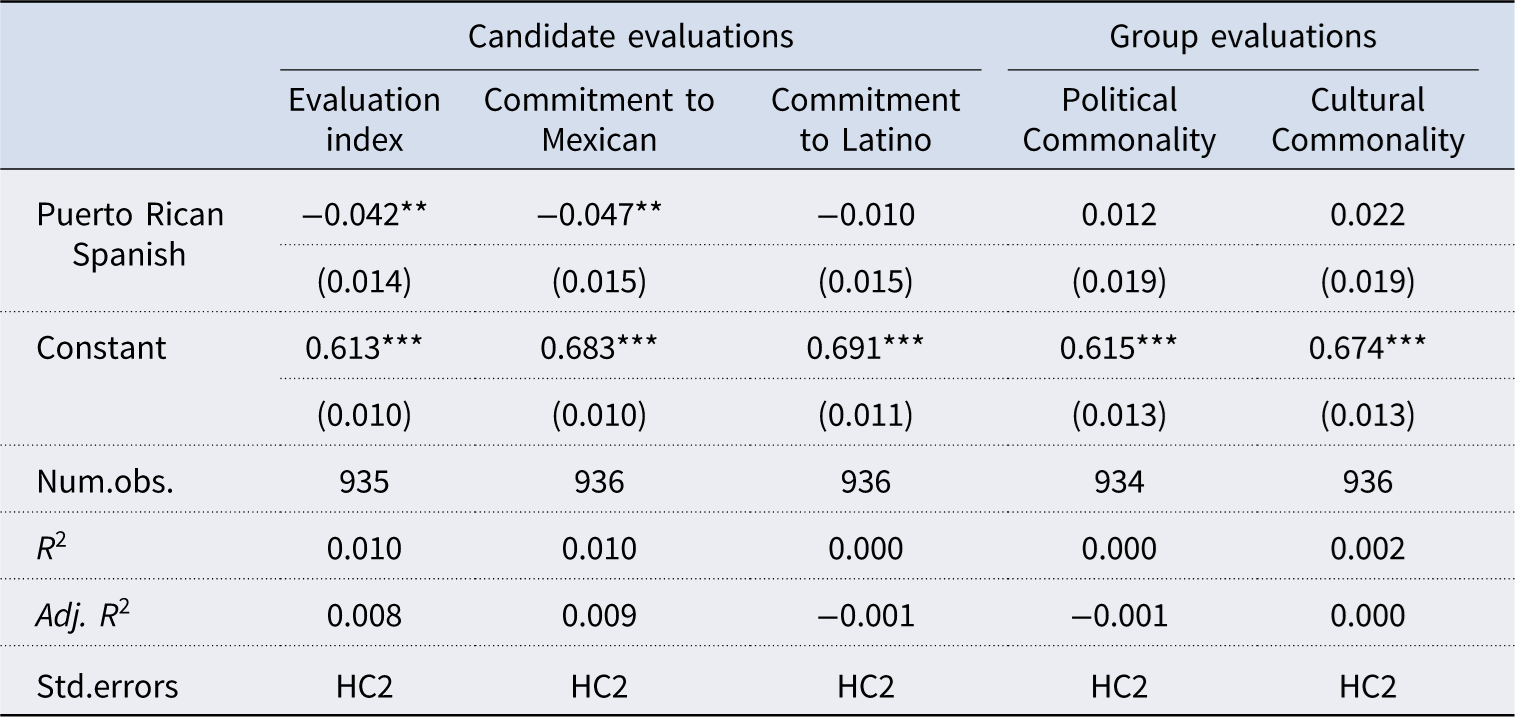
Table 3. Long description
The table presents a comparison of evaluations of candidate appeals in Spanish with different accents. It has 6 columns and 5 rows. The columns are labeled as Evaluation index, Commit Mexican, Commit to Latino, Political similarity, and Cultural similarity. The rows are labeled as Puerto Rican Spanish and Constant. Each cell contains numerical values and standard errors in parentheses. The table also includes statistical measures such as Num.obs., R2, R2 Adj., and Std.errors at the bottom.
+ p < 0.1, *p < 0.05, **p < 0.01, ***p < 0.001.
Consistent with H1, Latino respondents of Mexican descent exposed to a Puerto Rican–accented Spanish-language appeal evaluated the candidate .042 scale points more negatively (p < .01) than those who heard the Mexican-accented appeal. Although modest in absolute terms, the magnitude of the effect aligns closely with prior work on Spanish-language candidate appeals (Flores and Coppock Reference Flores and Coppock2018; Zárate, Quezada-Llanes, and Armenta Reference Zárate, Quezada-Llanes and Armenta2024). For comparison, Zárate, Quezada-Llanes, and Armenta (Reference Zárate, Quezada-Llanes and Armenta2024) found that Spanish-language appeals increased candidate evaluations by roughly .04–.12 scale points. Our findings suggest that incongruent accent exposure can offset between one-third and the full effect of the symbolic benefits of a Spanish-language appeal. The magnitude also mirrors research showing lower support for Latino candidates from different national origin groups (Cuevas-Molina and Nteta Reference Cuevas-Molina and Nteta2023). The opt-in, online sample also underrepresents first-generation Latinos (9.9% of the sample). As a result, our estimates may be conservative because immigrant Latinos tend to have higher rates of Spanish use and may be more responsive to linguistic cues. As such, the effect of accent mismatch could be even larger in a more representative sample.
Beyond general candidate evaluations, exposure to an incongruent Spanish accent significantly reduced perceptions of the candidate’s commitment to the Mexican-American community. Respondents in the incongruent condition rated the candidate’s subgroup commitment .047 scale points lower than those in the congruent accent condition (p < .01). By contrast, the treatment had no statistically significant effect on perceived commitment to Latinos as a whole (β = −.01; p = .519). These results support H1 and reinforce our theoretical claim that the symbolic power of Spanish-language appeals, rooted in perceptions of community connections, is disrupted when the accent signals out-group membership.
The null results for panethnic commitment are theoretically consistent with this logic. If accents primarily cue national origin identity, subgroup commitment should be more directly affected because it reflects perceptions of representation for a specific community, where the potential for competing group interests is more salient. Panethnic commitment, by contrast, involves broader, more diffuse notions of inclusion that are less sensitive to linguistic markers of subgroup belonging. Incongruent accents therefore may activate perceptions of subgroup boundaries and competing subgroup interests rather than shifting attitudes about panethnic representation. When voters interpret Spanish-language appeals as signals of a candidate’s cultural ties and willingness to advocate for their community, an incongruent accent can highlight cultural and linguistic differences that weaken that representational signal. A Puerto Rican–accented appeal from a candidate perceived to be outside the respondent’s national origin group may therefore diminish the intended sense of shared identity and political recognition.
We next examined whether exposure to an out-group accent shifts perceptions of political and cultural commonality with Latinos overall ( H2 ). Table 3 reports these results. Across both cultural and political commonality outcomes, we find no statistically significant effect of the treatment (β = .022; p = .235; β = .012; p = .535, respectively). The right panel of Figure 2 visualizes these null effects. Together, the results suggest that while accent incongruence alters candidate-specific evaluations, it does not meaningfully affect respondents’ broader sense of Latino panethnic commonality. This finding is theoretically informative, suggesting that accent cues may operate more proximately as an informational signal about subgroup representation rather than panethnic identity more broadly. Voters may interpret an incongruent accent as evidence that the candidate may not speak for their particular community, without that inference extending to how they see Latinos as a whole. Panethnic identity, as a broader and more durable attachment, appears less sensitive to a single linguistic cue than candidate evaluations.
Given that we find no support for accent incongruence’s predicted impact on perceptions of group commonality ( H2 ), we assess the robustness of these null results following the framework proposed by Kane (Reference Kane2025). Null results can stem from design or implementation failures, rather than a true lack of effect, so we conducted a series of diagnostic checks and equivalence tests summarized in SI.B. These diagnostics rule out plausible alternative explanations and strengthen confidence that the null findings reflect a genuine absence of effects rather than a methodological artifact.
Treatment Heterogeneity: Spanish-Language Proficiency and Identity Strength
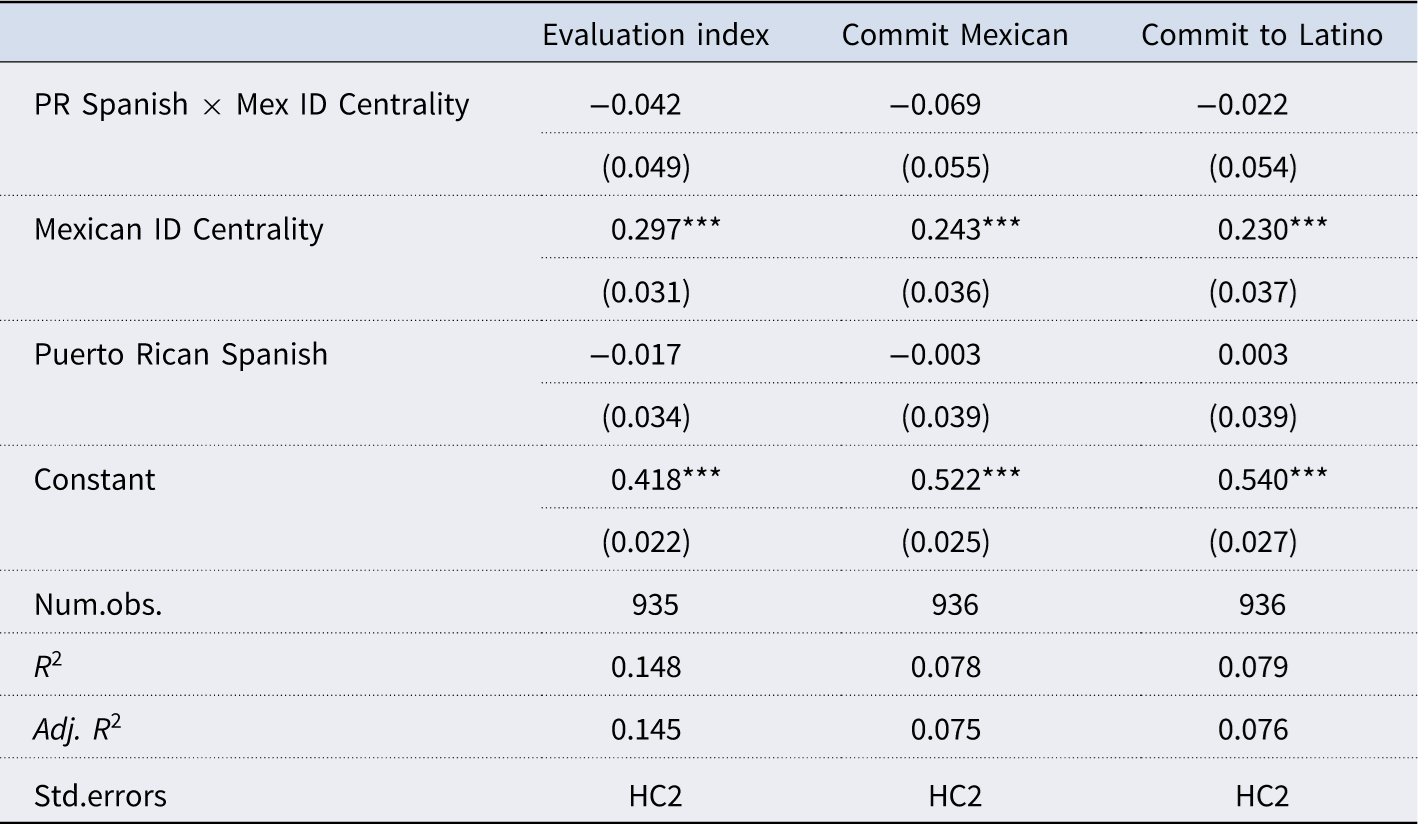
Not all respondents may perceive or interpret accent cues to the same degree. We therefore tested whether treatment effects vary by national origin identity strength ( H1a ) and Spanish-language proficiency ( H1b ). These analyses were preregistered alongside the main hypotheses, but because the study was powered to detect main effects rather than interaction effects, the results below should be interpreted with appropriate caution. Interaction models were estimated separately for each moderator and are summarized in Tables 4 and 5.
Identity strength interaction models
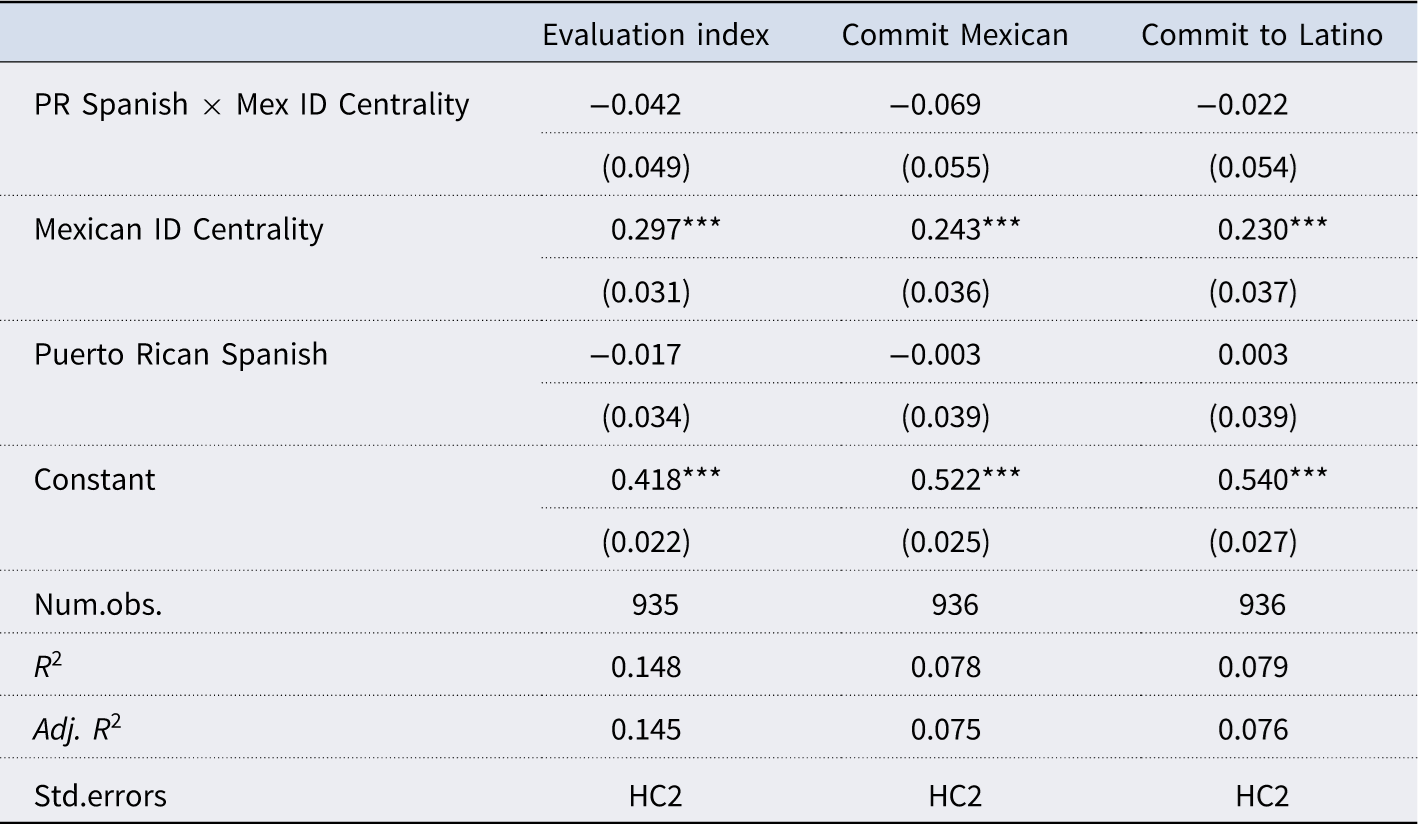
Table 4. Long description
A table with three columns and seven rows, comparing evaluation indexes and identity centrality measures. The columns are labeled Evaluation index, Commit Mexican, and Commit to Latino. The rows include PR Spanish × Mex ID Centrality, Mexican ID centrality, Puerto Rican Spanish, Constant, Num.obs., R2, R2 Adj., and Std.errors. Each cell contains numerical values and standard errors in parentheses. Notable trends include significant values for Mexican ID centrality and Constant across all columns.
+ p < 0.1, *p < 0.05, **p < 0.01, ***p < 0.001.
Spanish proficiency interaction models
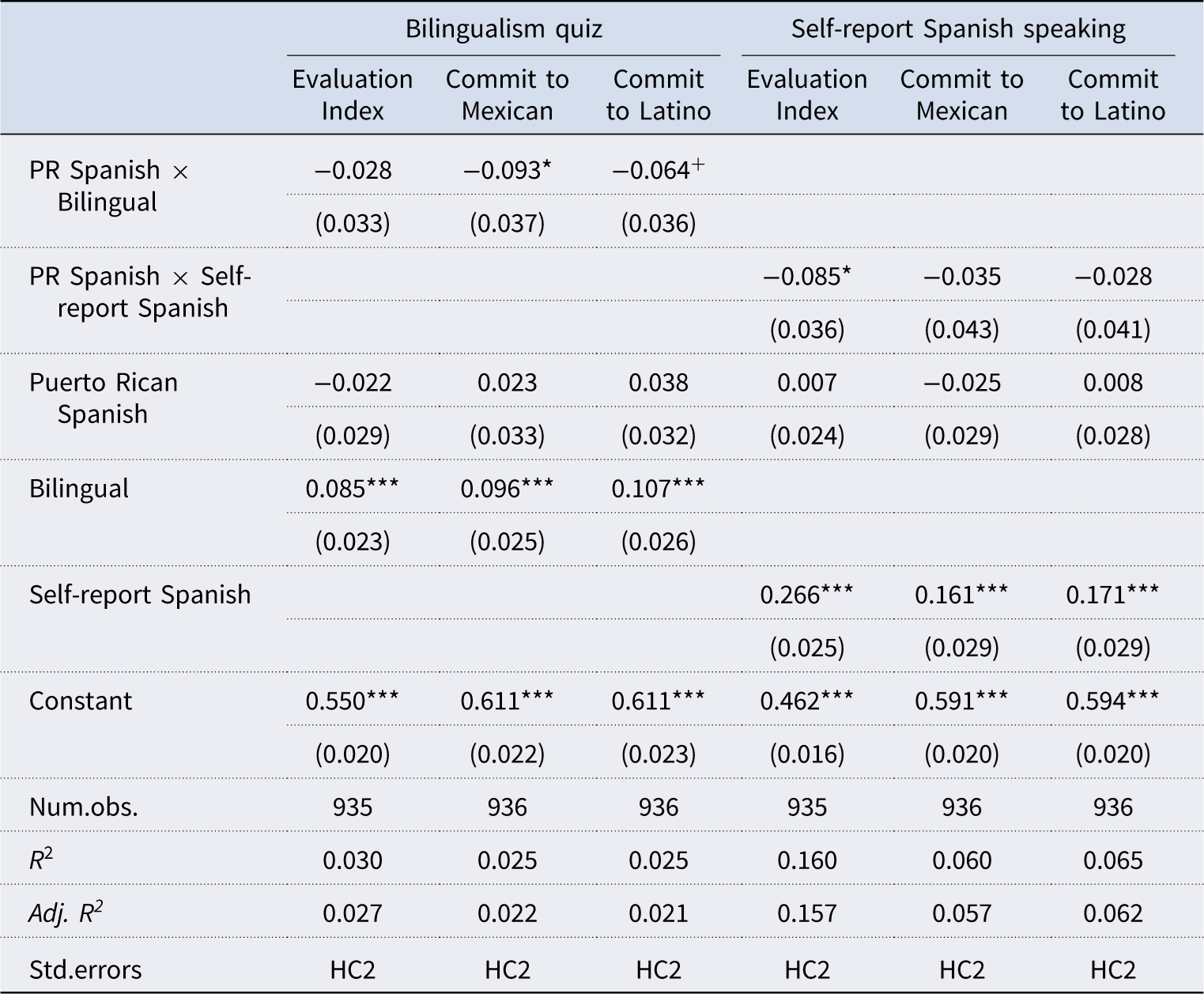
Table 5. Long description
The table presents data on bilingual interaction models, focusing on the evaluation index, commitment to Mexican, and commitment to Latino across different variables. It includes rows for PR Spanish x Bilingual, PR Spanish x Self-report Spanish, Puerto Rican Spanish, Bilingual, and Self-report Spanish. Each row contains values for these variables, along with standard errors in parentheses. The table also includes a constant row and summary statistics such as the number of observations, R-squared values, adjusted R-squared values, and standard errors. The data is organized into two main sections: Bilingualism quiz and Self-report Spanish speaking, each with three columns. Notable values include significant results marked with asterisks, indicating varying levels of statistical significance.
+ p < 0.1, *p < 0.05, **p < 0.01, ***p < 0.001.
Contrary to H1a, we find no evidence that national origin identity strength moderates the effect of accent incongruence. The coefficients for the interaction are correctly signed—indicating stronger negative reactions among respondents with stronger Mexican identity—but they are substantively small and not statistically significant. The null findings may reflect a ceiling effect: overall, 58% of respondents describe their Mexican identity as “very” or “extremely” important to how they see themselves, while only 17% describe it as “not at all” or “slightly” important, leaving little variation to capture heterogeneity.
Results for H1b provide mixed evidence. Across outcomes, the interaction coefficients for Spanish proficiency are negatively signed, consistent with expectations that more proficient speakers are more sensitive to accent differences, but they do not consistently reach significance thresholds. Substantively, respondents with greater Spanish ability tended to evaluate incongruent accent appeals more negatively.
Discussion and Conclusion
As the Latino electorate grows, Spanish-language appeals have become a routine campaign strategy. Yet the assumption that Spanish functions as a straightforward panethnic cue overlooks the internal diversity of the Latino community. This is not a purely academic intuition—political campaigns have begun to recognize the electoral potential of hyper-targeted Latino outreach to specific origin groups that uses culturally specific referents, including accents. Our results demonstrate that Spanish-language appeals operate through a dual-cue logic. They can signal panethnic identity while also activating subgroup identity through accent. This duality complicates the logic behind panethnic appeals, since a Spanish-language message may not simply convey familiarity with or commitment to Latinos as a whole but may also foreground intra-Latino heterogeneity when the accent is incongruent, thereby undermining the intended benefits of the appeal. In our experiment, respondents exposed to a campaign ad with an incongruent accent evaluated the candidate less positively and perceived weaker commitment to the Mexican-American community. These effects are modest but consistent with prior work on Spanish-language appeals and highlight the risk of accent incongruence undermining the symbolic benefit of such outreach. At the same time, we find that perceptions of panethnic identity were unaffected.
These findings highlight the importance of attending to the nuances of Spanish beyond questions of proficiency. In homogeneous Latino constituencies, candidates are likely to benefit from using the accent most familiar to the majority. The challenge is greater in heterogeneous Latino constituencies, where the choice of accent risks alienating some subgroups even as it appeals to others, raising difficult strategic questions for campaigns attempting to build panethnic coalitions. If a candidate is Latino, their national origin is fixed, so we are not suggesting that candidates adapt how they speak, but rather that they be aware of the possible consequences among electorates of different origins and consider using multiple Spanish speakers with different accents when possible.
Additionally, voter calculations reflect a bundle of information that extends well beyond accent alone. While our treatment was intentionally sparse to isolate the accent effect and was modeled on a real campaign ad, voters in the real world encounter accent alongside policy positions, candidate biography, and other cues. Rather than being drowned out, accent likely interacts with this broader information environment: a mismatched accent may compound with policy misalignment or be partially offset by policy congruence. How accent compares to and interacts with other informational cues remains an empirical question for future work.
While these results advance our understanding of the links between politics, language, and identity, there are important limitations that point to fruitful directions for future research. Our sample is older, more educated, and underrepresents first-generation respondents. Because first-generation Latinos are more likely to speak Spanish, value Spanish-language outreach, and recognize accent incongruence, our results may be a conservative estimate of the true effect. We also restrict the sample to Mexican-origin Latinos. This choice strengthens internal validity by focusing on a clear in-group/out-group contrast, but it limits generalizability. Mexicans comprise the majority of Latinos in the United States (59% according to the American Community Survey (ACS)), yet other groups may respond differently to incongruent accents. As the largest subgroup, Mexicans may react differently than smaller groups accustomed to being in the minority. Reactions may also depend on demographic context. Living in more diverse or homogeneous Latino neighborhoods shapes exposure to different Spanish accents and may influence responses. Future work should explore these nuances to better understand the complex link between language, identity, and politics.
As the Latino community continues to diversify and grow, understanding how linguistic cues operate is increasingly important. Our results suggest that while Spanish-language appeals can connect with Latino voters, their effectiveness depends in part on the alignment of accent with subgroup identities. Accents thus complicate the presumed benefits of Spanish-language panethnic appeals, highlighting the complexity of Latino panethnicity in the United States.
Supplementary material
The supplementary material for this article can be found at https://doi.org/10.1017/rep.2026.10103.
Data availability statement
Replication data and code for this article is available on Harvard Dataverse at https://dataverse.harvard.edu/dataset.xhtml?persistentId=doi:10.7910/DVN/ONBHA9.
Acknowledgments
The authors would like to thank Ariel White, Joseph Loffredo, Gabrielle Péloquin-Skulski, Preston Johnston, and Clemente T. Sánchez for their feedback and assistance throughout the research and writing process. We also thank participants at the 2024 MPSA and APSA conferences and MIT’s Political Experiments Research Lab workshops for their helpful comments.
Funding statement
The authors received no external funding for this research.
Competing interests
The authors do not acknowledge any relevant conflict of interest.



 Open access

