


Introduction
Dialectical behaviour therapy (DBT) is an evidence-based psychological intervention for borderline personality disorder (BPD) or pervasive and problematic personality traits, and it was initially created for individuals with chronic suicidality and self-harming behaviours (Linehan, Reference Linehan1993). However, there is emerging evidence that supports DBT as a treatment for emotion regulation difficulties, which is the aim of the treatment in this service evaluation (Harvey et al., Reference Harvey, Hunt and White2019).
DBT draws on the biosocial theory and has a weighted focus on behavioural science, acceptance principles and dialectical philosophy with a core treatment target of emotion regulation. Comprehensive DBT is delivered through four core modes and one ancillary component. Individual psychotherapy involves weekly 60-minute sessions focused on applying skills to current difficulties, enhancing motivation, managing crises, and reducing therapy-interfering behaviours. Skills training groups provide weekly 1.5–2.5 hour classes that teach mindfulness, distress tolerance, emotion regulation, and interpersonal effectiveness. Telephone coaching offers brief, between-session coaching to help clients apply skills in real-time situations and generalise them to daily life. Therapist consultation teams meet weekly to support clinicians, maintain adherence to the DBT model, and reduce burnout when working with complex presentations.
In addition, DBT includes case management strategies, in which the therapist helps clients navigate environmental demands and coordinate other necessary treatments, such as medication management or social care support (Linehan, Reference Linehan1993). For the purpose of this service evaluation, we will be looking at an adapted 16-week DBT skills training programme as a standalone intervention for emotion dysregulation.
DBT has a strong empirical foundation, with numerous randomised controlled trials demonstrating significant reductions in self‑harm, suicide attempts, hospitalisation, and emotional distress among individuals with BPD (Linehan, Reference Linehan1991; Koons et al., Reference Koons, Robins, Tweed, Lynch, Gonzalez, Morse, Bishop, Butterfield and Bastian2001; Linehan et al., Reference Linehan, Comtois, Murray, Brown, Gallop, Heard, Korslund, Tutek, Reynolds and Lindenboim2006). More recent meta-analytic reviews continue to support DBT’s effectiveness across diverse clinical populations, reinforcing its status as an evidence‑based intervention.
The Cambridgeshire and Peterborough NHS Foundation Trust (CPFT) is currently experiencing significant challenges due to a substantial growth in mental health service demand across the region. CPFT serves a population of approximately one million people, and it is estimated that 12.16% of this population may experience difficulties associated with personality disorders, including emotion dysregulation (Volkert et al., Reference Volkert, Gablonski and Rabung2018). In 2024 alone, the Relational and Emotional Difficulties Service (REDS) received 3330 referrals, despite having the capacity to provide treatment for only 520 individuals. Considering this growing demand and limited capacity, increasing group size within REDS is being explored as a viable approach to expand access. By safely accommodating more participants per group, the aim is to maximise available resources, reduce waiting times, and provide intervention to more people to meet the mental health needs of the population effectively, without compromising the quality of the service.
In addition to the pressures faced within CPFT, national data suggest that these challenges reflect a wider trend across NHS mental health services. Recent CQC reports (Care Quality Commission, 2023) highlight escalating demand, lengthening waiting times, and persistent gaps in system-wide support, emphasising the need for efficient and scalable interventions such as DBT skills training.
Evidence supporting DBT skills training as a standalone treatment
A limited but growing body of research has examined DBT skills training as a standalone intervention, separate from comprehensive DBT. It is also being increasingly recognised as an effective intervention for improving mental health symptomology across a range of clinical populations. DBT skills training focuses on teaching core skills in mindfulness, distress tolerance, emotion regulation and interpersonal effectiveness without the additional components of comprehensive DBT.
A systematic review by Valentine et al. (Reference Valentine, Bankoff, Poulin, Reidler and Pantalone2015) reported improvements in emotion regulation difficulties and problematic behaviours, while also highlighting the need for further research due to the limited number of randomised controlled trials.
Supporting this, Lyng et al. (Reference Lyng, Swales, Hastings, Millar, Duffy and Booth2019) found that standalone DBT skills training and comprehensive DBT produced comparable improvements in participant symptoms, indicating that skills-only formats can provide effective treatment. Similarly, McMain et al. (Reference McMain, Guimond, Barnhart, Habinski and Streiner2016) observed improvements in emotion regulation and reductions in suicidal thoughts following a short-term DBT skills intervention compared with the control group.
Further evidence from Kells et al. (Reference Kells, Joyce, Flynn, Spillane and Hayes2020) suggests that standalone DBT skills groups are particularly effective for individuals experiencing emotion dysregulation who are not actively self-harming or displaying suicidal behaviours. Collectively, these findings indicate that standalone DBT skills training offers a practical, evidence-based option for addressing growing demand in stretched mental health services.
Group-based psychological interventions
Group-based interventions are widely used across psychological services and have become a central method for delivering treatment for a broad range of mental health difficulties. These interventions offer numerous advantages including cost-effectiveness, opportunities for interpersonal learning, and the therapeutic value of shared experiences (Lee and Arora, Reference Lee and Arora2023).
Yalom and Leszcz (Reference Yalom and Leszcz2020) identified key therapeutic factors in group settings – universality, altruism, and group cohesion – which they argue are fundamental to fostering positive therapeutic outcomes across various group formats. These factors help to create a sense of connection, supportiveness and trust. Although Yalom’s framework is well-cited and supported by empirical evidence, it is primarily based on therapy groups. As such, it may not fully capture the dynamics of more structured, psychological group interventions, such as those used in dialectical behaviour therapy (DBT). This limitation raises concerns regarding the generalisability of these factors and underscores the need for further research into group dynamics in different therapeutic models.
Empirical research also supports the effectiveness of group-based interventions across mental health conditions. For example, meta-analyses have demonstrated that structured group interventions can produce significant improvements in depression, anxiety, and emotional regulation (Burlingame et al., Reference Burlingame, Strauss, Joyce and Lambert2013; McDermut et al., Reference McDermut, Miller and Brown2001), highlighting the therapeutic value of group processes beyond theoretical frameworks.
Group structure and outcomes
Group structure ‒ particularly group size ‒ is consistently identified throughout the literature as an important factor influencing therapeutic outcomes. A meta-analysis by Burlingame et al. (Reference Burlingame, Fuhriman and Mosier2003) examined how group characteristics affect treatment efficacy, concluding that optimal group size typically falls between six and 12 participants. The authors suggested that larger groups may hinder individual participation and limit opportunities for peer interaction. It is important to consider the context of much of the existing research. For instance, a large proportion of the data in Burlingame et al.’s (Reference Burlingame, Fuhriman and Mosier2003) meta-analysis was derived from university counselling centres, which may not reflect the broader age range and diversity of populations treated within the UK’s Nation Health Service (NHS).
Corey (Reference Corey2011) further contends that determining optimal group size is not straightforward, as it depends on several contextual factors, including participant age, facilitator experience, and the nature of the psychological difficulties being addressed. Corey recommends a ratio of 1:8, emphasising that each participant should have the opportunity to meaningfully contribute throughout the group.
In addition to the broader literature on DBT skills training, emerging research has begun to examine how group size influences outcomes in structured psychological interventions. Twomey and Dowling, (Reference Twomey and Dowling2025) provide a comprehensive synthesis of skills‑based and manualised group programmes, including DBT‑informed interventions, and report little consistent evidence that smaller groups confer superior outcomes compared with larger ones. Their review further notes that several DBT skills studies demonstrate comparable effectiveness across different group sizes, suggesting that structured, skills‑focused interventions may be less sensitive to variations in group size than more process‑oriented therapies. This evolving evidence base offers important context for the present evaluation, which focuses specifically on group size within a 12‑week DBT skills programme rather than the full DBT model.
Manualised therapies and group size
Research into other manualised treatments such as cognitive behavioural therapy (CBT) and mentalisation-based treatment (MBT) provide additional insight into how group size may influence treatment outcomes. These models, which also include structured content and skill acquisition, share some similarities with DBT in format and delivery.
For example, McDermut et al. (Reference McDermut, Miller and Brown2001) conducted a meta-analysis of group interventions for depression and found that groups with 8‒10 participants were associated with better clinical outcomes, improved engagement, stronger peer connections and more consistent attendance. However, the authors cautioned that further research is needed in real-world settings to validate these findings, limiting their direct applicability to NHS contexts.
Similarly, Bateman and Fonagy (Reference Bateman and Fonagy2016) reported an association between smaller group sizes (8–9 participants) and therapeutic benefit including enhanced interaction, increased participation and improved group alliance. Whilst these findings suggest smaller groups may facilitate more effective learning and therapeutic processes, they are not specific to DBT. Moreover, although DBT skills training does involve active participation, they may rely less heavily on interpersonal process and more on structured content delivery compared with other group therapies.
Theoretical processes affected by group size
Group size may also influence key therapeutic processes that underpin the effectiveness group-based treatments. Group cohesion, therapeutic alliance, and peer-to-peer sharing are all considered central mechanisms contributing to successful outcomes. Burlingame et al. (Reference Burlingame, MacKenzie and Strauss2004) argued that smaller groups are more conducive to creating a safe trusting environment that fosters meaningful engagement and group cohesion. Increased group cohesion has been consistently linked to better outcomes in psychotherapy as it increases openness, accountability and mutual support.
Joyce et al. (Reference Joyce, Piper and Ogrodniczuk2007) similarly highlighted the role of therapeutic alliance in groups, noting that in larger groups, alliance may be diluted – both between participants and between participants and facilitators – potentially diminishing treatment effectiveness.
Importantly, evidence from comprehensive DBT also demonstrates that therapeutic alliance is a meaningful predictor of clinical outcomes. For example, Bedics et al. (Reference Bedics, Atkins, Harned and Linehan2015) found that client and therapist ratings of alliance predicted reductions in suicidal behaviour and non-suicidal self-injury during DBT, supporting the theoretical view that a strong alliance enhances treatment outcomes in this model. This suggests that although DBT skills training involves more structured, content focused interactions, alliance-related processes may still play a significant role in how participants engage with skills and apply them outside of sessions.
While it is reasonable to hypothesise that excessively large group sizes could undermine individual participation and reduce opportunities for meaningful feedback, there is currently no empirical consensus on what constitutes as an ‘excessive’ number of participants in this context.
Beyond theoretical mechanisms, empirical evidence consistently shows that therapeutic alliance is a robust predictor of treatment outcome in group and individual psychotherapy. In DBT specifically, stronger client- and therapist-rated alliance predicts reductions in suicide attempts and non-suicidal self-injury (Bedics et al., Reference Bedics, Atkins, Harned and Linehan2015), underscoring the clinical importance of alliance in structured skills-based settings.
Application to DBT and rationale for current evaluation
Despite DBT’s strong evidence base as a treatment for individuals with emotional regulation difficulties, there remains a notable lack of research examining how group size affects outcomes within DBT skills training. DBT skills training is a highly structured intervention delivered in a taught format, supported by behavioural rehearsal and in-session skills coaching.
Given this structured, curriculum‑driven approach, the impact of group size may differ from that observed in more process‑oriented therapy groups. Nevertheless, effective engagement, participation, and skills practice remain vital. Larger group sizes could hinder these processes by limiting individual contributions, reducing facilitator responsiveness, and restricting group cohesion.
Linehan (Reference Linehan1993) offers minimal guidance on optimal group size, beyond suggesting that groups should be manageable and allow for active skills coaching and stating that in acutely dysregulated clients it is advised to have between 6 and 8 in a group (Linehan, Reference Linehan2015; p. 31). As services face increasing demand and pressure to accommodate more service users, the decision to expand DBT skills training group sizes from 12 to 20 participants raises important questions about how such structural changes might affect client experience, engagement, and outcomes.
Given the absence of research examining whether DBT skills training outcomes vary by group size, a comparative service evaluation was undertaken. This project was conceptualised as an evaluation of the feasibility of delivering standalone DBT skills training groups in larger formats within routine NHS practice. Feasibility was operationalised as the extent to which larger groups produced clinical outcomes and retention comparable to those observed in standard–sized groups. Retention was examined descriptively through discontinuation rates as an indicator of participant engagement, rather than as a formal measure of acceptability.
By comparing routinely collected outcome data collected before and after the expansion in group size, this evaluation aimed to generate preliminary feasibility signals to inform local service–level decision–making and contribute to the limited evidence base on DBT provision in real–world NHS settings.
The evaluation was guided by two questions:
-
(1) Does increasing DBT skills training group size affect treatment outcomes, as measured by change in DERS–18 total scores from pre– to post–intervention?
-
(2) Does group size influence participant retention, as indicated by discontinuation (drop-out) rates between small (12–participant) and large (20–participant) DBT skills training groups?
Method
Participants
Between May 2023 and October 2024, 302 individuals enrolled in the Making Connections programme were invited to complete outcome measures. Of these, 206 participants (68.2%) met the inclusion criterion of providing both pre‑ and post‑group data.
Inclusion criteria
-
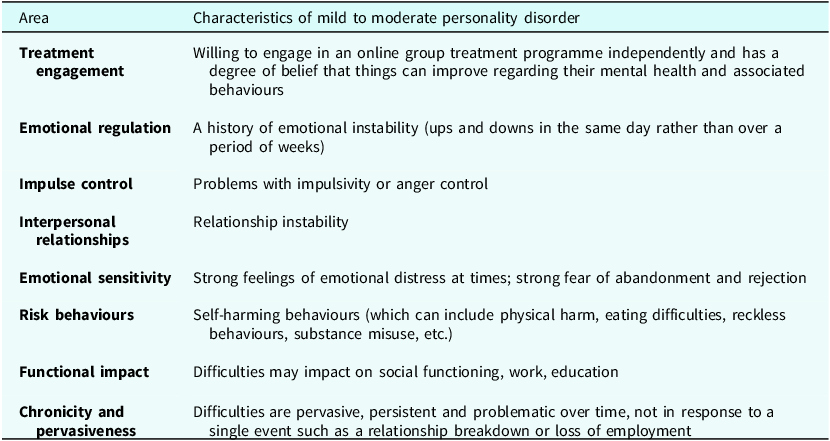
(1) Receiving or awaiting treatment from the REDS and therefore meeting standard REDS referral criteria (see Table 1).
-
(2) Completion of both pre- and post-group outcome measures.
Referral criteria for REDS

Table 1. Long description
A table with two columns and nine rows. The first column lists areas of concern, and the second column describes the characteristics of mild to moderate personality disorder for each area. The areas include treatment engagement, emotional regulation, impulse control, interpersonal relationships, emotional sensitivity, risk behaviors, functional impact, and chronicity and pervasiveness. Each row provides specific details about the characteristics associated with each area.
Demographics
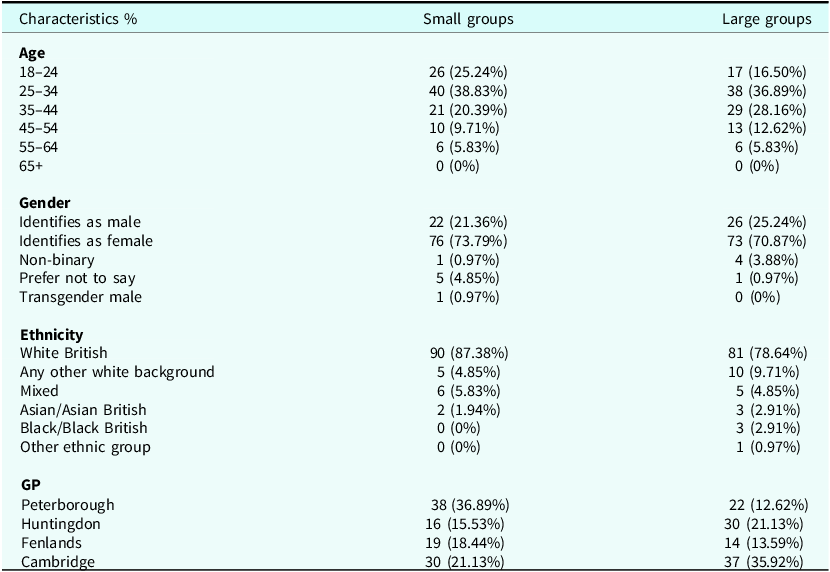
Most participants were aged between 18 and 44 years old (small groups: M = 33.09, SD = 10.82; large groups: M = 35.19, SD = 10.52). The sample predominantly identified as female and White British, with additional representation across other ethnic groups. GP registration was used to infer area of residence, with most participants living within Cambridge (Table 2).
Demographics and characteristics of individuals within each group

Table 2. Long description
The table compares demographics and characteristics of individuals in small and large groups across various categories. It has 15 rows and 3 columns. The columns are labeled Characteristics %, Small groups, and Large groups. The rows are grouped into Age, Gender, Ethnicity, and GP. Each row lists specific categories within these groups along with corresponding percentages for small and large groups. For example, under Age, the categories range from 18-24 to 65+, with percentages provided for each age group in both small and large groups. Under Gender, categories include Identifies as male, Identifies as female, Non-binary, Prefer not to say, and Transgender male, with respective percentages. Ethnicity categories include White British, Any other white background, Mixed, Asian/Asian British, Black/Black British, and Other ethnic group, with percentages for each in small and large groups. GP categories include Peterborough, Huntingdon, Fenlands, and Cambridge, with percentages for each location in both small and large groups.
Design and materials
A between-subjects design examined whether group size (small vs large) influenced treatment effectiveness. Group size thresholds were determined by service capacity: 12 participants reflected the historical standard, whereas 20 represented the expanded maximum considered clinically and administratively manageable. Treatment effectiveness was assessed using validated outcome measures.
Measures
Difficulties in Emotion Regulation Scale-Short Form (DERS-18)
The primary outcome measure was the Difficulties in Emotion Regulation Scale-Short Form (DERS-18; Victor and Klonsky, Reference Victor and Klonsky2016), routinely collected within REDS. The DERS-18 assesses six domains of emotion regulation: Non-acceptance of Emotional Responses, Difficulties Engaging in Goal-Directed Behaviour, Impulse Control Difficulties, Lack of Emotional Awareness, Limited Access to Emotion Regulation Strategies, and Lack of Emotional Clarity. Items are rated on a 5-point Likert scale ranging from ‘almost never’ to ‘almost always’ with some items reverse scored. Total and subscale scores were calculated for the DERS, with higher scores indicating greater difficulty with emotion regulation. Consistent with our analytic aims, only the total score was analysed, and subscale scores were not included in subsequent analyses. Example items include: ‘I have difficulty making sense out of my feelings’ and ‘When I’m upset, I feel guilty for feeling that way’.
Procedure
Service context
REDS is a primary-care-facing community NHS service supporting adults with problematic, persistent and pervasive emotion regulation difficulties. Prior to the evaluation period, demand for DBT support exceeded capacity, resulting in extended waiting times. A large group format was introduced to (a) reduce waiting times and (b) to enable the service to accommodate the volume of incoming referrals without substantially diminishing the scope or quality of the treatment offered.
Service job plan reviews indicated that groups of up to 20 participants were feasible within existing staffing. This limit reflected not only facilitation time, but also the substantial administrative and safeguarding workload associated with group delivery. The evaluation therefore reflects real-world service delivery rather than controlled research conditions.
Intervention
Making Connections is the REDS DBT skills programme, delivered in line with Linehan’s (Reference Linehan2015) core principles. Groups met online for 2-hour sessions, with a small break, over 16 weeks. The programme consisted of 12 sessions organised into three session modules: Distress Tolerance, Emotion Regulation, and Interpersonal Effectiveness, with mindfulness integrated throughout. Distress Tolerance emphasises crisis survival strategies and methods for managing acute emotional distress; Emotion Regulation focuses on developing understanding of emotional experiences and enhancing positive affect; and Interpersonal Effectiveness targets assertiveness, boundary setting, and maintaining relationships while preserving self-respect. Each session included a brief mindfulness exercise ‒ such as one mindfully making a drink, a body scan, or visually tracking shapes in the room ‒ selected to reinforce the DBT what skills (observe, describe, participate) and how skills (non-judgmentally, one mindfully, effectively). These practices were aligned with the session’s focus to support rehearsal of core mindfulness behaviours and promote generalisation to daily life.
Participants could access optional telephone coaching during office hours, for up to 15 minutes per week, arranged as needed. Unlike standard DBT, where telephone coaching often supports individuals in crisis, the REDS model emphasised its use for applying skills in daily life to strengthen their learning. Those requiring urgent support were directed to the local First Response Service (FRS), whose staff have received training in DBT skills.
Group delivery format
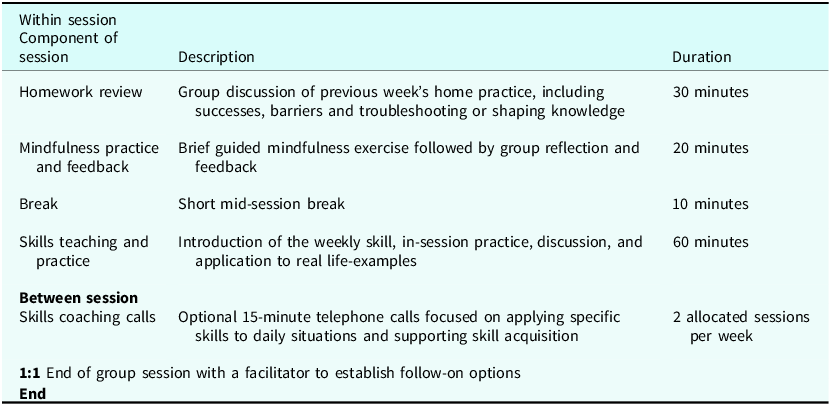
Groups were delivered via Microsoft Teams by DBT-trained clinicians, with three facilitators per group regardless of size. Sessions followed a standardised structure (see Table 3) including skills teaching, guided practice, discussion, and weekly home practice tasks which involve practising the skills taught in session.
Structure of the ‘Making Connections’ skills group sessions

Table 3. Long description
A table detailing the structure of group sessions, divided into within session and between session components. The table has three columns: Component of session, Description, and Duration. Within session components include Homework review with a 30-minute duration, Mindfulness practice and feedback with a 20-minute duration, Break with a 10-minute duration, and Skills teaching and practice with a 60-minute duration. Between session components include Skills coaching calls with 2 allocated sessions per week. The table provides a clear breakdown of the activities and their respective times.
Group size expansion
The service operated a rolling-entry model, enabling participants to join at the start of any module. Internal evaluation has shown no differences in outcomes based on module order. To meet rising demand, group sizes were gradually increased from 12 to 20 during the evaluation period. Allocation reflected service flow rather than participant preference.
Participants missing three sessions within a module were discharged unless extenuating circumstances applied, and all discharged participants were included in discontinuation rates.
Data collection
Pre- and post-intervention psychometric data were collected as part of routine outcome monitoring within the service. Participants completed the DERS-18 at the start of the DBT skills group and again at the end of their final session. Demographic information (age, gender, ethnicity, registered GP) was collected alongside the measures. All data were stored in a password-protected spreadsheet, with access restricted to authorised personnel.
Completion of psychometric measures
Participants received links to the standardised measures and were sent reminders if incomplete. Additional prompts were given during the first group session (pre-treatment) and during the individual review session at programme completion (post-treatment). Completion was encouraged but not mandatory, consistent with national patterns in NHS routine outcome monitoring (NHS England, 2023). Completion rates were similar across group sizes and reasons for non-completion were not recorded.
Data analysis
Analyses summarised demographic characteristics and examined pre- to post-treatment change on DERS-18 total scores. Raw score differences were calculated to assess treatment effectiveness. As REDS is a needs-led service, diagnostic information was not collected.
Retention
Drop-out was operationalised as discontinuation after treatment had begun, defined as missing three or four sessions within a module. Given the exploratory nature of the evaluation and modest sample sizes, discontinuation rates were examined descriptively rather than through inferential statistical testing. Percentages were compared across group sizes to identify any emerging patterns rather than to draw statistical conclusions.
Results
Baseline demographic differences
Baseline demographic characteristics were compared between participants allocated to small and large groups to assess equivalence prior to outcome analysis.
Gender
A chi‑square test of independence examined whether gender distribution differed between small and large groups. The association was not statistically significant (Pearson χ2 (4, N = 206) = 3.39, p = .494), indicating no evidence that gender composition varied by group size. Although 60% of cells had expected counts below five, reflecting the presence of smaller gender categories, the overall pattern suggests that gender distribution was comparable across the two group sizes at baseline.
Ethnicity
A chi‑square test examined whether ethnic background differed between small and large groups. The association was not statistically significant (Pearson χ2 (13, N = 206) = 14.77, p = .322), indicating no evidence that ethnicity was distributed differently across group sizes. Although a high proportion of cells had expected counts below five (85.7%) due to the number of detailed ethnicity categories, the overall pattern suggests that the two group sizes were broadly similar in terms of ethnic composition.
Age at intake
An independent‑samples t‑test was conducted to examine whether age at intake differed between participants in small versus large groups. The difference was not statistically significant (t 204 = −1.77, p = .079), indicating that the two group sizes did not differ meaningfully in age at the point of beginning treatment. The mean age difference between groups was small (−2.69 years), and the 95% confidence interval (−5.69 to 0.31) included zero, further supporting the conclusion that age at intake was comparable across groups.
Summary of demographic equivalence
Across gender, age, and ethnicity, no statistically significant differences were observed between small and large groups. Although sparse cells limited the precision of some categorical analyses, the consistent pattern of non‑significant findings suggests that the groups were demographically comparable at baseline, reducing the likelihood of confounding in subsequent outcome comparisons.
Comparison of outcomes between small and large groups
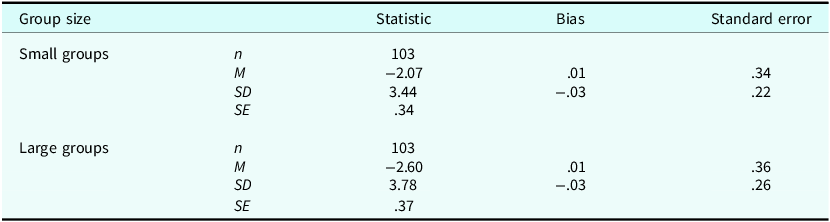
Visual inspection of DERS-18 score distributions suggested approximate normality (see Fig. 1), consistent with a mesokurtic distribution. The assumption of homogeneity of variance was tested using Levene’s test, and was non-significant (F 1,204 = 1.14, p = .287), indicating that the assumption was met and variances could be considered equal. Descriptive statistics for the outcome variable with group-specific statistics are shown in Table 4.
Descriptive statistics. A normal Q-Q plot demonstrating approximate normality of outcome data.

Group statistics

Table 4. Long description
A table comparing group statistics for small and large groups. The table has two main rows labeled Small groups and Large groups, each with four sub-rows for different statistics. Column headers are Group size, Statistic, Bias, and Standard error. For Small groups: n is 103, M is -2.07 with a bias of .01 and standard error of .34, SD is 3.44 with a bias of -.03, SE is .34. For Large groups: n is 103, M is -2.60 with a bias of .01 and standard error of .36, SD is 3.78 with a bias of -.03, SE is .37.
M, SD and SE represent mean, standard deviation and standard error of the mean.
An independent-samples t-test was conducted to compare DERS-18 outcome change scores (RCI) between small and large groups. There was no statistically significant difference in outcome scores for participants in small groups (M = ‒2.07, SD = 3.44) compared with those in large groups (M = ‒2.60, SD = 3.78), t 204 = ‒1.04, p = .300, d = 0.15, 95% CI [‒.47, 1.52]). Negative scores represent reductions in DERS-18 scores, indicating improvements in emotion regulation difficulties. This pattern suggests that participants in both small and large groups showed similar levels of improvement, and that group size did not have a meaningful impact on the degree of improvement.
A sensitivity power analysis indicated that with n = 206 (approximately 103 participants per group), α = .05 (two‑tailed), and power = .80, the study was sufficiently powered to detect effects in the small‑to‑medium range (approximately d = 0.40–0.50). The observed effect (d = 0.15) fell below this threshold, indicating that the study was not powered to detect effects of this magnitude (Fig. 2).
Mean change in DERS-18 scores by group size (±1SD). Negative values indicate improvement (reductions in difficulties with emotion regulation). No significant differences were observed between small (n = 103) and large (n = 103) groups.

Discontinuation rates
Discontinuation rates were 43% in larger groups and 36% in smaller groups. Although this difference was not statistically significant (p > .05) the study was under-powered to detect small effects, meaning the result is inconclusive rather than indicative of equivalence. The observed 7% absolute difference may still be clinically relevant: in practical terms, for every 100 participants entering a larger group, an additional seven did not complete compared with the smaller groups.
This pattern cannot be interpreted as evidence of a true effect and instead, represents a potential signal that merits further examination. When considered alongside the broader DBT literature, the discontinuation rates observed here (36–43%) fall within the range reported in routine clinical services. Meta analytic estimates suggest average attrition of approximately 25% in DBT programmes, but rates vary widely and are often substantially higher in real-world settings, with some NHS based evaluations reporting discontinuation rates approaching 50% (Dixon and Linardon, Reference Dixon and Linardon2020). The rates observed here are therefore consistent with comparable services.
Nonetheless, the possibility that larger groups may contribute to modest increases in attrition cannot be ruled out. Future research with adequate power and systematic recording of reasons for non‑completion is needed to clarify whether group size meaningfully influences retention.
Discussion
This service evaluation examined whether increasing DBT skills-training group size from 12 to 20 participants affected treatment outcomes or retention. No statistically significant differences were found in DERS-18 change scores or discontinuation rates between smaller and larger groups. These findings should be interpreted cautiously: the evaluation was not powered to detect very small effects, and the observed effect size fell below the detectable threshold. The primary conclusion supported by the data is therefore that, within this sample and context, no evidence of poorer outcomes in larger groups was identified. This does not demonstrate equivalence or confirm that DBT skills training is robust to variations in group size.
Baseline demographic equivalence between groups strengthens internal validity by reducing the likelihood that age, gender, or ethnicity confounded the comparison. However, demographic similarity does not eliminate the possibility of unmeasured confounding, particularly given the observational design. Factors such as baseline severity, motivation, readiness for change, or external support may have influenced outcomes independently of group size.
Understanding these findings requires consideration of how DBT skills training supports change. DBT is a structured, manualised intervention grounded in behavioural principles, acceptance-based strategies, and dialectical philosophy, with skills acquisition positioned as the central mechanism of change. Skills groups promote improvement through structured teaching, behavioural rehearsal, and generalisation to daily life, supported by group-based processes such as validation and peer modelling.
Although this evaluation did not collect process-level data, adjacent research suggests that DBT skills training may rely less on relational mechanisms than other group therapies. For example, Uliaszek et al. (Reference Uliaszek, Hamdullahpur, Chugani and Rashid2018) found that therapeutic alliance predicted symptom change in a Positive Psychotherapy group but not in a DBT skills group, despite higher alliance ratings in the latter. This pattern implies that DBT outcomes may be driven more by skills acquisition than by interpersonal or process-heavy mechanisms. If DBT skills training is less dependent on nuanced relational processes, this may help explain why increasing group size did not appear to diminish outcomes in this evaluation, although this interpretation remains tentative without mechanism level data.
These findings align with emerging evidence from structured and manualised group interventions more broadly. Research on CBT and MBT groups has often suggested that smaller groups may enhance interaction, participation, and alliance (Bateman and Fonagy, Reference Bateman and Fonagy2016; McDermut et al., Reference McDermut, Miller and Brown2001). However, these models rely more heavily on interpersonal process than DBT skills training. More recent evidence synthesised by Twomey et al. (2025) indicates that skills based and manualised group programmes, including DBT informed interventions, show little consistent evidence that smaller groups produce superior outcomes. Their review highlights that structured, skills-focused interventions may be less sensitive to variations in group size than process-oriented therapies. This broader literature supports the interpretation that DBT skills training, with its emphasis on psychoeducation and behavioural rehearsal, may tolerate larger groups without compromising outcomes.
The sensitivity analysis further contextualises the null findings. With the available sample size, the evaluation was powered to detect effects in the small to medium range (d ≈ 0.40–0.50), whereas the observed effect of group size on outcomes was small (d = 0.15). This suggests that any true effect of group size is likely to be subtle and below the detectable threshold of this evaluation. The absence of a statistically significant difference should therefore be interpreted as inconclusive rather than evidence that group size has no impact on outcomes.
The characteristics of the sample are important for interpreting the findings. Seventy-five per cent of participants were referred from primary care, a pathway typically associated with mild-to-moderate emotional difficulties and relatively stable day-to-day functioning. Baseline DERS-18 scores were consistent with this profile. DBT skills training has an emerging evidence base as a standalone intervention for individuals with emotion regulation difficulties who are not actively self-harming or suicidal (Kells et al., Reference Kells, Joyce, Flynn, Spillane and Hayes2020; Lyng et al., Reference Lyng, Swales, Hastings, Millar, Duffy and Booth2019; McMain et al., Reference McMain, Guimond, Barnhart, Habinski and Streiner2016; Valentine et al., Reference Valentine, Bankoff, Poulin, Reidler and Pantalone2015). This supports the relevance of the intervention for this cohort but limits generalisability: the findings may not extend to higher-acuity DBT populations or to services working with more complex presentations.
Discontinuation rates were broadly comparable between group sizes and consistent with other skills-only DBT services (e.g. Kells et al., Reference Kells, Joyce, Flynn, Spillane and Hayes2020). This is notable given that broader group-therapy literature often emphasises the risks associated with larger groups, such as reduced cohesion, limited participation, and diluted alliance (Burlingame et al., Reference Burlingame, Fuhriman and Mosier2003; Corey, Reference Corey2011; Yalom and Leszcz, Reference Yalom and Leszcz2020). DBT skills groups differ from more process oriented therapeutic models, relying less on interpersonal disclosure and more on structured, manualised content delivery. This distinction may help explain why larger groups did not show poorer outcomes in this evaluation. However, the absence of a difference does not imply that group size has no impact on retention; rather, it indicates only that within this specific service context, larger groups did not appear to exacerbate attrition. Because group size was determined by service pressures rather than random allocation, unmeasured confounding variables may have influenced outcomes independently of group size. Taken together with the outcome findings, the attrition data suggest that larger groups did not meaningfully compromise either retention or clinical improvement within this service context, although the study was not powered to detect small differences in retention.
Overall, the findings indicate that in this service, with this specific cohort and structure, larger DBT skills-only groups did not produce poorer outcomes. However, the observational design, limited representativeness of the sample, absence of process data, and potential for unmeasured confounding mean that no reliable conclusions can be drawn about whether DBT skills training is robust to variations in group size more broadly. The lack of empirical research examining group size specifically within DBT skills training remains a notable gap. Future research should incorporate clearer baseline characterisation, process level measures, and qualitative data to better understand how group size interacts with mechanisms of change and participant experience. Larger, prospective, or multi-site evaluations would also improve power and generalisability, enabling more robust conclusions about the impact of group size on DBT skills training.
Limitations
This evaluation relied solely on a self‑report measure of emotion regulation difficulties, without assessing skills use, behavioural change, or functional outcomes. Although the DERS‑18 is practical in NHS settings, self‑report data are vulnerable to bias and may reflect perceived rather than observable change. Including measures of DBT skills use (e.g. DBTWCCL), broader distress measures (e.g. PHQ-9, GAD-7, CORE-OM), functional impairment (e.g. WSAS), wellbeing (e.g. WHO-5), or behavioural indicators (e.g. crisis contacts, self‑harm) would have strengthened the evaluation.
Only participants with complete pre‑ and post‑intervention data were included, introducing potential bias by excluding those who disengaged or did not complete follow‑up. An intention‑to‑treat approach would reduce this bias but is often impractical in routine services. The absence of recorded reasons for non‑completion further limits interpretation of missing data.
Use of routinely collected service data also brings constraints in accuracy and consistency, and the lack of randomisation means group size changes may be confounded with temporal or cohort effects. The study was under-powered to detect very small effects; with a sample of 206, only small‑to‑medium effects were detectable. Non‑significant findings therefore cannot be taken as evidence of equivalence.
Finally, waiting‑time data were not available for analysis. Although the service observed increased throughput after expanding group size, the extent of any impact on waiting times cannot be quantified. Operational conclusions are therefore tentative. These limitations indicate that findings should be interpreted cautiously, and future research using prospective designs, multiple outcomes, and more controlled allocation is needed.
Future directions
Future research should examine more rigorously how group size affects DBT skills‑training outcomes, ideally using prospective or multi‑site designs with adequate power and procedures that minimise cohort or temporal confounding. Incorporating behavioural, functional, and skills‑use measures would provide a fuller picture of change beyond self‑report.
Investigating mechanisms of change is also important, including whether engagement, practice, or group processes vary by group size. Process‑level and qualitative data could clarify how participants and facilitators experience different group formats and whether factors such as cohesion or perceived safety shift with size.
Further work should assess the operational impact of larger groups, including effects on waiting times, sustainability, and any upper limits beyond which outcomes decline. Understanding facilitator workload and emotional demands will be key to evaluating long‑term feasibility.
Finally, research should explore whether certain participant characteristics predict who benefits most from larger online groups and who may require smaller settings. Implementation‑science frameworks may support evaluation of how adaptations such as increased group size interact with fidelity and sustainability.
Conclusion
This comparative service evaluation examined whether increasing DBT skills‑only group size from 12 to 20 participants affected clinical outcomes. No significant differences were found in emotion regulation improvements or discontinuation rates, suggesting that larger groups did not produce poorer outcomes within this service. However, the evaluation was under-powered to detect small effects, meaning the findings reflect an absence of evidence for harm rather than evidence that group size has no impact.
These results may support NHS services considering capacity expansion. Although waiting‑time data were not available, the lack of outcome differences suggests that larger groups may be feasible in routine practice. Any decision to increase group size should remain cautious and guided by ongoing monitoring of participant experience, facilitator workload, and clinical outcomes.
Future research should examine interactions between group size and delivery format, explore participant and facilitator experiences, and assess operational effects such as waiting times. Identifying characteristics that predict who benefits from larger versus smaller groups will also be important. Overall, while larger online groups did not appear to reduce effectiveness in this evaluation, further research is needed before drawing broader conclusions about scalability.
Key practice points
-
(1) Structured, skills-based group therapies may tolerate larger group sizes. This evaluation suggests that DBT skills training may be less sensitive to increases in group size than process-oriented therapies.
-
(2) Mechanisms of change matter when considering group size. DBT skills training appears to rely more on skills acquisition than on relational processes such as alliance or cohesion. This may help explain why larger groups did not show poorer outcomes, highlighting the importance of understanding mechanism‑specific sensitivity to group size.
-
(3) Findings may not generalise to higher‑acuity DBT populations. The sample primarily consisted of individuals with mild‑to‑moderate emotion regulation difficulties referred from primary care. Results may not extend to populations with active self‑harm, higher risk, or more complex presentations.
-
(4) Retention did not appear to worsen with larger groups. Discontinuation rates were similar across group sizes and consistent with other DBT skills‑only services. This challenges assumptions that larger groups necessarily reduce engagement, although the study was not powered to detect small differences.
Further reading
Readers wishing to explore this area further may find it most useful to begin with Linehan’s DBT Skills Training Manual (Reference Linehan2015; see also the updated iteration), which provides the clearest guidance on structuring and delivering DBT skills groups. Evidence syntheses focused specifically on DBT skills training, such as Valentine and colleagues’ systematic review (Valentine et al., Reference Valentine, Bankoff, Poulin, Reidler and Pantalone2015), offer additional insight into how group format and size relate to outcomes. Further empirical and conceptual work on DBT skills interventions (e.g. Kells et al., Reference Kells, Joyce, Flynn, Spillane and Hayes2020) can then be consulted depending on the reader’s interests. Broader literature on group processes (Burlingame et al., Reference Burlingame, Strauss, Joyce and Lambert2013; Yalom and Leszcz, Reference Yalom and Leszcz2020) may be helpful for contextual understanding, although it is less directly tied to decisions about DBT group size. For NHS practitioners, the NICE guideline for borderline personality disorder (NICE, 2009) remains a relevant over-arching reference.
Data availability statement
The datasets generated and/or analysed during the current study are not publicly available because they contain potentially identifiable clinical information. Data may be available from the corresponding author on reasonable request, subject to ethical approval and data protection requirements.
Acknowledgements
None.
Author contributions
Amanda Barton: Conceptualization-Lead, Methodology-Supporting, Project administration-Lead, Supervision-Lead, Validation-Equal, Visualization-Equal, Writing - original draft-Supporting, Writing - review & editing-Equal; Lauren Taisha Green: Data curation-Lead, Formal analysis-Lead, Methodology-Lead, Project administration-Equal, Writing - original draft-Equal, Writing - review & editing-Equal; Catherine Rudd: Formal analysis-Supporting, Investigation-Lead, Project administration-Equal, Writing - original draft-Equal, Writing - review & editing-Equal.
Financial support
This research received no specific grant from any funding agency, commercial or not-for-profit sectors.
Competing interests
All authors were employees of the service at the time of writing. Amanda Barton is the Consultant Clinical Psychologist and Clinical Lead for the REDS service. Lauren Taisha Green and Catherine Rudd are Assistant Psychologists and trained DBT group facilitators who led both the small and large groups included in the analysis.
Ethical standards
The authors have abided by the Ethical Principles of Psychologists and Code of Conduct as set out by the BABCP and the BPS. Standard local NHS governance arrangements were in place to manage data. Participants consented to their data being used for service evaluation purposes, including publication of findings. This evaluation met NHS Health Research Authority criteria for service evaluation. All data was collected internally to inform service-level improvements and support wider learning; therefore, formal research ethics approval was not required. Governance approval was obtained through the Trust’s Clinical Effectiveness Team. Participants received written information explaining data use, consent was collected, and all procedures adhered to Trust confidentiality and information-governance policies.



 Open access


Comments
No Comments have been published for this article.