INTRODUCTION
Until recently, the only sponge-associated genera in the order Zoantharia were Parazoanthus (family Parazoanthidae), and Epizoanthus and Thoracactis (family Epizoanthidae), both within the suborder Macrocnemina. The taxonomy of the genus Parazoanthus has been a challenge throughout its taxonomic history, as the ecological ranges of the genus are wide and useful morphological characteristics are few (Sinniger et al., Reference Sinniger, Montoya-Burgos, Chevaldonne and Pawlowski2005). In recent years, the genus has undergone major modifications, with several genera, species and even families described. Its revision started with Sinniger et al. (Reference Sinniger, Reimer and Pawlowski2010), who used molecular and ecological characteristics to divide the genus Parazoanthus into the genus Antipathozoanthus within the family Parazoanthidae for species associated with antipatharians, genus Hydrozoanthus within the family Hydrozoanthidae for species associated with hydrozoans, and Parazoanthus sensu stricto for zoantharians living on sponges. However, Sinniger et al. (Reference Sinniger, Reimer and Pawlowski2010) noted that Parazoanthus was still a polyphyletic group composed of three clades. Recently, Montenegro et al. (Reference Montenegro, Sinniger and Reimer2015) used multiple molecular markers combined with morphological characteristics to erect the genus Umimayanthus inside the family Parazoanthidae to formally describe one of these Parazoanthus clades.
Umimayanthus, the most recently described genus of sponge-associated zoantharians, is believed to be widely distributed in the Indo-Pacific region (Montenegro et al., Reference Montenegro, Sinniger and Reimer2015). There are currently three newly erected Indo-Pacific species in the genus, with another species, Umimayanthus parasiticus (Duchassaing de Fonbressin & Michelotti, Reference Duchassaing de Fonbressin and Michelotti1860), in the Caribbean region. Umimayanthus chanpuru has been reported from southern Japan, the Great Barrier Reef (GBR), New Caledonia and the Red Sea, while Umimayanthus miyabi has also been reported from southern Japan and the GBR (Montenegro et al., Reference Montenegro, Sinniger and Reimer2015). Finally, Umimayanthus nakama is only known from southern Japan (Montenegro et al., Reference Montenegro, Sinniger and Reimer2015). Zoantharians of taxa such as Umimayanthus are easily overlooked and also difficult to survey given their cryptic habitat and inconspicuous morphologies. As the three Indo-Pacific Umimayanthus spp. have been recently described and are also inconspicuous, more studies are needed to confirm the true extent of their distributions. In this study, we report on the first records of Umimayanthus from Palau, and by extension from Micronesia.
MATERIAL, METHODS AND RESULTS
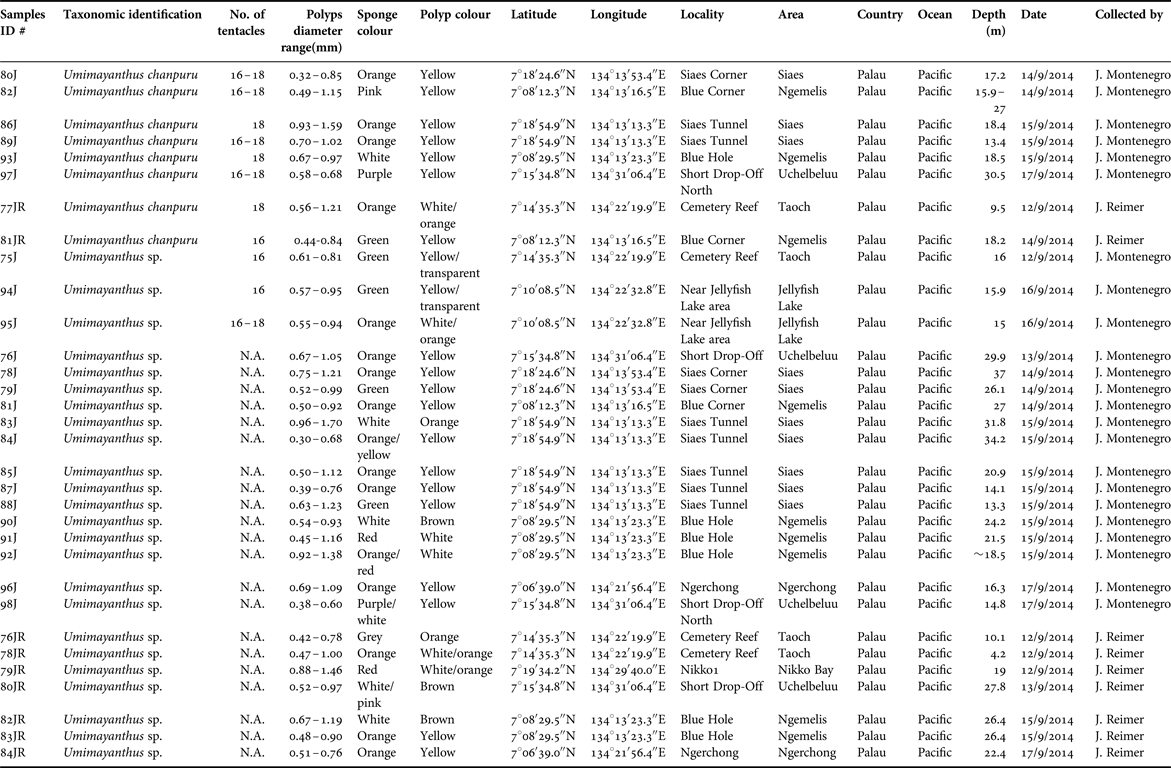
Specimens were collected by SCUBA at depths between 8 and 37 m during surveys conducted between 11 September and 17 September 2014. A total of 32 colonies were collected from seven different locations (Figure 1; Table 1). All specimens were identified as belonging to the genus Umimayanthus by confirmation of the following characteristics: specimens were associated with encrusting sponges, most of the specimens were found in shaded environments and all colonies had small polyps (polyp diameter range = 0.3–1.7 mm,  $\bar{x} = 0.79$, SD = 0.22, N = 359) that were smaller than any other known sponge-associated zoantharian species in the Indo-Pacific. Eight of the samples were identified as Umimayanthus chanpuru by the number of tentacles (16 to 18) (Figure 2), while 24 specimens were only identified to genus level as Umimayanthus sp. (Figure 3).
Map of southern part of Palau showing sampling locations and specimen pictures for representative specimens collected in this study.

In situ images of Umimayanthus chanpuru specimens. Pictures 93J, 97J, 80J, 89J, 86J and 82J are specimens from this study identified as U. chanpuru.
In situ images of Umimayanthus sp. specimens collected in this study. Compare similarity of 75J, 94J, 95J with Umimayanthus miyabi images in Montenegro et al. (Reference Montenegro, Sinniger and Reimer2015).
List of specimens of genus Umimayanthus collected in Palau.
All specimens were preserved in 99% EtOH.
DISCUSSION
The genus Umimayanthus was originally defined as:
… exclusively associated with sponges, usually encrusting and cushion sponges, occasionally with massive sponges. Polyps generally scattered over the sponge surface… Polyps may be solitary or connected to each other by a stolon through a thin but clearly visible coenenchyme either over or under the sponge surface… Tentacles equal or longer than the expanded oral disc diameter… (Montenegro et al., Reference Montenegro, Sinniger and Reimer2015).
All of the above characteristics match very well with the specimens reported in this study. Additionally, Umimayanthus has the smallest polyp sizes (0.16–2.3 mm) of all formally described sponge-associated Parazoanthidae species inhabiting the Pacific Ocean; Parazoanthus aruensis Pax, Reference Pax and Merton1910 from Indonesia has polyp diameters of 5 mm and 36 tentacles, Parazoanthus darwini Reimer & Fujii, Reference Reimer and Fujii2010 from the Galapagos has diameters of 3–6 mm and 24–30 tentacles, Parazoanthus elongatus McMurrich, 1904 from New Zealand and Chile has diameters of 6 mm and 40–48 tentacles, Parazoanthus juanfernandezii Carlgren, Reference Carlgren1922 from Chile has diameters of 5 mm and 40–44 tentacles, and Parazoanthus lividum Cutress, Reference Cutress and Edmund1971 from Australia has diameters of 2 mm and 29 tentacles (see Table 3 in Montenegro et al., Reference Montenegro, Sinniger and Reimer2015).
The above evidence leaves us confident that all specimens reported in this study belong to the genus Umimayanthus. There is one previous record in Reimer et al. (Reference Reimer, Albinsky, Yang and Lorion2013) of a sponge-associated Zoantharia specimen from Palau, at Nikko Bay, site XXIX, depth 3 m, reported as ‘Parazoanthus sp.’. We also refer this specimen to the genus Umimayanthus, given that it was associated with an encrusting sponge and had a small polyp diameter. Nevertheless, molecular and morphological analyses are required to accurately identify the majority of our Umimayanthus specimens to the species level.
Some of the specimens reported here were identified as Umimayanthus chanpuru due to their habitat, host sponge morphology, and tentacle numbers. Specimens 80J, 82J, 86J, 89J, 93J, 97J, 77JR and 81JR (Figure 2) were found associated with encrusting sponges inhabiting cracks and holes on the reef, and had tentacle numbers ranging from 16 to 18 (Umimayanthus chanpuru original description 14 to 20 tentacles, Montenegro et al., Reference Montenegro, Sinniger and Reimer2015). Three specimens (75J, 94J and 95J; Figure 3) had morphological similarities to Umimayanthus miyabi, with delicate and slender tentacles, different from Umimayanthus chanpuru's tentacles, with a more robust morphology. Therefore, given that in these three specimens the number of tentacles and the morphology of the host sponge did not match the original description of Umimayanthus miyabi (18 to 22 tentacles, and exclusively associated with non-encrusting sponges, Montenegro et al., Reference Montenegro, Sinniger and Reimer2015), they were identified as belonging to Umimayanthus sp. The remaining specimens (23) were classified only to genus level given that no tentacles were visible in the pictures. Further molecular and morphological analyses are needed to achieve conclusive identifications of these specimens. However, this report supports the observation that zoantharians of the genus Umimayanthus, and in particular Umimayanthus chanpuru, are common and widespread in the Indo-Pacific region, as previously hypothesized by Montenegro et al. (Reference Montenegro, Sinniger and Reimer2015), and confirms that their distribution includes Micronesia.
In this study, we have confirmed that the genus Umimayanthus is present in Micronesia. With other reports from the GBR and the Red Sea, it appears that this genus is widely represented in the Indo-Pacific. Future work along the east African coast, and in further afield regions such as Polynesia, the Galapagos, the Pacific coast of the Americas and the east coast of Africa should help to determine the true extent of Umimayanthus's distribution in the Indo-Pacific.
ACKNOWLEDGEMENTS
This research was supported by the Science and Technology Research Partnership for Sustainable Development (SATREPS), ‘Project for sustainable management of coral reef and island ecosystems: responding to the threat of climate change’ in Palau, funded by the Japan Science and Technology Agency (JST) and the Japan International Cooperation Agency (JICA) in cooperation with the Palau International Coral Reef Center (PICRC) and Palau Community College (PCC). Dr Yimnang Golbuu (PICRC) is thanked for his generous support throughout the course of this research. Jay Oruetamor, Arius Merep, Geory Merep and Assap Bukurrou at PICRC are thanked for logistical support. This is contribution PCoRIE Biodiversity #4. Two anonymous reviewers’ comments improved the manuscript.