Management Implications
Invasive Pennisetum ciliare (buffelgrass) has negatively impacted native plant communities and intensified wildfire activity across dryland ecosystems globally. One of the longest and most intensively treated areas to reduce P. ciliare occurs in Saguaro National Park within the Sonoran Desert of North America. To better inform invasive management, we examined the effectiveness of a decade (2011 to 2020) of chemical (glyphosate herbicide) and mechanical (manual removal) treatments to reduce P. ciliare and how stage of invasion, treatment type and intensity, and environmental variables influenced reductions in cover of the invasive grass. We found that treatments have largely been effective at reducing all but the smallest areas occupied by P. ciliare, and chemical treatments had greater or equal effectiveness compared with mechanical treatments. Our findings point toward several opportunities for improvement. Treatments will likely be more effective if they occur over an average of less than 3 yr of treatment gap, although mechanical treatments in the eastern Rincon Mountain District of the park and areas that favor P. ciliare growth (e.g., south-facing aspects, steep topographic slopes) may need to occur more frequently. For sensitive areas of the park requiring a very low amount of P. ciliare, treatments will be more effective if there is more frequent follow-up surveillance, because we found that areas with low initial invasive grass cover had potential to increase orders of magnitude following treatment. Early invasive detection and treatments in new areas of invasion will likely increase treatment effectiveness. If longer periods of treatment gaps are necessary due to a lack of resources, treatments in areas with less favorable environmental conditions for P. ciliare growth (e.g., north-facing aspect, low topographic slope) can be cautiously discontinued on a temporary basis.
Introduction
The invasion of nonnative species has led to widespread loss of biodiversity, wildlife habitat, and ecosystem function (DiTomaso Reference DiTomaso2000; Pyšek et al. Reference Pyšek, Jarošík, Hulme, Pergl, Hejda, Schaffner and Vilà2012). Nonnative grasses that invade plant communities can increase fuel load and wildfire risk and alter native plant communities and the ecosystem services they provide (Brooks et al. Reference Brooks, D’Antonio, Richardson, Grace, Keeley, DiTomaso, Hobbs, Pellant and Pyke2004; D’Antonio and Vitousek Reference D’Antonio and Vitousek1992; Fusco et al. Reference Fusco, Finn, Balch, Nagy and Bradley2019). Costs associated with invasive species in the United States have grown in recent decades to reach over $20 billion annually (Crystal-Ornelas et al. Reference Crystal-Ornelas, Hudgins, Cuthbert, Haubrock, Fantle-Lepczyk, Angulo, Kramer, Ballesteros-Mejia, Leroy, Leung and López-López2021; Fantle-Lepczyk et al. Reference Fantle-Lepczyk, Haubrock, Kramer, Cuthbert, Turbelin, Crystal-Ornelas, Diagne and Courchamp2022), with millions spent on reducing nonnative grasses in the western United States each year (U.S. Department of the Interior 2021). Despite the enormous investment of resources, we know little about how effective treatments are at reducing nonnative species.
Buffelgrass [Pennisetum ciliare (L.) Link] is a highly invasive warm-season perennial bunchgrass native to Africa that has rapidly spread across arid regions globally following its introduction to improve livestock forage and soil stability (Hanselka Reference Hanselka1988). The proliferation of P. ciliare into the Sonoran Desert of North America has transformed plant community composition and ecosystem function (Abella et al. Reference Abella, Chiquoine and Backer2012; Lyons et al. Reference Lyons, Maldonado-Leal and Owen2013; Stevens and Falk Reference Stevens and Falk2009). Sonoran Desert native plant communities have high diversity, contain sparsely distributed individual plants, and experience a very low occurrence of wildfire (Franklin et al. Reference Franklin, Lyons, Nagler, Lampkin and Glenn2006; Schussman et al. Reference Schussman, Enquist and List2006). Much like other invasive grasses in dryland regions (Brooks et al. Reference Brooks, D’Antonio, Richardson, Grace, Keeley, DiTomaso, Hobbs, Pellant and Pyke2004), P. ciliare fills in existing plant interspace with high biomass and increases the risk of wildfire. Following a burn, P. ciliare quickly recovers and colonizes new areas, while fire-intolerant native desert species experience high mortality, creating a positive feedback loop between wildfire and the invasion of P. ciliare (Farrell and Gornish Reference Farrell and Gornish2019; McDonald and McPherson Reference McDonald and McPherson2011; Wilder et al. Reference Wilder, Jarnevich, Baldwin, Black, Franklin, Grissom, Hovanes, Olsson, Malusa, Kibria and Li2021). Increased fire frequency and intensity elevate the risk to human and natural resources (Franklin et al. Reference Franklin, Lyons, Nagler, Lampkin and Glenn2006).
Effective containment of P. ciliare spread is among the highest priorities for land managers throughout the Sonoran Desert. One of the longest and most intensively treated areas is Saguaro National Park in southern Arizona, which has been implementing mechanical treatments since 1993 and chemical treatments since 2005 (Saguaro National Park 2011). Pennisetum ciliare was first detected in the park in 1989 and has since invaded multiple soils, landforms, and plant communities (Abella et al. Reference Abella, Chiquoine and Backer2013; Elkind et al. Reference Elkind, Sankey, Munson and Aslan2019; Olsson et al. Reference Olsson, Betancourt, Crimmins and Marsh2012) and now is estimated to occur on 800 ha with potential to double every 2 to 7 yr (Olsson et al. Reference Olsson, Betancourt, Crimmins and Marsh2012; Saguaro National Park 2011). Treatments include ground- and aerial-based glyphosate herbicide applications and manually removing P. ciliare with hand tools. Despite the long history of treatments and their growing implementation within the park and adjacent areas, treatment effectiveness has not been systematically evaluated.
Our objective was to assess how treatment effectiveness, as indicated by a reduction in P. ciliare cover, was influenced by stage of invasion (represented by initial P. ciliare cover), treatment type and intensity, and environmental variables within the park. We hypothesized that treatments were more likely to be effective in areas with a low amount of invasive cover, because these areas have lower rates of spread and are more likely to be eradicated in a cost-effective manner than areas with high cover (Sharma et al. Reference Sharma, Singh and Raghubanshi2005; Simberloff Reference Simberloff2013). We predicted that chemical treatments would be more effective than mechanical treatments because of the reduced treatment effort per unit area and the potential for mechanical treatments resulting in more disturbance that can favor P. ciliare seedling establishment (Stevens and Falk Reference Stevens and Falk2009). We expected that greater treatment intensity, as indicated by an increasing number of treatment years and shorter treatment gaps, would increase effectiveness by reducing live biomass and preventing opportunity for regrowth. Finally, we hypothesized that treatment effectiveness would be high under environmental conditions known to be less favorable for P. ciliare regrowth within the park, including north-facing aspects with limited slope (Elkind et al. Reference Elkind, Sankey, Munson and Aslan2019). We employed a long-term park treatment database to address our objective and inform the improvement of invasive treatment strategies.
Materials and Methods
Study Area
Saguaro National Park is located primarily in the Arizona Upland subdivision of the northeastern Sonoran Desert (Figure 1A), which primarily consists of desertscrub communities dominated by xerophytic trees mainly in the Fabaceae family (Parkinsonia and Prosopis spp.), shrubs, succulents [including the iconic saguaro, Carnegiea gigantea (Engelm.) Britton & Rose], perennial grasses, and herbaceous dicots (Turner and Brown Reference Turner and Brown1982). The subtropical climate within Saguaro National Park ranges from arid at low elevation to subhumid at high elevation. Precipitation is bimodal with cool-season (October to March) precipitation originating from large frontal storms and warm-season (July to September) precipitation from high-intensity North American monsoon storms. Soils in the park are granite-derived and classified as Torriorthents and Haplargids (Cochran and Richardson Reference Cochran and Richardson2003).
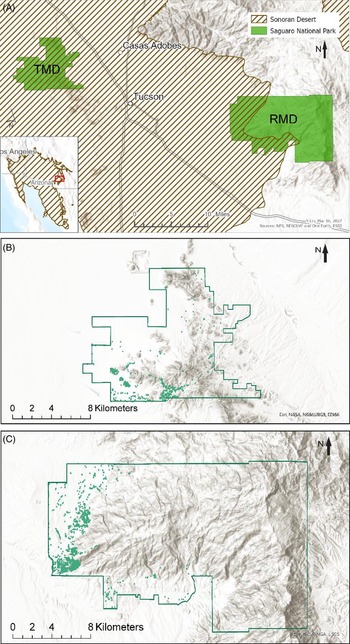
The study area includes the two districts of Saguaro National Park, the Tucson Mountain District (TMD) and the Rincon Mountain District (RMD). The districts are separated by the Tucson Basin, which includes the city of Tucson, and are generally within the Sonoran Desert (A). The TMD (B) and RMD (C) have diverse topography and received different intensities of treatments from 2011 to 2020 (green dots), generally in low elevations in the park where Pennisetum ciliare has spread.

The two districts of the park, the Tucson Mountain District (TMD) and the Rincon Mountain District (RMD) are named after the Tucson Mountains and the Rincon Mountains they contain and are separated by the Tucson Basin (Figure 1A). The TMD is 9,725 ha, ranges in elevation from 664 to 1,429 m, with the Tucson Mountains primarily running in a north-south orientation, and alluvial fans and plains occupying lower elevations (Fig 1B). Mean warm-season monsoon (July to September) precipitation recorded between 2000 and 2010 at the TMD visitor center (760 m) was 188 mm (Rojas et al. Reference Rojas, Swann and Alvarez2011). In TMD, P. ciliare primarily occurs within desertscrub communities and the lower reach of semidesert grasslands. Soils occupied by P. ciliare are primarily gravelly loam, gravelly sandy loam, and gravelly clay loam. The RMD is 27,279 ha, ranges in elevation from 814 to 2,641 m, and contains two major sets of peaks that are oriented west-east and north-south, and alluvial fans and plains at lower elevations (Figure 1C). Mean warm-season precipitation (2000 to 2010) at the low-elevation RMD visitor center (900 m) and Rincon Creek (940 m) weather stations, where P. ciliare is typically found, was comparable to that of TMD, with 196 mm and 154 mm, respectively, although warm-season precipitation increased above the current P. ciliare distribution at the high-elevation Manning Camp (2,440 m) weather station to 382 mm (Rojas et al. Reference Rojas, Swann and Alvarez2011). The wider and higher elevational range of the RMD houses not only the desertscrub and semidesert grassland communities that P. ciliare occupies, but also Madrean evergreen woodlands and temperate forest communities in which P. ciliare growth is not favored. Within the elevational range suitable for P. ciliare, soil in the RMD resembles that in the TMD in texture but differs in its mineral content due to geological differences between the two mountain ranges.
Treatment Type and Intensity
Saguaro National Park began treating P. ciliare in the mid-1990s. Park managers initially planned treatments across large areas and later divided the park into operational spatial units of approximately 1 ha. Within the smaller units, treatments were planned according to detected cover and density of P. ciliare and treatment history in each unit. If a treatment was planned in one operational spatial unit, the entire unit was searched for patches of P. ciliare, followed by treatment application. Units with very low cover and density of P. ciliare were often not treated as intensively to prioritize areas with moderate to large amounts of the invasive grass. Multiple treatments could take place within the same operational spatial unit, even within the same year if there were late warm-season monsoon events. Ground-based chemical and mechanical treatments were carried out in both the TMD and RMD districts (Figure 1B and C; Supplementary Table S1). An operational spatial unit could receive one or both types of treatment through time. Ground chemical treatment involved applying a 3% mixture of glyphosate-based herbicide (5% if P. ciliare was beginning to senesce), which included the brand names Roundup Pro® (Bayer Group, Leverkusen, Germany), Razor® Pro (Nufarm, Melbourne, Australia), KleenUp® Pro (Loveland Products, Loveland, CO, USA 80538), and Ranger Pro® (Monsanto, St. Louis, MO, USA 63166), mixed with a water conditioner and indicator dye (to mark application areas). Each plant received a spot application with a backpack sprayer, although the exact application rate varied slightly. Herbicide application took place during and after the peak of summer monsoon precipitation when P. ciliare was actively growing, because glyphosate is ineffective on dormant or semidormant plants. Mechanical treatment involved a two-step action: digging and pulling whole P. ciliare plants using shovels, picks, or rock bars, then piling the biomass into large piles that remained on-site. Aerial chemical treatment using helicopter sprayers has also been carried out in remote locations of the park since 2014, but this type of treatment was not analyzed in this study.
Ground treatment polygons within Saguaro National Park were recorded and curated by park staff in a GIS database between 1995 and 2020. In each location where P. ciliare was treated, park staff or volunteers recorded the treatment polygon (on the ground using handheld GPS devices), treatment method (mechanical or chemical), and a visual estimate of the percent canopy cover (in classes: <1%, 1% to 25%, 26% to 50%, 51% to 75%, and 76% to 100%) of P. ciliare in the polygon before treatment (Supplementary Figure S1). We organized the database by the fiscal year (FY: October 1 of previous year to September 30 of current year) in which the treatment took place, because this time period corresponded to a typical cycle of treatment planning and implementation. A FY also corresponded to a water year in which P. ciliare and other vegetation had the capacity to respond to cool- and warm-season precipitation. Starting in FY2011, park staff began recording treatments and P. ciliare attributes at a higher resolution than an operational spatial unit, specifically for polygons within an operational unit. As we were interested in capturing treatment effectiveness at the highest resolution possible, we only used data from the most recent decade (FY2011 to FY2020) in our analyses.
We divided Saguaro National Park and a 100-m buffer beyond the park boundaries into 20 m by 20 m grid cells. This cell size was chosen to achieve a reasonably high spatial resolution at which environmental and treatment data could be reliably obtained. Total P. ciliare canopy cover for each FY in each grid cell was calculated as the sum of the canopy cover of all P. ciliare polygons intersecting the grid cell weighted by the proportion of each polygon’s area within the grid cell (Supplementary Figure S1). To avoid confounding the effects of different treatment types, we limited the analyses to grid cells that only received one type of treatment (chemical or mechanical) throughout their treatment history (green dots in Figure 1B and C) and analyzed each treatment type separately. For a limited number of grid cells that received both ground and aerial helicopter chemical treatments, we excluded all data collected from the FY of the first application of aerial herbicide and following years. Our final analysis included 3,162 grid cells.
We quantified treatment intensity within grid cells by calculating the total number of years of treatment and the average years of treatment gap (a period in which no treatments were applied). To account for both the length of the period and number of periods without treatments, we calculated average years of treatment gap as the total number of years in which treatment gaps occurred divided by the number of gaps, rounded to the closest integer. A shorter average years of treatment gap indicated higher treatment intensity.
Environmental Variables
We used a 1-m-resolution digital elevation model to derive the mean aspect, slope, and elevation within each 400-m2 grid cell. We then calculated the northness and eastness of each grid cell as the cosine and sine of the mean grid aspect, respectively. The northness, eastness, slope, and elevation of a grid were used as environmental explanatory variables. We also investigated the use of plant communities (Galvin and Studd Reference Galvin and Studd2021) as an environmental explanatory variable, but decided not to include these due to the highly unbalanced distribution of P. ciliare treatment data among plant communities. Among the 12 plant communities in the TMD, the top two communities with treatment data included yellow paloverde (Parkinsonia microphylla Torr.)–velvet mesquite (Prosopis velutina Wooton)–brittlebush (Encelia farinosa A. Gray ex. Torr.) shrubland and P. microphylla–creosote bush [Larrea tridentata (DC.) Coville]–triangle bur ragweed [Ambrosia deltoidea (Torr.) Payne] shrubland, which corresponded to 46% and 9% of the area with treatment data, respectively. Among the 22 plant communities in the RMD, the top two communities with treatment data included P. microphylla–teddybear cholla [Cylindropuntia bigelovii (Engelm.) F.M. Knuth]–E. farinosa shrubland and P. microphylla–P. velutina–E. farinosa shrubland, which corresponded to 38% and 28% of the area with treatment data, respectively.
Statistical Analyses
To quantify treatment effectiveness, we created an index (hereafter “effectiveness index”) that was the ratio of initial canopy cover (coveri; Supplementary Figure S2) and posttreatment canopy cover (coverpt) of P. ciliare in a grid cell:
 $${\rm{Effectiveness\;index}} = - {\rm{lo}}{{\rm{g}}_{10}}\left[ {\left( {{{{\rm{\;Cove}}{{\rm{r}}_{{\rm{pt}}}} - {\rm{Cove}}{{\rm{r}}_{\rm{i}}}} \over {{\rm{Cove}}{{\rm{r}}_{\rm{i}}}}}} \right) + 1.000001} \right]$$
One was added to the ratio to not only avoid taking the log of zero but also adjust for no change in cover to correspond to an index value of zero, and 0.000001 was added to restore the normality in the distribution of the transformed variable (Supplementary Figure S3). The negative of this log-transformed ratio was used as the index so that a positive and higher index was related to a larger reduction of P. ciliare cover. For example, if initial P. ciliare cover (coveri) = 100 m2 and posttreatment P. ciliare cover (coverpt) = 50 m2, then:
 $${\rm{Effectiveness\;index}} = - {\rm{lo}}{{\rm{g}}_{10}}\left[ {\left( {{{50 - 100} \over {100}}} \right) + 1.000001} \right]\; \approx 0.30.$$
In contrast, a negative effectiveness index value indicates a posttreatment increase compared with initial P. ciliare cover, and an index value near zero indicates no posttreatment change from the initial cover. Although transformations were needed for many of our response variables, including the treatment effectiveness index, we show untransformed means in some figures for ease of interpretation.
Using this effectiveness index as the response variable, we evaluated how treatment effectiveness differed by park district, treatment type, and their interaction with a generalized least-squares (GLS) model for the entire grid cell–based data set. We found a significant interaction between district and treatment type, and therefore analyzed how invasion stage, treatment intensity, and environmental variables influenced treatment effectiveness in each district and for each treatment type, respectively. For each of the four subsets of data, a GLS model (gls function in the nlme R package v. 3.1-152) was constructed, in which the effectiveness index was the response variable, and the explanatory variables included initial P. ciliare cover (log transformed), total number of years of treatment, average years of treatment gap, northness, eastness, slope, and elevation. The total number of years of treatment and the average years of treatment gap were treated as categorical variables. Due to the difference in treatment intensity between the districts and between the treatment types, the levels of the treatment intensity variables were assigned differently among the four subsets of data and associated GLS models to balance sample size across levels (Supplementary Table S1). We did not include interactions between explanatory variables in the models, given the highly unbalanced distribution of the data.
In all analyses of how treatment effectiveness was influenced by district, treatment, and environmental variables, we used restricted maximum likelihood-based Akaike information criterion (AIC) comparisons to choose the best correlation and variance structure of model residuals for the GLS model to account for spatial autocorrelation and heteroscedasticity (Zuur et al. Reference Zuur, Ieno, Walker, Saveliev and Smith2009). A spherical correlation structure was chosen for all models to account for spatial autocorrelation. To account for heteroscedasticity, a constant variance structure, in which an error variance was estimated in each level of total years of treatment, was chosen for the model of analyzing mechanical treatment in the RMD (Supplementary Appendix 1). We used both backward and forward stepwise selection (stepAIC function in the mass R package v. 7.3-54) to choose the final most parsimonious model with the lowest AIC for each subset of data. Variance partitioning was then applied to significant explanatory variables using the varpart function in the vegan R package (v. 2.6-2) to approximate the percent of variance in treatment effectiveness explained by each variable. Planned pairwise comparisons among levels of categorical variables in GLS models were performed using the emmeans function in the emmeans R package (v. 1.7.3). Marginal effects and their 95% confidence intervals associated with all significant variables in the GLS models were calculated using the ggpredict function in the ggeffects R package (v. 1.1.1) and were double-checked using the emmeans function. The x intercepts were derived from the marginal regression lines of any continuous explanatory variables in the final models and were used to determine the thresholds at which the change in P. ciliare cover shifted from a reduction to an increase due to the change of these continuous variables (e.g., slope and northness). All statistical analyses were performed using R v. 4.2.0.
Results and Discussion
Initial Pennisetum ciliare Cover
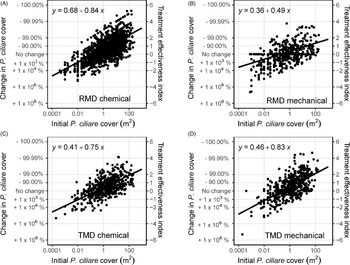
The initial total P. ciliare canopy in a 400-m2 grid cell area where treatments were applied varied from 1 × 10⁻⁴ to 252 m2, with a mean of 1.05 m2 and a median of 1.29 m2 (Supplementary Figure S2). This range in cover that spans six orders of magnitude indicates different stages of invasion across Saguaro National Park. Following invasion ecological theory, we expected that P. ciliare would be more effectively treated in the early stage of invasion when it had low cover, was not well established, and treatments were cost-effective (Sharma et al. Reference Sharma, Singh and Raghubanshi2005; Simberloff Reference Simberloff2013). Initial P. ciliare cover explained the highest percentage of variance in treatment effectiveness in all final models for both districts and treatment types (Table 1). Contrary to our predictions, results from 10 yr of P. ciliare treatments in Saguaro National Park showed that treatment effectiveness increased with higher initial P. ciliare cover.
Final generalized least-squares (GLS) model results with the fractions of variance explained by each significant variable and the total variance explained by all significant variables combined (model total). a

a A plus sign (+) indicates a positive correlation between the variable and treatment effectiveness; a minus sign (−) indicates a negative correlation. Individual variances do not sum up to the total variance due to collinearity between the variables.
Although initial P. ciliare cover was used in the calculation of the treatment effectiveness index and therefore expected to have some spurious correlation with the effectiveness index (Brett Reference Brett2004), this correlation cannot explain our finding that high initial P. ciliare cover was primarily associated with a large reduction in P. ciliare cover posttreatment. The most plausible explanation for this positive relationship is that park staff focused greater attention on reducing P. ciliare in areas that had high infestation of the invasive grass where it was most easily detected (Saguaro National Park 2011). Indeed, total number of years of treatment increased (χ2 = 149.4, P < 0.0001; Supplementary Figure S4A; Supplementary Table S2), and average years of treatment gap decreased (χ2 = 17.1, P = 0.002; Supplementary Figure S4B; Supplementary Table S2), with initial P. ciliare cover. This confirms that treatment intensity was high in areas with large amounts of the invasive grass.
Treatment Type
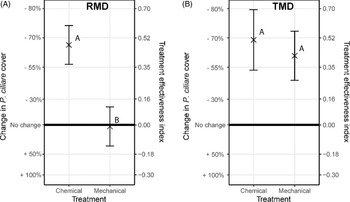
There have been few, if any, studies that compare the effectiveness of chemical and mechanical treatment of P. ciliare in the Sonoran Desert, despite both treatment types extending well beyond park boundaries (Arizona-Sonora Desert Museum 2022; Stevens and Falk Reference Stevens and Falk2009). We found that the effectiveness of P. ciliare treatment was significantly influenced by an interaction between park district and the treatment type (χ2 = 7.7, P = 0.005; Figure 2; Supplementary Table S3). There was a higher effectiveness index for chemical compared with mechanical treatments in RMD, such that P. ciliare cover was reduced by 67% or increased by 2% (not significantly different from zero), respectively (Figure 2A). The effectiveness indices associated with both chemical and mechanical treatment types were higher than zero but not significantly different from each other in TMD (Figure 2B; Supplementary Table S3). Chemical treatment reduced P. ciliare by 69%, and mechanical treatment reduced P. ciliare by 62%.
The effectiveness of Pennisetum ciliare treatment, as indicated by the treatment effectiveness index and change in P. ciliare cover (+, increase; −, decrease), following chemical and mechanical treatment in (A) the Rincon Mountain District (RMD) and (B) the Tucson Mountain District (TMD). Crosses indicate the mean effectiveness indices, and error bars indicate the 95% confidence intervals. Significant pair-wise differences between park district and treatment types are shown by different letters and in Supplementary Table S3.

Our results from the TMD suggest that at least in environments similar to the lower elevations of the Tucson Mountains, with comparable treatment intensity, mechanical and chemical treatment are expected to achieve similar effectiveness. On the other hand, our results also partially confirmed the expectation that chemical treatment was more effective than mechanical treatment, but this difference only applied to the RMD. Although mechanical treatments are more likely to remove adult plants and a proximate seed source, they can potentially create more disturbance, which can enhance P. ciliare seedling growth (Stevens and Falk Reference Stevens and Falk2009; Tjelmeland et al. Reference Tjelmeland, Fulbright and Lloyd-Reilley2008). A higher infestation of P. ciliare and a more conducive environment for P. ciliare growth in the RMD compared with TMD (Elkind et al. Reference Elkind, Sankey, Munson and Aslan2019), combined with increased labor and time per unit area required by mechanical compared with chemical treatments (Saguaro National Park 2013), might explain why mechanical treatments could not sufficiently reduce P. ciliare in the RMD. Although the mean effectiveness of chemical treatment in the RMD was similar to mean effectiveness of chemical and mechanical treatments in the TMD, there were more locations with increases or lower reductions in P. ciliare after mechanical treatment in the RMD than after either type of treatment in the TMD. Although a recent meta-analysis suggests that mechanical removal followed by herbicide application can be highly effective in reducing P. ciliare (Farrell and Gornish Reference Farrell and Gornish2019), we did not analyze these mixed treatments in this study and further examination is warranted.
The effectiveness of P. ciliare treatment increased significantly with increasing initial cover of P. ciliare at a similar rate for chemical treatments in RMD (0.84 slope) and TMD (0.75 slope) and mechanical treatments in TMD (0.83 slope), but at a lower rate for mechanical treatments in RMD (0.49 slope) (Figure 3). Thresholds of initial P. ciliare cover (the x intercepts of the regression lines shown in Figure 3) of approximately 0.15 m2 for the chemical and 0.18 m2 for the mechanical treatments in the RMD, and approximately 0.29 m2 for the chemical and 0.28 m2 for the mechanical treatments in the TMD, indicated that initial P. ciliare cover below these amounts had a high likelihood of increasing posttreatment. Collectively, these results demonstrate that treatments had potential to be effective, or reduce P. ciliare cover, in patches as small as 0.3-m2 P. ciliare canopy per 400-m−2 area (<0.001% canopy cover) across park districts and treatment types. Average treatment effectiveness at such a low amount of initial invasive grass cover underscores the general success of long-term invasive management within the park. This effectiveness can be attributed to the large investment in resources the park expends each year to control P. ciliare spread, including an estimated average of $500 ha−1 spent on herbicide application and more than 3,000 volunteer hours contributed annually to implement mechanical treatments (Saguaro National Park 2013). Despite this success, there is still large variance in the effectiveness index at high initial P. ciliare cover and potential for the invasive grass to increase orders of magnitude posttreatment. This finding suggests that early detection and careful monitoring of P. ciliare are still necessary to prevent rapid spread. Invasive grass patches below the 0.3-m2 P. ciliare canopy per 400-m−2 area threshold are particularly prone to increase after treatment and indicate that the invasive can regrow or recolonize at very low abundance due to its rapid growth (Wallace et al. Reference Wallace, Walker, Skirvin, Patrick-Birdwell, Weltzin and Raichle2016) and germination (Tinoco-Ojanguren et al. Reference Tinoco-Ojanguren, Reyes-Ortega, Sánchez-Coronado, Molina-Freaner and Orozco-Segovia2016) and long-lived seedbank (Winkworth Reference Winkworth1971). These traits, along with the constraints of detecting and treating the invasive grass at this very low level, make P. ciliare eradication from the park very difficult. A strategy to limit the growth of sparse patches of P. ciliare is to make more continuous revisits to low-abundance areas after a year or two of growth to allow the patch to be visible but not overly dense so the treatment can be implemented at relatively low cost. High-resolution remote sensing imagery may also provide some assistance in tracking small P. ciliare patches (Elkind et al. Reference Elkind, Sankey, Munson and Aslan2019; Olsson et al. Reference Olsson, Betancourt, Crimmins and Marsh2012).
The linear relationships between initial Pennisetum ciliare cover and treatment effectiveness (change in P. ciliare cover: +, increase; −, decrease) chemical and mechanical treatment in (A and B) the Rincon Mountain District (RMD) and (C and D) the Tucson Mountain District (TMD) predicted by the final models. Regression lines are marginal effects predicted by the final models.

Treatment Intensity
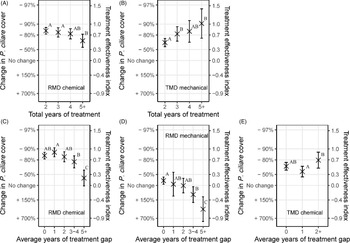
All final models contained at least one variable directly quantifying treatment intensity, with reductions in P. ciliare associated with shorter average years of treatment gaps, and to a lesser degree, total years of treatment (Table 1). Our results provide a unique perspective of the long-term effectiveness of repeated treatments compared with other studies that have examined one or two treatment applications and monitored P. ciliare abundance an average of 15 mo posttreatment (Farrell and Gornish Reference Farrell and Gornish2019). In the RMD, treatment effectiveness remained high for 2 to 4 total years of chemical treatment but then unexpectedly dropped after 5+ yr (Figure 4A; Supplementary Table S4). In the TMD, effectiveness of mechanical treatment increased with increasing years of treatment (Figure 4B), as expected. Treatment effectiveness after 3 and 5 yr of treatment was significantly greater than after 2 yr of treatment (Supplementary Table S4). In the RMD, effectiveness of chemical (Figure 4C) and mechanical treatment (Figure 4D) declined as the average treatment gap increased. Pairwise comparisons indicated that only gaps longer than an average of 3 yr were associated with a significant decline in treatment effectiveness (Supplementary Table S5), and P. ciliare increased 300% in RMD mechanical treatments with 5+ average years of treatment gaps. There was no effect of reducing P. ciliare even with 1 and 2 yr of treatment gap for mechanical treatments, whereas chemical treatments maintained high levels of effectiveness for these same shorter gap periods in RMD. In the TMD, there was a reduction in P. ciliare with no or 1 average year of chemical treatment gap, but then an unexpected increase in effectiveness if there was more than 2 yr of average gap (Figure 4E; Supplementary Table S5).
The relationship between Pennisetum ciliare treatment effectiveness and treatment intensity expressed as total years of treatment (A and B) and average years of treatment gap (C and D) in the Rincon Mountain District (RMD) and (E) Tucson Mountain District (TMD). Crosses show the marginal effects predicted by the selected models and error bars indicate 95% confidence intervals. Only significant relationships selected by the final models are shown in the figure. Significant pair-wise differences among treatment intensity levels are shown by different letters and in Supplementary Tables S4 and S5.

These results suggest that it is important to maintain consecutive years of mechanical removal to achieve treatment effectiveness in RMD, whereas longer or more frequent gaps, which do not exceed an average of 3 average years of treatment gap, for herbicide application can maintain reductions in P. ciliare cover in both park districts. Our results are in line with other studies that have shown the benefit of implementing consecutive treatments and the diminishing effectiveness of herbicide application through time (Chambers et al. Reference Chambers, Urza, Board, Miller, Pyke, Roundy, Schupp and Tausch2021; Munson et al. Reference Munson, Long, Decker, Johnson, Walsh and Miller2015). Part of the need for such intensive treatments to reduce P. ciliare is that most of the lower elevations of Saguaro National Park have high environmental suitability and further invasion is likely according to climate projections (Jarnevich et al. Reference Jarnevich, Young, Talbert and Talbert2018). Olsson et al. (Reference Olsson, Betancourt, Crimmins and Marsh2012) found that P. ciliare infestations in the nearby Santa Catalina Mountains doubled every 2.2 to 7.0 yr. Even after a 98% dieback of mature P. ciliare following glyphosate treatments in Saguaro National Park, there was a surge in germination of the invasive grass and regrowth from partially killed plants in difficult to treat areas, including under rocks (Backer and Foster Reference Backer and Foster2007). Given the large amount of effort required for mechanical treatments, and the high demand for treatments in RMD, chemical treatments in this district provide some assurance of reducing P. ciliare and indicate that expanded aerial chemical treatments (which we did not include in this study) may extend effectiveness.
Reductions in P. ciliare due to herbicide application and mechanical treatments should be weighed against the potential negative effects on non-target native species and ecosystem processes (Abella Reference Abella2014; Cornish and Burgin Reference Cornish and Burgin2005; Paretti et al. Reference Paretti, Beisner, Gungle, Meyer, Kunz, Hermosillo, Cederberg and Mayo2021). Previous studies have found that treatments to reduce P. ciliare have no effect on (Abella et al. Reference Abella, Chiquoine and Backer2013; Backer and Foster Reference Backer and Foster2007) or increase native species (Daehler and Goergen Reference Daehler and Goergen2005; Lyons et al. Reference Lyons, Maldonado-Leal and Owen2013; Tjelmeland et al. Reference Tjelmeland, Fulbright and Lloyd-Reilley2008), especially if herbicide is combined with additional treatments (Farrell and Gornish Reference Farrell and Gornish2019). Restoration of native species affected by P. ciliare in conjunction with treatments can be an effective strategy to reverse degradation (Stevens and Falk Reference Stevens and Falk2009). Seeding and outplanting native species in previously treated areas may allow competition with P. ciliare and possibly reduce the intensity of mechanical and chemical treatments needed to reduce nonnative grass cover (Abella et al. Reference Abella, Chiquoine and Backer2012; Farrell et al. Reference Farrell, Funk, Law and Gornish2022). However, P. ciliare, like other nonnative grasses, fills the interspaces of sparsely distributed native vegetation in arid regions (Brooks et al. Reference Brooks, D’Antonio, Richardson, Grace, Keeley, DiTomaso, Hobbs, Pellant and Pyke2004), including the Sonoran Desert.
In the TMD, an average of more than 3 yr of treatment gap was rare, and treatment effectiveness remained high for chemical treatment and was not significantly influenced by average gap length of mechanical treatment. Unlike in RMD, mechanical treatment effectiveness increased with a higher total years of treatment in TMD, indicating this district may benefit from an increase in manual removal intensity. Furthermore, the correlation between initial P. ciliare cover and treatment intensity might to some degree mask the actual influence of total years of treatment and average length of treatment gaps on treatment effectiveness in our models. Nevertheless, when initial P. ciliare cover was excluded from the models, treatment intensity consistently remained a significant factor in explaining treatment effectiveness. Treatments implemented before FY2011 also might have a lagged influence on subsequent treatment effectiveness.
Environmental Variables
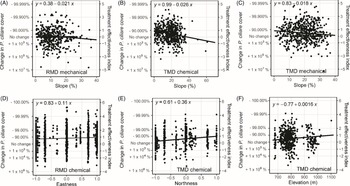
While environmental variables influenced treatment effectiveness to a lesser degree than stage of invasion and treatment characteristics (Table 1), environmental conditions known to be less favorable for P. ciliare growth resulted in high potential treatment effectiveness, as we expected. The effectiveness of the mechanical treatment in RMD (Figure 5A) and chemical (Figure 5B) and mechanical treatment (Figure 5C) in TMD weakly declined with an increasing topographic slope. Although there was a very low variance explained in the regression models (<3%), the x intercepts indicated that P. ciliare in RMD had high potential to increase at a slope >19% following mechanical treatment (Figure 5A) compared with TMD, where thresholds for both chemical (Figure 5B) and mechanical treatments (Figure 5C) were on very steep (>30%) slopes. Treatment effectiveness likely had potential to decline on steep slopes, because P. ciliare reaches high cover in these areas, where there is a lack of competition, as other plant species do not grow well on these poorly developed and highly erodible soils (Abella et al. Reference Abella, Chiquoine and Backer2012; Van Devender and Dimmitt Reference Van Devender and Dimmitt2006). These steep slopes are also expected to be difficult to treat with ground-based herbicide application and mechanical removal, which may have limited effectiveness. The low effectiveness of mechanical treatments in RMD on even moderate slopes may be due the substantial resources required for this treatment type and a high rate of infestation in many areas of this district.
The relationship between Pennisetum ciliare treatment effectiveness and (A) topographic slope in Rincon Mountain District (RMD) with mechanical treatment, (B) topographic slope in Tucson Mountain District (TMD) with chemical and (C) mechanical treatments, (D) eastness aspect in RMD with chemical treatment, (E) northness aspect and (F) elevation in TMD with chemical treatment. Only significant relationships selected by the final models are shown in the figure. Regression lines are marginal effects predicted by the final models.

Effectiveness had a tendency to increase with eastness for chemical treatments in RMD (Figure 5D) and increasing northness (Figure 5E) and elevation (Figure 5F) for chemical treatments in TMD. The difference in the influence of aspect between the two districts may be due to the significantly lower number of north-facing aspects treated chemically in the RMD compared with the TMD (t = 4.59, P < 0.0001). Aspect did not influence mechanical treatment effectiveness in either district, likely because the distribution of aspects covered by mechanical treatment was more unbalanced than those covered by chemical treatment. We attribute lower reductions of P. ciliare, or less treatment effectiveness, on south-facing aspects and low elevation because these areas of the park are where P. ciliare is more abundant (Elkind et al. Reference Elkind, Sankey, Munson and Aslan2019) and likely able to recover quickly. Regrowth is more likely in the warm temperatures of these landscape positions, because the C4 grass has a high optimal temperature for photosynthesis (Tix Reference Tix2000), and P. ciliare is less likely to dieback or experience seedling mortality during the winter (Cox et al. Reference Cox, Martin-R, Ibarra-F, Fourie, Rethman and Wilcox1988).
A caveat to our interpretation of the influence of treatment and environmental variables is that our study only focused on areas where P. ciliare received treatment, and observations were biased toward areas of the park that were favorable for growth. Including observations of change in P. ciliare cover from untreated areas over the same time periods would increase confidence in this conclusion. However, leaving areas untreated creates additional risk for further invasive spread and wildfire occurrence and is not a practice the park has adopted. Furthermore, pairing such a large number of treated polygons (n = 3,162) with untreated polygons was not possible in our study due to limited park resources during monitoring. In an earlier study in Saguaro National Park that used a much smaller number of treated areas (n = 15), P. ciliare was minimal or absent compared with untreated controls (n = 3), and posttreatment soil, native vegetation, and soil seedbanks were largely indistinguishable between treated areas and areas not invaded by P. ciliare (n = 3) (Abella et al. Reference Abella, Chiquoine and Backer2013). Lyons et al. (Reference Lyons, Maldonado-Leal and Owen2013) used a type of experimental control that created a disturbance similar to mechanical removal by digging holes but not removing P. ciliare where it had invaded and found that this type of disturbance did not affect native species cover or further invasion of P. ciliare.
Even in environments less favorable for P. ciliare growth, such as on north-facing aspects, shallow slopes, and at high elevation, P. ciliare cover often increased after initial treatment. These results suggest that even in environments where P. ciliare invasion pressure is low, prolonged gaps of invasive grass surveillance and treatment >3 yr should be minimized to achieve high treatment effectiveness. However, creating gaps in treatment years may be necessary to free up resources to treat other infested areas of the park. While a high level of treatment and surveillance intensity requires considerable resources, extending these efforts to the edges of the current distribution of P. ciliare in the park and predicting its spread can lead to early detection and more effective control (Jarnevich et al. Reference Jarnevich, Young, Cullinane Thomas, Grissom, Backer and Frid2020). These insights from our study were possible because Saguaro National Park has maintained one of the longest-running treatment effectiveness monitoring programs for an invasive grass. Future improvements might include the use of a limited number of control (untreated) areas and tracking native species and other biophysical attributes at a fine scale, which can expand our understanding of treatment effectiveness. When possible, we encourage long-term monitoring of invasive treatments and their effects on target and non-target species to improve future management strategies.
Supplementary material
To view supplementary material for this article, please visit https://doi.org/10.1017/inp.2023.2
Acknowledgments
We thank Saguaro National Park staff for curating and sharing the invaluable P. ciliare treatment data. We thank the park staff and volunteers for their decades of sweat, diligence, and determination in controlling P. ciliare and collecting field data. We appreciate helpful feedback on early versions of our paper from Kim Franklin, Daniel Winkler, Kelly Lyons, and two anonymous reviewers. Research funding was provided by the U.S. Geological Survey Invasive Species Program. No conflicts of interest have been declared. Any use of trade, product, or firm names in this paper is for descriptive purposes only and does not imply endorsement by the U.S. government.