

1. INTRODUCTION
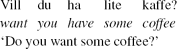
A consequence of the symmetric analysis of Germanic verb second (V2) languages – i.e. that the finite verb moves to C0 in matrix clauses – is that there are two potential subject positions, Spec,TP and Spec,CP (see Koster Reference Koster1975; den Besten Reference Besten and Abraham1977; Platzack Reference Platzack, Haider and Printzhorn1986, Reference Platzack1998; Vikner Reference Vikner1990, Reference Vikner1995). In non-V2 languages like English, on the other hand, the subject normally appears in Spec,TP. In Germanic, the subject appears in Spec,TP in yes/no-questions, (1a), and whenever another constituent appears preverbally, (1b). In subject-first matrix declaratives, the subject occupies the Spec,CP position, as illustrated in (1c). The examples are in Swedish, unless otherwise indicated.Footnote 1
(1)


In this article I explore certain dependencies between Spec,TP and Spec,CP, starting with some data illustrating the strong subject constraint in modern Swedish, Section 2. So-called tough constructions, which turn out to be particularly relevant, are discussed in Section 3 and in Section 4, I analyze a new construction in Swedish where expletive subjects are omitted when there is an initial det in the clause. The syntactic nature of the strong subject requirement and its connections with the Exended Projection Principle are discussed in Section 5. A characteristic feature of the new construction is the presence of an unbounded dependency and in Section 6, the processing of det-initial clauses is addressed. In Section 7, I compare the subject requirement in present-day Swedish with the other Germanic languages.
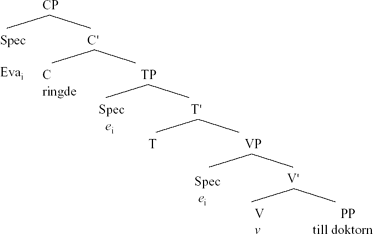
Throughout the article I adopt a wysiwyg version of Thráinsson's (Reference Thráinsson, Abraham, Epstein, Thráinsson and Zwart1996) Real Minimalist Principle: Assume only those positions in the syntax for which there is overt evidence in the language.Footnote 2 With respect to possible subject positions, this means that I will limit myself to postulating one initial position, which I will refer to as Spec,CP, one position in the part of the clause that follows C, which I will refer to as Spec,TP, and one position in Spec,VP. I thus adopt a tripartite clause structure with a C-domain, a T-domain and a V-domain, similar in many respects to what Platzack (Reference Platzack1998, Reference Platzack2011) has proposed for Swedish. The structure for (1c) is shown in (2).
(2)
Furthermore I do not assume that syntactic properties such as agreement or Case, or semantic properties such as tense or mood, or information structural aspects such as topic and focus motivate postulating distinct syntactic projections like AgrP, AspP or FocP.Footnote 3 I assume that the semantic-pragmatic contribution of a phrase appearing in Spec,CP as e.g. a contrastive or continued topic is determined by the content and phonological realization of that phrase together with a model of the information states of the discourse participants (Engdahl Reference Engdahl, Rohrer, Roßdeutscher and Kamp2001, Reference Engdahl, Bonami and Hofherr2006; Ginzburg Reference Ginzburg2012). I believe that this is a more transparent approach, which is compatible with several syntactic frameworks such as Head-Driven Phrase Structure Grammar (Pollard & Sag Reference Pollard and Sag1994; Sag, Wasow & Bender Reference Sag2003), Lexical-Functional Grammar (Bresnan Reference Bresnan2001; Dalrymple Reference Dalrymple2001; Lødrup Reference Lødrup2011) and the Simpler Syntax approach proposed by Culicover & Jackendoff (Reference Culicover and Jackendoff2005).
2. THE SUBJECT REQUIREMENT
There is general agreement in descriptions and reference grammars of Swedish that a finite clause must contain an overt subject, see e.g. Teleman, Hellberg & Andersson (Reference Teleman, Hellberg and Andersson1999/4:42). This is often referred to as ‘the subject requirement’ (Sw. subjektstvånget). If a clause does not have a lexical (referential) subject, then an expletive subject det ‘it’ is required. Note that I use ‘expletive’ somewhat loosely for all non-referential occurrences of det in this and the following two sections. In Section 4.5 I will make a finer distinction between different types of expletive subjects. In matrix clauses, det appears either postverbally, in Spec,TP, or initially, in Spec,CP (but see (7) below).
(3)
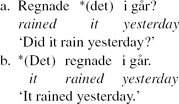
In this respect, the mainland Scandinavian languages differ from Icelandic, where það only occurs in Spec,CP (see e.g. Holmberg & Platzack Reference Holmberg and Platzack1995:Chapter 4; Vikner Reference Vikner1995:Chapters 6 and 7; Thráinsson Reference Thráinsson2007:Chapter 6).
(4)

2.1 Null subjects in Spec,CP
Subjects in Spec,CP are sometimes not realized overtly, as shown in (5). This is commonly taken to be an instance of topic drop, i.e. a topic is not pronounced in a context where the referent is highly accessible (Ross Reference Ross1982; Cardinaletti Reference Cardinaletti, Mascaró and Nespor1990; Mörnsjö Reference Mörnsjö2002; Rosenkvist Reference Rosenkvist2010; Sigurðsson & Maling Reference Sigurðsson2010; Sigurðsson Reference Sigurðsson2011).
(5)
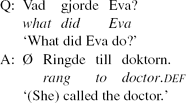
Topic drop is not limited to subjects, see (6a), but, as is well known, it is limited to the initial position (6b).
(6)

Topic drop of an initial constituent, especially a first person pronoun, is quite common in spoken informal Swedish, as well as in blogs and SMS text messages, see (7a). Interestingly initial expletive subjects may also be dropped, as shown in the authentic examples from Mörnsjö (Reference Mörnsjö2002) in (7b, c).Footnote 4 In these cases it is less appropriate to talk about topic drop, if we assume that topics have to refer to something.
(7)

In (7a), the first person plural pronoun vi is left out in the third sentence. In (7b) the weather det is not pronounced and in (7c) the expletive in a cleft construction is missing.
Although the examples in (7) represent an informal register, and may be considered somewhat marked by certain speakers, there is a sharp contrast between examples with a missing initial expletive and examples with a missing expletive in Spec,TP. The latter are judged to be clearly ungrammatical, as shown below.
(8)

The non-referential subject det is also required in cleft constructions, (9), and presentational constructions, (10). It is also used when an infinitival or finite clause is extraposed, as shown in (11). Falk (Reference Falk1993:91ff.) refers to these as clause-anticipating det and I will adopt this term here.Footnote 5
(9)
(10)
(11)


2.2 Null subjects in [Spec,TP]?
Judging from the minimal pairs in (8)–(11) it looks like det is obligatory in Spec,TP. There is however one context where det is frequently left out, viz. when there is a locative adverbial in Spec,CP, as in (12a).
(12)

This type has been discussed by Sundman (Reference Sundman1980:115ff.), Falk (Reference Falk1993:282ff.) and others, and additional examples are given in Teleman et al. (Reference Teleman, Hellberg and Andersson1999/4:54). Most speakers accept examples like (12a) but find structurally similar examples with non-locative initial adverbials, as in (12b), less acceptable. In her 1993 book, Falk assumes that ‘the subject position [in Spec,TP] is empty and licensed by the topicalized phrase, but at the same time connected with the VP-internal argument’ (Falk Reference Falk1993:284). Her analysis is given in (13).
(13)

The subject position thus acts as a ‘link’ between the constituent in Spec,CP and an argument in the VP. This analysis, which involves double indexing, is presumably not available on current assumptions about syntactic structure.
Examples without expletive subjects like (12a) are used in written, often rather formal language, and hardly occur in spoken language. Younger speakers tend to think that they sound old-fashioned and prefer to use an overt expletive. We can summarize the situation in present-day Swedish as follows: All finite clauses require a subject, either a referential subject or the expletive det. Subjects in Spec,CP may be left out in informal speech, but neither referential nor expletive subjects in Spec,TP can be omitted.Footnote 6
3. TOUGH CONSTRUCTIONS
Let us have a closer look at the structures involved. In a polar interrogative as in (14a), the finite verb appears in C and the expletive det occupies Spec,TP. The little v indicates the verb positions in TP and VP. In a declarative clause, the expletive is fronted to Spec,CP. For perspicuity I indicate the empty subject position in Spec,TP by a coindexed e.
(14)
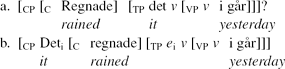
In examples with meteorological predicates like (14), the subject det is often analysed as a quasi-argument, following Chomsky (Reference Chomsky1981:325). Just like it in English, this det is identical to the neuter singular form of the personal pronoun det. An initial det can hence also function as an anaphoric referential pronoun, as in (15), where coindexing indicates intended coreference.Footnote 7
(15)
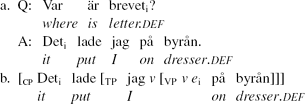
It is less clear whether examples with extraposed clauses, as in (11), should be treated as co-reference. In order to make the analysis easier to follow, I will annotate such uses with a subscript x on the clause-anticipating det, the empty subject position and the extraposed clause.
(16)

A particularly interesting case is the so-called tough construction, where the subject of the predication in the matrix clause is simultaneously interpreted as the object of an embedded predicate, as in (17).
(17)
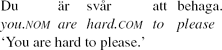
This construction has been much discussed in the literature (see e.g. Chomsky Reference Chomsky, Culicover, Wasow and Akmajian1977:102ff., Reference Chomsky1981:308ff.; Nanni Reference Nanni1978, Reference Nanni1980; Bennis Reference Bennis and Coopmans2000; Dalrymple & King Reference Dalrymple, King, Butt and King2000; Rezac Reference Rezac2006; Hicks Reference Hicks2009). An analysis on which the matrix subject du ‘you’ has been moved from the object position of behaga ‘please’ runs into problems. Du is nominative whereas behaga assigns accusative case to its object. Furthermore there is ample evidence from scope and selection that the subject is an argument of a two-place tough adjective which also takes an infinitival complement (for an overview, see Dalrymple & King Reference Dalrymple, King, Butt and King2000; Rezac Reference Rezac2006). I will here adopt an analysis where the matrix adjective forms a complex property with the infinitival phrase which is predicated of the subject.Footnote 8 In (16), svår ‘hard’ composes with the property of being a k such that an arbitrary referent (PRO) pleases k. See the analysis in (18), where the superscripted k indicates predication.Footnote 9 Just as in previous examples, the element in Spec,CP is coindexed with an empty subject position in Spec,TP. The adjective svår ‘hard’ agrees with the subject and has the non-neuter common form, as is expected since it is predicated of a non-neuter subject.
(18)

Next consider the example in (19) where the initial constituent has been fronted from the object position and is in the accusative case. Here the Spec,TP position is filled with an expletive det, presumably the clause-anticipating det x. The adjective svårt ‘hard’ is in the neuter form, agreeing with det.
(19)

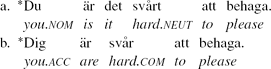
The agreement patterns here are very clear. Nominative case is not possible if the initial constituent does not act as a subject of the predication, (20a), and the non-neuter form of the adjective is not possible with an initial accusative, non-subject, constituent, (20b).
(20)
Against this background, the example in (21a) is somewhat unexpected.Footnote 10 Here the initial constituent is accusative, indicating that it is not a subject. The adjective has the neuter form, but there is no subject with which it can agree. Given what we have seen so far, the structure must be as shown in (21b). The symbol Ø here marks an empty Spec,TP position.
(21)
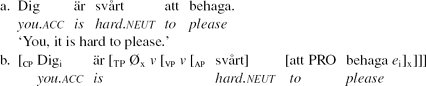
(21) shows that the generalization expressed at the end of Section 2.2 is not correct; expletive subjects can be left out in Spec,TP under certain conditions. Let us look more closely at what these conditions might be. (22) shows an example where the infinitival clause acts as a subject; the adjective obligatorily has the neuter form. (23) shows the extraposed version.
(22)
(23)


In (23b) the clause-anticipating det x acts as a subject, as shown by e x in Spec,TP. (21b) has a similar structure, but there is no coindexed empty element in Spec,TP, since the accusative dig in Spec,CP cannot be analysed as a subject.
We thus have some evidence that examples (17) and (21) differ structurally. The structure of (17), repeated here in (24), involves an initial constituent which acts as a subject of the matrix clause and where the agreeing adjective forms a complex property with the infinitival clause which is predicated of the subject.
(24)

In (21b), the initial dig does not act as a subject at any point. Presumably it is linked directly to the empty object position in the infinitival clause. The adjective svårt does not form a complex property with the infinitival clause att behaga; rather svårt is predicated of the infinitival clause, as in (22)–(23).
Additional evidence for distinguishing the two structures comes from tests involving fronting of the AP. Modifying and fronting the complex property in (24b) is perfectly grammatical, as shown in (25a). The subject du here occupies Spec,TP. Fronting just the infinitival part is not felicitous, (25c).
(25)

In the other structure, the initial dig cannot be analysed as a subject in Spec,TP. Consequently it is not possible to front the AP since dig already occupies Spec,CP.
(26)

In (21) and (24), the case marking of the initial constituent makes it clear that we have two different structures. However, in modern Swedish only certain pronouns have distinct forms in nominative and accusative. Lexical noun phrases are not case marked, but sometimes agreement facts distinguish the two structures, as in (27).
(27)

In (27a) the adjective omöjliga ‘impossible’ agrees in number with tre barn ‘three children’, which is interpreted as the subject of the predication of the complex property ‘impossible to look after’ and which can be distributed over the individual children, cf. the structure in (24b). In (27b) on the other hand, the adjective omöjligt is in the singular neuter form and does not agree with the initial plural NP, which means that tre barn does not act as a subject in Spec,TP.Footnote 11 The absence of agreement suggests the same structure as in (21b), viz. with an empty expletive in Spec,TP. The amount interpretation further supports this analysis; it is the looking after (as many as) three children that is claimed to be impossible. Malmgren (Reference Malmgren1990:104f.) discusses a similar distinction in interpretation using the pair of examples in (28).
(28)

In (28a), with the agreeing adjective, the predication is interpreted distributively – it holds for each threat – whereas in (28b) it is the simultaneous countering of the two threats which is judged to be hard.
3.1 Tough constructions with initial det
We have thus established that clause-anticipating expletive det x may be left unrealized in Spec,TP under certain conditions. The crucial factor seems to be that there is a constituent in Spec,CP which is linked to an empty position in an embedded infinitival clause. As shown in (8)–(11), an expletive subject in Spec,TP is required in verb-initial clauses and in declaratives where Spec,CP is occupied by a connecting adverbial like därför ‘therefore’ or temporal adverbials like nu ‘now’. So far we have looked at examples where the initial constituent is either clearly a non-subject (dig) or does not act as a subject (lack of agreement). However, the overwhelming majority of authentic examples are introduced by det, which, as we have seen, can be either a referential anaphoric pronoun or an expletive. Sometimes the status of an initial det is unambiguous, as in (15), repeated here as (29), where it must be referential, or in (16), repeated here as (30), where it must be analysed as a clause-anticipating expletive det.
(29)
(30)


But what about examples like (31)?
(31)
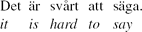
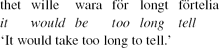
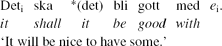
(31) can be analysed in two ways. First, it can be analysed as in (32a), where the complex property ‘hard to say’ is predicated of the initial det i, which consequently acts as the subject of the matrix clause, as shown by the coindexed e i in Spec,TP. Alternatively, it can be analysed as in (32b), where the expected clause-anticipating det x in Spec,TP is absent and marked by Øx, as in (21b).
(32)

Thus (31) displays a structural ambiguity. It is either an instance of a tough construction where the initial det acts as a subject of the tough adjective svårt, or it is a case of topicalization out of an extraposed infinitival clause, but without the expected overt clause-anticipating det x in Spec,TP.Footnote 12 Inserting such a det x in (31) is possible, as shown in (33):
(33)
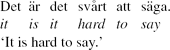
(31) and (33) have the same range of interpretations according to the native Swedish speakers I have consulted. Given the strong subject requirement in modern Swedish, one might expect (33) to be preferred, but in fact, this structure with an overt det x is not very common.Footnote 13 Instead the pattern in (31) seems to be extending to other constructions.
4. NOT JUST TOUGH CONSTRUCTIONS
In addition to examples like (31) we find examples like (34a), first discussed in Engdahl (Reference Engdahl, Milles and Vogel2007, Reference Engdahl2010), where an initial det must be interpreted as the missing object in the embedded finite clause; sa ‘said’ requires an object, as shown in (34b).
(34)
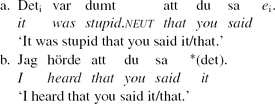
Note that there is no expletive subject in Spec,TP in the matrix clause. Some additional examples from informal conversations or radio broadcasts are given in (35). Main stress is indicated by ' in front of the stressed word.
(35)

In these examples, the matrix clause contains an evaluative or modal adjective or a modal verb together with a finite complement clause. The initial det in (34) and (35) must be interpreted as a fronted object. Versions without fronting are of course grammatical, see (36a), where the initial det must be analysed as a clause-anticipating det x as in (36b) with e x in Spec,TP.
(36)
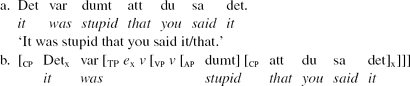
(34a), with a fronted referential object det, is most plausibly analysed as in (37), with an unrealized expletive subject in Spec,TP.
(37)

The structure in (37) is very similar to (32b), the main difference being that in (37) the initial det i is linked to an empty object in a finite complement clause whereas (32b) has an infinitival clause.
In addition to the examples with complement clauses in (34) and (35), there are examples involving what looks like relative clauses, see (38).
(38)

Footnote 14 These examples resemble both cleft and presentational constructions.Footnote 15 Just like typical cleft constructions, the main verb is the copula vara ‘be’ and the clefted constituent is stressed. Similar to presentational constructions, the head of the relative clause often consists of an indefinite quantity expression (många, ofta) and the relative clause contributes new information. This type of clause has been discussed in connection with extractions from relative clauses in the mainland Scandinavian languages (see e.g. Engdahl Reference Engdahl and Ejerhed1982, Reference Engdahl1997; Erteschik-Shir Reference Erteschik-Shir1982; Lambrecht Reference Lambrecht1988). But note that the expected version with an extraction would be as in (39), with an expletive det in Spec,TP. Recall that in standard Swedish, presentational sentences are introduced by det.
(39)

The type in (39) is used, but it seems to me that the version without an expletive subject is gaining ground. Such utterances are typically used when the speaker provides a comment on how many or which people do, have, see or participate in the event that the comment is about and which is often anaphorically referred to by an utterance-initial det. The initial det is usually unstressed, but utterances with a stressed det occur, as in (40), where the speaker, a 12-year old girl, commented on having a newly washed car.
(40)

4.1 Examples in context
In order to give the reader a better idea of how and when these constructions are used, I provide a few transcribed examples with more context. The sound files are available via Språkbanken.Footnote 16 The first two examples come from the popular radio program Språket (‘The Language’) where Lars-Gunnar Andersson, professor of Modern Swedish, answers questions from the listeners. In (41), the topic of the discussion is how come the use of double supine forms is more common in spoken language than in written. In spoken Swedish, det is normally pronounced without the final t.
(41)

First Andersson comments that it is normal to notice these double supines when you read through your text. The initial de in the bold segment refers to ‘to notice the double supines’ and Andersson continues; de e ju inte säkert att man gör när man pratar på eh ‘it is not certain that you do when you are busy talking’. In the next example, a listener has asked about the expression koka ner ‘boil down’, presumably a direct translation from the English expression. The program host Anna-Lena Ringarp first conveys what the listener has said and then Andersson makes a comment.
(42)

Here Andersson's initial de presumably refers back to the content of the previous utterance: think that it sounds strange. He continues and affirms that there are probably many who find this expression strange. Note that there is clearly a missing object after gör in (42), since Swedish does not allow the kind of VP deletion used in the English paraphrase, where the proverb do replaces the entire VP do this.
In (43) former journalist Barbro Hedvall features in the early morning program Tankar för dagen (‘Thoughts for the day’), talking about the role of clothes and hair styles in politics.
(43)

Hedvall here asks two rhetorical questions about Julia Timosjenko's choice of hair style and then delivers the answer herself at a quicker pace. Hedvall is presumably reading from a manuscript. The initial de in her reply refers back to ett budskap ‘a message’ in the preceding question and den refers back to frisyr ‘hair style’. Just like in the previous example, there is clearly a missing object after the verb har, a fact that is not conveyed by the English paraphrase.
Until now I have collected approximately 150 examples of det-initial utterances with missing expletive subjects from informal conversations and radio broadcasts. In the extracts from the radio which I have been able to analyse more closely, the relevant sequences were produced quickly, with a single intonation contour. I have not found any instances where the speaker interrupts the delivery and corrects him/herself by inserting an expletive subject. I have also not found any signals that the listener has difficulties understanding the utterance. I take this as evidence that the construction type is a normal feature of Modern Swedish.
4.2 Unexpressed det
In my collection of attested examples, the most common type is the one exemplified in (43) and in (35a), repeated here as (44a), where the utterance starts with det e klart ‘it is clear’. In addition, there are also a number of examples as in (44b).
(44)

As shown by the English paraphrases, both utterances convey an affirmative reaction, adequately rendered by the utterance-initial of course in English.Footnote 17 In (44a), the missing object after göra ‘do’ is co-indexed with the topicalized det. In (44b), there is no topicalized antecedent. However, it seems plausible that (44b) is the result of topic drop together with a left out copula. As we saw in Section 2.1, anaphoric elements in Spec,CP are often not realized phonetically, cf. (6)–(11). In evaluative utterances, both an initial det and the copula are often omitted in spoken Swedish, as pointed out in Teleman et al. (Reference Teleman, Hellberg and Andersson1999/4:966), from where the examples in (45) are taken.
(45)

Given the tendency to leave out utterance-initial det är/var ‘it is/was’ in spoken Swedish, I assume that (44b) has the structure shown in (46b) with a missing topicalized object and a missing finite verb. For perspicuity I have indexed the missing elements (cf. also (37)).
(46)

Evidence that (46) involves an empty referential element in Spec,CP and an empty expletive element in Spec,TP comes from data like the following. In (47a) the subject is missing and is conventionally interpreted as first person, as shown in (47b). In (48) the object of the embedded clause is missing, analyzed as an instance of topic drop.
(47)
(48)
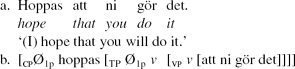

Both (47) and (48) are common in ordinary conversation and contrast with (49), which is clearly ungrammatical. As shown in the analysis in (49b), this would involve two empty elements in Spec,CP, which would be unexpected in a V2 language.
(49)

4.3 Comparison with tough constructions
The data discussed in Section 4 show many similarities with the tough constructions discussed in Section 3. In both cases, an expletive subject in Spec,TP is not pronounced when there is a referential det (overt or silent) in Spec,CP linked to an empty position in an embedded clause. However, there are also some differences. In the case of tough constructions, we established that there is a structural ambiguity, shown in (32) and repeated here in (50). The initial det is either a subject of the complex predication är svårt att säga ‘is hard to say’ as shown in (50a), or it is the fronted object of att säga ‘to say’ as shown in (50b), in which case the expected expletive subject is missing.
(50)

The examples with fronting from finite clauses are not structurally ambiguous. In the proposed structure in (37), repeated here in (51), the initial det is analysed as the fronted object of att du sa ‘that you said’.
(51)

There is no alternative analysis corresponding to (50a) where the initial det also acts as the subject of the matrix predicate var dumt ‘was stupid’. Whereas it is semantically plausible to analyse tough constructions as composite predications (the property of being hard composes with the property of being an x such that it is hard for someone to say x), this is not an option for examples like (51). The finite complement clause ‘that you said x’ expresses a proposition (provided that x is given a value) and acts as an argument of the matrix predicate ‘was stupid’. It is not possible for an embedded object to raise and become a subject of the matrix clause. Consequently we expect to find grammatical examples where det is realized in the Spec,TP subject position in tough constructions, but not in the constructions involving finite clauses. This prediction is borne out, as shown in (52) and (53).
(52)
(53)
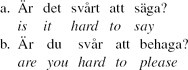
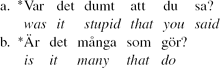
I have no attested examples like the ones in (53) and to my ears they sound ungrammatical.Footnote 18 Note that it is impossible to analyze these yes/no questions as involving topic drop or to assume that the object has been fronted to Spec,TP.
4.4 Comparison with clause-bounded examples
In Section 2.2, I brought up one type of example where expletive subjects are sometimes left out, viz. (12a), repeated here as (54a) together with an additional example.
(54)

In these examples there is a locative adverbial or a superlative predicative adjective in Spec,CP and there is often a temporal or modal auxiliary.Footnote 19 The initial locative is linked to an empty argument position in the VP, as shown in (55a), on the assumption that these locatives actually behave as arguments, in contrast with temporal modifiers (cf. (12b)). The fronted predicative adjective in (55b) is similarly linked to an empty argument position in the VP.
(55)

In addition there are examples with optional expletive subjects where the gap is inside a DP in the matrix clause as in (56a), brought to my attention by Lars-Olof Delsing (p.c. 2008), which presumably has the structure in (56b).
(56)
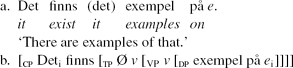
If we compare the structures in (55) and (56) with the ones proposed for tough constructions in (50) and the det-initial constructions with finite complements in (51), we see that they only differ in the position of the empty category that is linked to the constituent in Spec,CP. In (50b), the initial det is linked to an empty object in an infinitival complement clause and in (51) there is an empty object in a finite complement clause. In both cases the identification of the initial constituent must involve some non-local mechanism. The structures in (55) and (56) also involve an empty argument, though not an object but a locative, a predicative adjective phrase or a complement of a preposition. Since these examples are all mono-clausal, the interpretation of the initial item can be established locally, within the matrix clause.Footnote 20 But what the structures in (50)–(51) and (55)–(56) have in common is that the expletive subject in Spec,TP can be left out precisely when there is a fronted constituent in Spec,CP. Before discussing possible analyses of these examples, we will look at which types of expletive subjects can be left out.
4.5 Expletives and quasi-arguments
So far I have referred to all instances of non-referential det as an expletive, disregarding the finer distinctions concerning different types of pleonastic items that have been proposed in the literature. Chomsky (Reference Chomsky1981:37) introduces the term quasi-argument for the it that is used with weather predicates since it behaves like an argument with respect to control. Following Hoekstra (Reference Hoekstra, Bennis and van Lessen Kloeke1983) and Bennis (Reference Bennis1986), Vikner (Reference Vikner1990, Reference Vikner1995:Chapter 6) restricts the term expletive to items like English there and Danish der, which are used in presentational constructions. English it and Danish det are assumed to be quasi-argumental in nature since they may be involved in theta marking chains.Footnote 21 In languages like Faroese, Icelandic and Swedish, which do not use a separate word corresponding to presentational there, the single item used (tað, það, det) is hence ambiguous between being a ‘real’ expletive and a quasi-argument. In her study of the development of non-referential subjects in Swedish, Falk (Reference Falk1993:Chapter 3) makes essentially the same distinction between true expletive det and quasi-argumental det and takes clause-anticipating det to be quasi-argumental.
The question now is whether this distinction between true expletive occurrences of det and non-argumental occurrences of det plays any role with respect to the possibility of omitting det. As we have seen, det in Spec,TP may be left out in clause-anticipating constructions, as in (51), and in cleft constructions, as in (38b, c), both of which involve a quasi-argumental det, according to Vikner and Falk. In addition, the real expletive det may be omitted in presentational constructions, as shown in (38a). Furthermore, in the southern region Skåne, where the expletive used in presentational constructions is där ‘there’ (cf. Danish der), examples like (57b) can be heard (L.-O. Delsing p.c. 2008).Footnote 22
(57)

Given that both quasi-argumental det and true expletive det can can be omitted when there is a fronted referential det in Spec,CP, it does not seem that the factors that condition this optionality in Swedish are sensitive to the proposed distinction between true expletives and qusi-arguments.Footnote 23 We return to this issue in Section 7.
5. THE SUBJECT REQUIREMENT AND THE EPP
In much generative work in the 1980s and 1990s, the fact that a clause needs a subject was captured by the so-called Extended Projection Principle (EPP), which still plays a role in Minimalism.Footnote 24 The EPP presumably applies universally but languages differ in whether the subject has to be overtly realized or not. In current minimalist analyses, where the syntactic derivation is driven by syntactic features, it is common to assume the existence of an EPP feature which serves to ensure that a subject is overtly realized in the syntactic structure. In his minimalist analysis of Swedish, Platzack (Reference Platzack2011) assumes that T, the functional projection where subject agreement is checked, has an unevaluated Φ-feature which is marked EPP (2011:78f., 136–145). This feature must be eliminated before Spell-out by merging a DP in the Spec position, see e.g. (3a). In Icelandic impersonal constructions, where overt expletive subjects in Spec,TP are ungrammatical (see (4a)), Platzack assumes, without further argument, that there is no EPP feature in T and consequently no overt subject is required. Platzack also assumes that Swedish, being a V2-language, has an EPP feature connected to an unevaluated Fin feature in C which forces the finite verb to move to C in matrix clauses (2011:82). In addition he assumes, following Chomsky (Reference Chomsky, Freidin, Otero and Zubizarreta2008), that C carries an edge feature which has to be eliminated by the merger of a constituent in Spec,CP (2011:93ff., 104ff.). The structure of the subject-initial declarative clauses in (1c) is outlined in (58), where double strike through is used for elements that have moved.Footnote 25
(58)

The verb ringde is first merged in V, then moved to v and then to C in order to satisfy its Finepp feature. The subject Eva is first merged in Spec,vP, then moved (internally merged) to Spec,TP in order to satsify the unevaluated Φ-feature in T, and then moved to Spec,CP in order to eliminate the edge-feature of C.
The analysis in (58) retains an important feature of den Besten's (Reference Besten and Abraham1977) original proposal: a declarative subject-initial clause involves a chain between the A-bar position Spec,CP and the A-position Spec,TP. More recently this type of ‘mixed’ chain formation has been questioned. Chomsky (Reference Chomsky, Freidin, Otero and Zubizarreta2008) proposes to replace it by so-called parallel movement (see also Hicks Reference Hicks2009; Platzack Reference Platzack, Brandtler, Håkansson, Huber and Klingvall2012a). In (58) the movement of Eva from Spec,vP to Spec,TP and Spec,CP would take place in parallel, which means that the derivation involves one A-chain (Spec,TP–Spec,vP) and one A-bar chain (Spec,CP–Spec,vP), as shown in (59), but no chain linking Spec,CP and Spec,TP.
(59)

Clearly only one of the chain heads can be pronounced, but exactly what in the system determines that it has to be the instance in Spec,CP remains unclear. Platzack here follows Chomsky (Reference Chomsky, Freidin, Otero and Zubizarreta2008) and assumes that it is the subject in Spec,CP that is pronounced (Platzack in press:30).Footnote 26
5.1 Platzack's ‘Spurious Topic Drop’
Platzack (in press) argues that Chomsky's parallel movement can be used to account for the missing expletive subjects which are the topic of this article.Footnote 27 As shown above, a subject moves in parallel from Spec,vP to Spec,TP and to Spec,CP, but only the subject in Spec,CP is pronounced. Platzack makes a further assumption concerning the CP domain in Swedish. In order to account for the common type of example illustrated in (60), he argues that we need to assume that there are two Spec,CPs in Swedish main clauses.
(60)

The initial constituent is normally accented whereas the second (den, så) is unaccented, as shown in (60). Examples like (60a), with a definite NP and a coreferent pronoun, are quite common. Andersson (Reference Andersson1982:34f.) treats them as left dislocation structures followed by what he calls topic movement of the pronominal copy. The reference grammar Teleman et al. (Reference Teleman, Hellberg and Andersson1999) assumes a förfält ‘prefield’, preceding the initial position, for dislocated constituents which are more loosely connected to the clause (Teleman et al. Reference Teleman, Hellberg and Andersson1999/4:6ff.).Footnote 28 Platzack assumes that both positions are specifiers of C; ‘the high/first specifier contains a first merged usually stressed element, and the low/second specifier is a position for an internally merged unstressed element’ (Platzack in press:32, see also Platzack Reference Platzack, Brandtler, Håkansson, Huber and Klingvall2012b:412ff.). He then proposes that the unstressed element in the low Spec,CP may be dropped when the higher Spec,CP is pronounced and introduces the term spurious topic drop for this. A consequence of this spurious topic drop is that we may get examples without overt subjects. Platzack's analysis of such an example is given in (61) (cf. the tree in (15) in Platzack in press).
(61)

In this analysis, the initial det is first merged (i.e. directly generated) in the high Spec,CP position. An expletive det is first merged in Spec,vP and then moved in parallel to Spec,TP and the low Spec,CP. Det in Spec,TP is deleted because there is parallel movement (see above). Since det in the low Spec,CP is a weak, unstressed element, it can also be dropped, ‘giving the impression of a null subject’ (Platzack in press:36).
I think there are several problems with this analysis. First, it does not account for the object gap, which is present in all the examples with missing expletive subjects discussed in Sections 3 and 4. Note that the relation between the initial det in the high Spec,CP and the unrealized object of sa ‘said’, indicated by a double-headed non-dashed arrow in (61), is a semantic relation, not a syntactic one (Platzack in press:note 10).Footnote 29 Since the initial det is directly generated (first merged) in the high Spec,CP position, there cannot be any syntactic dependency and the non-pronunciation of the downstairs object is left unexplained. In suggesting that the relation between an initial constituent and a gap inside the clause is semantic and not syntactic, Platzack parts company with most of the generative tradition which has seen wh-movement (later A-bar-movement) as one of the clearest examples of a syntactic dependency. In (60a), there is a syntactic dependency between the fronted element in the low Spec,CP position 0den and a gap in the VP, but this is not the case in (61). Since there is no syntactic dependency between the high Spec,CP and either the low Spec,CP or the gap, we would also expect examples like (62a) to be grammatical, contrary to fact. Following Platzack, the analysis should be as in (63).
(62)
(63)
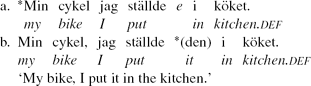

If a constituent, in this case the object of ställde ‘put’, can be freely deleted when there is a semantic relation between it and a first merged element in the high Spec,CP, then we would expect (62a) to be grammatical, but it is not. A left dislocation structure, as shown in (62b), would be well-formed, where both Spec,CP positions are filled and where there is an anaphoric pronoun in the VP, agreeing, as expected, with the initial constituent. This pronoun, however, cannot be deleted. It seems to me that Platzack's proposal blurs the distinction between topicalization and left dislocation.
A second problem with Platzack's proposal is the existence of examples like (64a).
(64)

At first glance, (64a) seems to fit very well with the double Spec,CP analysis proposed by Platzack. The accented lexical phrase vinho verde is first merged in the high Spec,CP and an unstressed pronoun det is moved to the low Spec,CP. But since this det is in fact pronounced, Platzack would have to assume yet another Spec,CP, acting as the landing site for parallel movement, in order for spurious topic drop to take place, as shown in (64b).
A third problem with Platzack's proposal is that it is unclear how it would extend to examples like (44b), repeated here as (65), where the initial det, the copula and the expletive subject are all missing.
(65)
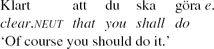
According to Platzack, a weak element in low Spec,CP can be dropped by spurious topic drop provided that the element in the high Spec,CP is pronounced. But examples like (65) show that there is no need for an overt topic as long as there is an understood unrealized topicalized constituent (cf. (46b)). I think that Platzack's assumption that there need not be any syntactic dependency between an initial constituent and an empty position in the clause is on the wrong track. Instead I believe that it is precisely the fact that an initial constituent heads a non-local syntactic dependency that is crucial. Before turning to why this is so, I will make a few more comments on the EPP.
5.2 Where does the EPP apply?
The requirement for overt subjects has been assumed to apply to finite clauses given that infinitival clauses lack overt subjects in many languages, including the Scandinavian languages. However, the subject requirement in Swedish seems to be independent of finiteness, as shown by the examples in (66), which involve non-finite complements of perception verbs (cf. Teleman et al. Reference Teleman, Hellberg and Andersson1999/3:575f.) and where both the quasi-argument in (66a) and the real expletive subject in (66b) are obligatory.Footnote 30 English counterparts tend to involve finite clauses or avoid the expletive.
(66)

Just like in matrix clauses, the expletive det in (66) cannot be stressed. Furthermore it cannot be fronted to initial position, as shown in (67a, b), whereas fronting of a referential argument from the same position is fine (67c).
(67)

The ungrammaticality of (67a, b) highlights a difference between local and non-local dependencies. Whereas fronting an expletive subject to its closest Spec,CP is unproblematic, as shown in Sections 1 and 2, fronting an expletive across clauses is impossible.
Another interesting observation concerning expletives in small clause structures is that although they cannot be fronted, they can be left unpronounced, as shown in (68) and (69).
(68)
(69)
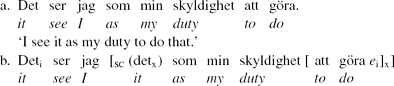

In both these examples it is possible to have a clause-anticipating det in the small clause, as shown in (68b) and (69b). But they can also be left out if there is a fronted referential det. In the next section we will look closer at the ways an initial det may be interpreted before turning to an analysis.
6. NON-CLAUSE-BOUNDED DEPENDENCIES
6.1 The processing of det-initial clauses
The examples we discussed in Sections 3 and 4 all involve clauses beginning with det ‘it’ and many of them start with det är ‘it is’. According to Allwood (1999:Table 3:1) det är is the most common two-word collocation in both spoken and written Swedish, which is maybe not surprising given that det has so many functions.Footnote 31 In addition to referring to neuter antecedents, as shown in example (15), it is used to refer to properties, propositions and events, like it in English. A few examples are given in (70)–(71). In (70b, c) det refers back to baking bread, introduced in the question in (70a).
(70)
(71)


The answers in (70) and (71) illustrate a common pattern in Swedish, viz. to start off a reply, or a further comment, with an unaccented pronoun which refers back to a referent or event introduced in the preceding utterance (see Vallduví & Engdahl Reference Vallduví and Engdahl1996:500f.; Engdahl Reference Engdahl1997:72f.; Erteschik-Shir Reference Erteschik-Shir2007:7ff.). The grammatical function of the pronoun may be as a subject (70b), (71b), as a subject in an embedded clasue (70c), as an object in the matrix clause (71c) or as an object in an embedded clause (71d). All of these exeamples are perfectly natural replies, including (71d) which involves fronting from an embedded question. In the given context, the reference of the initial det can probably be established quickly, but its grammatical function in the utterance cannot be determined until more of it as been processed and a gap has been detected.
But det is also used as a quasi-argument or expletive, as discussed above in Section 4.5. Whether an initial det is used anaphorically or as a quasi-argument or expletive is of course determined by the syntactic construction. Very often this cannot be determined until most or all of the sentence has been processed. Consider the examples in (72). On the right I have indicated the function of det, using det i for an anaphorically used referential det and det x for det used as a clause-anticipating expletive.
(72)
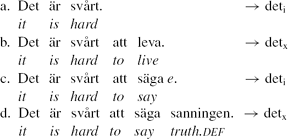
In (72a), det must be interpreted as a referential det, but in (72b) the added infinitival clause att leva ‘to live’ forces an interpretation of det as an anticipating expletive. If the infinitival clause contains a gap, as in (72c), the initial det must be interpreted as referential and as providing the referent for the missing complement of säga ‘say’. Whether or not the infinitival clause contains a gap may of course not be determined until the whole clause has been processed. In (72d), there is no object gap and the initial det consequently must be resolved as an anticipating expletive. The examples with finite complement clauses display the same underdetermination when it comes to the function of the intial det.
(73)

In (73a), where the complement att du kom ‘that you came’ is a complete clause, the initial det must be interpreted as an anticipating expletive, but in (73b), where the object of sa ‘said’ is missing, the initial det can only be interpreted as referential and as providing the antecedent for the object gap. The initial det in (73c) must be understood as an expletive, introducing a presentational construction, but in (74d), the object of gör ‘do’ is missing in the relative clause and must be linked to the fronted referential det.
The examples in (72) and (73) illustrate how the function of det is determined as the sentence is processed. The examples are here presented out of context, but in actual use there are presumably clues in the context and in the delivery which help the listener/reader get the intended interpretation of an initial det. As we know, sentence interpretation takes place rapidly and incrementally and starts as soon as the first word is perceived (Marslen-Wilson Reference Marslen-Wilson1973, Reference Marslen-Wilson1975). Starting off with an assumption that an initial det is an expletive or quasi-argument is probably a good strategy given the frequency of impersonal constructions in the language,Footnote 32 but in many cases this interpretation will have to be changed during the processing, as shown in (72a, c) and (73b, d).Footnote 33
6.2 Examples in context
An authentic example illustrating how this incremental processing might evolve is provided in (74). This is a transcription of an excerpt from an interview on Swedish Radio. (.) marks a short pause.
(74)

After the reporter's suggestion that increased accessibility of drugs might make it harder to give them up, B picks up on the topic of quitting, de där me att lägga av ‘this thing about quitting’ and adds a comment starting with de e ju ‘it is’. In his rather long utterance, there are two potential gap locations which I have marked and indexed in (75).
(75)

B's comment starts off as a presentational construction introducing an indefinite NP, which is interrupted, nån å-, and resumed by nån annan ‘someone else’. The relative clause som vill ‘that wants’ is incomplete; instead of an expressed complement to vill ‘wants’ there is a short pause during which the missing complement e 1 may be identified as the initial de. After the short pause, B continues and produces a that-clause which then provides the missing complemement of vill. At the end of the finite clause, there is another pause after the verb göra ‘do’, which in Swedish requires a complement, as we have seen above. Again, the missing complement e 2 must be linked to the initial de. During the interpretation of this utterance, a possible initial interpretation of de as an expletive must be revised around e 1 where it is reinterpreted as a referential det. This interpretation must be rejected when B continues talking and then resumed again when the second gap e 2 is identified. Despite this repeated reinterpretation of det, B's comment is not hard to process. There is no indication in this example, or in the previous ones, that the discovery of an object gap causes problems for the language user.
In this respect, the examples discussed here resemble certain parasitic gap (pg) constructions, as in (76) (cf. Engdahl Reference Engdahl1983).
(76)

Although the initial constituent köttfärs ‘mince’ in (76a) has been interpreted as the direct object of steka ‘fry’, it is still accessible and can be used to resolve the missing object of äter ‘eat’ in the adverbial clause. Similarly in (76b), the initial det, which referred back to a meeting just must mentioned by the speaker, is first interpreted as the complement of på ‘on’ in the matrix clause but also fills the missing complement of om ‘about’ in the following adverbial clause. This suggests that the activiation of a filler in an unbounded dependency remains after the gap has been located.
In addition to the examples in (72)–(73), we also find examples like (77a), where there is no subject gap in the matrix clause but where there are two embedded clauses, the first with a subject gap and the second with an object gap.Footnote 34
(77)

When processing (77a), the listener presumably rapidly realizes that det is not a plausible subject of tycker ‘think’ but may consider it as a potential object, see e 1 in (77b). However, the recognition of another finite verb var ‘was’ forces the listener to postulate an empty subject (e 2) which may be identified with the initial det. This assignment has to be revised when the following that-clause is recognized. Finally when the empty object (e 3) is recognized, it can be linked to the initial det and the whole utterance interpreted, as indicated in the English paraphrase. But what about the missing subject in e 2? This turns out to be an instance of the type of empty expletive subjects (Øx) which we have encountered before. This expletive subject may be overtly realized, as shown in (78a), where it functions as an anticipating expletive for the extraposed clause. If there is no long-distance dependency, i.e. if there is no gap in the most deeply embedded clause, the expletive subject cannot be left out, see (78b). The only way to interpret this example would be with det as linked to the empty subject position e 2, which must be an anticipating expletive subject, given the final extraposed clause att du sa det ‘that you said it’. But as we saw above in 5.2, expletive subjects cannot be fronted, cf. (67a, b).
(78)

If there is a pause before the that-clause, then a version without an object gap is possible as shown in (78c), but the that-clause att du sa det ‘that you said it’ is then interpreted as an afterthought and not as a syntactically integrated complement. The initial det is then interpreted as referential, as shown.
Examples like (77a) show that expletive subjects can be left unrealized also in embedded clauses provided that there is a dependency between an initial det and a gap in the embedded clause.Footnote 35 If there is no such dependency, as in (78b), the expletive subject cannot be left out. In all the examples discussed so far, there has been such a dependency between an initial det and a gap located in an embedded clause, finite or non-finite. I believe that this is the relevant condition for when expletive subject det may be left out and in the next section I will outline an analysis which capitalizes on this fact.Footnote 36
6.3 Towards an analysis without movement
We saw in Section 6.1 that it is very often impossible to determine which role an initial det plays until most of the sentence has been processed. The contribution of det cannot be fully resolved until a gap – or the absence of an expected argument – is detected. This suggests that the initial constituent is available to the listener/reader while s/he processes the sentence. This is reflected in Gazdar's (Reference Gazdar1981) account of unbounded dependencies which instead of a movement transformation uses a feature called slash which takes a category as value. This feature indicates that there is a gap somewhere in the structure dominated by the node marked with this feature. When an initial filler, i.e. a constituent in an A-bar position like Spec,CP, is generated, its sister constituent must have a slash feature, taking the initial constituent as value. The feature is then instantiated on subsequent mother and daughter nodes until it bottoms out at an empty node.Footnote 37 Using a slash feature to account for displaced constituents is an important aspect of HPSG (see Sag et al. Reference Sag2003). The tree in (79) gives a visualisation of how the dependency between an initial det and a missing object is represented in the structure.Footnote 38
(79)
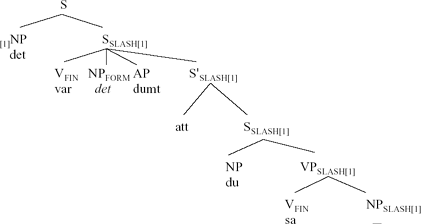
In (79) the information that there is an initial filler, with the phonological/ortographical form det, is present at each node on the path that connects the filler with the node dominating the empty object position in the lowest VP. Having recognized the finite verb var, the processor proceeds, trying to find a suitable empty argument that matches the filler. Once the transitive verb sa in the lowest VP is recognized, the dependency can be resolved. Note that the NP in the matrix subject position has a form feature which requires it to be det. This form feature is instantiated by the lexical rule that also introduces the extraposed S′. Given that in most cases, an initial det is fronted from the matrix subject position, it is not implausible that the processor routinely assumes that the initial det should be linked to this empty subject position. But as shown by examples like (72c), the processor presumably still keeps the option open to connect an initial det with a missing argument later in the sentence. Examples with parasitic gaps, as in (76), confirm that the filler is available for being identified with a subsequent empty argument, even when a match between a detected gap and the slash value has been found.
6.4 Other initial constituents
So far most of the examples discussed have been introduced either by an overt det or by an unexpressed det (see Section 4.2) and these are by far the most common type in the spoken data. In written Swedish, I have found examples where the missing expletive is in an embedded clause and where the dependency is introduced by the relative pronoun vilket. (80) is from a master's thesis, June 2012.
(80)

I have also come across a few examples where the dependency is introduced by phrases which cannot be anaysed as expletives, see the examples in (81).
(81)

(81a) was uttered by a woman on discovering a pair of trousers at the bottom of the laundry basket. The spoken Swedish form dom is used for both subject and object pronouns. The predicative adjective bra ‘good’ in (81b, c) is invariant and shows neither number nor gender agreement. (81c) is one of relatively few written attested examples and is taken from an e-mail message from my head of department. Detta is the nominative or accusative neuter singular demonstrative pronoun.Footnote 39 The examples in (81) have in common that there is no formal feature of the initial constituent which signals whether it is to be interpreted as a subject or not. Furthermore, the predicative adjective used bra ‘good’, or the temporal adverbial längesen ‘long ago’ do not show any agreement which might resolve whether the initial constituent is a subject or not. If we change the examples slightly so that there is overt agreement between the initial constituent and a predicative adjective, the result is clearly ungrammatical, as shown in (82).
(82)

If we replace the invariant bra ‘good’ in (81c) with an adjective that shows agreement, using the neuter form as in (83a), the result is not as clearly ungrammatical as in (82) or as in (83b) with plural agreement. This is not surprising as many researchers have found that the neuter form often seems to indicate lack of agreement (cf. Josefsson Reference Josefsson2006, Reference Josefsson2009). I have, however, not noticed any spontaneous examples like (83a).
(83)

Turning the declaratives in (81) into yes/no questions, thereby forcing the initial constituent to appear in the Spec,TP subject position, also leads to ungrammaticality, cf. the ungrammatical examples in (53).
(84)

To conclude this section on processing considerations, we have found that expletive subjects may be left out in utterances where there is an initial det which can be interpreted as expletive or quasi-argument, although this interpretation has to be revised as more of the sentence is processed. We have also seen that this primarily happens when the initial constituent heads an unbounded dependency and is linked to a gap inside an embedded clause.Footnote 40
7. A GERMANIC COMPARISON
Examples with missing expletive subjects are also attested in spoken Norwegian, see (85).
(85)

(85a) comes from the Oslo corpus of spoken Norwegian NoTa compiled in 2005. (85b) was produced by a 25-year-old Norwegian woman and shows that the gap may occur inside a noun complement clause. (85c) was uttered by Janne Bondi Johannesen in a discussion about corpus data.
The construction is also found in spoken Finland-Swedish, see the exchange in (86), which Mona Forsskåhl has noted and passed on to me.Footnote 41
(86)

Note that this construction must be distinguished from another type of det-omission, which Saaristo (Reference Saaristo and Lindström2008) discusses. He has noted that Swedish speakers in Helsinki often leave out det in contexts as shown in (87).Footnote 42
(87)

Note that the missing word after blev ‘became’ is not an expletive but a referential det, which refers back to the property of being a policeman. In Sweden such a referential det cannot be left out, see (88).
(88)
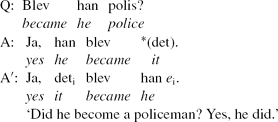
The first answer above, with a realized anaphoric det following the verb, is possible in Sweden, but a more common way to answer such a question is to reply as in A′ and front the predicative anaphor det to initial position.
Given that the construction is found in both Norwegian and Swedish, one might expect it to be possible in other V2 languages with expletive or quasi-argumental subjects. Somewhat surprisingly, the construction is hardly used in Danish. No spontaneous examples corresponding to e.g. (73b) have been attested and Danish informants judge Danish translations of the Norwegian and Swedish examples as ungrammatical, with one interesting exception. Patrizia Paggio (p.c. March 2012) has pointed out that examples where an embedded clause-anticipating subject is unrealized are acceptable. A Danish example is given in (89).Footnote 43
(89)

Sten Vikner has suggested that the reason that Danish does not pattern with Norwegian and Swedish might be that Danish makes a clear distinction between the expletive der used in presentational constructions and the quasi-argument det used in clause-anticipating constructions.Footnote 44 But if (89), with a missing quasi-argument det, is acceptable, it is not clear why examples with missing matrix quasi-arguments are not used. Furthermore, the expletive där is optional in Swedish dialects which make a distinction between presentational där and quasi-argument det (see (57)). Clearly more research on possible correlations between types of expletives and optionality is needed. Faroese and Icelandic would be particularly interesting to investigate, as would those dialects of Norwegian where there is an alternation between det and der in presentational constructions (see Søfteland to appear).Footnote 45
The situation in German is very interesting. Although es ‘it’ in German is used as an expletive, a quasi-argument and as a referential neuter pronoun, it has been claimed that an initial es cannot be interpreted as a fronted object; instead the demonstrative das is used (Travis Reference Travis1984:168). More recently, Meinunger (Reference Meinunger2007:555) has shown that an initial object es is possible, provided that the subject is low, as shown in (90) (see also van Craenenbroeck & Haegeman Reference Craenenbroeck and Haegeman2007).
(90)

Frey (Reference Frey2004) argues that the German middle field has a topic and a non-topic region. A low subject, like niemand ‘nobody’ in (90), would then be a non-topic. Theiler & Bouma (to appear) point out that the fronting of a weak object es is possible in precisely the types of sentences which could also have been introduced by a ‘placeholder’ es, i.e. sentences there the subject is not topical, as in their example in (91), taken from a body building blog.Footnote 46
(91)

There are clearly similarities between the German data in (90) and (91) and the Swedish constructions without expletive subjects. One notable difference is that the Swedish construction often involves a non-clause-bounded fronting of det whereas German es cannot be fronted from a subordinate clause.
8. CONCLUDING REMARKS
In this article we have seen that expletive and quasi-argument subject det in present-day Swedish is optional, sometimes even dispreferred, when there is an instance of a homphonous det in initial position, in Spec,CP. This happens in tough constructions like (31), repeated here as (92a), which was shown to be structurally ambiguous. The initial det is either a real subject of the predicative adjective (92b) or it is the fronted object from the infinitival clause, in which case the expected expletive subject det is left out (92c).
(92)

The pattern with unrealized expletive and quasi-argument subjects also extends to sentences with finite complement clauses as in (34a), repeated here as (93a). In this case there is no evidence that the initial det acts as a subject of the matrix clause; hence there is only one possible structure, shown in (93b).
(93)
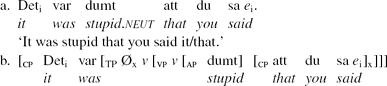
In (92) and (93) an expletive subject in the matrix clause is not pronounced. Expletive subjects in embedded clauses can also be unrealized, provided that there is an unbounded dependency headed by det, as in (77a), repeated here as (94a).
(94)

The constructions in (92)–(94) are interesting since they may shed some light on the relation between grammar and processing. As discussed in Section 6, the processor must be able to keep several interpretive options for an inital det available during the processing of the sentence. The construction with finite complements seems to be gaining ground in Swedish and is now found also in written texts. The lack of corpora of spoken Swedish from earlier periods makes it hard to investigate the extent to which it has been used earlier.Footnote 47 As shown in Section 7, it is used productively in Swedish and Norwegian, but in Danish it is limited to the embedded type shown in (94). The construction thus provides an interesting area for comparative research as well as for investigating how a novel syntactic pattern spreads in a speech community. Whether or not the pattern will become productive with other initial constituents besides det is also an interesting line of inquiry. If it does, we may expect this to trigger a more drastic reanalysis of Swedish clause structure.
ACKNOWLEDGMENTS
I have presented parts of this paper at the Grammar seminar in Gothenburg, at the ScanDiaSyn meeting in Sandbjerg 2008, at the CP workshop in Lund, December 2010, at the University of Iceland, March 2011, at the Third International Workshop on Germanic Languages at FU Berlin, March 2012, and at the Grammar seminar in Lund, May 2012. The questions and comments from the audiences have contributed significantly to the development of this paper. In particular I would like to thank Gerlof Bouma, Lars-Olof Delsing, Verner Egerland, Fredrik Heinat, Gunlög Josefsson, Ida Larsson, Filippa Lindahl, Benjamin Lyngfelt and Christer Platzack for helpful and/or challenging comments. The detailed comments from three anonymous reviewers have been very useful. Finally I would like to thank the editor Sten Vikner for constructive comments and suggestions.