Introduction
Available data on livestock production in Nigeria clearly indicate that we are far from the biological potential for rate and efficiency of gain, fertility and breeding efficiency (Gbore et al., Reference Gbore, Ewuola, Ogunlade, Idahor, Salako and Egbunike2007). As the demand for animal flesh continues to soar, the necessity for increasing the reproductive efficiency of livestock becomes more evident because this may be the area where man can expect the most significant economic achievement in livestock production. However, one of the greatest setbacks of this objective is the nutritional hazards that livestock are exposed to through an underestimation of the adverse mycotoxin influence on performance and reproductive efficiency of livestock (Egbunike, Reference Egbunike1995).
Optimal semen production is of great importance for pig breeding programmes, especially when artificial insemination (AI) is used. However, sperm production does not occur at a constant rate; many factors, known and unknown, influence semen quality and quantity (Colenbrander and Kemp, Reference Colenbrander and Kemp1990). The level of reproductive performance in domestic animals depends on the interaction of genetic and environmental factors such as climate, nutrition, management and diseases.
Breeding performance in farm animals is not dependent only on semen fertility; female fertility is a critical factor. However, quantitative and qualitative assessments of semen as well as the factors that affect them enhance the assessment of the reproductive status of the male. Such factors include nutrition, age, breed and method and frequency of semen collection (Colenbrander and Kemp, Reference Colenbrander and Kemp1990).
Fumonisins are mycotoxins produced by Fusarium molds, most notably Fusarium verticillioides (= F. moniliforme) and F. proliferatum. These mycotoxins occur as contaminants of agricultural products, particularly maize, worldwide (Nelson et al., Reference Nelson, Plattner, Shackelford and Desjardins1991). Shephard et al. (Reference Shephard, Thiel, Stockenström and Sydenham1996) reported that maize, which is the major cereal utilized in the formulation of livestock feeds as well as a major dietary staple in several parts of the world, is the only commodity that contains significant amounts of fumonisins; hence, the potential for fumonisins to be found in feeds and feedstuffs is high. Although several naturally occurring fumonisins are known, fumonisin B1 (FB1) has been reported to be the most abundant and most toxic which represents approximately 70% of the total concentration in naturally contaminated foods and feeds, followed by fumonisins B2 (FB2) and B3 (Murphy et al., Reference Murphy, Rice and Ross1993; Norred, Reference Norred1993). Consequently, toxicological studies on the fumonisins have been concentrated on FB1.
There are numerous reports that weanling piglets (Friend et al., Reference Friend, Trenholm, Elliot, Thompson and Hartin1982; Döll et al., Reference Döll, Dänicke, Ueberschär, Valenta, Schnurrbusch, Ganter, Klosaba and Flachowsky2003) and growing and finishing pigs (House et al., Reference House, Abramson, Crow and Nyachoti2002; Dänicke et al., Reference Dänicke, Valenta, Klobasa, Döll, Ganter and Flachowsky2004) are particularly sensitive to feed-borne Fusarium mycotoxins. Though fumonisins were reported to have some deleterious effects on reproduction in rats (Flynn et al., Reference Flynn, Pritchard, Bradlaw, Eppley and Page1996), Syrian hamsters (Floss et al., Reference Floss, Casteel, Johnson, Rottinghaus and Krause1994), chicken (Javed et al., Reference Javed, Richard, Bennett, Dombrink-Kurtzman, Bunte, Koelkebeck, Côté, Leeper and Buck1993; Bacon et al., Reference Bacon, Porter and Norred1995) and human beings (Hendricks, Reference Hendricks1999), much less is known, however, about the potential for fumonisin to influence reproductive performance of boars. The objective of this study was to determine the association among varied dietary FB1, reproductive organ weights and seminal quality in boars, since the reproductive capacity of a male animal is evaluated in terms of a number of physiological criteria such as the boars’ physical willingness and ability to mate, and produce live and physically normal sperm in adequate numbers.
Material and methods
Experimental materials and operations
Autoclaved maize grains were cultured with a toxigenic strain of F. verticillioides (MRC 286) inoculum obtained from the Plant Pathology Laboratory of the International Institute of Tropical Agriculture (IITA), Ibadan, Nigeria, to produce FB1 as described earlier (Nelson et al., Reference Nelson, Juba, Ross and Rice1994). The ground cultured maize was substituted for ground autoclaved, non-cultured maize in various proportions to formulate four diets containing 5.0, 10.0, 15.0 and 0.2 mg FB1/kg, as determined using the fumonisin quantitative competitive direct (CD)-ELISA test kit (Neogen Corp., Lansing, MI, USA), constituting diets 1, 2, 3 and control diet, respectively.
A total of 24 clinically normal male Large White weaned piglets of about 8 to 9 weeks of age, averaging 6.94 ± 0.26 kg, were sourced from the Piggery Unit of the Teaching and Research Farm, University of Ibadan, Ibadan, Nigeria. The animals were housed individually in concrete-floor indoor pens, and were randomly assigned into one of the four diets (six per treatment) after a 2-week physiological adjustment period.
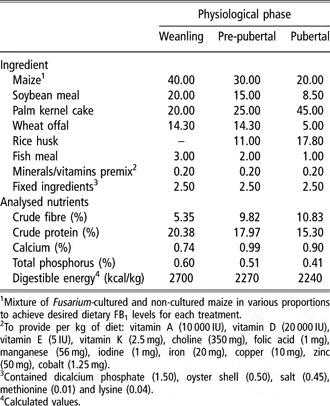
The feeding trial, which was conducted at the Animal Physiology Unit of the Teaching and Research Farm, University of Ibadan, Ibadan, Nigeria (7°20′N, 3°50′E, 200 m above sea level with an average daytime temperature of 24°C to 25°C and relative humidity 80% to 85%) during the early dry season, lasted 24 weeks. The feeding was divided into three physiological phases (weanling (starter), pre-pubertal (grower) and pubertal (finisher)). The composition of the diets fed ad libitum for 6, 10 and 8 weeks during the weanling, pre-pubertal and pubertal phases, respectively, are shown in Table 1.
Gross composition (%) of the test diets for the various physiological phases

1Mixture of Fusarium-cultured and non-cultured maize in various proportions to achieve desired dietary FB1 levels for each treatment.
2To provide per kg of diet: vitamin A (10 000 IU), vitamin D (20 000 IU), vitamin E (5 IU), vitamin K (2.5 mg), choline (350 mg), folic acid (1 mg), manganese (56 mg), iodine (1 mg), iron (20 mg), copper (10 mg), zinc (50 mg), cobalt (1.25 mg).
3Contained dicalcium phosphate (1.50), oyster shell (0.50), salt (0.45), methionine (0.01) and lysine (0.04).
4Calculated values.
Semen collection and evaluation
All the boars, upon reaching puberty (34 weeks of age), were exposed once weekly to dummy females for the purpose of training boars for semen collection by hand technique. Semen collection for analyses started when boars were 36 weeks old, and semen samples were collected from each boar three times in a week (Monday, Wednesday and Friday). Ejaculate from each animal was collected with a beaker and the ejaculate volume, excluding the gel, was read off immediately in a measuring cylinder and recorded, and semen was further evaluated for concentration (Zaneveld and Polakoski, Reference Zaneveld and Polakoski1977). A drop of undiluted semen from each animal was placed on a clean, pre-warmed (37°C) glass slide and examined with a microscope, under low power, to determine the mass activity of spermatozoa for each animal. This was scored according to the intensity of the wave motion, from absence of wave motion (+) to very turbulent motion (+++) characterized by the appearance of dark prominent waves in a very rapid motion. The semen progressive motility was evaluated as described earlier (Kastelic et al., Reference Kastelic, Cook, Pierson and Coulter2001). Percent live sperm was determined by counting 100 cells throughout the slide for each of two slides using a 400× magnification microscope, and recording the average number of live (unstained) v. dead (stained) cells from a thin smear of a drop of semen mixed with Eosin–Nigrosin stain (P/N HCS-101) (World Health Organization (WHO), 1999). Spermatozoa on these live–dead stained slides were also evaluated for morphological abnormalities (Malmgren and Larsson, Reference Malmgren and Larsson1984) consisting primary defects (those affecting the head) and secondary defects (those affecting the midpiece or tail).
Testicular and epididymal characteristics
After the semen collection, all the experimental pubertal boars were sacrificed by decapitation, their reproductive systems carefully dissected and their testes and epididymides carefully collected, trimmed, weighed and recorded. The relative weights of the testes and epidydimides (expressed as percent of live weight) as well as the volumes of the testes were determined.
Statistical analyses
The design used for this experiment is Complete Randomization Design (CRD). Data collected were subjected to statistical analysis using ANOVA procedure of Statistical Analysis Systems Institute (SAS, 1999). The Duncan’s multiple range tests of SAS (1999) was used to separate all means at 5% probability level.
Results
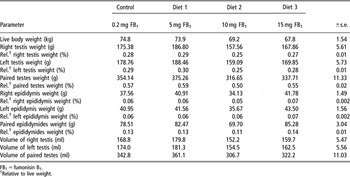
The characteristics of the testes and epididymides of pubertal boars exposed to varied levels of dietary FB1 are presented in Table 2. The results revealed that dietary FB1 did not influence the weights of the testes and epididymides as well as the volumes of the testes of the animals.
Testicular and epididymal characteristics of pubertal boars exposed to dietary FB1

FB1 = fumonisin B1.
1Relative to live weight.
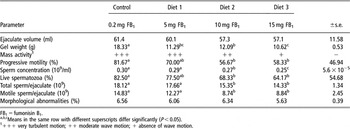
The semen characteristics of pubertal boars exposed to varied levels of dietary FB1 are summarized in Table 3. There were significant (P < 0.05) differences among the treatments for all parameters studied except for the semen volume and spermatozoa morphological abnormalities. The sperm concentration, total sperm and motile sperm per ejaculate of the animals on diet 3 were 83.3%, 79.1% and 59.6% of those on the control diet, respectively. The dietary FB1 levels also influenced the mass activities of the semen. The mass activity ranged from very turbulent motion for the animals on the control diet to absence of wave motion for those on diet 3.
Seminal characteristics of pubertal boars fed varied levels of dietary FB1

FB1 = fumonisin B1.
a,b,cMeans in the same row with different superscripts differ significantly (P < 0.05).
1+++ very turbulent motion; ++ moderate wave motion; + absence of wave motion.
Discussion
Colenbrander and Kemp (Reference Colenbrander and Kemp1990) reported that testes size is directly related to age of the animal. In this present study, the absolute and relative weights of the testes and epididymides as well as the testes volume of animals fed varied levels of dietary FB1 were not different among the treatments. The non-significant influence of dietary FB1 on the weights of the testes and epididymides as well as the volume of testes of boars exposed to FB1-contaminated diets is expected since all the animals were of similar age. The result suggested that dietary FB1 did not influence the weights and volume of reproductive organs in boars.
The non-significant difference in the gross and relative weights of epididymides of boars exposed to varied levels of dietary FB1, however, are contradictory to the finding of Ogunlade et al. (Reference Ogunlade, Ewuola, Gbore, Bandyopadhyay, Niezen and Egbunike2006) that observed significant decrease in the weights of caput and caudal segment of the epididymides in rabbits fed fumonisin-contaminated diets. This difference in the effect of dietary FB1 on epididymal weights seems to be due to differing susceptibility of both animal species to the mycotoxin, as observed by Voss et al. (Reference Voss, Bacon, Herbert, Chapin, Chamberlain, Plattner and Merdith1996). Also, the United States Food and Drug Administration (US FDA, 2001) considered rabbits (grouped with horses) as the most sensitive species to fumonisins in animal feed.
It has been established that there is a positive relationship between testicular size and sperm production in boars (Huang and Johnson, Reference Huang and Johnson1996). It then appears that males with large testes would produce ejaculates with higher numbers of spermatozoa compared to those with smaller testicles. Since there was no significant effect of dietary FB1 on gonadal characteristics of the pubertal boars with respect to weight and volume, irrespective of the dietary FB1 concentration, the significantly lower total sperm per ejaculate with increased dietary FB1 is an indication that dietary FB1 could play a major role in sperm production as reported earlier (Gbore and Egbunike, Reference Gbore and Egbunike2008). It thus implies that a maximum of 12 doses, as against 10 doses, would be obtained from a single ejaculate by animals on the control diet and diet 3, respectively, if the number of spermatozoa of 1.5–3.0 × 10⁹/dose recommended for one insemination by Park et al. (Reference Park, Kim and Son2000) is employed. This is of great significance in pig breeding programme especially when AI is employed.
Flowers (Reference Flowers1998) reported that the level of nutrition that boars receive during the earlier months after birth can have a significant effect on sperm output as an adult. As observed by Gbore and Egbunike (Reference Gbore and Egbunike2007), the main effect of fumonisin is to interfere with nutrient utilization in addition to reduced feed intake due to feed refusal effect in animals. Hemsworth et al. (Reference Hemsworth, Winfield and Hansen1983) reported that a significant correlation between testis size and sperm output exists in the adult boar. The significantly lower values of total sperm per ejaculate of the animals fed diets containing ⩾10 mg FB1/kg (diets 2 and 3) may therefore be attributed to the adverse effect of dietary FB1 on sperm production since the animals were similar in age, and no significant differences exist in their body, testicular and epididymal weights and testicular volume.
Although the normal values for ejaculate volume in boars range between 100 and 500 ml, the limit value of 50 ml reported by Larsson (Reference Larsson1986) was still lower than the ejaculate volumes of 57.1 to 61.4 ml collected from the pubertal boars across the treatments in this study. Similarly, the evaluated total sperm per ejaculate of 14.33–18.12 × 10⁹ and morphological abnormalities of 5.63% to 6.56% from the ejaculates of pubertal boars exposed to dietary FB1 was higher than the limit value of 10 × 109 and lower than the limit value of 30% reported by Flowers (Reference Flowers1998) across the treatments for the respective parameters. The progressive motility values of 56.7% and 58.3% estimated for animals on diets 2 and 3 were below the limit value of 62% recommended by Flowers (Reference Flowers1998) below which the author observed that farrowing rates and litter sizes would decrease.
Based on a review of scientific literatures, libido and semen quality in boars can be adversely affected if protein, or both energy and protein intakes are reduced. Kemp and Vertsegen (Reference Kemp and Vertsegen1991) concluded that a prolonged period of protein and energy restriction decreases the production of sperm cells. It appears, however, that the deleterious effects of under-nutrition are more pronounced when protein, rather than energy, is limited. Louis et al. (Reference Louis, Lewis, Weldon, Miller, Kittok and Stroup1994) reported that boars fed low-protein diet ejaculated less semen than those fed high-protein diet. Gbore (Reference Gbore2003) reported decreased dietary nitrogen retention potentials in rabbits fed micro doses of fumonisin. This finding was attributed to the inhibition of sphingolipid synthesis in the animals by fumonisin and has been observed by Yoo et al. (Reference Yoo, Norred, Wang, Merril and Riley1992) to adversely influence normal epithelial morphology. Recently, Gbore and Egbunike (Reference Gbore and Egbunike2007) suggested adverse effect of FB1 on intestinal function in nutrient digestibility and absorption in animals when the authors observed significantly lower nutrient digestibility by boars fed diets containing ⩾5.0 mg FB1/kg in a 6-month feeding trial. This suggests that FB1 might have interfered with protein metabolism in relation to its digestibility in the intestine, absorption in the intestinal lumen and/or utilization in the animal systems, which might have therefore contributed to the observed significant difference in semen characteristics of the pubertal boars in this study.
The dietary FB1 concentrations used in this study bracketed the published US FDA-recommended maximum level of 10 mg/kg total dietary fumonisins for swine (US FDA, 2001). This study has shown that dietary exposure to FB1 at a concentration above 5 mg/kg for a 6-month period may result in significantly reduced semen quality, which might impair fertility capacity of boars.
Acknowledgement
I wish to express my profound appreciation to members of the staff of the Pathology Unit, International Institute of Tropical Agriculture (IITA), Ibadan, Nigeria for the supply of the F. verticillioides inoculum and the analyses of the toxin used for this study.