Introduction
Whole-breast radiation therapy is the standard of care after breast-conserving surgery, because it reduces the risk of recurrence in the breast by approximately 50% at 10 years of follow-up and significantly reduces the 15-year risk of breast cancer death. 1 Conventional whole-breast radiation therapy is delivered in 1.8–2 Gy daily fractions over 5–6 weeks to a total dose of 45–50 Gy. A shorter fractionation schedule of 3–4 weeks is also acceptable. Reference Whelan, Pignol and Levine2,Reference Berlin, Boolbol, Cate, White and Chadha3 When patients receive radiation therapy, it is necessary to take off their underwear to avoid build-up effects that increase the skin dose, to ensure the reproducibility of the patient’s position and to check skin tattoos. However, it is a mental burden for female patients to take off their underwear at every fraction of radiation therapy. Reference Hama and Tate4
The purpose of this study was to investigate whether commercially available thin underwear can be worn during radiation therapy for breast cancer.
Materials and Methods
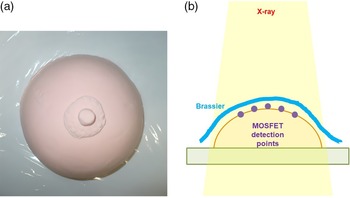
This article does not contain any studies with human participants or animals performed by any of the authors. Flattening filter-free 6 MV X-ray beam was used to measure surface dose. In our institution, intensity-modulated radiation therapy (IMRT) using 6 MV X-ray is the standard protocol for breast cancer. All the measurements were performed at 75 cm source-to-surface distances (SSD), and jaws were fixed at a width of 10 cm and length 5 cm. The gantry angle was 0 degree. A rigid breast phantom was made from calcium carbonate and pulp mixtures to avoid shape deformation (Figure 1a). In order to suppress build-up dose as much as possible, thin and simple non-disposable brassieres (n = 6) and one disposable paper brassiere were purchased at local mass merchants (Ito Yokado, Tokyo, Japan). The irradiation dose was about 1.8 Gy on the phantom surface without brassiere.
(a) A rigid breast phantom made from calcium carbonate and pulp mixtures. (b) Schematic diagram of phantom study using in vivo dosimetry system. A linear array with five detection points was attached on the breast phantom.

Surface doses were measured using a metal oxide semiconductor field effect transistor (MOSFET) detector system (Best Medical Canada, Canada). The MOSFET is approximately 200 microns in diameter and consists of a 0.5-micron Al electrode on top of a 1-micron SiO2 and 300-micron Si substrate. Results for per cent surface dose were within ±2% compared to the Attix chamber and within ±3% of thermoluminescent dosimeter extrapolation results. Reference Butson, Rozenfeld, Mathur, Carolan, Wong and Metcalfe5 A linear array with five detection points was attached strongly on the breast phantom (Figure 1b). The linear array was set so that all five detection points were included in the radiation field. The absorbed dose on the surface of the breast phantom was measured with or without each brassiere. Each measurement was carried out three times, and the dose increase rate (ΔD) when a brassiere was attached was calculated using the following equation.
 $${\rm \Delta} D\left( \% \right) = \left( {D1 - D0} \right)/D0*100$$
where D0 is absorbed dose without brassiere; D1 is absorbed dose with brassiere.
The average value of ΔD obtained from all five detection points of MOSFET dosimetry system was calculated.
Results
The average values of ΔD are shown in Table 1. For the six non-disposable brassieres, the average value of ΔD was 13.5% (9.0–21.8%), whereas that of disposable ones was 2.0%. The value of ΔD tended to increase with brassiere thickness (Table 1).
Dose increase values (ΔD) of six commercially available brassieres and one disposable brassiere.

Discussion
As far as we know, this is the first report that has investigated whether commercially available underwear can be used during radiation therapy for breast cancer. In this study, all six commercially available non-disposable brassieres were found to increase surface dose by about 10% even if simple and thin materials were used. Considering the safety, the use of commercially available underwear may increase skin dose excessively and seems to be unfeasible. On the other hand, the disposable paper brassiere can minimise the skin dose within an acceptable range (ΔD = 2.0%).
The limitation of this study is that the underwear we examined here is not customised for radiation therapy or made of optimal material. Considering the cost-effectiveness, it is advantageous to use readymade products, but customised underwear might be desirable from the viewpoint of safety. Second, dose on the phantom surface was measured using X-ray in one direction. Since radiation therapy for breast cancer usually uses tangential fields, Reference Taylor, Wang, Macaulay, Jagsi, Duane and Darby6 it is expected that more radiation will be absorbed by the skin surface in patients. However, when radiotherapy is performed by IMRT, there is no major problem because the absorbed dose can be adjusted. Third, the material of the phantom used in this study is not tissue-equivalent (e.g. water gel, PMMA). In order to suppress the influence of phantom material, we used X-ray in one direction (0 degree) instead of tangential fields.
Conclusion
Although a phantom study cannot be generalised to routine clinical use without further investigation, commercially available underwear has the risk of giving excessive dose to the skin during radiation therapy for breast cancer, but a thin disposable paper brassiere may be safe for use.
Acknowledgements
No funding or financial support was received for this study. Since this article does not contain any studies involving animals or humans, ethical approval or informed consent was not necessary.