Introduction
An increasing number of children are being exposed to a reading system in a language that is different from their first language (L1) as a result of migration processes or increased learning opportunities. These children can be defined either as bilingual children or as second-language learners, depending on the type of linguistic exposure they have received (Paradis, Genesee & Crago, Reference Paradis, Genesee and Crago2011). Immigrant children have often been described as performing less well than monolingual children on reading tasks (Slavin & Cheung, Reference Slavin and Cheung2003). By contrast, parallel research on the so-called bilingual advantage has reported enhanced nonverbal skills (e.g. Bialystok, Reference Bialystok2009; Bialystok & Feng, Reference Bialystok and Feng2009; Bonifacci, Giombini, Bellocchi & Contento, Reference Bonifacci, Giombini, Bellocchi and Contento2011; Costa, Hernàndez & Sebastiàn-Gallés, Reference Costa, Hernàndez and Sebastián-Gallés2008). An in-depth analysis of the cognitive and linguistic processes that intervene in reading in a second language (L2) is imperative, if we are to understand typical and atypical development of this ability. Many studies have shown that learning to read in an L2 is similar, in many aspects, to learning to read in an L1 (for comprehensive reviews, see August & Shanahan, Reference August and Shanahan2006; Genesee & Jared, Reference Genesee and Jared2008). Some predictors of reading efficiency, such as phonemic awareness, letter-sound knowledge, working memory, vocabulary, and rapid automatized naming (RAN), have been found to be meaningful indices both for monolingual (e.g. Kirby, Desrochers, Roth & Sandy, Reference Kirby, Desrochers, Roth and Sandy2008) and bilingual reading acquisition (see Genesee, Lindholm-Leary, Saunders & Christian, Reference Genesee, Lindholm-Leary, Saunders and Christian2006).
Although most studies in the literature point to similar patterns of reading acquisition in L1 and L2, there are also important differences. These differences may be linked to different sociocultural backgrounds (e.g. teaching methods and materials that are not familiar to children speaking an L2-minority language) (Paradis et al., Reference Paradis, Genesee and Crago2011). Moreover, learning to read in an L2 can be modulated by other specific factors, related to either the reader's prior linguistic exposure or the specific properties of the language that is to be acquired. In the present study, we focused on the interaction between two main factors: age of first bilingual exposure and impact of lexical knowledge. In particular, we sought to test lexicality, frequency, and stress assignment effects in bilingual children reading Italian as an L2. Although a number of studies have addressed these questions in monolingual or bilingual adults, to the best of our knowledge this is the first study to have looked at bilingual children whose L2 is Italian.
Age of first L2 exposure
Based on the definition provided by Kovelman, Baker and Petitto (Reference Kovelman, Baker and Petitto2008), the term age of first bilingual exposure (AoE-L2) refers to the age when a bilingual child first begins to receive intensive, systematic, and maintained exposure to his/her new language. In the literature, it is often used interchangeably with the expression age of acquisition, which has been commonly employed to denote the age at which a monolingual individual first starts learning a new or second language. An increasing number of studies have shown that children who are raised in a bilingual environment from birth reach linguistic milestones (e.g. first two-word combinations) in both languages at very similar times to monolingual children (Genesee, Reference Genesee1989; Holowka, Brosseau-Lapré & Petitto, Reference Holowka, Brosseau-Lapré and Petitto2002; Pearson, Reference Pearson1998; Pearson, Fernandez & Oller, Reference Pearson, Fernández and Oller1993; Petitto, Katerelos, Levy, Gauna, Tetreault & Ferraro, Reference Petitto, Katerelos, Levy, Gauna, Tétrault and Ferraro2001). Nevertheless, the debate on the sensitive periods for developing fully proficient linguistic skills in two or more languages is ongoing and controversial, and there are still some misconceptions concerning the relationship between age and L2 learning, as evidenced by Marinova-Todd, Marshall and Snow (Reference Marinova-Todd, Marshall and Snow2000). Penfield and Roberts (Reference Penfield and Roberts1959) first put forward their critical period hypothesis, subsequently developed by Lenneberg (Reference Lenneberg1967), who defined critical periods for the acquisition of segmental phonology, morphology, and syntax. Then Locke (Reference Locke1997) proposed his optimum biological moment view and, in recent years, behavioral data have been enriched by neuroimaging studies. These studies suggest that late bilinguals (LBs), although highly proficient, do not exhibit a native-like pattern of activity in response to a new language (Isel, Baumgärtner, Thrän, Meisel & Büchel Reference Isel, Baumgärtner, Thraen, Meisel and Buechel2010; Perani, Abutalebi, Paulesu, Brambati, Scifo & Cappa, Reference Perani, Abutalebi, Paulesu, Brambati, Scifo and Cappa2003) whereas early bilinguals (EBs), usually defined as having an AoE-L2 below three years, do not exhibit any significant differences in brain activation patterns in linguistic tasks with respect to monolingual children. However, when we take behavioral indices of L2 proficiency into consideration, the existence and timing of a sensitive period significantly affecting the acquisition of L2 structures become far less clear cut. For example, while Johnson and Newport (Reference Johnson and Newport1989) highlighted a decline in grammatical judgment in people exposed to English as an L2 after puberty (15 years), when Bialystok and Hakuta (Reference Bialystok, Hakuta and Birdsong1999) recalculated age‑performance correlations, they found that the decline set in after age 20.
While several studies have examined the sensitive period in a variety of domains of linguistic competence, very few have addressed the role of AoE-L2 in reading proficiency. Kovelman et al. (Reference Kovelman, Baker and Petitto2008) reported that EBs (AoE-L2 within the first three years of life) displayed better L2 reading skills, in terms of accuracy and speed, than LBs (or second-language learners; AoE-L2 four to six years of age), and the reading skills of EBs did not differ from those of monolingual children. Moreover, EBs performed just as well as native speakers of their L1 (Spanish) and L2 (English) on a standardized language competence/expressive proficiency assessment, whereas LBs performed less well in their new language. In the present study, we adopted the definition of EBs used by Kovelman et al. (Reference Kovelman, Baker and Petitto2008) and further compared EBs and LBs in reading tasks. As previously indicated, we also assessed the impact of AoE-L2 on children's sensitivity to specific language properties.
Lexical knowledge in reading Italian
Contrary to the claim that word reading in transparent orthographies is accomplished mainly through the nonlexical route (i.e. relying on grapheme–phoneme correspondences), recent studies have shown that the acquisition of reading in transparent orthographies such as Italian is influenced by lexical variables from the earliest stages of development (e.g. Burani, Marcolini & Stella, Reference Burani, Marcolini and Stella2002), in a similar way to what happens in the case of languages with opaque orthographies such as English. Several studies have highlighted lexicality effects (the advantage of reading words rather than nonwords), frequency effects (the advantage of reading high-frequency versus low-frequency words), and stress-assignment effects when reading in Italian (e.g. Bellocchi & Bastien-Toniazzo, Reference Bellocchi and Bastien-Toniazzo2011; Burani & Arduino, Reference Burani and Arduino2004; Burani, Paizi & Sulpizio, Reference Burani, Paizi and Sulpizio2014; Colombo, Reference Colombo1992; Colombo, Pasini & Balota, Reference Colombo, Pasini and Balota2006; Pagliuca, Arduino, Barca & Burani, Reference Pagliuca, Arduino, Barca and Burani2008; Paizi, De Luca, Zoccolotti & Burani, Reference Paizi, Luca, Zoccolotti and Burani2013; Paizi, Zoccolotti & Burani, Reference Paizi, Zoccolotti and Burani2011).
The study of stress assignment in monolingual readers has received increasing attention in recent years, as the attribution of stress is an important process that can tell us how linguistic knowledge is activated in reading tasks. As we explain below, in Italian stress position can vary, and the process of stress assignment in reading requires lexical knowledge, specifically knowledge of the suprasegmental properties of the Italian language. For example, in the word farina (“flour”), the stress is placed on the penultimate syllable, whereas in the word favola (“tale”), the stress is placed on the antepenultimate syllable.
Most studies examining the relationship between the development of phonological representations and literacy acquisition have focused on the sublexical segmental level. However, spoken words also carry suprasegmental or prosodic information, defined by fundamental frequency, intensity, duration, and amplitude modulations. At the lexical level, these parameters co-determine the prosodic or stress pattern of words in stress-based languages (e.g. English, Dutch, Spanish) that display a rhythmic alternation between stressed and unstressed syllables (Goetry, Wade-Woolley, Kolinsky & Mousty, Reference Goetry, Wade-Woolley, Kolinsky and Mousty2006). Italian is a transparent language with regular grapheme–phoneme correspondences, but less predictable suprasegmental properties. In words of three or more syllables, the stress can be assigned to either the penultimate or the antepenultimate syllable, but there are no formal rules governing the two cases,Footnote 1 and no mark is used in the written form to signal where the stress occurs.Footnote 2 To correctly assign stress, the reader therefore needs to access the lexicon and retrieve the correct pronunciation. Alternatively, the reader can estimate which stress pattern is more likely to be correct based on a probabilistic assessment of the stress properties of his/her language (Burani & Arduino, Reference Burani and Arduino2004; Burani et al., Reference Burani, Paizi and Sulpizio2014; Colombo, Reference Colombo1992; Paizi et al., Reference Paizi, Zoccolotti and Burani2011; Sulpizio & Colombo, Reference Sulpizio and Colombo2013). For example, in Italian there is a predominance of words with the stress on the penultimate syllable (Thornton, Iacobini & Burani, Reference Thornton, Iacobini and Burani1997), which have therefore been defined as regular words, or more correctly as words with a dominant stress, in contrast to words with the stress on the antepenultimate syllable, which have been defined as irregular words, or words with a non-dominant stress.
However, stress assignment may interact with another fundamental word property, namely frequency. A number of studies have investigated this interaction with contrasting results. Colombo (Reference Colombo1992), in accordance with results obtained for English words with regular versus irregular spelling–sound correspondences (e.g. Andrews, Reference Andrews1992; Seidenberg, Waters, Barnes & Tanenhaus, Reference Seidenberg, Waters, Barnes and Tanenhaus1984), found an interaction between stress dominance and word frequency in reading Italian polysyllables: words with a dominant stress were read aloud faster than words with a non-dominant stress, but only when these were of low frequency; that is, they were more likely to be computed through sublexical correspondences. Burani and Arduino (Reference Burani and Arduino2004) challenged the effect of stress dominance on low-frequency word reading (Colombo, Reference Colombo1992; Rastle & Coltheart, Reference Rastle and Coltheart2000) by showing that stress assignment to low-frequency words can be determined by the number of words that share the same stress pattern and final orthographic/phonological sequence (referred to as stress neighborhood) (Burani & Arduino, Reference Burani and Arduino2004; Burani et al., Reference Burani, Paizi and Sulpizio2014; Colombo, Reference Colombo1992; for similar effects in English, see also Arciuli & Cupples, Reference Arciuli and Cupples2006; Kelly, Morris & Verekkia, Reference Kelly, Morris and Verrekia1998).
Paizi et al. (Reference Paizi, Zoccolotti and Burani2011), together with Sulpizio, Boureux, Burani, Deguchi, and Colombo (Reference Sulpizio, Boureux, Burani, Deguchi, Colombo, Miyake, Peebles and Cooper2012) and Sulpizio and Colombo (Reference Sulpizio and Colombo2013), have suggested that beginning and less-skilled readers may be more influenced by stress dominance in reading, possibly because they do not yet possess a stable link between the orthographic representation of a word and its stress pattern, unlike older children or adult readers. The absence of lexical information on the stress position for a given word, with consequent reliance on sublexical processing (Ziegler & Goswami, Reference Ziegler and Goswami2005), may favor the assignment of stress to the penultimate syllable, owing to sensitivity to the statistical distribution of stress patterns, leading children to assign the dominant (i.e. most frequent) stress pattern.
In contrast to the growing literature on stress assignment in monolingual readers, stress assignment in bilinguals has been rarely investigated. Goetry et al. (Reference Goetry, Wade-Woolley, Kolinsky and Mousty2006) compared the stress-processing abilities of French and Dutch monolinguals with French–Dutch bilinguals and Dutch–French bilinguals. As well as replicating the stress deafness Footnote 3 effect in native French listeners (Dupoux, Pallier, Sebastian & Mehler, Reference Dupoux, Pallier, Sebastián-Gallés and Mehler1997; Dupoux, Peperkamp & Sebastian-Galles, Reference Dupoux, Peperkamp and Sebastián-Gallés2001), they observed that the performances of the French–Dutch bilinguals in terms of the accuracy of stress assignment were midway between those of the two monolingual groups. The authors interpreted these data as suggesting that stress-processing abilities can be acquired through L2 exposure in children between four and five years of age. They further observed that stress-processing abilities were significantly correlated with lexical development and reading skills in the French–Dutch bilingual group.
The present study
Taking all these considerations into account, the present study was designed to assess whether bilingual children exposed to Italian as a second language exhibit sensitivity to lexical properties and stress dominance when reading Italian, and whether this sensitivity differs between bilinguals with differing AoE-L2. Thus, the overall purpose of this study was to test lexicality, frequency, and stress-assignment effects in EBs and LBs compared with monolinguals. AoE-L2 is associated with differences in L2 lexical knowledge and vocabulary size. Furthermore, the age at which a bilingual child is introduced to a new (or additional) language is thought to impact ultimate dual-language competence and proficiency, such that persons with early exposure to two languages (EBs) achieve greater language mastery than persons with late bilingual exposure (LBs; see, for example, Flege, MacKay & Meador, Reference Flege, MacKay and Meador1999; Flege, Munro & MacKay, Reference Flege, Munro and MacKay1995; Johnson & Newport, Reference Johnson and Newport1989; Petitto & Kovelman, Reference Petitto and Kovelman2003). We thus predicted that L2 lexicon size, which is assumed to be smaller in LBs, would have a negative impact on their sensitivity to lexical effects and stress assignment. To test this prediction, we conducted two reading aloud experiments: Experiment 1 assessed lexicality and frequency effects, and Experiment 2 the effects of stress assignment and its interaction with word frequency on reading speed and accuracy.
Method
Participants
A total of 66 children aged from eight to ten years (mean age in months: 108.82, SD: 6.89) took part in this study. They were all selected and recruited from mainstream primary schools where the Laboratory for the Assessment of Learning Disabilities (LADA) of Bologna University's Department of Psychology was screening for learning disabilities. All the children were in fourth or fifth grade.
The children were divided into three groups:
-
(i) Two groups of bilingual children (30), selected on the basis of their age of exposure (AoE) to Italian as a second language (AoE-L2 Kovelman et al., Reference Kovelman, Baker and Petitto2008), established by means of a questionnaire completed by parents and teachers (Bellocchi, Reference Bellocchi2010; see also Contento, Bellocchi & Bonifacci, Reference Contento, Bellocchi and Bonifacci2013): 15 EBs with an AoE-L2 before three years and eleven months old; 15 LBs with an AoE above four years. The EBs had all attended kindergarten in Italy while, in order to participate, the LBs had to have been schooled in Italian at least for 3 years [46.7% of them started learning Italian as an L2 at the start of primary school (i.e. first grade), and the remaining 53.3% started learning Italian during the last years of kindergarten]. None of the bilingual children had previously been schooled from first grade in their L1.
The selection criteria were:
-
(a) exposure to an L1 different from Italian (L2) within the family context.
-
(b) performance IQ within the normal range (> 85).
-
(c) normal reading abilities defined by scores no more than one standard deviation below the mean on a standardized word reading test.
All the bilinguals were schooled exclusively in Italian. There were 15 girls and 15 boys representing eight native language groups: Albanian (13.3%), Tagalog (33.3%), Moroccan (16.6%), Romanian (20%), Bengali (6.6%), Spanish, Russian, and Mandarin (3.3% each).
-
-
(ii) One group of Italian monolinguals (36; 22 girls and 14 boys) matched with the bilinguals for chronological age and nonverbal IQ. Like the bilinguals, they were all typically developing readers, as assessed by standardized measures.
Screening tests
During the screening phase, each participant's reading, lexical, and cognitive abilities were evaluated using standardized tests. Parental permission was obtained before administering these tests and the subsequent experimental tasks.
Italian reading achievement was tested by means of Tasks 2 (speed in syllables/second) and 3 (accuracy in number of errors in word and pseudoword reading) of the Batteria per la Valutazione della Dislessia e Disortografia Evolutiva-2 (“Developmental dyslexia and dysorthographia assessment battery”; Sartori, Job & Tressoldi, Reference Sartori, Job and Tressoldi2007), which is one of the most widely used Italian tests for assessing word and nonword reading efficiency. Reported test–retest reliability is .77 for reading speed and .56 for accuracy. The third task, Prove di Lettura MT per la Scuola Elementare (“MT Reading tests for primary schools”; Cornoldi & Colpo, Reference Cornoldi and Colpo1998) consisted in reading aloud a meaningful passage in which speed (syllables/seconds) and accuracy (number of errors) were rated. Passage difficulty varied with grade level, meaning that fourth graders read a different passage from fifth graders. Correlation indices on parallel forms for each grade level ranged from .75 to .87 for accuracy scores and from .94 to .97 for reading speed.
The cognitive assessment took the form of the Kaufman Brief Intelligence Test-2 (K-BIT-2; Kaufman & Kaufman, Reference Kaufman and Kaufman2004) an Italian version of verbal tasks adapted in our laboratory for experimental purposes.Footnote 4 This test is composed of vocabulary (verbal knowledge and riddles) and matrix subtests, and provides standardized measures of verbal, performance, and composite full scale IQ. Reliability for native English-speakers (age 4–90 years) is .91 for verbal IQ, .88 for nonverbal IQ, and .93 for composite IQ.
Participants’ lexical abilities were also assessed by means of a verbal fluency task drawn from the Batteria per la Valutazione Neuropsicologica 5–11 (“Neuropsychological assessment test for 5–11-year-olds”; Bisiacchi, Cendron, Gugliotta, Tressoldi & Vio, Reference Bisiacchi, Cendron, Gugliotta, Tressoldi and Vio2005). Participants are asked to verbally produce a set of Italian words that belong to several semantically defined domains (towns, colors, etc.), with a one-minute interval between each domain (defined using a stopwatch). Mean test–retest reliability is .84.
Most of these measures had been standardized on a population of monolingual Italian speakers, which may constitute a limitation when comparing bilinguals. However, they had the advantage of allowing us to analyze these descriptive statistics from a comparative perspective (Uchikoshi & Marinova-Todd, Reference Uchikoshi and Marinova-Todd2012) and to select participants (both monolingual and bilingual) with typical reading and cognitive development.
The entire reading and cognitive assessment with standardized tests lasted approximately 30 minutes.
Sample characteristics: Results
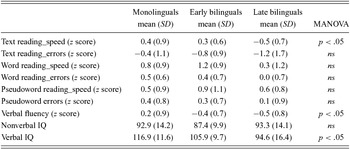
In order to investigate and describe the sample's characteristics, we ran a multivariate analysis of variance (MANOVA) on cognitive and reading abilities, with group (3 levels: monolinguals, EBs, and LBs) as a between-participants factor. Table 1 provides the means and standard deviations of the error rate and speed (z scores) in the reading aloud tasks for the monolinguals, EBs, and LBs, together with the verbal fluency z scores and IQ scores. Statistics are also reported. Statistical analyses were conducted using the SPSS® program, version 20.0.
Monolinguals’ and bilinguals’ mean scores (standard deviations) on the Italian reading aloud tasks, verbal fluency task (z scores) and IQ test (standard scores).

Results showed that LBs were significantly slower than EBs (p < .05) and monolinguals (p < .05) (Bonferroni post hoc test) on text reading (F(2,66) = 7.38, p < .05, MSE = 0.61). No significant differences were found for accuracy (number of errors). Differences between groups also emerged for verbal IQ (F(2,66) = 17.3, p < .05, MSE = 156.09): LBs had less verbal knowledge than either EBs or monolinguals (p < .05 and p < .001, respectively), and EBs had less verbal knowledge than monolinguals (p < .05) (Bonferroni post hoc). There were also differences in verbal fluency (F(2,66) = 5.8, p < .05, MSE = 0.69): Bonferroni post hoc tests showed that both LBs and EBs performed worse than monolinguals (p < .05 and p < .05, respectively). No significant differences emerged between LBs and EBs.
Finally, results did not reveal any significant difference between the groups in either the decoding of words and pseudowords or nonverbal IQ. The absence of differences in the decoding of words and pseudowords, as measured by standardized tests, showed that the bilingual children were not characterized by reading difficulties or delays compared to monolinguals. Moreover, consistent with our selection criterion, all the children (bilingual and monolingual) were typically developing readers, as shown by the fact that none of their scores were more than two standard deviations below the mean, which can be regarded as the cut-off score for defining reading disorders.
Experiment 1: Lexicality and frequency effects
Experiment 1 investigated the lexicality effect, which refers to the advantage, in terms of error rates and reading speed, of words over pseudowords. Contrary to the claim that word reading is accomplished mainly via the nonlexical route in transparent orthographies, several studies have reported that Italian developing readers exhibit lexicality and frequency effects (e.g. Barca, Burani, Di Filippo & Zoccolotti, Reference Barca, Burani, Di Filippo and Zoccolotti2006; Paizi et al., Reference Paizi, Zoccolotti and Burani2011, Reference Paizi, Luca, Zoccolotti and Burani2013; Sulpizio & Colombo, Reference Sulpizio and Colombo2013). These results indicate that lexical information is employed in reading Italian from the very early years of learning to read. As to whether children who learn Italian as an L2 display similar lexical effects on their reading, we assumed that this is indeed the case, especially for EBs. Moreover, we predicted that EBs, characterized by a larger vocabulary than LBs (see Table 1), would exhibit the lexicality effect when low-frequency words were compared with matched pseudowords. By contrast, we expected that in the LB group the lexicality effect would be present for high-frequency words but not for low-frequency words, resulting in similar reading performances with respect to matched pseudowords.
Materials
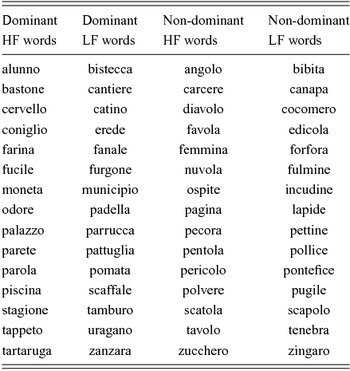
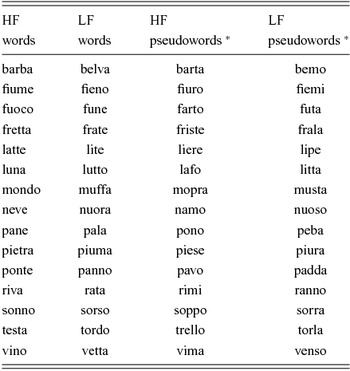
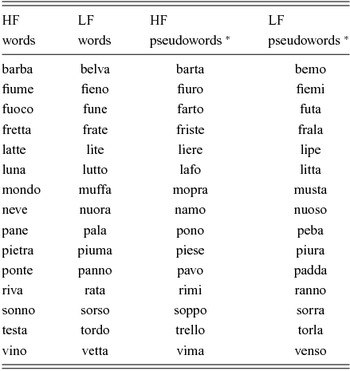
We used a list of 60 stimuli. The experimental items were selected from the list originally developed by Pagliuca et al. (Reference Pagliuca, Arduino, Barca and Burani2008) for Italian adults reading aloud. Frequency values were taken from the CoLFIS frequency count for contemporary written Italian by Bertinetto, Burani, Laudanna, Marconi, Ratti, Rolando & Thornton (Reference Bertinetto, Burani, Laudanna, Marconi, Ratti, Rolando and Thornton2005). All the stimuli were disyllabic, contained four to six letters, and were stressed on the penultimate syllable. The list of stimuli can be found in Appendix 1 and 2 (see also Primativo, O’Brien, Paizi, Rinaldi, Arduino & Burani, Reference Primativo, O’Brien, Paizi, Rinaldi, Arduino and Burani2013).
Two dimensions were orthogonally manipulated: (i) regarding stimulus lexicality, half the stimuli were words (all nouns), whereas the other half were nonwords, matched with words on several psycholinguistic variables; (ii) regarding word frequency, half the word stimuli have a high frequency (HF) of occurrence in written Italian, and half have a low frequency (LF). The word stimuli were selected from the LEXVAR database (Barca, Burani & Arduino, Reference Barca, Burani and Arduino2002). Half the nonword stimuli were derived from the HF words and half from the LF words, by changing one or two letters. The final list included four sets of 15 items each, totaling 60 stimuli. Stimuli were matched for two initial phonemes (Kessler, Treiman & Mullennix, Reference Kessler, Treiman and Mullennix2002), length in letters, bigram frequency, number of orthographic neighbors (N-size), summed neighbor frequency (Wagenmakers & Raaijmakers, Reference Wagenmakers and Raaijmakers2006), and number of geminate consonants and diphthongs (Burani & Cafiero, Reference Burani and Cafiero1991).
Procedure
The stimuli were presented in two separate blocks, of 30 trials each. Each block had a similar number of HF and LF words and pseudowords. The order of trials within each block was randomized, and block order was counterbalanced across participants. There was a practice block of six stimuli (three words and three pseudowords).
The stimuli were presented using E-Prime Version 2 (Psychology Software Tools, Pittsburgh, PA, USA; http://www.pstnet.com) on a laptop computer (TravelMate 4000WLMi; Acer). Participants were asked to read aloud, as fast and accurately as possible, the stimuli that appeared in the center of the computer screen. Before each stimulus, an auditory cue was played for 250 ms, after which a fixation cross was displayed in the center of the screen for 250 ms. The stimulus appeared immediately after the fixation cross. Each stimulus disappeared as soon as the participant responded or after 5000 ms. There was an interstimulus interval of 250 ms.
A native Italian speaker noted and recorded the errors, and a second experimenter subsequently checked the recorded errors. A microphone connected to the laptop recorded the pronunciation of all the stimuli. Vocal reaction times (VRTs) were measured using SayWhen (Jansen & Watter, Reference Jansen and Watter2008), a software system designed to detect speech onset latencies automatically and with a high degree of accuracy, and which flags up a subset of trials most likely to have mismeasured onsets for optional manual checking. It allows experimenters to implement a graphical user interface that greatly speeds up and facilitates the checking and correction of this flagged subset of trials. Thanks to the use of this hybrid mode (automatic and hand coding), it is possible to achieve a very high level of accuracy compared with other fully automated methods (i.e. voice keys) or fully hand-coded methods.
Results
In both the first and second experiments, errors and VRTs (in ms) were analyzed using the generalized linear mixed model (GLMM), treating participants and items as crossed random factors. We chose to run this robust analysis in order to avoid a potential lack of power of the by-participant and by-item analyses, and to control for the variability of items and participants (Baayen, Davidson & Bates, Reference Baayen, Davidson and Bates2008; for a discussion on the usefulness of GLMMs for examining variability in cognitive strategies during childhood, see Dauvier, Chevalier & Blaye, Reference Dauvier, Chevalier and Blaye2012). Errors were analyzed by means of the logistic model and VRTs by means of the linear one, as the residuals were basically normally distributed. We stepped through a series of models, then selected the best one according to the Akaike information criterion (AIC)Footnote 5 value. All the comparisons between the models were carried out with the likelihood ratio test (LRT) using restricted maximum likelihood (REML) estimation. Thus, the best model was the one with the lowest AIC value and for which the comparison with other models was statistically significant. For this reason we only report this comparison. With this approach we rejected models that did not explain more variance than those we accepted.
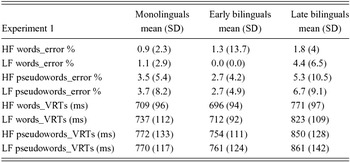
For a clearer presentation of the results, Table 2 provides the mean values and standard deviations of error percentages and VRTs for each group with regard to words (HF and LF) and pseudowords (derived from HF and LF words).
Experiment 1. Mean (standard deviation) error percentages and vocal reaction times (in ms) for each group, for words (high- vs. low-frequency) and pseudowords (derived from high- and low-frequency words).

HF = high frequency, LF = low frequency, VRT = vocal reaction time
Statistical analyses were conducted using lme4 (Bates, Maechler & Dai, Reference Bates, Maechler and Dai2008) and languageR packages (Baayen, Reference Baayen2008).
Errors
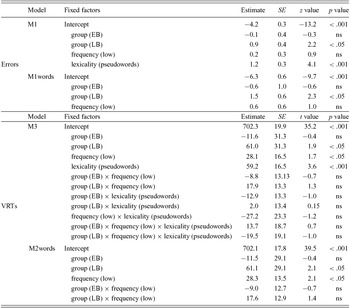
In the analysis of errors, we first tested a model (M0) that included participants and items as random factors and intercept as a fixed factor. We then added Group (monolinguals, EBs, and LBs), Frequency (HF vs. LF), and Lexicality (words vs. pseudowords) as fixed factors (M1). In a third model (M2) we added the interactions between the fixed factors (Group × Frequency, Frequency × Lexicality, Group × Lexicality), and in a fourth one (M3) we finally added the Group × Frequency × Lexicality interaction. AIC values for all four models showed that M1 was the best model (AIC = 882.86; LRTM0–M1 = 23.16, df = 4, p < .001) compared with M0 (AIC = 898.02), M2 (AIC = 886.49), and M3 (AIC = 886.21). As shown in Table 3 below, a clear lexicality effect emerged in M1 (errors ~ 1 + (1 | participants) + (1 | items) + Group + Frequency + Lexicality), meaning that words were read more accurately than pseudowords (% errors, words: mean = 1.6, SE = 0.3; pseudowords: mean = 4.1, SE = 0.9). With regard to the group factor, results showed that LBs were less accurate (LBs: mean = 4.6, SE = 0.8; EBs: mean = 1.6, SE = 0.5; monolinguals: mean = 2.3, SE = 0.3) than the other groups. The statistical parameters for all the factors are set out in Table 3.
Experiment 1. Statistical parameters of the generalized linear mixed models for errors and vocal reactions times.

EB = early bilinguals, LB = late bilinguals, VRT = vocal reaction time
Table 2 shows that there was a floor effect for EBs for LF words. This result was not problematic, as the GLMM with the logistic link function allows data to be characterized by an absence of variation, as the homogeneity of variance does not need to be satisfied.
In order to investigate the frequency effect, we ran a separate analysis on words only. In the selection of models, we proceeded as before. Again, we first tested a model (M0words) that included participants and items as random factors and intercept as a fixed factor. We then added Group (monolinguals, EBs, and LBs) and Frequency (HF vs. LF) as fixed factors (M1words). In a third model (M2words), we added the interaction between the two fixed factors (Group × Frequency). AIC values for all four models showed that M1words was the best model (AIC = 262.23; LRTM0words–M1words = 8.99, df = 3, p < .05) compared with M0words (AIC = 265.23) and M2words (AIC = 260.42). A group effect emerged in this model (errors ~ 1 + (1 | participants) + (1 | items) + Group + Frequency). The mean percentages of errors were 3.1% (SE = 0.6) for LBs, 0.7% (SE = 0.6) for EBs and 1% (SE = 0.4) for monolinguals. However, no frequency effect emerged. The statistical parameters are presented in Table 3.
Vocal reaction times
As with errors, we first tested a model (M0) that included participants and items as random factors and intercept as a fixed factor. We then added Group (monolinguals, EBs, and LBs), Frequency (HF vs. LF), and Lexicality (words vs. pseudowords) as fixed factors (M1). In a third model (M2), we added the interactions between the fixed factors (Group × Frequency, Frequency × Lexicality, Group × Lexicality), and in a fourth one (M3) we finally added the Group × Frequency × Lexicality interaction. AIC values for all four models showed that M3 was the best model (AIC = 47119.15; LRTM2–M3 = 17.54, df = 2, p < .001) compared with M0 (AIC = 47203.18), M1 (AIC = 47159.35), and M2 (AIC = 47132.69). A lexicality effect emerged in M3 (VRTs ~ 1 + (1 | participants) + (1 | items) + Group + Frequency + Lexicality + Group : Frequency + Frequency : Lexicality + Group : Lexicality + Group : Frequency : Lexicality), meaning that words (mean = 741, SE = 13) were read faster than pseudowords (mean = 795, SE = 16). Moreover, results showed group and frequency effects. The statistical parameters for all the factors are set out in Table 3.
In order to investigate the frequency effect, we ran a separate analysis on words only. We applied the same procedure as above. Three models were developed (M0words, M1words, and M2words). AIC values showed that M2words was the best model (AIC = 23960.49; LRTM1–M2 = 16.98, df = 2, p < .001) compared with M0words (AIC = 24004.27) and M1words (AIC = 23973.47). With regard to M2words (VRTs ~ 1 + (1 | participants) + (1 | items) + Group + Frequency + Group : Frequency), a group and a frequency effect emerged. As before, the statistical parameters for this model are reported in Table 3 below.
Discussion
The results of the first experiment showed the presence of lexicality and frequency effects for all three groups of participants. These results confirmed that lexical information is employed in reading Italian even in the initial years of learning to read and, more importantly, they showed that this is also true for children who are learning to read Italian as an L2, regardless of their AoE-L2. However, contrary to our expectations, the lexicality effect was not modulated by word frequency or by type of bilingualism (early vs. late), as there was no significant triple Group × Lexicality × Frequency interaction. Moreover, a group effect emerged, showing that LBs were less accurate and slower than monolinguals and EBs.
Experiment 2: Stress assignment
Experiment 2 was designed to explore the impact of lexicon size and AoE-L2 on reading Italian words with dominant and non-dominant stress. We also set out to investigate whether errors in reading are influenced by the distributional properties of the stress patterns in Italian. As is well known, although Italian has almost perfect grapheme-to-phoneme correspondence at a segmental level, there is a degree of unpredictability at the suprasegmental level, which can be regarded as a source of irregularity in this language. This is because the position of the stress in words with three or more syllables is neither orthographically marked nor predicted by rules. Most three- and four-syllable Italian words are stressed on the penultimate syllable, that is, they carry a dominant stress (e.g. faRIna “flour”). However, a smaller proportion of polysyllabic words are stressed on the antepenultimate syllable, that is, they carry a non-dominant stress (e.g. FAvola “tale”). Some authors have hypothesized that stress assignment is affected by stress neighborhood (i.e. the number of words that share the same stress pattern and final orthographic/phonological sequence) (Burani & Arduino, Reference Burani and Arduino2004; Burani et al., Reference Burani, Paizi and Sulpizio2014; Colombo, Reference Colombo1992; Sulpizio, Arduino, Paizi & Burani, Reference Sulpizio, Arduino, Paizi and Burani2013). It has also been hypothesized that younger readers display greater sensitivity to stress dominance in reading because they have a smaller vocabulary than adult readers. The absence of lexical information about a word's stress position may favor stress assignment to the dominant position, that is, the penultimate syllable (Paizi et al., Reference Paizi, Zoccolotti and Burani2011; Sulpizio et al., Reference Sulpizio, Boureux, Burani, Deguchi, Colombo, Miyake, Peebles and Cooper2012; Sulpizio & Colombo, Reference Sulpizio and Colombo2013).
In line with these considerations, assuming that bilingual readers (especially LBs with a limited lexicon) tend to overgeneralize stress assignment on the basis of stress dominance in L2, we would expect them to assign the most frequent stress pattern to the majority of stimuli (particularly low-frequency words).
Materials
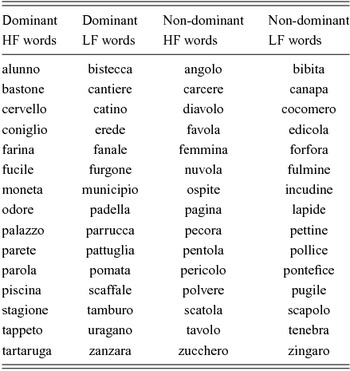
The stimuli were adapted from the original list created by Paizi et al. (Reference Paizi, Zoccolotti and Burani2011). The adapted list comprised four sets of three- and four-syllable words totaling 60 stimuli. There were 30 HF words and 30 LF words. Frequency was based on printed frequency counts for children (Marconi, Ott, Pesenti, Ratti & Tavella, Reference Marconi, Ott, Pesenti, Ratti and Tavella1993). Half the words in each frequency set had the dominant stress pattern (i.e. on the penultimate syllable) and half the non-dominant stress pattern (i.e. on the antepenultimate syllable). Words in each subset (frequency–stress pattern) were matched for age of acquisitionFootnote 6 (AoA; Juhasz, Reference Juhasz2005), familiarity, imageability, orthographic neighborhood size, length (in letters and syllables), bigram frequency, orthographic complexity, and initial phoneme. The number of words with the same final sequence and stress pattern (defined as stress friends; see Burani & Arduino, Reference Burani and Arduino2004; Burani et al., Reference Burani, Paizi and Sulpizio2014) was balanced across the four sets of words.
The list of stimuli is provided in Appendix 1 and 2 (see also Primativo et al., Reference Primativo, O’Brien, Paizi, Rinaldi, Arduino and Burani2013).
Procedure
The procedure was the same as in Experiment 1. Participants were asked to read the stimuli aloud as rapidly and accurately as possible. There was a practice block of four stimuli, two words with the dominant stress pattern and two with the non-dominant stress pattern. Stimuli were presented in random order, in two separate blocks in which stimuli were balanced for frequency (HF vs. LF) and stress pattern (penultimate vs. antepenultimate syllable). Block order was counterbalanced across participants.
As in Experiment 1, a native Italian speaker noted and recorded the errors, which were subsequently checked by a second experimenter. Owing to the ease with which word stress can be identified for each native Italian speaker, the stress errors were also noted by the experimenter on the fly. A microphone connected to the laptop recorded the pronunciation of all the stimuli. VRTs were measured by means of the SayWhen software system (Jansen & Watter, Reference Jansen and Watter2008).
The order in which Experiments 1 and 2 were administered was counterbalanced across participants.
Results
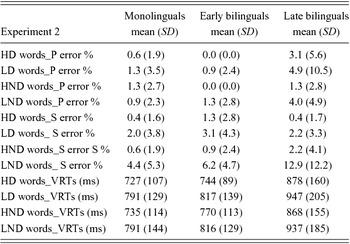
The mean percentages of pronunciation and stress errors for each group of participating readers, together with their VRTs (in ms), are presented in Table 4. The total percentage of errors was divided into percentages of pronunciation and stress assignment errors. Errors were classified as pronunciation errors when the participant did not accurately pronounce the word at the segmental level, that is, when the errors consisted of phoneme substitutions, omissions, insertions or transpositions, hesitations, stuttering or false starts. When the error consisted of incorrect stress placement, the response was classified as a stress error. If a pronunciation and a stress error were both present in the response, the error was deemed to be a pronunciation error.
Experiment 2. Mean (standard deviation) percentages of pronunciation and stress errors and vocal reaction times (in ms) for each group for words (high- vs. low-frequency) with dominant or non-dominant stress.

HD = high frequency dominant, LD = low frequency dominant, HND = high frequency non-dominant, LND = low frequency nondominant, S = stress, P = pronunciation, VRT = vocal reaction time
As in Experiment 1, errors (separated into pronunciation and stress errors) and VRTs were analyzed using the GLMM, treating participants and items as crossed random factors. More specifically, errors were analyzed with the logistic model and VRTs with the linear one as the residuals were basically normally distributed. Once again, we explored a series of models, then we selected the best one according to its AIC value. As before, all the comparisons between the models were carried out with the LRT, using REML estimation. As in Experiment 1 (see Experiment 1, Results section) we rejected models that did not explain more variance than those we accepted, and only the results for the best model are reported. Statistical analyses were conducted using the lme4 (Bates et al., Reference Bates, Maechler and Dai2008) and languageR packages (Baayen, Reference Baayen2008).
Errors
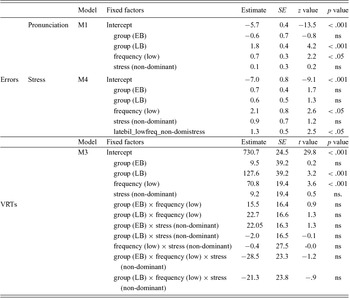
In the analysis of pronunciation errors, we first tested a model (M0) that included participants and items as random factors. In a second model (M1), we added Group (monolinguals, EBs, and LBs), Stress (dominant vs. non-dominant) and Frequency (HF vs. LF) as fixed factors. At a later stage, we added the interactions between the fixed factors (Group × Frequency, Frequency × Stress, Group × Stress) (M2), and finally added the Group × Frequency × Stress interaction (M3). AIC values for these four models showed that M1 was the best model (AIC = 563.01; LRTM0words–M1words = 24.40, df = 4, p < .001) compared with M0 (AIC = 581.41), M2 (AIC = 568.73) and M3 (AIC = 571.12). M1 (pronunciation errors ~ 1 + (1 | participants) + (1 | items) + Group + Stress + Frequency) showed a group effect (% error: monolinguals: mean = 1, SE = 0.5; EBs: mean = 0.6, SE = 0.7; LBs: mean = 3.3, SE = 0.7). It also revealed an effect of frequency, suggesting that LF items (mean = 2.2, SE = 0.5) were read less correctly than HF ones (mean = 1.1, SE = 0.3). Neither the main effect of stress pattern nor the interaction effects were significant. Statistical parameters for this model are shown in Table 5.
Experiment 2. Statistical parameters of the generalized linear mixed models for errors and vocal reactions times.

EB = early bilinguals, LB = late bilinguals, VRT = vocal reaction time
Table 4 shows that there was a floor effect for early EBs for HF words with dominant and non-dominant stress. Once again, this result was not problematic as the GLMM with a logistic link function allows data characterized by an absence of variation to be processed because the homogeneity of variance does not need to be satisfied.
With regard to the analysis of stress errors, as we had a clearly defined experimental hypothesis concerning this variable (LBs assign the most frequent stress pattern to LF words), we created a new independent variable (latebil_lowfreq_non-domistress) that allowed us to distinguish items belonging to these three conditions (i.e. answered by LBs, non-dominant stress, LF). This procedure followed the one commonly used with planned contrasts in linear models (for a comprehensive explanation, see Noel, Reference Noel2013). Moreover, by using this specific variable, we were able to take into account the smallest number of parameters (principle of parsimony), which is in line with the use of AIC values to select the best fitting model.
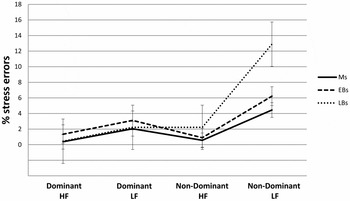
We first tested a model (M0) that included participants and items as random factors. In a second model (M1), we added Group (monolinguals, EBs, and LBs), Stress (dominant vs. non-dominant) and Frequency (HF vs. LF) as fixed factors. At a later stage, we added the interactions between these fixed factors (Group × Frequency, Frequency × Stress, Group × Stress) (M2), and subsequently added the Group × Frequency × Lexicality interaction (M3). Finally, we considered a fifth model (M4) that included participants and items as random factors, and group, stress, frequency, and latebil_lowfreq_non-domistress as fixed factors. AIC values clearly showed that M4 was the best model (AIC = 710.10; LRTM1–M4 = 6.88, df = 1, p < .05) compared with M0 (AIC = 735.46), M1 (AIC = 716.19), M2 (AIC = 715.79), and M3 (AIC = 719.37). In particular, M4 (stress errors ~ 1 + (1 | participants) + (1 | items) + Group + Frequency + Stress + latebil_lowfreq_non-domistress) showed an effect of frequency, with LF words being read less accurately than HF words (LF items: mean = 5.2, SE = 0.6; HF items: mean: 1, SE = 0.3). Moreover, we observed an effect of the latebil_lowfreq_non-domistress factor, suggesting that LBs were less accurate than EBs and monolinguals on LF words with non-dominant stress (see Figure 1). The statistical parameters are presented in Table 5.
Percentages of stress assignment errors as a function of type of stress pattern (Dominant/Non-dominant), word frequency (High and Low) and group (monolinguals, early bilinguals and late bilinguals) (error bars show standard error). Ms = monolinguals, EBs = early bilinguals, LBs = late bilinguals, HF = high frequency, LF = low frequency

Vocal reaction times
Once again, we began by testing a model (M0) that included participants and items as random factors and intercept as a fixed factor. We then added Group (monolinguals, EBs, and LBs), Frequency (HF vs. LF), and Stress (dominant vs. non-dominant) as fixed factors (M1). In a third model (M2), we added the interactions between the fixed factors (Group × Frequency, Frequency × Stress, Group × Stress), and in a fourth one (M3) we finally added the Group × Frequency × Stress interaction. AIC values for these four models showed that M3 was the best model (AIC = 47717.34; LRTM2–M3 = 18.05, df = 2, p < .001) compared with M0 (AIC = 47822.38), M1 (AIC = 47760.16), and M2 (AIC = 47731.39). In M3 (VRTs ~ 1 + (1 | participants) + (1 | items) + Group + Frequency + Stress + Group : Frequency + Frequency : Stress + Group : Stress + Group : Frequency : Stress), a frequency effect emerged, meaning that HF words were read faster than LF ones. There was also an effect of group, but neither the main effect of stress pattern nor the interaction effects were significant. The statistical parameters for all the factors are reported in Table 5 below.
Discussion
To sum up, the results of Experiment 2 highlighted the presence of a frequency effect in pronunciation errors and stress errors, both for monolinguals and bilinguals, regardless of AoE-L2. Percentages of pronunciation errors showed a group effect, indicating that LBs were less accurate than EBs and monolinguals. However, there was no stress pattern effect and no interactions between stress pattern, frequency and group. The most interesting result was for stress assignment errors, as we found that LBs were less accurate than EBs and monolinguals on LF words with a non-dominant (antepenultimate syllable) stress. This result is discussed below.
Finally, the groups differed on VRTs, with LBs being the slowest group. However, VRTs (for correctly read items) were not sensitive to stress patterns, confirming similar findings for both adults and children (see, for example, Burani et al., 2013; Primativo et al., Reference Primativo, O’Brien, Paizi, Rinaldi, Arduino and Burani2013; Sulpizio et al., Reference Sulpizio, Boureux, Burani, Deguchi, Colombo, Miyake, Peebles and Cooper2012). We therefore do not discuss this result in the General Discussion.
General discussion
The purpose of the present study was twofold. First, we wanted to investigate lexicality and frequency effects in bilingual children reading Italian as an L2 and differing in AoE-L2. Second, we wanted to examine suprasegmental processing (i.e. stress assignment) in reading Italian as an L2 in the same groups of children. The role of AoE-L2 was studied by comparing two groups of bilingual children: one characterized by an AoE-L2 before three years and eleven months old (early bilinguals) and one characterized by an AoE-L2 above four years (late bilinguals).
The results of Experiment 1 showed that words were read better than pseudowords, that is, a lexicality effect emerged in all three groups. In addition, high-frequency words were read faster than low-frequency words. Thus, similarly to monolinguals, bilingual children exhibited sensitivity to the lexical properties of Italian words. As for monolinguals, results confirmed those of previous studies highlighting the importance of a lexical strategy in reading Italian (e.g. Barca et al., Reference Barca, Burani, Di Filippo and Zoccolotti2006; Paizi et al., Reference Paizi, Zoccolotti and Burani2011; Reference Paizi, Luca, Zoccolotti and Burani2013). Lexical information is employed when reading Italian as an L2 in the same way as it is when reading Italian as an L1. We observed that late bilinguals were less accurate than both monolinguals and early bilinguals. However, both groups of bilinguals exhibited a similar lexicality effect to monolinguals, reading words better than pseudowords. The absence of a significant interaction between group and lexicality invalidated our hypothesis of a greater lexicality effect for early bilinguals than for late bilinguals. However, the absence of a significant interaction does not mean that the groups had similar lexical knowledge. An inspection of the mean VRTs and error percentages for participants in Experiment 1 (Table 2) reveals that late bilinguals exhibited greater differences between high-frequency and low-frequency words (on both VRTs and errors) than the other groups, although these differences did not reach statistical significance. Larger frequency effects in younger or less skilled readers have often been reported (for Italian, see, for example, Barca et al., Reference Barca, Burani, Di Filippo and Zoccolotti2006; Mazzotta, Barca, Marcolini, Stella & Burani, Reference Mazzotta, Barca, Marcolini, Stella and Burani2005), and have been attributed to the fact that several low-frequency words are likely to be unknown to readers with a limited vocabulary. The tendency toward a larger frequency effect for late bilinguals is thus consistent with the idea of a limited vocabulary, especially in the case of low-frequency words. Then again, it may be that testing high-frequency versus low-frequency words is not enough to reveal differences between late bilinguals’ and early bilinguals’ (or monolinguals’) lexical reading: other word properties (e.g. prosodic properties such as lexical stress) may be more revealing than a mere high-frequency versus low-frequency word comparison. This point deserves to be explored further in future research. In general, this pattern of results supports the hypothesis of overall lexical influence in reading in transparent orthographies. To the best of our knowledge, this is the first time that this result has been found for L2 Italian, and it is consistent with similar findings for L1 and L2 English (e.g. Erdos, Genesee, Savage & Haigh, Reference Erdos, Genesee, Savage and Haigh2010; Erdos, Genesee, Savage & Haigh, Reference Erdos, Genesee, Savage and Haigh2014; Genesee, Reference Genesee2007; Genesee & Lindholm-Leary, Reference Genesee, Lindholm-Leary, Harris, Graham and Urdan2012).
The results of Experiment 2 indicated that low-frequency words with non-dominant stress received the correct stress less frequently than dominant-stress words. Critically to the purpose of the present study, different patterns were obtained with regard to AoE-L2: only late bilinguals were significantly deficient in reading low-frequency words with the non-dominant antepenultimate stress pattern. These results support the idea that less skilled readers may exhibit greater sensitivity to stress dominance in reading, possibly owing to their limited lexical knowledge compared with that of skilled readers. An absence of lexical information about stress position, with a consequent reliance on sublexical processing (Ziegler & Goswami, Reference Ziegler and Goswami2005), may lead children to apply the statistically dominant stress, thus assigning the dominant/most frequent stress pattern to less familiar words. This finding was reported, by Sulpizio and Colombo (Reference Sulpizio and Colombo2013), in second graders and, to a lesser extent, fourth graders reading low-frequency words, and was also observed in a group of older children with developmental dyslexia by Paizi et al. (Reference Paizi, Zoccolotti and Burani2011). In a similar vein, Sulpizio et al. (Reference Sulpizio, Boureux, Burani, Deguchi, Colombo, Miyake, Peebles and Cooper2012) found that when they read nonwords aloud, second graders assigned the dominant stress more often than the non-dominant stress – a tendency that disappeared with age (for similar results in English, see Arciuli, Monaghan & Seva, Reference Arciuli, Monaghan and Ševa2010). Accordingly, readers with a reduced lexicon may tend to make more errors when reading unfamiliar words with a non-dominant stress. If we look at the results of the screening tests (Table 1) we can see that late bilinguals had a significantly lower verbal IQ than early bilinguals and monolinguals. However, neither late bilinguals nor early bilinguals were impaired in word and pseudoword reading, as assessed by means of a standardized test. In other words, none of their scores in the standardized tests were more than two standard deviations below the mean, which is regarded as the cut-off score for defining reading disability. This means that our late bilinguals group was not composed of poor readers, consistent with our selection criterion. This allows us to assume that late bilinguals had developed adequate decoding strategies, even though they scored lower than the other two groups, particularly when reading low-frequency words with a non-dominant stress. In this specific condition, vocabulary size may have had a greater impact on stress assignment. As Sulpizio and Colombo (Reference Sulpizio and Colombo2013) have suggested, in younger (Grade Two) readers, lexical reading is still under development and the lexicon still limited, with incomplete knowledge of word stress. Accordingly, late bilinguals (like younger and less skilled Italian readers) made more errors when reading unfamiliar L2 words with a non-dominant stress because of their limited L2 vocabulary, not because of a general reading difficulty. It also has to be underscored that the results on standardized measures showed that early bilinguals performed at the same level as – and sometimes better than – monolinguals, providing added evidence that early bilingualism does not delay linguistic development and literacy acquisition (e.g. Paradis et al., Reference Paradis, Genesee and Crago2011).
With regard to the type of lexicon that may influence stress assignment in less skilled readers, Sulpizio and Colombo (Reference Sulpizio and Colombo2013) have suggested that at least the orthographic one might be involved. We did not directly address this question in the present study where lexicon size was measured by means of two tasks: receptive vocabulary and verbal fluency. That is, lexicon size here essentially meant oral vocabulary size, as is usual in the literature on bilingualism. We did not record possible stress errors during oral production, which would have allowed us to discuss the potential influence of the phonological lexicon on stress assignment in reading. In principle, late bilinguals can be assumed to have both a limited phonological and a limited orthographic lexicon. Thus, they would have difficulty rapidly recognizing printed low-frequency words, with consequent difficulty matching orthographic and phonological representations. This is an interesting issue that needs to be explored in future research.
To sum up, the present study showed that bilingual children learning to read in an L2 are sensitive to the distributional properties of the target L2 language. Specifically, in the case of a language with a transparent orthography such as Italian, we found that the performance of bilingual children in a reading aloud task was affected by lexicality (they read words better than pseudowords), word frequency (they read high-frequency words better than low-frequency words), and stress pattern (they tended to assign the dominant stress to low-frequency words with a non-dominant stress). Furthermore, these effects were modulated by AoE-L2, in that late bilinguals performed worse than early bilinguals when it came to assigning stress to low-frequency words – an effect we attribute to their reduced vocabulary size.
One possible objection to this interpretation is that lexicon size and AoE-L2 cannot be easily disentangled. Thus, the effects found for early bilinguals and late bilinguals are intertwined with differences in lexicon size. Despite the debate in the literature regarding the presence of a critical period for L2 acquisition, it is an ecological fact that developing readers have different lexicon sizes according to AoE-L2. That is, the results of the present study could be interpreted in terms of age effects on vocabulary size and subsequent lexical reading development. This is a broader concept that also considers the amount of exposure to L2, which can affect all aspects of proficiency (e.g. vocabulary). Besides the amount of exposure, other factors can influence proficiency, such as the type of exposure children have to L2 (for a comprehensive review, see Paradis et al., Reference Paradis, Genesee and Crago2011). However, these issues are beyond the ambit of our study.
The findings of the present study lead to a further consideration: despite their poor vocabulary, late bilinguals develop a high degree of sensitivity to the systematic linguistic properties of their L2. The literature reports contrasting results on the bilingual advantage in terms of metalinguistic awareness. In a recent study, Bialystok and Barac (Reference Bialystok and Barac2012, p. 72) advanced the hypothesis that “bilingualism gives children a boost into figuring out structural relations within language but beyond that initial insight, more bilingual experience does not move that development forward”. The authors observed that metalinguistic awareness improved as a function of language proficiency, but not bilingual exposure. We did not test metalinguistic awareness. In further research, it might be worthwhile looking at whether sensitivity to the lexical properties of the L2 and reading skills are related to metalinguistic awareness in early bilinguals and late bilinguals. Finally, it seems important to point out that both early bilinguals and late bilinguals displayed good skills in using the sublexical route for reading (they read nonwords as accurately as monolinguals did). From a clinical standpoint, this means that a behavioral delay in reading accuracy for late bilinguals does not necessarily reflect the presence of a specific reading disorder in L2. In most cases, this delay could be ascribed to poor vocabulary size, which reduces word reading speed. By contrast, there is a broad consensus that the most sensitive measure for detecting specific reading disorders in L2 is the reading speed for nonwords (e.g. Erdos et al., Reference Erdos, Genesee, Savage and Haigh2014), particularly for transparent languages.
To conclude, we argue that investigating how bilingual children learn to read increases our knowledge of the processes involved in learning to read in L1. Further research is needed to define precisely the nature of reading development in L2, and studies involving L1s and L2s with different orthographic structures (transparent vs. opaque) should be encouraged.
Stimuli used in Experiment 1
Words used in Experiment 2