That Telemann was a prolific composer is well known. We can gain some insight into the sheer scale of his productivity from his practice of composing a completely new liturgical passion every year from 1721 (when he was appointed director of Hamburg’s five Hauptkirchen) until his death in 1767. This fact becomes all the more extraordinary when we consider that this was neither a requirement of the job, nor an established practice in Hamburg. Telemann’s predecessor (Joachim Gerstenbüttel) typically reused, or lightly reworked, the same passion settings over multiple decades, while his successor (Carl Philipp Emmanuel Bach) assembled pasticcio works from excerpts of existing compositions. In popular discourse, passions are often held up as one of the most expressive and weighty – even monumental – musical genres of the early-modern Lutheran world. For modern audiences accustomed to the two surviving passions by Leipzig’s most famous Thomaskantor, it seems almost inconceivable that a composer might create no fewer than forty-four works of this kind (a number that excludes Telemann’s six non-liturgical passion oratorios). One might, reasonably, wonder whether Telemann and his librettists achieved this feat by developing a template that made possible the easy production of annual passions in more or less the same mould, year on year. Yet the opposite is true: the twenty-two surviving works are highly diverse, in terms of structure, scoring and style. Indeed, Hamburg’s performance tradition of liturgical passions was, for Telemann and his librettists, a crucible for poetic and musical experimentation.
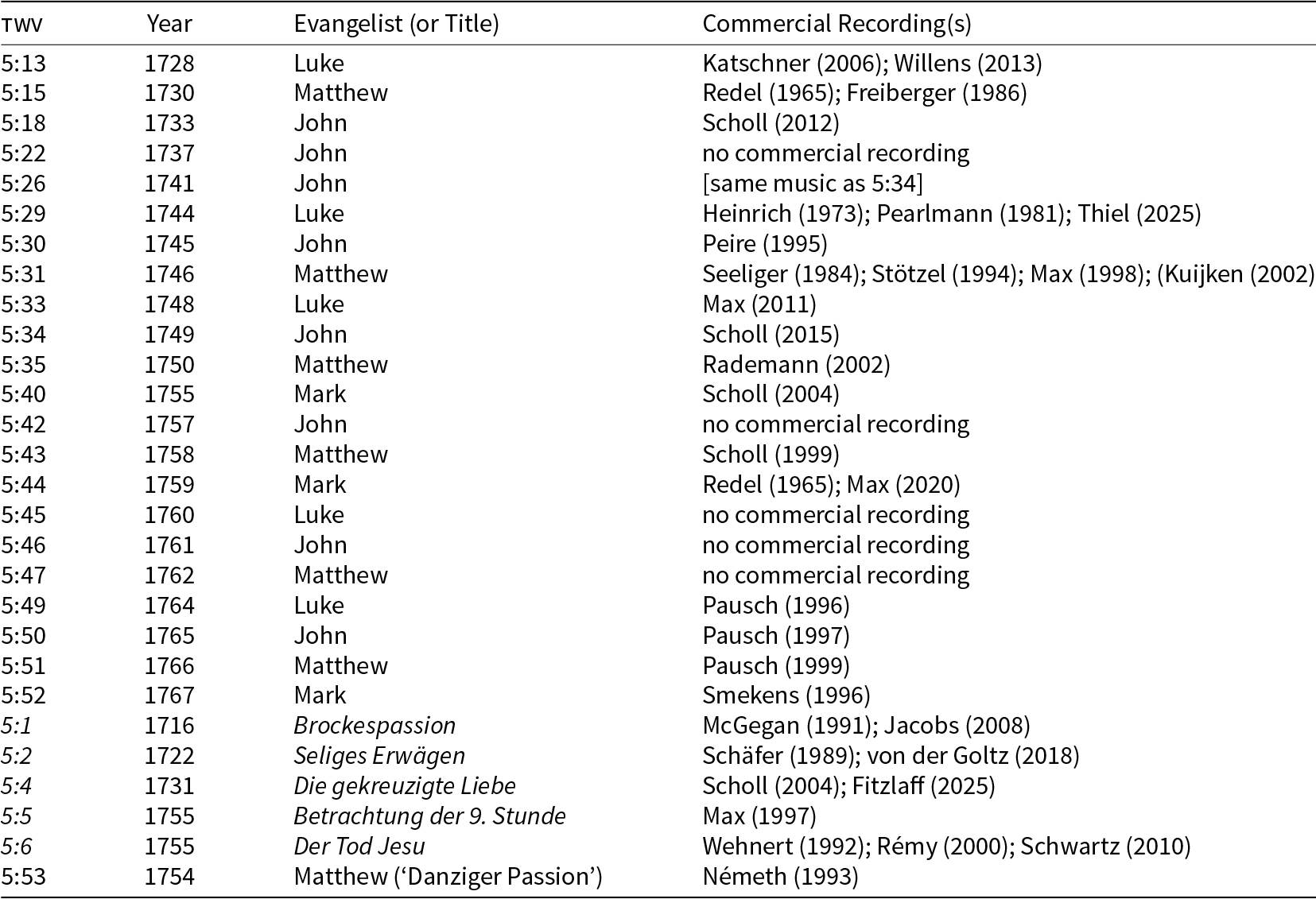
Even in 2025, with the ‘second wave’ of the modern Telemann renaissance in full swing, five of his passions are still unrecorded (as shown in the rightmost column of Table 1). Equally important is that many existing recordings are, by now, seriously dated, and some – especially those of Michael Scholl and Johannes Pausch – had a very limited distribution and are now difficult to access. The new recording of Telemann’s 1744 Lukaspassion by the Dresdner Kammerchor and the Wrocław Baroque Orchestra, under Jarosław Thiel, is therefore a welcome contribution to the growing discography of this remarkable repertory. Perhaps because a modern edition was published relatively early (in 1966), the 1744 Lukaspassion was already available in two recordings, from 1973 and 1981. While both have their merits, the latest version raises the standard, in terms of both the calibre of the performers and the quality of the recording.
List of the surviving liturgical passions and passion oratorios by Telemann, with details of commercial recordings (to date) of each

In style and structure, the 1744 Lukaspassion may be the most operatic of Telemann’s extant liturgical passions. The interpolated poetic texts emphasize direct portrayals of characters’ emotions and experiences over theological interpretation: Peter sings of his regret after betraying Jesus (‘Du, o ewiges Erbarmen’), Christ is given a ‘rage aria’ (‘Ihr werdet mich sehen mit feurigen Flammen’) after he is mocked by the crowds and, near the end, one of the thieves crucified alongside Jesus sings in hopeful anticipation of reaching paradise (‘Holdselige Worte, süßes Versprechen’). Even when arias serve to comment on the action from outside (rather than being the outpourings of persons involved), as is more typical of eighteenth-century passions, the themes explored are often more earthly than divine: the first two arias (‘Die freundlichsten Küsse’ and ‘Wie sich ein winz’ges Lüftchen regt’) deal with human duplicitousness in a manner that eschews religious language entirely. As if to further distance this work from liturgical norms, the librettist only included three chorales (most of Telemann’s passions have at least six, and some as many as twelve). The theatrical nature of this passion means that its eight arias benefit from a performance by singers well versed in eighteenth-century opera. This is one of the strengths of the present recording: all three aria soloists have at least one foot in the operatic world, and this expertise leads to performances which are not only technically assured, but also have immediate communicative and dramatic force. Indeed, it is the quality of the soloists, bolstered by the energetic and flexible Wrocław Baroque Orchestra, that plays no small role in setting this version apart from previous recordings.
Telemann responds to the libretto’s operatic bent with arias that range from vivid dramatic declamation to some of his most galant melodic writing. Firmly in the former camp is Jesus’ aforementioned rage aria. Here, leaping vocal lines (expertly navigated by bass Michael Nagy) and frantic string figuration anticipate Telemann’s much later, but similarly turbulent, depictions of the Last Judgement in his oratorio Der Tag des Gerichts of 1762. Other arias in the 1744 Lukaspassion occupy the more melodious end of Telemann’s expressive spectrum. Amongst these are two for tenor (for Peter and for the unnamed thief, here given heartfelt interpretations by Maximilian Schmitt) and what might be the musical high point of the whole passion: the soprano aria ‘Schönste Freundin edler Seelen’. Scored for transverse flute and solo violin plus the usual quartet of strings and continuo, this aria is brought to life wonderfully by soprano Sophia Junker, who rises to the challenge of lending its word repetitions an air of breathlessness and excitement, without sacrificing a sense of line. Here, the ensemble follows Felix Schroeder’s suggestion (in the 1966 edition) that the prescribed solo violin in scordatura can be replaced by a second transverse flute. The result here is perfectly musical, though one misses the unique instrumental colour engendered by the interplay between scordatura violin and solo flute (audible in earlier recordings).
A performance of this passion can stand or fall on the merits of the soprano soloist, given that five of its eight arias are scored for this voice. Happily, Junker’s renditions are outstanding: highlights from her other arias include agile repeated notes in the playfully querulous ‘Wie sich ein winz’ges Lüftchen regt’ and well-chosen embellishments in the da capo of the lyrical closing aria ‘Ich befehl’ an meinem Ende’ (in the latter, a beautiful effect is achieved in the solo passages when the harpsichord falls silent and Toshinori Ozaki’s lute comes to the fore). While Telemann experimented with a variety of types in other liturgical passions, all arias in the 1744 Lukaspassion are in da capo form. Despite having far fewer arias between them, Schmitt and Nagy nonetheless match the standard set by Junker in enlivening the repeated A sections of their arias with ornaments that balance vocal virtuosity with communication of melodic line. In eighteenth-century repertoire with a preponderance of long da capo forms, the listener can sometimes feel ready for the aria to end once the B section is over: not so here.
While the libretto, taken in isolation, leans more towards the theatre than the church, Telemann takes a significantly more complex approach in setting the music. To be sure, he cultivates a markedly operatic and then-modern idiom in the arias, as discussed above. However, the recitatives contain elements that pull strongly in the other direction by harking back to earlier liturgical passions. The practice of setting apart the words of Christ through contrasting instrumental accompaniment (the so-called ‘halo of strings’) dates back to passions by Thomas Selle (1643), Johann Sebastiani (1672) and Johann Theile (1673). What is so unusual about the scoring of Jesus’ words in the 1744 Lukaspassion is that rather than simply adding static chords in the strings (as in J. S. Bach’s Matthäuspassion), Telemann writes instrumental parts which are rhythmically active and contrapuntally intricate. The resulting texture for Jesus’ dialogue – more measured arioso than free accompagnato – is unparalleled in Telemann’s surviving passions. Instead, it is reminiscent of passions of the mid- to late seventeenth century. It is hard to say why Telemann chose to draw on a style which, by the 1740s, was almost a century old: perhaps he wished to make clear the connectedness of this particular passion – the libretto of which threatened to breach the divide of sacred and profane – to a venerable tradition of Lutheran church music. In any case, the utterances of Jesus (who has more dialogue in Luke’s gospel than in any of the other three) are treated to a delivery by Nagy which is both songful and articulate.
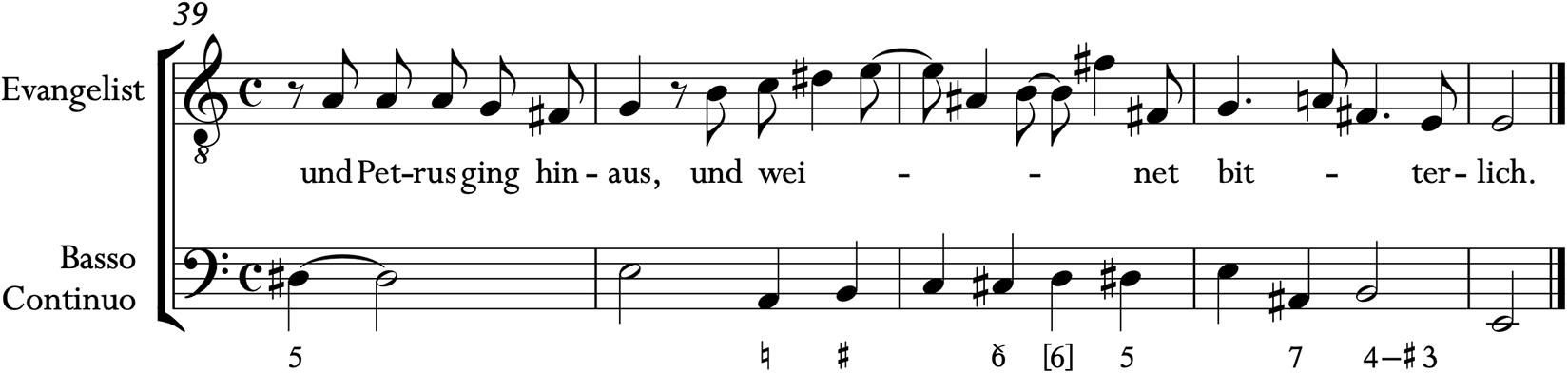
The other retrospective aspect of the recitatives in this passion is the use of madrigalisms (word-painting) on the part of the Evangelist. In passions by Theile and Sebastiani, one finds rapid repeated notes for the temple-splitting earthquake, and sighing melismas for Peter’s tears: similar devices are at play in works by Johann Georg Kühnhausen (c1700) and Johann Valentin Meder (1701). When Bach used these techniques in the 1720s, they were already old-fashioned; by the 1740s, they were positively antiquated. It is remarkable, therefore, that in his 1744 Lukaspassion, Telemann sets Peter’s weeping to a lengthy syncopated melisma over a chromatically ascending bass line, complete with a pungent false relation (A♯ against A♮) on the word ‘bitterlich’ (see Example 1). This challenging vocal line is executed with real pathos – and at an impressively languorous tempo – by Benedikt Kristjánsson, who excels in the role of Evangelist. Later, even Jesus has similar madrigalisms, with a tumbling nineteen-note melisma on the first syllable of the words ‘fallet über uns’, and a series of interlocking fourths and fifths on ‘bedekket uns’. Telemann seems to have had a long-standing interest in bringing musical materials of the past into dialogue for more up-to-date elements, and this passion – especially in this recording – demonstrates how compelling such dialogue can be.
Telemann, ‘Sie griffen ihn aber’, Lukaspassion (1744), twv5:29, bars 39–43, ed. Felix Schröder (Stuttgart: Carus, 1966). Excerpt showing the moment when the Evangelist narrates Peter’s bitter weeping after his threefold denial of Jesus

If the recitatives and arias in Telemann’s 1744 Lukaspassion juxtapose old and new, the choruses sit somewhere in between. On the one hand, they are longer, more contrapuntal and contain more text repetition than the rather curt homophonic utterances found in some of his later liturgical passions (such as the 1765 Johannespassion). On the other, they show an emphasis on clarity of text so characteristic of Telemann’s choruses from the 1730s to 1750s, a clarity enhanced by this composer’s willingness to push rhythmic and harmonic boundaries in the service of communication. When, for instance, the crowd clamours for the release of Barrabas, Telemann sets their words to a flurry of alternating triplets and duplets, and after Pilate asks about Jesus’ fate, they cry ‘Kreuzige ihn’ to a dissonant cluster which expands over a tritone. Such bold text-setting devices require careful consideration from a performance perspective. Should one embrace the chaos and risk crossing a line between music and noise? Or is it better to prioritize precision and trust that the drama will emerge from the notes Telemann has written? Here, the Dresdner Kammerchor – a medium-sized ensemble, with four singers per part – manages to strike an effective balance between violent energy and clarity of pitch and rhythm, though I would be curious to hear a performance which is even more daring and wild in its approach to the turbae.
The majority of Telemann’s liturgical passions open, as do most other eighteenth-century examples, with a simple chorale. Telemann and his librettists often experimented with other forms, such as beginning with a chorus, an accompanied recitative, or – particularly in the later passions – complex chains of interlinked shorter movements. What Telemann apparently never did was open any of his liturgical passions for Hamburg with instrumental music, which he reserved for his passion oratorios, and the so-called Danziger Passion of 1754. Ever since Kurt Redel’s pioneering recordings of the 1960s, there has been a tradition of prefacing Telemann’s passions with an instrumental movement drawn from another work. When recording the 1759 Markuspassion in 1965, Redel chose the sinfonia from Telemann’s 1722 passion oratorio Seliges Erwägen, and when recording the 1730 Matthäuspassion in the same year, he opted for a slow movement (‘Sommeil’) from an overture-suite in C major (twv55:C6). With this new recording of the 1744 Lukaspassion, Thiel follows in Redel’s footsteps, and begins with the opening movement (‘Gravement’) of a five-part sonata in E minor (twv50:4), preserved in a manuscript dated c1730, but probably a much earlier work. Thiel’s choice, like those of Redel, makes some sense in that it more or less matches the key of the music which follows (here, the match is a little approximate, since the first chorale is in G major, not E minor). The chosen prelude also has a suitably ponderous and sombre affect, as befits a narrative of Christ’s passion – although there is no discussion of this in Klaus Hofmann’s otherwise informative and well-written liner notes.
While to modern ears the selection of slow music in a minor key for this purpose might seem obvious, we might question the straightforwardness of this linkage for Telemann and his contemporaries. Across his liturgical passions and passion oratorios, Telemann strongly favours major keys, and the 1744 Lukaspassion is no different: only two of its eight arias use the minor mode. Of the four passion oratorios with instrumental introductions, just one (the monumental Brockespassion (1716), Telemann’s earliest foray into the genre) is in a minor key. Recalling that Telemann’s style evolved a great deal over his career, a major-key movement from an instrumental work written in the late 1730s or early 1740s may have been a better fit for the 1744 Lukaspassion. But why include an instrumental opening at all? One wonders whether such additions are intended to compensate for the relatively plain openings of Telemann’s passions, at least compared to some of the more famous examples from the period. Yet as modern audiences become increasingly familiar with the conventions of eighteenth-century passion music beyond Bach, the need for such modifications may fade. More importantly, as more of Telemann’s passions are made available in excellent recordings such as this, we will be able better to appreciate the diversity and beauty of his contributions to this ever-fascinating genre.