Introduction
Native breeds belong to the cultural heritage of the country in which they were bred and significantly contribute to the genetic variability of a species. However, some local breeds are nowadays characterized by low population counts and, therefore, it is important to preserve their valuable genetic material. This preservation requires the elaboration of conservation programmes involving management of cryopreserved semen. Rabbit sperm can be effectively cryopreserved using a cryoprotective agent (CPA) with an amide group, such as dimethylsulfoxide (DMSO) or dimethylacetamide (DMA), in combination with a non-permeate CPA (such as sucrose, trehalose or Ficoll) during rapid freezing in liquid nitrogen vapours (LNV). This process results in a similar post-thaw sperm quality, fertilization ability and prolificacy to those of fresh semen (Mocé & Vicente, Reference Mocé and Vicente2009; Iaffaldano et al., Reference Iaffaldano, DiIorio and Rosato2012; Kulíková et al., Reference Kulíková, DiIorio, Kubovičová, Kuželová, Iaffaldano and Chrenek2014). However, different resistances of sperm to cryopreservation processes among different breeds or lines (Castellini et al., Reference Castellini, Battaglini and Lattaioli1992; Mocé et al., Reference Mocé, Vicente and Lavara2003, Reference Mocé, Lavara and Vicente2005; Piles & Baselga, Reference Piles and Baselga2012) and high individual variation (Alvariño, Reference Alvariño2000; Mocé et al., Reference Mocé, Lavara and Vicente2005; Leibo et al., Reference Leibo, Kubisch, DeeSchramm, Harrison and VandeVoort2006; Blesbois et al., Reference Blesbois, Grasseau, Seigneurin, Mignon-Grasteau, Saint Jalme and Mialon-Richard2008) have been reported. These differences might be affected by genetic features, age and environmental factors, as well as by the different evaluation criteria, sample size, and semen processing methodologies applied (Safaa et al., Reference Safaa, Vicente, Lavara and Viudes de Castro2008).
Variability in sperm quality traits and fertilization ability emphasizes the need for an effective in vitro quality test to predict the success rates of sperm cryopreservation for individual males. There are studies suggesting the use of different indicators including sperm viability, motility, acrosome reaction status and resistance to osmotic stress (Hoflack et al., Reference Hoflack, Rijsselaere, Maes, Dewulf, Opsomer, de Kruif and Van Soom2005; Vidament, Reference Vidament2005; Hernandéz et al., Reference Hernandéz, Roca, Ballester, Vasquez, Martinez, Johannisson, Saravia and Rodriguez-Martinez2006; Peterson et al., Reference Peterson, Kappen, Ursem, Nothling, Colenbrander and Gadella2007). Nevertheless, most of the previous research has been devoted to selected lines or crossbreeding rabbits (Mocé et al., Reference Mocé, Lavara and Vicente2005; Lavara et al., Reference Lavara, David, Mocé, Baselga and Vicente2013), and comparative studies on autochthonous breeds are lacking. Moreover, effective long-term storage of semen from local breeds of rabbit is of high importance for establishing a backup collection at a gene bank of animal resources. Therefore, our study aimed at determining different sources of variation, including breed and individual males, that can potentially affect frozen–thawed rabbit sperm quality. In our experiments we measured sperm motility using computer-assisted sperm analysis (CASA) and sperm viability (membrane integrity and stability, apoptosis, necrosis) using flow cytometry.
Materials and methods
Chemicals
Unless stated otherwise, all chemicals were purchased from Sigma Aldrich (Germany).
Ethical standards
The authors assert that all procedures contributing to this work comply with the ethical standards of the relevant national and institutional guidelines on the care and use of laboratory animals. The treatment of the animals was approved by the Ministry of Agriculture and Rural Development of the Slovak Republic, no. SK P 28004 and Ro 1488/06-221/3a. The experiments were carried out in accordance with the Code of Ethics of the EU Directive 2010/63/EU for animal experiments.
Animals
Eight clinically healthy males of Nitra and Zobor rabbit breeds (individuals marked as N1, N2, N3, N4, Z1, Z2, Z3 and Z4) from the Institute of Small Farm Animals, Research Institute for Animal Production near Nitra, NPPC were used for the study. Animals were housed individually, fed with a commercial diet (KV; TEKRO Nitra s.r.o., Slovakia) and watered ad libitum. The photoperiod used was a ratio of 14 h light:10 h dark. The temperature and humidity in the hall were kept at 15 to 25°C and 60 to 65%, respectively.
Semen collection and cryopreservation
Semen was collected from sexually mature rabbit males (about 1 year old) using a pre-heated artificial vagina once a week in a regular manner. The semen was transported to the laboratory in a water bath at 37°C and processed individually. For each male, six semen samples were collected and used for cryopreservation and in vitro evaluation (fresh and frozen–thawed). Only ejaculates that exhibited a white colour were used in the experiments. Samples containing urine and cell debris were discarded, whereas gel plugs were removed.
Semen from individual males was frozen using a rapid freezing method described previously (Iaffaldano et al., Reference Iaffaldano, DiIorio and Rosato2012; Kulíková et al., Reference Kulíková, DiIorio, Kubovičová, Kuželová, Iaffaldano and Chrenek2014). Individual semen samples were cooled down to 5°C for 90 min in a fridge to minimize cold-shock damage. After cooling, an aliquot of semen was diluted in a freezing medium (5°C) consisting of a commercial diluent (DMRS; Minitübe, Germany) dissolved in Milli-Q water (Millipore; Lambda Life a.s., Slovakia) and mixed with 16% dimethyl sulfoxide (DMSO), 4% Ficoll 70 and 2% sucrose to give the final concentrations of 8, 2 and 1%, respectively. Thereafter, the semen were loaded into 0.25-ml plastic straws and equilibrated at 5°C for 45 min. The straws were suspended horizontally in LNV 5 cm above the liquid nitrogen (LN2) level for 10 min (−125 to −130°C) before being plunged into LN2 (−196°C) for storage. For thawing, the straws were immersed into a water bath at 50°C for 10–13 s.
Sperm evaluation
An aliquot taken from each fresh and frozen–thawed rabbit semen sample was used for motility analysis immediately after collection/thawing and following 30 or 60 min of incubation at 37°C. Semen was diluted in a saline solution (0.9% NaCl; Braun, Germany) up to a concentration of 60 × 106/ml, immediately placed into Standard Count Analysis Chamber Leja (depth of 20 microns) (MiniTüb, Tiefenbach, Germany) and evaluated under a Zeiss AxioScope A1 microscope using the CASA system (Sperm Vision™; MiniTübe, Tiefenbach, Germany). For each sample and repetition, seven microscopic view fields were analyzed for average concentration (CON; 1 × 10⁶) and percentage of total motility (TM; motility > 5 µm s−1), progressively moving spermatozoa (PM; motility > 20 µm s−1), velocity curved line (VCL; µm s−1), velocity average path (VAP; µm s−1), velocity straight line (VSL; µm s−1), amplitude of lateral head displacement (ALH; µm), linearity (LIN; VSL/VCL), straightness (STR; VSL/VAP) and beat cross frequency (BCF; Hz).
To assess the viability and plasma membrane integrity of the frozen–thawed sperm, each sample was stained fluorescently with SYBR-14 (viable sperm), propidium iodide (PI; necrotic sperm), YO-PRO-1 (apoptotic sperm), fluorescently labelled lectin from the peanut agglutinin (Arachis hypogea (PNA); plasma membrane damage) and annexin V [phosphatidylserine (PS) translocation]. For SYBR/PI staining, approximately 1 × 10⁶ sperm were added to 250 µl phosphate-buffered saline (PBS) containing 100 nM SYBR-14 and incubated for 15 min in the dark. Afterwards, 4 µl PI (50µg/ml) were added to reach the final concentration of 1 µg/ml PI. Thereafter, samples were immediately analyzed using a BD FACS Calibur flow cytometry analyzer. For YO-PRO-1, PNA and annexin V staining, approximately 1 × 10⁶ sperm were washed in PBS (YO-PRO-1 or PNA staining) or binding buffer (annexin V; supplied with the kit) and centrifuged at 300 g for 6 min. The semen pellet was resuspended in either (i) 50 μl of PBS with 100 nM YO-PRO-1; (ii) in 50 μl of PBS with PNA (0.05 µg/ml); or in (iii) 50 μl working solution of annexin V–Fluos (2 μl of annexin V in 200 μl of binding buffer). Following incubation in the dark for 15 min, sperm were washed in PBS (YO-PRO-1 or PNA staining) or binding buffer (annexin V; supplied with the kit) and centrifuged at 300 g for 6 min. Thereafter, the pellets were resuspended in PBS or binding buffer (annexin V), 4 µl of PI (50 µg/ml) was added to reach the final concentration of 1 µg/ml PI and samples were immediately assessed using BD FACS Calibur flow cytometry analyzer. Propidium iodide was present in each fluorescence assay (SYBR-14/PI; YO-PRO-1/PI; PNA/PI; annexin V/PI). In order to simplify our data, only one value of PI-positive sperm for each sample was presented in the Results section, corresponding to SYBR-14/PI staining. At least, 10,000 events were analyzed for each sample. The emitted green fluorescence of SYBR-14-, YO-PRO-1-, PNA- or annexin V-positive cells and the red fluorescence from PI-positive cells was recorded in the FL-1 and FL-3 channels, respectively. The different labelling patterns in bivariate analysis (e.g. PNA/PI) identified four different sperm populations: non-stained spermatozoa (PNA–/PI–); PNA single-positive sperm (PNA+/PI–); double-positive sperm (PNA+/PI+) and PI single-positive sperm (PNA–/PI+).
Fertility assay
Data from 38 artificial inseminations (AI) with fresh or frozen–thawed insemination doses were evaluated. Due to low animal numbers, male-to-male differences in fertilization ability were not assessed. Fresh and frozen–thawed samples of three (Nitra) or two (Zobor) rabbit males were used for AI. Males showing the lowest frozen–thawed motility results (N3, Z2, and Z4) were not used. In addition, only samples with TM ≥ 35% and PM ≥ 25% were utilized. Both multiparous and nulliparous does of corresponding breed (aged 6 to 24 months) were treated with 25 IU PMSG (Sergon, Bioveta, Czech Republic) 48 h before insemination. AI was performed either with fresh, or frozen–thawed semen samples (40–50 × 106 sperm per doe), applied with an insemination plastic pipette simultaneously with i.m. treatment with 100 μl of synthetic GnRH (Supergestran 36, Ferring Pharmaceuticals, Czech Republic) to trigger ovulation. Pregnancy for each doe was checked 14 days after the insemination by abdominal palpation. Kindling rate, number of young born alive and total number of kits born for each female were determined at parturition 30–32 days post AI.
Statistical analysis
To analyze variation of sperm traits (except for TM and PM) in dependence on effects of breed (fixed) and individual rabbit (random), the following mixed model (Proc Mixed; SAS Institute Inc., 2009) was applied (for fresh and frozen–thawed semen analyzed separately):
 $$\begin{equation*}
{y_{ij}} = \mu + {B_i} + {u_j} + {e_{ij}}
\end{equation*}$$
where:
yij – individual observation of sperm motility traits (CON, VCL, VAP, VSL, ALH, LIN, STR, BCF) and viability/plasma membrane integrity (SYBR/PI, Yo-Pro-1, PNA, annexin V)
µ– intercept
Bi – fixed effect of breed (Nitra, Zobor rabbit); ∑iB = 0
uj – random effect of male (1, 2 to 8); uj ~ N (0, Iσj 2 )
eij – random error; eij = N (0, Iσe 2 ).
To analyze the variation of the TM and PM traits in dependence on effects of breed and time point of observation, and of interaction between these two effects, the following mixed model was applied (for fresh and frozen−thawed semen analyzed separately):
 $$\begin{equation*}
{y_{ijk}} = \mu + {B_i} + {T_j} + {B_i}{T_j} + {u_k} + {e_{ijk}}
\end{equation*}$$
where:
yijk – individual observation of sperm motility traits (TM, PM)
µ– intercept
Bi – fixed effect of breed (Nitra, Zobor rabbit); ∑iB = 0
Tj – fixed effect of time point of observation (0 s, 30 s, 60 s); ∑k T = 0
BiTj – interaction between breed and time point of observation ∑ikBT = 0
uk – random effect of male (1, 2 to 8); uk ~ N (0, Iσk 2 )
eijk – random error; eijk = N (0, Iσe 2 ).
Fixed effects included in the model were estimated using the least squares means (LSM) method. Statistical significance of fixed effects was tested by Fischer's F-test and differences between the estimated levels were tested by Scheffe's multiple range tests. Rabbit and residual error variances were estimated using restricted maximum likelihood (REML) method. The estimated variances were used to estimate the repeatability of the studied traits that can be interpreted as the proportion of total variance attributable to among-individual variation:
 $$\begin{equation*}
{r^2} = \frac{{{\rm{\sigma }}_{\rm{j}}^2}}{{\sigma _j^2 + \sigma _e^2}}\ {\rm{and\ }}{r^2} = \frac{{{\rm{\sigma }}_{\rm{k}}^2}}{{\sigma _k^2 + \sigma _e^2}},{\rm{\ respectively}}.
\end{equation*}$$
Pearson correlation coefficients among semen quality traits (N = 54) were calculated using the CORR procedure. For a comparison of fertilization ability, kindling rate and number of kits born (fresh versus frozen; Nitra versus Zobor), were tested by χ2 test. Differences between the groups with P ≤ 0.05 were considered as significant.
Results
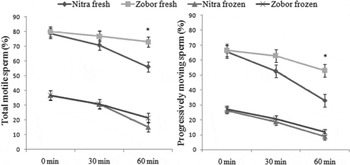
Immediately after collection and post freezing–thawing, no breed effect on TM, progressive movement (Fig. 1) and other motility parameters (Table 1) between Nitra and Zobor rabbit semen was observed. However, after 60 min of incubation at 37°C, difference (P ≤ 0.05) in the proportion of fresh total motile and progressively moving sperm was revealed between the breeds. Nonetheless, after freezing–thawing, the motility and progressive movement was similar at each time point of incubation (Fig. 1).
Total motility and progressive movement of fresh and frozen–thawed semen (least square means ± standard error) in dependence on interaction between breed and different time points after collection/thawing. *Mean significant difference (P ≤ 0.05).

Overview of fresh and frozen–thawed sperm movement traits in Nitra and Zobor rabbit measured immediately after collection/thawing

Values are presented as least squares means ± standard error. ns, not significant.
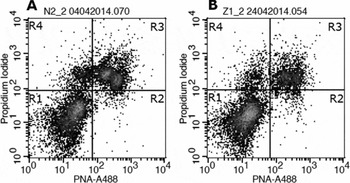
Conversely, significant effects of breed on proportion of live, necrotic and plasma membrane damaged sperm were found in frozen–thawed semen (Table 2). Ratios of sperm with translocated PS or apoptotic sperm were not affected by the breed. In addition, our results showed clear overlaps in the proportion of sperm labelled with PI and one of the four fluorescence probes (SYBR-14, YO-PRO-1, PNA or Annexin V). Nevertheless, in order to simplify the data, only single positivity is displayed in Table 2 and the PI values correspond to SYBR-14/PI staining. For instance, dual staining showed that most of the sperm with damaged plasma membrane (PNA) were stained as dead (PI) (Fig. 2).
Effect of breed on frozen–thawed sperm viability and plasma membrane integrity measured immediately after thawing

Values are presented as least squares means ± standard error; *P ≤ 0.05. ns, not significant.
Representative flow cytometry dot plots for Nitra (A) and Zobor (B) frozen–thawed sperm. R1 − non-stained spermatozoa (PNA–/PI–); R2 − PNA single-positive sperm (PNA+/PI–); R3 − double-positive sperm (PNA+/PI+); R4 − PI single-positive sperm (PNA–/PI+).

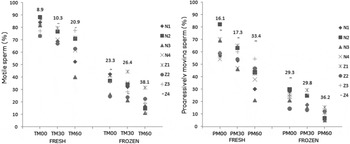
Apart from the effects of a breed and observation time on semen characteristics, our results revealed relatively high inter-male variability in some quality parameters of fresh and frozen–thawed rabbit semen. In terms of TM and PM, the differences among males increased with incubation time or after freezing–thawing (Fig. 3).
Inter-male differences in fresh and frozen–thawed total sperm motility and progressive movement measured at different time points after collection/thawing. Numbers shown are the coefficients of variation (CV%) among males.

Accordingly, our models showed that individual rabbits account for moderate part of variance of fresh (0.54 and 0.57) and frozen–thawed (0.52 and 0.41) TM and PM traits as well as for moderate part of variance of apoptotic sperm occurrence (Yo-Pro-1) and membrane destabilization (annexin V) (0.63 and 0.71, respectively). Also, the effect of individual rabbits on the other motility parameters (VCL, VAP, VSL, LIN, STR, ALH, BCF) as well as frozen–thawed semen viability (SYBR-14/PI) and membrane integrity (PNA) showed moderate repeatabilities (0.31 to 0.67).
Table 3 shows the coefficients of correlation between all the fresh (CASA) and frozen–thawed (CASA and flow cytometry) variables. Fresh TM and PM was positively correlated (r = 0.27 to 0.53) with the majority of the frozen–thawed sperm motility traits (TM, PM, VAP, VCL, VSL, BCF) and viability (SYBR-14; r = 0.31), while most of the fresh sperm motility parameters were negatively correlated (r = −0.26 to −0.51) with numbers of apoptotic (Yo-Pro-1) and plasma membrane damaged sperm (PNA) post-thaw.
Pearson correlation coefficients calculated between fresh (rows) and frozen–thawed (columns) rabbit semen variables measured immediately after collection/thawing

ALH, amplitude of lateral head displacement; Annexin, phosphatidylserine translocation; BCF, beat cross frequency; LIN, linearity; PI, necrosis; PM, progressive movement; PNA, plasma membrane damage; STR, straightness; SYBR, viability; TM, total motility; VAP, velocity average path velocity; VCL, velocity curved line; VSL, velocity straight line; Yo-pro, apoptosis. *P ≤ 0.05.
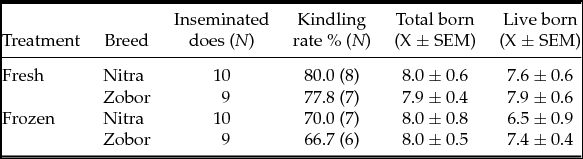
To test the fertilization ability of Nitra and Zobor rabbit sperm, 38 does of corresponding breed were inseminated with fresh or frozen–thawed semen. Only the frozen–thawed samples with motility and progressive movement higher than 35% and 25%, respectively, were used for the AI. Altogether, kindling rate was similar in the does inseminated with fresh (78.9%) or frozen–thawed (68.4%) semen. No difference in fertilization rate between breeds was observed (Table 4).
Fertilization ability of fresh and frozen–thawed Nitra and Zobor rabbit semen after AI

N, number of does.
Discussion
Variations in the susceptibility of semen to cryogenic process among breeds (Auerbach et al., Reference Auerbach, Norinsky, Ho, Losos, Guo, Chatterjee and Joyner2003; Mocé et al., Reference Mocé, Vicente and Lavara2003; Long, Reference Long2006; Waterhouse et al., Reference Waterhouse, Hofmo, Tverdal and Miller2006) and males of the same breed (Castellini et al., Reference Castellini, Battaglini and Lattaioli1992; Thurston et al., Reference Thurston, Watson and Holt2002; Mocé et al., Reference Mocé, Lavara and Vicente2005; Waterhouse et al., Reference Waterhouse, Hofmo, Tverdal and Miller2006; Lavara et al., Reference Lavara, David, Mocé, Baselga and Vicente2013; Sellem et al., Reference Sellem, Broekhuijse, Chevrier, Camugli, Schmitt, Schiber and Koenen2015) have been reported for several species. However, very few data exist on zootechnical performances of original breeds or local populations in Europe (Bolet et al., Reference Bolet, Brun, Monnerot, Abeni, Arnal, Arnold, Bell, Bergoglio, Besenfelder, Bosze, Boucher, Chanteloup, Ducourouble, Durand-Tardif, Esteves, Ferrand, Gautier, Haas, Hewitt, Jehl, Joly, Koehl, Laube, Lechevestrier, López, Masoero, Menigoz, Piccinin, Queney, Saleil, Surridge, van der Loo, Vicente, Viudes de Castro, Virag and Zimmermann2000). Most previous work has been devoted to selected rabbit lines or crossbreedings (Mocé et al., Reference Mocé, Lavara and Vicente2005; Lavara et al., Reference Lavara, David, Mocé, Baselga and Vicente2013), and comparative studies of native breeds are lacking. Therefore, we aimed to compare the quality of fresh and frozen–thawed semen of two Slovak national rabbit breeds (Nitra and Zobor rabbit) and evaluate susceptibility of semen from an individual male to cryopreservation protocol in order to facilitate long-term storage of good-quality insemination doses as a backup collection at a bank of animal genetic resources.
In our study, pooled values of fresh sperm motility parameters in Nitra and Zobor rabbits, measured immediately after collection, were similar. However, the differences in number of TM and PM sperm were revealed after additional incubation at 37°C. It reflects the fact that Nitra rabbit sperm motility decreased more rapidly with increasing incubation time. We suggest that the lower percentage of fresh sperm motility might account for the lower viability (SYBR-14/PI staining) and higher plasma membrane damage (PNA) found in frozen–thawed Nitra rabbit sperm when compared with Zobor rabbit. Conversely, the effect of breed on frozen–thawed sperm movement and ratio of apoptotic sperm was not confirmed. Actually, repeatability of the semen quality traits (CASA or fluorescence probes) was high or moderate for most of them, indicating that more than a half of the observed phenotypic variance was due to male-related sources of variation. Therefore, we might suggest that different sources of variation affect the post-thaw semen quality. The combination of an individual and a breed effect provides strong argument for the view that variation in sperm freezability is to some extent genetically determined (Thurston et al., Reference Thurston, Watson and Holt2002). In addition, according to coefficients of variations, incubation time at 37°C or freezing–thawing process enhanced inter-male differences in TM and PM trait. Likewise, increased variation in the semen quality under stressful conditions was already found in bovine species (Sellem et al., Reference Sellem, Broekhuijse, Chevrier, Camugli, Schmitt, Schiber and Koenen2015). The importance of pre-treating sperm (e.g. their exposure to incubation at 37°C) before quality assessment was also shown in ovine sperm (del Olmo et al., Reference Del Olmo, Bisbal, Maroto-Morales, García-Alvarez, Ramon, Jimenez-Rabadan, Martínez-Pastor, Soler, Garde and Fernandez-Santes2013).
Nevertheless, the arguments provided by various authors for the breed and individual variations are controversial. Viudes de Castro et al. (Reference Viudes de Castro, Marco-Jiménez, Vicente, Navarro, Lavara and Mocé2004) suggested that the seminal plasma (SP) protein profile could be used to differentiate between rabbit breeds. Moreover, a number of studies reported that the differences in a complex mixture of SP might be the reason for the male-to-male variability in semen quality within species (Haugan et al., Reference Haugan, Gröhn, Kommisrud, Ropstad and Reksen2007; Lavara et al., Reference Lavara, David, Mocé, Baselga and Vicente2013). The effects of SP on the survival of ejaculated spermatozoa after cryopreservation may be both beneficial and detrimental to sperm motility and viability (Marti et al., Reference Marti, Mara, Marti, Muiño-Blanco and Cebrián-Pérez2007; Muiño-Blanco et al., Reference Muiño-Blanco, Pérez-Pé and Cebrián-Pérez2008).
Depending on the link between complexity of factors affecting semen quality and fertility, there are suggestions that all ejaculates used in the field for insemination may have to be routinely qualified before use (Sellem et al., Reference Sellem, Broekhuijse, Chevrier, Camugli, Schmitt, Schiber and Koenen2015). Here we have analyzed the relevance of quick CASA analysis prior to cryopreservation, by evaluating correlations among quality traits of fresh and frozen–thawed semen. Our results showed that sperm total motility and progressive movement positively correlate with frozen–thawed TM, PM VCL STR and TM, PM, VAP, VCL, VSL, BCF, respectively. In addition, negative correlation between TM and plasma membrane damage and apoptosis was found, while PM positively correlated with the ratio of viable sperm. This might indicate that routine CASA analysis is of high importance in terms of storage of good-quality biological material for animal genetic resource preservation. Commercially available CASA systems are capable of high-speed objective analysis of many characteristics of mammalian spermatozoa (Farrel et al., 1995). Moreover, several significant relations between different parameters of sperm movement and fertility have already been described (Castellini et al., Reference Castellini, Lattaioli, Moroni and Minelli2000; Hirano et al., Reference Hirano, Shibahara, Obara, Suzuki, Takamizawa, Jamaguchi, Tsunoda and Sato2001; Lavara et al., Reference Lavara, Mocé, Lavara, Viudes de Castro and Vicente2005; del Olmo et al., Reference Del Olmo, Bisbal, Maroto-Morales, García-Alvarez, Ramon, Jimenez-Rabadan, Martínez-Pastor, Soler, Garde and Fernandez-Santes2013; Sellem et al., Reference Sellem, Broekhuijse, Chevrier, Camugli, Schmitt, Schiber and Koenen2015). However, due to the low number of individuals (males and females) available in our study, it was not possible to compare fertilizing ability of individual males or to evaluate any correlations with fertility. In addition, males with the lowest motility results (N3, Z2, and Z4) were not used for AI and samples were selected according to TM (≥35%) and PM (≥25%). Conversely, our study showed that selection and compensatory effect of relatively high sperm numbers per dose for AI (40–50 × 106) resulted in similar fresh and frozen–thawed semen fertilization ability. There are reports that the use of higher sperm numbers for AI might compensate differences in fertilization ability of higher and lower fertile males (Ruiz-Sánchez et al., Reference Ruiz-Sánchez, O'Donoghue, Novak, Dyck, Cosgrove, Dixon and Foxcroft2006). In addition, individual or mass motility score are commonly used as criteria for ejaculate rejection in most AI centres (Tusell et al., Reference Tusell, Legarra, García-Tomás, Rafel, Ramon and Piles2012).
We conclude that rabbit sperm can be effectively cryopreserved using a relatively quick and simple method, although a freezing procedure could not ensure comparable sperm post-thaw survival for different breeds or males. Our study supports the hypothesis that individual males account for a large part of the variation in the semen quality traits. Objective assessment of totally motile and PM sperm in fresh rabbit semen may be an effective indicator of frozen–thawed semen quality. Therefore, the storage of semen from local breeds that are in danger of extinction requires regular semen assessment in order to create a backup collection in a bank of animal genetic sources.
Acknowledgements
Authors would like to thank to Mr Matušica and Mr Pecho for technical assistance.
Financial support
The funding was provided from the grants VEGA (VEGA-1/0611/15) – Slovak Research and Development Agency (APVV-14–0043) and European Community (26220220180: Building Research Centre ‘AgroBioTech’).
Conflict of interest
None.
Ethical standards
The authors assert that all procedures contributing to this work comply with the ethical standards of the relevant national and institutional guides on the care and use of laboratory animals. The treatment of the animals was approved by the Ministry of Agriculture and Rural Development of the Slovak Republic, no. SK P 28004 and Ro 1488/06-221/3a. The experiments have been carried out in accordance with the Code of Ethics of the EU Directive 2010/63/EU for animal experiments.